Friday, September 13, 2013

Obituary: Frederick T. Zugibe, Ph.D., M.D. (May 28, 1928-September 6, 2013)

With the possible cessation of the British Society for the Turin Shroud Newsletter [which has since been averted], the lot may fall to us in Shroud cyberspace (see Dan Porter's "Rest in Peace Dr. Frederick Zugibe (1928-2013)," "Frederick T. Zugibe (An Update)", and Shroud.com's "In Memoriam: Frederick T. Zugibe 1928-2013") to record within the Shroud community the passing of significant sindonologists, such as Dr. Frederick T. Zugibe, former Chief Medical Examiner of Rockland County, New York State. Here is an obituary of Dr. Zugibe in the Times Herald Record, Garnerville, New York State, of September 10, 2013.

Dr. Zugibe's website, "Crucifixion and Shroud Studies: Medical Aspects of the Crucifixion" lists some of his online articles, including: "The Man Of The Shroud Was Washed" (1989) and "Pierre Barbet Revisited" (1995). See also Wikipedia, "Frederick Zugibe".


Times Herald Record

September 10, 2013

Obituaries

FREDERICK T. ZUGIBE

May 28, 1928 - September 6, 2013

Garnerville, NY

Frederick T. Zugibe, Ph.D., M.D. passed away September 6, 2013. He was born on May 28, 1928 in Garnerville, NY to Benjamin Zugibe and Anna (Zarick) Zugibe.

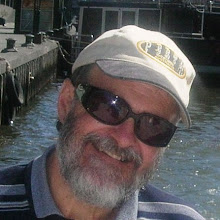
[Above: The late Dr. Frederick T. Zugibe, one of many eminent medical doctors who were and are persuaded by the physiological evidence that the image on the Shroud of Turin is that of Jesus: The Journal News.]

He is survived by Catherine (O'Leary), his wife of 62 years, and six of his seven children: Thomas (Peggy), Cathryn Blaber (Thomas), Theresa Mandracchia (Stephen), Mary Raleigh (Peter), Matthew (Carol) and Kevin Zugibe. He was predeceased by his son, Frederick T. Zugibe, M.D. (Anna) in 2006. He is also survived by 18 grandchildren and five great-grandchildren. He is also survived by his brother, Edward Zugibe. He was predeceased by his brothers: Benjamin, Paul and John and his sister, Victoria Jansen.

He was a deeply committed and involved parishioner at St. Peter's Roman Catholic Church in Haverstraw. He was a member of the Secular Franciscan Order and in 2002, he was received as a knight in the papally-approved Order of Our Lady of the Conception of Vila Vicosa in Portugal.

He graduated from Haverstraw High School in 1946 and St. Francis College. He earned a Masters Degree from Columbia University and a Ph.D. in anatomy and histochemistry from the University of Chicago. After having seven children, he returned to school and obtained his M.D. degree from West Virginia University in 1968 and became Board Certified in Anatomic and Forensic Pathology. In 1969 he was appointed the first Chief Medical Examiner of Rockland County replacing the old coroner system. He served as Rockland's Chief Medical Examiner for 34 years retiring in 2003. During his tenure, the Rockland Medical Examiner's Office gained an international reputation in the field of forensic science and innovative techniques and inventions that are still in use throughout the world. Dr. Zugibe was also internationally lauded in the field of cardiovascular research and discovered several diseases that had never before been identified. He was a fellow in the American College of Cardiology and was Board Certified in Family Practice. He also had an active medical practice during his tenure as Medical Examiner, specializing in cardiology.

He was an accomplished author and became world-renowned in connection with his scientific research on the Shroud of Turin

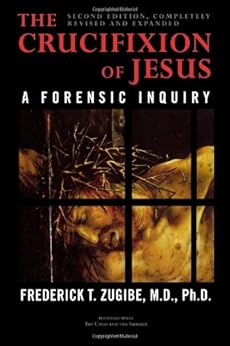
[Right: Dr. Zugibe's masterly, "The Crucifixion of Jesus: A Forensic Inquiry," M. Evans & Co.: New York NY, 2005: Amazon.com]

and the mechanism and cause of death of Jesus appearing in numerous documentaries in connection with his research. He is the author of The Crucifixion of Jesus, a Forensic Inquiry and Dissecting Death: Secrets of a Medical Examiner as well as numerous other books and papers. He also served as adjunct Associate Professor of Pathology at Columbia University College of Physicians and Surgeons.

Dr. Zugibe was driven by a pursuit of knowledge, truth and excellence in his work, but it was his desire to share and use this knowledge to help others that truly was his legacy. He established the first disaster response protocol for Rockland County, coordinating training among all law enforcement, medical and emergency response teams and conducting EMT classes. As medical examiner, he established protocols to support the donation of organs and corneas, while still maintaining the integrity of death investigations. In 1972, he joined relief efforts in Nicaragua providing medical care to earthquake victims. Whether it was comforting a victim's family at the scene of an investigation, responding to a medical emergency, or giving his time and support to innumerable individuals and groups who needed his help, Dr. Zugibe worked tirelessly on behalf of those in need and in service to the community.

He was devoted to his family and took immense pleasure and pride in their endeavors. His vast knowledge and accomplishments were only surpassed by his compassion for the suffering of others and the love of and for his family.

Visitation will be held Tuesday from 2 to 4 and 7 to 9 p.m. at the George M. Holt Funeral Home, 50 New Main St., Haverstraw, NY 10927. Dr. Zugibe's Mass of Christian Burial will be celebrated 10 a.m. Wednesday, September 11th, at St. Peter's Church, Haverstraw, NY. Burial will be private.

In lieu of flowers, the family requests that Memorial Donations be made to United Hospice of Rockland, 11 Stokum Ln, New City, NY 10956.

George M. Holt Funeral Home, 50 New Main Street, Havertsraw, NY 10927 845-429-2159.

Copyright © 2013


Sunday, September 8, 2013

The Shroud of Turin: 3.5. The man on the Shroud and Jesus were crowned with thorns

This is part 23, "3.5. The man on the Shroud and Jesus were crowned with thorns," of my series, "The Shroud of Turin." My previous post was part 22, "3.4. The man on the Shroud and Jesus were beaten." For more information about this series see part 1, "Contents."


THE SHROUD OF TURIN
3. THE BIBLE AND THE SHROUD
3.5 THE MAN ON THE SHROUD AND JESUS WERE CROWNED WITH THORNS
© Stephen E. Jones

Introduction The man on the Shroud was crowned with thorns[1], as the Gospels record that Jesus was[2].

The man on the Shroud was crowned with thorns The man on the Shroud has numerous puncture wounds around his scalp[3]. These wounds differ from those caused by the scourging (see part 21) and so were separately inflicted[4]. There are at least eight independent blood streams, but some have further divided[5]. Of those divided streams, only one has flowed nearly vertical, at least seven have veered to the left and three to the right[6], consistent with the man tilting his head in various positions while on a cross[7]. These streams have been halted at the nape of the neck along a convex downwards line where thorn-branches would had been secured by a circular band of some kind[8] to the back of the head[9]

These puncture wounds are marked on the frontal image of the man on the Shroud by blood flows in the hair on the front of his head, on his forehead, and on the sides of his face[10].

[Above: Bloodstains around the front top of the head of the man on the Shroud, consistent with a cap of thorns: Shroud Scope: Enrie Negative Vertical. Note that the `reversed 3' bloodflow on the man's forehead appears to be the shape of a normal `3'. That is because Enrie's photograph is a negative (see part 3) and so it laterally inverts the actual positive image (see below). ]

The most prominent of these crown of thorns bloodflows is on the man's left forehead[11] and is shaped like a reversed `3'[12], or the Greek letter epsilon (ε)[13]. Ian Wilson quotes the following from unpublished notes of the late physician, Dr David Willis:
The most striking of these flows is one in the shape of a reversed three and repays detailed study, so true to life is it. It starts just below the hairline to the left of the midline from a single wound; the flow then moves down to the medial part of the arch above the left eye following a meandering course obliquely and outwards. As the stream descends it broadens and alters course twice, finally building up and spreading out horizontally to the mesial line. Immediately below but separate is a "tear" of blood close to the eyebrow, which is presumably part of the same flow, or possibly from an independent wound. The reason for the meandering course of this vivid mark indicates that it met some obstruction in its downward course, and most likely this was due to the reflex contraction of the muscles of the brow from the pain of the wounds, furrowing the surface[14].

These thorn wounds, particularly the one shaped like a reversed numeral three, is entirely faithful to scientific and physiological detail[15] Physicians have pointed out that this bloodflow is characteristic of venous blood[16] and its reversed `3' shape is consistent with the muscles of the brow having contracted and formed ridges under intense pain[17]. The bloodflows above the eyes, on the other hand, are characteristic of arterial blood[18]. Moreover, the reversed `3' shaped bloodflow begins exactly over the site of the frontal vein[19] and the origin of one of the arterial flows corresponds with the location of the frontal branch of the superficial temple artery[20].

[Above: Close up of the `reversed 3' bloodstain on the left forehead of the man on the Shroud, and showing the round puncture wound from which the blood originated: Shroud Scope: Durante 2002: Face Only Vertical. Note that in this positive photograph of the Shroud, that bloodflow is in the shape of a `reversed 3' or Greek letter epsilon (ε).]

On the dorsal (back) image, blood is visible throughout the hair at the back of the man's head[21]. However, as there is no imprint of the summit of the head[22], it cannot be known whether it was similarly injured[23].

[Above: Bloodstains around the back top of the head of the man on the Shroud, consistent with a cap of thorns: Shroud Scope: Enrie Negative Vertical (inverted). Note how the bloodflows at the back of the head all end in a concave line, suggesting they were halted by a circular band which held the thorn branches in place.]

The pattern of puncture wounds is consistent with a cap of thorns rather than a circlet crown[24]. While in the European West a crown was typically of a circlet type[25], in the East a crown typically was a mitre, a cap-like structure which encloses the entire skull[26]. A learned French priest, St. Vincent of Lerins (d. 445), wrote that the crown of thorns was, "in the shape of a pileus, so that it touched and covered His head in every part"[27], and a pileus was a Roman semi-oval head-dress made of felt, which enveloped the head[28].

[Above: "Helmet" of thorns in the permanent exhibition of the Shroud of Turin in the Pontifical Institute Notre Dame of Jerusalem Center[29].]

The thorns were probably from a plant of the Zizyphus spina-christi species, which are approximately 2.5 cm (1 inch) long[30]. The more than thirty different wounds about the head of the man on the Shroud would have caused far more agony than a typical crucifixion[31].
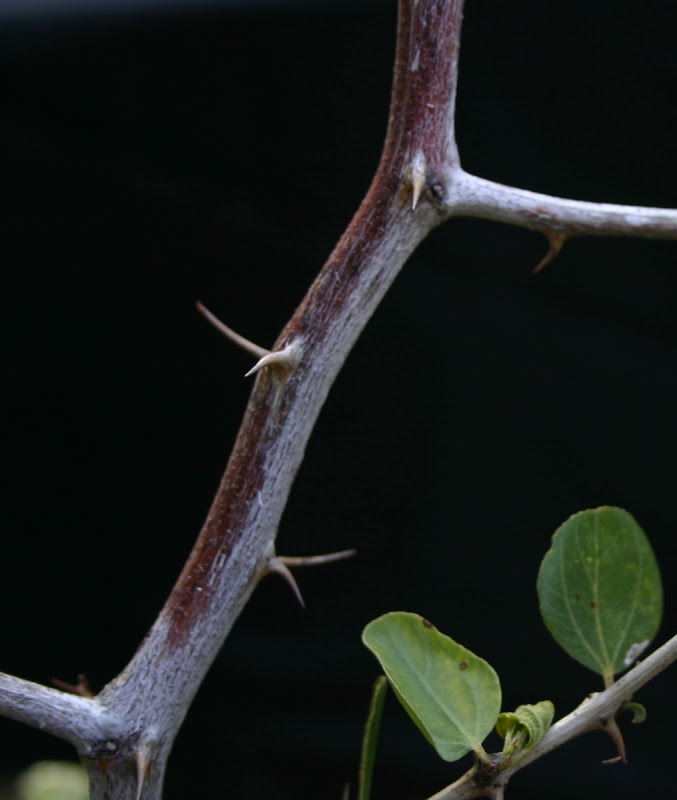
[Above: A branch of a Zizyphus spina-christi shrub showing its long, curved and sharp thorns[32].]

Jesus was crowned with thorns The Gospels record that Jesus was crowned with thorns[33]:

Mt 27:27-31. 27Then the soldiers of the governor took Jesus into the governor's headquarters, and they gathered the whole battalion before him. 28And they stripped him and put a scarlet robe on him, 29and twisting together a crown of thorns, they put it on his head and put a reed in his right hand. And kneeling before him, they mocked him, saying, "Hail, King of the Jews!" 30And they spit on him and took the reed and struck him on the head. 31And when they had mocked him, they stripped him of the robe and put his own clothes on him and led him away to crucify him.

Mk 15:16-20. 16And the soldiers led him away inside the palace (that is, the governor's headquarters), and they called together the whole battalion. 17And they clothed him in a purple cloak, and twisting together a crown of thorns, they put it on him. 18And they began to salute him, "ail, King of the Jews!" 19And they were striking his head with a reed and spitting on him and kneeling down in homage to him. 20And when they had mocked him, they stripped him of the purple cloak and put his own clothes on him. And they led him out to crucify him.

Jn 19:1-5.1Then Pilate took Jesus and flogged him. 2And the soldiers twisted together a crown of thorns and put it on his head and arrayed him in a purple robe. 3They came up to him, saying, "Hail, King of the Jews!" and struck him with their hands. 4Pilate went out again and said to them, "See, I am bringing him out to you that you may know that I find no guilt in him." 5So Jesus came out, wearing the crown of thorns and the purple robe. Pilate said to them, "Behold the man!"

The soldiers had placed a purple robe on Jesus and put a reed in his hand, pretending to address him as king, bowing down to him in mock homage[34]. Then, to further scoff at him, they made a crown out of thorns and forcefully placed it on his head[35]. The form of the crown is not described but the soldiers must have woven it roughly of thorn branches with no artistic aim[36]. Their aim rather was of cruel mockery of Christ's claim to be the King of the Jews (Mt 27:11; Mk 15:2; Lk 23:3; Jn 18:33-36; 19:19-21)[37]. The soldiers took the reed and kept striking him on the head[38]. Note that the crown of thorns was still on Jesus' head when He was brought back before Pilate after His scourging. Therefore Jesus may have worn the crown of thorns on the Cross[39].

[Above: An artist's impression of how Jesus would have appeared after His crowning with thorns[40].

The forehead, temple, and scalp contain a major network of highly sensitive nerves[41]. These nerves are tributaries of the Trigeminal Nerve and the Greater Occipital Nerve, which conducts pain perception from the front half of the head, and the back half of the head, respectively[42]. These major nerves in turn divide almost infinitesimally throughout the skin of the scalp[43]. Stimulation or irritation of branches of these two major nerves causes intense pain[44]. For example, irritation of only one of the tiny branches of the trigeminal nerve which supply the teeth can result in a very painful toothache[45]. A clinical condition associated with irritation of the trigeminal nerve is called Trigeminal Neuralgia[46]. This condition causes paroxysmal bouts of pain to the face, which sufferers describe as "knifelike stabs," "electric shocks," or "jabs with a red-hot poker"[47]. Trigeminal neuralgia is among the worst pain a human can experience[48].

[Above: The major nerve pathways of the head (yellow), including the Trigeminal Nerve and Greater Occipital Nerve[49] which would have conducted the additional agony that a cap of thorns would have caused the man on the Shroud to experience.]

The soldiers filed past Jesus, taking the reed from Him and striking it down on the crown of thorns (Mt 27:30)[50]. A cap of interwoven thorn twigs would have placed a large number of thorns in contact with the entire top of the head: front, back, and sides[51]. The blows from the reed on the cap of thorns would have directly irritated the nerves bringing on severe pains resembling a hot poker or electric shock[52]. The traumatic shock from scourging (see part 21) would have been enhanced by the paroxysmal pains across Jesus' face[53]. The throbbing bolts of pain would have recurred along the way to Calvary and would have been triggered by walking and falling, the pressure of the thorns against the cross, and from the shoves and blows by the soldiers, and during the crucifixion itself[53].

Crowning with thorns was not part of Roman crucifixion procedure[54]. Nor was crowning or capping with thorns ever a part of any other culture's penal procedure throughout human history[55]. The only mention of a crowning with thorns in all of ancient literature is that found in the Gospel accounts of the passion of Jesus of Nazareth[56]. No other crucifixion victim but Jesus is known to have been crowned with thorns[57]. Hence the crowning with thorns of the man on the Shroud is signatory that he is Jesus[58].

More problems for the forgery theory Problems for the forgery theory due to the crown of thorns include:

• No medieval or earlier artist had depicted Jesus wearing a cap of thorns[§23]. Where traditional Christian art depicted Jesus wearing a crown of thorns it was a circlet type of crown[59]. A cap of thorns would therefore be non-traditional and non-European and so would offend the sensibilities of medieval Europeans rather than impress them[60]. Moreover, this information would not be common knowledge to a medieval forger for centuries to come[61].

[Above: The medieval idea of a circlet crown of thorns is exemplified by this crown of thorns bought by King Louis IX (1214-1270) of France from Emperor Baldwin II (1217–1273) of Constantinople in 1238, and preserved today in Notre Dame Cathedral, Paris[62]. The circlet is made of plaited rushes[63]. As we saw above, the bloodflows on the back of the head of the man on the Shroud were halted by a circular band, so it is possible that this actually was part of Jesus' cap of thorns. While it is now only a circlet of rushes, it originally had many thorns which were distributed as relics[64]. The location of many of these thorn relics is known and they have identified as from the plant Ziziphus spina-Christi[65]. This "Crown of Thorns" (as its official name is) was transferred from Jerusalem, where it had been documented since at least the 6th century[66], to Constantinople in about 1063[67]. In 1238 Baldwin II (1217–1273), the Emperor of Constantinople, offered to sell the Crown of Thorns to his cousin King Louis IX of France(1214–1270)[68]. It was then held by Venetian moneylenders as security for a large loan made to Baldwin[69]. Louis redeemed the Crown of Thorns for the huge sum of 177,300 livres[70], a livre being equal to one pound's weight of silver[71]. In 1239 the Crown of Thorns was brought from Venice to France[72] by St. Louis (as he was also known)[73] and in 1241 it was installed in the Sainte Chapelle which Louis had built for it[74]. Today the Crown of Thorns is kept in Notre Dame Cathedral, Paris[75].

• No medieval artist has approached the physiological realism of the cap of thorns bloodflows on the Shroud[§24] Only a modern artist who has a thorough knowledge of the physiology of coagulation could portray the `reversed 3' bloodflow[76]. Even then, some mistake would betray it as a work of his imagination[77]. Let alone a hypothetical medieval forger imagining all the minutiae of the reversed `3' bloodflow[78]. So the `reversed 3' bloodflow alone is enough to prove that the Shroud is Christ's and yet it is but one such proof among many others[79]. As the French biology professor, artist and sindonologist Paul Vignon (1865-1943) observed of the reversed `3' bloodflow, "No painter, in his most elaborate work, has ever risen to such exactitude":

Let us turn now to another wound, the reproduction of which would have required even greater ingenuity and skill. We allude to the large drop of blood visible on the forehead above the left eyebrow. This drop springs from a definite point, indicated by its darker colour ... This dark point corresponds to one of the wounds made by the crown of thorns. The blood which has flowed therefrom has met in its course the two wrinkles of the forehead, and has, by this slight opposition, been forced to spread itself out, forming two small horizontal pools; thence it continued to flow, until it ended in a tear of blood close to the eyebrow, and having thus flowed, it dried upon the skin. Now any drop of blood, drying thus, upon a substance into which it does not penetrate, takes, when coagulated, a sort of basin-like shape, a section of which we give here ... The border or brim of the basin is formed by the fibrine of the blood, containing the red corpuscles in its coagulum; the centre is composed of the serum, which in drying takes a dull brown tint. Here, as the liquid part of the serum evaporates, the convexity of the centre is depressed. The contour of the drop of blood preserves, however, the same shape as it had when it was fresh. Now this description applies exactly to the blood-drop on the forehead. In the parts where the blood has flowed, and where it has accumulated in sufficient quantity, it is bordered by a dark edge. The centre of the little stream, and the centre also of the terminal tear, are of a lighter tint. This drop of blood is reproduced not only with the greatest minuteness and delicacy, but with entire faithfulness to scientific detail. No painter, in his most elaborate work, has ever risen to such exactitude, as a glance at any of the numerous representations of Christ, Crowned with Thorns, will show us[80].

• The cap of thorns bloodflows on the Shroud reveal a knowledge of the distinction between arterial and venous blood, which did not exist until the 16th century[§25] As seen above, if the Shroud were a medieval or earlier forgery, the forger would have had to know the difference between arterial and venous bloodflows[81]. But that difference was not discovered until 1593, more than 230 years after the Shroud appeared at Lirey, France in the mid-1350s [82], by Andrea Cesalpino (c. 1524-1603) [83].

• Some of the bloodflows at the back of the man on the Shroud's head match exactly those on the Sudarium of Oviedo[§26] The stains on the back of the man on the Shroud's head correspond exactly to those on the Sudarium of Oviedo[84]. But the Sudarium has been in Spain since the 6th century[85]. This will be covered in more detail in "7. The Sudarium of Oviedo."

Conclusion Both the man on the Shroud and Jesus were scourged with a Roman flagrum (see part 20), crowned with thorns, and as we shall see, underwent a Roman crucifixion. But there is no record of any other Roman crucifixion victim but Jesus having been crowned with thorns, nor any reason why any other would have been. As the agnostic art historian Thomas de Wesselow, who accepts that the Shroud is authentic, but not that Jesus rose from the dead, wrote:

The bloodstains on the head, then, are traces of a crown of thorns, removed from the head of a man who was crucified in the Roman manner and buried according to the custom of the Jews. Historically, we know of only one Roman Jew who was crucified wearing a crown of thorns: Jesus. The implication is that the Shroud is the very cloth in which Jesus was wrapped for burial[86].

NOTES
1. Guerrera, V., 2000, "The Shroud of Turin: A Case for Authenticity," TAN: Rockford IL, p.38. [return]
2. Stevenson, K.E. & Habermas, G.R., 1990, "The Shroud and the Controversy," Thomas Nelson Publishers: Nashville TN, p.85. [return]
3. Stevenson, K.E. & Habermas, G.R., 1981, "Verdict on the Shroud: Evidence for the Death and Resurrection of Jesus Christ," Servant Books: Ann Arbor MI, p.122. [return]
4. Stevenson & Habermas, 1981, p.122. [return]
5. Wilson, I., 1979, "The Shroud of Turin: The Burial Cloth of Jesus?," Image Books: New York NY, Revised edition, p.36. [return]
6. Wilson, 1979, p.36. [return]
7. Wilson, 1979, p.37. [return]
8. Wuenschel, E.A., 1954, "Self-Portrait of Christ: The Holy Shroud of Turin," Holy Shroud Guild: Esopus NY, p.42. [return]
9. Wilson, 1979, p.37. [return]
10. Stevenson & Habermas, 1990, p.85. [return]
11. Wuenschel, 1954, p.42. [return]
12. Wilson, I., 1986, "The Evidence of the Shroud," Guild Publishing: London, p.20. [return]
13. Antonacci, M., 2000, "Resurrection of the Shroud: New Scientific, Medical, and Archeological Evidence," M. Evans & Co: New York NY, p.26. [return]
14. Wilson, 1979, p.37. [return]
15. Ibid. [return]
16. Wilson, I., 1998, "The Blood and the Shroud: New Evidence that the World's Most Sacred Relic is Real," Simon & Schuster: New York NY, p.33. [return]
17. Wilson, 1998, p.33. [return]
18. Wilson, 1998, p.33. [return]
19. Antonacci, 2000, p.26. [return]
20. Antonacci, 2000, p.26. [return]
21. Stevenson & Habermas, 1990, pp.85-86. [return]
22. Wilson, 1979, p.36. [return]
23. Wuenschel, 1954, p.42. [return]
24. Bucklin, R., 1982, "The Shroud of Turin: Viewpoint of a Forensic Pathologist," Shroud Spectrum International, Issue #5, December, p.8. [return]
25. Tribbe, F.C., 2006, "Portrait of Jesus: The Illustrated Story of the Shroud of Turin," Paragon House Publishers: St. Paul MN, Second edition, p.99. [return]
26. Antonacci, 2000, p.102. [return]
27. Cruz, J.C., 1984, "Relics: The Shroud of Turin, the True Cross, the Blood of Januarius. ..: History, Mysticism, and the Catholic Church," Our Sunday Visitor: Huntington IN, p.34. [return]
28. Barbet, P., 1953, "A Doctor at Calvary," Earl of Wicklow, transl., Image Books: Garden City NY, Reprinted, 1963, p.93. [return]
29. Danin, A., 2010, "Botany of the Shroud: The Story of Floral Images on the Shroud of Turin," Danin Publishing: Jerusalem, Israel, p.59. [return]
30. Bucklin, R., 1970, "The Legal and Medical Aspects of the Trial and Death of Christ," Medicine, Science and the Law, Las Vegas, Nevada, January. [return]
31. Antonacci, 2000, p.33. [return]
32. "Ziziphus spina-christi," 2008, Flora of Israel Online. [return]
33. Stevenson & Habermas, 1990, p.85. [return]
34. Stevenson & Habermas, 1981, p.122. [return]
35. Ibid. [return]
36. Wuenschel, 1954, pp.41-42. [return]
37. Wuenschel, 1954, p.42. [return]
38. Wuenschel, 1954, p.41. [return]
39. Barbet, 1953, p.95. [return]
40. Ricci, G., 1981, "The Holy Shroud," Center for the Study of the Passion of Christ and the Holy Shroud: Milwaukee WI, p.83. [return]
41. Antonacci, 2000, p.33. [return]
42. Zugibe, F.T., 2005, "The Crucifixion of Jesus: A Forensic Inquiry," M. Evans & Co.: New York NY, 2005, p.33. [return]
43. Ibid. [return]
44. Ibid. [return]
45. Ibid. [return]
46. Zugibe, 2005, p.34. [return]
47. Ibid. [return]
48. Ibid. [return]
49. "The nerves of the scalp, face, and side of neck," (extract), Wikipedia, 23 January, 2007. [return]
50. Zugibe, 2005, p.36. [return]
51. Ibid. [return]
52. Ibid. [return]
53. Ibid. [return]
54. Ricci, G., 1977, "Historical, Medical and Physical Study of the Holy Shroud," in Stevenson, K.E., ed., 1977, "Proceedings of the 1977 United States Conference of Research on The Shroud of Turin," Holy Shroud Guild: Bronx NY, p.67. [return]
55. Wilson, I., 2010, "The Shroud: The 2000-Year-Old Mystery Solved," Bantam Press: London, p.44. [return]
56. Bennett, J., 2001, "Sacred Blood, Sacred Image: The Sudarium of Oviedo: New Evidence for the Authenticity of the Shroud of Turin," Ignatius Press: San Francisco CA, p.85. [return]
57. Ricci, 1977, p.67. [return]
58. Wilson, 1979, p.52. [return]
59. Robinson, J.A.T., 1978, "The Shroud and the New Testament," in Jennings, P., ed., 1978, "Face to Face with the Turin Shroud ," Mayhew-McCrimmon: Great Wakering UK, p.78. [return]
60. Wilcox, R.K., 1977, "Shroud," Macmillan: New York NY, pp.170-171. [return]
61. Wilcox, 1977, p.171. [return]
62. "Crown of thorns," Wikipedia, 10 July 2013. [return]
63. Barbet, 1953, p.94. [return]
64. Cruz, 1984, p.34. [return]
65. Cruz, 1984, p.35. [return]
66. Ibid. [return]
67. Ibid. [return]
68. Crispino, D., "1204: Deadlock or Springboard?," Shroud Spectrum International, Vol. I, No. 4, September 1982, p.27. [return]
69. Cruz, 1984, p.35. [return]
70. Sox, H.D., 1988, "The Shroud Unmasked: Uncovering the Greatest Forgery of All Time," Lamp Press: Basingstoke UK, p.10. [return]
71. "French livre," Wikipedia, 10 June 2013. [return]
72. Cruz, 1984, p.35. [return]
73. Currer-Briggs, N., 1984, "The Holy Grail and the Shroud of Christ: The Quest Renewed," ARA Publications: Maulden UK, p.81. [return]
74. Cruz, 1984, p.35. [return]
75. Ibid. [return]
76. Barbet, 1953, pp.96-97. [return]
77. Barbet, 1953, p.97. [return]
78. Ibid. [return]
79. Barbet, 1953, p.97. [return]
80. Vignon, P., 1902, "The Shroud of Christ," University Books: New York NY, Reprinted, 1970, pp.29-30. [return]
81. Wilson, 1986, p.20. [return]
82. Antonacci, 2000, p.26. [return]
83. Tribbe, 2006, p.99. [return]
84. Guscin, M., 1998, "The Oviedo Cloth," Lutterworth Press: Cambridge UK, p.31. [return]
85. Guscin, 1998, p.15. [return]
86. De Wesselow, T., 2012, "The Sign: The Shroud of Turin and the Secret of the Resurrection," Viking: London, p.132. [return]
§23, §24, §25, §26. To be further examined under "9. Problems of the forgery theory". [return]


Continued in part 24, "3.6.The man on the Shroud and Jesus were crucified."

Posted 8 September 2013. Updated 18 February 2026.

Tuesday, August 6, 2013

The Shroud of Turin: 3.4. The man on the Shroud and Jesus were beaten

Continuing from part 21, "3.3. The man on the Shroud and Jesus were scourged" of my series, "The Shroud of Turin," with this part 22, "3.4. The man on the Shroud and Jesus were beaten." See part 1, "Contents" for more information about this series.


THE SHROUD OF TURIN
3. THE BIBLE AND THE SHROUD
3.4 THE MAN ON THE SHROUD AND JESUS WERE BEATEN
© Stephen E. Jones

Introduction The man of the Shroud was beaten about the face[1], as the Gospels record that Jesus was[2].

The man on the Shroud was beaten about his face The man on the Shroud had been severely beaten[3] about the face[4]. His facial wounds include: swelling of both eyebrows, a torn right eyelid, a large swelling below his right eye, a swollen nose, a triangular-shaped wound on right cheek with its apex pointing to his nose, a swelling to his left cheek, a swelling to the left side of his chin[5]. His right eye is nearly swollen shut, and his nose is twisted[6].

[Above: Enrie 1931 negative photograph of the face of the man on the Shroud, showing the large swelling of the cheek under the right eye[7].

The swelling of the man's cheek, under his right eye-socket, was probably caused by a blow with a stick, estimated to have been about 1.75 in. (44.5 mm) in diameter[8].

Some of the man's facial injuries may have been the result of unprotected falls onto his face with his arms tied to a crossbeam behind his head, including the separation of the nasal cartilage from the nasal bones[9]. We will cover this in more detail in "3.7. The man on the Shroud fell."

One of the benefits of discovering by the use of a VP-8 Image Analyser that there was three-dimensional information encoded in the Shroud image[10], was the realisation of the degree of swelling of the man's right cheek[11].

[Above: Three-dimensional enhancement of the Shroud face, by Mário Azedvedo of Rio de Janeiro, Brazil[12], showing the extreme degree of swelling of the man's right cheek, under his right eye.]

Jesus was beaten about his face The Gospels record that Jesus was struck in the face on three occasions[13]. The first was at the night session of the Sanhedrin, when Jesus was first sentenced to death[14]. Then He was struck [Gk. rapisma] by one of the Jewish attendants of the court (Jn 18:22-23)[15]. The second occasion was the morning after that session, when the sentence of death was ratified before the full Sanhedrin[16]. Then the Jewish guards blindfolded Jesus, spat in His face, struck Him [Gk. errapisan] and asked Him to prophesy who did it (Mt 26:67-68; Mk 14:65; Lk 22:63-65)[17]. The third occasion when Jesus was struck in the face was after He had been scourged, when mock homage was paid to Him and He was crowned with thorns[18]. Then Jesus was spat on by the Roman soldiers and then struck [Gk. etupton] on the head with a reed (Mt 27:27-31; Mk 15:16-20; Jn 19:3)[19]. The terms used by the Gospel writers signify heavy blows with the hand, fist or rod[20]. A "reed" [Gk. kalamon] can be also a staff[21].

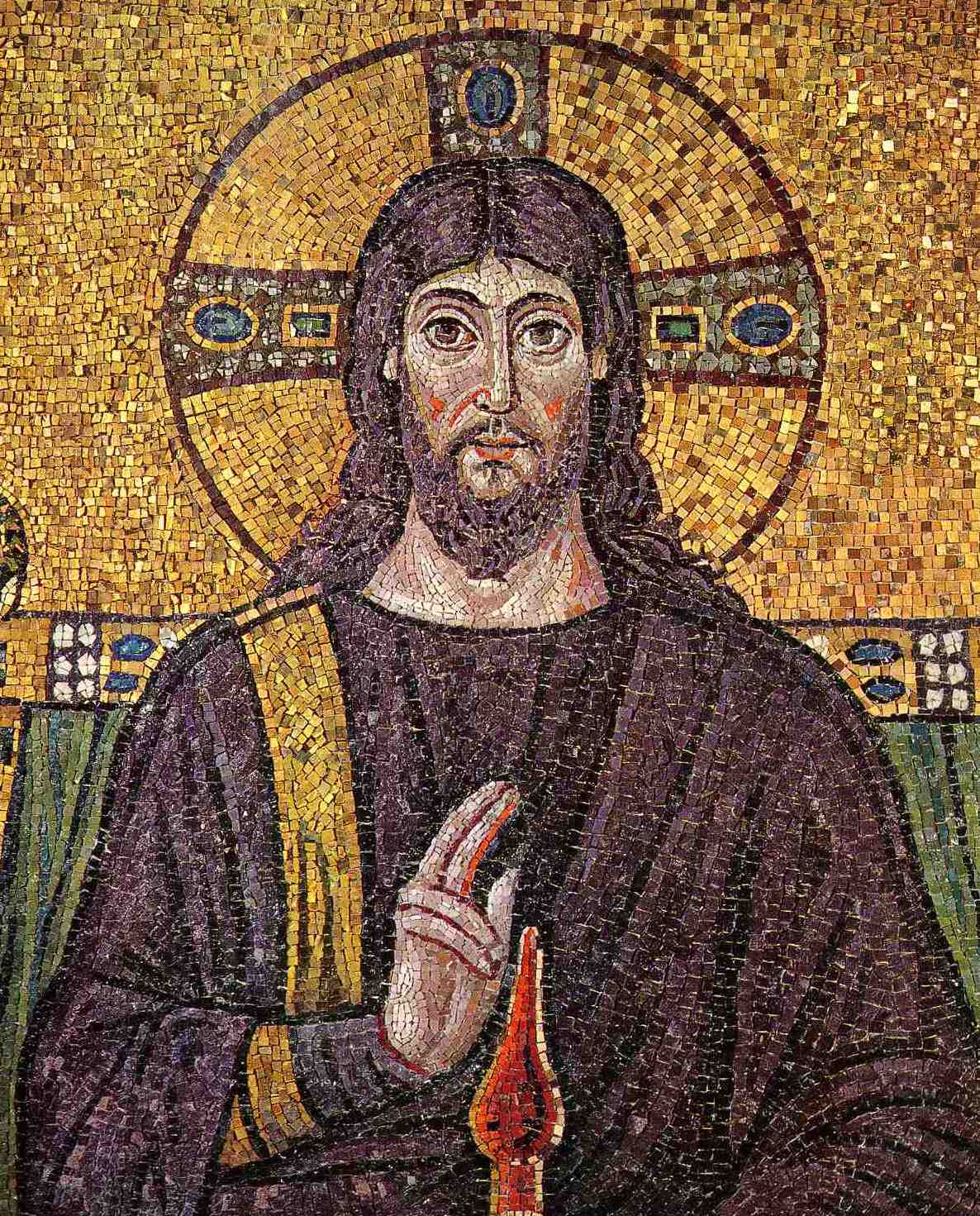
More problems for the forgery theory Byzantine artists in their Christ Pantocrator ("ruler over all"[22]) icons, drew an asymmetric face with one cheek concave[23]. Examples are the Christ of a mosaic at St. Apollinare Nuovo at Ravenna where Christ is portrayed with the left cheek concave, Christ Pantocrator in the Convent of St. Catherine on Mount Sinai, and the mosaic of Cefalu, Sicily[24].

[Above: "Christ surrounded by angels and saints" (526 AD), in the Basilica of Sant'Apollinare Nuovo, Ravenna, Italy[25]. Note the asymmetrical face, with the cheek under the right eye convex and the cheek under the left eye concave. Note also the lopsided nose. There would be no reason for the artist to depict Jesus this way, unless the Shroud was the artist's model and he was struggling to interpret the swollen right cheek and bent nose of the man on the Shroud.]

[Above: Christ Pantocrator, St. Catherine's Monastery, Mount Sinai (6th-7th century)[26]. Again, note the asymmetrical face, the concave left cheek and the bent nose.]

[Above: Christ Pantocrator, Cathedral of Cefalù (ca. 1150)[27]. The artist has gone out of his way to highlight Christ's concave left cheek and the asymmetry of the face and eyes.]

[Above: "Christ Pantocrator in Hagia Sophia Cathedral, Constantinople, Turkey (13th century)[28]. Note again Christ's convex right cheek and concave left cheek. Again, why such a strange artistic tradition, persisting from the 6th to the 13th century, if it were not that the Shroud was the artists' model and they were trying to depict Christ's beaten up face as it is on the Shroud?]

This is yet another problem for the forgery theory. The existence of Christ Pantocrator icons from the 6th century that `just happen' to match the facial injuries of the man on the Shroud is further evidence that the Shroud was in existence in at least the 5th century[§20]. And why would a medieval forger depict Christ's face severely beaten up when it is not so described in detail in the Gospels?[§21]. How could (and why would) a medieval or earlier forger encode three-dimensional information of Christ's bulging right cheek and eye such that it could not be fully appreciated until the late 20th century when three-dimensional information encoded in a photograph could be discovered by advanced computer technology?[§22].

That the man on the Shroud's face has been badly beaten is especially a problem for Lynn Picknett and Clive Prince's theory that Leonardo da Vinci (1452–1519) forged the Shroud[29], and moreover that the face on the Shroud is actually Leonardo's[30]. But that would require Leonardo to have had his face specially beaten up to match the man on the Shroud's injuries[31]!

Conclusion The man on the Shroud has facial injuries which closely match the Gospels' description of the blows about the face which Jesus was subjected to. Christian artists since the sixth century have depicted Jesus with an asymmetrical face, a bent nose, a concave left cheek and a convex right cheek which matches the facial injuries of the man on the Shroud. This adds to the already overwhelming weight of evidence that the Shroud of Turin is not a forgery, but it really is Jesus' burial sheet and the image on it really is of Jesus!

NOTES
1. Antonacci, M., 2000, "Resurrection of the Shroud: New Scientific, Medical, and Archeological Evidence," M. Evans & Co: New York NY, p.119. [return]
2. Stevenson, K.E. & Habermas, G.R., 1990, "The Shroud and the Controversy," Thomas Nelson Publishers: Nashville TN, p.88. [return]
3. Stevenson & Habermas, 1990, p.85. [return]
4. Heller, J.H., 1983, "Report on the Shroud of Turin," Houghton Mifflin Co: Boston MA, p.2. [return]
5. Wilson, I., 1979, "The Shroud of Turin: The Burial Cloth of Jesus?," Image Books: New York NY, Revised edition, p.36. [return]
6. Stevenson, K.E. & Habermas, G.R., 1981, "Verdict on the Shroud: Evidence for the Death and Resurrection of Jesus Christ," Servant Books: Ann Arbor MI, p.44. [return]
7. Latendresse, M., n.d., Shroud Scope: Enrie Negative Vertical. [return]
8. Barbet, P., 1953, "A Doctor at Calvary," Earl of Wicklow, transl., Image Books: Garden City NY, p.90. [return]
9. Heller, 1983, p.3. [return]
10. Jackson, J.P., Jumper, E.J., Mottern, R.W. & Stevenson, K.E., ed., 1977, "The Three Dimensional Image On Jesus' Burial Cloth," in Stevenson, K.E., ed., 1977, "Proceedings of the 1977 United States Conference of Research on The Shroud of Turin," Holy Shroud Guild: Bronx NY, pp.78-81. [return]
11. Jackson, et al., 1977, p.92. [return]
12. "Shroud Dimensional Data Dramatically Visualized By Brazilian Experimenter," Shroud.com, August 15, 2003. [return]
13. Wuenschel, E.A., 1954, "Self-Portrait of Christ: The Holy Shroud of Turin," Holy Shroud Guild: Esopus NY, Third printing, 1961, p.40. [return]
14. Ibid. [return]
15. Antonacci, 2000, p.119. [return]
16. Wuenschel, 1954, p.40. [return]
17. Wilson, I., 2010, "The Shroud: The 2000-Year-Old Mystery Solved," Bantam Press: London, p.44. [return]
18. Ibid. [return]
19. Antonacci, 2000, p.119. [return]
20. Wuenschel, 1954, p.40. [return]
21. Bauer, W., Arndt, W.F., Gingrich, F.W. & Danker, F.W., 1979, "A Greek-English Lexicon of the New Testament and Other Early Christian Literature," University of Chicago Press: Chicago IL, Second edition, p.398. [return]
22. Zodhiates, S., 1992, "The Complete Word Study Dictionary: New Testament," AMG Publishers: Chattanooga TN, pp.1093-1094. [return]
23. Pfeiffer, H., 1984, "The Shroud of Turin and the Face of Christ in Paleochristian, Byzantine and Western Medieval Art: Part II," Shroud Spectrum International, Issue #10, March, pp.14-15. [return]
24. Ibid. [return]
25. "Christus Ravenna Mosaic," Wikipedia, 12 September, 2006. [return]
26. "Spas vsederzhitel sinay," Wikipedia, 25 December 2011. [return]
27. "Cathedral of Cefalù, Sicily, the apsidal mosaic: Christ Pantocrator," Wikipedia, 15 June 2010. [return]
28. "Jesus-Christ-from-Hagia-Sophia," Wikipedia, 31 March 2006. [return]
29. Scavone, D.C., 1996, "Book Review of `The Turin Shroud: In Whose Image?'", Shroud.com. [return]
30. Picknett, L. & Prince, C., 2006, "The Turin Shroud: How Da Vinci Fooled History," Touchstone: New York NY, Second edition, p.87. [return]
31. Wilson, I., 1998, "The Blood and the Shroud: New Evidence that the World's Most Sacred Relic is Real," Simon & Schuster: New York NY, p.212. [return]
§20, §21, §22. To be further examined under "9. Problems of the forgery theory". [return]


Continued in part 23, "3.5.The man on the Shroud and Jesus were crowned with thorns."

Posted: 6 August 2013. Updated: 13 July 2024.

Monday, July 15, 2013

The Shroud of Turin: 3.3. The man on the Shroud and Jesus were scourged

This is "3.3. The man on the Shroud and Jesus were scourged" being part 21 of my series, "The Shroud of Turin." The previous post in this series was part 20, "3.2 The Man the Shroud." For more information about this series, see part 1, Contents.


THE SHROUD OF TURIN
3. THE BIBLE AND THE SHROUD
3.3 THE MAN ON THE SHROUD AND JESUS WERE SCOURGED
© Stephen E. Jones

Scourging Scourging was a Roman punishment for serious offenses by non-Roman citizens(Acts 22:25-29)[1].The victim was stripped naked, forced to bend over[2] and tied to a stake or column[3]. He or she then flogged with a flagrum,

[Right: A reconstruction of a Roman flagrum by Paul Vignon [4]. One similar to this was recovered from the Roman city of Herculaneum which, with its neighbour Pompeii[5], was buried in the eruption of Mt Vesuvius in AD 79[6].]

a uniquely Roman[7] whip which comprised a handle[8] to which were attached two or three thongs of rope or leather tipped or interwoven with small, sharp pieces of wood, bone[9] or metal [10]. This was designed to rip out pieces of flesh with each blow[11] so as to inflict maximum pain on the victim[12]. Scourging was the usual preliminary to Roman crucifixion[13] and some died of the scourging alone[14].

The man on the Shroud was scourged The imprints on the Shroud show that the man was scourged with a Roman flagrum[15]. All blows were to the man's back, including his legs, and the end of

[Above: Enhanced National Geographic photograph of the Shroud[16], showing bloodstains and wounds on the man of the Shroud, including those from scourging with a Roman flagrum, which are consistent with the Gospels' description of Jesus' suffering, crucifixion, death, burial and resurrection!]

the lash whipped around to the front of his body and legs[17]. The head, neck, and arms were spared[18]. There are tiny marks of over a 100 dumbbell shaped scourge wounds[19]. That they are in groups of two or three indicates they were inflicted by a two- or three-thonged lash tipped with dumbbell-shaped[20] lead pellets called plumbatae[22], the same as on the flagrum found in the excavations of Herculaneum[21] (see above). The scourge wounds on the Shroud were originally thought to be contusions, or hematomas, in which bleeding occurs under the skin without necessarily breaking it[23]. But more recent analysis suggests that the scourge marks on Shroud are of blood from within the breaks in the skin caused by the dumbbell-shaped objects[24]. From a horizontal axis across the middle of the body the scourge wounds fan out upward over the upper back, criss-cross over at the shoulders, and fan downward on the thighs and calves[25]. Using goniometry, the science of calculating angles[26], it has been deduced that there were two scourgers, the one on the right being slightly taller than the one on the left[27]. There are also tiny scratches[28] which may indicate that an additional scourging instrument was used[29], probably the "reeds" which were long, slender sticks or rods[30] (cf. Acts 16:22; 2Cor 11:25) and may be the Roman scuticae[31].

[Above (click to enlarge): Back of the man on the Shroud, showing the criss-cross pattern of scourge wounds, meaning that there were scourge blows over existing scourge wounds[32].]

Jesus was scourged The Gospels of Matthew and Mark (Mt 27:26; Mk 15:15) record that Jesus was "scourged" (Gk. phragelloosas)[33], a Latin loan-word which specifically means to be flogged with a Roman flagrum[34]. The Gospels of Luke and John (Lk 23:16 & Jn 19:1) use the general terms "chastise" (paideusas) and "flog" (emastigoosen), respectively[35]. The scourging of Jesus was evidently carried out by Roman soldiers (Mt 27:27; Mk 15:16; Lk 23:11; Jn 19:2)[36]. While the Law of Moses limited a judicial whipping to no more than "forty stripes" (Dt 25:3), in practice the Jews administered only thirty-nine lashes (2Cor 11:24), to avoid inadvertently exceeding the legal limit[37]. But the Romans had no such legal limit and so were free to administer as many lashes of the flagrum as they pleased[38]. However, the Romans did not want crucifixion victims to die too early[39] and 39 strokes of a three-thonged flagrum is 117 lash marks[40].

[Above: "Reconstruction of the flagellation" (Ricci, 1976)[41]. Except that Jesus would not have been wearing a loincloth because, as can be seen in the National Geographic photograph above, there are scourge marks on the Shroud man's buttocks[42] which wrap around to his hips and would presumably be also on his pubic region but for that not being in contact with the Shroud[43] due to his crossed arms.]

The Roman governor Pontius Pilate had originally intended that Jesus be scourged and then released (Lk 23:16)[44]. He had hoped that the Jewish religious leaders would regard the scourging of Jesus as sufficient punishment for their charge of blasphemy and Pilate tried unsuccessfully to reason with them to let Jesus go (Jn 19:1-16)[45]. So Jesus unusually received both an extreme scourging and then was crucified, and this unusual double punishment was also inflicted on the man in the Shroud[46]. The repeated impacts on Jesus' chest of four or six lead balls (depending on whether a two or three-thonged flagrum was used) with each lash of a flagrum would have caused a slow accumulation of fluid (pleural effusion) in the pleural sac (pleura) around each lung[47]. This pleural fluid, and blood from the right attrium of Jesus' heart as the Roman soldier who pierced Jesus' right side with a spear withdrew it, is the likely cause of the "blood and water" which the Apostle John records in Jn 19:34[48]. Pilate was surprised that Jesus had died after a comparatively short time on the cross (Mk 15:42-45), so it was probably the unusually severe scourging that Jesus received which was hastened His death[49].

After His scourging the soldiers put Jesus' clothes back on him (Mt 27:31; Mk 15:20) which may partly explain why the scourge marks on the Shroud are accompanied by such little blood, it having been mostly absorbed by Jesus' clothes[50].

Problems for the forgery theory The scourge marks on the Shroud are physiologically accurate[51]. When examined under a microscope, each scourge mark reveals a slightly depressed center and raised edges[52]. Under ultraviolet light each scourge mark can be seen to have a "halo" of lighter colour surrounding it[53]. These halos were chemically tested and found to be blood serum which is left behind after a blood clot forms and then retracts inwards as it dries, a process called syneresis[54]. These scourge mark indented centres and raised edges on the Shroud are not visible to the naked eye, but can only be seen when examined under a microscope and the serum halos can only be seen under ultraviolet light[55]. This is further evidence that the Shroud could not have been created by an artist in the Middle Ages, or earlier, because that knowledge about blood clot structure[§18], let alone a microscope and an ultraviolet light source to see it[§19], did not then exist for many centuries into the future [56].

Each one of the over 100 scourge wounds on the Shroud matches exactly what would have been caused by a type of Roman flagrum[57] buried in the eruption of Mt. Vesuvius in AD 79 (see above). So a fourteenth century or earlier forger would have had to possess a faultless archaeological knowledge of a first century Roman scourging with a flagrum as well as make no normal artists' mistakes since each one of the over 100 scourge marks has identical dimensions [58]. Only from the Middle Ages did artists depict the scourging of Jesus and even the best of them were vague about the details[59]. But the scourge-marks on the Shroud are depicted with a realism that is unknown to the art of any period[60]. Agnostic art historian Thomas de Wesselow states:

"Once again, though, it [the Shroud] differs dramatically from anything envisaged in the Middle Ages. The vast majority of medieval images of the dead or dying Christ fail to depict any scourge marks at all ... Christ is sometimes shown bleeding in depictions of the flagellation, but the effect is always rather crude. In Duccio's rendering of the scene, for example, the scourge marks are represented as red dribbles all over the body, including the arms but not the legs ...The artist displays no knowledge of the Roman flagrum, nor any conception of how it was wielded. Even a fifteenth-century artist as accomplished as Jean Colombe, who definitely knew the Shroud, was unable to reproduce its convincing pattern of scourge marks ... To attribute the marks on the Shroud to a provincial unknown working in the mid-fourteenth century is therefore ridiculous"[61].

[Above (enlarge): Extract from "Flagellation of Christ" by Duccio di Buoninsegna (c. 1255-1319). "The scourge marks are represented as red dribbles all over the body, including the arms but not the legs".]

[Above (click to enlarge): "Man of Sorrows" by Jean Colombe (c. 1430-1493). "Colombe, who definitely knew the Shroud, was unable to reproduce its ... pattern of scourge marks."]

Moreover, the medieval or earlier forger would have had to use goniometry, the science of calculating angles[62](see above), to correctly work out the angle of each one of the over 100 scourge marks on the Shroud, but the first goniometer was not invented until 1780[63, §9].

Conclusion In conclusion, the pattern of scourge wounds on the Shroud correlates remarkably closely with the Gospels' description of the scourging of Jesus[64] and with what has, since the fourteenth century, been discovered by modern archaeology about first century Roman scourging[65].

NOTES
1. Petrosillo, O. & Marinelli, E., 1996, "The Enigma of the Shroud: A Challenge to Science," Scerri, L.J., transl., Publishers Enterprises Group: Malta, p.225. [return]
2. Stevenson, K.E. & Habermas, G.R., 1990, "The Shroud and the Controversy," Thomas Nelson Publishers: Nashville TN, p.85. [return]
3. Petrosillo & Marinelli, 1996, p.225. [return]
4. Wilson, I. & Schwortz, B., 2000, "The Turin Shroud: The Illustrated Evidence," Michael O'Mara Books: London, p.56; de Wesselow, T., 2012, "The Sign: The Shroud of Turin and the Secret of the Resurrection," Viking: London, p.144O. [return]
5. Wilson, I., 1979, "The Shroud of Turin: The Burial Cloth of Jesus?," Image Books: New York NY, Revised edition, p.48. [return]
6. "Herculaneum," Wikipedia, 10 June 2013. [return]
7. Wilson, 1979, p.48. [return]
8. Stevenson & Habermas, 1990, p.84. [return]
9. Petrosillo & Marinelli, 1996, p.225. [return]
10. Bulst, W., 1957, "The Shroud of Turin," McKenna, S. & Galvin, J.J., transl., Bruce Publishing Co: Milwaukee WI, p.48. [return]
11. Stevenson, K.E. & Habermas, G.R., 1981, "Verdict on the Shroud: Evidence for the Death and Resurrection of Jesus Christ," Servant Books: Ann Arbor MI, p.44. [return]
12. Wilson, 1979, p.38. [return]
13. Bulst, 1957, p.48. [return]
14. Ibid. [return]
15. Wilcox, R.K., 1977, "Shroud," Macmillan: New York NY, p.170. [return]
16. Weaver, K.F., 1980, "Science Seeks to Solve...The Mystery of the Shroud," National Geographic, Vol. 157, June, p.740. [return]
17. Wilson, 1979, p.38. [return]
18. Zugibe, F.T., 2005, "The Crucifixion of Jesus: A Forensic Inquiry," M. Evans & Co.: New York NY, p.22. [return]
19. Wilson, I., 1986, "The Evidence of the Shroud," Guild Publishing: London, p.20. [return]
20. Ibid. [return]
21. Ibid. [return]
22. Wilson, 1979, p.48. [return]
23. Wilson, 1986, p.20. [return]
24. Zugibe, 2005, p.24. [return]
25. Ibid. [return]
26. Ibid. [return]
27. Wilson, 1979, p.38. [return]
28. Stevenson & Habermas, 1981, p.66. [return]
29. Faccini, B., 2008, "Scourge bloodstains on the Turin Shroud: an evidence for different instruments used," in Fanti, G., ed., "The Shroud of Turin: Perspectives on a Multifaceted Enigma," Proceedings of the 2008 Columbus Ohio International Conference, August 14-17, 2008, Progetto Libreria: Padua, Italy, 2009, pp.228-245, p.228. [return]
30. Stevenson & Habermas, 1990, p.151. [return]
31. Faccini, 2008, pp.230, 243. [return]
32. Shroud Scope, Durante 2002: Vertical. [return]
33. Marshall, A., 1966, "The Interlinear Greek - English New Testament," Samuel Bagster & Sons: London, pp.129 & 211. [return]
34. Bauer, W., Arndt, W.F., Gingrich, F.W. & Danker, F.W., 1979, "A Greek-English Lexicon of the New Testament and Other Early Christian Literature," University of Chicago Press: Chicago IL, Second edition, p.865. [return]
35. Marshall, 1966, pp.345 & 448. [return]
36. Wuenschel, E.A., 1954, "Self-Portrait of Christ: The Holy Shroud of Turin," Holy Shroud Guild: Esopus NY, Third printing, 1961, p.41. [return]
37. Ibid. [return]
38. Ibid. [return]
39. Zugibe, 2005, p.19. [return]
40. Zugibe, 2005, p.22. [return]
41. Ricci, G., 1981, "The Holy Shroud," Center for the Study of the Passion of Christ and the Holy Shroud: Milwaukee WI, p.76. [return]
42. Wilson, I., 1998, "The Blood and the Shroud: New Evidence that the World's Most Sacred Relic is Real," Simon & Schuster: New York NY, p.32. [return]
43. Faccini, 2008, p.231. [return]
44. Bulst, 1957, p.48. [return]
45. Stevenson & Habermas, 1990, p.85. [return]
46. Stevenson & Habermas, 1990, p.90. [return]
47. Zugibe, 2005, pp.21,22, 139. [return]
48. Zugibe, 2005, pp.136-140. [return]
49. Ibid. [return]
50. Wuenschel, 1954, p.41. [return]
51. Wilson, 1979, p.38. [return]
52. Antonacci, M., 2000, "Resurrection of the Shroud: New Scientific, Medical, and Archeological Evidence," M. Evans & Co: New York NY, p.26. [return]
53. Ibid. [return]
54. Antonacci, 2000, pp.26-27. [return]
55. Antonacci, 2000, p.27. [return]
56. Ibid. [return]
57. Heller, J.H., 1983, "Report on the Shroud of Turin," Houghton Mifflin Co: Boston MA, p.3. [return]
58. Wilson, 1986, p.31. [return]
59. Wilson, 1979, p.47. [return]
60. O'Rahilly, A. & Gaughan, J.A., ed., 1985, "The Crucified," Kingdom Books: Dublin, p.53. [return]
61. de Wesselow, 2012, p.123. [return]
62. Wilson, 1986, p.20. [return]
63. Prudchenko, K., nd., "The History of Goniometers," eHOW. [return]
64. Stevenson & Habermas, 1981, p.122. [return]
65. Wilson, 1998, p.42. [return]
§9, §18, §19. To be further examined under "9. Problems of the forgery theory". [return]


Continued in part 22, "3.4. The man on the Shroud and Jesus were beaten."

Posted 15 July 2013. Updated 23 January 2024.

Saturday, June 22, 2013

The Shroud of Turin: 3.2. The man on the Shroud

Here is "3.2. The man on the Shroud" which is part 20 of my series, "The Shroud of Turin." The previous post in this series was part 19, "3. The Bible and the Shroud: Introduction." For more information about this series, see part 1, Contents.


THE SHROUD OF TURIN
3. THE BIBLE AND THE SHROUD
3.2 THE MAN ON THE SHROUD
© Stephen E. Jones

The Shroud image is of a man The image on the Shroud is of a man[1]. He is powerfully built[2], has a beard[3] and is about 181 cms (5 ft 11 in) tall[4].

Jesus was a man (Mt 26:72; Mk 15:12; Jn 19:5; Acts 2:22; Rom 5:15; 1Tim 2:5). He was a carpenter (Mk 6:3) which is consistent with His muscular physique[5].

[Above: Professor Lorenzo Ferri (1902-1975) of the School of Painting and Sculpture, Rome, making a life-sized statue of the man of the Shroud, based on information contained on the Shroud[6].]

A Jew The man on the Shroud was a Jew, according to the late Harvard physical anthropologist Carleton S. Coon[7]. The man on the Shroud has shoulder length hair which is parted in the middle, but of the numerous Greek and Roman portraits we have, there is not one of a man with middle-parted hair falling to the shoulders[8]. Similarly a full beard like that on the Shroud is rarely found in a Greek or Roman portrait, but Jews regarded a full beard as a mark of manhood[9]. Also the manner of burial was first-century Jewish, with the deceased lying on his back, his hands crossed in front covering his pelvic region and his body covered with a single linen sheet[10].

Jesus was a Jew (Mt 1:1,24-25; Lk 2:4-7; Jn 4:9; 18:35; Rom 1:1-3; Heb 7:14). His body was wrapped in a clean linen shroud (Mt 27:59; Mk 15:46; Lk 23:53) according to the burial custom of the Jews (Jn 19:40).

Age The Shroud man was aged between thirty and forty-five, according to his hair, beard and physique[11].

Jesus was in His mid-thirties when He died (Lk 3:23; Jn 2:2; 8:57; Mt 2:19,22).

Conclusion That the man on the Shroud is Jewish, with a muscular physique, and aged between thirty and forty-five, is consistent with what the Bible states or implies about Jesus[12].

NOTES
1. Stevenson, K.E. & Habermas, G.R., 1981, "Verdict on the Shroud: Evidence for the Death and Resurrection of Jesus Christ," Servant Books: Ann Arbor MI, pp.124-125. [return]
2. Wilson, I., 1979, "The Shroud of Turin: The Burial Cloth of Jesus?," Image Books: New York NY, Revised edition, p.21. [return]
3. Ibid. [return]
4. Wilson, I., 1998, "The Blood and the Shroud: New Evidence that the World's Most Sacred Relic is Real," Simon & Schuster: New York NY, p.25. [return]
5. Wilson, 1979, p.21. [return]
6. Wilson, I. & Schwortz, B., 2000, "The Turin Shroud: The Illustrated Evidence," Michael O'Mara Books: London, p.47. [return]
7. Wilcox, R.K., 1977, "Shroud," Macmillan: New York NY, p.136. [return]
8. Bulst, W., 1957, "The Shroud of Turin," Bruce Publishing Co: Milwaukee WI, p.104. [return]
9. Bulst, 1957, p.104. [return]
10. Stevenson & Habermas, 1981, p.46. [return]
11. Wilson, 1979, p.22. [return]
12. Stevenson & Habermas, 1981, p.54. [return]


Continued in part 21, "3.3. The man on the Shroud was scourged."

Posted 22 June 2013. Updated 23 March 2024.

Saturday, June 15, 2013

The Shroud of Turin: 3.1 The Bible and the Shroud: Introduction

This is "3.1. Introduction" of "3. The Bible and the Shroud," being part 19 of my series, "The Shroud of Turin." The previous post in this series was part 18, "3. The Bible and the Shroud." See part 1, the main Contents page, for more information about this series.


THE SHROUD OF TURIN
3. THE BIBLE AND THE SHROUD
3.1 INTRODUCTION
© Stephen E. Jones

The Shroud must be consistent with the Bible If the Shroud of Turin is the burial shroud of Jesus Christ, then it must be consistent with what the Bible says about Him, and particularly about His suffering, crucifixion, death, burial and resurrection:

"If the Shroud is the actual burial garment of Jesus, then it should be consistent with the New Testament texts. This condition must be satisfied before anyone can identify the cloth as Jesus' burial garment."[1].

[Above (enlarge): Depiction of the most likely position in which Jesus died, and then was fixed by rigor mortis, based on the blood stains on the Shroud of Turin[2]. Note the injuries on the Shroud which are consistent with the injuries that the New Testament records of Jesus.]

Because, as Stevenson and Habermas' second sentence above implies, if the image on the Shroud was not consistent with the Bible says about Jesus, and particularly about His suffering, crucifixion, death, burial and resurrection, then there would be no reason to believe the Shroud was "Jesus' burial garment"[3]. For example, if the Gospels said nothing about Jesus having been scourged with a Roman flagrum, crowned with thorns and speared in the side, that would be sufficient reason to believe that the Shroud imprint is that of another crucifixion victim, as proposed by the theory that the man on the Shroud is that of "a Crusader crucified by the Saracens," or that he is "Jacques de Molay the last Grand Master of the Knights Templar"[4].

The Shroud is consistent with the Bible There is no injury sustained by the man on the Shroud that does not correspond to the injuries to Christ described or implied in the Gospels[5]. Some of the parallels between the Gospel evidence and the Shroud evidence are summarised below in table form[6]:

Gospel evidenceVersesShroud evidence
Jesus was scourged.Mt 27:26; Mk 15:15; Jn 19:1The body is covered with the wounds of a severe scourging.
Jesus was struck blows to the face.Mt 27:30; Mk 15:19; Lk 22:63; Jn 19:3There is a severe swelling below the right eye and other face wounds.
Jesus was crowned with thorns.Mt 27:29; Mk 15:17; Jn 19:2Bleeding from the scalp indicates that a `cap' of thorns was thrust upon the head.
Jesus was made to carry a heavy crossbeam.Jn 19:17Scourge wounds on the shoulders are blurred, as if by the chafing of a heavy burden.
Jesus' cross had to be carried for him, suggesting he fell under its weight.Mt 27:32; Mk 15:21; Lk 23:26The knees are severely damaged, as if from repeated falls.
Jesus was crucified by nails in His hands and feet.Jn 20:25-27; Col 2:14There are blood flows as from nail wounds in the wrists and at the feet.
Jesus' legs were not broken, but a spear was thrust into his side as a check that he was dead.Jn 19:31-37The legs are not broken, and there is a large wound in the right side.

The Bible does not exclude the man on the Shroud being Jesus Nothing in the Bible rules out the man on the Shroud being Jesus[7]. There is no detail in the Gospels' account of the suffering, crucifixion, death and burial of Jesus that contradicts the witness of the Shroud[8].

Shroud sceptics concede the image on the Shroud matches the Gospels' description of Jesus As we saw in part 5, "1.3 The central dilemma of the Shroud," even leading Shroud sceptics concede that the image of the man on the Shroud matches the Gospels' description of Jesus' suffering, crucifixion and death. For example, the late Fr. Herbert Thurston (1856-1939), a leading early 20th century Roman Catholic Shroud sceptic, admitted that:

"As to the identity of the body whose image is seen on the Shroud, no question is possible. The five wounds, the cruel flagellation, the punctures encircling the head ... If this is not the impression of the Body of Christ, it was designed as the counterfeit of that impression. In no other personage since the world began could these details be verified."[9]

Conclusion "The comparison of the New Testament and the Shroud image lines up at every point"[10]. As can be seen above in this introductory overview, the Shroud of Turin is fully consistent with the Bible's description of the suffering, crucifixion and death of Jesus Christ. In succeeding posts in this section, "3. The Bible and the Shroud," we will see the above in more detail, as well as that the Shroud is fully consistent with the burial and resurrection of Jesus.

NOTES
1. Stevenson, K.E. & Habermas, G.R., 1981, "Verdict on the Shroud: Evidence for the Death and Resurrection of Jesus Christ," Servant Books: Ann Arbor MI, p.43. [return]
2. "World Mysteries - Strange Artifacts - Shroud of Turin." (no longer online) [return]
3. Stevenson & Habermas, 1981, p.43. [return]
4. Wilson, I., 1998, "The Blood and the Shroud: New Evidence that the World's Most Sacred Relic is Real," Simon & Schuster: New York NY, 1998, p.10. [return]
5. Ruffin, C.B., 1999, "The Shroud of Turin: The Most Up-To-Date Analysis of All the Facts Regarding the Church's Controversial Relic," Our Sunday Visitor: Huntington IN, p.49. [return]
6. Wilson, I., 1979, "The Shroud of Turin: The Burial Cloth of Jesus?," Image Books: New York NY, Revised edition, pp.51-52. [return]
7. Stevenson & Habermas, 1981, p.53. [return]
8. Ruffin, 1999, p.49. [return]
9. Thurston, H., 1903, "The Holy Shroud and the Verdict of History," The Month, CI, p.19, in Wilson, 1979, p.53 (my emphasis). [return]
10. Stevenson & Habermas, 1981, p.45. [return]


Continued in part 20, "3.2. The man on the Shroud."

Posted 15 June 2013. Updated 8 September 2025.