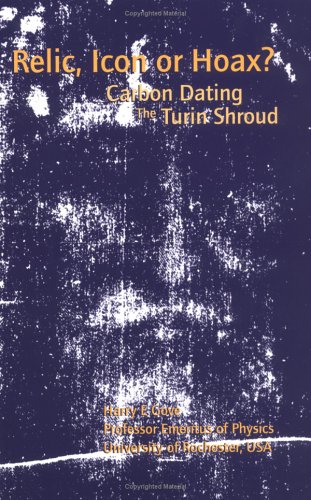
 This is the Bibliography "G" page for author's surnames beginning with
[Left: Physics professor Harry E. Gove's book, "Relic, Icon or Hoax?: Carbon Dating the Turin Shroud" (1996). See PS below.]
"G" of books that I will probably refer to in my book outline, "The Shroud of Turin: Burial Sheet of Jesus?"
© Stephen E. Jones
BIBLIOGRAPHY "G"
Garza-Valdes, L.A., 1998, "The DNA of God?," Hodder & Stoughton: London.
Gove, H.E., 1996, "Relic, Icon or Hoax?: Carbon Dating the Turin Shroud," Institute of Physics Publishing: Bristol UK.
Guerrera, V., 2000, "The Shroud of Turin: A Case for Authenticity," TAN: Rockford IL.
Guscin, M., 1998, "The Oviedo Cloth," Lutterworth Press: Cambridge UK.
PS: See `tagline' quotes below (bold emphases mine). These include quotes from Gove's book, in which Gove reveals himself to be implacably hostile to the Shroud being the burial sheet of Jesus, but he nevertheless was strongly critical, before the event, of the 1988 radiocarbon dating of the Shroud. Gove's "blow-by-blow chronicle of the events leading up to, and immediately following the Shroud radiocarbon dating" (Wilson, BSTS Newsletter, 45, June/July 1997), contains clues which in my opinion, are evidence of scientific fraud in radiocarbon-dating the Shroud to the too good date ~AD1350 (i.e. "the time its historic record began" - Gove). But as is evident from the last two `tagline' quotes below by Mark Guscin, that date must be wrong, by at least ~7 centuries. Yet how could radiocarbon-dating be that wrong, and still arrive at the `perfect' date, ~AD1350?
Posted: 10 December 2007. Updated: 3 September 2016.
"The evidence I have found has broad implications. For example, my research has clarified many puzzles about the age of the Shroud, particularly the 1988 radiocarbon dating, whose proponents concluded that the Shroud does not date from the time of Jesus of Nazareth. I now know that this conclusion was mistaken, but the reasons were not apparent back in 1988. I have discovered on the Shroud what I call a bioplastic coating, a type of clear encasing that is invisible to the unaided eye. Today, it looks to viewers like a shiny lamination, which is why some eyewitnesses say the Shroud has a surprising `surface sheen'. It is not, however, a manmade coating; it is actually composed of millions of living microbiological organisms that have formed over time, somewhat like a coral reef. This is a natural process I had earlier noted while doing research an other ancient artefacts. When the scientists used carbon dating on Shroud samples in 1988, they did not realize that they were dating, as one entity, both the original ancient fabric and this living bioplastic coating. Their mistaken result was off by centuries. My conclusion, based on evidence I have gathered, is that the Shroud of Turin is not a medieval fake, as was suggested, but is quite possibly a relic of the time of Jesus of Nazareth." (Garza-Valdès, L.A., "The DNA of God?," Hodder & Stoughton: London, 1998, pp.2-3).
"This led to a fruitful research programme in microbiology and DNA studies conducted on the white blood cell remnants present in the blood globules from the occipital region. I explained my problems with the blood to Dr Victor Tryon, Director of the Center for Advanced DNA Technology at UTHSC at San Antonio, where a technique known as polymerase chain reaction (PCR) is regularly used for establishing the DNA make-up of samples. Dr Tryon knew that the sample we were using came from the Shroud of Turin. One cannot hide the purpose of research when depending on the advice of an expert in the field. But Nancy, Dr Tryon's wife, who actually ran the samples through the PCR equipment, was not aware of the origin of the sample. ... Tryon advised that we try cloning the easiest of the genes that could be obtained from ancient blood, the betaglobin gene. What we were not sure of was whether the blood ... would be too degraded for cloning. Fortunately, our fears were unfounded, and Nancy was able to clone the blood sample and amplify it. A blood globule from the five tiny collections on the Scotch tape was used, and the betaglobin gene segment from chromosome 11 was cloned. This proved conclusively that there was ancient blood on the Shroud. We could not, of course, tell from whom it had come, nor whether that person had Semitic blood. ... Nor could we ascertain how old the blood was. Obviously there was the possibility of contamination and the possibility that blood from someone other than the crucified victim happened to fall on the part of the Shroud from which the sample was taken. But it is certainly more likely that the blood came from the Man on the Shroud, rather than a bystander, in view of the fact that the sample was taken from the back of the head, from the area where the crown of thorns would have damaged the head of the victim." (Garza-Valdes, 1998, pp.40-41).
"G. Riggi was happy with the news I imparted by telephone, as was everyone in Dr Tryon's laboratory. But at this stage, all we could say about the blood was that it was ancient, because of the degree of degradation of the small amount of blood we found on our sample, and that it had come from a human being or high primate. Nothing more. The next stage of the research was to uncover evidence that could have been regarded as controversial, and that was to be followed by another stage with even more potential for sensationalism. ... In order to establish the sex of the individual, one can look for the testes-descending gene, which is positive only in the male. If you don't find it, however, you cannot conclude that your sample is from a female: it may be that something went wrong during the testing procedure. Another way to determine the sex is to clone the genes amelogenin-X and amelogenin-Y, and that is what Dr Tryon advised. Again he was right; the PCR technique enabled us to isolate the amelogenin-X gene from chromosome X and the amelogenin-Y gene from chromosome Y. ... we had proved that the blood on the Shroud had belonged to a human male." (Garza-Valdes, 1998, pp.41-42).
"Shroud aficionados entering the Cathedral of John the Baptist in Turin are confronted, outside the Royal Chapel, with a full-size, colour photograph of the Turin Shroud. That will have to satisfy their curiosity. The shroud itself is stored, elaborately coffined, on an altar behind a triply locked iron grill in the cathedral's chapel. It is only displayed to the public on special occasions every forty years or so. The photograph shows an altogether impressive and beautiful stained linen cloth the colour of old ivory, 14' 3" long and 3' 7" wide. It bears the faint front and back imprint of a naked crucified man with hands folded modestly over his genitals. The image depicts all the stigmata of the crucifixion described in the Bible including a large blood stain from the spear wound in the side. The linen weave is a three to one herringbone twill. A seam or tuck divides the main body of the shroud from a 6" side strip of the same weave which runs almost the entire length of the cloth. A backing cloth of basket weave covering the entire back area of the shroud is exposed at both ends of this side strip where pieces of the side strip have either been removed or never existed." (Gove, H.E., "Relic, Icon or Hoax?: Carbon Dating the Turin Shroud," Institute of Physics Publishing: Bristol UK, 1996, p.1).
"The most notable feature of the shroud is the sixteen patches that were applied symmetrically in pairs to the front of the shroud in 1534, two years after it was damaged in a fire that occurred in the chapel in Chambery, France, where the shroud was stored in a silver chest. Gouts of molten silver burned through the shroud, fortunately outside the image, in a symmetric fashion due to the way in which it was folded in the chest. The shroud was doused with water before the fire damage could spread to the image. This near catastrophe, however, did yield some interesting scientific information. Silver melts at a temperature close to 1800°F. Because the shroud was folded inside the chest, there had to be a considerable variation of temperature at various points on the image ranging from something near this high temperature to ones approaching normal room values. Yet there was essentially no change in the appearance of the image from one region to another. Since many art pigments volatilize at temperatures well below the melting point of silver, those that could have been used, if it is a painting, are rather limited.' (Gove, 1996, pp.1,3).
"I believed STURP's members to be so convinced it was Christ's shroud that I was determined to prevent their involvement in its carbon dating, if that were ever to come about. I feared the most important measurement that could be made on the shroud would be rendered less credible by their participation. Fortunately in this I was successful." (Gove, 1996, pp.6-7).
"It is well known to scientists that one can sometimes obtain a desired scientific result by subconscious manipulation of the technique or the data. It is a human flaw that must be carefully guarded against. It is most easily circumvented by not having preconceived notions of what the answer should be." (Gove, 1996, pp.8-9).
"In a letter postmarked 15 April 1987 Sox sent me a clipping from the London Times dated 15 April 1987, that was titled 'Science and the Shroud'. It was based on an interview with Professor Edward Hall of Oxford University. Hall asked the reporter to imagine a path about 130 yards wide made of a single layer of sand stretching from the Earth to the Moon. Our task, he explained, was the equivalent of finding a grain of sand in that path that differed slightly from the other grains. That was a measure of the problem being undertaken by seven laboratories in Europe and America sometime in the coming months." (Gove, 1996, p.184).
"I listed the changes in the Turin Workshop Protocol being proposed by Ballestrero, clearly on the advice of Professor Gonella. 1. Five AMS and two small-counter laboratories reduced to three AMS laboratories. 2. No independent textile expert designated to remove the shroud samples. 3. Laboratory representatives not permitted to witness shroud sample removal. 4. No suggested involvement by laboratory representatives in the final data analysis. 5. No official involvement by the Pontifical Academy of Sciences at any stage. Professor Chagas invited to participate merely as a guest of the Cardinal of Turin." (Gove, 1996, p.218).
"The draft letter to the pope read as follows: `Your Holiness: Following your specific instructions, representatives of scientific laboratories specializing in the technique of carbon dating small samples met in Turin on 29 September-1 October 1986, to discuss the protocol to follow should you permit the dating of the Holy Shroud of Turin. The workshop was held under the joint sponsorship of His Eminence Cardinal A Ballestrero and of the Pontifical Academy of Sciences. At the end of this workshop a detailed protocol was arrived at that was agreed upon by all participants. The two main guiding principles were: 1. Removal of a minimum amount of Shroud material. A total of 122 square centimetres (less than 0.03 per cent of the total surface of the Shroud) will suffice for all the laboratories. 2. Absolute scientific credibility. It was unanimously decided that, to improve the statistical credibility of the analysis, a minimum of seven laboratories should perform the dating. It is important to note that they use different techniques." (Gove, 1996, p.218).
"In a letter dated 10 October 1987 to all the workshop participants, Cardinal Ballestrero has ordered substantial modifications to the original protocol. In particular, the number of laboratories is reduced, without any explanation, to three. ... `It is our collective impression that Cardinal Ballestrero has received very unwise scientific advice. The proposed modifications will confirm the suspicion of many people around the world that the Church either does not want the Shroud dated or it wants to have it done in an ambiguous way. The procedure that the Cardinal of Turin is suggesting is bound to produce a result that will be questioned in strictly scientific terms by many scientists around the world who will be very skeptical of the arbitrarily small statistical basis when it is well known that a better procedure was recommended. Since there is great world expectation for the date of the Shroud, the publicity resulting from a scientifically dubious result will do great harm to the Church. ... Rather than following an ill advised procedure that will not generate a reliable date but will rather give rise to world controversy, we suggest that it would be better not to date the Shroud at all'." (Gove, 1996, pp.218-219).
"The fourth enclosure was the proposed press release. It outlined the events up to Ballestrero's rejection of the Turin workshop agreement and his selection of only three labs to carbon date the shroud. It was an expanded version of the proposed letter to the pope. The concluding paragraph read: `The new procedures suggested to the Cardinal of Turin and that he has now embraced, will, if implemented, yield a result for the date of the Shroud that will certainly be vigorously challenged by the world scientific community for their flimsy statistical basis. We urge the Cardinal of Turin to seek scientific advice from an unimpeachable source that was available to him from the very beginning, but that he chose to ignore, namely the Pontifical Academy of Sciences, which enjoys worldwide respect in the world scientific community. Only with the best advice of world experts on carbon-14 dating can a scientifically credible date for the Shroud of Turin be arrived at.'" (Gove, 1996, p.219).
"On 3 November 1987, Hall told me that he would not sign the letter to the pope. ... He said that if all three labs got the same result then of course everything would be fine, but he agreed there was some risk. ... He thought representatives from the labs must be at least in the next room when Tite supervised the cutting, and that they should receive the samples right there and then. He was particularly concerned that the British Museum be protected against the charge that Tite substituted samples. That charge could be made if there were no witnesses other than Turin authorities when the sample was taken under Tite's supervision. (In the event, that was what happened and such a charge was later made.)" (Gove, 1996, pp.220-221).
"The letter [to Cardinal Ballestrero] read: `Your Eminence: ... we are concerned to learn that a decision has been made to limit the number of participating laboratories to three. We are in agreement with the conclusions reached at the workshop held in Turin in September-October 1986, that is: "a minimum amount of cloth will be removed which is sufficient to (a) insure a result that is scientifically rigorous and (b) to maximize the credibility of the enterprise to the public. For these reasons, a decision was made that seven laboratories will carry out the experiment..." `We believe that reducing the number of laboratories to three will seriously reduce "the credibility of the enterprise" which we are also anxious to achieve. As you are aware, there are many critics in the world who will scrutinize these measurements in great detail. The abandonment of the original protocol and the decision to proceed with only three laboratories will certainly enhance the skepticism of these critics. While we understand your desire to use a minimum amount of material from the Shroud, we believe that the increased confidence which would result in the inclusion of more than three laboratories in the programme would justify the additional expenditure of material. Although improvements in statistical errors resulting from including more measurements might not be great, the possibility of the occurrence of unrecognized non-statistical errors would be substantially reduced. For example, if only three laboratories participate, and one of them obtains a divergent non-understandable result, the entire project could be jeopardized, but if results from a larger number of laboratories are available, a divergent result could be more easily recognized as such and can be treated appropriately in a statistically accepted manner. Clearly it is the reduction of unrecognized non-statistical errors in measurements that leads to increased confidence in the final result. We would very much like to take part in the programme to determine the age of the cloth in the Shroud, but we are hesitant to proceed under the arrangement in which only three laboratories would participate in the measurements. We urge that the decision to change the protocol of the Turin workshop and to limit participation to only three laboratories be given further consideration. Respectfully...' This letter spelled out in the most transparently unambiguous way the reasons for having the measurements made by more than three labs. It would add little or nothing to the statistical accuracy of the final result but it would provide a remedy for a rogue result by one laboratory as it had in the case of the British Museum's interlaboratory comparison." (Gove, 1996, pp.222-223).
"One of the next things I did-another last-gasp effort-was to write a letter to Sir David Wilson, the Director of the British Museum, dated 27 January 1988. I enclosed a copy of the press release issued by the British Museum following the 22 January meeting. I said that I had no reservations whatsoever concerning Dr Tite's honesty, integrity and credibility as a representative of the British Museum in this enterprise. However, there were many people who were overly suspicious of the entire operation. The situation was particularly exacerbated by the fact that the head of one of the three laboratories to be involved, Professor E T Hall of Oxford, was also on the board of directors of the British Museum. I pointed out that the original protocol called for a third person to be involved in both the certification and data analysis, namely the president of the Pontifical Academy of Sciences or his representative. I said that Dr Chagas was such a distinguished scientist that if both he and Dr Tite had been involved and if the original seven labs had participated, the enterprise would have been as credible as possible. I was astonished that Wilson would permit the British Museum to risk having its reputation called into question in what had become a somewhat shoddy enterprise." (Gove, 1996, p.242).
"On 25 April at 11 am, Harbottle called. He had learned from Otlet that the shroud samples had been removed on 21 April 1988. Hall had flown into London on 25 April with the samples in hand and he received a lot of publicity. The archbishop had been, according to Harbottle, furious about Hall's trying to commercially capitalize on the venture. Harbottle also said that the BBC were going to film the measurements at Zurich. He said that, according to Otlet, there was no possibility this time of any outliers because the three labs would consult together so the answers would come out the same. I must say I thought that Otlet was being either paranoid or surprisingly cynical." (Gove, 1996, p.252).
"The 24 March 1988 edition of Nature contained another letter from Denis Dutton. He expressed the worry that nobody had come forward with procedures to secure the authenticity of the samples. He deplored the reduction of the number of labs to three. Shut out from the tests would be Dr Harry Gove of the University of Rochester and Dr Garman Harbottle of the Brookhaven National Laboratory, as well as the Saclay laboratory of France and the Atomic Energy Research Establishment at Harwell. Of equal importance was the fact that the Vatican officials in charge of the test had still not come forward with procedures to secure the authenticity of the samples-procedures, for example, to make it impossible for ancient mummy linen to be surreptitiously introduced into the chain of evidence. Dutton is clearly an eminent and respectable man but he was certainly snatching at straws here. I don't think anyone in the seven carbon dating labs ever worried that there might be a substitution of Egyptian linen for the shroud-at least I certainly did not." (Gove, 1996, p.248).
"Eight of the ten samples in this first historic load were OX1, OX2, blank, two shroud and three controls. ... Damon said the 1/2 cm^2 shroud sample being used in this 6 May run had a red silk thread in it as well as some blue threads or fibrils and they had been removed. There was absolutely no problem in identifying the shroud-it was finely, closely hand woven (the weave was not as even as it would have been if done by a machine) and it was the unmistakable shroud herringbone weave." (Gove, 1996, p.263).
"The first sample run was OX1. Then followed one of the controls. Each run consisted of a 10 second measurement of the carbon-13 current and a 50 second measurement of the carbon-14 counts. This is repeated nine more times and an average carbon-14/carbon-13 ratio calculated. All this was under computer control and the calculations produced by the computer were displayed on a cathode ray screen. The age of the control sample could have been calculated on a small pocket calculator but was not-everyone was waiting for the next sample-the Shroud of Turin! At 9:50 am 6 May 1988, Arizona time, the first of the ten measurements appeared on the screen. We all waited breathlessly. The ratio was compared with the OX sample and the radiocarbon time scale calibration was applied by Doug Donahue. His face became instantly drawn and pale. At the end of that one minute we knew the age of the Turin Shroud! The next nine numbers confirmed the first. ... Based on these 10 one minute runs, with the calibration correction applied, the year the flax had been harvested that formed its linen threads was 1350 AD-the shroud was only 640 years old! It was certainly not Christ's burial cloth but dated from the time its historic record began." (Gove, 1996, p.264).
"I received a letter dated 1 June 1988 from Monsignor Giovanni Tonnucci, Charge d'Affaires at the Apostolic Nunciate to the USA in Washington as follows: `Dear Professor Gove ... For your information, I am also enclosing a copy of the statement which appeared in the 2 May 1988 issue of the English-language weekly edition of L'Osservatore Romano. With every good wish, I remain sincerely yours.' The article was titled 'Samples of Shroud of Turin taken for scientific dating'. It stated that three samples of cloth from the main body of the Shroud were removed on 21 April 1988. The total weight was approximately 150 milligrams comprising a strip measuring about 1 cm by 7 cm. It stressed the procedures followed to ensure blindness and described the three control samples. The ones supplied by the British Museum were stated to be a fabric of the first century AD and the other of the eleventh century AD while a fourth sample, the source of which was not given, was said to be dated about 1300 AD. It gave the names of the two textile experts who were present, Professor Franco A Testore of the Polytechnic of Turin assisted by M. Gabriel Vial of the Historical Museum of Fabrics of Lyon, and said the entire operation was videotaped and documented photographically. What really surprised me was the fact that the ages of the control samples were given in this news report and they actually corresponded to the results on the three control samples later obtained by the three laboratories. The article appeared even before Arizona carried out their measurements, although I am sure Damon and Donahue were not aware of it (the first Arizona measurement, at which I was present, was carried out six days after the article appeared). However, both Zurich and Oxford made their measurements considerably later and people in those two labs might have been aware of L'Osservatore Romano article." (Gove, 1996, pp.269-270).
"Meanwhile, the story that the Shroud of Turin was a fake was getting increased attention from the press. The original rumour that the shroud was medieval appeared in the article by Kenneth Rose in the London Sunday Telegraph. Aside from a naive statement from Ballestrero that the labs would not know which of four samples was the shroud, there was not much reaction to the Rose report. However, this changed when the 27th August 1988 edition of the Washington Post carried a story by Tim Radford of the Guardian that "The furor began after Dr Richard Luckett of Cambridge University wrote in the Evening Standard yesterday that a date of 1350 'looks likely' for the 14-foot piece of linen which appears to bear the imprint... of Jesus. He also referred to laboratories as "leaky institutions".' ... Somehow the impression had been created that the 'leaky institution' Luckett referred to was Hall's Oxford Laboratory because the Washington Post quoted Gonella as saying `Frankly we in Italy feel we have been taken for a ride. I am amazed that there should be indiscretions of this sort from a university like Oxford. We had expected different behaviour from a laboratory of this reputation.' ... A friend of mine who was visiting Mexico sent me a clipping from the 27th August edition of the Mexico City News. It quoted the report carried by the Evening Standard on 26 August and provided a few more details from that report. The Evening Standard report claimed that Oxford had found the shroud to be a fake which dated only to 1350 AD. It gave no attribution for its report but quoted Dr Richard Luckett of Magdalen College, Cambridge as saying `I think that as far as seems possible the scientific argument is now settled and the shroud is a fake'. ... Oxford had completed their measurements during the first week of August and had sent them to the British Museum. Hall certainly knew the Oxford result at the time of the leak and may also have known the overall result that was to be published in Nature." (Gove, 1996, pp.277-278).
"The Rochester Democrat and Chronicle also carried the story on the front page of their 27th August edition under the headline 'UR (University of Rochester) scientist rejects story of relic's age'. The subhead read 'London paper claims tests show Shroud of Turin a fake'. The report read: `The ... London Evening Standard yesterday reported, without attribution, that radio-carbon tests at Oxford University showed the shroud was made about 1350. ... ' ... The article stated that Luckett, whose university is an ancient rival of Oxford, was not connected with the tests but had been associated with investigations of the shroud's history. `He wrote in a separate article in the Evening Standard that laboratories "are rather leaky places" but did not elaborate.' ... An Associated Press story appeared in the 9 September 1988 issue of the Rochester Democrat and Chronicle headlined 'Shroud's age remains secret Oxford research chief says', with the subhead 'He claims forgery report was just a guess'. Teddy Hall was quoted to this effect in the Oxford Mail. The article went on `But Dr Richard Luckett, a Cambridge University professor, said he stood by his word, adding, "I had an absolutely marvellous leak from one of the laboratories and it wasn't Oxford." Luckett, last month, said tests at Oxford showed the shroud was made in 1350. ... I must say I wondered about Luckett's date of 1350 because it was the date Donahue announced to me when I was present at the first radiocarbon measurement on the shroud in 6 May 1988. Of course, it also corresponds very closely to the shroud's known historic date. However, I still assumed Luckett had said he got the number from Oxford. When I read that he claimed he got it from one of the other two labs I worried that it might have come from someone who was present at Arizona during the first measurement." (Gove, 1996, pp.278-279).
"Peter Rinaldi ? wrote to his shroud friends that this had been a busy and difficult time for him. `I doubt if the cause of the Shroud ever went through more trying times than it did during the last year. Surely you must know by now that the scientists, using the ultimate test, the carbon-14 analysis, have dated the origin of the Shroud to the 14th century AD. This would mean, of course, that the Shroud is not the burial cloth of Christ.'... He continued: `Let me say, first of all, that not all the experts accept the results of the test. Some of them are actually calling for a new test on good scientific grounds. I was intrigued by what one of them told me: "Valid or not, the results of the carbon-14 test in no way solve the mystery of Christ's image on that cloth. The test has not said the last word on the Shroud".' He recounted how, `Shortly after the results of the carbon-14 tests were announced, a friend met me in front of the Turin Cathedral. Placing his hand on my shoulder, he said mournfully: "I feel terribly sorry for the Church and for you". "You can't be serious," I told him. "Do you really think the Church will fall apart because the Shroud may not be what many of us supposed it to be? The Church has nothing to fear from the truth, provided, of course, it is backed by solid facts... .I might be persuaded to accept the results of the test only when someone will demonstrate beyond all question, how a medieval artist produced so extraordinary an image as that of the Shroud".'" (Gove, 1996, pp.292-293).
"ONE cloth which can contribute a great deal to the study of the Shroud of Turin and its authenticity is the Sudarium of Oviedo. This cloth has been kept in Spain since the seventh century and housed in the cathedral of Oviedo, a town in the north of Spain, since the eleventh century. The sudarium is a piece of bloodstained cloth woven with the same type of thread as the Shroud. The cloth bears no image and measures two feet nine inches by one foot nine inches. It is believed by many to be the face cloth or napkin that covered the face of Christ when He was taken down from the Cross. The sudarium is mentioned in the Gospel of St. John: `Then Simon Peter came, following him, and went into the tomb; he saw the linen cloths lying, and the napkin [Gk. soudarion], which had been on his head, not lying with the linen cloths but rolled up in a place by itself' (John 20:6-7). According to Jewish burial traditions, it was considered impertinent to show the disfigured face of a dead man. Therefore, a sweat cloth or a napkin was placed over the face and was then discarded at the tomb." (Guerrera, V., "The Shroud of Turin: A Case for Authenticity," TAN: Rockford IL, 2000, p.41. Emphasis original).
"The history of the sudarium is better documented than that of the Shroud of Turin. Much of our information on the cloth comes from the writings of Bishop Pelayo, who was bishop of Oviedo in the twelfth century. According to his Book of the Testaments of Oviedo and the Chronicon Regum Legionensium, the sudarium was preserved in Jerusalem up to the year 614, when the city was conquered by the Persian King Chosroes II, who reigned from 590 to 628. [Guscin, M., "The Oviedo Cloth," Redwood Books: Trowbridge UK, 1998, p.14] At that time a priest by the name of Filipo took the cloth and other relics, which were kept in a cedar chest to Alexandria for safekeeping. When Chosroes conquered Alexandria in 616, the cloth was taken across the north of Africa to evade the advancing Persians. The cloth was then brought to Spain via Cartagena where Saint Fulgentius, bishop of Ecija, received the chest, or holy ark, along with the fleeing refugees. In turn, he entrusted the holy ark containing the sudarium to Saint Leandro, Bishop of Seville. Leandro once lived in Constantinople from 579 to 582 and may very well have seen the Shroud itself. Evidence for this can be gleaned from a verse in the Mozarabic Liturgy for Easter Saturday which is associated with Leandro. In the Illatio we read: `Peter ran to the tomb with John and saw the recent imprints of the dead and risen one on the cloths.' [Ibid., p.17] This makes for another interesting connection between the Shroud and the sudarium." (Guerrera, 2000, pp.41-42).
"Saint Isidore later succeeded Saint Leandro as Bishop of Seville. One of Isidore's disciples was Saint Braulio, Bishop of Zaragoza (585-651). In the eighteenth century, twenty-four of his letters were discovered in Lyons. In one of his letters written in 631 to a priest named Tayo, Braulio says: `But at that time they knew about many things that happened but were not written down, as one reads concerning the linen cloths, and the sudario with which the Lord's body was enveloped, that it was found, but one does not read that it was preserved. For I do not believe that it was ignored, with the result that these relics were not kept by the Apostles for future times, and other things of that sort. [San Braulio de Zaragoza, in Migne, J.P., ed., "Patrologia Latina," Vol. 80, Buffer, T., trans., Apud Editorem: Paris, 1850, col. 689] Isidore was eventually succeeded by Saint Ildefonso, who had been his student. When Ildefonso was appointed Bishop of Toledo in 657, he took the chest with him where it remained until 718. With the invasion of the Moors at the beginning of the eighth century, the chest containing the sudarium was taken farther north to Asturias, according to some authors, to avoid destruction. It was here that it first became designated as the `holy ark.' Initially it was kept in a cave now known as Monsacro, six miles from Oviedo. In 840, King Alfonso II commissioned a special chapel in the cathedral, called the Camara Santa, to house the holy ark. The fact that the sudarium has been in the region of Asturias from ancient times cannot be disputed. On March 14, 1075, the holy ark was opened on the occasion of a visit by King Alfonso VI. Also present were his sister Urraca Fernandez and Rodrigo Diaz de Vivar, better known as El Cid. At this time a list was made of its contents. The King ordered that the chest be silver-plated to honor the precious relics. The bas relief includes images of Our Lord, the Twelve Apostles and the Four Evangelists. This work was finally realized in 1113. An inscription on the reliquary reads: `el Santo Sudario de NS.J.C.' (`the Holy Sudarium of Our Lord Jesus Christ')." (Guerrera, 2000, pp.42-43).
"Much of the scientific research on the sudarium has been carried out by the Equipo de Investigacion del Centro Espanol de Sindonologia (EDICES) under the direction of Guillermo Hernias and Dr. Jose Villalain of the University of Valencia. They first studied the sudarium in late 1989 and early 1990. ... During their studies they excised minute samples of the cloth and also tested pollen and dust from its surface. Previous research on the cloth had been carried out by Monsignor Giulio Ricci and Dr. Max Frei, who took pollen samples from the Shroud of Turin. Frei conducted similar pollen tests on the sudarium and found pollen from Jerusalem, Oviedo, Toledo and North Africa, consonant with the ancient account of the sudarium's itinerary. [Guscin, 1998, p.22] Of the thirteen pollens that were found, eight were on both the Shroud and the sudarium. [Whanger, A.D. & Whanger, M.W., "A Comparison of the Sudarium of Oviedo and the Shroud of Turin Using the Polarized Image Overlay Technique," Sudario del Señor: Universidad de Oviedo, 1996, p.380] There is no evidence on the cloth of any pollen which is indigenous to Turkey, Constantinople, France or Italy, which are believed to be the locations along the route the Shroud traveled. Subsequent pollen studies conducted by Dr. Carmen Gomez Ferreras, a biologist at the University of Complutense in Madrid, found pollen from three genera of plants identified as quercus, pistacia and tamarix, which are native to the region of Palestine. [Ferreras, C.G., "El Sudario de Oviedo y la Palinologia, " Sudario del Señor, p.86]" (Guerrera, 2000, pp.42-43).
 "Stain Marks Perhaps the most obvious
[Right (click to enlarge): Perfect match of overlay of the face of the Shroud of Turin on the Sudarium of Oviedo, Wikipedia]
characteristics of the sudarium are its numerous stain marks. Scientific analysis has shown that the main stains are composed of one part blood and six parts of pulmonary oedema fluid. [Guscin, 1998, p.22] It has also been established that when a person dies by crucifixion, "his lungs are filled with the fluid from the oedema. If the body is moved or jolted, this fluid can come out through the nostrils." [Ibid., p.23] This finding is consistent with the manner in which the man on the Shroud died. The remarkable aspect about the bloodstains on the sudarium is that they match exactly the shape and form of the face of the man on the Shroud. Dr. Alan Whanger, professor emeritus of psychiatry at Duke University Medical Center in Durham, North Carolina, and his wife Mary, developed the polarized image overlay technique which, in order to make comparisons, allows for two images to be superimposed using polarized filters. When they applied this technique to the sudarium and the Shroud, they found over seventy-five congruent blood stains on the facial portion of the two cloths and fifty-five congruent blood stains on the back of the head and neck. Consequently, Dr. Whanger believes that these one hundred thirty points of congruence between the sudarium and the Shroud provide overwhelming evidence that both linens touched the same person. In a court of law, only forty-five to sixty points of congruence are needed to establish a facial identity. Professor Avinoam Danin, a botanist from Hebrew University in Jerusalem, and the world authority on the flora of the Near East, said: "There's no possibility that this cloth in Oviedo and the Shroud would both have the same blood stains and these pollen grains unless they were covering the same body." [Danin, A., The Holy Shroud Guild Newsletter, December 25, 1999, p. 3] Also noteworthy about the facial characteristics of the two cloths is that both exhibit typical Jewish features: a prominent nose measuring eight centimeters or a little over three inches, and high cheek bones. What is more, the beard of the sudarium matches that of the Shroud perfectly. There is also a high concentration of dust in the nasal area suggesting that the man may have fallen on his face." (Guerrera, 2000, pp.44,47. Emphasis original).
"Dr Alan Whanger has studied the points of coincidence and relationship between the Shroud and hundreds of Byzantine paintings and representations of Christ, even using coins, from the sixth and seventh centuries. This was done using a system called Polarised Image Overlay Technique. His conclusion was that many of these icons and paintings were inspired by the image on the Shroud, which means that the Shroud must have been in existence in the sixth and seventh centuries. This coincides with Ian Wilson's theory that the Shroud was `rediscovered' in Edessa just before this. Dr Whanger applied the same image overlay technique to the sudarium, comparing it to the image and blood stains on the Shroud. Even he was surprised at the results. The frontal stains on the sudarium show seventy points of coincidence with the Shroud, and the rear side shows fifty. The only possible conclusion, according to this highly respected scientist, is that the sudarium covered the same face as the Turin Shroud. If this is so, and taking into account that it is impossible to deny that the sudarium has been in Oviedo since 1075, it casts a great shadow of doubt over the results of the Shroud's carbon dating." (Guscin, M., "The Oviedo Cloth," Lutterworth Press: Cambridge UK, 1998, p.32).
"Carbon 14, Again We are faced with a choice. There are two irreconcilable conclusions, one of which must be wrong. All the studies on the sudarium point to its having covered the same face as the Shroud did, and we know that the sudarium was in Oviedo in 1075. On the other hand, the carbon dating specialists have said that the Shroud dates from 1260 to 1390. Either the sudarium has nothing to do with the Shroud, or the carbon dating was wrong - there is no middle way, no compromise. If the sudarium did not cover the same face as the Shroud, there are an enormous number of coincidences, too many for one small piece of cloth. If there was only one connection, maybe it could be just a coincidence, but there are too many. The only logical conclusion from all the evidence is that both the Oviedo sudarium and the Turin Shroud covered the same face. As we have already seen from the Cagliari congress, there are also many inherent reasons why the Shroud cannot be fourteenth century, reasons that nobody has been able to disprove, and only one that suggests a medieval origin-carbon dating. Those who believe in the carbon dating have never been able to offer any serious proof or evidence to explain why every other scientific method practised on the Shroud has given a first century origin as a result, most have not even tried. It can hardly be considered rational or scientific to blindly accept what conveniently fits in with one's own personal ideas without even taking into consideration what others say. And after all, carbon dating is just one experimental method compared with dozens of others, and it stands alone in its medieval theory. If both the sudarium and the Shroud date from the first century, then the carbon dating must be mistaken, and it is the duty of those who believe in the dual authenticity of the cloths to show why carbon dating has shown the Shroud to be first century. Those who have attempted this can be broadly divided into two bands, those who think that the particular process of the Shroud's carbon dating was a fake, a deliberate deception by the scientists involved, and those who believe that the whole process of carbon dating is not as reliable as it is made out to be, and is far from infallible." (Guscin, 1998, pp.64-65).
"However, let us suppose for a while that the results obtained from the carbon dating of both the sudarium and the Shroud are accurate, and neither cloth ever touched the body of Jesus. In that case, the following story would have to be true. Sometime in the seventh century, in Palestine, after reading the gospel of John, a well known forger of religious relics saw the opportunity of putting a new product on the market - a cloth that had been over the face of the dead body of Jesus. This forger was also an expert in medicine, who knew that a crucified person died from asphyxiation, and that when this happened, special liquids fill the lungs of the dead body, and can come out through the nose if the body is moved. The only way he could get this effect on the cloth was by re-enacting the process, so this is exactly what he did. He crucified a volunteer, eliminating those candidates who did not fulfil the right conditions - swollen nose and cheeks, forked beard to stain the cloth, etc. When the body was taken down from the cross, he shook it around a bit with the help of a few friends, holding the folded cloth to the dead volunteer's nose so that future generations would be able to see the outline of his fingers. He even stuck a few thorns in the back of the dead man's neck, knowing that relic hunters would be looking for the bloodstains from the crown of thorns. Being an eloquent man, he convinced people that this otherwise worthless piece of cloth was stained with nothing less than the blood and pleural liquid of Christ, and so it was guarded in Jerusalem with other relics, and considered so genuine and spiritually valuable that it was worth saving first from the invading Persians and later from the Arabs. A few hundred years later, some time between 1260 and 1390, another professional forger, a specialist in religious relics too, decided that the time was ripe for something new, something really convincing. There were numerous relics from various saints in circulation all round Europe, bones, skulls, capes, but no, he wanted something really original. Various possibilities ran through his mind, the crown of thorns, the nails from the crucifixion, the table cloth from the last supper, and then suddenly he had it - the funeral shroud of Jesus! And not only that, but he would also put an image on the Shroud, the image of the man whom the Shroud had wrapped! The first step was difficult. Being an expert in textile weaves, (one of his many specialities, the others being pollen, Middle East blood groups, numismatism of the years of Tiberius, photography, Roman whips, and electronic microscopes) he needed linen of a special kind, typical of the Middle East in the first century. Once this had been specially ordered and made, he folded it up before starting his work, as a neighbour had suggested that such a cloth would have been folded up and hidden in a wall in Edessa for a few hundred years, so the image would be discontinuous on some of the fold marks. Leaving the cloth folded up, he travelled to Oviedo in the north of Spain, where he knew that a forerunner in his trade had left a cloth with Jesus' blood stains. On obtaining permission to analyse the sudarium, he first checked the blood group - AB of course, common in the Middle East and relatively scarce in Europe - then made an exact plan of the blood stains (carefully omitting those which would have already clotted when the sudarium was used) so that his stains would coincide exactly. After his trip to Oviedo, he went on a tour of what is now Turkey, forming a composite portrait of Jesus from all the icons, coins and images he could find. After all, he needed people to think that his Shroud had been around for over a thousand years, and that artists had used it as their inspiration for painting Christ. He didn't really understand what some of the marks were, the square box between the eyes, the line across the throat, but he thought he'd better put them on anyway. He didn't want to be accused of negligence, because he was an internationally famous forger and had a reputation to maintain. Once he was back home, he somehow obtained some blood (AB, naturally) and decided to begin his work of art with the blood stains, before even making the body image. Unfortunately, he miscalculated the proportions, and the nail stains appeared on the wrist instead of on the palms of the hands, where everyone in the fourteenth century knew that they had been. `Well', he thought, `it's just a question of a few inches, nobody will notice.' Now, even the omniscient author is forbidden to enter in the secret room where the forger `paints' the image of Christ, a perfect three dimensional negative, without paint or direction. His method was so secret that it went to the tomb with him. After a few hours, he opened the door, and called his wife, who was busy preparing dinner in the kitchen. `What do you think?' `Not bad. But you've forgotten the thumbs' `No, I haven't. Don't you know that if a nail destroys the nerves in the wrist, the thumbs bend in towards the palm of the hand, so you wouldn't be able to see them?' `But didn't the nails go through the palms?' `Well, yes, but I put the blood on first, and didn't quite get the distance right' `Oh, in that case ... and what about the pollen?' `What pollen?' `Well, if this Shroud has been in Palestine, Edessa, and let's suppose it's been in Constantinople too, it's going to need pollen from all those places.' Our forger loved the idea, got the pollen from all the places his wife had indicated, and delicately put it all over his Shroud. And then, the final touch. Two coins from the time of Christ, minted under the emperor Tiberius, to put over the man's eyes. Our man had a sense of humour too - he decided that the coins would be included in the image in such a way that they would only be visible under an electronic microscope. Such a story, even without the embellishments, is more incredible than the Shroud's authenticity." (Guscin, 1998, pp.84-88).



 Posts


