Friday, October 10, 2008

Shroud of Turin News - August 2008

Here, belatedly is my Shroud of Turin News for August 2008. The previous issue was May 2008, since I am not aware of any significant news about the Shroud of Turin in June or July 2008. Articles are in chronological order (earliest first). My comments are in bold.

Oxford view on Shroud of Turin eagerly awaited, Irish Times, August 7, 2008, William Reville

[Right: Prof. William Reville, University College Cork, Ireland]

THE TURIN SHROUD (TS) poses a fascinating mystery. It is a linen cloth (4.42m x 1.13m) bearing the image of a man that many believe is the crucified Jesus Christ. The cloth has been investigated scientifically but the jury is still out as to the age of the TS and the identity of the man whose image it carries. That a Professor for the Public Awareness of Science, as Prof. Reville is, to concede 20 years after the 1988 radiocarbon dating report in Nature claimed that:

"The results provide conclusive evidence that the linen of the Shroud of Turin is mediaeval." (Damon, 1989, "Radiocarbon Dating of the Shroud of Turin," Nature, p.612).

that "the jury is still out as to the age of the T[urin] S[hroud]" is itself evidence, bordering on proof, that the Shroud is the very burial sheet of Jesus. Because if it was not, then the Shroud would be a forgery (see Schafersman below). But then, since:

"The Shroud of Turin is now the most intensively studied artifact in the history of the world. Somewhere between 100,000 and 150,000 scientific man-hours have been spent on it, with the best analytical tools available." (Heller, 1983, "Report on the Shroud of Turin," p.219).

science would by now demonstrated not only that the Shroud was a forgery, but what type of forgery it is, and how the forging was done. .... Byzantine tradition refers to a shroud bearing an image of Christ taken from Jerusalem to Turkey in the first century, then lost, rediscovered and brought to Constantinople in 944. .... A fragment of the TS was radiocarbon dated in 1988 by three different laboratories and their results are in agreement. The results claim a 95 per cent probability that the TS dates from between 1260 and 1390 ... The researchers interpreted the TS as a medieval fake .... But there are reasons to question the results of this radiocarbon dating. Contamination of samples can pose serious problems in radiocarbon dating and have caused several anomalous results A refreshingly candid admission. It is highly significant that the problems of radiocarbon-dating ancient linen have increased, while the evidence for the Shroud being in existence long before the 13th century earliest date that "between 1260 and 1390" radiocarbon-dating found it could be, is grounds for rejecting that radiocarbon-dating, even if it could not be shown how it went wrong.... What if the TS really is the burial cloth of Christ? .... The Gospel account of the resurrected Christ is that he was entirely different to a physically embodied Christ - able to pass through walls, and to appear and disappear suddenly. What if his resurrection involved nuclear events in his dematerialisation? Dr August Accetta, California, has carried out a fascinating experiment in which he injected himself with a radioactive compound used in medical imaging to show up internal organs.

[Above: Nuclear radiation image of Dr. August Accetta in Wilson, I. & Schwortz, B., "The Turin Shroud: The Illustrated Evidence," 2000, p.131]

He then assumed the pose of the man imaged on the TS and a gamma camera imaged the radioactivity emanating from his body. The results astonishingly replicated most of the features of the image on the TS. So there you have it. The TS story is still running strongly. We await the results of the Oxford radio carbon dating. .... A surprisingly open-minded consideration by a scientist, that the image on the Shroud could be explained by a burst of radiation emanating from Jesus' body as it changed state at His resurrection:

"... the Lord Jesus Christ, who, by the power that enables him to bring everything under his control, will transform our lowly bodies so that they will be like his glorious body." (Php 3:20-21).

"...`How are the dead raised? With what kind of body will they come?' ... ... The body that is sown is perishable, it is raised imperishable; it is sown in dishonor, it is raised in glory." (1Cor 15:35,41-42).

"... flesh and blood cannot inherit the kingdom of God, nor does the perishable inherit the imperishable. ... the dead will be raised imperishable, and we will be changed." (1Cor 15:50-52).

New findings reveal that the sample used to carbon-date the Shroud of Turin was not the original linen, Society and Religion, India, August 15, 2008... In his presentation yesterday at The Ohio State University's Blackwell Center, Los Alamos National Laboratory (LANL) chemist, Robert Villarreal,
[Left: Program cover: Ohio Shroud of Turin Conference, August 14 - 17, 2008]

disclosed startling new findings proving that the sample of material used in 1988 to Carbon-14 (C-14) date the Shroud of Turin, which categorized the cloth as a medieval fake, could not have been from the original linen cloth because it was cotton. This closely follows the Ohio Shroud Conference press release. Hear Villarreal's presentation (mp3), "Analytical Results on Threads Taken from the Raes Sampling Area (Corner) of the Shroud." The abstract of his paper states:

"The results of the FTIR analysis on all three threads taken from the Raes sampling area (adjacent to the C-14 sampling corner) led to identification of the fibers as cotton and definitely not linen (flax). ... all age dating analyses were conducted on samples taken from this same area. ... the age-dating process failed to recognize one of the first rules of analytical chemistry that any sample taken for characterization of an area or population must necessarily be representative of the whole. .... Our analyses of the three thread samples taken from the Raes and C-14 sampling corner showed that this was not the case." (Villarreal, R., 2008, "Analytical Results on Thread Samples Taken from the Raes Sampling Area (Corner) of the Shroud Cloth," Shroud Science Group International Conference, Ohio State University, August 14-17).

That is, the area of the Shroud adjoining the samples that were radiocarbon-dated in 1988 has now been found to contain cotton, probably from a medieval patch, indicating the samples carbon-dated did not represent the Shroud itself.

According to Villarreal, who lead the LANL team working on the

[Right: Raes' cornerat the bottom left-hand corner of the Shroud (see below). The three threads were from the "Raes fragment" and "Retained" areas near the C-14 samples. The large pale area is missing.]

project, thread samples they examined from directly adjacent to the C-14 sampling area were "definitely not linen" and, instead, matched cotton.

[Right: Raes' corner in relation to the Shroud (click to enlarge). Based on "Examine The Shroud of Turin," Shroud.com]

Villarreal pointed out that "the [1988] age-dating process failed to recognize one of the first rules of analytical chemistry that any sample taken for characterization of an area or population must necessarily be representative of the whole. The part must be representative of the whole. Our analyses of the three thread samples taken from the Raes and C-14 sampling corner showed that this was not the case." It is amazing how unscientifically dogmatic the leaders of the 1988 radiocarbon-dating were, with Oxford's Prof. Hall declaring that anyone who considered the Shroud to be authentic was equivalent to being a member of the "Flat Earth Society":

"... the tests had established a 95 per cent likelihood that the 14-foot linen was made between 1260 and 1390 AD. ... based on counting the number of radioactive carbon 14 atoms in a fragment of the shroud about the size of a postage stamp. .... Professor Edward Hall, the director of the Oxford research laboratory ... said ... believers in the shroud's authenticity ... would probably continue to regard it as genuine, `Just as there is a Flat Earth Society'." (Wilson, & Schwortz, 2000, "The Turin Shroud: The Illustrated Evidence," p.94).

even though the sample of this "14-foot linen" sheet was "about the size of a postage stamp" (i.e. 1.2cm x 8cm, or 0.012m x 0.08m sample of the ~4.3 x 1.1m = 4.732 Shroud, or a mere 0.012 x 0.08m = 0.00096*100/4.73 = 0.02% of the whole)!

Villarreal also revealed that, during testing, one of the threads came apart in the middle forming two separate pieces. A surface resin, that may have been holding the two pieces together, fell off and was analyzed. Surprisingly, the two ends of the thread had different chemical compositions, lending credence to the theory that the threads were spliced together during a repair. Ends of pure linen would not have "different chemical compositions," let alone a "resin ... holding the two pieces together." LANL's work confirms the research published in Thermochimica Acta (Jan. 2005) by the late Raymond Rogers, a chemist who had studied actual C-14 samples and concluded the sample was not part of the original cloth possibly due to the area having been repaired. This hypothesis was presented by M. Sue Benford and Joseph G. Marino in Orvieto, Italy in 2000. Benford and Marino proposed that a 16th Century patch of cotton/linen material was skilfully spliced into the 1st Century original Shroud cloth in the region ultimately used for dating. The intermixed threads combined to give the dates found by the labs ranging between 1260 and 1390 AD. Since the three labs further subdivided each of their one-third of the "postage stamp"sized sample:

"The laboratory in Zurich divided each sample in half, each of which was further subdivided into three. .... The laboratory in Arizona divided each sample into four sub-samples. ... The laboratory in Oxford divided the samples into three." (Guerrera, 2000, "The Shroud of Turin: A Case for Authenticity," pp.130-131).

in order "to do further testing ... If anything went wrong":

"Wolfli [Zurich laboratory] decided to halve each of his samples. This was in case he needed to do further testing. ...If anything went wrong ... Wolfli wanted another try." (Sox, 1988, "The Shroud Unmasked," pp.137-138).

it is not unreasonable to assume they discarded "wrong" dates (e.g. 1st century) and kept testing, until at least one of their subsamples returned a medieval date, being that of the cotton.

Benford and Marino contend that this expert repair was necessary to disguise an unauthorized relic taken from the corner of the cloth. A paper presented yesterday at the conference by Benford and Marino, and to be published in the July/August issue of the international journal Chemistry Today, provided additional corroborating evidence for the repair theory.

Shrouded in mystery, Columbus Dispatch, August 15, 2008, Meredith Heagney .... A conference at Ohio State this weekend will present new research on the authenticity of the Shroud of Turin. Most participants are believers, but a few skeptics will take part. This is a false antithesis. Those of the so-called "skeptics" who hold the philosophy of metaphysical naturalism (i.e. nature is all there is-there is no supernatural) are the real true "believers." All Christians can accept the Shroud is not the very burial sheet of Jesus, bearing the image of His resurrected body, but no metaphysical naturalist "skeptic" can accept that it is! ... There's a new wrinkle in the mystery of a linen cloth that some say held Jesus' body. .... Local researchers say they have new information that discredits the assumption that the shroud is a hoax. It will be presented at a conference this weekend at Ohio State University. ... Robert Villarreal ... further confirms the theory of ... Joe Marino and Sue Benford. ...

[Left: Husband and wife team Joe Marino and Sue Benford]

In the 1500s, the shroud went on a tour of Europe, and security wasn't tight, Benford said. It's possible somebody removed a small piece of the shroud and patched it using "invisible weaving," a common technique at the time that would've left the alteration unnoticeable to the naked eye. .... Despite ample evidence that the relic is a fake, many Christians will insist it's real, said Joe Nickell, a senior research fellow at the Committee for Skeptical Inquiry in Amherst, N.Y. Nickell, who is not a scientist, has written a book about the shroud and said he assembled his own scientific team to examine the data. "Science and scholarship have absolutely proven the Shroud of Turin as a 14th-century forgery," he said. "They're trying to sell you on a mystery." Nickel's "absolutely proven" is typical of the dogmatic "skeptics" (so-called), who, as previously mentioned are really true believers in naturalistic philosophy, which forces them to deny the Shroud is the very burial sheet of Jesus, irrespective of the evidence. True scientists like Prof. Reville (above) admit that:

"... the jury is still out as to the age of the TS and the identity of the man whose image it carries ..."

and Prof. Christopher Ramsey, Director of the Oxford Radiocarbon Accelerator Unit, one of the three labs which carbon-dated the Shroud as "medieval" in 1988, has agreed that:

"... carbon monoxide is naturally enriched in radiocarbon when found in the environment and ... could affect the radiocarbon age of the Shroud enough to allow it to be 2000 years old ... There is a lot of other evidence that suggests to many that the Shroud is older than the radiocarbon dates allow"." (Ramsey, 2008, "Shroud of Turin," Oxford Radiocarbon Accelerator Unit).

meaning that the Shroud could be 2,000 years old and the image be that of Jesus!

Turin shroud controversy envelops pair, Seattle Times, 24 Aug 2008, DeeDee Correll. ... Is the Shroud of Turin - which purportedly bears the image of a crucifixion victim - the burial cloth of Jesus?

[Right: John and Rebecca Jackson with a model, based on the Shroud, that approximates Jesus' body in His tomb: Seattle Times]

In 1988, science seemed to put that question to rest. Radiocarbon dating by three separate laboratories showed the shroud originated in the Middle Ages ... John Jackson, one of the shroud's most prominent researchers, was among those who insisted the results made no sense. Too much else about the shroud, they said, including characteristics of the cloth and details in the image, suggested it was much older. Twenty years later, Jackson, 62, is getting his chance to challenge the radiocarbon dating. Oxford University, which participated in the original radiocarbon testing, has agreed to work with him in reconsidering the age of the shroud. If the challenge is successful, Jackson hopes to be allowed to re-examine the shroud .... Jackson, a physicist who teaches at the University of Colorado, hypothesizes that contamination of the cloth by elevated levels of carbon monoxide skewed the 1988 carbon-14 dating by 1,300 years. See Shroud News May 2008 for my comments on Jackson's 1532 fire carbon monoxide enrichment theory. See also similar articles at Catholic News Agency, Los Angeles Times, NewsMax.com & UPI. Of course if the sample carbon-dated in 1988 was a patch and not representative of the Shroud, then Jackson's theory may be unnecessary to account for the Shroud's anomalous 14th century date. . .... Steven Schafersman, a geologist who maintains a skeptical Web site about the shroud, dismissed the effort as one that's bound to fail. "He's had other ideas, but they've all been shot down, and this one will be shot down too," he said of Jackson. Schafersman is another dogmatic "skeptic" (so-called) who rules out in advance the Shroud being authentic, irrespective of the evidence. He states on his website that he believes in "naturalism ... that nature or the universe is all that exists." Yet Schafersman admits that "If the shroud is authentic, the image is that of Jesus":

"...it becomes clear there are only two choices: Either the shroud is authentic ... or it is a product of human artifice. ... After all, the man on this shroud was flogged, crucified, wore a crown of thorns, did not have his legs broken, was nailed to the cross, had his side pierced, and so on. Stevenson and Habermas .... calculate the odds as 1 in 83 million that the man on the shroud is not Jesus Christ Christ (and they consider this a very conservative estimate). I agree with them on all of this. If the shroud is authentic, the image is that of Jesus." (Schafersman, in Nickell, 1987, "Inquest on the Shroud of Turin," p.141).

He therefore is unable, while he holds his metaphysical naturalism position, to accept that the Shroud is authentic, that it really is the burial sheet of Jesus, bearing the imprint of His resurrected body.

Age of shroud of Turin disputed again, The Sunday Times, August 24, 2008, John Follain. ... Carbon dating tests carried out in 1988 indicated that the shroud, long revered as the winding-sheet in which the body of Jesus was wrapped for burial and bearing his imprint, had been made between 1260 and 1390. The Catholic church admitted at the time that the shroud could not be authentic. This is false. The Roman Catholic Church has never admitted the Shroud "could not be authentic." What the then Archbishop of Turin, the late Cardinal Ballestrero stated was that:

"... he accepted the laboratories' findings even though ... `the problems about the origin of the image and its preservation still remain to a large extent unresolved'" (Wilson, 1998, "The Blood and the Shroud," pp.7-8).

John Jackson, a physicist at Colorado University and a prominent expert on the relic, has argued that the tests were skewed by 1,300 years because of high levels of carbon monoxide. He said many other elements of the shroud, including details of the image, indicate that it is much more ancient. "It's the radiocarbon date that, to our minds, is like a square peg in a round hole. It's not fitting properly and the question is `Why?'," Jackson told an interviewer. The non-radiocarbon evidence is overwhelming that the Shroud is the very burial sheet of Jesus. And as archaeologist the late Dr. Eugenia Nitowski pointed out:

"In any form of enquiry or scientific discipline, it is the weight of evidence which must be considered conclusive: In archaeology, if there are ten lines of evidence, carbon dating being one of them, and it conflicts with the other nine, there is little hesitation to throw out the carbon date as inaccurate" (Wilson, 1991, "Holy Faces, Secret Places," pp.178-179).

Oxford has agreed to work with Jackson to reassess the age of the shroud. He will now try to demonstrate through experiments in his laboratory that the results were flawed, in the hope that this could prompt new tests on the relic itself. Christopher Ramsey, head of the Oxford Radiocarbon Accelerator Unit that tested the shroud in 1988, said: "There is a lot of other evidence that suggests to many that the shroud is older than the radiocarbon dates allow and so further research is certainly needed." Scepticism about the 1988 tests is widespread.

A conference at Ohio State University earlier this month heard findings from the Los Alamos National Laboratory that they were unsound because the samples tested came from a portion of cloth that may have been added during medieval repairs. The area of the Shroud adjoining the C-14 samples has now been found to contain cotton, indicating the samples carbon-dated were of a medieval patch and thus did not represent the Shroud itself:

"The results of the FTIR analysis on all three threads taken from the Raes sampling area (adjacent to the C-14 sampling corner) led to identification of the fibers as cotton and definitely not linen (flax). ... all age dating analyses were conducted on samples taken from this same area. ... the age-dating process failed to recognize one of the first rules of analytical chemistry that any sample taken for characterization of an area or population must necessarily be representative of the whole. .... Our analyses of the three thread samples taken from the Raes and C-14 sampling corner showed that this was not the case." (Villarreal, R., 2008, "Analytical Results on Thread Samples Taken from the Raes Sampling Area (Corner) of the Shroud Cloth," Shroud Science Group International Conference, Ohio State University, August 14-17).

Monsignor Giuseppe Ghiberti, spokesman for the commission that manages the shroud at the Cathedral of St John the Baptist in Turin, said any new tests would have to wait until after it is put on public display in 2010. "The decision is a matter for its owners, that is the Holy See, and the Vatican has said nothing must be touched," he said. This "any new tests" is an encouraging shift in position, indicating that the linen of the Shroud may eventually be properly radiocarbon-dated.

The quotes below (emphasis italics original, emphasis bold mine) are hyperlinked to references above.


"Very small samples from the Shroud of Turin have been dated by accelerator mass spectrometry in laboratories at Arizona, Oxford and Zurich. As controls, three samples whose ages had been determined independently were also dated. The results provide conclusive evidence that the linen of the Shroud of Turin is mediaeval. ... The results of radiocarbon measurements at Arizona, Oxford and Zurich yield a calibrated calendar age range with at least 95% confidence for the linen of the Shroud of Turin of AD 1260 - 1390 (rounded down/up to nearest 10 yr). These results therefore provide conclusive evidence that the linen of the Shroud of Turin is mediaeval." (Damon, P.E., et al. , 1989, "Radiocarbon Dating of the Shroud of Turin," Nature, Vol. 337, 16 February, pp.611-615, pp.612,614).

"The laboratory in Zurich divided each sample in half, each of which was further subdivided into three. One third received no additional treatment, one third was treated with a weak solution of .05 % hydrochloric acid, followed by 0.25% sodium hydroxide, followed again by 0.5% hydrochloric acid at room temperature with intermittent washings. The last third was treated with a strong solution of 5% hydrochloric acid, then by 2.5% sodium hydroxide, which was followed again with 5% hydrochloric acid at temperatures of 80°C and intermittent washings. The laboratory in Arizona divided each sample into four sub-samples. One pair was treated with diluted hydrochloric acid, diluted sodium hydroxide, and again with hydrochloric acid with intermittent washings. The other pair was cleaned with commercial detergents, hydrochloric acid, ethanol, and distilled water. The laboratory in Oxford divided the samples into three. Each was treated with hydrochloric acid, sodium hydroxide, and again with hydrochloric acid at a temperature of 80°C with intermittent washings. Two of the three pieces were also bleached in sodium hypochlorite. [Nature, February 16, 1989, p.613]" (Guerrera, V., 2000, "The Shroud of Turin: A Case for Authenticity," TAN: Rockford IL, pp.130-131).

"So where does all this huge amount of science leave us? The Shroud of Turin is now the most intensively studied artifact in the history of the world. Somewhere between 100,000 and 150,000 scientific man-hours have been spent on it, with the best analytical tools available. The physical and chemical data fit hand in glove. It is certainly true that if a similar number of data had been found in the funerary linen attributed to Alexander the Great, Genghis Khan, or Socrates, there would be no doubt in anyone's mind that it was, indeed, the shroud of that historical person. But because of the unique position that Jesus holds, such evidence is not enough." (Heller, J.H., 1983, "Report on the Shroud of Turin," Houghton Mifflin Co: Boston MA, p.219).

"As the (red ochre) dust settles briefly over Sindondom, it becomes clear there are only two choices: Either the shroud is authentic (naturally or supernaturally produced by the body of Jesus) or it is a product of human artifice. Asks Steven Schafersman: `Is there a possible third hypothesis? No, and here's why. Both Wilson [Wilson, I., "The Shroud of Turin," 1979, pp.51-53.] and Stevenson and Habermas [Stevenson, K.E. & Habermas, G.R., "Verdict on the Shroud," 1981, pp.121-129] go to great lengths to demonstrate that the man imaged on the shroud must be Jesus Christ and not someone else. After all, the man on this shroud was flogged, crucified, wore a crown of thorns, did not have his legs broken, was nailed to the cross, had his side pierced, and so on. Stevenson and Habermas [Ibid., p.128] even calculate the odds as 1 in 83 million that the man on the shroud is not Jesus Christ (and they consider this a very conservative estimate). I agree with them on all of this. If the shroud is authentic, the image is that of Jesus.' [Schafersman, S.D., "Science, the public, and the Shroud of Turin," The Skeptical Inquirer, Vol. 6, No. 3, Spring 1982, pp.37-56, p.42]" (Nickell, J., 1987, "Inquest on the Shroud of Turin," [1983], Prometheus Books: Buffalo NY, Revised, Reprinted, 2000, p.141).

"John Jackson ... has developed a new hypothesis, which he believes may explain why the mediaeval date for the Shroud is incorrect. The hypothesis ... is that the linen of the Shroud might have been contaminated by carbon monoxide. Unlike most contaminants, carbon monoxide is naturally enriched in radiocarbon when found in the environment and would therefore in principle be able to alter the radiocarbon age significantly. .... This is the only contamination hypothesis which could affect the radiocarbon age of the Shroud enough to allow it to be 2000 years old. .... The Oxford Radiocarbon Accelerator Unit has been collaborating with John Jackson's team to test the reaction rates. .... The research continues because the effect of the specific storage conditions of the Turin Shroud .... It remains possible ... that in these specific conditions there are reactions which provide significant contamination. There are also other possible types of contaminant, and it could be that one, or some combination of these, might mean that the Shroud is somewhat older than the radiocarbon date suggests. .... There is a lot of other evidence that suggests to many that the Shroud is older than the radiocarbon dates allow and so further research is certainly needed. It is important that we continue to test the accuracy of the original radiocarbon tests as we are already doing. It is equally important that experts assess and reinterpret some of the other evidence. Only by doing this will people be able to arrive at a coherent history of the Shroud which takes into account and explains all of the available scientific and historical information." (Ramsey, C., 2008, "Shroud of Turin," Oxford Radiocarbon Accelerator Unit, April)

"Wolfli [Zurich laboratory] decided to halve each of his samples. This was in case he needed to do further testing. He said the condition he gave for being involved in the first place was having enough sample material with which to work. If anything went wrong - as it had in the inter-lab comparison of 1982 - Wolfli wanted another try." (Sox, H.D., 1988, "The Shroud Unmasked: Uncovering the Greatest Forgery of All Time," The Lamp Press: Basingstoke UK, pp.137-138).

"I became involved with the analytical aspect of the Shroud when Ray Rogers asked me for help in conducting certain Shroud image formation studies. He needed an alpha-particle source to complete investigation of possible image formation processes and some radiochemical calculations on the depth of penetration of an emitted alpha-particle into flax fibers. I provided him with both and he asked further for X-ray Photoelectron Spectroscopy (XPS) measurements on a special sample he termed a `spliced thread' or R1 sample. The XPS measurements were made and he was quite excited at the results because they indicated the two ends of the thread were not the same and he additionally asked if there were other specialized non-destructive equipment that might be available. ... Based on evidence he had accumulated, Ray was convinced that the material from the Raes (1973) and C-14 (1988) sampling corner (lower left corner of frontal image area) was significantly different from the original Shroud cloth. ... After conducting analysis at high vacuum with the ToF-SIMS [Time-of-Flight Secondary Ion Mass Spectrometry], the `spliced thread' broke into three distinct pieces; a fuzzy end (Region 1), a tight woven end (Region 2), and a micro-sized circular cocoon-shaped brown crust that seemed to be connecting the two end pieces. The ToF-SIMS results were the first to show that the spectra from the two ends were similar to cotton rather than linen (flax) and the Spectroscopist recommended that the next analysis should be with the FTIR [Fourier Transform Infrared Spectroscopy] instrument. After several scans of individual fibers or strands, the FTIR data showed that the two ends (Region 1 and 2) were definitely cotton and not linen (flax). The crust appeared to be an organic-based resin, perhaps a terpene species, with cotton as a main sub-component. After showing the FTIR data to Barrie Schwortz and Sue Benford, they were quite surprised at the results and decided to send me two other pieces of thread (No. 7 and 14) that were from the same sampling area ... The results of the FTIR analysis on all three threads taken from the Raes sampling area (adjacent to the C-14 sampling corner) led to identification of the fibers as cotton and definitely not linen (flax). Note, that all age dating analyses were conducted on samples taken from this same area. Apparently, the age-dating process failed to recognize one of the first rules of analytical chemistry that any sample taken for characterization of an area or population must necessarily be representative of the whole. The part must be representative of the whole. Our analyses of the three thread samples taken from the Raes and C-14 sampling corner showed that this was not the case. What was true for the part was most certainly not true for the whole. This finding is supported by the spectroscopic data provided in this presentation. The recommendations that stem from the above analytical study is that a new age dating should be conducted but assuring that the sample analyzed represents the original main shroud image area, i.e. the fibers must be linen (flax) and not cotton or some other material. It is only then that the age dating will be scientifically correct." (Villarreal, R., 2008, "Analytical Results on Thread Samples Taken from the Raes Sampling Area (Corner) of the Shroud Cloth," in "The Shroud of Turin: Perspectives on a Multifaceted Enigma," Shroud Science Group International Conference, Ohio State University, August 14-17).

"Whether, therefore, there has or has not been some error in respect of the shroud carbon dating, what is undeniable is that the process of carbon dating, despite all the ultra-scientific precision with which it is associated, can and does err in its results. It should be regarded as tool, not arbiter, and should never be mistaken for the latter. As has been very cogently remarked by the former Biblical archaeologist Dr Eugenia Nitowski: `In any form of enquiry or scientific discipline, it is the weight of evidence which must be considered conclusive: In archaeology, if there are ten lines of evidence, carbon dating being one of them, and it conflicts with the other nine, there is little hesitation to throw out the carbon date as inaccurate ...' [Nitowski, E., Private communication]" (Wilson, I., 1991, "Holy Faces, Secret Places: The Quest for Jesus' True Likeness," Doubleday: London, pp.178-179).

"Thus it was that on the morning of 14 October 1988 most of the world woke up to newspaper headlines - by no means always front-page news - that the Shroud had been `proven' to be a mediaeval fake. At his Turin press conference Cardinal Ballestrero, true to his earlier expressed insistence that the Church has nothing to fear from the truth, declared that he accepted the laboratories' findings even though, as he carefully added, `the problems about the origin of the image and its preservation still remain to a large extent unresolved'. England's Daily Telegraph newspaper duly translated this into the headline `Turin shroud is a forgery, says Catholic Church'." (Wilson, I., 1998, "The Blood and the Shroud: New Evidence that the World's Most Sacred Relic is Real," Simon & Schuster: New York NY, pp.7-8).

"CARDINAL Anastasio Ballestrero of Turin yesterday confirmed what newspaper readers around the world have known for weeks: that tests on the Turin Shroud have shown it to be of medieval origin. The shroud, believed by many to carry the imprint of Christ's face and body when laid in the tomb, has attracted devout pilgrims to Turin for centuries. Leaks of the results of modern carbon-dating tests had infuriated the archdiocese of Turin and the shroud's Italian custodians who spoke darkly of foreign plots against Italy, anti-Catholic prejudice and the like. Yesterday it was at last official: the tests had established a 95 per cent likelihood that the 14-foot linen was made between 1260 and 1390 AD. There is no chance that it dates back to the time of Christ. Cardinal Ballestrero pointed out that the church had never claimed that the shroud represented Jesus but had honoured a tradition of piety rooted in centuries past. `Considering the results of the scientific tests, the church reiterates her respect and her veneration for the shroud,' he said. The tests were carried out in laboratories at Oxford University and in Arizona and Zurich. They were based on counting the number of radioactive carbon 14 atoms in a fragment of the shroud about the size of a postage stamp. However, they did not resolve the icon's origin, or the mystery which surrounds the blood-stained image on the shroud, resembling a photographic negative, of an apparently crucified man. Professor Edward Hall, the director of the Oxford research laboratory involved, gave his theory: `There was a multi-million pound business in making forgeries during the fourteenth century. Someone just got a bit of linen, faked it up, and flogged it.' Professor Hall, 64, who said he had a file full of mostly `cranky' letters from believers in the shroud's authenticity, added that same people would probably continue to regard it as genuine, `Just as there is a Flat Earth Society'. But he was utterly convinced his findings were right." (Sheridan, M. & Reeves, P., "Turin Shroud shown to be a fake," Independent, 14 October 1988, in Wilson, I. & Schwortz, B., 2000, "The Turin Shroud: The Illustrated Evidence," Michael O'Mara Books: London, p.94).

Posted 10 October 2008. Updated 5 January 2025.

Saturday, August 2, 2008

Response #2 to Bill Meacham's criticism of my proposal to radiocarbon-date the Shroud's pollen

Continuing from my response #1 to Shroud of Turin pro- authenticity archaeologist Dr. William (Bill) Meacham, who privately criticised my

[Above: four of Max Frei's pollen tape microscope slides: Steven D. Schafersman]

paper, "A proposal to radiocarbon-date the pollen of the Shroud of Turin," published in the British Society for the Turin Shroud newsletter of December 2007. Dr Meacham has kindly approved me quoting his words, but I have edited out some non-essentials.

On Friday, 4 April 2008, Dr Meacham wrote:

Dear Stephen,

[...]

> I looked into this issue a while back and found that a single pollen grain CANNOT be dated; that it would take 100 or more to get a date even taking the smallest sample size that can be accurately dated (80 micrograms). Now there might be certain species of pollen that have heavier grains, but I doubt that would reduce the figure very much. I can send some references later.

My response to him of the same date was:

Thanks for your criticisms. However, you seem not to have read carefully my paper, "A proposal to radiocarbon-date the pollen of the Shroud of Turin," because the problems you raise are explicitly or implicitly covered in it. As I pointed out, your claim that "a single pollen grain CANNOT be dated" is contradicted by the references I sent you.

However, after sending that response, on April 10, I sent a query via the form at the bottom of the U.S. Geological Survey web page, 14C (radiocarbon) Dating, as follows:

Referring web page: http://esp.cr.usgs.gov/info/lacs/radiocarbon.htm Your web page "14C (radiocarbon) Dating" [http://esp.cr.usgs.gov/info/lacs/radiocarbon.htm] states that: "AMS dating of single pollen grains ... is now commonplace." Could you please confirm whether this is correct (or otherwise)? I have been told by an archaeologist that it requires a minimum of 100 grains of pollen to extract enough carbon to obtain a radiocarbon date. If you confirm it is correct that AMS dating of single pollen grains is commonplace, I would also appreciate references to scientific article(s) where AMS dating of single pollen grains was successfully accomplished. Thank you.

I received a reply on April 15, from a Richard Pelltier, U.S. Geological Survey, that "AMS dating of single pollen grains is not commonplace" (my emphasis):

Hello, I spoke with the person in charge of the Bear Lake project at USGS, and he confirmed that you are indeed correct. AMS dating of single pollen grains is not commonplace. The information on the web site has been updated to more accurately reflect the requirements for AMS dating. Thank you very much for your feedback. If you have additional questions, please feel free to contact me.

I checked the USGS 14C (radiocarbon) Dating web page and it had changed "single pollen grains" to "small amounts" (my emphasis):

Technological advances have made analyses of very small samples possible, using accelerator mass spectrometry (AMS). AMS dating of small amounts of pollen, ostracode shells, and single plant seeds is now commonplace.

I communicated this to Dr Meacham the same day, 15 April:

Bill, Here is the reply I received from the USGS confirming its "AMS dating of single pollen grains ... is now commonplace" was wrong. It has now changed it to "AMS dating of small amounts of pollen, ostracode shells, and single plant seeds is now commonplace." I will include this in my response to your criticisms on my blog.

I relied on this original US Geological Survey statement that "AMS dating of single pollen grains, ostrocode shells and plant seeds is now commonplace" (USGS, 2 May 2001) as being correct, and it is astonishing that it was not only wrong but remained uncorrected for nearly 7 years!

This might seem to be the end of my proposal to radiocarbon-date the pollen of the Shroud of Turin, but it is not. Clearly if single pollen grains cannot be radiocarbon-dated, this makes it most unlikely that the limited amount of pollen in the Max Frei collection can be dated. So it seems that if the Shroud's pollen is ever to be radiocarbon-dated, it will have to be the abundant pollen on the Shroud itself (Marino, 1999; Maloney, 1990, pp.4-5; Maloney, 2000, p.250 & Wilson & Schwortz, 2000, p.82).

>Also, there is HUGE doubt about Frei's identifications, as contrary to the impression he gave in his published writings, he did not do any SEM on the Shroud pollen. In particular his id of Gundelia appears to be wrong in one instance, and far from confirmed in others.
>
>Further, all of Frei's pollen is embedded in scotch tape, making contamination likely and removal difficult-to-impossible.

My response was:

And as my paper also said, Frei's identifications at the genus level have been confirmed, and that would be sufficient to test Ian Wilson's theory. But even if all you claim is true, as my paper also said, there is abundant pollen on the Shroud itself. Where it was originally located on it is not an issue. A dating of a 100 confirmed Gundelia tournefortii pollen grains from the Shroud would therefore be feasible.

>And the coup de grace is that dating the pollen would not really get us anywhere, since it can shift around with and be transferred from other objects. If the Shroud was kept in a room where several first century AD relics were also stored, after being looted from Palestine, say, the Shroud could have 2000-year-old Palestinian pollen on it without ever having left France.

See my response above that "Where it was originally located on it is not an issue." That is, it does not matter if the pollen on the Shroud has been shifted around, since it is not actually part of the Shroud and presumably was deposited randomly in the first place.

I here add that, as for "the Shroud could have 2000-year-old Palestinian pollen on it without ever having left France," the first step is to find out if the Shroud does have "2000-year-old Palestinian pollen on it" and then if it does, those who wish to explain that as due to it being "in a room where several first century AD relics were also stored, after being looted from Palestine" can do so.

>So it appears to me an impossible endeavor. Whereas, dating a few tiny fragments of the Shroud from different areas on the cloth is so simple and straight-forward, it is just crazy that it hasn't been done for the last 20 years!

My response was:

And as my paper also said, testing both the linen and the pollen are complementary, not mutually exclusive.

I add here that while carbon-dating the pollen in the Frei collection now looks to be "an impossible endeavor," radiocarbon-dating the pollen on the Shroud itself is just as possible as it ever was. The only difference is that unlike the Frei collection pollen, testing the pollen on the Shroud would require the permission of the Shroud's owner, the Pope, through the Shroud's custodian, the Archbishop of Turin (Cassanelli, 2002, p.14; Tribbe, 2006, p.5). While this may be more difficult, it is not "impossible". Indeed, as I wrote in a future response in this series:

I consider it to be inevitable that the pollen of the Shroud will be carbon-dated, because it is the only ultimate check on the accuracy of the carbon-dating of the Shroud's linen.

>Regards,
>
>Bill

To be continued in Response #3 of this series.

Posted 2 August 2008. Updated 22 March 2025.


"In 1453 Marguerite de Charny, the last descendant of the family, gave custody of the Shroud to Anna di Lusignano, the wife of Duke Lodovico of Savoy, who transferred it to Chambery, then Capital of Savoy. Here, in the `Sainte Chapelle' during the night of 4 December 1532, the Shroud suffered very severe damage as a result of a fierce fire; the damage caused, even though lovingly repaired by the Poor Clares, is still evident. In 1578, in order to ease the exhausting pilgrimage for St Charles Borromeo, who was travelling on foot and fasting to Chambery, Duke Emanuel Philibert moved the Shroud to Turin, his new capital. Since 1694, the Shroud has been preserved in the Chapel of the same name built between the Cathedral and the Royal Palace, to a design by the Theatine father and architect, Guarino Guarini. Venerated beneath the famous dome, it is contained in an ornate urn, the three keys to which are separately in the possession of the Custodian, the Archbishop, and the Proprietor. The latter, by virtue of the will of Umberto (Humbert) of Savoy, the last king of Italy, is now, since 1983, the Holy Father himself. The Shroud, stretched and stitched on to a backing of Holland canvas, has been preserved rolled up for its entire length around a wooden cylinder.Only on occasions associated with the Church or the history of the House of Savoy was the Shroud exposed for the viewing of the faithful. The relic has thus never left Turin, a city with which it has such deep associations, except that in 1706, during the siege by the French, it was taken for safe-keeping to Genoa, while in the terrible years of the Second World War, after a stay in the Quirinale, it was hidden in the Benedictine Monastery of Montevergine (Avellino)." (Cassanelli, A., 2002, "The Holy Shroud," Williams, B., transl., Gracewing: Leominster UK, p.14).

"Frei told Dr. Walter McCrone, a noted Shroud critic, that there were 1 to 2 pollen per square centimeter on the tapes, which indicates that there are between 47,000 and 94,000 pollen grains on the Shroud. McCrone, who examined the tapes on July 23, 1988, agreed with this figure (ASSIST Newsletter, June 1990, pg. 7, footnote 11). Frei's pollen findings were studied by Dr. Aharon Horowitz, Israel's leading palynologist, and Dr. Avinoam Danin, professor at the Hebrew University of Jerusalem (the world's expert on botany in Israel) who both agreed with Frei's assertion that the pollen came from Israel (ASSIST Newsletter, June 1990, pg. 3)" (Marino, J., 1999, "The Shroud Report: The Debate Rages On." Response to Joe Nickell, "Blooming 'Shroud' Claims," Skeptical Inquirer, November. Academy of Religion and Psychical Research Bulletin, March 2000. Shroud of Turin Education Project).

"So far as Dr. Frei's surveys of the tapes are concerned, the evidence indicates that he made a kind of random analysis of the contents of each tape, circling items of interest which came to light at low power (probably 10x). Those experienced in microscopy know that the higher power the more time consuming it is to do survey work. Dr. Frei once told Dr. Walter McCrone that he (Frei) was finding approximately 1 to 2 pollen per square centimeter on the tapes. Projecting this figure onto the Shroud it would imply that there are between 47,000 and 94,000 pollen grains on the cloth. I have used a. different approach. Beginning at the upper right hand corner of the tape I surveyed down, moved over one tenth of a millimeter and continued upward. Following that pattern I have nearly completed my survey of pollen on at least 3 of the 27 sticky tapes. But quick preliminary analysis of the remainder of the tapes have proven that on every single tape taken directly from the Shroud, there are apparently many times the figure given by Frei. For example, on the tape which Frei took from the blood flow from the heel I have made a quick count of at least seven pollen. And seven were found in a quick count of the tape from the blood flow across the back. But such quick counts do not really tell the story. My nearly complete photo-inventory of a tape from the dorsal `side-strip' shows a count of more than 80, and the one from the blood flow down the anatomical left arm holds more than 160, while the one from beside the face of the man of the Shroud exhibits more than 275 pollen, all of these concentrated in the approximate two square centimeters of the lead end of the tape! 12 These findings imply that there are incredible amounts of pollen on the Shroud. One need only find 21.1 pollen per square centimeter to project a million on the cloth. (Maloney, P.C., 1990, "The Current Status of Pollen Research and Prospects for the Future," ASSIST Newsletter, Vol. 2., No. 1, June, pp.1-7, pp.4-5. Emphasis original).

"Dr. Frei was not interested in the statistics of pollen grains on the Shroud. His goal was to identify individual plant types he found in the representing pollen on the Shroud cloth. Thus, Frei apparently used the `random walk' approach to his examination of his tapes. He told Dr. McCrone that he had been finding, on average, one to two pollen per square centimeter. At the 1988 exam of the 1978 tapes, Dr. McCrone told our group that he confirmed Frei's observation. McCrone's approach at that exam was also the use of the `random walk' - zig-zagging around the slide to locate and view each item of interest. There is another method one can use to determine the actual number of pollen grains that may be on the Shroud. When one examines the 1978 tapes using an `actual count' approach (and photographing each to create a photo-inventory) as I did, one gains not only an idea of the extant grains on the tape, but one can also extrapolate to develop some idea of the statistical presence of pollen on the Shroud in general and, indeed, the distribution and statistical presence of pollen types on the Shroud. In my 1989 paper (Maloney, 1990) I noted that the count I did on tapes 10/9 Aa from the side-strip produced a result of 88 in two square centimeters of space-i.e. 44 per square centimeter; the count on 4 B/d from the left anatomical arm showed 163 pollen grains in two centimeters-i.e. approximately 81 pollen per square centimeter, the count on 6 B/d taken from relatively close to the face stood at more than 275 grains in two centimeters space-i.e. approximately 137 grains per square centimeter." (Maloney, P.C., 2000, "A Contribution toward a History of Botanical Research on the Shroud of Turin," in Walsh, B., ed., Proceedings of the 1999 Shroud of Turin International Research Conference, Richmond, Virginia, pp.241-266, p.250. Emphasis original).

"In 1453 the Shroud was purchased by the Duke of Savoy, and the Savoy family owned it thereafter until 1983. The Savoys ultimately ruled over all of Italy, which was unified in the nineteenth century. Umberto II was deposed as king of Italy in June 1946 and lived in exile in Portugal until his death in 1983. He was titular head of the House of Savoy during his lifetime and owner of the Shroud, and regularly consulted with the archbishop of Turin, who was the Shroud's custodian. By his will, Umberto gave the Shroud to the pope of the Roman Catholic Church and his successors; the bequest was accepted by Vatican announcement of October 18, 1983. On February 7, 1984, the Vatican secretary of state announced that under the terms of Umberto's will, the Shroud was to remain in Turin, and that the archbishop of Turin would be the pope's personal representative for all future Shroud matters." (Tribbe, F.C., 2006, "Portrait of Jesus: The Illustrated Story of the Shroud of Turin," [1983], Paragon House Publishers: St. Paul MN, Second edition, p.5).

"Radiocarbon dating is a relatively new science, in use only since the 1960's. As our knowledge 14C increases, we expect that both the accuracy and precision of radiocarbon dates will increase. Technological advances have made analyses of very small samples possible, using accelerator mass spectrometry (AMS). AMS dating of single pollen grains, ostrocode shells and plant seeds is now commonplace." ("14C (radiocarbon) Dating)," U.S. Geological Survey, 2 May 2001).

"Unruffled, Frei kept up a friendly correspondence with me, making clear that his work with the tiny pollen grains demanded much time and patience, and that, when his researches were complete, he had every intention of publishing them in the form of a fully definitive scientific report. Sadly, however, he was never able to achieve this; in January 1983 he died of a sudden heart attack. Five and a half years later, almost unnoticed amid the attention given to the carbon dating, his entire collection of Shroud sticky tapes, along with his unpublished manuscript, passed to the United States, ceded by his widow, Gertrud, who hoped that her husband's work might thereby be carried on. On 23 July 1988 examples from this tape collection were formally viewed on video-linked microscopes at a meeting at the Academy of Natural Science, Philadelphia. At this meeting Dr Walter McCrone, who was specially invited to attend, acknowledged that quantities of pollen grains, whatever their age and geographical derivation, were undeniably present on these tapes. The Shroud researcher Paul Maloney, then acting as the collection's custodian, later reported on the preliminary statistical analysis that he had personally conducted: `Eighty-eight pollen grains were counted in approximately 2 square centimetres on a dorsal `sidestrip' tape ... A hundred and sixty-three grains were counted on the same size area on a tape from the left arm, but an astounding circa 300 grains were counted on a tape taken from near the face in a comparative size area. [Maloney, P., "The Current Status of Pollen research and Prospects for the Future," at "Symposium Scientifique International sur le Linceul de Turin," Paris, 7-8 September 1989]" (Wilson, I. & Schwortz, B., 2000, "The Turin Shroud: The Illustrated Evidence," Michael O'Mara Books: London, p.82).

Tuesday, July 29, 2008

Re: Middle Eastern Features on Shroud Image

AN

Thanks for your message and your prior permission to quote it

[Above (click to enlarge): "The Vignon markings-how Byzantine artists created a living likeness from the Shroud image. (1) Transverse streak across forehead, (2) three-sided `square' between brows, (3) V shape at bridge of nose, (4) second V within marking 2, (5) raised right eyebrow, (6) accentuated left cheek, (7) accentuated right cheek, (8) enlarged left nostril, (9) accentuated line between nose and upper lip, (10) heavy line under lower lip, (11) hairless area between lower lip and beard, (12) forked beard, (13) transverse line across throat, (14) heavily accentuated owlish eyes, (15) two strands of hair." (Wilson, I., "The Turin Shroud," Book Club Associates: London, 1978, p.82ff.)]

anonymously in my response to my TheShroudofTurin blog. For clarity, your words are in bold.

----- Original Message -----
From: AN
To: Stephen E. Jones
Sent: Thursday, July 24, 2008 6:49 AM
Subject: Middle Eastern Features on Shroud Image

>Hi Stephen,
>[...]
>I'm a Maronite Catholic- as you probably know, Maronites are ultimately from Lebanon. In my case, I'm an American of half Lebanese ancestry and half Irish ancestry. The Lebanese side spoke Syriac until only recently (perhaps in the last 100 years). My grandfather, for instance, spoke fluently what he thought was Arabic..and then around 1980 he and someone from Beirut couldn't understand one another's accent. It ends up that in the northern Lebanese mountains, where my ancestors were isolated since time immemorial, they retained many Syriac words and expressions (Syriac is a dialect of Jesus' language of Aramaic, of course).

Thanks for the information. I had occasionally heard about the Maronite Christians on the news, but I did not know who they were. But I read more about them at the following websites: Maronite Church (Wikipedia) and "The Maronites and Lebanon, A Brief History."

>To the point: One of my brothers and I used to joke once in a while that he and I had the same beard as Jesus- again I know this sounds silly! We based that on our beards (we both had them at the time) and some drawings based on the Shroud showed Jesus with?exactly- our beard shape, down to the gap between the small tuft under the lower lip and the chin. I've never seen those drawings again?but they were amazingly similar to our beards- the Jesus of the Shroud had a much longer beard, but it was the same!

Interesting. It may well be that that Maronite beard style was based on the Shroud. The "forked beard" is one of the "distinctive characteristics of the Nazarenes" and is found on "the Syro-Byzantine Christs":

"... with the emergence of Christianity under Constantine... pictures of Christ began to appear quite differently. Now He consistently resembled the face we see on the Shroud of Turin. .... In all of them, there are many significantly similar features: the mustache and forked beard, hair parted in the middle and falling to the shoulders. These were distinctive characteristics of the Nazarenes." (Adams, 1982, pp.18-19).

"Art historians associate this long-haired Christ with the forked beard and staring eyes with Syria rather than with Greece or Rome. None have been able to explain its origin nor its immediate acceptance as the true type as against the Greco-Roman Christ. Only Paul Vignon and his followers have noticed certain peculiarities of the Syro-Byzantine Christs" (Green, 1969, pp.319-345).

"Around the sixth century, a common representation of the face of Christ ... began to emerge and has been a standard depiction ever since. ... researchers noticed a number of similarities between the face on the Shroud and early paintings and icons of Christ, particularly in the Byzantine tradition. They identified about twenty unusual details. ... a forked beard." (Guerrera, 2000, pp.100-101).

"... Paul Vignon in the 1930's..... pointed out that, among the family of post-sixth century portraits of Christ, there was a recurrence of certain unusual markings seemingly derived from the Shroud. ... fifteen such oddities or anomalies which have come to be known as the Vignon-Markings .... The fork in the beard ...]" (Iannone, 1998, pp.151-152).

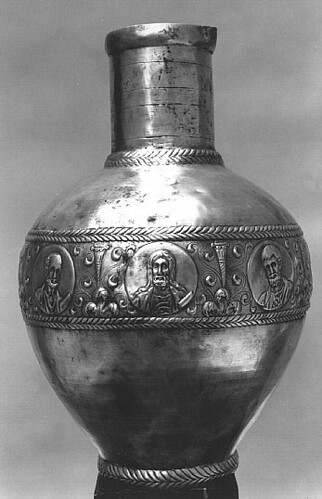
Among the earliest representations of the Shroud is on a 6th century silver vase, from Homs (ancient Emessa) in Syria:

[Right (enlarge): Sixth century liturgical vase from Homs (Emessa), Syria, Louvre]

"A 6th c. vase from Homs, Syria is quite similar to the Shroud in many of the `Vignon' .... respects. ... the narrowness of the face; the distortions carved into the right side of the face, where the Shroud face has two sizable bruises, the swollen cheek and the half-moon bruise below; and the `light-bulb' shape of the head on its outer edge." (Scavone, 1991, p.189).

"In the sixth century, the Christ portrait appears on a silver vase found at Homs, in present-day Syria and on the beautiful icon of Christ Pantocrator from the Monastery of St. Catherine in the Sinai desert. ... each has a strong resemblance to the face visible on the Shroud. ...." (Iannone, 1998, p.154).

"One can find the same likeness even as far back as the sixth century in several examples, but notably a mosaic Christ Enthroned at Ravenna's Sant'Apollinare Nuovo church, and a medallion portrait of Christ in the Byzantine manner on a silver vase discovered at Homs, the ancient Emesa, in Syria." (Wilson, 1978, pp.82-83).

>I know that it's unlikely- I never heard of anything like a study of "beard shapes" (!) based on nationality?but every time I see that face on the Shroud, I'm convinced that the features are those of a Middle Easterner rather than a European. ... I'm convinced ... that the man in the Shroud is one of Middle Eastern features. I base this belief on knowing people with Middle Eastern features all my life. A subjective belief- yes. But not necessarily an incorrect one. Has there ever been a study done at that level- what nationality or racial group or what features the Man in the Shroud belongs to?

Leading anthropologist, the late Carleton S. Coon, (1904-1981), whose speciality was human racial groups, confirmed that the image on the Shroud was that of "he is of a physical type found in modern times among Sephardic Jews which as far as I am aware, has never been disputed:

"Stewart suggested that I put the question to Carlton S. Coon, one of the world's most distinguished ethnologists. ... Coon had written books on the racial classifications of people all over the world. ... Coon wrote back .... `Whoever the individual represented may have been, he is of a physical type found in modern times among Sephardic Jews and noble Arabs." (Wilcox, 1977, p.136).

"ethnologist Carleton S. Coon has associated the man with the very pure Semitic type found today among noble Arabs and Sephardic Jews, and certainly there are at least broad hints of Jewishness in the ... unbound rope of hair at the back of the head ... one of the commonest fashions for Jewish men in antiquity." (Wilson, 1986, pp.15-16).

>If there is DNA in the Blood of the Shroud?perhaps there's enough to help figure out the ancestory of the figure.

There is DNA in the blood on the Shroud. Which is itself very important because it shows that it really is blood and that virtually eliminates painting, because no forger would paint with real blood. This was proved by the isolation of a human betaglobin gene segment in the bloodstains:

"DNA studies conducted on the white blood cell remnants present in the blood globules from the occipital region. ... a technique known as polymerase chain reaction (PCR) ... used for establishing the DNA make-up of samples. ... A blood globule from the five tiny collections on the Scotch tape was used, and the betaglobin gene segment from chromosome 11 was cloned. This proved conclusively that there was ancient blood on the Shroud" (Garza-Valdes, 1998, pp.40-41).

Moreover, the "amelogenin-Y gene from chromosome Y" was isolated, which "proved that the blood on the Shroud had belonged to a human male":

"Another way to determine the sex is to clone the genes amelogenin-X and amelogenin-Y ... the PCR technique enabled us to isolate the amelogenin-X gene from chromosome X and the amelogenin-Y gene from chromosome Y. ... we had proved that the blood on the Shroud had belonged to a human male" (Garza-Valdes, 1998, p.42).

"But arguably of the greatest importance ... are studies ... which ... have identified DNA in the Shroud `blood'. ... Dr Victor Tryon, and his technician wife, Nancy Mitchell Tryon ... determined that it had both X and Y chromosomes, indicating that the individual from whom it came was male. Three ... gene segments were identified, beta globin from chromosome 11, amelogenin X from chromosome X and amelogenin Y from chromosome Y ...." (Wilson & Schwortz, 2000, pp.77-78).

But being ancient, fragmentary and degraded, the DNA on the Shroud would probably never be sufficient to show that the victim was Jewish:

"We could not, of course, tell from whom it had come, nor whether that person had Semitic blood. ... For this type of investigation you need to clone the short DNA segments generally known as minisatellites" (Garza-Valdes, 1998, p.41).

>Oh ? you can post this email in your blog if you so wish of course- but please make it anonymous.
>
>Thank you,
>AN

See quotes below (emphasis italics original, emphasis bold mine), hyperlinked from the above inline references.


"It is a fact known to historians of art that the physical appearance of Christ in paintings, sculptures and carvings is rather sharply divided into two periods, with the line of demarcation running through the Fourth Century. In the first period, from the evidence of the catacomb pictures and some early Christian sarcophagi, Christ is depicted as an Apollo-like beardless youth with an oval, innocent face. In none of the art that has been preserved from the first three hundred years after His death is He seen any other way. Then, with the emergence of Christianity under Constantine, this obviously symbolic portrayal was discarded and pictures of Christ began to appear quite differently. Now He consistently resembled the face we see on the Shroud of Turin. Many pictures and icons of this period exist today, coming from Russia, Greece, Egypt, the Balkans and Italy. In all of them, there are many significantly similar features: the mustache and forked beard, hair parted in the middle and falling to the shoulders. These were distinctive characteristics of the Nazarenes. In addition, there were the three-sided square between the brows, the second V above this, the transverse streak across the forehead, the accentuated cheeks and enlarged left nostril. The heavily drawn owlish eyes which were also evident in most of the reproductions could today be explained by the fact that the Shroud image is a negative, and what is seen is the outline of the eye socket." (Adams, F.O., 1982, "Sindon: A Layman's Guide to the Shroud of Turin," Patrick Walsh Press: Tempe AZ, pp.18-19).

"This led to a fruitful research programme in microbiology and DNA studies conducted on the white blood cell remnants present in the blood globules from the occipital region. I explained my problems with the blood to Dr Victor Tryon, Director of the Center for Advanced DNA Technology at UTHSC at San Antonio, where a technique known as polymerase chain reaction (PCR) is regularly used for establishing the DNA make-up of samples. Dr Tryon knew that the sample we were using came from the Shroud of Turin. One cannot hide the purpose of research when depending on the advice of an expert in the field. But Nancy, Dr Tryon's wife, who actually ran the samples through the PCR equipment, was not aware of the origin of the sample. ... Tryon advised that we try cloning the easiest of the genes that could be obtained from ancient blood, the betaglobin gene. What we were not sure of was whether the blood ... would be too degraded for cloning. Fortunately, our fears were unfounded, and Nancy was able to clone the blood sample and amplify it. A blood globule from the five tiny collections on the Scotch tape was used, and the betaglobin gene segment from chromosome 11 was cloned. This proved conclusively that there was ancient blood on the Shroud. We could not, of course, tell from whom it had come, nor whether that person had Semitic blood. (For this type of investigation you need to clone the short DNA segments generally known as minisatellites.) Nor could we ascertain how old the blood was. Obviously there was the possibility of contamination and the possibility that blood from someone other than the crucified victim happened to fall on the part of the Shroud from which the sample was taken. But it is certainly more likely that the blood came from the Man on the Shroud, rather than a bystander, in view of the fact that the sample was taken from the back of the head, from the area where the crown of thorns would have damaged the head of the victim." (Garza-Valdes, L.A., "The DNA of God?," Hodder & Stoughton: London, 1998, pp.40-41).

"G. Riggi was happy with the news I imparted by telephone, as was everyone in Dr Tryon's laboratory. But at this stage, all we could say about the blood was that it was ancient, because of the degree of degradation of the small amount of blood we found on our sample, and that it had come from a human being or high primate. Nothing more. The next stage of the research was to uncover evidence that could have been regarded as controversial, and that was to be followed by another stage with even more potential for sensationalism. ... In order to establish the sex of the individual, one can look for the testes-descending gene, which is positive only in the male. If you don't find it, however, you cannot conclude that your sample is from a female: it may be that something went wrong during the testing procedure. Another way to determine the sex is to clone the genes amelogenin-X and amelogenin-Y, and that is what Dr Tryon advised. Again he was right; the PCR technique enabled us to isolate the amelogenin-X gene from chromosome X and the amelogenin-Y gene from chromosome Y. I telephoned Riggi ... that we had proved that the blood on the Shroud had belonged to a human male." (Garza-Valdes, 1998, pp.41-42).

"Paul Vignon has made a detailed study of the Image, comparing every feature with the details of the mask of the Turin Shroud. Since the chief characteristic of the Mandylions is their lack of neck and shoulders, it is probable that they derived this peculiarity from the Image of Edessa. Otherwise, they belong to the same family as the typical Christs of the normal Byzantine icons. Their faces are of the same type, as can be seen from a comparison between them ... and the Early Portraits ... As we have seen, this type of Christ appeared in the sixth century with the Edessan Image as the most famous, and perhaps the earliest, of the miraculous Mandylions. Art historians associate this long-haired Christ with the forked beard and staring eyes with Syria rather than with Greece or Rome. None have been able to explain its origin nor its immediate acceptance as the true type as against the Greco-Roman Christ. Only Paul Vignon and his followers have noticed certain peculiarities of the Syro-Byzantine Christs which, when taken in conjunction with their generally accepted characteristics, seem to pin-point their origin. ... The forehead marks of these Christs, for instance, are real disfigurements, as if their artists had deliberately accentuated one Byzantine method of emphasising eyebrows till their portraits seem to be branded for identification purposes. Were they driven by some remote model that they could not escape?" (Green, M., 1969, "Enshrouded in Silence: In search of the First Millennium of the Holy Shroud," Ampleforth Journal, Vol. 74, Autumn, pp.319-345. References omitted).

"Sacred Scripture does not provide us with any physical description of Jesus. People of the first century were more concerned with His message than with what He looked like. Representations of Christ prior to the sixth century varied. Most often He was portrayed as a young beardless man with short hair. Around the sixth century, a common representation of the face of Christ with long hair, mustache and beard began to emerge and has been a standard depiction ever since. Perhaps the first person to notice this gradual change was Paul Vignon in the 1930s. He was later followed by Fr. Wuenschel. These researchers noticed a number of similarities between the face on the Shroud and early paintings and icons of Christ, particularly in the Byzantine tradition. They identified about twenty unusual details. Some of the most notable are the two strands of hair at the top of the forehead. Particularly noteworthy is the directionality of the wisps of hair, which is to the right, just like the bloodstain on the Shroud in the form of the Greek letter epsilon when viewed with the naked eye. The bloodstain only appears as the number `3' on a negative photo of the Shroud. Other parallels include a three-sided `square' between the brows (believed by some to be caused by a phylactery, a small leather box containing Scripture parchments worn around the forehead by Jewish men-cf. Deut. 6:8); an enlarged left nostril; a `V' shape at the bridge of the nose; one eyebrow higher than the other; a transverse line across the throat (perhaps a crease from the way the Shroud was folded); and a forked beard. [Wilson, I., "The Shroud of Turin," Image Books: New York, 1979, pp.104-105] These facial characteristics found on the Shroud appear in most images of the face of Christ as early as the sixth century. Another interesting point is that artists who painted copies of the image usually depicted the face in a frame surrounded by an ornamental trellis. This may very well have been the way in which the face on the Shroud was displayed for veneration. Ian Wilson surmises that there must have been an official `portrait' which was used by artists as a model for their paintings." (Guerrera, V., 2000, "The Shroud of Turin: A Case for Authenticity," TAN: Rockford IL, pp.100-101).

"The Vignon-Markings Wilson's theory linking the Image of Edessa with the Shroud receives strong support from the work done previously by the famous sindonologist Paul Vignon in the 1930's. Vignon pointed out that, among the family of post-sixth century portraits of Christ, there was a recurrence of certain unusual markings seemingly derived from the Shroud. Tribbe notes that `in each of these cases, the artist, wishing to be totally faithful to the original, incorporated these oddities even though they are irrelevant to or detract from the naturalness of the face.' He goes on to say that `all these artists must have copied from the same original, and all of them misunderstood the nature of these imperfections.' However, because of the sacred status of the acheiropoietas it was very important that every detail, even if odd or unusual, be faithfully duplicated by the Byzantine artists. [Tribbe, F.C., "Portrait of Jesus?," Stein & Day: New York NY, 1983, p.239] Wilson, following Vignon, cites fifteen such oddities or anomalies which have come to be known as the Vignon-Markings: Starkly geometric topless square (3-sided) visible between the eyebrows on the Shroud image. 1. Starkly geometric topless square (3-sided) visible between the eyebrows on the Shroud image. 2. V-shape visible at the bridge of the nose. 3. A transverse streak across the forehead. 4. A second V-shape inside the topless square. 5. A raised right eyebrow. 6. An accentuated left cheek. 7. An accentuated right cheek. 8. An enlarged left nostril. 9. An accentuated line between the nose and upper lip. 10. A heavy line under the lower lip. 11. A hairless area between the lip and beard. 12. The fork in the beard. 13. A transverse line across the throat. 14. The heavily accentuated `owlish eyes.' 15. Two loose strands of hair falling from the apex of the forehead.' [Wilson, I., 1979, "The Shroud of Turin," Doubleday & Co: New York NY, pp.104-105]" (Iannone, J.C., 1998, "The Mystery of the Shroud of Turin: New Scientific Evidence," St Pauls: Staten Island NY, pp.151-152. List numbers mine).

"In the sixth century, the Christ portrait appears on a silver vase found at Homs, in present-day Syria and on the beautiful icon of Christ Pantocrator from the Monastery of St. Catherine in the Sinai desert. As Wilson states: "Despite stylistic variations, each of these works seems inspired by the same tradition of Jesus' earthly appearance. And each has a strong resemblance to the face visible on the Shroud." [Wilson, 1986, p.105] We can add to this list the seventh-century coins, the tremisses and solidus coins, minted by Justinian II with shroud-like images; the Spas Nereditsa fresco (Savior of Neredica) in 1199 and the icon in the Church of St. Bartholomew of Armenia in Genoa, Italy." (Iannone, 1998, p.154).

"The well-known eleventh-century mosaic of Christ Pantocrator in the dome of the monastery church in Daphni near Athens, Greece, includes thirteen of the fifteen Vignon markings. ... Two early (sixth-century) examples are the mosaic of Christ enthroned, in the Sant'Apollinare Nuovo Church in Ravenna, Italy (which includes eight Vignon markings ...), and a medallion portrait on a silver vase from Syria. There is an eighth-century example in a painting in the catacomb of Saint Pontianus in Rome that has eight Vignon markings. In the South Gallery of the Hagia Sophia, Constantinople, there is a thirteenth-century mosaic of Christ enthroned with eleven Vignon markings. ... There is also another mosaic of Christ with Vignon markings in the South Gallery of the Hagia Sophia." (Maher, R.W., 1986, "Science, History, and the Shroud of Turin," Vantage Press: New York NY, pp.76-77).

"A 6th c. vase from Homs, Syria is quite similar to the Shroud in many of the `Vignon' -- and other -- respects. Additionally, one is struck by the narrowness of the face; the distortions carved into the right side of the face, where the Shroud face has two sizable bruises, the swollen cheek and the half-moon bruise below; and the `light-bulb' shape of the head on its outer edge." (Scavone, D.C., "The History of the Turin Shroud to the 14th C.," in Berard, A., ed., "History, Science, Theology and the Shroud: Symposium Proceedings, St. Louis Missouri, June 22-23, 1991, The Man in the Shroud Committee of Amarillo, Texas: Amarillo TX, 1991, pp.171-204, p.189).

"The best method of approach seems to be to track back rather than forward, and to use as a base the fifteenth century, i.e., within the period that the Shroud was known to have been preserved. In fact there was from this period an ideal work of art with which to compare the Shroud likeness, the `Rex Regum' of Jan van Eyck, which, although the original has not survived, is known to us from no less than four excellent copies made at the time. It is ideal because it has the same rigidly front-facing aspect as the Shroud face. One can therefore see how in each of the distinctive features-long hair parted in the middle and falling to the shoulders, a moderately long, forked beard, a long prominent nose, a thin mustache drooping to join the beard, a distinctive hairless gap beneath the lower lip-it matches the Shroud likeness virtually exactly. It might have been copied from the Shroud face, except that it is known from the work of art experts such as Pachts that, in fact, Van Eyck derived it from Christ portraits of the East, from the world of Byzantium, in which artist after artist had copied from another the same likeness in a tradition going back many centuries. It is this tradition that is the path to the source of the likeness." (Wilson, I., 1978, "The Turin Shroud," Book Club Associates: London, p.82).

"Looking back to the thirteenth century, the likeness can be found in a large and magnificent mosaic of Christ Enthroned in the gallery of Hagia Sophia, Constantinople. From the twelfth century there is an excellent example of the likeness in the huge, brooding Christ Pantocrator mosaic that dominates the apse of the Norman-Byzantine church of Cefalù, Sicily, a work described by British art critic John Beckwith as `one of the most sublime attempts to represent the Logos Incarnate.' [Beckwith, J., "Early Christian and Byzantine Art," in "Pelican History of Art," Penguin: London, 1970, p.123] The likeness is awe-inspiringly evident in the Christ Pantocrator from the eleventh-century dome of the church of Daphni, near Athens, a likeness called by writer Sacheverell Sitwell `a terrifying countenance that makes it credible that a man has lived beyond the grave.' There are two splendid tenth-century examples of the likeness, the Christ Enthroned fresco in the church of Sant'Angelo in Formis near Capua, Italy, and the majestic `Christ as Holy Wisdom' mosaic uncovered in this century high above the royal door in the narthex of Hagia Sophia, Constantinople. Looking back to the eighth century, an epoch in which most eastern portraits of Christ were destroyed during the wave of image-smashing, or iconoclasm, the same likeness can be found, heavily influenced by Byzantium in a Pantocrator painting from the catacomb of St. Pontianus, Rome. One can find the same likeness even as far back as the sixth century in several examples, but notably a mosaic Christ Enthroned at Ravenna's Sant'Apollinare Nuovo church, and a medallion portrait of Christ in the Byzantine manner on a silver vase discovered at Homs, the ancient Emesa, in Syria." (Wilson, 1978, pp.82-83).

"As generally agreed by most observers, the visible body on the Shroud appears to be that of a thirty-to-forty-five-year-old male, quite naked, with beard and mustache and hair falling to the shoulders. At the back of the head seems to be visible a long, loose rope of hair extending down the spine to the level of the shoulder blades. Although anthropological deductions are inevitably subjective, ethnologist Carleton S. Coon has associated the man with the very pure Semitic type found today among noble Arabs and Sephardic Jews, and certainly there are at least broad hints of Jewishness in the hair styling. The seemingly unbound rope of hair at the back of the head accords with what German biblical scholar H. Gressman has referred to as one of the commonest fashions for Jewish men in antiquity, to which French scriptural authority Daniel-Rops has supportively added the information that the Jews normally wore this `plaited and rolled up under their headgear' except on public holidays." (Wilson, I., 1986, "The Evidence of the Shroud," Guild Publishing: London, pp.15-16).

"A study of this kind is, to say the least, illuminating. A consistent Shroud-like, long-haired, fork-bearded, front-facing likeness of Christ can be traced back through numerous works in the Byzantine tradition dating many centuries before the time of Geoffrey de Charny. Beginning with the twelfth century, there is an imposing Christ Pantocrator from Cefalu, Sicily. From about a century earlier, a similar, almost terrifying Pantocrator glowers from the dome of the church of Daphni, near Athens. From back to the tenth century, a still familiar-looking Christ Enthroned stares out from the church of St. Angelo in Formis, near Capua ... . Datable back to the eighth century, a similar-looking Christ portrait is to be found in the depths of the Pontianus catacomb, near Rome. As early as the sixth century, still with the same facial resemblance, are a Christ portrait on a silver vase found at Homs, in present-day Syria, and a beautiful icon of Christ Pantocrator from the monastery of St. Catherine in the Sinai Desert. Despite stylistic variations, each of these works seems inspired by the same tradition of Jesus' earthly appearance. And each has a strong resemblance to the face visible on the Shroud." (Wilson, 1986, p.105).

"But arguably of the greatest importance, even though they are as yet far from fully secure, are studies, both in Italy and the United States, which, completely independently of each other, have identified DNA in the Shroud `blood'. On the afternoon of 21 April 1988, just a few hours after having cut off the snippets of the Shroud used for radiocarbon dating, the Italian microscopist Dr Giovanni Riggi took a 1.5 mm `blood' sample from the back-of-the-head region. In June 1993 he provided some of this sample to a visiting American microbiology professor, Dr Leoncio Garza-Valdès, who took it back for analysis at the University of Texas' Center for Advanced DNA Technologies at San Antonio, Texas. There the laboratory director, Dr Victor Tryon, and his technician wife, Nancy Mitchell Tryon, quickly established that the sample was human blood of the AB group, just as Baima-Bollone had before them. They also determined that it had both X and Y chromosomes, indicating that the individual from whom it came was male. Three unmistakable gene segments were identified, beta globin from chromosome 11, amelogenin X from chromosome X and amelogenin Y from chromosome Y, a finding quite impossible if the Shroud `blood' were merely iron oxide as contended by Walter McCrone.." (Wilson, I. & Schwortz, B., 2000, "The Turin Shroud: The Illustrated Evidence," Michael O'Mara Books: London, pp.77-78).

"Among other points of similarity, Vignon listed the following: no ears; no neck; no shoulders; a `forked' beard; a `truncated' mustache; straight nose; enlarged nostrils; one raised eyebrow; a line across the throat (which is really a wrinkle on the shroud); bruised forehead; abnormally shaded or swollen cheeks. No icon had all these similarities, but all had at least a few. The earliest icons that Vignon found with shroudlike similarities were copies of the `Image of Edessa,' a portrait of Jesus on cloth which was discovered in 544 bricked up in a wall in Edessa, the center of Syrian Christianity. After its discovery, the `true likeness' of Christ, as it came to be known, was the object of great veneration in Byzantium." (Wilcox, R.K., 1977, "Shroud," Macmillan: New York NY, p.85).

"Stewart suggested that I put the question to Carlton S. Coon, one of the world's most distinguished ethnologists. A former Harvard professor and ethnology curator at the University of Pennsylvania, Coon had written books on the racial classifications of people all over the world. `He'd be the man who might be able to give you some answers.' `Here are the pictures that you asked me to return,' Coon wrote back in a week's time. `Whoever the individual represented may have been, he is of a physical type found in modern times among Sephardic Jews and noble Arabs. The soft parts of the nose have shrunken a bit, which is simply a sign of death. I have seen the same thing in the mummies of Egyptian pharaohs. `For what it is worth, that is my opinion.' Coon's opinion was worth a great deal, especially in view of the fact that he had traveled widely throughout the Middle East, Asia, South America, and Africa. He was also the author of fifteen books in the area of anthropology, including The Origin of Races, published in 1962; and The Living Races of Man, published in 1965." (Wilcox, 1977, pp.131,136).

Posted 29 July 2008. Updated 24 April 2024.

Tuesday, July 15, 2008

Re: Are you still trying to talk the Pope into "pollen dating"?

AN

Thank you for your message. However, as stated under "Policies" on my TheShroudofTurin blog's front page regarding private

[Above: Pope Benedict XVI is shown a copy of the Shroud of Turin, June 2, 2008: 30 Days in the Church and in the world]

messages I receive on Shroud of Turin related topics, I am responding publicly to this blog, minus your personal identifying information. Your words are bold to distinguish them from mine.

----- Original Message -----
From: AN

To: Stephen E. Jones
Sent: Sunday, July 13, 2008 11:42 PM
Subject: Re: Carbon Dating the Pollen

>Hi Stephen

>Are you still trying to talk the Pope into "pollen dating"?

I am not trying to talk the Pope, or anyone, into dating the pollen of the Shroud of Turin. Since I am in my 60s and live in Australia, realistically I have only ever saw my role as publishing my paper, "A proposal to radiocarbon-date the pollen of the Shroud of Turin" in the British Society for the Turin Shroud's newsletter and then advocating it on this blog.

>I like your arguments, but I still think we should push for real Shroud cloth carbon dating---3 samples rather than 1 and from areas that we are confident are not re-weaves, etc.

Thanks. However, the "but" suggests that you think it is either dating the Shroud's "cloth" or dating its pollen. But as I wrote in my paper, "they are not mutually exclusive."

While I support another dating of the Shroud's linen, taken from different parts of the cloth, it still might not be conclusive. That is because even if the Shroud is first century burial sheet of Jesus, it could still have an apparently younger radiocarbon age due to:

1) neutron irradiation either: a) natural, if it has been kept for hundreds of years in monasteries and castles (Stevenson & Habermas, 1981, pp.20-21; Wilson, 1979 pp.177-178) made of granite (Wikipedia, 2008); and/or b) supernatural, due to neutron irradiation due to Jesus' resurrection (Danin, et al., 1999, p.6; Wilson, 1998, p.233; Wilson & Schwortz, 2000, p.128).

or 2) contamination and isotope fractionation, having been enriched with carbon-14 in the 1532 fire (Draper, 2008; Ramsey, 2008; Walsh, 2000, p.338).

Carbon-dating the Shroud's pollen would avoid most of those problems because: 1) pollen is impervious to contamination by external carbon-14 and 2) if the Shroud is genuine then some of the pollen would not have been on the linen until after Jesus' resurrection.

>If Pope says no to that but maybe he looks at our proposal and sees our Plan B is pollen, who knows---maybe he says yes to that. What do you think?

See above. If it is a choice between radiocarbon-dating the Shroud's pollen and its linen, then I think the former, carbon-dating its pollen, should be Plan A. But there is no reason why both could not be done as part of a comprehensive retesting of the Shroud's 1988 radiocarbon dating.

However, I should here point out there is a problem with radiocarbon-dating of single pollen grains, that I was not aware of when I wrote my paper, but which I will acknowledge in the too long delayed continuation of my "Response #1 to Bill Meacham's criticisms of my proposal to radiocarbon-date the Shroud's pollen" series.

Sincerely, AN

See quotes below (my emphasis bold) hyperlinked from inline references above.

Stephen E. Jones, BSc. (Biology).
My other blogs: CreationEvolutionDesign & Jesus is Jehovah!


"The exact mechanisms by which the images on the Shroud were formed are not known, but they are speculated to be some type or types of radiation. The process may even have possibly included a neutron flux, which could have produced additional carbon 14 in the molecular structure of the flax fibers themselves, thus yielding an erroneously young age (Trenn, 1996)." (Danin, A., Whanger, A.D., Baruch, U. & Whanger, M., 1999, "Flora of the Shroud of Turin," Missouri Botanical Garden Press: St. Louis MO, p.6).

"COLORADO SPRINGS A physics professor here has resurrected the mystery of the Shroud of Turin, the fabled burial cloth of Christ that 20 years ago scientists declared a fake. Millions of faithful believe the shroud's blood-stained image of a battered, crucified man is the miraculous image of Jesus, formed as he rose from the dead. Scientists at three laboratories using radiocarbon dating in 1988-89 determined the shroud was a medieval forgery, though they could not explain how the image was created. Now, John Jackson, a University of Colorado at Colorado Springs physics lecturer has done something his colleagues consider nearly miraculous. Jackson, who is a leading researcher on the 14-foot-long linen sheet, has persuaded the Oxford laboratory that dated the shroud to the 13th or 14th Century to revisit the question of its age. Professor Christopher Ramsey, head of the Oxford University Radiocarbon Accelerator Unit, has agreed to test Jackson's hypothesis that contamination by carbon monoxide could throw off radiocarbon dating by more than a millennium. It is possible, Jackson said, that even minimal contamination of the shroud by environmental carbon monoxide could have skewed the dating by 1,300 years - making it not medieval but contemporaneous with Jesus's life. Jackson, who must prove a viable pathway for that contamination, is working with Oxford to test samples of linen under the various conditions the shroud has endured, such as outdoor exhibitions and exposure to extreme heat during a 1532 fire. ... Ramsey also acknowledged the need to reconcile radiocarbon-dating results with other forensic and historical evidence, which indicate the shroud is much older than 600 to 700 years old. Scientists must arrive at a coherent story about the enigmatic shroud, Ramsey said." (Draper, E., "Lab agrees to test Shroud of Turin for new theory," Chicago Tribune, May 20, 2008).

"The Oxford Radiocarbon Accelerator Unit has been working with a team from Performance Films Ltd making a documentary about the Shroud of Turin for the BBC. .... Another contributor to the film, John Jackson (Turin Shroud Center of Colorado) ... has developed a new hypothesis, which he believes may explain why the mediaeval date for the Shroud is incorrect. The hypothesis put forward in the film is that the linen of the Shroud might have been contaminated by carbon monoxide. Unlike most contaminants, carbon monoxide is naturally enriched in radiocarbon when found in the environment and would therefore in principle be able to alter the radiocarbon age significantly. A relatively small amount of carbon monoxide (roughly 2% of the carbon in the linen) could alter the age of the sample by a thousand years. This is the only contamination hypothesis which could affect the radiocarbon age of the Shroud enough to allow it to be 2000 years old ... The research continues because the effect of the specific storage conditions of the Turin Shroud have yet to be reproduced by John Jackson's team. It remains possible, though not at all likely, that in these specific conditions there are reactions which provide significant contamination. There are also other possible types of contaminant, and it could be that one, or some combination of these, might mean that the Shroud is somewhat older than the radiocarbon date suggests. It is important to realise, however, that only if some enriched contaminant can be identified does it become credible that the date is wrong by 2000 years." (Ramsey, C.B., 2008, "Shroud of Turin," Oxford Radiocarbon Accelerator Unit, 23 March).

"Ian Wilson proposes an intriguing theory to link the Mandylion with the Shroud. He suggests that from 1204 to the early 1300s, the Shroud-Mandylion was in the possession of one of the most exotic and mysterious groups in the medieval church-the Knights Templars. [Wilson, I., "The Shroud of Turin," Doubleday: New York, 1979, pp. 172-191] The Knights Templars were a religious order of knights founded about eighty years before the sack of Constantinople for the purpose of defending the crusader territories in the Holy Land. The Templars attracted powerful friends and noble members because they combined the two great passions of the Middle Ages-religious fervor and martial prowess. The members of the order took vows of poverty, chastity, and absolute obedience, and their courage in battle was legendary. They vowed never to retreat under attack, and they defended crusader territories in the Holy Land with resourcefulness and great bravery. By the time of the sack of Constantinople, the Templars had grown very powerful. They built impregnable fortresses in the Holy Land and in Europe, and princes and nobles in those unsettled times often entrusted their valuables to the Templars for safekeeping. Among these valuables were many relics. The Templars surely had the strength and the motive to safeguard a relic as fabulous as the Mandylion-Shroud. As one of the principal traders of relics from the Fourth Crusade, the Templars would have been in a position to acquire it, and their wealth would have protected them from the common temptation to sell relics for much needed cash. They would have been able to keep its location secret in their network of fortresses and castles." (Stevenson, K.E. & Habermas, G.R., 1981, "Verdict on the Shroud: Evidence for the Death and Resurrection of Jesus Christ," Servant Books: Ann Arbor MI, pp.20-21).

"In the case of the Shroud of Turin, the linen fibrils exposed to higher temperatures would be expected to have a lower level of reaction-related isotopic fractionation than the areas of the cloth more insulated from the elevated temperatures of the 1532 fire. This would appear to imply the existence of a carbon isotopic gradient on the Shroud cloth in areas exposed to large differential temperatures. In addition, isotopic fractionation theory states that bonds involving heavier isotopes will be stronger and thus be more difficult to break for a given level of temperature than lighter isotopic bonds. Moreover, at equilibrium, the heavier isotopes will tend to occupy the site with the stronger bonds. As a result, because bonds involving lighter isotopes are weaker and more easily broken, lighter isotopes participate more readily in a given chemical reaction. The combined result of these effects is to diffuse light-isotope reaction products further from the source of a reaction. If these light isotope elements vacate a stronger bond location, then the heavier isotopes are more likely to be able to attach themselves to that site. This would leave a relatively enriched heavier isotope concentration wherever the lighter products had taken part in an exogenous chemical reaction. The fire to which the Shroud was exposed in 1532 appears to be a reasonable candidate for inducing both kinetic isotopic reactions and, also, potentially incomplete equilibrium reactions that may have resulted from the rapid temperature drop and water vapor environment associated with the quenching of the heated Shroud reliquary with water. This isotopic fractionation process could lead to areas of relative enrichment and depletion of various carbon isotopes if the reactions occurred in a confined environment. If the lighter isotopic reaction products were free to move away from the fibers, then the isotopic effects noted above could cause the Shroud to be left relatively enriched in heavier isotopic products as the result of the isotopic exchanges noted above. It would then radiocarbon date younger than its actual age at sites affected by this process." (Walsh, B.J., 2000, "The 1988 Shroud of Turin Radiocarbon Tests Reconsidered," in Walsh, B.J., ed., "Proceedings of the 1999 Shroud of Turin International Research Conference, Richmond, Virginia," Magisterium Press: Glen Allen VA, p.338).

"Granite is a normal, geological source of radiation in the natural environment. Granite contains around 10 to 20 parts per million of uranium. By contrast, more mafic rocks such as tonalite, gabbro or diorite have 1 to 5 ppm uranium, and limestones and sedimentary rocks usually have equally low amounts. Many large granite plutons are the sources for palaeochannel-hosted or roll front uranium ore deposits, where the uranium washes into the sediments from the granite uplands and associated, often highly radioactive, pegmatites. Granite could be considered a potential natural radiological hazard as, for instance, villages located over granite may be susceptible to higher doses of radiation than other communities. Cellars and basements sunk into soils formed over or from particularly uraniferous granites can become a trap for radon gas, which is heavier than air. However, in the majority of cases, although granite is a significant source of natural radiation as compared to other rocks it is not thought an acute health threat or significant risk factor. Various resources from national geological survey organisations are accessible online to assist in assessing the risk factors in granite country and design rules relating, in particular, to preventing accumulation of radon gas in enclosed basements and dwellings." ("Granite: Natural Radiation," Wikipedia, 2 July, 2008).

"Finally, and not least, they must, if the Shroud/Mandylion identification is valid, have had some historical link with Geoffrey de Charny, the French knight who was the Shroud's first authenticated owner. None of this might appear to provide any real substance with which to identify the Shroud's possible guardians between 1204 and the 1350s, but as it happens there is one historical group of suspects who fit these requirements with uncanny precision. Some eighty years before the capture of Constantinople two French knights, Hugh of Payens and Geoffrey of Saint-Omer, with seven companions had founded the Crusader Order of Knights Templars or `Poor Knights of Christ of the Temple of Solomon,' so called because they were given land close to the site of the ruined Temple in Jerusalem. By 1204 they had become both wealthy and powerful, attracting to their ranks men of the noblest blood, distinguishing themselves as fearless crusaders, and building across Europe and the Near East a series of virtually impregnable fortresses. In a precarious age these fortresses were of no small importance, and became recognized as useful storehouses for national treasures and valuables of all kinds. Kings and popes alike came to bank with the Templars, giving the `poor knights' the reputation, if not the reality, of possessing enormous wealth. Because of this role the Templars were one of the principal sources of finance for the Fourth Crusade, although they themselves took little part in it. They were also in a position to act as guardians, traders, and pawnbrokers for the flourishing trade in relics, genuine and false alike, that ensued from the Fourth Crusade. Thus the means of acquiring the Mandylion/Shroud were there. Also, the Templars' heavily guarded monastery-fortresses provided the means of keeping the cloth's whereabouts secret for a considerable period." (Wilson, I., 1979, "The Shroud of Turin: The Burial Cloth of Jesus?," [1978], Image Books: New York NY, Revised edition, pp.177-178).

"A similar view has been expressed by the pioneering British nuclear physicist Dr Kitty Little, now retired from her career at the UK's Atomic Energy Research Establishment at Harwell, Oxfordshire. She has recalled an experiment that she conducted back in the 1950s in which she irradiated a range of fibres, including several different cellulose ones, in a research reactor called BEPO: `At the time BEPO was being run at only three MW, so that the temperatures were in the range 70° to 90° centigrade. This meant that I was obtaining radiation effects without the complication of heat effects.' Little observed the fibres to change with only relatively low-grade heat to the very same colour reported of the Shroud image, something of which at that time she had no knowledge. In her own words: `[The] cellulose fibres turned to the straw-yellow colour that has been described for the image of the Shroud...' Even more interesting, however, was that the very same radiation particles which produced this effect were necessarily also accompanied by neutron emission. And as she has explained, this would inevitably have resulted `in the formation of extra carbon 14 on the sheet, the whole of it', this extra carbon tending quite categorically and specifically `... to make the apparent age of the fabric appear more recent than it really is ...'" [ Little, K., "The Holy Shroud of Turin and the Mystery of the Resurrection," Christian Order, April 1994, p. 226]" (Wilson, I., 1998, "The Blood and the Shroud: New Evidence that the World's Most Sacred Relic is Real," Simon & Schuster: New York NY, p.233)

"So, given that one interpretation of Jesus' resurrection is a dematerialization of the atoms of his physical body, what about the Shroud's imprint having been caused by some kind of atomic radiation from this event? In the Second World War bombings of Hiroshima and Nagasaki, the intense light from the atomic bombs' fireballs imprinted eerie images of people and objects on walls. Yet, however compelling this might sound, it cannot be a valid parallel to the Shroud image, since in the bombing instances it was the people's bodies blocking the light which created permanent shadows on the walls behind them, whereas in the case of the Shroud the light would appear to have come from the body itself, which was responsible for its unique, non-directional, self-lighting characteristics. Based on this kind of thinking, the Harvard physicist Dr Thomas J. Phillips [Phillips, T.J., "Shroud irradiated with neutrons?," Nature, Vol. 337, 16 February 1989, p.594], in the wake of the 1988 radiocarbon dating, made the intriguing suggestion that, had Jesus' claimed resurrection involved a radiation of neutrons, it could explain at a stroke both the Shroud's `scorch' image and the skewing of its carbon 14 content." (Wilson, I. & Schwortz, B., 2000, "The Turin Shroud: The Illustrated Evidence," Michael O'Mara Books: London, p.128).

Updated: 11 July 2015.