Chronology of the Turin Shroud: AD 30
© Stephen E. Jones[1]
This "Chronology of the Turin Shroud" has been superseded by my "Chronology of the Turin Shroud: AD 30 to the present" series.
This is my "Chronology of the Turin Shroud: AD 30," which is also the Main Index and part #1 of my "Chronology of the Turin Shroud" series. This series supersedes the "Chronology of the Shroud" in my "Turin Shroud Encyclopedia." This chronology will be divided into a separate post for each time period, starting with AD 30 and working forwards. I have changed it from one post per century because I now realise that some centuries would be too long (like the 1st century), and other centuries would be too short, for a post. My chronology is inspired by Ian Wilson's "Highlights of the Undisputed History") but is not based on it. To save space throughout this chronology series I will assume, what the evidence overwhelmingly points to, that the man on the Turin Shroud is Jesus Christ. Some dates will necessarily be approximate.
Main Index[
AD 30] [
31-176]
AD 30[Next: 31-]
AD 30 On Friday, 7th April, AD 30[2] Jesus, the man on the Turin Shroud, after having been arrested on the previous night by Jewish Temple guards (Mt 26:47-50; Mk 14:43-46; Lk 22:47-48,52-54; Jn 18:2-8,12) and while bound (Mt 27:2; Mk 15:1, Jn 18:12,24), was struck on his face and head (Mt 26:67-68,27:30; Mk 14:65; Lk 22:64; Jn 18:22; 19:3) and beaten on his body (Mk 14:65; Lk 22:63). Having been sentenced to death by the Jewish Sanhedrin, led by the High Priest Caiaphas (r. 18–36), for alleged blasphemy (Mt 26:63-66; Mk 14:53,61-64; Lk 22:66-71), Jesus was then sent to the Roman Governor Pontius Pilate (r. 26–36) to ratify the Sanhedrin's death
[Right (enlarge): "Anatomy of the Shroud"[3], showing the wounds and bloodstains on the Shroud match those in the Gospels' accounts of Jesus' passion and death.]
sentence (Mt 27:1-2; Mk 15:1; Lk 23:1-2; Jn 18:24,28-32). Jesus was then scourged on Pilate's orders with a Roman flagrum (Mt 27:26; Mk 15:15; Lk 23:16; Jn 19:1) and crowned with thorns (Mt 27:29; Mk 15:17; Jn 19:2,5). Pilate then reluctantly sentenced Jesus to death by crucifixion (Mt 27:11-26; Mk 15:2-15; Lk 23:1-5, 18-25; Jn 19:1-16). Having carried his crossbeam a short distance (Mt 27:32; Mk 15:21; Lk 23:26; Jn 19:17), at the site of crucifixion Jesus was stripped of his clothes (Mt 27:35; Mk 15:24; Lk 23:34; Jn 19:23-24) and nailed to a cross through his hands (wrists) and feet (Lk 24:36-40; Jn 20:19-20,24-28; Col 2:14). One of Jesus' last acts while He hung in agony on the cross was to commit His mother Mary, to the care and protection of her nephew and His cousin (see below), the Apostle John (see below) (Jn 19:25-27). Jesus died on that cross (Mt 27:50; Mk 15:37; Lk 23:46; Jn 19:30) and because He was dead, Jesus' legs were not broken (Jn 19:31-33), which was to hasten death by asphyxiation[4]. Instead Jesus was speared in the [right] side to make sure he was dead (Jn 19:34-35). Jesus was then given a hasty and incomplete burial[5] because of the impending weekly Sabbath (Mt 27:62; Mk 15:42; Lk 23:54; Jn 19:31), which was also the annual Passover (Mt 26:2,17-19; Mk 14:1,12-16; Lk 22:1,7-15; Jn 13:1;18:28,39;19:14,31), and buried in a cave tomb (Mt 27:57-60; Mk 15:46; Lk 23:53-55; Jn 19:41-42). Jesus was buried according to the burial custom of the Jews (Jn 19:40), therefore His hands and feet would have been bound (Jn 19:40) with strips as Lazarus' were (Jn 11:44)[6], to prevent them moving and a Pontius Pilate lepton coin was placed over each eyelid to keep it closed[7]. On the top [epi[8]] = "on, upon" - see below] of his head was a bloodstained face cloth [soudarion] (Jn 20:7; 11:44), the Sudarium of Oviedo (see below), and over all, enveloping his entire body[9], was a large linen sheet [sindon] (Mt 27:59; Mk 15:46; Lk 23:53; Mk 14:51).
Sunday, 9th April, 30 At dawn on Sunday, three of Jesus' women disciples: Mary Magdalene; Mary the mother of James the younger and Joseph; and Salome the mother of the Apostle John and sister of Mary the mother of Jesus (Mt 20:20; Mk 10:35; Mt 27:55-56; Mk 15:40; Jn 19:25)[10], went the tomb to anoint Jesus’ body with spices (Mt 28:1; Mk 16:1-2; Lk 24:1; Jn 20:1). They found that the large stone which Joseph of Arimathea had rolled across the entrance of the tomb (Mt 27:60; Mk 15:46;16:3) had been rolled away (Mk 16:4; Lk 24:2; Jn 20:1) by an angel (Mt 28:2-4) causing the guards who had been set on Saturday (Mt 27:62-66) to flee (Mt 28:4,11). And when the women went in to the tomb, Jesus’ body was not there (Lk 24:3). While they were in the tomb the angel(s) told them that Jesus had risen from the dead (Mt 28:5-6; Mk 16:5-6; Lk 24:4-6). The women left to tell the other disciples (Mt 28:7-8; Mk 16:7-8; Lk 24:9; Jn 20:1-2) and on the way the risen Jesus met them, spoke with them and they touched him (Mt 28:9-10; Mk 16:9; Jn 20:11-17). The women continued on to tell the other disciples that Jesus' body was not in the tomb and that He had appeared to them (Mt 28:11; Mk 16:8-11; Lk 24:10-11; Jn 20:2,18).
In response to the women's report that Jesus' body was not in the tomb (Lk 24:10-11; Jn 20:1-2; Mk 16:9-11), Peter and "the other disciple, the one whom Jesus loved," i.e. John[11], ran to the tomb but John reached it before Peter (Jn 20:4). Then "stooping to look in, he saw the linen cloths [othonia = "strips of linen"[12], "linen bandages"[13]] lying there, but he did not go in" (Jn 20:5) (because John was a priest - see below). Peter then arrived at the tomb, and also "stooping and looking in, he saw the linen cloths [othonia "strips of linen"[14]] by themselves" (Lk 24:12). Then Peter, "went into the tomb" and "saw the linen cloths [othonia "strips of linen" NIV] lying there" (Jn 20:6). Peter also saw "the face cloth [soudarion], which had been on [epi "on, upon" not peri "around," "about" [15]] Jesus' head (see below), not lying with the linen cloths but folded up in a place by itself." (Jn 20:7). Then "the other disciple" (John - see above), "who had reached the tomb first, also went in, and he saw and believed" that Jesus had risen "from the dead." (Jn 20:8-9).
There is no mention of the
sindon (Shroud) having been seen by Peter and John in the empty tomb[
16], which there surely would have been, because of its dominating size, if it had been there. The eminent pro-authenticist Irish theologian
Patrick A. Beecher (1870-1940) in 1928 pointed out that "The
Sindon was a large white linen sheet that covered the entire body" but "After the resurrection
there is no mention of the Sindon as having been found in the tomb" (my emphasis):
"THE three Synoptic Evangelists, Saints Matthew, Mark and Luke, tell us that Joseph of Arimathea wrapped the body of Our Lord in a Sindon (Matt. 27:59; Mark 15:46; Luke 23:53). The Sindon was a large white linen sheet that covered the entire body. The Evangelists carefully distinguish between it and the sudarium (napkin), which latter was in shape and size like a handkerchief, and was used for the head. In addition, as we know from St. John (Jn 19:40), linen cloths (ta othonia) were used, with spices, according to Jewish custom. After the resurrection there is no mention of the Sindon as having been found in the tomb. St. John tells us that Peter `saw the linen cloths lying, and the napkin that had been about his head, not lying with the linen cloths, but apart, wrapped up into one place' (20:6,7). And St. Luke tells us that `Peter rising up, ran to the sepulchre, and stooping down, he saw the linen cloths laid by themselves' (24:12)"[17].
And as Beecher further pointed out, that Luke in
24:12 did not mention the
sindon being present in the empty tomb after Jesus' resurrection, despite
having previously mentioned it in
Lk 23:53 as being present in the tomb at Jesus' burial, indicates that "the Sindon was
not in the [empty] tomb" (my emphasis):
"What became of the Sindon? Saints Matthew and Mark are silent and make no reference to any cloths in the tomb. St. John still speaks of bandages and of the napkin. His silence about the Sindon would have no special significance, inasmuch as he did not refer to it before. But the fact that St. Luke does not now mention the Sindon [in Lk 24:12], which had occupied his attention previously [in Lk 23:53], but speaks of cloths (othonia) instead, would indicate that the Sindon was not in the tomb."[18].
Attempts to include the
sindon in the
othonia, or identify it as the
soudarion, have failed. It has been claimed that
othonia in
Lk 24:12 and Jn 20:5 are to be understood in a collective sense as "linen cloths"[
19] or "[linen] cloths in general"[
20]. But my New Testament Greek lexicons are
unanimous in stating that
othonia is a plural of
othonion, which is a diminutive of
othone, "a linen cloth," hence
othonion is "a small linen cloth," "a bandage," and
othonia its plural, are "strips of linen," "bandages."[
21]. This is clear also from the "strips of linen" [
othoniois] in which the spices were bound to Jesus' body (
Jn 19:40 NIV). Both
othoniois and
othonia denote the same thing, the only difference being that
othoniois is the
dative (indirect object) plural of
othonion and
othonia is the
accusative (direct object)) plural of
othonion[
22].
Likewise attempts to identify the Shroud with "the face cloth [soudarion], which had been on [epi] Jesus' head" (Jn 20:7)[23] also fail. Again my lexicons are unanimous in stating that the soudarion, is a "face-cloth" corresponding to our "handkerchief" (Lk 19:20, Acts 19:12), and "used as a head covering for the dead" (Jn 11:44; 20:7)[24]. Moreover, the discovery in 1965 by Giulio Ricci (1913-95) that there 
[Above (enlarge): "Comparison of the Sudarium of Oviedo and the Shroud of Turin"[25]. "The most striking thing about all the stains [on the Sudarium of Oviedo] is that they coincide exactly with the face of the image on the Turin Shroud."[26] (my emphasis).]
was a "perfect correspondence" between the bloodstains on the face and head of the man on the Shroud and the Sudarium of Oviedo[27],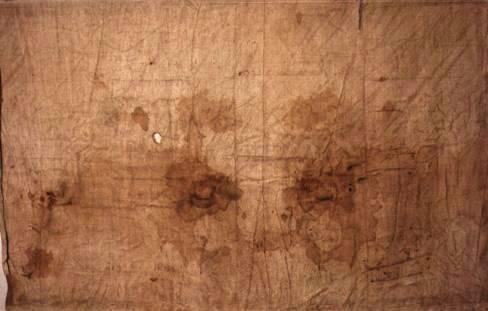
[Above (enlarge): The Sudarium of Oviedo[28]. "It was originally a white linen cloth with a taffeta texture, now stained, dirty, and wrinkled"[29]. Its dimensions are "84 cm. x 53 cm. or 2 feet 9 inches x 1 foot 9 inches"[30]. Unlike the Shroud, the Sudarium bears no image[31], so there is no reason why such an unimpressive, bloodstained and dirty cloth would have been kept in the first place unless it was known by the earliest Christians to have been "the face cloth [soudarion] which had been on Jesus' head" and found in the empty tomb "not lying with the linen cloths but folded up in a place by itself" (Jn 20:7).]
meant that both cloths covered the same face[32]. And since the Sudarium of Oviedo has been in Spain since 616, and indisputably in Oviedo since at least 1075, this is further evidence that the 1988 radiocarbon dating of the Shroud as "mediaeval ... AD 1260-1390"[33] must be wrong[34]! Therefore, in addition to the above negative linguistic evidence that the soudarion ("face cloth") of Jn 20:7 could not have been the sindon ("shroud") of Mt 27:59; Mk 15:46 & Lk 23:53[35]; the positive scientific evidence is that the Sudarium of Oviedo IS the soudarion of Jn 20:7!
Unlike the
soudarion which was wrapped around [
peridedeto = "bound about"[
36]] Lazarus'
face (
Jn 11:44), Jesus'
soudarion had been on His
head (
Jn 20:7)[
37]. The Greek is
epi tes kephales ="on the head of him"[
38], which is identical to the placing of the crown (which was a cap[
39]) of thorns on Jesus' head in
Mt 27:29: "and twisting together a crown of thorns, they put it on his head" [
epi tes kephales][
40]. And as
Prof. Werner Bulst (1913-95) pointed out (although arguing for the "sweat cloth" [
soudarion] being a chin-band) there is a space between the frontal and dorsal head images wide enough to allow for the
soudarion having been on the crown or top of the man on the Shroud's

[Above (enlarge)[41]: Gap of about 6½ inches (~16.5 cms) (see below) between the front and back head images, where the bloodstained "face cloth [soudarion] which had been on [epi] Jesus' head", but the image being vertically collimated[42], i.e. straight up and down from the body[43], no image would have been formed there.]
head, since there no image would have been formed:
"Still more interesting, there is no imprint of the crown of the head between the forehead and the dorsal view. If the sweat cloth was tied above, no imprint could be formed there on the Shroud. The space between the frontal and dorsal view is wide enough to allow for the sweat sweat cloth, especially if we suppose that the Shroud was not loosely laid, but drawn quite taut over the head"[44]
Agnostic art historian Thomas de Wesselow, also arguing for a chin-band, agrees that "something fairly thin must have lain across the crown of the head":
"There is, in fact, clear evidence that such a band covered the crown of the head: the gap between the frontal and dorsal images. If the Shroud had lain directly on the man's crown, the body-image would have formed here as elsewhere, joining the two figures via a long, sausage-shaped head. The length of the gap, roughly 6½ inches, is too short to allow the cloth to have been raised beyond the range of the image-forming process (somewhere in the order of 2 inches). Therefore, something fairly thin must have lain across the crown of the head, preventing the imprint forming on the Shroud. Given its apparent shape and the ritual requirement to bind up the jaw, this can hardly have been anything other than a bandage."[45]
However, unlike a normal Jewish death, such as that of Lazarus, "a chin band ... would have served no useful purpose, since, by virtue of the
rigor mortis when Jesus was lowered from the cross, where He had remained with the head inclined on the chest, the mouth could not be open."[
46]. Furthermore, as Wilson pointed out, albeit arguing wrongly (see
above) that the Shroud was the
soudarion ("a sweat-cloth"), Jewish law prescribed that if a Jew died a bloody death, then "
any clothes, however bloodstained" were to be
with the body inside "an all-enveloping ... single sheet," called a
sovev, that went "right round ... the entire body":
"But why should Jesus have needed a sweat-cloth [sic] for his entire body and not Lazarus? The answer lies in the fundamentally different circumstances of the two burials. Lazarus died a natural death. ... Jesus, in contrast, died a very bloody death ... In his case Jewish law prescribed something very different. ... In these circumstances, therefore, those preparing the dead person for burial had to wrap a `sheet which is called a sovev' straight over any clothes, however bloodstained. This sovev had to be an all-enveloping cloth, that is a `single sheet ... used to go right round' the entire body. Such a sovev readily corresponds to the `over the head' characteristics of Turin's Shroud."[47]
That same Jewish law would have required the bloodstained
soudarion to be inside the
sovev/
sindon) and in contact with Jesus' body[
48], which the top of His head was. So there is no need to posit a hypothetical chin-band. The "face cloth [
soudarion], which had been on [
epi] Jesus' head" and found in the empty tomb "not lying with the linen cloths but folded up in a place by itself"(
Jn 20:7), that is, the
Sudarium of Oviedo, fits
all the evidence, Biblical, linguistic, historical, Jewish and scientific,
perfectly!
From the above and below, what Peter and John saw in the empty tomb, and my reconstruction of what had happened in the tomb immediately after Jesus' resurrection, as recorded in Lk 24:12 & John 20:6-9, is as follows:
• The "strips of linen" [othonia] were "lying by themselves" (Lk 24:12; Jn 20:6). The linen strips which had bound Jesus' hands and feet (see Jn 11:44) and the spices (Jn 19:40), were "lying by themselves" [mona = "alone"] (Lk 24:12). There was no body[49] and nor was there the sindon which Luke had only just (Lk 23:53) mentioned that Jesus had been wrapped in[50]. Since the Shroud had fallen through where Jesus body had been (as per Jackson's "cloth collapse theory"[51]) it would also have fallen through these linen strips which had bound Jesus' hands and feet. So they would have been lying there still "looped together and knotted exactly as they had bound the hands and the feet"[52]. The strips binding Lazarus' hands and feet had to be untied by others (Jn 11:44) but those which had bound Jesus' hands and feet were lying on the floor of the tomb untied[53].
• The "face cloth [soudarion], which had been on Jesus' head [epi tes kephales], not lying with the linen cloths [othonia = strips"] but folded up in a place by itself" (Jn 20:7). The Greek is alla choris entetyligmenon eis ena topon = "but apart having been wrapped up into one place"[54]. John's emphasis is on the soudarion which had been on Jesus' head, under the sindon, was now apart from the linen strips and had been folded up and put in a separate place. John "saw [eide = "saw the meaning of"[55]] and believed" (Jn 20:8) that Jesus had risen from the dead (Jn 20:9).
• Both the Shroud [sindon] and the linen strips [othonia] under it, which were binding Jesus' hands and feet, fell through the space where Jesus' supine body had been. The soudarion was also under the sindon but being on the top of Jesus' head, was not vertically over His body, and so did not fall through the space where His body had been, but just settled down inside the Shroud, in the space between the front and back head images, which had just been imprinted on both inside surfaces of the Shroud as "a literal `snapshot' of the Resurrection"[56]. The risen Jesus, being outside the Shroud, reached inside one edge of it and took out the soudarion, folded it up and placed it on a separate, but nearby part of the tomb. Then Jesus extracted the Shroud from the still looped and knotted linen binding strips [othonia] and walked out of the tomb with the Shroud[57] through the opening that the angel had made by rolling away the large stone that had been across its entrance (Mt 28:2; Mk 16:3-4; Lk 24:2).
Sundays 23rd - 30th April, 30[58] According to the late first century/early second century[59] writing, "The Gospel of the Hebrews," preserved only in fragments in some Church Fathers, notably St Jerome (c.347–420)[60], Jesus "had given the linen cloth [sindon] to the servant of the priest" (see 06Nov14 & 15Nov14):
"The Gospel that is called `according to the Hebrews,' which I have recently translated into both Greek and Latin, a Gospel that Origen frequently used, records the following after the Savior's resurrection: `But when the Lord had given the linen cloth to the servant of the priest, he went and appeared to James.' (Jerome, Illustrious Men, 2)"[61]
In Jerome's Greek translation of the gospel, "linen cloth" renders
sindon[
62]. The Gospel of the Hebrews originated in early Judaeo-Christian circles[
63]. In fact, many of the Church Fathers believed it was the original Hebrew version of the Gospel of Matthew[
64]. However, since this seems to say that the risen Jesus appeared to a servant of the High Priest, Caiaphas (or
Annas -
Lk 3:2), who had recently sentenced Jesus to death (see
above), which makes no sense[
65], other explanations have been proposed. The most popular being that "servant of the priest" is a copyist error of an original "Simon Peter"[
66]. In favour of this is that Peter was the first Apostle to whom Jesus appeared after His resurrection (
1Cor 15:5; Lk 24:34) [
67]. Jerome believed that "the priest" was James, Jesus' brother (
Mt 13:55; Mk 6:3; Gal 1:19)[
68], to whom also Jesus did appear (
1Cor 15:7). However, attempts to amend either the Greek, the Latin, or the presumed Hebrew text of the gospel have failed[
69]. This passage is the first of many statements (see "
Chronology ... Second century") in early Christian extra-biblical writings that Jesus' burial shroud (
sindon) had been preserved from His empty tomb[
70]
There are multiple lines of evidence that "the servant of the priest" was the Apostle John, of whom there is historical and Biblical evidence that he was a priest and that he had been a servant in the High Priest's household (see 23Nov14 for full quotes of references):
• Historical evidence that the Apostle John was a Jewish priest. Early Church historian Eusebius (c. 260-340) quoted from a letter by Polycrates (c.130–196), a Bishop of Ephesus (where John had ministered and died), who wrote that "John, who rested upon the bosom of our Lord; who also was a priest, and bore the sacerdotal plate (petalon) ..."[71]
• Biblical evidence that John was a servant of the High Priest. John "was known to the high priest" (Jn 18:15-16), and was also known to the High Priest's servant girl (Jn 18:17), who let him through the door into the High Priest's courtyard (Jn 18:15), and then let him bring Peter in also (Jn 18:16). John knew the name of the High Priest's servant Malchus, whose ear Peter had cut off (Jn 18:10) and Jesus had healed (Mt 26:51-52; Mk 14:47-48; Lk 22:49-51) and John also knew that one of the High Priest's servants was a relative of Malchus (Jn 18:26). This depth of detailed knowledge of the the High Priest's household is beyond what a fish supplier, or even a relative of the High Priest, would know, let alone write about. The only plausible explanation is that the Apostle John was himself a member of the the High Priest's household, that is, John was himself a servant of the High Priest.
• Biblical evidence that John was a priest. Kruse asks, "how do we account for him [John], as a Galilean fisherman, being 'known' to the high priest?" and his only answer is that, "Someone in the fishing industry could have friends among the chief priests"[72]. Hendriksen has no answer and says it "remains a mystery"[73]. Tenney's answer is that:
"... it may be that the [John's] family had connections with the priesthood, either by business relationships or possibly by marital ties. Salome, the mother of John, was a sister of Mary, Jesus' mother (cf. John 19:25 with Mark 15:40), and would have been equally related to Elizabeth, whose husband, Zechariah, was a priest (Lk 1:36)."[74]
Morris' answer also is that John "came from a priestly family" and he also accepts the historical evidence "that John was a priest":
"John seems to have come of a priestly family. The woman Salome, who stood by the cross of Jesus, appears to have been his mother, as a comparison of Mark 15:40 and Matt. 27:56 shows. John does not mention Salome, nor his own mother specifically, but he does speak of the Virgin Mary's sister (John 19:25) in such a way as to lead to the conclusion that she is Salome. Now Mary was related to Elizabeth (Luke 1:36) who is called one `of the daughters of Aaron' (Luke 1:5). Salome thus had priestly connections. The conclusion is that John was of a priestly family and could well have come in contact with the high priest in connection with his priestly duties. This is supported by the passage in the letter of Polycrates (c. 190 A.D.) which says that John `was a priest wearing to petalon (Eusebius HE, III. xxxi, 3) ... Polycrates certainly supports the view that John was a priest"[75]
• The Jewish High Priest was commonly called simply "the Priest"[
76]. Examples include:
Aaron, the first High Priest was called "Aaron the priest" (
Ex 31:10; 35:19; 38:21, etc); "Hilkiah the high priest" (
2Ki 22:4,8; 23:4; 2Chr 34:9) was called "Hilkiah the priest" (
2Ki 22:10,12,14; 23:24; 2Chr 34:14). There are examples in the Bible where a High Priest is never called "High Priest" but only "the priest":
Eleazar (
Num 16:39; Josh 14:1); and
Phinehas (
Josh 22:30). So the Apostle John could have been a servant of the High Priest (either Annas or Caiaphas -
Lk 3:2) and be called "the servant of the Priest."
• Further Biblical evidence that John had been a servant of the High Priest. Although John and his brother James had helped their father Zebedee in his fishing business on the Sea of Galilee, they had left it to follow Jesus (Mt 4:18-22; Mk 1:16-20) and John had a home in Jerusalem (Jn 19:27)[77]. John had a detailed and accurate knowledge of the geography of Judea and the features of Jerusalem before its destruction in AD 70, which one would not expect from a Galilean fisherman[78]. The Gospel of John, much more than the other gospels, gives details of Jewish feasts and purification rites, which would have been especially important to a Jewish priest: the Passover (Jn 2:13,23; 5:1; 6:4; 13:1; 18:28); the Feast of Tabernacles (Jn 7:2, 37, 38); and the Feast of Dedication (Jn 10:22, 23)[79]. This is further Biblical evidence that John was a priest and had been based in Jerusalem, as would be the case if he had been a servant of the High Priest.
• Jesus appeared to the Apostle John before He appeared to James, Jesus' brother. The Apostle Paul, quoting a list of post-resurrection appearances of Jesus, stated that Jesus appeared to "the Twelve" (1Cor 15:3-7), which included John (Mt 10:2; Mk 3:16-17, Lk 6:13-14), before He appeared to James, Jesus' brother (Mt 13:55; Mk 6:3; Gal 1:19)[80]. Jesus could have given His shroud to John when He appeared to the Twelve. Or, since Paul lists only five of the ten recorded post-resurrection appearance of Jesus[81], and since Acts 1:3 states that Jesus appeared to His apostles after His resurrection over a space of "forty days," it is possible that Jesus appeared to John alone, but unrecorded, to give His shroud to him, before He appeared James.
• That Jesus took His burial shroud (sindon) with Him out of the empty tomb and later gave it to the Apostle John, is the most likely explanation of all the evidence. See above and also my "Servant of the priest" series: (1), (2) and (3). It is therefore proposed that the term "servant of the priest" was a pseudonym of the Apostle John, necessary to preserve the security of the Shroud from the far more numerous and powerful enemies of the early Church, the Romans and the Jews, who if they knew the Shroud existed with Jesus' image on it, they would demand it be handed over to them under threat of torture and death[82].
To be continued in part #2, "31-176" of this "Chronology of the Turin Shroud."
Notes
1. This post is copyright. Permission is granted to quote from any part of this post (but not the whole post), provided it includes a reference citing my name, its subject heading, its date, and a hyperlink back to here. [return]
2. Finegan, J., 1964, "Handbook of Biblical Chronology: Principles of Time Reckoning in the Ancient World and Problems of Chronology in the Bible," Princeton University Press: Princeton NJ, pp.296,300; Doig, K.F., 2015, "New Testament Chronology: Part IV, The Crucifixion of Jesus" & "The 30 CE Crucifixion," 22 April. [return]
3. Weaver, K.F., 1980, "Science Seeks to Solve ... The Mystery of the Shroud," National Geographic, Vol. 157, June, pp.736-737. [return]
4. Barbet, P., 1953, "A Doctor at Calvary," [1950], Earl of Wicklow, transl., Image Books: Garden City NY, Reprinted, 1963, pp.84-87; Guscin, M., 1998, "The Oviedo Cloth," Lutterworth Press: Cambridge UK, pp.22-23; Wilson, I., 1998, "The Blood and the Shroud: New Evidence that the World's Most Sacred Relic is Real," Simon & Schuster: New York NY, pp.48-49. [return]
5. Robinson, J.A.T., "The Shroud of Turin and the Grave-Clothes of the Gospels," in Stevenson, K.E., ed., 1977, "Proceedings of the 1977 United States Conference of Research on The Shroud of Turin," Holy Shroud Guild: Bronx NY, pp.24-25; Stevenson, K.E. & Habermas, G.R., 1990, "The Shroud and the Controversy," Thomas Nelson Publishers: Nashville TN, pp.87-88; Antonacci, M., 2000, "Resurrection of the Shroud: New Scientific, Medical, and Archeological Evidence," M. Evans & Co: New York NY, pp.116-117,120. [return]
6. Except in Lazarus' burial the strips binding his hands and feet [Gk keiriais] were primarily bands and not necessarily linen: "a band, either for a bed-girth ... or for tying up a corpse" (Thayer, J.H., 1901, "A Greek-English Lexicon of the New Testament," T & T. Clark: Edinburgh, Fourth edition, Reprinted, 1961, p.343); "bandage, grave-clothes" (Bauer, W., Arndt, W.F., Gingrich, F.W. & Danker, F.W., 1979, "A Greek-English Lexicon of the New Testament and Other Early Christian Literature," University of Chicago Press: Chicago IL, Second edition, p.427). That John uses a different word "keiriais" of Lazarus' gravecloths instead of othonia which he used of Jesus' gravecloths (see above) implies that Lazarus' were not linen. [return]
7. Jackson, J.P., Jumper, E.J., Mottern, R.W. & Stevenson, K.E., ed., 1977, "The Three Dimensional Image On Jesus' Burial Cloth," in Stevenson, 1977, pp.290-291; Iannone, J.C., 1998, "The Mystery of the Shroud of Turin: New Scientific Evidence," St Pauls: Staten Island NY, pp.38-39; Whanger, M. & Whanger, A.D., 1998, "The Shroud of Turin: An Adventure of Discovery," Providence House Publishers: Franklin TN, pp.30-31; Ruffin, C.B., 1999, "The Shroud of Turin: The Most Up-To-Date Analysis of All the Facts Regarding the Church's Controversial Relic," Our Sunday Visitor: Huntington IN, pp.107-108. [return]
8. Green, J.P., Sr., ed., 1986, "The Interlinear Bible: One Volume Edition," [1976], Hendrickson Publishers: Peabody MA, Second edition, p839. All New Testament Greek words in this post are from Green, 1986, at the respective verses, unless otherwise indicated. [return]
9. Wilson, I., 1986, "The Evidence of the Shroud," Guild Publishing: London, pp.45-46; Wilson, 1998, pp.54-55. [return]
10. Hendriksen, W., 1964, "A Commentary on the Gospel of John: Two Volumes Complete and Unabridged in One," [1959], Banner of Truth: London, Third Edition, Vol. II, p.978; Morris, L.L., 1971, "The Gospel According to John," The New International Commentary on the New Testament," Eerdmans: Grand Rapids MI, Reprinted, 1984, pp.810-811; Tenney, M.C., "The Gospel of John," in Gaebelein, F.E., ed., 1981, "The Expositor's Bible Commentary: Volume 9: John - Acts," Zondervan: Grand Rapids MI, p.182. [return]
11. Hendriksen, 1964, Vol. II, pp.23-25, 448; Tenney, 1981, pp.5-7, 188; Morris, 1971, pp.8-11; Barker, K., ed., 1985, "The NIV Study Bible," Zondervan: Grand Rapids MI, p.1591; Kruse, C.G., 2003, "The Gospel According to St. John: An Introduction and Commentary," The Tyndale New Testament Commentaries, Inter-Varsity Press: Leicester UK, pp.28-30, 375. [return]
12. Jn 20:5 NIV; Tenney, 1981, p.187; Kruse, 2003, p.375. [return]
13. Hendriksen, 1964, II:448. [return]
14. Lk 24:12 NIV; Liefeld, W.L., "Luke," in Gaebelein, 1984, p.1049. [return]
15. Thayer, 1901, p.231, 501; Abbott-Smith, G., 1937, "A Manual Greek Lexicon of the New Testament," [1921], T. & T. Clark: Edinburgh, Third edition, Reprinted, 1956, pp.166, 231; Bauer, et al., 1979, pp.285-286; Wilson, I., 2010, "The Shroud: The 2000-Year-Old Mystery Solved," Bantam Press: London, p.51. [return]
16. Bulst, W., 1957, "The Shroud of Turin," McKenna, S. & Galvin, J.J., transl., Bruce Publishing Co: Milwaukee WI, p.82. [return]
17. Beecher, P.A., 1928, "The Holy Shroud: Reply to the Rev. Herbert Thurston, S.J.," M.H. Gill & Son: Dublin, p.16. Footnotes omitted and verse references modernised. Transliterations mine. [return]
18. Beecher, 1928, pp.16-17. Greek othonia has been substituted for Beecher's Latin "linteamina" error. [return]
19. Bulst, 1957, p.88; Ruffin, 1999, pp.46-47; Guerrera, V., 2001, "The Shroud of Turin: A Case for Authenticity," TAN: Rockford IL, p.33. [return]
20. Wilson, I., 1979, "The Shroud of Turin: The Burial Cloth of Jesus?," [1978], Image Books: New York NY, Revised edition, p.58; Wilson, 2010, p.50. [return]
21. Bagster, S., ed., 1870, "The Analytical Greek Lexicon," Samuel Bagster and Sons: London, c. 1960, reprinted, p.283; Thayer, 1901, p.439; Abbott-Smith, 1937, p.411; Bauer, et al., 1979, p.555; Zodhiates, S., 1992, "The Complete Word Study Dictionary: New Testament," AMG Publishers: Chattanooga TN, Third printing, 1994, p.1028. [return]
22. Bagster, 1870, p.283. [return]
23. Wilson, 1979, pp.58,60; Wilson, 1986, p.45; Wilson, 1998, p.55; Wilson, 2010, pp.51-52, 297. [return]
24. Thayer, 1901, p.439; Abbott-Smith, 1937, p.311; Bauer, et al., 1979, p.759; Zodhiates, 1992, p.1028. [return]
25. Bennett, J., 2001, "Sacred Blood, Sacred Image: The Sudarium of Oviedo: New Evidence for the Authenticity of the Shroud of Turin," Ignatius Press: San Francisco CA, p.122. [return]
26. Guscin, 1998, p.27. [return]
27. Ricci, G., 1981, "The Holy Shroud," Center for the Study of the Passion of Christ and the Holy Shroud: Milwaukee WI, p.137; Bennett, 2001, p.17. [return]
28. Guscin, M., 1997, "The Sudarium of Oviedo: Its History and Relationship to the Shroud of Turin," Shroud.com. [return]
29. Bennett, 2001, p.13. [return]
30. Ricci, 1981, p.137; Guscin, M., 1996, "The Sudarium of Oviedo," British Society for the Turin Shroud Newsletter, No. 43, June/July. [return]
31. Whanger, A.D. & M.W., "A Quantitative Optical Technique for Analyzing and Authenticating the Images on the Shroud of Turin," in Berard, A., ed., 1991, "History, Science, Theology and the Shroud," Symposium Proceedings, St. Louis Missouri, June 22-23, 1991, The Man in the Shroud Committee of Amarillo, Texas: Amarillo TX, pp.303-324, 312-313; Guscin, 1996. [return]
32. Guscin, 1998, pp.28,32,64,87; Guscin, M., 1999, "Recent Historical Investigations on the Sudarium of Oviedo," in Walsh, B.J., ed., 2000, "Proceedings of the 1999 Shroud of Turin International Research Conference, Richmond, Virginia," Magisterium Press: Glen Allen VA, pp.122-141, 124-125; Bennett, 2001, p.79. [return]
33. Damon, P.E., et al., 1989, "Radiocarbon Dating of the Shroud of Turin," Nature, Vol. 337, 16th February, , pp.611-615, 611. [return]
34. Guscin, 1998, pp.32,64,110; Bennett, 2001, p.79. [return]
35. Bennett, 2001, pp.146-148. [return]
36. Robertson, A.T., 1932, "Word Pictures in the New Testament: Volume V: The Fourth Gospel & the Epistle to the Hebrews," Broadman Press: Nashville TN, p.207. [return]
37. Wilson, 1979, p.59; Wilson, 2010, p.51. [return]
38. Robinson, 1977, p.26. [return]
39. Barnes, A.S., 1934, "The Holy Shroud of Turin," Burns Oates & Washbourne: London, p.35; Barbet, 1953, p.94; Cruz, J.C., 1984, "Relics: The Shroud of Turin, the True Cross, the Blood of Januarius. ..: History, Mysticism, and the Catholic Church," Our Sunday Visitor: Huntington IN, p.34; Wilson, 1986, p.20; Guscin, 1998, p.30; Ruffin, 1999, pp.42-43; Wilson, 2010, p.44. [return]
40. Barbet, 1953, pp.34,51. [return]
41. Extract from Latendresse, M., 2010, "Shroud Scope: Durante 2002 Vertical," Sindonology.org. [return]
42. Whanger, A.D., 1998, "Radiation in the Formation of the Shroud Image - The Evidence," in Minor, M., Adler, A.D. & Piczek, I., eds., 2002, "The Shroud of Turin: Unraveling the Mystery: Proceedings of the 1998 Dallas Symposium," Alexander Books: Alexander NC, pp.184-189, p.188; Adler, A.D., "Chemical and Physical Aspects of the Sindonic Images," in Adler, A.D. & Crispino, D., ed., 2002, "The Orphaned Manuscript: A Gathering of Publications on the Shroud of Turin," Effatà Editrice: Cantalupa, Italy, p.18. [return]
43. Whanger & Whanger, 1998, p.118; Wilson, I. & Schwortz, B., 2000, "The Turin Shroud: The Illustrated Evidence," Michael O'Mara Books: London, pp.35, 130. [return]
44. Bulst, 1957, pp.95-96. [return]
45. de Wesselow, T., 2012, "The Sign: The Shroud of Turin and the Secret of the Resurrection," Viking: London, pp.147-148. [return]
46. Bennett, 2001, p.150. [return]
47. Wilson, 2010, p.52. [return]
48. Whanger & Whanger, 1991, p.313. [return]
49. Robertson, A.T., 1930, "Word Pictures in the New Testament: Volume II: The Gospel According to Luke," Broadman Press, Nashville TN, p.292; Liefeld, 1984, p.1049. [return]
50. Beecher, 1928, pp.16-17; Bulst, 1957, p.142. [return]
51. Jackson, J.P., "An Unconventional Hypothesis to Explain all Image Characteristics Found on the Shroud Image," in Berard, A., ed., 1991, "History, Science, Theology and the Shroud," Symposium Proceedings, St. Louis Missouri, June 22-23, 1991, The Man in the Shroud Committee of Amarillo, Texas: Amarillo TX, p.325-344; Oxley, M., 2010, "The Challenge of the Shroud: History, Science and the Shroud of Turin," AuthorHouse: Milton Keynes UK, pp.240-241. [return]
52. Bulst, 1957, p.99; Wilson, 1979, p.60; Iannone, 1998, p.90. [return]
53. Kruse, 2003, p.376. [return]
54. Marshall, A., 1966, "The Interlinear Greek - English New Testament," Samuel Bagster & Sons: London, p.454. [return]
55. Tenney, 1981, p.188. [return]
56. Wilson, 1979, p.251. [return]
57. Robinson, 1977, p.29. [return]
58. Assumed, since according to 1Cor 5:7, Jesus appeared to James, after He had "appeared to more than five hundred brothers at one time" (1Cor 5:6), which presumably was His Great Commission appearance in Galilee (Mt 28:16-20 - see Mt 28:7,10; Mk 14:28; 16:7). Which would take those in Jerusalem about a week to walk there (the distance by road between Jerusalem and Capernaum in Galilee being ~196 kms or ~120 miles). [return]
59. Bulst, 1957, pp.87, 144; Green, M., 1969, "Enshrouded in Silence: In search of the First Millennium of the Holy Shroud," Ampleforth Journal, Vol. 74, No. 3, Autumn, pp.319-345; Guscin, M., 2004, "The History of the Sudarium of Oviedo: How It Came from Jerusalem to Northern Spain in the Seventh Century A.D.," Edwin Mellen Press: Lewiston NY, p.18. [return]
60. Beecher, 1928, p.17; Barnes, 1934, p.50. [return]
61. Ehrman B.D., 2003, "Lost Scriptures: Books that Did not Make It into the New Testament," Oxford University Press: New York NY, p.16. [return]
62. Barnes, 1934, p.50; Bulst, 1957, p.87; Green, 1969; Robinson, J.A.T., "The Shroud and the New Testament," in Jennings, P., ed., 1978, "Face to Face with the Turin Shroud ," Mayhew-McCrimmon: Great Wakering UK, pp.69-81, 75. [return]
63. Bulst, 1957, p.142. [return]
64. Schonfield, H., "Historical Supplement," in Proszynski, K. & Schonfield, H., ed., 1932, "The Authentic Photograph of Christ: His Face, and Whole Figure as Marvellously Appearing on the Shroud which was Thrown Over His Body after the Crucifixion," The Search Publishing Co Ltd: London, p.54; Green, 1969; Humber, T., 1978, "The Sacred Shroud," [1974], Pocket Books: New York NY, p.74. [return]
65. Barnes, 1934, p.50. [return]
66. Schonfield, 1932, pp.54-55; Barnes, 1934, p.50; Humber, 1978, p.74; Wilson, 1979, pp.92-93; Scavone, D.C., 1989, "The Shroud of Turin: Opposing Viewpoints," Greenhaven Press: San Diego CA, p.74. [return]
67. Guscin, 200, p.18. [return]
68. Ruffin, 1999, pp.52-53. [return]
69. Guscin, 2004, pp.18-19; Fulbright, D., 2008, "A Note on `the Servant of Peter'," in Fanti, G., ed., 2009, "The Shroud of Turin: Perspectives on a Multifaceted Enigma," Proceedings of the 2008 Columbus Ohio International Conference, August 14-17, 2008, Progetto Libreria: Padua, Italy, p.435. [return]
70. Scavone, 1989, p.74; Tribbe, F.C., 2006, "Portrait of Jesus: The Illustrated Story of the Shroud of Turin," Paragon House Publishers: St. Paul MN, Second edition, p.14. [return]
71. Eusebius, "The Ecclesiastical History of Eusebius Pamphilus," Cruse, C.F., transl., 1955, Baker: Grand Rapids MI, Fourth printing, 1966, Book V, Chapter xxiv, p.208. [return]
72. Kruse, 2003, p.353. [return]
73. Hendriksen, 1964, Vol. II, pp.390-391. [return]
74. Tenney, 1981, p.182. [return]
75. Morris, 1971, p.752. [return]
76. "High Priest of Israel: Biblical narrative," Wikipedia, 23 December 2015. [return]
77. Tenney, 1981, p.182. [return]
78. Kruse, 2003, p.30; Tenney, 1981, p.6. [return]
79. Hendriksen, 1964, Vol. I, p.18. [return]
80. Grosheide, F.W., 1954, "Commentary on the First Epistle to the Corinthians," [1953], The New London Commentary on the New Testament," Marshall, Morgan & Scott: London, Second edition, pp.351-352; Mare, W.H., "1 Corinthians," in Gaebelein, F.E., ed., 1978, "The Expositor's Bible Commentary: Volume 10 - Romans - Galatians," Zondervan: Grand Rapids MI, p.282; Morris, L.L., 1985, "The First Epistle of Paul to the Corinthians: An Introduction and Commentary," The Tyndale New Testament commentaries, [1958], Inter-Varsity Press: Leicester UK, Second edition, Reprinted, 1987, p.203. [return]
81. Robertson, A.T., 1931, "Word Pictures in the New Testament: Volume IV: The Epistles of Paul," Broadman Press: Nashville TN, pp.187-188. [return]
82. Ricci, 1981, p.xxi; Scavone, 1989, pp.70-71. [return]
Posted 21 January 2016. Updated 25 April 2025.
 "Shroud Encounter " ... a production of the Shroud of Turin Education Project Inc. , will be presented by
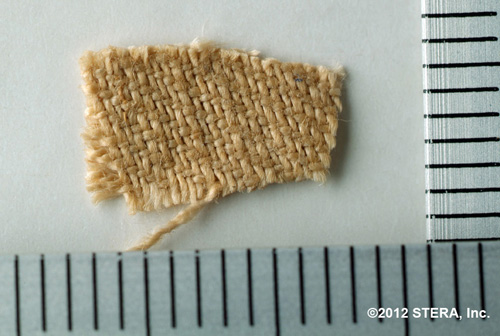 photomicrograph [Left (enlarge) and 16Jul15] taken by pro-authenticist Barrie Schwortz in 2012, of Arizona laboratory's remaining undated part of its Shroud sample[9]. The true explanation of the 1st century Shroud's false "mediaeval ... AD 1260-1390" is that it was the result of a computer hacking (see my "Conventional explanations of the discrepancy all fail"). Many scientists now believe the carbon dating result is inconclusive. Agreed, but even most Shroud pro-authenticists fail to grasp that: 1) since the Shroud is Jesus' burial sheet; 2) the improbability that the first-century Shroud could by chance have a radiocarbon date of 1260-1390 (i.e. 1325 ±65) is "astronomical," "about one in a thousand trillion," "totally impossible," and indeed "a miracle," 3) so there had to have been some form of fraud in the radiocarbon dating of the Shroud; and 4) one form of fraud that had not been previously considered but was rife in the 1980s, is computer hacking, which the fully computerised AMS radiocarbon dating system was vulnerable to (see my series, "The 1260-1390 radiocarbon date of the Turin Shroud was the result of a computer hacking"). Adding more doubt to the carbon dating tests, new chemical and mechanical tests published in 2013 by Italian scientists with Padua University indicate a date range of 280 BC to 220 AD. Indeed! See my post, "New tests by Prof. Giulio Fanti show the Shroud of Turin could date from the time of Christ." National Geographic called it: "One of the most perplexing enigmas of modern times." That was in June 1980:




 Posts

