Friday, May 6, 2016

Editorial and Contents: Shroud of Turin News - April 2016

Shroud of Turin News - April 2016
© Stephen E. Jones
[1]

[Previous: March 2016, part #3] [Next: April 2016, part #2]

This is the "Editorial and Contents," part #1 of the April 2016 issue of my Shroud of Turin News. Following this editorial, I will add excerpts from Shroud-related March/April 2016 news articles in separate posts, linked back to this post, with the articles' words in bold to distinguish them from mine. Click on a link below to go to that article.

Contents:
Editorial
"Has Science Proven the Shroud of Turin to Be a Medieval Forgery? (1)"
"Has Science Proven the Shroud of Turin to Be a Medieval Forgery? (2)"
"The Shroud of Oviedo: A Legendary Cloth Connected to the Death of Jesus"


Editorial. Rex Morgan's Shroud News: My scanning and word-processing of issues of Rex Morgan's Shroud News and emailing them to Barrie Schwortz for him to convert to PDF and add to his online Shroud News archive, continued in April up to issue #47, June 1988. [Right (enlarge)]. It is up to issue #36, August 1986, in that archive. 1988 was the year of the radiocarbon dating of the Shroud so in there is a lot on that topic coming soon!

Topic index: I continued adding my old posts to my Topic Index in April up to and including my post of 28 March 2012, but the rate has slowed to a crawl due to other priorities. In April, I blogged 7 posts: Editorial and Contents: Shroud of Turin News - March 2016 - 1st; Problems of the Forgery Theory: Index G-M - 2nd; "The Shroud of Turin": Shroud of Turin News - March 2016 - 3rd; "Modern-day 'Indiana Jones' links Shroud to 1st century": Shroud of Turin News - March 2016 - 4th; Non-traditional #13: The man on the Shroud: The evidence is overwhelming that the Turin Shroud is authentic - 13th; My review of "The Keramion, Lost and Found: A Journey to the Face of God" (2016) by Philip E. Dayvault - 25th.

Updates to my posts in the background in April included: "Problems of the Forgery Theory: Index A-F," "G-M" and "N-Z"; and "Is The Shroud Of Turin Genuine?": Shroud of Turin News, January 2016" (the latter is too time-consuming so I have ceased adding to it).

Pageviews: At midnight on 30th April, Google Analytics [below (enlarge)] gave this blog's "Pageviews all time history" as 524,526 and "Pageviews last month" as 9,216. It also gave the most viewed posts for the month as: ""Modern-day 'Indiana Jones' links Shroud to 1st century ...,"Apr 4 - 143; "The Shroud of Turin: 3.6. The man on the Shroud and Jesus were crucified," Dec 2, 2013 - 119; "Re: Shroud blood ... types as AB ... aged blood always types as AB, so the significance of this ... is unclear," Mar 18, 2011 - 108; "Phil Dayvault Presents Major New Evidence from Early Christianity ...," Mar 13 - 94 and "Non-traditional #13 ... ," - 91.

Continued in part #2 of this April 2016 issue of my Shroud of Turin News.


Notes:
1. This post is copyright. Permission is granted to extract or quote from any part of it (but not the whole post), provided the extract or quote includes a reference citing my name, its subject heading, its date, and a hyperlink back to it. [return]

Posted 6 May 2016. Updated 8 May 2025.

Monday, April 25, 2016

My review of "The Keramion, Lost and Found: A Journey to the Face of God" (2016) by Philip E. Dayvault

Philip E. Dayvault's 2016 book, "The Keramion, Lost and Found: A Journey to the Face of God" [Right: Amazon.com[1].] arrived by mail on 15th April, 2016. Here is my review of it, between the horizontal lines, on which will be the basis of a reader's review that I will submit to Amazon.com. [However, as mentioned in my 10Jul16, I belatedly discovered that, "The ideal length is 75 to 500 words" for an Amazon.com customer review, and this review was already many times that, so I abandoned that Amazon.com review]. I hope this review will be found by some intending buyers of the book before they waste their money on it (unless they are into historical fiction, or rather fantasy). See my previous posts, "`Modern-day 'Indiana Jones' links Shroud to 1st century': Shroud of Turin News - March 2016" and "`Phil Dayvault Presents Major New Evidence from Early Christianity': Shroud of Turin News - February 2016." Dayvault's words are in bold and the numbers in square brackets are page numbers in the book.


Leading Shroud scholar, Ian Wilson once began a review of a much better book than this one by Philip E. Dayvault, with:

"... very sadly the subject of the Shroud needs this particular book like a hole in the head ..."[2]
And very sadly the same applies to Dayvault's book because it is so wrong that it is at best an exercise in self-delusion (as will be seen). And I write as a fellow Christian and Shroud pro-authenticist of Dayvault.

• "Upon seeing the cloth, King Abgar V was healed of leprosy and gout and converted to Christianity, as soon did the entire city." [viii]. Wrong. While Edessa's King Abgar V (r.13-50) may have been healed of leprosy by Jesus' disciple Thaddeus and then converted to Christianity, along with some of Edessa's citizens, there is no good evidence for, and much evidence against, that Abgar V saw "the cloth," i.e. the Mandylion, which was the Shroud four-doubled (tetradiplon), i.e. folded 4 x2 = 8 times[3]. In the earliest c. 325 record of Abgar V's healing and conversion, that of Eusebius (c. 260–340)[4], there is no mention of a cloth[5] or an image[6]. And some (if not most) leading Shroud scholars now regard the story of Abgar V "seeing the cloth" as a "pious fraud"[7] and accept that it was under King Abgar VIII (r. 177-212) that Edessa became a Christian city[8]. Shroud pro-authenticist historian Dan Scavone has shown that it was Abgar VIII who was the originator of the Abgar V legend and had it inserted into Edessa's royal archives[9] (unknown to Eusebius). Even Ian Wilson the leading proponent of the Abgar V theory, now concedes:

"Abgar V was part of a dynasty of rulers bearing this same name, and one successor slightly more favoured by historians as the Abgar whom Addai [Thaddeus] converted (and who therefore may have been the true recipient of the Image of Edessa/Shroud) is Abgar VIII,' who reigned from 179 [sic] to 212" (my emphasis)[10]

• "Also, according to the legend, King Abgar V displayed the cloth and had a tile bearing the same facial image of Jesus Christ placed over a Western Gate of the `City'" ... [viii]. Wrong. The 945 "Official History of the Image of Edessa" (Narratio de Imagine Edessena)[11], which is Appendix C, pages 272-290, in Ian Wilson's 1979 book, The Shroud of Turin): 1) does not say "a tile bearing the same facial image of Jesus Christ" was "placed over a Western Gate of the `City'." That "tile" (there were two) which the Official History states, had a "copy of the likeness of the divine face" which "had been transferred to the tile from the cloth" was at "Hierapolis" [Hierapolis, Syria, modern Manbij], not Edessa:

"8. Christ entrusted this letter to Ananias, and knew that the man was anxious to bring to completion the other command of his master, that he should take a likeness of Jesus' face to Abgar. The Savior then washed his face in water, wiped off the moisture that was left on the towel that was given to him, and in some divine and inexpressible manner had his own likeness impressed on it. This towel he gave to Ananias and instructed him to hand it over to Abgar ... When he was returning with these things, Ananias then hurried to the town of Hierapolis ... He lodged outside this city at a place where a heap of tiles which had been recently prepared was lying, and here Ananias hid that sacred piece of cloth. ... The Hieropolitans ... found ... [on] one of the tiles nearby, another copy of the likeness of the divine face ... the divine image had been transferred to the tile from the cloth ... they retained the tile on which the divine image had been stamped, as a sacred and highly valued treasure" (my emphasis)[12].
That tile with Jesus' image on it was transferred from Hierapolis, Syria, to Constantinople in 968/969[13], that is ~24/25 years after the Mandylion/Shroud had been transferred from Edessa to Constantinople in 944[14].

Nor does the Official History say that the Edessa tile was "placed over" a gate of the city. It states that the "the image," i.e. the image of Jesus on the "towel" (see above), "lay" in a "place" which "had the appearance of a semispherical cylinder" and "a tile," of which nothing is said about it having an image, was "placed ... on top" of the image:
"15. ... A statue of one of the notable Greek gods has been erected before the public gate of the city by the ancient citizens and settlers of Edessa to which everyone wishing to enter the city had to offer worship and customary prayers. Only then could he enter into the roads and streets of the city. Abgar then destroyed this statue and consigned it to oblivion, and in its place set up this likeness of our Lord Jesus Christ not made by hand, fastening it to a board and embellishing it with the gold which is now to be seen ... And he laid down that everyone who intended to come through that gate, should-in place of that former worthless and useless statue-pay fitting reverence and due worship and honor to the very wondrous miracle-working image of Christ, and only then enter the city of Edessa. And such a monument to and offering of his piety was preserved as long as Abgar [V] and his son [Ma'nu V] were alive, his son succeeding to his father's kingdom and his piety. But their son and grandson [Ma'nu VI] succeeded to his father's and grandfather's kingdom but did not inherit their piety ... Therefore ... he wished just as his grandfather had consigned that idolatrous statue to oblivion so he would bring the same condemnation on the image of the Lord also. But this treacherous move was balked of his prey. For the bishop of the region, perceiving this beforehand, showed as much forethought as possible, and, since the place where the image lay had the appearance of a semispherical cylinder, he lit a lamp in front of the image, and placed a tile on top. Then he blocked the approach from the outside with mortar and baked bricks and reduced the wall to a level in appearance. And because the hated image was not seen, this impious man desisted from his attempt. .. Then a long interval of time elapsed and the erection of this sacred image and its concealment both disappeared from men's memories" (my emphasis)[15]
And Wilson pointed out that "a semispherical cylinder" is an apt description of "an arched vault," and "one of the four main gates of Edessa, that to the west, was specifically known in Syriac as the Kappe gate, which means gate of arches or vaults"[16]. So there is no reason to think that this undistinguished, "a tile," placed on top of the Mandylion/Shroud, in an arched vault above Edessa's "public gate of the city" (see above) the Western Gate, was: a) attached to anything; and b) had an image on it. The only tile which the 945 Official History records as having an image on it was the tile which had been in "a heap of tiles" at Hierapolis Sysria, and was still there in 945 when the Official History was written. So this Hierapolis tile, the only tile which is recorded as having an image of Jesus on it, must have been the tile which was later called "the Keramion." And that Hierapolis tile had never been at Edessa nor had anything to do with Edessa! So the answer to Dayvault's question that he asked in the Preface of his book:
"Could the small mosaic, the ISA Tile, be the actual historical and legendary Keramion?"[viii]
already is a resounding NO, and we are still only in the Preface, with still more to come in that Preface!

"... (Citadel), as a memorial to this momentous event. "[viii]. Wrong. As per my previous post, firstly, the Citadel was not the city, but a castle inside the city of Edessa[17] (see photo below). Secondly,

[Above (enlarge): Photo at page 221 of Dayvault's book of Edessa's citadel, with Dayvault's self-evidently false annotation that at the arrowed point is a "Gate" when there is no gate (see further below). But note that even Dayvault has to admit that this is only the Western end of "the Citadel" not of the city!]

the Citadel (which Dayvault on page 60 agrees was called the "Birtha") did not exist in the time of Abgar V (r.13-50) but was built by Abgar VIII (r. 177-212) in 205: "The sixth-century Syriac Chronicle of Edessa announces that `in the year 205 Abgar VIII built the Birtha."[18]. Thirdly, Dayvault is misleading his readers by a fallacious word-play between "city" and "citadel." In his online PDF, Dayvault wrote:

"Interestingly, the word, `city' derives from the Latin word, `civitas', which also can mean `citadel.'"[19]
The footnote 7 Dayvault cited, "7 http://viagabina rice.edu/oecus/oecus html, `Site 10 Villa: The Oecus Emblema', by Philip Oliver-Smith," does not have the words "civitas" or "citadel" in it. And in his book Dayvault simply asserts, with no reference:
"Civitas (Latin) means either city or citadel"[117].
But apart from that being false (my Latin-English dictionary states that the Latin "civitas" means "citizenship; community state;" and that the English "citadel" is "arx" in Latin[20]), that word-play only works in English. In Syriac the word for "citadel" is birtha[21], which Dayvault in his book even states[60] and "Edessa" in Syriac is "Orhay"[22].

And as can be seen in the photo below from page 220 of Dayvault's book, with his annotation that this is the "Western Gate of the Citadel," on that same page 220 Dayvault wrote that it was "Viewed

[Above (enlarge): Photo at page 220 of Dayvault's book of the Western end of the Citadel, with his self-evidently false (and deluded) annotation that it is the "Western Gate of the Citadel. But as can be seen in the maximum zoom Google Earth photo of the Western end of the Citadel, again there is no gate!]

from across the moat while looking eastward, the westernmost tip of the Citadel in Sanliurfa and its tunnel entrance is pictured above." As can be seen in the Google Earth photo below, that place from where

[Above (enlarge): Google Earth photo of Sanliurfa[23] showing the Western end of Edessa's Citadel. The triangular `island' (red arrow) is evidently from where Dayvault took his photo above, and the circular structure (blue arrow) is evidently what he called the "Western Gate Monument." Which is in fact the ruins of a tower/windmill (see below)!]

Dayvault evidently took his page 220 photo above, is on the triangular `island' to the upper left of the western end of the Citadel (red arrow). And the circular structure on the tip of the western end of the Citadel blue arrow) is evidently what Dayvault called the "Western Gate Monument" in his same photo above. But a photo on a "Rome Art Lover's" website identified this as the remains of a tower/windmill (see below). That is confirmed by an online tourist guide document,

[Above (enlarge): "Remains of a windmill tower at the western end of the citadel ..."[24]. See below that this windmill tower is "Byzantine and Islamic," which is 11th-12th century. How could Dayvault go to Sanliurfa, with a Turkish guide/interpreter (page 95ff), and not know that this is the remains of a windmill tower? And that it is 11th-12th century?]

"A Guide to Southeastern Anatolia," which states of "Sanliurfa": "The ruined Byzantine and Islamic structures include a windmill to the west of the citadel" (my emphasis)[25]. Note that this ruined windmill tower is "Byzantine and Islamic," but the Byzantine period in Edessa was from 1031[26] and ended with the Islamic conquest of Edessa in 1144[27]! So this windmill tower dates from between the 11th and 12th centuries, which is about a thousand years too late to be the "public gate of the city" (above) which, according to the 945 Official History (above), the Mandylion/Shroud, tile and lamp had been hidden! And therefore about a thousand years too late to be Dayvault's "Western Gate Entrance" (see below). Indeed by 1031 the Shroud and Keramion had been in Constantinople for ~87 and ~63 years respectively!

That this is the same structure which Dayvault called the "Western Gate Monument" above, but from a different angle, is confirmed by its inclusion in a triptych photo on page 222 of his book from that different angle (see below).

[Above (enlarge): Triptych photo on page 222 of Dayvault's book, being different views of what he calls, the "Western Gate Monument." The middle photo especially shows that it is in fact the windmill tower ruins in the photo above!]

Thus, all visitors to Edessa would see it and pay homage to the one true God." [viii]. Wrong. First, the Official History does not say that "all visitors to Edessa would see it" the tile "and pay homage to the one true God." It says (see above), that "everyone who intended to come through that gate ["the public gate of the city"], should ... pay fitting reverence and due worship and honor to the very wondrous miracle-working image of Christ" which "fasten[ed] ... to a board and embellish[ed] .. with ... gold," that is, the Mandylion/Shroud. As we saw above, the "tile" at Edessa had no image and its only function was to be "on top" of the Mandylion/Shroud. Why does Dayvault even want to boost this mere plain tile to the detriment of the Shroud?

Second, Dayvault (deludedly), claims that the "tunnel" in these windmill tower (see below) was "the public gate of the city" (see above)

[Above (enlarge): Photo on page 226 of Dayvault's book of the tunnel in this 11th-12th century (see above) windmill tower ruins, which Dayvault (deludedly) calls, "The Western Gate Entrance."]

within which the Mandylion/Shroud, the tile and lamp had supposedly been hidden! So incredible is this that I myself did not realise that is what Dayvault had been claiming. At page 228, Dayvault claims (or implies) that the Edessa tile was on a "single marble block" which had been in a cavity (see below) about "2 feet high by 3.5 feet wide" by "8-12 inches" deep (about 61 cms H x 107 cms W x 25 cms D):

"The opening above the Western Gate tunnel entrance measures approximately 2 feet high by 3.5 feet wide. The depth of the opening is approximately 8-12 inches. A single marble block is missing from the cavity. A block, similar in type to adjacent blocks, that would have been suitable for the accommodation of the ISA Tile with nimbus lies directly at the entrance to the tunnel."[228]
The cavity over the top of the tunnel (above) is where Dayvault claims (see future below) that the marble block on which the Sanliurfa mosaic, which he claims was the Keramion, was attached. This would have been the place in his book where Dayvault should have produced his key evidence that one of the loose blocks nearby matched the underside of the Sanliurfa mosaic, which Dayvault had claimed in his PDF, accompanied by a comparison photo (below), that he had "forensically

[Above (enlarge): Dayvault's claimed "unique features" of a stone block at what he calls the "Western Gate" of Edessa's Citadel and the underside of the Sanliurfa mosaic[28]. See my previous post where I pointed out that none of Dayvault's claimed "unique features" between the stone block and mosaic tile, match!]

determined the ISA Tile had been ... attached to the referenced stone block, thereby making it the original tile and not a copy:"

"Additional evidence was needed to associate the ISA Tile to the cavity and stone which would have been placed over the Western Gate of entranceway to the Citadel, otherwise the tile still might have been a copy of an even earlier mosaic. By examining his available photographic evidence, Dayvault noticed unique features on the large rock directly in front of the Citadel entranceway. The general characteristics were similar in configuration to the backside of the ISA Tile. Using skills from his former years of image analysis experience in the FBI Laboratory and Shroud research, he forensically determined the ISA Tile had been, in fact, at one time in its history, attached to the referenced stone block, thereby making it the original tile and not a copy[29].

But significantly, Dayvault has left that item of crucial evidence out of his book (he briefly mentions it later on pages 282-283 with only a tiny, postage stamp sized, ~3 cm x ~3.5 cm = ~ 1.2 in. x ~1.4 in. photo), presumably because he had since realised that the underside of the mosaic does not match the stone block at this so-called "Western Gate Entrance"!

Dayvault claimed on page 228 that this "tunnel" is a "cylindrical semicircle" which is "the description for the location where the Shroud, Keramion, and lamp were hidden" and "That is exactly what the tunnel entrance depicts!" (his emphasis):

"The actual tunnel opening is not visible from the top of the mound while standing next to the Western Gate Monument. This is ... where most visitors stand while observing the great view of Sanliurfa. One has to walk all the way around the monument on a narrow trail to see the tunnel entrance with the missing block over the passageway. A `cylindrical semicircle' ... is the description for the location where the Shroud, Keramion, and lamp were hidden. That is exactly what the tunnel entrance depicts! " [228. Dayvault's emphasis]
But it is not what the tunnel entrance depicts! The Official History states above that "the place where the image," tile and lamp "lay had the appearance of a semispherical cylinder" (my emphasis). The difference is that a "cylindrical semicircle" would be a cylinder which was flat at each end, and cut in half lengthwise; but a "semispherical cylinder" would be a cylinder with one end flat and the other end a half-sphere, and cut in half lengthwise. This does not fit Dayvault's tunnel so he changes the wording of the Official History! And apart from this windmill tower being "Byzantine and Islamic" and therefore 11th- 12th century (see above), as shown by Dayvault's own photo on page 226 [Right (enlarge)] this tunnel is neither a "cylindrical semicircle" nor a "semispherical cylinder," but just brick tunnel (presumably for storage of grain to be milled and flour) with a pointed apex along its length. And as Dayvault's own photo below on page 223 of the opposite side of this tunnel entrance shows, it did not go all the way through. So (apart from

[Above (enlarge): Opposite side of what Dayvault calls the "Western Gate Monument" (which is actually a 11th-12th century windmill tower - see above), showing there is no way through what Dayvault claims was the "public gate of the city" (see above).]

everything else above, this tunnel could not have been what Dayvault claims on page 230 was the Official History's "Edessa city gate," that is "the public gate of the city" (see above).

This tile is historically known as the Keramion." [viii]. Wrong. As pointed out above the only tile the 945 Official History states had an image on it, was the one at Hierapolis, Syria. That tile was never at Edessa, but was transferred from Hierapolis, Syria to Constantinople in 968/969. The Official History says nothing about the tile at Edessa having an image on it. It was therefore this tile which had been at Hierapolis, Syria, that the Official History records had a "likeness of the divine [Jesus'] face" (see above) on it, and was transferred from Hierapolis, Syria, to Constantinople in 968/969, and later became known as The Keramion[30].

Further evidence against this Sanliurfa mosaic (see below) being the Keramion includes: 1) It is a mosaic, and even credulous first century

[Above (enlarge): "Mosaic face of Jesus, sixth century. Fragment from an unidentified location in Sanliurfa"[31]. Guscin and Wilson dated this Sanliurfa mosaic "somewhere between the sixth and seventh centuries"[32]. Dayvault in 2002[280] and Wilson and Guscin in 2008 were independently told by the Director of Sanliurfa Museum that the mosaic had been cut out of the wall of a Sanliurfa house[33]. This is a higher quality photo of the Sanliurfa mosaic, which Guscin found in a Sanliurfa magazine[34], and was first published outside of Turkey in Ian Wilson's 2010 book, "The Shroud" (see reference 31), thus preempting Dayvault who evidently sat on his 2002 discovery of the mosaic for ~9 years (2002-11) (see previous). Dayvault was aware that Wilson was the first to publish outside of Turkey an account of finding this mosaic, including the above photo of it, because on page 140 Dayvault refers to what presumably is private communication between him and Wilson about the mosaic:

"... Ian Wilson has indicated the place of its [the mosaic's] supposed original discovery was in Bireçik, a small town on the banks of the Euphrates River and in the western part of Sanliurfa Provence [sic]..." (see also below).
But Dayvault does not give a reference to this communication with Wilson, and nowhere in Dayvault's book can I find (it does not have an index) where Dayvault credits Wilson or even cites his 2010 book.]

Hieropolitans would know that a mosaic was not an image but a lot of tiny tiles, none of which has an image, which together form the illusion of an image. So this Sanliurfa mosaic, Dayvault's "ISA tile," has no image, but only an illusion of an image which exists, not on the tile, but in the heads of humans looking at it. So this Sanliurfa mosaic cannot be the Keramion!

2) As pointed out in a previous post, the Greek word "keramion" is derived from keramos, which means "clay," "anything made of clay," and includes "a roofing tile"[35]. This fits with the Official History where the tile upon which the image of Jesus was transferred, which was later named "The Keramion," was one of "a heap of tiles which had been recently prepared," that is, clay roofing tiles. The exact same word keramion" occurs in Mark 14:13 and Luke 22:10 where it is translated "jar," as in a clay jar for carrying water[36]. But Dayvault described the base of the Sanliurfa mosaic, in which the mosaic tiles or tesserae were embedded, as "tufa" which is "a limestone commonly used for artwork" (my emphasis)[285]. So again, this Sanliurfa mosaic cannot be the Keramion!

3) Dayvault needs to plausibly explain how the Keramion, which disappeared during the 1204 sack of Constantinople[37] ended up in the wall of a house in Bireçik, a small town in Sanliurfa Province. He admitted in his PDF that "If his [the man who sold the mosaic to the museum] story were true, the ISA Tile would have been only a copy of an even earlier prototype" (Dayvault's emphasis)[38]. However in his book on page 280, Dayvault wrote that if this were true, it only "potentially could "preclude the possibility of its being the actual Keramion" (my emphasis). That is because Dayvault had since thought of two fantastic (as in fantasy) `explanations' of how what the man told the museum was true, yet the mosaic was the Keramion. Dayvault's first fantasy `explanation' was that because "Bireçik ... [is] about 20 miles [actually 35 miles = 56 kms] from Hierapolis, Syria, this Sanliurfa mosaic is the original Hierapolis tile and it was a copy of it which in 968 was taken to Constantinople and became known as the Keramion:

"Interestingly, Ian Wilson has indicated the place of its supposed original discovery was in Bireçik, a small town on the banks of the Euphrates River and in the western part of Sanliurfa Provence [sic], about 20 miles from Hierapolis, where the Keramion had been taken and later ordered retrieved and taken to Constantinople by Emperor Phokas in AD 966 or AD 968. Is that mere coincidence? Or, perhaps, could a copy have been sent to the emperor ... with the original remaining behind in Hierapolis (Edessa)? This would allow for the original to have been rediscovered and eventually passed on to the museum. The mosaic tile sent to Constantinople would most likely have been a copy in that the custodians would have wanted to retain the original" [140. Emphasis Dayvault's]
But apart from Wilson and Guscin, world authorities on the Image of Edessa, having dated this mosaic to "between the sixth and seventh centuries" (see above), it not being made of clay (which is what keramion means - see above), and being a mosaic having no image on it (see above), Dayvault's "Hierapolis (Edessa)" reveals his confusion of the Hierapolis tile which had an image and the Edessa tile which didn't (see above). Then there are Dayvault's problems of explaining how the Emperor's experts were fooled when they would have been intimately familiar with the Hierapolis tile, and again how the tile ended up in the wall of a house in a small town in Sanliurfa Province, with no one knowing it was there, including the owner of the house.

Dayvault's second fantasy `explanation' is that the museum misunderstood what the seller (not "donor" because he sold it to the museum) told them. What the seller really said (according to Dayvault) was that the tile had been "hacked out ... of the wall ... [of] "the `house ...' of the king ... the Citadel"!:

"However, what if the donor had actually said, `It, the mosaic, had been 'hacked' out of a 'house' during 'renovations'? ... the donor could possibly be describing exactly what happened to the ISA Tile when it was removed centuries ago. Theoretically, describing the donor's statement and possible true meaning, the tile was `hacked out' of the wall cavity over the Western Gate tunnel, removed from its display, and hidden away, circa AD 57 in a tunnel cavity (in a small niche also `hacked out' to accommodate its shape) only to be rediscovered 468 years later during `house' renovations (flood repairs) in AD 525! The `house' he was possibly referring to was the `house' of the king, the winter palace on the Citadel. Now, his statement takes on a much different and relevant meaning!"[280-281]
But where the tile had been since 525, how the seller obtained it, and how many thousands (if not millions) of US dollar equivalents he sold it for (since the seller knew it came from the Citadel) Dayvault doesn't say. Perhaps Dayvault imagines the following conversation between the seller and the Sanliurfa Museum Director:

Seller: "This mosaic tile was in AD 57 hacked out of a wall in the King's house, the Citadel, and I want one million US dollars for it."
Museum Director (hard of hearing): "You hacked it out of a wall in your house?"
Seller: "No, out of a wall in The Citadel. One of my ancestors hacked it off a stone block at the entrance of what is today the tunnel of the old windmill. The tile has been passed down through our family for 1447 years, from 525 to 1972. But I have inherited it and I want to sell it for one million dollars."
Museum Director (hearing only "I want to sell it"): "How much do you want for this mosaic tile you hacked out of a wall in your house?"
Seller (exasperated): "As I said, I want one million US dollars for it."
Museum Director (hearing only "one" and "dollar"): "It's a deal."

Dayvault's two contradictory fantasy `explanations' above just show the bankruptcy of his claim that this Sanliurfa mosaic is the Keramion. And what's more, it shows that Dayvault, at some level knows that his Keramion claim is false. As one who claims to be a Christian, Dayvault should publicly admit that his claim that this Sanliurfa mosaic is the Keramion is false, and offer to refund the money of the publisher and the purchasers of his book. I own over a hundred Shroud-related books and this book by Dayvault is easily the worst, and that includes my anti-authenticist books! If you are thinking about buying this book, I strongly recommend you don't, unless you like historical fiction/fantasy!


Notes
1. Dayvault, P.E., 2016, "The Keramion Lost and Found: A Journey to the Face of God," Morgan James Publishing: New York NY. [return]
2. Wilson, I., 2007, "Review of Brendan Whiting The Shroud Story, Harbour Publishing, Strathfield, New South Wales, Australia, 2006." 21 January. [return]
3. Wilson, I., 1974, "The Shroud in history," The Tablet, 13th April, p.12 (no longer online); Wilson, I., "The Shroud's History Before the 14th Century," in Stevenson, K.E., ed., 1977, "Proceedings of the 1977 United States Conference of Research on The Shroud of Turin," Holy Shroud Guild: Bronx NY, pp.44-45; Wilson, I., 1979, "The Shroud of Turin: The Burial Cloth of Jesus?," [1978], Image Books: New York NY, Revised edition, pp.120, 307 n.16; Drews, R., 1984, "In Search of the Shroud of Turin: New Light on Its History and Origins," Rowman & Littlefield: Lanham MD, pp.36-37, 39-40; Wilson, I., 1986, "The Evidence of the Shroud," Guild Publishing: London, pp.112-113; Scavone, D.C., "The History of the Turin Shroud to the 14th C.," in Berard, A., ed., 1991, "History, Science, Theology and the Shroud," Symposium Proceedings, St. Louis Missouri, June 22-23, 1991, The Man in the Shroud Committee of Amarillo, Texas: Amarillo TX, pp.171-204, 171, 184; Iannone, J.C., 1998, "The Mystery of the Shroud of Turin: New Scientific Evidence," St Pauls: Staten Island NY, pp.104-105, 114-115; Wilson, I., 1991, "Holy Faces, Secret Places: The Quest for Jesus' True Likeness," Doubleday: London, p.141; Wilson, I., 1998, "The Blood and the Shroud: New Evidence that the World's Most Sacred Relic is Real," Simon & Schuster: New York NY, pp.152-153; Ruffin, C.B., 1999, "The Shroud of Turin: The Most Up-To-Date Analysis of All the Facts Regarding the Church's Controversial Relic," Our Sunday Visitor: Huntington IN, pp.55, 57; Antonacci, M., 2000, "Resurrection of the Shroud: New Scientific, Medical, and Archeological Evidence," M. Evans & Co: New York NY, pp.132-133; Wilson, I. & Schwortz, B., 2000, "The Turin Shroud: The Illustrated Evidence," Michael O'Mara Books: London, pp.110-111; Guerrera, V., 2001, "The Shroud of Turin: A Case for Authenticity," TAN: Rockford IL, pp.2-3, 5-6; Wilson, I., 2010, "The Shroud: The 2000-Year-Old Mystery Solved," Bantam Press: London, pp.140-141, 148, 299, 174; de Wesselow, T., 2012, "The Sign: The Shroud of Turin and the Secret of the Resurrection," Viking: London, pp.186-187. [return]
4. Eusebius, c. 325, "The Ecclesiastical History of Eusebius Pamphilus," Book I, Chapter XIII, Cruse, C.F., transl., 1955, Baker: Grand Rapids MI, Fourth printing, 1966, pp.46-47; Wilson, 1979, pp.127-128; Antonacci, 2000, p.133; Wilson & Schwortz, 2000, p.107; Guerrera, 2001, pp.1-2. [return]
5. Ruffin, 1999, p.54; Guerrera, 2001, p.2. [return]
6. Drews, 1984, p.62; Scavone, D.C., 1989, "The Shroud of Turin: Opposing Viewpoints," Greenhaven Press: San Diego CA, pp.80-81; Scavone, D.C., 2002, "Joseph of Arimathea, the Holy Grail and the Edessa Icon," Collegamento pro Sindone, October, pp.1-25, p.2. [return]
7. Markwardt, J.J., 1998, "Antioch and the Shroud," in Walsh, B.J., ed., 2000, "Proceedings of the 1999 Shroud of Turin International Research Conference, Richmond, Virginia," Magisterium Press: Glen Allen VA, pp.94-108, 94; Markwardt, J.J., 2009, "Ancient Edessa and the Shroud: History Concealed by the Discipline of the Secret," in Fanti, G., ed., "The Shroud of Turin: Perspectives on a Multifaceted Enigma," Proceedings of the 2008 Columbus Ohio International Conference, August 14-17, 2008, Progetto Libreria: Padua, Italy, p.384. [return]
8. Guerrera, 2001, p.2. [return]
9. Scavone, D.C., 2010, "Edessan sources for the legend of the Holy Grail," Proceedings of the International Workshop on the Scientific approach to the Acheiropoietos Images, ENEA Frascati, Italy, 4-6 May 2010, pp.1-6, 1. [return]
10. Wilson, 2010, p.119. [return]
11. Wilson, 1979, p.307; Wilson, 1998, pp.256, 268; Guscin, M., 2009, "The Image of Edessa," Brill: Leiden, Netherlands & Boston MA, pp.7-69; 154-157. [return]
12. "Court of Constantine Porphyrogenitus `Story of the Image of Edessa' (A.D. 945)," in Wilson, 1979, pp.272-290, 276-277. [return]
13. Wilson, 1979, p.132; Currer-Briggs, N., 1988, "The Shroud and the Grail: A Modern Quest for the True Grail," St. Martin's Press: New York NY, p.71; Currer-Briggs, N., 1995, "Shroud Mafia: The Creation of a Relic?," Book Guild: Sussex UK, p.74; Wilson, 1998, p.268; Whiting, B., 2006, "The Shroud Story," Harbour Publishing: Strathfield NSW, Australia, p.256. [return]
14. Wilson, 1979, pp.116, 151; Maher, R.W., 1986, "Science, History, and the Shroud of Turin," Vantage Press: New York NY, pp.92; Morgan, R., 1980, "Perpetual Miracle: Secrets of the Holy Shroud of Turin by an Eye Witness," Runciman Press: Manly NSW, Australia, pp.36-37; Scavone, D.C., 1989, "The Shroud of Turin: Opposing Viewpoints," Greenhaven Press: San Diego CA, p.85; Wilson, 1998, pp.148-149; Guerrera, 2001, pp.4-5; Scavone, D.C., "Underscoring the Highly Significant Historical Research of the Shroud," in Tribbe, F.C., 2006, "Portrait of Jesus: The Illustrated Story of the Shroud of Turin," Paragon House Publishers: St. Paul MN, Second edition, p.xxvii; Wilson, 2010, p.165. [return]
15. Wilson, 1979, pp.280-281. [return]
16. Wilson, 1979, pp.131-132; Wilson, 2010, pp.131-134. [return]
17. Wilson, 1998, p.172. [return]
18. Scavone, 2002, p.10. [return]
19. Dayvault, P.E., 2011, "`FACE of the GOD-man': A Quest for Ancient Oil Lamps Leads to the Prototype of Sacred Art...and MORE!," Shroud University, May 11, p.24. [return]
20. Kidd, D.A., 1995, "Collins Paperback Latin Dictionary," HarperCollins: London, Latin-English p.37 & English-Latin p.29. [return]
21. Wilson, 1998, p.172; Scavone, 2010, p.1. [return]
22. "Edessa: Names," Wikipedia, 20 April 2016. [return]
23. "Sanliurfa," Google Maps: Earth, 29 April 2016. [return]
24. Piperno, R., 2011, "Sanliurfa: page one," A Rome Art Lover's Webpage. [return]
25. "A Guide to Southeastern Anatolia: Şanlıurfa Citadel, November 16, 2007. [return]
26. "Edessa: History," Wikipedia, 20 April 2016. [return]
27. "Siege of Edessa," Wikipedia, 16 February 2016. [return]
28. Dayvault, 2011, p.25. [return]
29. Ibid. [return]
30. Wilson, 1979, p.132; Currer-Briggs, N., 1984, "The Holy Grail and the Shroud of Christ: The Quest Renewed," ARA Publications: Maulden UK, p.19; Currer-Briggs, 1988, p.71; Whiting, B., 2006, "The Shroud Story," Harbour Publishing: Strathfield NSW, Australia, p.256 [return]
31. Wilson, 2010, plate 19a. [return]
32. Wilson, 2010, p.2. [return]
33. Ibid. [return]
34. Guscin, M., 2015, "MARK GUSCIN PhD THESIS 05.03.15," Royal Holloway, University of London, p.275. [return]
35. Thayer, J.H., 1901, "A Greek-English Lexicon of the New Testament," T & T. Clark: Edinburgh, Fourth edition, Reprinted, 1961, p.344. [return]
36. Zodhiates, S., 1992, "The Complete Word Study Dictionary: New Testament," AMG Publishers: Chattanooga TN, Third printing, 1994, p.858. [return]
37. Currer-Briggs, 1984, pp.23-24ff; Currer-Briggs, 1988, pp.72-73; Wilson, 1998, p.273; Currer-Briggs, 1995, pp.73-74; Oxley, M., 2010, "The Challenge of the Shroud: History, Science and the Shroud of Turin," AuthorHouse: Milton Keynes UK, pp.107-108. [return]
38. Dayvault, 2011, p.7. [return]

Posted 25 April 2016. Updated 7 May 2025.

Wednesday, April 13, 2016

Non-traditional #13: The man on the Shroud: The evidence is overwhelming that the Turin Shroud is Jesus' burial sheet!

NON-TRADITIONAL #13

Copyright © Stephen E. Jones[1]

This is part #13, "The man on the Shroud: Non-traditional," of my series, "The evidence is overwhelming that the Turin Shroud is Jesus' burial sheet!" See the Main index for more information about this series.

[Main index #1] [Previous: Colour #12] [Next: No outline #14]


  1. The man on the Shroud #8
    1. Non-traditional #13

Introduction. The image of the man on the Shroud is non-traditional[2].

[Above (enlarge): "Man of Sorrows," c. 1347, by Naddo Ceccarelli (c. 1330–60), in Liechtenstein Museum, Vienna[3]. Although this work was painted in 1347, before the Shroud's first undisputed public exposition at Lirey, France, in 1355[4], Jesus' hands are crossed, the right over the left, with an awkward crossing point at the wrists, as on the Shroud[5]. So even though this 14th century artwork reflects a prior knowledge of the Shroud, it still retains traditional medieval Christian art conventions: Jesus is not naked but wearing a loincloth; the crown of thorns is a circlet, not a cap; and the nails were through the palms of His hands, not the wrists (as we will see).]

Naked. The man on the Shroud is entirely naked)[6] (see also part #9). Although the man's hands cover his genitals[7], the tip of his penis seems to protrude below his fingers[8], and there are extensive scourge marks around his genital area[9] (see future below). Moreover, his back is completely nude[10], showing his buttocks[11]. This is consistent with all four gospels which state that just before His crucifixion, Jesus' clothes were taken by His Roman soldier executioners (Mt 27:35; Mk 15:24; Lk 23:34; Jn 19:23-24)[12]. However, in medieval Christian art, the crucified or dead Jesus was almost never depicted completely naked[13], but wearing at least a loincloth[14] (see above and below). A claimed exception is the Holkham Bible[15]. But there the figure of Jesus is cartoon-like[16] and he doesn't have genitals (see part #9)! Other than the Shroud, the only depiction of Jesus' completely naked back that I am aware of is the second century Roman Alexamenos graffito which depicts Jesus naked from the rear, on a cross, with the head of a donkey[17] (see below).
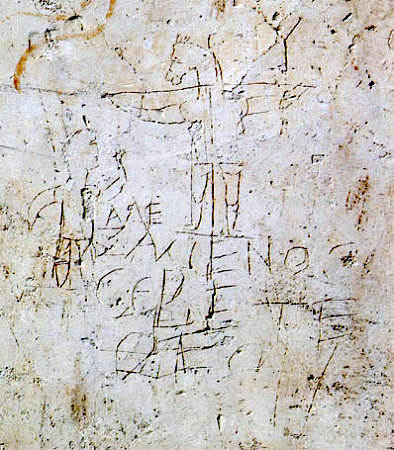
[Above (enlarge): The Alexamenos graffito mocks Alexamenos, a second century Christian Roman soldier or slave[18], who is depicted raising a hand in worship of a naked Jesus with a donkey's head, on a cross from the rear, under the caption: "Alexamenos worships [his] God"[19] This earliest known depiction of the crucifixion of Jesus, dated c.200, was found in 1857 scratched on a wall in an excavated building under the Palatine Hill, Rome[20]. The nude back view of Jesus was presumably designed to be especially shocking and degrading.]

Crown of thorns. (see also my 08Sep13). In mockery of Jesus' confirmation to Pilate that He was the King of the Jews (Mt 27:11; Mk 15:2, Lk 23:3, Jn 18:33-37), the Gospels record that the Roman soldiers guarding Jesus twisted together a crown [Gk. stephanos] of thorns and put it on His head (Mt 27:29; Mk 15:17; Jn 19:2)[21]. The shape of the crown cannot be determined[22] from the Greek word for "crown" (stephanos)[23], which means "primarily, that which surrounds, as a wall or crowd (from stepho, to encircle)"[24]; "to put round ... a crown (with which the head is encircled)"[25]. So traditional Christian art has depicted Jesus wearing a wreath[26] or circlet[27] crown of thorns, down to the present[28]. But the pattern of puncture marks all over the scalp of the man on the Shroud indicate that his crown of thorns was a "cap"[29] or "helmet"[30] (see below).

[Above (enlarge): "Helmet" of thorns in the permanent exhibition of the Shroud of Turin in the Pontifical Institute Notre Dame of Jerusalem Center[31].]

Nails in the hands. Traditional Christian art has depicted the crucifixion nails that the Gospels state were in Jesus' hands (Jn 20:19-20, 24-28; Lk 24:36-40)[32] as being in His palms[33],
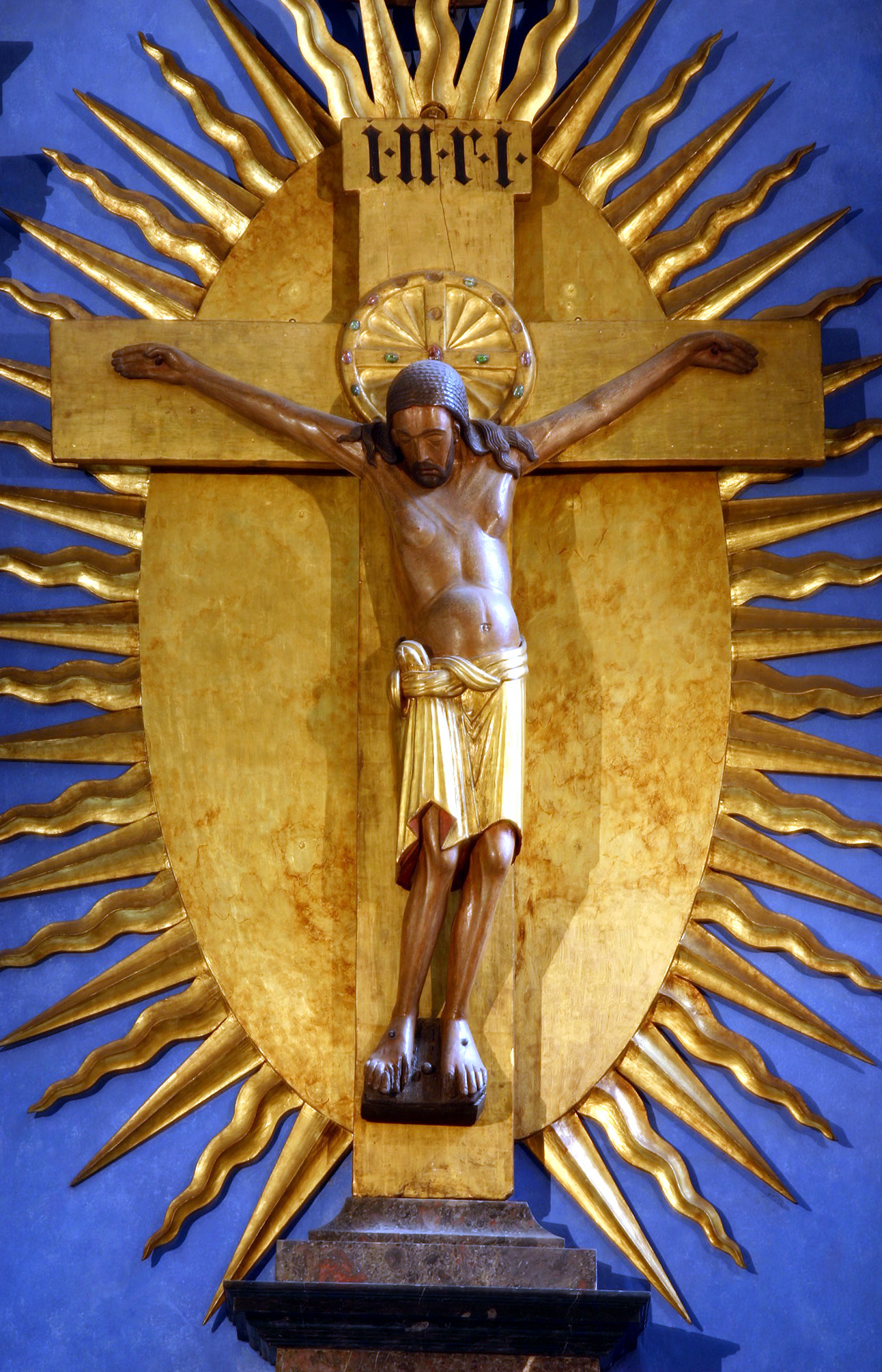
[Above (enlarge): "Gero Cross, late 10th century, Cologne Cathedral, Germany"[34]. As can be seen, the nails in Jesus' hands are in His palms, and Jesus is not naked but wearing a large loincloth.]

including by some who have copied the Shroud[35]. However, as Paul Vignon (1865-1943) had pointed out[36], and surgeon Pierre Barbet (1884–1961) proved experimentally on cadavers, that when a man's body is suspended on a cross by only a nail through the palm of each hand, the nails would tear through the fleshy palms[37] and the crucified would fall off his cross[38]. However Barbet also proved experimentally on other cadavers that a nail through the wrist (as on the Shroud[39]-see next) of each hand would support a suspended man's body without tearing through the bony wrists[40]. On the Shroud only the nail wound in the left hand is visible, its counterpart in

[Above (enlarge)[41]: Nail exit wound on the back of the Shroud man's left wrist[42], showing trickles of blood from that wound and the inferred wound in the right hand, both of which trickles ran down each forearms when the hands were raised above the head on the cross].

the right hand being covered by the left hand[43]. The existence of a corresponding nail wound in the right hand can be inferred from the trickles of blood down the right forearm, similar to those on the left forearm[44]. This is consistent with the Gospels because the New Testament Greek for "hand" [cheir][45] included the wrist[46] and in fact the hand, wrist and arm up to the elbow[47], because the Greek words for "arm" [ankale and brachion][48] did not include the arm from the elbow to the hand (i.e. the forearm)[49].

Problems for the forgery theory. (see previous three: #10, #11 & #12). Jesus completely naked. It is highly unlikely that a medieval artist/forger would have depicted Jesus naked[50], when He was usually represented wearing robes[51] or at least a loincloth[52]. But the supposed forger must have intended to stress Jesus' nudity because hr not only depicted Jesus fully naked from behind showing even His

[Above (enlarge): Scourge marks on the Shroud man's buttocks (rotated 180°)[53]. According to the forgery theory the medieval forger not only depicted Jesus completely nude from behind without even a loincloth, but he deliberately emphasised Jesus' complete nudity by placing scourge marks over them.]

buttocks (as in the Alexamenos graffito above), but the forger had shown scourge marks around Jesus' genital area which a loincloth would have hidden[54].

[Above (enlarge): Scourge marks around the genital area of the Shroud man[55]. According to the forgery theory the 14th century, or earlier, forger deliberately depicted them there.]

The Alexamenos graffito is also known as the "graffito blasfemo," or blasphemous graffito[56]. A completely naked depiction of Jesus would have been sacrilegious and blasphemous to the medieval mind[57], and the usual punishment for blasphemy in medieval Europe was death by burning at the stake[58]. So no medieval European forger would have dared to depict Christ naked[59] realistically, as the man on the Shroud is[60] . Therefore the complete nudity of the image on the Shroud is a further proof of its authenticity[61]!

The crown of thorns is a cap. That the crown of thorns on the Shroud is a cap (see above) is evidence that the Shroud is Jesus' burial sheet and so is a problem for the forgery theory. In the East the traditional crown of kings was a mitre which covered the entire head like a cap[62]. But a European medieval forger would be unlikely to know this and even if he did, he would most likely still have depicted Jesus wearing a circlet, not a cap, crown of thorns as on the Shroud[63]. That is because even after the Shroud had first appeared in undisputed history at Lirey, France in 1355, European artists continued to depict the crown of

[Above (enlarge): "Christ Carrying the Cross as portrayed by El Greco [1541–1614], 1580."[64]. Note that even in 1580, more than two centuries after the Shroud had indisputably first appeared at Lirey in 1355, this leading European artist was still depicting Jesus wearing a traditional circlet, or wreathlet, crown of thorns.]

thorns on Jesus' head as a Western circlet crown, not as an Eastern mitre (cap) crown, as on the Shroud[65].

Nails in the wrists, not palms. A medieval artist/forger who who intended his shroud to be accepted, would not have contradicted the traditional iconography, showing only only one full hand on the Shroud and therefore only one nail wound[66], in the wrist, not the palm[67]. It was not until the 17th century, and therefore likely influenced by the Shroud, that a minority of artists, notably Van Dyck, began depicting

[Above (enlarge)[68]: "Crucifixion," 1622 by Anthony van Dyck (1599–1641), was one of the first depictions of Jesus crucified by a nail in each wrist, albeit well past the Middle Ages (5th-15th centuries).]

Jesus crucified, suspended by a nail in each wrist[69] (see above). A medieval forger would certainly have placed the hand nail wound in Jesus' palm, as he would have had to conform to traditional norms, if he wanted his false shroud to have been accepted[70]. Medieval tradition demanded that the nail-wound in the left hand be in the centre of the palm, and in a forged relic such independence from tradition would not have been tolerated[71]. A medieval forger would have depicted two nail wounds in the centre of Christ's two hands, not one nail wound in one wrist, because in the Middle Ages the wounds of Christ had intense devotional interest and were always conventionally depicted[72]. And because Christ's wounds were considered profoundly meaningful and were a focus of devotion in the Middle Ages, if the Shroud were a medieval forgery, the wounds in the hands (plural) would have been clearly marked[73]. Since crucifixion had been abolished across the Roman Empire (including Europe) in 337[74], by Emperor Constantine the Great (c. 272–337), a medieval forger would be most unlikely to know enough about Roman crucifixion to contradict the unanimous view of medieval Christianity, that nails had been driven through the middle of Jesus' palms[75]. So either an unknown medieval artistic genius had a unique insight into the practice of Roman crucifixion, or the Shroud genuinely documents this ancient torture[76]!

Conclusion A medieval forger of the Shroud would have wanted his forgery to be accepted by his contemporaries, so he could sell it for a higher price. His forgery would therefore have conformed to traditional norms shared by his contemporaries.

The forger would not therefore have depicted Jesus completely nude, but would have added at least a loincloth. He certainly would not have shown Jesus' buttocks and added scourge marks around Jesus' genital area and buttocks. Indeed if a known medieval forger had done that he would have been burned at the stake for blasphemy!

Which incidentally is another reason to believe that Bishop Pierre d'Arcis (r. 1377-1395) was wrong in his 1389 memorandum's claim that the image on the Shroud had been "cunningly painted" and one of his predecessors, Bishop Henry de Poitiers (†1354-1370), had "discovered ... the artist who had painted it"[77]. That known artist would have been arrested, charged, tried, found guilty and punished. In which case there would have been a record of his trial and its details, including the forger's name, which would have been cited by Bishop d'Arcis, who had been a lawyer[78]. That d'Arcis did not cite the name of the forger, or details of his trial and execution, shows that there never was a forger, and d'Arcis was at best misinformed, or at worst lying.

A medieval forger would have depicted the crown of thorns, not as a cap, as the Shroud man's is, but as a circlet, as did all medieval and most later artists who depicted Jesus having been crowned with thorns, including some who copied the Shroud (see right). Even if the forger had somehow (given that crucifixions had ceased in Europe more than a thousand years before 1355[79]) known that Eastern kings were crowned with a cap not a circlet, his contemporaries would not have known that.

[Right (enlarge): Copy of the Shroud dated 1516, kept in the Church of St. Gommaire, Lier, Belgium, showing Jesus naked, but His crown of thorns is a circlet, and He has two hands visible with a nail wound in each palm[80]. So it would have been easy for a forger to have depicted Jesus' two nail wounds while His hands covered His genital area, as the artist of this copy - probably Albrecht Dürer (1471–1528) - did.]

A medieval forger of the Shroud would not have shown only one of Jesus' hands in full, and therefore only one of His hand nail wounds, because the wounds of Christ were very important in medieval Christian devotion. And a medieval forger would have shown the nail wounds in the centre of each of Jesus' hands, that is, His palms, as traditional medieval Christian art did, even those who copied the Shroud (see above).

These three non-traditional major features of the Shroud image are three more problems for the medieval forgery theory and three more reasons why the Turin Shroud is Jesus' burial sheet! That is, the actual burial sheet of Jesus Christ, bearing the imprint of His beaten (Mt 26:67-68; 27:30; Lk 22:64; Jn 18:22; 19:3), scourged (Mt 27:26; Mk 15:15; Lk 23:16; Jn 19:1), crowned with thorns (Mt 27:29; Mk 15:17; Jn 19:2,5), crucified (Mt 27:35,38,44; Mk 15:24-27,32; Lk 23:33; Jn 19:16-18), dead (Mt 27:50; Mk 15:37,39; Lk 23:46; Jn 19:30), legs not broken (Jn 19:32-33), speared in the side (Jn 19:34), wrapped in a linen shroud (Mt 27:59; Mk 15:46; Lk 23:53; Jn 19:40), buried in a rock tomb (Mt 27:59-60; Mk 15:46; Lk 23:53; Jn 19:38-42) and resurrected (Mt 28:1-6; Mk 16:1-6; Lk 24:1-6; Jn 20:1-9) body!

Continued in the part #14 of this series.

Notes
1. This post is copyright. Permission is granted to quote from any part of this post (but not the whole post), provided it includes a reference citing my name, its subject heading, its date, and a hyperlink back to this post. [return]
2. Habermas G.R., "Discussion," in Habermas G.R., Flew A.G.N. & Miethe T.L., ed., 1987, "Did Jesus Rise From The Dead?: The Resurrection Debate," Harper & Row: San Francisco CA, p.120; Wilcox, R.K., 1977, "Shroud," Macmillan: New York NY, p.170. [return]
3. Krén, E. & Marx, D., 2016, "Ceccarelli, Naddo, (active 1340s in Siena), Man of Sorrows, c. 1347, Tempera on panel, 71 x 50 cm, Liechtenstein Museum, Vienna," Web Gallery of Art. [return]
4. Humber, T., 1978, "The Sacred Shroud," [1974], Pocket Books: New York NY, p.99; Wilson, I., 1979, "The Shroud of Turin: The Burial Cloth of Jesus?," [1978], Image Books: New York NY, Revised edition, p.90; Wilson, I., 1998, "The Blood and the Shroud: New Evidence that the World's Most Sacred Relic is Real," Simon & Schuster: New York NY, pp.128, 278; Oxley, M., 2010, "The Challenge of the Shroud: History, Science and the Shroud of Turin," AuthorHouse: Milton Keynes UK, pp.4, 52; Wilson, I., 2010, "The Shroud: The 2000-Year-Old Mystery Solved," Bantam Press: London, p.222. [return]
5. Wilson, 1979, p.160; Wilson, 2010, p.183; de Wesselow, T., 2012, "The Sign: The Shroud of Turin and the Secret of the Resurrection," Viking: London, p.179. [return]
6. Beecher, P.A., 1928, "The Holy Shroud: Reply to the Rev. Herbert Thurston, S.J.," M.H. Gill & Son: Dublin, p.17; Hynek, R.W., 1951, "The True Likeness," [1946], Sheed & Ward: London, p.30; Wilson, 2010, p.183. [return]
7. Wilson, 1998, p.26; de Wesselow, 2012, p.145. [return]
8. Wilson, 1998, pp.24, 28. [return]
9. Vignon, P., 1902, "The Shroud of Christ," University Books: New York NY, Reprinted, 1970, p.41. [return]
10. Vignon, 1902, p.42; Beecher, 1928, p.17. [return]
11. Messenger, J., 2002, "More on the `Mysterious' Shroud: In Response," Voice News, June 14. No longer online). [return]
12. Wilson, I., 1996, "Jesus: The Evidence," [1984], Weidenfeld & Nicolson: London, Revised, p.129; Wilson, 2010, p.52. [return]
13. Meacham, W., 1983, "The Authentication of the Turin Shroud: An Issue in Archaeological Epistemology," Current Anthropology, Vol. 24 - No. 3, June, pp.283-311, 307; Drews, R., 1984, "In Search of the Shroud of Turin: New Light on Its History and Origins," Rowman & Littlefield: Lanham MD, p.29; Iannone, J.C., 1998, "The Mystery of the Shroud of Turin: New Scientific Evidence," St Pauls: Staten Island NY, pp.70. [return]
14. Vignon, 1902, p.41; Hynek, 1951, p.30; Wilcox, R.K., 2010, "The Truth About the Shroud of Turin: Solving the Mystery," [1977], Regnery: Washington DC, p.188; de Wesselow, 2012, pp.176, 179. [return]
15. Wilson, I., 1986, "The Evidence of the Shroud," Guild Publishing: London, p.71. [return]
16. Wilson, I. & Schwortz, B., 2000, "The Turin Shroud: The Illustrated Evidence," Michael O'Mara Books: London, p.55. [return]
17. O'Rahilly, A. & Gaughan, J.A., ed., 1985, "The Crucified," Kingdom Books: Dublin, p.237; Wilson, 1998, p.49; "Alexamenos graffito," Wikipedia, 12 January 2016. [return]
18. O'Rahilly., 1985, p.237; Wilson, 1998, p.49. [return]
19. "Alexamenos graffito," Wikipedia, 2016. [return]
20. O'Rahilly, 1985, p.237; "Alexamenos graffito," Wikipedia, 2016. [return]
21. Wuenschel, E.A., 1954, "Self-Portrait of Christ: The Holy Shroud of Turin," Holy Shroud Guild: Esopus NY, Third printing, 1961, p.41; Wilson, 1979, p.52; Stevenson, K.E. & Habermas, G.R., 1981, "Verdict on the Shroud: Evidence for the Death and Resurrection of Jesus Christ," Servant Books: Ann Arbor MI, pp.44, 122; Wilson, 1986, p.44; Stevenson, K.E. & Habermas, G.R., 1990, "The Shroud and the Controversy," Thomas Nelson Publishers: Nashville TN, p.85; Ruffin, C.B., 1999, "The Shroud of Turin: The Most Up-To-Date Analysis of All the Facts Regarding the Church's Controversial Relic," Our Sunday Visitor: Huntington IN, pp.42-43; Antonacci, M., 2000, "Resurrection of the Shroud: New Scientific, Medical, and Archeological Evidence," M. Evans & Co: New York NY, p.119; Guerrera, V., 2001, "The Shroud of Turin: A Case for Authenticity," TAN: Rockford IL, p.38. [return]
22. Ruffin, 1999, p.43. [return]
23. Green, J.P., Sr., ed., 1986, "The Interlinear Bible: One Volume Edition," [1976], Hendrickson Publishers: Peabody MA, Second edition, pp.765, 784, 838. [return]
24. "crown," in Vine, W.E., 1940, "An Expository Dictionary of New Testament Words: With their Precise Meanings for English Readers," Oliphants: London, Nineteenth impression, 1969, Vol. I., p.258; Abbott-Smith, G., 1937, "A Manual Greek Lexicon of the New Testament," [1921], T. & T. Clark: Edinburgh, Third edition, Reprinted, 1956, p.417. [return]
25. Thayer, J.H., 1901, "A Greek-English Lexicon of the New Testament," T & T. Clark: Edinburgh, Fourth edition, Reprinted, 1961, p.587. [return]
26. Scavone, D.C., 1989, "The Shroud of Turin: Opposing Viewpoints," Greenhaven Press: San Diego CA, pp.70-71; Wilcox, 2010, p.188. [return]
27. Heller, J.H., 1983, "Report on the Shroud of Turin," Houghton Mifflin Co: Boston MA, p.4; Wilson & Schwortz, 2000, p.57; de Wesselow, 2012, p.131. [return]
28. Barbet, P., 1953, "A Doctor at Calvary," [1950], Earl of Wicklow, transl., Image Books: Garden City NY, Reprinted, 1963, p.93; Guscin, M., 1998, "The Oviedo Cloth," Lutterworth Press: Cambridge UK, p.30; Iannone, 1998, p.54; Cruz, J.C., 1984, "Relics: The Shroud of Turin, the True Cross, the Blood of Januarius. ..: History, Mysticism, and the Catholic Church," Our Sunday Visitor: Huntington IN, p.34; Guerrera, 2001, p.38. [return]
29. Barnes, A.S., 1934, "The Holy Shroud of Turin," Burns Oates & Washbourne: London, p.35; Barbet, 1953, p.93; Wuenschel, 1954, p.48D; Stevenson & Habermas, 1981, p.4; Heller, 1983, p.4; Wilson, 1979, pp.36-37, 52; Wilson, 1986, p.20; Zugibe, F.T., 1988, "The Cross and the Shroud: A Medical Enquiry into the Crucifixion," [1982], Paragon House: New York NY, Revised edition, pp.19,27,29; Bucklin, R, 1998, "The Shroud of Turin: A Pathologist's Viewpoint," in Minor, M., Adler, A.D. & Piczek, I., eds., 2002, "The Shroud of Turin: Unraveling the Mystery: Proceedings of the 1998 Dallas Symposium," Alexander Books: Alexander NC, pp.271-279,274; Guscin, M., 1998, "The Oviedo Cloth," Lutterworth Press: Cambridge UK, p.30; Iannone, 1998, p.54; Guerrera, 2001, p.38; Wilson & Schwortz, 2000, p.57; Zugibe, F.T., 2005, "The Crucifixion of Jesus: A Forensic Inquiry," M. Evans & Co.: New York NY, pp.36-37; Tribbe, F.C., 2006, "Portrait of Jesus: The Illustrated Story of the Shroud of Turin," Paragon House Publishers: St. Paul MN, Second edition, p.231; Wilcox, 2010, p.188; Wilson, 2010, p.44; de Wesselow, 2012, p.131. [return]
30. Cahill, T., 1999, "Desire of the Everlasting Hills: The World before and after Jesus," Nan A. Talese/Doubleday: New York NY, p.292; Cassanelli, A., 2002, "The Holy Shroud," Williams, B., transl., Gracewing: Leominster UK, p.15. [return]
31. Danin, A., 2010, "Botany of the Shroud: The Story of Floral Images on the Shroud of Turin," Danin Publishing: Jerusalem, Israel, p.59. [return]
32. Stevenson & Habermas, 1981, pp.45,123; Stevenson & Habermas, 1990, pp.86-87; Iannone, 1998, p.57; Antonacci, 2000, pp.22,120; Guerrera, 2001, p.39. [return]
33. Brent, P. & Rolfe, D., 1978., "The Silent Witness: The Mysteries of the Turin Shroud Revealed," Futura Publications: London, p.40; McNair, P., "The Shroud and History: Fantasy, Fake or Fact?," in Jennings, P., ed., 1978, "Face to Face with the Turin Shroud ," Mayhew-McCrimmon: Great Wakering UK, p.35; Heller, 1983, p.3; Meacham, 1983, pp.284, 307; Drews, 1984, p.25; Wilson, 1986, p.22; Iannone, 1998, pp.56-58; Wilson, 1998, p.36; Cahill, 1999, p.288; Adler, A.D., 2000, "Chemical and Physical Characteristics of the Bloodstains," in Adler, A.D. & Crispino, D., ed., 2002, "The Orphaned Manuscript: A Gathering of Publications on the Shroud of Turin," Effatà Editrice: Cantalupa, Italy, pp.129-138, 131; Guerrera, 2001, p.39; de Wesselow, 2012, p.119. [return]
34. "Crucifixion in the arts," Wikipedia, 15 January 2016. [return]
35. Barbet, 1953, p.31. [return]
36. Brent & Rolfe, 1978, p.40. [return]
37. Barbet, 1953, pp.110-111,114; Wuenschel, 1954, p.44; Meacham, 1983, p.284; Iannone, 1998, p.58; Wilson, 1998, p.35; Cahill, 1999, p.288; Adler, 2000, p.131. [return]
38. Heller, 1983, p.3; Drews, 1984, p.25; Cahill, 1999, p.288; de Wesselow, 2012, p.119. [return]
39. Meacham, 1983, p.284; O'Rahilly, 1985, p.136; Adler, 2000, p.131. [return]
40. Barbet, 1953, pp.114-118; Wuenschel, 1954, p.44; Drews, 1984, p.25; O'Rahilly, 1985, p.137; Wilson, 1986, p.22; Wilson, 1998, p.35; de Wesselow, 2012, p.119. [return]
41. Extract from Latendresse, M., 2010, "Shroud Scope: Durante 2002 Vertical," Sindonology.org. [return]
42. Guerrera, 2001, p.39; de Wesselow, 2012, p.119. [return]
43. Heller, 1983, p.3; Wilson, 1986, p.22; Wilson, 1998, p.34; Guerrera, 2001, p.39; de Wesselow, 2012, pp.118-119. [return]
44. Wilson, 1986, p.22; Guerrera, 2001, p.39; de Wesselow, 2012, p.119. [return]
45. Green, 1986, pp.817, 840. [return]
46. Iannone, 1998, p.58. [return]
47. O'Rahilly, 1985, p.137; Stevenson & Habermas, 1990, p.152. [return]
48. Vine, 1940, Vol. I., p.75. [return]
49. Weaver, K.F., 1980, "Science Seeks to Solve...The Mystery of the Shroud," National Geographic, Vol. 157, June, pp.730-753, 740; Antonacci, 2000, pp.22, 284. [return]
50. Iannone, 1998, p.180. [return]
51. Vignon, 1902, p.42. [return]
52. Vignon, 1902, p.41; Hynek, 1951, p.30; Wilcox, 2010, p.188; de Wesselow, 2012, p.176. [return]
53. Extract from Latendresse, M., 2010, "Shroud Scope: Enrie Negative Vertical," (rotated 180°), Sindonology.org. [return]
54. Vignon, 1902, p.43. [return]
55. Extract from Latendresse, M., 2010, "Shroud Scope: Enrie Negative Vertical, Sindonology.org. [return]
56. "Alexamenos graffito," Wikipedia, 12 January 2016. [return]
57. Bennett, J., 2001, "Sacred Blood, Sacred Image: The Sudarium of Oviedo: New Evidence for the Authenticity of the Shroud of Turin," Ignatius Press: San Francisco CA, p.88. [return]
58. Wendel, F., 1963, "Calvin: The Origins and Development of His Religious Thought," [1950], Mairet, P., transl., Fontana: London, Reprinted, 1965, p.96; Wilcox, 1977, pp.170-171; Wilcox, 2010, p.188. [return]
59. Barbet, 1953, p.31; Adams, F.O., 1982, "Sindon: A Layman's Guide to the Shroud of Turin," Synergy Books: Tempe AZ, p.81. [return]
60. Wilcox, 2010, p.188. [return]
61. Vignon, 1902, p.43. [return]
62. Ricci, G., "Historical, Medical and Physical Study of the Holy Shroud," in Stevenson, K.E., ed., 1977, "Proceedings of the 1977 United States Conference of Research on The Shroud of Turin," Holy Shroud Guild: Bronx NY, p.67; Meacham, 1983, p.292; Antonacci, 2000, p.102; Tribbe, 2006, p.98; Wilcox, 2010, p.188 [return]
63. Iannone, 1998, p.70. [return]
64. "Crown of thorns," Wikipedia, 10 March 2016. [return]
65. Ricci, G., 1981, "The Holy Shroud," Center for the Study of the Passion of Christ and the Holy Shroud: Milwaukee WI, p.81. [return]
66. Vignon, 1902, p.40. [return]
67. Barbet, 1953, p.31. [return]
68. "File:Anthony van Dyck - Crucifixion - WGA07434.jpg," Wikipedia, 31 January 2015. [return]
69. McNair, in Jennings, 1978, p.35; Wilson, 1998, p.36; [return]
70. Barbet, 1953, p.114. [return]
71. Vignon, 1902, p.40. [return]
72. de Wesselow, 2012, p.119. [return]
73. de Wesselow, 2012, p.121. [return]
74. "Crucifixion: Ancient Rome," Wikipedia, 18 April 2016. [return]
75. Drews, 1984, pp.25-26). [return]
76. McNair, in Jennings, 1978, p.35; de Wesselow, 2012, p.120. [return]
77. Wilson, 1979, pp.266-267. [return]
78. Wilson, p.11; Wilson, 1998, p.121; Wilson, 2010, p.231. [return]
79. McNair, 1978, p.36. [return]
80. Moretto, G., 1999, "The Shroud: A Guide," Paulist Press: Mahwah NJ, p.18. [return]

Posted 13 April 2016. Updated 7 April 2026