Turin Shroud Encyclopedia
Copyright © Stephen E. Jones[1]Allen, N. #8
This is "Allen, N," part #8 of my Turin Shroud Encyclopedia. For information about this series, see part #1 and part #2. Emphases are mine unless otherwise indicated. I have not italicised Shroud in my quotations of Allen, as he idiosyncratically does. See also my 2016 post, "Medieval photography: Nicholas Allen" and "My reply to Prof. Nicholas Allen (assumed)."
[Index #1] [Previous: Adler, A #7] [Next: AMS #9]
Nicholas Peter Legh Allen (1956-) was (or is) a Professor of Art in  the University of Port Elizabeth, South Africa.
[Right: Nicholas P.L. Allen [2].]
Allen's first exposure to the Shroud was in 1969, as a 13 year-old, when he saw a photograph of the Shroud face on the wall of the Zimbabwe (then Rhodesia) home of his parish priest, Fr. Philip Foster[3]. Allen was "completely overawed by this holy relic" and by what he "then perceived, to be its very serious implications for mankind as a whole"[4].
However, after the 1988 radiocarbon dating of the Shroud claimed it was "mediaeval ... AD 1260-1390," Allen accepted that "this piece of linen was produced sometime in the late thirteenth century"[5]. Allen is evidently rewriting history here to support his later Medieval Photography theory because the midpoint of 1260-1390 is 1325 ±65[6], which is the early fourteenth century.
Somehow from that radiocarbon date, Allen, in what sounds like a case of "psychological projection":
"... finally knew for certain, that as far as the Shroud ... was concerned, there were, to put it quite plainly, no experts. Rather, there existed a proliferation of opinionated individuals who often used whatever means were available to promote their particular hobby horse"[7].
Except Allen, because he alone "
knew that the answer to the Shroud's secret
had to be obvious":
"Certainly, by 1988, I knew that the answer to the Shroud's secret had to be obvious — so obvious that when we comprehended it at last, we should wonder for quite some time, how our supposedly superior twentieth century civilisation could have been so persistently dull and witless"[8].
So according to Allen, anyone who doesn't accept his Medieval Photography theory is "dull and witless" and that includes his fellow anti-authenticists like
Joe Nickell, who described Allen's theory as "
astonishingly absurd":
"...the astonishingly absurd notion of an art historian named Nicholas Allen that the image was `the world's first photograph.' (The technique was supposedly invented to make a fake shroud and then conveniently lost for subsequent centuries!)"[9].
In 1993 Allen proposed his `Medieval Photography' theory of the Shroud's origin, in a
South African Journal of Art History article, "
Is the Shroud of Turin the first recorded photograph?"[
10].
In that article Allen, the anti-authenticist, in the manner of a `circular firing squad', first refuted the claim of his fellow anti-authenticists that the image of the man on the Shroud is a painting (Allen's words are bold to distinguish them from mine):
■ This image ... cannot be readily discerned by the human eye at close range ... [it] is so faint that it is visually coherent only at a distance of some seven metres[11]. As far as I am aware, no one else has claimed that one needs to be "seven metres" from the Shroud to readily discern the image. The maximum distance that I am aware of is at "four to five meters ... all of the image features... can be easily recognized"[12]. So presumably Allen is making up this "seven metres" to better fit his theory!
■ ... the image has many of the characteristics of a modern day photographic negative ... if the polarity of this image is reversed (e.g. by making a photographic negative of the Shroud) one can clearly see a positive, seemingly three-dimensional image of a man ... This positive version of the Shroud's image ... is highly naturalistic and detailed[13].
■ If it is to be accepted that the Shroud is, in fact, simply a painted/dyed/stained product of a medieval band of forgers ... then why is our culture (with its highly sophisticated technology and expertise) still unable to explain its means of production, far less duplicate it?[14].
■ Also ... why did its creators go to so much trouble over this relic when, conceivably, they could have quite easily satisfied the needs of the credulous with a production far less sophisticated than the Shroud actually is[15]. Allen does not realise that the same unanswered question applies to his hypothetical medieval photographer!
■ ... why does this relic not contain the vestiges or stylistic minutiae characteristic of the culture that produced it? ... if the carbon dating can be trusted, the image which appears on this seemingly unique relic was produced at a time when Christian art ... was more normally characterised by the fairly rigid stylistic conventions ...[16].
■ ... Christian teaching in the late thirteenth century would have ensured that Christ be depicted with the marks of the nails in the palm of his hands and ... a crown of thorns. However, the Shroud not only shows Christ uncharacteristically naked, but with the marks of the nails in his wrists and ... a 'helmet' rather than a 'crown' of thorns[17]. Again Allen does not realise that a medieval photographer would be subject to the same cultural limitations as a medieval painter.
■ In addition to these non-conformist, possibly heretical depictions of Christ, the image in the Shroud ... displays a degree of anatomical/medical/pathological knowledge that simply was not available to ... a medieval artist or forger of relics[18]. This particularly applies to the Shroud's bloodflows which Allen admits were not photographed but later "daubed on"[19] (see below) by his medieval photographer. Thus Allen's `circular firing squad' executes also his own theory!
Next Allen summarised "The more important findings of the 1978 commission [STURP] vis a vis the characteristics of the image as found on the Shroud[20]:
■ Superficiality: The image is essentially a straw-yellow discolouration of the uppermost fibres of the linen threads of the Shroud's fabric. This ... has not 'penetrated' the individual threads which make up the Shroud nor is the image visible on the underside of the Shroud[21].
■ Detailed: The Shroud's image is so highly detailed that a number of medical experts (notably Barbet, Buckley [sic Bucklin] and Willis) have been able to treat the image as they would the corpse of a deceased man ...[22].
■ Thermally stable: The Shroud's image was not affected by the heat of the 1532 fire ... the fire's temperature was high enough to melt the silver casket within which the Shroud was folded. Indeed, drops of molten silver set light to one of the corners of the folded linen[23].
■ No pigment: From the evidence of numerous tests it is quite certain that no pigment was applied to the Shroud and the image is not caused by pigment either[24].
■ Three-dimensional: The intensity of the image varies according to the distance of the body from the cloth ... features such as the nose, forehead and cheeks are more intense than areas such as the neck, ankles, and elbows. This correspondence between the body's high points and low points is so precise that Jackson and Jumper were able to produce a computer enhanced, three-dimensional replica from a photograph taken of the image in 1931[25].
■ Negative: The image acts like a photographic negative which is as visually coherent as a positive photograph when its polarity is reversed[26].
■ Directionless: Unlike hand-painted images (e.g., paintings)
[Above (enlarge): Allen's image of a plaster bodycast painted white (left) and a negative photograph of the Shroud's frontal image (right)[27] (flipped horizontally for comparison). Note the directional sunlight from above on the head, shoulder, arm, wrist, knee and feet of Allen's image and the total lack of light directionality on the Shroud (the white patches on the Shroudman's side, wrist, arms and feet are dark blood which is white in a photographic negative (see positive photograph of the Shroud frontal image).]
the image on the Shroud contains no 'directionality'. In other words the image could not have been produced by any technique which involved the use of brushwork[28]. Allen's "In other words ... any technique which involved the use of brushwork" is disingenuous. Since Allen's writings show that he is familiar with STURP's findings, he must know that what STURP meant by "directionality" was randomly oriented, ruling out not only "brushwork" but any means of imprinting the man's image on the cloth that showed any direction whatsoever:
"One piece of high-tech imaging equipment used to study the Shroud is called a microdensitometer. This instrument digitally measures the density of details contained in a photographic negative. STURP members Don Lynn and Jean Lorre, working at the Jet Propulsion Laboratory in 1976, used a microdensitometer to scan photos of the Shroud. The scanning data was then processed through a computer and displayed on a television screen. The image resulting from this technique highlighted additional subtle details invisible to the naked eye. These density studies revealed another image characteristic that impressed scientists: The Shroud body image appears to be directionless. When the computer-displayed image was viewed at high resolutions, the only directional features found on the Shroud were in the weave of the cloth; in the body image areas, the color was randomly oriented. This absence of directionality (up and down, side to side, etc.) is noteworthy because one would expect the microdensitometer to expose the presence of brush strokes running in obvious directions if the image were painted. The microdensitometer testing, therefore, offered a method for demonstrating that the Shroud is indeed a painting, yet it did not prove this. Instead, the image's directionless nature provides one more piece of evidence consistent with the theory that the Shroud image did not result from an artist's application of some foreign substance but rather was encoded directly from a body lying underneath the cloth"[29].
STURP photographer
Barrie Schwortz confirmed that Allen's image does indeed have "a
lighting directionality obvious to even the least experienced viewer":
"As Barrie [Schwortz] points out, images that have been created using light as the imaging mechanism, as in any type of photographic process, display a lighting directionality obvious to even the least experienced viewer. In Allen's 'negative' there are deep shadows under the nose and chin and in the eye sockets, from which it is clear that the light came from almost directly above the model's vertical image. Yet in the case of the man of the Shroud's image there is absolutely no directionality"[30].
This alone (and it is
not alone!) disqualifies Allen's "medieval photography" as an explanation of how the Shroud's image was imprinted on its linen sheet!
■ Chemically stable: The straw-yellow 'discoloration' which is the cause of the image on the Shroud cannot be easily dissolved, bleached, or altered by the application of bleaching agents[31].
■ Water stable: The Shroud was doused with water to extinguish the fire in 1532. Although this has caused a water stain, the image itself does not appear to be affected[32]. Allen here continues with his `circular firing squad' (see above), intending to kill off all anti-authenticist theories except his own medieval photography theory. Yet leading anti-authenticist Walter McCrone (1916-2002) was surely right in his question (paraphrased): `why would a medieval forger have used any other method of depicting the dead body of Jesus wrapped in his burial shroud, when the simplest, painting, would have done'?:
"Why go to all the work of preparing a statue or bas-relief or making a transfer of the image from a primary artist's rendering? A direct approach to painting a dilute watercolor image on a canvas of the proper size is a common sense assumption; Occam's Razor applies here ... I hope that now, already 20 years since the 1978 exhibition and STURP's `scientific study', the carbon-date will give the Bishop of Troyes' statement that the `Shroud' was painted by an artist [see "1389d"], a bit more credibility. It is certainly the simplest and probably the only way an undistorted original image could be prepared. If an artist (read sculptor) has to first prepare a statue or bas-relief then decorate it he will have to be more skilled, go to more trouble and stand in greater risk of distorting the final image than if he decided, by careful study, the image he wanted to produce then proceeded to paint it on a flat canvas with materials, and, by a method, readily available to him in the 1350s"[33].
McCrone could have included in the above, "or of
inventing medieval photography, use it
only once to fake the Shroud, and
never use it again (nor write or tell anyone about it, so that it became a `
lost technology' for the next ~500 years)"!
■ Bloodstains are real blood: In addition to these characteristics of the Shroud's image, the [STURP] researchers came up with fairly convincing evidence to support the notion that the stigmata (`blood' areas) and 'scourge' marks are formed from real blood ... For example, Pellicori undertook an experiment in which he compared the data of the reflectance spectra of several blood samples ... with Shroud 'blood', Pellicori discovered (as did Adler & Heller 1980) that there was a correlation in the spectrophotometry that indicated the Shroud blood to be bona fide. Pellicori (1980:1916) notes that `the absorption spectrum of a blood particle removed from the Shroud independently suggests that blood is' present. Furthermore, the resemblance to blood as seen in the photomicrography of these areas is strong. The spectrum suggests denatured met-haemoglobin' [methemoglobin]"[34].
■ Untenable image formation theories: With the findings of the 1978 commission [STURP] in mind, I would like to review the following image formation theories which have been propounded in the past century by numerous authorities and their respective untenability[35].
■ Painted 1. The image contained in the Shroud was produced by an artist who used either paint, dye; stain or a form of surface printing: Theories which support this kind of notion may be very quickly discounted, for even if an artist were able to apply some staining compound that contained a proportion of red ochre (as suggested by McCrone) (Stevenson & Habermas 1981: 105-7) the fibrils would be stained throughout, as is the case with the water stain caused by the Franciscan priests at Chambery when they doused the smouldering Shroud in 1532. However, this problem aside, one must also ask how an 'artist' could possibly view what he/she were painting/staining. As has been pointed out already, the image is so subtle as to be almost indiscernible from close range. This would imply that an artist would have to stand at least seven metres [sic - see above] from the Shroud whilst he/she executed the 'forgery'[36]. Here is part of what "Stevenson & Habermas 1981: 105-7" says:
"If the Shroud was painted, the forger's work cannot be detected by skeptics using the most sophisticated analytical technology of the twentieth century. When considering the possibility of a forgery in the classic sense of the word, science can investigate several areas. First, are there signs of pigments, dyes, stains, powders, acids, or other artificial or natural colorants on the cloth? Second, is there evidence for the presence of a medium to apply said pigment? Third, are there any signs of an artist's hand at work-brush strokes, block prints, or finger rubbings? Finally, can a duplicate be made of the Shroud image that demonstrates all of the known characteristics of the image and still fall within the technological ability of a forger who lived between the first and fourteenth centuries? ... The answer to the first two questions above-the presence of pigment and medium-is negative. Meticulous testing failed to find any evidence of pigment, powder, dyes, acids or any known colorant or medium to apply it. The image is composed of yellowed linen fibrils. No colorant known in the fourteenth century or today can account for the fibrils. The amount of yellow does not increase in the darker image areas, as would be expected if the image had been painted. Instead, the density of the image increases: there are simply more yellowed fibrils present in the darker areas ... Scientists have considered-and rejected-other painting theories as well. If a pigment had been applied to the cloth and later cracked off, its residue would be detectable. No residue was found. Neither is there evidence of a medium to apply such a pigment. In fact, it is difficult to see how any kind of medium could have been applied. The image is on the surface fibrils only (to a depth of microns) and in no way soaks through the fibers. This would eliminate any pigment medium applied as a fluid; a fluid would have penetrated and travelled along the fibers, and its presence would have been detected" (emphasis original)[37].
Remember that Allen is an
anti-authenticist, so he has no reason to support what pro-authenticists like Stevenson and Habermas had pointed out (above) in 1981, unless Allen, as a
Professor of Art, could not deny that what Stevenson and Habermas wrote was
true!
■ Photographic negative: Finally, the image has all the  characteristics of a photographic negative, a fact that was only fully appreciated in 1898. How could anyone living in the thirteenth or fourteenth century (or even today for that matter) have managed to paint, dye or stain a photographically perfect negative image of a crucified man and ... why would they have bothered to have gone to such seemingly impossible lengths (assuming they had even understood these principles)? After all, an 'inferior' version ... would have sufficed, a fact borne out by the fact that both the Shrouds of Besançon and Xabergas [sic] (the latter still in existence) have been
[Right (enlarge)[38]: Monochrome photo of the full-size, on linen, red and brown, copy of the Shroud, c.1600, kept in the Monastery of the Mother of God in Xabregas, Portugal[39].]
held in high esteem by their respective supporters for centuries. Indeed, both of these patently amateurish attempts at duplicating the Shroud of Turin's image (Vignon 1902) have been revered for centuries as the genuine article[40]. Allen's `circular firing squad' again (see above), executes his own medieval photography theory! Since "an 'inferior' version [of the Shroud] ... would have sufficed" for medieval viewers, why would his hypothetical medieval photographer go to all the trouble of: 1) inventing photography ~500 years before it historically first appeared in the early 19th century? 2) only faking the double full-length Shroud, not a face first and then the frontal image? and 3) allowing his invention to be completely forgotten?
■ Direct contact 2. The image contained in the Shroud was produced by the actions of a paint/dye/blood/sweat covered corpse, body or statue coming into direct contact with the linen cloth[41]. There are four main hypotheses for this category of image-formation theory. The image of the man on the Shroud is a natural chemical reaction between the Shroud and a corpse; a man-made impression caused by covering a red-ochre stained corpse with the Shroud; a man-made impression caused by covering a chemically-treated corpse, statue or a heated metal statue with the Shroud; a man-made impression caused by covering a heated metal relief sculpture with the Shroud[42]. All of these theories (with the exception of the last one) can be safely excluded for one major reason, namely that if the Shroud came into contact with all areas of the hypothetical corpse/body/statue that appear in the actual image, then that image should be grossly distorted[43].
The last possibility - the image is a man-made impression caused by covering a heated metal low-relief sculpture with the Shroud [cloth] ... is highly speculative. Not only would the style of such a relief sculpture (which would have to have been akin to a modern photographic plate) be totally unknown to 14th-century artists, its production (even if possible) would have been far more of a technical tour de force than the Shroud itself. Indeed, this two-dimensional metal plate would have to have contained the three-dimensional data which the Shroud's image actually contains.[44]. These are good points by Allen, coming as they do from pro-authenticist literature, but as we shall see, Allen's own Medieval Photography theory, if it were true, would be even "more of a technical tour de force" than the "man-made impression caused by covering a heated metal low-relief sculpture with the Shroud [cloth]"!
■ Vaporography 3. The image contained in the Shroud was produced by the actions of a chemical process Vignon termed vaporography. It is supposed that someone spread an unguent on the Shroud (such as myrrh and aloes) 'thus rendering it sensitive to the action of organic emanations from the body' (Vignon' 1902:164); a corpse, still covered in a layer of uric acid-rich 'morbid sweat' (the latter produced naturally by the body as a result of a highly stressful death) was laid out naked on the Shroud and then covered by the same; the urea, starting to ferment, produced carbonate of ammonia. The resultant ammoniacal vapours rose upwards and oxidized the aloes, thus producing a negative image (similar to the kind produced by zinc vapours on a photographic plate)[45]. Vignon's 'vaporographic' theory has to be excluded for at least three reasons: • The cloth of the Shroud (laid upon the cadaver) would not have suspended itself horizontally (literally in the air) in order to maintain a two-dimensional surface. The latter factor would be an absolute prerequisite to obtaining a vapour induced and still visually coherent three-dimensional image. Any distortion of the cloth's surface (including bodily contact) would have resulted in a distortion of the final image. • The pressure of the body reposing on the Shroud would have produced a dorsal image quite unlike the carefully modulated image that in fact exists on this section of the Shroud. In other words the image of the buttocks, calves and ankles show no signs of having been compressed. • Vaporographic images are caused by chemical changes that would be evident throughout the fibrils of the Shroud. The image on the Shroud is in fact visible only on the outer surface of the fibrils.[46]. More good points by Allen from pro-authenticist literature. Except that he omits that the future STURP team in 1977 from their analysis of the VP8 Image Analyzer three-dimensional relief of Shroud photographs, found that "the hair ... on the back image it appears compressed against the head":
"Second, it would appear that the image forming process acted in the same manner on the bottom side of the body as on the top because the characteristics of the bottom relief seem similar to those of the top relief. For example, (1) the hair on the front image stands out in natural relief but on the back image it appears compressed against the head, as it would for a reclining body on a hard surface ..."[47].
Allen also omits the explanation why "the image of the buttocks, calves and ankles show no signs of having been compressed" is because "the ... buttocks ... are not flat, but instead are stiff and rigid" from "rigor mortis":
"When looking at the back of the man's legs and feet, we see that his left leg is raised slightly and that both feet, especially the right one, are flat and pointed down. For the lower extremities to have remained in such an awkward position indicates that rigor mortis set in while the man remained crucified. Moving up the back of the man, we notice that the thighs, buttocks, and torso are not flat, but instead are stiff and rigid. If rigor mortis had declined and the muscles had relaxed, these parts of the body would appear flatter and wider"[48]
Allen is making this up because his medieval photography `shroud'

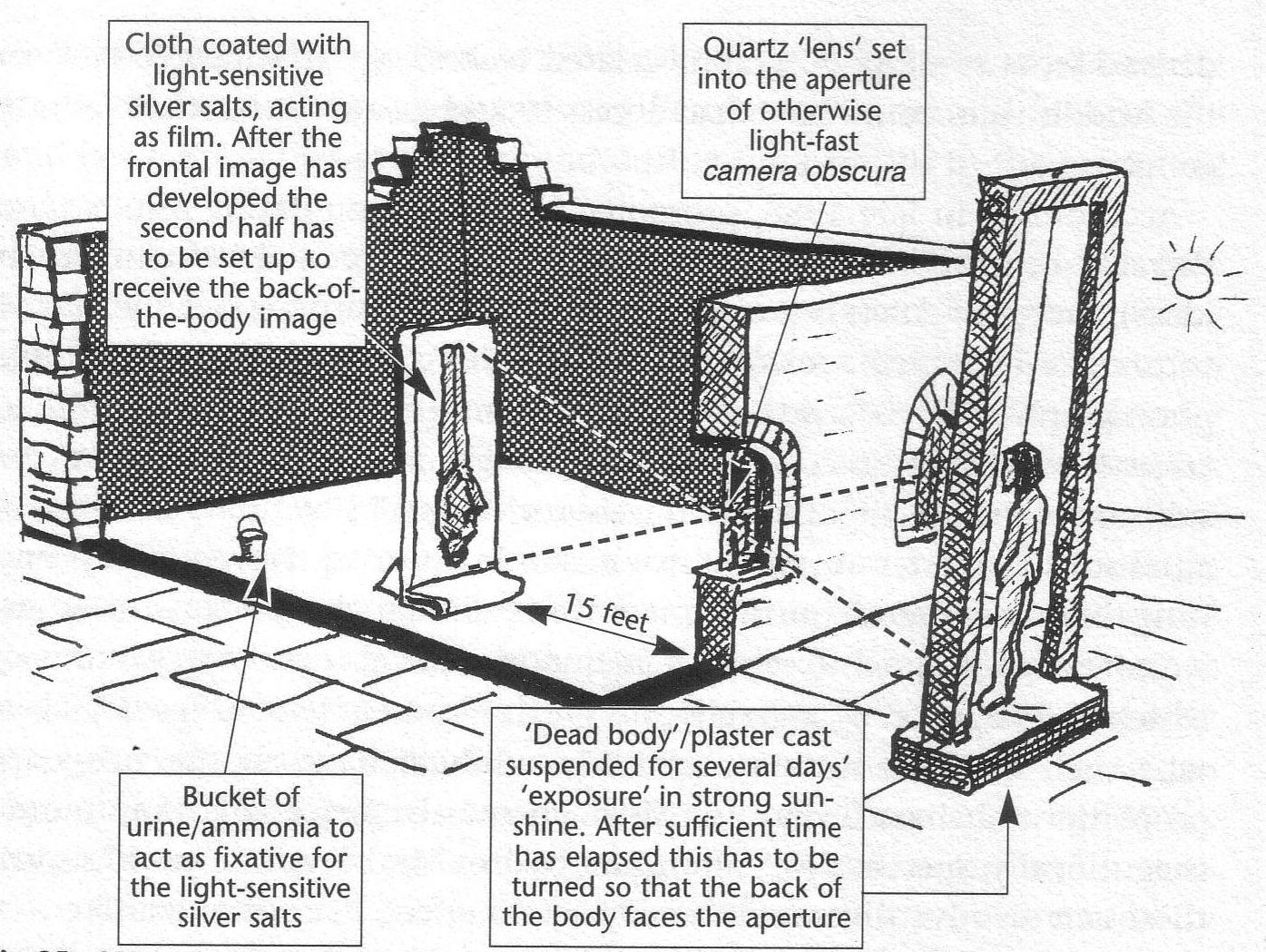
[Above (enlarge): "How a mediaeval forger [supposedly] produced the Shroud `photographically' ... Based on a model by Professor [Nicholas] Allen"[49].]
required the man to be hanging vertically, unlike the real Shroud!
It is because of these and other seeming paradoxes, that most sindonologists have alluded in different ways to the suggestion that the Shroud could almost be a photograph taken of an actual victim of a crucifixion but for the annoying little fact that photography was not invented until c. 1800-1851. In this regard the following statement by Ostler (1988: 56) is typical of the feelings of many modern researchers: "The dating dispute may be settled, but the shroud remains as mysterious as ever, reason: it bears an inexplicable life-size image of a crucified body, which is uncannily accurate and looks just like a photographic negative - occurring centuries before photography was invented"[50]. This is misleading by Allen that "most sindonologists have ... suggest[ed] that the Shroud could almost be a photograph taken of an actual victim of a crucifixion." Most (if not all) sindonologists, i.e. pro-authenticists, believe that the man on the Shroud is Jesus, not just any "victim of a crucifixion." And most (if not all) pro-authenticists do not merely believe that the Shroudman's image "could almost be a photograph" - they believe it is "a photograph," a "`snapshot' of the Resurrection" of Jesus, as Ian Wilson put it:
"Even from the limited available information, a hypothetical glimpse of the power operating at the moment of creation of the Shroud's image may be ventured. In the darkness of the Jerusalem tomb the dead body of Jesus lay, unwashed, covered in blood, on a stone slab. Suddenly, there is a burst of mysterious power from it. In that instant ... its image ... becomes indelibly fused onto the cloth, preserving for posterity a literal `snapshot' of the Resurrection"[51]!
And most (if not all) pro-authenticists are not
annoyed "that photography was not invented until c. 1800-1851" - they
rejoice in it! Because pro-authenticists, including Wilson, don't believe the "photograph," even the "
literal `snapshot' of the Resurrection" of Jesus, was taken by a
camera in AD 30, imprinted on
photographic film and developed as the "the photography [that] not invented until c. 1800-1851" was. Most, if not all, pro-authenticists believe that, as Wilson put it, "a burst of mysterious power from" the dead body of Jesus, imprinted His image onto the Shroud cloth. But it
is an annoying (to put it mildly) fact
for Allen, "that photography was not invented until c. 1800-1851"!
Despite this overwhelming evidence to the contrary most researchers are still prepared to concede that this relic is nothing more than a painted/dyed forgery, one which was produced for the sole purpose of deceiving the Catholic world of the late thirteenth century. However, if this is the case, then why does this image defy our repeated attempts to decipher the methods and techniques which were most assuredly employed during its manufacture? Surely, the answer to this problem must lie in the fact that this artifact was produced by some technique that is either completely unknown to us or is known, but not normally associated with the level of technology believed to have been available before 1357 ...[52]. Who are these "most researchers"? The fact is that overwhelmingly "most researchers" of the Shroud are pro-authenticists. The agnostic art historian Thomas de Wesselow bemoans the fact that no one in secular academia today takes the Shroud seriously as an object of academic research:
"Although Delage [Yves Delage (1854–1920)] made it clear that he did not regard Jesus as the resurrected Son of God, his paper upset the atheist members of the Academy [the French Academy of Sciences], including its secretary, Marcellin Berthelot, who prevented its full publication in the Academy's bulletin. This act of scientific censorship marks the beginning of the academic refusal even to discuss the origin of the Shroud, a refusal that continues to this day"[53].
"In the eyes of the general public the Shroud is a certified fake, a medieval oddity, nothing more. It might be interesting to find out how it was made, but, if it remains an enigma, so be it ... This popular verdict is shared by the vast majority of academics, which is unfortunate, because it means that very few scholars or scientists have spent any time at all thinking about the Shroud"[54].
And although Allen does ask the right question: "if this is the case [that the Shroud "is nothing more than a painted/dyed [medieval] forgery"], then
why does this image defy our repeated attempts to decipher the methods and techniques which were most assuredly employed during its manufacture?" His being evidently a non-Christian (despite his Roman Catholic schooling-see
above), Allen's "
most assuredly" and "
Surely" that the Shroud was "produced by some technique,"
rules out in advance the answer that the Shroud was indeed a "snapshot" of Jesus' resurrection.
It is accepted by all that in every way the Shroud acts as a negative photographic plate. However, surprisingly, no-one to date has seriously suggested that the Shroud could have been produced photographically. This is undoubtedly because such an outlandish notion would threaten our comfortable paradigm concerning the history, development and 'progress' of art and science. Indeed, it is accepted that the workings of such apparatus as the camera obscura were well known by Renaissance times, but the actual process which we call photography (i.e., the art of producing stable records of the images of nature through the action of light on light sensitive materials) was only in its infancy five centuries after the Shroud came to the attention of the western world. In this regard, Thomas Wedgwood (1771-1805) and Sir Humphry Davy (1778-1829) are on record as having produced the first photographically related images, in the form of silhouettes and negative images of botanical specimens (i.e., contact copies of leaves) on both white paper and-leather moistened with a silver nitrate solution before 1802. However they could not fix their images, which had to be kept in a dark room and could only be viewed by candle light. William Henry Fox Talbot (1800-1877), like the other early pioneers of photography, first employed silver nitrate as a suitable light-sensitive chemical for his investigations. At first his products were simple negative images, but he went on to perfect a negative-positive process and is consequently accredited with being the discoverer of photography.[55]. Allen does not mention Joseph Nicéphore Niépce (1765–1833), who

[Above (enlarge): Niépce's "View from the Window at Le Gras" (1826-27), "the first successful permanent photograph"[56].]
Wikipedia says is "usually credited as the inventor of photography"[57]. Allen's "no-one to date has seriously suggested that the Shroud could have been produced photographically ... undoubtedly because such an outlandish notion would threaten our comfortable paradigm concerning the history, development and 'progress' of art and science" is deluded. The reason no one but Allen (and Picknett and Prince who plagiarised Allen-see 07Aug16a and 05Sep16) is because there is zero evidence that some unknown evil genius in the late 13th-early 14th century, invented modern chemical photography ~500 years before it was `reinvented' in the 19th century, obtained a "fresh corpse"[58], crucified it in imitation of Jesus and then photographed its double image on a ~4.4m x 1.1m = 14.3ft x 3.6ft = 8 x 2 standard Assyrian cubits!) fine linen sheet. After which he left no other copies of his photographs, nor a written account of his invention, so that his invention of photography was completely forgotten!
However, if we remove the phenomenon of the Shroud of Turin from the paradigm of contemporary scientific and historical opinion it becomes patent for those with eyes to see that the image on the Shroud is a type of photographic negative, but like the early silver nitrate negative images produced by the 'known' pioneers of photography, the Shroud displays a number of features that would necessarily classify it as a very primitive form of photography. If my argument is acceptable thus far, we have at the very least a provisional theory which would explain how the image on the Shroud was produced - a solution which seems bombastic and speculative only once it is placed within the context text of our present-day understanding of medieval cultures and their respective levels of technology. In addition, if it could be proved that our present understanding of certain aspects of medieval technology was inaccurate, it would not only help to solve the mystery concerning the Shroud's method of production but, perhaps more importantly, would force us to re-evaluate the kind of knowledge available c. 1200-1357.[59]. Allen shows his capacity for self-deception in his claim that the image on the Shroud is "a very primitive form of photography." For an actual "primitive form of photography" see above. Chemist-photographer Michael J. (Mike) Ware (1939-), an expert in "earlier methods of printing photographic images"[60], likens Allen's claim that in the Shroud image, "development processes" were discovered before "proto-photographic processes," as "akin to positing a history of aviation in which Concorde preceded the Wright brothers":
"The assumption that proto-photographic processes must have been discovered before development processes is justified by the uniquely improbable nature of the latter. Development — in the very specific meaning that is given to the word here — consists in the chemical formation of a silver photograph from a latent image in crystals of silver halide, as first discovered by Louis Daguerre [1787–1851)], using mercury vapour in 1837, and Henry Talbot [1800-1877], using gallic acid in 1840. Chemical development results in an enormous enhancement of the effect of light alone, thus providing light-sensitive materials that have practically useful 'camera-speed'. It is not widely appreciated what an extraordinary fluke this whole process is: it stems from a combination of 'finely tuned' physico-chemical properties of the material which makes it a highly improbable phenomenon and, apparently, unique to silver halides. So, to claim that it could have 'sprung forth, fully armed with 100 ISO', and with no tradition of prior art, would be akin to positing a history of aviation in which Concorde preceded the Wright brothers"[61].
However, both Allen and Ware are wrong in thinking that the image on the Shroud has
anything to do with "development processes" or "proto-photographic processes." A closer analogy to the Shroud image is
digital photography, which was invented in the mid-twentieth century[
62].
The Shroud's flax fibres are in only two states: the image
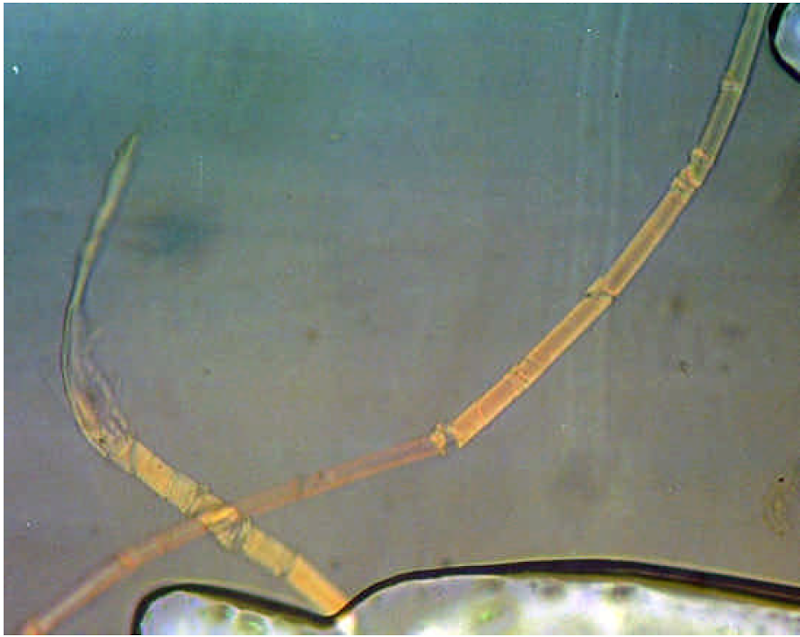
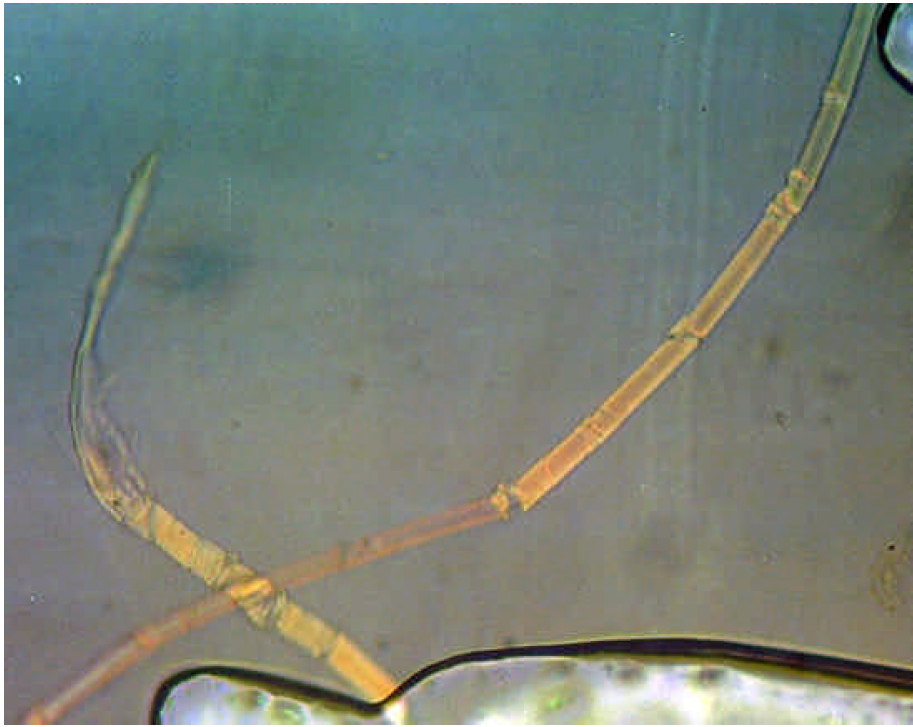
[Above (enlarge): Photomicrograph at 200 magnification taken by optical engineer Kevin Moran of 15 micron (15 thousandth of a millimetre) diameter Shroud fibres[63]. Moran notes that these yellow image sections of Shroud fibre are effectively "picture elements, or pixels"[64]. As can be seen, the boundaries between the image (yellow) and non-image part of the same fibre are sharp, about 1 micron wide. Moran points out that: "... the section where the darkened fibre meets the clear fibre looks like a precision line formed on a modern semiconductor"[65]! Moran also points out that only high-energy radiation could account for such sharp micron-width image boundaries on a 15 micron diameter linen fibre[66]. Clearly no medieval photographer, or artist, could apply light-sensitive silver salts or pigment with such microscopic precision[67].]
sections of those fibres are straw-yellow colour[68] and the non-image fibres are ivory colour[69]. This corresponds with the two digital states of on or off[70].
An even closer analogy to the Shroud image is the images imprinted on 
[Left (enlarge)[71]: Sharp image of a valve imprinted on the side of a metal gas tank by radiation from the atomic bomb dropped on Hiroshima on August 1945. Presumably the image is the original colour of the tank shielded from the bomb's radiation by the valve. If so, then the analogy with the Shroud image is the permanent colour change of the metal tank that was not shielded by the valve from the bomb's radiation.]
concrete, stone and metal by radiation from the World War II atomic bombs dropped on the Japanese cities of Hiroshima and Nagasaki in August 1945[72].
For the past three years I have been conducting research which, is looking very seriously at the possibility that a form of photography was the cause of the image on the Shroud. It has been discovered that a person can very easily make a permanent photographic negative image on linen which utilises chemicals and substances which, collectively, were known to have existed at least by 1280, viz: silver nitrate (in solution), ammonia (in solution), linen cloth (which naturally contains cellulose, hemicellulose, lignin, pectin etc., natural quartz (optical quality) magnifying glass or bi-convex lens[73]. This is misleading by Allen. That the individual elements of photography existed by 1280 does not mean that they were then recognised as elements of photography and brought together in the invention of photography. The elements of a nuclear reactor existed by 1280 (we know that because at Oklo in Africa the remains of 16 natural nuclear reactors that existed 1.7 billion years ago have been found[74]), but the first man-made nuclear reactor was invented in 1942[75]. And as Allen must have known, it was not until 1717 that Johann Heinrich Schulze (1687-1744) discovered that the darkening of silver nitrate was due to light, not heat[76]. Moreover, Ware wrote that it was "disingenuous" (i.e. "not truly honest") of Allen to claim that because optical quality quartz rock-crystal was available as a "substance" in the 13th century, therefore "a very large, accurately ground high-quality biconvex lens of long focal length" was also available back then, when they were "unknown until several centuries later":
"Allen states that rock-crystal was available in the thirteenth century 'as a substance' (which is certainly true) but it is disingenuous of him to imply that this 'substance' could at that time have taken the form of a very large, accurately ground high-quality biconvex lens of long focal length. He implicitly assumes, without evidence or justification, the existence of a lens technology that was unknown until several centuries later"[77].
It has been found that if any three-dimensional object (including a deceased human subject) is set up in front of a camera obscura and is illuminated by direct sunlight over a period of a few days, that a negative purple-brown image will form on linen cloth which has been impregnated with silver nitrate in solution. In addition, this image may be 'fixed' simply by soaking the cloth in a mild solution ... A negative photograph of the image produced with silver nitrate and ammonia of ammonia. During this process the image turns to faint straw-yellow. This image is in the negative and only forms on the upper fibrils of the linen material. In other words, no image is visible on the reverse side of the cloth. This image is extremely subtle and (like the images formed inside a camera obscura when either a pinhole aperture or a small aperture with a fixed lens is employed) is not easily discernable at close range[
78].
Allen's

"
It has been found that if ... a deceased human subject ... is set up in front of a
camera obscura and is illum-inated by direct sunlight
[Right (enlarge): "The suspended plaster cast which Professor Allen used as his model"[79].].
over a period of a few days ..." is a lie! For obvious reasons Allen has not hung "a deceased human subject" out in the sun! Allen's experi-ments were with a plaster bodycast painted white[80].
And as I pointed out in 07Aug16b, Allen here "has lost touch with reality" as he does not seriously consider what would happen to a "deceased human subject" hung out in the necessarily bright sunlight, for even a few days, because rigor mortis would be quickly lost, and therefore so would the body's shape:
"Among just some of the difficulties ... are that if an actual crucified human corpse really were suspended for `several days' in full sunshine, then its likely condition after such a length of time, particularly in any climate with the required sufficiency of sunshine, boggles both the mind and the olfactory system. This is quite aside from the offence it would have caused to every mediaeval religious sensitivity. An actual corpse must therefore be considered most unlikely, given that rigor mortis would in any case never have held sufficiently long to create the impression of the figure lying flat"[81].
This is because
decomposition would have started, as artist and physicist
Isabel Piczek (1927-2016) pointed out:
"But how come, that not knowing the most evident fact, that corpses do not maintain rigor mortis or that they cannot hang for 14 [sic] days in the sun, or else you would not care to see what the camera obscura would bring in onto your canvas"[82].
Allen could have tested his theory by hanging a dead pig out in the sun for a few days and seeing what happened to its image in his `medieval camera' but it is another example of Allen's
scientific dishonesty that he didn't (or if he did he has concealed it).
In addition, the image is not a 'snapshot' of a particular moment in time (as is the case with most modern photographs). Rather, it is the record of the passing of many days. This means that those parts of the body which have literally received more sun (such as the bridge of the nose, cheeks, eye brows etc) are registered more intensely on the cloth than those areas which were further away (such as the neck, sides of the head etc) or received less less radiation (such as the sides of the nose)[83]. Allen forgets that he had earlier admitted that, "... the image on the Shroud contains no 'directionality'." But the passage of the sun across the sky, from east to west, every day, is directional! Also note Allen's `Freudian slip' that he had to hang his plaster bodycast out in the sun for "many days"! As mentioned in 07Aug16c, in 2005 the History Channel's Sean Heckman's tried to reproduce Allen's `medieval photograph' but it took "43 days to get a faint image" which soon after "completely disappeared":
"I personally worked with artist Stephen Berkman to design, construct and test the theory that the Shroud was created by such a process. Stephen and I paid particular attention to building the camera and exposing the image with historical accuracy. We only used simple lenses that would have been available in the thirteenth century as well as exposed and fixed the image with chemicals that are known to have existed at the time. But simply, the experiment failed. While it is theoretically possible to expose an image, there are a countless number of variables that make the process nearly impossible, a multitude of which caused our project to fail. Namely, in order to make a life-sized image, you would need to position the linen at least six or more feet away from the lens. Since light fades at an inverse square rate, a pinhole or simple lens only allows for an extremely faint amount of light to reach that distance, making it extremely difficult to expose the image. In our case it took 43 days to get a faint image, which completely disappeared once the image was fixed. Considering the experiment was based on 200 years of known photographic technology, I find it difficult [to believe] that such an image could have been created six hundred years ago, particularly an image that we'd still be able to see today"[84].
So
how "many days" did Allen hang his plaster cast out in the sun to get his image (
above)? And did he use only "simple lenses that would have been available in the thirteenth century" and "chemicals that are known to have existed at the time"? Or did Allen cheat? See
07Aug16d that Allen
did indeed cheat by using
synthetic quartz, not a natural quartz crystal! And has Allen's image by now disappeared?
Although an image may be focused onto a piece of linen cloth by means of a simple bi-convex lens and this image (viewed at the correct distance) is clearly visible with the naked eye (inside the camera obscura) it was discovered that, in actual fact; the visible spectrum had no discernable affect on the silver-nitrate solution at all. Rather, it was the action of ultraviolet radiation (specifically 320-190 nm) that actually formed the image over a period of many hours. In this regard a glass lens is quite useless for this technique, since glass absorbs ultraviolet light whereas quartz will not.[85]. Again Allen refutes his own theory! Ultraviolet radiation was only discovered in 1801 by the German physicist Johann Wilhelm Ritter (1776– 1810)[86]. So "no one in medieval times knew about ultraviolet light at all, much less what materials would or would not transmit it"[87]!
It was also discovered that if the subject (to be 'photographed') was painted white the image formation would take place in considerably less time. In short, increased reflectivity of the surface of the subject ensured that higher concentrations of ultraviolet radiation would enter the camera obscura[88]. See Allen's white painted plaster body cast above. This is a tacit admission of failure by Allen that he needed to something so extraordinary as to paint the `body' of his photographic subject white, just to get an image in his `medieval camera'! And see above that the History Channel tried to repeat Allen's experiment but it took "43 days to get a faint image" which soon after "completely disappeared"!
In many ways the images that were achieved had all the characteristics of a severe suntan and were uncannily similar to the image on the Shroud of Turin ... [89]. Allen continues to delude himself. The Shroudman's image is not a suntan! See the above comparison photographs of Allen's `shroud' which strongly shows the effects of sunlight and the real Shroud which doesn't. And it is not enough that the image in Allen's `medieval camera' is only "similar to the image on the Shroud of Turin," it must be exactly the same as the Shroud in all essential respects, but it isn't!
I am certain that if a human subject could be found who has the identical physiognomy to the unfortunate man who died sometime before 1357 and whose negative image is now contained in the Shroud, that for all intents and purposes an identical image could be achieved today.[90]. Allen is tacitly admitting that his so-called medieval photography `shroud' is too different from the real Shroud to explain how the latter was formed. So he kids himself that if only he could find "a human subject ... who has the identical physiognomy" to the man on the Shroud, then his medieval photography `shroud' would look the same is the real Shroud. But Allen is (or was) a Professor of Art and so he could make a plaster bodycast with that "identical physiognomy." It is also significant that Allen thinks that the image on the Shroud is of an "unfortunate man who died sometime before 1357." Why was he "unfortunate" unless Allen is claiming that his `medieval photographer" actually crucified a living man in imitation of Jesus, in which case he would have been both a murderer and a monster!
Stigmata and other 'blood' areas on the Shroud were most probably daubed on by brush in real blood (with or without a slight addition of red ochre) after the negative body image had been achieved[91]. Allen forgets that he had earlier pointed out that, "the image in the Shroud ... displays a degree of anatomical/medical/pathological knowledge that simply was not available to ... a medieval ... forger" (see above). This applies to the Shroud's bloodstains, particularly on the head, which show a distinction between arterial and venous bloodflows, which was only discovered in 1593 (see 03Jun17)! Moreover, as Barrie Schwortz pointed out, STURP found that the "bloodstains ... were on the cloth before the image was formed":
"Also, Allen makes no attempt to explain the forensic accuracy of the bloodstains on the Shroud. Since research done by the Shroud of Turin Research Project (STURP) and others has shown that there is no image underneath these bloodstains, we have been able to conclude that they were on the cloth before the image was formed. In fact, it appears that they actually acted to inhibit the image formation mechanism. Prof. Allen's mechanism leaves the critical issue of the bloodstains totally unresolved'[92].
(this latter image needing two separate exposures to obtain the frontal and dorsal views of the suspended corpse)[
93]. Allen claimed it took "four days" for "an acceptable negative image" to form in his `medieval camera'[
94]. So that would have to be
doubled to eight days[
95], for "two separate exposures to obtain the frontal and dorsal views of the suspended corpse"! And if in any, or all, of those eight days the sun did not shine the full day, then the body of "the unfortunate man" would have to hang out in the open air waiting until the sun shone again, making it even more than 8 days[
96]!
Moreover, because Allen used a plaster bodycast, not a "suspended corpse" hanging out in the sun for a
minimum of eight days, he did not have to confront the reality of not only decomposition and
putrefaction, but also maggots and carnivorous birds eating the body of his "unfortunate

[Left (enlarge)[97]: Blowfly life cycle. Even at 70°F (21°C) blowflies rapidly discover a dead body and each lays 300 eggs in it. In 2 days these hatch out into maggots which after 7 days have eaten their fill and finished that stage of their life cycle. And there can be hundreds of blowflies laying their eggs in a corpse[98].]
man" hung out in the sun for at least 8 days! This is so obvious, especially for Allen who lives in Africa, that it is further (see above) scientific dishonesty of Allen to ignore it.
And that is not the only example of Allen's scientific dishonesty in this matter. For Allen to show that "a very large, accurately ground high-quality biconvex [quartz] lens of long focal length" (see above) could have been used by his `medieval photographer,' Allen would need to replicate it using only medieval technology:
"For Allen's purposes, he needs a very large, transparent, rock-crystal-quality quartz, which is very rare, just to begin his process. The largest and most abundant of these are found in the Western hemisphere, which certainly did not export them in medieval times. Once our medieval forger had obtained this unlikely stone he would have to form a perfectly circular lens, with smooth, equal curves around each side of the complete circle. The convex curves of each side would have to match perfectly. If our medieval forger is off a fraction of a degree anywhere, it will throw off the highly resolved and focused image. In addition, he cannot have imperfections of any kind on the perfectly curved surfaces anywhere on the entire lens. There is absolutely no history of such skill or such a product in medieval times. Our medieval forger would most likely have had to have done this perfect job with only his hands and a piece of cloth with some sand on it ... Allen does not inform us where he acquired his lens, but it is extremely doubtful that he chiseled and hand-ground it from natural stone. Since optical-quality quartz lenses do not appear historically until the nineteenth century, Allen has the burden of demonstrating how a seven-inch, optical-quality, biconvex quartz-crystal lens without any imperfections could be made"[99].
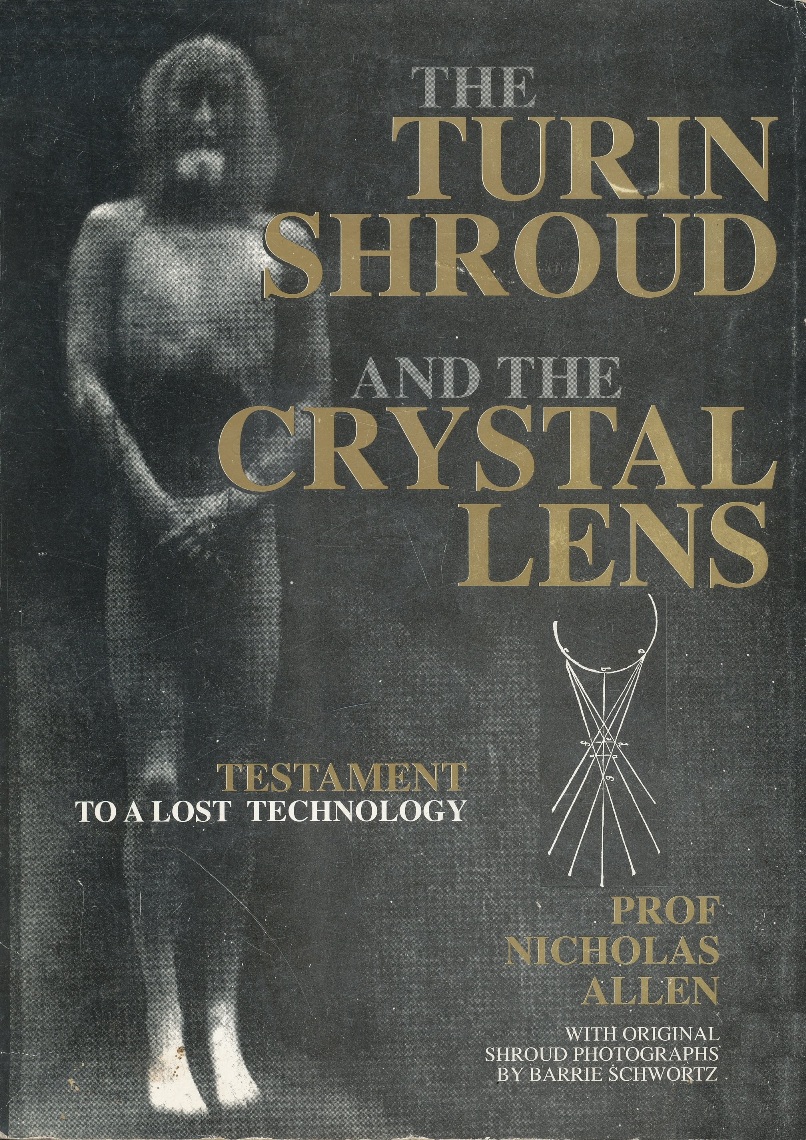
But in fact, hidden in Allen's 1998 book, "The Turin Shroud and the

Crystal Lens," but not listed
[Right (enlarge): The book's title is another lie by Allen because in it he indirectly admitted that he had used "synthetic quartz" (pp. 94, 96-97, 207-208, 240), not a quartz crystal that he obtained, shaped and polished into a bi-convex lens, using only a medieval source and technology. But see 07Aug16e where I do not claim that Allen realises that he is being dishonest, but I assume he is self-deceived in this matter.]
in its index, is Allen's admission that he used 20th century synthetic quartz to obtain his so-called `medieval photograph':
"Through the kindness of my institution I was made a loan with which I purchased a blank piece of high grade ["synthetic"[100]] quartz. After many months of waiting, a blank sent from Switzerland, finally arrived in South Africa, where ... it was ground and polished into a bi-convex lens. The new lens had a focal length of just over 2000 mm which meant that the distance between the screen and the 'corpse' could now be reduced from 8800 mm to just over 8000 mm. This was quite a saving, cutting off an estimated 50 hours of exposure time alone ... To be sure, had I increased the diameter of the lens to the full 180 mm which was now available to me, I calculated that the exposure should take about 30 hours (i.e. just short of four days)[101].
But synthetic quartz is made by heating quartz
in a furnace to about 3,500ºF [= 1927ºC]
, which was not possible until the Industrial Revolution (1760-1840):
"Allen ... is using a type of lens that was not available until the nineteenth or twentieth century. He uses a biconvex, optical-quality quartz crystal lens measuring more than seven inches (180 mm) in diameter ... Optical-quality quartz lenses are made by first heating quartz to about 3,500ºF, at which point this material becomes flexible and can be shaped. Not until the Industrial Revolution could furnaces burn that hot. In medieval times, there would not have existed a container that could even hold the quartz at that temperature, for the melting point of iron [2800°F = 1538°C] is about 285°F [= 141°C] less than quartz"[102] [sic 700°F [= 371°C]].
Today
synthetic quartz is made from
silicon dioxide (SiO2) crystals in an
alkaline solution at lower, but still very high temperatures (300-400°C) under very high pressure (130-145 MPa =
18,855-21,030 psi)[
103].
In the light of these findings (no pun intended), it would seem that we have no choice but to accept that the Shroud of Lirey-Chambery- Turin (irrespective of its-actual origin, and regardless of who may have produced it) is, in itself, sufficient evidence that someone had access to a form of photographic technology sometime before 1357. If this view can be supported by another non-destructive test on the Shroud which specifically addresses the photographic hypothesis, then the implications would have far reaching affects on our present understanding of the history and development of art, science and technology during the medieval period[104]. Allen really is self-deceived (see also above) if he thinks that "we have no choice but to accept that the Shroud ... is ... sufficient evidence that ... photographic technology" existed "before 1357," because (to recap):
■ Allen's `medieval photograph' is directional, in that it shows the effect of sunlight shining down on his white plaster cast `shroudman,' yet Allen admits the real Shroudman's image is "directionless" (see above)!
■ It is fallacious for Allen to claim that because the "chemicals and substances" used in later photography "existed at least by 1280" (see above) that therefore photography could then have existed.
■ Allen is lying (or deluded) in his claim that, "It has been found that if ... a deceased human subject) is set up in front of a camera obscura ..." (see above). Allen did not hang a dead human (or even a dead animal) body out in the sun at all! Allen's experiments were with a plaster bodycast painted white (see above)! Yet Allen has admitted that, "the persons who produced this image most probably used a fresh corpse"[105]!
■ Loss of rigor mortis, decomposition (see above ), birds and maggots (see above) would have so disfigured a dead man's body which had been hung out in full sunlight for at least 8 days, that the Shroudman's image would show that, but it doesn't.
■ Allen requires the blood to have been "daubed on" the Shroud after the image had been imprinted on it (see above ), because it would have impossible for his `medieval photographer' to have applied the blood onto the linen sheet before the image was formed on it. But in fact (as Allen must know because he is familiar with STURP's findings - see above), the blood was on the Shroud before the Shroudman's image was imprinted on it (see above )!
■ The words "Crystal Lens" in the title of Allen's 1998 book is another lie (or self-deception) by Allen, because he did not start with a natural, very large, flawless, quartz crystal and grind and polish it into an optical quality, 180 mm = 7 inch diameter bi-convex lens, using only a medieval source and technology, but hidden in his book, not listed in its index, Allen admitted that he used 20th century "synthetic quartz" (see above)!
Nevertheless, the importance of Allen is that he is an anti-authenticist Professor of Art who by his `circular firing squad' (see above) refuted all anti-authenticist theories which claim that the Shroud image was painted, powdered or dyed, etc[106]. Allen's is the only anti-authenticist full-length, front and back, albeit failed, replication of the Shroud[107]. Allen thus showed that the Shroud image is a photograph[108], but not a medieval one!
Notes
1. This post is copyright. I grant permission to quote from any part of this post (but not the whole post), provided it includes a reference citing my name, its subject heading, its date and a hyperlink back to this page. [return]
2. "CurriculumVitae: Nicholas P L Allen, North-West University," Academia.edu. [return]
3. Allen, N.P.L., 1998, "The Turin Shroud and the Crystal Lens: Testament to a Lost Technology," Empowerment Technologies: Port Elizabeth, South Africa, pp.xii-xiii. [return]
4. Allen, 1998, p.xiii. [return]
5. Ibid. [return]
6. Wilson, I., 1998, "The Blood and the Shroud: New Evidence that the World's Most Sacred Relic is Real," Simon & Schuster: New York NY, p.7. [return]
7. Allen, 1998, pp.xiii-xiv. [return]
8. Allen, 1998, p.xv. [return]
9. Nickell, J., 2004, "PBS `Secrets of the Dead' Buries the Truth About Turin Shroud," Skeptical Inquirer, April 9. [return]
10. Allen, N.P.L., 1993, "Is the Shroud of Turin the first recorded photograph?," The South African Journal of Art History, 11, November, pp.23-32. [return]
11. Allen, 1993, p.23. [return]
12. Schwalbe, L.A. & Rogers, R.N., 1982, "Physics and Chemistry of the Shroud of Turin: Summary of the 1978 Investigation," Reprinted from Analytica Chimica Acta, Vol. 135, No. 1, pp.3-49, Elsevier Scientific Publishing Co: Amsterdam, 1982, pp.6. [return]
13. Allen, 1993, p.23. [return]
14. Allen, 1993, p.24. [return]
15. Ibid. [return]
16. Ibid. [return]
17. Ibid. [return]
18. Ibid. [return]
19. Allen, 1993, p.31. [return]
20. Allen, 1993, p.26. [return]
21. Ibid. [return]
22. Ibid. [return]
23. Ibid. [return]
24. Ibid. [return]
25. Ibid. [return]
26. Ibid. [return]
27. Extract from Latendresse, M., 2010, "Shroud Scope: Enrie Negative Horizontal," (rotated left 90 degrees), Sindonology.org. [return]
28. Allen, 1993, p.26. [return]
29. Antonacci, M., 2000, "Resurrection of the Shroud: New Scientific, Medical, and Archeological Evidence," M. Evans & Co: New York NY, pp.37-38. Footnote omitted. [return]
30. Wilson, I. & Schwortz, B., 2000, "The Turin Shroud: The Illustrated Evidence," Michael O'Mara Books: London, pp.124-125. [return]
31. Allen, 1993, p.26. [return]
32. Ibid. [return]
33. McCrone, W.C., 1999, "Judgment Day for the Shroud of Turin," Prometheus Books: Amherst NY, p.122. [return]
34. Allen, 1993, p.26. [return]
35. Allen, 1993, p.27. [return]
36. Ibid. [return]
37. Stevenson K.E. & Habermas G.R., 1981, "Verdict on the Shroud: Evidence for the Death and Resurrection of Jesus Christ," Servant Books: Ann Arbor MI, pp.104-105. [return]
38. Van Haelst, R., 1986, "The Lier Shroud: A Problem in Attribution," Shroud Spectrum International, No. 20, September, pp.7-24, 16-17. [return]
39. Van Haelst, 1986, p.10. [return]
40. Allen, 1993, p.27. [return]
41. Ibid. [return]
42. Allen, 1993, pp.27-28. [return]
43. Allen, 1993, p.28. [return]
44. Ibid. [return]
45. Ibid. [return]
46. Ibid. [return]
47. Jackson, J.P., Jumper, E.J., Mottern, R.W. & Stevenson, K.E., ed., 1977, "The Three Dimensional Image on Jesus' Burial Cloth," in Stevenson, K.E., ed., "Proceedings of the 1977 United States Conference of Research on The Shroud of Turin," Holy Shroud Guild: Bronx NY, pp.82-83. [return]
48. Antonacci, 2000, p.32. Footnote omitted. [return]
49. Wilson, 1998, p.214. [return]
50. Allen, 1993, p.28. [return]
51. Wilson, I., 1979, "The Shroud of Turin: The Burial Cloth of Jesus Christ?," [1978], Image Books: New York NY, Revised edition, p.251; Wilson, 1998, p.234. [return]
52. Allen, 1993, p.28. [return]
53. de Wesselow, T., 2012, "The Sign: The Shroud of Turin and the Secret of the Resurrection," Viking: London, p.20. [return]
54. de Wesselow, 2012, p.25. [return]
55. Allen, 1993, pp.28-29. [return]
56. "File:View from the Window at Le Gras, Joseph Nicéphore Niépce.jpg," Wikimedia Commons, 11 June 2019. [return]
57. "Nicéphore Niépce," Wikipedia, 27 June 2019. [return]
58. Wilson, 1998, p.260. [return]
59. Allen, 1993, p.29. [return]
60. "Mike Ware (photographer)," Wikipedia, 26 April 2018. [return]
61. Ware, M., 1997, "On Proto-photography and the Shroud of Turin," History of Photography, Vol. 21, No. 4, Winter, pp.261-269, 261. [return]
62. "Digital photography: History," Wikipedia, 25 May 2019. [return]
63. Moran, K.E., 1999, "Optically Terminated Image Pixels Observed on Frei 1978 Samples," Shroud.com, pp.1-10, 8. [return]
64. Moran, 1999, p.8. [return]
65. Moran, K.E., 1995, "Observations by Microscopy of Shroud Tape Samples taken by Max Frei in 1978," British Society for the Turin Shroud Newsletter, No. 41, September, pp.12-15, 14. [return]
66. Moran, 1999, p.8. [return]
67. Wilson & Schwortz, 2000, p.74. [return]
68. Heller, J.H., 1983, "Report on the Shroud of Turin," Houghton Mifflin Co: Boston MA, p.113. [return]
69. de Wesselow, 2012, p.13. [return]
70. "Digital data," Wikipedia, 29 May 2019. [return]
71. Nixon, T., 2016, "The shadows of Hiroshima: Haunting imprints of people killed by the blast," The Sun, 5 April. [return]
72. Humber, T., 1978, "The Sacred Shroud," [1974], Pocket Books: New York NY, p.199; Wilson, I., 1979, "The Shroud of Turin: The Burial Cloth of Jesus Christ?," [1978], Image Books: New York NY, Revised edition, pp.224H, 248-249; Morgan, R., 1980, "Perpetual Miracle: Secrets of the Holy Shroud of Turin by an Eye Witness," Runciman Press: Manly NSW, Australia, pp.76, 160-161; Stevenson, K.E. & Habermas, G.R., 1981, "Verdict on the Shroud: Evidence for the Death and Resurrection of Jesus Christ," Servant Books: Ann Arbor MI, p.70; Carter, G.F., 1982, "Formation of the Image on the Shroud of Turin by x-Rays: A New Hypothesis," in Lambert, J.B., ed., 1984, "Archaeological Chemistry III: ACS Advances in Chemistry, No. 205," American Chemical Society, Washington D.C., pp.425-446, 429-430; Testa, A. 1995, "Shrouded in mystery," Shroud News, No. 88, April,, pp.16-19, 19; Scott, C., 1997, "Holy Shroud led agnostic to priesthood," Shroud News, No. 100, February, p.56; Iannone, J.C., 1998, "The Mystery of the Shroud of Turin: New Scientific Evidence," St Pauls: Staten Island NY, pp.186-187; Wilson & Schwortz, 2000, pp.128-129; Tribbe, F.C., 2006, "Portrait of Jesus: The Illustrated Story of the Shroud of Turin," Paragon House Publishers: St. Paul MN, Second edition, pp.220-222; Wilcox, R.K., 2010, "The Truth About the Shroud of Turin: Solving the Mystery," [1977], Regnery: Washington DC, pp.148-149. [return]
73. Allen, 1993, pp.29-30. [return]
74. "Natural nuclear fission reactor," Wikipedia, 22 June 2019. [return]
75. "Nuclear reactor: Early reactors," Wikipedia, 25 June 2019. [return]
76. "Johann Heinrich Schulze," Wikipedia, 6 September 2018. [return]
77. Ware, 1997, p.264. [return]
78. Allen, 1993, p.30. [return]
79. Wilson, 1998, p.238O. [return]
80. Wilson, 1998, pp.214-217, 238O; Antonacci, 2000, p.87; Wilson & Schwortz, 2000, pp.124-125; Whiting, B., 2006, "The Shroud Story," Harbour Publishing: Strathfield NSW, Australia, p.159; Oxley, M., 2010, "The Challenge of the Shroud: History, Science and the Shroud of Turin," AuthorHouse: Milton Keynes UK, p.249; Wilson, I., 2010, "The Shroud: The 2000-Year-Old Mystery Solved," Bantam Press: London, pp.26-27; de Wesselow, 2012, pp.140, 288B. [return]
81. Wilson, 1998, p.217. [return]
82. Piczek, I., 1996, "Alice in Wonderland and the Shroud of Turin," Proceedings of the Esopus Conference, August 23rd-25th, Esopus, New York. [return]
83. Allen, 1993, p.30. [return]
84. Wilson, 2010, pp.28-29. [return]
85. Allen, 1993, p.30. [return]
86. "Ultraviolet: Discovery," Wikipedia, 17 July 2019. [return]
87. Antonacci, 2000, p.87. [return]
88. Allen, 1993, p.31. [return]
89. Ibid. [return]
90. Ibid. [return]
91. Ibid. [return]
92. Schwortz, B.M., 2000, "Is The Shroud of Turin a Medieval Photograph?: A Critical Examination of the Theory," Shroud.com. [return]
93. Allen, 1993, p.31. [return]
94. Allen, N.P.L., 1995, "Verification of the Nature and Causes of the Photonegative Images on the Shroud of Lirey-Chambery-Turin," De Arte 51, Pretoria, UNISA, pp.21-35; Allen, 1998, pp.94, 100. [return]
95. Antonacci, 2000, p.89; Schwortz, B.M., 2000; de Wesselow, 2012, p288B. [return]
96. Antonacci, 2000, p.89. [return]
97. Mangels, J., 2009, "At crime scenes such as the home of suspected serial killer Anthony Sowell, bug expert Joe Keiper uses insects as clues," The Plain Dealer, 11 November. [return]
98. "Decomposition: fly life cycle and development times," Australian Museum, 25 January 2019. [return]
99. Antonacci, 2000, pp.91-92. [return]
100. Allen, 1998, p.99. [return]
101. Allen, 1998, p.100. [return]
102. Antonacci, 2000, p.91. [return]
103. "Synthetic Quartz Crystal - ndk," Nihon Dempa Kogyo, 19 September 2008. [return]
104. Allen, 1993, p.31. [return]
105. Wilson, 1998, p.260. [return]
106. Wilson, 1998, p.212. [return]
107. Wilson, 1998, p.238O; Antonacci, 2000, pp.85-87, 93; Wilson & Schwortz, 2000, p.124. [return]
108. Wilson, 1998, p.235. [return]
Posted 16 June 2019. Updated 16 August 2025.
Casabianca [Right[2]], a French researcher. In March, after two years of tests and analysis, Casabianca and his team of scientists published their results in the scholarly journal Archaeometry. This month, in an interview with the French publication L'Homme Nouveau ... Casabianca discusses how he obtained the documents, his team's methodology, and conclusion. Here is an excerpt:
"In 1989, the results of the shroud dating were published in the prestigious journal Nature: between 1260 and 1390 with 95% certainty. But for thirty years, researchers have asked the laboratories for raw data. These have always refused to provide them. In 2017, I submitted a legal request to the British Museum, which supervised the laboratories. Thus, I had access to hundreds of unpublished pages, which include these raw data. With my team, we conducted their analysis. Our statistical analysis shows that the 1988 carbon 14 dating was unreliable: the tested samples are obviously heterogeneous, [showing many different dates], and there is no guarantee that all these samples, taken from one end of the sheet, are representative of the whole fabric. It is therefore impossible to conclude that the shroud of Turin dates from the Middle Ages."







 Posts