Wednesday, November 26, 2008

Did Max Frei misidentify Carduus argentatus Shroud pollen as Gundelia tournefortii?

It have been advised in a private email, which I am not at liberty

[Above (click to enlarge): Carduus argentatus, Silver Thistle: Flowers in Israel.]

to quote, that what the late Max Frei identified as Gundelia tournefortii pollen on the Shroud of Turin, had in 2001 been re-identified by a leading palynologist, Bonn University Prof. Thomas Litt, as within

[Right: Prof. Thomas Litt: Bonn University.]

the different genus Carduus.

It was not possible for Prof. Litt to identify that Carduus genus pollen down to the species level, because Frei used sticky tape to take his samples off the Shroud and then folded the tape over onto itself to preserve the pollen.

[Left: Max Frei using sticky tape to take pollen samples from the Shroud in 1978: Shroud.com]

But the tape glue has obscured the pollen's microstructure, which needs to be clearly seen under an electron microscope for a species-level identification.


The information itself in the email is not private, being in an 88-page book, Danin, A. & Guerra, H., 2008, "L'uomo della Sindone [Who is the Man in the Shroud?]," Edizioni ART: Rome, which however, as the title indicates, is in Italian. It is described in Google's translation as basically an interview with Israeli botanist Prof. Avinoam Danin:

In this book-interview, the expert botanist Prof. Avinoam Danin, a professor at the Hebrew University of Jerusalem, presents the latest results of his research regarding the Shroud. Prof. Danin says that the only place in the world where people could gather fresh shares of at least four species of plants found on the Shroud and place them on the body, which was wrapped in it, is the area between Jerusalem and Hebron, and the weeks between the months of March and April are the only time of year in eight of the plants are identified on the Shroud in the same flower.

However, this reclassification by Prof. Litt of Frei's Gundelia tournefortii pollen to the Carduus genus may be a blessing in disguise for the authenticity of the Shroud. That is because there is a species in that genus, Carduus argentatus, which grows around Jerusalem, flowers in April-May, has a more attractive flower (see above), and is a much less thorny plant than Gundelia tournefortii.

[Above (click to enlarge): Gundelia tournefortii, Flowers in Israel. "an extremely fearsome-looking thorn ... it is certainly not obvious as the kind of plant that might have been used as a funerary bouquet," Ian Wilson (see below). ]

And most significantly, Frei did not identify any Carduus argentatus on the Shroud (see below). As can be seen, the only

[Above (click to enlarge): Part of a list of pollen species identified by Frei, in Bulst, W., "The pollen grains on the Shroud of Turin," Shroud Spectrum International, Vol. 3, No. 10, March 1984, pp.20-28].

Carduus species of pollen that Frei identified was Carduus personata, which however, although the above list does not indicate it, is a European plant.

Moreover, images of "plants from the Carduus genus of thistles" have been identified by Prof. Danin on the Shroud:

"Avinoam Danin, emeritus professor of botany at the Hebrew University of Jerusalem, has spent years examining images of plant life discovered on the shroud. He also has discovered additional pieces of plant life on the cloth, which has provided additional evidence to support his theory that the shroud was used somewhere in the area of Jerusalem. Over the years, Danin, co-author of `Flora of the Shroud of Turin,' noted he has discovered the presence of three plant species that indicate the shroud's origin was somewhere between Jerusalem and Hebron. Eight species also have been used to determine, through flowering characteristics, that the plant life placed on the body happened somewhere during March or April. Danin said he also recently has indicated more than 300 flowers and plant parts on the head area of the shroud. Those were discovered, he said, after studying photos of the cloth taken in the 1970s.Among the plant life identified are the Matricaria and Anthemis, two genera of the sunflower family. He also said he discovered plants from the Carduus genus of thistles, and pieces of the shrub Rhamnus lycioides - both potential evidence of a crown or helmet of thorns." (Brinker, J., "Plant life traces on Shroud of Turin draws local interest," St.Louis Review, September 5, 2008.).

including apparently Carduus argentatus:

"Capparis [sic] argentatus is one of the flower images identified on the Shroud by Avinoam Danin, a botany professor at the Hebrew University of Jerusalem and a leading authority on the flora of Israel, along with Uri Baruch, a pollen specialist with the Israel Antiquities Authority. The identifications of Carduus Argentatus confirmed some previous floral image identifications by Oswald Sheuermann, a German physicist, and Alan Whanger, a professor at Duke University." ("Carduus argentatus flower image," Sugar Coated Shroud of Turin, 2 September 2008),

although I have yet to find where Danin himself has claimed that particular identification at the species level.

And as Ian Wilson pointed out, there is a problem of why pollen of a not particularly pretty flowered, or pleasantly scented, and very thorny species like Gundelia tournefortii was in such abundance on the Shroud, because "it is certainly not obvious as the kind of plant that might have been used as a funerary bouquet":

"All of this raises the question of just what sort of plant is Gundelia tournefortii? At which point the surprise is that it is an extremely fearsome-looking thorn, with prickly leaves and a thistle-like head that bears the sharpest of spines. Its greatest known usefulness appears to be as a low-grade winter fodder for goats and sheep when there is nothing better available for them. So it is certainly not obvious as the kind of plant that might have been used as a funerary bouquet, even supposing there was evidence that the Jews of Jesus' time had such a custom. Likewise, while it is possible that the plant's spikiness might have caused it to be used for the `crown of thorns' laid on Jesus' head - a view certainly favoured by Dr Alan Whanger - Danin for one is ambivalent on this. And Dr Fred Zugibe, having carefully compared photos of Gundelia with the bloodstains around the back of the Shroud man's head, similarly expresses doubts. In fact the very distribution of Gundelia pollen grains as these occur on the Shroud is contra-indicative of any such scenario. The greatest concentration of specimens (fourteen) has been found on tape 4/3Aa, which Frei took from the very edge of the Shroud's front-of-the-body half, at the level of the crossed hands, with the next highest incidence ten specimens on tape 12 Cd, from the spillage of blood from the ankle on the back-of-the-body half of the cloth. Conversely only a few Gundelia have been found in the region of the head. ... But while it might resolve matters wonderfully if we knew Gundelia to have some perfuming or fumigatory properties, its odour is said to be very nondescript, the closest resemblance being artichoke." (Wilson, I. & Schwortz, B., "The Turin Shroud: The Illustrated Evidence," Michael O'Mara Books: London, 2000, pp.90-91).

So if Frei was wrong in his identification of Gundelia tournefortii pollen (as seems to be the case) and it is actually Carduus argentatus, then that would seem to be even better for the Shroud's authenticity, given that C. argentatus would be a much more likely flower for Jesus' disciples to place on His body as a funerary bouquet than G. tournefortii.

I look forward to an eventual (perhaps in conjunction with the next Shroud exhibition in 2010?) new extraction and identification of pollens directly from the Shroud, i.e. that are not from the Frei collection and so have not been embedded in obscuring sticky tape glue.

Stephen E. Jones, BSc. (Biology).
My other blogs: CreationEvolutionDesign & Jesus is Jehovah!

Saturday, November 22, 2008

Re: There is compelling evidence it is the burial cloth of Christ, or a man crucified during that time #2

Kris

Continuing from Re: There is compelling evidence it is the burial cloth of Christ, or a man crucified during that time #1 with this

[Left (click to enlarge): The only place on Earth, near Jerusalem (blue), where three plant species on the Shroud are found close together: Gundelia tournefortii (green), Cistus creticus (red) and Zygophyllum dumosum (dotted): Based on Danin, A., et al., "Flora of the Shroud of Turin," Missouri Botanical Garden Press: St. Louis MO, 1999, p.41, and Danin, A. & Guerra, H., 2008, "L'uomo della Sindone," Edizioni ART, Rome, p.88 (see below)]

part #2 of my multi-part response to your comment to my post: Bogus: Shroud of Turin? #10: The Shroud's blood and pollen closely matches the Sudarium of Oviedo's.

Your words are bold to distinguish them from my comments. I have split my reply into multiple parts because of the size of my response (which involves a lot of quote material as documentation).

----- Original Message -----
From: Anonymous
To: Stephen E. Jones
Sent: Wednesday, November 12, 2008 6:00 PM
Subject: [The Shroud of Turin] New comment on Bogus: Shroud of Turin? #10: The Shroud's blood an....

>.... I am a Christian who has drawn no real definitive conclusions about the authenticity of the Shroud. There is compelling evidence, however, that it is the burial cloth of Christ, or a man crucified during that time and in that area. ...

Continuing with 18-21 of the at least twenty-three (23) separate and independent features on the Shroud of Turin that match the gospel's depiction of the crucifixion of Jesus. My conservative estimates of the proportion of Roman crucifixion victims that had each particular feature are in square brackets:

18. The body left an imprint on the Shroud like no other known [1 in 1,000] (HJ1983p220; IJ1998p10; S&H1990p127; VP1970p44);

19. The feet have limestone dust that has the same rare chemical composition as dust in the tombs around Jerusalem [1 in 1,000] (AM2000p109; P&M1996p206; RC1999p103; WB2006p129; WI1998p104; W&S2000p93);

20. The Shroud has images and pollen of flowers that together

[Above (click to enlarge): Distributions of Zygophyllum dumosum (blue), Cistus creticus (red) and Gundelia tournefortii (green): Danin, A. & Guerra, H., 2008, "L'uomo della Sindone," Edizioni ART, Rome, p.88]

occur only around Jerusalem [1 in 1,000] (AM2000p112; DA1999p18; IJ1998p25; ML2005p94; SD1999Aug3; WM1998p78; W&S2000p92);

21. The Shroud has images and pollen on it from plants that flower only March-April, in the afternoon, and Jesus was crucified early April in the afternoon [1 in 1,000] (AM2000p113; DA1999p18; IJ1998p25; WM1998p78);

Continued in part #3 of "Re: There is compelling evidence it is the burial cloth of Christ, or a man crucified during that time".

Quotes below are hyperlinked to inline references above (my emphasis bold).

Stephen E. Jones, BSc. (Biology).
My other blogs: CreationEvolutionDesign & Jesus is Jehovah!


"An important indication that the events depicted on the Shroud of Turin occurred not just in Palestine, but specifically in Jerusalem, is supported by an examination of the limestone in the Ecole Biblique tomb in Jerusalem. The Ecole Biblique provided researchers with access to the same rock shelf as the Holy Sepulcher and the Garden Tomb, both of which are considered the most probable choices for the actual tomb of Christ. Tombs in the Palestine/Transjordan area were carved out of limestone, which remains wet and pliable and which rubs off easily with the slightest contact. [Nitowski, E.L., "The Field and Laboratory Report of the Environmental Study of the Shroud in Jerusalem," Carmelite Monastery: Salt Lake City UT, 1986] Calcium carbonate is the major component of limestone. The limestone in the Jerusalem tomb was determined to be in the form of travertine aragonite, rather than the more common travertine calcite. [Kohlbeck, J. & Nitowski, E., "New Evidence May Explain Image on Shroud of Turin;" Biblical Archaeology Review, Vol. 12, No. 4, July/August 1986] Aragonite is less common than calcite and is formed under a much narrower range of conditions. The Jerusalem sample also contained small amounts of strontium and iron. [Nitowski; Kohlbeck & Nitowski] A calcium sample taken from a Shroud fiber on the foot has been compared to the calcium sample from the Jerusalem tomb. The Shroud sample was found to be in the form of aragonite, not the more common calcite, and also exhibited small amounts of strontium and iron. [Kohlbeck & Nitowski] This match was confirmed by Dr. Ricardo Levi-Setti [Levi-Setti, R.G., et al., "Progress in High Resolution Scanning Ion Microscopy and Secondary Ion Mass Spectrometry Imaging Microanalysis;" Scanning Electron Microscopy, Vol. 2, 1985, pp.535-552] of the Enrico Fermi Institute at the University of Chicago. Dr. Levi-Setti analyzed the calcium from both the Shroud fiber and the Jerusalem tomb with a high-resolution scanning ion microprobe. The resulting graphs show that these samples are an unusually close match, except for minute pieces of flax that could not be separated from the calcium sample taken from the Shroud fiber and that caused a slight organic variation. [Kohlbeck & Nitowski] Limestone samples taken from other tombs located at nine different test sites in Israel were also analyzed by Dr. Levi-Setti - but only the sample taken from the Jerusalem tomb matched the limestone on the Shroud." (Antonacci, M., 2000, "Resurrection of the Shroud: New Scientific, Medical, and Archeological Evidence," M. Evans & Co: New York NY, p.109).

"In 1985, Whanger detected what he believed to be a clear flower image near the head of the Shroud image, whose presence was first suggested by Oswald Scheuerman's observations in 1983. After finding other similar images, Whanger thought they might have great relevance, so he acquired a six-volume set of the definitive study on the botany of Israel. Whanger spent the next four years painstakingly comparing the faint images on Shroud photographs with life-size drawings in the botany books, and using his Polarized Image Overlay Technique to check his findings. By 1989, he had tentatively identified twenty-eight species of plants that grow in Israel. [Whanger, M. & Whanger, A., "The Shroud of Turin: An Adventure of Discovery," Providence House: Franklin TN, 1998, p.78] Although Whanger showed his findings to other Shroud researchers, he did not publish them until they could be confirmed by Dr. Avinoam Danin, professor of Botany at Hebrew University in Jerusalem and a world-renowned authority on the flora of Israel. Danin not only confirmed almost all of Whanger's identifications, but he also discovered a large number of additional flower images that were not found by Whanger. [Ibid., p.80] Of the twenty-eight plants, twenty-seven grow within the close vicinity of Jerusalem, where four geographical areas containing different specific climates and flora can be found. (The twenty-eighth plant grows at the south end of the Dead Sea.) All twenty-eight would have been available in Jerusalem markets in a fresh state, and most would have been growing along the roadside or in nearby fields. While three of these plants grow in France and nine grow in Italy, `half are found only in the Middle East or other similar areas and never in Europe' (italics added). [Ibid., p.79] One of these plants grows only in Israel, Jordan, or the Sinai, with its northernmost boundary between Jerusalem and Jericho. Danin concluded that there is only one place in the world where all of these flowers can be collectively found-Jerusalem. [Interview of Dr. Danin, CBS Evening News, April 12, 1997; Danin, A., Lecture at the Missouri Botanical Garden, St. Louis, MO, June 6, 1997; Whanger, A., "Flowers on the Shroud: Current Research," CSST News Vol. 1, No. 1, November 1997; Danin, A. et al., "Flora of the Shroud of Turin," Missouri Botanical Garden Press: St. Louis MO, 1999, p.18] Furthermore, the blooming season for all these plants is March and April. [Ibid.]" (Antonacci, 2000, p.112).

"Interestingly, one of the floral species on the Shroud that grows in Jerusalem and blooms in the Spring, Capparis aegyptia, provides further corroborating information of the events depicted on the Shroud. Damn, Baruch, and Whanger state: `Capparis aegyptia is also significant as an indicator for the time of the day when its flowering stems were picked. Flowering buds of this species begin to open about midday, opening gradually until fully opened about half an hour before sunset. Flowers seen as images on the Shroud correspond to opening buds at about 3 to 4 o'clock in the afternoon. This was confirmed by a two day experiment with, first, Capparis aegyptia, and later with Capparis spinosa Veillard.' [Danin, A., et al., "Flora of the Shroud of Turin," Missouri Botanical Garden Press: St. Louis MO, 1999, p.22] Furthermore, after examining flowers at various stages after they've been picked, Whanger concluded that their images most closely matched those that had wilted for twenty-four to thirty-six hours. [Whanger, M. & A., "The Shroud of Turin: An Adventure of Discovery," Providence House: Franklin TN, 1998, pp. 74-75, 80] This gives an indication of when the flower images might have been formed. This time frame is consistent with the formation of the body images, which occurred within two to three days after the body was placed within the Shroud, due to the lack of decomposition. These flower images, like the possible coin images, do not contain all of the unique features found on the body image and are very difficult to discern. They are most likely secondary images that also formed at the time the primary images formed. Further study should be undertaken to confirm the flower images, but so far, all evidence points toward corroboration. Danin has identified flowers and thorns on the photos of Pia, Enrie, and Miller, as well as on the ultraviolet fluorescent photos. He has even been able to identify two floral images on the Shroud itself with binoculars. [Danin, A., et al., "Flora of the Shroud of Turin," Missouri Botanical Garden Press: St. Louis MO, 1999, p.16] The implication of their identifications are enormous. In addition to confirming Frei's identifications, they could confirm the Jerusalem location, the period as the spring or Easter season, that different types of thorns were involved, that the flowers were picked around 3 to 4:00 in the afternoon, and that the images were encoded before two days had elapsed." (Antonacci, 2000, pp.113-114).

"The physical location of the bouquet containing Zygophyllum dumosum appears on the body image's upper chest (Figure 6, 10). Here, two young but well-developed succulent leaves are visualized. Each leaf has a terete petiole and a pair of flat leaflets (Figures 10 to 12). Such leaves, in the Near Eastern flora, are found only in the genus Zygophyllum. The images of two single petioles marked in this area are of at least 1-year-old leaves. The only species of Zygophyllum in Israel and its neighboring countries that sheds its pair of leaflets annually is Z. dumosum (Zohary, 1972; Feinbrun-Dothan & Danin, 1991). The top leaf in Figures 10 and 11 was seen in all the five kinds of photographs dealt with in Table 5. The fact that the Zygophyllum leaf image is black in the fluorescence photo means that the image is made up of the image-linen type fibrils that do not fluoresce. The chronological significance of Z. dumosum in the phenologic stage of bloom seen on the Shroud (it has a flower and two kinds of leaves) is that it was cut between the months of December and April (in the context of the Judean Desert). This is the particular season when both leaf types and flowers are found together on the plant. The geographical implications of Z. dumosum are significant beyond that of other species associated with the Shroud because the plant is endemic (Figure 9). Zygophyllum dumosum grows only in Israel, Sinai, and a small area of Jordan ... This assemblage of Z. dumosum and additional species such as Gundelia tournefortii, Cistus creticus, and Capparis aegyptia occurs in only one rather small spot on earth, this being the Judean mountains and the Judean Desert of Israel, in the vicinity of Jerusalem ... The distributional areas of the most significant species are used here to determine the proposed place of origin of the Shroud (the geographical fingerprint of the Shroud of Turin). Their significance is based on the following criteria: the highest frequency of pollen, endemism, and from which side of the Jordan river the first two were taken. A plant assemblage composed of two species is used for the first geographic approximation. These are Gundelia tournefortii, which has the highest frequency of pollen grains derived from the Shroud, and Zygophyllum dumosum, images of which are documented in both photographs and on the Shroud itself. Those biogeographic areas where the two species coexist are bounded by longitudinal lines linking Jerusalem and Hebron in Israel and Madaba and Karak in Jordan. Adding Cistus creticus as a third species to this plant assemblage anchors the area of origin toward the Jerusalem-Hebron zone. Future investigation of additional pollen grains from the Shroud may further pinpoint the place of origin indicated by the Shroud's flora. The species examined here have precise reproductive intervals or periods of times of blooming or of carrying leaves. Their phenology may serve as an indication of the time of year when they were brought to the Shroud. Table 6 indicates floral anthesis, after Feinbrun-Dothan and Danin (1991), for the eight most significant plants associated with the Shroud. For all eight plants, their concurrent blooming times fall in the months of March and April" (Danin, A., Whanger, A.D., Baruch, U. & Whanger, M., 1999, "Flora of the Shroud of Turin," Missouri Botanical Garden Press: St. Louis MO, pp.18,.21-22).

"The images are the result of dehydrative acid oxidation of the linen. The blood is human blood. How the images got on the cloth is a mystery. We would love to have the answer to this mystery, to explain the science of it. If it turns out that some form of molecular transport we have not been able to fathom is the method whereby the images of the scourged, crucified man were transferred to the linen, we shall have solved only another little micropart of the puzzle. We do know, however, that there are thousands on thousands of pieces of funerary linen going back to millennia before Christ, and another huge number of linens of Coptic Christian burials. On none of these is there any image of any kind. A few have some blood and stains on them, but no image. The Shroud bears the images of a man who has had incredible, violent damage done to his body, yet whose face is filled with serenity and peace. It is an extracanonical witness to what happened to Jesus Christ, whether the man in the Shroud was Jesus or not." (Heller, J.H., 1983, "Report on the Shroud of Turin," Houghton Mifflin Co: Boston MA, p.220).

"Some consider the images to have been formed by some as yet unknown `natural phenomena.' However, as ... Robert Wilcox states that `even if (researchers) come up with some `natural' process, the failure, so far, to find anything like the Shroud amongst the world's body cloths and artifacts leaves them with the further problem of why the process occurred only once in the history of the world, so far as is yet known.' [Wilcox, R.K., "Half of Shroud Scientists Say Image Is Authentic," The Voice, 5 Mar. 1982, p.13]" (Iannone, J.C., 1998, "The Mystery of the Shroud of Turin: New Scientific Evidence," St Pauls: Staten Island NY, p.10).

"Floral Images on the Shroud? During his studies in 1983, Oswald Scheuermann made an observation that there seemed to be flowerlike patterns around the face of the Man of the Shroud. Two years later, Dr. Alan Whanger, while examining photographs of the Shroud with a magnifying lens, suddenly saw out of the corner of his eye the image of a large chrysanthemum-like flower on the anatomic left side about fifteen centimeters lateral to and six centimeters above the midline top of the head. [Whanger, A. & M., "Floral Coin and Other Non-Body Images on the Shroud of Turin," Duke University: Durham NC, 1989] ... While there are vague or partial images of many flowers on the Shroud, Dr. Whanger and Oswald Scheuermann believe that they have tentatively identified twenty-eight plants whose images are sufficiently clear on the Shroud to make a good comparison and to be compatible with the drawings in Flora Palaestina . Of the twenty-eight plants identified on the Shroud, twenty-three are flowers, three are small bushes and two are thorns. All twenty-eight plants grow in Israel and twenty grow in Jerusalem itself (i.e., the Judean mountains). The other eight plants grew either in the Judean desert or the Dead Sea area or in both. Hence, these plants or flowers would have been available in Jerusalem's market in a fresh state. [Whanger, ibid]. They noted that a rather high percentage of the flower images identified have corresponding Pollen found on the Shroud by Dr. Max Frei. Of the twenty-eight plants whose images they believe they have identified, Dr. Frei had already identified the pollen of twenty-five of them. In addition, they noted with great interest that twenty-seven of the twenty-eight plants bloom during March and April, which would correspond to the time of Passover and of the Crucifixion. Dr. Whanger also states that the age of the flowers between the time they were picked and the time that the image was formed can be reasonably determined. He notes that the evidence indicates that the image of the body was formed (mysteriously) in a very brief time by some type of high energy process sometime between twenty-four and forty hours after death when decomposition (not seen on the Shroud image) would have begun to be apparent. Whanger believes that most of the flowers whose images are on the Shroud would be between twenty-four and thirty-six hours old after picking." (Iannone, 1998, pp.25-26).

"During another visit to the Whangers, Danin identified leaves and flowers of bean caper plants, Zygophyllum dumosum, in the image of a bouquet on the chest area of the figure of a man on the Shroud. At that time Danin didn't know that Frei had reported pollen of Z. dumosum on the Shroud tapes. Similarly, an image of a bouquet of Rock Roses [Cistus credicus] was found near the left cheek of the figure. Frei had found Rock Rose pollen on the tapes too. Although pollen and images from many other plants that grow in the Middle East have been recognised on the Shroud, the independent identification of both pollen and images of Gundelia tournefortii and Zygophyllum dumosum are the most significant. The thorn G. tournefortii is insect pollinated and flowers from February to May. Such great numbers of pollen from this species could only have arrived on the Shroud from a flower being placed on it. Zygophyllum dumosum is restricted to Israel, western Jordan and Sinai, and its northernmost distribution occurs between Jerusalem and Jericho. [Danin, A. & Baruch, U., "Floristic indicators for the origin of the Shroud of Turin," in Minor, M., et. al., eds., "The Shroud of Turin: Unraveling the mystery," Proceedings of the 1998 Dallas Symposium, Alexander Books: Alexander NC, 2001, pp.202-214] The natural distributions of G. tournefortii and Z. dumosum overlap in two small areas, both in the Holy Land. From studying distribution grids of all the plants identified by pollen or images, Danin reported that the area the Shroud may have originated from is 10-20 kilometres east and west of Jerusalem." (Milne, L., 2005, "A Grain of Truth: How Pollen Brought a Murderer to Justice," New Holland: Frenchs Forest, NSW, Australia, p.94).

"Aragonite as in Jerusalem ... The study of the area of the feet has been particularly interesting. In the greatly enlarged photographs, taken by Vernon Miller in 1978, one can see that the cloth looks dirty in the region corresponding to one of the heels. There, on the threads, is an exceptional amount of dust which helps one to think that the Man of the Shroud, very probably, had walked barefooted. [Archaeology, Vol. 34, No. 1, January-February 1981, p.41] Joseph Kohlbeck, an American crystallographer with the Hercules Aerospace Division, has identified a much greater concentration of calcium carbonate among the mineralogical particles present on the feet when compared with the other areas of the sheet. This calcium carbonate is, however, not the common calcite but a rarer form, the aragonite, with small amounts of strontium and iron. The comparison with samples of calcium carbonate taken from a tomb in Jerusalem has provided surprising similarities. Even in this case it is aragonite with small amounts of strontium and iron. Further chemical analyses, both on the aragonite found on the Shroud and that from Jerusalem, were carried out by means of a microprobe by Ricardo Levi-Setti of the University of Chicago. The two type samples have furnished extraordinarily similar results, which makes it highly probable that the aragonite on the Shroud came from Jerusalem. [Biblical Archaeology Review, Vol. 12, No. 4, July-August 1986, pp.23-24]" (Petrosillo, O. & Marinelli, E., 1996, "The Enigma of the Shroud: A Challenge to Science," Scerri, L.J., transl., Publishers Enterprises Group: Malta, pp.206-207).

"Scientists found other interesting features connected with the Shroud. Joseph Kohlbeck, an optical crystallographer working for the Hercules Aerospace Divisions, which makes missiles, found particles of aragonite with small amounts of strontium and iron on the Shroud's fibers on the image of the foot. With the help of archaeologist Eugenia Nitowski, he obtained samples of limestone from inside ancient tombs in and near Jerusalem and subjected them also to microscopic analysis. He found the same substance. The aragonite on the Shroud and in the tombs was an uncommon variety, deposited from springs, typically found in limestone caves in Palestine, but not in Europe. The samples from the Shroud and the tombs provided `an usually close match,' suggesting to him and to Nitowski that the Shroud had once been in one of the `rolling-stone tombs' that were common in Palestine around the time of Christ and for several centuries before. Kohlbeck observed that those who believe that the Shroud is a forgery need to explain how the very rare aragonite found its way to the surface of the Shroud. [Kohlbeck, J.A. & Nitowski, E.L., "New Evidence May Explain image on Shroud," Biblical Archaeology Review, July/August, 1986, pp.23-24]" (Ruffin, C.B., 1999, "The Shroud of Turin: The Most Up-To-Date Analysis of All the Facts Regarding the Church's Controversial Relic," Our Sunday Visitor: Huntington IN, p.103).

"Another plant seen in a clear image on the Shroud is of the Zygophyllum dumosum species, according to the paper. This is a native plant with an unusual leaf morphology, displaying paired leaflets on the ends of leaf petiole of the current year during the beginning of winter. Gundelia tournefortii and Zygophyllum dumosum coexist in a limited area, according to Danin, a leading authority on plants of Israel. The area is bounded by lines linking Jerusalem and Hebron in Israel and Madaba and Karak in Jordan. The area is anchored toward the Jerusalem-Hebron zone with the addition of a third species, Cistus creticus, identified as being placed on the Shroud through an analysis of pollen and floral imaging. `This combination of flowers can be found in only one region of the world,' Danin stated. `The evidence clearly points to a floral grouping from the area surrounding Jerusalem.' Danin stated that the evidence revealing these species on the Shroud suggests that they were placed with the body prior to the process that caused the formation of images on the cloth." (Science Daily, August 3, 1999, "Botanical Evidence Indicates `Shroud Of Turin' Originated In Jerusalem Area Before 8th Century," XVI International Botanical Congress, St. Louis, MO).

"If this type of body-on-cloth action is natural, why are there so many burial garments that have no images of the person buried in them? Surely more than one burial cloth with a contact image on it would have been discovered. But so far as we know, the Shroud is unique in this regard. And even if another burial garment with an image caused by natural contact with a dead body were found, the image would still have to display the characteristics of the Shroud's image, which has been shown to be highly unlikely ... On the other hand, on a purely logical basis, if a completely natural process caused the Shroud image, why are there no others known in the entire world-especially since the Egyptians left us so many burial linens? Numerous sindonologists who believe in a natural process are troubled by this fact." (Stevenson, K.E. & Habermas, G.R., 1990, "The Shroud and the Controversy," Thomas Nelson Publishers: Nashville TN, pp.127,201).

"The simple fact remains. No such impression on a winding-sheet has ever been found in any tomb, and we may add that it is materially impossible that such a thing should be found. Whatever may be the exact nature of the chemical process by which the impressions were produced, what concerns us now is the organic action exercised between a naked body and a prepared cloth. All such action is restricted by one essential condition, namely, that the body should have remained in contact with the cloth for too short a time to allow of putrefaction. If corruption set in, any impression previously made would be ipso facto destroyed. What indeed is found in a violated sepulchre ? A mummy or a skeleton. In either case the tomb could not have furnished a winding-sheet like the Holy Shroud. On the other hand, it is not possible for any one to have arrived at a method of producing such impressions, and this because of their altogether exceptional character." (Vignon, P., 1970, "The Shroud of Christ," [1902], University Books: New York NY, p.44).

"While there are images of hundreds of flowers on the Shroud, many are vague or incomplete. We feel Alan has identified, tentatively but with reasonable certainty, twenty-eight plants whose images are sufficiently clear and complete to make a good comparison with the drawings in Flora Palaestina. Of these twenty-eight plants, twenty-three are flowers, three are small bushes, and two are thorns. All twenty-eight grow in Israel. Twenty grow in Jerusalem itself, and the other eight grow potentially within the close vicinity of Jerusalem, either in the Judean Desert or in the Dead Sea area or in both. All twenty-eight would have been available in Jerusalem markets in a fresh state. Many would have been growing along the roadside or in nearby fields, available for the picking. A rather unique situation exists in that within Jerusalem and the surrounding twelve miles, four geographic areas exist with their differing specific climates and flora. Nowhere else are so many different types of species found so close together. Of these twenty-eight plants, Frei, working from the sticky tape slides, had previously identified the pollens of twenty-five of the same or similar plants. Twenty-seven of these twenty-eight bloom in March and April, which corresponds to the time of Passover and the Crucifixion. There are at least seven small bouquets in addition to the various bunched flowers. Some species of plants have wide geographic distribution. Using botanical references, Alan determined the ranges of the twenty-eight plants, noting whether they are found in central Europe, including France (botanical Zone I) or in the Mediterranean, including Italy (botanical Zone IV). Only three are found in central Europe. Nine are definitely found in Italy. Five more are found mostly in the eastern Mediterranean, which includes Israel, but might extend into Italy. Half are found only in the Middle East or other similar areas and never in Europe. Some skeptics have suggested that maybe the pollens were blown across the Mediterranean and deposited on the Shroud while it was on display in France or Italy. That is hardly likely, as many of these pollens are heavy pollens with prickly surfaces designed to be carried by insects, not by wind." (Whanger, 1998, pp.78-79).

"Considering that the underside of Christ's burial shroud had been in hard contact with the limestone burial platform of the cave-tomb, the intriguing question was whether the mineral coating on these pollens had come from rock in the same area. This question was taken up in 1986 by optical crystallographer Dr Joseph Kohlbeck, resident scientist at Hercules Aerospace, Colorado. He gained the support of archaeologist Dr Eugenia Nitowski, an expert in ancient Jewish tombs of Israel, who obtained for him some limestone samples from a first-century tomb in Jerusalem. Dr Kohlbeck closely analysed and compared his samples from the underside of the Shroud with Dr Nitowski's samples. In both instances he identified the calcium component to be of the aragonite variety, and in both he also uncovered traces of strontium and iron. In scientific terms, these points meant a close match. [Kohlbeck, J.A. & Nitowski, E.L., "New evidence may explain image on the Shroud of Turin," Biblical Archaeological Review, July/August 1986, p.23] There was still more that Dr Kohlbeck could do to test his evidence. He took his mineral-coated pollen samples and the limestone tomb samples to Dr Ricardo Levi-Setti at the Enrico Fermi Institute in the University of Chicago. The two scientists studied the patterns of spectra produced by the comparative samples through a high-resolution scanning ion microprobe. Although they were unable to prove beyond doubt that the Shroud aragonite had come from the Jerusalem area, the samples were found to be an unusually close match. This led Dr Kohlbeck to assess the strong probability that the Shroud limestone is of Jerusalem provenance." (Whiting, B., 2006, "The Shroud Story," Harbour Publishing: Strathfield NSW, Australia, pp.129-130).

"And there is one further supportive finding which has come to light ... which also takes us into yet another variety of extraneous material on the Shroud's surface: mineral deposits. ... back in 1982 STURP's Ray Rogers took some of the Shroud sticky-tape samples to his old friend optical crystallographer Dr Joseph Kohlbeck ... Kohlbeck began to take a lively interest in some of the particles of calcium carbonate (or limestone) that he immediately spotted among all the other debris on the tapes. ... these raised in his mind the interesting question of whether the chemical `signature' of these might in any way match that of the stone of the tomb in which Jesus was laid in Jerusalem. As ... the Church of the Holy Sepulchre... is at present so well protected against any further hacking about ... Kohlbeck ... reasoned that limestone rock inside other tombs in the Jerusalem vicinity ought to have roughly the same characteristics. ... archaeologist Dr Eugenia Nitowski ... was able to obtain for Kohlbeck the Jerusalem tomb limestone samples that he needed. He subjected them to microscopic analysis, quickly finding them to have precisely the sort of distinctive characteristics that he had hoped for. As he has explained: `This particular limestone was primarily travertine aragonite deposited from springs, rather than the more common calcite. Calcite and aragonite differ in their crystalline structure - calcite being rhombohedral [i.e. triangular] and aragonite orthorhombic [i.e. with three unequal axes at right angles to each other]. Aragonite is less common than calcite. Aragonite is formed under a much narrower range of conditions than calcite. In addition to the aragonite, our Jerusalem samples also contained small quantities of iron and strontium, but no lead.' [Kohlbeck, J.A. & Nitowski, E.L., "New Evidence May Explain Image on Shroud of Turin," Biblical Archaeology Review, July-August 1986, p.23] ... Kohlbeck proceeded to examine a sample of calcium taken from the Shroud in the very same foot area in which Roger and Mary Gilbert had come across the now famous `dirt'. This was chosen because it showed a larger and therefore potentially more significant concentration of calcium carbonate than other areas. To Kohlbeck's considerable satisfaction, the sample turned out to be of the rarer aragonite variety, exactly as in the case of the samples taken from the Jerusalem tombs. Not only this, but it also exhibited small amounts of strontium and iron, again suggesting a close match. But even these parallels were not enough to `prove' the needed signature, as a result of which Kohlbeck took both the Shroud samples and the Jerusalem tomb samples to Dr Ricardo Levi-Setti of the famous Enrico Fermi Institute at the University of Chicago. Here, Levi-Setti put both sets of samples through his high-resolution scanning ion microprobe, and as he and Kohlbeck studied the pattern of spectra produced by each ... it became quite obvious that they were indeed an unusually close match, the only disparity being a slight organic variation readily explicable as due to minute pieces of flax that could not be separated from the Shroud's calcium." (Wilson, I. , 1998, "The Blood and the Shroud: New Evidence that the World's Most Sacred Relic is Real," Simon & Schuster: New York NY, pp.104-106).

"For, whatever anyone else may make of Danin's botanical `eye', what cannot be emphasized enough is that the location-type evidence, even from the pollens alone, is quite overwhelming. As Uri Baruch found, there are some instances in which he cannot be as specific about plant species as Frei was, but instead refers to a plant type. Possibly Frei may have been a little over-enthusiastic in his identification in these cases, or (since his death robbed us of ever knowing his full insights), it may have been because he found a way to manipulate the specimen in order to see it better. Either way, such differences are essentially minor, and the sceptics' slurs on Frei's memory are proved to be unfounded. As Danin sums up, particularly from superimposing the known distribution sites of Gundelia tournefortii, Zygophyllum dumosum and Cistus creticus, together with three further specific pollen types confirmed to be on the Shroud, [Lomelosia (Scabiosa) prolifera (L) Greuter et Burdet, Cistus incanus-type and Cistus salvifolius type] the very narrow geographical region that all these plants share in common is the mere twenty miles between Hebron and Jerusalem. [Danin, A., "Micro-traces of plants on the Shroud of Turin as geographical markers," in Scannerini, S. & Savarino, P., eds, "The Turin Shroud: Past, Present and Future," International scientific symposium, Turin, 2-5 March 2000," Effat?: Cantalupa, 2000, pp.495-500] So the conclusion is inescapable, in the very teeth of the radiocarbon dating, that at some time in its history the Turin Shroud positively must have been in the same environs in which Jesus of Nazareth lived and died." (Wilson, I. & Schwortz, B., 2000, "The Turin Shroud: The Illustrated Evidence," Michael O'Mara Books: London, p.92).

"Perhaps the most tantalizing glimpse of all, however, came from reflectance spectroscopy work carried out by the husband-and-wife team Roger and Marty Gilbert in the course of the 1978 STURP examination. As they ran their equipment up and down the man of the Shroud's image the spectra they obtained proved relatively regular except when they reached the sole of the foot imprint on the back-of-the-body half of the cloth. Suddenly the spectra changed dramatically. Something in the foot area, and particularly around the heel, was giving a markedly stronger signal than elsewhere, but what? When optical physicist Sam Pellicori was summoned to view the area under the portable microscope the answer proved as chilling as it was obvious. Dead-pan, Pellicori pronounced, `It's dirt!' As might have been expected in an individual who had had even his sandals taken away from him, the man of the Shroud had dirty feet. During the March 2000 Turin sacristy viewing I and others, even with the unaided eye, could see the Shroud is significantly dirtier at the soles of the feet than anywhere else on the cloth, this dirt very visible underlying the serum-haloed bloodstains that otherwise coat the same soles. So had the Gilberts stumbled upon the very dirt from the streets of Jerusalem that had blackened the feet of Jesus of Nazareth two thousand years ago? In fact analysis of particles of limestone also found adhering to the Shroud have been identified by optical crystallographer Dr Joseph Kohlbeck as travertine aragonite that spectrally has a `signature' strikingly similar to limestone samples from ancient Jerusalem tombs, taken by archaeologist Dr Eugenia Nitowski. [Kohlbeck, J.A. & Nitowski, E.L., "New Evidence May Explain Image on Shroud of Turin," Biblical Archaeology Review, July-August 1986, pp.18-29] From such a variety of different directions, there is therefore the most striking evidence that rather than being a `cunning painting', some time in its history the Shroud really was used somewhere in the environs of Jerusalem to wrap the dirty and bloody corpse of a man who had just been crucified." (Wilson, & Schwortz, 2000, p.93).

Wednesday, November 19, 2008

Re: There is compelling evidence it is the burial cloth of Christ, or a man crucified during that time #1

Kris

Thank you for your comment to my post, Bogus: Shroud of Turin? #10: The Shroud's blood and pollen closely matches the Sudarium of Oviedo's. As per my reply comment under that post, since my answer may be of interest to others, but would be

[Right (click to enlarge): "... markings on the shroud are medically consistent with biblical accounts of the crucifixion of Christ." (Brooks, E.H., Miller, V.D. & Schwortz, B.M., "The Turin Shroud: Contemporary Insights to an Ancient Paradox," Worldwide Exhibition: Chicago, 1981, p.13]

`buried' down there in comments to an old post, I am answering it here in a separate series of posts.

Your words are bold to distinguish them from my comments.

----- Original Message -----
From: Anonymous
To: Stephen E. Jones
Sent: Wednesday, November 12, 2008 6:00 PM
Subject: [The Shroud of Turin] New comment on Bogus: Shroud of Turin? #10: The Shroud's blood an....

>Hi Mr Jones, and whomever may be able to help answer this...
>
>I just came upon your site after watching a documentary that put a lot of focus on the Shroud. I am a Christian who has drawn no real definitive conclusions about the authenticity of the Shroud. There is compelling evidence, however, that it is the burial cloth of Christ, or a man crucified during that time and in that area.

If the Shroud is of "a man crucified during that time and in that area" then it would have to be "the burial cloth of Christ". That is because the man on the Shroud has at least twenty-three (23) separate and independent features that match the gospels' description of the crucifixion of Jesus. Even a conservative estimate [mine are in square brackets below] of the proportion of Roman crucifixions that matched each of those at least 23 (or more) features, yields (as we shall see in part #3) an improbability of multi-billions to 1 that the man on the Shroud is not Jesus but another "man crucified during that time."

While I have documented these 23 different features from the Shroud of Turin literature, this list is, as far as I am aware, the first time they have all been brought together and added up to 23 (I was surprised there were so many).

This part #1 and the following parts #2 and #3 are very long due to the need to document each point by quotes from the Shroud literature. So to save some space in the hyperlinked references below, I have used a code based on the authors' initials, year, and first page:

1. His face is majestic [1 in 100] (HR1978p37; RJ1978p76; ZT1984p29);

2. He was semitic [1 in 10] (HR1978p37; S&H1990p89; WR1977p131; WI1986p15);

3. He was beaten [1 in 5] (AM2000p32; CA2002p15; GV2000p37; HR1978p37; IJ1998p64; RJ1978p76; S&H1990p89; WI1978p37);

4. He was scourged excessively with a Roman flagellum [1 in 100] (AM2000p32; CA2002p15; DR1984p27; GV2000p37; HR1978p37; HR1951p30; IJ1998p64; P&M1996p227; RJ1978p76; S&H1981p124; WI1978p37);

5. He had been `crowned' with thorns [1 in 1,000] (AM2000p32; DR1984p27; HR1978p37; GV2000p37; IJ1998p64; P&M1996p227; RG1977p67; RJ1978p76; S&H1981p124; S&H1990p89; WI1978p37; ZT1984p29);

6. He had carried his cross [1 in 5] (AM2000p32; CA2002p15; GV2000p37; HR1978p37; IJ1998p64; RJ1978p76; WI1978p37; P&M1996p227);

7. He had fallen on his face [1 in 2] (AM2000p32; IJ1998p64; WI1978p37);

8. He was crucified with nails through his wrists and feet [1 in 2] (AM2000p32; CA2002p15; GV2000p37; HR1978p37; IJ1998p64; P&M1996p227; RJ1978p76; S&H1990p89; WI1978p37; ZT1984p29);

9. His legs were not broken [1 in 10] (HR1978p37; IJ1998p64; S&H1990p89; RJ1978p76; WI1978p37; ZT1984p29);

10. He had been speared in the side by a Roman lance [1 in 10] (AM2000p32; CA2002p15; DR1984p27; HR1978p37; IJ1998p64; P&M1996p227; RJ1978p76; S&H1981p124; S&H1990p89; WI1978p37; ZT1984p29);

11. From which blood and `water' flowed [1 in 10] (AM2000p32; GV2000p37; HR1978p37; RJ1978p76; S&H1990p89);

12. He had been taken down from the cross within hours after death [1 in 100] (BJ2001p125; HR1978p37);

13. He was buried in a shroud [1 in 10] (DR1984p27; ZT1984p29);

14. Which is made of expensive, fine linen [1 in 100] (HR1978p37; HR1951p30; S&H1990p89);

15. The burial was incomplete, indicating the victim was buried in haste [1 in 100] (HR1951p30, 93-94; S&H1981p124; S&H1990p89);

16. The body had not decomposed, indicating it was separated from the shroud within 3 days [1 in 10,000] (AM2000p32; DR1984p27; P&M1996p227; RJ1978p76; S&H1981p124; HR1951p30, 93-94; RJ1978p76; VP1970p44; WJ1963p90; ZT1984p29);

17. The body was separated from the shroud without disturbing its blood clots [1 in 100,000] (AM2000p32; WE1954p51; ZT1984p29);

Continued in part #2 of "Re:There is compelling evidence it is the burial cloth of Christ, or a man crucified during that time"

Quotes below are hyperlinked to inline references above (my emphasis bold).

Stephen E. Jones, BSc. (Biology).
My other blogs: CreationEvolutionDesign & Jesus is Jehovah!


"When we compile all the information about the wounds on the man in the Shroud with the knowledge that they were inflicted over a period of several hours, we can reconstruct what happened to him with some accuracy. Most likely, he was first beaten about the head, which caused swelling, bruises, and lacerations on his head and face. The scores of scourge marks all over his body attest to a whipping. Something made of sharp, thornlike objects placed over his head caused numerous piercing wounds on the front, top, and back of the head. Some of these wounds could have occurred from being struck on the head after the thornlike objects were placed over it. Other head wounds may have resulted from falling and being struck in the head by the crossbeam often carried by victims to the execution site, or from scraping his head against the cross when he pushed himself up and down to breathe. The shoulder abrasions could also have been imposed as he carried the crossbeam or later scraped his back during the up-and-down breathing motion. If some of these injuries were suffered while the man carried the crossbar, they may have occurred at the same time the victim apparently fell, as evidenced by the dirt in the nose and knee areas, as well as the scratches and cuts detected on his nose, cheek, knee, and leg. Such dirt and scratches suggest the man had been unable to break his fall with his hands. ... The man's foot and wrist wounds were next inflicted by large nails driven through his flesh between the metatarsal and wrist or forearm bones to anchor him on the cross. .... After he was dead, a spearlike weapon thrust into his right side pierced his heart, causing blood and watery fluid to escape. All of the data gleaned from extensive study of the pathology evident on the Turin Shroud tells us this piece of linen was wrapped around the corpse of a man who was crucified and died while still nailed to a cross. We also know that the man's corpse lay inside the burial linen for no more than two or three days. Had he been there longer, decomposition stains would be present on the cloth, but the Shroud contains no signs of bodily decomposition. It is also noteworthy that the bloodstains remain unbroken and unsmeared and appear to be exact mirror images of the man's wounds. This tells us that the blood marks could not have been transferred to the Shroud through direct contact between the body and the cloth alone; instead, some other process must have been at work." (Antonacci, M., 2000, "Resurrection of the Shroud: New Scientific, Medical, and Archeological Evidence," M. Evans & Co: New York NY, pp.32-33).

"The Biblical account of the execution of Jesus agrees with the Roman method of execution, but there were, however, several concessions made because of Jewish custom: a) Jesus was given back his clothes after being scourged (Mk 15:20; Mt 27:31), b) He was given aid in carrying the cross (Mk 15:21), c) He was offered a drink of spiced wine which He refused (Mk 15:23; Mt 27:34), and d) Contrary to the Roman practice of leaving the body on the cross for days as a sign of disgrace and as a warning to others, that of Jesus was removed and buried before sunset of the same day, in accordance with Jewish law (Dt 21:23; Mk 15:42)." (Bennett, J., 2001, "Sacred Blood, Sacred Image: The Sudarium of Oviedo: New Evidence for the Authenticity of the Shroud of Turin," Ignatius Press: San Francisco CA, p.125).

"The Shroud is in the form of a cloth strip, yellowish-white in colour, 4.37 metres long, 1.11 metres wide and 1.450 kg in weight. It shows, close to each other at the head, the front and rear imprint of the body of a man. From the archaeological standpoint, the Shroud is a burial-sheet, wrapped round a corpse on the table in the tomb where the body was laid. To forensic medical examination, the image of the body seems to be stiffened by rigor mortis, and reveals a whole series of wounds and injuries corresponding to those recounted in the Gospels as being inflicted on Jesus. Signs of flagellation over the whole body, small wounds in the scalp caused by a helmet of thorns, two torn areas in the left scapula zone and the right super-scapular zone, holes in the wrists and at the feet, which could be caused by the penetration of nails, and a wide injury caused by a steel weapon in the lower right rib region." (Cassanelli, A., 2002, "The Holy Shroud," Williams, B., transl., Gracewing: Leominster UK, p.15).

"The conventional argument that the image on the Shroud is the true image of Jesus assumes that we all agree, as perhaps we may, that the image came from a dead man's body. Most reasonable investigators have firmly ruled out the possibility that the image was painted, and they are also persuaded that it could not have been effected by means of a scorch from a hot statue. In addition, experts in anatomy and forensic medicine have concluded that the image on the Shroud could only have come from a human body, and in fact from the body of a man who had died (rigor mortis is evident) the violent death indicated by the visible wounds. ... In addition to this reasonable assumption, the argument that the image came from Jesus' body assumes ... that the image was not produced by human skill, but is either miraculous (if it is Jesus' image) or `natural' (if it is someone else's image). If this second assumption is conceded, the argument quickly and inexorably narrows to the desired conclusion. Of the millions who died in antiquity, a tiny minority died of crucifixion. Of the thousands of men who were crucified, only a few hundred would have been wrapped in a linen sheet, as the Gospels say that Jesus was. Of these few hundred buried in a shroud, only a fraction would have been scourged before crucifixion, as was Jesus and as was the Man of the Shroud. And of those who suffered those tortures, how many would have been wounded across the scalp, as though by a crown of thorns? How many bodies so abused were pierced in the side by a spear? And of all the bodies that meet these requirements, how many-here the odds rise to the maximum-would have been separated from their shrouds before decomposition began? In a recent book, Verdict on the Shroud, Gary Habermas thus fixes the statistical probability that a body other than Jesus' has left its imprint on the Shroud. Others have made the attempt before, and Habermas notes their conclusions: reckonings of the chance that a body, if it leaves an imprint at all, will leave this imprint, range from 1 in 225,000,000,000, at the lower end of the scale, to 1 in 10^26 at the higher. Habermas's own estimate is a much more conservative 1 in 82,944,000." (Drews, R., 1984, "In Search of the Shroud of Turin: New Light on Its History and Origins," Rowman & Littlefield: Lanham MD, pp.27-28).

"Good Friday and the Shroud Jesus was scourged by Roman soldiers prior to His Crucifixion (Matt. 27:26; Mark 15:15; John 19:1). The Shroud shows evidence of about 120 scourge marks, some visible only under ultraviolet light. The instrument used to cause these marks was likely the Roman flagrum, which was a whip constructed from two or three leather strips with two small balls made of lead or bone tied at each end. When a flagrum was used to whip a person, it would tear off pieces of flesh. ... Jesus was struck at the head and spat upon (Matt. 26:68, 27:30; Mark 14:65, 15:19; Luke 22:63-64; John 18:22, 19:3). The image on the Shroud shows a bruised face, a broken nose and a swollen right eye that is almost closed. Jesus was crowned with thorns (Matt. 27:29; Mark 15:17; John 19:2). The head of the man on the Shroud is covered with numerous puncture holes with blood trickling downward, which suggest a cap of thorns. This covered the entire head and was not just a circlet as is often depicted on a crucifix. According to Dr. Jackson, `these puncture-type wounds are consistent with thorns from a Jerusalem plant with vicious one to three-inch spikes.' [Scott, C., "Holy Shroud Research Continues in Colorado," Sindone Press: Colorado Springs CO, 1994, p.16] ... Jesus was made to carry His Cross (John 19:17). The Shroud image shows that the man must have carried a heavy object on his shoulders, for there are bruises and cuts on his shoulders and knees ... These wounds demonstrate that the man likely carried a cross-beam or patibulum, rather than a full-length `T' cross. ... Jesus was nailed to the Cross by His hands and feet (cf. Luke 24:39-40; John 20:20-27; Col. 2:14). The image of the man on the Shroud reveals that he had been pierced through the wrists and feet. The right wrist is hidden under the left hand (in negative photo), and a blood flow can be seen coming from the base of the left hand. ... His heart was pierced, and blood and water poured forth (John 19:34). This was the final mortal blow inflicted upon the crucified man to ensure he was dead. ... The correlations between the scriptural account of the sufferings of Christ on the Cross with those depicted on the Shroud of Turin are too compelling to be considered merely coincidental." (Guerrera, V., 2000, "The Shroud of Turin: A Case for Authenticity," TAN: Rockford IL, pp.37-40).

"What evidence is there in the Shroud that could help us to identify the person it contained? ... To begin with, the stains show a perfectly proportioned man with a remarkably majestic face. ... We can see that the man was crucified. The Shroud clearly shows bloodstains from the nail-wounds in the upper wrist and the soles of the feet. .... The shoulder-length hair and beard suggest a Jew ... There are visible on the body other signs of injury which might help in identification. First, there was extensive bruising, as if the person had been buffeted around the face and body. Damage to the skin on the shoulder-blades suggests that he may have had to carry the heavy cross-beam of the cross for some way. Secondly, there are marks over almost the entire body ... indicating scourging with a Roman flagrum... Thirdly, there are streaks of blood on the hair round the head ... These marks imply that he had to wear round his head something with sharp points digging into the skin. Lastly, there is a large bloodstain on the right side, not far below the armpit, indicating a serious wound. .... Almost as significant are certain wounds which we would expect to be present but which are not. The legs, for instance, were not broken. ... the prisoner was usually put out of his agony by having his legs smashed, so that he could no longer press up to breathe. Once dead, a body would then have been thrown into a communal grave, so the existence of the Shroud is an important clue in itself. ... At once the parallels become impressive. Christ was a Jew, of course, and he was crucified. We can consider the extensive bruising, and compare it with the Gospel accounts ... A crown of thorns, followed by a beating about the head .. It certainly explains the bloodstains on the Shroud, and what are the chances of another man having been given a torture that could have left those same marks? Already the agreement between the facts as we know them and the evidence of the Shroud is astonishing. Then there is the wound in the side .. And why were the legs not broken? Because it was the eve of the Passover, the Jews were anxious that the bodies should not remain on the cross for the coming Sabbath ... so they requested Pilate to have the legs broken and the bodies taken down. ... but when they came to Jesus, they found that he was already dead, so they did not break his legs. But one of the soldiers stabbed his side with a lance, and at once there was a flow of blood and water. .. Even the use of the Shroud is explained, as there was no time for the proper burial rites .. and the surprisingly fine texture of the material used for wrapping up the crucified man's body is explained by the reported wealth of Joseph of Arimathea. In all these points there is remarkable corroboration between the two sources of evidence, so that each seems to stand as guarantor of the other. ... On these grounds, in view of the agreement of two widely different types of evidence, the written and the photographic, the historicity of Jesus and his Crucifixion may be taken as proven. ... So far as the Shroud is concerned, the evidence of the stains points with certainty towards their having been made by the body of Jesus." (Hoare, R., 1978, "Testimony of the Shroud," St. Martin's Press: New York NY, pp.37-42).

"THE time has now come to ask ourselves the question-If the body imprinted on the Shroud is not that of Christ, whose could it have been? We know indeed that, in the past, hundreds of thousands of slaves and rebels were crucified. It was the most painful and humiliating form of execution known to the days of antiquity-a death so terrible that contemporary references to it are few and brief. Those condemned to the cross were regarded as having lost their human rights, and death did not restore them. The bodies of the crucified received varying treatment: sometimes they were thrown to dogs, or left to be devoured by birds of prey: or they might be burnt or buried in some pit. In the Shroud, however, we see the imprints of a crucified body which had been wrapped in costly linen, covered with anti-putrifying aromatic mixtures. The body was evidently quite incorrupt, and could therefore have remained in the linen only a short time. It bears the marks of innumerable bruises and wounds, and of blood, shed both before and after death: also of blood serum, spreading around the dark blood stains. It is quite clear that no attempt was made to wash the body, or this blood would have been blurred or even obliterated. This applies particularly to the face and the nape of the neck, which is covered with rivulets of blood. Had the head and hair been either washed or combed-a process prescribed by almost every burial rite in the world-all this valuable evidence would have been destroyed. The inference seems a fairly clear one: that for some reason, such as the need for haste, the body was given only provisional burial, which did not include the ceremonial washing and anointing prescribed by the law of the time. Moreover, we can be sure from the lack of any sign of corruption that the body did not remain in the Shroud for long ... Let us now consider the imprints on the Shroud with an especial reference to marks of identification. In the first place, there are the clear and unmistakable marks of a crown of thorns round the forehead and temples. There is no record in history of a crown of thorns being given to anyone under sentence of death except Our Lord Himself. This is not all. Christ was crucified on Friday, the day of preparation for the Sabbath, and according to the law of Moses the body had to be in the grave before the first star appeared in the sky. He was, therefore, given provisional burial in the utmost haste. All this is in complete agreement with the findings on the Shroud. According to the Gospels, Our Lord's body lay for about thirty hours in the sepulchre, and He then rose from the dead. The imprints on the Shroud, as we have already seen, are so distinct and unsmudged that it is quite certain that the body which caused them was free of any trace of corruption. If the physico-chemical process which caused the imprints had continued, they would have become more and more indistinct, and finally merged into a dark confused mass." (Hynek, R.W., 1951, "The True Likeness," Sheed & Ward: New York NY, pp.30-31, 93-94).

"The study of the testimony of the Gospels, when matched with Roman weapons and practices of crucifixion as well as with the findings of medical pathologists studying the Shroud, shows a strong correlation of these sources. The uniqueness of the markings on the Shroud, especially when taken in their totality, with the testimony of the Gospels provides the signature or the fingerprint of the Crucifixion that identifies the Man of the Shroud with Jesus. This is especially true of the capping of thorns to mock Jesus' `kingship,' a unique event never recorded with any other crucifixion victim; the lancing of the right side to assure that Jesus was dead instead of the usual crucifragium; the nails through the wrists; the scourge marks all over his back; the marks of the crossbeam (patibulum) on the shoulders, and the swollen face from the beating of the Sanhedrin guards. In all cases, the words match the wounds which match the weapons." (Iannone, 1998, "The Mystery of the Shroud of Turin: New Scientific Evidence," St Pauls: Staten Island NY, p.64).

"As the (red ochre) dust settles briefly over Sindondom, it becomes clear there are only two choices: Either the shroud is authentic (naturally or supernaturally produced by the body of Jesus) or it is a product of human artifice. Asks Steven Schafersman: `Is there a possible third hypothesis? No, and here's why. Both Wilson [Wilson, I., "The Shroud of Turin," 1979, pp.51-53.] and Stevenson and Habermas [Stevenson, K.E. & Habermas, G.R., "Verdict on the Shroud," 1981, pp.121-129] go to great lengths to demonstrate that the man imaged on the shroud must be Jesus Christ and not someone else. After all, the man on this shroud was flogged, crucified, wore a crown of thorns, did not have his legs broken, was nailed to the cross, had his side pierced, and so on. Stevenson and Habermas [Ibid., p.128] even calculate the odds as 1 in 83 million that the man on the shroud is not Jesus Christ (and they consider this a very conservative estimate). I agree with them on all of this. If the shroud is authentic, the image is that of Jesus.' [Schafersman, S.D., "Science, the public, and the Shroud of Turin," The Skeptical Inquirer, Vol. 6, No. 3, Spring 1982, pp.37-56, p.42]" (Nickell, J., 1987, "Inquest on the Shroud of Turin," [1983], Prometheus Books: Buffalo NY, Revised, Reprinted, 2000, p.141).

"The Man of the Shroud executed by the Romans On looking closely at the Turin Shroud it is evident that the Man who was enshrouded in it had suffered injuries which resulted from a Roman crucifixion of the first century AD. The entire body is covered by wounds produced by a Roman flagrum. The scourge marks appear to exceed greatly the number of strokes that were normally give to a man condemned to a subsequent death; indeed 120 strokes can be counted. One can deduce that this scourging had originally been ordered to serve as a severe separate punishment; it shows, in any case, a particular fury on the part of the torturers. The absence of mutilations exclude an oriental type of crucifixion. The trickles of blood that cover the whole head and forehead of the Man of the Shroud, with the different morphology of veinous and arterial blood, are clear signs of a crowning with thorns, an unusual fact outside the normal procedure. As the Man was led to the place of execution, he was made to carry the beam of the cross and in doing so he fell to the ground. Very clear are the wounds on the left knee, the mark of a blow with a stick on the right cheek, the tumefaction and excoriation of the nose, and the swellings on the face. ... The wrists and the feet have been pierced with nails. In the case of the wrists, the nails have penetrated Destot's space, among the eight small bones of the carpus, causing an injury to the median nerve. As a result the thumbs have withdrawn inside the palms of the hand; they are indeed not visible on the Shroud. The feet have been nailed together, the left foot over the right, directly to the cross without a suppedaneum. The stabbing of the side made after the death of the condemned man rather than before in order to cause death, is unusual: this fact can be interpreted as a proof that death had already occurred. The burial sheet itself clearly shows that the corpse was immediately returned to the relatives; the absence of any sign of decomposition on it confirms the fact that the contact of the body with the cloth was only for a brief period of time. The presence of blood shows that the corpse was not washed, which can only be explained in the case of a burial in a Jewish cultural context before the fall of Jerusalem in AD 70. The number of coincidences between this crucifixion and that as used by the Romans is high; this is enough to rule out any other type of oriental crucifixion. Finally, one should point out also the very remarkable correspondence between the details that are observed on the Shroud and the description of Jesus's crucifixion as narrated in the four gospels; this becomes all the more surprising when one remembers that each crucifixion was `personalized' according to the victim to he executed and the crime committed."(Petrosillo, O. & Marinelli, E., 1996, "The Enigma of the Shroud: A Challenge to Science," Scerri, L.J., transl., Publishers Enterprises Group: Malta, pp.227-228).

"The Crowning with Thorns The fact of the crowning with thorns and the way in which it was done are expressed concisely but precisely by the Gospel of John: `And the soldiers plaited a crown of thorns, and put it on his head' (Jn. 19,2). Students of law may be surprised by this punishment, which was not contemplated by the penal procedure of Rome. No other crucified man in history, in fact, is known to have been crowned with thorns! ... But the way in which it was carried out is unexpectedly documented by the marks on the Shroud: the whole top of the skull, in fact, from the occiput to the bregma, is covered with trickles of blood, while the dark colour of all the same area makes one think of sweat mixed with blood, in which the mass of the hair was steeped, creating the conditions for the resulting imprint." (Ricci, G., 1977, "Historical, Medical and Physical Study of the Holy Shroud," in Stevenson, K.E., ed., "Proceedings of the 1977 United States Conference of Research on The Shroud of Turin," Holy Shroud Guild: Bronx NY, pp.67-68).

"There will never be final proof that this is the actual cloth that wrapped the body of Jesus of Nazareth. Even if all the tests proved positive there would only be a very strong possibility that it was the burial cloth of this man. If the date of the linen were to come out correct, then there is a pretty powerful concurrence of evidence that would point to this conclusion. Clearly it carries the image of a man, almost certainly a Jew, of the right age, who suffered death by crucifixion. Though most of the marks of this barbarous punishment would not point distinctively to this one man, the evidence of severe injury to the scalp by a `crown of thorns' surely cannot reasonably be posited of any usual victim: it was a mock coronation as King of the Jews. There is also the fact that, unlike any other shroud, it did not disintegrate with the corpse it covered. For some reason it became separated from its body prior to decomposition and was regarded by a long series of people in most hazardous circumstances as valuable enough to preserve. If then everything else were to prove positive, there must be a strong presumption that it belonged to this man. ... in regard to the death of Jesus, the Shroud bears out the reports in all the Gospels of multiple buffetings and Roman scourgings (far exceeding the Jewish thirty-nine strokes) and confirms how brutal these were. It supports a cap, and not merely as traditional art would have suggested, a circlet of thorns. The additional abrasions on the back of one shoulder could also bear out the tradition which John records [19.17], though not the Synoptists, that Jesus was compelled to carry his own cross at least part of the way. Again, the attachment of the body to the cross by nails, and not ropes, attested by John [20.25] and implicitly by Luke [24.39] is of course also confirmed by the Shroud. So are two important details strongly insisted upon by John on the evidence of eye-witness. The first is that the legs of Jesus were not broken, unlike those of the two crucified with him [John 19.32-3], a practice now confirmed by the mangled skeleton to which I have referred. The second is the lance-stab in the side with its effusion of blood and water which is clearly traceable on the Shroud [John 19.34]. ... Finally, though this is inevitably a subjective judgement, the image of the Shroud reveals a visage, like that of Hamlet's father, altogether `most majestical'. It is surely a face that could credibly have commanded the loyalty and faith which the Gospels describe. The image might have been terribly disillusioning. But no one, I think, since its full photographic likeness became revealed, from the agnostic Delage onwards, could say that it was out of keeping with the man of supreme inner authority whom the Gospel records present." (Robinson, J.A.T., 1978, "The Shroud and the New Testament," in Jennings, P., ed., "Face to Face with the Turin Shroud ," Mayhew-McCrimmon: Great Wakering UK, pp.69-81, p.76,78).

"Before concluding that the man of the Shroud is Jesus, we must consider the possibility that he is someone else-another Jew tortured. and crucified by Romans and buried according to Jewish customs. ... We can do this because the crucifixion and burial of Jesus differed significantly from the ordinary ways the Romans crucified criminals and the Jews buried their dead. Jesus' case was irregular. He was scourged, crowned with thorns, nailed to his cross, stabbed in the side (instead of his legs being broken), buried well but incompletely, and his body left the cloth before it decomposed. Because we know a fair amount about Roman and Jewish customs in these matters, we can assess the probability that two men were crucified and buried this way. Such a probability, in reverse, would be the probability that the Shroud of Turin is the burial garment of Jesus Christ. Several Shroud researchers and scientists have already tried to computed such a probability. One is Francis Filas, professor of theology at Loyola University and a long-time investigator of the Shroud. Fr. Filas believes that there is very little chance that the man buried in the Shroud could be someone other than Jesus. Citing the correspondence between the Shroud anti the irregularities of Jesus' crucifixion, Fr. Filas computes tho total possibility [sic] that the man in the Shroud was not Jesus as 1 in 10^26, thereby virtually identifying the Shroud as Jesus' burial garment. [Filas, F., "Inquiry Into the Shroud of Turin," CBN University, April 4, 1980] A more conservative figure was devised by Vincent J. Donovan. Donovan was also impressed by the ways irregularities in Jesus' crucifixion correspond to the Shroud, especially the crown of thorns, the fact that Jesus' ankles were not broken, the spear wound, and the incomplete burial. Donovan concludes that there is a probability of 1 chance in 282 billion that the person buried in the Shroud was someone other than Jesus. [Donovan, V.J., "The Shroud and the Laws of Probability," The Catholic Digest, April, 1980, pp.49-52] French Jesuit and engineer Paul de Gail is another scholar who attempted to compute the probability that the Shroud wrapped someone other than Jesus. De Gail arrived at a much higher figure than Donovan's 1 in 282 billion, in spite of the fact that he performed his research in 1972, before some of the most surprising discoveries about the Shroud were made. [Donovan, Ibid., p. 51; cf. Wilcox, R.K., "Shroud," Macmillan: New York 1977, p.171] The most conservative probability arrived at thus far was computed in 1978 by Professors Tino Zeuli and Bruno Barbaris, two members of the science faculty at the University of Turin. Zeuli and Barbaris combined a skeptical approach with a mastery of statistics. They still concluded that the chances were 1 in 225 billion that someone other than Jesus was buried in the Shroud. [Donovan, Ibid] Statistical analyses such as these are not meaningless guesses. They are respectable scientific tools. Scientists employ them continually to weigh the merits of alternative theories to explain observed phenomena. These previous calculations about the Shroud-ranging from 1 in 225 billion to 1 in 10^26 virtually identify the Shroud of Turin beyond any reasonable doubt as Jesus' burial garment." (Stevenson, K.E. & Habermas, G.R., 1981, "Verdict on the Shroud: Evidence for the Death and Resurrection of Jesus Christ," Servant Books: Ann Arbor MI, pp.124-125).

"Why do so many researchers agree on identifying the two men? We will not reproduce here the basis for the probability we presented in Verdict, [Stevenson, K.E. & Habermas, G.R., "Verdict on the Shroud," Servant Books: Ann Arbor MI, 1981, pp.121-129] but we will briefly note the major irregularities that both the Gospels and the Shroud reveal. 1. Both the Gospels and the Shroud plainly concern cases of crucifixion. While it is true that many persons were crucified in ancient times, the number is small in comparison to those who died by all other means combined. In other words, if the Shroud belonged to some person other than Jesus, it would probably have been that of a noncrucified individual, but that is not the case. The probability of identification is increased, though only slightly, by the fact that both victims were males. Occasionally, some females were crucified-hence, a small increase in probability. 2. It is also unlikely that a random burial shroud, especially one surfacing in western Europe, would bear the image of a person of Semitic origin. Yet ... Harvard University ethnologist Carleton Coon concluded, `Whoever the individual represented may have been, he is of a physical type found in modern times among Sephardic Jews and noble Arabs.' [Wilcox, R.K., "Shroud," Macmillan: New York, 1977, pp.130-31, 136] 3. The scourging and beating of Jesus at the hands of His enemies was unusual treatment for those marked for crucifixion. We are told that Pilate hoped in vain to satisfy the mob by punishing Jesus in these other ways, but the people demanded His crucifixion, rejecting the suggestion that Jesus be set free (John 19:1-16). Therefore Jesus was both seriously beaten and crucified. This was not a common procedure. A man who was to be crucified was generally not beaten nearly to death. Yet this double punishment was inflicted on both Jesus and the man in the Shroud. In fact, some believe that the man in the Shroud eventually died from the scourging while he hung on a cross. [Sava, A., "The Holy Shroud on Trial," in Stevenson, K.E., ed., "Proceedings of the 1977 United States Conference of Research on The Shroud of Turin," Holy Shroud Guild: Bronx NY, 1977, pp.50-57] 4. One of the most unusual similarities between the two men is in the head wounds. Since the Romans were, to some extent, emperor worshipers, it is plain that they crowned Jesus with thorns to mock His claims to be the Messianic ruler or King of the Jews. But would this treatment be given to the average criminal who was to be crucified? Probably not. Yet the man in the Shroud had injuries a crown of thorns would create all over his scalp. 5. Another similarity is that both men were nailed to crosses instead of being tied to them. This is not as irregular as some of the other points, for Yohanan, the first-century crucifixion victim whose bones were discovered in 1967, was also nailed to his cross. But tying was an option. 6. The Gospel of John agrees with the Yohanan archaeological find that normal Roman crucifixion procedure involved breaking the victim's legs to hasten death. But since He was already dead, this was not done to Jesus. The man buried in the Shroud did not have broken legs. 7. Besides the crown of thorns, the piercing of Jesus' side by a Roman spear is the most intriguing parallel. Since legs were regularly broken to hasten death, lancing the victim's side would be a superfluous procedure. But while neither of the two men had broken legs, both were wounded in the chest by a spear. Furthermore, it was reported that blood and water flowed from Jesus' chest wound as are visible from the wound in the man on the Shroud. The soldiers could have done nothing when they detected that the victims were dead, or they could have struck different areas of their bodies. The fact Jesus and the man in the Shroud were similarly wounded raises the likelihood that the two men are one and the same. Moreover, the flow of blood and water would not have occurred apart from the chest wound. John's description of Jesus' death coincides with the Shroud image in that a post-death wound was inflicted, the chest area was affected, and blood and water oozed from the wound. 8. Jesus and the man in the Shroud were both given fine, individual burials in linen, not the common burials generally given to crucifixion victims. 9. Jesus was buried hastily because of the oncoming Sabbath. Therefore, the women returned with spices on Sunday morning in order to finish the burial process. There are also signs that the man in the Shroud was buried hastily .... What are the chances that two men would he crucified, receive individual burials in fine linen shrouds, and still have to be buried hastily? 10. Last, the New Testament testifies that Jesus' body did not experience corruption (Acts 2:22-32), but that He was resurrected instead. No decomposition stains are present on the Shroud. Since many of the burial garments in existence have even visible decomposition stains on them, the absence of stains on the Shroud is enigmatic, especially in light of the New Testament testimony concerning Jesus' resurrection ... These ten similar crucifixion anomalies between Jesus and the man buried in the Shroud are strong arguments for the identification of the two men." (Stevenson, K.E. & Habermas, G.R., 1990, "The Shroud and the Controversy," Thomas Nelson Publishers: Nashville TN, pp.89-92).

"The simple fact remains. No such impression on a winding-sheet has ever been found in any tomb, and we may add that it is materially impossible that such a thing should be found. Whatever may be the exact nature of the chemical process by which the impressions were produced, what concerns us now is the organic action exercised between a naked body and a prepared cloth. All such action is restricted by one essential condition, namely, that the body should have remained in contact with the cloth for too short a time to allow of putrefaction. If corruption set in, any impression previously made would be ipso facto destroyed. What indeed is found in a violated sepulchre ? A mummy or a skeleton. In either case the tomb could not have furnished a winding-sheet like the Holy Shroud. On the other hand, it is not possible for any one to have arrived at a method of producing such impressions, and this because of their altogether exceptional character." (Vignon, P., 1970, "The Shroud of Christ," [1902], University Books: New York NY, p.44).

"But in his thoroughness he [Vignon] turned, at the last, to one final hypothesis that would still deny the cloth's connection with Christ. Suppose, someone had suggested, that another man sometime in the course of the early centuries-some poor criminal-had been crowned with thorns, scourged, crucified and lanced in the side. Why couldn't the Shroud of Turin be his winding sheet? A marvelous coincidence? Yes. But who was to say it couldn't happen? Vignon didn't even bother to calculate the enormous odds against it. His answer was more direct and convincing-and its implications devastating. There was one essential condition, he said, for the production and retention of the imprint on the cloth: `The body would have remained in contact with the cloth for too short a time to allow of putrefaction. If corruption set in, any impression previously made would be, ipso facto, destroyed.' There was no sign of corruption on the linen." (Walsh, J.E., 1963, "The Shroud," Random House: New York NY, pp.90-9).

"The FBI, said Stewart, frequently asked him to identify the race of a person by bones that agents would bring in. `But we can't go beyond broad racial stocks with so little evidence. We can say, these are from a white man, a Negro, or a Mongoloid. But you really need to see a person in life to be positive. The shroud face is that of a white man. I think we can say that. But whether he was from Palestine or Greece, I don't know. I don't think you can be that specific. You'd be challenged. People would say, `How do you know? What's your proof?' Stewart suggested that I put the question to Carlton S. Coon, one of the world's most distinguished ethnologists. A former Harvard professor and ethnology curator at the University of Pennsylvania, Coon had written books on the racial classifications of people all over the world. `He'd be the man who might be able to give you some answers.' `Here are the pictures that you asked me to return,' Coon wrote back in a week's time. `Whoever the individual represented may have been, he is of a physical type found in modern times among Sephardic Jews and noble Arabs. The soft parts of the nose have shrunken a bit, which is simply a sign of death. I have seen the same thing in the mummies of Egyptian pharaohs. `For what it is worth, that is my opinion.' Coon's opinion was worth a great deal, especially in view of the fact that he had traveled widely throughout the Middle East, Asia, South America, and Africa. He was also the author of fifteen books in the area of anthropology, including The Origin of Races, published in 1962; and The Living Races of Man, published in 1965." (Wilcox, R.K., 1977, "Shroud," Macmillan: New York NY, pp.131,136).

"The evidence seems, then, to indicate that the man of the Shroud was very probably a Jew crucified under the Romans. This draws us to the inevitable question, Could it have been Jesus? To what extent does the image on the Shroud correspond to the crucifixion of Christ as recounted by the Gospels? Given the premise that the Shroud is from all other points of view genuine, this presents us with virtually no difficulty. ... 1. Jesus was scourged (Mt. 27:26, Mk. 15:15, Jn. 19:1). The body is literally covered with the wounds of a severe scourging. 2. Jesus was struck a blow to the face (Mt. 27:30, Mk. 15:19, Lk. 22:63, Jn. 19:3). There appear to be a severe swelling below the right eye and other superficial face wounds. 3. Jesus was crowned with thorns (Mt. 27:29, Mk. 15:17, Jn. 19:2). Bleeding from the scalp indicates that some form of barbed `cap' has been thrust upon the head. 4. Jesus had to carry a heavy cross (Jn. 19:17). Scourge wounds in the area of the shoulders appear to be blurred, as if by the chafing of some heavy burden. 5. Jesus' cross had to be carried for him, suggesting he repeatedly fell under the burden (Mt. 27:32, Mk. 15:21, Lk. 23:26). The knees appear severely damaged as if from repeated falls. 6. Jesus was crucified by nailing in hands and feet (Jn. 20:25). ... There are clear blood flows as from nail wounds in the wrists and at the feet. 7. Jesus' legs were not broken, but a spear was thrust into his side as a check that he was dead (Jn. 19:31-37). The legs are clearly not broken, and there is an elliptical wound in the right side. Of these seven stages, it is possible that stages one, two, and four through seven could have occurred in the case of any crucifixion victim. But the third stage, the crowning with thorns, is virtually signatory. ... If the Shroud itself is genuine, the case for it being actually Jesus' shroud is very strong, as even one of those most convinced of its fraudulence, the Jesuit historian Herbert Thurston, felt obliged to admit in 1903: `As to the identity of the body whose image is seen on the Shroud, no question is possible. The five wounds, the cruel flagellation, the punctures encircling the head, can still be clearly distinguished... If this is not the impression of the Christ, it was designed as the counterfeit of that impression. In no other person since the world began could these details be verified.' [Thurston, H., "The Holy Shroud and the Verdict of History," The Month, CI, 1903, p.19]" (Wilson, I., 1978, "The Turin Shroud," Book Club Associates: London, pp.37-38).

"As generally agreed by most observers, the visible body on the Shroud appears to be that of a thirty-to-forty-five-year-old male, quite naked, with beard and mustache and hair falling to the shoulders. At the back of the head seems to be visible a long, loose rope of hair extending down the spine to the level of the shoulder blades. Although anthropological deductions are inevitably subjective, ethnologist Carleton S. Coon has associated the man with the very pure Semitic type found today among noble Arabs and Sephardic Jews, and certainly there are at least broad hints of Jewishness in the hair styling. The seemingly unbound rope of hair at the back of the head accords with what German biblical scholar H. Gressman has referred to as one of the commonest fashions for Jewish men in antiquity, to which French scriptural authority Daniel-Rops has supportively added the information that the Jews normally wore this `plaited and rolled up under their headgear' except on public holidays." (Wilson, I., 1986, "The Evidence of the Shroud," Guild Publishing: London, pp.15-16).

"After-light of the Resurrection How did the body emerge from the Shroud at the right moment, when the two figures were perfectly formed with all their precise and varied details, and before corruption began? Vignon labored at this problem on the hypothesis that some human agent had removed the sheet. In the end he surrendered and called the attention of Science to a challenge of the Shroud: `Explain if you can how this sheet was separated from the body it had enveloped.' It was those extremely precise impressions of blood that created the difficulty. Remember, this blood had already clotted on the body. It had to be partially redissolved to be impressed on the Shroud, and it is there now entirely intact and with incredible exactness. Vignon succeeded in obtaining similar transfers of clotted blood, but never any as complete or precise as those on the Shroud. It was too difficult to time the process exactly, and he could never remove the cloth without disturbing the blood, although he worked under laboratory conditions with small quantities of blood, and with small pieces of cloth of a texture specially chosen for the purpose. Now here is a fourteen foot sheet which was originally longer, and this sheet retains complete and perfect transfers of clotted blood, varied in form, much of it extensive in area, and originally located on different parts of a human body. From his own experience Vignon was convinced that no human agent could have removed the frontal half of the sheet without destroying the extreme precision of the two trickles on the back of the left hand, the streams on the forearms, the large clot on the right side, and the clots and streams on the brow and the hair. But suppose that the frontal half of the sheet had been successfully removed-there was the body still lying on the lower half, where there are the many trickles at the back of the head, the blood on the soles of the feet, and the two intertwining streams across the loins beginning and ending with a large pool of blood and serum. Lift the body off the sheet? Turn it over and lift the sheet off the body? The thing was plainly impossible if that whole array of decalcomanias of blood was to be retained intact with the precision it has on the Shroud. So there was the challenge of the Shroud to Science: `... and if in the end you must confess that it is beyond your powers to explain how my mysterious guest departed, you will still have made a great discovery.' Christians, of course, know the answer. In fact, this and other `mysteries' of the Shroud seem natural enough to those who realize what this cloth is and whose blood it bears. For them, these `mysteries' are a confirmation of the authenticity of the Shroud for the very reason that they are inexplicable unless they be a distant afterlight of the resurrection of Christ." (Wuenschel, E.A., 1954, "Self-Portrait of Christ: The Holy Shroud of Turin," Holy Shroud Guild: Esopus NY, Third printing, 1961, pp.51-52).

"Therefore-and also to round out this argument-let us look at a more recent and more precise example of a calculation relative to the problem under examination; we are indebted to Paul de Gail, S.J., French, who is an engineer in industrial technology, and for more than fifty years a most assiduous scholar of the Shroud. In his book, Le Visage de Jesus-Christ et son Linceul (France-Empire, Paris 1972), he takes up, among other things, this question we have been discussing, and offers a more complete and more accurate analysis, based on only seven independent elements. In words that we have heard before, he states: `It is Jesus Christ; considering all that I can now evaluate, the possibility that it is not is equal to (or less than) 1 chance in 225 billions.' Paul de Gail's study is very interesting, also for its clearness. I present it here most willingly. 1) The Man of the Shroud had a burial sheet. Many persons, after being executed on the cross, were abandonned [sic] to birds of prey and wild beasts, or thrown into a pit. Let us admit-a very wide hypothesis-that 1 in 3 crucified persons had a regular burial with a shroud. Probability of this event: 1/3. 2) The Man of the Shroud remained a short time in the sheet, otherwise the intensity of the marks produced by the body would have become illegible [through decomposition]. To how many of the crucified was a burial sheet given, only to have it removed after such a short time? Let us say, with abundant largesse, that there was 1 in 20. Probability of this event: 1/20. 3) The Man of the Shroud separated perfectly from the Shroud, with a technic which has left the imprints of blood clots on the fabric without leaving smears or streaks of blood, as would have happened if the clots had been moist, and without flaking or impairing these clots as would have happened if they had been dry. In how many cases could this operation have succeeded? The fact is so surprising that one can reply: This could happen once in a hundred times, or in a thousand. Let us limit ourselves to 1 in 50. Probability of this event: 1/50. 4) The Man of the Shroud was fixed to the cross with nails. It seems that this type of crucifixion was reserved to special cases, but let us admit anyway, with ample leeway, that crucifixions with nails occurred 2 times out of 3. Probability of this event: 2/3. 5) On the Man of the Shroud are seen the wounds of a crown of thorns. Some cases have been cited of Christian martyrs who, for derision, were crowned with thorns to make them resemble their Master more closely. Let us suppose, though it is certainly unrealistic, that this could have happened 1 time in 1000. Probability of this event: 1/1000. 6) The Man of the Shroud was pierced by a lance in the right side. It was the custom to break the legs of the crucified, to hasten their death. The lance thrust and the unbroken legs constitute an unexpected fact, without any doubt a rare exception. Given the lack of precise historical data on this point, let us confine ourselves to admitting-with wide liberality-that this could have happened 1 time in 5. Probability of this event: 1/5. 7) The face of the Man of the Shroud is of incomparable splendor, which thousands of artistic efforts have never attained. This man, crucified, found himself among criminals; but criminals do not have this expressive mask of majesty ... When we reflect on all his sufferings and tortures, then contemplate this countenance of nobility and serenity, we can be well assured that we would not find one such face in a million. And for good reason! Nevertheless, we will be content with the modest estimate of 1 in 10,000. Probability of this event: 1/10,000. What, then, is the probability that all these 7 characteristics, these 7 independent events to which we have limited ourselves, would be found simultaneously in any victim of crucifixion? Very simple: we need only to multiply all the single probabilities. For the coin and die, we had 1/2 x 1/6, which is 1/12. Here we multiply all the respective probabilities: 1/3 x 1/20 x 1/50 x 2/3 x 1/1000 x 1/5 x 1/10,000, and the product of these is 1 in 225 billions. And in his own distinctively provocative style, our Paul de Gail concludes: `We see that if, in all history there had been 225 billion persons crucified-which is manifestly absurd!-in this astronomical assembly we have one chance, one only, to find a victim identical to the one that the Gospels, in their historicity, describe as bearing these seven characteristics'. Pere de Gail assures us that in all these calculations on the probability, he took only a few elements into consideration, not more than seven; and for each one he wanted to reduce to the minimum the evaluation favorable to the result. With a more extended and more precise evaluation, it would not be difficult to ascertain the probability, not as 1 in 225 billions, but 1 in 50,000 billions, or more. `If the slightest trace of doubt is not pulverized and destroyed by these astronomical figures, it must be, perhaps, that for certain minds, too mathematical-or not mathematical enough?-numbers have nothing to say.' And he concludes: `One word suffices: The crucified man in the Shroud of Turin is Jesus Christ himself.'" (Zeuli, T., 1984, "Jesus Christ is the Man of the Shroud," Shroud Spectrum International, Vol. 3, No. 10, March, pp.29-33, pp.32-33).

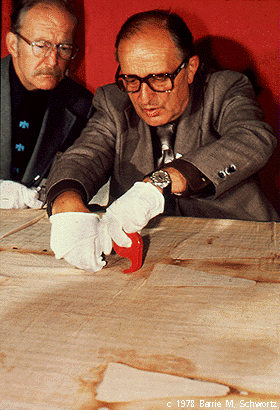
Thursday, November 13, 2008

Index to my "Bogus: Shroud of Turin?" posts

I am preparing a response to a comment under one of my posts, "Bogus: Shroud of Turin? #10: The Shroud's blood and pollen closely matches the Sudarium of Oviedo's," and am about respond

[Above: Giuseppe Enrie's 1931 photographic negative of the face on the Shroud of Turin, which was a positive image, meaning that the image on the Shroud was the equivalent of a photographic negative, Shroud of Turin Facts Check]

to another, when I remembered that the first 9 parts of that series of responses to a no-doubt well-meaning (but ignorant) article, "Bogus: Shroud of Turin," The Conservative Voice, April 08, 2007, Grant Swank (which I can now only find in Google's cache), was to my CreationEvolutionDesign blog (CED), because at the time it was the only one I had.

So here on this my TheShroudofTurin blog (TSoT) is an index of my "Bogus: Shroud of Turin" posts on CED:

And here is my as yet one and only post in that series on TSoT:

I have also just remembered that I had planned to continue that series with:

  • Bogus: Shroud of Turin? #11: Coin images minted by Pontius Pilate between AD 29 and 32 cover the eyes of the man on Shroud.

So I hope to do that in the near future. When I do, I will add future posts in that series here on this index, for completeness.

[Right: Roman lepton coin minted by Pontius Pilate 29-32 AD, Shroud Story]

As it happens, only today I was reading in an articles that I had recently received from the USA (Borkan, M., "Ecce Homo?: Science and the Authenticity of the Turin Shroud," Vertices, Duke University, Winter 1995, Vol. X, No. 2, pp.18-51), about the coins in the eyes of the man in the Shroud (see `tagline' quotes).

Stephen E. Jones, BSc. (Biology).
My other blogs: CreationEvolutionDesign & Jesus is Jehovah!


"As unexpected as the generation of a 3D image by the VP-8 analysis of the Shroud ... was, another observation made at the time proved equally surprising. In a VP-8 relief made from a photograph of the Shroud face, researchers noted flat button-like objects over each eye. The characteristics of these images led the investigators to conclude that they were solid objects on top of the eyes of the man in the Shroud. In light of readings he made about Jewish burial customs, Jackson theorized that these objects were coins placed on the eyes to keep them closed in death. In 1979, the late Francis Filas reported identifying the letters UCAI and a design resembling a shepherd's crook, or lituus, in the coin area over the right anatomic eye. [Whanger and Whanger 1991:3, Whanger and Whanger 1985:767, Stevenson and Habermas 1990:66] These patterns match those of a lepton of Pontius Pilate, struck in Israel during the time of Jesus, with the exception that the Latin C is apparently a misspelling of what should have been the (identically pronounced) Greek K in KAICAROC (Caesar). Filas, however, managed to obtain a Pontius Pilate lepton with exactly this misspelling, and at least six others have been found, [Whanger in Meacham 1983 Comments, p.304] thus rendering academic any debate over the likelihood of a coin with such a misspelling being struck." (Borkan, M., "Ecce Homo?: Science and the Authenticity of the Turin Shroud," Vertices, Duke University, Winter 1995, Vol. X, No. 2, pp.18-51, p.28).

"Using their overlay technique, the Whangers compared a photograph of Filas' coin with a computer-enhanced photo of the area over the right eye on the Shroud. .... They found a very close match, noting at least 74 points of congruence. In order to demonstrate that it is not the case, as one critic of the Shroud has put it, that `the alleged coin-images are artifacts of observers' hopes and beyond the limits of photo enlargements and the coarseness of the Shroud weave,' [John R. Cole in Meacham 1983 Comments, p. 296] a number of confirmatory studies have been carried out. The Whangers twice repeated their polarized overlay comparison, first with a right-left reversal of the coin, and then with a top-bottom reversal. In the first case, they observed only ten points of congruence; in the latter, they observed six. They also performed a comparison with a lepton of the Procurator Coponius (C.E. 6-9) in place of the Pontius Pilate lepton (the two coins are nearly the same size and shape,) but were able to tabulate only 11 points of congruence. [Whanger and Whanger 1985:770] A series of computer-aided studies of the Shroud image carried out by Robert Haralick of the Spatial Data Analysis Laboratory at Virginia Polytechnic and State University also supports Filas' initial observations. Image analysis revealed not only the letters UCAI but also three additional letters in their proper positions. [Haralick 1983:34]" (Borkan, 1995, p.28).

"The Whangers further noted that the coin image over the right eye `is so similar to [Filas' lepton] that the two coins must have been struck from the same die.' The pattern on the back of F'ilas' coin identifies the year in which it was struck: the 16th year of the reign of Tiberius Caesar, or 29 C.E. This is also the only year in which another Pontius Pilate lepton, the Julia lepton, was struck; though the image over the left eye on the Shroud is less distinct than that over the right, the Whangers have reported 73 points of congruence between the image over the left eye and a Julia lepton. [Whanger and Whanger 1985:767, Whanger and Whanger 1991:4]" (Borkan, 1995, pp.28-29).

"Extensive debate has surrounded the discovery of coins on the eyes of the man in the Shroud. Critics have questioned both the reliability of the identification and the archaeological evidence for the practice of placing coins on the eyes of a corpse. The work of Haralick and the Whangers demonstrates that the images over the eyes on the Shroud are not anomalies in the cloth weave. In conjunction with the VP-8 analysis, this provides supportive evidence for the presence of coins on the eyes of the man in the Shroud. For several years after the initial identification of these images, the issue of archaeological justification for this discovery was hotly debated. It has become apparent in recent years that there is little archaeological support for a first-century Jewish practice of placing coins on the eyes of the deceased. [Hachlili and Killebrew 1983] However, there is neither a complete lack of support nor a strong theoretical argument against such an occasional practice." (Borkan, 1995, p.29).

Friday, November 7, 2008

Are the three Hebrew letters on the Shroud tsade-'aleph-waw: `you will come out'?

See update below. Further to my Shroud of Turin News-September 2008 comments on the article, "Plant life traces on Shroud of Turin draws local interest," St.Louis Review, September 5, 2008,

[Above (click to enlarge): 3D hologram showing three Hebrew letters under the beard of the man on the Shroud: "The Shroud of Turin: The Holographic Experience," Missouri Botanical Garden]

by Jennifer Brinker, where I showed that there were major problems with Dr Petrus Soons' identification of the three Hebrew letters on the Shroud as (from right-to-left) ayin-'aleph-nun, meaning, according to him, "small cattle, sheep, sheep and goats ... lamb." Nothing I said there and say here is meant to take away from Dr Soons' very important achievement of converting the Enrie photographs into a hologram of the man on the Shroud and finding that there are three Hebrew letters on His body.

As I had further stated in my comments:

I had thought the third (left-most) letter was gimel which made a word tsade-'aleph-gimel. I had then found what I thought was that word in one of my Hebrew lexicons, and it meant, "you will come out," which may have been the very Hebrew or Aramaic word that Jesus used when He commanded Lazarus to "come out" from the tomb (Jn 11:43). But alas, on closer inspection the word in my lexicon is tsade-'aleph-waw and the left-most letter on the Shroud does not look like waw. I will keep working on this, trying to accurately identify the letters and then check to see if they spell a Hebrew word. Of course it may be that the three letters are not a word but an acronym.

However, I had not then looked at the above 3D holographic image with 3D red and green spectacles, not owning any. But after I borrowed a pair of 3D spectacles and looked through them at the 3D image above, I saw that the left-most letter does in fact look like waw, if the indistinct

[Right: tsade-'aleph-waw (from right to left)]

blob at the bottom of that letter is not part of the letter itself but the raised edge of the amulet or plaque. So I will now largely reinstate what I originally posted, but had removed, substituting waw for gimel.

After many hours looking at Dr. Soon's holographic images (albeit via the Internet and not directly as Dr Soons can), especially the 3D image above, it seems to me that the first (right-most) letter is tsade, the middle letter is definitely 'aleph and the third letter seems to be waw, i.e. tsade-'aleph-waw (from right-to-left), forming the Hebrew word tse'w.

I then found in one of my Hebrew lexicons that tse'w was an imperative imperfect plural masculine verb of the Hebrew root yatsa' (yodh-tsade-'aleph). Yatsa' in turn means "to go out, come out, exit, go forth" (Davidson, 1966, pp.638,336; Strong's Concordance 3318; Tregelles, 1949, pp.359-360; Harris, et al., 1980, pp.1:393-394). And according to R.K. Harrison's, "Teach Yourself Hebrew," 1955, p. 69, the meaning of yatsa' in the imperfect plural masculine, i.e. tse'w, would be, "you will come out." So this may well be the very Hebrew or Aramaic word that Jesus used when He commanded Lazarus to "come out" from the tomb (Jn 11:43)!

If this identification of the Hebrew letters, the word they form and its meaning is correct (and I freely admit I am far from an expert in Hebrew), then the word tse'w may have been on an amulet or plaque placed on Jesus' body by the disciples as a prayer that He would indeed "come out" of the tomb on the third day, as He had predicted (Mt 12:40; 16:21; 17:23; 20:19; 27:63-64; Mk 8:31; 9:31; 10:34; Lk 9:22; 18:33; 24:7; Jn 2:19-21). The gospel accounts of Jesus' burial (Mt 27:59-60; Mk 15:45-46; Lk 23:52-53; Jn 19:38-42) do not mention this, but they are very brief. Also, the letters appear to be raised, so the amulet or plaque probably would not be something hastily made on the day of Jesus' death specifically for Him, but rather may have been a generic Jewish burial plaque, the equivalent of our R.I.P.

Whether specifically for Jesus, or generic, the very presence of Hebrew letters on the Shroud (and the middle letter is definitely and unmistakeably aleph') no European 14th century forger would have gone to the trouble of inscribing Hebrew letters onto the Shroud, which could not be seen until a 21st century hologram revealed them, even if he could do it. Remember that artists down through the centuries have faithfully copied many incomprehensible marks on the Shroud but none of them, as far as I am aware, has depicted these Hebrew letters.

All this is necessarily speculative, but the fact is that the three Hebrew letters are there on the Shroud, and therefore require explanation. If there are any other suggestions, including corrections to my self-taught Hebrew, or a plausible three-letter acronym, I would appreciate being advised of them in comments below this post.


After this was posted, I received an email from Bishop Jacob Barclay of Jerusalem, an expert in Hebrew and Aramaic, who is cited in Dr Soons' "The Shroud of Turin, The Holographic Experience," as his Aramaic language authority. Bishop Barclay confirmed that ayin-aleph-nun means "flock" not "lamb," and that the last letter is unlikely to be nun because when it is at the end of a word it has a long, straight stem. However, Bishop Barclay also confirmed that while tsade-'aleph-waw would be the second person plural masculine imperative of yatsa', i.e. "go out, come out," it would never be used in addressing one person in the masculine. Bishop Barclay hopes, as I do, that experts in Israel (I suggested the Israel Antiquities Authority), may be able to decipher the three letters and then derive their meaning, whether that be a word or an acroynym.

Update: I have been subsequently advised by Bishop Barclay that there actually is an Aramaic word ayin-'aleph-nun which means "flock" and that its Hebrew equivalent is tsade-'aleph-nun. But that does change the main facts: 1) that Aramaic word is not in the four Hebrew-Aramaic lexicons I consulted; 2) neither that Aramaic word ayin-'aleph-nun nor its Hebrew equivalent tsade-'aleph-nun means "lamb"; and 3) the last (left-most) letter is probably not nun.


The `tagline' quotes below (emphasis bold mine) are hyperlinked to inline references above.

Stephen E. Jones.
My other blogs: CreationEvolutionDesign & Jesus is Jehovah!


"tse'w ...Kal. imp. pl. masc.; waw bef. yatsa' ... yatsa' fut. yetse', imp. tse', inf. c. tse't (§ 95. No. 2d) -I. to go out, go forth; with sin, also acc. of the place whence, with b (rarely sin) of the place through or by which. one goes out.-II. to come forth, to issue, descend, of children, posterity.-III to escape, as danger, with 'et Ecc. 7:18.-IV. to rise, as the sun, stars, &c.-V. to shoot forth, spring up, as plants; to spring forth, of water.-VI. to go forth, be issued, published, as a decree.-VII. to go out, to end, of a period of time. Hiph. hotsiy'. to cause to go, come out or forth, to lead, bring forth or out.-II. to cause to spring up, to yield, as the earth plants.-III. to cause to lay out, as money, to exact, with `al, 2 Ki. 15:20.-IV. ta spread abroad, to publish, with `al, le of the person. -V. to produce, make, Is. 54:16.-VI. to take out, to separate, Je. 15:19. Hoph. to be led, brought forth or out." (Davidson, B., 1966, "The Analytical Hebrew and Chaldee Lexicon," Samuel Bagster & Sons: London, pp.638,336. My transliteration).

"yasa' ... go out, come out, go forth.... yasa' ... has the usual causative meaning `cause to go out, bring out, lead out.' ... The basic notion of yasa' is `to go out.' It is used literally of going out from a particular locality or from the presence of a person. It is used of nature, i.e. water out of a rock, sun rising out of the east, etc. For our purposes we shall note the following uses. First, it is used frequently of the great exodus event which forms the major focus of theological attention in the OT. The Hiphil with its causative function is used extensively. .... `I am the Lord your God, who brought you out of the land of Egypt, out of the house of slavery' (Ex 20:2). The record shows that history is theologically related, the great `going out' event was to symbolize the mighty redemption of God's people from the shackles of sin by his sovereign powerful grace. ... Throughout Israel's history, the covenanted people of God are called to remember this God-initiated redemption and to live accordingly. (Cf. Deut 6:12; 26:8; Jud 2:12; I Sam 12:8; I Kgs 8:16; Jer 11:4; Dan 9:15 ... Ps 136:11, ... 106:6-12.) ... Another theological usage of yasa' is an extension of the exodus theme. The prophets see the irremediable corruption of Israel and Judah which inevitably leads to exile but after that a return. Ezekiel ... quotes the Lord's promise of a new exodus-like redemptive activity from the exile. `As a soothing aroma I shall accept you, when I bring you out from the peoples and gather you from the lands where you are scattered' (20:41; cf. v. 34). Its true fulfillment may only come after the good shepherd `will bring them out from the peoples and gather them from the countries and bring them to their own land' (34:13). Hence, an eschatological note of hope is introduced." (Harris, R.L., Archer, G.L. & Waltke, B.K., eds, 1980, "Theological Wordbook of the Old Testament," Moody Press: Chicago IL, Twelfth printing, 1992, Vol. I, pp.393-394).

"yatsa' ... TO GO OUT, TO GO FORTH .... In Syriac and Chaldee the word which radically corresponds ... to germinate, to expand, as a plant, they use in the sense of going out, when speaking of men and other things ... Specially to go out, to go forth, is used--- (a) of soldiers-(a) to war, 1 Sa. 8:20; Job 39:21; Isa. 42:12; Zechariah 14:3 (and similarly shepherds against wild beasts, 1 Sa. 17:35).-(B)out of a city in order to surrender it, Isa. 36:16.-(b) merchants and sailors for purposes of trade, Deut. 33:18.-(c) slaves manumitted by their owners, Ex. 21:3, 4, 11; Lev. 25:41, 54 ... (d) children, descendants are said to come forth from their father, or the ancestor of the race; Gen. 17:6, ... to come forth from the womb, from the loins of any one, Job 1:21 ; Gen. 46:26.-(e) those who are delivered from danger are said to come forth ... Ecc. 7:18, ... 1 Sa. 14:41 ... It is applied to inanimate things. So- (f) the sun is said to go forth, i.e. to rise, Gen. 19:23; Ps. 19: 6; the stare, Neh. 4:15; the morning, Hos. 6:5. -(g) to plants which spring forth, 1 Ki. 5:13; Isa. 11:1 ; flowers, Job 14:2... (h) water flowing, gushing forth from a fountain, Gen. 2:10 ; Deut. 8:7; ... Isa. 41:18. It is used also-(i) of a boundary, terminus, running on, running through, Josh. 15:3, 4,9,11- (k) of money which is laid out, expended, 2 Ki. 12:13. ... (l) of things which go forth to the people, are promulgated; of an edict, Hab. 1:4; of the sentence of a judge, Ps. 17:2; compare Gen. 24:50.(m) of the outgoing, i. e. the end of a period of time; Exod. 23:16, ... Ezek. 7:10; hence of the end, the destruction of a city, Eze. 26:18. ... to cause to go out, or come forth, hence of animate beings; to lead out, e. g. the people from Egypt, Ex. 12:51; 16:6; of inanimate beings, to carry out, Gen. 14:18; to draw out, to take out, Ex. 4:6,7; Job 28:11; to take out as from a case, Gen. 24:53. Specially it is (a) causat. ... to put forth plants (as the earth), Gen. 1:12, 24; Isa. 61:11.-(b) .... to cause to lay out, to exact money, followed by .., to lay on a tribute, 2 Ki. 15:20 ... (c) ... to publish a report, followed by ... of the pers. concerning whom the report is spread, Nu. 14:37; Deu. 22:14, 19; to report words, followed by ... of the pers. to whom they are brought, Neh. 6:19; to promulgate doctrine, Isa.42:1, ... ... Isa. 42:3.-(d) to produce as an artisan, Isa. 54:16.(e) to lead forth, i.e. to separate, Jer. 15:19. ... to be brought forth, to be taken out, Eze.38:8; 47:8." (Tregelles, S.P., transl., 1949, "Gesenius' Hebrew and Chaldee Lexicon to the Old Testament Scriptures," Eerdmans: Grand Rapids: MI, Eighth Printing, 1967, pp.359-360. My transliteration. Emphasis original).

Saturday, November 1, 2008

Shroud of Turin News - September 2008

Here, again belatedly, is my Shroud of Turin News for September 2008, being only two articles. The previous issue was August 2008. My comments are in bold.

[Above (click to enlarge): Hologram showing three Hebrew letters under the beard of the man on the Shroud: "The Shroud of Turin: The Holographic Experience," Missouri Botanical Garden]

Plant life traces on Shroud of Turin draws local interest, St.Louis Review, Sep 5, 2008, Jennifer Brinker ... For decades, scientists have debated the authenticity of the Shroud of Turin, believed to be the burial cloth Jesus Christ. Two researchers were in St. Louis to present their findings on the shroud. The event was held at the

[Left: Dr Petrus Soons presenting his "The Shroud of Turin: The Holographic Experience" at the Missouri Botanical Garden: St. Louis Review]

Missouri Botanical Garden. Some 400 people attended. Hear also Dr Soons' presentation at the Ohio Conference (mp3).

Avinoam Danin, emeritus professor of botany at the Hebrew University of Jerusalem, has spent years examining images of plant life discovered on the shroud. He also has discovered additional pieces of plant life on the cloth, which has provided additional evidence to support his theory that the shroud was used somewhere in the area of Jerusalem. Dr. Petrus Soons, a

[Right: Dr. Petrus Soons (left) and Prof. Avinoam Danin stand before the Shroud of Turin: Missouri Botanical Garden]

native of the Netherlands and retired doctor, has used digital photos of the shroud to create three-dimensional holograms, which have provided new and unique views of the cloth. While neither Soons nor Danin attempted to prove that the image of the man found on the shroud indeed was that of Christ, both agreed that their research provides additional insight into the history of the cloth. Missouri Botanical Garden president Peter Raven noted to the audience: "You will walk away with a tremendous amount of food for thought." Soons said it was after an injury that he began searching for authentic images of Christ and ... he came across the Shroud of Turin ... Using photos taken of the shroud in 1931, Soons enhanced them to improve the details and translated the grayscale images into depth data. He also worked with computer expert Bernardo Galmarini to produce from those images three-dimensional holographs of the shroud. Among his findings from the images, Soons discovered an oval-shaped plaque or medallion placed at

[Left: Dr Soon's depiction of what he believes are the three Hebrew letters on the Shroud.]

the bottom of the face that displays the word "lamb" in Hebrew. To know the meaning we go to religion" and the Gospels, said Soons, a Catholic. The word lamb, he noted for example, is used just before Communion, when the priest says, "this is the Lamb of God, who takes away the sins of the world." I agree that on the hologram below the beard of the man of the Shroud there are three Hebrew letters, which itself is further evidence that the Shroud is that of Jesus, because why would, or even could, a forger add three Hebrew letters to his forgery, such that they could only be detected by 21st century science?

However, there are problems with Dr Soons' claim that the letters are, from right to left (as Hebrew is) `ayin-'aleph-nun: 1. there is no such word as `ayin-'aleph-nun, in my three Hebrew / Aramaic lexicons and another I consulted; 2. While the two Hebrew / Aramaic lexicon pages Soon's shows are too blurry for me to distinguish the letters, one of them (Klein's "A Comprehensive Etymological Dictionary of the Hebrew Language for Readers of English"), clearly has the Hebrew letter tsade in large print at the top of the page, indicating that the key words on that page start with tsade, not `ayin; and 3. The Hebrew word for "small cattle, sheep, sheep and goats" is another word tsade-'aleph-nun (ts'n):

"ts'n ... small cattle, sheep and goat ... flock, flocks of sheep and goats" (Davidson, 1966, p.638); "s'n ... flock, sheep. ... the generic term for `small cattle' comprised mostly of sheep and goats" (Harris, et al., 1980, p.2:749); "ts'n ... small cattle, i.e. sheep & goats" (Holladay, 1971, p.302) and "small cattle, sheep, sheep and goats, flock" (Strong's Concordance 6629); "ts'n ... flocks, small cattle, i.e. sheep and goats" (Tregelles, 1949, p.698).

But ts'n is a collective plural and (apart from Ex 12:21 which should be "flock" as per The Interlinear Bible and Young's Literal Translation), is never rendered "lamb" in the Bible, the latter having its own Hebrew word seh. I have emailed Dr Soons advising him of these problems.

I had thought the third (left-most) letter was gimel which made a word tsade-'aleph-gimel. I had then found what I thought was that word in one of my Hebrew lexicons, and it meant, "you will come out," which may have been the very Hebrew or Aramaic word that Jesus used when He commanded Lazarus to "come out" from the tomb (Jn 11:43). But alas, on closer inspection the word in my lexicon is tsade-'aleph-waw and the left-most letter on the Shroud does not look like waw. I will keep working on this, trying to accurately identify the letters and then check to see if they spell a Hebrew word. Of course it may be that the three letters are not a word but an acronym.

Dr. Soons also discovered several areas of the images in which data seemed to be missing. Those placed were marked with empty, black holes. Eventually, Soons learned of Danin and his research, and the two discovered that those places were perhaps areas that were once covered in flowers that Danin was researching.

[Left: Flower images on the Shroud discovered by Danin which are information`black holes' in Sooon's hologram]

Over the years, Danin, co-author of "Flora of the Shroud of Turin," noted he has discovered the presence of three plant species that indicate the shroud's origin was somewhere between Jerusalem and Hebron. Prof. Danin said in his talk that the three species are Gundelia tournefortii, Zygophyllum dumosum and Cistus creticus, and their distributions overlap only in the tiny area between Jerusalem and Hebron, which are only ~20 miles / ~30 kilometres apart! Eight species also have been used to determine, through flowering characteristics, that the plant life placed on the body happened somewhere during March or April. Jesus was crucified in early April (Finegan, 1964, p.296). No medieval forger would have known all this about these plants, and even if he did, why would he bother adding images of plants to the Shroud that: a) are only found together around Jerusalem; and b) flower only during the very month that Jesus was crucified! Danin said he also recently has indicated more than 300 flowers and plant parts on the head area of the shroud. Hear also Prof. Danin's presentation at the Ohio Conference (mp3).Those were discovered, he said, after studying photos of the cloth taken in the 1970s. Among the plant life identified are the Matricaria and Anthemis, two genera of the sunflower family. He also said he discovered plants from the Carduus genus of thistles, and pieces of the shrub Rhamnus lycioides - both potential evidence of a crown or helmet of thorns. This fits with Jn 19:40, "Taking Jesus' body, the two of them [Joseph of Arimathea and Nicodemus] wrapped it, with the spices, in strips of linen" where "spices" is Gk. aromaton, i.e. aromatics, and includes "flowers, perfumes, etc" (Robertson, 1932, p.307).

Shroud Of Turin Is Fake, Mindanao Examiner, Philippines - September 9, 2008. The image of a man on the Shroud of Turin,

[Right: A bas-relief `duplicate' of the Shroud, by Paul-Eric Blanrue and Patrick Shepherd,"A false Shroud of Turin carried out in five minutes" Science et Vie, June 2005. Its gross inferiority to the Shroud face (see below) is obvious.]

believed by many Christians as the so-called Jesus Christ, their god, turned out to be a fake. This is old news that keeps getting recycled, having been published in 2005, e.g.: "Turin Shroud confirmed as a fake," PhysOrg.com, "Shroud of Turin 'a fake'," News24 and "Turin Shroud 'confirmed as fake'," NEWS.com.au ... In 2005, a French magazine said ... it had carried out experiments that proved the Shroud of Turin, believed by some Christians to be their religion's holiest relic, was a fake. I have been unable to find a picture of this claimed duplicate of the Shroud, unless the above is it. A medieval technique helped us to make a Shroud," Science & Vie (Science and Life) said in its July issue. .... Drawing on a method previously used by skeptics to attack authenticity claims about the Shroud, Science & Vie got an artist to do a bas-relief -- a sculpture that stands out from the surrounding background -- of a Christ-like face. First this was just a face. Not a full-length body, front and back. A scientist then laid out a damp linen sheet over the bas-relief and let it dry, so that the thin cloth was moulded onto the face. There is nothing knew in this. As this translated French pro-Shroud web page critique points out, "But the technique has been developed in the 80s by Walter McCrone, an American chemist." But even Shroud anti-authenticity proponents Picknett and Prince point out that McCrone's iron oxide on linen bas-relief `Shroud' face, even though "he got an artist, Walter Sanford,

[Above (click to enlarge): Negatives of McCrone's bas-relief (left) and the Shroud (right) compared: Wilson, I. & Schwortz, B., "The Turin Shroud: The Illustrated Evidence," 2000, pp.120-121]

to produce it, was "nowhere near the quality of the original" (Picknett & Prince, 2006, pp.74-75). Using cotton wool, he then carefully dabbed ferric oxide, mixed with gelatine, onto the cloth to make blood-like marks. When the cloth was turned inside-out, the reversed marks resulted in the famous image of the crucified Christ. This is false unless the image had all the major features of the Shroud. And as the above French translated web page noted: "This is not a 3D image and the image of the Shroud is in 3D" (see further below). Gelatine, an animal by-product rich in collagen, was frequently used by Middle Age painters as a fixative to bind pigments to canvas or wood. The imprinted image turned out to be wash-resistant, impervious to temperatures of 250 C (482 F) and was undamaged by exposure to a range of harsh chemicals, including bisulphite which, without the help of the gelatine, would normally have degraded ferric oxide to the compound ferrous oxide. This was McCrone's method, to duplicate the work of a hypothetical "mediaeval artist" who supposedly "created the Shroud by simply painting its image onto the cloth using iron-oxide pigments in a gelatin binding medium" (Wilson, 1998, p.9). But:

"Because of the [1532] fire that the Shroud had been exposed to, there must have been a temperature gradient .... The binders most often used were egg white, gelatin, milk products, and oil. Any of these would have changed color along the line of the heat gradient. But the Shroud showed no color change of this kind ..." (Heller, 1983, pp.85-86).

The experiments, said Science & Vie, answer several claims made by the pro-Shroud camp, which says the marks could not have been painted onto the cloth. For one thing, the Shroud's defenders argue, photographic negatives and scanners show that the image could only have derived from a three-dimensional object, given the width of the face, the prominent cheekbones and nose. In addition, they say, there are no signs of any brushmarks. And, they argue, no pigments could have endured centuries of exposure to heat, light and smoke. This is correct, but the bas-relief method uses a "pigment," yet there is none on the Shroud, i.e. that comprises its image. For Jacques di Costanzo, of Marseille University Hospital, southern France, who carried out the experiments, the mediaeval forger must have also used a bas-relief, a sculpture or cadaver to get the 3-D imprint. Costanza did not use a "cadaver" but only a "bas-relief," so to save space I will ignore the problems of using a cadaver to duplicate the Shroud.

Some of the major problems with using a bas-relief or sculpture to duplicate the Shroud are: 1) there is no powder or pigment comprising the image as there would be if a bas-relief or sculpture was used (Antonacci, 2000, pp.73-74; Stevenson & Habermas, 1990, p.122); 2) bas-relief `shrouds' do not reproduce the real Shroud's 3D, superficial and non-directional properties (Picknett & Prince, 2006, pp.76-77; Stevenson & Habermas, 1981, pp.109-110; Stevenson & Habermas, 1990, p.122); 3) the bas-relief technique was unknown in the 14th century (Meacham, 2005, p.47; Picknett & Prince, 2006, pp.76-77; Stevenson & Habermas, 1990, p.122); 4) the bas relief would be a the real great masterpiece of art and it should still exist (Stevenson & Habermas, 1981, pp.109-110); 5) there would be many Shrouds mass-produced from the same bas-relief (Stevenson & Habermas, 1981, pp.109-110); 6) the anatomical accuracy of the Shroud's wounds and blood flows have never been duplicated in bas-relief carving or sculpture (Meacham, 2005, p.47).

The faker used a cloth rather than a brush to make the marks, and used gelatine to keep the rusty blood-like images permanently fixed and bright for selling in the booming market for religious relics. The bloodstains on the Shroud are not "blood-like images". They are stains of real blood:

"... the red stuff on the Shroud is emphatically, and without any reservation, nothing else but B-L-O-O-D!" (Heller, 1983, pp.215-216).

To test his hypothesis, di Costanzo used ferric oxide, but no gelatine, to make other imprints, but the marks all disappeared when the cloth was washed or exposed to the test chemicals. And see above that there is no "gelatine" or "ferric oxide" on the Shroud. He also daubed the bas-relief with an ammoniac compound designed to represent human sweat and also with cream of aloe, a plant that was used as an embalming aid by Jews at the time of Christ. He then placed the cloth over it for 36 hours -- the approximate time that Christ was buried before rising again -- but this time, there was not a single mark on it. So, Far from proving the Shroud is a fake, Costanzo has helped confirm it is genuine, as every failed attempt at duplicating the Shroud has inadvertently done! "It's obviously easier to make a fake shroud than a real one," Science & Vie report drily. So even Science & Vie does not regard Costanzo's `Shroud' as "a real one" but just another "fake"! ...

The quotes below (emphasis bold mine) are hyperlinked to references above.

Stephen E. Jones.
My other blogs: CreationEvolutionDesign & Jesus is Jehovah!


"Joe Nickell, a former stage magician and amateur detective, has experimented with a proposed technique of image encoding. Nickell's technique involved conforming wet linen to a bas-relief while impressing all the relief's features onto the cloth. After the cloth dried, he used a cotton dauber covered with cloth to rub powdered pigment onto the impressions left on the linen. The results obtained by such a technique ... show what happened when STURP members tested Nickell's theory. As is evident in the VP-8 photograph, Nickell's powder-rubbing method does not produce a true three-dimensional image. A powdered bas-relief technique would involve the application of a substance to the Shroud. As discussed earlier, all the extensive scientific examinations of the cloth indicate that no powdered particles or foreign materials of any kind have been added to the body-image fibrils that could account for the coloring-and therefore visibility-of the image. Specifically, magnified photographs of the body image threads do not reveal any sort of applied particles or staining substance. The `natural experiment,' arising from the fire of 1532, also disproves Nickell's theory, as it did the painting theory. Nickell promulgates that the powdered pigments used were iron oxide, myrrh, or aloes. Yet if organic substances such as these had been used to encode the Shroud image, they would have been altered or decomposed during the fire, depending on their distance from the hottest areas of the cloth. However, no such alteration in the body image can be found on the Shroud when those image areas nearer the burn marks are compared to those areas farther away." (Antonacci, M. , 2000, "The Resurrection of the Shroud: New Scientific, Medical, and Archeological Evidence," M. Evans & Co: New York NY, pp.73-74).

"ts'n ... com. dec. 1 a, collect.-I. small cattle, sheep and goat. - II. flock, flocks of sheep and goats ; metaph. of a people. tso'n idem, Ps. 144:13 ... " (Davidson, B., 1966, "The Analytical Hebrew and Chaldee Lexicon," Samuel Bagster & Sons: London, p.638).

"The Johannine requirement of having Nisan 14 fall on a Friday (and Nisan 15 on a Saturday) can be satisfied in A.D. 30 under (1) and in A.D. 33 under (1), both of which years seem to be well within the range of likelihood. Astronomically calculated, therefore, the likely dates for the crucifixion of Jesus appear to be either Friday Apr 7, A.D. 30, or Friday Apr 3, A.D. 33. Therewith, in terms of the standard Jewish calendar, the representation of the day in the Fourth Gospel appears to be confirmed." (Finegan, J., 1964, "Handbook of Biblical Chronology: Principles of Time Reckoning in the Ancient World and Problems of Chronology in the Bible," Princeton University Press: Princeton NJ, p.296).

"Assumed root of the following. 1864a ... so'n flock, sheep. (ASV and RSV very similar.) so'n is the generic term for `small cattle' comprised mostly of sheep and goats, but the emphasis in the word is on sheep (cf. Gen 38:17; I Sam 25:2)." (Harris, R.L., Archer, G.L. & Waltke, B.K., eds, 1980, "Theological Wordbook of the Old Testament," Moody Press: Chicago IL, Twelfth printing, 1992, Vol. II, p.749).

"Because of the [1532] fire that the Shroud had been exposed to, there must have been a temperature gradient, from the hottest portion, where the molten silver burned holes through the folds of fabric, through the area of scorch, to that portion of the linen which was relatively unaffected. The gradient of temperature, Rogers had calculated, went from about 900?C to well below 200?C. If an inorganic color had been used on the Shroud, it would have had a binder of some type to make the color stick to the fabric. The binders most often used were egg white, gelatin, milk products, and oil. Any of these would have changed color along the line of the heat gradient. But the Shroud showed no color change of this kind, as evidenced by the color photographs that were available. Organic or biological colors could be ruled out by the same reasoning, for anything organic would have changed in hue; it would be darker, lighter, discolored. But there was no evidence of this kind of change, which seemed to rule out the use of any familiar coloring agent." (Heller, J.H., 1983, "Report on the Shroud of Turin," Houghton Mifflin Co: Boston MA, pp.85-86).

"Adler was asked how he could answer McCrone's claim that there was no blood, but merely a mixture of red ocher and vermilion. Adler flashed on the screen the following table from our paper. Table 5 Tests confirming the presence of whole blood on the Shroud 1. High iron in blood areas by X-ray fluorescence 2. Indicative reflection spectra 3. Indicative microspectrophotometric transmission spectra 4. Chemical generation of characteristic porphyrin fluorescence 5. Positive hemochromogen tests 6. Positive cyanomethemoglobin tests 7. Positive detection of bile pigments 8. Positive demonstration of protein 9. Positive indication of albumin 10. Protease tests, leaving no residue 11. Positive immunological test for human albumin 12. Microscopic appearance as compared with appropriate controls 13. Forensic judgment of the appearance of the various wound and blood marks Then, after explaining each item briefly, Al said, `That means that the red stuff on the Shroud is emphatically, and without any reservation, nothing else but B-L-O-O-D!'" (Heller, 1983, pp.215-216).

"ts'n (273 X) sf. ... Ne 10:37 ... Ps 144:13; f.: coll. small cattle, i.e. sheep & goats Gn 4:2; sheep only 1S 25:2; males only (thus m.) Gn 30:40; bene so'n individual animals Ps 114:4; metaph. = Isr. 2S 24:17." (Holladay, W.L. , 1971, "A Concise Hebrew and Aramaic Lexicon of the Old Testament: Based upon the Lexical work of Ludwig Koehler and Walter Baumgartner," Eerdmans: Grand Rapids MI, p.302. My transliteration).

"In addition to the four unprecedented features described above, there is no rubbing from the entire medieval period that is even remotely comparable to the Shroud, nor is there any negative painting. Nickell's wet-mold-dry-daub technique was not known in medieval times, according to art historian Husband (cited in Sox 1981:88), and even that technique fails to reproduce the contour precision and three-dimensional effect, the lack of saturation points, and the resolution of the Shroud image. The bas-relief used would have been far more accurate than any example of 14th century wood carving or sculpture known; even later carvings by 15th / 16th century masters of bas-relief do not have the fine detail of wounds and postures which would translate into the undistorted three-dimensional projections of Tamburelli, confirmed as accurate anatomically by the forensic pathologist Zugibe (1982:169-76). Similarly, even the blood flows painted in the greatest 14th century works of art are not at all comparable to those on the Shroud." (Meacham, W., 2005, "The Rape of the Turin Shroud: How Christianity's Most Precious Relic was Wrongly Condemned and Violated," Lulu Press: Morrisville NC, p.47).

"His [McCrone's] final conclusion was that the samples contained a pigment known as Venetian red, which was made by grinding iron oxide into a powder. He claimed that this alone was responsible for the Shroud image. The ground pigment would have been mixed with a liquid medium for application; his chemical tests revealed the presence of a protein, collagen, that he interpreted as being just that medium. To reinforce these observations, he got an artist, Walter Sanford, to reproduce the Shroud face using the same materials, with tolerably good results, although nowhere near the quality of the original. ... The dispute between McCrone and the rest of STURP turns on two questions: the origin of the particles of iron oxide on the threads and whether or not they were responsible for the creation of the image. .... It was not the presence of iron oxide that was disputed by the STURP scientists ... but rather McCrone's belief that it actually created the image that led to their disagreement. So they tested it without resort to microscopy to see if it was present in sufficient quantities to account for the image. X-ray fluorescence scans during the 1978 tests had revealed traces of iron, but there was no detectable difference in its density between the image and the nonimage areas-although there was more in the bloodstains. Several suggestions were made to account for the iron oxide; it could have come from the blood, spreading across the cloth due to years of folding and rolling. On the other hand, it could have been a byproduct of the manufacture of the linen itself (probably the most plausible explanation), or it could have been due to atmospheric contamination. In view of these objections, STURP declined to include McCrone's two papers in its final report." (Picknett, L. & Prince, C. , 2006, "The Turin Shroud: How Da Vinci Fooled History," [1994], Touchstone: New York NY, Second edition, Reprinted, 2007, pp.74-75).

"Nickell soaked a cloth in hot water and then pressed it over a bas-relief statue. When dry, the cloth was fitted closely over the statue's contours. He then rubbed the cloth with powdered pigment .... He claimed that the result is an image that looks very like that of Shroudman. It has a similar negative effect but no three-dimensional quality. It must be said that Nickell's results, like those produced by Walter Sanford under McCrone's direction ... are nowhere near as impressive as the Shroud, even though both attempts were produced by modern artists deliberately trying to create a negative image. Although they were much more familiar with negatives than any medieval artist would have been, the hypothetical early hoaxer managed to outdo them. Nickell's suggestion has been criticized for being too convoluted for any putative medieval artist and as having no parallel in art of that period. ... Although they do reproduce some of the characteristics of the Shroud image, neither McCrone's nor Nickell's method-nor that of any other technique yet suggested-is satisfactory, and both researchers have been forced to deny or belittle the significance of some of the Shroud's features, such as the negative effect." (Picknett & Prince, 2006, pp.76-77).

"[Jn 19:]40. In linen cloths (othoniois). Late diminutive for the old othone, used for ships' sails, in N.T. here and Luke 24:12. Case here either locative or instrumental. With the spices (meta ton aromaton). Late word aroma for spices, from fumes. To bury (entaphiazein). Late verb, from entaphia (en, taphos) the burial preparations of all sorts (flowers, perfumes, etc.), in N.T. only here and Matt. 26:12." (Robertson, A.T., 1932, "Word Pictures in the New Testament: Volume V: The Fourth Gospel & the Epistle to the Hebrews," Broadman Press: Nashville TN, p.307).

"An artist who was good enough to create an image as impressive as the Shroud's would surely have made many copies of it. Shroud copies of this level of artistry would have demanded a king's ransom. Where is the statue or the bas-relief that the artist used? It would have graced the finest cathedral and become a famous image in its own right. And, to repeat a point made before, this artist would have had to have forged an image that, would not have been appreciated for hundreds of years after his death, until the invention of photography and other modern analytical techniques. The basic fact remains: neither Joe Nickell nor any other artist or forger has ever created an image showing all the characteristics of the image of the man of the Shroud. For example, none of them are three-dimensional, superficial, or non-directional." (Stevenson, K.E. & Habermas, G.R., 1981, "Verdict on the Shroud: Evidence for the Death and Resurrection of Jesus Christ," Servant Books: Ann Arbor MI, pp.109-110).

"One other well-publicized set of attempts to show how the image may have been faked came from artist Joe Nickell. His chief example involved applying a dry powder mixture of myrrh and aloes to a damp cloth which had been carefully fitted around a bas-relief face. The result is also an image of the face, created by the powder, which, to an untrained eye, resembles the face on the Shroud. [Nickell, J., "The Turin Shroud: Fake? Fact? Photograph?," Popular Photography, November 1979, pp.99,147] ... The absence of powder on the Shroud and the disproving of any artistic process by both chemical and physical testing wielded death blows to Nickell's theories. Also, Nickell's models failed the 3-D test and were badly distorted when checked by the VP-8 image analyzer, as pointed out by John Jackson. Problems with shading and the fact that Nickell's model is not superficial (despite his claims to the contrary) led to the assessment that it was `unacceptable.' [Jackson, J., in Murphy, C., "Shreds of Evidence," Harper's, November 1981, pp.42-65, p.55] Heller likewise listed as a major failure of both bas-reliefs and block prints the fact that they do not reproduce a 3-D image, as the Shroud does. He also pointed out that no such bas-reliefs or artistic method existed in medieval times. [Heller, J.H., "Report on the Shroud of Turin," Houghton Mifflin: Boston, 1983, p.208]" (Stevenson, K.E. & Habermas, G.R. , 1990, "The Shroud and the Controversy," Thomas Nelson: Nashville TN, p.122).

"ts'n for ts'on; as Psa. 144:13 ... a collect. noun, flocks, small cattle, i.e. sheep and goats ... Gen. 4:2; 26:14; 29:2; and very frequently. Opp. to baqar herds, which 699 see, Gen. 27:9; Levit. 1:10; 22:21 (compare 19); rarely used only of sheep, 1 Sam. 25:2. To this collective (which is also used with numerals) corresponds the noun of unity seh a sheep, or goat. Exod. 21:37, `if any one steal a sheep (seh), he shall restore four sheep' ('arba' tso'n); Eze. 45:15. Note. As to gender, it is joined with a masc., where it means rams and he-goats. Gen. 30:39 ... `and the rams (and he-goats) rutted;' with a .fem., where it means ewes and she-goats; ibid., ... `and the sheep brought forth;' but, Gen. 31:10, it is joined, like epicoene nouns, with a masc., although it means ewes." (Tregelles, S.P., transl., 1949, "Gesenius' Hebrew and Chaldee Lexicon to the Old Testament Scriptures," Eerdmans: Grand Rapids: MI, Eighth Printing, 1967, pp.698-699. My transliteration).

"The Chicago microanalyst Dr Walter McCrone, for instance, had been vigorously maintaining from the early 1980s that a mediaeval artist created the Shroud by simply painting its image onto the cloth using iron-oxide pigments in a gelatin binding medium. According to him, this artist's so successful production of the negative was just a lucky chance deriving from his deliberately painting in reverse of positive tones.." (Wilson, I., 1998, "The Blood and the Shroud: New Evidence that the World's Most Sacred Relic is Real," Simon & Schuster: New York NY, p.9).