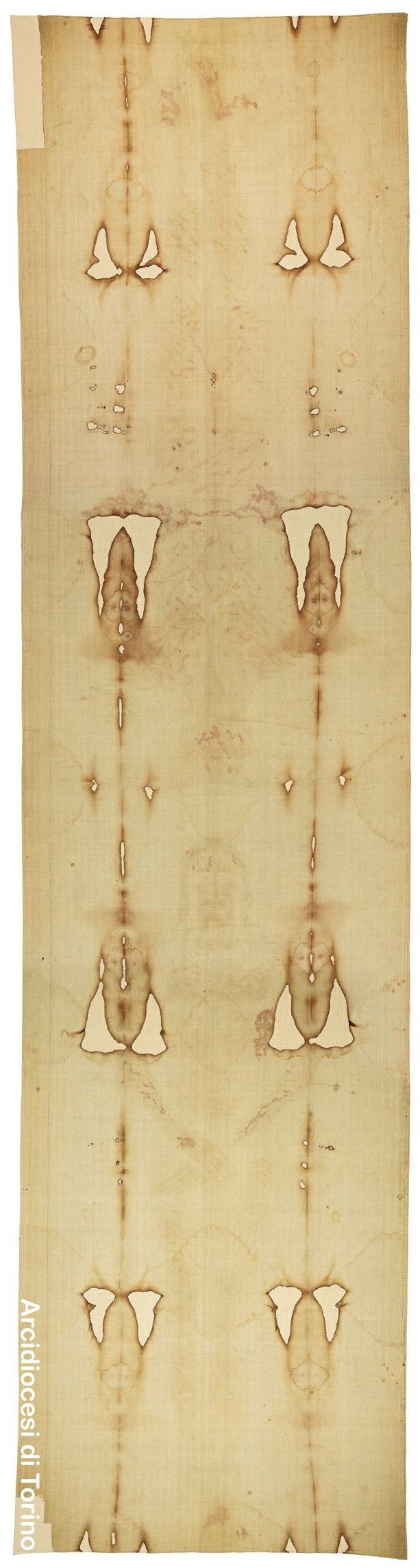
Wednesday, March 23, 2016

Colour #12: The man on the Shroud: The evidence is overwhelming that the Turin Shroud is Jesus' burial sheet!

COLOUR #12

Copyright © Stephen E. Jones[1]

This is part #12, "The man on the Shroud: Colour," of my series, "The evidence is overwhelming that the Turin Shroud is Jesus' burial sheet!" See the Main index for more information about this series.

[Main index #1] [Previous: Faint #11] [Next: Non-traditional #13]


  1. The man on the Shroud #8
    1. Colour #12

Introduction. The colour of the image of the man on the Shroud is a uniform straw-yellow[2].

[Above (enlarge): "Micrograph taken at the image area of the right eye at 32x magnification."[3]. As can be seen, the straw-yellow image colour is uniform against the lighter flax fibril background.]

Uniform. The body image lies only on the very top of those Shroud fibres it has modified[4] (see future part "superficial"). All the image portions of the fibres show a uniform straw-yellow coloration[5]. The colour is that of dehydrated oxidised cellulose in linen fibres[6]. Microdensitometric measurements of Shroud color photomicrographs found that the yellowing of any given fibril was the same of any other yellowed fibril on the Shroud[7]. That is, body image fibrils over the entire Shroud are basically identical to each other in their straw-yellow color[8]. Each yellowed fibre is yellowed to the same extent as any other image fibre[9]. There was no graduating difference in yellowness of the image fibres[10]. Each image fibre held the same quantity of yellowness[11].

Areal density image. If every topmost fiber of yellowed threads contained the same shade of yellow, then what caused the difference in the shading of the image[12]? The difference in the shading of

[Above (enlarge):

"areal density. The elements that make up the shroud image are all the same color. Like a halftone image all the `dots are the same color, more where its darker and less where its lighter. In the case of the Shroud the fibers are a uniform yellow of oxidized cellulose."[13].]

yellow from one area of the image to another was dependent on the number of yellowed fibers in each area[14]. If one image area was darker than the other, that area would contain more yellowed fibers[15]. It is similar to the half-tone prints in newspaper photos, where black is made by black ink dots bunched together, and gray is made by black ink dots interspersed with white areas[16]. The darker an area, the more dots in it[17]. This shows that the image seen at the macroscopic level is an areal density image and not a pigment concentration image[18]. Shading is not accomplished by varying the color but by varying the number of colored fibers per unit area at the microlevel[19]. The darker portions of the image were not due to a variation of the degree of the yellowing of the fibrils, but rather to the presence of more yellowed fibrils per unit area[20]. Any differences in intensity between different parts of the body image are due solely to the number of yellow-colored fibrils concentrated in a given area[21]. Although parts of the body image may appear to be darker, it is not due to them having a darker yellow coloring, but rather they have a greater number of uniformly colored fibrils in those locations[22].

Digital. All the colored fibers are uniformly colored, that is, an exposed fiber is either colored or not colored[23]. Yellowed image fibers lie alongside white non-image fibers[24]. The Shroud image colour information is therefore digital, with only two states: on-off[25], as in modern computer technology. Not analogue[26], with continuously varying information, as in a painting. Optical engineer, Kevin Moran examined by microscope Shroud fibres attached to the 27 sticky tapes which Max Frei (1913–83 had pressed into the Shroud in 1978[27]. Moran dubbed the Shroud's image fibres, "pixels, similar to a TV screen. ... darker and lighter shades are not the result of more or less `paint but rather a greater concentration of dehydrated fibers, ie. Pixelization"[28]:

"Because of my interest in how the image was formed, I have examined the image-forming pixels or segments of the fibre that have the darker yellowing. I have dubbed the elements 'pixels' to draw attention to the fact that they are optically terminated. They are very sharply defined at their ends. They are not diffused spots that would be seen if they were dyed or chemically reacted, or a thermal burn. They are most certainly not made by pigment contact"[29]
Moran further noted that under the microscope, "where the ... image ...

[Above (enlarge): Photomicrograph taken by Kevin Moran of 15 micron (15 thousandth of a millimetre) diameter Shroud fibres attached to one of Max Frei's sticky tapes[30]. As can be seen, the boundaries between the image (yellow) and non-image fibres are sharp, about 1 micron wide. Note that the image fibres are uniformly yellow, even at this microscopic scale. Note also that where a non-image fibre crossed over an image fibre, the non-image fibre became the same uniform yellow image colouring.]

fibre meets the ... nonimage ... fibre looks like a precision line formed on a modern semiconductor":

"Since the linen fibres are some 10 to 30 microns in diameter and appear as smooth fibre optics, the section where the darkened [i.e. image] fibre meets the clear [i.e. nonimage] fibre looks like a precision line formed on a modern semiconductor."[31]
As Ian Wilson commented, "This is something completely outside any conceivable technology, medieval or modern"[32]. While Wilson may be overstating it that this is outside of modern technology, it certainly is completely outside of 14th century technology, when the Shroud first appeared in undisputed history in 1355, at Lirey, France.

Problem for the forgery theory. (see previous three: #9, #10 & #11) . The uniformity of color of the body image fibers is further evidence against the body image being a painting[33]. To provide variation in colour an artist varies the concentration of an applied pigment, that is, a pigment concentration gradient[34]. But the Shroud's image's uniform straw-yellow colour means it not a pigment concentration gradient but an areal density image[35]. An artist would have to monitor the number of fibers he paints per unit area of his painting while visualizing in his mind's eye the macroscopic image he is trying to create[36]. A single fiber on the Shroud is about half the thickness of an average human hair, putting severe restrictions on the size of the artist's brush and the time required to produce the finished painting[37]. Because the many fibrils that make up a single thread are too fine to be distinguished by an unaided human eye, and because each fibril has been individually encoded with color, to see them a painter would need a microscope, several centuries before that instrument was invented[38]. Nor is the uniform straw-yellow colour of the Shroud image evidence for a dry powder contact transfer process[39]. There is no evidence on the Shroud of the powder particulates required to produce the image[40]. Moreover, the Shroud contains, conservatively, thousands (if not millions) of individual body-image fibrils, and each fibril is encoded with a uniform intensity of color[41] Someone applying powdered pigment onto a cloth with a hand-held dauber and/or rubbing powder on woven linen could never achieve this uniform intensity on all individual image fibrils[42]. In fact, experiments involving powder rubbing have shown that a uniform application of powder cannot be obtained on even one fibril[43]. Let alone with the precision of a "line formed on a modern semiconductor" (see above). It goes without saying that a medieval forger could not by any technology of his time selectively colour individual linen fibres with a precision of 1 micron! Therefore, by this evidence alone, all Shroud medieval forgery theories are rendered false!

Conclusion. So even the colour of the image of the man on the Shroud is part of the overwhelming evidence that the Turin Shroud is Jesus' burial sheet! That the `terminator' line where the image part of a fibril meets the non-image part of the same fibril "looks like a precision line formed on a modern semiconductor," is alone proof beyond

[Above: Close-up of a photomicrograph of the ~1 micron wide `terminator' line between the image and non-image part of the same fibril from the Shroud[44], showing that where a different non-image fibril crossed an image fibril, it was coated with the image!]

reasonable doubt that the Shroud is not a medieval, or earlier, forgery, because before the microscope was invented in the 1600s, no one could even see linen fibrils, let alone colour them. But as leading anti-Jesus' burial sheetists Fr. Herbert Thurston (1856–1939) and Steven D. Schafersman (quoted approvingly by Joe Nickell), have stated, either the Shroud is "a product of human artifice" or "the image is that of Jesus":

"As to the identity of the body whose image is seen on the Shroud, no question is possible. The five wounds, the cruel flagellation, the punctures encircling the head, can still be clearly distinguished ... If this is not the impression of the Christ, it was designed as the counterfeit of that impression. In no other person since the world began could these details be verified" (my emphasis)[45]

"As the (red ochre) dust settles briefly over Sindondom, it becomes clear there are only two choices: Either the shroud is Jesus' burial sheet (naturally or supernaturally produced by the body of Jesus) or it is a product of human artifice. Asks Steven Schafersman: `Is there a possible third hypothesis? No, and here's why. Both Wilson[46] and Stevenson and Habermas[47] go to great lengths to demonstrate that the man imaged on the shroud must be Jesus Christ and not someone else. After all, the man on this shroud was flogged, crucified, wore a crown of thorns, did not have his legs broken, was nailed to the cross, had his side pierced, and so on. Stevenson and Habermas even calculate the odds as 1 in 83 million that the man on the shroud is not Jesus Christ (and they consider this a very conservative estimate)[48]. I agree with them on all of this. If the shroud is Jesus' burial sheet, the image is that of Jesus.'" (my emphasis)[49]
And since no medieval human artificer could have even seen linen fibrils on the Shroud which are ~15 microns (15/1000ths of a millimetre) in diameter, let alone selectively colour thousands of them, the Shroud is not "a product of human artifice." Therefore, "the image is that of Jesus"!

Continued in part #13 of this series.

Notes
1. This post is copyright. Permission is granted to quote from any part of this post (but not the whole post), provided it includes a reference citing my name, its subject heading, its date, and a hyperlink back to this post. [return]
2. Adler, A.D., 2000a, "Chemical and Physical Aspects of the Sindonic Images," in Adler, A.D. & Crispino, D., ed., 2002, "The Orphaned Manuscript: A Gathering of Publications on the Shroud of Turin," Effatà Editrice: Cantalupa, Italy, pp.11-27, 15; Adler, 2000b, p.116. [return]
3. Lavoie, G.R., 2000, "Resurrected: Tangible Evidence That Jesus Rose from the Dead," [1998], Thomas More: Allen TX, p.58. [return]
4. Adler, A.D., 1999, "The Nature of the Body Images on the Shroud of Turin," in Adler & Crispino, 2002, pp.103-112, 105; Adler, 2000a, p.15; Adler, A.D., 2000b, "The Shroud Fabric and the Body Image: Chemical and Physical Characteristics," in Adler & Crispino, 2002, pp.113, 116; Antonacci, M., 2000, "Resurrection of the Shroud: New Scientific, Medical, and Archeological Evidence," M. Evans & Co: New York NY, p.36; Lavoie, 2000, p.62; Schwalbe, L.A. & Rogers, R.N., 1982, "Physics and Chemistry of the Shroud of Turin: Summary of the 1978 Investigation," Reprinted from Analytica Chimica Acta, Vol. 135, No. 1, 1982, pp.3-49, Elsevier Scientific Publishing Co: Amsterdam, p.10; Wilson, I. & Schwortz, B., 2000, "The Turin Shroud: The Illustrated Evidence," Michael O'Mara Books: London, p.74. [return]
5. Carter, G.F., 1982, "Formation of the Image on the Shroud of Turin by x-Rays: A New Hypothesis," in Lambert, J.B., ed., 1984, "Archaeological Chemistry III: ACS Advances in Chemistry, No. 205," American Chemical Society, Washington D.C., pp.425-446, 428; Adler, 1999, pp.104-105; Adler, 2000a, p.15; Adler, 2000b, p.116; Antonacci, 2000, p.36. [return]
6. Heller, J.H., 1983, "Report on the Shroud of Turin," Houghton Mifflin Co: Boston MA, p.199; Adler, 1999, p.105. [return]
7. Jumper, E.J., Adler, A.D., Jackson, J.P., Pellicori, S.F., Heller, J.H., Druzik, J.R., in Lambert, 1984, "A Comprehensive Examination of the Various Stains and Images on the Shroud of Turin," pp.447-476, 451; Antonacci, 2000, p.36. [return]
8. Antonacci, 2000, p.36. [return]
9. Lavoie, 2000, p.63. [return]
10. Ibid. [return]
11. Ibid. [return]
12. Lavoie, 2000, pp.63-64. [return]
13. Schneider, R., 2015, "The Shroud of Turin an Enduring Mystery – Part 4: Skeptics & Image Formation," Slide 13. [return]
14. Lavoie, 2000, p.64. [return]
15. Lavoie, 2000, p.64. [return]
16. Case, T.W., 1996, "The Shroud of Turin and the C-14 Dating Fiasco," White Horse Press: Cincinnati OH, p.22. [return]
17. Lavoie, 2000, p.64. [return]
18. Adler, 1999, p.105. [return]
19. Ibid; Adler, 2000a, p.15. [return]
20. Jumper, et al., in Lambert, 1984, p.451. [return]
21. Antonacci, 2000, p.36. [return]
22. Antonacci, 2000, p.36. [return]
23. Adler, 1999, p.105. [return]
24. Lavoie, 2000, p.63. [return]
25. "Digital data," Wikipedia, 24 March 2016. [return]
26. "Analog signal," Wikipedia, 5 March 2016. [return]
27. Moran, K.E., 1995, "Observations by Microscopy of the Sticky Tape Samples Taken from the Shroud by Dr. Max Frei in 1978," British Society for the Turin Shroud Newsletter, No. 41, September, pp.12-13. [return]
28. "Department of Physics," Shroud of Turin Education Project, 2000. [return]
29. Moran, K., 1995, "Observations by Microscopy of the Sticky Tape Samples Taken from the Shroud by Dr. Max Frei in 1978," British Society for the Turin Shroud Newsletter, No. 41, September, pp.12-13. [return]
30. Moran, K.E., 1999, "Optically Terminated Image Pixels Observed on Frei 1978 Samples," Shroud.com, pp.1-10, 8. [return]
31. Wilson & Schwortz, 2000, p.74; Moran, 1995, p.14. [return]
32. Wilson & Schwortz, 2000, p.74. [return]
33. Adler, 2000a, p.15. [return]
34. Ibid. [return]
33. Ibid. [return]
34. Ibid. [return]
35. Adler, 2000b, p.113. [return]
36. Adler, 2000a, p.15. [return]
37. Ibid. [return]
38. Antonacci, 2000, p.36. [return]
39. Adler, 2000a, p.15. [return]
40. Ibid. [return]
41. Antonacci, 2000, p.74. [return]
42. Ibid. [return]
43. Ibid. [return]
44. Moran, 1999, p.8. [return]
45. Thurston, H., 1903, "The Holy Shroud and the Verdict of History," The Month, CI, p.19, in Wilson, I., 1979, "The Shroud of Turin: The Burial Cloth of Jesus Christ?," [1978], Image Books: New York NY, Revised edition, p.52. [return]
46. Wilson, 1979, pp.51-53. [return]
47. Stevenson, K.E. & Habermas, G.R., 1981, "Verdict on the Shroud: Evidence for the Death and Resurrection of Jesus Christ," Servant Books: Ann Arbor MI, pp.121-129. [return]
48. Stevenson. & Habermas, 1981, p.128. [return]
49. Schafersman, S.D., "Science, the public, and the Shroud of Turin," The Skeptical Inquirer, Vol. 6, No. 3, Spring 1982, pp.37-56, p.42 in Nickell, J., 1987, "Inquest on the Shroud of Turin," [1983], Prometheus Books: Buffalo NY, Revised, Reprinted, 2000, p.141. [return]

Posted 23 March 2016. Updated 3 May 2025.

Friday, March 18, 2016

Chronology of the Turin Shroud: 31-176

Chronology of the Turin Shroud: 31-176

© Stephen E. Jones[1]

This is my "Chronology of the Turin Shroud: 31-176," which is part #2 of my "Chronology of the Turin Shroud" series. See the Index, part #1 for more information about this series. These parts of my "Chronology of the Turin Shroud" series are a work in progress. It will take a lot of time researching and writing each part, so after I have posted it, I will continue updating it in the background and report the updates in the Editorials of my Shroud of Turin News.

This series has been superseded by my, "Chronology of the Turin Shroud: AD 30 to the present" series.

[Index] [Previous: AD 30] [Next: 177-]


c. 31 Healing and conversion of King Abgar V of Edessa. According to the early church historian, Eusebius of Caesarea (c. 260–340), Edessa's King Abgar (whom he calls Prince Agbarus), heard of Jesus' healing miracles and sent Him a letter by a courier, Ananias, asking to be healed of an incurable, wasting disease[2]. According to Eusebius, Jesus replied by letter carried back by Ananias, saying that He could not come but after His resurrection and ascension, He would send one of His disciples to heal Abgar and bring eternal life to him and his subjects[3]. After Jesus' resurrection and ascension in AD 30 (see part #1), the Apostle Thomas sent Thaddeus, one of the seventy (Lk 10:1-20) to Abgar in Edessa and through him Abgar was healed and converted to Christianity, along with many Edessans[4].

[Above (enlarge)[5]: King Abgar V (c.25 BC-AD 50) of Edessa is depicted in this 10th century icon at Saint Catherine's Monastery, Mount Sinai[6], receiving the Image of Edessa/Mandylion (the Shroud "four-doubled" (tetradiplon)) from Jesus' disciple Thaddeus[7]. Abgar's face is that of Emperor Constantine VII Porphyrogenitus (r. 913-959)[8], to commemorate the arrival of the Mandylion/Image of Edessa (Shroud) in Constantinople on 15 August 944[9].]

Writing in about AD 325[10], Eusebius stated that he had read in Edessa's archives Abgar's letter to Jesus and Jesus' reply letter to Abgar, written in Syriac (i.e. Aramaic)[11]. But Eusebius did not mention anything about Abgar seeing or receiving an image of Jesus from Ananias or Thaddeus[12]. And as we shall see in a future part, while Abgar V may have been healed and converted to Christianity through the preaching of Thaddeus (Addai in Syriac[13]), the Abgar-Jesus correspondence may have been a pious fraud[14] inserted into Edessa's archives during the reign of Abgar VIII (177-212)[15].

c. 42 Apostle John left Jerusalem. Paul mentions in Galatians 2:9 that he met with the "pillars" of the Jerusalem church which included the Apostles Peter and John. That was probably Paul's first meeting with the Jerusalem church leadership mentioned briefly in Acts 11:30[16], which was before the death in 44 of Herod Agrippa I (11BC–44AD) (Acts 12:20-23). Due to the severe persecution by Agrippa in which John's brother James was executed (Acts 12:1-3), the Apostles had left Jerusalem by 44[17]. Neither Peter or John are mentioned in Paul's second meeting with the Jerusalem church leaders in Acts 15, which was in 48-49[18], indicating that they had left Jerusalem by then[19]. On the assumption that the Apostle John was "the servant of the priest" to whom Jesus gave His Shroud after His resurrection (see part #1), I assume that John took the Shroud with him out from Jerusalem in about 42.

50 Death of Abgar V. Abgar V died in 50[20]. He was succeeded by his infant son Ma'nu V (50-57)[21], who was in turn succeeded by another of Abgar's sons, Ma'nu VI (57–71)[22]. Ma'nu VI reverted to paganism[23] and persecuted the Edessan Christians[24]. According to Ian Wilson's reconstruction (which I don't accept), the Image of Edesss/Mandylion (Shroud) was then hidden with a tile later called the Keramion[25], in a niche in the wall above Edessa's west gate[26], where according to the tenth century "Story of the Image of Edessa"[27], it was rediscovered in 525 (see future parts) after a major flood of Edessa's river Daisan uncovered its hiding place[28].

c. 60 Apostle John in Ephesus. According to early church tradition, the apostle John wrote his Gospel while residing in Ephesus[28]. Clement of Alexandria (c. 150–215) wrote that the Apostle John returned to Ephesus after the death of the Emperor Domitian (81–96)[29]. Irenaeus (c. 130-202) wrote that John remained at Ephesus until the time of Emperor Trajan (r. 98-117)[30]. There is no information about when John first took up residence in Ephesus[31]. However, there is evidence that the Gospel of John was written in the 60s[32]. The earliest known portion of the New Testament, papyrus p52, is a fragment containing Jn 18:31–33[33]. As with the other gospels, there is no mention of the destruction of Jerusalem in AD 70, indicating they either were all written before AD 70, or long afterward[34]. But Jn 5:2 refers to "the Sheep Gate" and the "pool ... called Bethesda" in Jerusalem as presently existing:

"Now there is in Jerusalem by the Sheep Gate a pool, in Aramaic called Bethesda, which has five roofed colonnades." (my emphasis).
The natural way to understand this is that they were still existing when John wrote his gospel[35]. But they were not existing after AD 70: the five porches were found in the 1960s by archaeologists, buried beneath the rubble of Jerusalem's destruction[36]. Eusebius recorded that, "the whom Jesus loved, apostle alike and evangelist, even John" lived on in Asia, "directing the churches there"[37]. A Bishop of Ephesus, Polycrates (c. 130–196), wrote that John died in Ephesus[38], and according to Irenaeus it was during the reign of Trajan (see above), that is about the year 100. I assume that John had the Shroud with him at Ephesus from c. 60. I also assume it may be significant that Ephesus (near modern Selçuk, Turkey) and Edessa (modern Sanliurfa, Turkey) are only 1271 kms (789 miles) apart):

[Above (enlarge): Distance between Ephesus (near modern Selçuk) and Edessa (modern Sanliurfa)[39].]

To be continued in part #3, "177-", of this series.

Notes
1. This post is copyright. Permission is granted to quote from any part of this post (but not the whole post), provided it includes a reference citing my name, its subject heading, its date, and a hyperlink back to here. [return]
2. Eusebius, c. 325, "The Ecclesiastical History of Eusebius Pamphilus," Book I, Chapter XIII, Cruse, C.F., transl., 1955, Baker: Grand Rapids MI, Fourth printing, 1966, pp.43-44. [return]
3. Eusebius, p.44. [return]
4. Eusebius, pp.44-47. [return]
5. "Image of Edessa or Holy Mandylion," Digital Journal, 28 March 2012. [return]
6. "Abgar V," Wikipedia, 31 January 2016. [return]
7. Wilson, I., 1979, "The Shroud of Turin: The Burial Cloth of Jesus?," [1978], Image Books: New York NY, Revised edition, 154-155. [return]
8. Wilson, 1979, pp.151,154. [return]
9. Wilson, 1979, pp.116,151,255; Wilson, I., 1998, "The Blood and the Shroud: New Evidence that the World's Most Sacred Relic is Real," Simon & Schuster: New York NY, pp.148,268; Guerrera, V., 2001, "The Shroud of Turin: A Case for Authenticity," TAN: Rockford IL, pp.4-5; Tribbe, F.C., 2006, "Portrait of Jesus: The Illustrated Story of the Shroud of Turin," Paragon House Publishers: St. Paul MN, Second edition, p.24; Wilson, I., 2010, "The Shroud: The 2000-Year-Old Mystery Solved," Bantam Press: London, pp.165,300. [return]
10. Antonacci, M., 2000, "Resurrection of the Shroud: New Scientific, Medical, and Archeological Evidence," M. Evans & Co: New York NY, p.133. [return]
11. Eusebius, pp.44-45, 47; Wilson, 1979, p.127. [return]
12. Scavone, D.C., 1989, "The Shroud of Turin: Opposing Viewpoints," Greenhaven Press: San Diego CA, p.81; Ruffin, C.B., 1999, "The Shroud of Turin: The Most Up-To-Date Analysis of All the Facts Regarding the Church's Controversial Relic," Our Sunday Visitor: Huntington IN, p.54; Guerrera, 2001, p.2. [return]
13. Wilson, 1979, p.128. [return]
14. Markwardt, J., 1998, "Antioch and the Shroud," in Walsh, B.J., ed., 2000, "Proceedings of the 1999 Shroud of Turin International Research Conference, Richmond, Virginia," Magisterium Press: Glen Allen VA, p.94; Markwardt, J.J., 2009, "Ancient Edessa and the Shroud: History Concealed by the Discipline of the Secret," in Fanti, G., ed., "The Shroud of Turin: Perspectives on a Multifaceted Enigma," Proceedings of the 2008 Columbus Ohio International Conference, August 14-17, 2008, Progetto Libreria: Padua, Italy, p.384. [return]
15. Scavone, D.C., 2010, "Edessan sources for the legend of the Holy Grail," Proceedings of the International Workshop on the Scientific approach to the Acheiropoietos Images, ENEA Frascati, Italy, 4-6 May 2010, pp.1-6, p.1. [return]
16. Marshall, I.H., 1980, "The Acts of the Apostles: An Introduction and Commentary," The Tyndale New Testament Commentaries, Inter-Varsity Press: Leicester UK, Reprinted, 1987, pp.204-205. [return]
17. Walker, W., 1959, "A History of the Christian Church," [1918], T. & T. Clark: Edinburgh, Revised, Reprinted, 1963, p.23. [return]
18. Polhill, J.B., "Acts," in Grudem, W., ed., 2007, "The ESV Study Bible," Crossway Bibles: Wheaton IL, p.2114. [return]
19. Culpepper, R.A, 2000, "John, the Son of Zebedee: The Life of a Legend," [1994], T&T Clark: Edinburgh, p49. [return]
20. Wilson, 1979, p.135; Ruffin, 1999, p.54; Wilson, 2010, pp.120, 297. [return]
21. Wilson, 1998, pp.134, 170; Wilson, 2010, p.120. [return]
22. Wilson, 1979, pp.135, 252; Wilson, 1998, p.170; Wilson, 2010, p.120. [return]
23. Wilson, 1979, p.135; Scavone, D.C., "The History of the Turin Shroud to the 14th C.," in Berard, A., ed., 1991, "History, Science, Theology and the Shroud," Symposium Proceedings, St. Louis Missouri, June 22-23, The Man in the Shroud Committee of Amarillo, Texas: Amarillo TX, 1991, pp.171-204, 184. [return]
24. Wilson, 1979, pp.131, 135; Guerrera, 2001, p.3; Wilson, 2010, pp.132, 297. [return]
25. Wilson, 1979, p.132; Wilson, 2010, pp.132-133. [return]
26. Wilson, 1979, pp.136, 138, 252; Wilson, 1998, p.162; Wilson, 2010, pp.131-132. [return]
27. Wilson, 1979, p.138; Wilson, 2010, p.132. [return]
28. Wilson, 1979, pp.138, 254; Morgan, R., 1980, "Perpetual Miracle: Secrets of the Holy Shroud of Turin by an Eye Witness," Runciman Press: Manly NSW, Australia, pp.33-34; Wilson, 1998, p.162; Guerrera, 2001, p.3; Wilson, 2010, pp.132, 142. [return]
28. Kruse, C.G., 2003, "The Gospel According to St. John: An Introduction and Commentary," The Tyndale New Testament Commentaries, Inter-Varsity Press: Leicester UK, p.31. [return]
29. Kruse, 2003, p.31. [return]
30. Ibid. [return]
31. Ibid. [return]
32. Ibid. [return]
33. Morris, L.L., 1971, "The Gospel According to John," The New International Commentary on the New Testament," Eerdmans: Grand Rapids MI, Reprinted, 1984, p.30; Kruse, 2003, p.31. [return]
34. Robinson, J.A.T., 1976, "Redating The New Testament," SCM Press: London, Second Impression, 1977, p.13; Morris, 1971, pp.33-34Morris, 1971, p.30; Kruse, 2003, p.31. [return]
35. Robinson, 1976, p.278; Morris, 1971, pp.33-34. [return]
36. Robinson, 1976, p.278. [return]
37. Stott, J.R.W., 1988, "The Letters of John: An Introduction and Commentary," Tyndale New Testament commentaries, [1964], Inter-Varsity Press: Leicester UK, Revised Edition, Reprinted, 2004, p.43. [return]
38. Tasker, R.V., "John," in Douglas, J.D., et al., eds., 1982, "New Bible Dictionary," [1962], Inter-Varsity Press, Leicester UK, Second edition, Reprinted, 1988, p.602. [return]
39. "Distance between Selçuk and Sanliurfa," Google Maps. [return]

Posted 18 March 2016. Updated 30 April 2025.

Sunday, March 13, 2016

"Phil Dayvault Presents Major New Evidence from Early Christianity": Shroud of Turin News - February 2016

Shroud of Turin News - February 2016
© Stephen E. Jones[1]

[Previous: February 2016, part #1] [Next: March 2016, part #1]

This is part #2 of the February 2016 issue of my Shroud of Turin News. The articles' words are in bold to distinguish them from mine. See also "Modern-day 'Indiana Jones' links Shroud to 1st century": Shroud of Turin News - March 2016 and My review of "The Keramion, Lost and Found: A Journey to the Face of God" (2016) by Philip E. Dayvault.


"Phil Dayvault Presents Major New Evidence from Early Christianity, Nickcole Watkins, Morgan James Publishing, New York. February 16, 2016, Christian Newswire. Philip E. Dayvault chronicles an epic exploration and reveals a revolutionary discovery. Words like

[Left: Dayvault's book, "The Keramion, Lost and Found" (2016): Amazon.com]

"epic" and "revolutionary" bring another word, "hype," to my mind! But presumably these are not Dayvault's words but his book's publicist's.

For millennia the world has debated over the story of Jesus Christ. His deity, resurrection, and even existence have been brought into question, and believers and nonbelievers alike have endlessly searched for definitive proof that Christ walked the earth. Only extreme atheists like Richard Dawkins deny, or question, whether Jesus existed:

"It is even possible to mount a serious, though not widely supported, historical case that Jesus never lived at all, as has been done by, among others, Professor G. A. Wells of the University of London in a number of books, including Did Jesus Exist? Although Jesus probably existed ..."[2]
Dawkins omits to inform his readers that "Professor G. A. Wells" is a "Professor of German"[3]! Professional historians, like Prof. Michael Grant (1914–2004), who while not a Christian (he described himself as "an unbeliever"[4]), not only accepted that Jesus existed because:
"... if we apply to the New Testament, as we should, the same sort of criteria as we should apply to other ancient writings containing historical material, we can no more reject Jesus' existence than we can reject the existence of a mass of pagan personages whose reality as historical figures is never questioned" (my emphasis)[5]
Grant rightly regarded Jesus as," The most potent figure ... in world history":
"The most potent figure, not only in the history of religion, but in world history as a whole, is Jesus Christ: the maker of one of the few revolutions which have lasted. Millions of men and women for century after century have found his life and teaching overwhelmingly significant and moving. And there is ample reason, as this book will endeavour to show, in this later twentieth century why this should still be so."[6]
After years of investigation and research, former FBI Special Agent and longtime Shroud investigator Phil Dayvault has compiled his studies and findings into his revealing narrative, The Keramion, Lost and Found: A Journey to the Face of God. Dayvault is (or was) the Director of Dr Alan and Mary Whanger's Council for the Study of the Shroud of Turin (CSST)[7]. I don't have this book but I have recently ordered it. When I get it I will report on it in a future Shroud of Turin News.

Having been long accepted among Christians as the greatest physical evidence for Christ's life, passion and death, many still question the authenticity of the Shroud of Turin, the traditional burial cloth of Jesus. The evidence is overwhelming that the Shroud of Turin is Jesus' burial sheet! That is, the very burial sheet of Jesus, bearing the image of His beaten (Mt 26:67-68; 27:30; Lk 22:64; Jn 18:22; 19:3), scourged (Mt 27:26; Mk 15:15; Lk 23:16; Jn 19:1), crowned with thorns (Mt 27:29; Mk 15:17; Jn 19:2,5), crucified (Mt 27:35,38,44; Mk 15:24-27,32; Lk 23:33; Jn 19:16-18), dead (Mt 27:50; Mk 15:37,39; Lk 23:46; Jn 19:30), legs not broken (Jn 19:32-33), speared in the side (Jn 19:34), wrapped in a linen shroud (Mt 27:59; Mk 15:46; Lk 23:53; Jn 19:40), buried in a rock tomb (Mt 27:59-60; Mk 15:46; Lk 23:53; Jn 19:38-42) and resurrected (Mt 28:1-6; Mk 16:1-6; Lk 24:1-6; Jn 20:1-9) body!

But now, after a quest to find ancient oil lamps in Turkey, Phil Dayvault has discovered what he believes to be the truth about the Shroud of Turin. I hope Dayvault did not write this but his over-enthusiastic publicist, because it implies that no one else but Dayvault knows "the truth about the Shroud of Turin," which is clearly false!

With a compilation of vivid historical writing, photographs of ancient sites and sacred arts, and the discovery of a small mosaic which actually depicts an image of Jesus Christ, From Googling "Keramion" and selecting "images" this evidently is the

[Above (enlarge): "ISA Mosaic Tile - Sanliurfa Turkey": Dayvault's 2002 photo on his website[8].]

same mosaic face of the Image of Edessa in Ian Wilson's 2010 book, "The Shroud" (see below). Wilson and Mark Guscin visited Sanliurfa (ancient Edessa) in 2008[9]. A local archaeologist and museum

[Above (enlarge): "Mosaic face of Jesus, sixth century. Fragment from an unidentified location in Sanliurfa"[10].

As can be seen, the Sanliurfa mosaic has the following "Vignon markings" (see 11Feb12) evident on the Shroud face below

(enlarge)[11]: "(2) three-sided `square' between brows" (a rectangle of dark tiles joining the eyebrows), "(6) accentuated left cheek," "(7) accentuated right cheek." "(8) enlarged left nostril," "(9) accentuated line between nose and upper lip," "(11) hairless area between lower lip and beard,", "(12) forked beard," "(14) heavily accentuated owlish eyes," and "(15) two strands of hair" (two unusually shaped light tiles) [12]. In addition, the Shroud has two vertical darker areas joining the right eye to the upper right cheek, and the Sanliurfa mosaic has two dark lines of mosaic tiles starting in the right eye as a "Y" shape and becoming one line of tiles joining the upper right cheek. That is at least nine (9) Vignon markings plus one that is not a Vignon marking but is a feature on the Shroud face! This is proof beyond reasonable doubt that the Sanliurfa mosaic, dating from "between the sixth and seventh centuries" (see next) ultimately derived from the Shroud! And since the Sanliurfa mosaic is a copy of the Image of Edessa (see next), that is also further proof beyond reasonable doubt that the Image of Edessa/Mandylion was the Shroud four-doubled (tetradiplon) - see my "Tetradiplon and the Shroud of Turin."]

director showed the mosaic to Wilson and Guscin, telling them that it had been "hacked ... out" of a Sanliurfan house, and they recognised it as dating from "between the sixth and seventh centuries":

"DR MEHMET ONAL sipped a glass of tea as we looked out over his excavation site. `I have a surprise for you both,' he said. `We have a mosaic of your "Image of Edessa" here in Sanliurfa.' ... As Sanliurfa's museum director Erman Bediz explained to us, it was just a six-inch-by-eight-inch fragment some local citizen had found while making structural alterations to his house. He had hacked it out then sold it to the museum on a no-questions- asked basis. It was not even on public display, kept hidden away in one of the museum's storerooms. Even so, as the very Islamic Dr Onal and his companions had already perceived, this was quite unmistakably some early mosaicist's interpretation of the prophet Jesus's face as imprinted on this city's one-time 'Image of Edessa' ... The point also immediately apparent to Mark Guscin and me, from our familiarity with depictions of the Image of Edessa to be found elsewhere, was that stylistically this unique Sanliurfan example dated somewhere between the sixth and seventh centuries. It was therefore not only the earliest- known such depiction; it came from the very city from which the legend of this mysterious cloth had originated"[13].
Wilson and Guscin were not at that time permitted to photograph the mosaic, but they found a high-quality photo of it (above) in a Turkish journal[14].

The Keramion, Lost and Found: A Journey to the Face of God ties together a fascinating and factual defense for the authenticity of the famous Shroud. Dayvault claims that this Sanliurfa mosaic IS "the actual, historical 1st Century Keramion":

"While conducting ancient oil lamp research in museum depots in Turkey during May 2002, Philip E. Dayvault, of Raleigh, NC, discovered a mosaic which depicts the Face of Christ and is remarkably derived from the Shroud of Turin, the traditional burial cloth of Jesus Christ. By comparing its image with various ancient Christological depictions, i.e., paintings, Icons, frescoes, and mosaics, he subsequently determined this mosaic to be the prototype of numerous Christological depictions; and also, the actual, historical 1st Century Keramion"[15]
But the Sanliurfa mosaic is only "a six-inch-by-eight-inch [~15 x ~20 cms] fragment" (see above), not a "roof-tile" onto which "the image of Jesus' face on the cloth" had "miraculously copied itself":
"The following is from a précis of the longer source known as the `Festival Sermon', and it describes the legendary origin of the Keramion: `8-9. On his way to Edessa, Ananias (Hanan) spent a night in the city of Mabbog, in the yard of a factory where roof-tiles were made, and hid the cloth under a stack of newly made tiles. During the night there was a great fire, during which the image of Jesus' face on the cloth miraculously copied itself onto one of the tiles."[16]
Even credulous early century Edessans would know that a mosaic was not a single image but a lot of tiny tiles which together form a composite image. Also the fragment had been "hacked ... out" of a Sanliurfan house (mentioned by Dayvault in his 2011 article"[17]) and dated by Wilson and Guscin to "between the sixth and seventh centuries" (see above). Dayvault may not have known this, but should have, because Wilson's 2010 book was published before Dayvault's 2011 article.

And as I wrote in my comment under this post to Dayvault himself:

"If Wilson and Guscin are right that the date of the mosaic is `between the sixth and seventh centuries' (see above), and I assume that they are, since they (particularly Guscin) are world authorities on the Mandylion/Image of Edessa, then it cannot be THE Keramion, because that was `mid first century':
"Accordingly, it would have been this same ceramic, or tile, version of Jesus's face, rather than the Image itself, as described in the Story [of the Image of Edessa], which Abgar's second son ordered to be removed from above the gate when he reverted to paganism and began persecuting Edessa's Christians. Whoever carried out this removal may have simply turned the tile around so that its 'face' side was turned inwards to the cavity behind. The clay oil lamp reportedly found in the same cavity suggests that this operation was carried out at night. And someone seems to have had the idea of using this same cavity to hide the Image/Shroud until the persecutions of Edessa's Christian community had blown over. By daybreak the gateway's brickwork would have been sealed up with mortar, no evidence of any Christ portrait remaining. If this was indeed how and where the Shroud lay hidden between the mid first century and some time in the first half of the sixth century, it would certainly have enjoyed near hermetically sealed conditions' throughout."[18]

In this new nonfiction, readers are ushered in to join Dayvault and his guide and translator Hafize on his exciting adventure and to experience illuminating new discoveries right along with him. Even though Dayvault is evidently wrong about this Sanliurfa mosaic being "the actual, historical 1st Century Keramion," as I also wrote in my comment to him, he deserves credit for discovering this important, earliest known copy of the Image of Edessa, which Guscin acknowledged in 2015:

"I later came across an unpublished and decidedly non-scholarly article on Internet entitled ‘Face of the God Man’, by Philip Dayvault, at http://www.datument.com/article-face-of-the-god-man.html (last accessed: 15 July 2014). The article claims a first or second-century date for the mosaic. The author saw the mosaic in the museum of Urfa [Sanliurfa] in 2002, and reproduces low-quality photographs of the same from the back too. The measurements are approximately 18 x 15 cm, and it was apparently torn out of a wall. No justification is given for such an early dating. The article ends with a request for financial aid to self-publish a book on the subject."[19]
Presumably Wilson also was unaware in 2010 that Dayvault had discovered and photographed the mosaic in 2002. It would be a pity if Dayvault had sat on his important discovery for nine years (2002-2011) and only published it in 2011 after Wilson had beaten him to it in his 2010 book. It is a further pity that Dayvault has detracted from the importance of his discovery in its own right by making the grandiose (and evidently false) claim that this Sanliurfa mosaic is "the actual, historical 1st Century Keramion."

The Keramion, Lost and Found brings history to life and leaves readers feeling enlightened and satisfied. Since Dayvault's central claim is evidently false that this mosaic is "the actual, historical 1st Century Keramion," then if Dayvault's readers believe that, they will be deceived rather than "enlightened." As I wrote above, I will report on Dayvault's book in a future Shroud of Turin News. I am open to Dayvault overcoming Guscin and Wilson's "between the sixth and seventh centuries" dating and proving that this Sanliurfa mosaic is "the actual, historical 1st Century Keramion." However, I have just re-read Dayvault's 33-page PDF 2011 Shroud University article but despite it being later than Wilson's 2010 book, there is no reference to the latter nor any mention, as far as I can see, of what Wilson wrote in his book about the mosaic. Much of the article is fallacious in claiming that because the Sanliurfa mosaic is based on the Shroud (on which we agree), other early depictions of Jesus must be based on the mosaic! There is a critical lateral inversion error on page 25, which if it is repeated in Dayvault's book, will further invalidate his claim that this Sanliurfan mosaic is THE Keramion!

This real life journey leaves no stone unturned, and no questions hanging in the balance. I look forward to reading in his book how Dayvault justifies his claim that this Sanliurfa mosaic is "the actual, historical 1st Century Keramion."

The truth is out there, and The Keramion, Lost and Found: A Journey to the Face of God has found it! See above on "hype"!


Notes:
1. This post is copyright. Permission is granted to extract or quote from any part of it (but not the whole post), provided the extract or quote includes a reference citing my name, its subject heading, its date, and a hyperlink back to it. [return]
2. Dawkins, R., 2006, "The God Delusion," Bantam Press: London, p.97. [return]
3. "George Albert Wells," Wikipedia, 7 March 2016. [return]
4. Grant, M., 1977, "Jesus," Rigel: London, 2004, reprint, p.198. [return]
5. Grant, 1977, pp.199-200. My emphasis. [return]
6. Grant, 1977, p.1. [return]
7. Dayvault, P.E., "CSST-An Overview," in Minor, M., Adler, A.D. & Piczek, I., eds., 2002, "The Shroud of Turin: Unraveling the Mystery: Proceedings of the 1998 Dallas Symposium," Alexander Books: Alexander NC, p.145. [return]
8. Dayvault, P.E., 2011, "`FACE of the GOD-man': A Quest for Ancient Oil Lamps Leads to the Prototype of Sacred Art...and MORE!," Shroud University, May 11. [return]
9. Wilson, I., 2010, "The Shroud: The 2000-Year-Old Mystery Solved," Bantam Press: London, p.1. [return]
10. Wilson, 2010, plate 19a. [return]
11. Extract from Latendresse, M., 2010, "Shroud Scope: Durante 2002 Vertical," Sindonology.org. [return]
12. Wilson, I., 1978, "The Turin Shroud," Book Club Associates: London, p.82E. [return]
13. Wilson, 2010, p.2. [return]
14. Wilson, 2010, p.296; Guscin, M., 2015, "MARK GUSCIN PhD THESIS 05.03.15," Royal Holloway, University of London, p.275. [return]
15. Dayvault, P.E., 2011, "Face of the God-man: A Quest for Ancient Oil Lamps Leads to the Prototype of Sacred Art...and MORE," Christian Newswire, May 17. [return]
16. Dayvault, 2011, p.5. [return]
17. Dayvault, 2011, p.7. [return]
18. Wilson, 2010, pp.132-133. [return]
19. Guscin, 2015, p.276 n.546. The link to Dayvault's article that Guscin cites is now password protected. But it evidently is the article at reference 8 above. [return]

Posted 13 March 2016. Updated 30 April 2025.

Tuesday, March 8, 2016

Faint #11: The man on the Shroud: The evidence is overwhelming that the Turin Shroud is Jesus' burial sheet!

FAINT #11

Copyright © Stephen E. Jones[1]

This is part #11, "The man on the Shroud: Faint," of my series, "The evidence is overwhelming that the Turin Shroud is Jesus' burial sheet!" See the Main index for more information about this series.

[Main index #1] [Previous: Double image #10] [Next: Colour #12]


  1. The man on the Shroud #8
    1. Faint #11

Introduction. The image of the man on the Shroud is extremely faint[2]. In fact the body image is so faint that only the face is readily discernible[3].

[Right (enlarge): Full-length faint double image of the man on the Shroud after the 2002 restoration[5], showing that the image is very faint (and photographs enhance the image[6]).]

Faint. The image is so faint that it appears ghostlike[7], like a shadow cast on the cloth[8]. Since the image lacks boundaries and is so faint, the eye and brain cannot compose a picture of it until the observer moves some distance away[9]. The faintness of the image is due to it being extremely superficial, residing only on the peaks of the linen fibres and does not consist of artists' pigments[10].

Historical. When the Mandylion / Image of Edessa was brought to Constantinople from Edessa in August 944[11], Byzantine historian Symeon Metaphrastes, who was present, recorded that the sons of the Emperor Romanus Lecapenus (c.870-948) were only able to distinguish a faint image of a face on the cloth[12], not the eyes and ears[13], indicating that the image was faint and indistinct[14]. This is a common reaction of those seeing the Shroud for the first time[15]. The future Emperor, Constantine VII Porphyrogenitus (905-59), who also saw the Mandylion up close at that time, was able to see faint facial details[16], including the eyes and ears[17], and described it as a "moist secretion without colors or the art of a painting[18]. This also precisely describes the extremely faint[19] image on the Shroud[20]. Nicholas Mesarites (c. 1163-1216) was the overseer of the imperial relic collection in Constantinople's Pharos Chapel[21]. In 1201 Nicholas described the "funerary sheets [sindones] of Christ" that were then in the Chapel as having "wrapped the un-outlined [aperilepton], dead, naked" dead body of Jesus "after the Passion"[22]. The descriptors "naked" and "un-outlined" can only refer to the image of the man on the Shroud which uniquely is fully naked and has no outline[23]. And this was in Constantinople 59 years before the earliest 1260 radiocarbon date of the Shroud[24]! Moreover, the Greek word aperilepton, which can also be translated "indefinable"[25], or "uncircumscribed"[26], implies that the image was very faint[27].

Problem for the forgery theory. (see previous three: #7, #9 & #10) Paul Vignon (1865-1943), who was an artist before he became a biologist[28], tried to paint an image on linen as faint as that on the Shroud, first with oil paints and then with water colours, but he found it to be almost impossible to paint even the crudest approximation of the Shroud's image and when he had done so, when the cloth was folded, the image peeled away[29]. Because the Shroud image is so faint it cannot be seen close up[30] (see above), and at touching distance the image "melts away like mist"[31], an artist would have had to stand 2 metres (~6.6 feet) or more[32] from the cloth to see what he was doing[33]. STURP chemist Alan D. Adler (1931-2000) and biophysicist John H. Heller (1921-95) conducted a gedankenexperiment (thought experiment) to think through how an artist could paint the Shroud's extremely faint image:

"... Adler and I began a gedankenexperiment to see what would be required of an artist. As mentioned earlier, you cannot see the man in the Shroud unless you are one or two meters away. An artist cannot paint if he cannot see what effect his brush is producing. Our putative artist, then, must have had a paintbrush one to two meters long. It must have consisted of a single bristle, since it painted single fibrils that were 10 to 15 microns in diameter. The finest paintbrush bristles I know of are sable, and a sable hair is vast in diameter compared with a linen fibril. In addition, the artist would have had to figure out a paint medium that had no oil or water, because there were no indications of capillarity. Now, to see what he was painting he would have needed a microscope with an enormous focal length that would permit the brush to operate under it. The physics of optics preclude such a device, unless it is attached to a television set. In this case, it would have had to be a color TV, for the straw-yellow is too faint to register on black and white. Another constraint the artist must have-dealt with is the limit of the human nervous system. No one can hold so long a brush steady enough to paint the top of a fibril. One would need a twentieth-century micromanipulator, which would have to work hydraulically at a distance of one to two meters. It would have to be rigged to a device called a waldo, which is an invention of the atomic era. Also, the artist would have to know how many fibrils to paint quantitatively, and do the whole thing in reverse, like a negative."[34]
Conclusion. From the above, an artist-forger could not have created the extremely faint image on the Shroud. And even if he could have, he would not have created an image that was so faint, it could not be seen close-up. As the Irish theologian Alfred O'Rahilly (1884-1969) pointed out:
"Even forgery, being a business, must supply in accordance with demand, it must give customers what they want ..."[35]
An artist would know that a forgery of Jesus' dead body on His burial Shroud, that was so faint it could not be seen close-up, would fetch a far lower price than one on which Jesus' body that could be clearly seen. So even the extreme faintness of the image of the man on the Shroud is part of the overwhelming evidence that the Turin Shroud is Jesus' burial sheet!

Ccontinued in part #12 of this series.

Notes
1. This post is copyright. Permission is granted to quote from any part of this post (but not the whole post), provided it includes a reference citing my name, its subject heading, its date, and a hyperlink back to this post. [return]
2. Scavone, D.C., 1989, "The Shroud of Turin: Opposing Viewpoints," Greenhaven Press: San Diego CA, p.6; Scavone, D.C., "The Shroud of Turin in Constantinople: The Documentary Evidence," in Sutton, R.F., Jr., 1989, "Daidalikon: Studies in Memory of Raymond V Schoder," Bolchazy Carducci Publishers: Wauconda IL, p.311-329, 314; Scavone, D.C., 2002, "Joseph of Arimathea, the Holy Grail and the Edessa Icon," Collegamento pro Sindone, October, pp.1-25, p.2; de Wesselow, T., 2012, "The Sign: The Shroud of Turin and the Secret of the Resurrection," Viking: London, p.13. [return]
3. Wilson, I., 1974, "The Shroud in history," The Tablet, 13th April, p.12. [return]
5. "Image of Full 2002 Restored Shroud," High Resolution Imagery, Shroud University, 2014. [return]
6. Cruz, J.C., 1984, "Relics: The Shroud of Turin, the True Cross, the Blood of Januarius ..: History, Mysticism, and the Catholic Church," Our Sunday Visitor: Huntington IN, p.48. [return]
7. Scavone, 1989, p.20. [return]
8. Adams, F.O., 1982, "Sindon: A Layman's Guide to the Shroud of Turin," Synergy Books: Tempe AZ, pp.4-5; Oxley, M., 2010, "The Challenge of the Shroud: History, Science and the Shroud of Turin," AuthorHouse: Milton Keynes UK, p.3. [return]
9. Antonacci, M., 2000, "Resurrection of the Shroud: New Scientific, Medical, and Archeological Evidence," M. Evans & Co: New York NY, p.37. [return]
10. Guscin, M., 1998, "The Oviedo Cloth," Lutterworth Press: Cambridge UK, p.114. [return]
11. Wilson, I., 1979, "The Shroud of Turin: The Burial Cloth of Jesus?," [1978], Image Books: New York NY, Revised edition, pp.116, 151; Maher, R.W., 1986, "Science, History, and the Shroud of Turin," Vantage Press: New York NY, p.92; Scavone, D.C., "The History of the Turin Shroud to the 14th C.," in Berard, A., ed., 1991, "History, Science, Theology and the Shroud," Symposium Proceedings, St. Louis Missouri, June 22-23, 1991, The Man in the Shroud Committee of Amarillo, Texas: Amarillo TX, pp.171-204, 190; Scavone, in Sutton, 1989, p.314; Wilson, I., 1998, "The Blood and the Shroud: New Evidence that the World's Most Sacred Relic is Real," Simon & Schuster: New York NY, pp.148-149; Guerrera, V., 2001, "The Shroud of Turin: A Case for Authenticity," TAN: Rockford IL, pp.4-5; Tribbe, F.C., 2006, "Portrait of Jesus: The Illustrated Story of the Shroud of Turin," Paragon House Publishers: St. Paul MN, Second edition, pp.24-25; Wilson, I., 2010, "The Shroud: The 2000-Year-Old Mystery Solved," Bantam Press: London, p.167. [return]
12. Scavone, in Sutton, 1989, p.316; Guerrera, 2001, p.5. [return]
13. Wilson, 1979, p.116. [return]
14. de Wesselow, 2012, pp.48-49. [return]
15. Wilson, 1979, p.116. [return]
16. Ruffin, C.B., 1999, "The Shroud of Turin: The Most Up-To-Date Analysis of All the Facts Regarding the Church's Controversial Relic," Our Sunday Visitor: Huntington IN, p.58. [return]
17. Scavone, 1989, p.86. [return]
18. Ruffin, 1999, p.58; Guerrera, 2001, p.5; Scavone, 2002, p.2; de Wesselow, 2012, p.185. [return]
19. Scavone, in Sutton, 1989, p.314. [return]
20. Scavone, 1989, p.105. [return]
21. de Wesselow, 2012, p.176. [return]
22. de Wesselow, 2012, p.176. [return]
23. Wilson, 1998, p.145; de Wesselow, 2012, p.181. [return]
24. Wilson, I., 1991, "Holy Faces, Secret Places: The Quest for Jesus' True Likeness," Doubleday: London, p.3; Wilson, 1998, p.141. [return]
25. Scavone, 1989, p.89. [return]
26. Scavone, in Sutton, 1989, p.321; Wilson, 1991, p.155. [return]
27. Schwalbe, L.A. & Rogers, R.N., 1982, "Physics and Chemistry of the Shroud of Turin: Summary of the 1978 Investigation," Reprinted from Analytica Chimica Acta, Vol. 135, No. 1, pp.3-49, Elsevier Scientific Publishing Co: Amsterdam, 1982, p.6; Scavone, in Sutton, 1989, p.321; Whanger, M. & Whanger, A.D., 1998, "The Shroud of Turin: An Adventure of Discovery," Providence House Publishers: Franklin TN, p.8. [return]
28. Shepard, L., "New Foreword," Vignon, P., 1902, "The Shroud of Christ," University Books: New York NY, Reprinted, 1970, p.vii. [return]
29. Brent, P. & Rolfe, D., 1978, "The Silent Witness: The Mysteries of the Turin Shroud Revealed," Futura Publications: London, pp.36-37. [return]
30. Heller, J.H., 1983, "Report on the Shroud of Turin," Houghton Mifflin Co: Boston MA, p.2. [return]
31. Wilson, 1979, p.21; Wilson, 1998, p.4; Wilson, 2010, p.7. [return]
32. Schwalbe & Rogers, 1982, p.6; Scavone, 1989, p.85. [return]
33. Heller, 1983, p.202; Schwalbe & Rogers, 1982, p.6; Antonacci, 2000, p.37. [return]
34. Heller, 1983, p.203. [return]
35. O'Rahilly, A. & Gaughan, J.A., ed., 1985, "The Crucified," Kingdom Books: Dublin, p.52. [return]

Posted 8 March 2016. Updated 28 April 2025.

Monday, March 7, 2016

Editorial and Contents: Shroud of Turin News - February 2016

Shroud of Turin News - February 2016
© Stephen E. Jones
[1]

[Previous: January 2016] [Next: February 2016, part #2]

This is the Editorial and Contents, being part #1 of the February 2016 issue of my Shroud of Turin News. Following this editorial, I will add excerpts from Shroud-related February 2016 news articles in separate posts, linked back to this post, with the articles' words in bold to distinguish them from mine.

Contents (click on a link below to go to that article):
Editorial
"Phil Dayvault Presents Major New Evidence from Early Christianity."


Editorial. Rex Morgan's Shroud News: My scanning and word- processing of Rex Morgan's Shroud News for Barrie Schwortz to convert to PDF and add to his online Shroud News archive, continued in February up to issue #41, June 1987. [Right (enlarge)]. It is up to issue #36, August 1986, on that archive.

Topic index: I continued adding my old posts to my Topic Index in February up to and including my post of 18 March 2012. In February, I blogged 5 posts: "Editorial and Contents: Shroud of Turin News - January 2016," Feb 12; "'"Shroud Encounter" coming to Bradenton big screen Jan. 14': Shroud of Turin News, January 2016," Feb 14; "`Is The Shroud of Turin Genuine?': Shroud of Turin News, January 2016," Feb 15; "From Joe Marino: Some recent articles," Feb 21; and "The 1260-1390 radiocarbon date of the Turin Shroud was the result of a computer hacking #6," Feb 22.

Radiocarbon dating hacking I continued part #6 of my "Timothy Linick's half-brother, Anthony Linick. Topics of these emails included: 1) Anthony Linick and David Sox were both

[Left: Anthony Linick's biography of his step-father, the composer and conductor Ingolf Dahl (1912 70), in which he confirmed that "my half-brother Timothy, took his own life [so it was assumed] at age 42 in 1989"[2]: Amazon.com].

teachers at the American School in London for 11 years from 1982 to 1993 [see 22Feb16]. But Anthony claimed that he met Sox only "once or twice", which seems highly implausible; 2) Anthony claimed that he "did not know of his [Sox's] interest in the shroud," which also seems implausible; 3) Anthony denied that he put Sox in contact with Timothy (or vice-versa), which, given his implausible attempts in 1) and 2) to distance himself from Sox, also seems implausible. Anthony Linick confirmed that: 4) Timothy Linick died of gunshot ("Tim shot himself") and A5) that he left no suicide note ("I don't know if there was a suicide note").This is fully consistent with my theory that both Timothy Linick and Karl Koch were murdered by the KGB (Koch's burned body was publicly identified by West German police on 3rd June 1989 and Linick's shot in the head body was found a day later on 4 June 1989) and that their murders were made to look like suicide, to ensure their silence for their alleged part in the Soviet-sponsored hacking of the 1988 radiocarbon dating of the Shroud as "mediaeval ... AD 1260-1390"[3]

Updates to my posts in the background in February included: "Problems of the Forgery Theory: Index A-Z" (since split into "A-M" and "N-Z") I have found it impractical to list the "Problems of the Forgery Theory" updates in February in this my next "Shroud of Turin News," so I am going to [have now done] clear them each month (i.e. March) and start again.

Pageviews: On 1st March at about 6am, Google Analytics gave this blog's "Pageviews all time history" as 504,195 and "Pageviews last month" as 8,834. It also gave the most viewed posts for the month as: "From Joe Marino: Some recent articles," Feb 21, 2016 - 109; "The Shroud of Turin: 3.6. The man on the Shroud and Jesus were crucified," Dec 2, 2013 - 109; Re: Shroud blood ... types as AB ... aged blood always types as AB, so the significance of this ... is unclear," Mar 18, 2011 - 87; and "The 1260-1390 radiocarbon date of the Turin Shroud was the result of a computer hacking #6," Feb 22, 2016 - 86.


Notes:
1. This post is copyright. Permission is granted to extract or quote from any part of it (but not the whole post), provided the extract or quote includes a reference citing my name, its subject heading, its date, and a hyperlink back to it. [return]
2. Linick, A., 2008, "The Lives of Ingolf Dahl," AuthorHouse: Bloomington IN, p.619. [return]
3. Damon, et al., 1989, "Radiocarbon Dating of the Shroud of Turin," Nature, Vol. 337, 16th February, pp.611-615, 611. [return]

Posted 7 March 2016. Updated 29 September 2025.

Sunday, March 6, 2016

Problems of the Turin Shroud forgery theory: Index N-R

This is my alphabetical index, "N-R" to where mentions of "forger," "forgery," etc, occur in Shroud literature on my system. This index had been split into "A-F," "G-M" and "N-Z" when each page grew too long. Now "N-Z" has been split into "N-R" (this post) and "S-Z". See "A-F" for more information. See also Problems of the forgery theory A-Z" in my "The evidence is overwhelming that the Turin Shroud is Jesus' burial sheet!" series.


PROBLEMS OF THE TURIN SHROUD FORGERY THEORY:
INDEX N-R
© Stephen E. Jones

[Above (enlarge): Secondo Pia's 1898 negative photograph of the Shroud face[WP15], which because it is a photographic positive, proved that the Turin Shroud image is a photographic negative[MP78p26-7, OA85p46-7, AM00p34-5].


nails Forger would have assumed the nails in the hands would go through the palms, as Christian tradition has depicted them, but which modern medical tests have shown could not support the weight of the body[RJ78p77]. Entry point of nails was in wrists (see hands), but a forger would not have known that, nor have the boldness to represent it if he did[BP53p117-8]. The nail-wound of the left hand is in the wrist, not in the centre of the palm, as demanded by tradition[VP02p40]. To have shown only one hand and therefore only one wound also contradicted tradition[VP02p43]. In a forged relic such independence from tradition would not have been tolerated[VP02p40].

naked A medieval forger would have been burned at the stake for depicting Jesus completely naked[WR10p188]. The supposed forger must have intentionally shown scourge-marks on those parts of the body (the genital area and buttocks) which the loin-cloth would have veiled[VP02p43]. In a forged relic such independence from tradition would not have been tolerated[VP02p40].

negative When Secondo Pia photographed the Shroud in 1898 he discovered that the image of the man on the Shroud is a photographic negative (see above)[MR86p1]. Forger would have to have painted a negative image, an unimaginable conception before the invention of photography [in early 19th century] [BP53p30]. The forger would have to have had a grasp of the negative-positive properties of photography five centuries in advance of his time[CT99p291]. How did a medieval artist paint the Shroud image so that after photography was invented 600 years later, a negative of a photograph of the Shroud would be a clear, three dimensional image[CT96p25]? This was clearly impossible[MR80p64-5]. And even if a medieval forger had conceived of a negative image, what would be the point in painting it on the cloth?[MR80p65]. "Forgery, being a business ... must give customers what they want-not a negative whose existence could not even be suspected for centuries"[OA85p52]. And even if a medieval painter had conceived of a negative image and had a reason for painting it on the cloth, how could he have had the skill to paint in negative[MR80p65]? No mediaeval forger could or would have produced a negative image on a cloth that could only be seen as a positive using technology that would not be available until five hundred years in the future[OM10p250]. No one, including the artist himself, would have been able to appreciate his work until photography was invented more than 500 years later[WR10p188]. Attempts by artists to copy the Shroud have shown that no artist can convert even a human face into a negative image and so the Shroud cannot be a forgery[KW82, p395].

non-traditional Forger would not have contradicted all artistic traditions[BP53p90]. He would have conformed to tradition and depicted the nails in the palms of the hands, but it would not have supported a body's weight and torn away[BP53p114-5]. A departure from tradition would never have been done by a forger, whose intention would have been to appeal to the imagination of his public[VP02p32]. The portrayal of Jesus on the shroud is non-traditional: the cap or miter of thorns, the nails through the wrists instead of through the palms, and the nakedness of the loins would not inspire fourteenth-century Europeans[WR77p170]. The latter would have gotten the forger burned at the stake[WR77p170]!

painting In 1978 STURP scientists proved that the Shroud image is not a painting[MR86p99].

pollen Botanist and forensic scientist Max Frei (1913-83), discovered that pollen on the Shroud came from Palestine, Anatolia and Constantinople[AF82p88-89]. Among these were pollens from halophytes, plants which grow in salty soil, and are unique to desert regions near the Dead Sea[GV01p96]. A forgery, produced in France during the Middle Ages, a country lacking these halophytes, could not contain pollen grains from the desert regions of Palestine[SH90p63]. The forger would have had to acquire from Palestine a sheet of linen carrying pollen of that zone [AF82p88]. Then forger would have had to obtain pollen from Anatolia and Constantinople[AF82p88-9]. But it is doubtful that a medieval forger could have known, let alone produced, a cloth with just the right non-European pollen spread[SH90p63]. Especially since the existence of pollen grains, which are microscopic, would not be discovered for at least another six hundred years[SH90p77]. And the historical path of the Shroud from Jerusalem, through Edessa and Constantinople would not be reconstructed for nearly eight hundred years[SH90p77].

proof Despite having been examined by experts from many disciplines, no one has proved conclusively the Shroud is a forgery[CN88p31].

radiocarbon dating In 1988 radiocarbon dating at laboratories in Arizona, Zurich and Oxford found the Shroud linen was made between 1260 and 1390, proving the Shroud was a medieval forgery, or so it seemed[CT96p16]. Around the world Shroud was denounced as a `forgery' by the media"[HT97p28]. Because the 1260-1390, or 1325 ± radiocarbon date of the Shroud agreed with Bishop d'Arcis' false claim that the Shroud was painted in about 1355 (see d'Arcis, Pierre) sceptics ignored all the other evidence (including scientific studies) that the Shroud was authentic and cited this one result as "proof" that the Shroud is a mediaeval forgery[OM10p87]. See also my "The 1260-1390 radiocarbon date of the Turin Shroud was the result of a computer hacking" series.

replication Those who claim the Shroud is a mediaeval forgery need to replicate it[OM10pxii] with medieval technology. Nobody has yet been able to do that with any credibility, which is evidence for the Shroud's authenticity[OM10pxii]. How could a medieval forger, with the limited science and technology of his time, produce an artifact that can still not be replicated by 21st century science[OM10pxii]? That the Shroud image has not been duplicated is a tremendous blow to the forgery thesis[SH90p93].

To be continued in the background.

REFERENCES [top]
AF82. Adams, F.O., 1982, "Sindon: A Layman's Guide to the Shroud of Turin," Synergy Books: Tempe AZ.
AM00. Antonacci, M., 2000, "Resurrection of the Shroud: New Scientific, Medical, and Archeological Evidence," M. Evans & Co: New York NY.
BP05. Ball, P., 2005, "To know a veil," Nature news, 28 January.
BP08. Ball, P., 2008, "Material witness: Shrouded in mystery," Nature Materials, Vol. 7, No. 5, May, p.349.
BP53. Barbet, P., 1953, "A Doctor at Calvary," [1950], Earl of Wicklow, transl., Image Books: Garden City NY, Reprinted, 1963.
CT99. Cahill, T., 1999, "Desire of the Everlasting Hills: The World before and after Jesus," Nan A. Talese/Doubleday: New York NY.
CT96. Case, T.W., 1996, "The Shroud of Turin and the C-14 Dating Fiasco," White Horse Press: Cincinnati OH.
CN88. Currer-Briggs, N., 1988, "The Shroud and the Grail: A Modern Quest for the True Grail," St. Martin's Press: New York NY.
GV01. Guerrera, V., 2001, "The Shroud of Turin: A Case for Authenticity," TAN: Rockford IL.
HA81. Heller, J.H. & Adler, A.D., 1981, "A Chemical Investigation of the Shroud of Turin," in Adler & Crispino, 2002, pp.34-57.
HT97. Hulse, T.G., 1997, "The Holy Shroud," Weidenfeld & Nicolson: London.
KW82. Keller, W., 1982, "The Bible as History: Archaeology Confirms the Book of Books," [1965], Neil, W., transl., Bantam: New York, Second revised edition.
MR86. Maher, R.W., 1986, "Science, History, and the Shroud of Turin," Vantage Press: New York NY.
MJ11. Marino, J.G., 2011, "Wrapped up in the Shroud: Chronicle of a Passion," Cradle Press: St. Louis MO.
MP78. McNair, P., 1978, "The Shroud and History: Fantasy, Fake or Fact?," in Jennings, P., ed., "Face to Face with the Turin Shroud," Mayhew-McCrimmon: Great Wakering UK.
MR80. Morgan, R., 1980, "Perpetual Miracle: Secrets of the Holy Shroud of Turin by an Eye Witness," Runciman Press: Manly NSW, Australia.
OA85. O'Rahilly, A. & Gaughan, J.A., ed., 1985, "The Crucified," Kingdom Books: Dublin.
OM10. Oxley, M., 2010, "The Challenge of the Shroud: History, Science and the Shroud of Turin," AuthorHouse: Milton Keynes UK.
RG81. Ricci, G., 1981, "The Holy Shroud," Center for the Study of the Passion of Christ and the Holy Shroud: Milwaukee WI.
RJ77. Robinson, J.A.T., " The Shroud of Turin and the Grave-Clothes of the Gospels," in Stevenson, 1977, pp.23-30.
RJ78. Robinson, J.A.T., "The Shroud and the New Testament," in Jennings, P., ed., 1978, "Face to Face with the Turin Shroud ," Mayhew-McCrimmon: Great Wakering UK, pp.69-81.
SH90. Stevenson, K.E. & Habermas, G.R., 1990, "The Shroud and the Controversy," Thomas Nelson: Nashville TN.
VP02. Vignon, P., 1902, "The Shroud of Christ," University Books: New York NY, Reprinted, 1970.
WP15. Wikipedia, "Holy Face of Jesus," 7 February 2015.
WR77. Wilcox, R.K., 1977, "Shroud," Macmillan: New York NY.
WR10. Wilcox, R.K., 2010, "The Truth About the Shroud of Turin: Solving the Mystery," [1977], Regnery: Washington DC.
[top]

Posted 6 March 2016. Updated 28 April 2025.