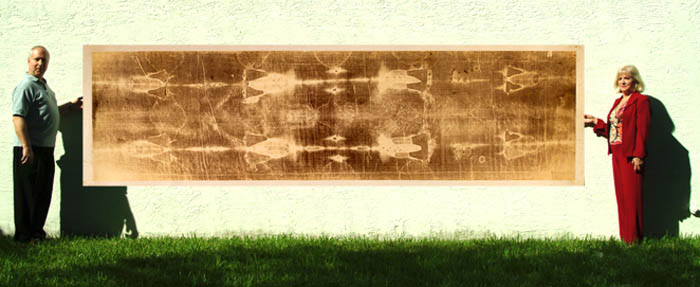
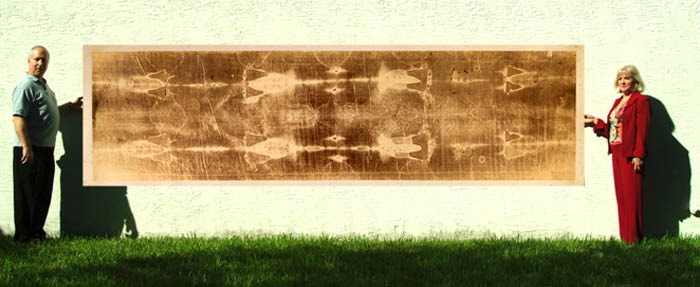
Tuesday, February 12, 2008

Shroud Dating May Have Been Inaccurate - Radiocarbon Expert

I was going to post this in February's Shroud News, but since I have not yet posted January's Shroud News (although I am working on it!), I felt this was too important to wait! The article is in bold to distinguish it from my comments.

Shroud Dating May Have Been Inaccurate - BBC Interviews Radiocarbon Expert, LifeSiteNews.com, February 5, 2008, Hilary White ...

[Left: Prof. Christopher Bronk Ramsey, Oxford University Radiocarbon Accelerator Unit]

NOVARA, Italy ... The techniques used in 1988 by three separate teams of scientists to date the Shroud of Turin to the middle ages, may have been inconclusive, a radiocarbon dating expert at Oxford University has told the BBC. This is astonishing news, not that the 1988 radiocarbon dating of the Shroud of Turin was "inconclusive" (to put it mildly!), but that finally, in the 20th anniversary year of that dating, a radiocarbon scientist has the honesty, and the courage, to admit it. And not just any radiocarbon scientist, but the Director of one of those three radiocarbon-dating laboratories (Oxford) that 20 years ago produced that "inconclusive" result, and claimed that it was "conclusive" (see `tagline' quotes).

According to the Church official in charge of the Shroud, Christopher Bronk Ramsey, director of Oxford's Radiocarbon Accelerator, whose specialty is the use of radiocarbon dating in archaeological research, told the BBC that radiocarbon dating techniques have developed since 1988, and that the Shroud's long history of travel, exposure to the elements and handling could have skewed the results. Indeed! This has been repeatedly pointed out by the Shroud pro-authenticity community, but they have generally been ignored, and/or dismissed as having a religious bias (usually with derogatory terms such as `true believers,'`religious fanatics,'`flat earthers,' etc).

But such dismissals are a prime example of `the pot calling the kettle black' in that by the same token, those in the Shroud anti-authenticity community have an anti-religious bias. Modern science is so completely dominated by Naturalism, the metaphysical assumption that "nature is all there is" (i.e. there is no supernatural), that most scientists are blissfully unaware of their own personal anti-religious bias, and are therefore predisposed to accept evidence too easily that points to the Shroud not being authentic and too easily reject evidence that points to it being authentic.

For example, Prof. Harry E. Gove, co-inventor of the

[Right: Harry E. Gove, Professor Emeritus of Physics, University of Rochester]

Accelerator Mass Spectrometry (AMS) radiocarbon dating method that was used by all three laboratories, was aware that "scientists ... can sometimes obtain a desired scientific result by subconscious manipulation of the technique or the data" by "having preconceived notions of what the answer should be," so he was very (if not fanatically) concerned to neutralise the "belief that the shroud was the genuine article":

"It is well known to scientists that one can sometimes obtain a desired scientific result by subconscious manipulation of the technique or the data. It is a human flaw that must be carefully guarded against. It is most easily circumvented by not having preconceived notions of what the answer should be. A belief that the shroud was the genuine article was the stuff of which STURP was made and I am happy to say that, in the end, they played no role in its carbon dating." (Gove, H.E., 1996, "Relic, Icon or Hoax?: Carbon Dating the Turin Shroud," Institute of Physics Publishing: Bristol UK, pp.8-9).
with no apparent self-awareness of his opposite "preconceived notions of what the answer should be," namely that "the shroud was" not "the genuine article"!

The BBC interview, that has yet to be broadcast, was discussed by Mgr. Giuseppe Ghiberti,

[Left: Giuseppe Ghiberti, Papal custodian of the Shroud of Turin]

president of the Diocesan Commission for the Shroud of Turin, at a conference in Novara Italy. Mgr. Ghiberti speculated that the Shroud's long history, including travels from Palestine to Europe, damage by fire in the 16th century, and much handling over the centuries could have influenced the outcome of the tests. Indeed! As Ian Wilson pointed out, if "Many materials ... may be impossible to remove subsequently," by "pre-treatment," including "glues, biocides," "ordinary packing materials such as paper, cardboard, cotton wool and string" which "contain carbon and are potential contaminants," as well as "Cigarette ash":

"What seems unavoidable, as has been candidly pointed out by Professor Murdoch Baxter of the Scottish Universities Research and Reactor Centre, East Kilbride, is that `other unaccounted-for sources of error occur during the processing and analysis of samples [italics mine].' [Coghlan, A., "Unexpected errors affect dating techniques," New Scientist, 30 September 1989, p.26] Just what those unaccounted for sources of error might be is undoubtedly the hardest question to answer. Quite definite is that there are varieties of contamination that can affect the reliability of carbon-dating readings. Although pre-treatment, involving cleaning of materials to be carbon dated, is standard procedure, and was certainly carried out with maximum possible thoroughness in the case of the shroud samples, doubts surround the extent to which this procedure can ever be 100 per cent effective, particularly in the case of highly porous materials, such as linen, which do not have the advantage of being able to be independently cross-checked by dendrochronology. As again remarked by Dr Sheridan Bowman, in her recent British Museum publication on radio-carbon dating: `Many materials used for preserving or conserving samples may be impossible to remove subsequently: do not use glues, biocides, ... [etc.]. Many ordinary packing materials such as paper, cardboard, cotton wool and string, contain carbon and are potential contaminants. Cigarette ash is also taboo.' [Bowman, S., "Radiocarbon Dating," British Museum Publications: London, 1990, p.56]" (Wilson, I., "Holy Faces, Secret Places: The Quest for Jesus' True Likeness," Doubleday: London, 1991, pp.175-176. Emphasis original).
then the Shroud "provides an almost copy-book case of an object seriously unsuitable for carbon-dating," having even in its "universally accepted history subsequent to the mid-fourteenth century" been "subjected to centuries of smoke from burning candles," "involved in a serious fire in 1532," and having a "backing made up from ... holland cloth" which "has now been in the closest contact with the shroud for over four hundred and fifty years":
"In the light of such concerns, the shroud's known history, that is, its universally accepted history subsequent to the mid-fourteenth century, provides an almost copy-book case of an object seriously unsuitable for carbon-dating. Quite aside from it having been subjected to centuries of smoke from burning candles, an equivalent surely to cigarette smoke, well-known also, not least from the scorches and patches it carries to this day, is that the shroud was involved in a serious fire in 1532. In this latter it came so close to destruction that the silver of its casket melted, destroying one corner of the cloth as it lay folded inside. Knowing that this process could only have happened at temperatures in excess of 960°C, silver's melting-point, Manchester textile specialist John Tyrer has remarked: `In these circumstances moisture in the shroud would turn to steam, probably at superheat, trapped in the folds and layers of the shroud. Any contaminants on the cloth would be dissolved by the steam and forced not only into the weave and yarn, but also into the flax fibres' very lumen and molecular structure ... [They would] become part of the chemistry of the flax fibres themselves and would be impossible to remove satisfactorily by surface actants and ultrasonic cleaning.' [Tyrer, J., Shroud Newsletter, British Society for the Turin Shroud , 20 October 1988, p.11] Furthermore, two years after the fire the shroud was sewn onto a backing made up from three portions of sixteenth-century holland cloth. Inevitably this linen must contain carbon with equally as much contamination potential as the paper, cardboard and cotton wool mentioned by Dr Bowman. And it has now been in the closest contact with the shroud for over four hundred and fifty years." (Wilson, 1991, pp.176-177).

In 1988, three groups of scientists made an attempt to use radio carbon dating techniques to determine the age of the Shroud, concluding that the linen cloth could only date to the middle ages and not to the first century near east. Their "concluding that the linen cloth could only date to the middle ages" is despite Prof. Gove before the 1988 radiocarbon-dating being very concerned that the then "new procedures" were "fraught with peril," in that if "one of the three laboratories obtained an outlier result as one did in the British Museum inter-laboratory comparisons" then "it would be impossible statistically to identify it and ... would all have to be included in the average thereby producing an incorrect result":
"My main concern was that this highly public application of the AMS technique, which I had played a major role in inventing and developing, be successful. The new procedures seemed to me to be fraught with peril. If one of the three laboratories obtained an outlier result as one did in the British Museum inter-laboratory comparisons it would be impossible statistically to identify it and the three measurements would all have to be included in the average thereby producing an incorrect result. The inclusion of the other laboratories would have obviated this potential risk. As it turned out my fears were not realized. The three laboratories performed their measurements flawlessly and the final result is a public triumph for AMS if not for the `true believers'. That the shroud's age is the historic one is the dullest result one could have wished for. But in science as in many other aspects of life one does not always get what one wishes." (Gove, H.E., "Letter To The Editor: The Turin Shroud," Archaeometry, Vol. 31, No. 2, 1989, pp.235-237, p.237).

According to the 1988 studies, the Shroud, venerated for centuries by Catholics as the burial cloth of Christ, could only have been a hoax or the product of some unknown natural process. So against all the odds of: 1) the Shroud being "an almost copy-book case of an object seriously unsuitable for carbon-dating"; 2) major anomalies in "the dry run" intercomparisons tests before the dating of the Shroud, where radiocarbon dates for the same three ancient artifacts differed between the laboratories by "1100 years," 450 years" and "over 1100 years" respectively:
"More germane to the issue is the dry run of C-14 testing, which was detailed in the journal Radiocarbon in 1986. Scientists used C-14 to date an Egyptian Bull Mummy linen (the wrappings from an ancient Egyptian burial) as well as two Peruvian linen cloths. The results of this testing using the new accelerator method was extremely revealing. First of all, it underscored the fact that the method is somewhat wanting in accuracy. On the Egyptian Bull Mummy linen, the dates ranged from 3440 to 4517 B.P. (before present)-a span of 1100 years. Although the known age of the cloth was 3000 B.C., the closest date they could get using C-14 was 2528 B.C. ..., a date which required a calibration of 472 years to correct it. That should raise plenty of eyebrows. The second sample, one of the Peruvian cloths, was not much better, with a span of 450 years and the closest date 250 years off. Finally, the third, also a Peruvian cloth, had a span of over 1100 years and the closest date less than 100 years off. This Peruvian cloth was a much easier target to hit because the date was `guesstimated' between A.D. 1000-1400. That range gave the testers a built in window of +/- 200 years to start with! After the tests on these three samples were run, the farthest dates were 1549 years, 709 years, and 439 years off respectively. To allow that margin of error on calibration alone would be ridiculous. Moreover, even admitting that errors of contamination would radically affect the test results still underscores the inherent weaknesses of this dating method. In fact, when the testers accredited these poor results to contamination during pretreatment and reran the tests with significant improvement, the oldest cloth still showed an error of nearly 1,000 years. Most importantly, it was 1,000 years on the young side !" (Stevenson, K.E. & Habermas, G.R., 1990, "The Shroud and the Controversy," Thomas Nelson Publishers: Nashville TN, pp.53-54. Emphasis original).
we are expected to believe that, "The three laboratories performed their measurements flawlessly and the final result" just happened to be "That the shroud's age is the historic one," i.e. ~AD1260-1390 or AD1325 ± 65 years. That is immediately before the Shroud's undisputable historic appearance at Lirey, France in AD1355.

That means that the pre-treatment by the three labs would also have to have been done "flawlessly i.e. they were each able to remove all the contamination of extraneous, younger carbon, that would have accumulated over "the Shroud's long history of travel, exposure to the elements and handling" and fire which would "have skewed the results."

But the problem is that if, as Prof. Ramsey now acknowledges, "the Shroud's long history of travel, exposure to the elements and handling could have skewed the results" then how is it that the three laboratories just happened to agree on the too good to be true date, "1350 AD ... the time its historic record began":

"The first sample run was OX1. Then followed one of the controls. Each run consisted of a 10 second measurement of the carbon-13 current and a 50 second measurement of the carbon-14 counts. This is repeated nine more times and an average carbon-14/carbon-13 ratio calculated. All this was under computer control and the calculations produced by the computer were displayed on a cathode ray screen. The age of the control sample could have been calculated on a small pocket calculator but was not-everyone was waiting for the next sample-the Shroud of Turin! At 9:50 am 6 May 1988, Arizona time, the first of the ten measurements appeared on the screen. We all waited breathlessly. The ratio was compared with the OX sample and the radiocarbon time scale calibration was applied by Doug Donahue. His face became instantly drawn and pale. At the end of that one minute we knew the age of the Turin Shroud! The next nine numbers confirmed the first. ... Based on these 10 one minute runs, with the calibration correction applied, the year the flax had been harvested that formed its linen threads was 1350 AD-the shroud was only 640 years old! It was certainly not Christ's burial cloth but dated from the time its historic record began." (Gove, 1996, p.264).
Especially as that was the date, i.e. "shortly before the first exhibition, or about 1355," predicted in 1981 by the late Shroud anti-authenticity theorist Walter McCrone in 1981:
"My conclusions published in October 1980-March 1981 (McCrone and Skirius 1980) (McCrone 1981) were as follows: `Our work now supports the two Bishops and it seems reasonable that the image, now visible, was painted on the cloth shortly before the first exhibition, or about 1355. Only a carbon-dating test can now resolve the question of authenticity of the 'Shroud' of Turin. A date significantly later than the first century would be conclusive evidence the `Shroud' is not genuine. A date placing the linen cloth in the first century, though not conclusive in proving the cloth to be the Shroud of Christ, would, no doubt, be so accepted by nearly everyone. Our work would then indicate later embellishment of an earlier image or, much less likely, that an artist was able to obtain a 14 x 3+ foot linen cloth dating from the first century. That an artist either enhanced an earlier image or created the entire image is inescapable.'" (McCrone, W.C., "Judgment Day for the Shroud of Turin," Prometheus Books: Amherst NY, 1999, p.138).
including McCrone's very words, "conclusive evidence" being twice used by the author(s) of the 1989 Nature paper which announced that, "The results of radiocarbon measurements at Arizona, Oxford and Zurich ... provide conclusive evidence that the linen of the Shroud of Turin is mediaeval":
"Very small samples from the Shroud of Turin have been dated by accelerator mass spectrometry in laboratories at Arizona, Oxford and Zurich. As controls, three samples whose ages had been determined independently were also dated. The results provide conclusive evidence that the linen of the Shroud of Turin is mediaeval." (Damon, P.E., et al., "Radiocarbon Dating of the Shroud of Turin," Nature, Vol. 337, 16 February, 1989, pp.611-615, p.612).

"The results of radiocarbon measurements at Arizona, Oxford and Zurich yield a calibrated calendar age range with at least 95% confidence for the linen of the Shroud of Turin of AD 1260 - 1390 (rounded down/up to nearest 10 yr). These results therefore provide conclusive evidence that the linen of the Shroud of Turin is mediaeval." (Damon., et al., 1989, pp.611-615, p.614).And despite:

That the radiocarbon dating of the Shroud could be manipulated to give the desired result was admitted by "the unchosen" four laboratories who were "privately ... saying the three" chosen laboratories, "were going to make certain they agreed":
"[Cardinal] Ballestrero gave the laboratory representatives a letter to enable the containers to pass though customs without any difficulty. Teddy Hall placed his in his briefcase, and with Hedges was the only one of the scientists to meet television cameras when returning home. They didn't say much to BBC except when pressed about when the world would know the answer. Hall responded: `We've waited five years for this.' In another interview Hall repeated his earlier remark that `I'd be hopping mad if I wasn't chosen', but added: `Having only three labs doesn't undermine the validity of the dating. I think it was absolutely the right decision. You only need one lab to get it badly wrong to confuse everything, and the chances of that are higher with seven than with three. [Schoon, N., "Analysing the Strands of Time," The Independent, 25 April 1988] That was hardly the way the unchosen saw the matter, and privately they were saying the three were going to make certain they agreed - no matter how long it took." (Sox, H.D. , 1988, "The Shroud Unmasked: Uncovering the Greatest Forgery of All Time," The Lamp Press: Basingstoke UK, p.134).
and by Prof. Gove who did not deny as impossible the claim by Brookhaven National Laboratory's Dr. Garman Harbottle and Harwell Laboratory's Dr. Robert Otlet that "there was no possibility this time of any outliers because the three labs would consult together so the answers would come out the same":
"On 25 April at 11 am, Harbottle called. He had learned from Otlet that the shroud samples had been removed on 21 April 1988. Hall had flown into London on 25 April with the samples in hand and he received a lot of publicity. The archbishop had been, according to Harbottle, furious about Hall's trying to commercially capitalize on the venture. Harbottle also said that the BBC were going to film the measurements at Zurich. He said that, according to Otlet, there was no possibility this time of any outliers because the three labs would consult together so the answers would come out the same. I must say I thought that Otlet was being either paranoid or surprisingly cynical." (Gove, 1996, p.252).
There is in fact evidence of collusion because[the then British Museum coordinator, Prof. Michael Tite, later admitted that "results from each testing centre have been circulated to the others with a proposal for a coordinated date on the Shroud from the samples":
"Contrary to Tite's protocol letter which stated the labs would not communicate with one another, he acknowledged that the `results from each testing centre have been circulated to the others with a proposal for a coordinated date on the Shroud from the samples....' [Shroud News, October 1988, p.7 ] Years later it was reported that the Arizona laboratory had produced eight different measurements rather than the four mentioned in the Nature report. [Van Haelst, R., "Radiocarbon Dating the Shroud of Turin: A Critical Review of the Nature Report," p.7]" (Guerrera, V., 2000, "The Shroud of Turin: A Case for Authenticity," TAN: Rockford IL, p.132).
And Gove himself records that "the date" AD1350 that Arizona laboratory's Prof. Douglas "Donahue announced to me when I was present at the first radiocarbon measurement on the shroud" was leaked by one of the laboratories, probably Arizona, the first of the three laboratories to date its portion of the Shroud, to a 'Cambridge University professor" who had nothing to do with the dating:
"The Rochester Democrat and Chronicle also carried the story on the front page of their 27th August edition under the headline 'UR (University of Rochester) scientist rejects story of relic's age'. The subhead read 'London paper claims tests show Shroud of Turin a fake'. The report read: `The ... London Evening Standard yesterday reported, without attribution, that radio-carbon tests at Oxford University showed the shroud was made about 1350. ... The article stated that Luckett, whose university is an ancient rival of Oxford, was not connected with the tests but had been associated with investigations of the shroud's history. `He wrote in a separate article in the Evening Standard that laboratories "are rather leaky places" but did not elaborate.' ... An Associated Press story appeared in the 9 September 1988 issue of the Rochester Democrat and Chronicle headlined 'Shroud's age remains secret Oxford research chief says', with the subhead 'He claims forgery report was just a guess'. Teddy Hall was quoted to this effect in the Oxford Mail. The article went on `But Dr Richard Luckett, a Cambridge University professor, said he stood by his word, adding, "I had an absolutely marvellous leak from one of the laboratories and it wasn't Oxford." Luckett, last month, said tests at Oxford showed the shroud was made in 1350. ... I must say I wondered about Luckett's date of 1350 because it was the date Donahue announced to me when I was present at the first radiocarbon measurement on the shroud in 6 May 1988. Of course, it also corresponds very closely to the shroud's known historic date. However, I still assumed Luckett had said he got the number from Oxford. When I read that he claimed he got it from one of the other two labs I worried that it might have come from someone who was present at Arizona during the first measurement." (Gove, 1996, pp.278-279).
The highly publicized study was published in 1988 in the scientific journal Nature. That conclusion, however, has not halted the debate over the origin of the Shroud, although Church officials have declined to allow the fragile cloth to be so closely examined since then. If no further samples of the Shroud's linen will be allowed to be destructively tested, then hopefully eventually some of the Shroud's pollen will be radiocarbon dated.

In 2005 a second analysis indicated that the cloth sample used by the 1988 teams had been taken from a part of the Shroud that was not part of the original cloth. That was by the late chemist Ray Rogers, who in an article in a leading peer-reviewed chemical journal, reported that "microscopic and microchemical observations prove that the radiocarbon sample was not part of the original cloth of the Shroud of Turin" and so "The radiocarbon date was thus not valid for determining the true age of the shroud":

"In 1988, radiocarbon laboratories at Arizona, Cambridge, and Zurich determined the age of a sample from the Shroud of Turin. They reported that the date of the cloth's production lay between A.D. 1260 and 1390 with 95% confidence. This came as a surprise in view of the technology used to produce the cloth, its chemical composition, and the lack of vanillin in its lignin. The results prompted questions about the validity of the sample. Preliminary estimates of the kinetics constants for the loss of vanillin from lignin indicate a much older age for the cloth than the radiocarbon analyses. The radiocarbon sampling area is uniquely coated with a yellow-brown plant gum containing dye lakes. Pyrolysis-mass-spectrometry results from the sample area coupled with microscopic and microchemical observations prove that the radiocarbon sample was not part of the original cloth of the Shroud of Turin. The radiocarbon date was thus not valid for determining the true age of the shroud." (Rogers, R.N., 2005, "Studies on the Radiocarbon Sample from the Shroud of Turin," Thermochimica Acta, Vol. 425, Nos 1-2, 20 January, pp.189-194, 189).
Here is what Rogers wrote in Thermochimica Acta in 2004, and was published in 2005, about the Shroud's vanillin content indicating that it was "between 1300- and 3000-years old" [see 01Dec07]:
"The fact that vanillin can not be detected in the lignin on shroud fibers, Dead Sea scrolls linen, and other very old linens indicates that the shroud is quite old. A determination of the kinetics of vanillin loss suggests that the shroud is between 1300- and 3000-years old. Even allowing for errors in the measurements and assumptions about storage conditions, the cloth is unlikely to be as young as 840 years." (Rogers, 2005, p.192)
If the Shroud was 1300 years old in 2004, its linen would date from ~AD 704. If it was 3000 years old in 2004, its linen would date from ~996BC. That is a range of ~996BC to ~AD 704, or ~146BC ± 850 years. Jesus' crucifixion was in AD 30, which was ~176 years after ~146BC, and the Shroud's flax would have been harvested and its linen woven before AD30.

If Rogers was right (which is disputed even within the Shroud pro-authenticity community) and the sample tested was a 16th century patch which was rewoven into the Shroud, it still will not explain how all three labs dated that 16th century patch to "1350 AD... the time its historic record began," unless by an amazing coincidence the patch itself was 14th century!

The interview with Dr. Ramsey will be broadcast by the BBC on Easter Saturday. This promises to be very interesting! Maybe this is the beginning of Ian Wilson's prediction that, "the shroud, even now, frail and discredited as it might seem, is part of a cosmic drama not yet played out":

"But the alternative, inevitably, is even more daunting. In the shroud we have a piece of cloth that men cast lots over when they put it to the test (remember the cowboy boots?). A piece of cloth they mocked when their instruments of destruction showed it, seemingly, as of mere human frailty. Is it not all strikingly evocative of what they did when they committed the body of Jesus himself to crucifixion and the grave? And did not something mind-blowingly unexpected happen to this, just when Jesus's followers felt at their most defeated? It all gives one the unnerving feeling that the shroud, even now, frail and discredited as it might seem, is part of a cosmic drama not yet played out." (Wilson, I., "Holy Faces, Secret Places: The Quest for Jesus' True Likeness," Doubleday: London, 1991, p.189).
See also this same story in La Stampa, Catholic World News, ReligionAndSpirituality.com and Interfaith,

Posted 12 February 2008. Updated 23 August 2025.


"There followed in February 1989 a formal paper in the highly respected, international scientific journal Nature, carrying as its signatories the names of twenty-one of those most closely involved in the carbon dating. After carefully setting out all the procedures that had been followed to obtain the dating result, the paper commented: `These results therefore provide conclusive evidence that the linen of the shroud of Turin is medieval.' [Damon, P.E., et al., "Radiocarbon Dating of the Shroud of Turin," Nature, Vol. 337, 16 February, 1989, pp.611-615, p.614]" (Wilson, I., 1991, "Holy Faces, Secret Places: The Quest for Jesus' True Likeness," Doubleday: London, pp.9-10).

"Inevitably there were a number of individuals, among them the present author who, having conducted their own prior researches on the shroud, felt that the word `conclusive' for such a date seemed overstrong, particularly given that carbon dating on its own could certainly not yet offer any explanation for how someone of the Middle Ages had produced an image of the shroud's extraordinary subtlety and complexity. Nonetheless, such was the seemingly overwhelming acceptance with which the results were received that most objections of this kind, if voiced at all, were tossed aside by the media. To the glee of the British press, Oxford's Professor Hall derisively labelled such protestors `Flat-Earthers'." (Wilson, 1991, p.10).

"Shooting the Fox There are two main ways of dealing with foxes. Ladies and gentlemen dress up smartly, mount fine horses, and have a splendid time chasing them all over the countryside before finally watching them being torn to bits by hounds. Farmers shoot them. It is considered unsporting but is quick and effective. For our present purposes to shoot a fox is to bring an argument to a sudden conclusion by cutting through the peripherals and getting to the heart of the matter in one stroke. Often people get to love an argument for its own sake. Indeed they can get so wrapped up in it that they lose sight of its original purpose. If you have the wit and presence of mind to grasp what is essential you can score a speedy and decisive victory. Take as an example the controversy surrounding the Shroud of Turin. This holy relic was traditionally supposed to be the shroud that had covered the body of Christ. In some miraculous way the image of Jesus' body had become printed on the cloth and could, using a photographic negative, be clearly seen. But was it genuine? It was a truly fascinating argument with endless ramifications. For example, the image was only clearly visible, as mentioned before, if you first photographed the cloth and then viewed the photographic negative. Yet, even if the shroud was, as some suspected, a fake, it certainly predated the invention of photography by many years. How could anyone produce a fake that was only visible using a process that had not yet been invented? The complications were endless. The nail holes in the body were in the correct place. Traditionally painters and sculptors had shown Christ's wounds to be in his hands. Anatomically and historically this was nonsense because the hands would not have borne such a weight. The actual method of crucifixion was to drive the nails through the wrist bones. The shroud showed this quite accurately. On the other hand the image on the shroud showed the hands modestly covering the genitals, but if a body has been `laid out' the hands would not normally reach so far. Also the image showed that blood had run from the wounds. Biblical evidence tells us that the body was washed before burial and, of course, dead bodies do not bleed. This argument looked set to go on for ever. It got extremely heated and some of the scholars involved got so emotionally and intellectually bound up in the struggle that religious conversions were reported to have taken place among them. Then, at long last, permission was given to take a small portion of the shroud and subject it to carbon dating. The results were conclusive. The cloth was of such late manufacture that the image could not be genuine. The fox had been shot. In a way it was a pity that such an entertaining argument should come to such an abrupt end. Many of the issues that had been raised were interesting and worthy of serious consideration but, once the fox was dead, they were quickly disregarded by all but a dedicated few." (Allen, R., 1996, "How To Win Arguments: The Complete Guide To Coming Out On Top," Thorsons: London, pp.71-72. Emphasis original).

"Scientifically the coup de grĂ¢ce came on 16 February 1989 with the scientific journal Nature's publication of the radiocarbon-dating laboratories' formal technical report. Authored by no less than twenty-one of the scientists who had played some part in obtaining the final result, this claimed `conclusive evidence that the linen of the shroud of Turin is mediaeval'. [Damon, P.E., et al., "Radiocarbon dating of the shroud of Turin," Nature, Vol. 337, 16 February 1989, pp.611-615] As the Oxford laboratory's Professor Edward Hall repeatedly stressed in accompanying interviews and talks, no one of any scientific worth could any longer believe in the possibility of the Shroud being genuine. If they did, they might just as well join the Flat Earthers. Thus it seemed that anyone who had previously upheld any serious case for the Shroud's credibility, among whom I numbered myself, had been dealt a fatal stab to the heart. And sadly, the quality of argument on the part of those who refused to accept that they were `dead' quickly degenerated into the unworthy. For some Shroud supporters in continental Europe, for instance, the chief defence offered was that it was the radiocarbon dating, not the Shroud, that must be the fraud." (Wilson, I. , 1998, "The Blood and the Shroud: New Evidence that the World's Most Sacred Relic is Real," Simon & Schuster: New York NY, pp.8-9).

"All this inevitably gives rise to the question, can anyone any longer be quite so sure of radiocarbon dating's claim `conclusively' to have proved the Shroud a mediaeval fake? Can we really still believe in a mediaeval forger? Of course, it may still be difficult to conceive that the radiocarbon dating of 1988, as conducted by three internationally respected scientific laboratories, could have erred by as much as 1300 years. But is it not time, now, to look just a little more critically at the technique's own credibility when its scientists so confidently claim `accuracies' to within a hundred years or so?" (Wilson, 1998, p.174-175).

"On the other side of the Atlantic, Professor Hall was similarly upbeat. In a lecture provocatively entitled `The Turin Shroud: A Lesson in Self-Persuasion' he told a packed audience of the British Museum Society in London that radiocarbon dating had so conclusively proved the Shroud to be a fake that anyone who continued to believe it genuine had to be a `Flat Farther. And in the March of 1989 his efforts to drum up the maximum publicity reaped their rewards when he was able to announce (for publication on, of all days, Good Friday) that his laboratory's future was secure. Following his retirement from the Oxford laboratory, this was now to be awarded a permanent professorship, financed with a million pounds donated by forty-five rich businessmen. Who was the person chosen for this post? Dr Michael Tite." (Wilson, 1998, pp.185-186).

"Archaeologists, who routinely call upon radiocarbon-dating laboratories' services, tend to shy from openly criticising the results they receive, even if they do not necessarily agree with some of them, but one who certainly has had no such qualms is Greece's Spyros Iakovidis, speaking at an international conference in 1989: `In relation to the reliability of radiocarbon dating I would like to mention something which happened to me during my excavation at Gla [in Boeotia, Greece]. I sent to two different laboratories in two different parts of the world a certain amount of the same burnt grain. I got two readings differing by 2000 years, the archaeological dates being right in the middle. I feel that this method is not exactly to be trusted.' [Iakovidis, S., "Thera and the Aegean World III.," Proceedings of the Third International Congress, Santorini, Greece, 3-9 September 1989 , Vol. 3, 1990, p.240] Nor are such examples isolated and anecdotal. In the same year of 1989 Britain's Science and Engineering Research Council commissioned a special inter-comparison trial for radiocarbon-dating laboratories in which altogether thirty-eight different laboratories took part, collectively representing both the conventional Libby method and the accelerator mass spectrometer one. Each laboratory was given artefacts of dates known to the organisers, but unknown to them. The shock finding of this totally scientific trial was that the laboratories' actual margins of error were on average two or three times greater than those that they quoted. Of the thirty-eight who participated, only seven produced results that the organisers of the trial considered totally satisfactory, with the laboratories using the new accelerator mass spectrometer technique faring particularly badly. [Coghlan, A., "Unexpected errors affect dating techniques," New Scientist, 30 September 1989, p.26.] It is also a matter of record that the Oxford laboratory ... inevitably the highest profile of any, actually declined to take part. Yet this is the method that we are supposed to believe `conclusively' proved the Shroud a mediaeval fake." (Wilson, 1998, p.193. Emphasis original).

"This is not to say that any of the possible sources of contamination that have been pointed out in this chapter were necessarily the reason why the Shroud radiocarbon dating erred by thirteen centuries, if indeed this was the case. As we will he learning later in this book, there is another possible source of error that even the science of 1988 would have been some way from anticipating. Rather, the point of major concern is that the radiocarbon laboratory scientists, in their eagerness to present a copybook example of the accelerator mass spectrometer method's prowess before the world, seriously neglected to take due account of any way in which their findings might be wrong in respect of the Shroud. In the Nature report they described their findings as `conclusive'. Professor Hall, in his post-dating lecture to the British Museum, most ebulliently derided any suggestion of how his laboratory's findings might be in some as yet undetermined way mistaken. And this even though neither he nor any of the other laboratory scientists could offer any properly thought-out explanation for how the Shroud image might have been made in the century they claimed it to be made. ... And of the Shroud itself, and the utterly valid question of how, if the carbon-dating method really is right, someone of the fourteenth century produced a fake that `good', one looks in vain for the slightest light on this in Gove's book. Professor Hall said likewise that this question was of absolutely no interest to him and he would be giving no thought to it. But the Shroud simply cannot be left in such limbo. The carbon-dating verdict was either right or it was wrong. And if it was right, just how could someone have produced something like it back in the fourteenth century?" (Wilson, 1998, pp.193-194. Emphasis original).

"Unfortunately, as often happens, the newspapers printed the results prematurely. The London Times stated on August 27, 1988 that Oxford scientists had leaked the results. Shortly thereafter, the Vatican made an announcement in Turin, Italy on October 13, 1988. The results of the test were first officially published in an article entitled `Radiocarbon Dating of the Shroud of Turin' in 1989 in Nature Magazine. [Damon, P.E., et al., "Radiocarbon Dating of the Shroud of Turin," Nature February 16, 1989, p.612] The official report stated that the Shroud of Turin was dated between 1260-1390, and this would make the Shroud between 607 to 737 years old. ... The report stated the following conclusion: `The results of radiocarbon measurements at Arizona, Oxford and Zurich yield a calibrated calendar age range with at least 95 percent confidence for the linen of the Shroud of Turin of A.D. 1260-1390. These results therefore provide conclusive evidence that the linen of the Shroud of Turin is medieval.' [Ibid.] Headlines all over the world jumped on this report and, ignoring the vast body of evidence to the contrary, and the warnings of the perils of the C-14 test, prematurely accepted the results of this one test to condemn the Holy Shroud as a `fake or fraud.' Sensationalism was the operative word. The newspapers in New York, as an example, capitalized on the negative test results of the Holy Shroud. Some headlines read as follows: `Test Shows Shroud of Turin to be Fraud, Scientist Hints,' read the New York Times on September 22, 1988. `Turin Shroud Made After Crucifixion,' was the Associated Press headline in the Daily News, September 28, 1988, which went on to explain that the Shroud was created almost a millennium after the death of Jesus. `Shroud of Turin Legend in Tatters: Carbon Tests Date it to the 14th Century,' was the headline in the New York Post on September 28, 1988." (Iannone, J.C., 1998, "The Mystery of the Shroud of Turin: New Scientific Evidence," St Pauls: Staten Island NY, pp.164-165).

"The first lab to report its results to Tite was the Tucson laboratory on May 6, 1988. The second lab to submit its data was Zurich on May 26. Finally, Oxford submitted its results several months later on August 8, more than ample time to hear of the results of the other two labs. Subsequently, the journal Nature reported that `the results of radiocarbon measurements in Arizona, Oxford and Zurich yield a calibrated calendar age range with at least 95% confidence for the linen of the Shroud of Turin of A.D. 1260-1390... . These results therefore provide conclusive evidence that the linen of the Shroud of Turin is mediaeval.' [Nature, February 16, 1989, p.614] Even before the data was officially reported to the proper Church authorities, there were leaks in the media. Sox, who was privy to the tests in Zurich, anticipated the publication of the results by producing a program for the BBC which aired on July 27, 1988. The program, originally entitled Verdict on the Shroud, was surreptitiously renamed Threads of Evidence when the results were not forthcoming. The following month, on August 26, the headline for London's Evening Standard was `The Shroud of Turin is a Fake.'" (Guerrera, V., 2000, "The Shroud of Turin: A Case for Authenticity," TAN: Rockford IL, p.131).

"Then ten years later, in 1988, radiocarbon dating of the cloth was done by three independent research laboratories. In the February 1989 issue of Nature (one of the most prestigious scientific journals in the world), it was announced by these scientists that the cloth was a fraud. The cloth was far too young to have existed at the time of Christ. Of all the data ever collected on the Shroud, scientists finally found one piece of evidence that questioned the possibility that the Shroud wrapped the body of Christ. With this evidence, they concluded `conclusively' that the image must have been created during the Middle Ages by some natural or man-made process. They failed to mention that their `conclusive' conclusion was based only on circumstantial evidence. It is the weight that is given to this single piece of evidence from radiocarbon dating which clearly demonstrates how scientists, wanting to reach a predetermined conclusion, will let their own prejudices dictate how they interpret the data. To declare conclusively that this article is a fake based only on radiocarbon dating, you need to manipulate the scientific facts, accepting some and ignoring others. And declaring the Shroud a fake raises some very difficult questions that cannot be answered by the state-of-the-art technology. Because of the significance placed on one piece of evidence, the only evidence that questions the Shroud's authenticity, other questions regarding how and why it was made are simply tossed aside." (Chiang, R.G., 2004, "Science and the Shroud," in "Overcoming Prejudice in the Evolution Creation Debate: Developing an integrative approach to Science and Christianity," Doorway Publications: Hamilton ON, Canada)

"Nevertheless, as it is with the theory of evolution, this naturalistic theory of the Shroud has been given serious consideration because it does not require the existence of a supernatural force. By having a totally naturalistic explanation, it is no longer necessary for skeptics to worry that a supernatural force could have created the image on the Shroud. Although the Picknett and Prince theory is very, very weak, it does represent a significant change in the attitude of the skeptics. No longer do these skeptics insist that the image on the Shroud is a painting. This turnabout may have been encouraged by the fact that the radiocarbon dating showed `conclusively' that the Shroud was too young to have been around to wrap the body of Christ. Possibly, with the assurance of the radiocarbon dating, the opponents of the Shroud have been more willing to concede that the facts are indeed overwhelmingly in favour of the image not being a painting. Unfortunately for the skeptics, who had their day when the radiocarbon results were first reported, radiocarbon dating is not thought to be as conclusive as it once was. It is quite possible that antique relics, like the Shroud, which have been exposed to everything from extreme heat and smoke to the touch of human hands, have too many variables associated with them to accurately determine their age using radiocarbon dating." (Chiang, 2004, "The Shroud: A Primitive Photograph").

"Since the Shroud is made of materials that were once living plants, radiocarbon dating can be applied to the Shroud. Before 1988, the Shroud had already undergone several forensic tests made by many experts in the field, and each finding supported the belief that this cloth was approximately 2000 yrs old, and that it originated from Israel. For example, the weaving is distinctive to the time of Christ and microscopic pollen grains found embedded in the cloth are from plants endemic to regions around the Dead Sea. Supposedly, radiocarbon dating would be able to tell us whether or not the cloth were old enough to have been around at the time of Christ. If it were significantly younger than expected, this would support the theory that it was not the death shroud of Christ. And if, by chance, this cloth were as young as the Middle Ages, this would confirm the theory that the image was produced by someone using a natural process to help support a fledgling church. In the winter of 1989, Damon et al. announced to the world the results of the radiocarbon dating. Their article in Nature stated, `The results provide conclusive evidence that the linen of the Shroud of Turin is Medieval.' [Damon, P.E., et al., "Radiocarbon dating of the Shroud of Turin," Nature, Vol. 337, 1989, pp.611-615] It is interesting that a reputable science journal like Nature would permit any author to claim that his results were conclusive unless one takes into account the deep-seated prejudice that the scientific community has against any theory that is not purely naturalistic. To claim conclusively that the Shroud is Medieval demonstrates this prejudice and deflects attention from the difficult questions regarding the Shroud's origin. The evidence they presented was not conclusive; it was, at best, supportive. The only definitive conclusion that can be made from this data is that the Shroud has enough carbon 14 in it to suggest that it is relatively young - provided that the assumption concerning the amount of carbon 14 in it to begin with is true, and that carbon 14 was not added after the cloth was made. To conclude that the Shroud is Medieval is an extrapolation of the facts, and should, in proper science, never be portrayed as `conclusive.' Conclusive proof should be reserved for data that are independent variables free of unprovable assumptions. The amount of carbon 14 in the cloth, and the rate of decay of carbon 14, are testable variables that can be measured over and over again, but the amount of carbon 14 present in the cloth when it was originally made, and the exclusion of extraneous sources of carbon 14 after death, are assumptions that must be accepted by faith." (Chiang, 2004, "The not-so conclusive radiocarbon dating").

"The international team of scientists who convened in 1987 to put a date on the shroud probably did not expect to banish such fantasies. But by applying radiocarbon dating to the fabric, they were at least employing the most definitive of archaeological tools. Or so they thought. The textile sample was cut from the shroud in Turin Cathedral in April 1988, under the supervision of textile experts, representatives of the laboratories in Arizona, Oxford and Zurich selected to perform the analyses, a conservation scientist from the British Museum, and the Archbishop of Turin. The three measurements indicated with 95% confidence that the shroud's linen dated from between AD1260 and 1390. This, the researchers said, was `conclusive evidence that the linen of the shroud of Turin is medieval" [Damon, P.E., et al., Nature, Vol. 337, 1989, pp.611-615]. ... And yet, the shroud is a remarkable artefact, one of the few religious relics to have a justifiably mythical status. It is simply not known how the ghostly image of a serene, bearded man was made. It does not seem to have been painted, at least with any known historical pigments." (Ball, P., "To know a veil," Nature news, 28 January 2005).

Monday, February 11, 2008

Shroud name index `R'

This is my Shroud of Turin name index, "R", for persons associated with the Shroud whose surnames start with "R."

[Right: In Memoriam: Raymond N. Rogers, Shroud.com]

See main name index A-Z for more about this Shroud name index.


Rogers, Raymond N. 1927-2005. A chemist with Los Alamos National Scientific Laboratories, Rogers joined the Shroud of Turin Research Project (STURP), which examined the Shroud in July 1978. He initially believed the Shroud to be a painting and that it would take him only 20 minutes to prove it! Rogers task was to collect particles from the Shroud's by pressing sticky tape on its surface and then later help analyse them. Rogers authored a number of important scientific papers on the Shroud. Schwalbe, L.A. & Rogers, R.N., "Physics and Chemistry of the Shroud of Turin," Analytica Chimica Acta, 135, 1982, pp.3-49, reported STURP's finding that the Shroud's image was not a painting and the bloodstains really were blood. Rogers, R.N., "Studies on the Radiocarbon Sample from the Shroud of Turin," Thermochimica Acta, Vol. 425, 2005, pp.189-194, found that the sample radiocarbon-dated in 1988 was not part of the original Shroud, and therefore could not validly be used for determining its true age. Obituary, In Memoriam, Ray Rogers FAQ, Wikinews & Wilipedia

PS: See `tagline' quotes below which will be about each person, in alphabetic of surname, and then in date order (most recent uppermost).

Stephen E. Jones, BSc. (Biology).
My other blogs: CreationEvolutionDesign & Jesus is Jehovah!


"A chemist who worked on testing of the Shroud of Turin says new analysis of the fiber indicates the cloth that some say was the burial linen of Jesus could be up to 3,000 years old. The analysis, by a scientist who was on the original 1978 team that was allowed to study tiny pieces of the cloth, indicates the shroud is far older than the initial findings suggesting it was probably from medieval times, and will likely be seized on by those who believe it wrapped the body of Jesus after his crucifixion. ... Raymond N. Rogers, a retired chemist from the University of California-operated Los Alamos National Laboratory in New Mexico, said in a telephone interview Friday from his home. `The chemistry says it was a real shroud, the blood spots on it are real blood, and the technology that was used to make that piece of cloth was exactly what Pliny the Elder reported for this time,' about 70 A.D. ... Rogers, whose findings were published recently in the scientific journal Thermochimica Acta. Rogers wrote that in 2003, the scientist advising the cardinal of Turin, where the shroud is kept, provided him with pieces of thread taken from the radiocarbon sample before it was distributed for dating. The American chemist said he decided to analyze the amount of vanillin, a chemical compound that is present in linen from the flax fibers used to weave it. Vanillin slowly disappears from the fiber over time at a calculated rate, he said. Judging by those calculations, a medieval-age cloth should have had some 37% of its vanillin left by 1978, the year the threads were taken from the shroud, Rogers said. But there was virtually no vanillin left in the shroud, leading the chemist to calculate it could be far older than the radiocarbon testing indicated, possibly some 3,000 years old. Asked why carbon-dating might have been off, Rogers contended that `the people who cut the sample didn't do a very good job of characterizing the samples,' that is, taking samples from many areas of the cloth. .... Disputes have flourished over the 1988 declaration by the scientific team that carbon-dating indicated the cloth came from medieval times. Researchers at The Hebrew University has said that pollen and plant images on it put its origins in Jerusalem sometime before the eighth century." ("Shroud of Turin could date to time of Jesus, examiner says," USA Today, January 29, 2005).

"The most recent scientific study of the Turin shroud will not surprise anyone with even a passing interest in this mysterious bit of cloth. Retired chemist Raymond Rogers claims that the sample used for radiocarbon-dating studies in 1988 - which suggested that the shroud was a medieval forgery - is quite different from the rest of the relic. Rogers, who worked on explosives at the US Los Alamos National Laboratory, presents chemical arguments for the shroud being much older than those datings implied. It is, he says, between 1,300 and 3,000 years old. Let's call it somewhere around the middle of that range, which puts the age at about 2,000 years. Which can mean only one thing... But it would be unfair to imply that Rogers has steered his study towards a preconceived conclusion. He has a history of respectable work on the shroud dating back to 1978, when he became director of chemical research for the international Shroud of Turin Research Project." (Ball, P., "To know a veil," Nature news, 28 January 2005).
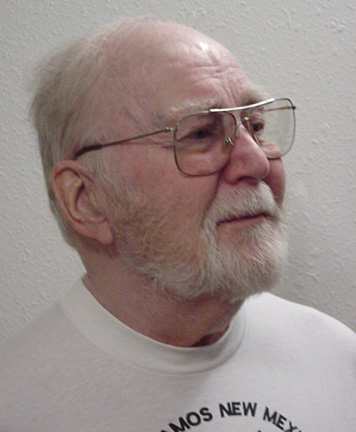
"Rogers has pursued another objection. ... the suggestion that the carbon-dated fragment was taken from a patch repaired in the sixteenth century did not look promising. The shroud was indeed damaged by fire and patched up in 1532, but those patches, called the Holland cloth, are obvious. Rogers thought that he would be able to `disprove [the] theory in five minutes'. But he now says that there is something in it. Luigi Gonella, the Archbishop of Turin's scientific adviser, provided Rogers with a few threads from the piece cut for dating, which he compared with the samples he collected during the Shroud of Turin Research Project. The radiocarbon sample, but not other parts of the shroud, seems to have been dyed with madder, a colorant not widely used in Europe until after the Crusades, Rogers writes in Thermochimica Acta [Rogers, R.N., "Studies on the Radiocarbon Sample from the Shroud of Turin," Thermochimica Acta, Vol. 425, 2005, pp.189-194]. This suggested that the fabric could have been inserted during repair, after being dyed to match the original, older cloth. Well, maybe. Perhaps more compelling is that most of the shroud lacks vanillin, a breakdown product of the lignin in cotton fibres. There is vanillin in the Holland cloth, and in other medieval linen. Because it decomposes over time, this suggests that the main body of the cloth is considerably older than these patches. By calculating the rate of decay, Rogers arrives at his revised estimate of the shroud's age." (Ball, 2005).

"The Shroud of Turin, the piece of linen long-believed to have been wrapped around Jesus' body after the crucifixion, is much older than radiocarbon tests suggest, according to new microchemical research. Published in the 20 January issue of Thermochimica Acta, a peer-reviewed chemistry journal, the study dismisses the results of the 1988 carbon-14 dating. At that time, three reputable laboratories in Oxford, Zurich and Tucson, Arizona, concluded that the cloth on which the smudged outline of the body of a man is indelibly impressed was a medieval fake dating from 1260 to 1390, and not the burial cloth wrapped around the body of Christ. `As unlikely as it seems, the sample used to test the age of the shroud in 1988 was taken from a rewoven area of the shroud. Indeed, the patch was very carefully made. The yarn has the same twist as the main part of the cloth, and it was stained to match the colour,' says Raymond Rogers, a retired chemist from Los Alamos National Laboratories and former member of the STURP (Shroud of Turin Research Project) team of US scientists that examined the Shroud in 1978.The presence of a patch on the shroud doesn't come as a surprise. The linen cloth has survived several blazes since its existence was first recorded in France in 1357, including a church fire in 1532. Badly damaged, it was then restored by nuns who patched burn holes and stitched the shroud to a reinforcing cloth now known as the Holland cloth. ... In his study, Rogers analysed and compared the radiocarbon sample with other samples from the controversial cloth. `As part of the STURP research project, I took 32 adhesive-tape samples from all areas of the shroud in 1978, including some patches and the Holland cloth. I also obtained the authentic samples used in the radiocarbon dating,' Rogers says. It emerged that the radiocarbon sample has completely different chemical properties than the main part of the shroud, Rogers says. `The radiocarbon sample had been dyed, most likely to match the colour of the older, sepia- coloured cloth. The sample was dyed using a technology that began to appear in Italy about the time the Crusaders' last bastion fell to the Mameluke Turks in 1291. `The radiocarbon sample cannot be older than about 1290, agreeing with the age determined by carbon-14 dating in 1988. However, the Shroud itself is actually much older,' says Rogers. ... Evidence came from microchemical tests ... These revealed the presence of vanillin in the radiocarbon sample and in the Holland cloth, but not in the rest of the shroud. Vanillin is produced by the thermal decomposition of lignin, a chemical compound of plant material including flax, and levels decrease and disappear with time. It is easily detected on medieval linens, but cannot be found in the very old ones, such as the wrappings of the Dead Sea scrolls. `A determination of the kinetics of vanillin loss suggests that the shroud is between 1300 and 3000 years old,' Rogers writes. According to Tom D'Muhala, the president of the American Shroud of Turin Association for Research, the new chemical tests produced `conclusive evidence'. `They indicate that the linen shroud is actually very old, much older than the published 1988 radiocarbon date,' D'Muhala says. ... In 1988, the Vatican approved carbon-dating tests. Three reputable laboratories concluded that the shroud was medieval, dating from 1260 to 1390, and not a burial cloth wrapped around the body of Christ. But since then a growing sense that the radiocarbon dating might have had substantial flaws emerged among shroud scholars. The history of the cloth has been steeped in mystery. It has survived several blazes since its existence was first recorded in France in 1357, including a mysterious fire at Turin Cathedral in 1997." (Lorenzi, R., "Turin shroud older than thought," ABC/Discovery News, 26 January 2005).

"In 1988, radiocarbon laboratories at Arizona, Cambridge, and Zurich determined the age of a sample from the Shroud of Turin. They reported that the date of the cloth's production lay between A.D. 1260 and 1390 with 95% confidence. This came as a surprise in view of the technology used to produce the cloth, its chemical composition, and the lack of vanillin in its lignin. The results prompted questions about the validity of the sample. Preliminary estimates of the kinetics constants for the loss of vanillin from lignin indicate a much older age for the cloth than the radiocarbon analyses. The radiocarbon sampling area is uniquely coated with a yellow-brown plant gum containing dye lakes. Pyrolysis-mass-spectrometry results from the sample area coupled with microscopic and microchemical observations prove that the radiocarbon sample was not part of the original cloth of the Shroud of Turin. The radiocarbon date was thus not valid for determining the true age of the shroud." (Rogers, R.N., "Studies on the Radiocarbon Sample from the Shroud of Turin," Thermochimica Acta, Vol. 425, Nos 1-2, 20 January 2005, pp.189-194).

"THE year 1978 marked the 400th anniversary of the Shroud's transfer from Chambery to Turin. To celebrate this occasion, the newly-appointed Archbishop of Turin, Anastasio Ballestrero, through the diplomatic efforts of Fr. Peter Rinaldi, a Salesian priest stationed in New York, had the Shroud exposed for public veneration from August 27-October 8. Following this exposition, over forty scientists from Italy and America were given five days to carry out non-destructive tests on the Shroud. The thirty-plus members of the American group known as the `Shroud of Turin Research Project,' or STURP, were headed by Dr. John Jackson and Dr. Eric Jumper, two United States Air Force captains and physicists. The team brought with them seventy-two crates of equipment. The group was composed of specialists from different disciplines: Donald Lynn headed a group from the Jet Propulsion Laboratory of Pasadena, including Jean Lorre, and Donald Devan from the Oceanographic Services, Inc., of Santa Barbara. Bill Mottern, from the Sandia Laboratories, led the team of specialists who carried out a series of radiography exams of the Shroud with the following group from Los Alamos National Scientific Laboratories: Robert Dinegar, Donald and Joan Janney, Larry Schwalbe, Diane Soran, Ron London, Roger Morris, and Ray Rogers who took various sticky tape samples of dust particles from the surface of the Shroud. Joseph Accetta from Lockheed Corporation coordinated the group that inspected the Shroud with infrared rays. Roger and Marion Gilbert from the Oriel Corporation of Connecticut examined the light spectrum emitted by fluorescence beneath ultraviolet lighting." (Guerrera, V., 2000, "The Shroud of Turin: A Case for Authenticity," TAN: Rockford IL, pp.60-61).

"More importantly, the single most significant conclusion of STURP was that the Shroud image cannot possibly be a painting. Two of STURP's members, Rogers and Schwalbe, state for the team: `The primary conclusion is that the image does not reside in an applied pigment. The reflectance, fluorescence, and chemical characteristics of the Shroud image indicate ... some cellulose oxidation/ dehydration process.' [Schwalbe, L.A. & Rogers, R.N., "Physics and Chemistry of the Shroud of Turin," Analytica Chimica Acta, 135, 1982, pp.3-49, p.60] Naturally speaking, some form of drying, aging (advanced decomposition) process has occurred on the image." (Stevenson, K.E. & Habermas, G.R., "The Shroud and the Controversy," Thomas Nelson: Nashville TN, 1990, p.29).

"In terms of religion, STURP members belong to various Protestant churches or are Roman Catholics, Jews or even agnostics. However, what they have in common is that each one is the type of person who is challenged by puzzles and `unsolvable mysteries,' and is unwilling to believe that any problem can stump him for long. When chemist Ray Rogers joined the organization, he was quoted by Cullen Murphy in `Shreds of Evidence,' published by Harpers in 1981, as having said, `Give me twenty minutes, and I'll have this thing shot full of holes.' That was several years ago. As this seemed to be a common opinion among members of STURP, they soon began to feel the need to observe and to study the Shroud at first hand, and they took steps toward that end. ? in July, 1978, when the Shroud was once again shown to the public, time was reserved for members of the STURP committee." (Adams, F.O., 1982, "Sindon: A Layman's Guide to the Shroud of Turin," Patrick Walsh Press: Tempe AZ, pp.94-95. Emphasis original).

"Conclusions The evidence seems to be sufficient to conclude that the Shroud `blood' areas are blood. The presence of protein, bilirubin, and albumin, the optical absorption and fluorescence characteristics of individual fibrils, and the iron concentrations determined by x-ray fluorescence, all support this hypothesis. This contradicts earlier tentative conclusions that were drawn mainly from the negative results of less sensitive tests." (Schwalbe, L.A. & Rogers, R.N., 1982, "Physics and Chemistry of the Shroud of Turin: Summary of the 1978 Investigation," Reprinted from Analytica Chimica Acta, Vol. 135, No. 1, pp.3-49, Elsevier Scientific Publishing Co: Amsterdam, 1982, p.40. Emphasis original).

Shroud name index `W'

Here is my first Shroud of Turin name index for `W', i.e. for persons associated with the Shroud whose surnames start with `W'.

[Left: Ian Wilson, Bradshaw Foundation]

I will add other names (not necessarily authors) beginning with "W" to this page, as and when I refer to them in a post.

The `tagline' quotes at the end will be about each person, in alphabetic order of each surname, and then in date order (most recent uppermost). See main name index A-Z for further details.


Wilson, Ian. 1941-. Author and historian. Wilson Graduated with honours in Modern History from Magdalen College, Oxford in 1963. He co-authored an award-winning BBC TV documentary about the Shroud of Turin, "The Silent Witness" (1979). Wilson is author of numerous books, including "Jesus: The Evidence" (1996) and "The Bible Is History" (2000). His books specifically or largely about the Shroud include: "The Turin Shroud" (1978), revised and titled in the USA, "The Shroud of Turin" (1979); "The Evidence of the Shroud" (1986), in the USA titled "The Mysterious Shroud" (1986); "Holy Faces, Secret Places" (1991); "The Blood and the Shroud" (1998); and with Barrie Schwortz, "The Turin Shroud: The Illustrated Evidence" (2000). Wilson and his wife Judith emigrated from Bristol, England in 1995 to Brisbane, Australia. See also Wikipedia and The Shroud Report video interview.

Stephen E. Jones, BSc. (Biology).
My other blogs: CreationEvolutionDesign & Jesus is Jehovah!


"Ian Wilson was born in London and educated at Emanuel School and Magdalen College, Oxford, where he read history. An interest in the Shroud that developed in the 1960s led, in 1973, to his having the opportunity to examine the cloth closely over a three-day period; five years later, his The Shroud of Turin became a bestseller on both sides of the Atlantic. Among his other books are Jesus: The Evidence (1984) and The Evidence of the Shroud (Michael O'Mara Books, 1986), and he was co-author of the BAFTA Award-winning BBC TV documentary about the Shroud, The Silent Witness. He and his wife Judith now live near Brisbane, Australia, and as recently as March 2000 he was among thirty experts specially invited to Turin to discuss future researches into the Shroud. On this occasion he was again allowed a prolonged closeup examination of the cloth." (Wilson, I. & Schwortz, B., 2000, "The Turin Shroud: The Illustrated Evidence," Michael O'Mara Books: London, rear inside cover).

"Ian Wilson was born in 1941 and educated at Emanuel School, Wandsworth, and he graduated in Modern History from Magdalen College, Oxford, in 1963. His previous books include The Turin Shroud, Holy Faces, Secret Places, The Columbus Myth, Undiscovered, and Shakespeare: The Evidence. Since 1995 he and his wife have lived in Brisbane, Australia." (Wilson, I., 2000, "The Bible Is History," Regnery: Washington DC, rear inside cover).

"Born in London. in 1941, Ian Wilson was educated at Emanuel School, Wandsworth, and Magdalen College, Oxford, where he graduated in modern history in 1963. During his early career he became deeply interested in the Turin Shroud, and articles based on his researches led to a commission to write a book on the subject. Published in the UK and US in 1978, this became a worldwide bestseller. Simultaneously he co-authored a television documentary on the Shroud, The Silent Witness, which received wide acclaim and won the BAFTA award for TV documentary films. The Bible: The Evidence is among his future projects. (Wilson, I., 1996, "Jesus: The Evidence," [1984], Weidenfeld & Nicolson: London, Revised, rear cover).

"Ian Wilson was born in London in 1941. He was educated at the Emmanuel School and in 1963 received an honours degree in history from Magdalen College, Oxford. He first became interested in the Turin Shroud during his early career in newspapers. This interest led to the publication, in 1978, of his best-seller, THE SHROUD OF TURIN. He also co-authored the award-winning BBC TV programme SILENT WITNESS. Ian Wilson's other books include JESUS: THE EVIDENCE (1984), described by the GUARDIAN as 'vivid and gripping.' He lives with his wife and two sons near Bristol." (Wilson, I., 1986, "The Evidence of the Shroud," Guild Publishing: London, rear inside cover. Emphasis original).

Updated: 30 June 2015.

Shroud name index `A-Z'

This 2008 Shroud name index has been superseded by my new 2019 Turin Shroud Encyclopedia.

In my blog posts I like to hyperlink to significant persons and things associated with the Shroud of Turin, so that I, and

[Above: Frank O. Adams' "Sindon: A Layman's Guide to the Shroud of Turin" (1982) and Frederick T. Zugibe's "The Cross and the Shroud: A Medical Enquiry into the Crucifixion" (1988). Just to show that there is a Shroud A to Z!]

also my readers, some of whom may be completely new to the Shroud (as I was only three years ago last month) may learn about who and what these persons are.

However, while I usually can find informative links to things related to the Shroud, I often find it difficult to find online information about persons associated with the Shroud. So I have decided to start an alphabetic index of key persons associated with the Shroud of Turin, and this is the main page of that index.

Each alphabet letter below will eventually link to an alphabetic sub-index pages for persons associated with the Shroud, starting with that letter. Each person's entry in each sub-page will in turn be in alphabetic order, will be hyperlinkable (e.g. Wilson, Ian), but will necessarily be very brief. Each entry may have hyperlinks to other sites where there is information about that person.

After I post a sub-page for an alphabetic letter, I will not post it again, but will continually add and expand existing entries to it. If there is an entry that is factually wrong or lacks important information about a person, I would appreciate being advised of it in the comments under that sub-page.


Main name index: A, B, C, D, E, F, G, H, I, J, K, L, M, N, O, P, Q, R, S, T, U, V, W, X, Y, Z.

PS: See `tagline' quotes below from both Adams' and Zugibe's books above. Emphases are original.


"A GREAT NUMBER OF SCIENTISTS, laymen and churchmen of all denominations now believe that the winding sheet in which Christ was wrapped in the sepulcher is actually in existence and located in Turin (Torino), Italy. It is known as the Shroud of Turin ... . It is the most sacred, the most controversial, and perhaps even the most important relic in all Christendom. The Shroud itself is of impressive dimensions fourteen feet, three inches long and three feet, seven inches wide. It is a single piece of time-faded linen with a strip approximately three and one-half inches wide running the length of the left-hand side. Only one seam was used for this attachment. On this sheet is an image which is so faint it looks more like a shadow cast on the cloth. The figure is the pale imprint in a honey-straw color (except for the blood stains, which are a deep burgundy) of the front and back of a powerfully-built man with a beard and long hair, between five feet seven inches and six feet tall, weighing between 155 and 175 pounds, and laid out in the normal position employed in Jewish burials of the First Century." (Adams, F.O., "Sindon: A Layman's Guide to the Shroud of Turin," Patrick Walsh Press: Tempe AZ, 1982, p.5).

"All reference to a shroud disappeared from written history for centuries. Then it gradually began to be reported as existing, and having been seen. The first account could be a legend, preserved by Nicephorus. This story says that the lady who was beatified as St. Helena was shown a shroud in Jerusalem during the Fourth Century. Next, we have the report of a pilgrim in 570 who returned from Jerusalem and talked of a shroud that was kept in a monastery beside the Jordan. A little over half a century later, St. Braulion said he believed in the authenticity of a `winding sheet in which our Lord was wrapped.' There are other reports scattered through the centuries like tiny pinpoints of light. The earliest reference ... is St. Nino in the Fifth or Sixth Century; and Antonius Placentinus can also be cited for the same period. In 670, a French bishop named Arculph reported having seen and kissed the Shroud, and as the years rolled by, other men also spoke of it. Among these were the English theologian, the Venerable Bede, who is buried in Durham Cathedral in England, and the Emperor Baldwin. St. John Damascene mentions the sindon as being among the relics venerated by the Christians, and St. Willibald spoke of seeing a shroud in the neighborhood of Jerusalem. Then there is the song of the voyage of Charlemagne to Jerusalem. This mentions the sindon Jesus wore `when He was laid and stretched in the tomb.' There are a few others including a letter of the Twelfth Century historian, William of Tyre, which refers specifically to `a shroud of Christ.' There is also a letter of Alexius of Comenos, some documents of Peter the Deacon, and two catalogues made by pilgrims to Constantinople. There are less than twenty of these random reports from antique texts, stretching over a period of 700 years. They may all be apocryphal, or any one of them may be true." (Adams, 1982, pp.16-17).

"It is a fact known to historians of art that the physical appearance of Christ in paintings, sculptures and carvings is rather sharply divided into two periods, with the line of demarcation running through the Fourth Century. In the first period, from the evidence of the catacomb pictures and some early Christian sarcophagi, Christ is depicted as an Apollo-like beardless youth with an oval, innocent face. In none of the art that has been preserved from the first three hundred years after His death is He seen any other way. Then, with the emergence of Christianity under Constantine, this obviously symbolic portrayal was discarded and pictures of Christ began to appear quite differently. Now He consistently resembled the face we see on the Shroud of Turin. Many pictures and icons of this period exist today, coming from Russia, Greece, Egypt, the Balkans and Italy. In all of them, there are many significantly similar features: the mustache and forked beard, hair parted in the middle and falling to the shoulders. These were distinctive characteristics of the Nazarenes. In addition, there were the three-sided square between the brows, the second V above this, the transverse streak across the forehead, the accentuated cheeks and enlarged left nostril. The heavily drawn owlish eyes which were also evident in most of the reproductions could today be explained by the fact that the Shroud image is a negative, and what is seen is the outline of the eye socket." (Adams, 1982, pp.18-19).

"Paul Vignon, the foremost early researcher into the authenticity of the Shroud of Turin, is the one who conceived the idea that these numerous icons and portraits had somehow been based on the face of the Shroud. Checking them in the museums and libraries of Paris, he discovered dramatic evidence that there was more than a casual link between them. Of the hundreds of Byzantine icons he examined, eighty percent had the identifying mark between the eyes as well as many other points of similarity. The earliest icons he found with sindonlike similarities were copies of what was known as the "Image of Edessa," ... Vignon wrote in a 1937 magazine, `There are many representations of Christ, notably the Image of Edessa, which could be derived only from the Shroud. A careful study of these copies, which I recently completed, shows that the ... face visible on the Shroud served as a model for artists as early as the fifth century. The artists did not copy slavishly, but tried to interpret the face, translating the masklike features into a living portrait, which was still a recognizable copy of the original.' [Vignon, P., "The problem of the Holy Shroud," Scientific American, Vol. 156, 1937, pp.162-164, p.162] Vignon noticed that the very oddities of the Shroud, certain peculiarities that were really accidental imperfections in the image or the fabric itself, were reproduced, appearing again and again in a whole series of ancient art works, even though artistically they made no sense. Surely, this could mean only one thing, he decided; ancient artists had taken their conception of a bearded, long-haired man from the image on the Shroud, and had included the anomalies which were aspects of the negative image because of a feeling that they were in some mysterious way connected with the earthly appearance of Jesus." (Adams, 1982, pp.20-21).

"An analysis of the Shroud of Turin very strikingly reveals dumbbell-shaped markings all over the front and back of the trunk and legs, essentially sparing the head, neck, and distal aspects of the extremities consistent with the use of bits of metal or bone on the end of a flagrum. The number of scourge impressions totals from 100 to 120 ... Some scientists, who have studied the Shroud in detail, indicate that the various markings on the Shroud are directed downward and inward toward the center of the body, suggesting either that two individuals executed the scourging or that one individual changed his position from one side to the other." (Zugibe, F.T., 1988, "The Cross and the Shroud: A Medical Enquiry into the Crucifixion," [1982], Paragon House: New York NY, Revised edition, p.18).

"Now that we have a basic knowledge of the characteristics of the plant used to plait the crown of thorns and a brief familiarity with the anatomy of the head region, with some insight into the effects of irritating the nerves that supply pain perception to these areas, let us now examine the probable effects of the crown of thorns during the mock coronation of Christ. Scriptures relate that the soldiers filed past Jesus, taking the reed from him and striking it down on the crown of thorns. It is important to note that the crown was made by interweaving (plaiting) the thorn twigs into the shape of a cap. This placed a large number of thorns in contact with the entire top of the head, including the front, back, and sides. The blows from the reed across Jesus' face or against the thorns would directly irritate the nerves or activate trigger zones along the lip, side of the nose, or face, bringing on severe pains resembling a hot poker or electric shock lancinating across the sides of his face or deep to his ears. The pain would stop almost abruptly, only to recur again with the slightest movement of the jaws or even from a wisp of wind, stopping Jesus `dead' in his tracks. The traumatic shock from the brutal scourging would be further enhanced with each paroxysmal pain across the face bringing him to his knees. Exacerbations and remissions of throbbing bolts of pain would occur all the way to Calvary and during crucifixion, being activated by the movements of walking, falling, and twisting, from pressure of the thorns against the cross stipes, and from the many shoves and blows by the soldiers. Because the head region contains a plethora of blood vessels, the blood would run freely down the face. This is very dramatically depicted in the Turin Shroud, which shows images representing rivulets and seepage points running down the forehead and confirms that the crown of thorns was plaited in the shape of a cap and not a circlet ... . This is an important fact for Christ's crucifixion. The various blows across the face are shown on the Shroud particularly in the region of the forehead, brow, right upper lip, jaw, and nose. The tridimensional pattern more vividly reveals a broken nose and confirms the above injuries ..." (Zugibe, 1988, pp.27-28).

Posted 11 February 2008. Updated 8 March 2025.

Tuesday, January 22, 2008

A proposal to radiocarbon-date the pollen of the Shroud of Turin #1

About a week ago I received the hardcopy of the December 2007 "Shroud Newsletter" of the British Society for the Turin Shroud (BSST)

[Left: Electron micrograph of a Gundelia tournefortii pollen grain from the Max Frei collection, Prof. Avinoam Danin.]

containing my paper, "A proposal to radiocarbon-date the pollen of the Shroud of Turin."

That last link is to a PDF of my paper which has now been webbed, along with that latest BSST newsletter, on Barrie Schwortz' Shroud.com. It is actually the full word-processed manuscript I submitted, converted to PDF, whereas the hardcopy version in the Newsletter has been slightly abbreviated. I will later blog in my January Shroud News about the new items on Barrie's site, including those in the BSST Newsletter.

However, now I will comment on my own paper (its words bold), expanding on my reasonings in a way that I could not in the paper itself, given the space constraints within the BSST Newsletter (my thanks to Mark Guscin its editor, for the generous allocation of space he did give my paper).

Introduction

A major area of Shroud of Turin studies over the past half-century has been radiocarbon-dating the Shroud's linen ... A potentially major new line of research ... is radiocarbon-dating the pollen of the Shroud of Turin. On 23 May 2007, I emailed a leading sindonologist, "Early this morning, while still in bed half-asleep, the thought came to me, Why not radiocarbon date the [Shroud's] pollen?" By then I had read a lot of Shroud books and articles on carbon-dating the Shroud's linen, but it suddenly occurred to me that I had not read anything about carrying out the same dating test on the Shroud's pollen. After all, pollen is just another part of a plant as the flax that linen is made from, and therefore it contains the same carbon, including carbon-14. I found out from this and other Shroud experts that I later emailed that, while the idea had occurred to some in the Shroud pro-authenticity community, it apparently had never been publicly proposed.

One reason given was that it was thought that too many of the precious pollen grains would have to be destroyed in the process and it had not been realised that advances in AMS radiocarbon dating had made dating of single pollen grains possible (see below). Another reason may be that in science it is often that an outsider first thinks of a new approach, or first takes it seriously enough to publicly propose it, because it is `outside the box' of what researchers in that field are concentrating on.

I received confirmation that my proposal was sound when I later found that the idea of radiocarbon-dating the Shroud's pollen, as a check on the 1988 linen dating, had briefly been mentioned in the mainstream scientific literature:

"Microgram level 14C soot studies have already been successful in Greenland snow; and pollen studies hold great promise for ice core dating, and perhaps even for dating the pollen found by Max Frei on the Turin Shroud. ... An important measurement issue for ice core pollen relates to the amount needed for a given dating precision. To give a rough estimate: assuming 50 ng carbon per pollen grain, a pollen age of 2000 years, and 5% Poisson imprecision (s ~ 400 years); one would need to collect about 100 pollen grains. This might be accomplished in a few hours, using the `hand picking' microscope technique ... Molecular dating" of the pure cellulose fraction of the Shroud, or of the associated pollen, could furnish an interesting consistency test for the published radiocarbon date. It would be especially interesting to put a `time stamp' on pollen whose point of origin has already been ascribed to a location 10 km to 20 km east and west of Jerusalem ... . Such measurements are made feasible by the reduction of requisite sample sizes by a factor of ten or more, from what AMS 14C dating required sixteen years ago. The question of noncontemporaneous fiber from 16th Century repairs, for example, could be addressed by new 14C measurements on just 100 mg of fibers (~50, 1 cm linen fibers) from the main part of the Shroud. The expected standard uncertainty would be equivalent to approximately 120 radiocarbon years ..." (Currie, L.A., "The remarkable metrological history of radiocarbon dating [II] ," Journal of Research of the National Institute of Standards and Technology, Vol. 109, No. 2, March 1, 2004. PDF).

Advantages of radiocarbon-dating the Shroud's pollen

Pollen is less subject to contamination than linen. ... pollen has a non-porous external shell or exine comprised of a tough organic polymer, sporopollenin, which ... is one of the most decay- and chemical-resistant substances known. ... This makes pollen extremely resistant to degradation by microorganisms ... This is a major advantage of carbon-dating pollen compared with linen. The fundamental assumption of carbon-dating is that what is being dated is the original carbon that was present when the plant or animal died, and not extraneous carbon that has subsequently entered the sample.

However, because linen is very porous, and comprised of multiple spiral microfibrils, like a rope, it is easily contaminated by microorganism and difficult to remove by pretreatment, without destroying the sample. By contrast, pollen's outer shell or exine (which is what is usually meant by "pollen" in this context-the soft pollen interior or intine, usually decomposes rapidly, leaving only the exine), is extremely non-porous, and therefore largely free from contamination. And because the exine is very hard and chemical-resistant, it can be subjected to far stronger pretreatments to remove what little contamination there is, without destroying the sample. The likelihood is therefore very high that the carbon that is dated is only what was there when the pollen grain's parent plant died (i.e. in the case of linen the flax was harvested).

Pollen is richer in carbon than linen. The carbon content of pollen's sporopollenin-rich exine is about 90% compared to about 50% ... of ... flax. This is a bonus because pollen grains are extremely tiny, as can be seen by the less than 5 µm (5 micrometres, or 5 thousandth of a millimetre) diameter of a Gundelia tournefortii pollen grain, which is one of the larger pollens!

The accelerator mass spectrometry (AMS) method ... can accurately date ... single pollen grains. This technological advance is what makes radiocarbon-dating the pollen of the Shroud feasible, at least in principle.

Pollen contains geographic information. Pollen grains vary in size, shape and surface features ... unique to the genus or species of its parent plant. Therefore, those ... which are native to a particular region can indicate where the Shroud has been. >This is the basis of forensic palynology. A cloth picks up pollen from its environment and if it travels through a series of different botanical regions, as is proposed of the Shroud by Ian Wilson's Eddessa Cloth-Shroud theory (see part #2), pollens from plants unique to those regions should document a historical record of that cloth's journey.

... Frei identified 57 different kinds of plants from pollen samples he had collected from the Shroud ... native to Palestine, Turkey, as well Europe. ... all Frei's identifications were accurate at the genus level. ... While species level identification would be better, genus-level identification should still be sufficient, especially considering overall assemblage of non-European pollen genera on the Shroud, to decisively test Wilson's theory.

It is here assumed that only Shroud pollen grains in the Max Frei collection will be radiocarbon-dated, at least initially ... permission of the Pope or the Archbishop of Turin is not required. It is simplest to first test the pollen in the Frei collection because it is private property and because pollen in that collection has been identified and confirmed to at least the genus level.

Less objection to destructive testing of the Shroud's pollen. This is a practical advantage of carbon-dating the Shroud's pollen compared with its linen. The Shroud itself is regarded by the Roman Catholic church as a holy relic, irrespective of whether it is authentic, so it seems unlikely that the Church would ever agree again to destructive testing of the Shroud's linen. But that the Shroud's pollen has little or no theological significance to the Church is evident that it allowed Max Frei, a private citizen and a Protestant, to collect pollen from the Shroud and keep it in his private collection.

... Moreover, there seems to be abundant pollen grains on the Shroud. There seems to be more than enough pollen, not only in the Frei collection, but also on the Shroud itself, for completely testing every different pollen type. It should therefore be possible, in the longer term, to fully test Wilson's theory, if necessary.

Pollen from different parts of the Shroud can be tested. Initially it is proposed that only one grain of pollen of one type be dated at a time (see part #2), so this is a longer-term advantage. But because the 1988 dating of the Shroud's linen was from only one location, and it seems unlikely that there will be any further destructive tests of the Shroud's linen (see above), future carbon-datings of pollen grains of the same type from different locations of the Shroud will be inherently more representative of the whole, and therefore more scientifically valid, than that single-location dating of the Shroud's linen. Therefore, if there is a significant difference between the carbon-dates of the Shroud's linen and its pollen, the latter should prevail over the former.

Continued in part #2.

Stephen E. Jones, BSc. (Biology).
My other blogs: CreationEvolutionDesign & Jesus is Jehovah!

Thursday, January 10, 2008

TSoT: Bibliography "R"

This is the Bibliography "R" page for authors' surnames beginning with "R" of books

[Right: Cover of, "The Holy Shroud" (1981), by the late Msgr. Giulio Ricci, founding president of the Rome Center for Sindonology. See PS and `tagline' quotes below (bold emphases mine, italics emphases original) which are all from this book.]

that I will probably refer to in my book outline, "The Shroud of Turin: Burial Sheet of Jesus?"


THE SHROUD OF TURIN: BURIAL SHEET OF JESUS?
© Stephen E. Jones


CONTENTS

BIBLIOGRAPHY "R"

Ricci, G., 1978, "The Way of the Cross in the Light of the Holy Shroud," [1975], Center for the Study of the Passion of Christ and the Holy Shroud: Milwaukee WI, Second edition, Reprinted, 1982.
Ricci, G., 1981, "The Holy Shroud," Center for the Study of the Passion of Christ and the Holy Shroud: Milwaukee WI.
Ricci, G., 1982, "Guide to the Photographic Exhibit of the Holy Shroud," Center for the Study of the Passion of Christ and the Holy Shroud: Milwaukee WI.
Rinaldi, P.M., 1978, "The Man in the Shroud," [1972], Futura: London, Revised.
Ruffin, C.B., 1999, "The Shroud of Turin: The Most Up-To-Date Analysis of All the Facts Regarding the Church's Controversial Relic," Our Sunday Visitor: Huntington IN.

PS: See Ricci's evidence below, which I cannot recall having heard of, that the length of the Shroud of Turin today, "4.36 ... metres ... or 14 feet 3.8 inches", less a piece at the foot of the Shroud of "about 40 cm. (15.76 inches) cut off by the Emperor Baldwin II in 1247" equals the "eight feet," in "the old Norman foot of 29.7 cm. (or 11.69 inches)", that an Irish pilgrim named Arculfus in AD670 measured "the sacred napkin which was placed upon the head [and the body]' of the Lord in the Sepulchre," which "corresponded to 2.376 metres (7 feet 9.6 inches), a measurement which can be doubled to 4.752 metres (15 feet 7.2 inches)." That is, the Shroud today is 4.36m, which when adding 0.40m cut off in AD1247, equals 4.76 metres, which in turn agrees with "4.752 metres", being Arculfus' AD670 measurement, in the then old Norman foot, of what seems to be the Shroud, folded in two.

Also, "by adding the frontal and dorsal imprints" of the image on the Shroud" "204+208"cm , then "dividing by two, and subtracting 25 cm ... for the soles of the feet" is 181cm. This agrees with the "180 cm." "which was the height of the life-size [i.e. "the height of Jesus"] cross," the now lost "crux mensuralis ... of Justinian (527-565)."

These are two additional lines of evidence that the Shroud of Turin is in fact the very burial sheet of Christ!

Shroud: Stephen E. Jones, BSc. (Biology).
My other blogs: CreationEvolutionDesign & Jesus is Jehovah!


"Thus, once we have, for obvious reasons, excluded direct testimony to the presence of the Holy Shroud in the Middle East in the first centuries, our research is limited to indirect sources. They would be those found in the apocryphal books which, though they are not on the level of revealed faith, have unquestionable historical value as religious literature, often being written for teaching purposes. They are from the first three centuries and in them the Holy Shroud is spoken of as a sheet which covered the body of the Lord `like a gown', and was handed down by the Lord Himself to the servant of the priest [Apoc. Gospel of St Matthew] - an action which, according to Fr. Vaccari, is equivalent to an account of transmission. The `gown' had othonia, i.e. thin linen fibres [Acts of Philip]. There is a veiled reproach from Annas and Caiphas against Joseph of Arimathea for having used a new shroud (which was prohibited by Jewish custom) for this criminal. [Acts of Pilate]" (Ricci, 1981, p.xxv. Greek transliterated).

"During the first century the belief was growing that on the day of the final resurrection bodies would be dressed in their burial garments. Because of this, the abuse of covering dead bodies with expensive and splendid decorations was replacing the use of a plain shroud. ... The use of a plain shroud for burial was current among Jews before the Christian era. It is mentioned in the Book of Adam and Eve (Vita Adae et Evae), written by a Jew before the end of the first century B.C. The book relates that on the death of Eve the Archangel Michael instructed Seth to do what the angels had done for the bodies of Adam and Abel, i.e. wrap the body in a plain shroud. He then `commanded that from that time until the day of resurrection, all the dead should be prepared in this way'. At the end of the first and again of the second centuries, there were two returns to the original Jewish custom of the plain shroud as used at the time of the Lord. The first was under Rabbi Gamaliel II, the grandson of St. Paul's teacher, who stipulated that on his death he was to be buried in a plain shroud, and this example was followed by all the people. The same thing took place, for the same reasons, under Rabbi Judah I, the grandson of Gamaliel II, who succeeded in bringing back the early Jewish custom." (Ricci, 1981, pp.xxv-xxvi).

"The Christian or Judaeo-Christian apocryphal sources also frequently contain such references. They are more valuable since, in spite of their predominantly literary worth, they reveal a connection with the true Shroud which leads one to think of an intentional implied reference to the true relic which, in the seething Judaeo-Christian atmosphere of the times, would never have been approved of or tolerated if it had been discovered, since whoever owned it would have found himself seriously opposed by Mosaic law concerning legal purity and the cult of images. [Lv 11:25] The apocryphal sources of `The Death of Joseph the Carpenter' tell of the Lord Himself who, on the death of Joseph, washed the body and anointed it with spices, then ordered two angels to cover it with a `shroud of fine weaving'. When the chiefs of the city were ready to carry out the burial rites, according to Jewish custom, they found the body wrapped in a shroud which had no opening and was closed like a tunic with no seam. St. John also, according to one of the apocryphal accounts - that of `The Acts of the Apostles' - was buried in a simple manner, wrapped in a shroud. [Apoc. Acts of the Apostles] There is also the moving story of the death of St. Philip who, on the eve of his crucifixion, instructed one of his disciples: `Take my body and wrap it in papyrus, and not in linen material as the body of the Lord was wrapped in the shroud'". [Acta Philippi 143, Lipsius Bonnet, pt. II, vol. II, p. 83]" (Ricci, 1981, pp.xxvi-xxvii).

"`The Gospel of Nicodemus', originally written in Aramaic by a Jewish Christian almost immediately after the death of the Lord, is a most moving document. It tells of an apparition of the Lord to Joseph of Arimathea, when Jesus says: `I am Jesus, whose body you requested from Pilate and dressed in a clean shroud. On my head you placed a sudarium and laid me in the tomb ....' And Nicodemus says to Jesus: `Show me the place where you were buried'. Jesus, pointing to the place where they buried Him, `showed me the shroud in which I wrapped him and the sudarium which I placed on his head'." (Ricci, 1981, p.xxvii).

"The `shroud of fine weaving' used as a garment, and its material, linen, are features mentioned in these documents of the first three centuries, features which are not found in the Gospel narratives, but which match the Shroud preserved at Turin." (Ricci, 1981, p.xxvii).

"We are in Jerusalem around 348 A.D. The faithful throng the Rotunda, as the basilica built over the Holy Sepulchre was called. The Easter liturgy is taking place and St. Cyril [of Jerusalem c.315-386] is giving one of his splendid catechetical homilies. In order to understand this, it is necessary to explain the architecture of the basilica as it was then. Eusebius, an eye-witness, tells us that in order to carry out the plan of construction, it was necessary to destroy the first cave, in front of the sepulchre, thus leaving isolated the red rock with white veins which was shaped like a hillock; this enclosed the Holy Sepulchre, which was thus left open for all to see in its wonderful simplicity. In front of the humble square opening at which St. John bent to see the cloths lying on the ledge in the tomb, dug out of the rock and standing isolated lay the round stone moved aside by the Angel. This was the Holy Sepulchre that St. Cyril showed to his listeners as testimony of the resurrection of Christ. But he also added a list of burial clothes as evidence - shroud, bandages and sudarium - as objects well-known to his listeners, in no way different from the red rock flecked with white or the funerary niche or the round stone removed by the angel on the day of the resurrection, which was still in situ and indicated by the orator to his attentive listeners." (Ricci, 1981, p.xxix).

"It is in this period [AD 670] that we find an explicit testimony to the veneration and cult of the Holy Shroud. The text of Adamnanus, speaking of Arculfus, is clear on this point: `Among the multitude of the faithful who kissed it, he himself kissed it at the assembly of the Church'. (Chap. XI) `It was held with great devotion and venerated by all the people'. (Ibid.)" (Ricci, 1981, pp.xxxi-xxxii).

"The existence of a shroud `bearing a figure' in the community at Jerusalem, recorded in the sixth and seventh centuries, provides us with evidence of two unusual kinds of research, eye-witness accounts of which have survived to the present day. The first of these concerned the calculation and recording of the longitudinal measurement of the imprints in order to work out the height of Christ; this research was carried out at the request of the Emperor Justinian. The second investigation, however, limited itself to the measurement of the length of the shroud itself, and was carried out by Arculfus, a pilgrim to Jerusalem in 670. He specifically mentioned the `bigger' shroud, `which bore the figure of the Lord'." (Ricci, 1981, p.xxxii).

"The testimony of Arculfus would be of greater value if one could ascertain the archaeological accuracy of the passage in which he says: `There exists (naturally in Jerusalem) a large church in honour of the Holy Sudarium of the Lord, which was put on his head and body in the tomb ....' (8) Now in this church, says Arculfus (chap. X of the book of Adamnanus, a Benedictine monk), `the Sudarium (that is `shroud', as the French referred to it) was kept in a casket (in scrinio), wrapped in another sheet. One day, our brother Arculfus (the author is still Adamnanus) saw it being exposed after it had been removed from the casket. He watched it being held up ('elevatum vidit'), and in the multitude of people kissing it, he also, in the midst of the assembly of the faithful, kissed it and measured its length [eight feet] ... (Ricci, 1981, pp.xxxi-xxxii. Ellipses original).

"Evidence to the fact that a shroud bearing a figure was kept in Constantinople ... dates from the year 1092, when the Emperor Alexis asked Robert, Count of Flanders, to take Constantinople, rather than let it fall into the hands of the pagans, since in that city were kept very precious relics of the Lord, including His burial clothes found in the sepulchre after His resurrection. A second piece of evidence dates from 1147, when the Shroud was exposed for the veneration of Louis VII, King of France." (Ricci, 1981, p.xxxv).

"Again in 1157, the Abbot of Thingeyrar, Nicholas Samudarson, lists the Shroud among the relics then venerated at Constantinople: `there is the stone that was under the head of the Lord in the tomb, the bendages, the shroud and the blood of Christ'. In 1171, Amauri, King of Jerusalem, came to Constantinople to venerate the Shroud, and King Emmanuel Comnenus personally showed it to the distinguished guest." (Ricci, 1981, p.xxxv).

"The description of Robert de Clary is also well-known. In 1203, he saw the Shroud exposed each Friday in the church of the monastery of Saint Mary of Blaquerne. It was exposed in such a way that both the front and back could be seen, leading us to believe that, since the Shroud was very long, it was shown folded in two so that it could be seen more easily." (Ricci, 1981, p.xxxv).

"Today it appears quite easy to establish up to what time the Shroud remained in Constantinople. It was certainly still there in 1247, for in that year Baldwin II sent his cousin Louis IX of France a part of the Shroud (partem Sudaria). This generous off-cut, which was certainly done out of devotion by the cousin of the King of France, explains the considerable difference between the present length of the Shroud and that reported by Bishop Arculfus in Jerusalem (see below), whilst the measurements obtained in Jerusalem by Justinian's envoys, to calculate the height of the Lord, the accuracy of which measurements can today be checked and verified to the nearest centimetre on the Holy Shroud venerated in Turin, show how necessary it is to examine carefully the various pieces of evidence handed down over the centuries, in order to put into relief the salient points, supported by internal evidence, which are useful in establishing both the transmission of the object and its authenticity." (Ricci, 1981, pp.xxxv-xxxvi).

"The history of the handing down of the Holy Shroud should not be so much looked for in archives and in the silence of the early centuries - a silence which is frequently justified by the fact that Christological doctrine was still being developed, as well as by the persecutions and also by Jewish prejudices over legal impurity -, but rather in the Shroud itself: mainly in the extraordinary imprints, but also in the unfortunate mutilations (not only that of Baldwin II). As we see it today, it has clearly been cut across the whole width on the front side, immediately under the imprint of the feet, and a small piece (14 x 8 cm., or 5 1/2 x 3 inches) has been added on the left; on the back a strip (36 x 8 cm., or 14 x 3 inches) has been added on the lower left side." (Ricci, 1981, p.xxxvi).

"Let us return for a moment to Constantinople in order to ascertain the final period in which the Holy Shroud was found there. The year 1261 marked the end of Latin rule in Constantinople and the year 1346 the fall of Smyrna, following a crusade in which Geoffrey I of Charney, Count of Lirey, took part as oriflamme-bearer. Geoffrey I would appear to have become the legitimate owner of the Shroud, having been presented with it by William de Toucy after the victory at Smyrna, as affirmed by his son Geoffrey II and grand-daughter Marguerite." (Ricci, 1981, pp.xxxvi-xxxvii. Typo "1436" corrected).

"In June 1353, Geoffrey I of Charny presented the Shroud to the chapter of canons which he himself had founded at Lirey near the city of Troyes. A few years later this same Geoffrey, after his liberation from English captivity, had fulfilled a vow to build the collegiate church of Lirey, and it was here that the Shroud was placed." (Ricci, 1981, p.xxxvii).

"In 1453, the Shroud was handed over by Marguerite of Charny, by deed of notary (after obtaining the Brief of Assent from the Pope), to Anne of Lusignan, wife of Duke Louis of Savoy, in exchange for the use of and revenue from Castle of Mirabel and its estate. On the 22nd of March of that year the Shroud was transferred to Chambéry." (Ricci, 1981, p.xxxvii).

"A curious premise, but one which is not merely a curiosity, concerns the surplus length of this shroud. The present length is 4.36 x 1.12 metres (or 14 feet 3.8 inches x 3 feet 8.1 inches). Until 1247 it was said to be considerably longer: indeed, in that year the Emperor Baldwin II sent from Constantinople to his cousin Louis IX of France `a part of the Shroud which was wrapped round His body in the tomb' ... [De Breul, P., "Theatre des antiquites de Paris," Paris, 1639, p.135] Of this relic, a part was divided into small portions and sent to various churches and monasteries, and a part remained in Paris where it was placed in the Sainte Chapelle. Bergier speaks of this relic as `a large off-cut of winding-sheet' ... [Bergier, "Plan de la Theologie," Besançon, 1831]; this can also be inferred from the expression `part of the Shroud' ('partem Syndonis'), which is different from the normal expression `from the Shroud' ('ex Sindone') used for the tiny pieces which were the more usual relics." (Ricci, 1981, p.7).

"In connection with this we should remember the measurement of the Shroud carried out by Arculfus in Jerusalem in 670, when the `larger shroud' ('linteum maius') which bore the image of the Lord was `eight feet' in length. Today, with the information supplied by Arculfus, we can gain a fairly precise idea of this measurement. Arculfus also had the happy idea of measuring the ledge in the Holy Sepulchre, one of the few things still intact today. It measures 2.02 metres (or 6 feet 7.5 inches); Arculfus personally measured it as 7 feet, and thus his foot would be equivalent to 29 cm. (or 11.36 inches), corresponding to the ancient Roman foot. It is possible to conjecture on a second measurement of the Holy Sepulchre by excluding the marble covering which did not exist at the time of Arculfus, who said that he saw the rock out of which the cave was dug, still with the marks of the chisel. By taking as a unit of measurement the old Norman foot of 29.7 cm. (or 11.69 inches), we will have a ledge in the Sepulchre which is 2.079 metres (6 feet 9.9 inches) long, or about 8 cm. (3.15 inches) bigger. This, I think, is the measurement which gets closest to the actual length of the ledge as it was in the 7th century." (Ricci, 1981, pp.7-9).

"Thus, estimating a foot as 29.7 cm. (11.69 inches), if Arculfus were to measure the Holy Shroud today, he would say that one and a half feet were missing from the measurement he carried out in 670: this would be the about 40 cm. (15.76 inches) cut off by the Emperor Baldwin II in 1247. Eight feet, in fact, corresponded to 2.376 metres (7 feet 9.6 inches), a measurement which can be doubled to 4.752 metres (15 feet 7.2 inches), since because of its exceptional length the Shroud was obviously exposed for the veneration of the faithful folded in two, as was later done in Constantinople. The several centimetres' difference between the two calculations is unimportant considering the fact, obviously not foreseen by Arculfus, of the future cutting of the Shroud. The apparent difference between the present measurement and that of Arculfus, in fact, becomes a proof that the relic existing in Jerusalem in 670 was the same as the one kept at present in Turin, after it had been kept in Constantinople. The principal and most convincing proof of this is provided by the off-cut taken by Baldwin II." (Ricci, 1981, p.9).

"If we add to this the information given by Procopius about the life-size cross (crux mensuralis) of Justinian (527-565), a silver gilt cross made `to the shape of the body of Christ' ('ad formam corporis Christi') according to measurements taken by persons entrusted by him whom he sent to Jerusalem to measure the height of Jesus, we have a further proof. In fact, only from the figure impressed on the Holy Shroud, measured by adding the frontal and dorsal imprints, dividing by two, and subtracting 25 cm. (9.84 inches) for the soles of the feet, could they obtain the 180 cm. (5 feet 10.9 inches) which was the height of the life-size cross venerated in Constantinople, of which we have the size, scaled down, in the report of a pilgrim, made before its disappearance from the treasury of St. Sophia. [Pluteus, XXV, ms. 3, Laur., Florence] The same result can be obtained today by measuring in the same way the two imprints on the Holy Shroud: 204+208:2-25=181. These two proofs, which follow from a simple examination of the internal evidence, stir our curiosity, but also provide us with documentation of a span of fourteen centuries on the disputed problem of the handing down of the object in question." (Ricci, 1981, pp.9-10).

Wednesday, January 2, 2008

Shroud News - December 2007

I have only been able to find two separate items of Shroud News for December 2007. Previous Shroud News' were: Nov-07, Oct-2007, Sep-07, Aug-07 & Jul-07.

"Shroud of Turin Preservation Society Created," Christian Newswire, BOCA RATON, Fla., Dec. 12 [2007]... Christ's burial

[Above (click to enlarge): Reecy Aresty (left) holding a life-sized photograph of the Shroud, ChristOnTheShroud.com]

cloth to be preserved for future generations. Reecy Aresty, President and CEO of Christ on the Shroud, Inc., is proud to announce the creation of the Shroud of Turin Preservation Society. Aresty expects his new website, ChristOnTheShroud.com, to generate sufficient revenues to help preserve the Shroud for future generations. The Shroud, believed by millions to be the cloth that covered Jesus Christ's crucified body when he was laid in his tomb, remains the most controversial and emotional ambiguity in history. A noted collector of ancient Roman silver coins and medieval documents, Aresty is making unique and exceedingly rare photographs of this ancient relic available to all. ... Reecy is available for media interviews and welcomes the opportunity to share his intriguing photos and his role in the greatest story ever told. ...
"Many see the face of Jesus: Boca Raton man creates society to help preserve Shroud of Turin, Boca Raton News December 25th, 2007, Dale M. King ...The Shroud of Turin is a mystical, enigmatic and controversial piece of linen. Millions believe it to be the cloth that covered Jesus Christ's crucified body when he was laid in his tomb. Others feel it's a forgery created during the Middle Ages when organized religion was in turmoil. Still, few can argue that the image does not resemble the visage of a person physically traumatized in a manner consistent with crucifixion. The shroud is kept in the royal chapel of the Cathedral of Saint John the Baptist in Turin, Italy. ... Coincidentally, Aresty is Jewish. But he noted that virtually all religions perceive Jesus Christ as a major religious figure, if not a savior, then perhaps a prophet. He feels the cloth is of interest to all. ... [That Aresty, who like Barrie Schwortz, is Jewish, shows that one can believe in the authenticity of the Shroud, on the basis of the scientific and historical evidence, without being a Christian.]

"No plans for public display of Shroud of Turin," Catholic World

[Left: Cardinal Poletto opening the last (2000) exhibition of the Shroud, Shroud.com]

News, Turin, Dec. 20, 2007 ... Cardinal Severino Poletto of Turin, Italy, does not plan to organize a public display of the Shroud of Turin in 2011, the KAI news agency reports. The Shroud, which is carefully conserved in Turin, is rarely available for public viewing; it was displayed only 5 times during the 20th century. In the latest regular public showing, more than 2.4 million pilgrims views the Shroud between April and August 1998. The Turin archdiocese organized a special showing for the Jubilee year, and another 1 million people attended that display between August and October 2000. Some observers had speculated that the archdiocese would put the Shroud on exhibit in 2011, the year that marks the 150th anniversary of Italian unification. But Cardinal Poletto has reportedly rebuffed those suggestions, citing his desire not to mix religion and politics. There are no current plans to put the Shroud of Turin on public display before the year 2025. [Further confirmation of the story, "Public expo of Holy Shroud a fabrication, says Archbishop of Turin," in November's Shroud News. This is disappointing for me personally, as I will be 79 in 2025! But if the Shroud's pollen is radiocarbon-dated and its non-European pollen, like Gundelia tournefortii, dates from the 1st-6th century AD, then any plans to exhibit the Shroud later might be brought forward?]

PS: I only have two Shroud `tagline' quotes that I scanned in December, and have not already posted.

[Right: "A Doctor at Calvary" (1953), by the late Dr. Pierre Barbet, Amazon.com]

They were from the last chapter, "The Corporal Passion of Jesus Christ: A Meditation," of a classic book on the Shroud, "A Doctor at Calvary" (1953), by the late Dr. Pierre Barbet, Chief Surgeon and Professor of Anatomy at St. Joseph's Hospital in Paris. Dr. Barbet was a pioneer in establishing the forensic accuracy of the image on the Shroud. I had sent those two quotes to a Christian friend, with my comments:

Thinking about the Shroud of Turin has drawn me closer to the Lord. If it is Jesus' burial cloth, then the suffering He endured (for my sake) is much worse than depicted in Mel Gibson's Passion of the Christ. Dr Pierre Barbet, who first investigated in depth the forensic pathology aspects of the Shroud victim's wounds, despite him being an army surgeon in France during World War II and thereafter a surgeon at a major Paris hospital, in the end had to stop thinking about the Shroud victim's sufferings because he found he was increasingly sharing in those sufferings.

On thinking about this again, the following verses occurred to me (my emphasis bold):

Luke 9:23: "Then he said to them all: `If anyone would come after me, he must deny himself and take up his cross daily and follow me.'"

Philippians 2:5-8: "... Christ Jesus: Who, being in very nature God, did not consider equality with God something to be grasped, but made himself nothing, taking the very nature of a servant, being made in human likeness. And being found in appearance as a man, he humbled himself and became obedient to death- even death on a cross!"

Acts 2:23: "This man was handed over to you by God's set purpose and foreknowledge; and you, with the help of wicked men, put him to death by nailing him to the cross."

Revelation 13:8: "... [Jesus] the Lamb that was slain from the creation of the world."

Hebrews 2:3: "how shall we escape if we ignore such a great salvation?"

Posted 2 January 2008. Updated 23 August 2025.

"Besides, when a surgeon has meditated on the sufferings of the Passion, when he has worked out its timing and its physiological circumstances, when he has methodically set himself to reconstruct all the stages of that martyrdom of a night and a day, he can, more than the most eloquent preacher, more than the most saintly ascetics (apart from those to whom was granted a direct vision, and who were overwhelmed by it), as it were share in the sufferings of Christ. I can assure you of a dreadful thing, I have reached a point when I no longer dare to think of them. No doubt this is cowardice, but I hold that one must either have heroic virtue or else fail to understand; that one must either be a saint or else irresponsible, in order to do the Way of the Cross. I no longer can." (Barbet, P., "A Doctor at Calvary," [1953], Image Books: Garden City NY, Reprinted, 1963, p.187. Emphasis original).

"And now, reader, let us thank God Who has given me the strength to write this to the end, though not without tears! All these horrible pains that we have lived in Him, were foreseen by Him all through His life; He premeditated them and willed them, out of His love, so that He might redeem us from our sins. ... He directed the whole of His passion, without avoiding one torture, accepting the physiological consequences, without being dominated by them. He died when and how and because He willed it. ... O Jesus, You Who had no pity on Yourself, You Who are God, have pity on me who am a sinner." (Barbet, 1953, pp.206-207. Emphasis original)