Thursday, November 13, 2008

Index to my "Bogus: Shroud of Turin?" posts

I am preparing a response to a comment under one of my posts, "Bogus: Shroud of Turin? #10: The Shroud's blood and pollen closely matches the Sudarium of Oviedo's," and am about respond

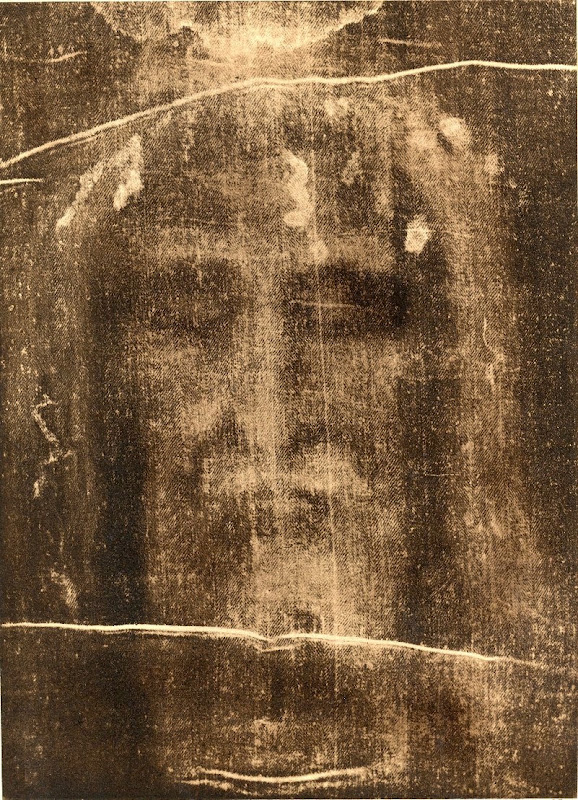
[Above: Giuseppe Enrie's 1931 photographic negative of the face on the Shroud of Turin, which was a positive image, meaning that the image on the Shroud was the equivalent of a photographic negative: Vignon, P., 1939, "Le Saint Suaire de Turin: Devant La Science, L'archéologie, L'histoire, L'iconographie, La Logique," Masson et Cie. Éditeurs: Paris, Second edition, plate I]

to another, when I remembered that the first 9 parts of that series of responses to a no-doubt well-meaning (but ignorant) article, "Bogus: Shroud of Turin," The Conservative Voice, April 08, 2007, Grant Swank (which I can now only find in Google's cache), was to my CreationEvolutionDesign blog (CED), because at the time it was the only one I had.

So here on this my TheShroudofTurin blog (TSoT) is an index of my "Bogus: Shroud of Turin" posts on CED:

And here is my as yet one and only post in that series on TSoT:

I have also just remembered that I had planned to continue that series with:

  • Bogus: Shroud of Turin? #11: Coin images minted by Pontius Pilate between AD 29 and 32 cover the eyes of the man on Shroud.

So I hope to do that in the near future. When I do, I will add future posts in that series here on this index, for completeness.

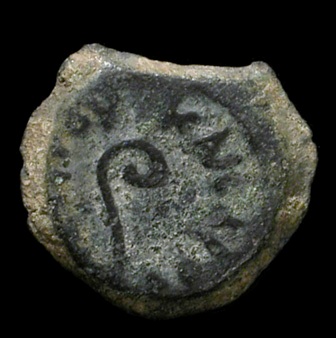
[Right: Roman lepton coin minted by Pontius Pilate 29-32 AD.]

As it happens, only today I was reading in an articles that I had recently received from the USA (Borkan, M., "Ecce Homo?: Science and the Authenticity of the Turin Shroud," Vertices, Duke University, Winter 1995, Vol. X, No. 2, pp.18-51), about the coins in the eyes of the man in the Shroud (see `tagline' quotes).

Stephen E. Jones, BSc. (Biology).
My other blogs: CreationEvolutionDesign & Jesus is Jehovah!


"As unexpected as the generation of a 3D image by the VP-8 analysis of the Shroud ... was, another observation made at the time proved equally surprising. In a VP-8 relief made from a photograph of the Shroud face, researchers noted flat button-like objects over each eye. The characteristics of these images led the investigators to conclude that they were solid objects on top of the eyes of the man in the Shroud. In light of readings he made about Jewish burial customs, Jackson theorized that these objects were coins placed on the eyes to keep them closed in death. In 1979, the late Francis Filas reported identifying the letters UCAI and a design resembling a shepherd's crook, or lituus, in the coin area over the right anatomic eye. [Whanger and Whanger 1991:3, Whanger and Whanger 1985:767, Stevenson and Habermas 1990:66] These patterns match those of a lepton of Pontius Pilate, struck in Israel during the time of Jesus, with the exception that the Latin C is apparently a misspelling of what should have been the (identically pronounced) Greek K in KAICAROC (Caesar). Filas, however, managed to obtain a Pontius Pilate lepton with exactly this misspelling, and at least six others have been found, [Whanger in Meacham 1983 Comments, p.304] thus rendering academic any debate over the likelihood of a coin with such a misspelling being struck." (Borkan, M., "Ecce Homo?: Science and the Authenticity of the Turin Shroud," Vertices, Duke University, Winter 1995, Vol. X, No. 2, pp.18-51, p.28).

"Using their overlay technique, the Whangers compared a photograph of Filas' coin with a computer-enhanced photo of the area over the right eye on the Shroud. .... They found a very close match, noting at least 74 points of congruence. In order to demonstrate that it is not the case, as one critic of the Shroud has put it, that `the alleged coin-images are artifacts of observers' hopes and beyond the limits of photo enlargements and the coarseness of the Shroud weave,' [John R. Cole in Meacham 1983 Comments, p. 296] a number of confirmatory studies have been carried out. The Whangers twice repeated their polarized overlay comparison, first with a right-left reversal of the coin, and then with a top-bottom reversal. In the first case, they observed only ten points of congruence; in the latter, they observed six. They also performed a comparison with a lepton of the Procurator Coponius (C.E. 6-9) in place of the Pontius Pilate lepton (the two coins are nearly the same size and shape,) but were able to tabulate only 11 points of congruence. [Whanger and Whanger 1985:770] A series of computer-aided studies of the Shroud image carried out by Robert Haralick of the Spatial Data Analysis Laboratory at Virginia Polytechnic and State University also supports Filas' initial observations. Image analysis revealed not only the letters UCAI but also three additional letters in their proper positions. [Haralick 1983:34]" (Borkan, 1995, p.28).

"The Whangers further noted that the coin image over the right eye `is so similar to [Filas' lepton] that the two coins must have been struck from the same die.' The pattern on the back of F'ilas' coin identifies the year in which it was struck: the 16th year of the reign of Tiberius Caesar, or 29 C.E. This is also the only year in which another Pontius Pilate lepton, the Julia lepton, was struck; though the image over the left eye on the Shroud is less distinct than that over the right, the Whangers have reported 73 points of congruence between the image over the left eye and a Julia lepton. [Whanger and Whanger 1985:767, Whanger and Whanger 1991:4]" (Borkan, 1995, pp.28-29).

"Extensive debate has surrounded the discovery of coins on the eyes of the man in the Shroud. Critics have questioned both the reliability of the identification and the archaeological evidence for the practice of placing coins on the eyes of a corpse. The work of Haralick and the Whangers demonstrates that the images over the eyes on the Shroud are not anomalies in the cloth weave. In conjunction with the VP-8 analysis, this provides supportive evidence for the presence of coins on the eyes of the man in the Shroud. For several years after the initial identification of these images, the issue of archaeological justification for this discovery was hotly debated. It has become apparent in recent years that there is little archaeological support for a first-century Jewish practice of placing coins on the eyes of the deceased. [Hachlili and Killebrew 1983] However, there is neither a complete lack of support nor a strong theoretical argument against such an occasional practice." (Borkan, 1995, p.29).

Posted 13 November 2008. Updated 25 August 2025.

Friday, November 7, 2008

Are the three Hebrew letters on the Shroud tsade-'aleph-waw: `you will come out'?

Further to my Shroud of Turin News-September 2008 comments on the article, "Plant life traces on Shroud of Turin draws local interest," St.Louis Review, September 5, 2008, by Jennifer Brinker, where I

[Above (enlarge): 3D hologram showing three Hebrew letters under the beard of the man on the Shroud: "The Shroud of Turin: The Holographic Experience," Missouri Botanical Garden. See my post of 27May23 where I proposed that the three Hebrew/Aramaic letters are numbers!]

showed that there were major problems with Dr Petrus Soons' identification of the three Hebrew letters on the Shroud as (from right-to-left) ayin-'aleph-nun, meaning, according to him, "small cattle, sheep, sheep and goats ... lamb." Nothing I said there and say here is meant to take away from Dr Soons' very important achievement of converting the Enrie photographs into a hologram of the man on the Shroud and finding that there are three Hebrew letters on His body.

As I had further stated in my comments:

I had thought the third (left-most) letter was gimel which made a word tsade-'aleph-gimel. I had then found what I thought was that word in one of my Hebrew lexicons, and it meant, "you will come out," which may have been the very Hebrew or Aramaic word that Jesus used when He commanded Lazarus to "come out" from the tomb (Jn 11:43). But alas, on closer inspection the word in my lexicon is tsade-'aleph-waw and the left-most letter on the Shroud does not look like waw. I will keep working on this, trying to accurately identify the letters and then check to see if they spell a Hebrew word. Of course it may be that the three letters are not a word but an acronym.

However, I had not then looked at the above 3D holographic image with 3D red and green spectacles, not owning any. But after I borrowed a pair of 3D spectacles and looked through them at the 3D image above, I saw that the left-most letter does in fact look like waw, if the indistinct

[Right: tsade-'aleph-waw (from right to left)]

blob at the bottom of that letter is not part of the letter itself but the raised edge of the amulet or plaque. So I will now largely reinstate what I originally posted, but had removed, substituting waw for gimel.

After many hours looking at Dr. Soon's holographic images (albeit via the Internet and not directly as Dr Soons can), especially the 3D image above, it seems to me that the first (right-most) letter is tsade, the middle letter is definitely 'aleph and the third letter seems to be waw, i.e. tsade-'aleph-waw (from right-to-left), forming the Hebrew word tse'w.

I then found in one of my Hebrew lexicons that tse'w was an imperative imperfect plural masculine verb of the Hebrew root yatsa' (yodh-tsade-'aleph). Yatsa' in turn means "to go out, come out, exit, go forth" (Davidson, 1966, pp.638,336; Strong's Concordance 3318; Tregelles, 1949, pp.359-360; Harris, et al., 1980, pp.1:393-394). And according to R.K. Harrison's, "Teach Yourself Hebrew," 1955, p. 69, the meaning of yatsa' in the imperfect plural masculine, i.e. tse'w, would be, "you will come out." So this may well be the very Hebrew or Aramaic word that Jesus used when He commanded Lazarus to "come out" from the tomb (Jn 11:43)!

If this identification of the Hebrew letters, the word they form and its meaning is correct (and I freely admit I am far from an expert in Hebrew), then the word tse'w may have been on an amulet or plaque placed on Jesus' body by the disciples as a prayer that He would indeed "come out" of the tomb on the third day, as He had predicted (Mt 12:40; 16:21; 17:23; 20:19; 27:63-64; Mk 8:31; 9:31; 10:34; Lk 9:22; 18:33; 24:7; Jn 2:19-21). The gospel accounts of Jesus' burial (Mt 27:59-60; Mk 15:45-46; Lk 23:52-53; Jn 19:38-42) do not mention this, but they are very brief. Also, the letters appear to be raised, so the amulet or plaque probably would not be something hastily made on the day of Jesus' death specifically for Him, but rather may have been a generic Jewish burial plaque, the equivalent of our R.I.P.

Whether specifically for Jesus, or generic, the very presence of Hebrew letters on the Shroud (and the middle letter is definitely and unmistakably aleph') no European 14th century forger would have gone to the trouble of inscribing Hebrew letters onto the Shroud, which could not be seen until a 21st century hologram revealed them, even if he could do it. Remember that artists down through the centuries have faithfully copied many incomprehensible marks on the Shroud but none of them, as far as I am aware, has depicted these Hebrew letters.

All this is necessarily speculative, but the fact is that the three Hebrew letters are there on the Shroud, and therefore require explanation. If there are any other suggestions, including corrections to my self-taught Hebrew, or a plausible three-letter acronym, I would appreciate being advised of them in comments below this post.


After this was posted, I received an email from Bishop Jacob Barclay of Jerusalem, an expert in Hebrew and Aramaic, who is cited in Dr Soons' "The Shroud of Turin, The Holographic Experience," as his Aramaic language authority. Bishop Barclay confirmed that ayin-aleph-nun means "flock" not "lamb," and that the last letter is unlikely to be nun because when it is at the end of a word it has a long, straight stem. However, Bishop Barclay also confirmed that while tsade-'aleph-waw would be the second person plural masculine imperative of yatsa', i.e. "go out, come out," it would never be used in addressing one person in the masculine. Bishop Barclay hopes, as I do, that experts in Israel (I suggested the Israel Antiquities Authority), may be able to decipher the three letters and then derive their meaning, whether that be a word or an acroynym.

Update: I have been subsequently advised by Bishop Barclay that there actually is an Aramaic word ayin-'aleph-nun which means "flock" and that its Hebrew equivalent is tsade-'aleph-nun. But that does change the main facts: 1) that Aramaic word is not in the four Hebrew-Aramaic lexicons I consulted; 2) neither that Aramaic word ayin-'aleph-nun nor its Hebrew equivalent tsade-'aleph-nun means "lamb"; and 3) the last (left-most) letter is probably not nun.


The `tagline' quotes below (emphasis bold mine) are hyperlinked to inline references above.

Posted: 7 November 2008. Updated: 17 June 2017.


"tse'w ...Kal. imp. pl. masc.; waw bef. yatsa' ... yatsa' fut. yetse', imp. tse', inf. c. tse't (§ 95. No. 2d) -I. to go out, go forth; with sin, also acc. of the place whence, with b (rarely sin) of the place through or by which. one goes out.-II. to come forth, to issue, descend, of children, posterity.-III to escape, as danger, with 'et Ecc. 7:18.-IV. to rise, as the sun, stars, &c.-V. to shoot forth, spring up, as plants; to spring forth, of water.-VI. to go forth, be issued, published, as a decree.-VII. to go out, to end, of a period of time. Hiph. hotsiy'. to cause to go, come out or forth, to lead, bring forth or out.-II. to cause to spring up, to yield, as the earth plants.-III. to cause to lay out, as money, to exact, with `al, 2 Ki. 15:20.-IV. ta spread abroad, to publish, with `al, le of the person. -V. to produce, make, Is. 54:16.-VI. to take out, to separate, Je. 15:19. Hoph. to be led, brought forth or out." (Davidson, B., 1966, "The Analytical Hebrew and Chaldee Lexicon," Samuel Bagster & Sons: London, pp.638,336. My transliteration).

"yasa' ... go out, come out, go forth.... yasa' ... has the usual causative meaning `cause to go out, bring out, lead out.' ... The basic notion of yasa' is `to go out.' It is used literally of going out from a particular locality or from the presence of a person. It is used of nature, i.e. water out of a rock, sun rising out of the east, etc. For our purposes we shall note the following uses. First, it is used frequently of the great exodus event which forms the major focus of theological attention in the OT. The Hiphil with its causative function is used extensively. .... `I am the Lord your God, who brought you out of the land of Egypt, out of the house of slavery' (Ex 20:2). The record shows that history is theologically related, the great `going out' event was to symbolize the mighty redemption of God's people from the shackles of sin by his sovereign powerful grace. ... Throughout Israel's history, the covenanted people of God are called to remember this God-initiated redemption and to live accordingly. (Cf. Deut 6:12; 26:8; Jud 2:12; I Sam 12:8; I Kgs 8:16; Jer 11:4; Dan 9:15 ... Ps 136:11, ... 106:6-12.) ... Another theological usage of yasa' is an extension of the exodus theme. The prophets see the irremediable corruption of Israel and Judah which inevitably leads to exile but after that a return. Ezekiel ... quotes the Lord's promise of a new exodus-like redemptive activity from the exile. `As a soothing aroma I shall accept you, when I bring you out from the peoples and gather you from the lands where you are scattered' (20:41; cf. v. 34). Its true fulfillment may only come after the good shepherd `will bring them out from the peoples and gather them from the countries and bring them to their own land' (34:13). Hence, an eschatological note of hope is introduced." (Harris, R.L., Archer, G.L. & Waltke, B.K., eds, 1980, "Theological Wordbook of the Old Testament," Moody Press: Chicago IL, Twelfth printing, 1992, Vol. I, pp.393-394).

"yatsa' ... TO GO OUT, TO GO FORTH .... In Syriac and Chaldee the word which radically corresponds ... to germinate, to expand, as a plant, they use in the sense of going out, when speaking of men and other things ... Specially to go out, to go forth, is used--- (a) of soldiers-(a) to war, 1 Sa. 8:20; Job 39:21; Isa. 42:12; Zechariah 14:3 (and similarly shepherds against wild beasts, 1 Sa. 17:35).-(B)out of a city in order to surrender it, Isa. 36:16.-(b) merchants and sailors for purposes of trade, Deut. 33:18.-(c) slaves manumitted by their owners, Ex. 21:3, 4, 11; Lev. 25:41, 54 ... (d) children, descendants are said to come forth from their father, or the ancestor of the race; Gen. 17:6, ... to come forth from the womb, from the loins of any one, Job 1:21 ; Gen. 46:26.-(e) those who are delivered from danger are said to come forth ... Ecc. 7:18, ... 1 Sa. 14:41 ... It is applied to inanimate things. So- (f) the sun is said to go forth, i.e. to rise, Gen. 19:23; Ps. 19: 6; the stare, Neh. 4:15; the morning, Hos. 6:5. -(g) to plants which spring forth, 1 Ki. 5:13; Isa. 11:1 ; flowers, Job 14:2... (h) water flowing, gushing forth from a fountain, Gen. 2:10 ; Deut. 8:7; ... Isa. 41:18. It is used also-(i) of a boundary, terminus, running on, running through, Josh. 15:3, 4,9,11- (k) of money which is laid out, expended, 2 Ki. 12:13. ... (l) of things which go forth to the people, are promulgated; of an edict, Hab. 1:4; of the sentence of a judge, Ps. 17:2; compare Gen. 24:50.(m) of the outgoing, i. e. the end of a period of time; Exod. 23:16, ... Ezek. 7:10; hence of the end, the destruction of a city, Eze. 26:18. ... to cause to go out, or come forth, hence of animate beings; to lead out, e. g. the people from Egypt, Ex. 12:51; 16:6; of inanimate beings, to carry out, Gen. 14:18; to draw out, to take out, Ex. 4:6,7; Job 28:11; to take out as from a case, Gen. 24:53. Specially it is (a) causat. ... to put forth plants (as the earth), Gen. 1:12, 24; Isa. 61:11.-(b) .... to cause to lay out, to exact money, followed by .., to lay on a tribute, 2 Ki. 15:20 ... (c) ... to publish a report, followed by ... of the pers. concerning whom the report is spread, Nu. 14:37; Deu. 22:14, 19; to report words, followed by ... of the pers. to whom they are brought, Neh. 6:19; to promulgate doctrine, Isa.42:1, ... ... Isa. 42:3.-(d) to produce as an artisan, Isa. 54:16.(e) to lead forth, i.e. to separate, Jer. 15:19. ... to be brought forth, to be taken out, Eze.38:8; 47:8." (Tregelles, S.P., transl., 1949, "Gesenius' Hebrew and Chaldee Lexicon to the Old Testament Scriptures," Eerdmans: Grand Rapids: MI, Eighth Printing, 1967, pp.359-360. My transliteration. Emphasis original).

Posted 7 November 2008. Updated 25 August 2025.

Saturday, November 1, 2008

Shroud of Turin News - September 2008

Here, again belatedly, is my Shroud of Turin News for September 2008, being only two articles. See important update. The previous issue was August 2008. The articles' word are bold to distinguish them from mine.
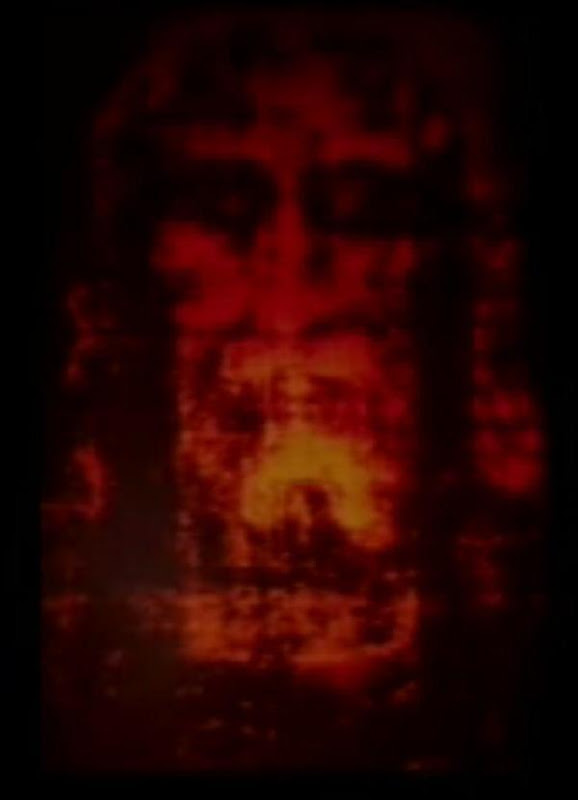
[Above (enlarge): Hologram showing three Hebrew letters under the beard of the man on the Shroud: "The Shroud of Turin: The Holographic Experience," Missouri Botanical Garden]

Plant life traces on Shroud of Turin draws local interest, St.Louis Review, Sep 5, 2008, Jennifer Brinker ... For decades, scientists have debated the authenticity of the Shroud of Turin, believed to be the burial cloth Jesus Christ. Two researchers were in St. Louis to present their findings on the shroud. The event was held at the
[Left: Dr Petrus Soons presenting his "The Shroud of Turin: The Holographic Experience" at the Missouri Botanical Garden: St. Louis Review]

Missouri Botanical Garden. Some 400 people attended. Hear also Dr Soons' presentation at the Ohio Conference (mp3).

Avinoam Danin, emeritus professor of botany at the Hebrew University of Jerusalem, has spent years examining images of plant life discovered on the shroud. He also has discovered additional pieces of plant life on the cloth, which has provided additional evidence to support his theory that the shroud was used somewhere in the area of Jerusalem. Dr. Petrus Soons, a

[Right: Dr. Petrus Soons (left) and Prof. Avinoam Danin stand before the Shroud of Turin: Missouri Botanical Garden]

native of the Netherlands and retired doctor, has used digital photos of the shroud to create three-dimensional holograms, which have provided new and unique views of the cloth. While neither Soons nor Danin attempted to prove that the image of the man found on the shroud indeed was that of Christ, both agreed that their research provides additional insight into the history of the cloth. Missouri Botanical Garden president Peter Raven noted to the audience: "You will walk away with a tremendous amount of food for thought." Soons said it was after an injury that he began searching for authentic images of Christ and ... he came across the Shroud of Turin ... Using photos taken of the shroud in 1931, Soons enhanced them to improve the details and translated the grayscale images into depth data. He also worked with computer expert Bernardo Galmarini to produce from those images three-dimensional holographs of the shroud. Among his findings from the images, Soons discovered an oval-shaped plaque or medallion placed at
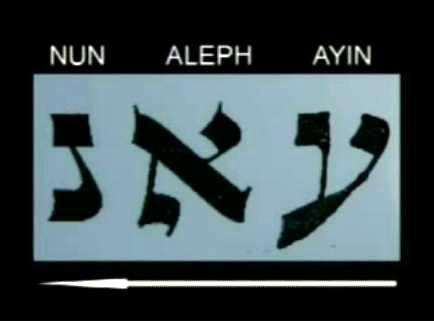
[Left: Dr Soon's depiction of what he believes are the three Hebrew letters on the Shroud.]

the bottom of the face that displays the word "lamb" in Hebrew. To know the meaning we go to religion" and the Gospels, said Soons, a Catholic. The word lamb, he noted for example, is used just before Communion, when the priest says, "this is the Lamb of God, who takes away the sins of the world." I agree that on the hologram below the beard of the man of the Shroud there are three Hebrew letters, which itself is further evidence that the Shroud is that of Jesus, because why would, or even could, a medieval forger add three Hebrew letters to his forgery, such that they could only be detected by 21st century science?

However, there are problems with Dr Soons' claim that the letters are, from right to left (as Hebrew is) `ayin-'aleph-nun: 1. there is no such word as `ayin-'aleph-nun, in my three Hebrew / Aramaic lexicons and another I consulted; 2. While the two Hebrew / Aramaic lexicon pages Soon's shows are too blurry for me to distinguish the letters, one of them (Klein's "A Comprehensive Etymological Dictionary of the Hebrew Language for Readers of English"), clearly has the Hebrew letter tsade in large print at the top of the page, indicating that the key words on that page start with tsade, not `ayin; and 3. The Hebrew word for "small cattle, sheep, sheep and goats" is another word tsade-'aleph-nun (ts'n):

"ts'n ... small cattle, sheep and goat ... flock, flocks of sheep and goats" (Davidson, 1966, p.638); "s'n ... flock, sheep. ... the generic term for `small cattle' comprised mostly of sheep and goats" (Harris, et al., 1980, p.2:749); "ts'n ... small cattle, i.e. sheep & goats" (Holladay, 1971, p.302) and "small cattle, sheep, sheep and goats, flock" (Strong's Concordance 6629); "ts'n ... flocks, small cattle, i.e. sheep and goats" (Tregelles, 1949, p.698).
But ts'n is a collective plural and (apart from Ex 12:21 which should be "flock" as per The Interlinear Bible and Young's Literal Translation), is never rendered "lamb" in the Bible, the latter having its own Hebrew word seh. I have emailed Dr Soons advising him of these problems.

I had thought the third (left-most) letter was gimel which made a word tsade-'aleph-gimel. I had then found what I thought was that word in one of my Hebrew lexicons, and it meant, "you will come out," which may have been the very Hebrew or Aramaic word that Jesus used when He commanded Lazarus to "come out" from the tomb (Jn 11:43). But alas, on closer inspection the word in my lexicon is tsade-'aleph-waw and the left-most letter on the Shroud does not look like waw. I will keep working on this, trying to accurately identify the letters and then check to see if they spell a Hebrew word. Of course it may be that the three letters are not a word but an acronym.

It occurred to me in April 2023 that the three Hebrew/Aramaic letters, from right to left, tsade-'aleph-waw are not letters but numbers! The numerical value of tsade is 90, 'aleph is 1, and waw is 6, simplistically making 9016. But "The Hebrew numeric system operates on the additive principle in which the numeric values of the letters are added together to form the total" ("Hebrew numerals," Wikipedia), so the number would be 97. It is entirely plausible that the Romans had a criminal identification numbering system. And since the Romans used Jews to do their clerical work (e.g. the Jewish tax collectors, Matthew and Zacchaeus - Mt 10:3; Lk 19:2), it is plausible that the numbers were Hebrew, not Roman. If these numbers were on an amulet, why didn't the disciples who buried Jesus remove it? They might not have had time since the Sabbath was about to begin (Lk 23:54). It also might have been illegal. See 27May23.

Dr. Soons also discovered several areas of the images in which data seemed to be missing. Those placed were marked with empty, black holes. Eventually, Soons learned of Danin and his research, and the two discovered that those places were perhaps areas that were once covered in flowers that Danin was researching.
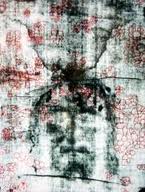
[Left: Flower images on the Shroud discovered by Danin which are information`black holes' in Sooon's hologram]

Over the years, Danin, co-author of "Flora of the Shroud of Turin," noted he has discovered the presence of three plant species that indicate the shroud's origin was somewhere between Jerusalem and Hebron. Prof. Danin said in his talk that the three species are Gundelia tournefortii, Zygophyllum dumosum and Cistus creticus, and their distributions overlap only in the tiny area between Jerusalem and Hebron, which are only ~20 miles / ~30 kilometres apart! Eight species also have been used to determine, through flowering characteristics, that the plant life placed on the body happened somewhere during March or April. Jesus was crucified in early April (Finegan, 1964, p.296). No medieval forger would have known all this about these plants, and even if he did, why would he bother adding images of plants to the Shroud that: a) are only found together around Jerusalem; and b) flower only during the very month that Jesus was crucified! Danin said he also recently has indicated more than 300 flowers and plant parts on the head area of the shroud. Hear also Prof. Danin's presentation at the Ohio Conference (mp3). Those were discovered, he said, after studying photos of the cloth taken in the 1970s. Among the plant life identified are the Matricaria and Anthemis, two genera of the sunflower family. He also said he discovered plants from the Carduus genus of thistles, and pieces of the shrub Rhamnus lycioides - both potential evidence of a crown or helmet of thorns. This fits with Jn 19:40, "Taking Jesus' body, the two of them [Joseph of Arimathea and Nicodemus] wrapped it, with the spices, in strips of linen" where "spices" is Gk. aromaton, i.e. aromatics, and includes "flowers, perfumes, etc" (Robertson, 1932, p.307).

Shroud Of Turin Is Fake, Mindanao Examiner, Philippines - September 9, 2008. The image of a man on the Shroud of Turin,

[Right: A bas-relief `duplicate' of the Shroud, by Paul-Eric Blanrue and Patrick Shepherd,"A false Shroud of Turin carried out in five minutes" Science et Vie, June 2005. Its gross inferiority to the Shroud face (see below) is obvious.]

believed by many Christians as the so-called Jesus Christ, their god, turned out to be a fake. This is old news that keeps getting recycled, having been published in 2005, e.g.: "Turin Shroud confirmed as a fake," PhysOrg.com, "Shroud of Turin 'a fake'," News24 and "Turin Shroud 'confirmed as fake'," NEWS.com.au ... In 2005, a French magazine said ... it had carried out experiments that proved the Shroud of Turin, believed by some Christians to be their religion's holiest relic, was a fake. I have been unable to find a picture of this claimed duplicate of the Shroud, unless the above is it [I later found a photo of di Costanzo's `shroud' face - see 19May19]. A medieval technique helped us to make a Shroud," Science & Vie (Science and Life) said in its July issue. .... Drawing on a method previously used by skeptics to attack authenticity claims about the Shroud, Science & Vie got an artist to do a bas-relief -- a sculpture that stands out from the surrounding background -- of a Christ-like face. First this was just a face. Not a full-length body, front and back. A scientist then laid out a damp linen sheet over the bas-relief and let it dry, so that the thin cloth was moulded onto the face. There is nothing new in this. As this translated French pro-Shroud web page critique points out, "But the technique has been developed in the 80s by Walter McCrone, an American chemist." But even Shroud anti-authenticity proponents Picknett and Prince point out that McCrone's iron oxide on linen bas-relief `Shroud' face, even though "he got an artist, Walter Sanford,
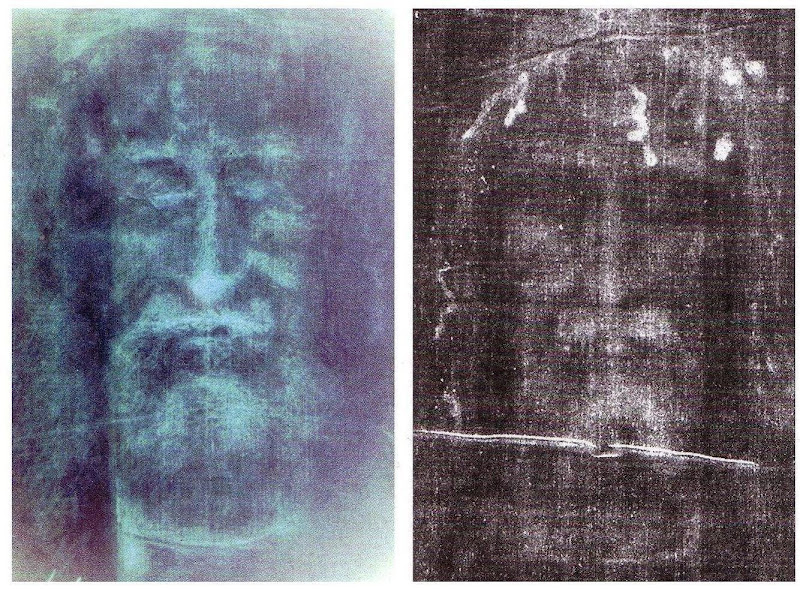
[Above (enlarge): Negatives of Sanfords's painted Shroud face (left) compared to the Shroud face (right) [Wilson, I. & Schwortz, B., "The Turin Shroud: The Illustrated Evidence," 2000, pp.120-121]

to produce it, was "nowhere near the quality of the original" (Picknett & Prince, 2006, pp.74-75). Using cotton wool, he then carefully dabbed ferric oxide, mixed with gelatine, onto the cloth to make blood-like marks. When the cloth was turned inside-out, the reversed marks resulted in the famous image of the crucified Christ. This is false unless the image had all the major features of the Shroud. And as the above French translated web page noted: "This is not a 3D image and the image of the Shroud is in 3D" (see further below). Gelatine, an animal by-product rich in collagen, was frequently used by Middle Age painters as a fixative to bind pigments to canvas or wood. The imprinted image turned out to be wash-resistant, impervious to temperatures of 250 C (482 F) and was undamaged by exposure to a range of harsh chemicals, including bisulphite which, without the help of the gelatine, would normally have degraded ferric oxide to the compound ferrous oxide. This was McCrone's method, to duplicate the work of a hypothetical "mediaeval artist" who supposedly "created the Shroud by simply painting its image onto the cloth using iron-oxide pigments in a gelatin binding medium" (Wilson, 1998, p.9). But:

"Because of the [1532] fire that the Shroud had been exposed to, there must have been a temperature gradient .... The binders most often used were egg white, gelatin, milk products, and oil. Any of these would have changed color along the line of the heat gradient. But the Shroud showed no color change of this kind ..." (Heller, 1983, pp.85-86).

The experiments, said Science & Vie, answer several claims made by the pro-Shroud camp, which says the marks could not have been painted onto the cloth. For one thing, the Shroud's defenders argue, photographic negatives and scanners show that the image could only have derived from a three-dimensional object, given the width of the face, the prominent cheekbones and nose. In addition, they say, there are no signs of any brushmarks. And, they argue, no pigments could have endured centuries of exposure to heat, light and smoke. This is correct, but the bas-relief method uses a "pigment," yet there is none on the Shroud, i.e. that comprises its image. For Jacques di Costanzo, of Marseille University Hospital, southern France, who carried out the experiments, the mediaeval forger must have also used a bas-relief, a sculpture or cadaver to get the 3-D imprint. di Costanzo did not use a "cadaver" but only a "bas-relief," so to save space I will ignore the problems of using a cadaver to duplicate the Shroud.

Some of the major problems with using a bas-relief or sculpture to duplicate the Shroud are: 1) there is no powder or pigment comprising the image as there would be if a bas-relief or sculpture was used (Antonacci, 2000, pp.73-74; Stevenson & Habermas, 1990, p.122); 2) bas-relief `shrouds' do not reproduce the real Shroud's 3D, superficial and non-directional properties (Picknett & Prince, 2006, pp.76-77; Stevenson & Habermas, 1981, pp.109-110; Stevenson & Habermas, 1990, p.122); 3) the bas-relief technique was unknown in the 14th century (Meacham, 2005, p.47; Picknett & Prince, 2006, pp.76-77; Stevenson & Habermas, 1990, p.122); 4) the bas relief the Shroud was based on would be a great masterpiece of art in its own right and it should still exist (Stevenson & Habermas, 1981, pp.109-110); 5) there would be many Shrouds mass-produced from the same bas-relief (Stevenson & Habermas, 1981, pp.109-110); 6) the anatomical accuracy of the Shroud's wounds and blood flows have never been duplicated in bas-relief carving or sculpture (Meacham, 2005, p.47).

The faker used a cloth rather than a brush to make the marks, and used gelatine to keep the rusty blood-like images permanently fixed and bright for selling in the booming market for religious relics. The bloodstains on the Shroud are not "blood-like images". They are stains of real blood:

"... the red stuff on the Shroud is emphatically, and without any reservation, nothing else but B-L-O-O-D!" (Heller, 1983, pp.215-216).

To test his hypothesis, di Costanzo used ferric oxide, but no gelatine, to make other imprints, but the marks all disappeared when the cloth was washed or exposed to the test chemicals. And see above that there is no "gelatine" or "ferric oxide" on the Shroud. He also daubed the bas-relief with an ammoniac compound designed to represent human sweat and also with cream of aloe, a plant that was used as an embalming aid by Jews at the time of Christ. He then placed the cloth over it for 36 hours -- the approximate time that Christ was buried before rising again -- but this time, there was not a single mark on it. So, Far from proving the Shroud is a fake, Costanzo has helped confirm it is genuine, as every failed attempt at duplicating the Shroud has inadvertently done! "It's obviously easier to make a fake shroud than a real one," Science & Vie report drily. So even Science & Vie does not regard Costanzo's `Shroud' as "a real one" but just another "fake"! ...

The quotes below (emphasis bold mine) are hyperlinked to references above.


"Joe Nickell, a former stage magician and amateur detective, has experimented with a proposed technique of image encoding. Nickell's technique involved conforming wet linen to a bas-relief while impressing all the relief's features onto the cloth. After the cloth dried, he used a cotton dauber covered with cloth to rub powdered pigment onto the impressions left on the linen. The results obtained by such a technique ... show what happened when STURP members tested Nickell's theory. As is evident in the VP-8 photograph, Nickell's powder-rubbing method does not produce a true three-dimensional image. A powdered bas-relief technique would involve the application of a substance to the Shroud. As discussed earlier, all the extensive scientific examinations of the cloth indicate that no powdered particles or foreign materials of any kind have been added to the body-image fibrils that could account for the coloring-and therefore visibility-of the image. Specifically, magnified photographs of the body image threads do not reveal any sort of applied particles or staining substance. The `natural experiment,' arising from the fire of 1532, also disproves Nickell's theory, as it did the painting theory. Nickell promulgates that the powdered pigments used were iron oxide, myrrh, or aloes. Yet if organic substances such as these had been used to encode the Shroud image, they would have been altered or decomposed during the fire, depending on their distance from the hottest areas of the cloth. However, no such alteration in the body image can be found on the Shroud when those image areas nearer the burn marks are compared to those areas farther away." (Antonacci, M. , 2000, "The Resurrection of the Shroud: New Scientific, Medical, and Archeological Evidence," M. Evans & Co: New York NY, pp.73-74).

"ts'n ... com. dec. 1 a, collect.-I. small cattle, sheep and goat. - II. flock, flocks of sheep and goats ; metaph. of a people. tso'n idem, Ps. 144:13 ... " (Davidson, B., 1966, "The Analytical Hebrew and Chaldee Lexicon," Samuel Bagster & Sons: London, p.638).

"The Johannine requirement of having Nisan 14 fall on a Friday (and Nisan 15 on a Saturday) can be satisfied in A.D. 30 under (1) and in A.D. 33 under (1), both of which years seem to be well within the range of likelihood. Astronomically calculated, therefore, the likely dates for the crucifixion of Jesus appear to be either Friday Apr 7, A.D. 30, or Friday Apr 3, A.D. 33. Therewith, in terms of the standard Jewish calendar, the representation of the day in the Fourth Gospel appears to be confirmed." (Finegan, J., 1964, "Handbook of Biblical Chronology: Principles of Time Reckoning in the Ancient World and Problems of Chronology in the Bible," Princeton University Press: Princeton NJ, p.296).

"Assumed root of the following. 1864a ... so'n flock, sheep. (ASV and RSV very similar.) so'n is the generic term for `small cattle' comprised mostly of sheep and goats, but the emphasis in the word is on sheep (cf. Gen 38:17; I Sam 25:2)." (Harris, R.L., Archer, G.L. & Waltke, B.K., eds, 1980, "Theological Wordbook of the Old Testament," Moody Press: Chicago IL, Twelfth printing, 1992, Vol. II, p.749).

"Because of the [1532] fire that the Shroud had been exposed to, there must have been a temperature gradient, from the hottest portion, where the molten silver burned holes through the folds of fabric, through the area of scorch, to that portion of the linen which was relatively unaffected. The gradient of temperature, Rogers had calculated, went from about 900?C to well below 200?C. If an inorganic color had been used on the Shroud, it would have had a binder of some type to make the color stick to the fabric. The binders most often used were egg white, gelatin, milk products, and oil. Any of these would have changed color along the line of the heat gradient. But the Shroud showed no color change of this kind, as evidenced by the color photographs that were available. Organic or biological colors could be ruled out by the same reasoning, for anything organic would have changed in hue; it would be darker, lighter, discolored. But there was no evidence of this kind of change, which seemed to rule out the use of any familiar coloring agent." (Heller, J.H., 1983, "Report on the Shroud of Turin," Houghton Mifflin Co: Boston MA, pp.85-86).

"Adler was asked how he could answer McCrone's claim that there was no blood, but merely a mixture of red ocher and vermilion. Adler flashed on the screen the following table from our paper. Table 5 Tests confirming the presence of whole blood on the Shroud 1. High iron in blood areas by X-ray fluorescence 2. Indicative reflection spectra 3. Indicative microspectrophotometric transmission spectra 4. Chemical generation of characteristic porphyrin fluorescence 5. Positive hemochromogen tests 6. Positive cyanomethemoglobin tests 7. Positive detection of bile pigments 8. Positive demonstration of protein 9. Positive indication of albumin 10. Protease tests, leaving no residue 11. Positive immunological test for human albumin 12. Microscopic appearance as compared with appropriate controls 13. Forensic judgment of the appearance of the various wound and blood marks Then, after explaining each item briefly, Al said, `That means that the red stuff on the Shroud is emphatically, and without any reservation, nothing else but B-L-O-O-D!'" (Heller, 1983, pp.215-216).

"ts'n (273 X) sf. ... Ne 10:37 ... Ps 144:13; f.: coll. small cattle, i.e. sheep & goats Gn 4:2; sheep only 1S 25:2; males only (thus m.) Gn 30:40; bene so'n individual animals Ps 114:4; metaph. = Isr. 2S 24:17." (Holladay, W.L. , 1971, "A Concise Hebrew and Aramaic Lexicon of the Old Testament: Based upon the Lexical work of Ludwig Koehler and Walter Baumgartner," Eerdmans: Grand Rapids MI, p.302. My transliteration).

"In addition to the four unprecedented features described above, there is no rubbing from the entire medieval period that is even remotely comparable to the Shroud, nor is there any negative painting. Nickell's wet-mold-dry-daub technique was not known in medieval times, according to art historian Husband (cited in Sox 1981:88), and even that technique fails to reproduce the contour precision and three-dimensional effect, the lack of saturation points, and the resolution of the Shroud image. The bas-relief used would have been far more accurate than any example of 14th century wood carving or sculpture known; even later carvings by 15th / 16th century masters of bas-relief do not have the fine detail of wounds and postures which would translate into the undistorted three-dimensional projections of Tamburelli, confirmed as accurate anatomically by the forensic pathologist Zugibe (1982:169-76). Similarly, even the blood flows painted in the greatest 14th century works of art are not at all comparable to those on the Shroud." (Meacham, W., 2005, "The Rape of the Turin Shroud: How Christianity's Most Precious Relic was Wrongly Condemned and Violated," Lulu Press: Morrisville NC, p.47).

"His [McCrone's] final conclusion was that the samples contained a pigment known as Venetian red, which was made by grinding iron oxide into a powder. He claimed that this alone was responsible for the Shroud image. The ground pigment would have been mixed with a liquid medium for application; his chemical tests revealed the presence of a protein, collagen, that he interpreted as being just that medium. To reinforce these observations, he got an artist, Walter Sanford, to reproduce the Shroud face using the same materials, with tolerably good results, although nowhere near the quality of the original. ... The dispute between McCrone and the rest of STURP turns on two questions: the origin of the particles of iron oxide on the threads and whether or not they were responsible for the creation of the image. .... It was not the presence of iron oxide that was disputed by the STURP scientists ... but rather McCrone's belief that it actually created the image that led to their disagreement. So they tested it without resort to microscopy to see if it was present in sufficient quantities to account for the image. X-ray fluorescence scans during the 1978 tests had revealed traces of iron, but there was no detectable difference in its density between the image and the nonimage areas-although there was more in the bloodstains. Several suggestions were made to account for the iron oxide; it could have come from the blood, spreading across the cloth due to years of folding and rolling. On the other hand, it could have been a byproduct of the manufacture of the linen itself (probably the most plausible explanation), or it could have been due to atmospheric contamination. In view of these objections, STURP declined to include McCrone's two papers in its final report." (Picknett, L. & Prince, C. , 2006, "The Turin Shroud: How Da Vinci Fooled History," [1994], Touchstone: New York NY, Second edition, Reprinted, 2007, pp.74-75).

"Nickell soaked a cloth in hot water and then pressed it over a bas-relief statue. When dry, the cloth was fitted closely over the statue's contours. He then rubbed the cloth with powdered pigment .... He claimed that the result is an image that looks very like that of Shroudman. It has a similar negative effect but no three-dimensional quality. It must be said that Nickell's results, like those produced by Walter Sanford under McCrone's direction ... are nowhere near as impressive as the Shroud, even though both attempts were produced by modern artists deliberately trying to create a negative image. Although they were much more familiar with negatives than any medieval artist would have been, the hypothetical early hoaxer managed to outdo them. Nickell's suggestion has been criticized for being too convoluted for any putative medieval artist and as having no parallel in art of that period. ... Although they do reproduce some of the characteristics of the Shroud image, neither McCrone's nor Nickell's method-nor that of any other technique yet suggested-is satisfactory, and both researchers have been forced to deny or belittle the significance of some of the Shroud's features, such as the negative effect." (Picknett & Prince, 2006, pp.76-77).

"[Jn 19:]40. In linen cloths (othoniois). Late diminutive for the old othone, used for ships' sails, in N.T. here and Luke 24:12. Case here either locative or instrumental. With the spices (meta ton aromaton). Late word aroma for spices, from fumes. To bury (entaphiazein). Late verb, from entaphia (en, taphos) the burial preparations of all sorts (flowers, perfumes, etc.), in N.T. only here and Matt. 26:12." (Robertson, A.T., 1932, "Word Pictures in the New Testament: Volume V: The Fourth Gospel & the Epistle to the Hebrews," Broadman Press: Nashville TN, p.307).

"An artist who was good enough to create an image as impressive as the Shroud's would surely have made many copies of it. Shroud copies of this level of artistry would have demanded a king's ransom. Where is the statue or the bas-relief that the artist used? It would have graced the finest cathedral and become a famous image in its own right. And, to repeat a point made before, this artist would have had to have forged an image that, would not have been appreciated for hundreds of years after his death, until the invention of photography and other modern analytical techniques. The basic fact remains: neither Joe Nickell nor any other artist or forger has ever created an image showing all the characteristics of the image of the man of the Shroud. For example, none of them are three-dimensional, superficial, or non-directional." (Stevenson, K.E. & Habermas, G.R., 1981, "Verdict on the Shroud: Evidence for the Death and Resurrection of Jesus Christ," Servant Books: Ann Arbor MI, pp.109-110).

"One other well-publicized set of attempts to show how the image may have been faked came from artist Joe Nickell. His chief example involved applying a dry powder mixture of myrrh and aloes to a damp cloth which had been carefully fitted around a bas-relief face. The result is also an image of the face, created by the powder, which, to an untrained eye, resembles the face on the Shroud. [Nickell, J., "The Turin Shroud: Fake? Fact? Photograph?," Popular Photography, November 1979, pp.99,147] ... The absence of powder on the Shroud and the disproving of any artistic process by both chemical and physical testing wielded death blows to Nickell's theories. Also, Nickell's models failed the 3-D test and were badly distorted when checked by the VP-8 image analyzer, as pointed out by John Jackson. Problems with shading and the fact that Nickell's model is not superficial (despite his claims to the contrary) led to the assessment that it was `unacceptable.' [Jackson, J., in Murphy, C., "Shreds of Evidence," Harper's, November 1981, pp.42-65, p.55] Heller likewise listed as a major failure of both bas-reliefs and block prints the fact that they do not reproduce a 3-D image, as the Shroud does. He also pointed out that no such bas-reliefs or artistic method existed in medieval times. [Heller, J.H., "Report on the Shroud of Turin," Houghton Mifflin: Boston, 1983, p.208]" (Stevenson, K.E. & Habermas, G.R. , 1990, "The Shroud and the Controversy," Thomas Nelson: Nashville TN, p.122).

"ts'n for ts'on; as Psa. 144:13 ... a collect. noun, flocks, small cattle, i.e. sheep and goats ... Gen. 4:2; 26:14; 29:2; and very frequently. Opp. to baqar herds, which 699 see, Gen. 27:9; Levit. 1:10; 22:21 (compare 19); rarely used only of sheep, 1 Sam. 25:2. To this collective (which is also used with numerals) corresponds the noun of unity seh a sheep, or goat. Exod. 21:37, `if any one steal a sheep (seh), he shall restore four sheep' ('arba' tso'n); Eze. 45:15. Note. As to gender, it is joined with a masc., where it means rams and he-goats. Gen. 30:39 ... `and the rams (and he-goats) rutted;' with a .fem., where it means ewes and she-goats; ibid., ... `and the sheep brought forth;' but, Gen. 31:10, it is joined, like epicoene nouns, with a masc., although it means ewes." (Tregelles, S.P., transl., 1949, "Gesenius' Hebrew and Chaldee Lexicon to the Old Testament Scriptures," Eerdmans: Grand Rapids: MI, Eighth Printing, 1967, pp.698-699. My transliteration).

"The Chicago microanalyst Dr Walter McCrone, for instance, had been vigorously maintaining from the early 1980s that a mediaeval artist created the Shroud by simply painting its image onto the cloth using iron-oxide pigments in a gelatin binding medium. According to him, this artist's so successful production of the negative was just a lucky chance deriving from his deliberately painting in reverse of positive tones.." (Wilson, I., 1998, "The Blood and the Shroud: New Evidence that the World's Most Sacred Relic is Real," Simon & Schuster: New York NY, p.9).

Posted 1 November 2008. Updated 22 October 2025.
Friday, October 10, 2008

Shroud of Turin News - August 2008

Here, belatedly is my Shroud of Turin News for August 2008. The previous issue was May 2008, since I am not aware of any significant news about the Shroud of Turin in June or July 2008. Articles are in chronological order (earliest first). My comments are in bold.

Oxford view on Shroud of Turin eagerly awaited, Irish Times, August 7, 2008, William Reville

[Right: Prof. William Reville, University College Cork, Ireland]

THE TURIN SHROUD (TS) poses a fascinating mystery. It is a linen cloth (4.42m x 1.13m) bearing the image of a man that many believe is the crucified Jesus Christ. The cloth has been investigated scientifically but the jury is still out as to the age of the TS and the identity of the man whose image it carries. That a Professor for the Public Awareness of Science, as Prof. Reville is, to concede 20 years after the 1988 radiocarbon dating report in Nature claimed that:

"The results provide conclusive evidence that the linen of the Shroud of Turin is mediaeval." (Damon, 1989, "Radiocarbon Dating of the Shroud of Turin," Nature, p.612).

that "the jury is still out as to the age of the T[urin] S[hroud]" is itself evidence, bordering on proof, that the Shroud is the very burial sheet of Jesus. Because if it was not, then the Shroud would be a forgery (see Schafersman below). But then, since:

"The Shroud of Turin is now the most intensively studied artifact in the history of the world. Somewhere between 100,000 and 150,000 scientific man-hours have been spent on it, with the best analytical tools available." (Heller, 1983, "Report on the Shroud of Turin," p.219).

science would by now demonstrated not only that the Shroud was a forgery, but what type of forgery it is, and how the forging was done. .... Byzantine tradition refers to a shroud bearing an image of Christ taken from Jerusalem to Turkey in the first century, then lost, rediscovered and brought to Constantinople in 944. .... A fragment of the TS was radiocarbon dated in 1988 by three different laboratories and their results are in agreement. The results claim a 95 per cent probability that the TS dates from between 1260 and 1390 ... The researchers interpreted the TS as a medieval fake .... But there are reasons to question the results of this radiocarbon dating. Contamination of samples can pose serious problems in radiocarbon dating and have caused several anomalous results A refreshingly candid admission. It is highly significant that the problems of radiocarbon-dating ancient linen have increased, while the evidence for the Shroud being in existence long before the 13th century earliest date that "between 1260 and 1390" radiocarbon-dating found it could be, is grounds for rejecting that radiocarbon-dating, even if it could not be shown how it went wrong.... What if the TS really is the burial cloth of Christ? .... The Gospel account of the resurrected Christ is that he was entirely different to a physically embodied Christ - able to pass through walls, and to appear and disappear suddenly. What if his resurrection involved nuclear events in his dematerialisation? Dr August Accetta, California, has carried out a fascinating experiment in which he injected himself with a radioactive compound used in medical imaging to show up internal organs.

[Above: Nuclear radiation image of Dr. August Accetta in Wilson, I. & Schwortz, B., "The Turin Shroud: The Illustrated Evidence," 2000, p.131]

He then assumed the pose of the man imaged on the TS and a gamma camera imaged the radioactivity emanating from his body. The results astonishingly replicated most of the features of the image on the TS. So there you have it. The TS story is still running strongly. We await the results of the Oxford radio carbon dating. .... A surprisingly open-minded consideration by a scientist, that the image on the Shroud could be explained by a burst of radiation emanating from Jesus' body as it changed state at His resurrection:

"... the Lord Jesus Christ, who, by the power that enables him to bring everything under his control, will transform our lowly bodies so that they will be like his glorious body." (Php 3:20-21).

"...`How are the dead raised? With what kind of body will they come?' ... ... The body that is sown is perishable, it is raised imperishable; it is sown in dishonor, it is raised in glory." (1Cor 15:35,41-42).

"... flesh and blood cannot inherit the kingdom of God, nor does the perishable inherit the imperishable. ... the dead will be raised imperishable, and we will be changed." (1Cor 15:50-52).

New findings reveal that the sample used to carbon-date the Shroud of Turin was not the original linen, Society and Religion, India, August 15, 2008... In his presentation yesterday at The Ohio State University's Blackwell Center, Los Alamos National Laboratory (LANL) chemist, Robert Villarreal,

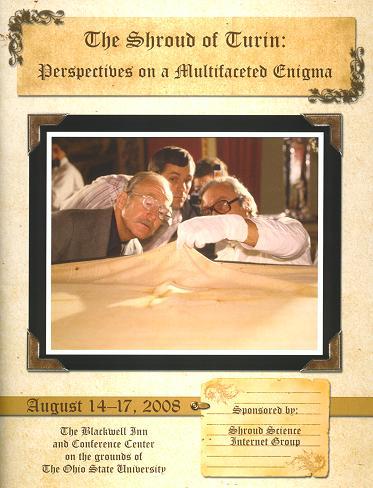
[Left: Program cover: Ohio Shroud of Turin Conference, August 14 - 17, 2008]

disclosed startling new findings proving that the sample of material used in 1988 to Carbon-14 (C-14) date the Shroud of Turin, which categorized the cloth as a medieval fake, could not have been from the original linen cloth because it was cotton. This closely follows the Ohio Shroud Conference press release. Hear Villarreal's presentation (mp3), "Analytical Results on Threads Taken from the Raes Sampling Area (Corner) of the Shroud." The abstract of his paper states:

"The results of the FTIR analysis on all three threads taken from the Raes sampling area (adjacent to the C-14 sampling corner) led to identification of the fibers as cotton and definitely not linen (flax). ... all age dating analyses were conducted on samples taken from this same area. ... the age-dating process failed to recognize one of the first rules of analytical chemistry that any sample taken for characterization of an area or population must necessarily be representative of the whole. .... Our analyses of the three thread samples taken from the Raes and C-14 sampling corner showed that this was not the case." (Villarreal, R., 2008, "Analytical Results on Thread Samples Taken from the Raes Sampling Area (Corner) of the Shroud Cloth," Shroud Science Group International Conference, Ohio State University, August 14-17).

That is, the area of the Shroud adjoining the samples that were radiocarbon-dated in 1988 has now been found to contain cotton, probably from a medieval patch, indicating the samples carbon-dated did not represent the Shroud itself.

According to Villarreal, who lead the LANL team working on the

[Right: Raes' cornerat the bottom left-hand corner of the Shroud (see below). The three threads were from the "Raes fragment" and "Retained" areas near the C-14 samples. The large pale area is missing.]

project, thread samples they examined from directly adjacent to the C-14 sampling area were "definitely not linen" and, instead, matched cotton.

[Right: Raes' corner in relation to the Shroud (click to enlarge). Based on "Examine The Shroud of Turin," Shroud.com]

Villarreal pointed out that "the [1988] age-dating process failed to recognize one of the first rules of analytical chemistry that any sample taken for characterization of an area or population must necessarily be representative of the whole. The part must be representative of the whole. Our analyses of the three thread samples taken from the Raes and C-14 sampling corner showed that this was not the case." It is amazing how unscientifically dogmatic the leaders of the 1988 radiocarbon-dating were, with Oxford's Prof. Hall declaring that anyone who considered the Shroud to be authentic was equivalent to being a member of the "Flat Earth Society":

"... the tests had established a 95 per cent likelihood that the 14-foot linen was made between 1260 and 1390 AD. ... based on counting the number of radioactive carbon 14 atoms in a fragment of the shroud about the size of a postage stamp. .... Professor Edward Hall, the director of the Oxford research laboratory ... said ... believers in the shroud's authenticity ... would probably continue to regard it as genuine, `Just as there is a Flat Earth Society'." (Wilson, & Schwortz, 2000, "The Turin Shroud: The Illustrated Evidence," p.94).

even though the sample of this "14-foot linen" sheet was "about the size of a postage stamp" (i.e. 1.2cm x 8cm, or 0.012m x 0.08m sample of the ~4.3 x 1.1m = 4.732 Shroud, or a mere 0.012 x 0.08m = 0.00096*100/4.73 = 0.02% of the whole)!

Villarreal also revealed that, during testing, one of the threads came apart in the middle forming two separate pieces. A surface resin, that may have been holding the two pieces together, fell off and was analyzed. Surprisingly, the two ends of the thread had different chemical compositions, lending credence to the theory that the threads were spliced together during a repair. Ends of pure linen would not have "different chemical compositions," let alone a "resin ... holding the two pieces together." LANL's work confirms the research published in Thermochimica Acta (Jan. 2005) by the late Raymond Rogers, a chemist who had studied actual C-14 samples and concluded the sample was not part of the original cloth possibly due to the area having been repaired. This hypothesis was presented by M. Sue Benford and Joseph G. Marino in Orvieto, Italy in 2000. Benford and Marino proposed that a 16th Century patch of cotton/linen material was skilfully spliced into the 1st Century original Shroud cloth in the region ultimately used for dating. The intermixed threads combined to give the dates found by the labs ranging between 1260 and 1390 AD. Since the three labs further subdivided each of their one-third of the "postage stamp"sized sample:

"The laboratory in Zurich divided each sample in half, each of which was further subdivided into three. .... The laboratory in Arizona divided each sample into four sub-samples. ... The laboratory in Oxford divided the samples into three." (Guerrera, 2000, "The Shroud of Turin: A Case for Authenticity," pp.130-131).

in order "to do further testing ... If anything went wrong":

"Wolfli [Zurich laboratory] decided to halve each of his samples. This was in case he needed to do further testing. ...If anything went wrong ... Wolfli wanted another try." (Sox, 1988, "The Shroud Unmasked," pp.137-138).

it is not unreasonable to assume they discarded "wrong" dates (e.g. 1st century) and kept testing, until at least one of their subsamples returned a medieval date, being that of the cotton.

Benford and Marino contend that this expert repair was necessary to disguise an unauthorized relic taken from the corner of the cloth. A paper presented yesterday at the conference by Benford and Marino, and to be published in the July/August issue of the international journal Chemistry Today, provided additional corroborating evidence for the repair theory.

Shrouded in mystery, Columbus Dispatch, August 15, 2008, Meredith Heagney .... A conference at Ohio State this weekend will present new research on the authenticity of the Shroud of Turin. Most participants are believers, but a few skeptics will take part. This is a false antithesis. Those of the so-called "skeptics" who hold the philosophy of metaphysical naturalism (i.e. nature is all there is-there is no supernatural) are the real true "believers." All Christians can accept the Shroud is not the very burial sheet of Jesus, bearing the image of His resurrected body, but no metaphysical naturalist "skeptic" can accept that it is! ... There's a new wrinkle in the mystery of a linen cloth that some say held Jesus' body. .... Local researchers say they have new information that discredits the assumption that the shroud is a hoax. It will be presented at a conference this weekend at Ohio State University. ... Robert Villarreal ... further confirms the theory of ... Joe Marino and Sue Benford. ...

[Left: Husband and wife team Joe Marino and Sue Benford]

In the 1500s, the shroud went on a tour of Europe, and security wasn't tight, Benford said. It's possible somebody removed a small piece of the shroud and patched it using "invisible weaving," a common technique at the time that would've left the alteration unnoticeable to the naked eye. .... Despite ample evidence that the relic is a fake, many Christians will insist it's real, said Joe Nickell, a senior research fellow at the Committee for Skeptical Inquiry in Amherst, N.Y. Nickell, who is not a scientist, has written a book about the shroud and said he assembled his own scientific team to examine the data. "Science and scholarship have absolutely proven the Shroud of Turin as a 14th-century forgery," he said. "They're trying to sell you on a mystery." Nickel's "absolutely proven" is typical of the dogmatic "skeptics" (so-called), who, as previously mentioned are really true believers in naturalistic philosophy, which forces them to deny the Shroud is the very burial sheet of Jesus, irrespective of the evidence. True scientists like Prof. Reville (above) admit that:

"... the jury is still out as to the age of the TS and the identity of the man whose image it carries ..."

and Prof. Christopher Ramsey, Director of the Oxford Radiocarbon Accelerator Unit, one of the three labs which carbon-dated the Shroud as "medieval" in 1988, has agreed that:

"... carbon monoxide is naturally enriched in radiocarbon when found in the environment and ... could affect the radiocarbon age of the Shroud enough to allow it to be 2000 years old ... There is a lot of other evidence that suggests to many that the Shroud is older than the radiocarbon dates allow"." (Ramsey, 2008, "Shroud of Turin," Oxford Radiocarbon Accelerator Unit).

meaning that the Shroud could be 2,000 years old and the image be that of Jesus!

Turin shroud controversy envelops pair, Seattle Times, 24 Aug 2008, DeeDee Correll. ... Is the Shroud of Turin - which purportedly bears the image of a crucifixion victim - the burial cloth of Jesus?

[Right: John and Rebecca Jackson with a model, based on the Shroud, that approximates Jesus' body in His tomb: Seattle Times]

In 1988, science seemed to put that question to rest. Radiocarbon dating by three separate laboratories showed the shroud originated in the Middle Ages ... John Jackson, one of the shroud's most prominent researchers, was among those who insisted the results made no sense. Too much else about the shroud, they said, including characteristics of the cloth and details in the image, suggested it was much older. Twenty years later, Jackson, 62, is getting his chance to challenge the radiocarbon dating. Oxford University, which participated in the original radiocarbon testing, has agreed to work with him in reconsidering the age of the shroud. If the challenge is successful, Jackson hopes to be allowed to re-examine the shroud .... Jackson, a physicist who teaches at the University of Colorado, hypothesizes that contamination of the cloth by elevated levels of carbon monoxide skewed the 1988 carbon-14 dating by 1,300 years. See Shroud News May 2008 for my comments on Jackson's 1532 fire carbon monoxide enrichment theory. See also similar articles at Catholic News Agency, Los Angeles Times, NewsMax.com & UPI. Of course if the sample carbon-dated in 1988 was a patch and not representative of the Shroud, then Jackson's theory may be unnecessary to account for the Shroud's anomalous 14th century date. . .... Steven Schafersman, a geologist who maintains a skeptical Web site about the shroud, dismissed the effort as one that's bound to fail. "He's had other ideas, but they've all been shot down, and this one will be shot down too," he said of Jackson. Schafersman is another dogmatic "skeptic" (so-called) who rules out in advance the Shroud being authentic, irrespective of the evidence. He states on his website that he believes in "naturalism ... that nature or the universe is all that exists." Yet Schafersman admits that "If the shroud is authentic, the image is that of Jesus":

"...it becomes clear there are only two choices: Either the shroud is authentic ... or it is a product of human artifice. ... After all, the man on this shroud was flogged, crucified, wore a crown of thorns, did not have his legs broken, was nailed to the cross, had his side pierced, and so on. Stevenson and Habermas .... calculate the odds as 1 in 83 million that the man on the shroud is not Jesus Christ Christ (and they consider this a very conservative estimate). I agree with them on all of this. If the shroud is authentic, the image is that of Jesus." (Schafersman, in Nickell, 1987, "Inquest on the Shroud of Turin," p.141).

He therefore is unable, while he holds his metaphysical naturalism position, to accept that the Shroud is authentic, that it really is the burial sheet of Jesus, bearing the imprint of His resurrected body.

Age of shroud of Turin disputed again, The Sunday Times, August 24, 2008, John Follain. ... Carbon dating tests carried out in 1988 indicated that the shroud, long revered as the winding-sheet in which the body of Jesus was wrapped for burial and bearing his imprint, had been made between 1260 and 1390. The Catholic church admitted at the time that the shroud could not be authentic. This is false. The Roman Catholic Church has never admitted the Shroud "could not be authentic." What the then Archbishop of Turin, the late Cardinal Ballestrero stated was that:

"... he accepted the laboratories' findings even though ... `the problems about the origin of the image and its preservation still remain to a large extent unresolved'" (Wilson, 1998, "The Blood and the Shroud," pp.7-8).

John Jackson, a physicist at Colorado University and a prominent expert on the relic, has argued that the tests were skewed by 1,300 years because of high levels of carbon monoxide. He said many other elements of the shroud, including details of the image, indicate that it is much more ancient. "It's the radiocarbon date that, to our minds, is like a square peg in a round hole. It's not fitting properly and the question is `Why?'," Jackson told an interviewer. The non-radiocarbon evidence is overwhelming that the Shroud is the very burial sheet of Jesus. And as archaeologist the late Dr. Eugenia Nitowski pointed out:

"In any form of enquiry or scientific discipline, it is the weight of evidence which must be considered conclusive: In archaeology, if there are ten lines of evidence, carbon dating being one of them, and it conflicts with the other nine, there is little hesitation to throw out the carbon date as inaccurate" (Wilson, 1991, "Holy Faces, Secret Places," pp.178-179).

Oxford has agreed to work with Jackson to reassess the age of the shroud. He will now try to demonstrate through experiments in his laboratory that the results were flawed, in the hope that this could prompt new tests on the relic itself. Christopher Ramsey, head of the Oxford Radiocarbon Accelerator Unit that tested the shroud in 1988, said: "There is a lot of other evidence that suggests to many that the shroud is older than the radiocarbon dates allow and so further research is certainly needed." Scepticism about the 1988 tests is widespread.

A conference at Ohio State University earlier this month heard findings from the Los Alamos National Laboratory that they were unsound because the samples tested came from a portion of cloth that may have been added during medieval repairs. The area of the Shroud adjoining the C-14 samples has now been found to contain cotton, indicating the samples carbon-dated were of a medieval patch and thus did not represent the Shroud itself:

"The results of the FTIR analysis on all three threads taken from the Raes sampling area (adjacent to the C-14 sampling corner) led to identification of the fibers as cotton and definitely not linen (flax). ... all age dating analyses were conducted on samples taken from this same area. ... the age-dating process failed to recognize one of the first rules of analytical chemistry that any sample taken for characterization of an area or population must necessarily be representative of the whole. .... Our analyses of the three thread samples taken from the Raes and C-14 sampling corner showed that this was not the case." (Villarreal, R., 2008, "Analytical Results on Thread Samples Taken from the Raes Sampling Area (Corner) of the Shroud Cloth," Shroud Science Group International Conference, Ohio State University, August 14-17).

Monsignor Giuseppe Ghiberti, spokesman for the commission that manages the shroud at the Cathedral of St John the Baptist in Turin, said any new tests would have to wait until after it is put on public display in 2010. "The decision is a matter for its owners, that is the Holy See, and the Vatican has said nothing must be touched," he said. This "any new tests" is an encouraging shift in position, indicating that the linen of the Shroud may eventually be properly radiocarbon-dated.

The quotes below (emphasis italics original, emphasis bold mine) are hyperlinked to references above.


"Very small samples from the Shroud of Turin have been dated by accelerator mass spectrometry in laboratories at Arizona, Oxford and Zurich. As controls, three samples whose ages had been determined independently were also dated. The results provide conclusive evidence that the linen of the Shroud of Turin is mediaeval. ... The results of radiocarbon measurements at Arizona, Oxford and Zurich yield a calibrated calendar age range with at least 95% confidence for the linen of the Shroud of Turin of AD 1260 - 1390 (rounded down/up to nearest 10 yr). These results therefore provide conclusive evidence that the linen of the Shroud of Turin is mediaeval." (Damon, P.E., et al. , 1989, "Radiocarbon Dating of the Shroud of Turin," Nature, Vol. 337, 16 February, pp.611-615, pp.612,614).

"The laboratory in Zurich divided each sample in half, each of which was further subdivided into three. One third received no additional treatment, one third was treated with a weak solution of .05 % hydrochloric acid, followed by 0.25% sodium hydroxide, followed again by 0.5% hydrochloric acid at room temperature with intermittent washings. The last third was treated with a strong solution of 5% hydrochloric acid, then by 2.5% sodium hydroxide, which was followed again with 5% hydrochloric acid at temperatures of 80°C and intermittent washings. The laboratory in Arizona divided each sample into four sub-samples. One pair was treated with diluted hydrochloric acid, diluted sodium hydroxide, and again with hydrochloric acid with intermittent washings. The other pair was cleaned with commercial detergents, hydrochloric acid, ethanol, and distilled water. The laboratory in Oxford divided the samples into three. Each was treated with hydrochloric acid, sodium hydroxide, and again with hydrochloric acid at a temperature of 80°C with intermittent washings. Two of the three pieces were also bleached in sodium hypochlorite. [Nature, February 16, 1989, p.613]" (Guerrera, V., 2000, "The Shroud of Turin: A Case for Authenticity," TAN: Rockford IL, pp.130-131).

"So where does all this huge amount of science leave us? The Shroud of Turin is now the most intensively studied artifact in the history of the world. Somewhere between 100,000 and 150,000 scientific man-hours have been spent on it, with the best analytical tools available. The physical and chemical data fit hand in glove. It is certainly true that if a similar number of data had been found in the funerary linen attributed to Alexander the Great, Genghis Khan, or Socrates, there would be no doubt in anyone's mind that it was, indeed, the shroud of that historical person. But because of the unique position that Jesus holds, such evidence is not enough." (Heller, J.H., 1983, "Report on the Shroud of Turin," Houghton Mifflin Co: Boston MA, p.219).

"As the (red ochre) dust settles briefly over Sindondom, it becomes clear there are only two choices: Either the shroud is authentic (naturally or supernaturally produced by the body of Jesus) or it is a product of human artifice. Asks Steven Schafersman: `Is there a possible third hypothesis? No, and here's why. Both Wilson [Wilson, I., "The Shroud of Turin," 1979, pp.51-53.] and Stevenson and Habermas [Stevenson, K.E. & Habermas, G.R., "Verdict on the Shroud," 1981, pp.121-129] go to great lengths to demonstrate that the man imaged on the shroud must be Jesus Christ and not someone else. After all, the man on this shroud was flogged, crucified, wore a crown of thorns, did not have his legs broken, was nailed to the cross, had his side pierced, and so on. Stevenson and Habermas [Ibid., p.128] even calculate the odds as 1 in 83 million that the man on the shroud is not Jesus Christ (and they consider this a very conservative estimate). I agree with them on all of this. If the shroud is authentic, the image is that of Jesus.' [Schafersman, S.D., "Science, the public, and the Shroud of Turin," The Skeptical Inquirer, Vol. 6, No. 3, Spring 1982, pp.37-56, p.42]" (Nickell, J., 1987, "Inquest on the Shroud of Turin," [1983], Prometheus Books: Buffalo NY, Revised, Reprinted, 2000, p.141).

"John Jackson ... has developed a new hypothesis, which he believes may explain why the mediaeval date for the Shroud is incorrect. The hypothesis ... is that the linen of the Shroud might have been contaminated by carbon monoxide. Unlike most contaminants, carbon monoxide is naturally enriched in radiocarbon when found in the environment and would therefore in principle be able to alter the radiocarbon age significantly. .... This is the only contamination hypothesis which could affect the radiocarbon age of the Shroud enough to allow it to be 2000 years old. .... The Oxford Radiocarbon Accelerator Unit has been collaborating with John Jackson's team to test the reaction rates. .... The research continues because the effect of the specific storage conditions of the Turin Shroud .... It remains possible ... that in these specific conditions there are reactions which provide significant contamination. There are also other possible types of contaminant, and it could be that one, or some combination of these, might mean that the Shroud is somewhat older than the radiocarbon date suggests. .... There is a lot of other evidence that suggests to many that the Shroud is older than the radiocarbon dates allow and so further research is certainly needed. It is important that we continue to test the accuracy of the original radiocarbon tests as we are already doing. It is equally important that experts assess and reinterpret some of the other evidence. Only by doing this will people be able to arrive at a coherent history of the Shroud which takes into account and explains all of the available scientific and historical information." (Ramsey, C., 2008, "Shroud of Turin," Oxford Radiocarbon Accelerator Unit, April)

"Wolfli [Zurich laboratory] decided to halve each of his samples. This was in case he needed to do further testing. He said the condition he gave for being involved in the first place was having enough sample material with which to work. If anything went wrong - as it had in the inter-lab comparison of 1982 - Wolfli wanted another try." (Sox, H.D., 1988, "The Shroud Unmasked: Uncovering the Greatest Forgery of All Time," The Lamp Press: Basingstoke UK, pp.137-138).

"I became involved with the analytical aspect of the Shroud when Ray Rogers asked me for help in conducting certain Shroud image formation studies. He needed an alpha-particle source to complete investigation of possible image formation processes and some radiochemical calculations on the depth of penetration of an emitted alpha-particle into flax fibers. I provided him with both and he asked further for X-ray Photoelectron Spectroscopy (XPS) measurements on a special sample he termed a `spliced thread' or R1 sample. The XPS measurements were made and he was quite excited at the results because they indicated the two ends of the thread were not the same and he additionally asked if there were other specialized non-destructive equipment that might be available. ... Based on evidence he had accumulated, Ray was convinced that the material from the Raes (1973) and C-14 (1988) sampling corner (lower left corner of frontal image area) was significantly different from the original Shroud cloth. ... After conducting analysis at high vacuum with the ToF-SIMS [Time-of-Flight Secondary Ion Mass Spectrometry], the `spliced thread' broke into three distinct pieces; a fuzzy end (Region 1), a tight woven end (Region 2), and a micro-sized circular cocoon-shaped brown crust that seemed to be connecting the two end pieces. The ToF-SIMS results were the first to show that the spectra from the two ends were similar to cotton rather than linen (flax) and the Spectroscopist recommended that the next analysis should be with the FTIR [Fourier Transform Infrared Spectroscopy] instrument. After several scans of individual fibers or strands, the FTIR data showed that the two ends (Region 1 and 2) were definitely cotton and not linen (flax). The crust appeared to be an organic-based resin, perhaps a terpene species, with cotton as a main sub-component. After showing the FTIR data to Barrie Schwortz and Sue Benford, they were quite surprised at the results and decided to send me two other pieces of thread (No. 7 and 14) that were from the same sampling area ... The results of the FTIR analysis on all three threads taken from the Raes sampling area (adjacent to the C-14 sampling corner) led to identification of the fibers as cotton and definitely not linen (flax). Note, that all age dating analyses were conducted on samples taken from this same area. Apparently, the age-dating process failed to recognize one of the first rules of analytical chemistry that any sample taken for characterization of an area or population must necessarily be representative of the whole. The part must be representative of the whole. Our analyses of the three thread samples taken from the Raes and C-14 sampling corner showed that this was not the case. What was true for the part was most certainly not true for the whole. This finding is supported by the spectroscopic data provided in this presentation. The recommendations that stem from the above analytical study is that a new age dating should be conducted but assuring that the sample analyzed represents the original main shroud image area, i.e. the fibers must be linen (flax) and not cotton or some other material. It is only then that the age dating will be scientifically correct." (Villarreal, R., 2008, "Analytical Results on Thread Samples Taken from the Raes Sampling Area (Corner) of the Shroud Cloth," in "The Shroud of Turin: Perspectives on a Multifaceted Enigma," Shroud Science Group International Conference, Ohio State University, August 14-17).

"Whether, therefore, there has or has not been some error in respect of the shroud carbon dating, what is undeniable is that the process of carbon dating, despite all the ultra-scientific precision with which it is associated, can and does err in its results. It should be regarded as tool, not arbiter, and should never be mistaken for the latter. As has been very cogently remarked by the former Biblical archaeologist Dr Eugenia Nitowski: `In any form of enquiry or scientific discipline, it is the weight of evidence which must be considered conclusive: In archaeology, if there are ten lines of evidence, carbon dating being one of them, and it conflicts with the other nine, there is little hesitation to throw out the carbon date as inaccurate ...' [Nitowski, E., Private communication]" (Wilson, I., 1991, "Holy Faces, Secret Places: The Quest for Jesus' True Likeness," Doubleday: London, pp.178-179).

"Thus it was that on the morning of 14 October 1988 most of the world woke up to newspaper headlines - by no means always front-page news - that the Shroud had been `proven' to be a mediaeval fake. At his Turin press conference Cardinal Ballestrero, true to his earlier expressed insistence that the Church has nothing to fear from the truth, declared that he accepted the laboratories' findings even though, as he carefully added, `the problems about the origin of the image and its preservation still remain to a large extent unresolved'. England's Daily Telegraph newspaper duly translated this into the headline `Turin shroud is a forgery, says Catholic Church'." (Wilson, I., 1998, "The Blood and the Shroud: New Evidence that the World's Most Sacred Relic is Real," Simon & Schuster: New York NY, pp.7-8).

"CARDINAL Anastasio Ballestrero of Turin yesterday confirmed what newspaper readers around the world have known for weeks: that tests on the Turin Shroud have shown it to be of medieval origin. The shroud, believed by many to carry the imprint of Christ's face and body when laid in the tomb, has attracted devout pilgrims to Turin for centuries. Leaks of the results of modern carbon-dating tests had infuriated the archdiocese of Turin and the shroud's Italian custodians who spoke darkly of foreign plots against Italy, anti-Catholic prejudice and the like. Yesterday it was at last official: the tests had established a 95 per cent likelihood that the 14-foot linen was made between 1260 and 1390 AD. There is no chance that it dates back to the time of Christ. Cardinal Ballestrero pointed out that the church had never claimed that the shroud represented Jesus but had honoured a tradition of piety rooted in centuries past. `Considering the results of the scientific tests, the church reiterates her respect and her veneration for the shroud,' he said. The tests were carried out in laboratories at Oxford University and in Arizona and Zurich. They were based on counting the number of radioactive carbon 14 atoms in a fragment of the shroud about the size of a postage stamp. However, they did not resolve the icon's origin, or the mystery which surrounds the blood-stained image on the shroud, resembling a photographic negative, of an apparently crucified man. Professor Edward Hall, the director of the Oxford research laboratory involved, gave his theory: `There was a multi-million pound business in making forgeries during the fourteenth century. Someone just got a bit of linen, faked it up, and flogged it.' Professor Hall, 64, who said he had a file full of mostly `cranky' letters from believers in the shroud's authenticity, added that same people would probably continue to regard it as genuine, `Just as there is a Flat Earth Society'. But he was utterly convinced his findings were right." (Sheridan, M. & Reeves, P., "Turin Shroud shown to be a fake," Independent, 14 October 1988, in Wilson, I. & Schwortz, B., 2000, "The Turin Shroud: The Illustrated Evidence," Michael O'Mara Books: London, p.94).

Posted 10 October 2008. Updated 5 January 2025.