Monday, April 23, 2012

Four proofs that the AD 1260-1390 radiocarbon date for the Shroud has to be wrong!: #2 The Vignon markings (5)

Continuing from part "#2 The Vignon markings (4)" with this part #2 (5) of my series "Four proofs that the AD 1260-1390 radiocarbon date for the Shroud has to be wrong!"

Examples of 6th to 12th century artistic representations of Christ's face which bear the Vignon markings found on the Shroud, include:

Holy Face of Laon (12th century)

[Above (enlarge): The Holy Face of Laon: Wikipedia. "Icon of the Holy Face (Mandylion), purchased in 1249 in Bari (Italy) by Jacques Pantaleon, archdeacon of the cathedral of Laon, who later became Pope Urban IV. Exhibited in the Cathedral of Laon." (Wikipedia, Google translated from French).]

The "Holy Face of Laon" (Fr. Sainte Face de Laon) [1] is about 44 cm high and 40 cm wide, and bears an image of Christ's face painted on wood. [2] It has an inscription in Old Slavonic, by the artist, which reads, "Obraz Gospodin na Ubruzje" ("The Lord's picture on the Cloth"). [1]

In 1249 papal chaplain Jacques Pantaleon de Troyes (later Pope Urban IV) sent this icon from Rome to his sister Sibylle, Abbess of the French Cistercian convent of Montreuil-des-Dames. [3] In 1795 the painting was transferred to Laon Cathedral where it has been ever since. [2]

Therefore this icon must have been painted many years, if not decades, before 1249, and if it was copied from the Shroud, then that must have been in existence even earlier still. [4] It is probable that this icon was already ancient when Jacques de Troyes received it as a gift from the Serbian Orthodox church, which had been liberated from the Byzantine Emperor's authority after the sack of Constantinople in 1204. [2] The most likely time of the icon's creation is between 944 and 1201, when the Shroud was in Constantinople. [3] And since it preserves features associated with the Edessa Cloth or Mandylion [5], such as the face of Christ surrounded by a circular "halo," which was in turn surrounded by a gold trellis pattern [6], a tenth century origin seems more likely, before it was discovered in Constantinople that the Mandylion head cloth was actually the full-length Shroud. [7] So if the Holy Face of Laon is a copy of the Shroud, then the 1988 radiocarbon dating of the Shroud as "medieval ... AD 1260-1390" [8] must be wrong! [4]

The fifteen Vignon markings [see part #2 (1)], including "a transverse streak across the forehead, a three-sided `square' between the brows, a V-shape at the bridge of the nose, a raised right eyebrow, accentuated left cheek, enlarged left nostril, a hairless area between the lower lip and the beard and two strands of hair descending from the middle parting" [4], found on the Shroud and on many Byzantine depictions of Christ from the 6th to 12th centuries, is proof beyond reasonable doubt that these early artists were working from the Shroud. [4] And the Laon icon contains more Vignon markings than any other known icon [9], thirteen of the fifteen [4] Indeed, by my count it it has fourteen out of the fifteen :

"(1) Transverse streak across forehead, (2) three-sided `square' between brows, (3) V shape at bridge of nose, (4) second V within marking 2, (5) raised right eyebrow, (6) accentuated left cheek, (7) accentuated right cheek, (8) enlarged left nostril, (9) accentuated line between nose and upper lip, (10) heavy line under lower lip, (11) hairless area between lower lip and beard, (12) forked beard, ... (14) heavily accentuated owlish eyes, (15) two strands of hair." [10]
and of the one that is missing, "(13) transverse line across throat," there is no throat area shown on the icon! Moreover, the Holy Face of Laon is particularly notable for the minute exactness with which it reproduces some of these anomalies of the Shroud, an exactness which would only have been possible if the artist had the Shroud before his eyes. [11] This, together with the artist's inscription that his painting was of "The Lord's picture on the Cloth", must mean that he was working directly from the Shroud itself. [9]

But, as we have seen, the Holy Face of Laon was already ancient in 1249, which itself is over a decade before the earliest possible radiocarbon date of 1260. Therefore, once again, the 1988 radiocarbon dating of the Shroud as "medieval ... AD 1260-1390" [8] has to be wrong!

[To be continued]

Hagia Sophia narthex mosaic (10th century)

Sant'Angelo in Formis fresco (11th century)

Pantocrator of St Saviour in Chora, in Istanbul (11th century)

Daphni Pantocrator (11th century)

Cefalù apse mosaic (12th century)

References
[1] Currer-Briggs, N., 1988, "The Shroud and the Grail: A Modern Quest for the True Grail," St. Martin's Press: New York NY, p.58. [return]
[2] de Riedmatten, P., "The Holy Face of Laon," British Society for the Turin Shroud Newsletter, No. 68, December 2008. [return]
[3] Wilson, I., 1991, "Holy Faces, Secret Places: The Quest for Jesus' True Likeness," Doubleday: London, pp.47,79. [return]
[4] Currer-Briggs, N., 1995, "Shroud Mafia: The Creation of a Relic?," Book Guild: Sussex UK, pp.56-57. [return]
[5] Wilson, I., 1998, "The Blood and the Shroud: New Evidence that the World's Most Sacred Relic is Real," Simon & Schuster: New York NY, pp.150-151. [return]
[6] Wilson, I., 1979, "The Shroud of Turin: The Burial Cloth of Jesus Christ?," Image Books: New York NY, pp.114-115, 121. [return]
[7] Wilson, 1979, pp.157-158. [return]
[8] Damon, P.E., et al., 1989, "Radiocarbon Dating of the Shroud of Turin," Nature, Vol. 337, 16 February, pp.611-615, p.611. [return]
[9] Currer-Briggs, 1988, pp.67-68. [return]
[10] Wilson, I., 1978, "The Turin Shroud," Book Club Associates: London, p.82e. [return]
[11] Wuenschel, E.A., 1954, "Self-Portrait of Christ: The Holy Shroud of Turin," Holy Shroud Guild: Esopus NY, Third printing, 1961, pp.58-59. [return]

Posted: 23 April 2012. Updated. 16 February 2026.

Tuesday, April 10, 2012

`De Wesselow fails to answer the reasons why rational people accept the Shroud is a fake'

Anonymous

Thank you for your comment under my post, "My comments on a Telegraph article about Thomas de Wesselow's claim that the Shroud is authentic but Jesus was not resurrected #2."

[Right: "1516 Copy of the Shroud Attributed to Albrecht Durer or Bernard van Orley": Daniel R. Porter, 2008. One of the "as many as forty" known copies of the Shroud ("What are some of the famous painted copies of the Shroud?" Daniel R. Porter, 10 December 2009)]

As I then briefly responded, because of the many points you raised, I would reply in a separate (this) blog post. Your words are >bold to distinguish them from mine.

>When are people going to accept reality *without* filtering it through their beliefs?

You are deceiving yourself if you think that you (and your Shroud anti-authenticity ilk) are the exception to the rule that humans perceive reality through the filter of their beliefs.

It is no coincidence that the vast majority of Shroud anti-authenticists have an a priori belief that Christianity is false and they refuse to accept the overwhelming evidence that the Shroud is authentic and cling to the few shreds of evidence that it is not, all the while congratulating themselves on how `rational' (see below) they are!

But as the agnostic French anatomy professor Yves Delage observed in 1902, "If, instead of Christ, there were a question of some [other] person ... no one would have thought of making any objection":

"If, instead of Christ, there were a question of some person like a Sargon, an Achilles or one of the Pharaohs, no one would have thought of making any objection ... I have been faithful to the true spirit of science in treating this question, intent only on the truth, not concerned in the least whether it would affect the interests of any religious party ... I recognize Christ as a historical personage and I see no reason why anyone should be scandalized that there still exist material traces of his earthly life.'" (Walsh, J.E., "The Shroud," Random House: New York NY, 1963, p.107. Ellipses original).

>The shroud is a fake, just like the eighty or so others.

That there may be forty (not "eighty") copies of the Shroud original (like the 1516 Lier copy above), does not thereby make that original a "fake".

And as agnostic art historian de Wesselow points out, the Shroud is "nothing like any other medieval work of art:

"That controversy still rages, but de Wesselow is convinced of the shroud's authenticity from an art history approach. `It's nothing like any other medieval work of art,' de Wesselow said. `There's just nothing like it.' Among the anachronisms, de Wesselow said, is the realistic nature of the body outline. No one was painting that realistically in the 14th century, he said. Similarly, the body image is in negative (light areas are dark and vice versa), a style not seen until the advent of photography centuries later, he said. `From an art historian's point of view, it's completely inexplicable as a work of art of this period,' de Wesselow said.' (Stephanie Pappas, "Did Shroud of Turin Inspire Spread of Christianity?" LiveScience, 5 April 2012).

And it is not enough to merely assert that "The shroud is a fake". Shroud anti-authenticists like yourself have to not only: 1) prove that the Shroud could not be the burial cloth of Jesus; and 2) plausibly explain away all the evidence that the Shroud is authentic; but also 3) convincingly show how all the major features of the Shroud image and bloodstains were created by a medieval or earlier forger.

>De Wesselow fails to answer the reasons why rational people accept it is a fake, e.g.

You are self-deceived if you think that only those who believe the Shroud is a fake are "rational".

But you inadvertently confirm John Klotz' point in David Rolfe's Dawkins' Challenge, that de Wesselow's claim that the Shroud is authentic but Jesus was not resurrected has put de Wesselow's atheist/agnostic colleagues "in a bind":

"The silence from Dawkins is deafening and revealing. De Wesselow's book "The Sign" may give some cover to Resurrection skeptics, but the simple fact is that once you accept the authenticity of the Shroud as the 1st Century CE burial cloth a man crucified in the manner scripture said he was, the whole think begins to unravel. It's like pulling the a loose thread of a knitted sweater. De Wesselow concedes the validity of the Shroud but his speculation that all the appearances related to Jesus after the Resurrection were more or less a mirage simply do not add-up. However, it puts agnostics and atheists like Dawkins in a bind ... his support of the authenticity of the Shroud even as a professed agnostic isn't going to serve his agnostic colleagues well. His supposed debunking of the reality of the Resurrection is as transparently absurd as the Emperor's New Clothes. It's much easier to dismiss the Shroud mistaken for the real Christ argument then it is to disprove his finding that the Shroud is authentic. The first is a speculation, the second is a fact. The militant atheists will be in a bind I suspect they will try to ignore.

Because while atheists/agnostics would normally welcome any new claims that Jesus was not resurrected, and therefore that Christianity is false, it is too high a price for them to pay to concede that the Shroud is authentic, because de Wesselow's claim that Jesus' resurrection was the Shroud is so `transparently absurd'."

>the lack of evidence it existed prior to ~1355

There is plenty of evidence that the Shroud existed prior to ~1355. See my series: "Four proofs that the AD 1260-1390 radiocarbon date for the Shroud has to be wrong!," where my first three lines of evidence: "1. the Vignon markings-which showed that unique features of the Shroud face were being copied by artists from the mid-6th century"; "2. the Hungarian Pray Codex (1192-95), with its unique features of the Shroud image and cloth, dating from the 12th century"; and "3. the exact match of bloodstains on the Shroud head and the Sudarium of Oviedo which has been in Spain since at least AD 840"; are proof beyond reasonable doubt that the Shroud existed well before the earliest AD 1260 radiocarbon date.

>the incompatibility of the shroud with usual Jewish burial practices

Actually the Shroud is compatible with first century Jewish burial practices:

"The apparent bloodstains suggest that the body was not washed before burial and this has led some to argue that the Shroud cannot be authentic because the Jewish rite always included washing. However, as recently pointed out by London University Jewish scholar Victor Tunkel, if a first-century Jew died a bloody death, such as from crucifixion, the body would quite specifically not have been washed, in order to keep the life-blood with the body in preparation for the anticipated physical resurrection - striking evidence in favour of the Shroud's authentic Jewishness." (Wilson, I., "Jesus: The Evidence," 1984, p.111).

>the definitive radiocarbon dating

First, the evidence is overwhelming that the Shroud existed well before the earliest radiocarbon dating of AD 1260, and indeed that it existed in the sixth century AD. Therefore the 1988 radiocarbon dating of the Shroud as "medieval ... AD 1260-1360" (Nature, 337:1989:611-615) simply has to be wrong!

Even Prof. Christopher Ramsey, current Director of the Oxford Radiocarbon Unit, and a co-signatory of that 1989 Nature paper, has admitted that "There is a lot of other evidence that suggests to many that the Shroud is older than the radiocarbon dates allow":

"There is a lot of other evidence that suggests to many that the Shroud is older than the radiocarbon dates allow and so further research is certainly needed. It is important that we continue to test the accuracy of the original radiocarbon tests as we are already doing. It is equally important that experts assess and reinterpret some of the other evidence. Only by doing this will people be able to arrive at a coherent history of the Shroud which takes into account and explains all of the available scientific and historical information." (Ramsey, C.B., "Shroud of Turin Version 77," Oxford Radiocarbon Accelerator Unit, 23 March, 2008).

The only question now is: how did the three C14 labs get it so wrong?

The three C14 labs dated one tiny postage-stamp sized sample of the ~4.4 x 1.1 metre (~14.3 x 3.6 foot) Shroud, which had been subdivided into three roughly equal parts, and a part given to each lab. All three labs used the same then new AMS C14 dating method. The sample was taken from the worst possible part of the Shroud, being a bottom corner where the Shroud had been damaged and repaired. Which is the reason that location was chosen at the last minute by order of the Vatican, to minimise the damage to the Shroud, not to maximise the best C14 date. The most likely explanation of how the three C14 labs got it wrong, was that the sample given to them to date was then unknowingly part of a 16th century "invisible reweave" repair:

"One prominent theory regarding the results of the 1988 Carbon-14 (C-14) dating of the Shroud is that the sample area had been repaired with a patch or "invisible reweave," thus producing a dating resulting from a combination of 16th century and first century cloth. This paper recounts the initial doubts about the validity of the C-14 results; the history behind the patch theory; the abundant historical and scientific information support of the theory, especially from the findings of the late Ray Rogers in his paper published in 2005 after his direct examination of the C-14 samples compared with other samples from the main cloth; independent confirmations of Rogers’ findings; criticisms of Rogers’ findings; and refutations of these criticisms. The authors conclude that the invisible reweave is the most reasonable explanation for the dating of the Shroud." (Marino, J.G. & Benford, M.S., "Invisible Mending and the Turin Shroud: Historical and Scientific Evidence," in "The Shroud of Turin: Perspectives on a Multifaceted Enigma," Shroud Science Group International Conference, Ohio State University, August 14-17, 2008).

But whatever the reason the C14 labs got it wrong, as I pointed out in my first post of my series, "Four proofs that the AD 1260-1390 radiocarbon date of the Shroud has to be wrong!:

The ball is now in the Shroud anti-authenticist court to try to find a face-saving answer. The pro-authenticity side no longer have to provide an answer since it no longer is (if it ever was) their problem. The 16th century invisible reweave theory is a possible explanation, among many, of how the radiocarbon labs got it wrong. If ... and his Shroud anti-authenticist ilk don't like that explanation, then let him/them find another. It's now his/their problem, not ours!

>the textile analysis

Textile analysis points to the Shroud's being first-century Jewish:

"In 2002, renown textile restorer Mechthild Flury-Lemberg went to Turin to help preserve the shroud and found a style of stitching she had only seen once before - in the ruins of Masada, a Jewish settlement destroyed by the Romans in A.D. 74. The cloth's herringbone weave, while common in the 1st Century, was rare in the Middle Ages, she said." (Draper, E., "Lab agrees to test Shroud of Turin for new theory," Chicago Tribune, May 20, 2008).

>the belief of contemporary church figures that it was a fake, even indicating a local bishop questioned the artist who created the shroud

There was only one known contemporary church figure who claimed the Shroud was a fake, the Bishop of Troyes, Henri d'Arcis, who claimed in a 1389 draft memo to the Pope that "thirty-four years or thereabouts" (i.e. about 1355) his predecessor bishop Henri of Poitiers had "... discovered the fraud and how the said cloth had been cunningly painted, the truth being attested by the artist who had painted it ..." (Wilson, I., "The Turin Shroud," 1978, pp.67-68).

But problems with this include: 1) the Shroud is not a painting: there is no paint, dye or pigment on it that forms its image (see below); 2) the document is only a draft - there is no evidence in either the Troyes diocesan or the Papal archives that the memo in that form was ever sent or received; and 3) there is no evidence that bishop Henri of Poitiers had a problem with the Shroud being exhibited at Lirey church in the 1350s.

>the pigment analyses, microscopical and chemical

Again, there is no pigment responsible for the Shroud image. The image is the result of accelerated aging of the topmost flax fibrils, as the following photomicrograph of the Shroud face image area shows:

[Above (click to enlarge): Micrograph X64 of Shroud nose image area, showing that the image consists of accelerated aging and hence yellowing of the topmost surface of the flax fibrils themselves: Lavoie, G.R., "Resurrected: Tangible Evidence That Jesus Rose from the Dead," 2000, p.55]

Note that those flax fibrils above are magnified 64 times. That is, they are in reality 1/64th the thickness they are shown in the above microscope photograph. Then ask yourself: "Could a medieval or earlier forger have even seen one of those flax fibrils, let alone paint only some of them yellow (to simulate their accelerated aging) while leaving others unpainted"?

>the iconographic similarity to other religious art of the period

The only iconographic similarity between the Shroud and other religious art of the period is in copies of and from the Shroud. And as the Vignon Markings show, those iconographic similarities date back to the sixth century AD!

>the ease with which the shroud has been replicated using period methods

In fact the Shroud has not been able to be replicated using any medieval or earlier period methods. Claimed replications do not withstand in-depth analysis. Which is why there are so many claimed replications, none of which satisfy other Shroud anti-authenticists. What Wilson wrote in 1998 is still true today:

"Indeed, if anyone had come up with a convincing solution as to how and by whom the Shroud was forged, they would inevitably have created a consensus around which everyone sceptical on the matter would rally. Yet so far this has not even begun to happen." (Wilson, I., "The Blood and the Shroud," 1998, p.235).

>the lack of correspondence of the image on the cloth to that which would result from it being used as a shroud

The Shroud image perfectly corresponds to it having been used as Jesus' burial Shroud.

>It's rather pathetic how desperate the religious are to (ab)use science to support their beliefs and quiet the doubts.

Your comment is based on a false dichotomy between "science" and "religion." There are many scientists who accept that the Shroud is authentic and there are many "religious" people who do not.

Indeed it is "science" which actually supports the Shroud being authentic! For what its worth, I have a Bachelor of Science degree and am a part-time Science and Mathematics high school teacher. It was the scientific evidence that convinced me (and still does) that the Shroud is authentic.

And as for "support their beliefs and quiet the doubts," the boot is actually on the other foot. If the Shroud was a fake it would not affect my Christian beliefs at all. I had been a Christian for nearly 40 years before I accepted the evidence for the Shroud's authenticity. But as Joe Marino points out, it is so-called "sceptics" (like yourself) who need the Shroud to be false, rather than Christians (like me) who need the Shroud to be true:

"Skeptics who deny the authenticity of the Shroud are often atheists, and many of these atheists are in the forefront of Shroud opposition. They are not willing to acknowledge the possibility of the supernatural and find it safer to dismiss the Shroud as a forgery, even when it flies in the face of all the evidence. Quite simply, the reality of the Shroud and its possible ramifications scares them. They know that an authentic Shroud of Turin puts their atheism on shaky ground. A comment by a bishop to one such skeptic really puts the whole significance of the Shroud in perspective. The bishop told him, `If the Shroud turned out to be 2,000 years old, it wouldn't really affect my faith, but it might affect yours'. Thus in a real sense, the Shroud is more important for skeptics than it is for Christians. It penetrates to their deepest philosophical levels." (Marino, J.G., "Wrapped up in the Shroud," 2011, p.272).

But as the proverbial ostrich with its head in the sand found out, too late, denying reality by refusing to see it, does not make it go away!

Posted 10 April 2012. Updated 22 June 2025

Monday, April 9, 2012

Proceedings of the 1986 Hong Kong Shroud Conference now online

[Image no longer online]

Below is an email from archaeologist Prof. William Meacham, convenor of the Symposium, "Turin Shroud - Image of Christ?" Hong Kong, March 1986, advising that he has now put the Proceedings of that Symposium online.


Colleagues,

A joyful Easter to everyone.

A couple of things I've just finished:

Prompted by a request from Stephen Jones, I've made a digital copy of the Proceedings of the 1986 Hong Kong Shroud Conference. The url is

http://freepages.religions.rootsweb.ancestry.com/~wmeacham/hkconf.htm

The paper by Al Adler is significant as he told me that while working up his notes into a paper for this publication, the idea occurred to him that a high level of bilirubin caused by prolonged torture could account for the surviving redness in the bloodstains.

Secondly, motivated by the discussion a few weeks ago about making all published Shroud writings more widely available, I have compiled a "digital bibliography" of things I have written that are currently available online.

The site is:

http://freepages.misc.rootsweb.ancestry.com/~wmeacham/wmonline.htm

Five of the articles are behind a pay wall, but if any member would like a copy of those I'd be happy to send the pdf.

I encourage everyone to compile a similar index of their papers that are available digitally.

Bill
===============================================
William Meacham
Honorary Research Fellow
Centre of Asian Studies
Hong Kong Institute for Humanities and Social Sciences
University of Hong Kong


Posted 9 April 2012. Updated 17 May 2025.

Thursday, March 29, 2012

My comments on a Telegraph article about Thomas de Wesselow's claim that the Shroud is authentic but Jesus was not resurrected #2

Continuing from part #1 with this part #2 of my comments (in bold) on an article in The Telegraph about a book, "The Sign: The Shroud of Turin and the Secret of the Resurrection," by an ex-Cambridge University art historian, Thomas de Wesselow, who accepts the Shroud is authentic but claims that Jesus was not resurrected, and that

[Right: Thomas de Wesselow's book, The Sign: Amazon.com]

His `resurrection' was actually the image on the Shroud!

"Mystery solved? Turin Shroud linked to Resurrection of Christ", The Telegraph, Peter Stanford, 24 Mar 2012 ... At the risk of sounding like an accountant, that leaves us 500 years short of first century Jerusalem. "Yes," de Wesselow replies... [there] are plenty of objects whose exact provenance includes long gaps. That happens very often in art history. ... but we can use science and detective work ..." ... What is becoming plain in our discussion is that in making his claims, de Wesselow has done very little first-hand research himself. His contribution has to be to gather up the work of others, re-examine past investigations (he draws heavily on the digging done by British author, Ian Wilson, a key figure before the carbon-dating tests, now living in retirement in Australia), and then tease out new conclusions.

Agreed! See my comments on part #1 that de Wesselow's "scientific detective work" seems to have been to copy from Ian Wilson's research and claim (or imply) it as his own! And the journalist makes it sound like de Wesselow did not disclose that to him, but he knew it anyway.

He is, essentially, taking existing pieces of a jigsaw and assembling them in a new and startling pattern. It is not a description he particularly likes when I put it to him, but neither does he substantially contradict it. Sounds like the "out to make a quick buck with an eye-catching theory that caters for gullible readers of the likes of The Holy Blood and The Holy Grail" mentioned earlier! This is unfair of me to de Wesselow. His book is excellent as far as its evidence for the Shroud from an art historian's perspective. It is the part where de Wesselow tries to explain away Jesus' resurrection as his image on the Shroud that is absurd.

... Having established – at least for the purposes of argument – the Shroud in first century Israel, it is now time to turn to his potentially even more earth-shaking theory, namely that the Resurrection was a kind of optical illusion. Christianity teaches that Peter, James, Thomas, Mary Magdalene and up to 500 other disciples saw Jesus in the flesh, back from the dead, in the ultimate proof that he was God. De Wesselow rejects this "divine mystery" in favour of something that he believes is much more plausible. This is at the heart of de Wesselow's theory. As an "agnostic" he personally refuses to accept the Bible's own testimony that Jesus was raised from the dead, and so he tries to find a "plausible" (i.e. naturalistic) explanation, which he imposes over it. But this is not history, it is historical fiction. The Apostle Peter in his day called this:

"the ignorant and unstable twist[ing] to their own destruction ... the ... Scriptures" (2Pet 3:16).
What the apostles were seeing was the image of Jesus on the Shroud, which they then mistook for the real thing. It sounds, I can't help suggesting, as absurd as a scene from a Monty Python film. A good analogy! De Wesselow's theory is "as absurd as a scene from a Monty Python film." But whether the buying public will think that remains to be seen. At least de Wesselow's book might raise the general public's acceptance of the Shroud's authenticity.

"I quite understand why you say that," he replies, meeting me half way this time, "but you have to think your way into the mindset of 2,000 years ago. The apostles did see something out of the ordinary, the image on the cloth.This is begging the question that absent Jesus' resurrection the disciples would "see ... the image on the cloth." See my comments in part #1 about the fatal flaws in de Wesselow's theory:

  • since the image is on the non-visible inside of the Shroud next to Jesus' body, if He was not resurrected the disciples would have to remove the Shroud off His bloody, decomposing, corpse to see the image;

  • but devout Jews, as the disciples were, would never do that, because a dead body was ceremonially unclean (Num 19:11,16; 5:2; Hag 2:13);

  • if the disciples did remove the Shroud from Jesus' bloodstained body, they would have to do it without breaking the bloodclots adhering to both the cloth and the body, because the Shroud's bloodclots are unbroken; and

  • the image on the Shroud is only 0.0002 of a millimetre thick and no chemical or vapour emanating from a dead body could do that, but only some form of radiation.

"And at that time – this is something that art historians and anthropologists know about – people were much less used to seeing images. They were rare and regarded as much more special than they are now. "There was something Animist in their way of looking at images in the first century. Where they saw shadows and reflections, they also saw life. They saw the image on the cloth as the living double of Jesus. "Back then images had a psychological presence, they were seen as part of a separate plain [sic] of existence, as having a life of their own." De Wesselow is just making this up. People in the first century would have been more used to seeing artistic images than we are today. Acts 17:16 says that "Athens ... was full of idols." On this point the historian Charles Freeman in a review of De Wesselow's book, wrote:

"I find De Wesselow's argument that the Shroud is the Risen Christ even less convincing . In fact I have not been able to find any relevant evidence in its support. To make the argument work both Paul and the Galilee disciples, from totally different cultural backgrounds, would have to 'mistake' the Shroud for the Risen Christ. De Wesselow's argument, expressed in an interview, that images were rare in the ancient world is nonsense. There were certainly Jewish inhibitions with images but classical cities were crammed with images and Paul in his travels would have continually been aware of them. Surely he would not have seen all images an [sic] animate and would the disciples, who had their differences with Paul, have shared the precious Shroud with him so that he could display it to the 500 of 'Corinthians'." (Charles Freeman, "Entertaining fantasies," Review of The Sign: The Shroud of Turin and the Secret of the Resurrection, by Thomas de Wesselow, Amazon.com, April 3, 2012).
Also, the majority of people in the first century rejected Christianity and there were sceptics even among the disciples: Thomas, James and Paul believed that Jesus had been resurrected only after He appeared to them in person. And if people were so taken in by images back then, why is there only one Christianity and not more religions based on images on cloth (assuming for the sake of argument that Christianity was)?

I am struggling. I have this picture in my mind of the apostles, gathered in an upper room in Jerusalem, being inspired to go out on missionary journeys that resulted in a Church that now numbers a third of the planet in its ranks. And they are looking not at the astonishing sight of Jesus himself, back from the dead, but at a cloth. It's obviously absurd! The disciples did claim that Jesus appeared to them. It would be more faithful to the historical evidence of their writings to dismiss them as deluded or liars, than for de Wesselow to claim that what they really meant was that they merely saw Jesus' image on His burial sheet.

"If you think yourself into the whole experience of the apostles," de Wesselow persists, "going into the tomb three days after the crucifixion, in the half-light, and seeing that image emerging from the burial cloth..."Again, de Wesselow is just making this up. The New Testament states that what Peter and John saw when they entered the tomb was that there was no body, only graveclothes:

Jn 20:1-9. Now on the first day of the week Mary Magdalene came to the tomb early, while it was still dark, and saw that the stone had been taken away from the tomb. So she ran and went to Simon Peter and the other disciple, the one whom Jesus loved, and said to them, "They have taken the Lord out of the tomb, and we do not know where they have laid him." So Peter went out with the other disciple, and they were going toward the tomb. Both of them were running together, but the other disciple outran Peter and reached the tomb first. And stooping to look in, he saw the linen cloths lying there, but he did not go in. Then Simon Peter came, following him, and went into the tomb. He saw the linen cloths lying there, and the face cloth, which had been on Jesus' head, not lying with the linen cloths but folded up in a place by itself. Then the other disciple, who had reached the tomb first, also went in, and he saw and believed; for as yet they did not understand the Scripture, that he must rise from the dead.
But, I interrupt, if his logical approach is to be taken at face value, wouldn't they also have seen the decomposing body of Jesus, and know that far from coming to life again, he was well and truly dead? "But that isn't how they understood resurrection. The earliest source we have on Jesus is Saint Paul [his epistles predate the writing of the gospels] and there in 1 Corinthians 15:50 — the reference is seared on my memory — you have him saying explicitly that resurrection is not about flesh and blood." De Wesselow claimed earlier that he was "not a theologian" yet here he is claiming to be able to say authoritatively what Paul meant by:
"I tell you this, brothers: flesh and blood cannot inherit the kingdom of God, nor does the perishable inherit the imperishable." (1Cor 15:50)
But his is a misunderstanding of what Paul means in that verse. In the context, beginning with 1Cor 15:3-8 Paul first states the fact of the death and bodily resurrection of Christ, listing as evidence Jesus' personal appearances to the disciples, including to Paul himself who saw the risen Jesus on the road to Damascus (Acts 9:3-8; 22:6-11; 26:12-15) not the Shroud:
For I delivered unto you first of all that which also I received: that Christ died for our sins according to the scriptures; and that he was buried; and that he hath been raised on the third day according to the scriptures; and that he appeared to Cephas [Peter]; then to the twelve; then he appeared to above five hundred brethren at once, of whom the greater part remain until now, but some are fallen asleep; then he appeared to James; then to all the apostles; and last of all ... he appeared to me also.
Note the symmetrical "buried ... raised," not "buried, his body left to decay in the grave, and his spirit raised." Since "buried" is bodily, so is "raised" bodily.

Paul deals next in 1Cor 15:12-15 with the future general bodily "resurrection of the dead":

Now if Christ is proclaimed as raised from the dead, how can some of you say that there is no resurrection of the dead? But if there is no resurrection of the dead, then not even Christ has been raised. And if Christ has not been raised, then our preaching is in vain and your faith is in vain. We are even found to be misrepresenting God, because we testified about God that he raised Christ, whom he did not raise if it is true that the dead are not raised
Again since Christ's "buried ... raised" was bodily, so is the general "resurrection of the dead" bodily. Now one can reject this as impossible, but nevertheless, that is what Paul taught. It would be better to say that Paul was wrong than to twist his words to make him say something more naturalistically "plausible" that he didn't say.

Then, having established that in the general resurrection, Christians are going to be raised bodily, just as Jesus was raised bodily, Paul answers the question, "With what kind of body do they come":

But someone will ask, "How are the dead raised? With what kind of body do they come?" ... What you sow does not come to life unless it dies. And what you sow is not the body that is to be, but a bare kernel, perhaps of wheat or of some other grain. But God gives it a body as he has chosen, and to each kind of seed its own body. For not all flesh is the same, but there is one kind for humans, another for animals, another for birds, and another for fish. There are heavenly bodies and earthly bodies, but the glory of the heavenly is of one kind, and the glory of the earthly is of another. There is one glory of the sun, and another glory of the moon, and another glory of the stars; for star differs from star in glory. So is it with the resurrection of the dead. What is sown is perishable; what is raised is imperishable. It is sown in dishonor; it is raised in glory. It is sown in weakness; it is raised in power. It is sown a natural body; it is raised a spiritual body.
Note that in all of the above, it is a "body" (repeated six times) that the raised believers will have. The same "it" is both buried and raised: "It is sown ... it is raised" (three times). It will be the same body, but changed from "perishable" to "imperishable."

With that setting of the context, we can now see what Paul meant in 1Cor 15:50, "I tell you this, brothers: flesh and blood cannot inherit the kingdom of God, nor does the perishable inherit the imperishable," in the immediate context of 1Cor 15:50-53:

I tell you this, brothers: flesh and blood cannot inherit the kingdom of God, nor does the perishable inherit the imperishable. Behold! I tell you a mystery. We shall not all sleep, but we shall all be changed, in a moment, in the twinkling of an eye, at the last trumpet. For the trumpet will sound, and the dead will be raised imperishable, and we shall be changed. For this perishable body must put on the imperishable, and this mortal body must put on immortality.
It can be seen above that Paul is talking about the believer's body being "changed" from "perishable" to "imperishable," not that his body will not be raised at all. The words "flesh and blood" are for Paul the equivalent of "perishable": "flesh and blood" is paralleled with "perishable," just as "kingdom of God" is paralleled with "imperishable." Our resurrection body won't be "flesh and blood" but it will be the same body changed from "perishable" to "imperishable"!

De Wesselow can quote the relevant gospel passages as readily as any Christian preacher. In the book, he takes each and every New Testament reference to the risen Christ – plus a few from the extracanonical texts of the first and second centuries that were excluded from the Authorised Version of the Bible – and rereads them to fit in with his thesis.

De Wesselow is deluding himself. That he needs to resort to "extracanonical texts" only shows that he cannot support his thesis from the canonical texts, the New Testament. Presumably those "extracanonical texts" were written by Gnostics, who denied the resurrection of the body. De Wesselow can re-read the Bible verses as much as he likes "to fit in with his thesis" but the fact remains it is crystal clear that the New Testament writers believed that Jesus had been raised bodily from the dead.

Mark Guscin's refutation of the theory that Jesus did not die on the Cross, is relevant to de Wesselow's theory:

"In the same way, if somebody wants to believe that Jesus survived the crucifixion, they are perfectly entitled to do so, although they have all the evidence against them. They will never be able to prove that he survived from texts written by people who knew and believed that he had died. It seems ridiculous even to try it ... Working backwards from this unfounded theory, the authors encounter all sorts of obstacles. ... The Bible clearly teaches that Jesus was both God and man, even though this may seem unexplainable and irrational. As with the death of Jesus, and with Julius Caesar's invasion of Britain, nobody is obliged to believe anything, and everybody is free to think whatever they want. This does not mean, however, that historical sources can be altered or changed. All Christian sources have always believed that Jesus was both God and man, and this is the teaching of the Bible. You can accept this or reject it, but nobody will ever be able to prove the opposite from the Bible itself, because the people who wrote it were convinced of this fact ... their message is clear and obvious. This message can be freely accepted or rejected, but not altered or changed." (Guscin, M., "The Oviedo Cloth," 1998, pp.90-91, 97-98).
After eight years working on it, Thomas de Wesselow could go on and on into infinite detail, far too much to take on board at one sitting. Yet for every answer – or "new way of understanding" as he prefers to put it — another question inevitably arises. The Jehovah's Witnesses have been working on their "new way of understanding" of the Bible since 1879, but they are just as wrong, if not more so, than when they first began. Their and de Wesselow's fundamental delusion is that the Bible must be made to fit their pre-existing views, instead of the Bible changing their pre-existing views.

That, of course, has long been the pattern with all attempts to explain the Shroud. So when, for example, carbon-dating located it between the 13th and 14th centuries, scientists then tried – and so far have failed – to show how any medieval forger could have made such an image, with its effect of a photographic negative anticipating the invention of the camera by 500 years. Perhaps, I venture, the Turin Shroud is destined always to remain a mystery "No," replies de Wesselow, suddenly fierce and passionate. "I'm an optimist. I think we have to try our best to understand things. I don't believe in just leaving problems alone." If by not "leaving problems alone" de Wesselow means the Shroud, he hasn't done any original work on it. All he has done is read the pro-Shroud literature, particularly Wilson, and he seems to have convinced himself, that he has done that research!

But if by "I don't believe in just leaving problems alone" de Wesselow means the "problem" that Jesus' bodily resurrection is to an "agnostic" like him, then no amount of his `twisting the Scriptures' (2Pet 3:16) to make it fit with his non-Christian worldview will make that "problem" go away. To paraphrase Mark Guscin:

"If somebody wants to believe that Jesus was not bodily resurrected, they are perfectly entitled to do so, although they have all the Biblical evidence against them. They will never be able to prove that Jesus was not bodily resurrected from texts written by people who knew and believed that he had been. It seems ridiculous even to try it. Working backwards from his unfounded theory, the author will encounter all sorts of obstacles. The Bible clearly teaches that Jesus was bodily resurrected, even though this may seem unexplainable and irrational. As with the bodily resurrection of Jesus, and Julius Caesar's invasion of Britain, nobody is obliged to believe anything, and everybody is free to think whatever they want. This does not mean, however, that historical sources can be altered or changed. All Christian sources have always believed that Jesus was bodily resurrected, and this is the teaching of the Bible. You can accept this or reject it, but nobody will ever be able to prove the opposite from the Bible itself, because the people who wrote it were convinced of this fact. Their message is clear and obvious. This message can be freely accepted or rejected, but not altered or changed."
Posted 29 March 2012. Updated 10 July 2024.

Wednesday, March 28, 2012

My comments on a Telegraph article about Thomas de Wesselow's claim that the Shroud is authentic but Jesus was not resurrected #1

Here is part #1 of my comments (in bold) on an article in The Telegraph on a book, "The Sign: The Shroud of Turin and the Secret of the Resurrection," by an ex-Cambridge University art-historian, Thomas de Wesselow, who claims that Jesus was not resurrected, but

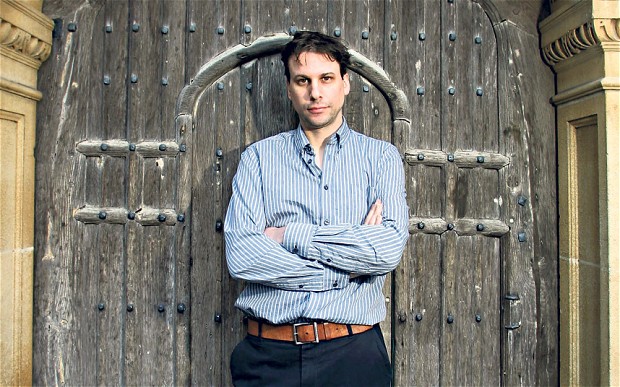
[Right: Thomas de Wesselow: The Telegraph]

instead His `resurrection' was actually the image on the Shroud!

"Mystery solved? Turin Shroud linked to Resurrection of Christ", The Telegraph, Peter Stanford, 24 Mar 2012 ... For centuries the Turin Shroud, regarded by some as the burial cloth of Jesus, by others as the most elaborate hoax in history, has inspired extraordinary and conflicting passions. ... scientists have dedicated their whole working lives to trying to explain rationally how the ghostly image on the cloth, even more striking when seen as a photographic negative, and matching in every last detail the crucifixion narrative, could have been created. And still a final, commonly agreed answer remains elusive, despite carbon-dating in 1988 having pronounced it a forgery. This is a very important point: the "medieval ... AD 1260-1390" radiocarbon date claimed in Nature (337: 1989) is not conclusive unless it can be shown how a medieval or earlier forger could have created an anatomically correct, photographic negative, full-length front and back image of a naked, crucified man, on linen, centuries before that anatomical and photographic negative knowledge existed! And also who was the forger? A great (if not the greatest) artist, as the forger would have to be, does not produce only one great masterpiece, and his other great works of art (as well as his teachers, pupils, and patrons), be completely unknown.

"That's what first attracted me," says Thomas de Wesselow, a... 40-year-old Cambridge academic. ... Eight years ago, de Wesselow was a successful art historian, based at King's College ... Today, he .. has thrown up his conventional career and any hopes of a professorial chair to join the ranks of what he laughingly calls "shroudies". ... But again it gets complicated, for the Vatican, since 1983 the owner of this hotly disputed icon, disappoints "shroudies" by limiting itself to declaring that the burial cloth is a representation of Jesus's crucified body, not his actual linen wrap. And it has accepted the carbon-dating tests as conclusive. This is simply false. When the then Archbishop of Turin, Cardinal Ballestrero, was in 1988 presented with the radiocarbon laboratories' "medieval ... 1260-1390" date of the Shroud, he naively stated that "he accepted the laboratories' findings," but this was sensationalised by certain British newspapers into a false claim that the Roman Catholic church admitted the Shroud was a forgery:

"Thus it was that on the morning of 14 October 1988 most of the world woke up to newspaper headlines - by no means always front-page news - that the Shroud had been `proven' to be a mediaeval fake. At his Turin press conference Cardinal Ballestrero, true to his earlier expressed insistence that the Church has nothing to fear from the truth, declared that he accepted the laboratories' findings even though, as he carefully added, `the problems about the origin of the image and its preservation still remain to a large extent unresolved'. England's Daily Telegraph newspaper duly translated this into the headline `Turin shroud is a forgery, says Catholic Church'." (Wilson, I., "The Blood and the Shroud," 1998, pp.7-8).
There is no space to go into it here, but the fact is that "the Vatican" did not agree with Cardinal Ballestrero's naive acceptance of the C14 laboratories' findings.

De Wesselow dismisses those tests as "fatally flawed". So, although he describes himself as agnostic, he now finds himself in the curious position of being more of a believer in the Shroud than the Pope. It is gratifying that de Wesselow has publicly stated that the 1988 carbon-14 tests were "fatally flawed". But if he really thinks that he is "more of a believer in the Shroud than the Pope," then his level of Shroud scholarship is seriously lacking. The fact is that the current Pope Benedict XVI in 2010 publicly all but endorsed the Sroud's authenticity:

"This is a moment that I have been waiting for for quite some time. I have found myself before the sacred Shroud on another occasion but this time I am experiencing this pilgrimage and this pause with particular intensity ... the Shroud ... is in fact a winding sheet, which covered the corpse of a man who was crucified, corresponding to everything that the Gospels say of Jesus, who was crucified about noon and died at about 3 in the afternoon." ("Pope's Remarks After Venerating Shroud of Turin," Zenit.org, TURIN, Italy, May 2, 2010).

And as "an agnostic" who accepts the Shroud as authentic, de Wesselow has no option but to deny Jesus' bodily resurrection. His position, while rare among those who accept the Shroud as authentic, is not unknown. The late Rodney Hoare, a past-President of the British Association of the Turin Shroud, wrote at least three books defending the Shroud's authenticity, but claimed that the Shroud showed that Jesus did not die on the Cross!

His historical detective work has convinced him, he insists, that it is exactly what it purports to be — the sheet that was wrapped round Jesus's battered body when it was cut down from the cross on Calvary. But that isn't the half of it. His new book, The Sign, the latest in a long line of tomes about the Shroud, makes an even more astonishing claim in its 450 pages (including over 100 of footnotes). It was, suggests de Wesselow, seeing the Shroud in the days immediately after the crucifixion, rather than any encounter with a flesh and blood, risen Christ, that convinced the apostles that Jesus had come back from the dead. This requires a wholesale rejection of what the Bible actually says, and replacing it with what the "agnostic" de Wesselow, imagines that it says. But the New Testament writers made it abundantly clear that Jesus rose from the dead and appeared to the disciples both singly and collectively. For example, Jesus' two appearance to the disciples in a locked Jerusalem room:

Jn 20:19-26 On the evening of that day, the first day of the week, the doors being locked where the disciples were for fear of the Jews, Jesus came and stood among them and said to them, `Peace be with you.' When he had said this, he showed them his hands and his side. Then the disciples were glad when they saw the Lord. Jesus said to them again, `Peace be with you. As the Father has sent me, even so I am sending you.' And when he had said this, he breathed on them and said to them, `Receive the Holy Spirit. If you forgive the sins of any, they are forgiven them; if you withhold forgiveness from any, it is withheld.' Now Thomas, one of the Twelve, called the Twin, was not with them when Jesus came. So the other disciples told him, `We have seen the Lord.' But he said to them, `Unless I see in his hands the mark of the nails, and place my finger into the mark of the nails, and place my hand into his side, I will never believe.' Eight days later, his disciples were inside again, and Thomas was with them. Although the doors were locked, Jesus came and stood among them and said, `Peace be with you.' Then he said to Thomas, `Put your finger here, and see my hands; and put out your hand, and place it in my side. Do not disbelieve, but believe.'

says nothing about the Shroud. Jesus not only appears to the disciples, but He speaks to them, something that an image on linen cannot do. So the Apostle John would have to be either a liar or massively deluded, if what really happened was that the disciples merely looked at Jesus' image on His burial Shroud.

Apart from its Biblical, psychological and moral problems, de Wesselow's theory itself is "fatally flawed." First, there wouldn't be a Shroud with Jesus' image on it for the disciples to see, in "the days immediately after the crucifixion." If Jesus was not resurrected and the Shroud covered His bloody, dead, and decomposing body, the disciples, being devout Jews, would have no reason (to put it mildly) to remove the Shroud from Jesus' ceremonially `unclean' corpse. The image is on the inside of the cloth, nearest Jesus' body, not the visible outside of it, so they would not know the image was there, even if it was. And if the disciples did remove the Shroud from Jesus' body, they would not be able to do it without breaking the blood clots adhering to both the body and the Shroud. But the blood clots on the Shroud are not broken:

"The second sign of the resurrection on the Shroud concerns the body's removal from the cloth. The facts militate against the body being removed from the Shroud by any human means because the bloodstains are intact. As we saw earlier, each bloodstain is characterized by anatomical correctness, including precisely outlined borders, with blood clots intact. If the cloth had been removed from the body, the blood clots would have smeared or broken. This precludes any separation of the body from the cloth by normal means. A moment's reflection will reveal some of the medical reasoning here. When the linen was wrapped lengthwise around Jesus' body, it contacted the shed blood flowing from the head, the open chest wound, and the left wrist, feet, and elsewhere. As the blood dried, the linen would have become loosely attached to the wounds. Removing the Shroud, however carefully, would require both the removal of blood clots and the disturbing of the edges of the bloodstains. Since this did not happen with the Shroud, we may assert the probability that the body left the cloth in some way other than normal unwrapping of the Shroud. The contact bloodstains indicate that the body was not moved, rewrapped, of unwrapped. " (Stevenson, K.E. & Habermas, G.R., "Verdict on the Shroud," 1981, p.156).

Second, why would there be an image of Jesus' body on His Shroud if it is not a "`snapshot' of the Resurrection"?:

"Even from the limited available information, a hypothetical glimpse of the power operating at the moment of creation of the Shroud's image may be ventured. In the darkness of the Jerusalem tomb the dead body of Jesus lay, unwashed, covered in blood, on a stone slab. Suddenly, there is a burst of mysterious power from it. In that instant the ... image ... of the body becomes indelibly fused onto the cloth, preserving for posterity a literal `snapshot' of the Resurrection." (Wilson, I., "The Turin Shroud," 1978, p.210.

After all, no other known burial shroud from antiquity has such an image of the corpse it covered. Then there is the fact that the Shroud's image "is extremely thin, around ... one fifth of a thousandth of a millimeter":

"Furthermore, the color of the image resides on the outer surface of the fibrils that make up the threads of the cloth, and recent measurements of fragments of the Shroud show that the thickness of staining is extremely thin, around 200 nm = 200 billionths of a meter, or one fifth of a thousandth of a millimeter, which corresponds to the thickness of the primary cell wall of the so-called single linen fiber." ("The Shroud is not a fake," The Vatican Insider, 12 December 2011).
but no chemicals or vapours emitted from a corpse could stain linen uniformly to that extremely superficial depth, which has only been able to be replicated on a small sample of linen using a very high power and frequency ultraviolet radiation laser.

If true, I point out, he is overturning 2,000 years of Christian history. But he doesn't even blink over his teacup. He's either ... out to make a quick buck with an eye-catching theory that caters for gullible readers of the likes of The Holy Blood and The Holy Grail ... or he's absolutely sincere. If de Wesselow is sincere (bearing in mind that he has proposed his theory via a no-doubt very lucrative Easter market book contract, not in the normal non-paying Shroud literature), then as Billy Graham once put it, he is "sincerely wrong."

"I am an art historian," he responds calmly, "not a theologian, so I can approach the problem from a new angle." This is arrogance, born of ignorance. As pointed out above, while it is comparatively rare on the pro-authenticity side, there is nothing new in de Wesselow position that: 1) the Shroud is authentic; but 2) Jesus was not resurrected. The agnostic Yves Delage believed that in the early 1900s. And more recently so did Rodney Hoare (see above).

It feels like we've reached a moment for laying our cards on the table before we start examining the details of his theory. The exact nature of the Resurrection troubles me, as it does many Christians. Was it physical, against all the laws of nature but as the Church claims, or was it "symbolic", as the Bishop of Durham, David Jenkins, famously suggested in 1984? Jenkins's ... willingness to question a "literal" resurrection did not put him so far outside the Christian mainstream as is often suggested. The resurrection is a cardinal doctrine of the historic Christian faith. Jesus predicted His own bodily resurrection:

Jn 2:18-22 So the Jews said to him, "What sign do you show us for doing these things?" Jesus answered them, "Destroy this temple, and in three days I will raise it up." The Jews then said, "It has taken forty-six years to build this temple, and will you raise it up in three days? But he was speaking about the temple of his body. When therefore he was raised from the dead, his disciples remembered that he had said this, and they believed the Scripture and the word that Jesus had spoken" (my emphasis)
so if that didn't happen, then Jesus was either deluded or a liar. Also St. Paul told the church at Corinth that:
1Cor 15:14 if Christ has not been raised, then our preaching is in vain and your faith is in vain.
and in the context Paul makes it clear that he means a bodily resurrection (see part #2). A `Christian' who denies the bodily resurrection of Jesus is as oxymoronic as someone who claims to be a Muslim but who denies the existence of Allah! Jesus Himself warned that there would be "many" on the Day of Judgment who thought they were Christians but will find out (too late) that they never were (Mt 7:21-23).

... The first challenge he faces is how to place the Shroud in first-century Jerusalem. The standard historical record of the Shroud – broadly endorsed by carbon-dating – traces its first appearance back to the 1350s in rural France, when a knight called Geoffrey de Charny put it on display in his local church. "But where did he get it from?" de Wesselow asks, perfectly reasonably. He highlights a connection between the French knight and the Crusaders who sacked Constantinople in 1204. "And we have a description of a cloth, that sounds very like the Shroud, that had been seen before that in Constantinople, described as the burial cloth of Jesus, that then goes missing and is never heard of again." So, de Wesselow's theory is that it was taken to France by the Crusaders as looted bounty. But what were the origins of the cloth in Constantinople? This brings us to the oddly named "Holy Mandylion" (man-dill-e-on), a long lost relic in Eastern Christianity, said to be the imprint of Jesus's face. "The Mandylion was brought to Constantinople in 944," says de Wesselow. "That is recorded. It was an object of fascination, said not to be made of paint but of blood, and described as a landscape shape, rather than a portrait."

This is not "de Wesselow's theory" but Ian Wilson's (see in part #2 where the journalist points that out to de Wesselow), first proposed in a paper to a Shroud conference in 1977 and then promoted in at least five of his books since 1978. But de Wesselow makes it sound like it is the result of his own "historical detective work," in which case, if he does not acknowledge in his book (as he evidently does not to this journalist) that Wilson's was the real "historical detective work" and all de Wesselow has done is copy it, then this would a case of plagiarism by de Wesselow.

The legend of the Mandylion is also given a reworking by de Wesselow. That cloth looted in 1204 was, he proposes, also the Mandylion. Its landscape format, he suggests with the aid of diagrams, was the result of it being the top fold of a bigger cloth – what we know as the Turin Shroud. It is an intriguing theory, with plenty of circumstantial evidence in those 100 pages of notes, and even mention of possible sightings back in the mid-sixth century, but nothing more precise.

Again, that the Shroud is the Mandylion (i.e. the Image of Edessa) "doubled in four" is Wilson's discovery:

"For me a crucial breakthrough in overcoming this objection surfaced in the 1960s, when I noticed how a sixth-century Greek version of the Abgar story, the Acts of the Holy Apostle Thaddaeus', describes the Edessa cloth as a tetradiplon. In all the corpus of Greek literature tetradiplon is an extremely rare word, and totally exclusive to the Edessa cloth. Yet, because it is a combination of two common words, tetra meaning `four' and diplon meaning `two fold' or `doubled', its meaning is actually very clear: `doubled in four', suggesting four times two folds. This immediately raised the thought: `What happens if you try giving the Shroud four times two folds? When I tried this, using a full-length photograph of the Shroud, I was dumb-founded by the result - as I continue to be today. There was the Shroud face, front-facing and disembodied-looking on a landscape aspect cloth, exactly as on the earliest artists' copies of the cloth of Edessa. Whenever the Shroud is presented in this manner - and it is a very logical way to present and make manageable a 437 cm length of cloth - its nature as a `shroud' is in fact subordinated to its rather more socially acceptable nature as a `portrait'. And historically such an arrangement finds ready support in the description of the Edessa cloth, on its arrival in Constantinople, as `fastened to a board and covered with the gold which is now to be seen'. It therefore readily explains the many centuries of silence about an image-bearing `shroud' as such." (Wilson, I. & Schwortz, B., "The Turin Shroud: The Illustrated Evidence," 2000, pp.110-111).
and if de Wesselow did not tell the journalist that, before (as we shall see), the journalist told de Wesselow, then that would be a form of plagiarism. Note that I do not claim that de Wesselow has committed plagiarism in his book, since I have not read it, but if this article is a true record of what he said to this journalist, then he did not up-front acknowledge Ian Wilson's historical research into the Shroud-Mandylion identity, while giving the impression to The Telegraph's readers that it was the result of his own "historical detective work."

[Continued in part #2]

Posted 28 March 2012. Updated 29 August 2025.

Sunday, March 18, 2012

Four proofs that the AD 1260-1390 radiocarbon date for the Shroud has to be wrong!: #2 The Vignon markings (4)

This part "#2 The Vignon markings (4)" is a continuation from my part #2 (3), of my series "Four proofs that the AD 1260-1390 radiocarbon date for the Shroud has to be wrong!"

Continuing with further examples of 6th to 12th century artistic representations of Christ's face which bear the Vignon markings found on the Shroud, including:

Christ Pantocrator in the catacomb of St. Pontianus, Rome (7th-8th century)

[Above (enlarge): Bust of Christ from the catacomb of St. Pontianus, Rome: Catacomba di Ponziano, Wikipedia, 31 January 2012. Note in particular the Vignon marking on this 7-8th century mosaic: "(2) three-sided [topless] `square' between brows (see below).]

This Christ Pantocrator fresco in the Catacomb of St. Pontianus (or St. Ponziano), Rome, dates from the end of the seventh [1] or eighth century. [2] It can scarcely be later than the eighth century because the catacomb was closed down in AD 820 and only reopened in 1852. [3] The face of Christ is so close iconographically to the coins of Justinian II (see part #2 (3)) that its date is probably the same - the end of the seventh century.[3]

In the 1930s, artist and biologist Paul Vignon began his study of sixth to twelfth century Byzantine faces of Christ which had certain peculiar markings that are also found on the Shroud. [4] He paid special attention to this Christ Pantocrator in the catacomb of St. Pontianus near Rome, and in particular to a topless square shape on the forehead between the eyebrows. [4] Artistically it made no sense, but there was on the equivalent point on the Shroud face the same feature [4], which was merely a flaw in the weave. [5] Of the hundreds of Byzantine icons Vignon examined, 80 percent had this particular identifying mark between the eyes.[6]

[Above (enlarge): The Shroud face clearly showing the "topless square" (amongst other Vignon markings) between the Man on the Shroud's eyebrows: ShroudScope. As can be seen, this is just a flaw or crease in the Shroud's weave. It therefore alone is proof beyond reasonable doubt the Shroud is the original from which these sixth to twelfth century icons are copies:

"An interesting argument is that in the law courts (where proof `beyond reasonable doubt' is required), cases of plagiarism or breach of copyright will be settled in the plaintiff's favour if it can be shown that the text (or whatever) is supposed to have been copied contains errors present in the original. Similarly, in tracing the texts of ancient authors, the best evidence that two versions are copies one from another or from the same original is when both contain the same errors. A charming example is an intrusive colon within a phrase in two fourteenth-century texts of Euripides: one colon turned out to be a scrap of straw embedded in the paper, proving that the other text was a later copy." [7]]

There are at least eight of these Vignon markings on this fresco. [8] Indeed, as can be seen above, it has at least eleven of the fifteen Vignon markings:

"(1) Transverse streak across forehead, (2) three-sided `square' between brows, ... (5) raised right eyebrow, (6) accentuated left cheek, (7) accentuated right cheek, (8) enlarged left nostril, (9) accentuated line between nose and upper lip, ... (12) forked beard, (13) transverse line across throat, (14) heavily accentuated owlish eyes, (15) two strands of hair. [9] (see part #2 (1)).

There probably would also be two more: "(10) heavy line under lower lip" and "(11) hairless area between lower lip and beard" but that area of the fresco is missing.

As Ian Wilson has pointed out:

"Just as the viewing of a single footprint on fresh sand provided for Robinson Crusoe the conclusive evidence that there was another human being (later revealed as Man Friday) on his island, so the presence of this topless square on an indisputably seventh/eighth-century fresco virtually demands that the Shroud must have been around, somewhere, in some form at this early date." [3]

The only reasonable explanation of these distinctive Vignon markings which are all found on the Shroud, is that the Shroud was in existence as early as the sixth century, and therefore they conclusively refute the radiocarbon-dating of the Shroud to the 13th-14th century! [2]

Continued with "Four proofs that the AD 1260-1390 radiocarbon date for the Shroud has to be wrong!: #2 The Vignon markings (5)."

References
[1] Wilson, I., 1991, "Holy Faces, Secret Places: The Quest for Jesus' True Likeness," Doubleday: London, pp.167-168. [return]
[2] Scavone, D.C., 1991, "The History of the Turin Shroud to the 14th C," in Berard, A., ed., 1991, "History, Science, Theology and the Shroud," Symposium Proceedings, St. Louis Missouri, June 22-23, 1991, The Man in the Shroud Committee of Amarillo, Texas: Amarillo TX, p.189. [return]
[3] Wilson, 1991, p.168. [return]
[4] Wilson, I., 1978, "The Turin Shroud," Book Club Associates: London, p.84. return]
[5] Wilson, I., 2010, "The Shroud: The 2000-Year-Old Mystery Solved," Bantam Press: London, p.142. [return]
[6] Wilcox, R.K., 1977, "Shroud," Macmillan: New York NY, p.85. [return]
[7] Patterson, C., 1999, "Evolution," Cornell University Press: Ithaca NY, Second edition, p.117. [return]
[8] Maher, R.W., 1986, "Science, History, and the Shroud of Turin," Vantage Press: New York NY. [return]
[9] Wilson, 1978, p.82e]. [return]

Posted 18 March 2012. Updated 1 February 2026.

Saturday, March 3, 2012

`I heard the Shroud image was made by a bas-relief metal sculpture heated'

This is my `fleshed out' response to an anonymous comment on my post "Four proofs that the AD 1260-1390 radiocarbon date for the Shroud has to be wrong!: #2 The Vignon markings (3)." I have improved the poor English of the comment.

>I'm confused, I heard it was made by a bas-relief metal sculpture heated but I'm not sure could some one elaborate because I'm on the verge of accepting authenticity but the bas-relief theory seems somewhat credible.

[Right: A bas-relief `duplicate' of the Shroud, by Paul-Eric Blanrue and Patrick Shepherd, "A false Shroud of Turin carried out in five minutes," Science et Vie, June 2005. Its gross inferiority to the Shroud face is obvious. Note the `hot spot' on the nose (see below) and the bright bloodstains due either to them having been cooked, or added after the image was formed (see below).]

First, "bas relief is a sculpture technique in which ... relief is created either by carving away material ... or adding material to the top of an otherwise smooth surface":
"bas relief ... A French term from the Italian basso-relievo ("low relief"), bas relief is a sculpture technique in which figures and/or other design elements are just barely more prominent than the (overall flat) background. Bas relief is created either by carving away material (wood, stone, ivory, jade, etc.) or adding material to the top of an otherwise smooth surface (say, strips of clay to stone). This is a technique as old as humankind's artistic explorations, and is closely related to high relief." ("bas relief," Shelley Esaak, About.com: Art History).
On that definition, "bas-relief" is a misnomer for the Shroud image, because the latter is double-sided, front and back and a bas-relief is a single-sided flat surface, upon which relief is built up. What really is (or should be) meant by "bas-relief" in the context of attempting to explain, or duplicate, the Shroud image, is "statue."

In this post I am going to concentrate on the `hot statue scorch' rather that the `cold powder rubbing' method of using a statue or `bas-relief' to recreate the Shroud image because: a) there is no powder (or dye, pigment or paint) on the Shroud in sufficient quantity to account for its image:

"Unfortunately, Mueller, Nickell, and others who have jumped onto the McCrone bandwagon seem blissfully unaware that for purely technical reasons the painting theory, regardless of the methodology, is a dead issue. Amazingly enough they continue to flog away at the now rotting carcass of this long dead horse. Nickell, for example, touts a dusting/rubbing method which obviously would leave a heavy distribution of chemicals between the fibers of the cloth and on its reverse side. Body paintings and rubbings invariably contain pigment layers and distortion in three-dimensional projection, all of which are absent on the Shroud." (Stevenson, K.E. & Habermas, G.R., "The Shroud and the Controversy," 1990, p.30);
and b) the commenter asked me about "a bas-relief metal sculpture heated" (my emphasis).

Here, are some problems of a hot statue/bas relief being used in creating the Shroud of Turin image:

1. The medieval, or earlier, forger first had to create the statue in stone or metal, with anatomical precision which was unknown until hundreds of years after the Shroud first appeared in undisputed history at Lirey, France in the mid-1350s:

"Even so the `hot statue' theory suffers from the serious problem that it demands the existence, back in the fourteenth century, of a life-size, anatomically convincing and totally nude statue of a recumbent Jesus, made in metal, that someone managed to heat to just the right temperature and manipulate so that a fourteen-foot length of linen could be wrapped all round it." (Wilson, I., "The Blood and the Shroud," 1998, pp.203-204).
2. Such a statue would be one of the world's greatest artwork in its own right, yet there is no record of it having existed:
"Where is the statue or the bas-relief that the artist used? It would have graced the finest cathedral and become a famous image in its own right." (Stevenson, K.E. & Habermas, G.R., "Verdict on the Shroud," 1981, p.109).
3. The forger could run off multiple copies of the Shroud from the stone or metal statue, and make a lot of money, but there is only one copy of the Shroud:
"An artist who was good enough to create an image as impressive as the Shroud's would surely have made many copies of it. Shroud copies of this level of artistry would have demanded a king's ransom." (Stevenson & Habermas, 1981, p.109).
4. The blood was on the Shroud linen before the image, so the forger would have to place the blood-stained linen over a hot statue, which would cook the blood:
"Microscopic and ultraviolet examinations of the Shroud indicate that the blood images were transferred to the cloth before the body image. If the body image were encoded through contact with a hot surface, thermal discoloration or degradation of bloodied fibrils would be evident because the blood images would have been in direct contact with the bas-relief heated to temperatures high enough to scorch linen. Indeed, this effect appeared in the experimental testing of this technique. Microscopic study of the bloodstains on the Shroud, however, reveals no thermal discoloration or fusing (except in areas where the fire marks of 1532 intersected bloodstains)." (Antonacci, M., "Resurrection of the Shroud," 2000, p.79).

"The many characteristics of the blood and serum marks also could not be reproduced with a draped hot statue. In particular, the blood marks would undergo thermal degradation as a result of their contact with a hot surface." (Antonacci, 2000, p.79).
5. The blood clots are intact on the Shroud, so the forger could not have smeared the clots as he placed the blood-stained linen shroud over a hot statue nor when he separated the linen sheet from the statue:
"The second sign of the resurrection on the Shroud concerns the body's removal from the cloth. The facts militate against the body being removed from the Shroud by any human means because the bloodstains are intact. As we saw earlier, each bloodstain is characterized by anatomical correctness, including precisely outlined borders, with blood clots intact. If the cloth had been removed from the body, the blood clots would have smeared or broken. This precludes any separation of the body from the cloth by normal means. A moment's reflection will reveal some of the medical reasoning here. When the linen was wrapped lengthwise around Jesus' body, it contacted the shed blood flowing from the head, the open chest wound, and the left wrist, feet, and elsewhere. As the blood dried, the linen would have become loosely attached to the wounds. Removing the Shroud, however carefully, would require both the removal of blood clots and the disturbing of the edges of the bloodstains. Since this did not happen with the Shroud, we may assert the probability that the body left the cloth in some way other than normal unwrapping of the Shroud. The contact bloodstains indicate that the body was not moved, rewrapped, of unwrapped. " (Stevenson & Habermas, 1981, p.156).

"The Man of the Shroud separated perfectly from the Shroud, with a technic which has left the imprints of blood clots on the fabric without leaving smears or streaks of blood, as would have happened if the clots had been moist, and without flaking or impairing these clots as would have happened if they had been dry." (Zeuli, T., "Jesus Christ is the Man of the Shroud," Shroud Spectrum International, Vol. 3, No. 10, March 1984, pp.32-33).
6. A hot statue would burn through the linen cloth but the Shroud image is extremely superficial, being only on the topmost fibrils, to a depth of only one-fifth of one thousandth of a millimetre (0.0002 mm):
"Even though the heated bas-relief produced better three-dimensional information than other methods, Jackson and colleagues concluded that this process could not encode many of the necessary Shroud image characteristics. For example, regardless of the temperature of the bas-relief, thermal discoloration appeared on the back side of the test cloth within several seconds after being placed on the hot bas-relief. Thus, the superficiality characteristic is violated because the image could not be encoded only on the topmost fibrils of the linen." (Antonacci, 2000, pp.78-79).

"Furthermore, the hot statue technique would scorch the image into multiple layers of the linen's threads, which means the image could not be superficial and confined to only the topmost fibrils of the cloth." (Antonacci, 2000, p.79).
7. A hot statue/bas relief would burn through, or scorch with a darker colour, the linen at high density contact points (e.g. the nose, hands, and feet):
"We turned once more to heat. A hot bas-relief - of all the models measured by the physicists - gave some distance information, but it was seriously flawed. When the bas-relief was hot enough to cause the recessed areas to show on linen, the hot spots, like the tip of the nose, burned through the cloth. Considering the heat conductivity of linen - wet or dry - the mechanism did not work." (Heller, J.H., "Report on the Shroud of Turin," 1983, p.211).

"Another objection to the hot statue method lies in the inevitable creation of `hot spots' or well-defined regions of enhanced image density at points where the statue touched the cloth. Such spots would necessarily result from thermal conduction, yet no such regions are present on the Shroud body image ... the entire image contains the same density of coloration." (Antonacci, 2000, p.79).
8. A hot statue scorch, like all heat scorches on linen, would fluoresce under ultraviolet light (as the scorches on the Shroud from the 1532 fire do), but the image on the Shroud does not fluoresce:
"Another popular concept has been that, instead of a body, a lifesize statue or relief was employed. Prior to 1978 there was considerable interest in the Shroud body image's similarity to the scorches from the 1532 fire. It was theorized that someone in the Middle Ages had produced the Shroud's delicate gradations by wrapping the cloth around a heated metal statue, the linen receiving scorches proportionately more intense according to the cloth's distance from any one part of the hot statue. Cogent as this idea might seem ... scorches fluoresce under ultraviolet light, and while the Shroud's scorches from the 1532 fire indeed do so, the body image does not." (Wilson, I., "The Evidence of the Shroud," 1986, p.66).

"Further contradicting any such `scorch' theory is the fact that the STURP team's ultraviolet fluorescence photography of 1978 revealed that whereas the cloth's scorches from the 1532 fire fluoresce red when irradiated with ultraviolet light, the body images do not. This argues strongly against the Shroud's body image having been created in some conventional scorch-like manner." (Wilson, 1998, p.204).
9. A scorch from a hot statue does not convey accurate three-dimensional information to the cloth it scorches:
"In short, though none of the Shroud opponents would willingly concede this point, the three-dimensional effect is the Waterloo for all artistic theories. That same effect has been scientifically demonstrated and subjected to the best peer review. And it still stands. Also, this same characteristic proves to be the acid test for all the image formation theories Dr. Jackson tried regardless of how well they met or failed to meet the other known Shroud image characteristics. A catalog of ruled-out theories includes the following: direct contact, diffusion, lab-induced radiation from a body shape, engraving, powdered bas-reliefs, electrostatic imaging, phosphorescent statues, hot statues or hot bas-reliefs." (Stevenson & Habermas, 1990, p.33. My emphasis).

Heated Bas-Relief/Scorch Theory Another possible image-forming mechanism similar to that proposed by Nickell involves pressing a stretched cloth over a heated bas-relief ... This theory is more intriguing than most because the Shroud image does appear to have many of the physical and chemical properties of a light scorch ... sharp focus found on the Shroud. While the bas-relief method seemingly yields a respectable three-dimensional image, problems are evident in the accompanying VP-8 relief of this image. Hollow spots below the eyes, next to the bridge of the nose, below the lips, in the beard, and on the forehead are all noticeable in figure. Further, a slight plateau is visible on the high spots of the VP-8 relief, similar to those produced in VP-8 analysis of results from experiments with direct-contact methods." (Antonacci, 2000, pp.77-78. Emphasis original).
10. A scorch from a hot statue/bas-relief would produce a blurred image, not the sharp, high-resolution image on the Shroud:
"Hot Statue Method Just as the heated bas-relief method cannot account for all the Shroud image characteristics, neither can the hot statue technique, which involves laying cloth over a full-size three-dimensional hot statue. A hot statue would produce an isotropic radiation source, which means the heat radiates the same in all directions. This type of uniform radiation could not produce the subtle cloth-drape distortions found on the Shroud because the distance information encoded onto the cloth would not be transferred along vertical, straight-line paths; instead, the heat would travel in all directions and produce a blurred image." (Antonacci, 2000, p.79. Emphasis original).

"Techniques other than painting have been proposed. One idea is that the scorchlike effect was created by heating a life-size metal statue and wrapping the cloth around it. But the end result, once again, is a distorted and bloated image." (Picknett, L. & Prince, C., "The Turin Shroud: How Da Vinci Fooled History," 2006, p.77).
Note that the last mentioned criticism of the "heating a life-size metal statue and wrapping the cloth around it" method was by two Shroud anti-authenticists!

There is a simple way to prove that the Shroud image was created by a bas-relief/hot statue method: replicate the full Shroud image, front and back, complete with bloodstains, using that method:

a. Make a metal or stone statue with the anatomical precision of the Shroud image (now that we have that anatomical knowledge unavailable in the 14th century), complete with over 100 accurate whip marks from a Roman flagrum, flower images, etc;

b. Apply anatomically correct arterial and venous blood (now that we have that knowledge of blood circulation since Harvey discovered it in the 1620s) to a ~4.4 x 1.1 metre linen cloth;

c. Heat the statue by burning coal, wood, charcoal or oil (since electric heating was unknown in the 14th century) to the correct uniform temperature (otherwise the scorch won't be uniform as the image is on the Shroud);

d. Envelop the hot statue with the bloodstained ~4.4 x 1.1 metre linen cloth, front and back, almost instantaneously so no part of the cloth receives more heat than the other (otherwise the scorch won't be uniform as the image is on the Shroud), without smearing the blood;

e. Ensure that the scorch does not fluoresce under ultraviolet light (which was unknown in the 14th century), as the Shroud's image doesn't, even though all heat scorches on linen do fluoresce under ultraviolet light;

Clearly this cannot be done today, even though we have the Shroud as a model, let alone by a medieval or earlier forger who didn't, and therefore the hot statue/bas-relief theory is yet another failed naturalistic theory of how the Shroud's image was formed.

Posted 3 March 2012. Updated 21 October 2025.