Tuesday, September 11, 2012

My critique of Charles Freeman's "The Turin Shroud and the Image of Edessa: A Misguided Journey," part 9: "The Image of Edessa" (5)

Continuing from part 8 of my critique of historian Charles Freeman's, "The Turin Shroud and the Image of Edessa: A Misguided Journey," May 24, 2012 [pages 7-8] with this part 9, "The Image of Edessa" (5).

[Above: My illustration of Freeman's "four foot by four foot" square Image of Edessa (see below), marked with `one foot' gridlines, and with his own "good example" of the Image, "one of the panels of the Santa Chiara triptych (c. 1330-50) in the Sartario Museum in Trieste" (see part 7) in the centre, making Freeman's "foot by two foot square" face image, in portrait aspect.]

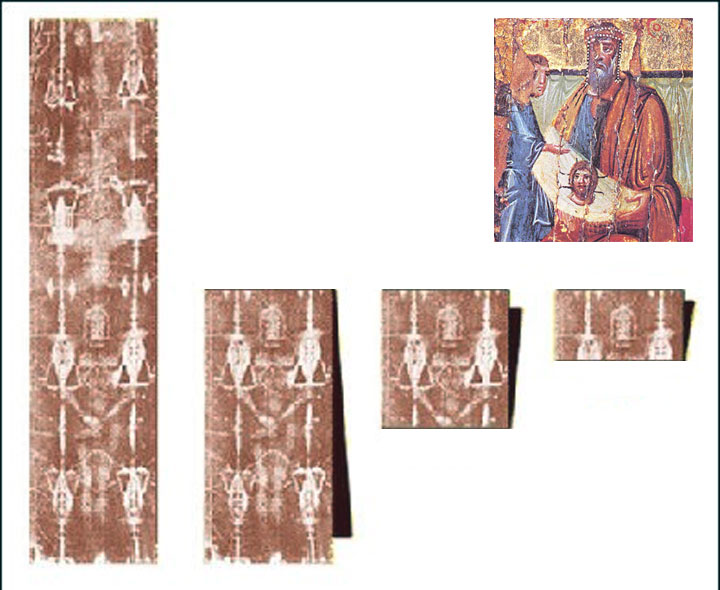
Freeman continues, looking first at two arguments that historian Ian Wilson provides for his attribution of the Image of Edessa being the Shroud of Turin (folded eight times, with Jesus head only visible in landscape aspect).

"What arguments can Wilson provide for his attribution? I will look at those from before the sixth century later but here let us take just two. He has tracked down one of the legendary accounts of the origins of the Image of Edessa in a sixth century text, the Acts of Thaddeus (or Jude). This gives a standard account of the image having been made by Christ himself and this in itself just provides further evidence against Wilson's thesis!"
Here is the relevant part of the Acts of Thaddeus:
"In those times there was a governor of the city of Edessa, Abgarus [Abgar] by name. And there having gone abroad the fame of Christ, of the wonders which He did, and of His teaching, Abgarus having heard of it, was astonished, and desired to see Christ, and could not leave his city and government. And about the days of the Passion and the plots of the Jews, Abgarus, being seized by an incurable disease, sent a letter to Christ by Ananias the courier ... And Ananias, having gone and given the letter, was carefully looking at Christ, but was unable to fix Him in his mind. And He knew as knowing the heart, and asked to wash Himself; and a towel [Gk. tetradiplon] was given Him; and when He had washed Himself, He wiped His face with it. And His image having been imprinted upon the linen [Gk. sindon], He gave it to Ananias, saying: Give this, and take back this message, to him that sent you: Peace to you and your city!"("The Acts of Thaddaeus, One of the Twelve," New Advent, 29 January 2010).
Freeman had just stated that the Acts of Thaddeus is "one of the legendary accounts of the origins of the Image of Edessa." So how can a "legendary account," which claims that Jesus' image was imprinted upon a linen towel when Jesus wiped His wet face with it, be regarded as historically factual? And what about Freeman's previous statement in this same paper (see part 6) that:
"In the case of the Image of Edessa there were two or three stories, that it had been painted by the court painter of king Abgar or, more usually, that Christ himself had wiped his face with a cloth and the image had been imprinted. ... What is important is that these images are not known before the sixth century and the stories of their origins must be treated as legendary."
So if Freeman believes that those stories which say that the Image of Edessa was imprinted on a cloth when Christ wiped his face with it, "must be treated as legendary," how can he then claim that one of those stories, in the Acts of Thaddeus, "provides further evidence against Wilson's thesis"? Neither Wilson, nor any Shroud pro-authenticist, believes that Jesus' image was imprinted on the Shroud while He was alive. Indeed, Wilson actually states in his latest book, which Freeman implies he has read, that, "... the Acts of Thaddaeus ... its initially off-putting aspect is that it 'explains' the creation of the Image as by Jesus washing himself ...":
"In the case of the Image of Edessa's dimensions, one important indicator is to be found in one of the very first documents to provide a 'revised version' of the King Abgar story in the wake of the cloth's rediscovery. The document in question is the Acts of Thaddaeus, dating either to the sixth or early seventh century. Although its initially off-putting aspect is that it 'explains' the creation of the Image as by Jesus washing himself, it intriguingly goes on to describe the cloth on which the Image was imprinted as tetradiplon `doubled in four'. It is a very unusual word, in all Byzantine literature pertaining only to the Image of Edessa, and therefore seeming to indicate some unusual way in which the Edessa cloth was folded. So what happens if we try doubling the Shroud in four? If we take a full-length photographic print of the Shroud, double it, then double it twice again, we find the Shroud in eight (or two times four) segments, an arrangement seeming to correspond to what is intended by the sixth-century description (fig. 25). And the quite startling finding from folding the Shroud in this way is that its face appears disembodied on a landscape-aspect cloth exactly corresponding to the later 'direct' artists' copies of the Image of Edessa." (Wilson, I., "The Shroud: The 2000-Year-Old Mystery Solved," 2010, p.140).
As can be seen above, Wilson's major claim about the Acts of Thaddaeus is that:
"... it intriguingly goes on to describe the cloth on which the Image was imprinted as tetradiplon `doubled in four'. It is a very unusual word, in all Byzantine literature pertaining only to the Image of Edessa, and therefore seeming to indicate some unusual way in which the Edessa cloth was folded."
And that:
"If we take a full-length photographic print of the Shroud, double it, then double it twice again, we find the Shroud in eight (or two times four) segments, an arrangement seeming to correspond to what is intended by the sixth-century description (fig. 25). And the quite startling finding from folding the Shroud in this way is that its face appears disembodied on a landscape-aspect cloth exactly corresponding to the later 'direct' artists' copies of the Image of Edessa."
[Above enlarge): "Tetradiplon," The Definitive Shroud of Turin FAQ, (No longer online), Dan Porter, 2009. Illustration of Ian Wilson's discovery, that if the Shroud of Turin is doubled four times, keeping Jesus' face image uppermost, the result is Jesus' face only, in landscape aspect, exactly as it is in the earlies copies of the Image of Edessa! See my "Tetradiplon and the Shroud of Turin."]

So again Freeman, "fails to tell his readers relevant material which might undermine his case, weak though it already is" (to quote Freeman's own criticism of Wilson in this very paper), so that he can take a cheap shot at Wilson, knowing that his Skeptical Shroud of Turin Website readers would be unlikely to notice his self-contradiction.

Having softened up his readers so that they are in the frame of mind to reject Wilson's real point about the Acts of Thaddaeus (see above), Freeman now tries (unsuccessfully) to explain away Wilson's discovery:

However, the Acts go on to describe the image as tetradiplon which seems to imply some form of doubling (diplon) taking place four (tetra) times.
Freeman continues to mislead his readers by concealing from them that tetradiplon, which literally means "four-doubled," is unique in all of known ancient Greek literature. As Wilson stated in his book (see above) and Freeman must have read, "in all Byzantine [and Greek] literature" it occurs "pertaining only to the Image of Edessa."

Freeman continues:

This is not difficult to explain. All cloth needs to be folded and stored against the damp and other molesters, and this is usually done in a wooden box or chest. This would be as necessary for the Image of Edessa as it would be for the Turin Shroud whenever the latter was made.
Freeman misses the point. A cloth is not normally described by its method of folding. And there would not be only one right way to fold a cloth. Nor would it be necessary to coin a unique Greek word, tetradiplon ("four-doubled") to describe the way a cloth was folded. Wilson is surely correct when he says (see above) that tetradiplon "indicate[s] some unusual way in which the Edessa cloth was folded."

And if Freeman had actually read Wilson's book, he need not have been so vague. Because Wilson quotes from the tenth century Story of the Image of Edessa that the Image of Edessa was stored and carried about in a wooden chest:
"Thus, the Story of the Image of Edessa - whether or not it was directly written by or merely commissioned by the Emperor includes some tantalizing indirect snippets of information about the Image's physical appearance, even though it never provides us with any direct description. In terms of the Image's housing, the Story includes several mentions of its being carried around Constantinople, together with the letter of Jesus to Abgar, in a kibotos, which means a coffer or chest. In the description of how the Image had been stored in Edessa the alternative word used was theke, carrying much the same meaning. There is therefore a strong suggestion that whether it was being transported long distance or being stored long term, its housing was rather more substantial than might be expected for something that was merely a headscarf-size piece of cloth." (Wilson, 2010, p.174).

Freeman continues with his attempt at an ordinary explanation of how the cloth bearing the Image of Edessa was stored:

Now how to store the Image of Edessa? It would clearly have been sacrilegious to have folded the sacred face of Christ and one would expect that the face would be fully visible when the protective box was opened.

Again Freeman reveals his ignorance of the Edessa Image, in assuming it was stored loose. But as Wilson, again quoting from the Story of the Image of Edessa, points out, the cloth bearing Jesus' face was "fixed to a wooden board and adorned with ... gold":
"The Story also makes fairly explicit that, as a piece of linen cloth, the Image was mounted in some form rather than merely being stored loose. For it relates that after King Abgar had been cured of his disease, he ordered the Image to be 'fixed to a wooden board and adorned with the gold that can still be seen. He had these words inscribed on the gold: "Christ, the God. Whoever hopes in you will never be disappointed.'" [Guscin, M., "The Image of Edessa," 2009, p.33] The strong inference is that at the time of the Story's composition - understood to have been no later than 16 August 945 - the Image was being preserved in Constantinople in the very same mounting provided for it while it was being kept in Edessa, a mounting possibly dating even as far back as Abgar's time." (Wilson, 2010, p.174).

So Freeman's `explanation', premised on a loose cloth, fails right there! Freeman, aptly, prefaces his `explanation' with "Now let us suppose ...":
Now let us suppose the Image was four foot by four foot. Lay it on the ground, draw a horizontal fold across the cloth one foot down from the top and fold the resulting rectangle underneath the cloth. This is the first doubling.

[Above: My illustration of what would be seen (minus the gridlines) after Freeman's "first doubling" of his "four foot by four foot" square Edessa Cloth (see above). But as can be seen, this is not a "doubling" of the whole cloth. It is merely a folding over of 4/16ths or one-quarter of Freeman's "four foot by four foot" square cloth bearing the Edessa Image.]

Continuing with Freeman's already failed (because the Edessa Image was not loose but fixed to a board) `explanation':

Repeat with the lower part of the cloth ...

[Above: My illustration of what would be seen after Freeman's "second doubling" of his originally "four foot by four foot" square cloth bearing the Edessa Image. Again, this is not a "doubling" of the whole cloth, but merely a folding over of another one-quarter of Freeman's originally "four foot by four foot" square Edessa Image cloth.]

Continuing with Freeman's failed `explanation':

... and then the two sides...

[Left: My illustration of what would be seen of the Edessa Cloth after Freeman's third `doubling' of it. But as can be seen, it is even less a "doubling" of the whole cloth, being only a folding of 2/16ths or 1/8th of the remaining left edge. And the original top left and bottom left corners that were already folded in the first and second `doubling' are now not doubled, they are quadrupled!]

[Right: My illustration of the Edessa Cloth after Freeman's fourth `doubling' of it. As can be seen, like the left hand `doubling', it is also only a folding of 1/8th of the remaining right edge. And again, the original top right and bottom right corners that were already folded in the first and second `doubling' are now quadrupled!]

Freeman concludes his `explanation':

... so as to make four doublings, and you have a folded cloth, with the face, now in a two foot by two foot square, ready for storing in a much smaller box.
Freeman deceives himself. Did he ever check this out? As can be seen, he has not doubled the whole cloth. All he has done is folded over: 1/4 + 1/4 + 1/8 + 1/8 = three quarters of the whole cloth. And the centre one quarter was not "doubled" at all!

So Freeman's alternative `explanation' fails not once, but four times: First, the oldest copies of the Edessa Image show Jesus' face on a rectangular cloth in landscape aspect, not on a square cloth in portrait aspect. Second, according to the 10th century Constantinople Story of the Image of Edessa, the Edessa Image was not a loose cloth as Freeman's explanation requires, but it was "fixed to a wooden board." Third, Freeman's "four doublings" explanation are not even that, but a folding over of a total of only three-quarters of his "four foot by four foot" square cloth, leaving the central one-quarter not doubled at all. Fourth, Freeman's `four-folding' ordinary explanation is just that. Ordinary! There would be no need to coin a unique word, tetradiplon ("four-doubled") to describe the result and in fact, it would not be described as "four-doubled".

Freeman concludes this section of his paper with an unscholarly dogmatic assertion:

As the Image of Edessa was never the Shroud of Turin in the first place, we do not need Ian Wilson's elaborate explanation (p.190 ff.) of how the Shroud, as we know it today, could be folded into four!

Freeman evidently thinks he is omniscient, being able to infallibly affirm that "the Image of Edessa was never the Shroud of Turin in the first place"! Freeman is here like the preacher whose sermon outline had a note: "Argument weak here: SHOUT!" That Freeman feels he needs to conclude his evaluation of only two of Wilson's arguments why the Image of Edessa is the Turin Shroud, with a dogmatic assertion, I interpret as `body language' revealing that deep down Freeman knows that he hasn't refuted Wilson's arguments at all.

And as for Freeman's "we do not need Ian Wilson's elaborate explanation ... of how the Shroud, as we know it today, could be folded into four," at least Wilson's explanation, unlike Freeman's: 1) accounts for the unique word tetradiplon ("four-doubled") being applied only to the Image of Edessa; and 2) explains why, if the Shroud is folded eight times (doubled four times), keeping Jesus' face image uppermost, the result is Jesus' face in the centre of a rectangular cloth, in landscape aspect, exactly as the earliest copies of the Image of Edessa, depict it (see above).

Continued in part 10: "The Image of Edessa" (6).

Posted 11 September 2012. Updated 15 February 2026.

Tuesday, September 4, 2012

My critique of Charles Freeman's "The Turin Shroud and the Image of Edessa: A Misguided Journey," part 8: "The Image of Edessa" (4)

Here is part 8, "The Image of Edessa" (4), of my critique of historian Charles Freeman's, "The Turin Shroud and the Image of Edessa: A Misguided Journey," May 24, 2012 [page 7]. See previous part 7.

[Above (enlarge): Fifth century depiction of the crucifixion of Christ between the two thieves, without crosses, on the wooden door of the Basilica of Saint Sabina, Rome. This is one of the earliest surviving depiction of the crucifixion of Christ: "Santa Sabina," Wikipedia, 3 September 2012]

Freeman continues with his reasons why he thinks the Image of Edessa is not the Shroud of Turin (doubled four times with only Jesus' head visible in landscape aspect):

There are two reasons why this could not be the Shroud of Turin (quite apart from the lack of water damage on the eyes of the Shroud!). The first is that no one knowing the legend that gave the image its authenticity, as a cloth wiped by Christ himself on his face while he was alive, would have stared at the face we see the Turin Shroud and have believed that this was an image of a living man. We can assume that the image, if extant, in the sixth century, would have been brighter than it is now. It might have been possible to fold the Turin Shroud up to conceal the image of a naked lifeless body but this could hardly have been kept secret for long. The Turin Shroud is of a dead man, the Edessa image is, like all the other images of this time, a living Christ. They cannot be one and the same.

Freeman's first- mentioned reason why the Image of Edessa cannot be the Shroud, "the lack of water damage on the eyes of the Shroud," doesn't hold water (pun intended)! First, as we saw in part 7, art historian Hans Belting's report that on feast days the people of Edessa approached the Edessa Image and sprinkled water on its eyes, is anonymous, vague, and not contemporaneous. And as I pointed out, it is highly unlikely that the Edessan clergy would have let the common people get close enough to their holiest relic for them to be able to sprinkle water on its eyes, let alone allowing them to do it.

Besides, even if water was sprinkled on the Image of Edessa's eyes (which are the Shroud image's eyes), the Shroud has been through at least two fires in 1532 and 1997, when water was used to put out those fires, and yet the Shroud's image was not affected. That is because it is not a chemical but a physical change to the cloth. Indeed, Freeman confirms that (despite those two fires and the copious amounts of water used to extinguish them), there is a "lack of water damage on the eyes of the Shroud." So again Freeman shows his ignorance of the topic he is criticising, that the Shroud's image is not affected by water.

Freeman's second-mentioned reason why the Image of Edessa cannot be the Shroud of Turin, because "no one ... would have stared at the face we see the Turin Shroud and have believed that this was an image of a living man" ignores the fact that the Shroud's image is very faint, it is a photographic negative, and there is not the unmistakable evidence of the Shroudman's torture, crucifixion and death on His face as there is on His body. So it would be precisely those who were brought up "knowing the legend" that the Image of Edessa was "a cloth wiped by Christ himself on his face while he was alive" who "would have stared at the face we see the Turin Shroud and have believed that this was an image of a living man"!

Freeman presents no evidence for his assumption "that the image ... in the sixth century, would have been brighter than it is now." Again, either Freeman has not read Ian Wilson's latest book he is criticising (as he implied he had), or Freeman conceals from his readers that in it Wilson mentioned that the Shroud's image was so indistinct back in 944 that some of those who had the luxury of examining it closely, such as the Emperor's sons and son-in-law, could not perceive some of the Image's facial features:

"Amid so much ceremony and self-evident excitement it is difficult to determine when and where, if at any point at all, anyone meaningfully saw the Image removed from its casket in a way that could enable proper study. Nevertheless, that this actually happened is confirmed by an independent contemporary account, not part of the Story of the Image of Edessa. According to this, 'A few days beforehand, when they [the imperial party] were all looking at the marvellous features of the Son of God on the holy imprint, the Emperor's sons [i.e. Stephen and Constantine] declared that they could only see the face, while Constantine his son-in-law said he could see the eyes and the ears.' [Migne, Patrologia Graeca, CIX, 812-13, in Guscin, 2009, p.180.] Given the extraordinary efforts that had been made to obtain the Image, several historians have expressed puzzlement that it should have appeared so indistinct to the few who were allowed to view it directly ... If the Image of Edessa was genuinely one and the same object as today's Shroud of Turin, no such explanation is of course necessary. The Shroud's watery-looking impression and its uncertainty of detail would readily explain Romanos's sons' perception difficulties." (Wilson, 2010, p.165).
Freeman's third-mentioned reason, "It might have been possible to fold the Turin Shroud up to conceal the image of a naked lifeless body but this could hardly have been kept secret for long" is just an unsubstantiated assertion. Sixth century Edessa was not an open, democratic society, and people back then would have believed what they were told by the clergy. Even if there were rumours that under the Edessa Cloth's face image lay the image of Jesus' naked lifeless body", it would be dismissed by most Edessans as both preposterous and blasphemous. While a select few among the clergy must have known that behind the image of Jesus' face was His double body length burial shroud, bearing the image of Jesus' bloodstained, naked and crucified body, Freeman himself has given compelling reasons why the Edessan clergy would have kept this a very closely guarded secret.

Freeman gives as his fourth-mentioned reason why the Image of Edessa is not the Turin Shroud, the Byzantines had a taboo about showing Christ, who was God incarnate, dead:

There is another important reason why this is not the Turin Shroud. There was a taboo in the Byzantine world about showing Christ, no less than God, of course, dead. Of course, most images avoided the problem by showing Christ while alive as the Edessa image surely did. What about the Crucifixion? There is a fascinating wood panel of the Crucifixion from about AD 420 on the door of Santa Sabina in Rome. It shows Christ and the two thieves. Christ has his arms outstretched but they are in the orans or praying form and he is standing as if alive. There is simply no cross behind him. So Christ can be shown `on the cross' while still being alive. This was one way of getting around the theological problem of showing Christ dead. Even if the Turin Shroud did show the face of the real dead Christ, it could not have been displayed without causing immense controversy. None is recorded among the accounts of the veneration of the Edessa image.
But this is a non sequitur, i.e. "it does not follow." That is, while it is true that the early Eastern Byzantine Church, and indeed the early Western Roman Church, was very reluctant to depict Jesus as dead, as evidenced by there being no extant early depictions of Christ on the cross, as the above 5th century depiction of Jesus crucified between two thieves, without crosses, attests.

But it simply does not follow that because the Byzantines had a taboo on showing Christ dead, the Image of Edessa cannot be the Shroud of Turin (folded eight times, mounted on a board and framed, so that Jesus' face only is visible in landscape aspect). That would only be the case if the bloodstained Shroud of Turin, bearing the image of a naked, crucified Christ, was a Byzantine forgery. But if the Shroud is authentic, and its bloodstains, and its naked, crucified image, really are of Jesus Christ, then that the Byzantines had a taboo on depicting that reality is beside the point.

Indeed, that the Byzantines had a taboo about depicting a dead Christ would explain why the Image of Edessa is the Turin Shroud! That is, why the Edessan clergy doubled the Shroud in four, mounted it on a board and framed it, so only the face of Jesus was visible in landscape aspect, hiding the unmistakable marks of Jesus' torture, crucifixion and death on His body, on the remaining 7/8ths of the cloth.

Freeman's "the face of the real dead Christ ... could not have been displayed without causing immense controversy" and "None is recorded among the accounts of the veneration of the Edessa image," would only apply if: 1) the Edessan public could perceive the face image as that of "a dead Christ"; and 2) it was widely known among the general Edessan populace that behind the face of Jesus on the Image of Edessa was folded His full burial shroud, bloodstained and bearing the image of His naked, crucified body. So again, Freeman has given a good reason why the burial shroud of Jesus was folded eight times, and mounted in a frame so only His face could be seen in landscape access. And then Byzantine artists `airbrushed' out signs of death on Jesus' face, a prime example being the "reversed 3" bloodstain on Jesus' forehead was depicted by Byzantine artists as a double or triple wisp of hair.

The next fallacy Freeman commits is "begging the question," that

[Above (enlarge): "The Crucifixion," St Catherine's Monastery, Sinai, 8th Century: Belmont University, Nashville, TN]

is, assuming in his premise the conclusion of his argument:

The earliest known representation of Christ dead on the Cross comes from an eighth century icon of the Crucifixion in St. Catherine's Monastery, Sinai. Christ's eyes are closed although the blood is still flowing from his hands, feet and side, with a separate stream of water from his side. This icon is also notable as it is the very first to show the Crown of Thorns. (See the entry/illustration of the icon in the catalogue of the Byzantium and Islam exhibition at the Metropolitan Museum, New York, 2012, catalogue entry 27, page 55.) This is another representation clearly based on the gospel accounts. The earliest example known in the west is the Gero Crucifix of c. 970 from Cologne Cathedral. Christ's suffering then becomes a major element of medieval thinking, which is why many would believe that only in the Middle Ages would a relic such as the Turin Shroud with its emphasis on suffering be created. If it were created earlier, it would not have been venerated. The theological counter-attack would have been overwhelming.

[enlarge): The Gero Cross or Crucifix, c. 965–970, in Cologne Cathedral in Germany: Wikipedia]

That is, Freeman first assumes that the Turin Shroud was "created" and then he concludes that it could only have been created "in the Middle Ages." With his mind taken captive (Colossians 2:8) by the philosophy of Naturalism ("nature is all there is-there is no supernatural") Freeman apparently cannot conceive that the image on the Shroud was not "created" by man in any age, but was imprinted on Jesus' burial Shroud at the moment of His resurrection:

"Although many wonder why anyone should find a few stains on an old piece of linen so fascinating, it is the character of those stains ... which is so compelling. The plain fact is that no normal human body leaves behind an image of itself, certainly not one with the extraordinarily photographic character of that on the Shroud. Can it be by accident, therefore, that this phenomenon has happened uniquely in the case of Jesus Christ, the one man in all human history who is accredited with having broken the bounds of death? If the Shroud really is two thousand years old, could whatever happened at that moment in time quite literally have flashed itself on to the cloth that we have today, a now permanent time-capsule of how Jesus's body looked at the very moment of his resurrection?" (Wilson, 2010, p.293).
But Freeman does not go far enough: if the Turin Shroud had not already existed in every age since the first century, depictions of Christ naked, bloodstained, and having died an horrific death by crucifixion, would never have been created at all, let alone venerated, because "The theological counter-attack would have been overwhelming"! An artist in the Middle Ages or earlier, who forged the Shroud, showing Jesus for the first time totally naked, front and back, and with the horrific marks of His scourging, crucifixion and death, which the Gospels do not depict in detail, would have been burned at the stake for blasphemy and his forgery would have been included in his pyre!

Continued in part 9: "The Image of Edessa" (5)

Posted 4 September 2012. Updated 15 February 2026

Monday, September 3, 2012

My critique of Charles Freeman's "The Turin Shroud and the Image of Edessa: A Misguided Journey," part 7: "The Image of Edessa" (3)

My critique of Charles Freeman's "The Turin Shroud and the Image of Edessa: A Misguided Journey," part 7: "The Turin Shroud and the Image of Edessa" (3)

Here is part 7, "The Image of Edessa" (3), of my critique of historian Charles Freeman's, "The Turin Shroud and the Image of Edessa: A Misguided Journey," May 24, 2012 [pages 6-7]. See previous part 6.

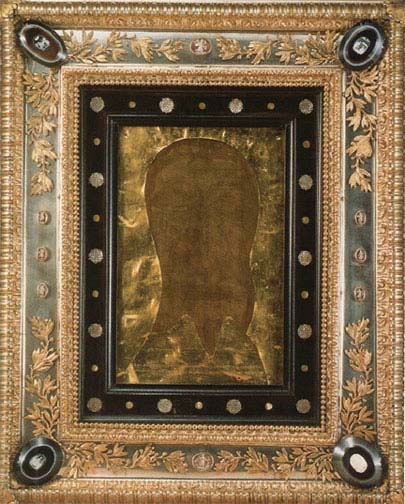
[Above (click to enlarge): "The Holy Towel of Jesus," also known as "The Holy Face of San Silvestro," a copy of the Mandylion or Image of Edessa (the Shroud of Turin folded eight times with Jesus' head only visible in landscape aspect), is normally kept at the Pope's private chapel in the Vatican: "Is this a true portrait of Christ?," Daily Mail, 6 April 2011. Freeman mentions this below as part of the British Museum's "Treasures of Heaven" exhibition, 23 June–9 October 2011.]

This is one of at least six very similar "Holy Faces," including the "Holy Face of Genoa"

[Left (enlarge): "The Holy Face of Genoa," preserved in the Church of St Bartholomew of the Armenians, Genoa: Wikipedia]

and the "Holy Face of Vienna."

[Below right (click to enlarge): the "Holy Face of Vienna": Facsimile Copy of the Veronica made in 1617. The Hofburg palace, Vienna: Wikipedia]

All six are thought to be copies of the Vatican's "Veil of Veronica", which has become so faded that its image is nearly invisible.

While these "veils" may be ultimately based on the Image of Edessa, their apparent stylistic conformity to a woman's veil means they are not a good example to demonstrate that the Image of Edessa is actually the Shroud of Turin, "four-doubled" (Greek: tetradiplon). Which presumably is why Freeman cited it, as part of his "misguided" attempt to convince his readers that both the Image of Edessa and the Shroud of Turin are two separate, and fake, relics!

Freeman continues with another falsehood, that "The Image of Edessa shows the face of a bearded ... Christ set in the middle of a square cloth":

The Image of Edessa shows the face of a bearded and, of course, living, Christ set in the middle of a square cloth. It is known from many copies. There is no body shown under the face and the cloth is often shown with a border. A good example is one of the panels of the Santa Chiara triptych (c. 1330-50) in the Sartario Museum in Trieste where red tassels surround the borders. It is illustrated below – apologies for quality of the enlargement but it shows the head of Christ, his halo, the red borders of the cloth and the lack of any body. One instantly knows that this is the Image/ Mandylion precisely because only the face is shown and the whole cloth is shown delineated. An excellent early example of a copy of the Mandylion, from the Vatican, was to be seen in the British Museum Treasures of Heaven exhibition of 2011 (catalogue entry no.113). There is an excellent discussion of the Mandylion with illustrations in Chapter 11 of Hans Belting's Likeness and Presence, pp. 208-224.

That in fact the Image of Edessa shows Jesus' face set in the middle of, not a "square" cloth but a rectangular cloth, is evident from

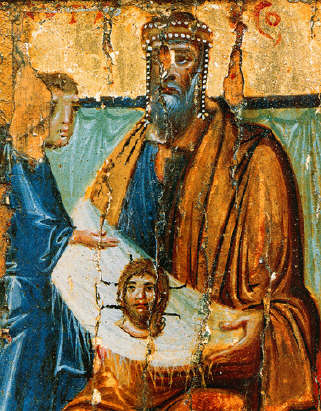
[Above: (click to enlarge): Tenth century icon depicting Edessa's King Abgar V (c. 4 BC-AD 50), holding the rectangular Image of Edessa or Mandylion, with Jesus' face in unusual (if not unique in all of art), for a portrait, in landscape aspect: Wikipedia]

Wikipedia's "Image of Edessa" page (above). See also the rectangular Sakli Church Image of Edessa in part 6. This rectangular versus square issue is very important as we shall see.

As for Freeman's "good example" (so-called) of the Image of Edessa, in "one of the panels of the Santa Chiara triptych (c. 1330-50) in the Sartario Museum in Trieste," that he had to `scrape the

[Right: Freeman's so-called "good example" of the Image of Edessa in "one of the panels of the Santa Chiara triptych (c. 1330-50) in the Sartario Museum in Trieste." His caption is:

A copy, one of many of the Image of Edessa, the Mandylion. Shown as one panel on a large triptych. Venetian/ Byzantine art, c. 1330-50. Note how the border of the cloth is clearly shown.]

bottom of the barrel' to find a square Image of Edessa is evident in that all he could find is this blurry photo of one, and he even gives "apologies for quality of the enlargement"! Freeman does not consider that the reason this rare Mandylion is square, is because it is a "panel" and so its shape is determined by its functional context.

But if he had tried harder (i.e. Googling "Santa Chiara" and "Mandylion"), Freeman could have found a clearer example of this Mandylion copy (see below).

[Left (click to enlarge): "Holy Face, part Triptych of St. Clare, 1310 the middle 1330 side panels, Trieste, Civico Museo Sartorio. The altarpiece panel can be assigned to a teacher near the Byzantine style and miniature (recognized in Marco Veneziano or Master of Santa Chiara). The Face represented as Mandylion is positioned between episodes of the Passion (Road to Calvary and the Crucifixion)": Veronica Route (Translated from Italian by Google)]

But perhaps the real reason Freeman only allowed his readers to see a blurry photograph of this copy of the Image of Edessa is because it reveals at least eight "Vignon Markings": wisps of hair representing the reversed 3 bloodstain (no. 15);

[Left (click to enlarge): The 15 "Vignon Markings" all found on the Shroud of Turin: Wilson, I., "The Turin Shroud," 1978, p.82e]

line across the forehead (no. 1); topless square above nose (no. 2); eyes wide and staring (no. 14); vertical line between nose and upper lip (no. 9); heavy line under lower lip (no. 10); hairless area between lower lip and beard (no. 11) and forked beard (no. 12). These are all found on the Shroud and so alone refute Freeman's argument that the Image of Edessa and the Shroud of Turin are not one and the same.

Freeman continues:

After it was `revealed' in its walled-up enclosure (miraculously surviving centuries of damp!) the Image of Edessa became open to intense veneration. In 787 Leo, Reader of Constantinople reported that he had seen in Edessa `the holy image that was "not made by human hands", held in honour and venerated by the faithful'. Hans Belting quotes (p.211) a report that the faithful actually sprinkled its eyes with water. For reasons that completely escape me, Wilson claims that the Image of Edessa is none other than the Shroud of Turin.

As for his "miraculously surviving centuries of damp," Freeman fails to tell his readers that Wilson, in his latest book (which Freeman implies he has read) specifically states that the Shroud's hiding place "above the city gate" was "sealed up with mortar" and so would "have enjoyed near hermetically sealed conditions":

"According to the ... information [in the Story of the Image of Edessa] ... was hidden away above the city gate ... in a place... shaped like a cylindrical semi-circle ... the gateway's brickwork ... sealed up with mortar ... would certainly have enjoyed near hermetically sealed conditions throughout" Wilson, I., "The Shroud," 2010, pp.131-133).

As stated in part 6, for other reasons I prefer Markwardt's theory (see his "Antioch and the Shroud" [PDF]) that the Shroud was in Antioch from c.47-526, after which it was taken to Edessa and the Edessans retrospectively applied the true history of the Shroud in Antioch to Edessa. Nevertheless ancient linen cloths have survived far longer in worse conditions than the 468 years (c.57-525) that Wilson's theory proposes that the Shroud was near-hermetically sealed up in Edessa's wall.

As for Freeman's, "In 787 Leo, Reader of Constantinople, reported that he had seen in Edessa `the holy image that was "not made by human hands", held in honour and venerated by the faithful'," this is an argument for Wilson's theory! Indeed, it is quoted by Wilson as such:

"Certainly in 787, a certain Leo the Reader of Constantinople when he visited Edessa was able to report, 'When I, your unworthy servant, went to Syria with the royal commission, I came to Edessa and saw the holy image that was not made by human hands, held in honour and venerated by the faithful.' [Mansi, in Guscin, M., "The Image of Edessa," 2009, p.179]." (Wilson, I., "The Shroud," 2010, p.154).

Art historian Hans Belting's "report that the faithful actually sprinkled its eyes with water" can be read online and may be seen to be anonymous, vague, and not contemporaneous:

"The rituals of the feast of the cloth image in Edessa are described retrospectively by a writer apparently a court theologian, from Byzantium, who adorns them with mystagogic explanations. The relic, concealed behind a white or purple cover, was usually kept in a shrine and was set up on a `throne' only on special days. On feast days it was approached with water that the people sprinkled on its eyes." (Belting, H., "Likeness and Presence," Chicago, 1994, p.211).

This sounds like one of those "mystagogic explanations"! It is highly unlikely (to put it mildly) that the Byzantine clergy would have let the common people get anywhere near close enough to their holiest relic for them to be able to sprinkle water on its eyes, let alone allow them to do it. There is more in the next part on this.

Freeman's "For reasons that completely escape me, Wilson claims that the Image of Edessa is none other than the Shroud of Turin," is an "Argument from Ignorance" ("I cannot understand this, therefore it cannot be true") by Freeman, if not an "Argument from Personal Incredulity" ("I cannot believe this, therefore it cannot be true"). That it completely escapes Freeman the reasons why Wilson claims that the Image of Edessa is the Shroud of Turin (apart from it being an damaging admission for a scholar to make, that he cannot understand the position he is criticising), is no reason why the Image of Edessa cannot be the Shroud of Turin!

Continued in part 8: "The Image of Edessa" (4)

Posted 3 September 2012. Updated 1 September 2025.

Thursday, August 23, 2012

My critique of Charles Freeman's "The Turin Shroud and the Image of Edessa: A Misguided Journey," part 6: "The Image of Edessa" (2)

This is part 6, "The Image of Edessa" (2) of my critique of historian Charles Freeman's, "The Turin Shroud and the Image of Edessa: A Misguided Journey," May 24, 2012 [pages 5-6]. Freeman's paper's words are bold. See previous parts 1, 2, 3, 4 and 5.

[Above (click to enlarge): The Image of Edessa (11th century), Sakli church, Goreme, Turkey: Wilson, I., "The Shroud: The 2000-Year-Old Mystery Solved," Bantam: London, 2010, plate 22b. Again note that Jesus' head appears in landscape aspect, which is obtained by doubling the Shroud of Turin four times, as Wilson points out in his book, but Freeman conceals it from his readers:

"But we still come back to a key question. Even if we accept that the Image of Edessa was a piece of cloth bearing Christ's imprint, so far that is all we have heard about it, that it bore the face of Jesus. Why should we believe it was a cloth of the fourteen-foot dimensions of the Shroud? And what evidence do we have that this Edessa cloth actually was the Shroud? In the case of the Image of Edessa's dimensions, one important indicator is to be found in one of the very first documents to provide a 'revised version' of the King Abgar story in the wake of the cloth's rediscovery. The document in question is the Acts of Thaddaeus, dating either to the sixth or early seventh century. Although its initially off-putting aspect is that it 'explains' the creation of the Image as by Jesus washing himself, it intriguingly goes on to describe the cloth on which the Image was imprinted as tetradiplon `doubled in four'. It is a very unusual word, in all Byzantine literature pertaining only to the Image of Edessa, and therefore seeming to indicate some unusual way in which the Edessa cloth was folded. So what happens if we try doubling the Shroud in four? If we take a full-length photographic print of the Shroud, double it, then double it twice again, we find the Shroud in eight (or two times four) segments, an arrangement seeming to correspond to what is intended by the sixth-century description ... And the quite startling finding from folding the Shroud in this way is that its face appears disembodied on a landscape-aspect cloth exactly corresponding to the later 'direct' artists' copies of the Image of Edessa." (Wilson, 2010, p.140)]

[Above (enlarge): How the Shroud "doubled in four" (Greek tetradiplon) results in Jesus' face in landscape aspect, exactly as it is in depictions of the Image of Edessa, like that in the Sakli church above: Dan Porter, "The Definitive Shroud of Turin FAQ: Tetradiplon" (2009) [No longer online. See my 15Sep12]. Wilson has a similar set of diagrams in his book on the opposite page 141, to illustrate his point above, but it is only in black and white. But again Freeman conceals this crucial information from his readers. And perhaps even from himself?]

Freeman resumes his fallacious argument that because there are many copies of the Image of Edessa (i.e. the Shroud of Turin doubled-in-four), therefore there cannot be an original from which all those copies ultimately derive:

The late sixth century saw the emergence of many such images and they have been studied in detail by Hans Belting in his authoritative Likeness and Presence: A History of the Image before the Era of Art, Chicago, 1994. This period was one when the first intimations of iconoclasm were being heard. Could Christ be represented in images? The response was the appearance of a number of paintings that were said to be acheiropoieton, `not made by human hands'. Most, but not all, were images left by the living Christ on a cloth, though there were others such as the traces left by Christ's body on the pillar against which he was scourged. So Christ had apparently shown, during his own lifetime, that he could be represented and so the iconoclasts could be resisted. Yet the emergence of these images came over five hundred years after the life of Christ! Each acheiropite or image therefore had to develop a story, telling how had it been created and where had it been in the intervening five hundred years. In the case of the Image of Edessa there were two or three stories, that it had been painted by the court painter of king Abgar or, more usually, that Christ himself had wiped his face with a cloth and the image had been imprinted.
Freeman continues to mislead his readers by confusing the Image of Edessa with the "Veil of Veronica" story that "Christ himself had wiped his face with a cloth and the image had been imprinted" on

[Above: Poor quality distance photograph of the Vatican's Veronica, which the Vatican apparently refuses to allow to be photographed close up, presumably because they know it is merely a deteriorated copy of the Mandylion/Image of Edessa: Veronica's Veil]

it. But as Freeman must know if he has read Ian Wilson's latest book, "The Shroud: The 2000-Year-Old Mystery Solved" (2010), which Freeman implies he has (under an alternative subtitle):

"Despite many years of research de Wesselow uncritically accepts much of the work of the veteran Shroud researcher Ian Wilson whose latest volume, The Shroud, Fresh Light on the 2000-year-old Mystery, Bantam Books, 2011, is used here" (page 1)
the Vatican's Veronica is merely "an official 'copy' for the western world of something that was altogether older and more mysterious being preserved at that time in the Byzantine east, in Constantinople", namely the Shroud:
"For westerners, the most familiar example of the genre will probably be the famous Veronica cloth. This is popularly associated with the story of a woman called Veronica wiping Jesus's face with her veil as he struggled with his cross through Jerusalem's streets on his way to be crucified. According to the story, Jesus's 'Likeness' became miraculously imprinted on Veronica's veil. Dozens of medieval and Renaissance artists depicted the scene, and thousands of Roman Catholic churches have it included among their 'Stations of the Cross', leading many to suppose the story must be in the gospels ... In fact the story in this form dates no earlier than the late Middle Ages, seeming to have been invented to spice up 'miracle play' dramatizations of the Passion story. In a twelfth-century version" there was no woman called Veronica, though at that time the canons of St Peter's, Rome were already keeping under close guard a cloth that was supposed to be the Vera Icon or 'True Likeness' of Jesus. Reputedly this likeness was imprinted not during Jesus's carrying of the cross but when he wiped his face after the 'bloody sweat' in the Garden of Gethsemane. A popular attraction for pilgrimages to Rome during the Middle Ages, this cloth can be traced historically no earlier than the eleventh century. It seems to have been an official 'copy' for the western world of something that was altogether older and more mysterious being preserved at that time in the Byzantine east, in Constantinople." (Wilson, 2010, pp.110-111).
So, as previously observed, either Freeman has not read Wilson's book thoroughly (which would be scholarly incompetence) or he has read the above, but is concealing it from his readers (which would be scholarly dishonesty).

Freeman continues with irrelevant red herrings about "Greek myths" and "Veronica's Veil" as part of his overall strategy to depict the Shroud as just another fake relic:

Varying legends were common, just as many Greek myths have several versions. The Abgar legends then went on to claim that the image had come to Edessa in the first century where it had been hidden in the city wall before its `reappearance' in the sixth century. Similar legends tell of images or other relics from the first century being buried (and often revealed in a dream) or stolen by Jews in the early days after the Crucifixion. Veronica's Veil was supposed to have been brought to Rome by Veronica after she had [6] wiped Christ's face with it and then presented it to the emperor Tiberius. (In fact Veronica was simply a corruption of Vera Iconica, `the true likeness'.) There is also a set of icons of the Virgin Mary that appear at this time said to have been painted by the evangelist Luke. Again the attribution is in order to give them status. What is important is that these images are not known before the sixth century and the stories of their origins must be treated as legendary.
But the difference is that: 1) unlike "Greek myths" the Shroud does exist today; and 2) no one (including Freeman) would bother arguing whether "Greek myths" are authentic.

And as for "The Abgar legends" which "claim that the image had come to Edessa in the first century where it had been hidden in the city wall before its `reappearance' in the sixth century" Freeman either is concealing from his readers, or may be simply ignorant of the fact, that many (if not most) Shroud pro-authenticists (including me) accept the modification to Ian Wilson's theory proposed by attorney/historian John J. (Jack) Markwardt that the Shroud was in Antioch from c. AD 47 until Antioch was devastated by a major earthquake in AD 526, after which the Shroud was taken to Edessa, and the Edessans retrospectively applied to their city, the true history of the Shroud at Antioch. However, see my "Problems of Markwardt's theory" and "My Ravenna theory" solution.

Briefly Markwardt's theory as set forth in his "The Fire and the Portrait" (1998); and "Antioch and the Shroud" (1999) [PDF]; and "Ancient Edessa and the Shroud" (2008) [PDF], proposes:

  1. The Shroud was first in the custody of the Apostle Peter in Jerusalem from c. AD 30-47, having been recovered by him when he and John entered Jesus' empty tomb, as recorded in Jn 20:3-8.

  2. Then following the persecution of the early Jewish Christians recorded in Acts 6:8-8:3, the Shroud was taken by St. Peter to Antioch, in ancient Syria. See Gal 2:11-12 where Peter was the leader of the church in Antioch, about AD 50.

  3. The Shroud was kept secret in and around Antioch from c. 47 to 357, most of that time in the control of minority Christian groups, the Arians and Monophysites, who kept the Shroud a closely guarded secret from iconoclastic Christians and Jews.

  4. In c. 357, following the Emperor Constantine's policy of centralising all passion relics in Constantinople, the Shroud was hidden in Antioch's city wall above the Gate of the Cherubim (the source of Edessa's similar legend) until it was rediscovered following the destruction of Antioch's city wall in a major earthquake in 526.

  5. Then, between 526 and the Persian further destruction of Antioch in 540, the Shroud was taken to Edessa, where it was regarded as a secondary relic to Edessa's letter of Jesus to Abgar V.

  6. During the Persian siege of Edessa in 544, following the failure of Jesus' letter to Abgar V protect the city, the Edessans took the Shroud into a tunnel under the Persian's wooden siege tower where they thrust a hot poker four times into the folded Shroud (the poker holes), the Persian siege tower miraculously caught fire, and the Persians abandoned their siege, sparing Edessa from Antioch's fate.

  7. The Edessans then regarded the Shroud as their primary relic, and to cover up the poker holes damage they doubled the Shroud in four and framed it, so that Jesus' face only appeared in landscape mode, becoming the Mandylion or Image of Edessa.

Markwardt's theory plausibly explains so many facts about the Shroud in its pre- and early-Eddessan period (c. AD 30-540) that it should be preferred over that part of Wilson's general theory.

Continued in part 7: "The Image of Edessa" (3)

Posted 23 August 2012. Updated 1 September 2025.

Tuesday, August 7, 2012

My critique of Charles Freeman's "The Turin Shroud and the Image of Edessa: A Misguided Journey," part 5: "The Image of Edessa" (1)

This is part 5, "The Image of Edessa" (1) of my critique of historian Charles Freeman's, "The Turin Shroud and the Image of Edessa: A Misguided Journey," (no longer online) May 24, 2012 [page 5]. The paper's words are bold. See previous parts 1, 2, 3 and 4.

[Above (enlarge): Icon of King Abgar V (c. 25 BC - AD 50) of Edessa, holding the Mandylion or Image of Edessa, 10th century, Saint Catherine's Monastery, Mount Sinai: Wikipedia and Digital Journal (not online). Abgar's face is actually that of Emperor Constantine VII Porphyrogenitus who reigned from 913 to 959, therefore the icon presumably dates from this time.]

I will first comment on Freeman's paragraph immediately preceding his section, "The Image of Edessa":

Ian Wilson has been tackling the problem of the Shroud for many decades. The latest of his many works is The Shroud, Fresh Light on the 200-year old Mystery (2011). Wilson accepts the authenticity of the Shroud as the burial shroud of Christ, collected by the disciples, preserved, its linen remaining intact over the centuries. He has to go against gospel tradition, of course, as the Turin Shroud is one long piece of cloth which would have covered Jesus in ways not recorded elsewhere, with the body lying on the cloth which was then brought over its head and presumably fixed at the feet. I have already noted other problems, that of the Shroud being collected as a relic in the first place and survival of cloth over centuries when damp and molesting insects are such a threat. Still Wilson has created a narrative and we need to follow it.

Freeman's "Wilson ... has to go against gospel tradition" is not only false, it does not follow from Freeman's "the Turin Shroud is one long piece of cloth which would have covered Jesus in ways not recorded elsewhere ..."

But as against Freeman's first point, three out of four gospels mention the seemingly irrelevant fact that Jesus was buried in a sindon a large linen sheet:

"And Joseph took the body and wrapped it in a clean linen shroud" (Mt 27:59);

"And Joseph bought a linen shroud, and taking him down, wrapped him in the linen shroud and laid him in a tomb that had been cut out of the rock." (Mk 15:46);

"Then he took it down and wrapped it in a linen shroud and laid him in a tomb cut in stone, where no one had ever yet been laid." (Lk 23:53);
with the fourth gospel, John, including the Shroud in the othonia "linen cloths":
"So they took the body of Jesus and bound it in linen cloths with the spices, as is the burial custom of the Jews."(Jn 19:40).
I no longer claim that the othonia seen by Peter and John in the empty tomb on resurrection Sunday [Lk 24:12; Jn 20:4-8] was a "collective singular" for all Jesus' linen burial cloths. See 26Jun08 and 11Jul12 .

As for Freeman's "the Turin Shroud is one long piece of cloth which would have covered Jesus in ways not recorded elsewhere, with the body lying on the cloth which was then brought over its head and presumably fixed at the feet," this is misleading because there are no surviving intact Jewish first century burial shrouds to base a statistically valid comparison of them with the Shroud of Turin.

And either Freeman has not fully read Wilson's book that he refers to (which would be academic incompetence) or Freeman is again concealing relevant information from his readers (which would be academic dishonesty). Because as Wilson points out in his book, according to Jewish scholar Victor Tunkel, a first century Jew who died a bloody death (as Jesus had), would have been buried in a "sovev ... an all-enveloping ... single sheet ... used to go right round' the entire body" and "Such a sovev readily corresponds to the `over the head' characteristics of Turin's Shroud":

"Lazarus died a natural death. In accordance with normal Jewish practice he would have been washed, interred fully dressed in his Sabbath best, tied up with a few binding strips to keep his jaw and limbs suitably together, and provided with some kind of face cloth for screening purposes. Jesus, in contrast, died a very bloody death, and stark naked, his clothes having been removed from him at the time of his crucifixion. [Matthew 27:35, Mark 15:24, Luke 23:34, John 19:23] In his case Jewish law prescribed something very different. As has been carefully explained by Jewish-born Victor Tunkel [Tunkel, V., "A Jewish View of the Shroud," Lecture to the British Society for the Turin Shroud, London, 12 May 1983] of the Faculty of Laws, Queen Mary College, University of London, the belief among the Pharisees of Jesus's time, shared by Jesus's own followers, was that everyone's body would be physically resurrected at the end of time. This meant that as far as humanly possible everything that formed part of that body, including particularly the life-blood, should be buried with it. As expressed in the Jewish Code of Laws, `One who fell [e.g. in battle] and died instantly, if ... blood flowed from the wound, and there is apprehension that the blood of the soul was absorbed in his clothes, he should not be cleansed.' [Gansfried, 1927, Vol. IV, ch. CXCVII, Laws Relating to Purification (Tahara nos 9 and 10), pp.99-100] In these circumstances, therefore, those preparing the dead person for burial had to wrap a `sheet which is called a sovev' straight over any clothes, however bloodstained. This sovev had to be an all-enveloping cloth, that is a `single sheet ... used to go right round' the entire body. Such a sovev readily corresponds to the `over the head' characteristics of Turin's Shroud." (Wilson, I., "The Shroud: The 2000-Year-Old Mystery Solved," 2010, p.52).

Freeman commences his discussion of the Image of Edessa with yet another concealment of relevant information from his readers, in his statement that "Edessa may have been Christian as early as the beginning of the third century":

The Image of Edessa
Let us start with Edessa, the modern Sanliurfa in south-eastern Turkey, where a image of Christ was first reported by the historian Evagrius Scholasticus (c.536-94) in the 590s. Edessa may have been Christian as early as the beginning of the third century but its legends took Christianity back further. (This was quite common. In the fourth and fifth centuries many cities `discovered' a first century founding bishop, usually one who had been consecrated as such by one of the apostles.) The Edessa legend told the story of King Abgar who had received a letter from Christ that was preserved within the city. As late as the 540s this was recorded as giving protection to Edessa but by the end of the century a new relic, an image of Christ, took its place as the `top' protector relic of the city.

But as Wilson pointed out in his latest book, which Freeman implies he has read, there are several lines of historical evidence which indicate Christianity was flourishing in Edessa from at least the second century:

• What appears to have been the earliest church building existed in Edessa in AD 201:

"In its entry for the year 201, the Chronicle of Edessa included a very detailed description of a lethal flood in Edessa during which the floodwaters 'destroyed the great and beautiful palace of our lord king and removed everything that was found in their path - the charming and beautiful buildings of the city, everything that was near the river to the south and north. They caused damage, moreover, to the nave [Syr. haikla - which can also mean 'shrine'] of the church of the Christians ... This is one of those tiny nuggets of information indicating that Christianity genuinely must have arrived very early in Edessa, to the extent of its having an officially recognized Christian church building as early as AD 201. As such this is a world first for Edessa, yet historians all too often sit on their hands over acknowledging this." (Wilson, 2010, p.118. Emphasis original).

• A coin issued in Edessa's King Abgar VIII's reign (177-212) depicts a Christian cross on his head-dress:

"A second nugget is Abgar VIII's coinage. In a recent article describing the evidence for Abgar VIII's conversion to Christianity as 'extremely flimsy', distinguished Oxford Syriac scholar Professor Sebastian Brock remarked that 'important ... in this connection is the negative evidence of the coins of the kings of Edessa, none of which bear any hint of a Christian symbol'. [Brock, S., " Transformations of the Edessa Portrait of Christ," Journal of Assyrian Academic Studies, Vol. 18, 2004, pp.227] When I pointed out to him that on several examples of Abgar VIII's coins, some of them housed in London's British Museum, there is an unmistakable Christian cross on the king's head-dress ... , Professor Brock very graciously acknowledged, 'It certainly looks as if I was too categorical.' [Email to the author, 12 March 2009] Abgar VIII, who issued his coins in close liaison with the Romans, seems to have dared to be open about his Christian affiliations only during the reign of Emperor Commodus, whose wife/mistress Marcia had Christian leanings. As the earliest-known instance of a monarch displaying the Christian cross symbol on his head-dress, this was another Edessan world first. It also sets Abgar VIII's adoption of Christianity back in time to no later than AD 192, because Commodus died in that year." (Wilson, 2010, pp.118-119).

[Above (enlarge): Abgar VIII coin depicting a Christian cross on his head-dress, probably issued during Emperor Commodus's reign (AD 177-192): Wilson, 2010, plate 15a.]

• A stone lion in Sanliurfa (Edessa) bearing a Christian cross, the lion (Syr. aryu), which was the symbol of the Abgar dynasty which ended in AD 215:

"A third nugget is an archaic-looking sculpted stone lion ... that stands forlornly in the open-air, outdoor section of Sanliurfa's [Edessa's] present-day museum, typically with no accompanying explanatory information. Judging by the hole drilled in the animal's mouth it clearly once served as a city fountain; but our interest is in what stands on top of its head: an unmistakable sculpted Christian cross, an all-too-rare sight in present-day Sanliurfa. In Syriac, the word for `lion' is aryu - the name of Edessa's ruling dynasty. This fountain has to have stood in Edessa when the city was ruled by a Christian king of the Abgars' Aryu dynasty, a line that ended for ever when the Romans took over in AD 215." (Wilson, 2010, p.119).

[Above (enlarge): A stone lion, the symbol of the Abgar dynasty, bearing a Christian cross, in Sanliurfa (Edessa), which must have been erected before AD 215: Wilson, 2010, plate 15b.]

• Edessa is only 180 miles (290 km) from Antioch, on a direct trade-route to it, and spoke the same Syriac language, making it highly likely that Edessa would have been evangelised by the mid-first century:

"That Addai's Image-bearing missionary journey ... happened in the first century rather than the second is further indicated by any glance at a map of the missionary journeys of St Paul. Every one of Paul's journeys started from Antioch, modern-day Antakya in south-eastern Turkey, from which he ventured five hundred miles westwards to Ephesus, a further five hundred miles westwards to Malta, and ultimately even further, to Rome. In contrast to these far-flung destinations, Syriac-speaking Edessa lies only 180 miles to Antioch's east, and on a direct trade route from both Antioch and Jerusalem. Is it really likely that throughout Christianity's first 150 years the first Christians should have ignored Edessa as a target for their missionary activities? That they did not is further indicated by the chronicle of one of Edessa's further-flung neighbours, the small border kingdom of Adiabene, whose capital was Arbela, today the large Iraqi city of Arbil. Arbela's ancient lineage of bishops began with one Pkhida, who can reliably be dated to the year 104. And according to Arbela's chronicle it was Addai who converted Pkhida to Christianity, thereby again indicating that Addai belonged to Abgar V's first century rather than Abgar VIII's second. As has been pointed out by the Estonian-born American scholar Arthur Voobus, if Christianity had reached as far as Adiabene by the year 100, there can be 'no doubt' that in Edessa 'the Christian faith had been established before the end of the first century'. [Voobus, A., "History of Asceticism in the Syrian Orient," Vol. 1, 1958, p.7]" (Wilson, 2010, pp.121-122).

[Above (enlarge): Map of St Paul's missionary journeys showing Edessa's comparative closeness to Antioch: ChristianityOasis.com]

So Freeman's claim that, "Edessa may have been Christian as early as the beginning of the third century" is misleading because, as the above evidence from Wilson's latest book, "The Shroud: The 2000-Year-Old Mystery Solved" (2010) shows, Edessa would have been Christian much earlier than that, beginning from the mid-first century.

And again, all the above is in Wilson's book, which Freeman implies that he has read. So either Freeman withheld this above important information from his readers (which would be a form of academic dishonesty); or Freeman did not read Wilson's book thoroughly (which would be a form of academic incompetence-considering this is all in Wilson's chapter on Edessa: Chapter 9, `Blessed City', pp.114-126).

Continued in part 6: "The Image of Edessa" (2)

Posted 7 August 2012. Updated 10 March 2025.

Saturday, July 28, 2012

My critique of Charles Freeman's "The Turin Shroud and the Image of Edessa: A Misguided Journey," part 4: "The Shroud of Turin and the Sudarium of Oviedo" (2)

Here is part 4, "The Shroud of Turin and the Sudarium of Oviedo" (2), of my critique of historian Charles Freeman's,

[Above: Perfect fit of Sudarium of Oviedo (right) to the face on the Shroud of Turin (left), in Bennett, J., "Sacred Blood, Sacred Image," 2001, plate 20. This is proof beyond reasonable doubt that the Shroud of Turin and the Sudarium of Oviedo once covered the bleeding head of the same man.]

"The Turin Shroud and the Image of Edessa: A Misguided Journey," May 24, 2012 [page 3-5]. The paper's words are bold. See previous parts 1, 2 and 3.

Having attempted to portray the Shroud of Turin as just another medieval fake relic, Freeman now attempts to do the same to Sudarium of Oviedo. That Freeman does this is tacit acknowledgment of my point in part 2 that:

"... The overwhelming majority of Shroud pro-authenticists believe that only TWO "of the thousands of ... first century ... relics [are] genuine: the Shroud of Turin and the Sudarium of Oviedo.

Freeman had previously made the patently false claim in part 1 that:

"the Turin Shroud is very much a cult of the past fifty years, not a medieval one"

He prefaces his attempt to discredit the Sudarium of Oviedo with the vacuous claim:

However, there is something about burial cloths and images that attract interest now in a way they did not in the Middle Ages.

What does Freeman mean by this? It is so vague ("burial cloths and images") that it virtually meaningless. This is the 21st century and "The Middle Ages [was] ... the period of European history encompassing the 5th to the 15th centuries" ("The Middle Ages," Wikipedia, 19 July 2012). So it goes without saying that "burial cloths and images ... attract interest now [in the 21st century] in a way they did not in the Middle Ages [5th to the 15th centuries]. So Freeman's statement, as it stands, is trivially true.

Freeman continues:

Many people have heard of the Sudarium of Oviedo (in Spain), a bloodstained cloth purporting, like the Shroud, to come from the tomb of Jesus.
Indeed! Classics scholar Mark Guscin explains:
"In the cathedral town of Oviedo in the north of Spain there is a cloth measuring approximately 84 x 53 cm on which there are bloodstains, fold marks, and other things invisible to the naked eye, such as pollen, but definitely no image. What makes this cloth special is that the bloodstains are claimed to be those of Jesus. ... Such a cloth is known to have existed from the gospel of John:
Simon Peter, following him, also came up, went into the tomb, saw the linen cloths lying on the ground, and also the cloth that had been over his head; this was not with the linen cloth but rolled up in a place by itself. (John 20.6-7)
... John describes in detail the cloths he saw in the tomb. First he mentions the linen cloths, or as other translations of the gospel call them, the linen wrappings. The Greek word is, `ta othonia', which means `pieces of fine linen'. It is a different word from that used in the other gospels, but the meaning is the same, and the curious thing here is that the word is plural. The other gospels only refer to the one cloth in which Jesus was wrapped, whereas John mentions at least two. ... The interesting point is the other piece of material that John saw -'the cloth that had been over his head'. The word he uses is, `to soudarion', which is an adaptation of the Latin `sudarium'. This word ... means a `face cloth' or `towel', used for drying or wiping the face. John saw this cloth rolled or folded up ... separate from the other cloths. On seeing these cloths, John tells us that he believed. ... Early Christian writers ... attribute John's believing on seeing the cloths to his realisation that if the cloths were still there, the body could not have been stolen, as no robbers would have taken the time and trouble to unwrap the corpse and leave the cloths folded or wrapped up, each in its own place." (Guscin, M., "The Oviedo Cloth," 1998, pp.8-11).

As can be seen below, the Sudarium of Oviedo is so unremarkable (if not revolting!) that there would be no reason for it to have been

[Above: The Sudarium of Oviedo: Mark Guscin, "The Sudarium of Oviedo: Its History and Relationship to the Shroud of Turin," 1997]

kept in the first place, let alone treasured, unless it actually was "the cloth [Gk. soudarion] that had been over his [Jesus] head" mentioned in John 20:7. And in fact (as can be seen in the photo at the beginning of this post) when the Sudarium stains are superimposed on the Shroud, "they coincide exactly with the face of the image on the Turin Shroud":

"The most striking thing about all the stains [on the Sudarium of Oviedo] is that they coincide exactly with the face of the image on the Turin Shroud. The first fact that confirms the relationship between the two cloths is that the blood on each belongs to the same group, AB. ... The length of the nose which produced this stain has been calculated at eight centimetres, just over three inches, which is exactly the same as the length of the nose on the Shroud. ... This, however, is not the only point of coincidence between the nasal areas on the two cloths. Both of them, especially the Shroud, contain a high concentration of ground particles and dust in this area. When a man was being led to the place of crucifixion, he had to carry the horizontal bar of the cross, which was probably tied to his outstretched arms and placed across the back of his neck. This meant that whenever he fell, which would have been often after being whipped and with such a weight to carry, he could not protect his face from the impact of the fall. This also explains why this nose was swollen, slightly displaced and bleeding ... Perhaps the most obvious fit when the stains on the sudarium are placed over the image of the face on the Shroud, is that of the beard; the match is perfect. This shows that the sudarium, possibly by being gently pressed onto the face, was also used to clean the blood and other fluids that had collected in the beard." (Guscin, 1998, pp.27-29).

The Sudarium might look like a simple cloth, but in fact it has a set of folds, which its some of blood and lung fluid stains correspond to as mirror images:

"The stains on the sudarium also show that when the cloth was impregnated with blood, it was folded over although not in the middle. The blood was so abundant that it stained all four sides of the folded cloth, so there is a fourfold stain in a logical order of decreasing intensity. When the body was lying on the ground face down, the liquid flow was so heavy that the stains on the part of the cloth farthest away from the face (i.e. the part that had direct contact with the hand that was holding the cloth to the face) are more extensive than the other. Numbered from one to four, Face One is the side that was in direct contact with the face, and Face Two is the reverse side if this. As the cloth was then folded back over itself, Face Three is on the same side of the cloth as Face Two, and Face Four on the same side as Face One. It is clear which part of the cloth was in direct contact with the face because actual dried blood, like scabs, is visible under the microscope." (Guscin, 1998, pp.25-26).

These stains in turn fit those on the head of the Shroud Man:
"If stain 13 is placed over the nose of the image on the Shroud, stain 6 is seen to proceed from the right hand side of the man's mouth. This stain is hardly visible on the shroud, but its existence has been confirmed by Dr John Jackson, who is well known for his studies on the Shroud using the VP-8 image analyser. Using the VP-8 and photo-enhancements, Dr Jackson has shown that the same stain is present on the Shroud, and the shape of the stain coincides perfectly with the one on the sudarium. The gap between the blood coming out of the right hand side of the mouth and the stain on the beard is mapped as number 18. This gap closes as the stains get progressively more extensive on faces 1, 2, 3 and 4 while at the same time they are less intense. Stain number 12 corresponds to the eyebrows of the face on the Shroud. As with the beard, this facial hair would have retained blood and this would have produced the stains on the sudarium when it was placed on Jesus' face. There is also blood on the forehead, which forms stain number 10 on the sudarium." (Guscin, 1998, p.28).

See the video "Shroud Report Interview with Mark Guscin on the Sudarium of Oviedo for how the Sudarium of was used.

[Above: How the blood and lung fluid stains on the Sudarium of Oviedo are mirror images along the major folds: Bennett, 2001, plate 18.]

The fit between the bloodstains on the Sudarium and the Shroud is too close and complex to have been mere coincidence. Yet for this to have been the work of a forger, he would have had to have access to the Shroud of Turin. But as Freeman himself admits, the Sudarium was "in Spain ... in 1030," that is, 230 years before 1260 which is the earliest radiocarbon date of the Shroud! So the only reasonable explanation is that the Sudarium of Oviedo and the Shroud of Turin, once covered the body of the same crucifixion victim: Jesus!:

"I do not believe that anyone could seriously propose a scenario whereby the Shroud of Turin and the Sudarium of Oviedo ... could have been fabricated. Their historical circumstances negate that possibility. That the Church would have cherished, hidden, and venerated two cloths that came from someone other than Christ, who happened to have died in exactly the same way and with wounds completely identical to His, is hardly possible ... " (Bennett, 2001, p.187).

But again Freeman withholds this vital information from his readers and so he continues to mislead them. That Freeman knows this information is evident from what follows, which is in Guscin's book.

It was found in a chest, supposed to have been made by the Apostles to contain their relics, that arrived in Spain in the seventh century but which had a legend attached to it that no good would come to anyone who opened it. Indeed when a bishop attempted to do so in 1030 there was a flash of white light and several people were blinded. What was inside it was not known. It took a more resolute figure, no less than a king, Alfonso VI, to dare to open it in 1075. It was crammed with relics of the Passion of Jesus, including, as was typical of these caches, a piece of the wood of the Cross, his Sacred Blood, bread from the Last Supper, a robe of the Virgin Mary, a stone from the tomb, as well as the Sudarium.

Freeman is again using the "guilt by association" tactic:

1. The Sudarium of Oviedo was kept in a chest with fake relics;
2. Therefore the Sudarium of Oviedo is a fake relic.
and:
1. There are legends associated with the Sudarium of Oviedo;
2. Therefore the Sudarium of Oviedo itself is legendary.

But again this is a form of the "Association fallacy ... which asserts that qualities of one thing [fake relics] are inherently qualities of another [the Sudarium of Oviedo], merely by an irrelevant association [they are both Christian relics and they both have legends associated with them]":

"An association fallacy is an inductive informal fallacy of the type hasty generalization or red herring which asserts that qualities of one thing are inherently qualities of another, merely by an irrelevant association. The two types are sometimes referred to as guilt by association and honor by association. Association fallacies are a special case of red herring, and can be based on an appeal to emotion... " ("Association fallacy," Wikipedia, 24 June 2012).

Freeman continues with yet another false claim that:

Later the chest was given a `history' that took it back to Jerusalem in 614.

But in fact the Sudarium of Oviedo already had a history that does take it back to Jerusalem in 614":
"The history of the sudarium is well documented, and much more straightforward than that of the Shroud. Most of the information comes from the twelfth century bishop of Oviedo, Pelagius (or Pelayo), whose historical works are the Book of the Testaments of Oviedo, and the Chronicon Regum Legionensium. According to this history, the sudarium was in Palestine until shortly before the year 614, when Jerusalem was attacked and conquered by Chosroes II, who was king of Persia from 590 to 628. It was taken away to avoid destruction in the invasion, first to Alexandria by the presbyter Philip, then across the north of Africa when Chosroes conquered Alexandria in 616. The sudarium entered Spain at Cartagena, along with people who were fleeing from the Persians. The bishop of Ecija, Fulgentius, welcomed the refugees and the relics, and surrendered the chest, or ark, to Leandro, bishop of Seville. He took it to Seville, where it spent some years. Saint Isidore was later bishop of Seville, and teacher of Saint Ildefonso, who was in turn appointed bishop of Toledo. When he left Seville to take up his post there, he took the chest with him. It stayed in Toledo until the year 718. It was then taken further north to avoid destruction at the hands of the Muslims, who conquered the majority of the Iberian peninsula at the beginning of the eighth century. It was first kept in a cave that is now called Monsacro, ten kilometres from Oviedo. King Alfonso II had a special chapel built for the chest, called the `Cámara Santa', later incorporated into the cathedral. The key date in the history of the sudarium is the 14th March 1075, when the chest was officially opened in the presence of King Alfonso VI, his sister Doña Urraca, and Rodrigo Díaz de Vivar, better known as El Cid. A list was made of the relics that were in the chest, and which included the sudarium. In the year 1113, the chest was covered with silver plating, on which there is an inscription inviting all Christians to venerate this relic which contains the holy blood. The sudarium has been kept in the cathedral at Oviedo ever since." (Guscin, 1997).

The bankruptcy of Freeman's Shroud and Sudarium anti-authenticity stance is evident when he admits that he has no answer to his own question, "why is the Sudarium [and the Shroud] still venerated today when the other more prestigious relics found with it are now forgotten?:

So why is the Sudarium still venerated today when the other more prestigious relics found with it are now forgotten? It was beyond the scope of my own researches, which remained within the Middle Ages, to explore why some relics resonate today and others do not. However, the Shroud of Turin, for whatever reason, is the most popular of all but other veils and cloths such as the Sudarium of Oviedo also attract special veneration at a time when so many other surviving medieval relics gather dust in sacristies. Who today notices the ‘genuine’ relics from Christ’s Passion when visiting the Treasury of St. Mark’s in Venice?

The answer is staring him in the face but Freeman's atheism/ agnosticism won't let him accept it. Which is that unlike all those other fake relics, the reason why "the Shroud of Turin ... [and] the Sudarium of Oviedo ... attract special veneration at a time when so many other surviving medieval relics gather dust" is because only the Shroud and the Sudarium have been confirmed by the preponderance of historical, artistic and scientific evidence to be authentic. That is, they both really did cover the body of Jesus Christ!

Freeman continues to mislead his readers by selectively concealing from them relevant information in his claim that the Sudarium has had "a radiocarbon-14 dating apparently of c. 700 AD":

Those trying to assess the authenticity of the Sudarium of Oviedo have to contend with a radiocarbon-14 dating apparently of c. 700 AD.

But Freeman's claim is misleading (and what's more, since he surely must have read Guscin's book, he knows it is misleading) that "the Sudarium of Oviedo "had ... a radiocarbon-14 dating ... of c. 700 AD." What Freeman does not tell his readers is that Guscin went into this very thoroughly in his book, detailing his correspondence with the Tucson Arizona radiocarbon dating laboratory, and he concluded:

"The only conclusion that can be drawn from this, and the Tucson laboratory would seem to agree, is that the whole affair was something of a shambles. Mr Jull ends his fax to me offering to carry out a serious radiocarbon dating on a sample of interest. The samples were not taken with permission for radiocarbon dating, and had presumably been taken by Monsignor Ricci about 15 years before being sent to Tucson. When sent, insufficient provenance information accompanied them; one of the samples was even stated to be 11th century. Paul Damon says the dating was never carried out, and in the results sent to Italy the sample numbers do not coincide. The laboratory suggests a serious experiment. Taking all this into account, the supposed results of the carbon dating of the sudarium can safely be ignored." (Guscin, 1998, pp.83-84).

Freeman continues with a true statement that both the Sudarium and the Shroud have the same "rare AB group." But then he adds a dubious factoid, that the "AB group ... would have been ... virtually unknown before AD 900":

The blood on it has been analysed and is of the rare AB group. This is the newest blood-group in evolutionary terms and results from the mingling of Caucasian blood-group A and Mongoloid blood-group B. At first such a mutation would have been very rare and is virtually unknown before AD 900. It probably only came more common between 1000 and 1100, an age of migrations in central Europe where the highest percentage of AB blood groups are still found. The AB blood-group still only accounts for five per cent of the human population, many still found in the areas where the mingling took place. A similar AB blood-grouping on the Turin Shroud and an apparent link between the two cloths through their bloodstains suggests a medieval date for both, but, surely, further work needs to be done to confirm the AB result which is the work of only one independent researcher (Baima Ballone) and has not been replicated. (If the Shroud and the bloodstains on it are authentic will we eventually learn something of the DNA of God?)

But for this to be true, that the "AB group" was the result of "mingling of Caucasian blood-group A and Mongoloid blood-group B," yet it was "virtually unknown before AD 900": 1) there would have to be little or no "mingling of ... blood-group A and ... blood-group B ... before AD 900;" and 2) there would have had to be a comprehensive, worldwide, human ABO blood group survey "before AD 900"! But clearly 1) is highly unlikely (to put it mildly); and 2) did not happen. Besides, since the bloodstains on the Shroud and the Sudarium are blood group AB, and the evidence is overwhelming that they are both authentic and therefore first century, they themselves prove that the "AB group" existed long "before AD 900"!

A day after I posted the above, I caught up with a comment by a Bippy123 under my post, "Old blood does not always degenerate to type AB, so the Shroud of Turin's and the Sudarium of Oviedo's AB blood group is significant!," in which he cited the abstract of an article which stated there was a full range of ABO blood groups in pre-European Peruvian Indians:

Am J Phys Anthropol. 1978 Jul;49(1):139-42. ABO blood groups in Chilean and Peruvian mummies. II. Results of agglutination-inhibition technique. Allison MJ, Hossaini AA, Munizaga J, Fung R. Abstract ABO blood groups of Peruvian and Chilean mummies were determined with the agglutination-inhibition method. In Peru all ABO blood groups were found in the period from 3000 B.C. to 1400 A.D.; from this period to 1650 only A and O were seen. In Chile no B or AB was noted either in pre-Columbian or Colonial mummies. This confirms the archeological concept that the Chilean Indian was culturally as well as genetically different from the Peruvian Indian. Further studies using other genetic markers are in order, as well as changing certain preconceived notions on blood groups of American Indians.

The above implies that AB was among the "all ABO blood groups [which] were found in the period from 3000 B.C. to 1400 A.D." in Peruvian Indians. I then found a related abstract of an article which explicitly stated that there were "A, B, AB and O blood groups in America prior to known European contact" :

ABO blood groups in Peruvian mummies. I. An evaluation of techniques† Marvin J. Allison 1,*, Ali A. Hossaini 1, Nora Castro 1, Juan Munizaga 2, Alejandro Pezzia 3 ... American Journal of Physical Anthropology Volume 44, Issue 1, pages 55-61, January 1976 ... Abstract Blood groups of Peruvian mummies of known origin were determined by three different methods: agglutination-inhibition, induction of antibody production and mixed cell agglutination. The three techniques gave identical results, but the last two were useful in establishing the presence of H (O) antigen, while the first technique would not. The results indicate the presence of A, B, AB and O blood groups in America prior to known European contact. This suggests the need for a revision of concepts of blood groups in the American Indian.

Since the AB blood group was found in Peruvian Indian mummies "from 3000 B.C. to 1400 A.D." Freeman's already dubious claim that the "AB group" was "virtually unknown before AD 900" is actually false.

And as for Freeman's claim that, "the AB result which is the work of only one independent researcher (Baima Ballone) and has not been replicated," this also is false, because in 1993, "Dr Victor Tryon ... established that the sample was human blood of the AB group, just as Baima-Bollone had before them":

"On ... 21 April 1988 ... after having cut off the snippets of the Shroud used for radiocarbon dating, the Italian microscopist Dr Giovanni Riggi took a 1.5 mm `blood' sample from the back-of-the-head region. In June 1993 he provided some of this sample to a visiting American microbiology professor, Dr Leoncio Garza-Valdès, who took it back for analysis at the University of Texas' Center for Advanced DNA Technologies at San Antonio, Texas. There [in September 1994] the laboratory director, Dr Victor Tryon, and his technician wife, Nancy Mitchell Tryon, quickly established that the sample was human blood of the AB group, just as Baima-Bollone had before them." (Wilson, I. & Schwortz, B., "The Turin Shroud: The Illustrated Evidence," 2000, pp.76-77).
Continued in part 5, "The Image of Edessa (1)."

Posted 28 July 2012. Updated 6 February 2026.