Chronology of the Turin Shroud: AD 30 to the present
NINETEENTH CENTURY
© Stephen E. Jones[1]
This is part #24, "Nineteenth century" of my "Chronology of the Turin Shroud: AD 30 - present" series. For more information about this series see the Index #1. Emphases are mine unless otherwise indicated. This page was initially based on Ian Wilson's 1996, "Highlights of the Undisputed History: 1800."
See important update.
[Index #1] [Previous: 18th century #23] [Next: 20th century (1) #25]
19th century (1801-1900b).

[Above (enlarge): "Secondo Pia (1855–1941)'s 1898 negative of the face image on the Shroud of Turin, in the Musée de l'Élysée, Lausanne"[2]. This, the most important photograph of the 19th century (indeed of all time!), occurred near the end of it [see "1898b" below].]
1800a May 15: Napoleon Bonaparte (1769–1821) and his French army begin crossing the Alps into Italy through the Great St Bernard Pass[3]. The Holy Roman Empire Austrian occupiers of northern Italy were unable to assemble fast enough to meet the French and in June 1800 were defeated first at the Battle of Montebello (9 June) and then at the Battle of Marengo (14 June)[4].
1800b September: King Charles Emmanuel IV (r. 1796–1802) and Queen Marie Clotilde (1759–1802) leave their exile in Sardinia [see "1798b"] for Florence, but the French victory at the Battle of Marengo caused them to flee to Rome and then to Naples, where they stayed from November 1800 to March 1801, before returning to Rome as guests of the wealthy Colonna family[5].
1802a 7 March: Death of Queen Clotilde followed by the abdication on 4 June of King Charles Emmanuel IV in favour of his younger brother, King Victor Emmanuel I (r. 1802–21)[6].
1802b June: The first account of the invention of photography by Thomas Wedgwood (1771–1805), using paper and leather coated with silver nitrate, is published by Humphry Davy (1778–1829) in the Journal of the Royal Institution in London, but Wedgwood's photographs haven't survived because he didn't then know how to fix them so that light didn't blacken them[7]. Contrast the step-by-step development of photography in the 19th century [see 1816, 1827, 1835, 1839a & 1839b below] with "astonishingly absurd" (Joe Nickell) `medieval photograph theory' of Prof. Nicholas Allen [see 13Jul07, 07Aug16, 05Sep16 & 16Jun19] that because the Shroud is a photograph, therefore photography must have been invented in one fell swoop by an unknown genius before the first undisputed appearance of the Shroud in 1355 and then it was completely forgotten to be independently rediscovered in the 1800s!
1804 November 13: Private showing of the Shroud for the visit to Turin of Pope Pius VII (r. 1800–23), a prisoner en route from Rome to Paris to crown Napoleon as Emperor on 2 December, who would be crowned only by the Pope, as Charlemagne (r. 800–14) had been[8].
1806a Restoration to the Sainte Chapelle, Paris of the Crown of
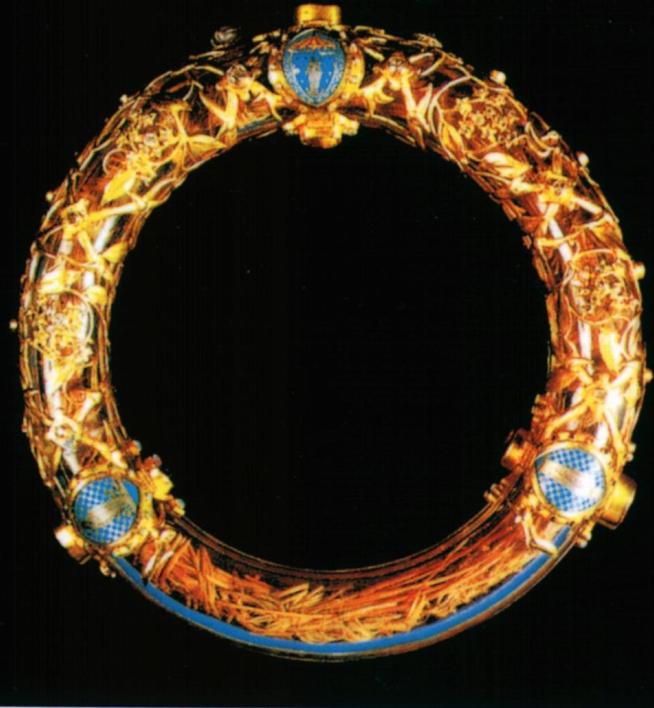
[Above (enlarge): The Crown of Thorns[9], bought in 1238 by King Louis IX of France from Emperor Baldwin II of Constantinople, and from 1801 to 2019 kept in Notre Dame Cathedral, Paris[10]. On 15 April 2019 a major fire in the cathedral, caused the relocation of the relic to the Louvre Museum[11]. Today the Crown of Thorns is a circlet made of plaited rushes[12], but originally it had many thorns which were over time removed and distributed as relics[13]. The locations of many of these thorn relics are known and they have been identified as having come from the plant Ziziphus spina-Christi[14]. On the Shroud the bloodflows at the back of the head all end in a concave line [see "1238"], indicating they were halted by a circular band which held the thorns in place, so it is possible (if not probable) that this circlet was actually part of Jesus' crown of thorns (Mt 27:29; Mk 15:17; Jn 19:2)! See also 08Sep13, 19Oct15 & 11Nov17]
Thorns, which during the French Revolution (1789–99) had been kept in the Bibliotheque Nationale in Paris[15].
1806b 6 August: Dissolution of the Holy Roman Empire when Emperor Francis II (1792–1806) abdicated, following the Empire's defeat by the French under Napoleon at the Battle of Austerlitz (2 December 1805)[16].
1807 6 April: Marriage of Prince Charles Felix (1765–31) to Princess Maria Cristina of Naples and Sicily (1779-1849), but they were to have no children[17].
1813 October: The Sixth Coalition of Prussian, Austrian and Russian forces defeat Napoleon at the Battle of Leipzig (16-19 October), invade France, capture Paris, and force Napoleon to abdicate and go into exile on the island of Elba, between Corsica and Italy[18].
1814a May 3: Louis XVIII (r. 1814–15, 1815–24) is crowned King of France[19].
1814b May 20: Public showing of the Shroud, the first since 1775 [see "1775b"], to mark the return to Turin on that day of King Victor Emmanuel I (r. 1802–21)[20].
1815a February 26: Napoleon escapes from Elba and retakes control of France, causing Louis XVIII to flee to Ghent, then in the Netherlands[21]. But Napoleon is soon defeated by the Seventh Coalition, led by the Arthur Wellesley, 1st Duke of Wellington (1769-1852), at the Battle of Waterloo (18 June)[22]. Louis XVIII is restored to the throne of France)[23] and Napoleon is exiled to the remote island of Saint Helena in the South Atlantic, where he died in 1821[24].
1815b May 21: Pope Pius VII, marking his return to Italy a year before on 24 May 1814, after Napoleon's defeat, personally displays the Shroud from the balcony of Turin's Palazzo Madama[25]. When the Shroud is returned to its casket it is sealed with both the papal and royal seals[26].
1815c 9 June: The Congress of Vienna, amongst other restorations to the pre-Napoleonic European order, restored to the Kingdom of Sardinia all the lands it had lost, including Piedmont, Nice, Savoy and added the seaport Genoa[27].
1816 Nicéphore Niépce (1765–1833), using paper coated with silver chloride, photographed images formed in a small camera obscura, but the photographs were negatives and not permanent as Niépce also could find no way to prevent the coating from darkening when it was exposed to light for viewing[28].
1817 30 September: Marriage of Prince Charles Albert of Carignano(1798–1849) to the sixteen-year-old Archduchess Maria Theresa of Austria (1801-55)[29]. They had three children, one of whom was Victor Emmanuel II (1820–78), who in 1870 [see below] became the first king of a united Italy since the sixth century[30].
1819 6 October: Death of the childless former King Charles Emmanuel IV (1751–1819)[31].
1821a March 6: Emboldened by their July 1820 success in forcing King Ferdinand I of the Two Sicilies (1816–25) to grant a constitution modelled on the Spanish Constitution of 1812[32], revolutionaries named the Carbonari, who had support in the army, met with Charles Albert (1798-1849), Prince of Carignano, a distant cousin of King Victor Emmanuel I, demanding that he help them force King Victor Emmanuel I to grant a similar constitution to the Kingdom of Sardinia[33]. The revoluionaries were taking advantage of the absence in Modena over 300km (~200 miles away) of Crown Prince Charles Felix (1765– 1831) [34]. After indicating his support, Charles Albert changed his mind and on 10 March went to Moncalieri Castle to alert the king[35]. That night, the garrison of Alessandria rose up and took control of that city[36]. The next day, 11 March, Victor Emmanuel I called a meeting of the council of the Crown, in which the majority, including Charles Albert, declared their willingness to grant a constitution[37]. The following day, 12 March, the Citadel of Turin fell into the hands of the rebels[38]. Faced with a spreading armed uprising, on 13 March King Victor Emmanuel I, who had no surviving son, abdicated in favour of his yonger brother, Charles Felix (r. 1821–31)[39]. But since Charles Felix was in Modena, Charles Albert was appointed regent[40]. Charles Albert on 13 March wrote to the new king Charles Felix an account of the events, seeking his instructions, but on the same day Charles Albert signed a decree granting a constitution which would not become law until approved by the king[41]. The Holy Alliance coalition of Austria, Prussia, and Russia could not tolerate this rebellion so in February 1821, it had sent an army to crush the revolution in Naples[42]. King Charles Felix also called for an Austrian intervention, which occupied Piedmont from April 1821 to 1823[43]. Faced with an enemy overwhelmingly superior in number, the Carbonari revolts collapsed and their leaders fled into exile[44].
1822 January 4: Showing of the Shroud to mark the start of the reign of King Charles Felix (r. 1821–31), first privately in the Royal Chapel then publicly from the Chapel balustrade[45].
1827 Nicéphore Niépce (1765–1833) takes what is today the oldest 
[Above (enlarge[46].): Niépce's "View from the Window at Le Gras" (1826-27), "the oldest surviving camera photograph"[47].]
surviving camera photograph, "View from the Window at Le Gras," on a pewter plate coated with bitumen inside a camera obscura[48].
1831 27 April: Death of the childless and brotherless King Charles Felix (r. 1821–31)[49]. He is succeeded as Duke of Savoy and King of Sardinia by his distant cousin, Charles Albert, Prince of Carignano (r. 1831–49)[50].
c1831 Thomas Frank Heaphy (1813-73) begins sketching the likenesses of Christ in the Catacombs of Rome which were early centuries' underground cemeteries[51]. Heaphy was in Rome during the 19th century opening of many of the catacombs[52] and sketched those that depicted the likeness of Christ, under conditions of great difficulty[53]. Heaphy, relying on the datings of Italian archaeologist Giovanni Battista de Rossi (1822–94) who opened many of the Roman catacombs in Heaphy's day[54], thought that the likeness of Christ in the catacombs must have been first or second century when Christians were alive who had seen Jesus or knew Christians who had[55]. Since Heaphy died in 1873, long before the 1898 first photograph of the Shroud [see above and "1898c" below], made the Shroud face well-known, Heaphy could not have been trying to, and nor did he claim to, depict the catacomb's face of Jesus as the face of the Shroud[56]. Therefore, Heaphy's early centuries' paintings of Shroud-like images of Jesus' face in the catacombs are independent confirmation that the Shroud had existed from the first century[57]. Leading Shroudies Ian Wilson and Dorothy Crispino (1916-2014) were critical of Heaphy, with Wilson accusing Heaphy of being "a cheat" and "fraudulent"[58]. But Rex Morgan had stood by Heaphy, that his catacomb paintings were evidence for the Shroud's existence in early centuries, while agreeing that Heaphy may have been wrong on some dates[59].
One of Heaphy's watercolour paintings in particular, that of a fresco in the Catacomb of Saints Nereo and Achilleo (Latin Nereus and
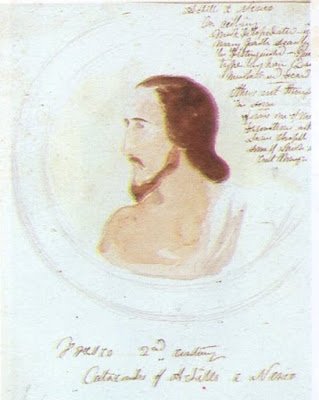
[Above (enlarge): "Original painting of fresco. Catacomb of SS Nereo and Achilleo. Probably 1st century ..."[61]. Wilson noted of this that, "the Heaphy profile view" was an "`odd-man-out'" in depictions of Jesus[62]. Morgan pointed out that Heaphy's painting was of the "three-quarters profile portrait of Christ, in a fresco ... in the ceiling of a vault in the Orpheus Cubiculum of the Domitilla catacomb" [see below] because "The figure [in the fresco] has long hair and a beard; a white mantle is clasped upon the right shoulder. Just as Heaphy had copied it"[63]. Belgian industrial chemist, Remi Van Haelst (1931-2003), saw this fresco and wrote of it, "This is the oldest representation of the Lord, made by an unknown artist ... who had know[n] Jesus":
"On the sepulchral vault, in the light of his flashlamp, the guide showed me a very vague painting. In a kind of circular inset on the ceiling of the chamber I saw the figure of a human bust, looking from the left side. With a kind of sepulchral voice the monk told me: `This is the oldest representation of the Lord, made by an unknown artist, probably based on descriptions or perhaps a sketch or painting by someone who had know[n] Jesus or his disciples"[[63a]
I propose that this fresco is a depiction of Jesus sitting up in the Tomb immediately after His resurrection, and the "white mantle" around His shoulder and back is the Shroud! My reasons are: 1) the simplest way to show Jesus sitting up is by a profile view; 2) Jesus is naked under the "white mantle" as He was when buried (
Jn 19:23); and 3) there is no mention in Scripture (or elsewhere as far as I am aware) of Jesus wearing a white mantle, or a white robe, but the Gospels mention that Jesus was buried in a "linen shroud" (
Mt 27:59; Mk 15:46; Lk 23:53) which would have been white (
Rev 19:14). If so, this is a
first century depiction of the Shroud!]
Achilleus) [64]. When it couldn't be found in that catacomb, Wilson had dismissed it as "another piece of Heaphy's artistic fantasising"[65]. But in 1969 British Shroud researcher Sylvia Bogdanescu, with her Romanian-born husband and a knowledgeable guide, photographed Heaphy's fresco in the cubiculum of Orpheus, which was in the 
[Above (enlarge). "The Earliest Portrait of Christ," A fresco dated to the 1st Century AD and having similar characteristics to the image on the Shroud of Turin and representing one of the most important recent pieces of evidence for the antiquity of the Shroud" (Photograph by Christopher Morgan 1996)[66]. This is not Bogdanescu's original photograph but a later one taken by Rex Morgan's archaeologist son, Christopher. I have ordered Bogdanescu's book, "The Catacombs and the Early Church" (1998) and I am hoping it has Bogdanescu's original photograph in colour. It does, but it is inferior to this photograph.]
different, but nearby, Domitilla catacomb[67], which dates from the first century[68]. Domitilla's husband was the consul Titus Flavius Clemens who was martyred in 95 and she herself was banished from Rome in the same year[69]. Wilson's response, instead of admitting that he had been wrong all along about Heaphy being dishonest, was:
"But even the most hardened counterfeiter (and I wouldn't rate Heaphy in quite that category), can pass the occasional genuine article"[70].
But would a "counterfeiter" have gone to this much trouble?:
"He [Heaphy] at once saw the value of the frescoes in this part, but his time in Rome was ended, and he must leave the next day. He realised that he could only do the work he desired in this section by staying all night, and he determined to do so. By further bribing he prevailed upon the custodian to lock up, and leave him there as if forgotten. Providing himself with candles and matches, as he thought sufficient, he descended 80 feet down to carry out his lonely and perilous task, - more perilous than would appear, for there have been instances of people swallowed up and lost in the catacombs, in one case that of a party consisting of an officer and twenty soldiers. As he proceeded he made careful notes of turnings and any features in the passages along which he groped his way, lest he should never find his way back to the entrance, so many and intricate are the passages in the larger catacombs. The catacombs are said to have an aggregate of 700 miles of passages, and a single false turn may lead into a labyrinth of passages from which the unwary explorer can find no way out. Having carefully noted in his sketch-book all the marks and turnings that he deemed necessary, he returned to the entrance to reassure himself that he knew his way. At length he was able to begin work, and soon became so absorbed that he forgot the novelty of his situation. There were three pictures he wished to copy, and having completed two [one of which was the above], he found that his supply of candles would not last out the work on the third, a picture of Adam and Eve in Paradise. Rather than lose his picture he decided to work while his last candle lasted, and then trust to groping his way back to the entrance to wait there in the dark until the door was opened. He tells us it became a race between his picture and the candle as to which would be completed first. The picture won by an inch of candle, and even this proved deceptive, for, as it turned out, afterwards, the wick did not extend above half-way into it. He ends his dramatic account of this adventure: `The perils I encountered during this night in the catacombs, in total darkness, and the difficulties I had to surmount in finding my way out, I must, however, leave to the imagination of the readers'"[71].
1835 William Henry Fox Talbot (1800–77), after learning in early 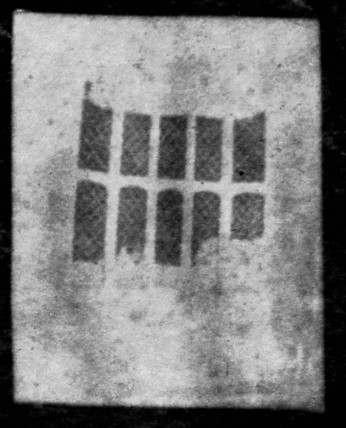
[Above (enlarge[72].): Talbot’s oldest surviving photographic negative of a latticed window at Lacock Abbey in 1835. See the positive made from that negative.]
January 1839a that Louis Daguerre had announced without details his daguerreotype photographic process [see below], Talbot asserted scientific priority based on experiments he had begun in early 1834[73]. At a meeting of the Royal Institution on 25 January 1839, Talbot exhibited several paper photographs he had made in 1835 and then communicated the general nature and details of his process to the Royal Society[74]. Talbot's "Calotype" process used writing paper bathed in a weak solution of ordinary table salt (sodium chloride), which when dried and brushed with a solution of silver nitrate, created a coating of light-sensitive silver chloride that darkened where it was exposed to light[75]. In 1841 Talbot announced his improvement of his process which, pioneered by Daguerre [see below], used an invisibly slight `latent' image which reduced the exposure time in the camera[76]. Talbot further devised ways of chemically stabilizing his negatives, making them insensitive to further exposure to light so that they could be used to create photographic positives[77]. The translucent calotype negative made it possible to produce as many positive prints as desired by simple contact printing, whereas the daguerreotype was an opaque direct positive that could be reproduced only by being copied in a camera[78]. But photographs produced by the paper calotype process were not as sharp as those produced by the metallic daguerreotype process[79]. Talbot is regarded as "the father of the negative-positive photographic process"[80]. but Jesus by His negative Shroud image beat him to it by more than 18 centuries!
1839a 7 January: Louis Daguerre (1787–1851), an associate of Niépce 
[Above (enlarge[81].): View of the Boulevard du Temple, taken by Daguerre in 1838 in Paris, includes the earliest known photograph of a person"[82].]
who had died in 1833, at a joint meeting of the French Academy of Sciences and the Académie des Beaux Arts, announced and described in general terms, his daguerreotype photographic process[83]. But only to the Academy of Sciences's secretary François Arago (1786–1853), under assurances of strict confidentiality, did Daguerre demonstrated his process[84]. In his "Daguerreotype" process, Daguerre exposed inside a camera obscura a thin copper sheet coated with light-sensitive silver iodide[85]. This required a very long exposure to produce a distinct image, but Daguerre made the crucial discovery that an invisibly faint `latent' image created by a much shorter exposure could be chemically `developed' into a visible image[86].
1839b 9 September: Astronomer John Herschel (1792-1871) photo- graphs on a still-existing glass plate the "forty-foot telescope" [Right (enlarge)[88].] which his father, Sir William Herschel (1738-1822) had constructed in 1789[89]. In the same year, 1839, Herschel coined the term "photo-graphy" (Greek photos "light" + graphos "writing")[90]. Herschel was also the first to apply the terms "negative" and "positive" to photography[91]. In 1819 Herschel had discovered sodium thiosulfate to be a solvent of silver halides and after experimentally applying it in early 1839, Herschel informed Talbot and Daguerre that this "hyposulphite of soda" ("hypo") could be used to "fix" pictures and make them permanent[92].
1842a April 12: Marriage of Crown Prince Victor Emanuel II (1820–78) to his cousin Maria Adelaide, Archduchess of Austria (1822–55)[93].
1842b May 4: Showing of the Shroud to mark the royal marriage[94]. Lithographs (e.g. below - enlarge[95]) - show the Shroud being exhibited from a  balcony of the Palazzo Madama[96]. The making of a daguerreotype of the Shroud on this occasion is considered but rejected[97].
1844 4 March: Birth to Victor Emanuel II and Adelaide of Austria, a son, Prince Umberto I (1844–1900b)[98], who in 1878 would become King of Italy.
1848a 12 January: The Sicilian revolution of 1848 began a year of popular revolts against absolutist monarchies across Europe[99]. Led by Ruggero Settimo (1778-1863) against the French King Ferdinand II (r.1830-59) of The Kingdom of the Two Sicilies, on 13 April the provisional government declared the King deposed[100]. A new constitution was issued on July 10, under the name of the Fundamental Statute of the Kingdom of Sicily, which provided for a parliamentary democracy under a constitutional monarchy[101]. In response, the King assembled a military force which by 15 May 1849 had crushed the revolution[102].
1848b 4 March: King Charles Albert of Sardinia (r. 1831–49), concerned at the revolutionary unrest agitating Italy, granted a constitution [Left (enlarge):[103].], the Statuto Albertino[104], to the Kingdom of Sardinia. The Statute in 1860 became the constitution of the unified Kingdom of Italy until 1948[105].
1849 28 July: Death of King Charles Albert (1798-1849)[106], who is succeeded as Duke of Savoy and King of Sardinia by his son Victor Emmanuel II (r. 1849–61), who in 1861 would become King of Italy.
1855 Arthur Forgeais (1822-78) a French archaeologist and numis-
[Above (enlarge)[107]: Lead pilgrim's badge or medallion in the Cluny Museum, Paris[108] from the first undisputed exposition of the Shroud at Lirey, France from c.1355-56[109]. See 13Apr18]
matist, taking advantage of the dredging of the river Seine, Paris, during reconstruction of its bridges, discovers in the dredged up mud a pilgrim's lead badge (above), amongst a great many artifacts at a presumed `wishing well' near the Pont au Change bridge[110]. This is the earliest surviving depiction of the Shroud as a double-imprint cloth, held out by two clergy whose heads have broken off[111]. It must have been obtained at Lirey, France during the first undisputed exposition of the Shroud there in c.1355 by Geoffroy I de Charny (c. 1300-56) and his wife Jeanne de Vergy (c.1332–1428), because it bears their coats of arms[112].
1857 Discovery of the Alexamenos graffito[113].which depicts Jesus naked from the rear, on a cross, with the head of a donkey[114]. This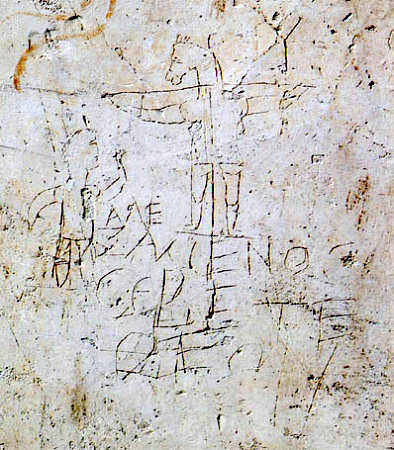
[Above (enlarge): The Alexamenos graffito mocks Alexamenos, a second century Christian Roman soldier or slave[115], who is depicted raising a hand in worship of a naked Jesus who has a donkey's head, on a cross from the rear, under the caption: "Alexamenos worships [his] God"[116]. See 13Apr16]
earliest known depiction of the crucifixion of Jesus, dated c.200, was found scratched on a wall in an excavated building under the Palatine Hill, Rome[117]. The nude back view of Jesus was intended by the anti-Christian mocker to be especially shocking and degrading.
1861 17 March. The Kingdom of Italy is established[118] and Victor Emmanuel II (r. 1861-78) becomes Italy's first king[119].
1868a April 21: Marriage of Prince Umberto I (1844–1900b) to his cousin Princess Margaret of Savoy (1851–1926)[120]. On 11 November 1869, their only child, Prince Victor Emmanuel would be born, who would become King Victor Emmanuel III of Italy (1900b–46)[121].
1868b April 24-27: Showing of the Shroud for four days on the Turin 
[Above (enlarge)[122]: Fernando Perrin, "Ostension of the Holy Shroud," lithograph, 1868[123], depicting the marriage of Prince Umberto I to Princess Margaret of Savoy.]
Cathedral's high altar, to celebrate the royal marriage[124].
1868c April 28: Princess Clotilde of Savoy (1843-1911), daughter of Victor Emanuel II and Adelaide of Austria, changes the Shroud's former lining cloth of black silk that had been sewn on by Sebastian Valfre (1629–1710) in 1694 [see "1694a], substituting for it one of crimson taffeta[125]. The Shroud is then measured and found (wrongly) to be 410cm. x 140 cm[126]. It actually is 437cm. x 111cm, which will be a problem for the next 1898 exposition[see 1898b].
1870 20 September: King Victor Emmanuel II (r. 1849–61), having supported the military victories of Giuseppe Garibaldi (1807-82), completes the unification of Italy by entering Rome and setting up his new capital there on 2 July 1871[127].
1878 9 January: Death of King Victor Emmanuel II (1820-78)[128]. He is succeeded as King of Italy by his son, Umberto I (r. 1878–1900b)[129].
1888 George Eastman (1854–1932) first put cheap box cameras with a roll of sensitised film into mass production[130].
1896 24 October: Marriage of Prince Victor Emmanuel III to Princess Elena of Montenegro (1873-1952)[131]. They were to have five daughters and one son, Prince Umberto II (1904–83)[132], who would become the last King of Italy, reigning for only 34 days (9 May-12 June 1946)[133]. An exposition of the Shroud to celebrate the royal wedding was deferred to May 1898 [see 1898b] to coincide with the fiftieth anniversary of the Statuto Albertino [see 1848b], the constitution of the nascent Kingdom of Italy[134].
1897 Completion of the current stone church of Lirey, on the site of 
[Above (enlarge)[135]: Third Church of St. Mary, Lirey, France. It was on these grounds in c.1355 that the Shroud was first exhibited in undisputed history.]
Geoffroy de Charny (c. 1300–56)'s wooden church built in 24 June 1353, and reconstructed in stone on 27 March 1526[136].
1898a May 25: Afternoon. Before the 1898 exposition began that day [see "next], Secondo Pia (1855–1941), an experienced Turinese amateur photographer[137], takes two 21 x 27 cm. test photographs of the Shroud[138], but due to technical difficulties he is unable to take his planned official photographs[139].
1898b May 25: The beginning of an 8-day public exhibition of the 
[Above (enlarge): Photograph by Secondo Pia of the interior of Turin Cathedral during the 1898 exposition with the Shroud exhibited above the high altar[140].]
Shroud which will run until 2 June[141].
1898c May 28: At night, Pia is successful[142] and takes two further 21 x 27 cm. test photographs of the Shroud and four 50 x 60 cm. official photographs[143]. At midnight in his home Pia develops one of his large glass photographic plates and he is astonished to see that the emerging negative of the Shroudman's face is life-like [see above and below] [144]!:
"A small, red light shone feebly in Pia's darkroom as he gingerly placed the large glass plates in a solution of oxalate of iron ... In the dim, red glare, he held the dripping plate up before his eyes. Clearly visible was the upper part of the altar with the huge frame above it containing the relic. But the brown stain-image seemed somehow different from the way it looked on the cloth itself. It had taken on a molding ... a depth ... a definition. Turning the plate on its side, he gazed at the face. What he saw made his hands tremble and the wet plate slipped, almost dropping to the floor. The face, with eyes closed, had become startlingly real. `Shut up in my darkroom,' Pia wrote later, `all intent on my work, I experienced a very strong emotion when, during the development, I saw for the first time the Holy Face appear on the plate, with such clarity that I was dumbfounded by it'"[145].

[Above (enlarge): Negative of Pia's fourth test photograph taken on 28 May[146]. From the mention above of "the upper part of the altar with the huge frame above it" I presume that this is the actual negative photograph in which Pia first saw the Shroudman's life-like face.]
Pia realised that the Shroudman's image must be a photographic negative[147]! This was shocking not only to Pia but also to King Umberto I and his advisors[148]. It was agreed that after informing the Vatican, no public announcement be made until the matter had been carefully considered[149]. But one of the king's court leaked the story to a newspaper and it became a worldwide sensation[150]. Proponents of the forgery theory tacitly confirmed that the Shroud image being a photographic negative was fatal to their position, by accusing Pia of fraudulent retouching his Shroud negatives[151]. It would not be until the 1931 exposition [see future "1931"] that Pia, age 76, would be vindicated, when a professional photographer, Giuseppe Enrie (1886-1961) took better photographs of the Shroud and confirmed that the Shroudman's image is indeed a photographic negative[152]! However, scientists saw these newspaper accounts and Pia's accompanying photographs, and this began a new era in the Shroud's history, that of science[153] [see below].
1898d May 26 and 27: Three members of Pia's Turin photography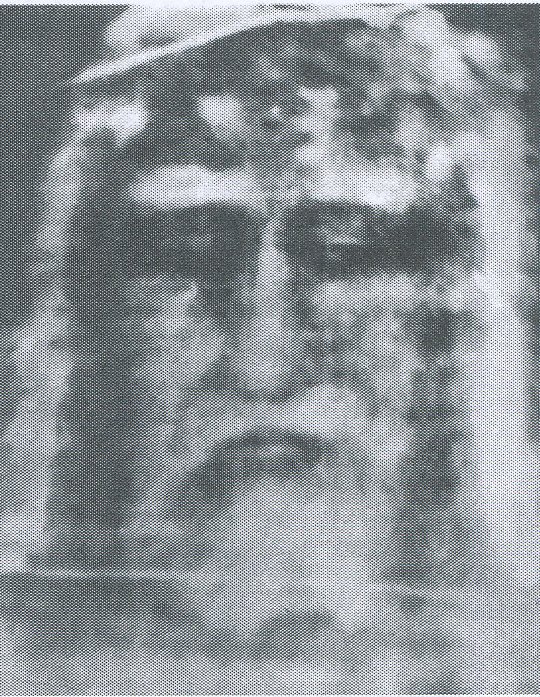 club, Prof. Noguier de Malijay, Lt. Felice Fino and Fr Giovanni Sanna Solaro smuggle, their
[Right (enlarge): Fr. Solaros's negative of the Shroud face[154].]
cameras into the exposition and take photographs, which when developed, confirm that the Shroudman's image is a photographic negative[155]!
1899 Roman Catholic historian Canon Ulysse Chevalier (1841–1923) publishes his Le Saint Suaire de Turin, est-il l'original ou une copie? ("The Shroud of Turin, is it the original or a copy?")[156], the first of his 6(!) books[157] against the authenticity of the Shroud.
1900a Yves Delage (1854–1920), a French zoologist at the Sorbonne  University in Paris[158] [Left (enlarge)[159].], from the anatom-ical details of the Shroudman's image evident in Pia's negative photographs, realised that the Shroud could not have been produced by an artist[160]. Delage showed Pia's photographs to his assistant, Paul Vignon (1865-1943), a Roman Catholic biologist, and asked him to conduct a scientific investigation into the Shroud[161]. In that same year Vignon met with Pia in Turin and confirmed that his photographs were genuine[162]. Pia gave Vignon a full set of his photographs for his investigation[163]. From those copies of Pia's plates, Vignon, in collaboration with other scientists, were able to study in great detail the anatomy of the man on the Shroud[164]. Vignon confirmed that Pia's photographs were photographic negatives and that, combined with their fine anatomical detail, meant that the Shroud could not be a forgery because the forger would have been working blind, unable to check his work[165]. Moreover, a medieval forger would not have been able to even conceive of a negative image, since photographic negativity entered the realm of human knowledge only when photography was invented in the middle of the nineteenth century[166]. See above 1816, 1835 & 1839b. Let alone a medieval forger having the skill to depict the entire double body image in negative values[167]. And what would be the point in painting a negative image on the cloth, when it couldn't be appreciated until photography was invented at least 5 centures later[168]? Vignon would in 1902 submit a report of their investigation to Delage, which concluded that the image on the Shroud was of Jesus[169], produced on His burial sheet by ammoniacal vapours from His body[170]. And, although he was an agnostic[171], Delage, now a Professor of Zoology at the Sorbonne, would in 1902 [see future "1902"] present to the French Academy of Sciences their finding that the man on the Shroud was Jesus[172]!
1900b 29 July: Assassination of King Umberto I (r. 1878–1900b)[173]. He is succeeded by his son, King Victor Emmanuel III of Italy (r. 1900b–1946)[174].
Notes
1. This post is copyright. I grant permission to quote from any part of this post (but not the whole post), provided it includes a reference citing my name, its subject heading, its date, and a hyperlink back to this page. [return]
2. "Holy Face of Jesus," Wikipedia, 16 February 2021. [return]
3. "1800: April–June," Wikipedia, 24 May 2021. [return]
4. "Great St Bernard Pass: Napoleonic crossing," Wikipedia, 5 May 2021. [return]
5. "Clotilde of France: Queen of Sardinia," Wikipedia, 15 May 2021. [return]
6. Ibid. [return]
7. Wilson, I., 1998, "The Blood and the Shroud: New Evidence that the World's Most Sacred Relic is Real," Simon & Schuster: New York NY, p.210; "1802: April–June," Wikipedia, 14 May 2021. [return]
8. Crispino, D.C, 1982, "Commemorations," Shroud Spectrum International, No. 2, March, pp.33-35, 34; Wilson, 1998, p.297. [return]
9. "File:Couronne d'epines - Crown of Thorns Notre Dame Paris.jpg," Wikimedia Commons, 5 March 2021. [return]
10. "Crown of thorns: France," Wikipedia, 15 April 2021. [return]
11. "Crown of thorns," Wikipedia, 15 April 2021. [return]
12. Barbet, P., 1953, "A Doctor at Calvary," Earl of Wicklow, transl., Image Books: Garden City NY, Reprinted, 1963, p.94. [return]
13. Cruz, 1984, p.34. [return]
14. Cruz, 1984, p.35. [return]
15. Ibid. [return]
16. "Holy Roman Empire: French Revolutionary Wars and final dissolution," Wikipedia, 7 June 2021. [return]
17. "Charles Felix of Sardinia: Marriage and return to Turin (1814-1821)," Wikipedia, 1 June 2021 & "Maria Cristina of Naples and Sicily," Wikipedia, 22 May 2021. [return]
18. "Napoleon," Wikipedia, 6 June 2021. [return]
19. "Louis XVIII," Wikipedia, 30 May 2021. [return]
20. Wilson, 1998, p.297; Scott, J.B., 2003, "Architecture for the Shroud: Relic and Ritual in Turin," University of Chicago Press: Chicago & London, p.269. [return]
21. "Louis XVIII: Hundred Days," Wikipedia, 30 May 2021. [return]
22. "Napoleon," Wikipedia, 6 June 2021. [return]
23. "Louis XVIII: Second Restoration (from 1815)," Wikipedia, 30 May 2021. [return]
24. "Napoleon," Wikipedia, 6 June 2021. [return]
25. Crispino, 1982, p.34; Wilson, 1998, p.297. [return]
26. Ibid. [return]
27. Scott, 2003, p.269; "Congress of Vienna: Final Act," Wikipedia, 9 June 2021. [return]
28. "History of photography: 1816 to 1833: Niépce's earliest fixed images," Wikipedia, 20 May 2021. [return]
29. "Charles Albert of Sardinia: ," Wikipedia, 16 May 2021. [return]
30. "Victor Emmanuel II of Italy," Wikipedia, 3 June 2021. [return]
31. "Charles Emmanuel IV of Sardinia," Wikipedia, 4 June 2021. [return]
32. "Revolutions during the 1820s: Italy," Wikipedia, 5 April 2021. [return]
33. "Charles Albert of Sardinia: Participation in the Revolution of 1821," Wikipedia, 16 May 2021. [return]
34. Charles Felix of Sardinia: Revolution of 1821," Wikipedia, 1 June 2021. [return]
35. "Charles Albert of Sardinia: Participation in the Revolution of 1821," Wikipedia, 16 May 2021. [return]
36. Ibid. [return]
37. Ibid. [return]
38. Ibid. [return]
39. Ibid. [return]
40. Ibid. [return]
41. Ibid. [return]
42. "Revolutions during the 1820s: Italy," Wikipedia, 5 April 2021. [return]
43. Ibid. [return]
44. Ibid. [return]
45. Wilson, 1998, p.297. [return]
46. "File:View from the Window at Le Gras, Joseph Nicéphore Niépce.jpg," Wikimedia Commons, 5 March 2021. [return]
47. "View from the Window at Le Gras," Wikipedia, 5 April 2021. [return]
48. "View from the Window at Le Gras: Creation," Wikipedia, 5 April 2021. [return]
49. Charles Felix of Sardinia: Death and succession," Wikipedia, 1 June 2021. [return]
50. "Charles Albert of Sardinia: Accession to the throne," Wikipedia, 16 May 2021. [return]
51. Morgan, R., 1986, "The Holy Shroud and the Earliest Paintings of Christ," Runciman Press: Manly NSW, Australia, p.140. [return]
52. Dobson, C.C., 1933, "The Face of Christ: Earliest Likenesses from the Catacombs," Centenary Press: London, p.7; Morgan, 1986, p.21; Crispino, D.C., 1986, "Recently Published," Shroud Spectrum International, No. 21, December, pp.23-24, 23. [return]
53. Dobson, 1933, pp.14-18; Morgan, 1986, pp.24-29. [return]
54. Dobson, 1933, p.25. [return]
55. Dobson, 1933, pp.14-18; Morgan, 1986, pp.15,21, 119-120; Iannone, J.C., 1998, "The Mystery of the Shroud of Turin: New Scientific Evidence," St Pauls: Staten Island NY, p.151. [return]
56. Morgan, 1986, pp.9-10, 15. [return]
57. Morgan, 1986, p.16. [return]
58. Crispino, 1986, p.23; Wilson, I., 1991, "Holy Faces, Secret Places: The Quest for Jesus' True Likeness," Doubleday: London, pp.90, 108. [return]
59. Morgan, 1986, p.120. [return]
61. Morgan, 1986, plate 1. [return]
62. Wilson, I., 1992, "Still in Rome: Rediscovery of 'Oldest Painted Likeness of Christ'?," BSTS Newsletter, No. 32, pp.7-10, 8. [return]
63. Morgan, R.H., 1993, "New Evidence for the Earliest Portrait of Jesus," Shroud Spectrum International, No. 42, December, pp.28-29, 28. [return]
63a. Van Haelst, R., 1987, "Did I see the Lord?," Shroud News, No. 44, December, pp.11-15, 12. [return]
64. Morgan, 1986, plate 1. [return]
65. Wilson, 1992, pp.8-9. [return]
66. Morgan, R., 1997, "The Earliest Portrait of Christ," Shroud News No. 100, February, back cover. [return]
67. Wilson, 1992, pp.8-9. [return]
68. Iannone, J.C., 1998, "The Mystery of the Shroud of Turin: New Scientific Evidence," St Pauls: Staten Island NY, p.150; "Catacombs of Domitilla," Wikipedia, 5 December 2020. [return]
69. Dobson, 1933, p.30; "Flavia Domitilla (saint)," Wikipedia, 15 May 2021. [return]
70. Wilson, 1992, p.9. [return]
71. Dobson, 1933, pp.19-20. [return]
72. Robinson, L., 2017, "William Henry Fox Talbot: An Overview," Photofocus, 7 May. [return]
73. "Henry Fox Talbot: Photographic inventions," Wikipedia, 28 March 2021. [return]
74. Ibid. [return]
75. Ibid. [return]
76. "Calotype: The process," Wikipedia, 14 March 2021. [return]
77. "Henry Fox Talbot: Photographic inventions," Wikipedia, 28 March 2021. [return]
78. "Henry Fox Talbot: The Calotype," Wikipedia, 28 March 2021. [return]
79. "Calotype: The process," Wikipedia, 14 March 2021. [return]
80. Whitmire, V., 2021, "William Henry Fox Talbot 1800-1877," The International Photography Hall of Fame and Museum. [return]
81. "File:Boulevard du Temple by Daguerre (unmirrored).jpg," Wikimedia Commons, 22 February 2021. [return]
82. "Louis Daguerre: Development of the daguerreotype," Wikipedia, 12 June 2021. [return]
83. "Louis Daguerre: Biography," Wikipedia, 12 June 2021. [return]
84. Ibid. [return]
85. "Louis Daguerre: Development of the daguerreotype," Wikipedia, 12 June 2021. [return]
86. Ibid. [return]
88. "File:Herschel first picture on glass 1839 3.jpg," Wikimedia Commons, 15 September 2020. [return]
89. "John Herschel: Photography," Wikipedia, 25 June 2021. [return]
90. Ibid. [return]
91. Ibid. [return]
92. Ibid. [return]
93. "Adelaide of Austria: Duchess of Savoy," Wikipedia, 18 June 2021. [return]
94. Wilson, 1998, p.298. [return]
95. Falcinelli, R., 2010, "Two unpublished letters of Secondo Pia about the 1898 Shroud photography," Proceedings of the International Workshop on the Scientific approach to the Acheiropoietos Images, ENEA Frascati, Italy, 4-6 May 2010. [return]
96. Wilson, 1998, p.298. [return]
97. Ibid. [return]
98. "Adelaide of Austria: Issue," Wikipedia, 18 June 2021. [return]
99. "Revolutions of 1848: Italian states," Wikipedia, 25 June 2021. [return]
100. "Ferdinand II of the Two Sicilies: Revolutions of 1848," Wikipedia, 22 May 2021. [return]
101. "Sicilian Constitution of 1848," Wikipedia, 4 April 2021. [return]
102. "Ferdinand II of the Two Sicilies: Revolutions of 1848," Wikipedia, 22 May 2021. [return]
103. "File:Carlo Alberto firma lo Statuto.jpg," Wikimedia Commons, 18 August 2018. [return]
104. "Statuto Albertino," Wikipedia, 9 June 2021. [return]
105. Ibid. [return]
106. "Charles Albert of Sardinia: Final days in Oporto," Wikipedia, 16 May 2021. [return]
107. Latendresse, M., 2012, "A Souvenir from Lirey," Sindonology.org. [return]
108. Guerrera, V., 2001, "The Shroud of Turin: A Case for Authenticity," TAN: Rockford IL, p.103; Latendresse, M., 2012, "A Souvenir from Lirey," Sindonology.org. [return]
109. Wilson, I., 2010, "The Shroud: The 2000-Year-Old Mystery Solved," Bantam Press: London, pp.221-222. [return]
110. Wilson, I., 1991, "Holy Faces, Secret Places: The Quest for Jesus' True Likeness," Doubleday: London, pp.21, 194 n.20; Bonnet-Eymard, B., 1991, "Study of Original Documents of the Archives of the Diocese of Troyes in France with Particular Reference to the Memorandum of Pierre D'Arcis," Shroud News, No. 68, December, pp.6-18, 15; Foster, A., 2012, "The Pilgrim's Medallion / Amulet of Lirey," BSTS Newsletter, No. 75, June; "Arthur Forgeais," Wikipedia, 13 March 2021. Translated by Google. [return]
111. Wilson, 1991, p.21; Guerrera, 2001, p.103. [return]
112. Wilson, 1991, p.21. [return]
113. "Alexamenos graffito," Wikipedia, 26 June 2021. [return]
114. O'Rahilly, A. & Gaughan, J.A., ed., 1985, "The Crucified," Kingdom Books: Dublin, p.237; Wilson, 1998, p.49; "Alexamenos graffito," Wikipedia, 26 June 2021. [return]
115. O'Rahilly, 1985, p.237; Wilson, 1998, p.49. [return]
116. "Alexamenos graffito," Wikipedia, 2021. [return]
117. O'Rahilly, 1985, p.237; "Alexamenos graffito," Wikipedia, 2021. [return]
118. "Kingdom of Italy," Wikipedia, 14 June 2021. [return]
119. "Victor Emmanuel II of Italy: Wars of Italian Unification," Wikipedia, 3 June 2021. [return]
120. "Umberto I of Italy: Youth," Wikipedia, 3 June 2021. [return]
121. "Victor Emmanuel III of Italy," Wikipedia, 5 July 2021. [return]
122. Cozzo, P., 2019, "The Shroud at Court: History, Usages, Places and Images of a Dynastic Relic," Brill: Netherlands, p.297. [return]
123. Scott, 2003, p.296. [return]
124. Wilson, 1998, p.298. [return]
125. Ibid. [return]
126. Ibid. [return]
127. "Victor Emmanuel II of Italy: Completion of the unification," Wikipedia, 3 June 2021. [return]
128. "Victor Emmanuel II of Italy," Wikipedia, 3 June 2021. [return]
129. "Umberto I of Italy: Reign," Wikipedia, 3 June 2021. [return]
130. O'Rahilly, 1985, p.47; "George Eastman: Career," Wikipedia, 27 June 2021. [return]
131. "Elena of Montenegro: Marriage," Wikipedia, 6 June 2021. [return]
132. "Elena of Montenegro: Children," Wikipedia, 6 June 2021. [return]
133. "Umberto II of Italy," Wikipedia, 19 June 2021. [return]
134. Wuenschel, E.A., 1954, "Self-Portrait of Christ: The Holy Shroud of Turin," Holy Shroud Guild: Esopus NY, Third printing, 1961, p.14; Walsh, J.E., 1963, "The Shroud," Random House: New York NY, p.17; McNair, P., "The Shroud and History: fantasy, fake or fact?," in Jennings, P., ed., 1978, "Face to Face with the Turin Shroud ," Mayhew-McCrimmon: Great Wakering UK, p.25; Wilson, I., 1979, "The Shroud of Turin: The Burial Cloth of Jesus Christ?," [1978], Image Books: New York NY, Revised edition, p.26. [return]
135. "Lirey, France," Google Street View, August 2008. [return]
136. Crispino, D.C., 1988, "To Know the Truth: A Sixteenth Century Document with Excursus," Shroud Spectrum International, No. 28/29, September/December, pp.25-40, 25. [return]
137. Cruz, J.C., 1984, "Relics: The Shroud of Turin, the True Cross, the Blood of Januarius. ..: History, Mysticism, and the Catholic Church," Our Sunday Visitor: Huntington IN, p.49Antonacci, M., 2000, "Resurrection of the Shroud: New Scientific, Medical, and Archeological Evidence," M. Evans & Co: New York NY, p.34; de Wesselow, T., 2012, "The Sign: The Shroud of Turin and the Secret of the Resurrection," Viking: London, p.18. [return]
138. Wilson, I., 1992, "Recent Publications," British Society for the Turin Shroud Newsletter, No. 30, December 1991/January, 1992, p.12; Moretto, 1999, p.24. [return]
139. McNair, 1978, p.26; Wilson, 1979, p.26; Morgan, R.H., 1980, "Perpetual Miracle: Secrets of the Holy Shroud of Turin by an Eye Witness," Runciman Press: Manly NSW, Australia, p.122. [return]
140. Moretto, G., 1999, "The Shroud: A Guide," Neame, A., transl., Paulist Press: Mahwah NJ, p.24. [return]
141. Wuenschel, 1954, p.14; Otterbein, A.J., 1977, "Introduction," in Stevenson, K.E., ed., 1977, "Proceedings of the 1977 United States Conference of Research on The Shroud of Turin," Holy Shroud Guild: Bronx NY, pp.3-9, 4; Wilson, 1979, pp.264-265; Wilson, 1998, pp.298-299; Moretto, 1999, p.24; Wilson, 2010, p.306. [return]
142. McNair, 1978, p.26; de Wesselow, 2012, p.18. [return]
143. Moretto, 1999, p.25. [return]
144. McNair, 1978, p.26; de Wesselow, 2012, pp.18-19. [return]
145. Walsh, 1963, p.24; de Wesselow, 2012, p.18. [return]
146. Moretto, 1999, pp.24-25. [return]
147. Walsh, 1963, pp.26-27; McNair, 1978, p.27; Cruz, 1984, pp.49-50; Wilson, 1998, p.18; Antonacci, 2000, p.35. [return]
148. Adams, F.O., 1982, "Sindon: A Layman's Guide to the Shroud of Turin," Synergy Books: Tempe AZ, p.54. [return]
149. Adams, 1982, p.54. [return]
150. Adams, 1982, p.54; Drews, 1984, p.3. [return]
151. Walsh, 1963, p36; Adams, 1982, p.57; O'Rahilly, 1985, p.50; Petrosillo, O. & Marinelli, E., 1996, "The Enigma of the Shroud: A Challenge to Science," Scerri, L.J., transl., Publishers Enterprises Group: Malta, p.169; Antonacci, 2000, p.47; Wilson, 2010, p.19. [return]
152. Adams, 1982, p.56; Petrosillo & Marinelli, 1996, pp.168-169; Wilson, 1998, p.18; Oxley, M., 2010, "The Challenge of the Shroud: History, Science and the Shroud of Turin," AuthorHouse: Milton Keynes UK, pp.197-198. [return]
153. Antonacci, 2000, p.4; Fanti, G. & Malfi, P., 2015, "The Shroud of Turin: First Century after Christ!," Pan Stanford: Singapore, pp.70-71; de Wesselow, 2012, p.19. [return]
154. Fanti & Malfi, 2015, p.71. [return]
155. van Haelst, R. & Morgan, R., 1987, "Honouring an Almost Forgotten Shroud Scholar: Don Noguier de Malijay," Shroud News, No. 40, April, pp.8-10, 9. [return]
156. Fossati, L., 1992, "A Critical Study of the Lirey Documents," Shroud Spectrum International, No. 41, December, pp.2-11, 2. [return]
157. Drews, R., 1984, "In Search of the Shroud of Turin: New Light on Its History and Origins," Rowman & Littlefield: Lanham MD, p.112. n.5. [return]
158. Drews, 1984, p.4; Antonacci, 2000, p.4; "Yves Delage," Wikipedia, 21 January 2021. [return]
159. Portrait of Professor Delage (1911-12), by Mathurin Méheut (1882–1958)," Station Biologique de Roscoff, France. [return]
160. Brent, P. & Rolfe, D., 1978, "The Silent Witness: The Mysteries of the Turin Shroud Revealed," Futura Publications: London, p.36; Drews, 1984, p.4; Antonacci, 2000, p.4; Guerrera, 2001, p.51. [return]
161. Antonacci, 2000, p.4; Guerrera, 2001, p.51; de Wesselow, 2012, pp.19-20. [return]
162. Morgan, 1980, p.64; Brent & Rolfe, 1978, p.36; Guerrera, 2001, p.51. [return]
163. Morgan, 1980, p.64; Drews, 1984, p.4. [return]
164. Borkan, M., 1995, "Ecce Homo?: Science and the Authenticity of the Turin Shroud," Vertices, Duke University, Vol. X, No. 2, Winter, pp.18-51, 20. [return]
165. Brent & Rolfe, 1978, p.36. [return]
166. Morgan, 1980, pp.64-65. [return]
167. Morgan, 1980, p.65. [return]
168. Morgan, 1980, p.65. [return]
169. Antonacci, 2000, p.4. [return]
170. Drews, 1984, p.4. [return]
171. Drews, 1984, p.4; Antonacci, 2000, p.4; Guerrera, 2001, p.51. [return]
172. Brent & Rolfe, 1978, p.41; Cruz, 1984, p.51; Drews, 1984, p.4; Antonacci, 2000, p.4; Guerrera, 2001, p.53; de Wesselow, 2012, p.20. [return]
173. "Umberto I of Italy: Assassination," Wikipedia, 3 June 2021. [return]
174. "Victor Emmanuel III of Italy: Accession to the throne," Wikipedia, 5 July 2021. [return]
Posted 5 June 2021. Updated 28 March 2026.






 Posts
Posts


