Wednesday, June 3, 2015

Locations of the Shroud: Turin 1918-Present: Turin Shroud Encyclopedia

Turin Shroud Encyclopedia
© Stephen E. Jones

Locations of the Shroud: Turin 1918-Present

This is the entry, "Locations of the Shroud: Turin 1918-Present," in my Turin Shroud Encyclopedia. It is a continuation from Locations of the Shroud: "Lirey c.1355-Chambéry 1471," "Chambéry 1471-Turin 1578," "Turin 1578-1694" and "Turin 1694-1918." I am working through the topics in the entry, "Shroud of Turin, expanding on them.

[Index] [Previous: Turin 1694-1918] [Next: Image of a man]


Introduction. This is the fifth of a five-part series of entries which has briefly traced the locations of the cloth today known as Shroud of Turin, from its first appearance in undisputed history (see previous) at Lirey, France in c.1355, to its current location since 1578 (apart from short periods due to wars) in or around St John the Baptist Cathedral, Turin, Italy. It is partly based on my 2012 post, "The Shroud's location."

Turin 1918-39. In 1926 Queen Margherita of Savoy (1851–1926), the wife of the late King Umberto I (1844-1900) and mother of King Victor Emmanuel III (1869–1947), died. In 1930 Prince Umberto II (1904–83) married Princess Marie José of Belgium (1906–2001). An
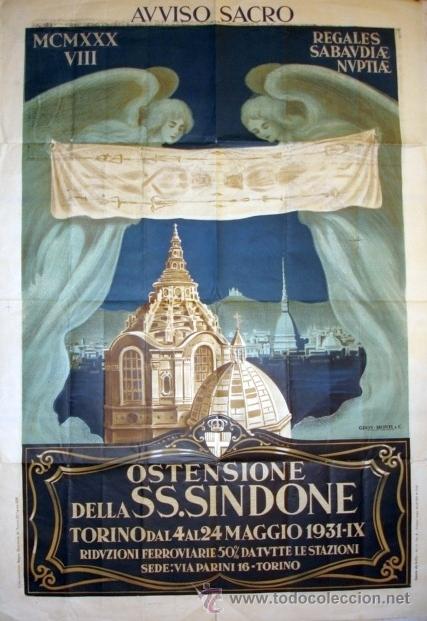
[Above (enlarge): A poster advertising the exposition of the Shroud from 4-24 May, 1931[1].]

exposition of the Shroud was held in Turin Cathedral 1931 to mark that occasion. A local professional photographer Giuseppe Enrie (1886-1961) was appointed to photograph the Shroud. Enrie took a series of black-and-white photographs of the Shroud. But unlike
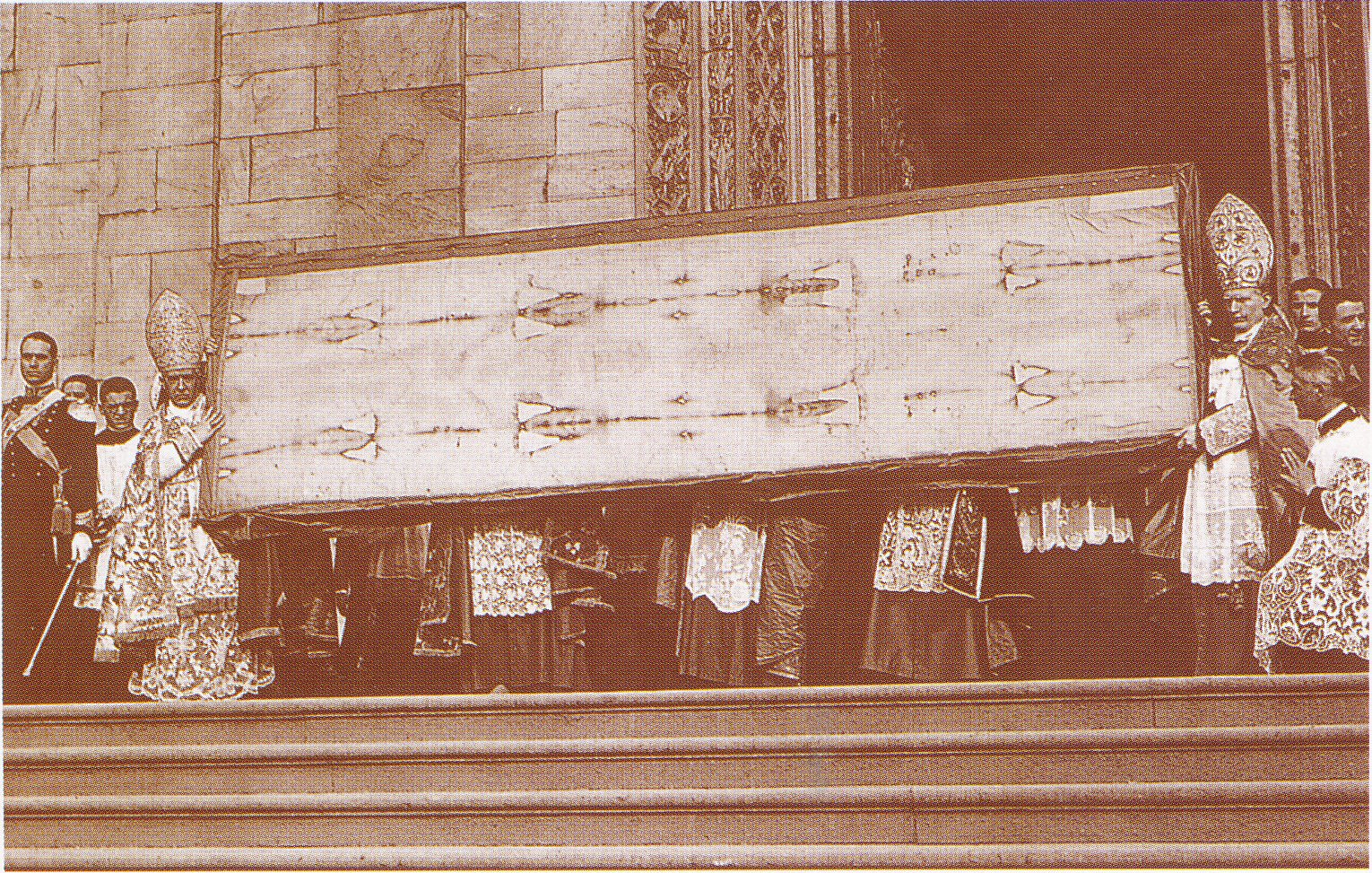
[Above (enlarge): Sepia print of Enrie's 1931 photograph of the Shroud on the steps of Turin cathedral[2].]

Secondo Pia (1855–1941), Enrie was permitted to photograph the Shroud directly, not through protective glass. Enrie's photographs confirmed Pia's 1898 discovery that the Shroud image is a photographic negative, much to the relief of Pia, who aged 76 was among those present and had been accused in 1898 by Shroud anti-authenticists of photographic error, trickery and even fraud.

Only ~2 years later Pope Pius XI (1857–1939), who as a young priest Achille Ratti was one of Paul Vignon's Alpine mountaineering companions, and first saw the Shroud at the 1898 exposition, decreed that 1933 was a Holy Year, to commemorate 19 centuries since Jesus' death and resurrection[3]. To mark that occasion the Shroud was
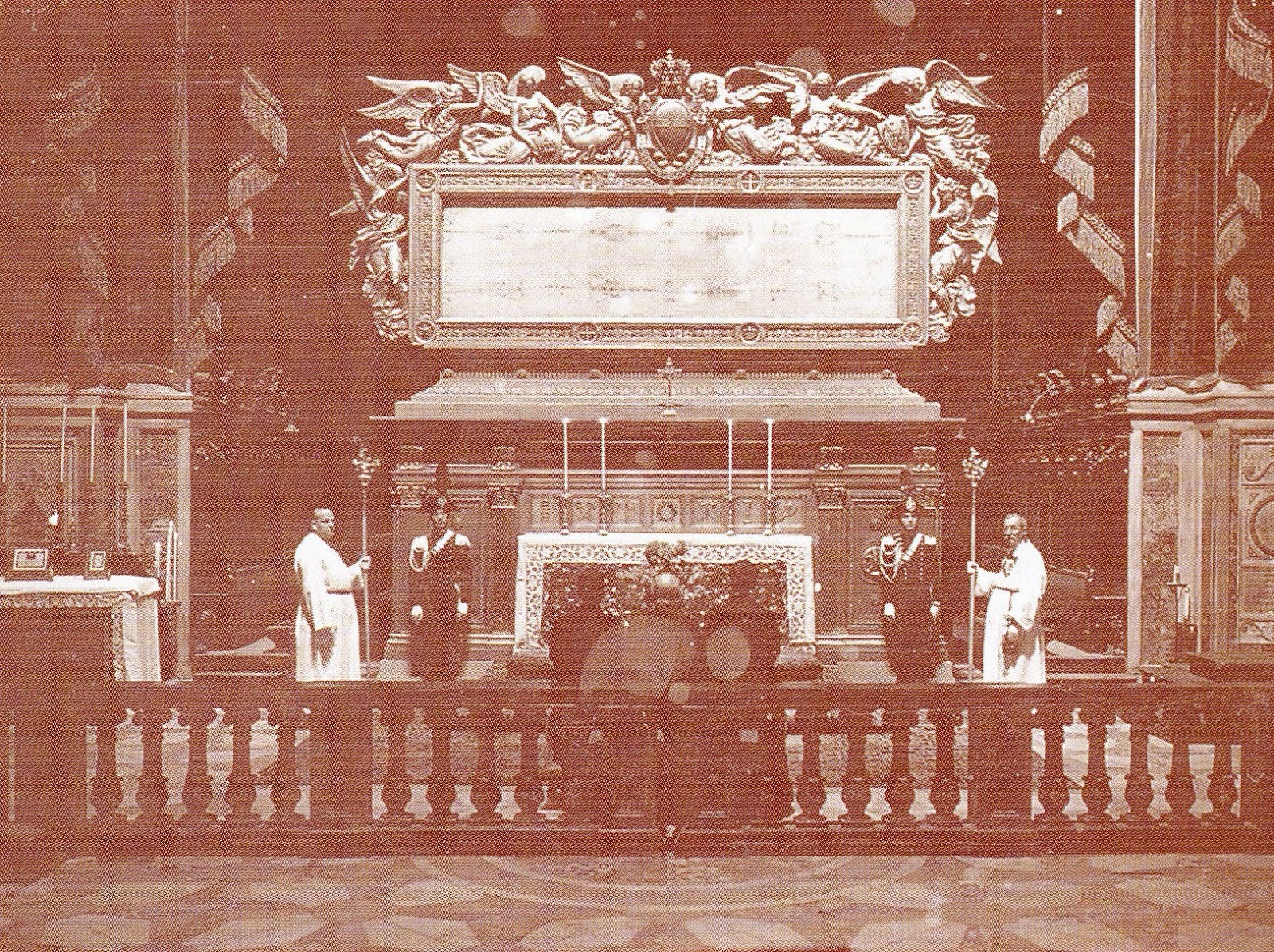
[Above (enlarge): The Shroud again displayed above Turin Cathedral's high altar at the 1933 exposition[4].]

exhibited again. Among those who viewed at that exposition for the first time was the French surgeon Dr Pierre Barbet (1884–1961) and a young seminarian Peter Rinaldi (1910-93). In 1937 Umberto II and Marie José's second of four children and only son, Victor Emmanuel (1937-), was born.

Montevergine 1939-46. Due to the outbreak of World War II, and fears that Hitler wanted the Shroud, in September 1939 King Victor Immanuel III secretly moved the Shroud via the Savoy Royal Palace in Rome, to the Benedictine monastery at Montevergine, near Avellino, in south-western Italy.
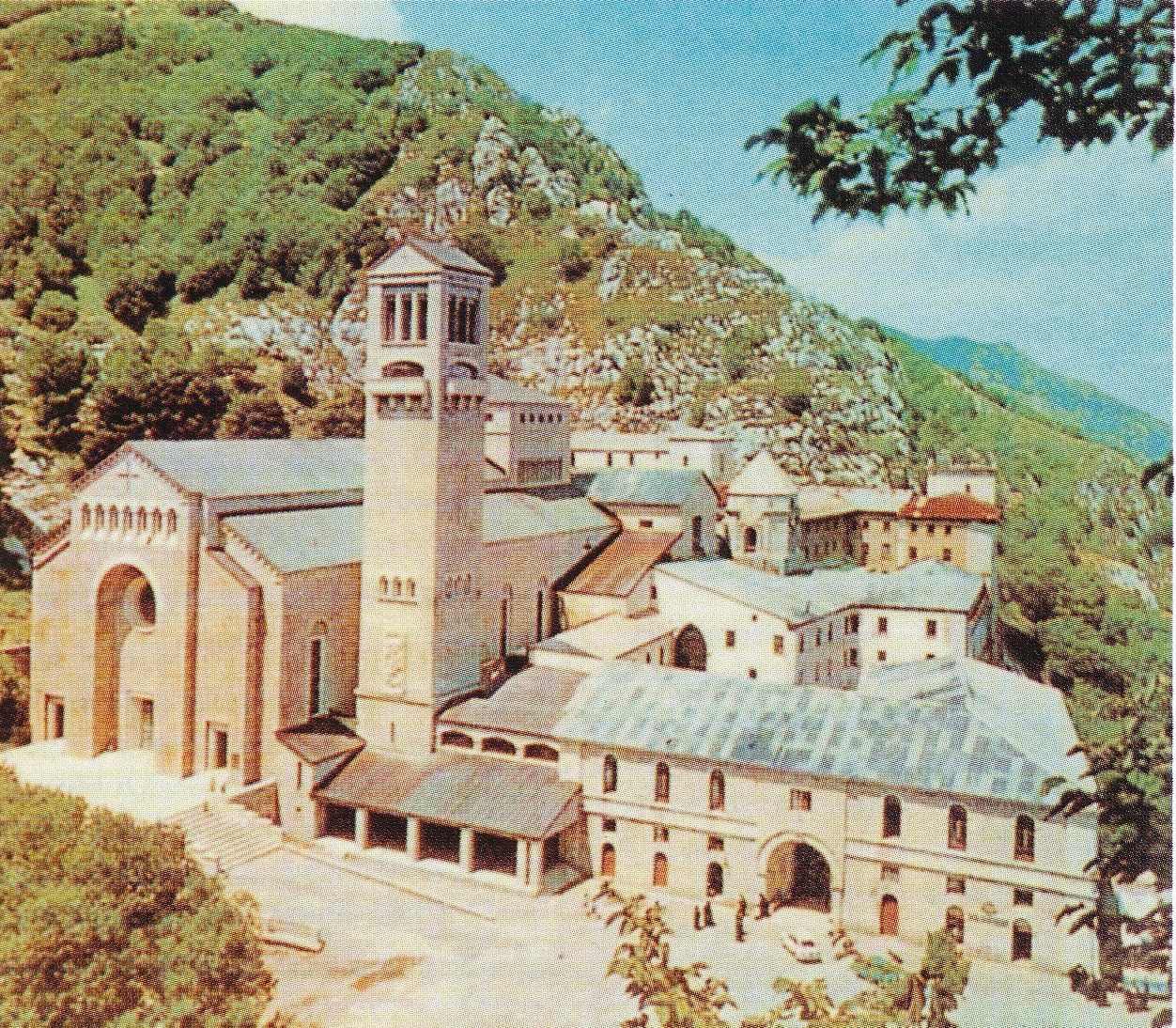
[Right (enlarge): The Benedictine monastery at Montevergine where the Shroud was secretly kept from September 1939 to October 1946[5].]

There the Shroud remained for ~7 years until the end of the war in 1946. In recognition of the monks preservation of the secrecy of the Shroud's location, the Archbishop of Turin, Cardinal Maurilio Fossati (1876–1965), when he came in October 1946 to collect the Shroud to take it back to Turin, gave the monks their own private exposition of the Cloth!

Turin 1946-83. Due to a proposed referendum to abolish the monarchy and Italy to become a republic, the unpopular King Victor Immanuel III abdicated in 1946 in favour of his son Umberto II who had been effectively king since 1944. The referendum passed and all Savoy property in Italy, including the Royal Chapel which housed the Shroud, and even the Shroud itself, was expropriated by the Italian government. Umberto II, having been formally King of Italy for only 34 days, went with his family into exile in Cascais, Portugal. Ex-king Victor Immanuel III had already left Italy before the referendum and died in 1947 in Alexandria, Egypt. In 1969 a secret Turin Commission examined the Shroud, and again in 1973 openly, but the results were inconclusive. The latter 1973 examination was in conjunction with a 1973 television-only exposition of the Shroud. An exposition of the Shroud was held in 1978 to commemorate the fourth centenary of Turin’s custody of the Cloth.
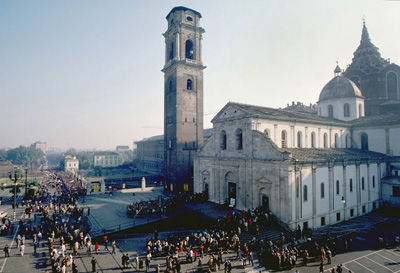
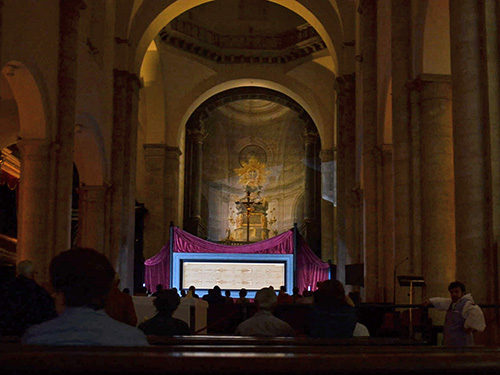
[Left (enlarge): "Turin's Cathedral of St. John the Baptist during the 1978 exhibition"[6].]

Immediately after the 1978 exposition a team of USA scientists, the Shroud of Turin Research Project (STURP), carried out an intensive 5-day examination of the Shroud. STURP concluded: 1) the Shroud was not a painting as "no pigments, paints, dyes or stains have been found on the fibrils," that constitutes the image, "It is not the product of an artist," so Bishop d'Arcis' 1389 claim that the Shroud was "cunningly painted" was false; 2) "the image has unique, three-dimensional information encoded in it"; 3) "the image was produced by something which resulted in oxidation, dehydration and conjugation of the polysaccharide structure of the microfibrils of the linen itself"; 4) science cannot explain the image naturalistically, "there are no chemical or physical methods known which can account for the totality of the image, nor can any combination of physical, chemical, biological or medical circumstances explain the image adequately"; and 5) "The blood stains are" real blood, being "composed of hemoglobin and also give a positive test for serum albumin." In 1983 ex-king Umberto II died and, having disinherited his son, Victor Emmanuel for marrying against his wishes, in his will he left the Shroud, which in exile he continued to claim was his private property, to "the Pope and his successors" as its owner, with the Archbishop of Turin the Cloth's custodian, meaning that the Shroud must continue to stay in Turin.

Turin 1983-90. In 1988 the Shroud was radiocarbon dated by three laboratories in Arizona, Zurich and Oxford, all using the same then new Accelerator Mass Spectroscopy (AMS) method. The very first run of the first laboratory to date the Shroud, Arizona, returned the date "1350 AD," which was uncritically accepted by all those present. That "1350 AD" date was leaked to the media by a Rev. David Sox while the carbon dating was still in progress at the other two laboratories. AMS pioneer Prof. Harry Gove (1922-2009, the unofficial leader of the Shroud's carbon dating, by a process of elimination concluded that the primary leaker was "someone who was present at Arizona during the first measurement." Later it was discovered that "Timothy Linick, a University of Arizona research scientist" was quoted in Sox's 1988 book on the carbon dating as hard-line anti-authenticist. So Linick must have been in communication with Sox about the carbon-dating, despite having signed a written undertaking "... not to communicate the results to anyone ... until that time when results are generally available to the public." So the inference is irresistible that Linick was the source of the leak of Arizona's very first "1350 AD" date to Sox. In 1989 the journal Nature reported that "the linen of the Shroud of Turin is mediaeval ... AD 1260-1390". But this must be wrong because the evidence is overwhelming that the Shroud has existed well before 1260 (e.g. the Pray Codex) and indeed all the way back to the 1st century. The midpoint of 1260-1390 is 1325 ±65 years, and as Shroud sceptics were quick to point out, 1325 `just happens' to be only just before Bishop d'Arcis [falsely - see above] claimed that the Shroud was painted in the 1350s. But given that all the other evidence overwhelmingly points to the Shroud being authentic and therefore first century, as Prof. Gove pointed out, the probability that the Shroud is first century, yet has a radiocarbon date of between 1260 and 1390, is "about one in a thousand trillion". So the 1260-1390 radiocarbon date of the Shroud must be the result of some form of fraud. A form of fraud which was rife in the 1980s was computer hacking, as documented by Clifford Stoll (1950-) in his 1989 book, "The Cuckoo's Egg." And according to Gove's eyewitness account of the AMS radiocarbon dating process of the Shroud at Arizona, and presumably at the other two AMS laboratories, "All this was under computer control and the calculations produced by the computer were displayed on a cathode ray screen." So a hacker, allegedly Timothy W. Linick (1946-89), who on 4 June 1989 was found dead of "suicide in very unclear circumstances," could have

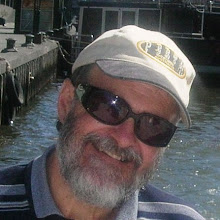
[Right: Photograph of Linick and report that "He died at the age of forty-two on 4 June 1989, in very unclear circumstances, shortly after the campaign of the Italian press reporting our [Bonnet-Eymard's] accusations"[7] of fraud in the carbon dating.]

written and installed a program on Arizona's AMS computer, and then had it installed on Zurich and Oxford's AMS computers (e.g. by the confessed hacker for the KGB, Karl Koch (1965–89)). Linick's alleged program substituted the Shroud samples' first (or early because of irremovable contamination) century date for computer-generated dates, which when calibrated, combined and averaged across the three laboratories, yielded a bogus date about 1325. Which `just happened' to be about 30 years before the Shroud first appeared in undisputed history at Lirey, France in c.1355.

That the Shroud samples' dates were computer-generated is supported by Table 2 of the 1989 Nature paper, which admitted:

"An initial inspection of Table 2 shows that the agreement among the three laboratories for samples 2, 3 and 4 [non-Shroud controls] is exceptionally good. The spread of the measurements for sample 1 [the Shroud] is somewhat greater than would be expected from the errors quoted."
But this is impossible given that the Shroud and control samples at each laboratory were all on the one ~26 cm (~1 inch) diameter carousel wheel and rotated through the one caesium ion beam within minutes of each other. If there was something technically wrong with the dating process at a laboratory, the controls and Shroud samples at that laboratory would wrongly agree and disagree with the controls and Shroud samples of the other two laboratories. But that the agreement across the three laboratories in the dates of the non-Shroud control samples was "exceptionally good" shows that there was nothing technically wrong with the dating itself, which must mean that the Shroud samples' dates were not real but computer-generated.

Koch is not essential to my theory that the radiocarbon dating laboratories were duped by a computer hacker, as Linick could have acted alone. But that both Linick and Koch (who need not have known each other) were involved in hacking the Shroud's radiocarbon date for the KGB is supported by the fact that Linick died of "suicide in mysterious circumstances" on 4 June 1989 and Koch's inexplicably burnt body which was made to look like suicide, had been publicly identified by the German police only a day earlier on 3 June 1989!

Turin 1990-97. In 1990 several pieces of stone in the dome of the 17th century Royal Chapel designed by architect-priest

[Left (enlarge): Interior of the dome or cupola of the Turin Royal (Guarini) Chapel.]

Camillo-Guarino Guarini (1624–83), fell to its floor ~30 metres (~98 feet) below. The Chapel, which had been since 1946 owned by the Italian government (see above) had to be closed for repairs. A bulletproof laminated glass display case was
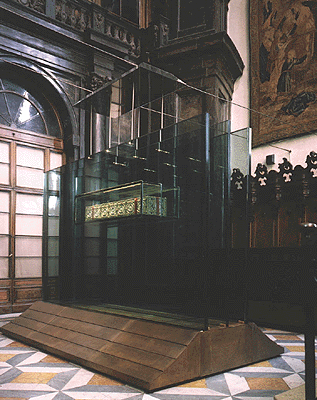
[Right: The Shroud's casket, in its bulletproof glass display case, behind the high altar of Turin Cathedral, between 1993 and the 1997 fire[8].]

constructed for the Shroud in the Cathedral, behind the high altar, and in 1993 the Shroud, still in its 17th century silvered wooden casket, was installed into its new location.

1997-98 Archbishop of Turin's residence. On the night of 11 April, 1997, a major fire gutted the Royal Chapel, part of the Cathedral and the adjoining Royal Palace. But for the heroic action of a Turin

[Above: Fire engulfs the Royal Chapel and Turin Cathedral on the night of 11 April, 1997.[9].]

fireman, Mario Trematore, who ignoring the extreme risk to his life, broke into the Shroud's laminated glass case with his fireman's axe, and dragged the Shroud's container to safety, the Shroud would almost certainly have been destroyed. The Shroud in its container was taken to the residence of the then Archbishop of Turin, Cardinal Giovanni Saldarini (1924-2011), and indications that the fire had been deliberately lit, the Shroud's location was kept secret until 1998.

1998-2005 Turin Cathedral. It was decided that the planned exposition of the Shroud in 1998, to mark the 500th anniversary of Turin Cathedral, would still go ahead. In preparing the Shroud for that exposition, ancient textiles specialist Dr. Mechthild Flury-Lemberg
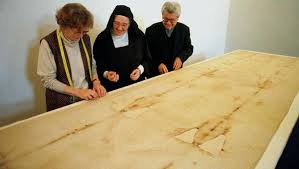
[Right (enlarge): Mechthild Flury-Lemberg (L), Sister Maria Clara Antonini of the Poor Clare nuns (C) and Turin diocese's Don Giuseppe Ghiberti (R) preparing the Shroud for the 1998 exposition[10].]

determined that the dimensions of the Shroud were 437 cm long by 111 cm wide. For the 1998 exposition the Shroud was placed in a new temperature controlled, primarily argon gas filled, stainless steel and bulletproof glass conservation case, sponsored by the Italian company Italgas, that weighs three tons and measures ~4.6 x 1.4 m. In it the
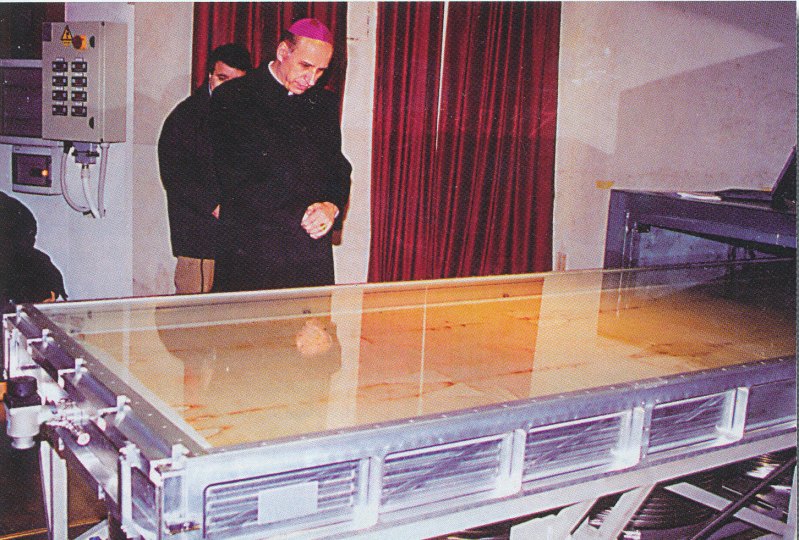
[Left (enlarge): The Shroud in its new container being prayed over by the then Archbishop of Turin, Severino Poletto (1933-)[11].]

Shroud can be stored flat and tilted ninety degrees when it is on public display. The Shroud was then displayed in Turin Cathedral in front
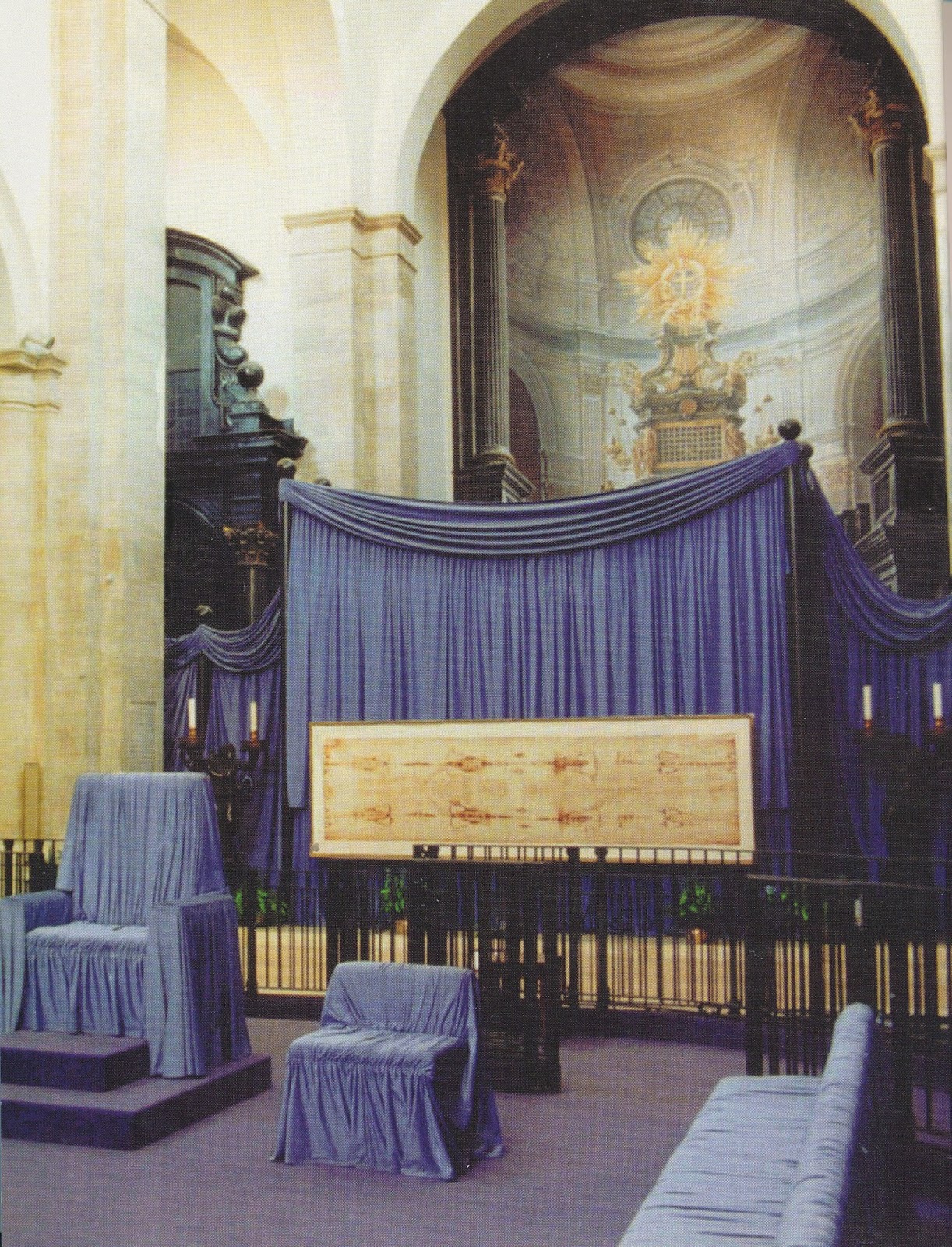
[Right (enlarge): A photograph of the Shroud, in Turin Cathedral, as it was when displayed at the 1998 exposition[12].]

of a huge temporary screen to hide the fire damage to the Chapel behind it, and upon the screen was painted a trompe l'oeil (illusory perspective) scene of how the interior of the Chapel would have looked in the 1820s.

2005 Turin Cathedral. In 2005 the Shroud, inside its conservation case, was installed in its new permanent reliquary in a side chapel in
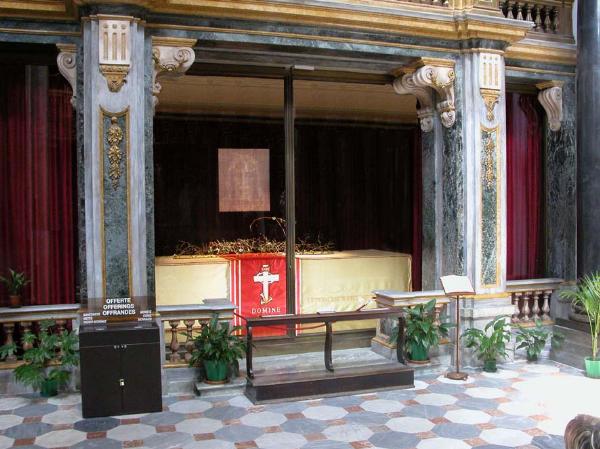
[Left (enlarge): The Shroud's reliquary, its (hopefully) final permanent resting place, in a side chapel of Turin Cathedral[13].]
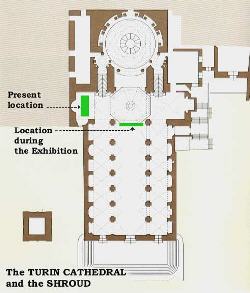


the left (north) transept of Turin Cathedral. When the

[Right: Floor plan of Turin Cathedral showing the Shroud's location since 2005, in a side chapel in the left (north) transept of the Cathedral[14].]

Shroud is to be publicly displayed it will be brought to the "Location during the Exhibition" (above right) position. As it is during the current 2015 exposition (see below).
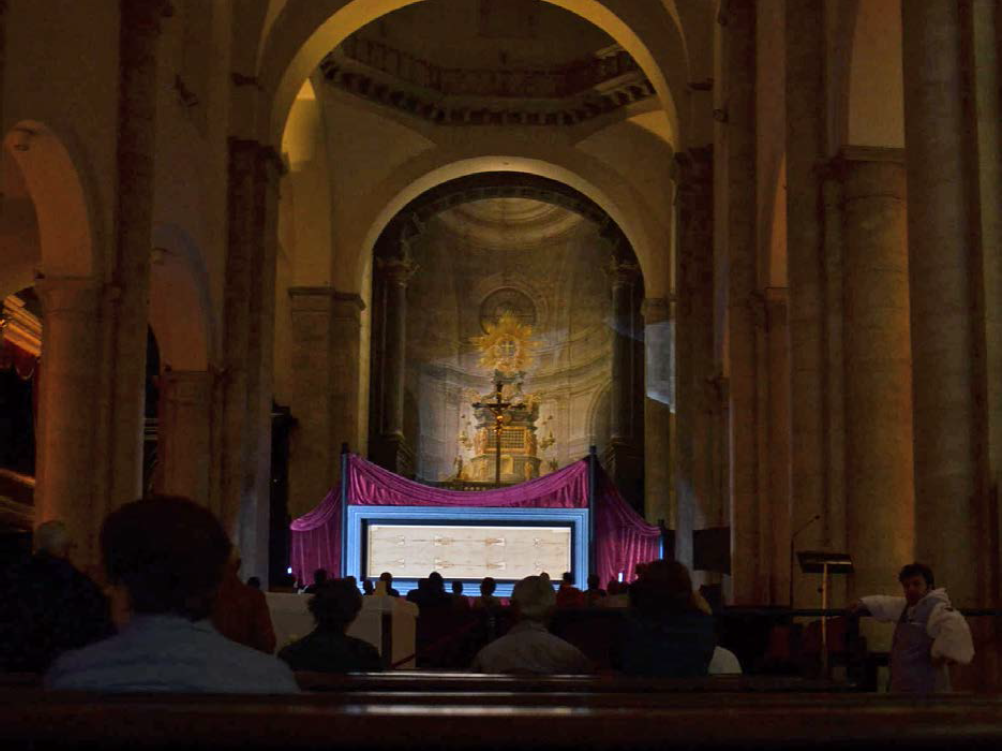
[Above (enlarge): The Shroud on public display in Turin Cathedral during the 2015 Exposition.[15].]

Notes
1. "Poster exhibition litografia Turin Shroud Exposition 1931 100 Cm X 70cm Sindone Holy Shroud," www.todocoleccion.net. [return]
2. Moretto, G., 1999, "The Shroud: A Guide," Neame, A., transl., Paulist Press: Mahwah NJ, p.27. [return]
3. While "Friday, April 3, 33 CE" is a possible date of Jesus' death, the more likely date is "Friday, April 7, 30 CE." [return]
4. Moretto, 1999, p.31. [return]
5. Moretto, 1999, p.32. [return]
6. Schwortz, B., 2014, "Summer 2014 Website Update," Shroud.com, June 7. [return]
7. Bonnet-Eymard, B., 2000, "The Holy Shroud is as Old as the Risen Jesus, IV. Caution! Danger!, The Catholic Counter-Reformation in the XXth Century, No 330, Online edition, May. [return]
8. Schwortz, B., 1997, "The 1997 Fire," Shroud.com. [return]
9. Wilson, I., 2010, "The Shroud: The 2000-Year-Old Mystery Solved," Bantam Press: London, p.274H. [return]
10. Brkic, B., 2010, "Hitler had designs on the Shroud of Turin; Indiana Jones fans are not surprised," Daily Maverick, 8 April. [return]
11. Wilson, 2010, p.82A. [return]
12. Wilson, I. & Schwortz, B., 2000, "The Turin Shroud: The Illustrated Evidence," Michael O'Mara Books: London, p.ii. [return]
13. Schwortz, B., "2005 Website News," Shroud.com. [return]
14. "News 2000," Collegamento pro Sindone. [return]
15. "Turin 2015 by Aldo Guerreschi - The Shroud of Turin," Shroud.com. [return]

Posted 3 June 2015. Updated 13 December 2025.

Sunday, May 24, 2015

"Ga-Gm": Turin Shroud Dictionary

[Garza-Valdes, Leoncio] [Geoffroy de Charny] [Geoffroy I de Charny] [Geoffroy II de Charny] [Gervase of Tilbury]


[Above: Geoffroy I de Charny's (see below) coat of arms[2] on pilgrim badge from the exposition of the Shroud at Lirey, France, in c.1355 (left). The de Charny coat of arms[3], "gules (red) three silver shields"[4] (right).]

Garza-Valdes, Leoncio. Dr. Leoncio Antonio Garza-Valdes (1939-2010) was a Mexican-born pediatrician living in San Antonio, Texas, whose hobby was microbiology. To reconcile his belief in the Shroud's authenticity and the 1260-1390 radiocarbon date of the Shroud, Garza-Valdes proposed a theory that the Shroud had an "accretion... of microbiological organisms" which formed a "bioplastic coating" of younger carbon, which gave the 1st century Shroud an apparent 13th-14th century radiocarbon date. In 1993 Garza-Valdes proposed his theory in Turin to physicist Professor Luigi Gonella (1930–2007), who had been the Roman Catholic Church's coordinator of the Shroud's radiocarbon dating. Gonella rejected Garza-Valdes' proposal because to shift the Shroud's radiocarbon date ~12-13 centuries, "the coating would be the weight of the Shroud, and this was not the case"[5]. But Garza-Valdes simply ignored this obvious refutation of his theory and obtained some threads of the Shroud from Giovanni Riggi (1935-2008), which was part of the sample that was cut by him in 1988 but not given to the three laboratories. Back in San Antonio Garza-Valdes claimed to have photographed the bioplastic coating under a microscope. Garza-Valdes gave a bloodstained thread from the Shroud to San Antonia Professor of Microbiology, Stephen J. Mattingly, who gave Assistant Professor in Microbiology, Victor V. Tryon, the task of extracting DNA from the thread. Tryon did extract fragments of three different human male genes from the Shroud blood sample. In 1998 Garza-Valdes published an account of all this in his book, "The DNA of God?" However, as the late blood chemist Prof. Alan D. Adler (1932-2000) pointed out in 1999[6], the DNA could have been from anyone who had handled the Shroud over the centuries. Adler also listed problems with Garza-Valdes' "bioplastic coating" theory: 1) for a bioplastic coating to have shifted the Shroud's 1st century carbon date to the 13-14th century would require "about a 50% increase in the C14," which would be "a prodigious amount of bacterial metabolism"; 2) but "where does all this energy for growth come from?"; 3) "Where does the mass come from?"; 4) "Does this microorganism fix the nitrogen from air as required for its growth and metabolism?," and 5) "Where does it get its sulfur, phosphorus, and minerals from and to where have they disappeared?" Adler further pointed out that the Shroud's shiny appearance that Garza-Valdes thought was a bioplastic coating was in fact what "all linen looks like ... It is called luster," and Garza-Valdes' photomicrographs "of what appear to be entubulated fibers" are "simply out of focus." Note that the same problem of the "prodigious amount" of contamination required to convert a 1st century chronological date of the Shroud to a 13th-14th radiocarbon date, means that conventional explanations of the discrepancy all fail, leaving my theory that the radiocarbon dating laboratories were duped by a computer hacker as the only viable explanation how the first century Shroud had a 13th-14th century radiocarbon date.

Genoa, Holy Face of (see "Holy Face of Genoa").

Geoffroy de Charny (c. 1240-1314) [the spelling "Geoffroi" and "de Charney," "de Charnay," etc, are optional but see future "Geoffroy II de Charny"] was a Preceptor of Normandy for the Knights Templar. Together with Jacques de Molay (c. 1243–1314), Grand Master of the Knights Templar, de Charny was burnt at the stake on the orders of King Philip IV of France (1268–1314), for recanting his confessions of the trumped up charges of heresy, sodomy and blasphemy against the Templars, extracted under torture. Genealogist Noel Currer-Briggs (1919-2004), wrote:

"Jean de Charny had two brothers, the Templar Preceptor of Normandy, and Dreux de Charny, Seigneur de Savoisy, and a sister, Jeanne de Charny ..."[7]
and
"Geoffroi I de Charny founded the collegiate [self-governing] church of Lirey ... the Preceptor of Normandy, Geoffroi de Charny ... was almost certainly the uncle of the Geoffroi de Charny mentioned above"[8].
However, according to most online genealogies, "Jean de Charny" (c.1263–1323) was the son, not the brother, of "Dreux de Charny" (1235-1285), as their age spans indicate. And since Jean de Charny was the father of Geoffroy I de Charny (see next), that would make Geoffroy the Templar the great-uncle of Geoffroy I de Charny. Moreover, since there are no earlier Geoffroys in the de Charny and de Mont-Saint-Jean family trees, it is likely that Geoffroy I de Charny was named after Geoffroy de Charny the Templar. Indeed, since Geoffroy I was born about 1300 and Geoffroy the Templar was not arrested until 1307, they may have known each other.

Geoffroy I de Charny (c.1300–1356) [see also Lirey (1)] was a French knight, author of works on chivalry, and the first undisputed owner of the Shroud. He was the third son of Jean I de Charny de Mont St Jean (c.1263-1323) and Jeanne de Berzé et Villurbain (c.1260-1310)[9]. In c. 1336 Geoffroy married Jeanne de Toucy (c. 1301-48). In 1337, the year the Hundred Years' War (1337-1453) between England and France began, Geoffroy fought at Languedoc and Guyenne in southern France. In the west he defended Tournai (1340) and Angers (1341). In that latter battle, Geoffroy fought alongside the ~22 year-old son of King Philip VI (1293–1350), the future King John II (1319–64). In 1342, during the battle of north coastal Morlaix in Brittany, Geoffroy was captured and taken prisoner to England. However, he was allowed to return to England to raise the money for his ransom, which was paid and in 1342 he resumed fighting the English on the west coast near Vannes. In 1345, during a brief truce with the English, Geoffroy and Edward de Beaujeu (1316-1351) captured the Turkish-held harbour fortress of Smyrna in a surprise attack. The next year, 1346, Geoffroy resumed fighting the English at the siege of Aiguillon, in south-west France. After that battle, Geoffroy was promoted to the rank of chevalier (knight), appointed a member of the King's Council, and made Governor of Saint-Omer, near Calais, on France's far north coast. In 1348 Geoffroy's wife Jeanne de Toucy died childless, probably of the Black Death. In 1349, while attempting to recapture Calais, Geoffroy was again captured and taken prisoner to England, but this time a huge ransom was posted for his return. While in captivity Geoffroy wrote his Book of Chivalry, setting out his views on the ideal knight. In 1351 his ransom was paid by the new King John II and Geoffroy returned to France, where the king appointed him the bearer of the Oriflamme of St. Denis, whose role was to personally defend the king in battle. The next year, 1352, King John II made Geoffroy a knight of the new Order of the Star. In that same year Geoffroy married his second wife, Jeanne de Vergy (c. 1332-1428) and in that year their son, Geoffroy II de Charny (1352–1398), was born.

Geoffroy I owned (or knew he was going to own) the Shroud by 1343. In 1343 Geoffroy I applied to Philip VI for funds to build and operate a chapel in Lirey with five chaplains. Geoffroy himself would contribute his inheritance from an great-aunt Alix de Joinville (1256-1336), the mother of Bishop Pierre d'Arcis (c.1300-95), which further explains Bishop d'Arcis later hostility to the exhibition of the Shroud at that same Lirey church (see future). In June that same year, 1343, King Philip donated land with an annual rental value for financing the chapel. In 1349, in a petition to the French Pope at Avignon, Clement VI (1291–1352), Geoffroy advised that he had constructed a chapel at Lirey with five canons (priests), and requested that it be raised to collegiate church. For a tiny village of 50 houses, this is evidence that Geoffroy already had the Shroud in 1343 (or knew he was going to get it), and was planning to exhibit it at that Lirey church. However, due to Geoffroy I's second imprisonment in England 1349-51, the collegiate status of the church was not proceeded with. Nevertheless, by 1353 the church had six canons, one of whom was Dean, as well as three other clerics. Moreover in that same year, 1353, King John II agreed to a further annual revenue increase. In 1354, Geoffroy renewed his petition to the new Avignon Pope Innocent IV (c. 1195-1254), renewing his request that the Lirey church be raised to collegiate status, which was granted. So from a simple rural chapel in a village of 50 fifty houses, Geoffroy was preparing his Lirey church from 1343, to be a centre of pilgrimage! Clearly the pilgrimages would be to see the Shroud (as happened in c. 1355. So Geoffroy must have owned the Shroud from no later than 1343 (or knew he was going to). And King Phillip VI must have known that Geoffroy had (or was going to get) the Shroud from at least 1343, for him to agree to fund a church with such a disproportionately large number of clergy for such a tiny village. So too must his son King John II to agree to increase funding of the Lirey church in 1353, as well as the French Avignon Popes Clement VI and Innocent IV. This places a 1343 time constraint on theories of when and how Geoffroy I de Charny obtained the Shroud (see next).

King Philip VI gave the Shroud to Geoffroy I. The explanation that best fits the facts of Geoffroy I de Charny owning (or knowing that he was going to own) the Shroud by 1343 and King Philip VI readily agreeing in 1343 to fund the yet future Lirey church's disproportionate number of 5 canons (priests) for a tiny village of only 50 houses, is that King Philip VI gave (or was intending to give) the Shroud to Geoffroy I. This is actually stated in a 1525 document which was posted at the entrance of the rebuilt Lirey church:
"King Philip of Valois ... informed that the count of Charny had got out of prison [in 1342] ... sent for him ... and so that the church of Lirey would be more revered and honored, he gave him the holy shroud of Our Lord, Savior and Redeemer Jesus Christ ... to be put ... in the church that he hoped and proposed to build .... And ... gave him leave and permission to give the church, for an endowment, up to the sum of two hundred sixty livres tournois; and afterwards the king John, son of Philip of Valois, also gave the count of Charny power and permission to give and increase the foundation of the church, up to the sum of a hundred livres tournois besides the gift of his father; all in amortized rent without paying any tax, from which he released him by a special grace on account of the great and agreeable services that the count of Charny had done for them" (my emphasis)[10].
This was accepted as reliable by arch-Shroud critic Canon Ulysse Chevalier (1841–1923), and by earlier Shroud pro-authenticists Beecher (1928), Barnes (1934) and Currer-Briggs (1987). But it was rejected on inadequate grounds by both Wilson (1979 & 1998) and Crispino (1988). A sufficient reason for Philip to give Geoffroy the Shroud would be if in the 1341 battle of Angers, Geoffroy saved the life of Philip's son, the future King John II. That would fit Geoffroy II's explanation that the Shroud was "freely given" to his father and Geoffroy II's daughter Marguerite's explanation that it was "conquis par feu" ("conquered by fire"), i.e. obtained by conquest in battle, by her grandfather Geoffroy I. But there are other plausible explanations of how King Philip VI obtained the Shroud and then gave it to Geoffroy I de Charny [see future "Besançon," "Jeanne de Vergy," and "Philip VI"].

Geoffroy I held the first undisputed exposition of the Shroud at Lirey in c. 1355. In c.1389 the Bishop of Troyes, Pierre d'Arcis (c. 1300-95), claimed in an unsigned, undated, draft, memorandum to the French Avignon Pope Clement VII (1342–1394), that one of his predecessors, Bishop Henri de Poitiers (c.1327-1370), in about 1355 became aware of a cloth "upon which ... was depicted the twofold image of one man ... back and front... upon which the whole likeness of the Saviour ... [was] impressed together with the wounds which He bore," which was being displayed at the "collegiate church ... Lirey" and was being declared by its Dean to be "the actual shroud in which our Saviour Jesus Christ was enfolded in the tomb". [see future "Pierre d'Arcis"]. That Geoffroy I and his second wife Jeanne de Vergy (c. 1332-1428) held that c. 1355 exposition is evident from a pilgrim's lead badge found in in the Seine river in 1855 which depicts two clerics holding the Shroud at an exhibition displaying the de Charny and de Vergy coats of arms. [see future "Lirey"].

Death of Geoffroy I de Charny in 1356. Geoffroy I de Charny was killed at the Battle of Poitiers on 19 September 1356, holding the Oriflamme aloft and shielding King John II with his body. Fourteen years later, in 1370, with his now remarried widow Jeanne de Vergy and his ~18 year old son Geoffroy II proudly looking on, Geoffroy I was given a hero's state funeral and reburial in Paris by King Charles V (1338–80):
"A more revealing gesture of the esteem in which Geoffroy de Charny had been held by Philip VI and John II is shown, in 1370, when King Charles V with honor, gratitude, and affection for the `perfect knight', transferred his remains from a hasty burial in a Franciscan monastery near Poitiers to the recently-founded, richly-endowed Abbey of the Celestins in Paris, there to rest beside the heart of King John II."[11]
who as an ~18 year old was with his father King John II and Geoffroy I at the Battle of Poitiers but escaped.

Geoffroy I and the Shroud's "1350 AD" first carbon-date. Note the further evidence that Arizona's first "1350 AD" radiocarbon date of the Shroud was a fraud, perpetrated by a computer hacker, allegedly Timothy W. Linick [see future "hacking" and "Linick"], because in 1350 the Shroud was owned (and had been since ~1341) by the "perfect knight," Geoffroy I de Charny, author of three works on chivalry, who would rather die (and did die) than go back on his word. The implicit claim by the 1988 radiocarbon dating of the Shroud, made explicit by Oxford's Prof. Edward Hall (1924–2001):
"`There was a multi-million-pound business in making forgeries during the 14th century," he bluntly told a British Museum press conference. `Someone just got a bit of linen, faked it up and flogged it.'"[12]
that Geoffroy de Charny, was a party to a fraud in either having "faked" the Shroud (while he was almost fully occupied in fighting battles or as a prisoner of war), or paying (despite the fact that he was poor) a forger who "flogged" it to him, is manifestly absurd!

Geoffroy II de Charny (c.1352-98) was the only son of Geoffroy I de Charny (c.1300-56) and Jeanne de Vergy (1332–1428). They also had a daughter, Charlotte de Charny (c.1356–98). In c. 1392 Geoffroy II married Marguerite de Poitiers-Valentinois (c.1362-1418), a niece of Bishop Henri de Poitiers (c. 1327-1370), who according to Bishop Pierre d'Arcis (c.1300-95), had denounced the Shroud at its c.1355 exhibition by Geoffroy I as a "cunningly painted" fraud. Which is just another reason why Bishop d'Arcis was wrong [see future "Pierre d'Arcis" and "Henri de Poitiers."]. Geoffroy II and Marguerite de Poitiers had three daughters: Marguerite (c. 1392–1460), Henriette (1395–1460) and Jeanne (c.1397–1406). Geoffroy II and his mother Jeanne de Vergy, widowed again by the death of her second husband Aymon (Amadeus) IV of Geneva (c. 1324-69), exhibited the Shroud again from c.1389 until at least 1390 [see future "Lirey"]. Geoffrey II died in 1398 from wounds sustained in Hungary at the Battle of Nicopolis and was buried in Froidmont Abbey, Picardy, France. His tombstone had a carved brass effigy of him as a knight in armor, which was destroyed in World War I. Fortunately, a drawing had been made of it, which is preserved in the Bibliothèque Nationale, Paris. On it his name is clearly spelled, "Geoffroy de Charny" so I have standardised on that spelling for the other Geoffroy de Charnys (see above). Having no son, Geoffrey II's eldest daughter, Marguerite de Charny (c. 1392–1460) inherited his titles, lands and the Shroud [see future "Marguerite de Charny"].

Gervase of Tilbury (c.1150–c.1228) was a widely travelled 13th century canon lawyer, statesman and writer. In c.1211 he referred in his Otia Imperialia to the story of the cloth upon which Jesus had impressed an image of His face and sent it to King Abgar V of Edessa. But he added new information:
"... it is handed down from archives of ancient authority that the Lord prostrated himself full length on most white linen, and so by divine power the most beautiful likeness not only of the face, but also of the whole body of the Lord was impressed upon the cloth" (my emphasis)[13].
This can only be the Shroud, nearly a half-century before the earliest radiocarbon date of 1260, and mentioned in archives which were "ancient" even then.


Notes:
1. This page, and each page in my Turin Shroud Dictionary, is copyright. However, permission is granted to quote from one entry at a time within a page (e.g. "Geoffroy I de Charny," not the whole page "Ga-Gm"), provided a link and/or reference is provided back to the page in this dictionary it came from. [return]
2. Latendresse, M., 2012, "A Souvenir from Lirey," Sindonology. [return]
3. 220px-Blason_famille_fr_Charny_svg, “Coat-of-arms of the de Charny family,” Wikipedia, 10 October 2025. [return]
4. Wilson, Ian, 2010, "The Shroud: The 2000-Year-Old Mystery Solved," Bantam Press: London, p.210. [return]
5. Garza-Valdes, L.A., 1998, "The DNA of God?," Hodder & Stoughton: London, p.23. [return]
6. Adler, A.D., 1999, "The Nature of the Body Images on the Shroud of Turin," in Adler, A.D. & Crispino, D., ed., 2002, "The Orphaned Manuscript: A Gathering of Publications on the Shroud of Turin," Effatà Editrice: Cantalupa, Italy, pp.103-112. [return]
7. Currer-Briggs, N., 1988, "The Shroud and the Grail: A Modern Quest for the True Grail," St. Martin's Press: New York NY, p.105. [return]
8. Currer-Briggs, N., 1995, "Shroud Mafia: The Creation of a Relic?," Book Guild: Sussex UK, p.115. [return]
9. According to most online genealogies. Not Marguerite de Joinville (c.1246-1306) as stated by Currer Briggs (1988), Crispino (1990), Wilson (1988 & 2010) and Wikipedia (2015), but as corrected by Currer-Briggs (1995). As their age spans indicate, Marguerite de Joinville, who was ~54 when Geoffroy I was born, was not his mother but his paternal grandmother. [return]
10. Crispino, D.C., 1988, "To Know the Truth: A Sixteenth Century Document with Excursus," Shroud Spectrum International, #28/29, September/December, pp.25-40, p.28. [return]
11. Ibid. [return]
12. "Obituaries: Professor Edward Hall," The Independent, 16 August 2001. [return]
13. Wilson, I., 1998, "The Blood and the Shroud: New Evidence that the World's Most Sacred Relic is Real," Simon & Schuster: New York NY, p.144, 255n20. [return]

Posted 24 May 2015. Updated 27 November 2025.

Sunday, May 17, 2015

My theory that the radiocarbon dating laboratories were duped by a computer hacker #10: Summary (9)

Copyright ©, Stephen E. Jones[1]

Introduction. This is part #10, Summary (9), of my theory that the radiocarbon dating laboratories were duped by a computer hacker. See the Index below for other posts in this series. It is my emphasis below unless otherwise indicated.

[Index #1][#2] [#3][#4][#5][#6][#7][#8][#9][#10(1)][#10(2)][#10(3)][#10(4)][#10(5)][#10(6)][#10(7)][#10(8)][#10(10)]. See "My Hacker Theory in a nutshell."]

9. EVIDENCE THAT KARL KOCH INSTALLED LINICK'S PROGRAM ON ZURICH AND OXFORD LABORATORIES' AMS COMPUTERS [#8]

[Above[2]: "The hacker Karl Koch was only 23 years old. On 1 June 1989 they found his burnt corpse in a forest near Gifhorn (Lower Saxony)."[3]. As summarised by Wikipedia:

"Karl Werner Lothar Koch (July 22, 1965 – ca. May 23, 1989) was a German hacker in the 1980s, who called himself "hagbard", after Hagbard Celine. He was involved in a Cold War computer espionage incident. ... Koch was born in Hanover. As his moniker would suggest, he was heavily influenced by The Illuminatus! Trilogy by Robert Anton Wilson and Robert Shea. ... Koch was loosely affiliated with the Chaos Computer Club. He worked with the hackers known as DOB (Dirk-Otto Brezinski), Pengo (Hans Heinrich Hübner), and Urmel (Markus Hess), and was involved in selling hacked information from United States military computers to the KGB. Clifford Stoll's book The Cuckoo's Egg gives a first-person account of the hunt and eventual identification of Hess. Pengo and Koch subsequently came forward and confessed to the authorities under the espionage amnesty, which protected them from being prosecuted. Koch was found burned to death with gasoline in a forest near Celle, Germany. The death was officially claimed to be a suicide. However, some believe there is little evidence supporting suicide and many believe that Koch was killed in order to keep him from confessing more to the authorities. Why Koch would be targeted, and not Pengo and Urmel, is unknown. Koch left his workplace in his car to go for lunch; he had not returned by late afternoon and so his employer reported him as a missing person. Meanwhile, German police were alerted of an abandoned car in a forest near Celle. When they went to investigate, they found an abandoned car, that looked like it had been there for years, as it was covered in dust. Near to the car they found a burned corpse (Koch). His shoes were missing and have never been found. There was a patch of burned ground around him, which although it had not rained in some time and the grass was perfectly dry, was controlled in a small circle around the corpse. It is thought to be highly unlikely that this type of controlled burning could have been achieved by Koch himself which leads many to believe that his death was not suicide."[4].]

• Koch is not essential to my theory. First, as I have previously stated, Karl Koch is not essential to my theory:

"... Koch's role is not essential to my theory. If it turned out that Koch could not possibly have personally travelled to Zurich and Oxford to access their radiocarbon laboratories computers, it would not falsify my theory. My theory includes Koch because of the striking coincidence that they were both allegedly hackers working for the KGB and both allegedly committed suicide within days of each other"[5]

I later discovered that Koch's charred body was identified by German police on 3 June 1989 (see below), one day earlier than Linick's `suicide' on 4 June 1989!

"...Karl Koch is not essential to my theory, as Linick could have hacked Zurich and Oxford's AMS computer some other way, e.g. by issuing them with a program `update', or one of the KGB's own operatives could have entered those two laboratories clandestinely and installed Linick's program on their AMS control console computers"[6]

If it turned out that Koch could not possibly have been involved, either directly or indirectly, in installing Linick's program on Zurich and Oxford laboratories' AMS control console computers, then my theory would not be falsified. In that case I would have to maintain that Linick's program was installed on those laboratories' computers by some other way. For example, Linick himself could have flown over to Zurich and Oxford, installed his program clandestinely on their computers, and returned to Arizona, in a few days. This is why my theory always has been "that the radiocarbon dating laboratories were duped by a computer hacker" (singular).

Also, as I have also previously stated, it is not essential to my theory that Linick knew Koch, or even about Koch (and vice-versa):

"... I don't claim that the laboratories, or even Linick, knew about Koch"[7]

I have included Karl Koch in my theory, despite there being as yet no confirmed link between Koch and Linick, because of: 1) the striking coincidence that both Koch and Linick died of suspected suicide within days of each other (and indeed Linick's `suicide' on 4 June 1989 was only one day after Koch charred body was identified and publicly announced as his by German police on 3 June 1989 (see below); 2) Koch's death was almost certainly the work of the KGB, or the East German Secret Police (Stasi)[8] at the behest of the KGB; 3) the KGB had no reason to kill Koch unless he had been involved in an entirely different type of hacking for them which they did not want to become public knowledge; 4) Koch's expertise would have been useful in hacking into Zurich and Oxford's AMS computers; and 5) Koch's living in Germany would have made it comparatively easy for him to travel to Zurich and Oxford to install Linick's program on their computers (although that too is not necessary to my theory as Koch may have only provided expert advice on how to hack into those computers and a KGB operative may have entered the laboratories clandestinely and installed Linick's program on their AMS computers, or Linick himself may have installed it).

So those who continue to dismiss my theory as merely a "conspiracy theory," in the full knowledge of my above disclaimers, do so dishonestly.

• Koch was a German computer hacker in the 1980s. Karl Koch was born in Hanover, West Germany, on 22 July 1965[9]. Both his parents were dead by the time he was 16 and Koch's inheritance supported his expensive drug habit[10]. Koch began computer hacking in Hannover, then West Germany, in the early 1980s[11]. Koch's adopted name was "Hagbard Celine" after the hero of the The Illuminatus! Trilogy[12] novels, who fights against The Illuminati, a fictitious, but to Koch real, all-powerful secret society[13]. Unlike other hackers, Koch was no programmer but was expert at guessing logins and passwords[14]. However what Koch lacked in programming skills he more than made up for by his deep intuition, fertile imagination[15], unusual insight, patience, single-mindedness[16] and persistence[17]. Other hackers were part-time but Koch, supported by his inheritance, devoted every waking moment to hacking[18].

• Koch became a paid hacker for the KGB. In 1985, at a hacker meeting in Hannover, Koch was recruited by a Peter Carl as a the first member of a ring of hackers to break into Western computer systems, particularly those on military or defence industry sites, and sell the information and programs to the KGB[19]. Others who joined Koch in the Hannover KGB hacker circle[20] included Hans Heinrich Hübner (Pengo)[21], Dirk-Otto Brzezinski (DOB)[22] and Markus Hess (Urmel)[23]. In September 1986 Peter Carl went to the Soviet trade mission in East Berlin with a proposition to sell them secret information from USA military computers[24]. A KGB agent, Sergei Markov, agreed to Carl's hacking proposition[25]. At subsequent meetings in East Berlin with Carl and Brzezinski, from 1986 through 1988, Sergei paid for information and software the German hacker ring provided[26].

• Koch allegedly installed Linick's program on Zurich and Oxford's AMS computers. By early 1987, Koch had spent his inheritance and his drug dependency had become acute[27]. It is in this 7 month period between October 1987, after the Archbishop of Turin announced that only three AMS laboratories, Arizona, Oxford and Zurich, would date the Shroud[28] and April 1988 when samples were cut from the Shroud and given to the three laboratories for dating[29], that according to my theory, the KGB's Sergei Markov secretly approached Koch, with an offer of drugs[30] and/or money in return for Koch installing Linick's program on Zurich and Oxford AMS computers. How exactly Koch installed Linick's program on Zurich and Oxford AMS computers is not part of my theory. Except that since Arizona's and Oxford's (and presumably Zurich's) AMS computers were never online[31], Linick's program would have had to be installed manually and locally, either by Koch alone, or by a KGB operative following Koch's instructions, or more likely by a KGB operative taking Koch to each of the two laboratories and helping him gain access to their AMS computers.

The hacking itself would have been easy for the very experienced Koch. In 1987 it was known by hackers (including Koch[32]) that VMS, the operating system for the "DEC computer system" that the AMS control console computer at Arizona[33] (and presumably also at Zurich and Oxford) was, had a major security flaw, in that if an unauthorised user entered any login and password and ignored the error messages, he could gain access to the system:

"Two ... Hamburg students. ... had exploited a devastatingly simple flaw in the VMS operating system used on VAX. The machines, like most computer systems, required users to log in their ID and then type their password to gain access. If the ID or the password was wrong, the VMS system had been designed to show an 'error' message and bar entry. But ... if they simply ignored all the 'error' messages, they could walk straight into the system - provided they continued with the log-on as though everything was in order. When confronted with the 'error' message after keying in a fake ID, they would press `enter', which would take them to the password prompt. They would then type in a phoney password, bringing up a second, equally ineffectual 'error' message. By ignoring it and pressing enter again, they were permitted access to the system. It was breathtakingly easy, and left the VAX open to any hacker, no matter how untalented. ... The VAX operating system, VMS, had been subjected to stringent tests ... It beggared belief that VMS could have gone through such testing without the back door being discovered. [Later, it would be established that although early versions of VMS had been fully tested, later ones hadn't. It was these newer versions that contained the back door. (Users update their computers with the latest versions of the operating systems almost as a matter of course, so nearly all VAXen became insecure for a time.)]"[34].

And even when "Digital issued a 'mandatory patch' ... in May 1987. ... many users didn't bother to install it"

"Responding to complaints from its users, Digital issued a 'mandatory patch', a small program designed specifically to close the back door, in May 1987. Despite the 'mandatory' tag, many users didn't bother to install it. So, at least for a time, VAX computers across the world provided hackers with an open house ..."[35].

And a good reason why many system managers did not install DEC's `mandatory patch" is that DEC were: "being real quiet about it. They don't want their customers to panic" (see below).

Indeed, in the "NASA hack," in which both Hess and Koch were involved[36], it was found that "DEC's [VMS] installation procedure works only" for a "SYSTEM account" but "most system managers do not change the preset default password MANAGER" and those who did change it used easy-to-guess passwords:

"In Hess' apartment, public prosecutors found (on March 3, 1989) password lists from other hacks. On Monday, March 6, 1989, the Panorama team (who had disclosed the NASA hack and basically the KGB connection) asked Klaus Brunnstein to examine some of the password lists; the material which he saw (for 30 minutes) consisted of about 100 photocopied protocols of a hack during the night of July 27 to 28, 1987; it was the famous `NASA hack.' From a VAX 750 (with VMS 4.3) ... to log-into other VAXes in remote institutes. They always used SYSTEM account and the `proper' password (invisible). ... DEC's installation procedure works only if a SYSTEM account is available; evidently, most system managers do not change the preset default password MANAGER; since Version 4.7, MANAGER is excluded, but on previous VMS versions, this hole probably exists in many systems! ... the hackers, in more than 40% of the cases, succeeded to login, their first activities were to ... to install ... the Trojan horse. With the Trojan horse ... they copied the password lists to their PCs. When looking through the password list, Klaus observed the well-known facts: More than 25% female or male first names, historical persons, countries, cities, or local dishes ... the password lists contained less than 5% passwords of such nature easy to guess!"[37].

And if the AMS laboratories' VMS was the very popular version 4.5, then "Anyone that logs into the system can become system manager by running a short program":

"Now if you want a tasty security hole, check out VMS. They've got a hole you could drive a truck through.' `Huh?' `Yeah. It's in every Vox computer from Digital Equipment Corporation that runs the VMS operating system Version 4.5.' `What's the problem?' Darren explained. 'Anyone that logs into the system can become system manager by running a short program. You can't stop 'em.' I hadn't heard of this problem. 'Isn't DEC doing something about it? After all, they sell those systems.' `Oh, sure, they're sending out patches. But they're being real quiet about it. They don't want their customers to panic.' `Sounds reasonable.' `Sure, but nobody's installing those patches. What would you do-some tape shows up in the mail saying, `Please install this program or your system may develop problems' ... you'll ignore it, because you've got better things to do.' `So all the systems are open to attack?' `You got it.' `Wait a second. That operating system was certified by NSA. They tested it and certified it secure.' `Sure they spent a year testing it. And a month after they verified the system, DEC modified it slightly. Just a little change in the password program.' ... `And now fifty thousand computers are insecure.'"[38].

So it would be likely the Zurich and Oxford's AMS computers, not being online, were among the many VAX computers which were not patched. And in the "more than 40% of the cases" where the System password was still set to its default "MANAGER." And among the 95% whose passwords were easy to guess!

Hacking into such insecure 1980s computers would be easy for a very experienced hacker as Koch was. It may be significant that in late 1987/early 1988 Sergei wanted Koch excluded from the KGB hacking ring because of his drug-taking and talking to journalists for money[39]. But there is no evidence that Koch's talking was the source of any of the news stories about the KGB's hacking, so perhaps Sergei's real concern was that Koch would talk about his hacking of Zurich and Oxford radiocarbon dating laboratories' computers?

• Koch confessed to hacking for the KGB. Following a period of treatment in psychiatric hospitals and drug rehabilitation centers[40], Koch was on the road to recovery[41]. In June 1987, due to Clifford Stoll's persistence, American and German authorities cooperated in tracing his Hess' modem call from Lawrence Berkeley Laboratories in California to his apartment in Hannover, Germany, but due to a police bungle, Hess was not caught in the act of hacking as planned[42], and although he was arrested and charged, Hess was later released on appeal[43]. A year later, in the summer of 1988, first Koch, then Hübner, independently, taking advantage of an amnesty provision for espionage in West German legislation, approached the authorities to confess their hacking for the KGB[44]. Both were interrogated by West German prosecutors[45], and on 2 March 1989 eight were arrested, including Hess, Hübner, Koch, Brescinsky and Carl, but all except Carl and Brescinsky were released after a few days[46]. Koch and Hübner, having confessed to espionage before they were caught, under the espionage amnesty legislation were in no danger of being jailed providing they co-operated[47].

• Koch was murdered between 23 and 30 May 1989. Before noon on 23 May 1989, Koch left his workplace at the Hannover office of Germany's Christian Democratic Union party, in his employer's vehicle, to deliver a package to a government office in Hannover, but he never arrived[48]. In the late afternoon, Koch's employer notified the police of his disappearance[49]. Koch's friends and the German domestic security agency (BFV) sent out search parties looking for Koch but after a week the searches were abandoned[50]. On 30 May a farmer who had been checking his irrigation daily noticed a car parked in the adjoining forest[51] near the village of Ohof, north of Hannover[52]. After a few days in a row, when he saw that the car was still there, he called the police[53], on 1 June. The police investigated the report that day and found that the car's roof, hood and windscreen were thick with dust[54], looking like it had been there for years[55]. In the undergrowth near the car, the police found a charred corpse lying next to an empty gasoline can[56]. He was lying face down with an arm over his head as though trying to shield himself from the flames[57]. The vegetation in the surrounding three or four metres had been burned black[58]. The police concluded that the driver of the car

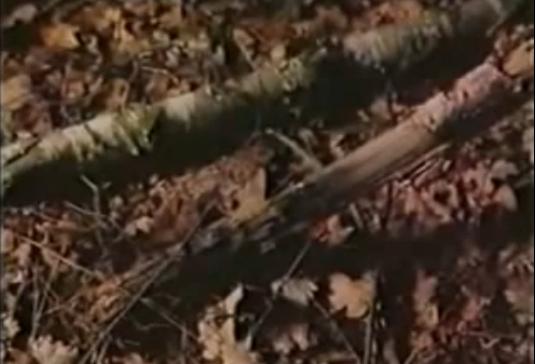
[Above: Partially burnt forest trees from the gasoline fire that killed Karl Koch[59]. Note that a fire which can partly burn "dry as matchwood" trees would not go out until all the wood was burned, unless it was controlled by one or more persons using fire extinguishers or hoses. Buckets of water would not put out a gasoline fire. But Koch couldn't have extinguished the gasoline fire that killed him and there were no fire extinguishers or hoses left at the scene. Therefore Koch's death was murder, not suicide!.]

had committed suicide[60] by pouring the contents of the gasoline can over himself, soaking the surrounding earth as well, lit a match, and was burned to death[61]. The police noted that the corpse was barefoot but no shoes were found in the car or in the surrounding area[62]. They were puzzled, because there had been no rain for five weeks and the undergrowth was as dry as matchwood, yet the scorched patch around the body was contained, as if it had been carefully controlled[63]. The body was on 3 June 1989[64] publicly identified by the police as that of Karl Koch[65]. But if Koch had committed suicide

[Above (enlarge): Timeline between: a. Koch's disappearance on 23 May 1989[66]; b. a farmer first noticing on 30 May what turned out to be Koch's work vehicle parked in the adjoining forest[67]; c. police responding to the farmer's report found a burnt body near the vehicle[68]; d. police identification on 3 June of the body as that of Koch[69]; and e. Linick's `suicide' a day later on 4 June[70].]

by pouring gasoline over himself and then setting it alight, he could not then have been able to control the fire that killed him to prevent it spreading outside the confined perimeter[71]. Koch would have been wearing shoes when he left his office in the car, but they weren't in the car or the surrounding area[72]. And no suicide note was found.[73].

Moreover, suicide made no sense, since Koch had confessed to the German authorities his selling of hacked Western computer secrets to the KGB[74]. He was therefore in no danger of being prosecuted, being protected from punishment by the terms of the espionage amnesty legislation[75]. The authorities had actually provided Koch with accommodation and found him a job with the Christian Democratic Party[76]. He was also receiving help with his drug dependency and seemed on his way to rehabilitation[77] Koch was even planning to move into an apartment of his own and had embraced conventional religion[78]. So even on those grounds (apart from the impossibility of Koch extinguishing, with no fire extinguisher or hose, the gasoline fire which killed him) murder was much more likely than suicide[79].

When the Nature paper announced on 16 February 1989 that the Shroud had in 1988 been dated by radiocarbon "laboratories at Arizona, Oxford and Zurich" as "mediaeval ... AD 1260-1390"[80], it was world news. Koch who was employed by the Christian Democratic Party, and had "embraced conventional religion," i.e. Christianity, would have heard about it, either from the news media, or from his Christian friends. If Koch knew that he had in 1988 hacked two computers in laboratories at Zurich and Oxford universities, even if he did not know what their function was, he would have `put two and two together' and realised that the "mediaeval" carbon date of the Shroud was partly the result of his hacking. In which case if Koch then told his Christian friends about it, the KGB would have learnt of it, which would explain why the KGB would have permanently silenced Koch, and then Linick the day after Koch's burnt body was publicly identified on 3 June 1989!

Continued in part #10, Summary (10).

Notes
1. This post is copyright. No one may copy from this post or any of my posts on this my The Shroud of Turin blog without them first asking and receiving my written permission. Except that I grant permission, without having to ask me, for anyone to copy the title and one paragraph only (including one associated graphic) of any of my posts, provided that if they repost it on the Internet a link to my post from which it came is included. See my post of May 8, 2014. [return]
2. Photo, "In memory of Karl Koch. Hagbard Celine. 22.7.1965. 23.05.1989." Translated by Google. http://www.hagbard-celine.de/. [return]
3. Clauss, U., 2012, "Ancestor of the Pirate Party was charred in the forest," Die Welt, 25 May 2012. Translated by Google. [return]
4. "Karl Koch (hacker)," Wikipedia, 28 January 2015. Footnotes omitted. Two links added. [return]
5. Jones, S.E., 2014, "My theory that the radiocarbon dating laboratories were duped by a computer hacker #1," The Shroud of Turin blog, May 24. [return]
6. Jones, S.E., 2014, "My theory that the radiocarbon dating laboratories were duped by a computer hacker #5," The Shroud of Turin blog, June 13. [return]
7. Jones, S.E., 2014, "My theory that the radiocarbon dating laboratories were duped by a computer hacker #7," The Shroud of Turin blog, July 5. [return]
8. Clough. B. & Mungo, P., 1992, "Approaching Zero: Data Crime and the Computer," Faber & Faber: London & Boston, p.185. [return]
9. Wikipedia, 2015. [return]
10. Hafner, K. & Markoff, J., 1991, "Cyberpunk: Outlaws and Hackers on the Computer Frontier," Corgi: London, reprinted, 1993, p.207. [return]
11. Clough & Mungo, 1992, pp.164-165. [return]
12. Shea, R. & Wilson, R.A., 1975, "The Illuminatus! Trilogy," Dell: New York NY. [return]
13. Hafner & Markoff, 1991, p.206. [return]
14. Ibid. [return]
15. Hafner & Markoff, 1991, pp.206-207. [return]
16. Hafner & Markoff, 1991, p.216. [return]
17. Hafner & Markoff, 1991, p.214. [return]
18. Hafner & Markoff, 1991, p.215. [return]
19. Clough & Mungo, 1992, p.164. [return]
20. Hafner & Markoff, 1991, p.208. [return]
21. Hafner & Markoff, 1991, pp.209, 185. [return]
22. Hafner & Markoff, 1991, p.209. [return]
23. Hafner & Markoff, 1991, p.211. [return]
24. Hafner & Markoff, 1991, p.224. [return]
25. Hafner & Markoff, 1991, pp.225, 293. [return]
26. Hafner & Markoff, 1991, pp.230-231, 239-240, 245, 249, 250, 254, 260. [return]
27. Hafner & Markoff, 1991, p.266. [return]
28. Gove, H.E., 1996, "Relic, Icon or Hoax?: Carbon Dating the Turin Shroud," Institute of Physics Publishing: Bristol UK, pp.213-214. [return]
29. Gove, 1996, pp.260-261. [return]
30. King, T., ed., 1989a, "Computer Espionage: Three `Wily Hackers' Arrested," Phrack Magazine, Issue #25, March 3. [return]
31. Jones, S.E., 2014, "Were the radiocarbon dating laboratories duped by a computer hacker?: My replies to Dr. Timothy Jull and Prof. Christopher Ramsey," The Shroud of Turin blog, March 13. [return]
32. Clough & Mungo, 1992, p.173. [return]
33. Linick, T.W., et al., 1986, "Operation of the NSF-Arizona accelerator facility for radioisotope analysis and results from selected collaborative research projects," Radiocarbon, Vol. 28, No. 2a, pp.522-533, 524. [return]
34. Clough & Mungo, 1992, pp.170-172, 228n5. [return]
35. Clough & Mungo, 1992, p.172. [return]
36. Stoll, C., 1989, "The Cuckoo's Egg Tracking a Spy through the Maze of Computer Espionage," Pan: London, reprinted, 1991, p.362. [return]
37. King, T., ed., 1989b, "News From The KGB/Wily Hackers," Phrack Magazine, Issue #25, March 7. [return]
38. Stoll, 1989, pp.341-342. [return]
39. Hafner & Markoff, 1991, pp.254, 266. [return]
40. Hafner & Markoff, 1991, p.283. [return]
41. Clough & Mungo, 1992, p.185. [return]
42. Stoll, 1989, p.363. [return]
43. Ibid. [return]
44. Clough & Mungo, 1992, p.184. [return]
45. Clough & Mungo, 1992, p.172. [return]
46. Clough & Mungo, 1992, p.184. [return]
47. Clough & Mungo, 1992, pp.183-184. [return]
48. Clough, & Mungo, 1992, p.163. [return]
49. Ibid. [return]
50. Hafner & Markoff, 1991, pp.302-303. [return]
51. Hafner & Markoff, 1991, p.303. [return]
52. Clough, & Mungo, 1992, p.163. [return]
53. Hafner & Markoff, 1991, p.303. [return]
54. Clough, & Mungo, 1992, p.163. [return]
55. Karl Koch (hacker)," Wikipedia, 30 May 2014. [return]
56. Clough, & Mungo, 1992, p.163. [return]
57. Hafner & Markoff, 1991, p.303. [return]
58. Ibid. [return]
59. "Cliff Stoll visiting Karl Koch's death forest," FirstPost, 2014. [return]
60. Clough, & Mungo, 1992, p.163. [return]
61. Hafner & Markoff, 1991, p.303. [return]
62. Ibid. [return]
63. Clough, & Mungo, 1992, p.163. [return]
64. King, T., ed., 1989c, "One of Cliff Stoll's `Wily Hackers' Is Dead (Suicide?)," Phrack Magazine, June 5. This 5th June Phrack Magazine report states that Koch died on 3 June, evidently wrongly assuming at the time that Koch had died the same day that the police publicly identified his body. [return]
65. Ibid. [return]
66. Clough & Mungo, 1992, p.163; Hafner & Markoff, 1991, pp.302-303. [return]
67. Hafner & Markoff, 1991, p. 303. [return]
68. Clough & Mungo, 1992, p.163; Hafner & Markoff, 1991, p.303. [return]
69. Clough, & Mungo, 1992, p.163. [return]
70. Galeazzi, G., 2013. "Never solved: The enigma that still divides the Church: The Shroud," Vatican Insider, 1 April. Translated from Italian by Google. See English translation, "Unsolved Enigma that Still Divides the Church: The Shroud." [return]
71. Clough, & Mungo, 1992, p.163. [return]
72. Ibid. [return]
73. Stoll, 1989, p.362. [return]
74. Clough & Mungo, 1992, p.185. [return]
75. Clough & Mungo, 1992, p.186. [return]
76. Clough & Mungo, 1992, p.185. [return]
77. Ibid. [return]
78. Hafner & Markoff, 1991, p.302. [return]
79. Clough & Mungo, 1992, p.185. [return]
80. Damon, P.E., et al., 1989, "Radiocarbon Dating of the Shroud of Turin," Nature, Vol. 337, 16th February, pp.611-615. [return]


Posted 17 May 2015. Updated 5 January 2026.

Saturday, May 16, 2015

"Fn-Fz": Turin Shroud Dictionary

Turin Shroud Dictionary
© Stephen E. Jones[1]

"Fn-Fz"

This is page "Fn-Fz" of my Turin Shroud Dictionary. For more information about this dictionary see the "Main index A-Z" and page "A."

This 2015 Turin Shroud Dictionary has been superseded by my new 2019 <Turin Shroud Encyclopedia>.

[Index] [Previous: "Fa-Fm"] [Next: "Ga-Gm"]


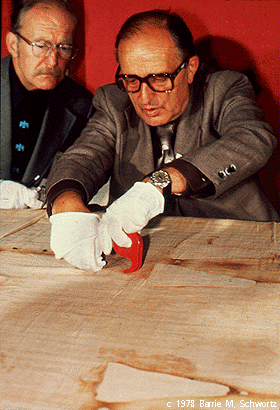
[Right: Max Frei-Sulzer[2] (see below), with STURP's Ray Rogers (1927 2005) looking on, taking pollen samples from the Shroud in 1978, in conjunction with (but not part of) STURP's investigation of the Shroud.]

face-cloth (see sudarium)

fold marks
forger
forgery
Fourth Crusade
fraud

Frei-Sulzer, Max. Max Frei-Sulzer (1913-83) was an eminent Swiss criminologist, with a doctorate in Botany. Frei was an expert in Mediterranean flora, his doctoral thesis having been on the flora of Sicily. Frei was the founder and for ~24 years from 1948 to his retirement in 1972, Director of the Criminology Department of Switzerland's police. Frei was a pioneer of forensic science, and in particular the use of pollen in proving accused persons at the scene of a crime. This is because pollen grains are microscopic and have a surface structure, size and shape which is unique to the species of plant they come from. Although he was a Protestant with no interest in relics, in 1973 Frei was appointed the Turin Commission on the Shroud to verify the authenticity of photographs of the Shroud submitted to it in 1969.

While examining the Shroud, Frei noticed there was dust on its surface. Frei knew that pollen on the Shroud could indicate which geographic region it had been in. Frei had developed the tape uplift method of collecting trace evidence which was a major advance in forensic science and still used today. Frei was permitted to take samples of dust from the Shroud by his sticky tape method for private analysis. The Shroud was hanging vertically so Frei could only take samples from the frontal foot end. Back in Zurich, in the following years, Frei identified a total of 48 different varieties of pollen-grains from the Shroud. In 1978 Frei obtained further dust samples containing pollen from the Shroud. Frei extracted the pollen grains from the sticking-tape, cleaned them, and studied them from all sides under an optical microscope. But Frei had only limited success obtaining pollen-grains or their photographs to compare with the Shroud pollen. So Frei undertook a systematic study of the pollen of plants growing in countries where the Shroud, if it was authentic, might have been. He realised that a positive identification of such pollens would be a confirmation of the Shroud's stay in that particular botanical region. So, from 1974 to 1978, Frei undertook seven field trips in different flowering seasons through Palestine, Turkey, Cyprus, France and Italy, for direct comparison under the microscope. Frei was successful in that the number of unidentified pollens steadily diminished. However Frei found that it was necessary to study the tiniest details of pollen structure under s scanning electron microscope (SEM), which he did, with the help of laboratories at Vercelli, Italy and Zurich, Switzerland.

Frei's summary of results included his identification of 56 different varieties of pollen on the Shroud, although presumably due to 2 later additions there were 58. These fell into the categories of: A. Desert plants, from sand deserts or halophytes (16 species). The latter grow in soils with a high concentration of salt. These plants grow around the Dead Sea but are completely missing in Italy and France. So "they could not have contaminated the Shroud during the last six centuries of its known history" (my emphasis). B. Plants of rocky hills and stony places (ruins) in Palestine and neighboring countries (7 species). C. Mediterranean plants, which grow in Palestine as well as in France and Italy (16 species). D. Plants from Anatolia, mostly steppic plants (16 [6 unique] species). These grow in the Near East, from Iran to the Eastern Mediterranean. "The contamination of the Shroud with these pollens could not have happened in Europe. They are strong evidence for the Shroud's stay in Edessa as theorised by Ian Wilson and others" (my emphasis). E. Plants growing near. A few plants in groups B, C and D can be found also around Constantinople (today Istanbul). Also one species of pollen on the Shroud, Epimedium pubigerum DC, has a more local distribution around Constantinople (Istanbul) and does not grow in the Near East nor in Western or Middle Europe, but only in Turkey and adjacent Bulgaria. These confirm the Shroud's stay at Constantinople. F. Plants widely distributed in Central Europe or cosmopolitans (12 species). These all grow in France and Italy where the Shroud has been for the last six centuries, and exposed in open public exhibitions. Frei therefore concluded:

"Groups A, B and C of plants on the Shroud from Palestine and Anatolia are so numerous, compared to the species from Europe, that a casual contamination or a pollen-transport from the Near East by storms in different seasons cannot be responsible for their presence, as I have explained in several conferences and publications. The predominance of these pollens must be the result of the Shroud's stay in such countries where these plants form part of the normal vegetation. A transport by migrating birds or a contamination with desert plants by pilgrims can be excluded because they had no possibility of a direct contact with the Shroud. ...."
Since the Shroud has never been outside Europe since the mid-14th century, even one of these non-European pollens on the Shroud would be a problem for the medieval forgery theory and the 1260-1390 radiocarbon date of the Shroud. Frei also collected pollen from the Sudarium of Oviedo and confirmed its historical route from Jerusalem through North Africa and into Spain. Regrettably Frei died unexpectedly in 1983, before he could finish and publish his pollen research.

In 1990 Dr. Alan Whanger reported he had found images of 28 different flowers and plants on the Shroud, 25 of which were among the pollens identified by Frei. Whanger's flower images and indirectly Frei's pollen identifications were later confirmed by Professor Avinoam Danin a world authority on the flora of Israel, reinforcing Frei's claims that the Shroud has been in Israel.

Frei's pollen identifications have had a mixed reception from palynologists. In 1983, Israel's leading pollen expert, Prof. Aharon Horowitz, after reading Frei's 1982 article in Shroud Spectrum International, stated that Frei's work was sound. Israeli palynologist Uri Baruch in 1998 studied Frei's pollen slides held by Whanger's Council for Study of the Shroud of Turin. Within a restricted protocol that Frei's pollens were not to be damaged or destroyed, Baruch found that of 34 pollen grains reported at the species level by Frei, 3 (Gundelia tournefortii, Ricinus communis, and Lomelosia [Scabiosa] prolifera) were correct. However, Baruch did find that all Frei s determinations are correct at the higher taxonomical level. In 2001 palynologist Thomas Litt was unable to confirm Frei's identifications due to their covering of sticky tape wax. But Frei had, unlike Baruch and Litt, painstakingly extracted his pollens from the sticky tape, cleaned them, and compared them with pollens from present-day plants.

While Frei's 1973 pollen tapes were not handed over to ASSIST by Frei's widow and now cannot be found, ASSIST's Paul Maloney advised me by email:

"You say that ASSIST never received the 1973 tapes. This is true. Mrs. Frei speculated to our team that the tapes taken from the Shroud in 1973 by her husband might have been left in Italy where the SEM work was done. She didn't really know. However, ASSIST probably did acquire the 1973 pollen grains extracted from those tapes. Dr. Frei created two different categories of studies. In his `Grey' box and in his `Green' box in the collection are a series of microscope slides with various pollen grains mounted on them. One group he labeled `MV' (Microscopie Vergleich?) i.e. modern fresh pollen grains he had collected during his seven trips to gather control samples, and the other type of slides were labeled `MS' which I decipher as (Microscopie Sindone?). In Frei's published materials he describes that he cut a `T' shaped incision in the 1973 tapes and teased out the grain. Some of this was done using a triangular shaped piece of sticky tape which he actually mounted, tape and all, on a microscope slide and covered with a cover glass. In macrographs we can see examples of these mounted triangles with the pollen on them. It is important to know that in no case did Dr. Frei remove any pollen grains from the 1978 tapes. They are completely intact. Hence, Dr. Frei's entire case was built upon his studies of the 1973 tapes. All of the SEM photos were done with fresh pollen grains taken from his collection gathered during his seven trips throughout Europe and the Middle East as control material for his study." (emphasis original)[3]
Turin botany professor, the late Silvano Scannerini (1940-2005), who, while critical of aspects of Frei's writings, nevertheless concluded that Frei's "pollens [are] of plants from the Near East [and so] are an indirect confirmation of the plausibility of the voyage of the Shroud from Asia to Europe"[4].

Extreme anti-authenticists Joe Nickell and Steven Schafersman have attempted to destroy Frei's reputation after his death, when he no longer could answer them. They accused Frei of fraud because STURP did not find much pollen on the Shroud. But Frei who, unlike STURP, was an expert at collecting pollen, pressed his sticky tape deep into the Shroud's fibres, while STURP used a pressure limiting applicator. Also, Frei wrongly identified the "Hitler Diaries'" handwriting as authentic, when they were later found, on other evidence, to be forged. But this had nothing to do with Frei's identification of pollens, which unlike handwriting, was his specialty. That Frei was no fraudster is self-evident in the enormous amount of painstaking work he did over a long period of time, delaying publication for many years until he had gathered sufficient evidence. If Frei had been a fraudster he would have published quickly to enjoy the glory. Evidence that Frei was not a fraudster is evident in his admission that he had been unable to identify any pollens on the Shroud which supported its transfer from Constantinople to Europe:

"So far I have not found any evidence for the Shroud's presence in Cyprus or other regions touched during the transfer from Constantinople to France and Italy."
If Frei had been a fraudster he would have manufactured that evidence. So there is no good reason to doubt Frei's main conclusion:
"The pollen-spectrum as described leaves no room for the hypothesis of a medieval fake painted in France. On the contrary, the pollen-deposits are a most valuable confirmation of the theory that the Shroud traveled from Palestine through Anatolia to Constantinople, France and Italy."


Notes:
1. This page, and each page in my Turin Shroud Dictionary, is copyright. However, permission is granted to quote from one entry at a time within a page (e.g. "Frei-Sulzer, Max," not the whole page "F"), provided a link and/or reference is provided back to the page in this dictionary it came from. [return]
2. Schwortz, B., "The 1978 Scientific Examination," Shroud.com, photograph https://www.shroud.com/78strp6.gif. [return]
3. Maloney, P., 2016, Email: "Re: The Max Frei entry in your Shroud Dictionary," 11 July, 4:39 AM. [return]
4. de Wesselow, T., 2012, "The Sign: The Shroud of Turin and the Secret of the Resurrection," Viking: London, p.114. [return]

Posted 6 May 2015. Updated 19 May 2026.