Sunday, March 18, 2018

11th-10th centuries: Shroud's 1260-1390 radiocarbon date is against the preponderance of the evidence (4): Steps in the development of my radiocarbon dating of the Turin Shroud hacker theory #12

Copyright © Stephen E. Jones[1]

This is part #12, "11th-10th centuries: Shroud's 1260-1390 radiocarbon date is against the preponderance of the evidence (4)," in my "Steps in the development of my radiocarbon dating of the Turin Shroud hacker theory," series. For more information about this series see part #1, "Hacking an explanation & Index." References "[A]", etc., will be to that part of my original post. Emphases are mine unless otherwise indicated.

[Index: #1, #2, #3, #4, #5, #6, #7, #8, #9, #10, #11, #13 (discontinued). See "My Hacker Theory in a nutshell."]

[Previous: "12th-11th centuries: Shroud's 1260-1390 radiocarbon date is against the preponderance of the evidence (3)" #11] [Next: "My theory that the radiocarbon dating laboratories were duped by a computer hacker #1" #13]

[Above (enlarge): A Russian Orthodox cross, dated second half of the 12th century (i.e. 1150-1200), and therefore ~sixty years before the earliest 1260 radiocarbon date of the Shroud[2]), in the Tretyakov Gallery, Moscow, Russia[3]. This shows the Russian Orthodox cross' unique footrest, or suppedaneum, which is inclined with the left side higher than the right. This matches the Shroud, in that the man's left leg, seems to be shorter than his right. See below. [A].]

Continuing with tracing the steps in the development of my radiocarbon dating of the Shroud hacker theory in my early 2014 posts (last three): "Were the radiocarbon dating laboratories duped by a computer hacker?: Revised #1"; "Were the radiocarbon dating laboratories duped by a computer hacker?: Revised #2 (Vignon markings)"; "Were the radiocarbon dating laboratories duped by a computer hacker?: Revised #3." and now "Were the radiocarbon dating laboratories duped by a computer hacker?: Revised #4" combined with "Were the radiocarbon dating laboratories duped by a computer hacker?: Revised #5"

This post continues from my previous "... against the preponderance of the evidence (3)", and before that "... against the preponderance of the evidence (2), and "... against the preponderance of the evidence (1), which presented historical evidence for the Shroud's existence in the 13th-12th centuries. As I had previously explained, my purpose of documenting all this historical evidence of the Shroud's existence from long before the 13th century is to prove, beyond any reasonable doubt, that the 1988 radiocarbon date of the Shroud as "mediaeval ... AD 1260-1390"[4] must be wrong. And then [since the evidence is overwhelming that the Shroud is authentic] the key questions would be (and are): 1. "How could the 1st century Shroud (absent fraud) carbon-date to the 13th-14th century?"; and 2. "How could the midpoint of that date range, 1325 ±65[5], `just happen' (absent fraud) to be a mere ~30 years before the Shroud's first appearance in undisputed history at Lirey, France, in c.1355"?[6] Especially given that the unofficial leader of the Shroud carbon-dating project, Prof. Harry Gove (1922-2009)[7], pointed out that the improbability of the Shroud being first century (which it is), yet its radiocarbon date was "between 1260 and 1390," is "about one in a thousand trillion"[8]).

c. 1001a The Russian Orthodox cross (late 10th-early 11th century)[9] has a footrest, or suppedaneum[10], which uniquely is inclined so that its left side is higher than its right[11] (see above). This matches the Shroud, in that the man on the Shroud's left leg appears to be shorter than his right[12]. This is

[Right (enlarge)[13]: The man on the Shroud's left leg (which looks to be his right because of mirror reversal[14]) appears to be shorter than his right.]

due to his left foot having been superimposed over his right[15], and both feet fixed by a single nail[16]. The man's left leg was therefore bent more and remained fixed in that position after death by rigor mortis[17] [see 02Dec13].

This presumably is the source of the 11th century Byzantine legend that Jesus actually had one leg shorter than the other and therefore was lame[18]. As this form of the cross is universal among the Russians[19] it must date from at least the beginning of the national conversion to Christianity, when missionaries in 988 came from Constantinople[20]. One of the oldest churches in Russia, the 10th-century Byzantine style Shoana Church[21], near Karachayevsk, Russia, has a Russian cross with an

[Left (enlarge): Russian cross atop the 10th-century Byzantine style Shoana Church, Russia. (For different views of the church and its cross see here).]

inclined footrest. This is probably not the original late 10th-early 11th century cross, but it is reasonable to assume that there was originally a Russian cross where the current cross is. And because its inclined footrest would have matched the apparently shorter right (but actually left) leg of the Shroud (see above), this is further evidence that the 1260-1390 radiocarbon date of the Shroud is wrong! [B]

c. 1001b Closely related to the Russian cross is the "Byzantine curve"

[Left (enlarge): "Byzantine Crucifix of Pisa," ca. 1230[22]. Note that Christ's right leg (corresponding to the Shroud's left leg - see above) is shorter than the other leg and His body is curved (the "Byzantine curve"[23]) to compensate.]

in Byzantine Christian iconography[24]. After the year 1000, a striking change occurred in Byzantine depictions of Christ on the Cross[25]. Christ's two feet were nailed separately at the same level but his left leg is bent (based presumably on the Byzantines realising that the Shroud's image is laterally inverted) which meant that Jesus' body needed to curve to His right to compensate[26]. This "Byzantine curve" became the established form of Eastern depictions of Christ at the beginning of the eleventh century and made its way also into the West and became the recognized form in Italy in the early mediaeval period[27]. As with the strange design of the Russian cross, so this strange belief that Jesus had to have a curved body on the Shroud because one foot was shorter than the other and the Romans would have crucified Jesus' feet at the same level[28], has its most likely common origin in the Shroud[29]. But then again that means the Shroud was known in the Byzantine world (the centre of which was Constantinople), in the year 1000, nearly three centuries before 1260, the earliest possible radiocarbon date of the Shroud[30]! [C]

c. 1000 Tenth-century "Christ Enthroned" fresco on the apse of the church of Sant'Angelo in Formis, near Capua, Italy[31] has 14 out

[Above (enlarge): Christ's face part of a larger 10th century fresco in the church of St. Angelo in Formis, Capua, Italy[32].]

of the 15 Vignon markings found on the Shroud (see #10)[33], many of which are just incidental blemishes on the cloth[34]. These include:

"... a transverse line across the forehead, a raised right eyebrow, an upside-down triangle at the bridge of the nose, heavily delineated lower eyelids, a strongly accentuated left cheek, a strongly accentuated right cheek, and a hairless gap between the lower lip and beard ..."[35].

One of these, the upside-down triangle at the bridge of the nose (VM #3)[36] is particularly important because it has no

[Above (enlarge): Upside-down triangle at the bridge of the nose on the Shroud, just below the base of the `topless square'[37].]

logic as a natural feature of the face, yet it recurs on several other works, for example, the eleventh-century mosaic Pantocrator in the dome of the church at Daphni, near Athens (see #11), where, being a mosaic, pieces of black material have been specially selected and arranged into the shape of a triangle in convey it[38].

Significantly the upside-down triangle is on several early copies of the Image of Edessa/Mandylion, notably on the twelfth-century fresco at [Spas Nereditsa[49], but that was destroyed[40] in World War II[41]. However, other icons from the same place and time still exist, for example the twelfth century Christos Acheiropoietos ("not made with hands") that was in the Assumption Cathedral, Moscow but is now in the Tretyakov Gallery, Moscow (see below). That icon has, by

[Above (enlarge): Christ Acheiropoietos (not made with hands), ~1100 from the Assumption Cathedral in the Moscow Kremlin, now in the Tretyakov Gallery, Moscow[42].]

my count, 12 out a possible 14 Vignon markings (since there is no throat for the transverse line across it, VM#13, to be depicted), including, as can be seen above VM#3, the upside-down triangle.

This is one of a few Image of Edessa/Mandylion icons which contain most of the 15 Vignon markings, and are, together with all the other evidence for it, prove that the Image of Edessa/Mandylion was the face panel of the tetradiplon ("four-doubled") Shroud (as we shall see below). This is more evidence that 10th century artists saw the Shroud[43], centuries before the earliest 1260 radiocarbon date of the Shroud[44].] And, as we have seen and will see, this is but one in a family of Byzantine likenesses of Christ, from the thirteenth century to as far back as the sixth century[45]! [D]

c. 990 Byzantine historian Leo Diaconus[46], or Leo the Deacon (c. 950-)[47], was a deacon in the imperial palace at Constantinople[48]. After 992 he began writing a ten-volume history of the Byzantine empire, in Constantinople, but he died

[Right (enlarge): "The History of Leo the Deacon," Amazon.com[49].]

before he could finish it[50]. In his history [51], Leo wrote that the image of Jesus in the Abgar V (c. 4 BC-AD 50) story was imprinted on a peplos, a full-length robe[52]. This can only be the Shroud, in Constantinople, in the tenth century (see also below), nearly three centuries before 1260, the earliest radiocarbon date of the Shroud[53]! [E]

958 In 958, a year before he died, Byzantine Emperor Constantine VII Porphyrogenitus (r. 913-959)[54], sent a letter of encouragement to his troops who were campaigning around Tarsus[55], telling them that he was sending them holy water that had been

[Left (enlarge): "Christ Crowning Constantine VII (945)": A piece of carved ivory dated 945, in the Pushkin Museum, Moscow, depicting Christ having just crowned Emperor Constantine VII[56].]

consecrated by various relics of the Passion, including "the sindon which God wore"[57]. The actual Greek words are, theophoron sindonos, the "God-worn linen sheet"[58]. This is clear evidence that the sindon seen by Robert de Clari (c.1170-1216) in 1203 (see #8) was in the imperial relic collection by the mid-tenth century, a full 300 years before the earliest 1260 radiocarbon date of the Shroud[59]. Also, Constantine VII, who as we shall see, viewed up close the Image of Edessa on its arrival in Constantinople in 944 [see "944b"], did not mention it in his 958 letter, which is inexplicable unless it and the full-length burial shroud were one and the same[60]. [F]

c. 950a Mid-tenth century depiction of the Edessa cloth/Mandylion being held by Edessa's King Abgar V (4BC–AD50) after he had been handed it by the disciple

[Right (enlarge): Icon of Abgar V holding the Mandylion bearing an image of Christ, 10th century, Saint Catherine's Monastery, Mount Sinai[61].]

Thaddeus (Addai), in this mid-tenth century encaustic (hot wax painting) icon at St. Catherine's Monastery, Mount Sinai[62]. Abgar's face is that of Emperor Constantine VII Porphyrogenitus (r. 913-959), as is evident from other works depicting him (see above)[63].

And the face of Jesus is in landscape aspect[64], confirming Ian Wilson's theory that the Edessa Cloth/Mandylion was the Shroud tetradiplon ("four-doubled") (see below)[65].

[Above (enlarge): Tetradiplon and the Shroud of Turin illustrated: The full-length Shroud of Turin (1); is doubled three times (2) through (4) keeping the man's face uppermost); resulting in the man's face within a rectangle, in landscape aspect (4); and the Shroud having been "four-doubled" in side view (5). Exactly as depicted in early copies of the Image of Edessa, such as the 11th century Sakli church, Turkey (6). See 15Sep12].

c. 950b A tenth century fresco of the Edessa cloth is in the Saklı Kilise (Hidden Church) at Sakli, in the ancient Cappadocia, now Goreme

[Above (enlarge): Image of Edessa from wall-painting in the Sakli or 'Hidden' Church, Goreme[67].]

region of central Turkey[68], about halfway between ancient Edessa and Constantinople[69]. The church and its frescoes have escaped the Islamic destruction and neglect which has befallen almost everything Christian in Turkey[70], by it having only been discovered in 1957 after a landslide had blocked its entrance for about 500 years[71]. This Edessa cloth fresco is painted above an arch in the Sakli `Hidden' church[72] and despite damage to the face, its resemblance to the face of the Shroud is remarkable[73]. It has the same sepia-coloured, disembodied, rigidly frontal face as the Shroud[74], in landscape aspect cloth, strikingly resembling the equivalent area on the Turin Shroud[75]. Its shape may be evidence of the frame which held the Mandylion[76]. This mural dates no later than the mid-eleventh century, at least two centuries earlier than the earliest 1260 radiocarbon date of the Shroud[78].[H]

c. 950c Codex Vossianus Latinus Q 69 is a tenth-century manuscript

[Above: "Vossianus Latinus Q69 is a tract dating to the 10th century that translates a probable 8th century Syriac text describing the Edessa cloth as containing a whole-body Christ image"[79].]

preserved at the University of Leiden in the Netherlands[80], mentions an eighth-century Syrian report that Jesus had left an imprint of his whole body on a cloth which was preserved in the big Church of Edessa, Turkey[81]. Adding to Jesus' legendary reply to Abgar V, the codex reads:

"...If you really want to see what my face looks like, I am sending you this linen cloth, on which you will be able to see not only the form of my face but the divinely transformed state of my whole body"[82].
This is an unmistakable reference to the Shroud[83] and reflects a changed understanding that the image was of the full body, not just the face[84]. And because of its Carolingian handwriting, the manuscript cannot date much later than the tenth century[85]. This supports Ordericus Vitalis 1130 variation of the Abgar story that, "...the Lord Jesus sent him [Abgar V] ... a beautiful linen cloth ... The image of the Saviour was miraculously imprinted on to it and shines out, displaying the form and size of the Lord's body..." (emphasis original)[86][I].

But these are only some of the "lot of other evidence" which "suggests ... that the Shroud is older than the radiocarbon dates allow," as admitted even by Oxford radiocarbon dating laboratory's Prof. Christopher Ramsey[Left[87].]:

"There is a lot of other evidence that suggests to many that the Shroud is older than the radiocarbon dates allow and so further research is certainly needed. It is important that we continue to test the accuracy of the original radiocarbon tests as we are already doing. It is equally important that experts assess and reinterpret some of the other evidence. Only by doing this will people be able to arrive at a coherent history of the Shroud which takes into account and explains all of the available scientific and historical information"[88].[J]
To be continued in the next part #13 of this series.

Notes
1. This post is copyright. I grant permission to quote from any part of it (but not the whole post), provided it includes a reference citing my name, its subject heading, its date, and a hyperlink back to this page. [return]
2. Wilson, I., 1991, "Holy Faces, Secret Places: The Quest for Jesus' True Likeness," Doubleday: London, p.3; Wilson, I., 1996, "Jesus: The Evidence," [1984], Weidenfeld & Nicolson: London, Revised, p.134; Wilson, I., 1998, "The Blood and the Shroud: New Evidence that the World's Most Sacred Relic is Real," Simon & Schuster: New York NY, pp.125, 141; Wilson, I. & Schwortz, B., 2000, "The Turin Shroud: The Illustrated Evidence," Michael O'Mara Books: London, p.113; Wilson, I., 2010, "The Shroud: The 2000-Year-Old Mystery Solved," Bantam Press: London, p.108. [return]
3. The Adoration of the Cross," Second half of the 12th century, "Christian Art: Icons, Murals, Mosaics," The Tretyakov Gallery, Moscow, Russia, 2 April 2014. [return]
4. Damon, P.E., et al., 1989, "Radiocarbon Dating of the Shroud of Turin," Nature, Vol. 337, 16 February, pp.611-615, 611. [return]
5. McCrone, W.C., 1999, "Judgment Day for the Shroud of Turin," Prometheus Books: Amherst NY, pp.1, 141, 178, 246; Wilson, 1998, p.7; Tribbe, F.C., 2006, "Portrait of Jesus: The Illustrated Story of the Shroud of Turin," Paragon House Publishers: St. Paul MN, Second edition, p.169; de Wesselow, T., 2012, "The Sign: The Shroud of Turin and the Secret of the Resurrection," Viking: London, p.170; Oxley, M., 2010, "The Challenge of the Shroud: History, Science and the Shroud of Turin," AuthorHouse: Milton Keynes UK, p.87. [return]
6. Wilson, I., 1979, "The Shroud of Turin: The Burial Cloth of Jesus?," [1978], Image Books: New York NY, Revised edition, p.91; Scavone, D.C., 1989, "The Shroud of Turin: Opposing Viewpoints," Greenhaven Press: San Diego CA, pp.14, 30; Wilson, 1991, p.19; Wilson, 1998, pp.126-127, 278; Ruffin, C.B., 1999, "The Shroud of Turin: The Most Up-To-Date Analysis of All the Facts Regarding the Church's Controversial Relic," Our Sunday Visitor: Huntington IN, p.64; Fanti, G. & Malfi, P., 2015, "The Shroud of Turin: First Century after Christ!," Pan Stanford: Singapore, p.59; Oxley, 2010, pp.4, 49, 52, 73; Wilson, 2010, pp.221-222, 302; de Wesselow, 2012, pp.14, 51. [return]
7. Sox, H.D., 1988, "The Shroud Unmasked: Uncovering the Greatest Forgery of All Time," The Lamp Press: Basingstoke UK, p.95; Antonacci, M., 2000, "Resurrection of the Shroud: New Scientific, Medical, and Archeological Evidence," M. Evans & Co: New York NY, pp.192-193. [return]
8. Gove, H.E., 1996, "Relic, Icon or Hoax?: Carbon Dating the Turin Shroud," Institute of Physics Publishing: Bristol UK, p.303. [return]
9. Barnes, A.S., 1934, "The Holy Shroud of Turin," Burns Oates & Washbourne: London, p.65. [return]
10. Bulst, W., 1957, "The Shroud of Turin," McKenna, S. & Galvin, J.J., transl., Bruce Publishing Co: Milwaukee WI, p.47. [return]
11. Barnes, 1934, p.65. [return]
12. Petrosillo, O. & Marinelli, E., 1996, "The Enigma of the Shroud: A Challenge to Science," Scerri, L.J., transl., Publishers Enterprises Group: Malta, p.196; Tribbe, 2006, p.234. [return]
13. Latendresse, M., 2010, "Shroud Scope: Durante 2002 Vertical". [return]
14. Barnes, 1934, p.64. [return]
15. Petrosillo & Marinelli, 1996, p.196; Tribbe, 2006, p.234. [return]
16. Barnes, 1934, p.64. [return]
17. Petrosillo & Marinelli, 1996, p.196. [return]
18. Petrosillo & Marinelli, 1996, pp.195-196; Ruffin, 1999, p.111. [return]
19. Barnes, 1934, p.65. [return]
20. Barnes, 1934, pp.65-66. [return]
21. "Shoana Church," Wikipedia, 13 June 2017. [return]
22. "Byzantine Master of the Crucifix of Pisa," Wikipedia, 14 April 2017. [return]
23. Barnes, 1934, pp.67, 68; Petrosillo, O. & Marinelli, E., 1993, "Shrouded in Mystery," Shroud News, No 76, April, pp.14-21, 16; Petrosillo & Marinelli, 1996, pp.195-196. [return]
24. Barnes, 1934, p.66. [return]
25. Barnes, 1934, pp.66-67. [return]
26. Barnes, 1934, p.67. [return]
27. Barnes, 1934, pp.67-68. [return]
28. Barnes, 1934, p.68. [return]
29. Petrosillo & Marinelli, 1996, p.195. [return]
30. See reference 2. [return]
31. Wilson, 1991, p.47. [return]
32. Wilson, I., 1986, "The Evidence of the Shroud," Guild Publishing: London, p.110A. [return]
33. Wilson, 1979, p.102. [return]
34. Wilson, 1991, p.47. [return]
35. Wilson, 1991, p.165. [return]
46. Wilson, I., 1978, "The Turin Shroud," Book Club Associates: London, p.82e. [return]
37. Latendresse, M., 2010, "Shroud Scope: Durante 2002 Face Only Vertical". [return]
38. Wilson, 1991, p.165. [return]
39. Ibid. [return]
40. Wilson, 1979, p.192f. [return]
41. "Saviour Church on Nereditsa," Wikipedia, 16 February 2018. [return]
42. "File:Christos Acheiropoietos.jpg," Wikipedia, 2 July 2008. [return]
43. Wilson, 1986, p.110A. [return]
44. See reference 2. [return]
45. Wilson, 1979, p.102. [return]
46. "Leo Diaconus," New Advent Catholic Encyclopedia, 21 December 2017. [return]
47. "Leo the Deacon," 2013, Wikipedia, 20 December 2017. [return]
48. "Leo Diaconus," New Advent Catholic Encyclopedia,. [return]
49. Sullivan, D.F. & Talbot, A-M., eds, 2005, "The History of Leo the Deacon," Amazon.com. [return]
50. "Leo Diaconus," New Advent Catholic Encyclopedia, 2017. [return]
51. Guscin, M., 2009, "The Image of Edessa," Brill: Leiden, Netherlands & Boston MA, p.161. [return]
52. Drews, R., 1984, "In Search of the Shroud of Turin: New Light on Its History and Origins," Rowman & Littlefield: Lanham MD, p.39; Wilson, 1998, p.152; Antonacci, 2000, p.132; Sullivan & Talbot, 2005, p.121; Oxley, 2010, p.36; de Wesselow, 2012, p.383. [return]
53. See reference 2. [return]
54. "Constantine VII," Wikipedia, 6 February 2018. [return]
55. Wilson, 1991, p.153; Whiting, B., 2006, "The Shroud Story," Harbour Publishing: Strathfield NSW, Australia, p.257; Wilson, 2010, pp.168-169. [return]
56. Constantine VII, Wikipedia. [return]
57. Wilson, 1991, p.153; Whiting, 2006, p.257; Wilson, 2010, p.169. [return]
58. de Wesselow, 2012, pp.177-178. [return]
59. de Wesselow, 2012, p.178. See also reference 2. [return]
60. Wilson, 1991, pp.153-154; Whiting, 2006, p.257; Wilson, 2010, p.169. [return]
61. "Abgar V," Wikipedia, 16 March 2018. [return]
62. Wilson, 1986, p.110E. [return]
63. Wilson, 1979, p.155; Whanger, A.D. in Meacham, W., 1983, "The Authentication of the Turin Shroud: An Issue in Archaeological Epistemology," Current Anthropology, Vol. 24, No. 3, June, pp.283-311, 304. [return]
64. Wilson, 1979, pp.119-120; Wilson, 1986, pp.111-113; Wilson, 1991, pp.141-143; Borkan, M., 1995, "Ecce Homo?: Science and the Authenticity of the Turin Shroud," Vertices, Duke University, Vol. X, No. 2, Winter, pp.18-51, 35; Iannone, J.C., 1998, "The Mystery of the Shroud of Turin: New Scientific Evidence," St Pauls: Staten Island NY, pp.104-105; Wilson, 1998, pp.151-153; Antonacci, 2000, p.132; Wilson & Schwortz, 2000, pp.110-111; de Wesselow, 2012, pp.186-187; Wilson, 2010, p.140-141. [return]
65. Wilson, 1998, p.152. [return]
66. Jones, S.E., 2012, "Tetradiplon and the Shroud of Turin," Blog post, September 15. [return]
67. Wilson, 2010, p.210F. [return]
68. Scavone, 1989, p.75. [return]
69. Wilson, 1998, p.151. [return]
70. Wilson, 1998, p.112. [return]
71. Wilson, 2010, p.172. [return]
72. Wilson, 1998, p.151. [return]
73. Ibid. [return]
74. Ibid. [return]
75. Wilson & Schwortz, 2000, p.109. [return]
76. Scavone, 1989, p.75. [return]
78. Wilson, 2010, p.112. See also reference 2. [return]
79. Long, J., 2013, "The Shroud of Turin's Earlier History: Part Two: To the Great City," Associates for Biblical Research, March 20. [return]
80. Wilson, 2010, p.177. [return]
81. Petrosillo & Marinelli, 1996, pp.250-251. [return]
82. Guscin, 2009, p.207. [return]
83. Petrosillo & Marinelli, 1996, p.251. [return]
84. Wilson, 2010, p.177. [return]
85. Ibid. [return]
86. Ibid. [return]
87. Prof. Christopher Ramsey, Merton College, Oxford, n.d.. [return]
88. Ramsey, C.B., 2009, "Shroud of Turin," Oxford Radiocarbon Accelerator Unit, 17 July. [return]

Posted 18 March 2018. Updated 18 February 2026.

Saturday, March 3, 2018

Obituary (3): Dr. Alan Duane Whanger (17 July 1930 - 21 October 2017)

© Stephen E. Jones[1]

This is part #3 of my obituary of Dr. Alan D. Whanger. Emphases are mine unless otherwise indicated. Previous parts in this series were part #1 and part #2. The next is part #4.

[Coins over the eyes] [Corona disharge]


Coins over the eyes [top]

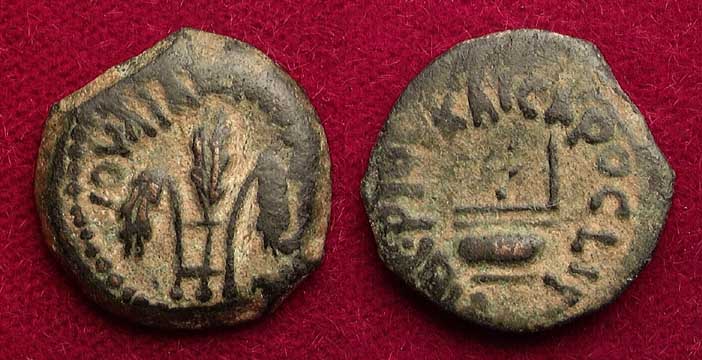
[Above (enlarge): A lepton (Greek) aka prutah (Hebrew) coin struck under the Roman governor of Judea, Pontius Pilate (r. AD 26-36), who sentenced Jesus to death by crucifixion (Mt 27:24-31; Mk 15:15-20; Lk 23:25-26; Jn 19:12-16) in AD 30[2]. This lepton has the "UCAI" ("TIBEPIOUCAICAPOC" - "Of Tiberius Caesar") variant of the usual "UKAI" ("TIBEPIOUKAI- CAPOC") which was given to Fr. Francis L. Filas (1915-85) in 1979 by numismatist William Yarbrough[3]. Tiberius Caesar was Roman Emperor from AD 14-37, and therefore over the time of Jesus' ministry and death (Lk 3:1). But this lepton's lituus (astrologer's staff) is in the shape of a reversed question mark, which pro-authenticist amateur numismatist Mario Moroni (1931-2007) correctly [sic] pointed out cannot be the version of lepton imprinted on the Shroud (see 10May13a). See my post of 18Apr20 that Moroni was wrong and Filas was right! And also that the "C" in "UCAI" was part of the lituus - see 10May13b. So both Filas and Whanger were correct about the coin over the Shroud man's right eye being a Pontius Pilate lepton (and therefore further proving beyond reasonable doubt that the man was Jesus!), but they misinterpreted which Pontius Pilate lepton it was - see my "The Shroud of Turin: 2.6. The other marks (5): Coins over eyes" and below.]

In January 1982 the Whangers had arranged a press conference through the Duke University News Service[4]. where Alan was a professor of psychiatry[5]. Its purpose was to disseminate the Whangers' Points of Congruence findings [albeit flawed - see part #2] on the St Catherine's Monastery Pantocrator icon [see part #1a] and a Justinian II gold solidus coin [see part #1b] [6]. After the press conference the Whangers were asked about Filas' claim that there were identifiable coins over the eyes of the Man on the Shroud[7]. Their response included: "We don't know ... But now we have a method for minute and detailed comparison and we'll go look"[8].

The Whangers then summarised (with my additions) the evidence that there are indeed images of Pontius Pilate lepton coins over the Shroud man's eyes:

■ In 1977 the leaders of what became The Shroud of Turin Research Project (STURP), John P. Jackson (1946-), Eric Jumper (1949-) and R.W. (Bill) Mottern (1924-2015), using a VP-8 Image Analyzer which converts shades of grey into height [see 05Feb17] discovered that the Shroud man's image was three-dimensional[9]. Moreover on the VP-8 Image Analyzer's `relief map' of the Shroud, they discovered there were two

[Above (enlarge): Extract of a close-up of the original 1977 VP-8 Image Analyzer three-dimensional output of the Shroud face, showing the "button-like objects" over each eye[10]. As can be seen, the "button" over the man's right (left facing) eye is in the correct place, but that over the left (right facing) eye, has been displaced to the edge of the eye-socket[11]. This is yet another problem of the forgery theory, which I will cover in my, "The evidence is overwhelming that the Turin Shroud is authentic!" series, namely "3. Other marks and images ... G. Coins over the eyes #32." That is, a medieval forger: 1) would be unlikely to even know the dimensions of a Pontius Pilate lepton; 2) would be unlikely, if not unable, to depict leptons as three-dimensional objects; and even if he did, 3) would have depicted them both over the centre of the eyes, not show one displaced to the edge of the eye socket. But a a displaced lepton could well have happened in a real transport of Jesus' body from the cross to the tomb and the laying of His body in the tomb. Since rigor mortis would by then have ensured Jesus' eyes were closed, those burying Jesus would not have bothered to re-position a displaced coin over one of His eyes, especially considering the extreme shortness of time they had left (see 30Sep15).]

"button-like objects, one over each eye" which "might be coins ... used to keep the eyes of the dead closed"[12]. Jackson, et al. noted that this "agrees with ancient Jewish burial custom where objects (potsherd fragments or coins) were ... sometimes placed over the eyes" of the dead[13]. They also saw with their then limited "computer enhancements ... a possible structure on the surface of the objects"[14].

■ Historian Ian Wilson mentioned several Judean Bronze lepton coins from the time of Pontius Pilate which would correspond to the size of

[Above (enlarge): Perfect fit of Pontius Pilate lepton coins superimposed over the Shroud man's eyes[15]!]

these "buttons"[16], which were about fifteen millimeters or five-eighths of an inch in diameter[17]. Wilson also pointed out that a lepton was acceptable as a Temple offering (Mk 12:41-44; Lk 21:1-4), and therefore would likely be used by orthodox Jews Joseph of Arimathea and Nicodemus who buried Jesus (Mt 27:57; Mk 15:43; Lk 23:50; Jn 19:38)[18]. So even if no inscription nor designs unique to Pontius Pilate leptons were found on these "buttons" over the Shroud man's eyes (but there were - see below), from their size and shape, the best explanation is that they were Pontius Pilate leptons!

■ In August 1979 Filas was looking at a high-quality enlargement of a 1931 Enrie negative photograph of the Shroud face, when he

[Right (enlarge): Fr. Francis L. Filas (1915-85)[19].]

noticed for the first time some sort of a design over the right eye[20]. Filas was a Jesuit priest and Professor of Theology at Loyola University in Chicago[21] and a founding member and Vice President of the Holy Shroud Guild[22]. Filas was aware of Jackson, et al's 1977 discovery of three-dimensional images of "buttons" over the eyes of the man on the Shroud (see above) and that Wilson had confirmed that they were the same size and shape as Pontius Pilate leptons (see above)[23], since Filas had been present and had even delivered a paper at that same 1977 Shroud conference in Albuquerque, New Mexico[24].

■ Filas showed the photograph to Michael Marx, a Chicago numismatist specialising in ancient Greek coins, who had previously volunteered his professional expertise[25]. Marx under his magnifier identified four curving capital letters, "UCAI" and a design that looked like a shepherd's crook (a lituus or astrologer's staff - see above)[26]. A prominent lituus in the shape of a question mark was unique to coins minted in Judea in the reign of Pontius Pilate[27] and only between AD 29-32[28]! So even if no inscription had been found on these images of coins over the eyes of the man on the Shroud (but there were - again see above), that they were uniquely the size and shape of Pontius Pilate leptons (see above) and that they have a prominent lituus unique to Pontius Pilate, is already proof beyond reasonable doubt, that they are Pontius Pilate leptons, and therefore the man on the Shroud is Jesus!

■ Marx suggested that Filas obtain Frederic W. Madden's History of Jewish Coinage and of Money in the Old and New Testament (1864)[29], in-addition to consulting the catalog of all Pontius Pilate coins in the British Museum[30]. But here is where Marx and Filas, and eventually Whanger, went wrong. I don't know about the then catalog of Pontius Pilate coins in the British Museum, but I have Madden's book in front of me, and it only shows Pontius Pilate leptons (page 149 and supplements s.10-11) with litui in the shape of a reversed question mark (see above). But as Italian numismatist Mario Moroni correctly pointed out (and reader scan verify this for themselves - as I

[Above (enlarge): Numismatist Mario Moroni's correct interpretation (right) of the lituus as a question mark shape in an Enrie negative sepia negative photograph[31] of the Shroud (left)[32].]

did [see 10May13c]) - that since the image of the lituus in the lepton over the right eye of the man on the Shroud in an Enrie negative photograph, is the shape of a question mark (not a reversed question mark), then the lituus on the actual lepton coin that is imprinted on the Shroud must have also had the shape of a question mark. And as Moroni discovered, there was a Pontius Pilate lepton with a lituus

[Left (enlarge): A Pontius Pilate dilepton coin with its lituus in the shape of a question mark[33], as it is on the Shroud. See other photos of Pontius Pilate dilepton lituus coins at 10May13d.]

in the shape of a question mark: a dilepton lituus, which was struck in AD 29[34]!

■ On reading Madden, Filas tentatively identified the coin over the Shroud man's left eye as a Julia lepton[35], which was issued only in [Above (enlarge): Julia (ΙΟΥΛΙΑ) lepton with three barley sheaves on one side (reverse) and a simpulum (Roman sacrificial vessel) and Greek letters "Tiberius Caesar" on the other (obverse): Edgar L. Owen, Ltd. The "LΙϚ" ("LIS") on the obverse indicates the coin was issued in the 16th year of the reign of Tiberius Caesar, which was AD 29[36]. ]

AD 29 upon the death in that year of Livia Drusilla (58 BC–AD 29), also known as Julia Augusta, who was Tiberius' mother and the wife of the former Roman Emperor Augustus (63 BC–AD 14)[37]. The basis of Filas' identification was "three very short curving lines that seemed to spread away from each other from a common source," which are the stalks of three sheaves of barley on the Julia lepton (see above)[38]. Filas' identification of this coin over the left eye as a Julia lepton was later confirmed by numismatist Arden R. Brame II (1943-2004)[39] and computer enhancement by Prof. Nello Balossino (1945-)[40]

■ In May, 1981 Filas requested that Log/E Interpretations Systems digitize photographs of both eye areas of the Shroud[41]. Their Standard Earthview equipment was similar to a VP-8 Image Analyzer[42]. Its enhancement for the right eye area showed clearly the letters "UCAI" (according to Filas), the curving staff (lituus) and the coin outline[43]. While this coin boundary and within it a lituus as well as an inscription, over the right eye of the Shroud man, is sufficient to add to the already proof beyond reasonable doubt that it is the image of a Pontius Pilate lepton coin, and therefore the Man on the Shroud is Jesus, but again, Filas (and Whanger) had misinterpreted what type of Pontius Pilate lepton coin it was (see above) and so the letters "UCAI" are an illusion and hence a distraction.

■ In August 1981, Filas had Gamma Laboratories of Chicago enlarge a photograph of his Pilate lepton to twenty-five times life-size, and to his great surprise he noticed for the first time the letter "C" where "K" should have been[44]. But instead of drawing the conclusion that he had all along misinterpreted the letter "C" (as Moroni pointed out, albeit in 1991[45]), especially since Mel Wacks, Editor of The Augur, the journal of the Biblical Numismatic Society, had been pointing out since 1980 that Filas' letters "C" and "A" were in the wrong position relative to the lituus on the Pontius Pilate lepton[46]), Filas (and Whanger) assumed that Filas `just happened' to have "in his possession a coin with the never-before-seen misspelling"[47]!

■ Then in November, 1981, at the coin sales department of Marshall Field's in Chicago, Filas found another Pontius Pilate lepton with "the aberrant C misspelling"[48]. Later, Filas located two more Pontius Pilate leptons "with the C misspelling"[49]. Whanger called these finds "astonishing"[50] but Wacks, a Jewish expert on Biblical coins, having studied highly magnified photographs of Filas' first coin, pointed out that "the actual inscription is quite normal for the coin and bears no similarity to Filas's findings"[51], which presumably also applies to these later so-called "aberrant C misspelling[s]"! Tellingly, numismatist William Yarbrough, who gave Filas the Pontius Pilate lepton which had the claimed "UCAI" variant (see above), agreed with Wacks on this and in an article in World Coin News of March 1982, Yarbrough stated that "a number of good numismatists disagree with Filas's opinion"[52].

■ It was soon after this that the Whangers held their January 1982 Duke News Service press conference (see above) where they were asked about Filas' claims of coins over the eyes of the man on the Shroud[53]. Alan contacted Filas, who sent the Whangers photographs of his coins: his original lituus lepton and a Julia lepton, as well as the Log/E Interpretations Systems computer enhancements[54]. According to Mary Whanger:

"Polarized image overlays revealed seventy-four points of congruence (PC) between the image on the right eye of the Shroud and Filas's lituus lepton, and seventy-three PC between the left eye image and the Joulia lepton! Remember, in a court of law it takes only fourteen PC to establish same source of fingerprints. These coins are much smaller than a fingerprint. For the right eye, there is a clipped edge on one side of the Filas coin that matches a clipped edge on the Shroud image. The letters, which are about one and one-half millimeters high, match remarkably: about half of the letter U, which actually is the Greek letter upsilon and shows the tail looking like a Y; all of the letter C; two-thirds of the letter A; the lower half of the letter I; as well as parts of other letters. On the coin there is a circular die defect at the base of the letter A; the same die defect can be clearly seen on the Shroud"[55]
This sounds impressive until it is remembered that (as we saw in part #2): 1) The Whangers' PC claims are entirely subjective and are merely what Alan and Mary Whanger agreed was so[Flaw #1]. 2) Their court of law analogy is fallacious since fingerprint points of congruence are so objective they can be, and are, computerised[Flaw #2]. 3) Their assumption is that more is better, but is "seventy-four" and "seventy-three" points of congruence really any better than Jackson, et al.'s and Filas' observations? Especially considering that the more claimed PCs, the smaller each is, and the more is the likelihood that some (if not most) are illusory[Flaw #3]. 4. Then there is the lack of realism [Flaw #4] in that the Whangers found "seventy-four points of congruence" using the wrong coin [see above]! If the Whangers truly believed that there really were 74 and 73 points of congruence between Pontius Pilate lituus and Julia leptons and the images of "buttons" over the right and left eyes, respectively, of the man on the Shroud, then they would have published in a peer-reviewed scientific journal comparative photographs of the coins and the Shroud eyes for each of them. But as far as I am aware they never did for any of their claimed PCs.

■ In 1983 Filas arranged with Robert M. Haralick (1943-), then Director of the Spatial Data Analysis Laboratory of Virginia Polytechnic Institute, to

[Right: "Robert M. Haralick is Distinguished Professor in Computer Science at Graduate Center of the City University of New York"[56].]

do a full-scale, three-dimensional computer image analysis of Filas' Enrie 1931 photographs of the Shroud[57]. Filas also gave Haralick a Pontius Pilate lepton[58] and a 1978 STURP colour photograph of the Shroud taken by Vernon D. Miller (1932-2009)[59]. Haralick spent about 6 months doing a variety of digital enhancements to the photographs[60], publishing his findings in 1983 in a 66-page monograph, "Analysis of Digital images of the Shroud of Turin"[61]. Haralick's report included:

"A number of digital enhancements were performed on imagery digitized from the 1931 Enrie photographs of the Shroud and a 1978 S.T.U.R.P. photograph taken by Vernon Miller. The enhancements provide supporting evidence that the right eye area of the Shroud image contains remnants of patterns similar to those of a known Pontius Pilate coin dating from 29 A.D. "[p.2]

" ... Thus, in the enlargement of the right eye image we find supporting evidence for a bright oval area: a shepherd's staff pattern as the main feature in the bright area; and bright segment patterns just to the side and top of the staff pattern, which in varying degrees match to the letters OUCAIC." [p.34]

"... This evidence cannot be said to be conclusive evidence that an image of the Pontius Pilate coin appears in the right eye of the Enrie Shroud Image ... however, the evidence is definitely supporting evidence because there is some degree of match between what one would expect to find if the Shroud did indeed contain a faint image of the Pilate coin and what we can in fact observe in the original and in the digitally produced images." [p.34][62]
■ It has been objected that placing a coin in the mouth of the dead was a pagan custom, to pay the mythical ferryman Charon to carry the soul of the recently died across the river Styx to Hades[63], and Jews would not have done that[64]. But coins have been found in first century Jewish skulls[65], which can only have originally been placed over the eyes, since coins placed in the mouth don't stay in the skull but coins placed over the eyes do[66]. The leptons of Pontius Pilate were actually Jewish coins (the prutah)[67] and (as we saw previously) were acceptable as temple offerings (Mk 12:42, Lk 21:2), so there is no reason why they could not have been used by first century Jews for the practical purpose of closing the eyes of their dead[68].

Corona discharge [top]

[Above (enlarge: Pontius Pilate lituus lepton (left) and its image imprinted on linen (right) by Oswald Scheuermann (1933-2019) using corona discharge[69].]

In 1982 Alan Whanger showed an overlay of the Filas coin and the computer enhancement of the right eye area to STURP member the late Dr. Alan Adler (1931-2000), then a Professor of Chemistry at Western Connecticut State University[70]. Prof. Adler realised that he was seeing a clue to the Shroud man's image formation[71], in that the image over the Shroud's right eye was only of the high points and rough spots of the coin, which is a characteristic of corona discharge[72]. In corona discharge, ionizing electrical energy first spreads over the surface of any object in the electrical field, whether it be flesh, hair, cloth, metal, etc[73]. The electrical energy is then discharged as ionized streamers from irregular or elevated areas of the object rather than from smooth surfaces[74]. Through Fr Adam J. Otterbein (1915-98), Alan then contacted Oswald Scheuermann (1933-), a high school physics teacher in Germany who had experimented with corona discharges on photographic film[75], using a Van de Graaf generator which produced high-voltage, high-frequency electricity[76]. Whanger sent a lituus lepton to Scheuermann and he promptly returned a piece of linen bearing a corona discharge image of the lepton (see above), which was remarkably similar to the image over the right eye of the Shroud[77]. In 1983, Scheuermann first noted the presence of flower images on the Shroud[78] and as a test he produced corona discharge

[Above (enlarge): "Corona discharge photographs made by O. Scheuermann on photographic paper. Left. Stems and a fruit of Berberis sp. Right. A leaf of Rosa sp"[79].]

images from diverse plant material, including leaves, stems, thorns, as well as flowers and fruits (see above)[80]. Although Scheuermann reported this in a 1983 letter to Alan Whanger[81], it was not until two years later, in 1985, that Whanger noticed out of the corner of his eye the image of a large chrysanthemum-like flower near the head of the man on the Shroud[82]. See part #4 of this obituary of Dr. Alan Whanger. See also my 2013 "... 2.6. The other marks (4): Plant images." Finally, in all of Scheuermann's samples the corona discharge images penetrate the cloth, something the Shroud images do not do[83]. Also some of Scheuermann's cloth fibres were scorched, unlike Shroud image fibres which are not scorched[84]. Moreover, for corona discharge to be the explanation of the Shroud's total body image would require an estimated amount of energy of 50 watt-seconds/square centimeter for a power source of at least 1,100 kilowatts for 1/10 second[85]. Since dead bodies don't generate that amount of energy[86] (to put it mildly!), Scheuermann proposed that the Shroud man was Jesus and the image on the Shroud was caused by His resurrection:

"Either there was a chain of coordinated processes of cause and effect due to laws that are still unknown or an inexplicable phenomenon of a supernatural kind left traces of a natural kind ... Consequently, it is high time now to completely record the primary aspect and add the phenomenon `resurrection' to the fact `corpse.' ... `Resurrection,' even if inexplicable, must not be excluded as a point of reference or an action principle ... It has to be admitted that we know hardly anything as to how that resurrection is to have taken place; but that does not exclude that it could have left palpable traces ... not only an empty tomb and all the attendant circumstances, but also a very informative image"[87].
Continued in the next part #4 of my obituary of Dr. Alan D. Whanger.

Notes
1. This post is copyright. I grant permission to quote from any part of it (but not the whole post), provided it includes a reference citing my name, its subject heading, its date, and a hyperlink back to this page. [return]
2. Doig, K.F., 2015, "New Testament Chronology: Part IV, The Crucifixion of Jesus" & "The 30 CE Crucifixion," 22 April. [return]
3. Filas, F.L., 1981, "`Missing Link' Coin of Pontius Pilate Proves Authenticity, Place of Origin, and Approximate Dating of the Shroud Of Turin," News Release, Loyola University of Chicago, September 1, p.5. [return]
4. Whanger, M. & Whanger, A.D., 1998, "The Shroud of Turin: An Adventure of Discovery," Providence House Publishers: Franklin TN, p.22. [return]
5. "In Memory of Alan Duane Whanger," Cremation Society of the Carolinas, October 21, 2017 & "About CSST," (no longer online) Council for Study of the Shroud of Turin, 2015. [return]
6. Whanger & Whanger, 1998, p.22. [return]
7. Ibid. [return]
8. Ibid. [return]
9. Whanger & Whanger, 1998, p.23. [return]
10. Jackson, J.P., Jumper, E.J., Mottern, R.W. & Stevenson, K.E., ed., 1977, "The Three Dimensional Image On Jesus' Burial Cloth," in Stevenson, K.E., ed., "Proceedings of the 1977 United States Conference of Research on The Shroud of Turin," Holy Shroud Guild: Bronx NY, pp.74-94, 88. [return]
11. Moroni, M., 1997, "Those Contentious 'Coins over the Eyes'...," Letters to the Editor, BSTS Newsletter, No. 46, November/December; Moretto, G., 1999, "The Shroud: A Guide," Neame, A., transl., Paulist Press: Mahwah NJ, p.51. [return]
12. Whanger & Whanger, 1998, p.23; Jackson, et al., 1977, pp.89-91 & Jumper, E., Stevenson, K. & Jackson, J., 1978, "Images of Coins on a Burial Cloth?," The Numismatist, July, Vol. 91, No. 7, pp.1349-1357, 1354-1355; Tribbe, F.C., 2006, "Portrait of Jesus: The Illustrated Story of the Shroud of Turin," [1983], Paragon House Publishers: St. Paul MN, Second edition, p.114. [return]
13. Jackson, et al., 1977, p.90; Jumper,et al., 1978, p.1355. [return]
14. Jackson, et al., 1977, p.90. [return]
15. Jumper,et al., 1978, p.1355. [return]
16. Jackson, Jumper, Mottern & Stevenson, 1977, p.90. [return]
17. Whanger & Whanger, 1998, p.23. [return]
18. Jackson, et al., 1977, p.90. [return]
19. Wilson, I., 1985b, "Obituary - Fr. Francis L. Filas, S.J.," BSTS Newsletter, No. 10, April, pp.4-5, 4. [return]
20. Filas, F.L., 1980, "The Dating of the Shroud of Turin from Coins of Pontius Pilate," Cogan Productions: Youngtown AZ, p.3; Whanger & Whanger, 1998, p.23. [return]
21. Stevenson, K.E. & Habermas, G.R., 1981, "Verdict on the Shroud: Evidence for the Death and Resurrection of Jesus Christ," Servant Books: Ann Arbor MI, p.124; Adams, F.O., 1982, "Sindon: A Layman's Guide to the Shroud of Turin," Synergy Books: Tempe AZ, p.89; Iannone, J.C., 1998, "The Mystery of the Shroud of Turin: New Scientific Evidence," St Pauls: Staten Island NY, p.36; Baima-Bollone, P., "Images of Extraneous Objects on the Shroud," in Scannerini, S. & Savarino, P., eds, "The Turin Shroud: Past, Present and Future," International scientific symposium, Turin, 2-5 March 2000," Effatà: Cantalupa, 2000, p.130. [return]
22. Whanger, A.D. & Whanger, M.W., 2008, "Revisiting the Eye Images: What are They?," in Fanti, G., ed., 2009, "The Shroud of Turin: Perspectives on a Multifaceted Enigma," Proceedings of the 2008 Columbus Ohio International Conference, August 14-17, 2008, Progetto Libreria: Padua, Italy, pp.134-139, 134. [return]
23. Filas, 1980, p.3. [return]
24. Filas, F.J., 1977, "Ideal Attitudes Concerning Research on the Shroud of Turin," in Stevenson, 1977, pp.13-15. [return].
25. Whanger & Whanger, 1998, pp.23-24; Filas, 1980, p.3; Iannone, 1998, p.36; Whanger & Whanger, 2008, p.135. [return]
26. Whanger & Whanger, 1998, p.24; Filas, 1980, p.4; Iannone, 1998, p.36; Whanger & Whanger, 2008, p.135. [return]
27. Filas, 1980, p.4; Moroni, M., "Pontius Pilate's Coin on the Right Eye of the Man in the Holy Shroud, in the Light of the New Archaeological Findings," in Berard, A., ed., 1991, "History, Science, Theology and the Shroud," Symposium Proceedings, St. Louis Missouri, June 22-23, 1991, The Man in the Shroud Committee of Amarillo, Texas: Amarillo TX, p.277; Antonacci, M., 2000, "Resurrection of the Shroud: New Scientific, Medical, and Archeological Evidence," M. Evans & Co: New York NY, pp.104; Whanger & Whanger, 2008, p.135. [return]
28. Petrosillo, O. & Marinelli, E., 1996, "The Enigma of the Shroud: A Challenge to Science," Scerri, L.J., transl., Publishers Enterprises Group: Malta, p.223; Tribbe, 2006, p.114; Oxley, M., 2010, "The Challenge of the Shroud: History, Science and the Shroud of Turin," AuthorHouse: Milton Keynes UK, p.176. [return]
29. Madden, F.W., Fairholt, F. W. & Reidenbach, R., ed., 1967, "History of Jewish Coinage, and of Money in the Old and New Testament," [1864], Pegasus Publishing Co: San Diego CA, Revised. [return]
30. Filas, 1980, p.3. [return]
31. Vignon, P., 1939, "Le Saint Suaire de Turin: Devant La Science, L'archéologie, L'histoire, L'iconographie, La Logique," Masson et Cie. Éditeurs: Paris, Second edition, plate 1. [return]
32. Moroni, 1991, p.286 (modified). [return]
33. "Jesus of Nazareth. By Donato Calabrese," (translated by Google), 20 July 2021. [return]
34. Moroni, 1991, p.292. [return]
35. Whanger & Whanger, 1998, p.24. [return]
36. Madden, F.W. et al., 1967, s.10; Whanger & Whanger, 1998, p.28; Whanger, A. & Whanger, M., 1999, "The Real Date of the Shroud: The Visual Evidence," in Walsh, B., ed., 2000, "Proceedings of the 1999 Shroud of Turin International Research Conference, Richmond, Virginia," Magisterium Press: Glen Allen VA, pp.69-77, 75; Guerrera, V., 2001, "The Shroud of Turin: A Case for Authenticity," TAN: Rockford IL, p.98. [return]
37. Borkan, M., 1995, "Ecce Homo?: Science and the Authenticity of the Turin Shroud," Vertices, Duke University, Vol. X, No. 2, Winter, pp.18-51, 28; Iannone, 1998, pp.38, 44; Whanger & Whanger, 1998, p.24; Tribbe, 2006, p.117; Oxley, 2010, p.177; "Livia," Wikipedia, 25 February 2018. [return]
38. Whanger & Whanger, 1998, p.24. [return]
39. Wilson, I., 1985a, "Some Recent Publications," BSTS Newsletter, No. 9 , January, pp.18-20, 19. [return]
40. Iannone, 1998, p.38; Oxley, 2010, p.177. [return]
41. Whanger & Whanger, 1998, p.25; Tribbe, 2006, p.117. [return]
42. Antonacci, 2000, p.105. [return]
43. Whanger & Whanger, 1998, p.25; Antonacci, 2000, p.105. [return]
44. Whanger & Whanger, 1998, p.25. [return]
45. Moroni, 1991, p.284. [return]
46. Morgan, R.H., 1982, "More About the Filas Coin Theory," Shroud News, September, pp.3-7, 3; Tribbe, 2006, p.117. [return]
47. Whanger & Whanger, 1998, p.25. [return]
48. Ibid. [return]
49. Ibid. [return]
50. Ibid. [return]
51. Morgan, 1982, p.3. [return]
52. Morgan, 1982, p.7. [return]
53. Whanger & Whanger, 1998, p.25. [return]
54. Whanger & Whanger, 1998, p.26. [return]
55. Ibid. [return]
57. Whanger & Whanger, 1998, p.30. [return]
58 Oxley, 2010, p.176. [return]
59. Iannone, 1998, p.39. [return]
60. Whanger & Whanger, 2008, p.136. [return]
61. Ibid. [return]
62. Iannone, 1998, pp.39-40 [return]
63. Meacham, W., 1983, "The Authentication of the Turin Shroud: An Issue in Archaeological Epistemology," Current Anthropology, Vol. 24, No. 3, June, pp.283-311, 290; Meacham, W., 1987, "On the Archaeological Evidence for a Coin-on-Eye Jewish Burial Custom in the First Century A.D.," Shroud News, No. 39, February, pp.7-12, 11; Borkan, 1995, p.49 n.129; de Figueiredo, L., 1997, "From Louis de Figueiredo of São Paulo, Brazil," Letters to the Editor, BSTS Newsletter, No. 46, November/December;Whanger & Whanger, 1998, p.30; "Charon (mythology)," Wikipedia, 10 March 2018. [return]
64. Whanger & Whanger, 1998, p.30; Guerrera, V., 2001, "The Shroud of Turin: A Case for Authenticity," TAN: Rockford IL, p.100. [return]
65. Meacham, 1983, p.290; Meacham, 1987, p.11; Borkan, 1995, p.49 n.129; Whanger & Whanger, 1998, p.30; Antonacci, 2000, p.106. [return]
66. Meacham, 1983, p.290; Borkan, 1995, p.49 n.129; Whanger & Whanger, 1998, pp.30-31; Antonacci, 2000, pp.106-107. [return]
67. Guerrera, 2001, p.100. [return]
68. Meacham, 1987, p.11; Borkan, 1995, p.49 n.129. [return]
69. "Image produced on linen by corona discharge from lepton by Scheuermann," (no longer online) Council for Study of the Shroud of Turin, 3 December 2017 [return]
70. Whanger & Whanger, 1998, p.28. [return]
71. Ibid. [return]
72. Whanger & Whanger, 1998, p.28; Guerrera, 2001, p.149; Whanger, A.D., 1998, "Radiation in the Formation of the Shroud Image - The Evidence," in Minor, M., Adler, A.D. & Piczek, I., eds., 2002, "The Shroud of Turin: Unraveling the Mystery: Proceedings of the 1998 Dallas Symposium," Alexander Books: Alexander NC, pp.184-189, 187. [return]
73. Stevenson, K.E. & Habermas, G.R., 1990, "The Shroud and the Controversy," Thomas Nelson: Nashville TN, p.41; Danin, A., Whanger, A.D., Baruch, U. & Whanger, M., 1999, "Flora of the Shroud of Turin," Missouri Botanical Garden Press: St. Louis MO, p.10; Guerrera, 2001, p.149. [return]
74. Stevenson & Habermas, 1990, p.41; Whanger & Whanger, 1998, p.28; Danin, A., et al., 1999, p.10; Guerrera, 2001, p.149. [return]
75. Whanger & Whanger, 1998, p.28; Guerrera, 2001, p.149; Whanger & Whanger, 2008, p.136. [return]
76. Danin, A., et al., 1999, p.10. [return]
77. Whanger & Whanger, 1998, p.28. [return]
78. Iannone, 1998, p.25; Danin, A., et al., 1999, p.9; Guerrera, 2001, p.149; Milne, L., 2005, "A Grain of Truth: How Pollen Brought a Murderer to Justice," New Holland: Frenchs Forest, NSW, Australia, p.93; Oxley, 2010, p.258. [return]
79. Danin, A., 2010, "Botany of the Shroud: The Story of Floral Images on the Shroud of Turin," Danin Publishing: Jerusalem, Israel, p.39. [return]
80. Danin, A., et al., 1999, p.10. [return]
81. Whanger & Whanger, 1998, p.70. [return]
82. Whanger & Whanger, 1998, p.70; Iannone, 1998, pp.25, 28; Maloney, P.C., 1999, "A Contribution toward a History of Botanical Research on the Shroud of Turin," in Walsh, 2000, pp.241-266, 251; Milne, 2005, p.93; Oxley, 2010, p.258. [return]
83. Stevenson & Habermas, 1990, p.41; Zugibe, F.T., 2005, "The Crucifixion of Jesus: A Forensic Inquiry," M. Evans & Co.: New York NY, p.272. [return]
84. Zugibe, 2005, p.272. [return]
85. Stevenson & Habermas, 1990, p.41. [return]
86. Fanti, G. & Malfi, P., 2015, "The Shroud of Turin: First Century after Christ!," Pan Stanford: Singapore, pp.28-29. [return]
87. Scheuermann, O., 1986, in Stevenson & Habermas, 1990, p.41. [return]

Posted 3 March 2018. Updated 24 July 2025.

Friday, March 2, 2018

"Editorial and Contents," Shroud of Turin News, February 2018

Shroud of Turin News - February 2018
© Stephen E. Jones
[1]

[Previous: January 2018, part #1] [Next: March 2018, part #1]

This is the "Editorial and Contents," part #1, of the February 2018 issue of my Shroud of Turin News. I have listed linked news article(s) about the Shroud in February as a service to readers, without necessarily endorsing them.

Contents:
Editorial
"Is This the Face of Jesus? Shreveport researchers examine ancient Shroud of Turin," KTBS, Nate Fluharty February 5, 2018.
"Local lecturer brings world class Shroud of Turin exhibit to Greater Cleveland," Middleburg Heights community blog, February 20, 2018.
"Physicist unveils secrets behind shroud," The Redstone Rocket, Amy Guckeen Tolson, February 28, 2018.


Editorial
Rex Morgan's Shroud News: My scanning and word-processing of the 118 issues of Rex Morgan's Shroud News, provided by Ian Wilson, and emailing them to Barrie Schwortz, for him to convert to PDFs and add to his online Shroud News archive, continued in February up to issue #96, August 1996. [Right (enlarge)], i.e ~81% completed. Issues in that archive are up to #93, February 1996.

News: The cataract operation (see below) on my left eye was a success, so much so that I was seeing more clearly with my `new' left eye as they

[Above: "Cataract Surgery Procedure: Safety, Recovery, and Effects," Fort Worth Eye Associates.]

wheeled me out of the operating theatre into the recovery room! Now my `good' right eye is less clear than my previously `bad' left eye! Eventually I will need the lens in my right eye replaced also.

Posts: In February I blogged only 3 new posts (latest uppermost): "Chronology of the Turin Shroud: Fourteenth century (1)" - 10th; "22 January 1988: On this day 30 years ago in the radiocarbon dating of the Turin Shroud" - 4th and "`Editorial and Contents,' Shroud of Turin News, January 2018" - 2nd.

Updates in the background of past posts in February included: I resumed adding footnotes to my "Chronology of the Shroud: First century" and I also updated my "Chronology of the Shroud: Thirteenth Century" with:

"c.1248 Henri I de Vergy (c.1205-1263) married Isabelle (Elizabeth) de la Roche de Ray (c.1235-1278). Isabelle de la Roche was a direct descendant (granddaughter) of Othon IV de la Roche (above. Henri I de Vergy was a direct ancestor (great-great-grandfather) of Jeanne de Vergy (c.1332-1428) (above). Therefore Jeanne de Vergy, whose husband Geoffrey I de Charny (c.1300-1356) was the first undisputed owner of the Shroud [see future "c1351"] was a direct descendant of Othon de la Roche, who brought the Shroud from Constantinople, via Athens, to France!" (footnotes omitted)

Comments: In February, I deleted as substandard another comment which implied I should not continue posting on a topic. But see my previous response to commenters who tell me what I should, or should not, post: "if you don't like what I write, then don't read my blog"! I also deleted as substandard two comments in a foreign language. If commenters cannot be bothered to translate their comments into English, then I cannot be bothered using Google translate to try to find out what they are saying.

My radiocarbon dating hacker theory: I did not blog about my radiocarbon dating of the Shroud hacker theory in February but again my "22 January 1988: On this day 30 years ago in the radiocarbon dating of the Turin Shroud" is part of a series which will provide further evidence to support my hacker theory.

My book: In February I gave this a higher priority and so completed the "Second century" and "Third century" and started on the "Fourth century" in "Chapter 6, "History and the Shroud," in the dot-point outline of my book, "The Shroud of Turin: The Burial Sheet of Jesus!" (see 06Jul17).

Pageviews: At midnight on 28 February 2018, Google Analytics [Below (enlarge)] gave this blog's "Pageviews all time history" as 855,514. This compares with 701,730 (up 153,784 or 22.0%) from the same time in February 2017. It also gave the most viewed posts for the month (highest uppermost) as: "The Shroud of Turin: 3.6. The man on the Shroud and Jesus were crucified.," Dec 2, 2013 - 141; "Chronology of the Turin Shroud: Fourteenth century (1)," Feb 10, 2018 - 111; "22 January 1988: On this day 30 years ago in the radiocarbon dating of the Turin Shroud," Feb 4, 2018 - 109; "Re: Shroud blood ... types as AB ... aged blood always types as AB, so the significance of this ... is unclear," Mar 18, 2011 - 97; and "Other marks and images #26: The evidence is overwhelming that the Turin Shroud is Jesus' burial sheet!", Jan 19, 2018 - 97.


Notes:
1. This post is copyright. I grant permission to extract or quote from any part of it (but not the whole post), provided the extract or quote includes a reference citing my name, its title, its date, and a hyperlink back to this page. [return]

Posted 2 March 2018. Updated 23 July 2025.