Saturday, August 2, 2008

Response #2 to Bill Meacham's criticism of my proposal to radiocarbon-date the Shroud's pollen

Continuing from my response #1 to Shroud of Turin pro- authenticity archaeologist Dr. William (Bill) Meacham, who privately criticised my

[Above: four of Max Frei's pollen tape microscope slides: Steven D. Schafersman]

paper, "A proposal to radiocarbon-date the pollen of the Shroud of Turin," published in the British Society for the Turin Shroud newsletter of December 2007. Dr Meacham has kindly approved me quoting his words, but I have edited out some non-essentials.

On Friday, 4 April 2008, Dr Meacham wrote:

Dear Stephen,

[...]

> I looked into this issue a while back and found that a single pollen grain CANNOT be dated; that it would take 100 or more to get a date even taking the smallest sample size that can be accurately dated (80 micrograms). Now there might be certain species of pollen that have heavier grains, but I doubt that would reduce the figure very much. I can send some references later.

My response to him of the same date was:

Thanks for your criticisms. However, you seem not to have read carefully my paper, "A proposal to radiocarbon-date the pollen of the Shroud of Turin," because the problems you raise are explicitly or implicitly covered in it. As I pointed out, your claim that "a single pollen grain CANNOT be dated" is contradicted by the references I sent you.

However, after sending that response, on April 10, I sent a query via the form at the bottom of the U.S. Geological Survey web page, 14C (radiocarbon) Dating, as follows:

Referring web page: http://esp.cr.usgs.gov/info/lacs/radiocarbon.htm Your web page "14C (radiocarbon) Dating" [http://esp.cr.usgs.gov/info/lacs/radiocarbon.htm] states that: "AMS dating of single pollen grains ... is now commonplace." Could you please confirm whether this is correct (or otherwise)? I have been told by an archaeologist that it requires a minimum of 100 grains of pollen to extract enough carbon to obtain a radiocarbon date. If you confirm it is correct that AMS dating of single pollen grains is commonplace, I would also appreciate references to scientific article(s) where AMS dating of single pollen grains was successfully accomplished. Thank you.

I received a reply on April 15, from a Richard Pelltier, U.S. Geological Survey, that "AMS dating of single pollen grains is not commonplace" (my emphasis):

Hello, I spoke with the person in charge of the Bear Lake project at USGS, and he confirmed that you are indeed correct. AMS dating of single pollen grains is not commonplace. The information on the web site has been updated to more accurately reflect the requirements for AMS dating. Thank you very much for your feedback. If you have additional questions, please feel free to contact me.

I checked the USGS 14C (radiocarbon) Dating web page and it had changed "single pollen grains" to "small amounts" (my emphasis):

Technological advances have made analyses of very small samples possible, using accelerator mass spectrometry (AMS). AMS dating of small amounts of pollen, ostracode shells, and single plant seeds is now commonplace.

I communicated this to Dr Meacham the same day, 15 April:

Bill, Here is the reply I received from the USGS confirming its "AMS dating of single pollen grains ... is now commonplace" was wrong. It has now changed it to "AMS dating of small amounts of pollen, ostracode shells, and single plant seeds is now commonplace." I will include this in my response to your criticisms on my blog.

I relied on this original US Geological Survey statement that "AMS dating of single pollen grains, ostrocode shells and plant seeds is now commonplace" (USGS, 2 May 2001) as being correct, and it is astonishing that it was not only wrong but remained uncorrected for nearly 7 years!

This might seem to be the end of my proposal to radiocarbon-date the pollen of the Shroud of Turin, but it is not. Clearly if single pollen grains cannot be radiocarbon-dated, this makes it most unlikely that the limited amount of pollen in the Max Frei collection can be dated. So it seems that if the Shroud's pollen is ever to be radiocarbon-dated, it will have to be the abundant pollen on the Shroud itself (Marino, 1999; Maloney, 1990, pp.4-5; Maloney, 2000, p.250 & Wilson & Schwortz, 2000, p.82).

>Also, there is HUGE doubt about Frei's identifications, as contrary to the impression he gave in his published writings, he did not do any SEM on the Shroud pollen. In particular his id of Gundelia appears to be wrong in one instance, and far from confirmed in others.
>
>Further, all of Frei's pollen is embedded in scotch tape, making contamination likely and removal difficult-to-impossible.

My response was:

And as my paper also said, Frei's identifications at the genus level have been confirmed, and that would be sufficient to test Ian Wilson's theory. But even if all you claim is true, as my paper also said, there is abundant pollen on the Shroud itself. Where it was originally located on it is not an issue. A dating of a 100 confirmed Gundelia tournefortii pollen grains from the Shroud would therefore be feasible.

>And the coup de grace is that dating the pollen would not really get us anywhere, since it can shift around with and be transferred from other objects. If the Shroud was kept in a room where several first century AD relics were also stored, after being looted from Palestine, say, the Shroud could have 2000-year-old Palestinian pollen on it without ever having left France.

See my response above that "Where it was originally located on it is not an issue." That is, it does not matter if the pollen on the Shroud has been shifted around, since it is not actually part of the Shroud and presumably was deposited randomly in the first place.

I here add that, as for "the Shroud could have 2000-year-old Palestinian pollen on it without ever having left France," the first step is to find out if the Shroud does have "2000-year-old Palestinian pollen on it" and then if it does, those who wish to explain that as due to it being "in a room where several first century AD relics were also stored, after being looted from Palestine" can do so.

>So it appears to me an impossible endeavor. Whereas, dating a few tiny fragments of the Shroud from different areas on the cloth is so simple and straight-forward, it is just crazy that it hasn't been done for the last 20 years!

My response was:

And as my paper also said, testing both the linen and the pollen are complementary, not mutually exclusive.

I add here that while carbon-dating the pollen in the Frei collection now looks to be "an impossible endeavor," radiocarbon-dating the pollen on the Shroud itself is just as possible as it ever was. The only difference is that unlike the Frei collection pollen, testing the pollen on the Shroud would require the permission of the Shroud's owner, the Pope, through the Shroud's custodian, the Archbishop of Turin (Cassanelli, 2002, p.14; Tribbe, 2006, p.5). While this may be more difficult, it is not "impossible". Indeed, as I wrote in a future response in this series:

I consider it to be inevitable that the pollen of the Shroud will be carbon-dated, because it is the only ultimate check on the accuracy of the carbon-dating of the Shroud's linen.

>Regards,
>
>Bill

To be continued in Response #3 of this series.

Posted 2 August 2008. Updated 22 March 2025.


"In 1453 Marguerite de Charny, the last descendant of the family, gave custody of the Shroud to Anna di Lusignano, the wife of Duke Lodovico of Savoy, who transferred it to Chambery, then Capital of Savoy. Here, in the `Sainte Chapelle' during the night of 4 December 1532, the Shroud suffered very severe damage as a result of a fierce fire; the damage caused, even though lovingly repaired by the Poor Clares, is still evident. In 1578, in order to ease the exhausting pilgrimage for St Charles Borromeo, who was travelling on foot and fasting to Chambery, Duke Emanuel Philibert moved the Shroud to Turin, his new capital. Since 1694, the Shroud has been preserved in the Chapel of the same name built between the Cathedral and the Royal Palace, to a design by the Theatine father and architect, Guarino Guarini. Venerated beneath the famous dome, it is contained in an ornate urn, the three keys to which are separately in the possession of the Custodian, the Archbishop, and the Proprietor. The latter, by virtue of the will of Umberto (Humbert) of Savoy, the last king of Italy, is now, since 1983, the Holy Father himself. The Shroud, stretched and stitched on to a backing of Holland canvas, has been preserved rolled up for its entire length around a wooden cylinder.Only on occasions associated with the Church or the history of the House of Savoy was the Shroud exposed for the viewing of the faithful. The relic has thus never left Turin, a city with which it has such deep associations, except that in 1706, during the siege by the French, it was taken for safe-keeping to Genoa, while in the terrible years of the Second World War, after a stay in the Quirinale, it was hidden in the Benedictine Monastery of Montevergine (Avellino)." (Cassanelli, A., 2002, "The Holy Shroud," Williams, B., transl., Gracewing: Leominster UK, p.14).

"Frei told Dr. Walter McCrone, a noted Shroud critic, that there were 1 to 2 pollen per square centimeter on the tapes, which indicates that there are between 47,000 and 94,000 pollen grains on the Shroud. McCrone, who examined the tapes on July 23, 1988, agreed with this figure (ASSIST Newsletter, June 1990, pg. 7, footnote 11). Frei's pollen findings were studied by Dr. Aharon Horowitz, Israel's leading palynologist, and Dr. Avinoam Danin, professor at the Hebrew University of Jerusalem (the world's expert on botany in Israel) who both agreed with Frei's assertion that the pollen came from Israel (ASSIST Newsletter, June 1990, pg. 3)" (Marino, J., 1999, "The Shroud Report: The Debate Rages On." Response to Joe Nickell, "Blooming 'Shroud' Claims," Skeptical Inquirer, November. Academy of Religion and Psychical Research Bulletin, March 2000. Shroud of Turin Education Project).

"So far as Dr. Frei's surveys of the tapes are concerned, the evidence indicates that he made a kind of random analysis of the contents of each tape, circling items of interest which came to light at low power (probably 10x). Those experienced in microscopy know that the higher power the more time consuming it is to do survey work. Dr. Frei once told Dr. Walter McCrone that he (Frei) was finding approximately 1 to 2 pollen per square centimeter on the tapes. Projecting this figure onto the Shroud it would imply that there are between 47,000 and 94,000 pollen grains on the cloth. I have used a. different approach. Beginning at the upper right hand corner of the tape I surveyed down, moved over one tenth of a millimeter and continued upward. Following that pattern I have nearly completed my survey of pollen on at least 3 of the 27 sticky tapes. But quick preliminary analysis of the remainder of the tapes have proven that on every single tape taken directly from the Shroud, there are apparently many times the figure given by Frei. For example, on the tape which Frei took from the blood flow from the heel I have made a quick count of at least seven pollen. And seven were found in a quick count of the tape from the blood flow across the back. But such quick counts do not really tell the story. My nearly complete photo-inventory of a tape from the dorsal `side-strip' shows a count of more than 80, and the one from the blood flow down the anatomical left arm holds more than 160, while the one from beside the face of the man of the Shroud exhibits more than 275 pollen, all of these concentrated in the approximate two square centimeters of the lead end of the tape! 12 These findings imply that there are incredible amounts of pollen on the Shroud. One need only find 21.1 pollen per square centimeter to project a million on the cloth. (Maloney, P.C., 1990, "The Current Status of Pollen Research and Prospects for the Future," ASSIST Newsletter, Vol. 2., No. 1, June, pp.1-7, pp.4-5. Emphasis original).

"Dr. Frei was not interested in the statistics of pollen grains on the Shroud. His goal was to identify individual plant types he found in the representing pollen on the Shroud cloth. Thus, Frei apparently used the `random walk' approach to his examination of his tapes. He told Dr. McCrone that he had been finding, on average, one to two pollen per square centimeter. At the 1988 exam of the 1978 tapes, Dr. McCrone told our group that he confirmed Frei's observation. McCrone's approach at that exam was also the use of the `random walk' - zig-zagging around the slide to locate and view each item of interest. There is another method one can use to determine the actual number of pollen grains that may be on the Shroud. When one examines the 1978 tapes using an `actual count' approach (and photographing each to create a photo-inventory) as I did, one gains not only an idea of the extant grains on the tape, but one can also extrapolate to develop some idea of the statistical presence of pollen on the Shroud in general and, indeed, the distribution and statistical presence of pollen types on the Shroud. In my 1989 paper (Maloney, 1990) I noted that the count I did on tapes 10/9 Aa from the side-strip produced a result of 88 in two square centimeters of space-i.e. 44 per square centimeter; the count on 4 B/d from the left anatomical arm showed 163 pollen grains in two centimeters-i.e. approximately 81 pollen per square centimeter, the count on 6 B/d taken from relatively close to the face stood at more than 275 grains in two centimeters space-i.e. approximately 137 grains per square centimeter." (Maloney, P.C., 2000, "A Contribution toward a History of Botanical Research on the Shroud of Turin," in Walsh, B., ed., Proceedings of the 1999 Shroud of Turin International Research Conference, Richmond, Virginia, pp.241-266, p.250. Emphasis original).

"In 1453 the Shroud was purchased by the Duke of Savoy, and the Savoy family owned it thereafter until 1983. The Savoys ultimately ruled over all of Italy, which was unified in the nineteenth century. Umberto II was deposed as king of Italy in June 1946 and lived in exile in Portugal until his death in 1983. He was titular head of the House of Savoy during his lifetime and owner of the Shroud, and regularly consulted with the archbishop of Turin, who was the Shroud's custodian. By his will, Umberto gave the Shroud to the pope of the Roman Catholic Church and his successors; the bequest was accepted by Vatican announcement of October 18, 1983. On February 7, 1984, the Vatican secretary of state announced that under the terms of Umberto's will, the Shroud was to remain in Turin, and that the archbishop of Turin would be the pope's personal representative for all future Shroud matters." (Tribbe, F.C., 2006, "Portrait of Jesus: The Illustrated Story of the Shroud of Turin," [1983], Paragon House Publishers: St. Paul MN, Second edition, p.5).

"Radiocarbon dating is a relatively new science, in use only since the 1960's. As our knowledge 14C increases, we expect that both the accuracy and precision of radiocarbon dates will increase. Technological advances have made analyses of very small samples possible, using accelerator mass spectrometry (AMS). AMS dating of single pollen grains, ostrocode shells and plant seeds is now commonplace." ("14C (radiocarbon) Dating)," U.S. Geological Survey, 2 May 2001).

"Unruffled, Frei kept up a friendly correspondence with me, making clear that his work with the tiny pollen grains demanded much time and patience, and that, when his researches were complete, he had every intention of publishing them in the form of a fully definitive scientific report. Sadly, however, he was never able to achieve this; in January 1983 he died of a sudden heart attack. Five and a half years later, almost unnoticed amid the attention given to the carbon dating, his entire collection of Shroud sticky tapes, along with his unpublished manuscript, passed to the United States, ceded by his widow, Gertrud, who hoped that her husband's work might thereby be carried on. On 23 July 1988 examples from this tape collection were formally viewed on video-linked microscopes at a meeting at the Academy of Natural Science, Philadelphia. At this meeting Dr Walter McCrone, who was specially invited to attend, acknowledged that quantities of pollen grains, whatever their age and geographical derivation, were undeniably present on these tapes. The Shroud researcher Paul Maloney, then acting as the collection's custodian, later reported on the preliminary statistical analysis that he had personally conducted: `Eighty-eight pollen grains were counted in approximately 2 square centimetres on a dorsal `sidestrip' tape ... A hundred and sixty-three grains were counted on the same size area on a tape from the left arm, but an astounding circa 300 grains were counted on a tape taken from near the face in a comparative size area. [Maloney, P., "The Current Status of Pollen research and Prospects for the Future," at "Symposium Scientifique International sur le Linceul de Turin," Paris, 7-8 September 1989]" (Wilson, I. & Schwortz, B., 2000, "The Turin Shroud: The Illustrated Evidence," Michael O'Mara Books: London, p.82).

Tuesday, July 29, 2008

Re: Middle Eastern Features on Shroud Image

AN

Thanks for your message and your prior permission to quote it

[Above (click to enlarge): "The Vignon markings-how Byzantine artists created a living likeness from the Shroud image. (1) Transverse streak across forehead, (2) three-sided `square' between brows, (3) V shape at bridge of nose, (4) second V within marking 2, (5) raised right eyebrow, (6) accentuated left cheek, (7) accentuated right cheek, (8) enlarged left nostril, (9) accentuated line between nose and upper lip, (10) heavy line under lower lip, (11) hairless area between lower lip and beard, (12) forked beard, (13) transverse line across throat, (14) heavily accentuated owlish eyes, (15) two strands of hair." (Wilson, I., "The Turin Shroud," Book Club Associates: London, 1978, p.82ff.)]

anonymously in my response to my TheShroudofTurin blog. For clarity, your words are in bold.

----- Original Message -----
From: AN
To: Stephen E. Jones
Sent: Thursday, July 24, 2008 6:49 AM
Subject: Middle Eastern Features on Shroud Image

>Hi Stephen,
>[...]
>I'm a Maronite Catholic- as you probably know, Maronites are ultimately from Lebanon. In my case, I'm an American of half Lebanese ancestry and half Irish ancestry. The Lebanese side spoke Syriac until only recently (perhaps in the last 100 years). My grandfather, for instance, spoke fluently what he thought was Arabic..and then around 1980 he and someone from Beirut couldn't understand one another's accent. It ends up that in the northern Lebanese mountains, where my ancestors were isolated since time immemorial, they retained many Syriac words and expressions (Syriac is a dialect of Jesus' language of Aramaic, of course).

Thanks for the information. I had occasionally heard about the Maronite Christians on the news, but I did not know who they were. But I read more about them at the following websites: Maronite Church (Wikipedia) and "The Maronites and Lebanon, A Brief History."

>To the point: One of my brothers and I used to joke once in a while that he and I had the same beard as Jesus- again I know this sounds silly! We based that on our beards (we both had them at the time) and some drawings based on the Shroud showed Jesus with?exactly- our beard shape, down to the gap between the small tuft under the lower lip and the chin. I've never seen those drawings again?but they were amazingly similar to our beards- the Jesus of the Shroud had a much longer beard, but it was the same!

Interesting. It may well be that that Maronite beard style was based on the Shroud. The "forked beard" is one of the "distinctive characteristics of the Nazarenes" and is found on "the Syro-Byzantine Christs":

"... with the emergence of Christianity under Constantine... pictures of Christ began to appear quite differently. Now He consistently resembled the face we see on the Shroud of Turin. .... In all of them, there are many significantly similar features: the mustache and forked beard, hair parted in the middle and falling to the shoulders. These were distinctive characteristics of the Nazarenes." (Adams, 1982, pp.18-19).

"Art historians associate this long-haired Christ with the forked beard and staring eyes with Syria rather than with Greece or Rome. None have been able to explain its origin nor its immediate acceptance as the true type as against the Greco-Roman Christ. Only Paul Vignon and his followers have noticed certain peculiarities of the Syro-Byzantine Christs" (Green, 1969, pp.319-345).

"Around the sixth century, a common representation of the face of Christ ... began to emerge and has been a standard depiction ever since. ... researchers noticed a number of similarities between the face on the Shroud and early paintings and icons of Christ, particularly in the Byzantine tradition. They identified about twenty unusual details. ... a forked beard." (Guerrera, 2000, pp.100-101).

"... Paul Vignon in the 1930's..... pointed out that, among the family of post-sixth century portraits of Christ, there was a recurrence of certain unusual markings seemingly derived from the Shroud. ... fifteen such oddities or anomalies which have come to be known as the Vignon-Markings .... The fork in the beard ...]" (Iannone, 1998, pp.151-152).

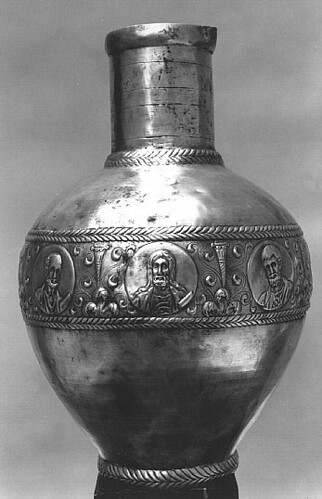
Among the earliest representations of the Shroud is on a 6th century silver vase, from Homs (ancient Emessa) in Syria:

[Right (enlarge): Sixth century liturgical vase from Homs (Emessa), Syria, Louvre]

"A 6th c. vase from Homs, Syria is quite similar to the Shroud in many of the `Vignon' .... respects. ... the narrowness of the face; the distortions carved into the right side of the face, where the Shroud face has two sizable bruises, the swollen cheek and the half-moon bruise below; and the `light-bulb' shape of the head on its outer edge." (Scavone, 1991, p.189).

"In the sixth century, the Christ portrait appears on a silver vase found at Homs, in present-day Syria and on the beautiful icon of Christ Pantocrator from the Monastery of St. Catherine in the Sinai desert. ... each has a strong resemblance to the face visible on the Shroud. ...." (Iannone, 1998, p.154).

"One can find the same likeness even as far back as the sixth century in several examples, but notably a mosaic Christ Enthroned at Ravenna's Sant'Apollinare Nuovo church, and a medallion portrait of Christ in the Byzantine manner on a silver vase discovered at Homs, the ancient Emesa, in Syria." (Wilson, 1978, pp.82-83).

>I know that it's unlikely- I never heard of anything like a study of "beard shapes" (!) based on nationality?but every time I see that face on the Shroud, I'm convinced that the features are those of a Middle Easterner rather than a European. ... I'm convinced ... that the man in the Shroud is one of Middle Eastern features. I base this belief on knowing people with Middle Eastern features all my life. A subjective belief- yes. But not necessarily an incorrect one. Has there ever been a study done at that level- what nationality or racial group or what features the Man in the Shroud belongs to?

Leading anthropologist, the late Carleton S. Coon, (1904-1981), whose speciality was human racial groups, confirmed that the image on the Shroud was that of "he is of a physical type found in modern times among Sephardic Jews which as far as I am aware, has never been disputed:

"Stewart suggested that I put the question to Carlton S. Coon, one of the world's most distinguished ethnologists. ... Coon had written books on the racial classifications of people all over the world. ... Coon wrote back .... `Whoever the individual represented may have been, he is of a physical type found in modern times among Sephardic Jews and noble Arabs." (Wilcox, 1977, p.136).

"ethnologist Carleton S. Coon has associated the man with the very pure Semitic type found today among noble Arabs and Sephardic Jews, and certainly there are at least broad hints of Jewishness in the ... unbound rope of hair at the back of the head ... one of the commonest fashions for Jewish men in antiquity." (Wilson, 1986, pp.15-16).

>If there is DNA in the Blood of the Shroud?perhaps there's enough to help figure out the ancestory of the figure.

There is DNA in the blood on the Shroud. Which is itself very important because it shows that it really is blood and that virtually eliminates painting, because no forger would paint with real blood. This was proved by the isolation of a human betaglobin gene segment in the bloodstains:

"DNA studies conducted on the white blood cell remnants present in the blood globules from the occipital region. ... a technique known as polymerase chain reaction (PCR) ... used for establishing the DNA make-up of samples. ... A blood globule from the five tiny collections on the Scotch tape was used, and the betaglobin gene segment from chromosome 11 was cloned. This proved conclusively that there was ancient blood on the Shroud" (Garza-Valdes, 1998, pp.40-41).

Moreover, the "amelogenin-Y gene from chromosome Y" was isolated, which "proved that the blood on the Shroud had belonged to a human male":

"Another way to determine the sex is to clone the genes amelogenin-X and amelogenin-Y ... the PCR technique enabled us to isolate the amelogenin-X gene from chromosome X and the amelogenin-Y gene from chromosome Y. ... we had proved that the blood on the Shroud had belonged to a human male" (Garza-Valdes, 1998, p.42).

"But arguably of the greatest importance ... are studies ... which ... have identified DNA in the Shroud `blood'. ... Dr Victor Tryon, and his technician wife, Nancy Mitchell Tryon ... determined that it had both X and Y chromosomes, indicating that the individual from whom it came was male. Three ... gene segments were identified, beta globin from chromosome 11, amelogenin X from chromosome X and amelogenin Y from chromosome Y ...." (Wilson & Schwortz, 2000, pp.77-78).

But being ancient, fragmentary and degraded, the DNA on the Shroud would probably never be sufficient to show that the victim was Jewish:

"We could not, of course, tell from whom it had come, nor whether that person had Semitic blood. ... For this type of investigation you need to clone the short DNA segments generally known as minisatellites" (Garza-Valdes, 1998, p.41).

>Oh ? you can post this email in your blog if you so wish of course- but please make it anonymous.
>
>Thank you,
>AN

See quotes below (emphasis italics original, emphasis bold mine), hyperlinked from the above inline references.


"It is a fact known to historians of art that the physical appearance of Christ in paintings, sculptures and carvings is rather sharply divided into two periods, with the line of demarcation running through the Fourth Century. In the first period, from the evidence of the catacomb pictures and some early Christian sarcophagi, Christ is depicted as an Apollo-like beardless youth with an oval, innocent face. In none of the art that has been preserved from the first three hundred years after His death is He seen any other way. Then, with the emergence of Christianity under Constantine, this obviously symbolic portrayal was discarded and pictures of Christ began to appear quite differently. Now He consistently resembled the face we see on the Shroud of Turin. Many pictures and icons of this period exist today, coming from Russia, Greece, Egypt, the Balkans and Italy. In all of them, there are many significantly similar features: the mustache and forked beard, hair parted in the middle and falling to the shoulders. These were distinctive characteristics of the Nazarenes. In addition, there were the three-sided square between the brows, the second V above this, the transverse streak across the forehead, the accentuated cheeks and enlarged left nostril. The heavily drawn owlish eyes which were also evident in most of the reproductions could today be explained by the fact that the Shroud image is a negative, and what is seen is the outline of the eye socket." (Adams, F.O., 1982, "Sindon: A Layman's Guide to the Shroud of Turin," Patrick Walsh Press: Tempe AZ, pp.18-19).

"This led to a fruitful research programme in microbiology and DNA studies conducted on the white blood cell remnants present in the blood globules from the occipital region. I explained my problems with the blood to Dr Victor Tryon, Director of the Center for Advanced DNA Technology at UTHSC at San Antonio, where a technique known as polymerase chain reaction (PCR) is regularly used for establishing the DNA make-up of samples. Dr Tryon knew that the sample we were using came from the Shroud of Turin. One cannot hide the purpose of research when depending on the advice of an expert in the field. But Nancy, Dr Tryon's wife, who actually ran the samples through the PCR equipment, was not aware of the origin of the sample. ... Tryon advised that we try cloning the easiest of the genes that could be obtained from ancient blood, the betaglobin gene. What we were not sure of was whether the blood ... would be too degraded for cloning. Fortunately, our fears were unfounded, and Nancy was able to clone the blood sample and amplify it. A blood globule from the five tiny collections on the Scotch tape was used, and the betaglobin gene segment from chromosome 11 was cloned. This proved conclusively that there was ancient blood on the Shroud. We could not, of course, tell from whom it had come, nor whether that person had Semitic blood. (For this type of investigation you need to clone the short DNA segments generally known as minisatellites.) Nor could we ascertain how old the blood was. Obviously there was the possibility of contamination and the possibility that blood from someone other than the crucified victim happened to fall on the part of the Shroud from which the sample was taken. But it is certainly more likely that the blood came from the Man on the Shroud, rather than a bystander, in view of the fact that the sample was taken from the back of the head, from the area where the crown of thorns would have damaged the head of the victim." (Garza-Valdes, L.A., "The DNA of God?," Hodder & Stoughton: London, 1998, pp.40-41).

"G. Riggi was happy with the news I imparted by telephone, as was everyone in Dr Tryon's laboratory. But at this stage, all we could say about the blood was that it was ancient, because of the degree of degradation of the small amount of blood we found on our sample, and that it had come from a human being or high primate. Nothing more. The next stage of the research was to uncover evidence that could have been regarded as controversial, and that was to be followed by another stage with even more potential for sensationalism. ... In order to establish the sex of the individual, one can look for the testes-descending gene, which is positive only in the male. If you don't find it, however, you cannot conclude that your sample is from a female: it may be that something went wrong during the testing procedure. Another way to determine the sex is to clone the genes amelogenin-X and amelogenin-Y, and that is what Dr Tryon advised. Again he was right; the PCR technique enabled us to isolate the amelogenin-X gene from chromosome X and the amelogenin-Y gene from chromosome Y. I telephoned Riggi ... that we had proved that the blood on the Shroud had belonged to a human male." (Garza-Valdes, 1998, pp.41-42).

"Paul Vignon has made a detailed study of the Image, comparing every feature with the details of the mask of the Turin Shroud. Since the chief characteristic of the Mandylions is their lack of neck and shoulders, it is probable that they derived this peculiarity from the Image of Edessa. Otherwise, they belong to the same family as the typical Christs of the normal Byzantine icons. Their faces are of the same type, as can be seen from a comparison between them ... and the Early Portraits ... As we have seen, this type of Christ appeared in the sixth century with the Edessan Image as the most famous, and perhaps the earliest, of the miraculous Mandylions. Art historians associate this long-haired Christ with the forked beard and staring eyes with Syria rather than with Greece or Rome. None have been able to explain its origin nor its immediate acceptance as the true type as against the Greco-Roman Christ. Only Paul Vignon and his followers have noticed certain peculiarities of the Syro-Byzantine Christs which, when taken in conjunction with their generally accepted characteristics, seem to pin-point their origin. ... The forehead marks of these Christs, for instance, are real disfigurements, as if their artists had deliberately accentuated one Byzantine method of emphasising eyebrows till their portraits seem to be branded for identification purposes. Were they driven by some remote model that they could not escape?" (Green, M., 1969, "Enshrouded in Silence: In search of the First Millennium of the Holy Shroud," Ampleforth Journal, Vol. 74, Autumn, pp.319-345. References omitted).

"Sacred Scripture does not provide us with any physical description of Jesus. People of the first century were more concerned with His message than with what He looked like. Representations of Christ prior to the sixth century varied. Most often He was portrayed as a young beardless man with short hair. Around the sixth century, a common representation of the face of Christ with long hair, mustache and beard began to emerge and has been a standard depiction ever since. Perhaps the first person to notice this gradual change was Paul Vignon in the 1930s. He was later followed by Fr. Wuenschel. These researchers noticed a number of similarities between the face on the Shroud and early paintings and icons of Christ, particularly in the Byzantine tradition. They identified about twenty unusual details. Some of the most notable are the two strands of hair at the top of the forehead. Particularly noteworthy is the directionality of the wisps of hair, which is to the right, just like the bloodstain on the Shroud in the form of the Greek letter epsilon when viewed with the naked eye. The bloodstain only appears as the number `3' on a negative photo of the Shroud. Other parallels include a three-sided `square' between the brows (believed by some to be caused by a phylactery, a small leather box containing Scripture parchments worn around the forehead by Jewish men-cf. Deut. 6:8); an enlarged left nostril; a `V' shape at the bridge of the nose; one eyebrow higher than the other; a transverse line across the throat (perhaps a crease from the way the Shroud was folded); and a forked beard. [Wilson, I., "The Shroud of Turin," Image Books: New York, 1979, pp.104-105] These facial characteristics found on the Shroud appear in most images of the face of Christ as early as the sixth century. Another interesting point is that artists who painted copies of the image usually depicted the face in a frame surrounded by an ornamental trellis. This may very well have been the way in which the face on the Shroud was displayed for veneration. Ian Wilson surmises that there must have been an official `portrait' which was used by artists as a model for their paintings." (Guerrera, V., 2000, "The Shroud of Turin: A Case for Authenticity," TAN: Rockford IL, pp.100-101).

"The Vignon-Markings Wilson's theory linking the Image of Edessa with the Shroud receives strong support from the work done previously by the famous sindonologist Paul Vignon in the 1930's. Vignon pointed out that, among the family of post-sixth century portraits of Christ, there was a recurrence of certain unusual markings seemingly derived from the Shroud. Tribbe notes that `in each of these cases, the artist, wishing to be totally faithful to the original, incorporated these oddities even though they are irrelevant to or detract from the naturalness of the face.' He goes on to say that `all these artists must have copied from the same original, and all of them misunderstood the nature of these imperfections.' However, because of the sacred status of the acheiropoietas it was very important that every detail, even if odd or unusual, be faithfully duplicated by the Byzantine artists. [Tribbe, F.C., "Portrait of Jesus?," Stein & Day: New York NY, 1983, p.239] Wilson, following Vignon, cites fifteen such oddities or anomalies which have come to be known as the Vignon-Markings: Starkly geometric topless square (3-sided) visible between the eyebrows on the Shroud image. 1. Starkly geometric topless square (3-sided) visible between the eyebrows on the Shroud image. 2. V-shape visible at the bridge of the nose. 3. A transverse streak across the forehead. 4. A second V-shape inside the topless square. 5. A raised right eyebrow. 6. An accentuated left cheek. 7. An accentuated right cheek. 8. An enlarged left nostril. 9. An accentuated line between the nose and upper lip. 10. A heavy line under the lower lip. 11. A hairless area between the lip and beard. 12. The fork in the beard. 13. A transverse line across the throat. 14. The heavily accentuated `owlish eyes.' 15. Two loose strands of hair falling from the apex of the forehead.' [Wilson, I., 1979, "The Shroud of Turin," Doubleday & Co: New York NY, pp.104-105]" (Iannone, J.C., 1998, "The Mystery of the Shroud of Turin: New Scientific Evidence," St Pauls: Staten Island NY, pp.151-152. List numbers mine).

"In the sixth century, the Christ portrait appears on a silver vase found at Homs, in present-day Syria and on the beautiful icon of Christ Pantocrator from the Monastery of St. Catherine in the Sinai desert. As Wilson states: "Despite stylistic variations, each of these works seems inspired by the same tradition of Jesus' earthly appearance. And each has a strong resemblance to the face visible on the Shroud." [Wilson, 1986, p.105] We can add to this list the seventh-century coins, the tremisses and solidus coins, minted by Justinian II with shroud-like images; the Spas Nereditsa fresco (Savior of Neredica) in 1199 and the icon in the Church of St. Bartholomew of Armenia in Genoa, Italy." (Iannone, 1998, p.154).

"The well-known eleventh-century mosaic of Christ Pantocrator in the dome of the monastery church in Daphni near Athens, Greece, includes thirteen of the fifteen Vignon markings. ... Two early (sixth-century) examples are the mosaic of Christ enthroned, in the Sant'Apollinare Nuovo Church in Ravenna, Italy (which includes eight Vignon markings ...), and a medallion portrait on a silver vase from Syria. There is an eighth-century example in a painting in the catacomb of Saint Pontianus in Rome that has eight Vignon markings. In the South Gallery of the Hagia Sophia, Constantinople, there is a thirteenth-century mosaic of Christ enthroned with eleven Vignon markings. ... There is also another mosaic of Christ with Vignon markings in the South Gallery of the Hagia Sophia." (Maher, R.W., 1986, "Science, History, and the Shroud of Turin," Vantage Press: New York NY, pp.76-77).

"A 6th c. vase from Homs, Syria is quite similar to the Shroud in many of the `Vignon' -- and other -- respects. Additionally, one is struck by the narrowness of the face; the distortions carved into the right side of the face, where the Shroud face has two sizable bruises, the swollen cheek and the half-moon bruise below; and the `light-bulb' shape of the head on its outer edge." (Scavone, D.C., "The History of the Turin Shroud to the 14th C.," in Berard, A., ed., "History, Science, Theology and the Shroud: Symposium Proceedings, St. Louis Missouri, June 22-23, 1991, The Man in the Shroud Committee of Amarillo, Texas: Amarillo TX, 1991, pp.171-204, p.189).

"The best method of approach seems to be to track back rather than forward, and to use as a base the fifteenth century, i.e., within the period that the Shroud was known to have been preserved. In fact there was from this period an ideal work of art with which to compare the Shroud likeness, the `Rex Regum' of Jan van Eyck, which, although the original has not survived, is known to us from no less than four excellent copies made at the time. It is ideal because it has the same rigidly front-facing aspect as the Shroud face. One can therefore see how in each of the distinctive features-long hair parted in the middle and falling to the shoulders, a moderately long, forked beard, a long prominent nose, a thin mustache drooping to join the beard, a distinctive hairless gap beneath the lower lip-it matches the Shroud likeness virtually exactly. It might have been copied from the Shroud face, except that it is known from the work of art experts such as Pachts that, in fact, Van Eyck derived it from Christ portraits of the East, from the world of Byzantium, in which artist after artist had copied from another the same likeness in a tradition going back many centuries. It is this tradition that is the path to the source of the likeness." (Wilson, I., 1978, "The Turin Shroud," Book Club Associates: London, p.82).

"Looking back to the thirteenth century, the likeness can be found in a large and magnificent mosaic of Christ Enthroned in the gallery of Hagia Sophia, Constantinople. From the twelfth century there is an excellent example of the likeness in the huge, brooding Christ Pantocrator mosaic that dominates the apse of the Norman-Byzantine church of Cefalù, Sicily, a work described by British art critic John Beckwith as `one of the most sublime attempts to represent the Logos Incarnate.' [Beckwith, J., "Early Christian and Byzantine Art," in "Pelican History of Art," Penguin: London, 1970, p.123] The likeness is awe-inspiringly evident in the Christ Pantocrator from the eleventh-century dome of the church of Daphni, near Athens, a likeness called by writer Sacheverell Sitwell `a terrifying countenance that makes it credible that a man has lived beyond the grave.' There are two splendid tenth-century examples of the likeness, the Christ Enthroned fresco in the church of Sant'Angelo in Formis near Capua, Italy, and the majestic `Christ as Holy Wisdom' mosaic uncovered in this century high above the royal door in the narthex of Hagia Sophia, Constantinople. Looking back to the eighth century, an epoch in which most eastern portraits of Christ were destroyed during the wave of image-smashing, or iconoclasm, the same likeness can be found, heavily influenced by Byzantium in a Pantocrator painting from the catacomb of St. Pontianus, Rome. One can find the same likeness even as far back as the sixth century in several examples, but notably a mosaic Christ Enthroned at Ravenna's Sant'Apollinare Nuovo church, and a medallion portrait of Christ in the Byzantine manner on a silver vase discovered at Homs, the ancient Emesa, in Syria." (Wilson, 1978, pp.82-83).

"As generally agreed by most observers, the visible body on the Shroud appears to be that of a thirty-to-forty-five-year-old male, quite naked, with beard and mustache and hair falling to the shoulders. At the back of the head seems to be visible a long, loose rope of hair extending down the spine to the level of the shoulder blades. Although anthropological deductions are inevitably subjective, ethnologist Carleton S. Coon has associated the man with the very pure Semitic type found today among noble Arabs and Sephardic Jews, and certainly there are at least broad hints of Jewishness in the hair styling. The seemingly unbound rope of hair at the back of the head accords with what German biblical scholar H. Gressman has referred to as one of the commonest fashions for Jewish men in antiquity, to which French scriptural authority Daniel-Rops has supportively added the information that the Jews normally wore this `plaited and rolled up under their headgear' except on public holidays." (Wilson, I., 1986, "The Evidence of the Shroud," Guild Publishing: London, pp.15-16).

"A study of this kind is, to say the least, illuminating. A consistent Shroud-like, long-haired, fork-bearded, front-facing likeness of Christ can be traced back through numerous works in the Byzantine tradition dating many centuries before the time of Geoffrey de Charny. Beginning with the twelfth century, there is an imposing Christ Pantocrator from Cefalu, Sicily. From about a century earlier, a similar, almost terrifying Pantocrator glowers from the dome of the church of Daphni, near Athens. From back to the tenth century, a still familiar-looking Christ Enthroned stares out from the church of St. Angelo in Formis, near Capua ... . Datable back to the eighth century, a similar-looking Christ portrait is to be found in the depths of the Pontianus catacomb, near Rome. As early as the sixth century, still with the same facial resemblance, are a Christ portrait on a silver vase found at Homs, in present-day Syria, and a beautiful icon of Christ Pantocrator from the monastery of St. Catherine in the Sinai Desert. Despite stylistic variations, each of these works seems inspired by the same tradition of Jesus' earthly appearance. And each has a strong resemblance to the face visible on the Shroud." (Wilson, 1986, p.105).

"But arguably of the greatest importance, even though they are as yet far from fully secure, are studies, both in Italy and the United States, which, completely independently of each other, have identified DNA in the Shroud `blood'. On the afternoon of 21 April 1988, just a few hours after having cut off the snippets of the Shroud used for radiocarbon dating, the Italian microscopist Dr Giovanni Riggi took a 1.5 mm `blood' sample from the back-of-the-head region. In June 1993 he provided some of this sample to a visiting American microbiology professor, Dr Leoncio Garza-Valdès, who took it back for analysis at the University of Texas' Center for Advanced DNA Technologies at San Antonio, Texas. There the laboratory director, Dr Victor Tryon, and his technician wife, Nancy Mitchell Tryon, quickly established that the sample was human blood of the AB group, just as Baima-Bollone had before them. They also determined that it had both X and Y chromosomes, indicating that the individual from whom it came was male. Three unmistakable gene segments were identified, beta globin from chromosome 11, amelogenin X from chromosome X and amelogenin Y from chromosome Y, a finding quite impossible if the Shroud `blood' were merely iron oxide as contended by Walter McCrone.." (Wilson, I. & Schwortz, B., 2000, "The Turin Shroud: The Illustrated Evidence," Michael O'Mara Books: London, pp.77-78).

"Among other points of similarity, Vignon listed the following: no ears; no neck; no shoulders; a `forked' beard; a `truncated' mustache; straight nose; enlarged nostrils; one raised eyebrow; a line across the throat (which is really a wrinkle on the shroud); bruised forehead; abnormally shaded or swollen cheeks. No icon had all these similarities, but all had at least a few. The earliest icons that Vignon found with shroudlike similarities were copies of the `Image of Edessa,' a portrait of Jesus on cloth which was discovered in 544 bricked up in a wall in Edessa, the center of Syrian Christianity. After its discovery, the `true likeness' of Christ, as it came to be known, was the object of great veneration in Byzantium." (Wilcox, R.K., 1977, "Shroud," Macmillan: New York NY, p.85).

"Stewart suggested that I put the question to Carlton S. Coon, one of the world's most distinguished ethnologists. A former Harvard professor and ethnology curator at the University of Pennsylvania, Coon had written books on the racial classifications of people all over the world. `He'd be the man who might be able to give you some answers.' `Here are the pictures that you asked me to return,' Coon wrote back in a week's time. `Whoever the individual represented may have been, he is of a physical type found in modern times among Sephardic Jews and noble Arabs. The soft parts of the nose have shrunken a bit, which is simply a sign of death. I have seen the same thing in the mummies of Egyptian pharaohs. `For what it is worth, that is my opinion.' Coon's opinion was worth a great deal, especially in view of the fact that he had traveled widely throughout the Middle East, Asia, South America, and Africa. He was also the author of fifteen books in the area of anthropology, including The Origin of Races, published in 1962; and The Living Races of Man, published in 1965." (Wilcox, 1977, pp.131,136).

Posted 29 July 2008. Updated 24 April 2024.

Tuesday, July 15, 2008

Re: Are you still trying to talk the Pope into "pollen dating"?

AN

Thank you for your message. However, as stated under "Policies" on my TheShroudofTurin blog's front page regarding private

[Above: Pope Benedict XVI is shown a copy of the Shroud of Turin, June 2, 2008: 30 Days in the Church and in the world]

messages I receive on Shroud of Turin related topics, I am responding publicly to this blog, minus your personal identifying information. Your words are bold to distinguish them from mine.

----- Original Message -----
From: AN

To: Stephen E. Jones
Sent: Sunday, July 13, 2008 11:42 PM
Subject: Re: Carbon Dating the Pollen

>Hi Stephen

>Are you still trying to talk the Pope into "pollen dating"?

I am not trying to talk the Pope, or anyone, into dating the pollen of the Shroud of Turin. Since I am in my 60s and live in Australia, realistically I have only ever saw my role as publishing my paper, "A proposal to radiocarbon-date the pollen of the Shroud of Turin" in the British Society for the Turin Shroud's newsletter and then advocating it on this blog.

>I like your arguments, but I still think we should push for real Shroud cloth carbon dating---3 samples rather than 1 and from areas that we are confident are not re-weaves, etc.

Thanks. However, the "but" suggests that you think it is either dating the Shroud's "cloth" or dating its pollen. But as I wrote in my paper, "they are not mutually exclusive."

While I support another dating of the Shroud's linen, taken from different parts of the cloth, it still might not be conclusive. That is because even if the Shroud is first century burial sheet of Jesus, it could still have an apparently younger radiocarbon age due to:

1) neutron irradiation either: a) natural, if it has been kept for hundreds of years in monasteries and castles (Stevenson & Habermas, 1981, pp.20-21; Wilson, 1979 pp.177-178) made of granite (Wikipedia, 2008); and/or b) supernatural, due to neutron irradiation due to Jesus' resurrection (Danin, et al., 1999, p.6; Wilson, 1998, p.233; Wilson & Schwortz, 2000, p.128).

or 2) contamination and isotope fractionation, having been enriched with carbon-14 in the 1532 fire (Draper, 2008; Ramsey, 2008; Walsh, 2000, p.338).

Carbon-dating the Shroud's pollen would avoid most of those problems because: 1) pollen is impervious to contamination by external carbon-14 and 2) if the Shroud is genuine then some of the pollen would not have been on the linen until after Jesus' resurrection.

>If Pope says no to that but maybe he looks at our proposal and sees our Plan B is pollen, who knows---maybe he says yes to that. What do you think?

See above. If it is a choice between radiocarbon-dating the Shroud's pollen and its linen, then I think the former, carbon-dating its pollen, should be Plan A. But there is no reason why both could not be done as part of a comprehensive retesting of the Shroud's 1988 radiocarbon dating.

However, I should here point out there is a problem with radiocarbon-dating of single pollen grains, that I was not aware of when I wrote my paper, but which I will acknowledge in the too long delayed continuation of my "Response #1 to Bill Meacham's criticisms of my proposal to radiocarbon-date the Shroud's pollen" series.

Sincerely, AN

See quotes below (my emphasis bold) hyperlinked from inline references above.

Stephen E. Jones, BSc. (Biology).
My other blogs: CreationEvolutionDesign & Jesus is Jehovah!


"The exact mechanisms by which the images on the Shroud were formed are not known, but they are speculated to be some type or types of radiation. The process may even have possibly included a neutron flux, which could have produced additional carbon 14 in the molecular structure of the flax fibers themselves, thus yielding an erroneously young age (Trenn, 1996)." (Danin, A., Whanger, A.D., Baruch, U. & Whanger, M., 1999, "Flora of the Shroud of Turin," Missouri Botanical Garden Press: St. Louis MO, p.6).

"COLORADO SPRINGS A physics professor here has resurrected the mystery of the Shroud of Turin, the fabled burial cloth of Christ that 20 years ago scientists declared a fake. Millions of faithful believe the shroud's blood-stained image of a battered, crucified man is the miraculous image of Jesus, formed as he rose from the dead. Scientists at three laboratories using radiocarbon dating in 1988-89 determined the shroud was a medieval forgery, though they could not explain how the image was created. Now, John Jackson, a University of Colorado at Colorado Springs physics lecturer has done something his colleagues consider nearly miraculous. Jackson, who is a leading researcher on the 14-foot-long linen sheet, has persuaded the Oxford laboratory that dated the shroud to the 13th or 14th Century to revisit the question of its age. Professor Christopher Ramsey, head of the Oxford University Radiocarbon Accelerator Unit, has agreed to test Jackson's hypothesis that contamination by carbon monoxide could throw off radiocarbon dating by more than a millennium. It is possible, Jackson said, that even minimal contamination of the shroud by environmental carbon monoxide could have skewed the dating by 1,300 years - making it not medieval but contemporaneous with Jesus's life. Jackson, who must prove a viable pathway for that contamination, is working with Oxford to test samples of linen under the various conditions the shroud has endured, such as outdoor exhibitions and exposure to extreme heat during a 1532 fire. ... Ramsey also acknowledged the need to reconcile radiocarbon-dating results with other forensic and historical evidence, which indicate the shroud is much older than 600 to 700 years old. Scientists must arrive at a coherent story about the enigmatic shroud, Ramsey said." (Draper, E., "Lab agrees to test Shroud of Turin for new theory," Chicago Tribune, May 20, 2008).

"The Oxford Radiocarbon Accelerator Unit has been working with a team from Performance Films Ltd making a documentary about the Shroud of Turin for the BBC. .... Another contributor to the film, John Jackson (Turin Shroud Center of Colorado) ... has developed a new hypothesis, which he believes may explain why the mediaeval date for the Shroud is incorrect. The hypothesis put forward in the film is that the linen of the Shroud might have been contaminated by carbon monoxide. Unlike most contaminants, carbon monoxide is naturally enriched in radiocarbon when found in the environment and would therefore in principle be able to alter the radiocarbon age significantly. A relatively small amount of carbon monoxide (roughly 2% of the carbon in the linen) could alter the age of the sample by a thousand years. This is the only contamination hypothesis which could affect the radiocarbon age of the Shroud enough to allow it to be 2000 years old ... The research continues because the effect of the specific storage conditions of the Turin Shroud have yet to be reproduced by John Jackson's team. It remains possible, though not at all likely, that in these specific conditions there are reactions which provide significant contamination. There are also other possible types of contaminant, and it could be that one, or some combination of these, might mean that the Shroud is somewhat older than the radiocarbon date suggests. It is important to realise, however, that only if some enriched contaminant can be identified does it become credible that the date is wrong by 2000 years." (Ramsey, C.B., 2008, "Shroud of Turin," Oxford Radiocarbon Accelerator Unit, 23 March).

"Ian Wilson proposes an intriguing theory to link the Mandylion with the Shroud. He suggests that from 1204 to the early 1300s, the Shroud-Mandylion was in the possession of one of the most exotic and mysterious groups in the medieval church-the Knights Templars. [Wilson, I., "The Shroud of Turin," Doubleday: New York, 1979, pp. 172-191] The Knights Templars were a religious order of knights founded about eighty years before the sack of Constantinople for the purpose of defending the crusader territories in the Holy Land. The Templars attracted powerful friends and noble members because they combined the two great passions of the Middle Ages-religious fervor and martial prowess. The members of the order took vows of poverty, chastity, and absolute obedience, and their courage in battle was legendary. They vowed never to retreat under attack, and they defended crusader territories in the Holy Land with resourcefulness and great bravery. By the time of the sack of Constantinople, the Templars had grown very powerful. They built impregnable fortresses in the Holy Land and in Europe, and princes and nobles in those unsettled times often entrusted their valuables to the Templars for safekeeping. Among these valuables were many relics. The Templars surely had the strength and the motive to safeguard a relic as fabulous as the Mandylion-Shroud. As one of the principal traders of relics from the Fourth Crusade, the Templars would have been in a position to acquire it, and their wealth would have protected them from the common temptation to sell relics for much needed cash. They would have been able to keep its location secret in their network of fortresses and castles." (Stevenson, K.E. & Habermas, G.R., 1981, "Verdict on the Shroud: Evidence for the Death and Resurrection of Jesus Christ," Servant Books: Ann Arbor MI, pp.20-21).

"In the case of the Shroud of Turin, the linen fibrils exposed to higher temperatures would be expected to have a lower level of reaction-related isotopic fractionation than the areas of the cloth more insulated from the elevated temperatures of the 1532 fire. This would appear to imply the existence of a carbon isotopic gradient on the Shroud cloth in areas exposed to large differential temperatures. In addition, isotopic fractionation theory states that bonds involving heavier isotopes will be stronger and thus be more difficult to break for a given level of temperature than lighter isotopic bonds. Moreover, at equilibrium, the heavier isotopes will tend to occupy the site with the stronger bonds. As a result, because bonds involving lighter isotopes are weaker and more easily broken, lighter isotopes participate more readily in a given chemical reaction. The combined result of these effects is to diffuse light-isotope reaction products further from the source of a reaction. If these light isotope elements vacate a stronger bond location, then the heavier isotopes are more likely to be able to attach themselves to that site. This would leave a relatively enriched heavier isotope concentration wherever the lighter products had taken part in an exogenous chemical reaction. The fire to which the Shroud was exposed in 1532 appears to be a reasonable candidate for inducing both kinetic isotopic reactions and, also, potentially incomplete equilibrium reactions that may have resulted from the rapid temperature drop and water vapor environment associated with the quenching of the heated Shroud reliquary with water. This isotopic fractionation process could lead to areas of relative enrichment and depletion of various carbon isotopes if the reactions occurred in a confined environment. If the lighter isotopic reaction products were free to move away from the fibers, then the isotopic effects noted above could cause the Shroud to be left relatively enriched in heavier isotopic products as the result of the isotopic exchanges noted above. It would then radiocarbon date younger than its actual age at sites affected by this process." (Walsh, B.J., 2000, "The 1988 Shroud of Turin Radiocarbon Tests Reconsidered," in Walsh, B.J., ed., "Proceedings of the 1999 Shroud of Turin International Research Conference, Richmond, Virginia," Magisterium Press: Glen Allen VA, p.338).

"Granite is a normal, geological source of radiation in the natural environment. Granite contains around 10 to 20 parts per million of uranium. By contrast, more mafic rocks such as tonalite, gabbro or diorite have 1 to 5 ppm uranium, and limestones and sedimentary rocks usually have equally low amounts. Many large granite plutons are the sources for palaeochannel-hosted or roll front uranium ore deposits, where the uranium washes into the sediments from the granite uplands and associated, often highly radioactive, pegmatites. Granite could be considered a potential natural radiological hazard as, for instance, villages located over granite may be susceptible to higher doses of radiation than other communities. Cellars and basements sunk into soils formed over or from particularly uraniferous granites can become a trap for radon gas, which is heavier than air. However, in the majority of cases, although granite is a significant source of natural radiation as compared to other rocks it is not thought an acute health threat or significant risk factor. Various resources from national geological survey organisations are accessible online to assist in assessing the risk factors in granite country and design rules relating, in particular, to preventing accumulation of radon gas in enclosed basements and dwellings." ("Granite: Natural Radiation," Wikipedia, 2 July, 2008).

"Finally, and not least, they must, if the Shroud/Mandylion identification is valid, have had some historical link with Geoffrey de Charny, the French knight who was the Shroud's first authenticated owner. None of this might appear to provide any real substance with which to identify the Shroud's possible guardians between 1204 and the 1350s, but as it happens there is one historical group of suspects who fit these requirements with uncanny precision. Some eighty years before the capture of Constantinople two French knights, Hugh of Payens and Geoffrey of Saint-Omer, with seven companions had founded the Crusader Order of Knights Templars or `Poor Knights of Christ of the Temple of Solomon,' so called because they were given land close to the site of the ruined Temple in Jerusalem. By 1204 they had become both wealthy and powerful, attracting to their ranks men of the noblest blood, distinguishing themselves as fearless crusaders, and building across Europe and the Near East a series of virtually impregnable fortresses. In a precarious age these fortresses were of no small importance, and became recognized as useful storehouses for national treasures and valuables of all kinds. Kings and popes alike came to bank with the Templars, giving the `poor knights' the reputation, if not the reality, of possessing enormous wealth. Because of this role the Templars were one of the principal sources of finance for the Fourth Crusade, although they themselves took little part in it. They were also in a position to act as guardians, traders, and pawnbrokers for the flourishing trade in relics, genuine and false alike, that ensued from the Fourth Crusade. Thus the means of acquiring the Mandylion/Shroud were there. Also, the Templars' heavily guarded monastery-fortresses provided the means of keeping the cloth's whereabouts secret for a considerable period." (Wilson, I., 1979, "The Shroud of Turin: The Burial Cloth of Jesus?," [1978], Image Books: New York NY, Revised edition, pp.177-178).

"A similar view has been expressed by the pioneering British nuclear physicist Dr Kitty Little, now retired from her career at the UK's Atomic Energy Research Establishment at Harwell, Oxfordshire. She has recalled an experiment that she conducted back in the 1950s in which she irradiated a range of fibres, including several different cellulose ones, in a research reactor called BEPO: `At the time BEPO was being run at only three MW, so that the temperatures were in the range 70° to 90° centigrade. This meant that I was obtaining radiation effects without the complication of heat effects.' Little observed the fibres to change with only relatively low-grade heat to the very same colour reported of the Shroud image, something of which at that time she had no knowledge. In her own words: `[The] cellulose fibres turned to the straw-yellow colour that has been described for the image of the Shroud...' Even more interesting, however, was that the very same radiation particles which produced this effect were necessarily also accompanied by neutron emission. And as she has explained, this would inevitably have resulted `in the formation of extra carbon 14 on the sheet, the whole of it', this extra carbon tending quite categorically and specifically `... to make the apparent age of the fabric appear more recent than it really is ...'" [ Little, K., "The Holy Shroud of Turin and the Mystery of the Resurrection," Christian Order, April 1994, p. 226]" (Wilson, I., 1998, "The Blood and the Shroud: New Evidence that the World's Most Sacred Relic is Real," Simon & Schuster: New York NY, p.233)

"So, given that one interpretation of Jesus' resurrection is a dematerialization of the atoms of his physical body, what about the Shroud's imprint having been caused by some kind of atomic radiation from this event? In the Second World War bombings of Hiroshima and Nagasaki, the intense light from the atomic bombs' fireballs imprinted eerie images of people and objects on walls. Yet, however compelling this might sound, it cannot be a valid parallel to the Shroud image, since in the bombing instances it was the people's bodies blocking the light which created permanent shadows on the walls behind them, whereas in the case of the Shroud the light would appear to have come from the body itself, which was responsible for its unique, non-directional, self-lighting characteristics. Based on this kind of thinking, the Harvard physicist Dr Thomas J. Phillips [Phillips, T.J., "Shroud irradiated with neutrons?," Nature, Vol. 337, 16 February 1989, p.594], in the wake of the 1988 radiocarbon dating, made the intriguing suggestion that, had Jesus' claimed resurrection involved a radiation of neutrons, it could explain at a stroke both the Shroud's `scorch' image and the skewing of its carbon 14 content." (Wilson, I. & Schwortz, B., 2000, "The Turin Shroud: The Illustrated Evidence," Michael O'Mara Books: London, p.128).

Updated: 11 July 2015.

Thursday, June 26, 2008

Re: In my humble opinion, the Shroud of Turin is a hoax #3

Continuing from part #2 of my response to a comment under my "Shroud News-January 2008." The commenter's words are bold.

[Above: How a soudarion (Latin sudarium) was placed over the head of a deceased Jewish person and then removed before he was enveloped by a linen shroud in his tomb. Bennett, J., 2001, "Sacred Blood, Sacred Image: The Sudarium of Oviedo: New Evidence for the Authenticity of the Shroud of Turin," Ignatius Press: San Francisco CA, p.118.]

[...]

But clearly the believers in the shroud are also believers in the bible as an accurate gospel of God and Jesus Christ, etc. I have seen a few bible quotes in the debate about the shroud, but I rarely, if ever, see one in particular that I offer here. How can the Shroud of Turin possibly be authentic when the bible reads thusly: John 20:

3 Peter therefore went forth, and that other disciple, and came to the sepulchre. 4 So they ran both together: and the other disciple did outrun Peter, and came first to the sepulchre. 5 And he stooping down, and looking in, saw the linen clothes lying; yet went he not in. 6 Then cometh Simon Peter following him, and went into the sepulchre, and seeth the linen clothes lie, 7 And the napkin, that was about his head, not lying with the linen clothes, but wrapped together in a place by itself.
The scripture clearly states that there were two pieces, with a separate piece around Jesus' head, and from what I understand common practice of the time. No, while the "napkin" (Gk. soudarion) in John 20:7 is singular and therefore one "piece" of graveclothes, the "linen clothes" (Gk. othonia, othonion) in John 20:5-7 are plural, that is more than one "piece" of graveclothes:
"... othonia is to be understood as a `collective singular,' just like the English word `clothes' could refer to one article of clothing, or two or three or four" (Ruffin, 1999, pp.46-47).

"... othonia refers to all the grave clothes associated with Jesus' burial-the large sindon (the shroud), as well as the smaller strips of linen that bound the jaw, the hands, and the feet." Stevenson & Habermas, 1981, pp.48-49).

"John mentions no shroud, but speaks in the plural of linen cloths (othonia) ...and also of a soudarion - `the napkin, which had been on his head ... " (Wenham, 1984, p.66).

"... othonia means cloths in general, which could incorporate shroud and bands." (Wilson, 1978, p.41).
Note: I no longer claim that the othonia seen by Peter and John in the empty tomb on resurrection Sunday [Lk 24:12; Jn 20:4-8] was a "collective singular" for all Jesus' linen burial cloths. That is because all my New Testament Greek lexicons state that othonion (singular) is a diminutive of othone a linen cloth, hence othonia (plural) are small linen cloths. Therefore othonia is correctly translated "strips of linen" as in Lk 24:12; Jn 19:40 and 20:5-7 (NIV) and Mounce Interlinear. I therefore maintain that the Shroud (sindon) was no longer in the Tomb when Peter and John entered it, Jesus having taken it with Him out of the Tomb. See my 2014 "Servant of the priest" series and my posts of 08May18 & 16Aug22.

Here is what all the gospel accounts say in the NIV, with the underlying Greek key words added :

Mt 27:59-60 NIV "59 Joseph took the body, wrapped [enetulizen] it in a clean linen cloth [sindoni], 60 and placed it in his own new tomb that he had cut out of the rock. He rolled a big stone in front of the entrance to the tomb and went away."

Mk 15:46 NIV "So Joseph [of Arimathea] bought some linen cloth [sindona], took down the body, wrapped [eneilesen] it in the linen [sindoni], and placed it in a tomb cut out of rock. Then he rolled a stone against the entrance of the tomb."

Lk 23:52-53; 24:12 NIV "52 Going to Pilate, he [Joseph of Arimathea] asked for Jesus' body. 53 Then he took it down, wrapped [enetulizen] it in linen cloth [sindoni] and placed it in a tomb cut in the rock, one in which no one had yet been laid. ... 12 Peter, however, got up and ran to the tomb. Bending over, he saw the strips of linen [othonia] lying by themselves, and he went away, wondering to himself what had happened."

Jn 19:40; 20:5-8 NIV "40 Taking Jesus' body, the two of them [Joseph of Arimathea and Nicodemus] wrapped [edesan] it, with the spices, in strips of linen [othoniois]. This was in accordance with Jewish burial customs. ... 5 He [John] bent over and looked in at the strips of linen [othonia] lying there but did not go in. 6 Then Simon Peter, who was behind him, arrived and went into the tomb. He saw the strips of linen [othonia] lying there, 7 as well as the burial cloth [soudarion] that had been around Jesus' head. The cloth was folded up [entetuligmenon] by itself, separate from the linen [othonion] . 8 Finally the other disciple [John], who had reached the tomb first, also went inside. He saw and believed."
As can be seen, the gospels of Matthew, Mark and Luke focus on the main large sindon or linen burial cloth in which the body of Jesus was wrapped (i.e. enfolded, not bandaged like a mummy) (Guerrera, 2000, p.31; Ruffin, 1999, pp.46-47; Stevenson & Habermas, 1981, pp.48-49; Wenham, 1984, pp.66-67).

The gospel of John focuses in more detail on the soudarion or head-cloth, and collectively referring to the other graveclothes, including the Shroud, as othonia (Guerrera, 2000, p.31; Ruffin, 1999, pp.46-47; Stevenson & Habermas, 1981, pp.49-50). That the sindon was included in the othonia is evident in that Luke above mentions both the sindon at the burial of Jesus and the othonia in the empty tomb (Ruffin, 1999, pp.46-47; Stevenson & Habermas, 1981, pp.49-50).

That being the case, the image of Jesus' face would not be on the Turin shroud, or would at least appear differently from the rest of the fabric. This would only be true if the soudarion remained "on the face under the Shroud, as this would have prevented the image from being formed on the Shroud, and it would presumably have caused it to be formed on the sudarium." (Guscin, 1998, p.34). But the gospels in John 20:7 only says that "the burial cloth ... had been around Jesus' head, without specifying when" (Guscin, 1998, p.33).

As historian Mark Guscin explains:

"the sudarium was used to cover Jesus' face before he was buried, from the moment when he died to the moment he was laid out in the tomb. ... then ... the sudarium was taken off his face, folded up and put to one side, and the clean linen cloth was used to quickly wrap the body before the sun went down and the Sabbath started. This coincides with Jewish custom and ritual. ... that if the face of the dead person was any way disfigured, it should be covered with a cloth ... The sudarium must have been placed over his face before his body had been taken down from the cross, left there while it was being transported to the tomb and there taken off, folded up and left to one side, when the body was placed in the larger linen cloth." (Guscin, 1998, p.35).
"The cloth was placed on Jesus' face, then folded over itself, although not in the middle. This is why there are four groups of the same stains. The cloth was then wrapped round the left side of Jesus' head, and fastened to his hair at the back with some kind of hairpin. This is evident from the blood stains which coincide with the blood on the nape of the neck on the Shroud. The cloth was only wrapped around the left-hand side of the head because Jesus' right cheek was almost touching his right shoulder. This suggests that the cloth was placed over the face when the body was still on the cross. The experiments with the stains show that the body was then left on the cross for about one hour before being taken down. It was then laid on the ground a further forty-five minutes before being carried to the tomb." (Guscin, 1998, pp.35-38).
See also Shroud Report Interview with Mark Guscin for a video on how the soudarion (Latin. Sudarium) would have been placed over the head of Jesus on the cross and then removed in the tomb before He was enfolded in the Shroud.

And the absense of folds, voids, and displacements in the image that would occur had the fabric been wrapped around a body further support the Shroud, not so much an intentional hoax, but a medieval work of art. See parts #1 and #2 for the Shroud not being "a ... work of art." Even Prof. Christopher Ramsey, the Director of the Oxford University Radiocarbon Accelerator Unit, the same laboratory which in 1988-89, radiocarbon-dated the Shroud and declared it to be "medieval", has admitted:

"There is a lot of other evidence that suggests to many that the Shroud is older than the radiocarbon dates allow ... there needs to be a coherent history of the Shroud which takes into account and explains all of the available scientific and historical information" (Ramsey, ORAU, 2008).

"`With the radiocarbon measurements and with all of the other evidence which we have about the Shroud, there does seem to be a conflict in the interpretation of the different evidence,' Professor Ramsey tells the BBC." (Omaar, BBC, 2008).

"Ramsey also acknowledged the need to reconcile radiocarbon-dating results with other forensic and historical evidence, which indicate the shroud is much older than 600 to 700 years old." (Draper, Chicago Tribune, 2008).
Clearly Prof. Ramsay would not be investigating whether the Shroud's "medieval" radiocarbon-date was wrong, would not be doing that if the Shroud had been conclusively proved to be "a medieval work of art." And if the Shroud was a "work of art," whether "medieval" or not, considering that:
"The Shroud of Turin is now the most intensively studied artifact in the history of the world. Somewhere between 100,000 and 150,000 scientific man-hours have been spent on it, with the best analytical tools available." (Heller, J.H., 1983, "Report on the Shroud of Turin," Houghton Mifflin Co: Boston MA, p.219).
science would have long ago proved the Shroud to be a "work of art."

Also, the Shroud was not "wrapped around a body" like an Egyptian mummy. In first century Jewish burials, the body was enfolded in a linen shroud, as the Shroud of Turin is:

"Jewish burial customs do not support the idea that John's othonia refers to the wrappings of a mummy. Jews did not wrap up their dead like mummies, but laid them in shrouds, as indicated by the Gospel of John, the Essene burial procedures, and the Code of Jewish Law." (Stevenson & Habermas, 1981, p.48).

"John's use of othonia has led to a widely held belief that Jesus was wrapped like an Egyptian mummy. But such a procedure doesn't conform to what is known of first-century normal Jewish burial ritual. ... John used the word edesan, which is translated wound in the KJV but literally means `enfolded.' Enfolded would also match the burial custom. Being wrapped with strips of cloth would not." (Stevenson & Habermas, 1990, pp.149-150).
See quotes below hyperlinked to references above (emphasis italics original, emphasis bold mine, my transliteration).

Posted 26 June 2008. Updated 4 January 2026.


"Ramsey also acknowledged the need to reconcile radiocarbon-dating results with other forensic and historical evidence, which indicate the shroud is much older than 600 to 700 years old. Scientists must arrive at a coherent story about the enigmatic shroud, Ramsey said. The shroud is either authentic or a hoax so ingenious that state-of-the-art scientific analysis has yet to explain how it was done, said David Rolfe, director of a new documentary, `Shroud of Turin.' `The shroud is brilliant and unfathomable,' Rolfe said." (Draper, E., 2008, "Lab agrees to test Shroud of Turin for new theory," Chicago Tribune, May 20).

"As for the image itself, what meets the eye is intelligible, but how it was formed is a matter of vigorous debate. We shall need to review, although necessarily in a superficial way, the scientific analyses of the Shroud's image (detailed discussions, by writers competent in these matters, are available elsewhere). The battery of sophisticated and expensive tests conducted in 1978 by the Shroud of Turin Research Project (STURP) has yielded a few significant conclusions, and these have been admirably presented by L. A. Schwalbe and R. N. Rogers. [Schwalbe, L.A. & Rogers, R.N., `Physics and Chemistry of the Shroud of Turin: Summary of the 1978 Investigation,' Reprinted from Analytica Chimica Acta, Vol. 135, 1982, pp.3-49] ... But although much remains unclear, considerably more is known now than was known when the Shroud was shown on television in 1973. Most important, perhaps, is the consensus that the image was not painted on the cloth. This is now conceded by virtually every observer, even those who believe that the image is somehow the result of human artifice. Painters outline a figure before painting it, but there is no tell-tale outline on the Shroud. Nor is there a hint of the directionality that brush-marks would produce. Finally, there is no clear evidence of any pigment on the Shroud .... The STURP team, using microscopic, chemical laser microprobes, concluded that the Shroud shows no trace of `any of the expected dyes, stains, pigments, or painting media.' [Ibid, p.27]" (Drews, R., 1984, "In Search of the Shroud of Turin: New Light on Its History and Origins," Rowman & Littlefield: Lanham MD, pp.16-17).

"WE know from the Gospels that after the body of Jesus was taken down from the Cross, it was wrapped in a linen cloth. The Synoptic Gospels use the Greek word sindon to describe this Shroud (cf. Matt. 27:59; Mark 15:46; Luke 23:53). The Fourth Gospel, on the other hand, uses the word soudarion to refer to the cloth which covered the head of Jesus (John 20:7) and the plural othonia (John 19:40), often interpreted to mean `strips of linen,' `wrappings' or `linen bandages:' An entry in a biblical dictionary, however, states: `Nowhere in the account of Christ's burial is mention made of keiriai, strips of cloth, bandages, such as bound the hands and feet of Lazarus in the tomb' [Hartman, L.R., "Encyclopedic Dictionary of the Bible," McGraw-Hill: New York, 1963, p.287] (John 11:44). ... In the Old Testament the sindon was used for a variety of purposes other than for burial. Samson promised his companions `thirty linen tunics, [Hebrew: sedhinim, Greek: sindonas] and as many coats' if they would solve a riddle for him (Jdg. 14:12). Interestingly, the Latin manuscript Codex Vaticanus, in lieu of sindonas, uses the word othonia, thereby indicating that the words were considered synonymous. The book of Proverbs speaks of the ideal wife who makes fine linen (sindonas) and sells it (Prov. 31:24). The word sindon is also used in the New Testament to refer to the cloth worn by the young man who followed Jesus from a distance after His arrest in the Garden of Gethsemane. `There was a young man following him, who was covered by nothing but a linen cloth. As they seized him he left the cloth behind and ran off naked' (Mark 14:51-52)." (Guerrera, V., "The Shroud of Turin: A Case for Authenticity," TAN: Rockford IL, 2000, pp.31-32).

"The only biblical reference to the sudarium is the one already discussed, in the gospel of John. We are told that this cloth had been over Jesus' head, and the seemingly natural conclusion from this is that it was over Jesus' head at the same time as the Shroud, when Jesus was buried. However, John does not exactly say this, he simply says that the sudarium had been over his head, without specifying when. There are various reasons that make it impossible for the sudarium to have covered the dead body of Jesus in the tomb." (Guscin, M., 1998, "The Oviedo Cloth," Lutterworth Press: Cambridge UK, p.33).

"One of the greatest mysteries about the Shroud is how the image was formed - and this mystery has not been solved. We know how it was not formed. It was definitely not painted, as there are absolutely no traces of any kind of paint, (except for tiny particles left by painted copies when they were pressed to the Shroud in order to `sanctify' the copy) and there is no direction in the outline, which is impossible on a painting. Also, nobody could have painted a perfect negative before negatives and photography were even known about. Various people have thought that the image was created by a mixture of body heat (another reason why they need Jesus to be alive in the tomb), gases and the spices which were present. However, all their attempts to reproduce the image using these methods have either resulted in total failure or in grotesque caricatures of the volunteer under the linen. Nobody has been able to reproduce anything even remotely similar to the image on the Shroud. What we do know about the image is that it appears to have been scorched into only the top few fibres in each thread, has no direction and its intensity was directly dependent on how far from the actual body the cloth was. This is why the throat is not shown on the image-the cloth would have been stretched from the chin to the chest, not tucked into every fold of the body." (Guscin, 1998, pp.33-34).

"This eliminates the possibility of the sudarium being on the face under the Shroud, as this would have prevented the image from being formed on the Shroud, and it would presumably have caused it to be formed on the sudarium. As the face image on the Shroud is just as clear as the rest of the body, and as there is no image, only blood, on the sudarium, we can confidently state that the smaller cloth was not placed between the face and the larger cloth in the tomb. Could it have been placed over the Shroud while the dead body was in the tomb? ... This does not seem probable, however, as John clearly states that the sudarium in the empty tomb was lying separate from the linen wrappings. No matter how the body came out of the tomb, there is no reason why anybody should fold up the sudarium and put it in a separate place, if it had been with the Shroud over the body. Some have tried to see a theological meaning in the fact that the sudarium was lying separate from the linen cloths. ... It is true that there is a high symbolic content in John's gospel, but at this point it looks much more like an exact detail remembered by an eyewitness than a passage with a symbolic meaning. Even if the sudarium was placed on Jesus' head on top of the Shroud, the blood stains are definitely from before this." (Guscin, 1998, p.34).

"All this points to one thing - the sudarium was used to cover Jesus' face before he was buried, from the moment when he died to the moment he was laid out in the tomb. It was probably then that the sudarium was taken off his face, folded up and put to one side, and the clean linen cloth was used to quickly wrap the body before the sun went down and the Sabbath started. This coincides with Jewish custom and ritual. One of the rules of the Sanhedrin for the burial of the dead was that if the face of the dead person was any way disfigured, it should be covered with a cloth to avoid people seeing the unpleasant sight. This would certainly have been the case with Jesus, whose face was covered in blood from the crown of thorns and swollen from falling and being struckThe cloth was placed on Jesus' face, then folded over itself, although not in the middle. This is why there are four groups of the same stains. The cloth was then wrapped round the left side of Jesus' head, and fastened to his hair at the back with some kind of hairpin. This is evident from the blood stains which coincide with the blood on the nape of the neck on the Shroud. The cloth was only wrapped around the left-hand side of the head because Jesus' right cheek was almost touching his right shoulder. This suggests that the cloth was placed over the face when the body was still on the cross. The experiments with the stains show that the body was then left on the cross for about one hour before being taken down. It was then laid on the ground a further forty-five minutes before being carried to the tomb. The chronology of the two cloths is thus clear: the smaller linen cloth was only in contact with Jesus' face for the short period of time from the death on the cross until the body was placed in the larger cloth and left in the tomb." (Guscin, 1998, pp.35-38).

"Mr Jackson has developed a new hypothesis that could explain how a genuinely ancient piece of linen could produce a distorted younger date. I took this to Professor Christopher Ramsey, director of the Oxford Radiocarbon Accelerator Unit. He agreed to collaborate with Mr Jackson in testing a series of linen samples that could determine if the case for the Shroud's authenticity could be re-opened. `With the radiocarbon measurements and with all of the other evidence which we have about the Shroud, there does seem to be a conflict in the interpretation of the different evidence,' Professor Ramsey tells the BBC. `And for that reason I think that everyone who has worked in this area, radiocarbon scientists and all of the other experts, need to have a critical look at the evidence that they've come up with in order for us to try to work out some kind of a coherent story that fits and tells us the truth of the history of this intriguing cloth." (Omaar, R., 2008, "Shroud mystery 'refuses to go away'," BBC, 21 March)

"There is a lot of other evidence that suggests to many that the Shroud is older than the radiocarbon dates allow and so further research is certainly needed. It is important that we continue to test the accuracy of the original radiocarbon tests as we are already doing. It is equally important that experts assess and reinterpret some of the other evidence. Only by doing this will people be able to arrive at a coherent history of the Shroud which takes into account and explains all of the available scientific and historical information." (Ramsey, C.B., 2008, "The Shroud of Turin," Version 77, Oxford Radiocarbon Accelerator Unit, 23 March)

"At question is the exact meaning of the Greek word used for the linen in which Jesus' body was enfolded. Matthew tells us that Joseph of Arimathea took Jesus' body and wrapped it in a linen Shroud (see Mt 27:59-60). The Greek word usually translated as shroud is sindon. In the literature of the time, it usually refers to the type of winding sheet of which the Shroud of Turin is representative. The author of the first Gospel makes no mention as to what became of this cloth after the Resurrection. Mark, likewise, tells us that the body of Jesus was wrapped in a linen shroud, and again, the Greek word is sindon. Like Matthew, Mark does not mention the sindon after the Resurrection. Luke also records that Jesus' corpse was wrapped in a sindon. However, when Peter is described as finding the linen lying by itself after the Resurrection (see Lk 24:12), the word used is othonia, which is plural, and has occasioned nearly all translators to render it as `linen cloths' or `linen wraps.' John speaks of the body being wrapped also in othonia (see Jn 19:40). Then, when he recounts his arrival (or that of `the disciple whom Jesus loved') with Peter at the empty tomb, he says, `Then Simon Peter came, following [John], and went into the tomb; he saw the linen cloths lying, and the napkin, which had been on his head, not lying with the linen cloths but rolled up in a place by itself' (Jn 20:6-7). The Greek word usually translated as `napkin' is sudarion. ... We have two problems. According to John, the grave clothing of Jesus is described in plural. John also specifies that the body of his Lord was wrapped in two types of graveclothes: the othonia (linen cloths) and the sudarion (napkin). Some have said that othonia refers to strips like those in which the Egyptians wrapped their mummies. Many artists throughout the years have pictured Jesus as being buried this way. Others have said that othonia is to be understood as a `collective singular,' just like the English word `clothes' could refer to one article of clothing, or two or three or four. Certainly Luke uses both the singular sindon and the plural othonia to refer, evidently, to the same thing. Victor Tunkel of the University of London described in a lecture in 1983 how Jewish victims of violent death were usually buried in one-piece shrouds. ... However, what is to be made of St. John's assertion that Jesus' burial clothing was in two parts? Most scholars think that othonia refers to what we now know as the Shroud, or something similar. The sudarion was most likely a smaller cloth put over the face or tied around it to keep the mouth from falling open. " (Ruffin, C.B., 1999, "The Shroud of Turin: The Most Up-To-Date Analysis of All the Facts Regarding the Church's Controversial Relic," Our Sunday Visitor: Huntington IN, pp.46-47).

"The Grave Clothes. Another issue concerns the difference in the words chosen by the gospel writers to describe the grave clothes that Jesus was wrapped in. The synoptic evangelists say that he was wrapped in a sindon, a Greek word meaning a linen cloth which could be used for any purpose, including burial. John, on the other hand, says Jesus was wrapped in othonia, a plural Greek word of uncertain meaning. Othonia is sometimes translated as `strips of linen,' a meaning that would seem to be incompatible with a fourteen-foot-long shroud covering the front and back of the body. However, it is likely that othonia refers to all the grave clothes associated with Jesus' burial-the large sindon (the shroud), as well as the smaller strips of linen that bound the jaw, the hands, and the feet. This interpretation of othonia is supported by Luke's use of the word. He says (23:53) that Jesus was wrapped in a sindon, but later (24:12) that Peter saw the othonia lying in the tomb after Jesus' resurrection. Luke, then, uses othonia as a plural term for all the grave clothes, including the sindon. Furthermore, as seen earlier, Jewish burial customs do not support the idea that John's othonia refers to the wrappings of a mummy. Jews did not wrap up their dead like mummies, but laid them in shrouds, as indicated by the Gospel of John, the Essene burial procedures, and the Code of Jewish Law. John himself insists that Jewish customs were followed Jesus' case (19:40). Thus, there is good scriptural evidence that Jesus was laid in the tomb wrapped in a shroud. Therefore, the gospels refer to the grave clothes in both the singular and the plural. When a single cloth is spoken of, it is obviously the linen sheet itself. However, since Luke (or early tradition) had no difficulty in using the plural (24:12) to describe what he earlier referred to in the singular (23:53), the term `clothes' may still refer to a single piece of material. On the other hand, if more than one piece is meant, `clothes' is most probably a reference to both the sheet and the additional strips which were bound around the head, wrists, and feet, as indicated in John 11:44 (cf. John 19:40). Interestingly enough, bands in these same locations can be discerned on the Shroud of Turin. At any rate, it is a reasonable conclusion that at least one major linen sheet is being referred to in the gospels." (Stevenson, K.E. & Habermas, G.R., 1981, "Verdict on the Shroud: Evidence for the Death and Resurrection of Jesus Christ," Servant Books: Ann Arbor MI, pp.48-49. Emphasis original).

"Another apparent problem crops up in the descriptions of the grave clothes the disciples saw in the tomb on Easter morning. Both Luke and John describe grave clothes in the tomb. Luke says that Peter went inside the tomb and saw the othonia-the generic term for all the grave clothes, including the shroud and the smaller pieces used to bind the jaw, hands, and feet. John, however, gives a more detailed description of what he and Peter saw, and he introduces another term into the grave clothes listing. When they went into the tomb, they saw the othonia lying on the ground, but also the sudarion lying rolled up in a place by itself, apart from these othonia. John adds the detail that the sudarion had been `around the head' of Jesus. Sudarion means `napkin' or `sweat cloth.' It is, at any rate, a rather small piece of cloth. If it had been placed over the face of Jesus in the tomb, no image of Jesus' face would have appeared on the Shroud. Since the Shroud of Turin bears the image of a face, the reference to a sudarion seems to challenge the authenticity of the Shroud. Indeed, some Christians have pointed to this passage as evidence that the Shroud is incompatible with scripture. However, a number of scripture scholars do not think that the sudarion was a napkin or cloth placed over Jesus' face. ... Why did the Gospel of John include this detail about the sudarion? The author seems to attach great importance to it. He describes the burial cloth on the ground and the sudarion rolled up in a place by itself, and then adds that this discovery caused belief. It is not easy to tell from the Greek exactly what it was about the placement of the grave clothes that caused belief (John 20:9), but Robinson has a plausible interpretation of what is being described here. We are told that the disciples entered the tomb and saw the shroud and the other linen cloths lying flat. But the sudarion was apparently still in its twisted oval shape, the way it had been when tied tightly around Jesus' head to keep the jaw closed. Something about this scene convinced them that grave robbers could not have stolen the body, as Mary Magdalene had reported after she discovered that the stone had been moved away from the tomb. Until this moment, the gospel explains, the disciples had not understood that Jesus would rise from the dead. Now, looking at the grave clothes, they believed." (Stevenson & Habermas, 1981, pp.49-51. Emphasis original).

"Many STURP scientists thought that the Shroud was simply a fake to be exposed by scientific testing. But in the 1981 meeting at New London, Connecticut, the scientists reported: `No pigments, paints, dyes or stains have been found on the fibrils. X-ray fluorescence and microchemistry on the fibrils preclude the possibility of paint being used as a method for creating the image. Ultraviolet and infrared evaluation confirm these studies.' ["Text," The Shroud of Turin Research Project, Press Release, 8 October 1981]. Ever since then, several STURP scientists have continued to report that forgery could not be the cause of the Shroud's image. [Murphy, C., "Shreds of Evidence," Harper's, November, 1981, pp.42-65, pp.61-62] Heller notes: `At the end of months of work, we had pretty well eliminated all paints, pigments, dyes, and stains.... the images were not the result of any colorant that had been added.' [Heller, 1983, p.198] Heller points out that fraud can be checked by at least two scientific methods - chemistry and physics. Concerning the first means, he said, `Adler and I had reached the conclusion that the image could not have been made by artistic endeavor.' [Heller, J.H., "Report on the Shroud of Turin," Houghton Mifflin Co: Boston MA, 1983, p.207] The second method revealed no forgery either: `The conclusion of the physical scientists was that the Shroud could not be the result of eye/brain/hand.' [Ibid., p.209]" (Stevenson, K.E. & Habermas, G.R., 1990, "The Shroud and the Controversy," Thomas Nelson Publishers: Nashville TN, pp.120-121).

"Q. Doesn't the Shroud conflict with Scripture? a) John 20:5-7 mentions linens and at the very least implies there were a minimum of two cloths. Many have suggested that the linens were `strips,' however the Shroud is merely one piece of cloth. ... A. All of the other scriptural issues were dealt with heavily in Verdict. The answers to these apparent discrepancies are as follows: First, the Gospels use the following words to describe the Shroud: Sindon-burial sheet, winding sheet, shroud; sudarion-sweat cloth, face cloth, handkerchief; othonia linens. ... John's use of othonia has led to a widely held belief that Jesus was wrapped like an Egyptian mummy. But such a procedure doesn't conform to what is known of first-century normal Jewish burial ritual. Nor does it match what was previously mentioned in the Word, to wit, that Joseph of Arimathea had purchased a winding sheet and wrapped Jesus in it (Mark 15:46). Even John used the word edesan, which is translated wound in the KJV but literally means `enfolded.' Enfolded would also match the burial custom. Being wrapped with strips of cloth would not. In other words, othonia in John should be understood to mean that Jesus' dead body was enveloped from head to feet in one burial cloth, not wrapped like a mummy with numerous strips of cloth." (Stevenson & Habermas, 1990, pp.149-150).

"The precise nature of the burial cloths has been the subject of much debate. The synoptists tell us that Joseph of Arimathea bought (Mark) a clean (Matthew) linen shroud or sheet (Greek - sindon) and wrapped Jesus in it (Matthew, Mark, Luke) [Mt 27:59; Mk 15:46; Lk 23:50-56]. John mentions no shroud, but speaks in the plural of linen cloths (othonia) [Jn 19:40; 20:5-6] and also of a soudarion - `the napkin, which had been on his head ... rolled up in a place by itself.' [Jn 20:7] The disputed (but probably authentic) passage at Luke 24:12 makes no further reference to the sheet, but mentions othonia lying by themselves. Christian artists have commonly depicted the grave-clothes of Jesus as broad bandages wound round the limbs and the body, together with a turban-like towel around his head. Some writers have visualised the linen sheet being torn into strips and the spices being wound into the folds. It has then been supposed that at the resurrection the soudarion and othonia collapsed in situ to form two separate piles. As will be seen presently this does not in fact tally very well with what the evangelists say, but it illustrates the apparently rather imprecise and confusing picture which they seem to give. John gives us an account of a normal burial in a well-to-do home in his record of the raising of Lazarus: `The dead man came out, his hands and feet bound with bandages (keiriai), and his face wrapped with a cloth (soudarion). Jesus said to them, "Unbind him, and let him go."' [Jn 11:44] There is nothing in this account to suggest a winding of long bandages around arms and legs and other parts of the body; indeed just the opposite, for the resuscitated corpse was certainly not deprived of wrappings which left him standing there naked. Before burial he had been washed, anointed with perfumed ointments and dressed in his best clean garment. Short strips of cloth had apparently been tied round wrists and ankles to keep his arms and legs in position, and the soudarion kept the mouth from falling open. The hobbled Lazarus was able to shuffle to the entrance of the tomb, where he was set free by the untying of these three cloths. And now he stood there fully clothed." (Wenham, J.W., 1984, "Easter Enigma: Are the Resurrection Stories in Conflict?," Paternoster: Exeter UK, Reprinted, 1987, pp.66-67).

"As we have already mentioned, it was normal for Jews to be buried in clothing, more specifically the white garments they wore for festivals. In the case of Jesus we would not necessarily expect this, as we know his clothing was taken from him at the time of crucifixion. But many authors have pointed out. that we would certainly not expect the fourteen-foot sheet that we find preserved in Turin. Here again we are in a hornets' nest of controversy over gospel interpretation that exists quite independently of the Shroud. It all stems from apparent conflicts of information between the synoptic writers and St. John. The synoptics speak only of the sindon purchased by Joseph of Arimathea (Mt. 7:59; Mk. 15:46; Lk. 23:53). This is often translated as shroud, although it should be pointed out that it does not have a specifically sepulchral meaning. St. Mark, for instance, used the same word to describe the garment lost by the young man at Gethsemane who fled at the arrest of Jesus (Mk. 14:51, 52). St. John, on the other hand, does not use the word sindon, but instead says the body of Jesus was wrapped in othonia. And in his account of the discovery of the linens in the empty tomb again he uses the word othonia (which he describes as lying at the scene), and refers also cryptically to a mysterious soudarion, rolled up and lying in a place by itself (Jn. 20:7) . The precise meanings of othonia and sindon in their gospel context have been hotly debated. Some have contended that othonia (which is a plural form) means linen bands and that Joseph must have torn up the sindon into strips to wind Jesus mummy-style. Quite neutral exegetes such as Pere Benoit have pointed out that it would surely have been easier for Joseph to purchase ready-made bandages rather than tearing up a large sheet for this purpose. The most balanced modern view is that othonia means cloths in general, which could incorporate shroud and bands." (Wilson, I., 1978, "The Turin Shroud," Book Club Associates: London, pp.41-42).