Saturday, April 25, 2009

Re: The Shroud of Turin: Evidence that Jesus was crucified on a cross, not a stake

AN

Thanks for your message. I will respond to your question publicly

[Above (enlarge): Shroud of Turin: World-Mysteries.com (no longer online). The direction and patterns of the bloodstains on the Shroud of Turin show that the man whose image is imprinted on it, died on a cross with both his arms outstretched to the side and nailed:

"In addition, by measuring the angle of dried blood on the wrist, one can reconstruct the angle at which this person hung from the cross. He mainly hung from a position 65 degrees from the horizontal. But there is another angle of dried blood at 55 degrees. This shows that this person tried to lift himself up by 10 degrees. Why? Medical studies show that if a person just hangs from a position of 65 degrees in would start to suffocate very quickly. Only if he could lift himself up by about 10 degrees would he be able to breathe. Thus he would have to raise himself up by this 10 degrees by pushing down on his feet which would have to have been fixed to the cross. He would then become exhausted and fall down again to the 65 degree position. Thus, he would continue to shift from these two agonizing positions throughout crucifixion. That is why the executioners of crucifixion would break the legs of their victims to speed up death. If they could not lift themselves up to breathe, they would suffocate very quickly." (Shroud of Turin: World-Mysteries.com - no longer online).

See also `tagline' quotes at the end of this post. If this is Jesus, and the evidence is overwhelming that it is (see for example my also as yet unfinished series, Re: There is compelling evidence it is the burial cloth of Christ, or a man crucified during that time #1, on my TheShroudofTurin blog), then this is further archeological and scientific evidence (if not absolute proof ) that Jesus was crucified on a two-beamed cross and not a single stake as the Watchtower Bible and Tract Society claims].

via my blog, JesusisJehovah!, minus your personal identifying information, i.e. substituting "AN" for your name.

[Above (enlarge): Jesus `impaled' on a single stake with both arms together over his head affixed by one nail: "What Does the Bible Really Teach?," Watchtower Bible & Tract Society, 2005, p.52. This is how the Watchtower Society has consistently depicted Jesus' execution since 1950 at least.]

because it may be of interest to my readers there. Although they may be unaware of (and astonished at) the Watchtower Bible & Tract Society's (Jehovah's Witnesses') claim that Jesus was not crucified with both arms outspread and therefore affixed with two nails through both wrists on a cross, but was instead affixed by only one nail through both hands above His head on a single upright stake.

----- Original Message - ----
From: AN
To: Stephen E. Jones
Sent: Saturday, April 25, 2009 4:09 AM
Subject: Stake/Cross comments continued?..

>Hello, Stephen!
>
>My name's AN and I'm from Russia (so excuse me, please, for my poor English). I've read with a great interest your articles (
#1-#3) about stake/cross controversy in your blog.
>
>I've been waiting for continuation since autumn and so have a question: do you plan to publish new posts (as you stated: "#4 Patristic, #5 Archaeological, #6 Pagan, #7 Biblical and #8 Conclusion") on this theme?

Thanks for your reminder. Quite frankly I have been so busy, what with, researching and posting my Jesus is Jehovah in the New Testament series, going back to university to become a science teacher and debating with JWs on Shazoolo's and Newagegamer's YouTube boards, that this had been moved to the backburner.

However, I do intend to continue with that series. I have now moved my draft next post in the series, "Was Jesus executed on a cross or a stake? #3D: Historical" out of my Drafts 2008 folder into my current Drafts folder and will try to finish it this Sunday, if not this week.

>Thanx for your work!
>Waiting for your reply,
>AN

Thanks again for your reminder and for your patience.

PS: Note in the `tagline' quotes below, that if the hands of the man on the Shroud had been affixed by one nail to a single upright pole, then the blood flows from his wrists would have been vertical, i.e. straight down the arms, not 65-55% to the vertical. So this is yet another nail (pun intended) in the Watchtower Society's coffin!


"We are now drawn to the wounds of the crucifixion itself. First we must establish that we can be quite confident we are dealing with a crucifixion victim. The principal evidence for this lies in the flows of blood from the wound in the left wrist. One of the most important aspects is the angle of the two streams of blood closest to the hand,

[Left (enlarge): The 55-65% angle of the Shroud victim's arms on the cross, deduced from the paths of the bloodflows on them (Wilson, 1978, pl.12.]

Other, interrupted streams run along the length of the arm as far as the elbow, dripping toward the edge of the arm at angles similar to the original flows. The first two flows are about ten degrees apart, the somewhat thinner one at an angle of about fifty-five degrees from the axis of the arm and the broader one closer to the hand at about sixty-five degrees. This enables us to do two things: (1) to compute that at the time the blood flowed, the arms must have been raised at positions varying between fifty-five and sixty-five degrees from the vertical, i.e., clearly a crucifixion position; (2) to compute that because of the ten-degree difference the crucified man must have assumed two slightly different positions on the cross, that at sixty-five degrees representing full suspension of the body, that at fifty-five degrees a slightly more acute angle of the forearm produced by flexing the elbow to raise the body. We are enabled to deduce then that the crucifixion forced on the victim an up-and-down or seesaw motion on the cross-perhaps, according to one school of thought, in order to breathe, the arms in that position taking a tension equal to nearly twice the weight of the body, inducing near-suffocation if there was no crutch support; perhaps, according to another school of thought, by the victim attempting to relieve himself of one unbearable agony, the pain in his wrists, by raising himself, at the price of yet more pain, on the living wounds in his feet." (Wilson, I., 1978, "The Turin Shroud," Book Club Associates: London, pp.25-26).

"For the first clear evidence that the Shroud shows a victim of crucifixion, we now turn to the next group of injuries, which take the form of what appear to be blood flows in the region of the hands and lower arms. On the man of the Shroud's left wrist can be seen two separately angled blood flows, one broad, the other thin and long; then, after a gap of a few centimeters, at least six blood rivulets appear to flow on toward the elbow joint. Although the right wrist is obscured by the left, the presence of similar bloodstains on this arm suggests a similarly originating injury. As before, it is the underlying logic that is so compelling. Each rivulet of blood ends its course pointing in a specific direction, from which it can be calculated that when the majority of the rivulets flowed, the man of the Shroud's arms must have been at an angle of 65 degrees from the vertical-i.e., clearly a crucifixion position. Only one rivulet is different, the longer and thinner of those at the wrist, which indicates not 65 but 55 degrees from the vertical. To pathologists, this single flow almost certainly indicates the attitude the arms assumed at death, at which time the head would have been slumped and one elbow flexed at a more acute angle." (Wilson, I., 1986, "The Evidence of the Shroud," Guild Publishing: London, p.22).

"Which leads us to the third category of injuries visible on the Shroud, the bloodflows as from piercings to the hands and feet. First let us take the trickles that can be seen on each forearm ... As various medical and other researchers have demonstrated, if these are, projected and painted onto a living model's arms and his arms are then moved to the position that their gravitational flow would seem to indicate, it can immediately be seen that at the time the blood flowed each arm must have been stretched out sideways at an approximate angle of sixty-five degrees, i.e. a crucifixion position ...

[Right (enlarge): Transpositions of the Shroud's forearms bloodflows onto a living man, showing the man on the Shroud's living (top) and dead (bottom) positions on the cross. (Wilson, 1998, pl. 18a-b).]

We cannot see the source of the trickle down the right forearm because its wrist and upper hand are covered by the fingers of the left hand. But this is more than compensated for by the fact that a `/\'shaped bloodstain is clearly visible on the left wrist, the apex of this, at the centre of the bending fold, being obviously the site of the puncture wound from which the blood flowed. The `/\' shape to the bloodstain also theoretically seems to indicate the two different positions that the man of the Shroud must have adopted while suspended, either denoting his agonising shifting from one position to another or, as some have suggested, the position his arms took at death." (Wilson, I., 1998, "The Blood and the Shroud: New Evidence that the World's Most Sacred Relic is Real," Simon & Schuster: New York NY, pp.34-35).

"Blood flowed along the arms while they were extended on the cross. At several points on the left forearm the blood was deflected and flowed vertically down the side. At the back of the left hand there are two trickles of blood which also flowed vertically during the crucifixion. These streams are still in their original position in relation to the arm and the hand. Thus they enable us to calculate the angle at which the arms were extended on the cross-about 65 degrees from the vertical. In the imprints of the Shroud we have an exact portrayal of the technique of crucifixion, and of one crucifixion in particular which supplies for the reticence of the Evangelists." (Wuenschel, E.A., 1954, "Self-Portrait of Christ: The Holy Shroud of Turin," Holy Shroud Guild: Esopus NY, Third printing, 1961, p.45).

Posted 25 April 2009. Updated 25 November 2024.

Tuesday, April 14, 2009

Knights Templar may have secretly held shroud, Vatican expert says

Now that I have gone back to university to become a biology teacher, my time is limited, so I am not going to post any more items combined under the heading "Shroud of Turin News."

[Above: The Templecombe Head:

"The Shroud-like Templar panel painting discovered at Templecombe, England, during the Second World War. This represents the prime clue that the Knights Templar may secretly have owned the Shroud during the period immediately following the capture of Constantinople and up to their suppression in 1307." (Wilson, I. & Schwortz, B., 2000, "The Turin Shroud: The Illustrated Evidence," Michael O'Mara Books: London, p.116).]

Instead I will just post significant items of Shroud news separately as they occur. This has the advantage of: being more timely, allowing a topic to be more fully stated and commented on, and any comments by readers can be specifically about that topic. My comments on this news item are [bold and in square brackets] below.

Knights Templar may have secretly held shroud, Vatican expert says, Catholic News Service, April 6, 2009, John Thavis ... A Vatican researcher has found evidence that the Knights Templar, the medieval crusading order, held secret custody of the Shroud of Turin during the 13th and 14th centuries. [This is an important confirmation of Ian Wilson's/Rex Morgan's theory that the Shroud of Turin, after being taken from Jerusalem to Edessa in Eastern Turkey in the 1st century as the Edessa Cloth or Mandylion, then to Constantinople in Western Turkey in 944, from where after the sack of Constantinople in 1204, it was kept secretly by the Knights Templars until their downfall in 1307, when it was taken for safekeeping to Templecome, England, after which it was returned to France in 1343 by Geoffrey de Charny, whose son Geoffrey II de Charny first displayed it at Lirey, France in 1357. I no longer believe Wilson's Templar theory and neither does he (see https://www.shroud.com/pdfs/wilsonvppt.pdf). Moreover, in 2011 Wilson publicly accused Frale of deliberately misleading him and her readers about this (see http://www.shroud.com/pdfs/n73part5.pdf).] The shroud, which bears the image of a man and is believed by many to have been the burial cloth of Jesus, was probably used in a secret Templar ritual to underline Christ's humanity in the face of popular heresies of the time, the expert said.

[Right: Prof. Barbara Frale: Arcade Publishing]

The researcher, Barbara Frale, made the comments in an article published April 5 by the Vatican newspaper, L'Osservatore Romano. The article anticipated evidence the author presents in an upcoming book on the Templars and the shroud.

[Left: Prof. Frale's book, "The Templars: The Secret History Revealed" (2009): Amazon.com ]

Frale, who works in the Vatican Secret Archives, said documents that came to light during research on the 14th-century trial of the Templars contained a description of a Templar initiation ceremony. The document recounts how a Templar leader, after guiding a young initiate into a hidden room, "showed him a long linen cloth that bore the impressed figure of a man, and ordered him to worship it, kissing the feet three times," Frale said. [A "long linen cloth that bore the impressed figure of a man" can only be the Shroud, in the custody of the Templars. And since the trial of the Templars was from 1307-1312, and this initiation ceremony then was a past event (actually 1287 - see below), this is further evidence of the existence of the Shroud, at least a half-century before it first appeared in the undisputed historical record in 1357.] The idea that the Knights Templar were secret custodians of the shroud was put forward by British historian Ian Wilson in 1978. [To be pedantic it actually was first in 1977:

"We have then the matter of the cloth's fate after 1204 ... This is the most mysterious period of all. But whoever came to possess it would seem to have possessed vast wealth, or otherwise they would have sold such a valuable relic; also they must have had some motive for keeping it secretly to themselves. To me the prime suspects seem to have been the Order of Knights Templar, who had a great veneration for the Holy Sepulchre, and built for themselves vast fortresses so heavily guarded that they became the banks of Europe, and so mysterious that rumours began to circulate of secret Templar ceremonies at which some great relic was venerated, a relic which had the appearance of the face of an unidentified bearded man upon a panel. ... Just one clue survives to the appearance of the last Templar `idol,' a clue found in the tiny village of Templecombe in England, once the home of a Templar preceptory. During the demolition of a cottage outhouse in the 1950's there came to light this oak panel painting ... undoubtedly Templar, answering exactly the documentary descriptions of the `idol' and with the uncanny appearance of being a copy of the face on the Shroud." (Wilson, 1977, "Proceedings of the 1977 United States Conference of Research on The Shroud of Turin," pp.47-49).

although Wilson first fully stated his Knights Templar custodians of the Shroud from 1204-1307 theory in his 1978 book, "The Turin Shroud," pp.153-165] Frale said the account of the initiation ceremony, along with a number of other pieces of evidence, supports that theory. The shroud's history has long been the subject of debate. It was believed by some to have been in Constantinople, now Istanbul, Turkey, when the city was sacked during the crusades in 1204. It turned up for public display in France in 1357, and today is kept in the cathedral of Turin, Italy.

'Missing' Turin shroud was in knights' safe keeping, The Australian, April 7, 2009, Richard Owen, Rome ... MEDIEVAL knights hid and secretly venerated the Holy Shroud of Turin for more than 100 years after the Crusades, the Vatican revealed yesterday, in an announcement that appeared to solve the mystery of the relic's missing years. [This is an important point. This discovery pushes the Shroud's existence in the historical record back to 1287 at least (see below) and therefore disposes of the 1389 hearsay claim by the Bishop of Troyes, Pierre d'Arcis (1377-1395), so much relied upon by Shroud critics, that the Shroud was "cunningly painted" and his predecessor, Bishop Henri de Poitiers (1354-1370), knew "the artist who had painted it":

"The Shroud first appeared around 1355 in Lirey, France. In 1389, Bishop Pierre d'Arcis of that diocese wrote to Pope Clement VII objecting strenuously to the treatment of the Shroud as genuine. He said an official of the church at Lirey had, "falsely and deceitfully, being consumed with the passion of avarice, and not from any motive of devotion but only of gain, procured for his church a certain cloth cunningly painted, upon which by a clever sleight of hand was depicted the twofold image of one man, that is to say, the back and the front, he falsely declaring and pretending that this was the actual shroud in which our Savior Jesus Christ was enfolded in the tomb, ..." Bishop d'Arcis went on to explain how a predecessor, Bishop Henri de Poitiers, had "discovered the fraud and how the said cloth had been cunningly painted, the truth being attested by the artist who had painted it, ..." (Castle, M.A., "600+ years of fakery: the Shroud of Turin," Atheists For Human Rights, 5 April 2009).

But clearly since the Shroud was in existence in or before 1287, then Bishop Henri de Poitiers 67+ years later could not have known the artist who allegedly painted the Shroud (apart from the fact that it has been conclusively proved the Shroud is not a painting), so either Bishop d'Arcis was mistaken or lying.] The Knights Templar, a crusading order suppressed and disbanded for alleged heresy, took care of the linen cloth, which bears the image of a bearded man with long hair and the wounds of crucifixion, according to the Vatican researchers. ... Barbara Frale, a researcher in the Vatican Secret Archives, said the shroud disappeared in the sack of Constantinople in 1204 during the Fourth Crusade, and did not emerge again until the middle of the 14th century. Writing in the Vatican newspaper, L'Osservatore Romano, Dr Frale said the shroud's fate in those years always puzzled historians. However, her study of the trial of the Knights Templar had brought to light a document in which a young Frenchman, Arnaut Sabbatier, who entered the order in 1287 [This is only 83 years after the Shroud disappeared from Constantinople in 1204, cutting in half the 153 `missing years' between 1204-1357.] , testified that as part of his initiation he was taken to "a secret place to which only the brothers of the Temple had access". There he was shown "a long linen cloth on which was impressed the figure of a man" and instructed to venerate the image by kissing its feet three times. [Contrary to conspiracy theorist, the Knights Templars were an orthodox Christian organisation, who would not commit idolatry by kissing the feet of an image, unless they were sure it was an image of Jesus.] Dr Frale said the Knights Templar had rescued the shroud to ensure it did not fall into the hands of heretical groups such as the Cathars, who claimed Christ did not have a human body, only the "appearance" of a man. She said her discovery vindicated a theory first put forward by Ian Wilson, a British writer, in 1978.

Researcher: Knights Templar trial records indicate possession of Shroud of Turin, Catholic News Agency, Vatican City, Apr 7, 2009 ... A researcher in the Vatican Secret Archives claims to have filled a gap in the known history of the Shroud of Turin, saying that rediscovered records of the Knights Templar trials show the Shroud had been in the possession of the order before it was suppressed. The Shroud had disappeared in the sack of Constantinople in 1204 during the Fourth Crusade and reports of it do not surface again until 1353, Researcher Barbara Frale said in L'Osservatore Romano. The Shroud was then displayed in a church at Lirey in France by descendants of Geoffroy de Charney,

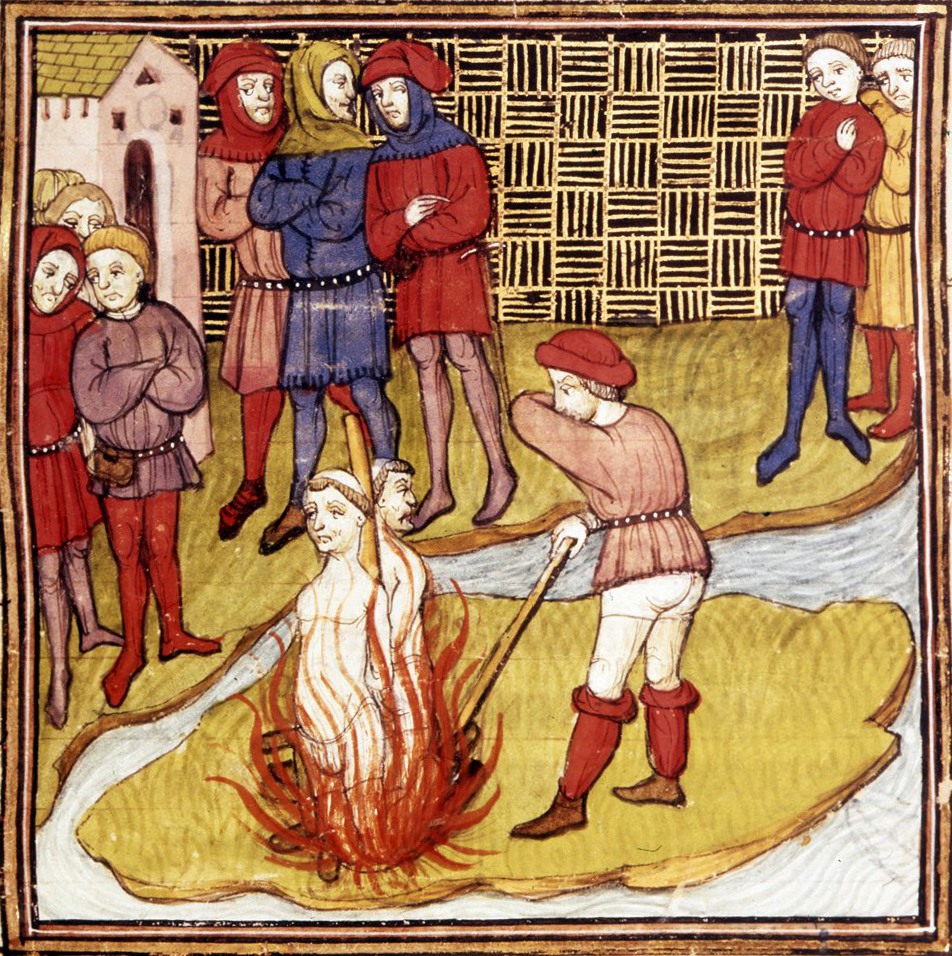
[Right: The two leading Templars Jacques de Molay and Geoffroy de Charnay being burned at the stake in 1314, rather than falsely confess their order was guilty of the charges brought by King Philip IV of France so he could get their money and the Shroud.]

a Templar Knight burned at the stake with the last head of the order, Jacques de Molay. According to L'Osservatore, Frale has uncovered new evidence concerning the Shroud in the testimony surrounding the Knights Templar, a crusading order. Founded at the time of the First Crusade in the eleventh century, the Knights Templar protected Christians making the pilgrimage to Jerusalem. They took their name from the Temple of Jerusalem, near which they were first stationed. After the crusaders lost the Holy Land with the fall of the city of Acre in 1291, support for them weakened. Accused of both heresy and engaging in corrupt and sexually immoral secret ceremonies, the order's leaders were arrested by King Philip IV of France. The king pressured Pope Clement V to dissolve the Knights Templar, which he did in 1307. Frale reported that a trial document recounts the testimony of Arnaut Sabbatier, a young Frenchman who entered the order in 1287. He testified that as part of his initiation he was taken to "a secret place to which only the brothers of the Temple had access." He was shown "a long linen cloth on which was impressed the figure of a man" and instructed to venerate the image by kissing its feet three times. Frale said that the Knights Templar had been accused of worshiping idols, in particular a "bearded figure."

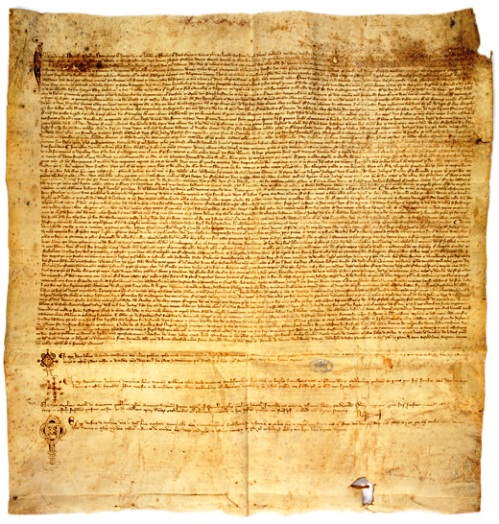
[Left: Chinon Parchment: After Math News.]

According to Frale, the Knights took possession of the Shroud to rescue it from heretical groups such as the Cathars. In 2003 Frale rediscovered her trial document source, known as the Chinon Parchment, after realizing it had been wrongly cataloged in the Vatican Library.

Shroud of Turin Secretly Hidden, Discovery News, Rossella Lorenzi, April 6, 2009 ... The Knights Templar secretly guarded the Shroud of Turin -- an ancient linen cloth believed by many to be the burial shroud of Jesus -- for more than 100 years, according to the Vatican's in-house newspaper. Writing in L'Osservatore Romano, Barbara Frale, a scholar at the Vatican Secret Archives, said new archival documents reveal "missing clues" to the fate of the Shroud between 1204 A.D. and 1351, a period during which it cannot otherwise be accounted for. "These unpublished documents appear to solve the puzzle of the shroud's missing years from a purely historic angle," Frale told Discovery News. "Indeed, a linen cloth extremely similar to the shroud of Turin is clearly described in those records." Believers contend that the shroud, now kept in a silver casket in Turin's Cathedral, is the "cloth with an image on it" reported by the early Christian historian Eusebius to have been given to the Christian King Abgar V of Edessa in 30 A.D. The linen, known then as the Mandylion of Edessa, was taken to Constantinople in 944. It disappeared in the sack of the city in 1204 during the Fourth Crusade, and did not surface until 1357, when the widow of a French knight had it displayed in a church in Lirey, France. According to Frale, the newly discovered documents support a theory first put forward by the British historian Ian Wilson in 1978. He argued that the shroud and the Mandylion of Edessa were one and the same, and that the Templars were the custodians of the Shroud. [A good summary of Wilson's Edessa Cloth = Mandylion = Shroud theory.] .

Knights Templar hid the Shroud of Turin, says Vatican, The Times, April 6, 2009, Richard Owen in Rome Medieval knights hid and secretly venerated The Holy Shroud of Turin for more than 100 years after the Crusades, the Vatican said yesterday in an announcement that appeared to solve the mystery of the relic's missing years. [This Rome correspondent for The Times makes the point that it is "the Vatican" saying this. That is, Frale works for the Vatican and her account is in the Vatican's in-house newspaper, L'Osservatore Romano.] ... In 2003 Dr Frale, the Vatican's medieval specialist, unearthed the record of the trial of the Templars, also known as the Chinon Parchment, after realising that it had been wrongly catalogued. The parchment showed that Pope Clement V had accepted the Templars were guilty of "grave sins", such as corruption and sexual immorality, but not of heresy. Their initiation ceremony involved spitting on the Cross, but this was to brace them for having to do so if captured by Muslim forces, Dr Frale said. Last year she published for the first time the prayer the Knights Templar composed when "unjustly imprisoned", in which they appealed to the Virgin Mary to persuade "our enemies" to abandon calumnies and lies and revert to truth and charity. Radiocarbon dating tests on the Turin Shroud in 1988 indicated that it was a medieval fake. However this had been challenged on the grounds that the dated sample was taken from an area of the shroud mended after a fire in the Middle Ages and not a part of the original cloth. [It is significant that even The Times of London now regards the 1988 radiocarbon dating of the Shroud as "medieval" was flawed.]

See also: Turin Shroud link with Templars proved by archives, claims historian, The Guardian, Monday 6 April 2009; Knights Templar worshipped the Turin Shroud, Telegraph.co.uk., 6 Apr 2009.


"We have then the matter of the cloth's fate after 1204 when according to the Crusader, `neither Greek nor Frenchman knew what became of it.' This is the most mysterious period of all. But whoever came to possess it would seem to have possessed vast wealth, or otherwise they would have sold such a valuable relic; also they must have had some motive for keeping it secretly to themselves. To me the prime suspects seem to have been the Order of Knights Templar, who had a great veneration for the Holy Sepulchre, and built for themselves vast fortresses so heavily guarded that they became the banks of Europe, and so mysterious that rumours began to circulate of secret Templar ceremonies at which some great relic was venerated, a relic which had the appearance of the face of an unidentified bearded man upon a panel. In 1307 the rumours were all that were needed to give the King of France the excuse to lay his hands on Templar wealth by arresting every member of the Order, not without a struggle, a struggle in which the mysterious `idol' the Templars were accused of possessing certainly disappeared. Just one clue survives to the appearance of the last Templar `idol,' a clue found in the tiny village of Templecombe in England, once the home of a Templar preceptory. During the demolition of a cottage outhouse in the 1950's there came to light this oak panel painting ... undoubtedly Templar, answering exactly the documentary descriptions of the `idol' and with the uncanny appearance of being a copy of the face on the Shroud. If the Shroud was indeed the idol possessed by the Templars, one further clue survives as to it's fate. In 1314 two of the last Templar dignitaries were brought out to be burnt at the stake, proclaiming to the last their innocence ... One was the Order's Grand Master, Jacques de Molay, the other the Order's Master of Normandy, Geoffrey de Charny. We do not know definitely if there was a family relationship between Geoffrey de Charny the Templar and Geoffrey I de Charny of Lirey, first known owner of the Shroud. But the likelihood is there. One may postulate the Shroud ripped or cut from it's panel at the time of the Templar capture, stuffed under a jerkin, and spirited away to safety with relatives of the Master of Normandy. The episode fits exactly the sort of murky past Geoffrey de Charny of Lirey would simply not have been able to reveal, particularly as a French King and Pope had been heavily implicated in the Templar demise. Such is the bizarre chain of events that I believe constitutes the hitherto `lost' 1300 years of the Shroud's history." (Wilson, I., "The Shroud's History Before the 14th Century," in Stevenson, K.E., ed., 1977, "Proceedings of the 1977 United States Conference of Research on The Shroud of Turin," Holy Shroud Guild: Bronx NY, 1977, pp.47-49).

Posted 14 April 2009. Updated 1 July 2024

Thursday, March 12, 2009

I am training to be a high school biology teacher, so less blogging!

In 2004 when I finished my biology degree, I originally intended to do further training to become a high school biology teacher.

[Above: Edith Cowan University, Joondalup]

However, by then our superannuation was doing so well, I did not need to work, so I decided to retire instead.

But now due to the financial crash, I have had to revert to plan A, and am 3 weeks into a 1 year Graduate Diploma of Education (Secondary), majoring in Biological Science, at Edith Cowan University, Joondalup, where I did my biology degree.

So I now have a lot less time for blogging, although I should have more time in the semester breaks. Of course if I am successful and do become a biology teacher, I expect I will continue to be very busy, even in school holidays!

Update: I have successfully completed my science teacher training and now have a long break until school commences in February next year. I don't need to work full-time so I will probably work part-time as a relief teacher. In the meantime I will now catch up on my blogging!

Posted 12 March 2009. Updated: 25 June 2023.

Saturday, December 13, 2008

Shroud of Turin News - October/November 2008

Here is my Shroud of Turin News for October/November 2008. The previous issue was September 2008. Articles are in

[Above (click to enlarge): Entombment of Jesus, by Nicholas of Verdun, 1181, Klosterneuburg Abbey church, Vienna. See about this at BSTS Newsletter No. 67, June 2008.]

reverse chronological order (most recent uppermost). My comments are in bold.

Discovery Channel's "UNWRAPPING THE SHROUD: NEW EVIDENCE" Re-Opens One Of Christianity's Greatest Mysteries, Reality TV News, Nov 28, 2008 -... The Shroud of Turin is one of the great enduring mysteries of all time, with its authenticity debated for years. Many believe it's the burial cloth of Jesus and the only physical link to Him, while others maintain that it is nothing more than an elaborate hoax. In fact, in 1988, a team of scientists radiocarbon dated the Shroud and concluded it was fake, dating back to the Middle Ages (1290-1360), long after Jesus was crucified. The preponderance of the evidence is overwhelming that the 1988 radiocarbon-dating of the Shroud to 1290-1360 was wrong. The above 1181 Entombment of Jesus by Nicholas of Verdun (1130-1205), like the Pray Manuscript (1192-1195), is clearly based on the Shroud (note the distinctive crossed hands and shroud), but is at least 109 years earlier than the earliest possible radiocarbon date 1290! And that's where the story stood, unchallenged -- until now. Discovery Channel's one-hour original special UNWRAPPING THE SHROUD: NEW EVIDENCE attempts to unravel the truth about the cloth on Sunday, December 14, 2008 from 10-11PM ET/PT. The special event features the story of Ray Rogers, a respected chemist from the Los Alamos National Laboratory in New Mexico and member of the original team of scientists who examined the Shroud. Rogers came across a paper written by a husband and wife from Columbus, Ohio that claimed the 1988 radiocarbon dating was inaccurate. That was Joe Marino and Sue Benford and their paper, Benford, M.S. & Marino, J.G.. "Discrepancies in the radiocarbon dating area of the Turin shroud," Chemistry Today, Vol. 26, No. 4, July/August 2008, pp.4-12:

"ABSTRACT Recent research reported new evidence suggesting the radiocarbon dating of the Turin Shroud was invalid due to the intrusion of newer material in the sampling area. This evidence included the detection of anomalous surface contaminates in specimens from the sampling area. This paper reports new data from an unpublished study conducted by the Shroud of Turin Research Project (STURP) team in 1978 that supports the above-referenced research findings. Additionally, this paper reports evidence supporting the identification of replacement material in the Carbon-14 (C-14) sampling region along with previously-unreported radiographic findings, corroborative textile evidence from the adjacent `Raes' sample, blinded-expert analysis of the Zurich laboratory C-14 sub-sample, independent microscopic confirmation of surface contaminates in Holland cloth/C-14 region, and historical restoration information. Based on these new data, the authors conclude that the radiocarbon sampling area was manipulated during or after the 16th Century and that further testing on the Shroud is warranted." (Benford, M.S. & Marino, J.G., 2008, "Discrepancies in the radiocarbon dating area of the Turin shroud," Chemistry Today, Vol. 26, No. 4, July-August, pp.4-12, p.4).

See online Benford, M. S. & Marino, J., "New Historical Evidence Explaining the `Invisible Patch' in the 1988 C-14 Sample Area of the Turin Shroud," Shroud.com, 2005. According to the couple, the test sample that was used had been taken from a section of the Shroud that had been repaired in the 16th Century, skewing the results. Expecting to prove this

[Above (click to enlarge): Medieval Reweaving the Shroud of Turin]

couple wrong, Rogers went back to examine the sample of the Shroud he tested years earlier, and what he found astonished even himself. In his last days (he had been battling cancer), Rogers made a video -- which before now has never been seen -- detailing his conclusions. This is a pleasant surprise. It promises to be very significant, in this the 20th anniversary year of the radiocarbon-dating of the Shroud. Shot entirely in high-definition, UNWRAPPING THE SHROUD: NEW EVIDENCE examines Rogers' findings and how they may unlock a mystery thousands of years in the making. UNWRAPPING THE SHROUD: NEW EVIDENCE is filled with twists and turns, science and faith, and iron-clad evidence that may turn out to be less than meets the eye. Presumably that "iron-clad evidence" which turns out "to be less than meets the eye" is the radiocarbon-dating of the Shroud to the Middle Ages (1290-1360) . ...

Important New Scientific Article Added, The Shroud of Turin Website, November 26, 2008 ... The website has been updated and an important new article has been added to the Scientific Papers & Articles page. Co-authored by noted Shroud scholar Joseph Marino and retired NASA scientist Edwin Prior, the article is titled "Chronological History of the Evidence for the Anomalous Nature of the C-14 Sample Area of the Shroud of Turin." It provides a detailed and compelling summary of all the scientific evidence supporting the theory that an anomalous sample was used for the 1988 C-14 dating of the Shroud. One of the co-authors, Joe Marino, emailed me that this is:

"A significant new article ... which presents all the compelling evidence that indicates that the sample used to date the Shroud in 1988 was invalid, has just been published. One of the authors, Ed Prior, is a retired 40 year NASA scientist who is an agnostic, so he can't be accused of being religiously biased in favor of the Shroud's authenticity"

What is found particularly interesting in that paper is at page 14 (of 40):

Entry: #28 Date: 2000 Data Category: Possibility or direct evidence of invisible reweaving Evidence: Ronald Hatfield, a scientist at Beta Analytic, the world's largest radiocarbon dating service, performed a theoretical C-14 calculation that supports the theory of a 16th century patch. A merging of threads from AD 1500 into a 2,000 year old piece of linen would augment the C-14 content, such that a 60/40 ratio of new material to old, determined by mass, would result in a C-14 age of approximately AD 1210. Source: Beta Analytic Laboratories (Miami, Florida): Personal communication to M.Sue Benford and Joseph Marino June 9, 2000 ("Evidence For The Skewing of the C-14 Dating of the Shroud of Turin" by Joseph G. Marino and M. Sue Benford, http://www.shroud.com/pdfs/marben.pdf). Comments: The Hatfield calculation correlates very closely with the Oxford mean date of AD 1200 as reported in Nature and with the observed ratio of original versus medieval material in the C-14 sample." (Marino, J.G. & Prior, E.J., "Chronological History of the Evidence for the Anomalous Nature of the C-14 Sample Area of the Shroud of Turin," November 2008, p.14. Shroud.com)

The evidence just keeps mounting against the 1988 radiocarbon-dating claim that the Shroud was a "fake, dating back to the Middle Ages (1290-1360)." That is, it is not the Shroud that was the "fake" but the radiocarbon-dating!

Shroud of Turin astonishes chemist in a new test, inspires a Discovery Channel special, Orlando Sentinel, Hal Boedeker, Nov 25, 2008 ... A dying chemist took another look at the Shroud of Turin -- and came to surprising conclusions. His story will be detailed in a new Discovery Channel special with the working title "Unwrapping the Shroud: New Evidence." The program will premiere at 10 p.m. Dec. 14.

[Left: Ray Rogers (1927- 2005): Shroud University]

The chemist, Ray Rogers, had worked at Los Alamos National Laboratory. In 1988, he took part in tests on the shroud. The results revealed that it came from the Middle Ages and couldn't be the burial cloth of Jesus. But Rogers took another look at the cloth after suggestions that the test had been skewed. According to Discovery, "What he found astonished even himself. In his last days (he had been battling cancer), Rogers made a video -- which before now has never been seen -- detailing his conclusions." One of the earlier news items announcing the forthcoming Discovery Channel special. Rogers, even though he was pro-authenticity of the Shroud, was a particularly hard-headed, sceptical, scientist, who for years dismissed the re-weaving theory out-of-hand. For him to be "astonished" by this new evidence for re-weaving, means it must be very strong that the Shroud sample radiocarbon-dated in 1988 was re-woven with 16th century cloth and threads, thus adding new carbon and thus skewing the radiocarbon-date to the 14th century of what might well have been a 1st century linen cloth.

'Turin Shroud' set to come to Tamworth, Tamworth Herald, November 24, 2008 ... Tamworth people are about to get the opportunity to make their own decision, when one of only four exact replicas of the priceless relic comes to town this weekend.

[Right: Prof. Edward Hall (1924- 2001), Dr. Michael Tite and Prof. Robert Hedges (left to right), on 13 October 1988 triumphantly announcing the Shroud was "conclusively" radiocarbon- dated to "1260-1390!": Ian Wilson, "The Blood and the Shroud," 1998, pl.3b]

Debate continues to rage about the authenticity of the Turin Shroud, which bears the image of a crucified man with markings identical to biblical accounts of the wounds Jesus' bore at his death. Millions of Christians throughout the world are convinced the shroud is the genuine burial cloth of Jesus of Nazareth, although extensive carbon dating on fragments of the original seem to suggest a cunning medieval con. Another journalist who chooses to remain in blissful ignorance, mindlessly regurgitating 20-year-old news that the 1988 radiocarbon-dating suggested that the Shroud was "a cunning medieval con," while ignoring (or denying) the mountain of evidence that the Shroud really is the burial sheet of Jesus. Presumably they just don't want the Shroud to be genuine because, like the late Prof. Edward Hall of the Oxford laboratory that dated the Shroud admitted, "he was not disappointed in the result" because:

"'I have to admit I am an agnostic and I don't want at my time of life to have to change my ideas." (Radford, The Guardian, October 14, 1988).

Pam Moon will be showing the replica at St John the Baptist RC Church, Tamworth on Sunday, November 30. It will be on display from 12noon until 5pm and Pam will be giving a talk about the shroud in the church at 4pm. That's Tamworth, near Birmingham, England. An example of how Shroud replica exhibitions are constantly going on around the world.

Art and Science Converge in State Museum Exhibit, UANews, November 3, 2008. A new Arizona State Museum exhibition showcases scientific research through the eyes of an artist ...

[Above: Magnified linen fibers from the Shroud of Turin, image by Rachel Freer, visiting research fellow, Arizona State Museum]

Magnified linen fibers from the Shroud of Turin. It had been requested that the specific sample radio carbon dated by the Arizona Accelerator Mass Spectrometry Laboratory be examined for authenticity. This is very interesting. Presumably this request was part of the Oxford Radiocarbon Accelerator Unit's investigation into what could have gone wrong with its 1988 radiocarbon-dating of the Shroud. But because radiocarbon-dating necessitates burning the sample to reduce it to pure carbon, this particular sample cannot be one of the "specific" samples radio-carbon dated by the Arizona lab in 1988. Polarized Light Microscopy was used to confirm that the major fiber content of the sample is linen. Note: the MAJOR fiber content of the sample is linen. That is, the sample was not pure linen but was contaminated with other threads. This alone should discredit the 1988 "medieval" radiocarbon-date and confirm the Benford-Marino reweave theory. Scientific images are used to help researchers understand the chemical make-up, composition, texture, age, geology and other components of an object or material being studied. But when viewed through the eye of an artist, these images can take on another realm of importance, that of structural, compositional and vividly colorful beauty. Thanks to David Killick, professor of anthropology at The University of Arizona, and Kress Conservation Fellow Rachel Freer, some of the most visually astounding and scientifically important images taken at the UA have been put together as an art exhibit, which opens Nov. 8 at the Arizona State Museum. Researchers at the UA have been using many types of imaging technologies to reveal the structure of clothing threads, such as those found in the Shroud of Turin or to view the radiation emitted from quasars obtained by scanning a portion of the sky - neither of which is accessible to the unaided human eye. It is truly serendipitous that the University of Arizona has at this very time, just before the Benford-Marino reweave theory gets a major airing on the Discovery Channel, exhibited one of its 1988 samples of the Shroud, with the admission that the samples used to date the Shroud between 1260-1390 AD was contaminated with other fibres which would, if it were any other radiocarbon-dating but the Shroud, render scientifically invalid that radiocarbon-date.

Shroud of Turin expert has presentation, will travel, Florida Catholic, October 13, 2008 ... Gerri Bauer ... DELAND |

[Right: This image is a `negative' version of a photograph of the Shroud of Turin: Shroud Scope: Enrie Negative Vertical]

Florida resident John C. Iannone considers the study of the Shroud of Turin the "greatest CSI case in history." This is a very important point. Just as a pattern of forensic evidence can uniquely identify an individual, so does the pattern of at least 23 wounds and other markings on the Shroud of Turin, uniquely identify the image on it as that of Jesus. "You start to get the idea there's only one person in history" whose image is imprinted on a centuries-old cloth," he told a crowd of more than 100 gathered at St. Peter Parish in DeLand Sept. 23 to hear his presentation, "The Mystery of the Holy Shroud: A Case for Authenticity." For example, "only one person in history" is known to be crowned with thorns as both Jesus (Mt 27:29; Mk 15:17; Jn 19:2) and the man on the Shroud were (see 5. He had been `crowned' with thorns of Re: There is compelling evidence it is the burial cloth of Christ, or a man crucified during that time #1). ... Iannone ... started studying the shroud about 30 years ago. In 1998 he wrote a book, "The Mystery of the Shroud of Turin: New Scientific Evidence," to help explain the subject in layperson's terms, then was invited to view the shroud in Turin during an international conference. I wholeheartedly recommend Iannone's book as being one of the best introductions to the Shroud. Seeing the cloth "was a defining moment in my life," he told the audience. .... His goal in each lecture is to explain the scientific evidence for authenticity in a manner easily understandable by people who aren't scientists. At the St. Peter's lecture, he showed slides that illustrated his point-by-point clarifications about specific aspects of study, such as the carbon testing of the 1980s that pinpointed the cloth's age as medieval. He cited early findings from the early 2000s that fibers from a medieval patch had intruded into fibers of the original cloth from which samples were removed for testing. A microphotograph detected the reweaving, he said. More about the re-weaving! Iannone's book has a section "Test Samples Taken from the Restored Area?" but being written in 1998, it does not have this latest information. He discussed such things as blood type, postmortem blood flow, median nerve damage, specific pollens from various flowers and their geographic distribution, and light and dark spots believed to illustrate rigor mortis setting in while Jesus was on the cross. He also addressed cultural aspects, burial customs and art history relating to how Jesus has been visually depicted over the centuries. ... Iannone said he finds a great deal of interest among people whenever he presents the program, not just about the shroud but about spirituality and religion in general. "People are struggling to get back to the roots of their religion in a very complicated world, especially with all the things that are happening today," he said. "For me, the shroud supports the fundamental points of Christianity." The Shroud is independent archaeological evidence that the Gospel's description of the scourging, crucifixion and resurrection is accurate:

"The extent to which the Shroud confirms the accuracy of even small incidents reported in the Gospels means that more reliance can be placed on those details which the Shroud is unable to confirm. So far as the Shroud is concerned, the evidence of the stains points with certainty towards their having been made by the body of Jesus." (Hoare, 1978, "Testimony of the Shroud," pp.41-42).

"But it is the bearing out of the New Testament evidence that is much the most significant. ... the light thrown by the Shroud can help us to understand how apparently discrepant accounts e.g., of the grave-cloths, are in fact compatible. ... the genuineness of the Shroud would shake is the theory that the whole story of the empty tomb is an invention of the early church. ... the Shroud unquestionably adds weight to the universal witness of the New Testament that there was a physical ... aspect to this event." (Robinson, 1978, "The Shroud and the New Testament," pp.77-78).

The quotes below (emphasis italics original, emphasis bold mine) are hyperlinked to references above.

Posted 13 December 2008. Updated 21 March 2025.


"Even the use of the Shroud is explained, as there was no time for the proper burial rites because they obtained Jesus's body only shortly before the Sabbath; and the surprisingly fine texture of the material used for wrapping up the crucified man's body is explained by the reported wealth of Joseph of Arimathea. In all these points there is remarkable corroboration between the two sources of evidence, so that each seems to stand as guarantor of the other. Under Jewish law, a single witness had little value; at least two were required (Deuteronomy 17:6 and 19:15; Numbers 35:30). On these grounds, in view of the agreement of two widely different types of evidence, the written and the photographic, the historicity of Jesus and his Crucifixion may be taken as proven. Most appraisals of the Shroud have begun with an assumption of the complete accuracy of the Gospel accounts, and have tried to make the stains fit them. This has led to doubts of the Shroud's authenticity when certain stains, or the existence of the Shroud itself, have failed to match a particular description in a Gospel. However, the Shroud is material evidence that is available, and the marks on it can be seen, and prove themselves to have been formed on the day of the Crucifixion. It is therefore the Shroud which should stand as the measure of the accuracy of the Gospel stories, for there was plenty of opportunity for alteration and distortion in the decades before the traditions were first written down. The extent to which the Shroud confirms the accuracy of even small incidents reported in the Gospels means that more reliance can be placed on those details which the Shroud is unable to confirm. So far as the Shroud is concerned, the evidence of the stains points with certainty towards their having been made by the body of Jesus." (Hoare, R., 1978, "Testimony of the Shroud," St. Martin's Press: New York NY, pp.41-42).

"The Holy Shroud of Turin - revered by Catholics for centuries - is a piece of linen woven between AD1260 and 1390. Therefore the image it bears cannot be the imprint of the bloodstained body of the crucified Jesus Christ. The news, confirming rumours and leaks which began circulating from the first weeks of radiocarbon dating tests on the shroud, was announced yesterday by Cardinal Anastasio Ballestrero, the Archbishop of Turin. He said that scientists at laboratories in Zurich, Arizona and Oxford had checked the ages of historically authenticated samples of cloth and cuttings from the shroud and were '95 per cent' certain of their findings. The shroud, 14ft 3in long and 3ft 7in wide, bears a faint yellowish negative image of the front and back of a man whipped, speared, nailed to a cross and crowned with thorns. Cardinal Ballestrero said that the church had never claimed that the shroud was a holy relic: its symbolic importance remained. 'The church believes in the image and not in the history because this image of Jesus Christ in fact is very interesting and the people believe deeply in Jesus,' the cardinal said. At a press conference in London, Dr Michael Tite, keeper of the British Museum research laboratories, who masterminded the three tests, and Professor Edward Hall and Dr Robert Hedges of Oxford, who conducted the British radiocarbon dating, all confirmed that there could be no serious doubt in the results. They also denied knowledge of any of the 'leaks' which dogged the experiment. These, they said, were the result of informed guesses by the press. Their finding, they said, was consistent with the known historical evidence for the shroud, which was first recorded in about 1389 by the Bishop of Troyes. He described it as a cunning forgery and said his predecessor had met the forger. Professor Hall, who heads the Oxford research laboratory in archaeology and the history of art, said he was not disappointed in the result. 'I have to admit I am an agnostic and I don't want at my time of life to have to change my ideas.' But that is not likely to be the end of the story: there are still mysteries wrapped in the shroud. Pathologists, artists and scientists have been puzzled at how a 14th century forger could have simulated complex details such as gravity's effect on blood flows from wounds in the hands, feet and side. 'Essentially we have an incomprehensible, extraordinary object. We now know its age but not its origin,' Professor Luigi Gonnella, scientific adviser to Cardinal Ballestrero, said in Turin yesterday. 'It is not a painting, it has no pigments. We know the red stains are blood, but we do not know of any mechanism in the Middle Ages that could put blood on a cloth.' He said church officials are angered by claims that because the shroud has a medieval date it must be a fraud, a fake or a forgery. 'A forgery means it was made for the specific purpose of deceiving people. This is possible but there is no proof of that. It could be a medieval icon.'" (Radford, T., 1988, "Shroud dating leaves 'forgery' debate raging," The Guardian, October 14).

"But it is the bearing out of the New Testament evidence that is much the most significant. It does not of course prove the Gospels are, or set out to be, exact historical records. The well-known differences between them remain, though I am convinced that the light thrown by the Shroud can help us to understand how apparently discrepant accounts e.g., of the grave-cloths, are in fact compatible. The first thing that the genuineness of the Shroud would shake is the theory that the whole story of the empty tomb is an invention of the early church. Despite its advocacy by Bultmann and other distinguished scholars I have never regarded this in any case as in the least degree probable. The story is firmly entrenched in all the strands of the Gospel tradition, and I believe that Paul's statement of the common apostolic teaching, received after his conversion, that Christ `was buried ... and was raised to life on the third day' points to a connection between the Resurrection and the tomb (not merely the appearances) which takes us back to the very first years of the Christian movement. The survival of the shroud would simply add weight to the very strong presumption that the tomb of Jesus was found empty - though how it became empty neither the Gospels nor, I believe, the Shroud tell us. But somehow the body disappeared. The traditional challenge, that the authorities had only to produce the body to discredit the whole message that Jesus was risen, must, I think, be taken more seriously than I have tended to suppose. The argument certainly does not hold the other way round. The mere fact that it was not produced can never prove it could not have been produced, any more than the absence of Hitler's corpse to this day proves that he rose from the dead. But if a lifeless cadaver had been produced which could irrefutably have been identified with Jesus of Nazareth, then the proclamation that he was not dead but alive would have seemed as unconvincing to Jewish as to modern presuppositions. The Christian church would never have got off the ground. Positively this proves nothing about the mode or meaning of `resurrection'. But the Shroud unquestionably adds weight to the universal witness of the New Testament that there was a physical and not merely a spiritual aspect to this event." (Robinson, J.A.T., 1978, "The Shroud and the New Testament," in Jennings, P., ed., "Face to Face with the Turin Shroud," Mayhew-McCrimmon: Great Wakering UK, pp.69-81, pp.77-78).

Wednesday, November 26, 2008

Did Max Frei misidentify Carduus argentatus Shroud pollen as Gundelia tournefortii?

It have been advised in a private email, which I am not at liberty

[Above (click to enlarge): Carduus argentatus, Silver Thistle: Flowers in Israel.]

to quote, that what the late Max Frei identified as Gundelia tournefortii pollen on the Shroud of Turin, had in 2001 been re-identified by a leading palynologist, Bonn University Prof. Thomas Litt, as within the different genus Carduus.

It was not possible for Prof. Litt to identify that Carduus genus pollen down to the species level, because Frei used sticky tape to take his samples off the Shroud and then folded the tape over onto itself to preserve the pollen.

[Left: Max Frei using sticky tape to take pollen samples from the Shroud in 1978: Shroud.com]

But the tape glue has obscured the pollen's microstructure, which needs to be clearly seen under an electron microscope for a species-level identification.

The information itself in the email is not private, being in an 88-page book, Danin, A. & Guerra, H., 2008, "L'uomo della Sindone [Who is the Man in the Shroud?]," Edizioni ART: Rome, which however, as the title indicates, is in Italian. It is described in Google's translation as basically an interview with Israeli botanist Prof. Avinoam Danin:

In this book-interview, the expert botanist Prof. Avinoam Danin, a professor at the Hebrew University of Jerusalem, presents the latest results of his research regarding the Shroud. Prof. Danin says that the only place in the world where people could gather fresh shares of at least four species of plants found on the Shroud and place them on the body, which was wrapped in it, is the area between Jerusalem and Hebron, and the weeks between the months of March and April are the only time of year in eight of the plants are identified on the Shroud in the same flower.

However, this reclassification by Prof. Litt of Frei's Gundelia tournefortii pollen to the Carduus genus may be a blessing in disguise for the authenticity of the Shroud. That is because there is a species in that genus, Carduus argentatus, which grows around Jerusalem, flowers in April-May, has a more attractive flower (see above), and is a much less thorny plant than Gundelia tournefortii.

[Above (click to enlarge): Gundelia tournefortii, Flowers in Israel. "an extremely fearsome-looking thorn ... it is certainly not obvious as the kind of plant that might have been used as a funerary bouquet," Ian Wilson (see below). ]

And most significantly, Frei did not identify any Carduus argentatus on the Shroud (see below). As can be seen, the only

[Above (click to enlarge): Part of a list of pollen species identified by Frei, in Bulst, W., "The pollen grains on the Shroud of Turin," Shroud Spectrum International, Vol. 3, No. 10, March 1984, pp.20-28].

Carduus species of pollen that Frei identified was Carduus personata, which however, although the above list does not indicate it, is a European plant.

Moreover, images of "plants from the Carduus genus of thistles" have been identified by Prof. Danin on the Shroud:

"Avinoam Danin, emeritus professor of botany at the Hebrew University of Jerusalem, has spent years examining images of plant life discovered on the shroud. He also has discovered additional pieces of plant life on the cloth, which has provided additional evidence to support his theory that the shroud was used somewhere in the area of Jerusalem. Over the years, Danin, co-author of `Flora of the Shroud of Turin,' noted he has discovered the presence of three plant species that indicate the shroud's origin was somewhere between Jerusalem and Hebron. Eight species also have been used to determine, through flowering characteristics, that the plant life placed on the body happened somewhere during March or April. Danin said he also recently has indicated more than 300 flowers and plant parts on the head area of the shroud. Those were discovered, he said, after studying photos of the cloth taken in the 1970s.Among the plant life identified are the Matricaria and Anthemis, two genera of the sunflower family. He also said he discovered plants from the Carduus genus of thistles, and pieces of the shrub Rhamnus lycioides - both potential evidence of a crown or helmet of thorns." (Brinker, J., "Plant life traces on Shroud of Turin draws local interest," St.Louis Review, September 5, 2008.).

including apparently Carduus argentatus:

"Capparis [sic] argentatus is one of the flower images identified on the Shroud by Avinoam Danin, a botany professor at the Hebrew University of Jerusalem and a leading authority on the flora of Israel, along with Uri Baruch, a pollen specialist with the Israel Antiquities Authority. The identifications of Carduus Argentatus confirmed some previous floral image identifications by Oswald Sheuermann, a German physicist, and Alan Whanger, a professor at Duke University." ("Carduus argentatus flower image," Sugar Coated Shroud of Turin, 2 September 2008),

although I have yet to find where Danin himself has claimed that particular identification at the species level.

And as Ian Wilson pointed out, there is a problem of why pollen of a not particularly pretty flowered, or pleasantly scented, and very thorny species like Gundelia tournefortii was in such abundance on the Shroud, because "it is certainly not obvious as the kind of plant that might have been used as a funerary bouquet":

"All of this raises the question of just what sort of plant is Gundelia tournefortii? At which point the surprise is that it is an extremely fearsome-looking thorn, with prickly leaves and a thistle-like head that bears the sharpest of spines. Its greatest known usefulness appears to be as a low-grade winter fodder for goats and sheep when there is nothing better available for them. So it is certainly not obvious as the kind of plant that might have been used as a funerary bouquet, even supposing there was evidence that the Jews of Jesus' time had such a custom. Likewise, while it is possible that the plant's spikiness might have caused it to be used for the `crown of thorns' laid on Jesus' head - a view certainly favoured by Dr Alan Whanger - Danin for one is ambivalent on this. And Dr Fred Zugibe, having carefully compared photos of Gundelia with the bloodstains around the back of the Shroud man's head, similarly expresses doubts. In fact the very distribution of Gundelia pollen grains as these occur on the Shroud is contra-indicative of any such scenario. The greatest concentration of specimens (fourteen) has been found on tape 4/3Aa, which Frei took from the very edge of the Shroud's front-of-the-body half, at the level of the crossed hands, with the next highest incidence ten specimens on tape 12 Cd, from the spillage of blood from the ankle on the back-of-the-body half of the cloth. Conversely only a few Gundelia have been found in the region of the head. ... But while it might resolve matters wonderfully if we knew Gundelia to have some perfuming or fumigatory properties, its odour is said to be very nondescript, the closest resemblance being artichoke." (Wilson, I. & Schwortz, B., "The Turin Shroud: The Illustrated Evidence," Michael O'Mara Books: London, 2000, pp.90-91).

So if Frei was wrong in his identification of Gundelia tournefortii pollen (as seems to be the case) and it is actually Carduus argentatus, then that would seem to be even better for the Shroud's authenticity, given that C. argentatus would be a much more likely flower for Jesus' disciples to place on His body as a funerary bouquet than G. tournefortii.

I look forward to an eventual (perhaps in conjunction with the next Shroud exhibition in 2010?) new extraction and identification of pollens directly from the Shroud, i.e. that are not from the Frei collection and so have not been embedded in obscuring sticky tape glue.

PS: It has just occurred to me (January 27, 2010) that there is a second blessing in disguise if this is an error in classification by Frei, in that it would be evidence against claims by Schafersman and others that Frei's data was fraudulent. That is because if Frei did collect modern pollen and claim it was Gundelia tournefortii he would have collected it from that species as an easily identifiable living plant. There was also no reason for Frei to choose Gundelia tournefortii because as my quote by Wilson indicated, it is an unlikely plant to be used in a 1st century Jewish burial.

Posted: 26 November 2008. Updated: 29 August 2017.

Saturday, November 22, 2008

Re: There is compelling evidence it is the burial cloth of Christ, or a man crucified during that time #2

Kris

Continuing from Re: There is compelling evidence it is the burial cloth of Christ, or a man crucified during that time #1 with this

[Left (enlarge): The only place on Earth, near Jerusalem (blue), where three plant species on the Shroud are found close together: Gundelia tournefortii (green), Cistus creticus (red) and Zygophyllum dumosum (dotted): Based on Danin, A., et al., "Flora of the Shroud of Turin," Missouri Botanical Garden Press: St. Louis MO, 1999, p.41, and Danin, A. & Guerra, H., 2008, "L'uomo della Sindone," Edizioni ART, Rome, p.88 (see below)]

part #2 of my multi-part response to your comment to my post: Bogus: Shroud of Turin? #10: The Shroud's blood and pollen closely matches the Sudarium of Oviedo's.

Your words are bold to distinguish them from my comments. I have split my reply into multiple parts because of the size of my response (which involves a lot of quote material as documentation).

----- Original Message -----
From: Anonymous
To: Stephen E. Jones
Sent: Wednesday, November 12, 2008 6:00 PM
Subject: [The Shroud of Turin] New comment on Bogus: Shroud of Turin? #10: The Shroud's blood an....

>.... I am a Christian who has drawn no real definitive conclusions about the authenticity of the Shroud. There is compelling evidence, however, that it is the burial cloth of Christ, or a man crucified during that time and in that area. ...

Continuing with 18-21 of the at least twenty-three (23) separate and independent features on the Shroud of Turin that match the gospel's depiction of the crucifixion of Jesus. My conservative estimates of the proportion of Roman crucifixion victims that had each particular feature are in square brackets:

18. The body left an imprint on the Shroud like no other known [1 in 1,000] (HJ1983p220; IJ1998p10; S&H1990p127; VP1970p44);

19. The feet have limestone dust that has the same rare chemical composition as dust in the tombs around Jerusalem [1 in 1,000] (AM2000p109; P&M1996p206; RC1999p103; WB2006p129; WI1998p104; W&S2000p93);

20. The Shroud has images and pollen of flowers that together

[Above (enlarge): Distributions of Zygophyllum dumosum (blue), Cistus creticus (red) and Gundelia tournefortii (green): Danin, A. & Guerra, H., 2008, "L'uomo della Sindone," Edizioni ART, Rome, p.88]

occur only around Jerusalem [1 in 1,000] (AM2000p112; DA1999p18; IJ1998p25; ML2005p94; SD1999Aug3; WM1998p78; W&S2000p92);

21. The Shroud has images and pollen on it from plants that flower only March-April, in the afternoon, and Jesus was crucified early April in the afternoon [1 in 1,000] (AM2000p113; DA1999p18; IJ1998p25; WM1998p78);

Continued in part #3 of "Re: There is compelling evidence it is the burial cloth of Christ, or a man crucified during that time".

Quotes below are hyperlinked to inline references above (my emphasis bold).

Posted 22 November 2008. Updated 19 April 2024.


"An important indication that the events depicted on the Shroud of Turin occurred not just in Palestine, but specifically in Jerusalem, is supported by an examination of the limestone in the Ecole Biblique tomb in Jerusalem. The Ecole Biblique provided researchers with access to the same rock shelf as the Holy Sepulcher and the Garden Tomb, both of which are considered the most probable choices for the actual tomb of Christ. Tombs in the Palestine/Transjordan area were carved out of limestone, which remains wet and pliable and which rubs off easily with the slightest contact. [Nitowski, E.L., "The Field and Laboratory Report of the Environmental Study of the Shroud in Jerusalem," Carmelite Monastery: Salt Lake City UT, 1986] Calcium carbonate is the major component of limestone. The limestone in the Jerusalem tomb was determined to be in the form of travertine aragonite, rather than the more common travertine calcite. [Kohlbeck, J. & Nitowski, E., "New Evidence May Explain Image on Shroud of Turin;" Biblical Archaeology Review, Vol. 12, No. 4, July/August 1986] Aragonite is less common than calcite and is formed under a much narrower range of conditions. The Jerusalem sample also contained small amounts of strontium and iron. [Nitowski; Kohlbeck & Nitowski] A calcium sample taken from a Shroud fiber on the foot has been compared to the calcium sample from the Jerusalem tomb. The Shroud sample was found to be in the form of aragonite, not the more common calcite, and also exhibited small amounts of strontium and iron. [Kohlbeck & Nitowski] This match was confirmed by Dr. Ricardo Levi-Setti [Levi-Setti, R.G., et al., "Progress in High Resolution Scanning Ion Microscopy and Secondary Ion Mass Spectrometry Imaging Microanalysis;" Scanning Electron Microscopy, Vol. 2, 1985, pp.535-552] of the Enrico Fermi Institute at the University of Chicago. Dr. Levi-Setti analyzed the calcium from both the Shroud fiber and the Jerusalem tomb with a high-resolution scanning ion microprobe. The resulting graphs show that these samples are an unusually close match, except for minute pieces of flax that could not be separated from the calcium sample taken from the Shroud fiber and that caused a slight organic variation. [Kohlbeck & Nitowski] Limestone samples taken from other tombs located at nine different test sites in Israel were also analyzed by Dr. Levi-Setti - but only the sample taken from the Jerusalem tomb matched the limestone on the Shroud." (Antonacci, M., 2000, "Resurrection of the Shroud: New Scientific, Medical, and Archeological Evidence," M. Evans & Co: New York NY, p.109).

"In 1985, Whanger detected what he believed to be a clear flower image near the head of the Shroud image, whose presence was first suggested by Oswald Scheuerman's observations in 1983. After finding other similar images, Whanger thought they might have great relevance, so he acquired a six-volume set of the definitive study on the botany of Israel. Whanger spent the next four years painstakingly comparing the faint images on Shroud photographs with life-size drawings in the botany books, and using his Polarized Image Overlay Technique to check his findings. By 1989, he had tentatively identified twenty-eight species of plants that grow in Israel. [Whanger, M. & Whanger, A., "The Shroud of Turin: An Adventure of Discovery," Providence House: Franklin TN, 1998, p.78] Although Whanger showed his findings to other Shroud researchers, he did not publish them until they could be confirmed by Dr. Avinoam Danin, professor of Botany at Hebrew University in Jerusalem and a world-renowned authority on the flora of Israel. Danin not only confirmed almost all of Whanger's identifications, but he also discovered a large number of additional flower images that were not found by Whanger. [Ibid., p.80] Of the twenty-eight plants, twenty-seven grow within the close vicinity of Jerusalem, where four geographical areas containing different specific climates and flora can be found. (The twenty-eighth plant grows at the south end of the Dead Sea.) All twenty-eight would have been available in Jerusalem markets in a fresh state, and most would have been growing along the roadside or in nearby fields. While three of these plants grow in France and nine grow in Italy, `half are found only in the Middle East or other similar areas and never in Europe' (italics added). [Ibid., p.79] One of these plants grows only in Israel, Jordan, or the Sinai, with its northernmost boundary between Jerusalem and Jericho. Danin concluded that there is only one place in the world where all of these flowers can be collectively found-Jerusalem. [Interview of Dr. Danin, CBS Evening News, April 12, 1997; Danin, A., Lecture at the Missouri Botanical Garden, St. Louis, MO, June 6, 1997; Whanger, A., "Flowers on the Shroud: Current Research," CSST News Vol. 1, No. 1, November 1997; Danin, A. et al., "Flora of the Shroud of Turin," Missouri Botanical Garden Press: St. Louis MO, 1999, p.18] Furthermore, the blooming season for all these plants is March and April. [Ibid.]" (Antonacci, 2000, p.112).

"Interestingly, one of the floral species on the Shroud that grows in Jerusalem and blooms in the Spring, Capparis aegyptia, provides further corroborating information of the events depicted on the Shroud. Damn, Baruch, and Whanger state: `Capparis aegyptia is also significant as an indicator for the time of the day when its flowering stems were picked. Flowering buds of this species begin to open about midday, opening gradually until fully opened about half an hour before sunset. Flowers seen as images on the Shroud correspond to opening buds at about 3 to 4 o'clock in the afternoon. This was confirmed by a two day experiment with, first, Capparis aegyptia, and later with Capparis spinosa Veillard.' [Danin, A., et al., "Flora of the Shroud of Turin," Missouri Botanical Garden Press: St. Louis MO, 1999, p.22] Furthermore, after examining flowers at various stages after they've been picked, Whanger concluded that their images most closely matched those that had wilted for twenty-four to thirty-six hours. [Whanger, M. & A., "The Shroud of Turin: An Adventure of Discovery," Providence House: Franklin TN, 1998, pp. 74-75, 80] This gives an indication of when the flower images might have been formed. This time frame is consistent with the formation of the body images, which occurred within two to three days after the body was placed within the Shroud, due to the lack of decomposition. These flower images, like the possible coin images, do not contain all of the unique features found on the body image and are very difficult to discern. They are most likely secondary images that also formed at the time the primary images formed. Further study should be undertaken to confirm the flower images, but so far, all evidence points toward corroboration. Danin has identified flowers and thorns on the photos of Pia, Enrie, and Miller, as well as on the ultraviolet fluorescent photos. He has even been able to identify two floral images on the Shroud itself with binoculars. [Danin, A., et al., "Flora of the Shroud of Turin," Missouri Botanical Garden Press: St. Louis MO, 1999, p.16] The implication of their identifications are enormous. In addition to confirming Frei's identifications, they could confirm the Jerusalem location, the period as the spring or Easter season, that different types of thorns were involved, that the flowers were picked around 3 to 4:00 in the afternoon, and that the images were encoded before two days had elapsed." (Antonacci, 2000, pp.113-114).

"The physical location of the bouquet containing Zygophyllum dumosum appears on the body image's upper chest (Figure 6, 10). Here, two young but well-developed succulent leaves are visualized. Each leaf has a terete petiole and a pair of flat leaflets (Figures 10 to 12). Such leaves, in the Near Eastern flora, are found only in the genus Zygophyllum. The images of two single petioles marked in this area are of at least 1-year-old leaves. The only species of Zygophyllum in Israel and its neighboring countries that sheds its pair of leaflets annually is Z. dumosum (Zohary, 1972; Feinbrun-Dothan & Danin, 1991). The top leaf in Figures 10 and 11 was seen in all the five kinds of photographs dealt with in Table 5. The fact that the Zygophyllum leaf image is black in the fluorescence photo means that the image is made up of the image-linen type fibrils that do not fluoresce. The chronological significance of Z. dumosum in the phenologic stage of bloom seen on the Shroud (it has a flower and two kinds of leaves) is that it was cut between the months of December and April (in the context of the Judean Desert). This is the particular season when both leaf types and flowers are found together on the plant. The geographical implications of Z. dumosum are significant beyond that of other species associated with the Shroud because the plant is endemic (Figure 9). Zygophyllum dumosum grows only in Israel, Sinai, and a small area of Jordan ... This assemblage of Z. dumosum and additional species such as Gundelia tournefortii, Cistus creticus, and Capparis aegyptia occurs in only one rather small spot on earth, this being the Judean mountains and the Judean Desert of Israel, in the vicinity of Jerusalem ... The distributional areas of the most significant species are used here to determine the proposed place of origin of the Shroud (the geographical fingerprint of the Shroud of Turin). Their significance is based on the following criteria: the highest frequency of pollen, endemism, and from which side of the Jordan river the first two were taken. A plant assemblage composed of two species is used for the first geographic approximation. These are Gundelia tournefortii, which has the highest frequency of pollen grains derived from the Shroud, and Zygophyllum dumosum, images of which are documented in both photographs and on the Shroud itself. Those biogeographic areas where the two species coexist are bounded by longitudinal lines linking Jerusalem and Hebron in Israel and Madaba and Karak in Jordan. Adding Cistus creticus as a third species to this plant assemblage anchors the area of origin toward the Jerusalem-Hebron zone. Future investigation of additional pollen grains from the Shroud may further pinpoint the place of origin indicated by the Shroud's flora. The species examined here have precise reproductive intervals or periods of times of blooming or of carrying leaves. Their phenology may serve as an indication of the time of year when they were brought to the Shroud. Table 6 indicates floral anthesis, after Feinbrun-Dothan and Danin (1991), for the eight most significant plants associated with the Shroud. For all eight plants, their concurrent blooming times fall in the months of March and April" (Danin, A., Whanger, A.D., Baruch, U. & Whanger, M., 1999, "Flora of the Shroud of Turin," Missouri Botanical Garden Press: St. Louis MO, pp.18,.21-22).

"The images are the result of dehydrative acid oxidation of the linen. The blood is human blood. How the images got on the cloth is a mystery. We would love to have the answer to this mystery, to explain the science of it. If it turns out that some form of molecular transport we have not been able to fathom is the method whereby the images of the scourged, crucified man were transferred to the linen, we shall have solved only another little micropart of the puzzle. We do know, however, that there are thousands on thousands of pieces of funerary linen going back to millennia before Christ, and another huge number of linens of Coptic Christian burials. On none of these is there any image of any kind. A few have some blood and stains on them, but no image. The Shroud bears the images of a man who has had incredible, violent damage done to his body, yet whose face is filled with serenity and peace. It is an extracanonical witness to what happened to Jesus Christ, whether the man in the Shroud was Jesus or not." (Heller, J.H., 1983, "Report on the Shroud of Turin," Houghton Mifflin Co: Boston MA, p.220).

"Some consider the images to have been formed by some as yet unknown `natural phenomena.' However, as ... Robert Wilcox states that `even if (researchers) come up with some `natural' process, the failure, so far, to find anything like the Shroud amongst the world's body cloths and artifacts leaves them with the further problem of why the process occurred only once in the history of the world, so far as is yet known.' [Wilcox, R.K., "Half of Shroud Scientists Say Image Is Authentic," The Voice, 5 Mar. 1982, p.13]" (Iannone, J.C., 1998, "The Mystery of the Shroud of Turin: New Scientific Evidence," St Pauls: Staten Island NY, p.10).

"Floral Images on the Shroud? During his studies in 1983, Oswald Scheuermann made an observation that there seemed to be flowerlike patterns around the face of the Man of the Shroud. Two years later, Dr. Alan Whanger, while examining photographs of the Shroud with a magnifying lens, suddenly saw out of the corner of his eye the image of a large chrysanthemum-like flower on the anatomic left side about fifteen centimeters lateral to and six centimeters above the midline top of the head. [Whanger, A. & M., "Floral Coin and Other Non-Body Images on the Shroud of Turin," Duke University: Durham NC, 1989] ... While there are vague or partial images of many flowers on the Shroud, Dr. Whanger and Oswald Scheuermann believe that they have tentatively identified twenty-eight plants whose images are sufficiently clear on the Shroud to make a good comparison and to be compatible with the drawings in Flora Palaestina . Of the twenty-eight plants identified on the Shroud, twenty-three are flowers, three are small bushes and two are thorns. All twenty-eight plants grow in Israel and twenty grow in Jerusalem itself (i.e., the Judean mountains). The other eight plants grew either in the Judean desert or the Dead Sea area or in both. Hence, these plants or flowers would have been available in Jerusalem's market in a fresh state. [Whanger, ibid]. They noted that a rather high percentage of the flower images identified have corresponding Pollen found on the Shroud by Dr. Max Frei. Of the twenty-eight plants whose images they believe they have identified, Dr. Frei had already identified the pollen of twenty-five of them. In addition, they noted with great interest that twenty-seven of the twenty-eight plants bloom during March and April, which would correspond to the time of Passover and of the Crucifixion. Dr. Whanger also states that the age of the flowers between the time they were picked and the time that the image was formed can be reasonably determined. He notes that the evidence indicates that the image of the body was formed (mysteriously) in a very brief time by some type of high energy process sometime between twenty-four and forty hours after death when decomposition (not seen on the Shroud image) would have begun to be apparent. Whanger believes that most of the flowers whose images are on the Shroud would be between twenty-four and thirty-six hours old after picking." (Iannone, 1998, pp.25-26).

"During another visit to the Whangers, Danin identified leaves and flowers of bean caper plants, Zygophyllum dumosum, in the image of a bouquet on the chest area of the figure of a man on the Shroud. At that time Danin didn't know that Frei had reported pollen of Z. dumosum on the Shroud tapes. Similarly, an image of a bouquet of Rock Roses [Cistus credicus] was found near the left cheek of the figure. Frei had found Rock Rose pollen on the tapes too. Although pollen and images from many other plants that grow in the Middle East have been recognised on the Shroud, the independent identification of both pollen and images of Gundelia tournefortii and Zygophyllum dumosum are the most significant. The thorn G. tournefortii is insect pollinated and flowers from February to May. Such great numbers of pollen from this species could only have arrived on the Shroud from a flower being placed on it. Zygophyllum dumosum is restricted to Israel, western Jordan and Sinai, and its northernmost distribution occurs between Jerusalem and Jericho. [Danin, A. & Baruch, U., "Floristic indicators for the origin of the Shroud of Turin," in Minor, M., et. al., eds., "The Shroud of Turin: Unraveling the mystery," Proceedings of the 1998 Dallas Symposium, Alexander Books: Alexander NC, 2001, pp.202-214] The natural distributions of G. tournefortii and Z. dumosum overlap in two small areas, both in the Holy Land. From studying distribution grids of all the plants identified by pollen or images, Danin reported that the area the Shroud may have originated from is 10-20 kilometres east and west of Jerusalem." (Milne, L., 2005, "A Grain of Truth: How Pollen Brought a Murderer to Justice," New Holland: Frenchs Forest, NSW, Australia, p.94).

"Aragonite as in Jerusalem ... The study of the area of the feet has been particularly interesting. In the greatly enlarged photographs, taken by Vernon Miller in 1978, one can see that the cloth looks dirty in the region corresponding to one of the heels. There, on the threads, is an exceptional amount of dust which helps one to think that the Man of the Shroud, very probably, had walked barefooted. [Archaeology, Vol. 34, No. 1, January-February 1981, p.41] Joseph Kohlbeck, an American crystallographer with the Hercules Aerospace Division, has identified a much greater concentration of calcium carbonate among the mineralogical particles present on the feet when compared with the other areas of the sheet. This calcium carbonate is, however, not the common calcite but a rarer form, the aragonite, with small amounts of strontium and iron. The comparison with samples of calcium carbonate taken from a tomb in Jerusalem has provided surprising similarities. Even in this case it is aragonite with small amounts of strontium and iron. Further chemical analyses, both on the aragonite found on the Shroud and that from Jerusalem, were carried out by means of a microprobe by Ricardo Levi-Setti of the University of Chicago. The two type samples have furnished extraordinarily similar results, which makes it highly probable that the aragonite on the Shroud came from Jerusalem. [Biblical Archaeology Review, Vol. 12, No. 4, July-August 1986, pp.23-24]" (Petrosillo, O. & Marinelli, E., 1996, "The Enigma of the Shroud: A Challenge to Science," Scerri, L.J., transl., Publishers Enterprises Group: Malta, pp.206-207).

"Scientists found other interesting features connected with the Shroud. Joseph Kohlbeck, an optical crystallographer working for the Hercules Aerospace Divisions, which makes missiles, found particles of aragonite with small amounts of strontium and iron on the Shroud's fibers on the image of the foot. With the help of archaeologist Eugenia Nitowski, he obtained samples of limestone from inside ancient tombs in and near Jerusalem and subjected them also to microscopic analysis. He found the same substance. The aragonite on the Shroud and in the tombs was an uncommon variety, deposited from springs, typically found in limestone caves in Palestine, but not in Europe. The samples from the Shroud and the tombs provided `an usually close match,' suggesting to him and to Nitowski that the Shroud had once been in one of the `rolling-stone tombs' that were common in Palestine around the time of Christ and for several centuries before. Kohlbeck observed that those who believe that the Shroud is a forgery need to explain how the very rare aragonite found its way to the surface of the Shroud. [Kohlbeck, J.A. & Nitowski, E.L., "New Evidence May Explain image on Shroud," Biblical Archaeology Review, July/August, 1986, pp.23-24]" (Ruffin, C.B., 1999, "The Shroud of Turin: The Most Up-To-Date Analysis of All the Facts Regarding the Church's Controversial Relic," Our Sunday Visitor: Huntington IN, p.103).

"Another plant seen in a clear image on the Shroud is of the Zygophyllum dumosum species, according to the paper. This is a native plant with an unusual leaf morphology, displaying paired leaflets on the ends of leaf petiole of the current year during the beginning of winter. Gundelia tournefortii and Zygophyllum dumosum coexist in a limited area, according to Danin, a leading authority on plants of Israel. The area is bounded by lines linking Jerusalem and Hebron in Israel and Madaba and Karak in Jordan. The area is anchored toward the Jerusalem-Hebron zone with the addition of a third species, Cistus creticus, identified as being placed on the Shroud through an analysis of pollen and floral imaging. `This combination of flowers can be found in only one region of the world,' Danin stated. `The evidence clearly points to a floral grouping from the area surrounding Jerusalem.' Danin stated that the evidence revealing these species on the Shroud suggests that they were placed with the body prior to the process that caused the formation of images on the cloth." (Science Daily, August 3, 1999, "Botanical Evidence Indicates `Shroud Of Turin' Originated In Jerusalem Area Before 8th Century," XVI International Botanical Congress, St. Louis, MO).

"If this type of body-on-cloth action is natural, why are there so many burial garments that have no images of the person buried in them? Surely more than one burial cloth with a contact image on it would have been discovered. But so far as we know, the Shroud is unique in this regard. And even if another burial garment with an image caused by natural contact with a dead body were found, the image would still have to display the characteristics of the Shroud's image, which has been shown to be highly unlikely ... On the other hand, on a purely logical basis, if a completely natural process caused the Shroud image, why are there no others known in the entire world-especially since the Egyptians left us so many burial linens? Numerous sindonologists who believe in a natural process are troubled by this fact." (Stevenson, K.E. & Habermas, G.R., 1990, "The Shroud and the Controversy," Thomas Nelson Publishers: Nashville TN, pp.127,201).

"The simple fact remains. No such impression on a winding-sheet has ever been found in any tomb, and we may add that it is materially impossible that such a thing should be found. Whatever may be the exact nature of the chemical process by which the impressions were produced, what concerns us now is the organic action exercised between a naked body and a prepared cloth. All such action is restricted by one essential condition, namely, that the body should have remained in contact with the cloth for too short a time to allow of putrefaction. If corruption set in, any impression previously made would be ipso facto destroyed. What indeed is found in a violated sepulchre ? A mummy or a skeleton. In either case the tomb could not have furnished a winding-sheet like the Holy Shroud. On the other hand, it is not possible for any one to have arrived at a method of producing such impressions, and this because of their altogether exceptional character." (Vignon, P., 1970, "The Shroud of Christ," [1902], University Books: New York NY, p.44).

"While there are images of hundreds of flowers on the Shroud, many are vague or incomplete. We feel Alan has identified, tentatively but with reasonable certainty, twenty-eight plants whose images are sufficiently clear and complete to make a good comparison with the drawings in Flora Palaestina. Of these twenty-eight plants, twenty-three are flowers, three are small bushes, and two are thorns. All twenty-eight grow in Israel. Twenty grow in Jerusalem itself, and the other eight grow potentially within the close vicinity of Jerusalem, either in the Judean Desert or in the Dead Sea area or in both. All twenty-eight would have been available in Jerusalem markets in a fresh state. Many would have been growing along the roadside or in nearby fields, available for the picking. A rather unique situation exists in that within Jerusalem and the surrounding twelve miles, four geographic areas exist with their differing specific climates and flora. Nowhere else are so many different types of species found so close together. Of these twenty-eight plants, Frei, working from the sticky tape slides, had previously identified the pollens of twenty-five of the same or similar plants. Twenty-seven of these twenty-eight bloom in March and April, which corresponds to the time of Passover and the Crucifixion. There are at least seven small bouquets in addition to the various bunched flowers. Some species of plants have wide geographic distribution. Using botanical references, Alan determined the ranges of the twenty-eight plants, noting whether they are found in central Europe, including France (botanical Zone I) or in the Mediterranean, including Italy (botanical Zone IV). Only three are found in central Europe. Nine are definitely found in Italy. Five more are found mostly in the eastern Mediterranean, which includes Israel, but might extend into Italy. Half are found only in the Middle East or other similar areas and never in Europe. Some skeptics have suggested that maybe the pollens were blown across the Mediterranean and deposited on the Shroud while it was on display in France or Italy. That is hardly likely, as many of these pollens are heavy pollens with prickly surfaces designed to be carried by insects, not by wind." (Whanger, 1998, pp.78-79).

"Considering that the underside of Christ's burial shroud had been in hard contact with the limestone burial platform of the cave-tomb, the intriguing question was whether the mineral coating on these pollens had come from rock in the same area. This question was taken up in 1986 by optical crystallographer Dr Joseph Kohlbeck, resident scientist at Hercules Aerospace, Colorado. He gained the support of archaeologist Dr Eugenia Nitowski, an expert in ancient Jewish tombs of Israel, who obtained for him some limestone samples from a first-century tomb in Jerusalem. Dr Kohlbeck closely analysed and compared his samples from the underside of the Shroud with Dr Nitowski's samples. In both instances he identified the calcium component to be of the aragonite variety, and in both he also uncovered traces of strontium and iron. In scientific terms, these points meant a close match. [Kohlbeck, J.A. & Nitowski, E.L., "New evidence may explain image on the Shroud of Turin," Biblical Archaeological Review, July/August 1986, p.23] There was still more that Dr Kohlbeck could do to test his evidence. He took his mineral-coated pollen samples and the limestone tomb samples to Dr Ricardo Levi-Setti at the Enrico Fermi Institute in the University of Chicago. The two scientists studied the patterns of spectra produced by the comparative samples through a high-resolution scanning ion microprobe. Although they were unable to prove beyond doubt that the Shroud aragonite had come from the Jerusalem area, the samples were found to be an unusually close match. This led Dr Kohlbeck to assess the strong probability that the Shroud limestone is of Jerusalem provenance." (Whiting, B., 2006, "The Shroud Story," Harbour Publishing: Strathfield NSW, Australia, pp.129-130).

"And there is one further supportive finding which has come to light ... which also takes us into yet another variety of extraneous material on the Shroud's surface: mineral deposits. ... back in 1982 STURP's Ray Rogers took some of the Shroud sticky-tape samples to his old friend optical crystallographer Dr Joseph Kohlbeck ... Kohlbeck began to take a lively interest in some of the particles of calcium carbonate (or limestone) that he immediately spotted among all the other debris on the tapes. ... these raised in his mind the interesting question of whether the chemical `signature' of these might in any way match that of the stone of the tomb in which Jesus was laid in Jerusalem. As ... the Church of the Holy Sepulchre... is at present so well protected against any further hacking about ... Kohlbeck ... reasoned that limestone rock inside other tombs in the Jerusalem vicinity ought to have roughly the same characteristics. ... archaeologist Dr Eugenia Nitowski ... was able to obtain for Kohlbeck the Jerusalem tomb limestone samples that he needed. He subjected them to microscopic analysis, quickly finding them to have precisely the sort of distinctive characteristics that he had hoped for. As he has explained: `This particular limestone was primarily travertine aragonite deposited from springs, rather than the more common calcite. Calcite and aragonite differ in their crystalline structure - calcite being rhombohedral [i.e. triangular] and aragonite orthorhombic [i.e. with three unequal axes at right angles to each other]. Aragonite is less common than calcite. Aragonite is formed under a much narrower range of conditions than calcite. In addition to the aragonite, our Jerusalem samples also contained small quantities of iron and strontium, but no lead.' [Kohlbeck, J.A. & Nitowski, E.L., "New Evidence May Explain Image on Shroud of Turin," Biblical Archaeology Review, July-August 1986, p.23] ... Kohlbeck proceeded to examine a sample of calcium taken from the Shroud in the very same foot area in which Roger and Mary Gilbert had come across the now famous `dirt'. This was chosen because it showed a larger and therefore potentially more significant concentration of calcium carbonate than other areas. To Kohlbeck's considerable satisfaction, the sample turned out to be of the rarer aragonite variety, exactly as in the case of the samples taken from the Jerusalem tombs. Not only this, but it also exhibited small amounts of strontium and iron, again suggesting a close match. But even these parallels were not enough to `prove' the needed signature, as a result of which Kohlbeck took both the Shroud samples and the Jerusalem tomb samples to Dr Ricardo Levi-Setti of the famous Enrico Fermi Institute at the University of Chicago. Here, Levi-Setti put both sets of samples through his high-resolution scanning ion microprobe, and as he and Kohlbeck studied the pattern of spectra produced by each ... it became quite obvious that they were indeed an unusually close match, the only disparity being a slight organic variation readily explicable as due to minute pieces of flax that could not be separated from the Shroud's calcium." (Wilson, I. , 1998, "The Blood and the Shroud: New Evidence that the World's Most Sacred Relic is Real," Simon & Schuster: New York NY, pp.104-106).

"For, whatever anyone else may make of Danin's botanical `eye', what cannot be emphasized enough is that the location-type evidence, even from the pollens alone, is quite overwhelming. As Uri Baruch found, there are some instances in which he cannot be as specific about plant species as Frei was, but instead refers to a plant type. Possibly Frei may have been a little over-enthusiastic in his identification in these cases, or (since his death robbed us of ever knowing his full insights), it may have been because he found a way to manipulate the specimen in order to see it better. Either way, such differences are essentially minor, and the sceptics' slurs on Frei's memory are proved to be unfounded. As Danin sums up, particularly from superimposing the known distribution sites of Gundelia tournefortii, Zygophyllum dumosum and Cistus creticus, together with three further specific pollen types confirmed to be on the Shroud, [Lomelosia (Scabiosa) prolifera (L) Greuter et Burdet, Cistus incanus-type and Cistus salvifolius type] the very narrow geographical region that all these plants share in common is the mere twenty miles between Hebron and Jerusalem. [Danin, A., "Micro-traces of plants on the Shroud of Turin as geographical markers," in Scannerini, S. & Savarino, P., eds, "The Turin Shroud: Past, Present and Future," International scientific symposium, Turin, 2-5 March 2000," Effat?: Cantalupa, 2000, pp.495-500] So the conclusion is inescapable, in the very teeth of the radiocarbon dating, that at some time in its history the Turin Shroud positively must have been in the same environs in which Jesus of Nazareth lived and died." (Wilson, I. & Schwortz, B., 2000, "The Turin Shroud: The Illustrated Evidence," Michael O'Mara Books: London, p.92).

"Perhaps the most tantalizing glimpse of all, however, came from reflectance spectroscopy work carried out by the husband-and-wife team Roger and Marty Gilbert in the course of the 1978 STURP examination. As they ran their equipment up and down the man of the Shroud's image the spectra they obtained proved relatively regular except when they reached the sole of the foot imprint on the back-of-the-body half of the cloth. Suddenly the spectra changed dramatically. Something in the foot area, and particularly around the heel, was giving a markedly stronger signal than elsewhere, but what? When optical physicist Sam Pellicori was summoned to view the area under the portable microscope the answer proved as chilling as it was obvious. Dead-pan, Pellicori pronounced, `It's dirt!' As might have been expected in an individual who had had even his sandals taken away from him, the man of the Shroud had dirty feet. During the March 2000 Turin sacristy viewing I and others, even with the unaided eye, could see the Shroud is significantly dirtier at the soles of the feet than anywhere else on the cloth, this dirt very visible underlying the serum-haloed bloodstains that otherwise coat the same soles. So had the Gilberts stumbled upon the very dirt from the streets of Jerusalem that had blackened the feet of Jesus of Nazareth two thousand years ago? In fact analysis of particles of limestone also found adhering to the Shroud have been identified by optical crystallographer Dr Joseph Kohlbeck as travertine aragonite that spectrally has a `signature' strikingly similar to limestone samples from ancient Jerusalem tombs, taken by archaeologist Dr Eugenia Nitowski. [Kohlbeck, J.A. & Nitowski, E.L., "New Evidence May Explain Image on Shroud of Turin," Biblical Archaeology Review, July-August 1986, pp.18-29] From such a variety of different directions, there is therefore the most striking evidence that rather than being a `cunning painting', some time in its history the Shroud really was used somewhere in the environs of Jerusalem to wrap the dirty and bloody corpse of a man who had just been crucified." (Wilson, & Schwortz, 2000, p.93).