Sunday, October 18, 2015

"Uncovering the sources of DNA found on the Turin Shroud" #1

Here is part #1 of my comments on the paper, Barcaccia, G., et al., 2015, "Uncovering the sources of DNA found on the Turin Shroud," Nature, Scientific Reports 5, 5 October. The article's words are in

[Above (enlarge): Figure 1: Plant DNA species found on the Turin Shroud. As can be seen, some of these came from Jerusalem, Sanliurfa (ancient Edessa) and Constantinople. But since the Shroud has since 1355 an undisputed, documented history within Western Europe, this is further evidence against the 1988 radiocarbon dating of the Shroud claim that:

"Very small samples from the Shroud of Turin have been dated by accelerator mass spectrometry in laboratories at Arizona, Oxford and Zurich. ... The results provide conclusive evidence that the linen of the Shroud of Turin is mediaeval. ... AD 1260-1390"[1]
and evidence for that the 1260-1390, i.e. 1325 ±65 radiocarbon date was computer-generated by a hacker's (allegedly Arizona physicist Timothy W. Linick's) program.]

bold to distinguish them from mine. This study was also reported in, "Shroud of Turin Offers Some DNA," GenomeWeb, October 6, 2015. There are news article on it: "Shroud of Turin DNA Comes from All over World," RealClearScience, October 12, 2015; "Turin Shroud: DNA and pollen from all over the world found on cloth, new study finds," The Independent, 14 October 2015; and "Mystery of the Shroud of Turin deepens: Genetic study reveals the fabric contains DNA from plants found all over the world," Daily Mail, October 19th, 2015. I will comment on these in my October Shroud of Turin News.

Abstract. The Turin Shroud is traditionally considered to be the burial cloth in which the body of Jesus Christ was wrapped after his death approximately 2000 years ago. Not just "traditionally." The evidence is overwhelming that the Turin Shroud is Jesus' burial sheet!, and bears the image of Jesus' crucified and resurrected body!

Here, we report the main findings from the analysis of genomic DNA extracted from dust particles vacuumed from parts of the body image and the lateral edge used for radiocarbon dating. Genomic DNA (gDNA) is chromosomal DNA, in contrast to extra-chromosomal DNA like mitochondial DNA (mtDNA). The paper covered gDNA of plants and mtDNA of humans found in the dust particles which were vacuumed from the interspace between the Shroud and its Holland Cloth backing in 1978 and 1988. The Holland cloth backing was sewn on to the Shroud in 1534, following the 1532 fire. So the interspace between the underside of the Shroud and the Holland cloth backing was effectively a sealed time capsule until 1978, so the DNA found in that space cannot have entered it between 1534 and 1978. Which effectively leaves only 209 years between ~1325 and 1534 (or at most 274 years between 1260 and 1534) if the radiocarbon date of 1260 -1390, or 1325 ±65 was correct. But since this first part of this series covers only the abstract, to avoid repeating myself, I will save most of my comments until I get to those sections of the article in future parts of this series.

Several plant taxa native to the Mediterranean area were identified as well as species with a primary center of origin in Asia, the Middle East or the Americas but introduced in a historical interval later than the Medieval period. This seems ambiguous, so I will save my comments until I get to that section of the paper. Except to say that the "Americas" DNA may have been introduced in 1978 by the American STURP team, including by the presumably American vacuum cleaner they used (see a later part of this series).

Regarding human mitogenome lineages, our analyses detected sequences from multiple subjects of different ethnic origins, which clustered into a number of Western Eurasian haplogroups, including some known to be typical of Western Europe, the Near East, the Arabian Peninsula and the Indian sub-continent. Such diversity does not exclude a Medieval origin in Europe but it would be also compatible with the historic path followed by the Turin Shroud during its presumed journey from the Near East. Furthermore, the results raise the possibility of an Indian manufacture of the linen cloth Again, I will save my comments for later parts. Except to say that a wide variety of plant and human DNA found in the dust particles within the space between the underside of the Shroud and its Holland cloth backing, which was created in 1534 and only partially first opened in 1978, is far more compatible with the Shroud having had in 1534 a ~1500 year history in its journey from Jerusalem, Syria, Turkey, Greece and France, than a then ~209-274 year history in France alone. As Stevenson and Habermas pointed out, "any individual factor that takes it [the Shroud] outside of medieval France, automatically increases its longevity":

"Thus, the documented history of the cloth is well established by the controversy surrounding it. After all, from the first public display of the Shroud in medieval France, the Shroud's whereabouts has been heavily documented precisely because its authenticity has been so hotly debated. Therefore, any individual factor that takes it outside of medieval France, automatically increases its longevity. For example, the cotton found on the cloth raises greatly the probability that the Shroud was woven in the pre-medieval Middle East. Other factors, such as pollen, coins, and cloth weave, also point to a much older and non-European origin for the Shroud."[1]

Continued in part #2 of this series.

Notes:
1. Damon, P.E., et al., 1989, "Radiocarbon Dating of the Shroud of Turin," Nature, Vol. 337, 16th February, pp. 611-615, p. 611. [return]
2. Stevenson, K.E. & Habermas, G.R., 1990, "The Shroud and the Controversy," Thomas Nelson Publishers: Nashville TN, p.62. [return]

Posted 18 October 2015. Updated 7 April 2025.

Thursday, October 15, 2015

Shroud of Turin News - September 2015

© Stephen E. Jones[1]

[Previous: August 2015] [Next: October 2015]

This is the the September 2015 issue of my Shroud of Turin News. See the April 2015 issue for more information about this series. Following my editorial, I will add excerpts from Shroud-related September news articles to this post, latest uppermost, with the articles' words in bold to distinguish them from mine.

Contents (click on a link below to go to that article):
"Editorial"
"From the archive, 27 August 1988: Turin Shroud leak starts unholy row"


"From the archive, 27 August 1988: Turin Shroud leak starts unholy row" The Guardian, Tim Radford, 27 August 2015

Scholars at Oxford University believe the linen, said to have wrapped the body of Jesus, may be a fake That The Guardian, more than a quarter century after the 1989 paper in Nature claimed that:

"Very small samples from the Shroud of Turin have been dated by accelerator mass spectrometry in laboratories at Arizona, Oxford and Zurich ... The results provide conclusive evidence that the linen of the Shroud of Turin is mediaeval ...AD 1260-1390" (my emphasis)[2]
feels the need to republish this 1988 article, is itself evidence that the 1260-1390, i.e. 1325 ±65, radiocarbon date of the Shroud was not "conclusive" and in fact was wrong (see below on the Pray Codex) and the Shroud is authentic!

Representatives of the Archbishop of Turin condemned Oxford University last night for allowing news to leak out that the Turin Shroud - revered by Roman Catholics as a bloodstained relic of the crucified Christ - is a medieval forgery. They announced that the university could not possibly know. The Archbishop of Turin's ego-driven scientific adviser, nuclear physicist Luigi Gonella (1930-2007) (see below), who was himself partly responsible for the radiocarbon dating fiasco, wrongly assumed that Oxford radiocarbon dating laboratory was the source of the leaked "1350" date (see below) because the leak came from a librarian at Cambridge (see below), Oxford's rival. But it turned out that the leak came from Arizona laboratory because "1350" was Arizona's first run Shroud date and was never one of Oxford's dates.

The furore began after Dr Richard Luckett, a fellow of

[Right (original): Dr. Richard Luckett, who "has been the Pepys Librarian at Magdalene College, Cambridge, since 1982"[3] and therefore was in 1988 when he was the first to leak that the Shroud's radiocarbon date was "1350".]

Magdalene College, Cambridge, wrote in the Evening Standard yesterday that a date of 1350 "looks likely" for the 14ft piece of linen, which bears the imprint of the face, the thorns, and wounds of Jesus s body. Luckett was a librarian at Cambridge, which had no part in the dating, and he was unknown to the laboratories who were involved in the dating. But it later was discovered that the Rev. David Sox, a former Secretary of the British Society for the Turin Shroud, was the leaker [see also #10(6)]. And Sox in his "August 1988" book, "The Shroud Unmasked," quoted Arizona physicist Timothy W. Linick:

"Timothy Linick, a University of Arizona research scientist, said: `If we show the material to be medieval that would definitely mean that it is not authentic. If we date it back 2000 years, of course, that still leaves room for argument. It would be the right age - but is it the real thing?'"[4]
proving that Sox was in contact with Linick (despite the latter's signed pledge of confidentiality-see below), who was present at Arizona's first "1350" dating. And Linick is whom I allege was the hacker whose program generated bogus dates, which when combined and averaged, produced the 1260-1390 radiocarbon dates of the Shroud. I have been told privately of a likely link between Luckett and Sox, on the condition that I not reveal it. See 24Jun14, 05Mar15, 15Oct015, 30Dec15, 03Aug19, 25Aug24 & 07Apr25, that Rose, Luckett and Sox were evidently part of an informal network of homosexuals.

He referred to laboratories as "leaky institutions". A fragment of the shroud is being radiocarbon-dated at the Research Laboratory for Archaeology and the History of Art at Oxford. At Magdalene the message was that Dr Luckett was away for the weekend. Luckett evidently was told by Sox that the "1350" leak came from someone at one of the laboratories. Oxford had only just completed its dating, whereas Arizona and Zurich had completed theirs months before. So presumably Sox waited until Oxford had completed its dating so that Linick, his source at Arizona, would be protected. Luckett probably knew nothing directly himself anyway, but he needed to protect his source, Sox.

Last night the laboratory was saying nothing. Nor was Dr Michael Tite, keeper of the research laboratories at the British Museum, who is coordinating and supervising the tests at three laboratories, the others being in Arizona and Zurich. Professor Paul Damone of Tucson would only say that all reports were "cock-and-bull. We each signed a pledge that we would say nothing". Oxford and Zurich probably knew of Arizona's "1350" date, but as that would be a breach of the confidentiality pledge it was circumspect for them to say nothing. Tite, who received the results from the laboratories, would have known that "1350" was Arizona's first date, but he had no reason to risk his career by leaking that date to Sox or Luckett. Arizona's Prof. Damon (not Damone) would have definitely known that "1350" was his laboratory's first run date, but as he said, "We each [including Linick] signed a pledge that we would say nothing."

Professor Luigi Gonella, chief scientific adviser to the Archbishop of Turin, said: "Frankly, we in Italy feel we have been taken for a ride. I am amazed that there should be indiscretions of this sort from a university like Oxford." Another spokesman said: "It is a blind test, and no one in Britain has the key to identify the samples." Gonella continues with his false assumption that the leak was from Oxford. But whoever was the "Another spokesman," he/she was wrong, as: 1) the test was not blind since, as stated below, the Shroud's distinctive weave meant that the laboratories knew which sample was from the Shroud; 2) Dr Tite of the British Museum knew the key to the samples; and 3) the laboratories were told the ages of the control samples:

"Rather less acceptable, however, is that whereas the normal procedure in any proper `control' situation would have been for at least the age of the control samples to be withheld from the dating laboratories, in this particular instance, and for reasons that have never been made clear, Dr Tite actually informed the laboratories of the dates of their controls. There can be absolutely no doubt about this, for this was the wording of the certificate that Tite and Cardinal Ballestrero gave to each laboratory's head simultaneous with their handing over of each set of samples: The containers labelled ... 1 ... 2 and ... 3 to be delivered to representatives of [named laboratory] contain one sample of cloth taken in our presence from the Shroud of Turin at 9.45 a.m., 21 April 1988 and two control samples from one or both of the following cloths supplied through the British Museum: first-century cloth; eleventh-century [cloth]. The identity of the samples put in the individual containers has been recorded in a special notebook that will be kept confidential until the measurements have been made. [signed] Anastasio Ballestrero Michael Tite."[5]
Stamp-sized samples of the shroud have been sent to the laboratories, along with wrapping from an Egyptian mummy from the time of Christ, wrapping from a Christian burial in Nubia of around the 11th century, and threads of a cope from France dated to 1300. The samples were simply numbered when they were delivered to the three laboratories. Unfortunately, however, the shroud has a very distinctive weave. An expert would know which sample he was handling. One didn't have to be an "expert" to know which sample was from the Shroud. First, the samples were not "simply numbered" but were numbered in a uniform simple `code' with samples labelled "A1," "Z1" and "O1" standing for Arizona's, Zurich's and Oxford's Shroud sample, respectively and so on for each of the control samples. It was this uniform identifying code which made it possible for a hacker (allegedly Linick) to write a program which would automatically detect which sample was from the Shroud, and then substitute the Shroud sample's actual date, with computer-generated dates (see #10(4)). The Director of Zurich laboratory, Willy Wolfli (1930-2014) guessed what "the `code' for the three Shroud samples of the three labs" might have been:
"The samples were photographed by normal and microphotography. By this time Wolfli and several others had a good look at the three. Anyone who knew the texture of the Shroud was aware which was from the relic. Wolfli joked: `All you would need is to look at the pictures in the National Geographic. It didn't take me long to know - Z1. Z1 and Z3 were both twill weave. Z2 was a tabby weave like mummy cloth. Unlike Z1, Z3 had irregular edges. Z1 was carefully trimmed piece as if to make absolutely certain it was an exact third. I could imagine the `code' for the three Shroud samples of the three labs as: A3 (Arizona); O2 (Oxford) and Z1 (Zurich)."[6]
except that it was A1 (Arizona); O1 (Oxford) and Z1 (Zurich). Second, as Wolfli pointed out, "All you would need is to look at the pictures in the National Geographic" to know which was from the Shroud! (see below).

[Above (enlarge): Extract and rearrangement of photos of the Shroud's distinctive weave in the June 1980 issue of National Geographic[7].]

Scientists and the church still disagree about the authenticity of the shroud. This just the old `Science versus the Church' false dichotomy. The fact is that there are a great many scientists who, based on the evidence, have concluded that the Shroud is authentic. And the Roman Catholic Church refuses to confirm or deny that the Shroud is authentic, presumably because it would have to then admit that most of its relics are fakes.


Editorial. Rex Morgan's Shroud News My scanning and word-

[Above (enlarge): "Entombment" (upper) and "Visit to the Sepulchre" (lower), ink drawings in the Hungarian Pray Manuscript or Pray Codex (1192-1195)[8]. My January 2010 post, The Pray Manuscript," had 78 pageviews in the past month (see below). These ink drawings in the Pray Codex have at least "eight telling correspondences" with the Shroud[9], yet the codex is dated 1192-95[10]. Therefore the 1988 radiocarbon dating of the Shroud as "mediaeval ... AD 1260-1390"[11] was wrong (and indeed the result of a computer hacking)!]

processing of issues of Rex Morgan's Shroud News and emailing them to Barrie Schwortz, for him to convert to PDF and eventually put online on his Shroud News archive, continued in September up to issue #27, February 1985. Topic index. I have continued adding past pages to my Topic Index and have indexed up to and including my post of 15 January 2012. My rate of indexing these posts has slowed under other pressures. In September I blogged 6 posts: "Shroud of Turin News - August 2015", "Selvedge #6: The evidence is overwhelming that the Turin Shroud is authentic!", "The 1260-1390 radiocarbon date of the Turin Shroud was the result of a computer hacking #3", "Why would Jesus have violated the 2nd commandment regarding religious images?", "Wasn't Jesus wrapped like a mummy like Lazarus?" and "Wasn't Jesus' body washed before putting it in the grave?" The latter three posts are part of my response to a comment by someone called Daryl. The last of the three took many days to research the order of events in the Gospels between Jesus' death on the cross and the completion of His burial. This is a good example of how a commenter can ask a question in minutes that takes me many days to answer fully. Which is one reason I have a policy: "I normally allow only one comment per individual under each one of my posts." Most pageviews. Google Analytics lists as my blog's pages most viewed for the month to date: "Re: Shroud blood ... types as AB ... aged blood always types as AB, so the significance of this ... is unclear," Mar 18, 2011 - 127; "Wasn't Jesus' body washed before putting it in the grave?," Sep 30, 2015 - 80; "The Shroud of Turin: 3. The Bible and the Shroud," Jun 9, 2013 - 79; "The Pray Manuscript," Jan 11, 2010 - 78; "Old blood does not always degenerate to type AB, so the Shroud of Turin's and the Sudarium of Oviedo's AB blood group is significant!," Jul 14, 2012 - 15. Again, I presume that the reason why the older posts had the most pageviews in the previous month to date is that they are topics in other forums unknown to me. [top]


Notes:
1. This post is copyright. Permission is granted to extract or quote from any part of it (but not the whole post), provided the extract or quote includes a reference citing my name, its subject heading, its date, and a hyperlink back to this post. [return]
2. Damon, P.E., et al., 1989, "Radiocarbon Dating of the Shroud of Turin," Nature, Vol. 337, 16th February, pp. 611-615, p. 611. [return]
3. "Birthdays: Dr Richard Luckett," The Times, July 1 2010. [return]
4. Sox, H.D., 1988, "The Shroud Unmasked: Uncovering the Greatest Forgery of All Time," Lamp Press: Basingstoke UK, p.147. [return]
5. Wilson, I., 1998, "The Blood and the Shroud: New Evidence that the World's Most Sacred Relic is Real," Simon & Schuster: New York NY, p.19. [return]
6. Sox, 1988, pp.137-138. [return]
7. Weaver, K.F., 1980, "Science Seeks to Solve ... The Mystery of the Shroud," National Geographic, Vol. 157, June, p.742. [return]
8. Berkovits, I., 1969 , "Illuminated Manuscripts in Hungary, XI-XVI Centuries," Horn, Z., transl., West, A., rev., Irish University Press: Shannon, Ireland, pl. III. [return]
9. de Wesselow, T., 2012, "The Sign: The Shroud of Turin and the Secret of the Resurrection," Viking: London, p.180. [return]
10. Ibid, p.178. [return]
11. Damon, 1989, p. 611. [return]

Posted 15 October 2015. Updated 18 July 2025.

Wednesday, October 14, 2015

Were scourged #4: Jesus and the man on the Shroud: Bible and the Shroud: Shroud of Turin quotes

Shroud of Turin quotes #4:

WERE SCOURGED

© Stephen E. Jones[1]

This is the "Bible and the Shroud: Jesus and the man on the Shroud: Were scourged" page in my Shroud of Turin quotes series. For more

[Above (enlarge): Scourge marks on the left shoulder blade of the man on the Shroud[2]. Note that they are in dumbbell-shaped pairs, matching the pair of lead balls on one of the three thongs of a Roman flagrum (see photo in my recent post), and they are criss-crossed indicating two scourgers. Can any Shroud sceptic really believe that a medieval forger would: 1) know such fine details about a Roman flagrum? 2) have the ability to recreate with mathematical precision (see below) over 100 such scourge marks without making even one mistake? and 3) go to so much effort when his medieval contemporaries would be satisfied with far less?]

information about this series, see the Main Index.

[Main Index] [Previous: Jesus and the man on the Shroud #3] [Next: Were crowned with thorns #5]


  1. Bible and the Shroud #2
    1. Jesus and the man on the Shroud #3
      1. Were scourged
"If, however, the shape of these marks be considered curious, their general distribution and direction in relation to the body are not less interesting. The wounds on the back may be divided into two series. Some, and these are the more numerous, are obliquely marked from top to bottom and from left to right ... They correspond to the direction in which the weapon of the scourger would have descended upon the body were he standing on the left and in the rear of the sufferer. The other series, visible especially on the left shoulder and left side of the back, point in an opposite direction, as if the wielder of the scourge had been standing behind, and on the right of his victim. The general disposition of the wounds visible on the fleshy parts is also remarkable. They group themselves in a sort of sheaf having a horizontal axis, on each side of which the marks spread outwards. Blows leaving such marks as these would have been inflicted by a short stick, furnished with a number of thongs, to the ends of which were attached metal buttons. With such a weapon the thongs themselves would not cut the skin, as they would have done without the metal buttons; for these metal buttons would strike the flesh before the thongs could reach it, and immediately after the stroke the scourger would draw back his arm, and lift the thongs in so doing. It may also be noticed that the marks on the back are in an upward direction, while those on the calves are the reverse, as if the scourge had struck the back obliquely from below, upwards; the fleshy parts are marked horizontally, and the calves obliquely, but the strokes in this case are from above, downwards ... It is hardly worth while to emphasize how very unlikely it is that any artist having to reproduce the marks of scourging on a human body could have imagined a system of scars so complicated as that which we have here indicated; each kind of mark would have required special attention, special invention, and we all know how difficult it is to repeat over and over again a representation which, while preserving the same general form, should show infinite variety in detail." (Vignon, P., 1902, "The Shroud of Christ," University Books: New York NY, Reprinted, 1970, pp.36-37)

"The Scourging It was Pilate who ordered Christ to be scourged, and the sentence was carried out by Roman soldiers (Mt 27:26; Mk 15:15; Jn 19:1). This made a great difference. The Mosaic Law limited a judicial scourging to forty lashes (Dt 25:3). In practice only thirty-nine were administered, lest the legal limit be inadvertently exceeded (2Cor 11:24). With the Romans, however, the executioners were free to administer as many strokes as they pleased. Christ was surely not spared if Pilate could hope that the sight of Him might move the multitude to pity: `Behold the Man.' The Man of the Shroud received a merciless scourging that spared only the face and the extremities. The long thongs left stripes across the shoulders and the back. They encircled the legs and cut the flesh. The chest, the abdomen and the back were struck many times with the weighted ends of the thongs, which left deep bruises in the form of a dumbbell. From the form, the position and the grouping of the wounds we can reconstruct the scourge-long, thin thongs, apparently two, each weighted with two round pieces of bone or metal about an inch and a half apart. With many of the blows the end of the thong joining the two weights left its mark, causing bruises with that peculiar shape of a dumbbell. From archaeological data it is known that such a scourge was in use among the ancient Romans. The Shroud shows very little blood from the wounds of the scourging. At first sight a discrepancy, this turns out to be in perfect harmony with Matthew (27:31) and Mark (15:20), who relate that after the scourging Christ was again clad in His own garments. There followed the journey to Calvary, during which much of the blood must have been absorbed by the garments, the absorption no doubt being facilitated by the perspiration." (Wuenschel, E.A., 1954, "Self-Portrait of Christ: The Holy Shroud of Turin," Holy Shroud Guild: Esopus NY, Third printing, 1961, p.40. Italics original)

"Then the scourging: `So Pilate, in his desire to satisfy the mob, released Barabbas to them; and he had Jesus flogged and handed him over to be crucified' ([Mk] 15:15). It is a brief, harsh word, `flogged', but horrifying to think of what it means. He would have been stripped, and his wrists tied to a low post little more than two feet high, so that he was unprotected from the cruel lashes of the flagellae of the soldier on each side. They would have given no mercy, those men. Victims sometimes died, their skins flayed from their backs." (Hoare, R., 1978, "Testimony of the Shroud," St. Martin's Press: New York NY, pp.40-41. Verse corrected)

"Jesus and the Shroud It is revealing to compare the wounds inflicted on the man buried in the Shroud with the witness of the New Testament concerning the crucifixion procedure used with Jesus. The correlation is, simply stated, quite remarkable. Before he was crucified, Jesus was subjected to a variety of punishments. The Roman soldiers scourged him (Mt 27:26; Mk 15:15; Jn 19:1). The man of the Shroud was beaten very severely. Ricci counts more than 220 scourge wounds on his body, located on almost every area with the exception of the head, feet, and arms. [Ricci, G., "Historical, Medical, and Physical Study of the Holy Shroud," in Stevenson, K.E., ed., 1977, "Proceedings of the 1977 United States Conference of Research on The Shroud of Turin," Holy Shroud Guild: Bronx NY, p.60] Wilson records somewhat fewer scourge wounds, but still enough to constitute a very severe beating. [Wilson, I., 1979, "The Shroud of Turin," Doubleday: New York NY, p.38] We have seen how these marks were most likely inflicted by the Roman flagrum, a feared instrument of torture which inflicted great pain by sometimes even ripping out small pieces of flesh with each blow." (Stevenson, K.E. & Habermas, G.R., 1981, "Verdict on the Shroud: Evidence for the Death and Resurrection of Jesus Christ," Servant Books: Ann Arbor MI, p.122. Italics original).

"`On the back and on the front there are lesions which appear to be scourge marks. Historians have indicated that Romans used a whip called a flagrum. This whip had two or three thongs, and at their ends there were pieces of metal or bone which look like small dumbbells. These were designed to gouge out flesh. The thongs and metal end-pieces from a Roman flagrum fit precisely into the anterior and posterior scourge lesions on the body. The victim was whipped from both sides by two men, one of whom was taller than the other, as demonstrated by the angle of the thongs.'" (Heller, J.H., 1983, "Report on the Shroud of Turin," Houghton Mifflin Co: Boston MA, p.3. Italics original)

"A second group of injuries, of less variegation but much greater extensiveness, is to be seen all over the back of the body in the form of more than a hundred dumbbell-shaped marks that can only be interpreted as from a severe whipping. Individually the marks have been identified as contusions, or hematomas; that is, wellings of blood into the flesh tissues without necessarily breaking the skin. They occur in groups of two and three, and would appear to have been inflicted by a two- or three-thonged lash tipped with dumbbell-shaped metal pellets. If these are the work of a forger, it is, again, the thinking behind them that has so impressed pathologists. Goniometry is the science of calculating angles, that is, for instance, enabling the direction of fire of a rifle to be calculated from the path of a bullet through a victim's body. The Shroud whip marks spread from the tops of the shoulders to the lower reaches of the calves, in places extending to the front of the body, in an astonishingly convincing-looking distribution pattern. From horizontal across the loins they fan upward over the upper back, crisscross over the shoulders, and fan downward on the thighs and calves. If the work of a forger, he has taken the care to think out exactly how the whipmaster swung this way and that, how he placed himself behind his victim, how high he held his hand, yet all so subtly conveyed that the marks are hardly visible on the Shroud itself, and can only properly be followed on the photographic negative." (Wilson, I., 1986, "The Evidence of the Shroud," Guild Publishing: London, p.20)

"Only during the Renaissance did there begin even the glimmerings of a serious interest in archaeology. In the Middle Ages, artists usually had so little historical sense that they unhesitatingly clothed biblical characters in the costume of the artists' own time and set them amid Gothic architecture. ... It is therefore yet another fascinating feature of the Shroud that if its image is the work of an artist, he made no such normal artists' mistakes. As will be recalled from the discussion in the previous chapter concerning the whip injuries, each of these exhibits a specific, characteristic shape best described as like a dumbbell. So precise are these markings that where they fell true they even have identical dimensions, enabling a reconstruction of the device that theoretically originally caused them. They match the twin pellets of metal (or sometimes bone) typically affixed to the ends of the thongs of the Roman scourge, or flagrum, a particularly brutal, two- or three-thonged whip, of which examples have been excavated at Herculaneum. The Gospels, of course, specifically state a scourging was carried out on Jesus. If the Shroud image is the work of an artist, his archaeology was faultless." (Wilson, I., 1986, "The Evidence of the Shroud," Guild Publishing: London, p.31)

"A medieval forger would also need to have been the only human being between the time of the emperor Constantine and our own to have been completely conversant with the details of Roman crucifixion. Before his crucifixion, the man on the Shroud was stripped naked and scourged over his whole body, the scourge marks especially visible on chest and back. The scourging was performed by two men of unequal height, standing in front and in back of the prisoner, and was effected by whips, which the Romans called flagri, to the ends of which were affixed small metal dumbbells." (Cahill, T., 1999, "Desire of the Everlasting Hills: The World before and after Jesus," Nan A. Talese/Doubleday: New York NY, p.292)

"Then Pilate took Jesus and scourged him (Jn 19:1; see also Mt 27:26 and Mk 15:15). Jesus was scourged by the Romans; as such, there would have been no limitation on the number of strokes he received. The man on the Shroud received a severe scourging by the Romans, and scourge marks cover the front and back of his body, from head to feet." (Antonacci, M., 2000, "Resurrection of the Shroud: New Scientific, Medical, and Archeological Evidence," M. Evans & Co: New York NY, p.119. Italics original)

" Jesus was scourged by Roman soldiers prior to His Crucifixion (Matt. 27:26; Mark 15:15; John 19:1). The Shroud shows evidence of about 120 scourge marks, some visible only under ultraviolet light. The instrument used to cause these marks was likely the Roman flagrum, which was a whip constructed from two or three leather strips with two small balls made of lead or bone tied at each end. When a flagrum was used to whip a person, it would tear off pieces of flesh. The scourge marks on the man on the Shroud are `nearly always in clusters of twos or threes.' [Rinaldi, P.M., 1973, "It Is the Lord," Warner Books: New York NY, p.28] According to the Mosaic Law, 40 lashes were the maximum number of strokes allowed (cf. Dt 25:3). Oftentimes the victim died from the scourging alone. To insure that they did not exceed the legal limit, the tormentors would give only 39 lashes (cf. 2 Cor. 11:24). Roman executioners, however, were free to administer as many lashes as they wished since they did not adhere to the Mosaic law. [Wuenschel, E.A., 1957, "Self-Portrait of Christ: The Holy Shroud of Turin," Holy Shroud Guild: Esopus NY, p.49] According to Dr. Pierre Barbet, who wrote his comprehensive work, A Doctor at Calvary, `there must have been two executioners. It is possible that they were not of the same height, for the obliqueness of the blows is not the same on each side.' [Barbet, P., 1963, "A Doctor at Calvary," Image Books: New York NY, pp.10-11]" (Guerrera, V., 2001, "The Shroud of Turin: A Case for Authenticity," TAN: Rockford IL, pp.37-38. Italics original)

[top]


Notes:
1. This post is copyright. Permission is granted to extract or quote from any quote, one at a time (but not the whole post), provided the extract or quote includes a reference citing my name, its subject heading, its date, and a hyperlink back to this post. [return]
2. Extract from Latendresse, M., 2010, "Shroud Scope: Durante 2002: Vertical.," Sindonology.org. [return]

Posted 14 October 2015. Updated 7 October 2025.

Tuesday, October 13, 2015

Jesus and the man on the Shroud #3: Shroud of Turin quotes

Shroud of Turin quotes #3:

JESUS AND THE MAN ON THE SHROUD

© Stephen E. Jones[1]

This is the "Bible and the Shroud: Jesus and the man on the Shroud"

[Above (enlarge): "Anatomy of the Shroud"[2]. As can be seen, the man on the Shroud has wounds and bloodstains which match the Gospel's description of the beatings, scourging, crowning with thorns, crucifixion with nails and spearing in the side of Jesus.]

sub-index page in my Shroud of Turin quotes series #3. For more information about this series, see the Main Index.

[Main Index] [Previous: Bible and the Shroud #2] [Next: Were scourged #4]


  1. Bible and the Shroud #2
    1. Jesus and the man on the Shroud #3
      1. Were scourged #4
      2. Were crowned with thorns #5
      3. Were struck in the face #6
      4. Carried their cross #7


Notes:
1. This post is copyright. Permission is granted to extract or quote from any quote, one at a time (but not the whole post), provided the extract or quote includes a reference citing my name, its subject heading, its date, and a hyperlink back to this post. [return]
2. Weaver, K.F., 1980, "Science Seeks to Solve ... The Mystery of the Shroud," National Geographic, Vol. 157, June, pp.736-737. [return]

Posted 13 October 2015. Updated 12 April 2025.

Monday, October 12, 2015

Bible and the Shroud #2: Shroud of Turin quotes

Shroud of Turin quotes:
BIBLE AND THE SHROUD
© Stephen E. Jones
[1]

This is the "Bible and the Shroud" index page in my Shroud of Turin

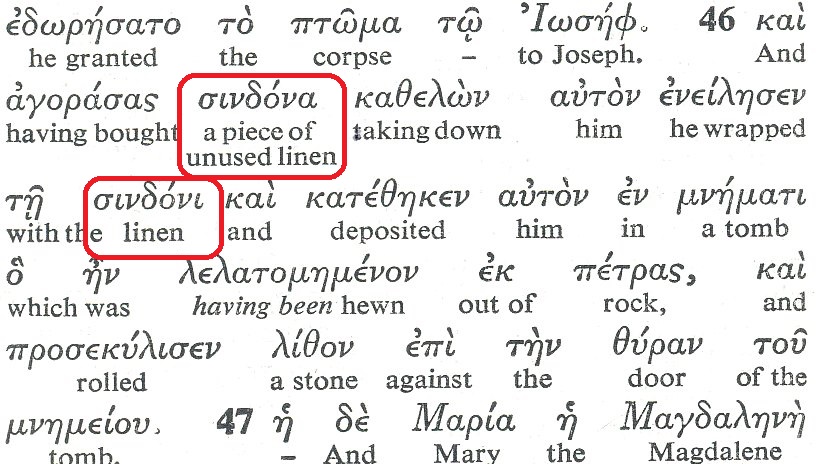
[Above: Mk 15:46 in my Interlinear New Testament[2]. This is one of the three places (the other two are Mt 27:59 and Lk 23:53) which mention that Jesus was buried in a linen shroud [Greek sindon]. The 1966 interlinear translation above of sindon as "a piece of unused linen" is technically correct, but modern translations like the ESV translate it, in that context, as "linen shroud".]

quotes series #2, based initially on my "Shroud of Turin quotes: Unclassified quotes." (no longer online) For more information about this Shroud of Turin quotes series, see the Main Index.

[Main Index] [Previous: Main Index #1] [Next: Jesus and the man on the Shroud #3]


  1. Bible and the Shroud #2
    1. Jesus and the man on the Shroud #3


Notes:
1. This post is copyright. Permission is granted to extract or quote from any quote, one at a time (but not the whole post), provided the extract or quote includes a reference citing my name, its subject heading, its date, and a hyperlink back to this post. [return]
2. Marshall, A., 1966, "The Interlinear Greek - English New Testament," Samuel Bagster & Sons: London, p.214. [return]

Posted 12 October 2015. Updated 5 April 2025.

Sunday, October 11, 2015

Main index #1: Shroud of Turin quotes

Shroud of Turin Quotes:
MAIN INDEX #1
© Stephen E. Jones
[1]

This is the Main Index to, and first page of, my Shroud of Turin quotes series. Each heading below is a topic page on which I will post quotes about the Shroud. Each new topic page will be a separate post, and thereafter I

[Right: Stevenson & Habermas' "Verdict on the Shroud" (1981), which in January 2005 was the first book on the Shroud that I had read.]

will add quotes to them in the background. To save time I will start with my "Shroud of Turin quotes: Unclassified quotes" and classify some (not all) of those quotes under topics and link those topic pages, via sub-index pages, back to this main index. The quotes on each topic page will be in date order (earlier first) and then alphabetic order of the author's surname. Quotes by anti-/non-authenticists will be marked with an asterisk (*). Because I will use HTML's ordered list facility, the order in this index (but not the pages it links to) will change as new topics are added.

[Next: Bible & the Shroud #2]


  1. Bible and the Shroud #2


Notes:
1. This post is copyright. Permission is granted to extract or quote from any part of it (but not the whole post), provided the extract or quote includes a reference citing my name, its subject heading, its date, and a hyperlink back to this post. [return]

Posted 11 October 2015. Updated 12 April 2025.

Wednesday, September 30, 2015

"Wasn't Jesus' body washed before putting it in the grave?"

Daryl

Continuing from part #2 of my response to your comment under my 2014 post, "Shroud of Turin depicts a Y-shaped cross?," here is part #3 of my response to your third and fourth points, "Wasn't Jesus' body washed before putting it in the grave?" and "So how is it that blood is present?" Again, your words are prefaced by ">" and in bold to distinguish them from mine.

[Right (enlarge): The Shroud, showing major bloodstains[1]. Note that the Shroud is not heavily bloodstained. This is compatible with the pro- authenticity positions of: 1) a full washing of Jesus' body and a later oozing of blood; 2) an incomplete washing due to shortness of time, leaving some blood on the Shroud; and 3) No washing due to shortness of time and Jewish law. The last is, as I understand it, the majority pro-authenticist position. It is also my position, for reasons I will give in a subsequent installment.]

>"Wasn't Jesus' body washed before putting it in the grave?" As mentioned above, there are three basic Shroud pro-authenticist positions on whether Jesus' body was washed:

1) A full washing of Jesus' body and a later oozing of blood This was the position of the late Frederick Zugibe (1928-2013), the Chief Medical Examiner of Rockland County, New York:

"The body unquestionably would have been covered with blood because the heart pumps about 4,500 gallons of blood through the more than 60,000 miles of large and small blood vessels throughout the whole body each day. Instead of the very exact imprints of the wounds, the Shroud would bear large indistinct masses of blood over the entire image, including the face, arms, hands, feet, and trunk."[2]

But then Zugibe has a problem. If Jesus' body was fully washed, how does he account for the fact that there is still blood on the Shroud? Zugibe's unconvincing and inconsistent answer is that after Jesus' body was washed, blood that was still in the wounds then oozed out onto the Shroud:

"However, if the body was washed, the dried blood around the wounds would be removed, causing an oozing of bloody material within the wounds. This should result in the production of relatively good impressions of the wound."[3]
But why would the burial party wash the dried blood from the wounds and not have also mopped up any blood that oozed from those wounds? And why would there still be blood that was not from within wounds, but had flowed a distance from them, like the reversed `3' blood trickle on the forehead from a thorn in the scalp (see photo below), and the blood trickles down the arm (see photo above), from the nails in the wrist?

Yet, despite these major (if not fatal) problems for his full-wash theory, Zugibe issued his medical opinion as an ultimatum - either he is right or the Shroud is a fake:

"Acceptance of the hypothesis that the crucified was not washed would therefore place the authenticity of the Turin Shroud in serious doubt."[4]
Zugibe based his entire argument on an assumption that the scourging of Jesus had produced "large indistinct masses of blood" (see above):
"The dumbbell-shaped markings on the Shroud may not be evidence of bruises or welts, as contended by some, but rather impressions of small breaks in the skin resulting in `patterned injuries' similar to those that we regularly see in the practice of forensic pathology" (my emphasis)[5]
But this assumption by Zugibe is a fallacious either/or, rather than a both/and. Clearly the dumbbell-shaped lead weights on the type of flagrum which matches the scourge marks on the Shroud[6] [left], brought down full-force on a victim's exposed skin would cause bleeding. Nevertheless, the self-evident

[Left (enlarge): A Roman flagrum excavated from Herculaneum, which was buried in the eruption of Mt Vesuvius in AD 79, with dumbbell-shaped lead weights which match the scourge marks on the Shroud[7].]

designed purpose of blunt lead balls would be "percussion":

"Of the many physicians and pathologists favouring the Shroud's authenticity, those who have studied the dumb-bell-shaped marks have unhesitatingly defined them as contusions, that is, severe swellings or bruises seemingly caused by the percussion of the whip tip with the body's surface." [8]
to induce internal bleeding[9], so that the victim suffered great pain, but did not lose consciousness and die prematurely before crucifixion from excessive blood loss. As Zugibe himself notes, there was a flagrum with pointed weights, called scorpiones which was rarely used[10], presumably because it killed crucifixion victims from blood loss too quickly.

Also, Mt 27:26-31 and Mk 15:17-20 record that after Jesus was scourged, the Roman soldiers "stripped him and put a scarlet robe on him" and then later "they stripped him of the robe and put his own clothes on him". These two changes of garments over Jesus' scourged body would have soaked up much of whatever blood there was on it from the scourging. And as Oxley pointed out, when Jesus clothes were removed, the blood on His body, which would have become stuck to His clothes, would have been torn away, "like a giant plaster strip":
"Following the scourging and his being dressed in a purple robe for the purpose of mockery, Jesus had had his clothes restored to him. He did not make the journey to Calvary naked. This, however, must have led to another source of extreme pain. On arrival at Calvary Jesus was stripped of his clothing. His cloak or tunic would have stuck to the blood covering his body. It must have been torn off his body prior to crucifixion, like a giant plaster strip attached to his whole body"[11]
which explains why there is not much blood on Jesus' trunk (see photo above).

This false assumption of Zugibe's that the scourging and crucifixion of Jesus resulted in the Shroud bearing "large indistinct masses of blood over the entire image" (see above), is fundamental to Zugibe's entire anti-Barbet position that Jesus died from hypovolemic (low blood volume) shock, not asphyxiation[12] (see my "Why I prefer Barbet's hypotheses over Zugibe's").

Further problems (amounting to falsifications) of Zugibe's full-wash theory include:

a) The man on the Shroud has dirt on his feet, face and knees:

"Perhaps the most tantalizing glimpse of all, however, came from reflectance spectroscopy work carried out by the husband-and-wife team Roger and Marty Gilbert in the course of the 1978 STURP examination. As they ran their equipment up and down the man of the Shroud's image the spectra they obtained proved relatively regular except when they reached the sole of the foot imprint on the back-of-the-body half of the cloth. Suddenly the spectra changed dramatically. Something in the foot area, and particularly around the heel, was giving a markedly stronger signal than elsewhere, but what? When optical physicist Sam Pellicori was summoned to view the area under the portable microscope ... [he] pronounced, `It's dirt!' As might have been expected in an individual who had had even his sandals taken away from him, the man of the Shroud had dirty feet."[13]
and also around his nose and knees[14]. It can't have been a full wash if it did not include the man's feet and face!

b) The reversed `3' bloodstain on man's forehead, is not over its source

[Above (enlarge): The reversed `3' or epsilon bloodstain on the Shroud man's forehead, as well as other blood trickles from the crown of thorns punctures in the man's scalp[15]. As can be seen, these bloodstains are not directly over their source wounds, so Zugibe's explanation that the blood on the Shroud oozed out from within the wounds after the body was completely washed doesn't work. And being on the man's face, they would surely have been washed if the man's body had been washed at all. So these bloodstains alone refute Zugibe's full wash theory!]

wound in the scalp (see above), and it would certainly have been among the first blood to be washed, if the man on the Shroud had been washed at all. Moreover, it was formed when the man was still alive because it follows the furrows of his forehead as its muscles contracted in pain:

"Quite unmistakable on the Shroud's frontal image are several `blood' trickles visible at the level of the forehead, together with others extending down the hair. Most pronounced of these, as visible on the negative, is a full-bodied rivulet that begins at the apex of the forehead, trickles downwards in a `3' shape (as if it has met a couple of diversions along the way), then terminates in a final glob just above the left eyebrow. As has been pointed out by several physicians ... not only is the way that this rivulet has flowed absolutely characteristic of venous blood, but the 3 shape is consistent with where the muscles of the brow would have contracted and formed ridges under intense pain ..."[16]
Also, tellingly, in his two books on the Shroud, Zugibe ignored the problem of the shortness of time, due to the impending sabbath, for the burial party to wash Jesus' body (as we shall see). However, in a 1989 article, which was after his first 1988 book but well before his second in 2005, Zugibe merely asserts, with no supporting evidence that, "A complete washing of the body ... can be accomplished in minutes":
"However, Wilson's statement that `Only on the view that Jesus was not washed can the authenticity of the Shroud of Turin be upheld'[17] basing it on the fact that there was not enough time to perform the washing since the Sabbath was at hand is completely untenable. A complete washing of the body accompanied by a shortened ritual can be accomplished in minutes."[18]
But leaving aside if that is even true, Zugibe by his qualification, "accompanied by a shortened ritual," defeats his own argument. To devout first-century Jews, let alone members of the Sanhedrin, as the burial party of Joseph of Arimathea (Mt 27:57; Mk 15:43; Lk 23:50; Jn 19:38) and Nicodemus (Jn 3:1; 19:39) were, burying Jesus, their Master, with the full "ritual" would have been all-important. So if there was no time for the full Jewish funerary ritual (which Zugibe tacitly conceded), Joseph and Nicodemus would not have washed Jesus body at all but postponed His funeral, including washing His body (if there was to be one - see future), until after the Sabbath, which as we shall see, is what the gospels indicate. So for all the above reasons, it is Zugibe's "complete washing" of Jesus' body theory which is "completely untenable"!

2) An incomplete washing due to shortness of time, leaving some blood on the Shroud This is a possible pro-authenticist position on the washing of Jesus' body, although I don't know of anyone who has held it. But as we saw above, since there was insufficient time for the full Jewish burial rites (see below), Joseph and Nicodemus would have postponed the washing of Jesus' body (if there was to be one - see future) until after the Sabbath. And, as we saw, the bloodstains and dirt on Jesus' face were not washed, which surely they would have been, even in an incomplete washing. So this second possible pro- authenticist position on the washing of Jesus' body is also refuted by the evidence.

3) No washing due to shortness of time and Jewish law This is, as I understand it, the majority position held by Shroud pro-authenticists. As Ian Wilson in 1979 stated:

"Some have argued that washing was a prescribed ritual that would have been permissible to carry out irrespective of the sabbath. Some eminent New Testament scholars do not share such a view. Even among the best exegetes there seems little major objection to the concept that there simply was no time for Jesus' body to be washed before the Sabbath, particularly in view of the various Jewish requirements relating to this rite. When, as events proved, it was also impossible to carry out this rite after the Sabbath, one can understand a certain reluctance on the part of gospel writers to admit this directly. Only on the view that Jesus was not washed can the authenticity of the Turin Shroud be upheld."[19]
While this may seem inconsistent with my above listing of three possible pro-authenticity positions, it isn't. As we also saw above, while the first two of the three pro-authenticist positions on the washing of Jesus' body: 1) no washing and 2) incomplete washing, are possible, they are nevertheless refuted by (amongst other things) the evidence of blood on the man on the Shroud's face, which cannot be explained by Zugibe's oozing out of washed wounds, and which surely would have been removed in even an incomplete washing of the man on the Shroud's body.

Further to the above evidence that the man on the Shroud's body was not washed, other evidence that Jesus' body was not washed includes:

■ The gospels do not state that Jesus' body was washed[20]. This contrasts with Acts 9:37, which states of a disciple named Tabitha that, "... she fell sick and died; and when they had washed her, they laid her in an upper room"[21]. Since it is recorded of a minor disciple that her body was washed; washing a body was one of the most basic funerary services[22]; any of the four gospels could have mentioned that Jesus' body had been washed[23], the likely inference from this silence is that Jesus' body was not washed[24].

■ The full Jewish burial rites, prescribed in the Mishnah, the code of Jewish law, included that a body had to be washed seven times and the hair and beard completely shaven[25]. The fingernails were to be cut, the body anointed it with oils[26] and dressed in the person's clothes[27]. Cloths were then to be bound around the chin, wrists and feet, a clean cloth was to be placed over the head, the body was to be wrapped in a linen shroud and spices packed around it to mask the odour of decay[28]. However, Jewish law made an exception for a Jew who had died a bloody death[29], as Jesus had[30]. In such cases, so that the whole body, including its blood, should be kept together for its resurrection[31], the body should not be washed[32], but it and any of its bloodstained clothes should be wrapped together in an all-enveloping linen sheet, called a sovev[33], deriving from a Hebrew word "to surround" or "to go around"[34]. This corresponds perfectly to the all-enveloping, over-the-head, Turin Shroud[35].

■ There was insufficient time to carry out the full Jewish funeral rites on the body of Jesus. The gospels record that Jesus died on the cross at "about the ninth hour" (Mt 27:46-50; Mk 15:34-37; Lk 23:44-46), that is about 9 hours after sunrise[36] or about 3 pm[37]. The Gospels also record the following events occurred between Jesus' death and His burial:

• The soudarion or facecloth which had been on Jesus' head (Jn 20:7), that is, the Sudarium of Oviedo, was placed over Jesus' dead face while He was still on the cross (see video "Mark Guscin - Sudarium of Oviedo").
• The Jewish religious leaders asked the Roman Governor of Judea, Pontius Pilate, to break the legs of Jesus and the two robbers who were crucified with him (Mt 27:38; Mk 15:27) be broken so that they would die quickly and their bodies be taken away, because it was both the Sabbath and also the Passover; so soldiers came from Pilate and broke the legs of the two robbers, but since Jesus was already dead, they did not break His legs but instead speared him in the side to make sure He was dead (Jn 19:31-34).
• When it was evening, Joseph of Arimathea, a rich man, a member of the Jewish council (the Sanhedrin) and a secret disciple of Jesus, went to Pilate and asked for Jesus' body (Mt 27:57-58; Mk 15:42-43; Lk 23:50-52; Jn 19:38).
• Pilate was surprised to hear from Joseph that Jesus was already dead, so he summoned the centurion, and when he came, asked him whether Jesus was dead (Mk 15:44).
• Pilate granted Jesus' body to Joseph (Mt 27:58; Mk 15:45; Jn 19:38).
• Joseph bought a linen shroud [sindon] (Mk 15:46).
• Joseph and Nicodemus took down Jesus body from the cross (Mt 27:59; Mk 15:46; Lk 23:53; Jn 19:38).
• They bound Jesus hands, feet and jaw with linen cloths to prevent them moving (Jn 20:6-7; 11:43-44).
• They then wrapped Jesus' body in the shroud (Mt 27:59; Mk 15:46; Lk 23:53; Jn 19:38).
• They then transported Jesus' body wrapped in the shroud to Joseph' nearby, never used, rock-cut tomb (Mt 27:59-60; Mk 15:46; Lk 23:53; Jn 19:40-42).
• They laid Jesus enshrouded body in the tomb (Mt 27:60; Mk 15:46; Lk 23:53; Jn 19:42).
• Nicodemus had brought 100 litras (~32.75 kgs or ~72.2 lb)[38] weight of myrrh and aloes (Jn 19:39). This very large quantity of spices is itself evidence that Jesus' body was not going to be washed before the sabbath (if at all), but was to prevent decomposition until Jesus' body could be anointed after the sabbath (see later below):

"There is one other suggestion that Jesus' body was not washed. This is John's statement that Jesus' body was wrapped in a large quantity of spices before burial (19:39-40). Since the women were returning to the tomb on Sunday in order to anoint the body with spices, what was the difference between the first anointing and the second? The most likely explanation is that the large quantity of spices had been packed around Jesus' body before the burial precisely because the body had not been washed. This large quantity of spices, possibly in dry form, could have been intended to serve as a disinfectant to arrest decomposition until the women could properly anoint the body after the Sabbath"[39]
• They then bound Jesus' enshrouded body in linen cloths [othoniois] i.e. not only, or even, in the shroud] with [meta "while making use of"[40]] the spices according to burial customs of the Jews (Jn 19:40).
• Joseph (and Nicodemus - Jn 19:42; 20:1) rolled a very large stone across the tomb's entrance (Mt 27:60; 28:2; Mk 15:46; 16:3-4; Lk 24:2; Jn 20:1).
• It being the Day of Preparation, the sabbath was beginning [epephosken]." (Lk 23:54; Jn 19:42). The Greek word epephosken (epi "upon" + phosko "to shine"[41]), appears to be only in Lk 23:54 in all of Greek literature[42], and may be "Jewish-Greek"[43]. It literally means "begin to dawn or give light" [44] and would presumably have been translated "was dawning" (Lk 23:54 ESV footnote) but it was evening[45]. The late Bishop John Robinson (1919–83), a New Testament Greek scholar and a founder of the British Society for the Turin Shroud, suggested epephosken may mean "lighting-up time"[46], when the lamps were lit to mark the start of the sabbath[47].

Whatever, the exact meaning of epephosken, it at least means that when Jesus' enshrouded body was placed in the tomb, the sabbath was beginning, when all work had to cease[48], including preparing a body for burial[49], so even if Jesus' body was to be washed (which having died a bloody death it wasn't - see above), there would have been insufficient time for Joseph of Arimathea and Nicodemus to do it:

"Several very convincing arguments refute assertions that Jesus' body was washed. In the first place, the burial that Jesus received was hurried and incomplete. It was the Day of Preparation and the Sabbath was approaching, and all work had to cease before sundown. Not only was this the Sabbath, but this particular Sabbath was also the Passover, one of the holiest of all Jewish occasions. It was already evening when Joseph of Arimathea went to Pilate to ask for the body of Jesus (Mt 27:57-58, Mk 15:42-43). This would have been at least a ten-minute journey (and possibly longer because of the crowds gathered for the Passover). There most likely would have been some additional delay in gaining an audience with Pilate, and even further delay as Pilate awaited confirmation of Jesus' death from the centurion (Mk 15:44-45). Since the release of the body would have involved a legal act of some importance, more than likely a document of release would have been prepared as well, especially since the Jews had sought permission a short time before to have the bodies of the crucified taken away (Jn 19:31). Joseph of Arimathea then had to proceed back to Golgotha, purchase a linen shroud along the way, take the body down from the cross, and transport it to the tomb. In describing Jesus' burial, Luke uses the graphic word epephosken (23:54), meaning that it was already `lighting-up time,' when lamps were lit or when the first stars became visible. Jewish law prohibited a crucifixion victim from remaining on the cross at night. The Gospel accounts clearly imply that Jesus' burial was hurried and provisional and that the Sabbath was fast approaching. Perhaps the Sabbath had already arrived by the time Jesus' body was laid in the tomb."[50]

■ Additional evidence that Jesus' body was not washed includes:

• After the sabbath, early on the first day of the week, some of Jesus' women disciples returned to the tomb with spices to anoint His body (Mt 28:1; Mk 16:1-2; Lk 24:1; Jn 20:1). They would not have done this if Jesus' burial had been completed before the sabbath:

"However, the gospels tell us that Jesus' burial was incomplete. Because the Sabbath was about to begin, he was removed from the cross and laid in the tomb rather hurriedly. This is why the women returned to the tomb on Sunday morning. They had prepared spices and ointments for Jesus' body, and they went to the tomb to apply them (Lk 23:54-56). ... At least to some degree, the anointing with spices was incomplete because the women returned to the tomb to complete the process."[51]
• Jesus predicted that His burial would never be completed when a few days before His death he stated that Mary of Bethany, in pouring an expensive ointment over His head and feet, had "anointed my body ... for burial":
"As a matter of fact none of the Gospels say anything about washing or anointing the body of Jesus. On the contrary, Mark and Matthew report the words spoken by Jesus a few days before the Passion on the occasion of the anointing by Mary of Bethany [Jn 12:3-7]. According to this, Mary had anticipated the anointing of His body for burial. `She has done me a good turn ... She has anointed my body in preparation for burial' (Mk 14:8; Mt. 26:12)."[52]

>"So how is it that blood is present?" Jesus' body was not washed. See above.

To be continued at a later date with part #4, "He was wrapped in more than one cloths."

Notes
1. Extract from Latendresse, M., 2010, "Shroud Scope: Durante 2002: Horizontal: Major bloodstains overlay.," Sindonology.org. [return]
2. Zugibe, F.T., 2005, "The Crucifixion of Jesus: A Forensic Inquiry," M. Evans & Co.: New York NY, p.219. [return]
3. Zugibe, 2005, p.221. [return]
4. Zugibe, F.T., 1988, "The Cross and the Shroud: A Medical Enquiry into the Crucifixion," [1982], Paragon House: New York NY, Revised edition.134; Zugibe, 2005, p.219 [return]
5. Zugibe, 2005, p.24. [return]
6. Wilson, I., 1986, "The Evidence of the Shroud," Guild Publishing: London, p.31. [return]
7. Wilson, I. & Schwortz, B., 2000, "The Turin Shroud: The Illustrated Evidence," Michael O'Mara Books: London, p.56. [return]
8. Wilson, I., 1998, "The Blood and the Shroud: New Evidence that the World's Most Sacred Relic is Real," Simon & Schuster: New York NY, p.32. [return]
9. Wilson, 1986, p.20. [return]
10. Zugibe, 2005, p.19. [return]
11. Oxley, M., 2010, "The Challenge of the Shroud: History, Science and the Shroud of Turin," AuthorHouse: Milton Keynes UK, p.165. [return]
12. Zugibe, 2005, p.135. [return]
13. Wilson & Schwortz, 2000, p.93. [return]
14. Antonacci, M., 2000, "Resurrection of the Shroud: New Scientific, Medical, and Archeological Evidence," M. Evans & Co: New York NY, p.32. [return]
15. Extract from Latendresse, M., 2010, "Shroud Scope: Face Only Vertical.," Sindonology.org. [return]
16. Wilson, 1998, p.33. [return]
17. Wilson, I., 1979, "The Shroud of Turin: The Burial Cloth of Jesus?," [1978], Image Books: New York NY, Revised edition, p.56. [return]
18. Zugibe, F.T., 1989, "The Man Of The Shroud Was Washed," Sindon N.S., Quad. No. 1, June. [return]
19. Wilson, 1979, p.56. [return]
20. Wilson, 1979, p.55; Stevenson, K.E. & Habermas, G.R., 1981, "Verdict on the Shroud: Evidence for the Death and Resurrection of Jesus Christ," Servant Books: Ann Arbor MI, p.51. [return]
21. Antonacci, 2000, p.32. [return]
22. Guerrera, V., 2001, "The Shroud of Turin: A Case for Authenticity," TAN: Rockford IL, p.33. [return]
23. Antonacci, 2000, p.117. [return]
24. Stevenson & Habermas, 1981, p.52. [return]
25. Ruffin, C.B., 1999, "The Shroud of Turin: The Most Up-To-Date Analysis of All the Facts Regarding the Church's Controversial Relic," Our Sunday Visitor: Huntington IN, p.45. [return]
26. Whiting, B., 2006, "The Shroud Story," Harbour Publishing: Strathfield NSW, Australia, p.24. [return]
27. Ricci, G., 1981, "The Holy Shroud," Center for the Study of the Passion of Christ and the Holy Shroud: Milwaukee WI, p.10; Wilson, I., 2010, "The Shroud: The 2000-Year-Old Mystery Solved," Bantam Press: London, p.52. [return]
28. Whiting, 2006, p.24. [return]
29. Wilson, 1986, p.45. [return]
30. Wilson, 2010, p.52. [return]
31. Wilson, 1986, p.46. [return]
32. Wilson & Schwortz, 2000, 44-45. [return]
33. Wilson, 1986, pp.45-46; Wilson, 1998, pp.54-55. [return]
34. Wilson, 1998, p.55. [return]
35. Ibid; Wilson, 2010, p.52. [return]
36. Finegan, J., 1964, "Handbook of Biblical Chronology: Principles of Time Reckoning in the Ancient World and Problems of Chronology in the Bible," Princeton University Press: Princeton NJ, p.12. [return]
37. Carson, D.A., "Matthew," in Gaebelein, F.E., ed., 1984, "The Expositor's Bible Commentary: Volume 8 - Matthew, Mark, Luke," Zondervan: Grand Rapids MI, p.577. [return]
38. "The litra of Jn 12:3; 19:39 (cf. Lat. libra: `pound' - from this weight we have our abbreviation lb for pound) was a Rom. measure of weight equivalent to 327.45 gm." (Wiseman, D.J., "Weights and Measures," in Douglas J.D., et al., eds., 1982, "New Bible Dictionary," [1962], Inter-Varsity Press, Leicester UK, Second edition, Reprinted, 1988, p.1249). Therefore 100 x 327.45 = 32745 gm = 32.75 kgs or 72.2 lb. [return]
39. Stevenson & Habermas, 1981, p.52. [return]
40. Bulst, W., 1957, "The Shroud of Turin," McKenna, S. & Galvin, J.J., transl., Bruce Publishing Co: Milwaukee WI, p.94. [return]
41. Zodhiates, S., 1992, "The Complete Word Study Dictionary: New Testament," AMG Publishers: Chattanooga TN, Third printing, 1994, pp.644-645. [return]
42. Arndt, W.F. & Gingrich, F.W., 1957, "A Greek-English Lexicon of the New Testament and Other Early Christian literature," University of Chicago Press: Chicago IL, Fourth edition, 1952, Revised, p.304. [return]
43. Moulton, J.H. & Milligan, G., 1930, "The Vocabulary of the Greek Testament: Illustrated from the Papyri and other Non-literary Sources," Hendrickson Publishers: Peabody MA, Reprinted, 1997, p.250. [return]
44. Robertson, A.T., 1930, "Word Pictures in the New Testament: Volume II: The Gospel According to Luke," Broadman Press, Nashville TN, p.289. [return]
45. Ibid. [return]
46. Robinson, J.A.T., "The Shroud of Turin and the Grave-Clothes of the Gospels," in Stevenson, K.E., ed., 1977, "Proceedings of the 1977 United States Conference of Research on The Shroud of Turin," Holy Shroud Guild: Bronx NY, p.24. [return]
47. Feuillet, A., 1982, "The Identification and the Disposition of the Funerary Linens of Jesus' Burial According to the Fourth Gospel," Shroud Spectrum International, No. 4, September, pp.13-23, p.23. [return]
48. Wilson, 1979, p.56; Wilson, 1986, p.55. [return]
49. Stevenson & Habermas, 1981, p.51. [return]
50. Antonacci, 2000, p.117. [return]
51. Stevenson & Habermas, 1981, pp.46-47. [return]
52. Bulst, 1957, p.81. [return]

Posted 30 September 2015. Updated 22 January 2026.