Friday, December 4, 2015

News articles #3: Uncovering the sources of DNA found on the Turin Shroud

This is part #3 of my comments on further news articles about the paper, Barcaccia, G., et al., 2015, "Uncovering the sources of DNA found on the Turin Shroud," Nature, Scientific Reports 5, 5 October. These will be in date order, with the article's words in bold. For previous posts in this series, see part #1 and part #2. Other previous posts on this topic were on: 06Oct15, 18Oct15, 25Oct15 and 10Nov15.


"Mystery of the Shroud of Turin deepens: Genetic study reveals the fabric contains DNA from plants found all over the world," Daily Mail, Ellie Zolfagharifard, 20 October 2015 ... A new DNA study has
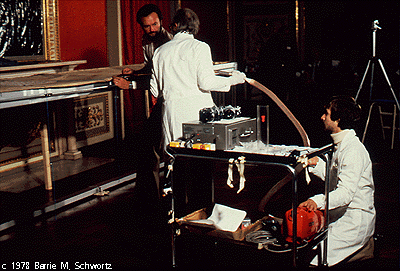
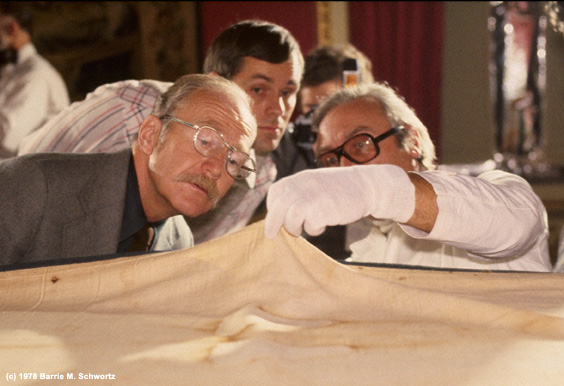
[Above (enlarge): "Professor Giovanni Riggi, (back to camera), leader of the Italian scientific team [in conjunction with STURP's 1978 examination of the Shroud], inserts a special vacuum nozzle between the Shroud and the Holland Cloth in an attempt to gather dust, pollen and other particulate matter from the cloth's fibers"[1].]

added to the mystery Again, they have not "added to the mystery." They have reduced what mystery there may have been, by adding to the already overwhelming evidence that the Shroud is authentic. It is only a "mystery" to those who don't want the Shroud to be authentic because they would then have to answer for themselves Pontius Pilate's question:

"Then what shall I do with Jesus who is called Christ?" (Mt 27:22).
surrounding the Shroud of Turin - the supposed burial cloth of Jesus. Again it is not "supposed." The evidence is overwhelming that the Shroud of Turin is authentic, the very burial sheet of Jesus, bearing the imprint of His crucified and resurrected body!

By sequencing genes from pollen and dust particles on the shroud, Again, this pollen and dust was not merely "on the Shroud." It was in the interspace between the underside of the Shroud and its Holland cloth backing, which was sewn on in 1534, following the 1532 fire. Which means that this interspace was effectively a sealed time capsule until 1978, so the DNA in that interspace cannot have entered it between 1534 and 1978. Which then means that if the 1988 radiocarbon dating of the Shroud as "mediaeval ... AD 1260-1390" was correct, then there would only be a maximum of 1534 - 1260 = 274 years for that "DNA from plants [and humans] found all over the world" to be deposited on the underside of the Shroud, when it was located entirely in France and briefly in Belgium (24Nov15 & 30Nov15). In fact, since the Shroud first appeared in undisputed history at Lirey, France, in 1355, that leaves only 1534 - 1355 = 179 years for this DNA from "all over the world" to be deposited on the underside of the Shroud (10Nov15 & 30Nov15). This is further evidence that the 1260-1390 radiocarbon dating of the Shroud was wrong and indeed the result of a computer hacking (10Nov15 & 24Nov15)!

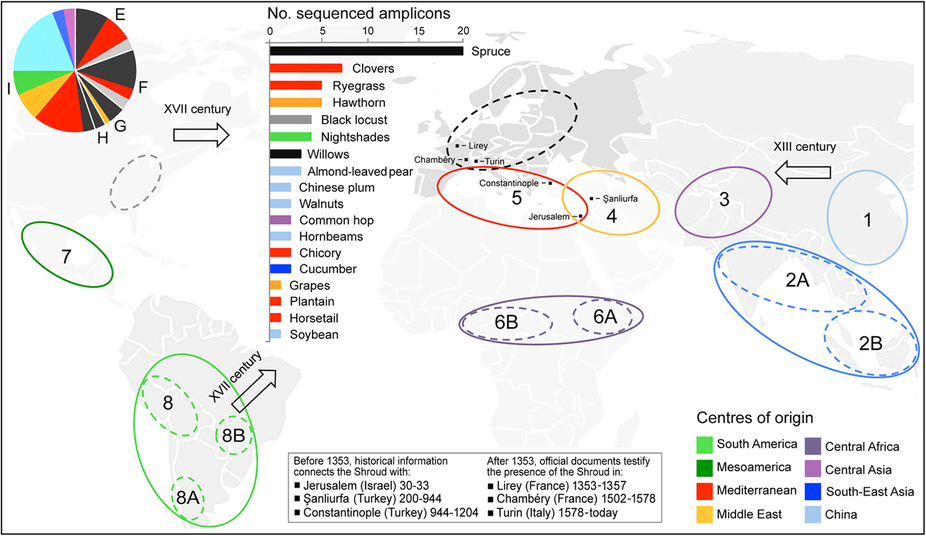
researchers have been able to map the type [of] plants and people that came into contact with the linen. Again (see 10Nov15 & 24Nov15), as can be seen below in this extract from that

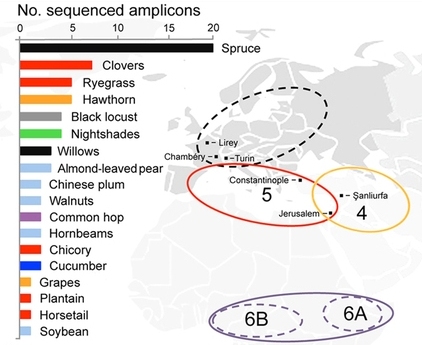
[Above: Extract from "Figure 1: Plant DNA species found on the Turin Shroud"[2].]

map of plant types, DNA from plant groups (red) are found around Jerusalem and Constantinople but not Turin, Chambéry or Lirey. Moreover, the red group includes the second and third most abundant species. The DNA of the yellow group includes Constantinople, Sanliurfa (formerly Edessa) and Jerusalem, but does not include Europe. In particular, the "Plantain" (Plantago lanceolata), is "a native of Palestine"[3].

And as for the DNA of "people that came into contact with the linen", again (see 10Nov15 & 24Nov15), as can be seen below in these extracts from that map, there was wide diversity of human mtDNA in the

[Above: Extracts from "Figure 2: Human mtDNA haplogroups found on the Turin Shroud"[4].]

interspace between the underside of the Shroud and its Holland cloth backing, which (again) was sewn on in 1534, in Chambéry, France and only partially opened in 1978 and 1988 inside Turin Cathedral.

Their research suggests the shroud was made in India, See previous (10Nov15 & 30Nov15) that:

"The highest frequency mtDNA haplogroups [in the above human DNA map] are M56, R8 and U2, as well as the medium frequency M39, the centre of origin of which includes India. The high frequency of these latter four mtDNA haplogroups suggests that the flax and/or the linen was manufactured in India, and indeed Barcaccia, et al. point out that the word "Sindon" derives from "Sindia or Sindien, a fabric coming from India. It is no problem for the authenticity of the Shroud if its flax or linen came from India, but there would be a problem for the anti-authenticity alternative because there is no record, and it would seem highly unlikely (to put it mildly) that Indians in any great numbers (indeed any at all) had access to the Shroud in the period 1260-1534, when the Shroud was in France."
According to Thayer's Greek lexicon, "sindon ... [a] linen cloth, esp. that which was fine and costly" may derive from the Sanskrit "sindhu"[5], which is a region west of the Indus River, in what today is Pakistan. The Indus River Valley was an early centre of flax growing[6].

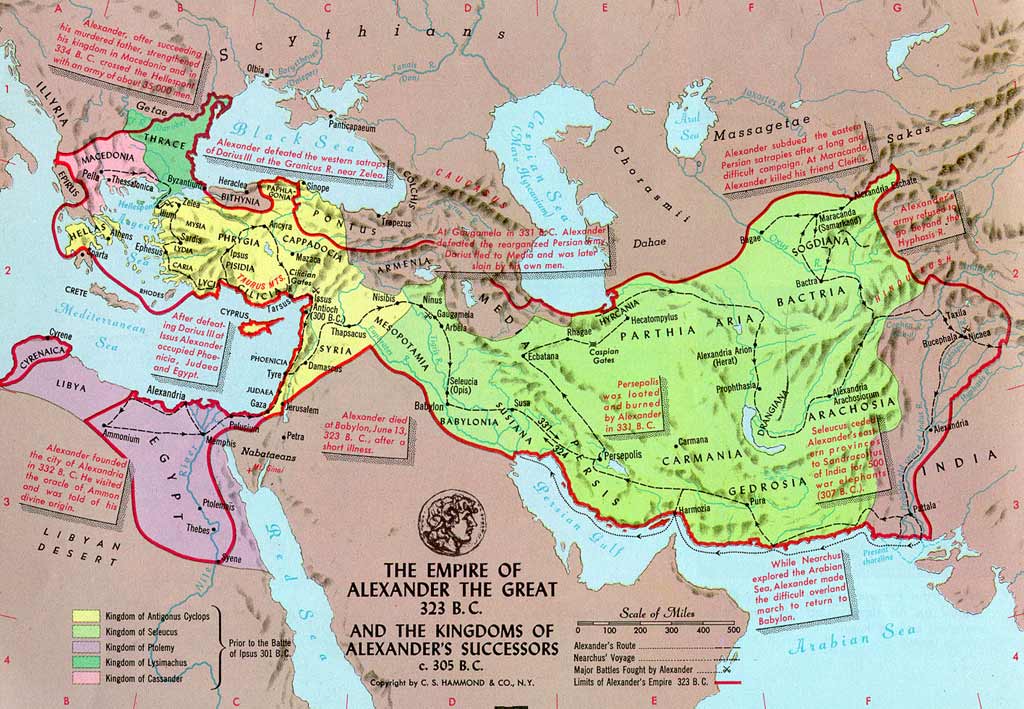
It may be that "the Shroud went, with the Apostle Thomas, to India in its early centuries." (24Nov15 & 30Nov15). Supporting this, the Apostle Thomas' remains were brought from India and buried in Edessa[7]! There were Jews in India (Esther 1:1; 8:9) during the reign of the Persian King Ahasuerus = Xerxes I (r. 486 BC - 465 BC). Significantly, the Hebrew word translated "India" in those versus is hoddu, which means the region of the lower Indus River[8]. That region was taken from the Persians by Alexander the Great in 326 BC. This opened

[Above (original): Extract of a map of Alexander the Great's Empire, showing it encompassed the region west of the Indus River, Jerusalem and Edessa[9]. It also corresponds to the above map of the highest frequency human mtDNA haplogroups M56, R8 and U2, as well as the medium frequency M39.]

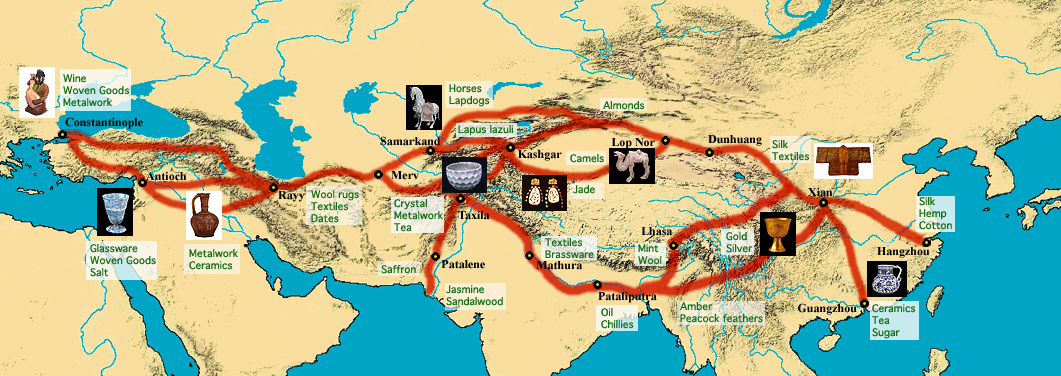
up trade between East and West, and added the region west of the Indus to the Silk Road network of trade routes[10]. With the result

[Above (original): Extract from "Maps & Atlas - Silk Road Trade Routes Map"[11], showing the lower Indus Valley, from where the word "sindon" came from (see above), as part of the ancient silk road network, which connected Antioch (and so indirectly Jerusalem) with Constantinople."]

that, by Jesus' time, "The Mediterranean world ... had become like one big marketplace, attracting trade goods from distant lands as far as India and China" and "The Jews had become very familiar with [such] trade ..." (24Nov15):

"During the first century A.D. the East and West were making a solid connection, especially with the Jews. By the time of Jesus the Jews were living in a commercial Greek world, due to the achievements of Alexander the Great. The Romans built even more and established additional trade in all of its provinces, linking the major centers of population and uniting the provinces. The Mediterranean world had become a Greco-Roman world and it had become like one big marketplace, attracting trade goods from distant lands as far as India and China. The Roman army and navy protected the boundaries of the Empire from barbarians and pirates. The Jews had become very familiar with trade and the art of international commerce. They became very wealthy and it was all controlled by a select few. Most of the common Israelites bought and sold in the local marketplace without ever realizing how all the goods from around the world had arrived there. How many of the goods had arrived there on the backs of camels and donkeys, passing through countless cities and villages upon roads and footpaths that were all but washed away by the heavy rains."[12]

And again (24Nov15), if the Shroud was an expensive import from India, that would only add to the evidence that the Shroud was authentic, because Joseph of Arimathea, who bought Jesus' shroud (Mk 15:46) was "a rich man" (Mt 27:57). But for the same reason this would be an added problem for the medieval forgery theory, because (see 16Jul15):

"That the Shroud's weave is expensive and rare is another ... problem for the forgery theory. The primary motive of art and archaeological (including relic) forgery is financial gain ... According to Oxford radiocarbon dating laboratory's Professor Edward Hall (1924-2001), that was the motive of the claimed forger of the Shroud, `There was a multi-million-pound business in making forgeries during the 14th century' so `Someone just got a bit of linen, faked it up and flogged it'[13] ... And in a sense Hall was right! If the Shroud were a medieval forgery, then the forger, to maximise his profit, would have "just got a bit of linen." That is, he would have used the least expensive `bit of linen' he could find that would still deceive his prospective buyers ... he would not have bought it [the ~4.4 x 1.1 metre fine linen sheet that the Shroud is] for the very high price it would have been, as that would have severely reduced the profit margin on his planned forgery of the Shroud image upon it. This is yet another of the many problems of the forgery theory ..."

and travelled the world extensively, moving from Jerusalem to Turkey to France before ending up in its in Turin, Italy. Again (see 25Oct15, 10Nov15, 24Nov15 & 30Nov15) the Shroud having had a ~15 centuries history from AD 30 up to 1534 in a wide variety of locations, including Jerusalem, Edessa, Constantinople, Athens and France, is consistent with this plant and human DNA evidence from the interspace between the underside of the Shroud and its Holland cloth backing which was sewn on in 1534. And (see 10Nov15 & 24Nov15) according to the lead author of study, University of Padua plant geneticist, Prof. Gianni Barcaccia, "the importance of the DNA analysis lies in the great diversity of the species identified, which is atypical" and is "an indication that the Shroud was displayed in very different areas":

"In agreement with Professor Barcaccia, the importance of the DNA analysis lies in the great diversity of the species identified, which is atypical if compared with similar studies that always present a much reduced number of species. They can be related to Asian, African, and European areas. This is an indication that the Shroud was displayed in very different areas ranging from cultivated plains to mountainous areas, from arid to more myths [sic moist?] environments."[14]
Another suggestion is that the shroud was created in medieval Europe, but people from all over the world came to see it, contaminating it with their DNA. Again (see 10Nov15, 24Nov15 & 30Nov15) while this may be genetically possible, it is historically and realistically highly implausible:

The first implausibility is that if the Shroud had been "created in medieval Europe" (based on the 1988 radiocarbon dating of the Shroud as "mediaeval ... AD 1260-1390") then, leaving aside that the cloth's dimensions are 8 x 2 standard Assyrian cubits (04Feb15 & 10Jul15) and its stitching and selvedge are identical to that found only at the 1st century Jewish fortress of Masada (22Jan15 & 24Aug15), and indeed the plant DNA evidence above from "Constantinople ... Edessa ... and Jerusalem), then as we saw above, there would only be a maximum of only 274 years for these "people from all over the world" to come to see the Shroud. But since the first exposition of the Shroud in undisputed history was in c. 1355 at Lirey, France, that leaves only 179 years for these "people from all over the world" to come to France or Belgium to see the Shroud.

The second implausibility is that these "people from all over the world" could have contaminated the Shroud with their DNA. But as we saw (24Nov15 & 30Nov15), in all known public expositions of the Shroud, it has been held by clerics on a raised platform or balcony, high above the general public, so they could have had no personal contact with it, as they would have to have had to leave their DNA on it.

The third implausibility (see 10Nov15 & 24Nov15) is that if those attending Shroud expositions had been able to contaminate the Shroud with their DNA, then the European-only haplogroups H1, H3, H4 and U2 would have the highest frequency, not among the lowest, since the vast majority of those attending Shroud expositions between 1355 and 1534, when the Shroud was only in France and Belgium (as well as the Shroud's owners and ecclesiastical custodians), were Europeans.

By contrast, the pro-authenticist scenario is consistent with the plant and human DNA evidence and does not have the above implausibility problems, because "in the ... faraway past," (i.e. the first through fourth centuries) "people" in small Christian congregations, could "have touched, kissed, or come in contact with the Shroud":

"In conclusion, in agreement with Professor Barcaccia, the haplotypes found in the traces of DNA have a reference to the haplogroups of ethnic groups belonging to Europe, North Africa, and the Middle East, that is to say, of people living in areas facing the Mediterranean basin. More accurate analyses in the process of development could, in the near future, be more precise and give us specific data concerning those people who in the past - even in a faraway past - have touched, kissed, or come in contact with the Shroud of Turin."[15]
So again (see above) this plant and human DNA on the Shroud is is yet another item in the already overwhelming evidence that the Turin Shroud is authentic, and further evidence that the 1260-1390 radiocarbon dating of the Shroud was wrong and indeed the result of a computer hacking!

I therefore see no point in continuing this series. As T.H. Huxley observed:

"Life is too short to occupy oneself with the slaying of the slain more than once."[16]!

Notes
1. "The 1978 Scientific Examination," Shroud.com, nd. [return]
2. Barcaccia, G., et al., 2015, "Uncovering the sources of DNA found on the Turin Shroud," Nature, Scientific Reports 5, 5 October. [return]
3. Fanti, G. & Malfi, P., 2015, "The Shroud of Turin: First Century after Christ!," Pan Stanford: Singapore, pp.298-299. [return]
4. Barcaccia, et al., 2015. [return]
5. Thayer, J.H., 1901, "A Greek-English Lexicon of the New Testament: Being Grimm's Wilke's Clovis Novi Testamenti Translated Revised and Enlarged," T & T. Clark: Edinburgh, Fourth edition, Reprinted, 1961, p.576. [return]
6. Tortora, P.G., 2015, "Dress, Fashion and Technology: From Prehistory to the Present," Bloomsbury Academic: London, p.32. [return]
7. Wilson, I., 1979, "The Shroud of Turin: The Burial Cloth of Jesus?," [1978], Image Books: New York NY, Revised edition, p.138; Wilson, I., 2010, "The Shroud: The 2000-Year-Old Mystery Solved," Bantam Press: London, pp.124, 131. [return]
8. Kitchen, K.A., "India," in Douglas, J.D., et al., eds., "New Bible Dictionary," [1962], Inter-Varsity Press, Leicester UK, Second edition, 1982, Reprinted, 1988, p.513; Gehman, H.S. & Davis, J.D., 1924, "The Westminster Dictionary of the Bible," [1898], Collins: London, Revised, 1944, p.265. [return]
9. Pillai, N.G., 2015, "Skanda: The Alexander Romance in India," 18 November. [return]
10. Marx, I., 2000, "Empire of Alexander the Great - Expansion into Asia and Central Asia," 8 September. [return]
11. "Maps & Atlas - Silk Road Trade Routes Map," Silkroutes.net, 24 October 2015. [return]
12. "Roads in Ancient Israel," Bible History Online, nd. [return]
13. "Obituaries: Professor Edward Hall," The Independent:, 16 August 2001. [return]
14. Fanti & Malfi, 2015, p.299. [return]
15. Fanti & Malfi, 2015, p.301. [return]
16. Huxley, T.H., 1861, The Athenaeum, 13 April, in Browne, E.J., 2002, "Charles Darwin: The Power of Place: Volume II of a Biography," Pimlico: London, Reprinted, 2003, p.159. [return]

Posted 4 December 2015. Updated 16 April 2025

Monday, November 30, 2015

News articles #2: Uncovering the sources of DNA found on the Turin Shroud

Continuing from part #1, this is part #2 of my comments on further news articles about the paper, Barcaccia, G., et al., 2015, "Uncovering the sources of DNA found on the Turin Shroud," Nature, Scientific Reports 5, 5 October. These will be in date order, with the article's words in bold.


"Turin Shroud: DNA and pollen from all over the world found on cloth, new study finds," The Independent, Kashmira Gander, 14 October 2015

[Above (enlarge): STURP's Ray Rogers (L) and John Jackson (C), and Turin's Giovanni Riggi (R) in October 1978, having partially unstitched the Shroud's Holland cloth backing which had been sewn on in April 1534, are the first to look at the underside of the Shroud in 444 years.[1]]

... Scientists have added to the complex and controversial tales of origin surrounding the Turin Shroud, by revealing the myriad locations of the DNA and pollen that are present on the cloth. As per my previous posts (18Oct15, 10Nov15 and 24Nov15), that the plant and human DNA in the interspace between the underside of the Shroud and its Holland cloth backing, which was sewn on in 1534, has "myriad locations" is inconsistent with the 1988 radiocarbon dating claim that, "the linen of the Shroud of Turin is mediaeval ... AD 1260-1390"[2]. Because that would leave less than 3 centuries between the claimed earliest possible radiocarbon date of 1260 and 1534, when the Shroud was then entirely in France and Belgium. In fact, less than 2 centuries between the Shroud's first public exposition in undisputed history at Lirey, France, in 1355[3] and 1534. But again, it is consistent with the Shroud having had a ~15 centuries history up to 1534, in widely different locations including "Jerusalem... Edessa ... Constantinople ... Athens ... [and] France":

"... the journey of TS [the Turin Shroud] began in Jerusalem in the year 30 or 33 AD. After concealment for years, TS would have been first moved to Edessa (now Şanliurfa in Turkey) and then to Constantinople (now Istanbul in Turkey) in 944 AD. A burial cloth, which some historians consider the Shroud, was owned by the Byzantine emperors but disappeared during the Sack of Constantinople in 12044. After this event, TS would have been taken by the crusaders and transferred to Athens (Greece), where it remained until 1225. Official documents attest that it was in France at Lirey around the years 1353 to 1357 and then was kept at Chambéry from 1502 to 1578, where passed into the hands of the Dukes of Savoy. From 1578, apart from some brief displacements in an effort to hide it during war periods, TS was kept in Turin (Italy) and later placed in the royal chapel of the city Cathedral inside a specially designed shrine where it has been permanently conserved from 1694 to the present."[4]
... The length of linen is highly contentious. Some Christians believe the fabric – which is kept in the Cathedral of Saint John the Baptist in Turin - is the burial shroud of Jesus of Nazareth, dating back over 2,000 years. Again a secular, naturalistic, false dichotomy: "Some Christians" versus "scientific studies." But as previously pointed out, so strong is the evidence for the Shroud's authenticity that non-Christians like agnostic zoologist Prof. Yves Delage (1854-1920), agnostic art historian Thomas de Wesselow and Jewish Barrie Schwortz have become pro-authenticists. However, previous scientific studies have suggested that the cloth, which appears to be imprinted with the image of a man, may in fact be from the 13th or 14th century - centuries after Jesus is believed to have died. The evidence is very strong that this 1988 radiocarbon dating of the Shroud as "mediaeval ... AD 1260-1390" (see above).

Now, a new study by Italian researchers published in the prestigious science journal Nature gives a further insight into the potential origins of the cloth. To make their findings for the paper entitled 'Uncovering the sources of DNA found on the Turin Shroud', the team behind the study sequenced the DNA of pollen and other dust from the cloth. This is doubly misleading (either deliberate or through journalistic ignorance). First, it was not just "DNA of pollen and other dust" but both plant and human DNA. Second, the dust did not merely come "from the cloth" but it came "from the interspace between the Shroud and the Holland Cloth sewn to it as reinforcement":

"In 1978 and 1988, dust particles were vacuumed from the interspace between the Shroud and the Holland Cloth sewn to it as reinforcement ... In this study, we performed DNA analyses to define the biological sources of the dust particles ... vacuum-collected in 1978 and 1988 ... To identify plant taxonomic entities and human genetic lineages, universal plant DNA sequences ... and human mitochondrial DNA (mtDNA) target regions were amplified and sequenced. This allowed the identification of DNA sources from a wide range of plant species and human mitogenomes belonging to numerous haplogroups. The overall findings were then evaluated to determine whether the geographic areas of origin and distribution of detected plant cpDNA species and human mtDNA haplogroups might provide novel clues concerning the origin of the Turin Shroud."[5]
And what even the Nature article omits to mention is the crucially important fact that "the Holland Cloth sewn to it" was in 1534:
"On the night of December 4, 1532, fire broke out in the Sainte Chapelle, Chambéry, where the Shroud was then kept. ... the cloth itself was only saved by the quick intervention of one of the duke of Savoy's counsellors ... and two Franciscan priests. ... For sixteen months the Shroud languished in a state quite unfit for exposition. Then, on April 15, 1534 ... it [was] sent to the nearby convent of Poor Clares for repair. ... on May 2 the cloth was returned, now backed by a simple piece of Holland cloth of the same size to give it strength. Over the worst of the damage had been sewn fourteen large triangular-shaped patches and eight small ones, all made from altar cloth."[6]
Because, as previously pointed out (see 18Oct15), if the radiocarbon dating of the Shroud's linen as "mediaeval ... AD 1260-1390" was correct, then this would leave at most a mere 274 years between 1260 and 1534 (and indeed a mere 179 years between the first undisputed exposition of the Shroud at Lirey, France, in 1355 and 1534), for all this plant and human DNA from "myriad locations" to be deposited on the underside of the Shroud!

By doing so, they were able to pinpoint the biogeographic origin of the people who came into contact with the shroud. Again (see 24Nov15), the key word is "contact". In all its known expositions, the Shroud has been held by clerics on a raised platform or balcony, high above the general public, so they could have no personal contact with it. See again the engraving by Antonio Tempesta of the 1613 exposition in Turin [above (enlarge)[7]. Again, this DNA was on the underside, which in all known Shroud expositions, the general public viewers would not have even seen, let alone touched to leave their DNA on it.

The authors found traces on the parchment The Shroud is linen cloth, made from flax, not "parchment," which is "made from processed animal skin." See above on journalistic ignorance! from people and pollen from around the world, including Europe, south Asia, eastern Africa and the Middle East. Again (see above) this is consistent with the Shroud being authentic and having a ~15 centuries history up to 1534, in widely different locations including Jerusalem, Edessa, Constantinople, Athens and France. But it is inconsistent with the Shroud being a medieval forgery, having had a less than 3 centuries history between the earliest possible radiocarbon date of 1260 (in fact less than 2 centuries between the Shroud's first public exposition in undisputed history at Lirey, France, in 1355) and 1534, when this DNA on the Shroud's underside, was sealed in by the Holland cloth backing. And when the Shroud was entirely in France and Belgium.

Researchers said that the findings could indicate that that the shroud made its "historic [...] presumed journey" from the Near East What the Nature paper said was:

"Such diversity ... would be also compatible with the historic path followed by the Turin Shroud during its presumed journey from the Near East."
and was taken around the world before being kept in Italy; See above on:
"the journey of TS began in Jerusalem in the year 30 or 33 AD. [it] ... would have been first moved to Edessa ... and then to Constantinople ... in 944 AD. ... but disappeared during the Sack of Constantinople in 1204. After this event, TS would have been taken by the crusaders and transferred to Athens (Greece) ... it was in France at Lirey around the years 1353 to 1357 and then was kept at Chambéry from 1502 to 1578 [in] ... the hands of the Dukes of Savoy. From 1578, apart from ... during war periods, TS was kept in Turin (Italy) ... to the present."
or that it has its origins in medieval Europe where and was contaminated by those who travelled to it. See previous (10Nov15) that:
"It may be genetically possible, but it is historically highly implausible. There is no evidence for, and much evidence against, that there were `thousands of worshippers who came into contact with the relic in France and Italy' before 1534 (or even after it), close enough to the Shroud to leave their DNA on it (especially its underside). All the depictions of public Shroud exhibitions in those centuries, show the Shroud being held by bishops on a high platform, well above the `thousands of worshippers' .... The Shroud would have been torn to pieces if it was allowed to be handled by those `thousands of worshippers,' which it would have to have been for them to leave their DNA on it. If it were the case, that `thousands of worshippers who came into contact with the relic in France and Italy,' left their DNA on the Shroud, then the European-only haplogroups H1, H3, H4 and U2 would have the highest frequency, not among the lowest, since the vast majority of those `worshippers' (not to mention the Shroud's de Charny and Savoy owners and its ecclesiastical custodians) were Europeans."
and 24Nov15:
"Genetically there are two explanations: 1) the Shroud originated in Jerusalem in the 1st century and in the subsequent ~15 centuries it was taken via Edessa, Constantinople, Athens and France up to 1534, when its underside was sealed off by its Holland cloth backing. Or 2), the Shroud originated no later than 1260 and in the less than 3 centuries between then and 1534, plant and human DNA was deposited on its underside, in greater quantities than European DNA, from Palestine, Turkey, France and even India. The second option, while genetically possible, is historically and realistically, effectively impossible! ... As geneticists, using only the tools of genetics, they could not rule out the anti-authenticist option 2. But historically and realistically it is preposterous that in the less than 3 centuries between 1260-1354, indeed less than 2 centuries between the Shroud's first public exposition in undisputed history at Lirey, France, in 1355 and the sewing of the Holland cloth backing on the Shroud in 1534, that `worshipers (and plants) from all over the world ... made their way to Europe [and] contaminated' the Shroud. Yet, the Shroud's European owners, ecclesiastical custodians and worshippers, contaminated it the least with their DNA!"
In a further twist, the study indicated that it may have been manufactured in India. See previous 10Nov15:
"It is no problem for the authenticity of the Shroud if its flax or linen came from India, but there would be a problem for the anti-authenticity alternative because there is no record, and it would seem highly unlikely (to put it mildly) that Indians in any great numbers (indeed any at all) had access to the Shroud in the period 1260-1534, when the Shroud was in France. The Shroud was in the 13-16th centuries, as it is today, displayed but not allowed to be touched by the public."
and24Nov15:
"It is no problem for the authenticity of the Shroud if its flax or linen came from India, or even if the Shroud went, with the Apostle Thomas, to India in its early centuries. But there would be a problem for the anti- authenticity alternative because there is no record, and it would seem highly unlikely (to put it mildly) that Indians in any great numbers (indeed any at all) had access to the Shroud in the period 1260-1534, when the Shroud was in France."

Continued in part #3 of this series.

Notes
1. Schwortz, B.M., 2005, "In Memoriam: Raymond N. Rogers - July 21, 1927-March 8, 2005," 2005 Website News, Shroud.com; Wilson, I. & Schwortz, B., 2000, "The Turin Shroud: The Illustrated Evidence," Michael O'Mara Books: London, p.68. [return]
2. Damon, P.E., et al., 1989, "Radiocarbon Dating of the Shroud of Turin," Nature, Vol. 337, 16th February, pp.611-615, p.611. [return]
3. Wilson, 1998, p.111,278; Wilson, I., 2010, "The Shroud: The 2000-Year-Old Mystery Solved," Bantam Press: London, pp.222-223. [return]
4. Barcaccia, G., et al., 2015, "Uncovering the sources of DNA found on the Turin Shroud," Nature, Scientific Reports 5, 5 October. [return]
5. Barcaccia, et al., 2015. [return]
6. Wilson, I., 1979, "The Shroud of Turin: The Burial Cloth of Jesus Christ?," [1978], Image Books: New York NY, Revised edition, p.24. [return]
7. Freeman, C., 2014, "The Origins of the Shroud of Turin," History Today, Vol. 64, Issue 11, 24 October. [return]

Posted 30 November 2015. Updated 15 April 2025.

Tuesday, November 24, 2015

News articles #1: Uncovering the sources of DNA found on the Turin Shroud

As promised in my October Shroud of Turin News, where I commented on the news article "Shroud of Turin Offers Some DNA," GenomeWeb, October 06, 2015, which was a continuation of my comments on the paper, Barcaccia, G., et al., 2015, "Uncovering the sources of DNA found on the Turin Shroud," Nature, Scientific Reports 5, 5 October, in my "`Uncovering the sources of DNA found on the Turin Shroud' #1" and #2, this is part #1 of my comments on further news articles about the study. These will be in date order, with the articles' words in bold.


"Shroud of Turin DNA Comes from All over World," RealClearScience October 12, 2015, Alex B. Berezow

The Shroud of Turin, the supposed, It is not "supposed." The evidence is overwhelming that the Shroud of Turin is authentic, the very burial sheet of Jesus, bearing the imprint of His crucified and resurrected body!

burial cloth of Jesus of Nazareth, has remained an object of fascination for the Christian faithful and scientists alike. Note the Naturalistic ("nature is all there is - there is no supernatural") false dichotomy. It is the "Christian faithful" versus "scientists". But there are many scientist who are also Christians, and who are persuaded by the evidence that the Shroud is authentic. For example, Professor Giulio Fanti, Department of Mechanical Engineering, Padua University, Italy:

"The first author [Fanti], having a scientific perspective and after long years dedicated to studying the Shroud, reaches the following conclusions on the subject. The Shroud is a particular `photograph' of Jesus Christ in His Resurrection, displaying the signs of the tortures He freely suffered for us all to be redeemed. It is the only `photograph' of Himself He allowed us to admire. It is addressed to the many doubtful persons and to those whose Christian faith is weak, reminding them that Jesus Christ has lived, and is living now, among us, and will be waiting for us at the end of our earthly life. In fact the Shroud has been especially given for persons with the hope that many others, pushed by the scientific interest aroused by this `impossible image,' come closer to Him and love Him better."[1]
And there have been pro-authenticist scientists who remained agnostics, like Yves Delage (1854-1920), an eminent French zoologist, who "estimated the probability that the image on the shroud was not caused by the body of Jesus Christ as 1 in 10 billion":
"Yves Delage (13 May 1854–7 October 1920) was a French zoologist known for his work into invertebrate physiology and anatomy. He also discovered the function of the semicircular canals in the inner ear. He is also famous for noting and preparing a speech on the Turin Shroud, arguing in favour of its authenticity. Delage estimated the probability that the image on the shroud was not caused by the body of Jesus Christ as 1 in 10 billion."[2]

Those who would suggest a supernatural origin nearly 2,000 years ago This is another naturalistic false dichotomy. While no doubt the majority of pro-authenticists, with Ian Wilson, assume that the image on the Shroud is a "`snapshot' of the [Jesus'] Resurrection":

"Even from the limited available information, a hypothetical glimpse of the power operating at the moment of creation of the Shroud's image may be ventured. In the darkness of the Jerusalem tomb the dead body of Jesus lay, unwashed, covered in blood, on a stone slab. Suddenly, there is a burst of mysterious power from it. In that instant ... the body becomes indelibly fused onto the cloth, preserving for posterity a literal `snapshot' of the Resurrection."[3]

there were and are leading pro-authenticists who maintain that the image formation process was not supernatural, including Yves Delage, BSTS Chairman Rodney Hoare (1927-1997) , STURP chemist Ray Rogers (1927–2005), STURP photographer and owner of Shroud.com, Barrie Schwortz, and agnostic art historian Thomas de Wesselow.

must contend with radiocarbon evidence, which dates the shroud to approximately the 13th or 14th Centuries. The boot is on the other foot. Because the Shroud is authentic (according to the overwhelming weight of the evidence), then it must be the 1988 radiocarbon dating of the Shroud as "mediaeval. ... AD 1260-1390" which is wrong. But because the improbability would be "astronomical"[4], "one in a thousand trillion"[5], "totally impossible"[6], and indeed "a miracle"[7] for the authentic, first-century, Shroud to have a radiocarbon date of 1260-1390, then it cannot have been accidental. Moreover, the midpoint of 1260-1390 is 1325 ±65 years[8], which `just happens' to be a mere 25-30 years before the Shroud first appeared in undisputed history at Lirey, France in c. 1355[9]. Indeed, after the radiocarbon dating of the Shroud to 1325 ±65 years, anti-authenticists claimed that 1325 was the date of the Shroud[10]! But if the improbability of any radiocarbon date between 1260 and 1390 for the authentic, first-century, Shroud would be "astronomical," "one in a thousand trillion," "totally impossible," and indeed "a miracle," how much more improbable must the `bull's eye' midpoint date of 1325 be? Indeed it was because of the "1325 ± 65 years" date that the agnostic pro-authenticist art historian Thomas de Wesselow considered that fraud in the radiocarbon dating was a real possibility:

"The third possibility is that a fraud was perpetrated, that genuine Shroud samples were deliberately swapped with cloth of a later date ... Most sindonologists regard these fraud theories as plainly incredible. Some, like Ian Wilson, refuse to contemplate such `unworthy' accusations. However, scientific fraud is by no means unknown, as the editors of science journals are well aware ... One important consideration weighs in favour of the possibility of deception. If the carbon-dating error was accidental, then it is a remarkable coincidence that the result tallies so well with the date always claimed by sceptics as the Shroud's historical debut. But if fraud was involved, then it wouldn't be a coincidence at all. Had anyone wished to discredit the Shroud, '1325 ± 65 years' is precisely the sort of date they would have looked to achieve." (my emphasis) [11]
And, while sample-switching fraud is implausible, there was a type of fraud which was rife in the 1980s, to which universities were particularly vulnerable (and all three of the radiocarbon dating laboratories were at universities), namely computer hacking! See my "The 1260-1390 radiocarbon date of the Turin Shroud was the result of a computer hacking!"

Those who would suggest a medieval European origin must contend with a rather large controversy over the accuracy of the sample used for dating, I agree with the majority of Shroud pro-authenticists that the Shroud sample may have been contaminated with cotton which was part of a 16th century repair. However, I disagree with the majority of Shroud pro-authenticists that that cotton contamination could shift the Shroud's 1st century date 13-14 centuries into the future, to give it an apparent 13th-14th century date, let alone a `bull's eye' 1325 ±65 date! See my "Conventional explanations of the discrepancy all fail."

as well as historical evidence to the contrary. Indeed! See my "Were the radiocarbon dating laboratories duped by a computer hacker?: Revised #3," #4, and #5, detailing artistic evidence of the Shroud's existence from c. 1100 to c. 950, centuries before the earliest possible 1260 radiocarbon date[12].

Additionally, despite extensive analysis, nobody knows how the image of a buried man was created on the shroud. This alone proves that the Shroud is authentic. If the Shroud were a medieval forgery, modern 20th-21st century science would certainly have discovered it and how it was done. This is a corollary of the Argument from Ignorance, that "if a certain event had occurred [the Shroud was forged in the Middle Ages], evidence for it would have been discovered by qualified investigators," in which case "the absence of proof of its occurrence ... [is] positive proof of its nonoccurrence" [the Shroud was not forged in the Middle Ages]:

"Argumentum ad Ignorantiam (argument from ignorance) ... A qualification should be made at this point. In some circumstances it can safely be assumed that if a certain event had occurred, evidence for it would have been discovered by qualified investigators. In such a case it is perfectly reasonable to take the absence of proof of its occurrence as positive proof of its nonoccurrence. Of course, the proof here is not based on ignorance but on our knowledge that if it had occurred it would be known ... In some cases not to draw a conclusion is as much a breach of correct reasoning as it would be to draw a mistaken conclusion."[13]
In Facebook terms, the shroud's status remains "complicated." It is not "complicated" at all. As the agnostic pro-authenticist Yves Delage pointed out in 1902 to his `free-thinking' colleagues who refused to accept the evidence of the Shroud's authenticity:
"If, instead of Christ, there were a question of some person like a Sargon, an Achilles or one of the Pharaohs, no one would have thought of making any objection"[14].
That is, if it was anyone other than Jesus, the evidence would be readily accepted that the Shroud was His, "but because of the unique position that Jesus holds, such evidence is not enough"[15]. That is, non-Christians don't want the Shroud to be authentic because that would then make Jesus authentic. And if Jesus is authentic, then they know, or sense, that Jesus would make demands on them. But those who do that are unwittingly acting out their part in Jesus' "Parable of the Pounds" in Lk 19:11-27, where the King's rebellious subjects "hated him" and declared, "We do not want this man to reign over us" (verse 14). But then read in verse 27 what Jesus warned He will do, when He returns, to those "enemies of mine, who did not want me to reign over them"!

Now, Italian researchers have added to the mystery. They have not "added to the mystery." They have reduced the mystery, by providing further evidence, to the already overwhelming evidence, the Shroud is authentic.

By sequencing the DNA of pollen and other dust particles taken from the shroud, This dust was in the interspace between the underside of the Shroud and its Holland cloth backing:

"In 1978 and 1988, dust particles were vacuumed from the interspace between the Shroud and the Holland Cloth sewn to it as reinforcement. ... In this study, we performed DNA analyses to define the biological sources of the dust particles ... To identify plant taxonomic entities and human genetic lineages ... target regions were amplified and sequenced. This allowed the identification of DNA sources from a wide range of plant species and human mitogenomes belonging to numerous haplogroups. The overall findings were then evaluated to determine whether the geographic areas of origin and distribution of detected plant cpDNA species and human mtDNA haplogroups might provide novel clues concerning the origin of the Turin Shroud."[16]
And this backing was sewn onto the Shroud by Chambéry's Poor Clare nuns in 1534, following the 1532 fire in the Sainte Chapelle, Chambéry which nearly destroyed the Shroud[17]. So for the 1988 radiocarbon dating of the linen of the Shroud as "mediaeval ... AD 1260-1390" to be correct, there would be a maximum of only 1534-1260 = 274 years for all that plant and human DNA to be deposited on the underside of the Shroud. Or only 1534-1325 = 209 years if 1325, the midpoint of 1260-1390, was the date of the Shroud as claimed by leading anti-authenticists (see above). Moreover, the Shroud was first displayed in undisputed history at Lirey, France in c. 1355 (as we saw above), after which it was continuously in France, Belgium and Italy thereafter[18].

the authors have been able to determine the types of plants and the biogeographic origin of people who have come into contact with it. The key word is "contact". In all its known expositions, the Shroud has been held by clerics on a raised platform or balcony, high above the general public, so they could have no personal contact with it (see the engraving by Antonio Tempesta of the 1613 exposition in Turin). There appear to be no surviving depictions of public outdoor expositions of the Shroud before 1534 (the c. 1355 Pilgrim's badge in the Musée de Cluny, Paris below, appears to be a

[Above: (enlarge): Pilgrim's badge c. 1355, depicting the first undisputed exposition of the Shroud in Lirey, France[19]. It is known that the Lirey priests exhibited the Shroud inside the chapel from a platform attached to the choir screen, and this is what appears to be depicted on the badge[20].]

depiction of an indoors exposition of the Shroud on a platform within Lirey chapel[21]). However, a retrospective engraving commissioned by Carlo Mallonio, Archdeacon of Biella near Turin[22], in 1579, depicts a typical exposition of the Shroud at Chambéry before its

[Above (enlarge): Engraving "Ostension of the Holy Shroud," [23] commissioned by Carlo Mallonio in 1579[24]. As can be seen, the Shroud is held by three bishops in front of a parapet, on a raised structure, supported by columns. Prints of this engraving had since been changed, with the three wreaths in front enlarged to partially obscure the three front columns. In the original, a photo of which is in Scott, 2003, p.48, there were also three arches supporting the structure, which in turn were supported by the three columns.]

removal to Turin in 1578[25]. In both these early expositions, indoor and outdoor, the Shroud wass separated from contact by its general public viewers, allowing them no possibility of leaving their DNA on the Shroud, especially its underside, which they would not have even seen, let alone touched.

Their results are depicted below: See above graph of plant and human mtDNA superimposed over a world map.

As shown, the shroud has been contaminated with DNA from plants that can be found all over the world. Again (see previous),

[Above: Extract from "Figure 1: Plant DNA species found on the Turin Shroud"[26].]

as can be seen in this extract from that graph, DNA from plants (red) are found around Jerusalem and Constantinople and the edge of their distribution does not include Turin, let alone Chambéry and Lirey. And moreover, the red group includes the second and third most abundant species. The DNA of the yellow group species includes in its centre of origin, Constantinople, Sanliurfa (formerly Edessa) and Jerusalem, but does not include Europe. In particular, the "Plantain" (Plantago lanceolata), is "a native of Palestine":
"About 100 samples were amplified through this technique and it was possible to reconstruct the nucleotidic structure of about 60 of them, identifying 24 different plant species ... Many of the species detected, like clover (Trifolium repens and Trifolium fragiferum) and rye-grass (Lolium multiflorum), are widespread in the Mediterranean basin, including in the Palestine; others originate from Central Asia but spread up to the Middle East, like the pear tree (Pyrus) and the plum tree (Prunus). The latter two are related to the species Pyrus Cossonii, a tree native of Algeria, and Pyrus syriaca, a pear tree spread in Turkey and Syria. Even more interesting for the reconstruction of the historic journey of the Shroud of Turin is the English plantain (Plantago lanceolata), a native of Palestine. There are then other species, spread over vaster areas (including Europe), which attest the exposition of the Shroud in different geographical areas"[27]
Again (see above), the plant DNA found in the interspace between the underside of the Shroud and its Holland cloth backing which was sewn on in 1534 and first opened by STURP in 1978, inside Turin Cathedral, cannot be plausibly explained as having been deposited on the Shroud in the less than 3 centuries between its claimed earliest possible radiocarbon date of 1260 and 1534, when the Shroud was then entirely in France and Belgium. And according to the lead author of study, University of Padua plant geneticist, Prof. Gianni Barcaccia, "the importance of the DNA analysis lies in the great diversity of the species identified, which is atypical" and is "an indication that the Shroud was displayed in very different areas":
"In agreement with Professor Barcaccia, the importance of the DNA analysis lies in the great diversity of the species identified, which is atypical if compared with similar studies that always present a much reduced number of species. They can be related to Asian, African, and European areas. This is an indication that the Shroud was displayed in very different areas ranging from cultivated plains to mountainous areas, from arid to more myths [sic moist?] environments."[28]
Again, this is only to be expected if the Shroud has had a ~15 centuries history up to 1534, in widely different locations including "Jerusalem... Edessa ... Constantinople ... Athens ... [and] France":
"... the journey of TS [the Turin Shroud] began in Jerusalem in the year 30 or 33 AD. After concealment for years, TS would have been first moved to Edessa (now Şanliurfa in Turkey) and then to Constantinople (now Istanbul in Turkey) in 944 AD. A burial cloth, which some historians consider the Shroud, was owned by the Byzantine emperors but disappeared during the Sack of Constantinople in 12044. After this event, TS would have been taken by the crusaders and transferred to Athens (Greece), where it remained until 1225. Official documents attest that it was in France at Lirey around the years 1353 to 1357 and then was kept at Chambéry from 1502 to 1578, where passed into the hands of the Dukes of Savoy. From 1578, apart from some brief displacements in an effort to hide it during war periods, TS was kept in Turin (Italy) and later placed in the royal chapel of the city Cathedral inside a specially designed shrine where it has been permanently conserved from 1694 to the present."[29]
But it is most definitely not to be expected, if according to the 1988 radiocarbon dating of the Shroud, "the year the flax had been harvested that formed its linen threads was 1350 AD"[30] (or even 1260 AD).

Similarly, their analysis of human DNA showed haplogroups from people originating in Europe, south Asia, eastern Africa, and the Middle East. Again (see previous), as with the plant DNA, this wide diversity of human mtDNA in the interspace between

[Above: Extracts from "Figure 2: Human mtDNA haplogroups found on the Turin Shroud."[31].] Again (see previous), like the plant DNA, there is a wide variety of human mtDNA haplogroups on the Shroud. Only H1, H3, H4 and U5 are fully consistent with the Shroud having had a less than 3 century history in France alone, yet they occur with the lowest frequency. The high frequency mtDNA haplogroups, H13 and H33 have a centre of origin including Jerusalem, Sanliurfa (Edessa) and Constantinople. Of medium frequency is R0a which also includes Jerusalem and Sanliurfa (Edessa). The highest frequency mtDNA haplogroups are M56, R8 and U2, as well as the medium frequency M39, the centre of origin of which includes India. It is no problem for the authenticity of the Shroud if its flax or linen came from India, or even if the Shroud went, with the Apostle Thomas, to India in its early centuries. But there would be a problem for the anti- authenticity alternative because there is no record, and it would seem highly unlikely (to put it mildly) that Indians in any great numbers (indeed any at all) had access to the Shroud in the period 1260-1534, when the Shroud was in France.]

the underside of the Shroud and its Holland cloth backing, which (again) was sewn on in 1534 in Chambéry, France, and first opened by STURP in 1978 inside Turin Cathedral, is consistent with the Shroud having had at least 15 centuries history up to 1534, including Jerusalem, Edessa, Constantinople and France. But it is inconsistent (to put it mildly) with the Shroud having had only less than 3 centuries history, in France only, from 1260 up to 1534, as the 1988 radiocarbon dating of the Shroud claimed:

"Very small samples from the Shroud of Turin have been dated by accelerator mass spectrometry in laboratories at Arizona, Oxford and Zurich ... The results provide conclusive evidence that the linen of the Shroud of Turin is mediaeval. ... AD 1260-1390 ..."[32]

So, what does this mean? It means (together with the other overwhelming evidence) is that the Shroud is Jesus' burial sheet!

It's hard to say. According to legend, the shroud moved around quite a bit, from Jerusalem to Turkey to France and to its final resting place in Turin, Italy. It is not "legend." There is good, historical and artistic evidence that the Shroud has existed (for some of the time as the Mandylion/Image of Edessa), from at least the sixth century, and indeed all the way back to the first century.

The DNA evidence confirms that many different people, from many different places, got their hands on or near the shroud. Indeed! This effectively rules out the anti-authenticist medieval forger claim, based on the 1988 radiocarbon dating of the Shroud to 1260-1390, midpoint 1325 ±65, because there is no evidence for, and much against, that "many different people, from many different places, got their hands on" the Shroud in the less than 3 centuries it was in France and Belgium from 1260-1354.

What still remains unclear is the shroud's origin. It is not "unclear" at all. See above on the agnostic Delage's `if it were anyone other than Jesus,' it would be accepted that the Shroud was Jesus'. Ockham's Razor (the simplest explanation which accounts for the facts is to be preferred) applies: Jesus is the only person of whom it is credibly claimed that He was resurrected. The Shroud of Turin only has an image of a body that has wounds and bloodstains consistent with the Gospels' description of Jesus' suffering, death and resurrection. The simplest explanation which accounts for those facts is that the Shroud of Turin is Jesus' burial shroud and the image on it is of Jesus and caused by His resurrection!

The DNA evidence is consistent with more than one explanation: (1) The shroud really did originate in Israel and traveled extensively before making its way to Italy, or (2) The shroud was created in medieval Europe, but worshipers (and plants) from all over the world that made their way to Europe contaminated it. Genetically there are two explanations: 1) the Shroud originated in Jerusalem in the 1st century and in the subsequent ~15 centuries it was taken via Edessa, Constantinople, Athens and France up to 1534, when its underside was sealed off by its Holland cloth backing. Or 2), the Shroud originated no later than 1260 and in the less than 3 centuries between then and 1534, plant and human DNA was deposited on its underside, in greater quantities than European DNA, from Palestine, Turkey, France and even India. The second option, while genetically possible, is historically and realistically, effectively impossible!

The authors cannot rule out either explanation. As geneticists, using only the tools of genetics, they could not rule out the anti-authenticist option 2. But historically and realistically it is preposterous that in the less than 3 centuries between 1260-1354, indeed less than 2 centuries between the Shroud's first public exposition in undisputed history at Lirey, France, in 1355 and the sewing of the Holland cloth backing on the Shroud in 1534, that "worshipers (and plants) from all over the world ... made their way to Europe [and] contaminated" the Shroud. Yet, the Shroud's European owners, ecclesiastical custodians and worshippers, contaminated it the least with their DNA!

(Intriguingly, the authors suggested that the DNA evidence linked to people from India hints that the shroud may have been weaved there.) Again, this is not a problem for the pro-authenticist position. Mk 15:46 states: "And Joseph [of Arimathea] bought a linen shroud, and taking him [Jesus] down, wrapped him in the linen shroud and laid him in a tomb that had been cut out of the rock." It does not say where that Shroud came from. And according to this website (amongst others), "The Mediterranean world ... had become like one big marketplace, attracting trade goods from distant lands as far as India and China" and "The Jews had become very familiar with [such] trade ...":

"During the first century A.D. the East and West were making a solid connection, especially with the Jews. By the time of Jesus the Jews were living in a commercial Greek world, due to the achievements of Alexander the Great. The Romans built even more and established additional trade in all of its provinces, linking the major centers of population and uniting the provinces. The Mediterranean world had become a Greco-Roman world and it had become like one big marketplace, attracting trade goods from distant lands as far as India and China. The Roman army and navy protected the boundaries of the Empire from barbarians and pirates. The Jews had become very familiar with trade and the art of international commerce. They became very wealthy and it was all controlled by a select few. Most of the common Israelites bought and sold in the local marketplace without ever realizing how all the goods from around the world had arrived there. How many of the goods had arrived there on the backs of camels and donkeys, passing through countless cities and villages upon roads and footpaths that were all but washed away by the heavy rains."[33]
Joseph of Arimathea was "a rich man" (Mt 27:57) so if the Shroud was an expensive import from India, that would only add to the evidence that the Shroud was Jesus'. But for the same reason this would be an added problem for the medieval forgery theory. As I pointed out in a previous post:
"That the Shroud's weave is expensive and rare is another ... problem for the forgery theory. The primary motive of art and archaeological (including relic) forgery is financial gain ... According to Oxford radiocarbon dating laboratory's Professor Edward Hall (1924-2001), that was the motive of the claimed forger of the Shroud, `There was a multi-million-pound business in making forgeries during the 14th century' so `Someone just got a bit of linen, faked it up and flogged it' ... And in a sense Hall was right! If the Shroud were a medieval forgery, then the forger, to maximise his profit, would have "just got a bit of linen." That is, he would have used the least expensive `bit of linen' he could find that would still deceive his prospective buyers ... he would not have bought it [the ~4.4 x 1.1 metre fine linen sheet that the Shroud is] for the very high price it would have been, as that would have severely reduced the profit margin on his planned forgery of the Shroud image upon it. This is yet another of the many problems of the forgery theory ..."

For now, despite this rich new body of evidence, it seems the Shroud of Turin will remain shrouded in mystery. It is only "shrouded in mystery" to those who don't want to see that the Shroud is authentic, the very burial sheet of Jesus, bearing the imprint of His crucified and resurrected body! As the Apostle Paul wrote in 2Cor 4:3-4:

"And even if our gospel is veiled, it is veiled to those who are perishing. In their case the god of this world [Satan] has blinded the minds of the unbelievers, to keep them from seeing the light of the gospel of the glory of Christ, who is the image of God."

Continued in part #2 of this series.

Notes
1. Fanti, G. & Malfi, P., 2015, "The Shroud of Turin: First Century after Christ!," Pan Stanford: Singapore, p.332. Typo "leaving" corrected by "having". [return]
2. "Yves Delage," Wikipedia, 2 May 2015. [return]
3. Wilson, I., 1979, "The Shroud of Turin: The Burial Cloth of Jesus Christ?," [1978], Image Books: New York NY, Revised edition, p.251. [return]
4. Wilson, I., 1998, "The Blood and the Shroud: New Evidence that the World's Most Sacred Relic is Real," Simon & Schuster: New York NY, pp.6-7. [return]
5. Gove, H.E., 1996, "Relic, Icon or Hoax?: Carbon Dating the Turin Shroud," Institute of Physics Publishing: Bristol UK, p.303. [return]
6. Currer-Briggs, N., 1995, "Shroud Mafia: The Creation of a Relic?," Book Guild: Sussex UK, pp.114-115. [return]
7. Tipler, F.J., 2007, "The Physics of Christianity," Doubleday: New York NY, pp.178-179; 216-217. [return]
8. McCrone, W.C., 1999, "Judgment Day for the Shroud of Turin," Prometheus Books: Amherst NY, pp.1,141,178,246; Wilson, 1998, p.7. [return]
9. Wilson, 1998, p.111,278; Wilson, I., 2010, "The Shroud: The 2000-Year-Old Mystery Solved," Bantam Press: London, pp.222-223. [return]
10. McCrone, 1999, pp.xxiii, xx, 247; Schafersman, S.D., 1998, "Unraveling the Shroud of Turin," Approfondimento Sindone, Vol. 2; Dutton, D., 2005, "Postscript: Requiem for the Shroud of Turin," Michigan Quarterly Review 23, 1984, pp.243-55. [return]
11. de Wesselow, T., 2012, "The Sign: The Shroud of Turin and the Secret of the Resurrection," p.170. [return]
12. Wilson, 1998, p.141. [return]
13. Copi, I.M., 1953, "Introduction to Logic," Macmillan: New York NY, Seventh Edition, 1986, pp.94-95. [return]
14. Walsh, J.E., 1963, "The Shroud," Random House: New York NY, pp.106-107. [return]
15. Heller, J.H., 1983, "Report on the Shroud of Turin," Houghton Mifflin Co: Boston MA, p.219. [return]
16. Barcaccia, G., et al., 2015, "Uncovering the sources of DNA found on the Turin Shroud," Nature, Scientific Reports 5, 5 October. [return]
17. Wilson, 1979, pp.24, 262; Wilson, I., 1986, "The Evidence of the Shroud," Guild Publishing: London, pp.2-3; Wilson, 1998, pp.64, 289-290; Wilson, I. & Schwortz, B., 2000, "The Turin Shroud: The Illustrated Evidence," Michael O'Mara Books: London, pp.22-23. [return]
18. Wilson, 1979, pp.259-263; Wilson, 1998, pp.278-292; Wilson, 2010, p.302-308. [return]
19. Latendresse, M., 2012, "A Souvenir from Lirey," Sindonology.org. [return]
20. Scott, J.B., 2003, "Architecture for the Shroud: Relic and Ritual in Turin," University of Chicago Press: Chicago & London, p.12 [return]
21. Scott, 2003, p.12 [return]
22. Scott, 2003, p.359. n.20. [return]
23. "Books," Geocities, October, 2009. [return]
24. Scott, 2003, pp.47-48. [return]
25. Scott, 2003, p.47. [return]
26. Barcaccia, et al., 2015. [return]
27. Fanti & Malfi, 2015, pp.298-299. [return]
28. Fanti & Malfi, 2015, p.299. [return]
29. Barcaccia, et al., 2015. [return]
30. Gove, 1996, p.264. [return]
31. Barcaccia, et al., 2015. [return]
32. Damon, P.E., et al., 1989, "Radiocarbon Dating of the Shroud of Turin," Nature, Vol. 337, 16th February, pp.611-615, p.611. [return]
33. "Roads in Ancient Israel," Bible History Online, nd. [return]

Posted 24 November 2015. Updated 14 April 2025.

Wednesday, November 18, 2015

The 1260-1390 radiocarbon date of the Turin Shroud was the result of a computer hacking #4

Copyright ©, Stephen E. Jones[1]

[Index: #1, #2, #3, #5, #6, #7, #8, #9, #10 & #11] See "My Hacker Theory in a nutshell."

Introduction. This is part #4 of my concluding summary of the evidence that the 1988 radiocarbon dating of the Shroud of Turin as "mediaeval ... AD 1260-1390"[2] was the result of a computer hacking, allegedly by Arizona radiocarbon dating laboratory physicist Timothy Weiler Linick (1946-89), 3], aided by German hacker Karl Koch (1965–89)[4], on behalf of the former Soviet Union, through its agency the KGB. Previous posts in this series were parts: #1, #2 and #3. I will link the headings back to my previous, "My theory ..." posts on those topics. It is my emphasis below unless otherwise indicated. The next post in this series is part #5.

■ Table 2 of the 1989 Nature paper is evidence that the Shroud's dating was hacked [#10(5) & #5] Table 2 of the 1989 Nature paper (below) is itself evidence that the radiocarbon dates of

[Above (enlarge): Table 2 in the 1989 Nature paper showing the mean uncalibrated radiocarbon dates of sample 1 (the Shroud) and control samples 2-4, by the three laboratories[5].]

the Shroud samples were not real but were computer-generated by a hacker's (allegedly Timothy W. Linick (1946-89)'s) program. This is because, as the Nature paper admitted, across the three laboratories, although "the agreement among the three laboratories for [control] samples 2, 3 and 4 is exceptionally good," yet the "spread of the measurements for sample 1 [the Shroud] is somewhat greater than would be expected:

"An initial inspection of Table 2 shows that the agreement among the three laboratories for samples 2, 3 and 4 is exceptionally good. The spread of the measurements for sample 1 [the Shroud] is somewhat greater than would be expected from the errors quoted"[6]
But, absent some form of fraud (e.g. computer hacking) this is impossible, as we shall see.

• This is the exact opposite of claims by Shroud anti- authenticists. The British Museum's Michael Tite at the 13 October 1988 press conference in the British Museum in which he,

[Right (enlarge): Prof. E. Hall, M. Tite and R. Hedges announcing on 13 October 1988 that the Shroud had been radiocarbon dated to "1260-1390!"[7].]

flanked by Oxford's Prof. Edward Hall (1924-2001) and Dr Robert Hedges, announced that the Shroud's radiocarbon date was "1260-1390!", falsely claimed that "the laboratories' findings ... had proved in excellent agreement with each other":

"During the second week of October 1988 press personnel of the English-speaking world were notified that the results would be announced on Thursday, 13 October in the British Museum's Press Room ... Accordingly, .. I joined this gathering in a dingy, poorly lit and overcrowded basement room of the British Museum. At one end of the room had been set a low platform which three men mounted ... They were ... Dr Michael Tite, with the Oxford radiocarbon-dating laboratory's Professor Edward Hall and Hall's chief technician, Dr Robert Hedges. ... their only `prop' was a blackboard behind them on which someone had rather crudely scrawled: `1260-1390!' ... as Dr Tite explained, these numbers represented radiocarbon dating's calculation, to a ninety-five per cent degree of probability, of the upper and lower dates of when the Shroud's flax had been harvested. Representing an average of the laboratories' findings, which had proved in excellent agreement with each other, they indicated that the Shroud's raw flax had most likely been made into linen on or about the year AD 1325, give or take sixty-five years either way."[8]
This was repeated uncritically by the professional sceptic Joe Nickell, that "the labs obtained dates in close agreement":
"That the shroud's cloth dated not to the first century but to the Middle Ages was reported on October 13, 1988, after samples were carbon-dated. Postage-stamp-size samples were snipped from one end of the main portion of the shroud and transferred to laboratories at Zurich, Oxford, and the University of Arizona. Using accelerator mass spectrometry, the labs obtained dates in close agreement: the linen dated from about 1260 to 1390, about the time of the forger's confession. The results were given added credibility by correct dates obtained on control swatches of ancient cloths (Damon et al. 1989)." (my emphasis)[9]

In 1996, Prof. Harry Gove (1922-2009), the co-inventor of Accelerator Mass Spectrometry (AMS) radiocarbon dating, actually referred to the Nature paper (as Nickell did, and which Tite presumably wrote!), yet falsely claimed it said that, "All three AMS carbon dating laboratories had independently obtained excellent agreement on the ages of the three control samples and the shroud sample":

"On 27th February the 16 February 1989 issue of the British journal Nature (volume 337) finally reached the library in my lab. On pages 611-615 appeared the article titled 'Radiocarbon dating of the Shroud of Turin' by P E Damon et al. As reported ... on 13 October 1988 it stated that ... the flax from which the shroud's linen was made was harvested between 1260 and 1390 AD. The ... results were clear. All three AMS carbon dating laboratories had independently obtained excellent agreement on the ages of the three control samples and the shroud sample." [10]
The above are prime examples of Shroud sceptics' self-deception in believing what they want to be true, overriding what clearly was true: the Shroud sample dates were in wide disagreement (as we shall see). And of what the late leading physicist Richard Feynman (1918–88) called, "cargo cult science," to avoid which:
"The first principle is that you must not fool yourself-and you are the easiest person to fool. So you have to be very careful about that. After you've not fooled yourself, it's easy not to fool other scientists" [11]

• This is impossible if the Shroud sample dates were real, given that the three laboratories' Shroud `postage stamp' size samples[12] were all sub-divided from the same sliver cut from the Shroud[13] (see below). And at each laboratory, both Shroud and

[Above (enlarge): Drawing of the approximately 8 cm x 1.2 cm Shroud sample, which was subdivided into sub-samples from right to left: "A" (Arizona), "Z" (Zurich), "O" (Oxford), and "A1" (Arizona additional), with a photograph of the sample superimposed over the bottom right hand side[14]. Clearly there can be no significant difference between sub-samples from such a tiny sample.]

control samples were converted to pure carbon and then compressed into tiny carbon pellets inside the holders on a carousel wheel (see below):

"Next the sample became a target. The powdery graphite was ... loaded into tiny target holders, and thousands of pounds of pressure per square inch was applied with a drill press. The Shroud sample was now a target for the beam of caesium atoms which was to be fired at it"[15].

The carousel wheel at each laboratory on which Shroud and control samples' graphite pellets were all together awaiting irradiation by a caesium beam was "a little larger than a [British] two pence coin" (about 26 mm or 1 in) in diameter[16]:

"Like gunpowder packed into a bullet casing, the Shroud sample now reduced to graphite is compressed into metal pellets one millimetre in diameter. A drill press with thousands of pounds of pressure is used for this task. Ten pellets with graphite are loaded into holes in a small carousel that is a little larger than a two pence coin ... The carousel is loaded into the end of the accelerator, and under a vacuum, a beam of caesium atoms is fired at the graphite target"[17]

[Left (enlarge): Carousel wheel of the CEDAD (CEntro di DAtazione e Diagnostica) AMS radiocarbon dating facility at the University of Salento, Italy[18]. This carousel wheel has 12 target holders and is of unknown diameter. Arizona's and Zurich's (and presumably Oxford's since all three were effectively clones[19]) carousel wheel had ten holders and its diameter was about 26 mm or 1 inch (see above).]

Then the Shroud and control sample graphite pellets on the one ~26 mm or ~1 inch diameter carousel wheel at each laboratory were irradiated together by the one caesium beam for a total of ten minutes:

"There were three or four members of the AMS team there when I arrived and they had almost finished the five minute per sample cesiation. This consisted of rotating each of the ten samples, located on the ion source wheel, into the cesium beam ensuring that the sample was coated with cesium ... The first sample run was OX1. Then followed one of the controls. Each run consisted of a 10 second measurement of the carbon-13 current and a 50 second measurement of the carbon-14 counts. This is repeated nine more times and an average carbon-14/carbon-13 ratio calculated. All this was under computer control and the calculations produced by the computer were displayed on a cathode ray screen"[20].
As stated above the process was fully "under computer control" so human error cannot have intervened in the process, to cause the Shroud sample dates at each laboratory to disagree widely (as they did-see next), while the control samples dates had "exceptionally good agreement. The AMS system is clearly designed so that if there was a problem with the dating process at a laboratory, then its target (Shroud) and control sample dates would wrongly agree together, and disagree together with the correct Shroud and control samples dates of the other two laboratories. Otherwise AMS radiocarbon dating in general would be unreliable and this "mediaeval ... AD 1260-1390" AMS radiocarbon date of the Shroud would have to be disregarded anyway (as it should have been)!

So again it is impossible if the Shroud sample dates were real (and not computer-generated by a hacker's (allegedly Timothy Linick (1946-89)'s) program in this fully computerised process), for "the agreement among the three laboratories for [control] samples 2, 3 and 4" to be "exceptionally good," yet the "spread of the measurements for sample 1 [the Shroud]" to be somewhat greater than would be expected.

• The uncalibrated dates of sample 1 (the Shroud) in Table 2 of the 1989 Nature paper are widely different. As can be seen in Table 2 of the 1989 Nature paper (see above), sample 1 (the Shroud)'s average uncalibrated radiocarbon date by each laboratory was widely different, unlike the non-Shroud samples (2, 3 and 4). Prof. Gove criticised the 1989 Nature paper for having been, "opaquely written" and "difficult to comprehend ... even by experts in the field":

"On 27th February the 16 February 1989 issue of the British journal Nature (volume 337) finally reached the library in my lab. On pages 611-615 appeared the article titled 'Radiocarbon dating of the Shroud of Turin' by P E Damon et al. ... The article was rather opaquely written-difficult to comprehend in complete detail even by experts in the field ..."[21]
Presumably this was deliberate so as to conceal the inexplicable fact that the Shroud sample dates between the three laboratories were widely different. If so, then this itself was a form of scientific fraud, or at least scientific dishonesty. Again, according to Richard Feynman's 1974 graduation address at the California Institute of Technology (Caltech):
"It's a kind of scientific integrity, a principle of scientific thought that corresponds to a kind of utter honesty - a kind of leaning over backwards. For example, if you're doing an experiment, you should report everything that you think might make it invalid-not only what you think is right about it: other causes that could possibly explain your results; and things you thought of that you've eliminated by some other experiment, And how they worked-to make sure the other fellow can tell they have been eliminated. Details that could throw doubt on your interpretation must be given, if you know them. You must do the best you can-if you know anything at all wrong, or possibly wrong-to explain it. If you make a theory, for example, and advertise it, or put it out, then you must also put down all the facts that disagree with it, as well as those that agree with it. ... In summary, the idea is to try to give all of the information to help others to judge the value of your contribution; not just the information that leads to judgment in one particular direction or another ... I'm talking about a specific, extra type of integrity that is not lying, but bending over backwards to show how you're maybe wrong, that you ought to have when acting as a scientist. And this is our responsibility as scientists, certainly to other scientists, and I think to laymen. ... If we only publish results of a certain kind, we can make the argument look good. We must publish both kinds of results."[22]
That there are wide differences in the Shroud sample dates between the three laboratories is clearer in my spreadsheet table and chart below, based on the years in column "1" (the Shroud sample) of Table 2 of the 1989 Nature paper (see above), showing the age ranges (before 1950)[23] and the years they equate to.

[Above: Spreadsheet table, based on column "1" (the Shroud sample) of Table 2 in the 1989 Nature paper, showing minimum and maximum uncalibrated year ranges of each of the three laboratories' average for Sample 1 (the Shroud).]

As can be seen above in the column "Age (bef. 1950)," Oxford's years range 780-720 doesn't overlap Arizona's 677-615 or Zurich's 700-652, and Arizona's and Zurich's ranges overlap by only 25 years (677-652). And in the column "Years," when subtracted from 1950, Oxford's 780-720 equates to a years range of 1170-1230, which doesn't overlap either Arizona's 1273-1335 or Zurich's 1250-1298. Moreover, Arizona's and Zurich's ranges again overlap by only 25 years (1273-1298). This is even clearer in my spreadsheet bar chart below.

[Above: Bar chart, based on the uncalibrated years in my spreadsheet table above, which in turn is based on the average age ranges for each laboratory's dating of Sample 1 (the Shroud) in Table 2.]

As can be seen in the bar chart above, which again is based on column "1" (the Shroud sample) of Table 2 in the 1989 Nature paper, (see above), there are wide differences between the three laboratories' dating of the Shroud (sample 1). Visually (allowing for the limitations of the spreadsheet), Oxford's year range of 1170-1230 does not overlap those of the other two laboratories: Arizona 1273-1335 or Zurich 1250-1298. And visually, Arizona's 1273-1335 and Zurich's 1250-1298 ranges overlap by only 25 years 1273-1298.

• The calibrated dates of sample 1 (the Shroud) in Table 2 of the 1989 Nature paper are also widely different. The above are uncalibrated years (i.e. not calibrated to take account of past variations in atmospheric CO2), because that is all that is shown in the tables of the 1989 Nature paper. Yet the paper does not in its text refer to "uncalibrated" dates but only to "calibrated" dates:

"The results of radiocarbon measurements at Arizona, Oxford and Zurich yield a calibrated calendar age range ... for the linen of the Shroud of Turin of AD 1260-1390 ... These results therefore provide conclusive evidence that the linen of the Shroud of Turin is mediaeval"[24]

There does not appear to have been published anywhere each laboratory's dating of the Shroud in calibrated years. However, the Nature paper on page 614, Fig. 2, has a calibration curve graph[25] (see below), from which I have converted the above uncalibrated years into calibrated calendar years.

[Above: Calibrated years of Arizona (red), Zurich (green) and Oxford (orange) laboratories, based on the ages (before 1950) and years in Table 2, drawn using Windows Paint™ on a copy of the calibration curve of Fig. 2, page 614, of the 1989 Nature paper.]

Below is my spreadsheet table based on these calibrated years, derived from the calibration curve of Fig. 2.

[Above: My spreadsheet table showing calibrated years of the Shroud (sample 1) based on Table 2 and Fig. 2 of the 1989 Nature paper.]

See my bar chart below for a clearer view of the still wide differences between the three laboratories' dating of the same `postage stamp' sized sample (see above) of the Shroud divided between the three laboratories and dated by the same AMS method.

[Above: My bar chart of the Shroud samples' calibrated years based on my table above, which is turn is based on Table 2 and Fig. 2 of the 1989 Nature paper.]

As can be seen, there are still wide variations between the three laboratories' calibrated dating of the Shroud, with Oxford's years 1264-1275 still not overlapping Arizona's 1285-1314 or Zurich' 1285-1293 and those latter two laboratories overlapping by only 8 years (1285-1293).

• This is explicable if the Shroud sample dates were computer-generated by a hacker's program. Again, it is inexplicable (and in fact no explanation has ever been given) that the agreement between the three laboratories in their non-Shroud control samples was "exceptionally good," yet the "spread of the measurements for sample 1 [the Shroud]" was "greater than would be expected." As we saw above, the three laboratories' `postage stamp' size Shroud sub-samples all came from the one sliver of linen cut from the Shroud. The three AMS laboratories were effectively clones, so there was no essential difference in their dating machinery and processes. The Shroud and control samples at each laboratory were all together on the one small (~26 mm = ~1 inch diameter) carousel wheel, and were all irradiated together for a total 10 minutes by the one caesium beam, during which time the fully computerised carbon 14 measurements were taken. If there was a problem with a laboratory's dating, then the spread of measurements of its Shroud and non-Shroud control samples would wrongly agree together, and disagree with that of the other two laboratories' Shroud and non-Shroud control samples. But again, it is explicable if the Shroud sample dates were not from the Shroud, but were computer-generated by a hacker's program. And as we shall see next, there is evidence that the hacker was Arizona laboratory physicist, Timothy W. Linick (1946-89)

Continued in part #5 of this series.

Notes
1. This post is copyright. Permission is granted to quote from any part of this post (but not the whole post), provided it includes a reference citing my name, its subject heading, its date, and a hyperlink back to this post. [return]
2. Damon, P.E., et al., 1989, "Radiocarbon Dating of the Shroud of Turin," Nature, Vol. 337, 16th February, pp.611-615, 611. [return]
3. Jull, A.J.T. & Suess, H.E., 1989, "Timothy Weiler Linick (1946-89)," Radiocarbon, Vol 31, No 2. [return]
4. "Karl Koch (hacker)," Wikipedia, 5 May 2015. [return]
5. Damon, 1989, p.613. [return]
6. Ibid. [return]
7. Wilson, I., 1998, "The Blood and the Shroud: New Evidence that the World's Most Sacred Relic is Real," Simon & Schuster: New York NY, p.7 & pl.3b. [return]
8. Wilson, 1998, pp.6-7. [return]
9. Nickell, J., 2007, "Relics of the Christ," The University Press of Kentucky: Lexington KY, pp.136-137; Nickell, J., 1993, "Looking for a Miracle: Weeping Icons, Relics, Stigmata, Visions & Healing Cures," Prometheus Books: Buffalo NY, p.28; Nickell, J., 2005, "Voice of Reason: The Truth Behind the Shroud of Turin," Livescience , 18 March. [return]
10. Gove, H.E., 1996, "Relic, Icon or Hoax?: Carbon Dating the Turin Shroud," Institute of Physics Publishing: Bristol UK, p.301. [return]
11. Feynman, R.P., 1985, "Cargo Cult Science," in "`Surely You're Joking, Mr Feynman!': Adventures of a Curious Character," Unwin Paperbacks: London, Reprinted, 1990, p.343. [return]
12. Scavone, D.C., 1989, "The Shroud of Turin: Opposing Viewpoints," Greenhaven Press: San Diego CA, pp.104; Wilson, I. & Schwortz, B., 2000, "The Turin Shroud: The Illustrated Evidence," Michael O'Mara Books: London, p.94; Tribbe, F.C., 2006, "Portrait of Jesus: The Illustrated Story of the Shroud of Turin," Paragon House Publishers: St. Paul MN, Second edition, p.170. [return]
13. Wilson, I., 1991, "Holy Faces, Secret Places: The Quest for Jesus' True Likeness," Doubleday: London, p.6; Wilson, 1998, pp.6,191; Wilson, I., 2010, "The Shroud: The 2000-Year-Old Mystery Solved," Bantam Press: London, pp.82A, 87, 95. [return]
14. Wilson, 1998, p.189. [return]
15. Sox, H.D., 1988, "The Shroud Unmasked: Uncovering the Greatest Forgery of All Time," Lamp Press: Basingstoke UK, p.142. [return]
16. "Two Pence Coin Designs and Specifications," The Royal Mint, 10 June 2014. [return]
17. Sox, 1988, p.145. [return]
18. "Accelerator Mass Spectrometry," CEDAD, University of Salento, Italy, 27 June 2006. [return]
19. Wilson, 1991, p.178; Wilson, 1998, p.192; Wilson, 2010, p.281. [return]
20. Gove, 1996, p.262. [return]
21. Gove, 1996, p.301. [return]
22. Feynman, 1985, pp.341-343. [return]
23. See note under "FIG.1 ... Ages are given in yr BP (years before 1950)." Damon, 1989, p.611. [return]
24. Damon, 1989, p.614. [return]
25. Ibid. [return]


Posted 18 November 2015. Updated 9 January 2026.