Shroud of Turin News - December 2015
© Stephen E. Jones[1][Previous: November 2015] [Next: January 2016]
This is the December 2015 issue of my Shroud of Turin News. See the April 2015 issue for more information about this series. Following my editorial, I will add excerpts from Shroud-related December 2015 news articles to this post, latest uppermost, with the articles' words in bold to distinguish them from mine.
Contents (click on a link below to go to that article):
Editorial
"Reader's view: Chemical analysis debunked the legend of the Shroud of Turin"
Dan Porter's "Shroud of Turin Blog" has closed.
Dan Porter's "Shroud of Turin Blog" has closed, as probably  everyone reading this already knows. Porter's final post, "Thank You, Everyone" was on 15
[Right: Looney Tunes' and Porter's sign-off.]
December 2015. I ceased being a commenter on Porter's blog in April 2014 due to the personal attacks I was subjected to (not by Porter himself), which he as Moderator did not lift a finger to protect me from. [On 21 January, Barrie Schwortz, under the heading "Dan Porter Retires His Shroud of Turin Blog!" wrote:
"I must also admit that I had somewhat of a love-hate relationship with the blog. There were many excellent articles published and archived on the blog over the years ... But there was a somewhat darker side as well, where unprovoked and unnecessary ad hominem personal attacks on unsuspecting (and often deceased) individuals were frequently permitted." (my emphasis)]
Then, following
my post of 8 May 2014, I ceased reading Porter's blog and its comments (apart from a few accidents and once deliberate to copy the comments under his post, "
Comment Promoted: On the Hacking Hypothesis," March 9, 2014). However, in regularly Googling "Shroud of Turin" and "Stephen Jones Shroud of Turin," I would see the title and the first few lines of Porter's posts, which often were critical of me. So I became increasingly puzzled why there seemed to be no new posts on Porter's blog, until on 2 January curiosity got the better of me and I clicked on it read Porter's more than 2 weeks old announcement that he had retired from blogging! I won't pretend that I am sorry to see the end of Porter's regular attacks on me and my posts, although I will miss the free publicity! I had expected that Porter would eventually get bored with his "
Mr Facing Both Ways," `neither pro- nor anti-authenticist position:
"... I am not a pro-authenticists or an anti-authenticists [sic]; never have been and I hope I never will be" ("Of Pro-Authenticists and Anti-Authenticists: My response to Dan Porter," April 25, 2014)
By contrast I have been blogging about the Shroud longer than Porter (~8 years to his ~7, which surprised me), and my interest in it shows no sign of waning, because my position is "unequivocal pro-authenticist" (see my above post). From that perspective I cannot think of anything more significant for me to do. I hope I am still blogging about the Shroud until the day I die, or Jesus returns (Mt 16:27; 24:30; 26:64; Ac 1:11; 1 Cor. 11:26; 1Th 4:16; Heb 9:28; Rev 1:7), which I expect will be before 2037 (CED: 11Nov06, 12Jul08 & 30Nov08). My hope is that I will be among the "we who are alive, who are left until the coming of the Lord" (1Th 4:15).
I read some of the comments under Porter's final post lamenting that they had nowhere to comment on Shroud-related matters anymore. They are welcome to comment on my blog (except for Colin Berry who is permanently banned), as long as they abide by my stated policies:
"MY POLICIES Comments are moderated. Those I consider off-topic, offensive or sub-standard will not appear. Except that comments under my latest post can be on any Shroud-related topic without being off-topic. I normally allow only one comment per individual under each one of my posts."
The "only one comment per individual under each one of my posts" is to avoid the time-wasting debates of a discussion group (which Porter's blog was). I have in the past posted approvingly as a comment, and a link to it in my post of
18 April 14, but apparently never fully in a post, the following 2004 quote (with its older terminology "Message Boards" (= discussion groups) and Weblogs (= blogs):
"What are the Differences Between Message Boards and Weblogs? Posted by: leelefever on August 23, 2004... Responses Weblogs and Message Boards both allow for responses from the community- new topics can be responded-to by others. Weblog topics have comments and message board topics have replies. This subtle difference in syntax reveals a difference in the roles. The word comment for weblogs implies that the author does not need further participation to reach a goal - comment if you want. Reply, on the other hand, implies that participation is explicitly requested by the poster. A discussion is not a discussion without a reply." (my emphasis)
By way of guidance as to what I mean by "offensive" and "sub-standard," as I have stated previously (e.g.
13Aug14), I regard comments to my blog as analogous to letters to the Editor of a newspaper. If the Editor of a newspaper would not publish a comment because it is "offensive" and/or "sub-standard" then neither will I. It
does not mean that if I disagree with a comment I won't publish it. I have published anti-authenticist comments and other comments that I disagreed with, and I have deleted "offensive" and/or "sub-standard" comments that are pro-authenticist. "Sub-standard" includes attempting to use my blog as a platform to publish a block of text of the commenter's own views, and also bare links to other sites with little or no actual comments. By "off-topic" I mean if a comment has little or nothing to do with the topic(s) in the post it is under (except for the latest post-see above).
It may be just a coincidence but now that Porter's blog has closed, my blog which previously seemed to be averaging ~300-400 pageviews a day (actually 10453/31 = ~337) now seems to be averaging ~400-500 pageviews a day (actually 486,793-482,283 = 4510/12 = ~375). It's too early to say for sure, but maybe Shroud `junkies' who got their daily `fix' from Porter's blog are now getting it from mine!
Reader's view: Chemical analysis debunked the legend of the Shroud of Turin," Duluth News Tribune, Kenneth L. Johnson, December 13, 2015. On Nov. 1, the News Tribune published an article headlined, "Shroud of Turin mystery deepens." This was about the plant and human DNA found on the Shroud which came from "all over the world" including "the Middle East":
"As shown, the shroud has been contaminated with DNA from plants that can be found all over the world. Similarly, their analysis of human DNA showed haplogroups from people originating in Europe, south Asia, eastern Africa, and the Middle East."[2]
covered in my blogs of
18Oct15,
25Oct15,
10Nov15,
24Nov15,
30Nov15 &
04Dec15. It is a copy of an article in
The Kansas City Star of October 20, 2015. [Below (
enlarge) [
3]]
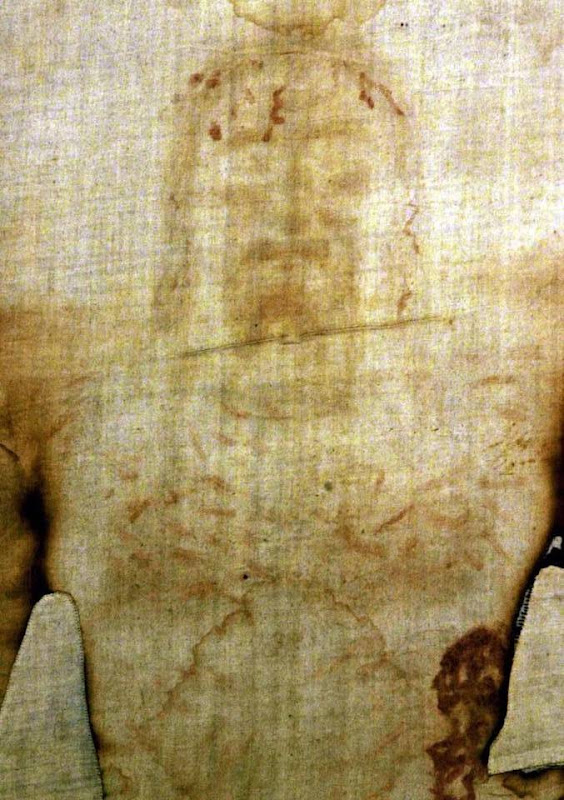 The mystery to me is how this
subject continues to get press coverage. This disciple of Walter McCrone (1916-2002) (see below) evidently suffers from the same Naturalistic (`nature is all there is-there is no supernatural') "invincible ignorance":
"There does remain, nonetheless, a cast of mind which seems peculiarly closed to evidence. When confronted with such a mind, one feels helpless, for no amount of evidence seems to be clinching. Frequently the facts are simply ignored or brushed aside as somehow deceptive, and the principles are reaffirmed in unshakable conviction. One seems confronted with what has been called `invincible ignorance.'" (my emphasis)[4]
selective blindness as his master!
In the 1970s, Dr. Walter McCrone examined a portion of the shroud that was purported to contain dried blood. He did not. McCrone never examined the Shroud itself directly[5]. All he examined, and only under an optical microscope, were sticky tapes that had been pressed onto the Shroud by STURP in 1978 and given to him by Ray Rogers (1927–2005). Here is Rogers' own account of McCrone's unethical, dishonest and "unconscionable" actions:
"I had known Walter since the 1950s, and I considered him to be both an ethical scientist and one of the world's best microscopists. We agreed to share the work on the tape samples. Walter ... never became a formal STURP team member. ... Walter and I had made an agreement to share uncontaminated samples before any chemistry was done on them. ... I let Walter have the box of samples and take it to his laboratory. He agreed to open the box in a clean-room, and he promised that he would do nothing but cut small sections of the tapes for microscopy. He said: `You know how little that will take.' He also promised to maintain the `chain of evidence' for the samples, allowing no unauthorized access to them. He paid no attention to his promises: He nearly destroyed the value of the carefully prepared samples. Walter McCrone took it upon himself to stick all of the samples down to microscope slides. He did not reserve any samples in a pristine state. Even worse than that, he immediately found that he could not tolerate the optical effects of a thick slide. That is amazing performance for a `great' microscopist. Consequently, he pulled the tapes off of the slides and stuck all of them down to microscope cover slips. This destroyed much of the physical evidence we had sought. Some fibers can now be seen to have been broken during these transfers, and thin coatings were often pulled off of fibers' surfaces.. This exacerbated contamination with adhesive, and it also initiated crystallization of the adhesive and amorphous tape at a higher rate than would have been necessary. The original tape is still amorphous, but the samples mishandled by McCrone are crystallizing. McCrone's failure to follow protocols and his abuse of the samples were unconscionable. Fortunately, we had chosen the adhesive to provide for quantitative removal from the samples. It required much meticulous work to get around the damage caused by McCrone, and much information was simply destroyed by his actions." (my emphasis)[6]
Nothing better illustrates McCrone's capacity for
self-deception, if not
outright lying, than his claim that the STURP tapes Rogers had loaned him had become "my [McCrone's] set of tapes" and "I [McCrone] was conned out of" them by "letters from STURP lawyers" and "Not being very bright, I [McCrone]... naively gave Ray my set":
"Unfortunately, my two planned formal publications outlining my work and my conclusions in 1980 were not very popular with STURP. As a result, I was conned out of my set of tapes. Ray Rogers, John Jackson and Eric Jumper visited my lab to `discuss the "Shroud" problem.' Among other things, remarks were made inferring that I had kept the best of the two sets. I immediately offered to trade sets and naively gave Ray my set saying I would pick up his set in Los Alamos in two weeks when I would be in that area. Naturally, I never was able to obtain his set and I was recipient of several letters from STURP lawyers insisting I return all slides, bits and pieces of those tape slides. Not being very bright, I did just that."[7]
This is
self-evidently false. The tape samples were taken from the Shroud by Rogers in 1978 as a member of STURP and so they belonged to STURP. They were not Rogers' tapes to give to McCrone. And McCrone was both "bright" and wealthy[
8] and could have afforded his own lawyers to enforce his right to keep the tapes if they really had been his.
He found no blood, Prof. Alan D. Adler (1931-2000), a blood chemist, subjected the Shroud samples on McCrone's slides that had been retrieved from him by Rogers, to a battery of 13 chemical and physical tests, and he did find that "the red stuff on the Shroud is emphatically, and without any reservation, nothing else but B-L-O-O-D!":
"We began our presentation. One by one, we gave our short talks with slides, graphs, spectra, and tried to make them intelligible to the nonscientist. .... Adler was asked how he could answer McCrone's claim that there was no blood, but merely a mixture of red ocher and vermilion. Adler flashed on the screen the following table from our paper. Table 5 Tests confirming the presence of whole blood on the Shroud 1. High iron in blood areas by X-ray fluorescence 2. Indicative reflection spectra 3. Indicative microspectrophotometric transmission spectra 4. Chemical generation of characteristic porphyrin fluorescence 5. Positive hemochromogen tests 6. Positive cyanomethemoglobin tests 7. Positive detection of bile pigments 8. Positive demonstration of protein 9. Positive indication of albumin 10. Protease tests, leaving no residue 11. Positive immunological test for human albumin 12. Microscopic appearance as compared with appropriate controls 13. Forensic judgment of the appearance of the various wound and blood marks.
Then, after explaining each item briefly, Al said, `That means that the red stuff on the Shroud is emphatically, and without any reservation, nothing else but B-L-O-O-D!'" (emphasis original)[9]
The problem was McCrone's "antireligious" desire to "debunk the Shroud" and to gain "publicity" which caused him to not be "objective" and to not "test his method for false positives":
"On the basis of his work with microscopes, Walter McCrone had claimed that the image had been painted with glair (egg) and hematite. He had used an amido black reagent to detect the proteins. The amido black reagent had been developed to test paintings for the presence of glair, and it was not intended to be used on porous, adsorptive surfaces. Our tests showed that amido black did indeed give a positive test for proteins on linen: It also gave a positive test on clean, modern, commercial linen. That being the case, we studied it to determine the probability of false positive tests. ... McCrone had not followed the simplest procedures of rigorous analytical chemistry: He had not run `blanks.' He did not test his method for false positives. All he wanted was to debunk the Shroud. A rigorous scientific study requires as many independent observational methods as possible. It is as unconscionable to allow antireligious sentiments to direct science as it is to demand a specific theological answer. I was disappointed to find that Walter could not be objective when he wanted publicity." (my emphasis)[10]
Prof. Harry Gove (1922-2009), independently agreed, assessing McCrone as being motivated by the dream of "becoming history's greatest iconoclast" by demolishing "the authenticity of the ... Turin Shroud":
"I sometimes think that McCrone dreamed of becoming history's greatest iconoclast. Having, in his view, demolished the authenticity of the Vinland Map he saw the chance to do the same to the Turin Shroud!"[11]
but he did find red ochre He
did not (see
below).
Red ochre is
haematite, an
iron oxide. McCrone's claim that "
all of the red flecks in blood areas are iron oxides" was "later refuted" by "One of his own people" (see
below):
"On 24 March 1979, STURP met in Santa Barbara, California. Preliminary presentations were made on all of the chemical, microscopic, and instrumental analyses. Two important claims were made by Walter McCrone. He said that all of the red flecks in blood areas are iron oxides in different degrees of hydration. One of his own people later refuted this during laser-microprobe analyses." (emphasis original)[12]
Reflectance spectrometry showed that the image, blood and Fe
2O
3 (
haematite) spectra were different (see Fig. VIII-1 below) and therefore "hematite ... claimed by McCrone to have been used to paint the image,
could not have contributed the color ... red":
"Roger and Marty Gilbert of Oriel Optical Corp. designed and built a dual-beam reflectance spectrometer that could be used on the Shroud. They recorded visible, ultraviolet, and fluorescence spectra from many areas of the cloth. ... They found ... that hematite (Fe2O3), claimed by McCrone to have been used to paint the image, could not have contributed the color (figure VIII-1). Hematite absorbs light in the blue and green, reflecting the red. Your eye sees red, and the spectrum shows a sharp cutoff. Reflectance goes from nearly zero at wavelengths below about 550 nanometers to nearly 90% above 600 nanometers (in the red). All known pigments could be rejected in the same way as hematite. The image was not painted ... The lack of detectable pigments agreed with the x-ray-fluorescence analysis and chemical tests."[13]

[Above (enlarge): Reflectance spectrometry graphs of the Shroud image, Shroud blood and hematite (Fe2O3)[14]. As can be seen, the blood and haematite curves are similar (because blood's haemoglobin contains iron oxide). But at around 600 nanometres wavelength the blood and haematite curves begin to diverge markedly. If the Shroud blood was red ochre (haematite), as claimed by McCrone, then the blood and Fe2O3 reflectance spectral curves would be identical, or at least closely similar.]
As previously mentioned, one of McCrone own people later refuted his claim that the blood on the Shroud was red ochre (haematite). This was "Mark Anderson, McCrone's MOLE [Laser Microprobe Raman Spectrometry] expert" who "observed that most of the red flecks on the Shroud `bubbled up and turned black' when he hit them with the laser beam ... an entirely different response than he got from ... hematite crystals" and "acted like an organic phase." But "McCrone refused to accept those observations ... he wanted the image to be painted with hematite" so "no conflicting observations would be allowed":
"Joan Rogers identified suitable fibers on the tape samples and prepared them for analysis. She took tapes, fibers from non-image areas, and fibers from image areas to Instruments SA, Inc., in Metuchen, N.J. in December 1979. The samples were analyzed by Dr. Fran Adar. Similar samples were analyzed by Mark Anderson, McCrone's MOLE expert in January 1980. Anderson observed that most of the red flecks on the Shroud `bubbled up and turned black' when he hit them with the laser beam. This was an entirely different response than he got from authentic hematite crystals. He said it `acted like an organic phase' (21 January 1980). Walter McCrone refused to accept those observations. If he wanted the image to be painted with hematite, no conflicting observations would be allowed." (my emphasis)[15]
Further evidence against McCrone's claim that the Shroud "image was painted with hematite" is that "pyrolysis products from the [
1532] fire would reduce red hematite to black magnetite on the Shroud" but "No such effect could be observed on the Shroud":
"A large body of chemical information is available on the interactions among reactive pyrolysis products and known or suspected Shroud components. For example, McCrone claimed until his death that the image was painted with hematite. Experiments we did before 1978 proved that the pyrolysis products from the [1532] fire would reduce red hematite to black magnetite on the Shroud. No such effect could be observed on the Shroud during the hurried observations of 1978 ..."[16]
and vermilion paint particles. McCrone's scanning electron microscope (SEM) group found on one linen fibre from blood image tape (3-CB) peaks of mercury (Hg) and Sulfur (S)[
17]. They also
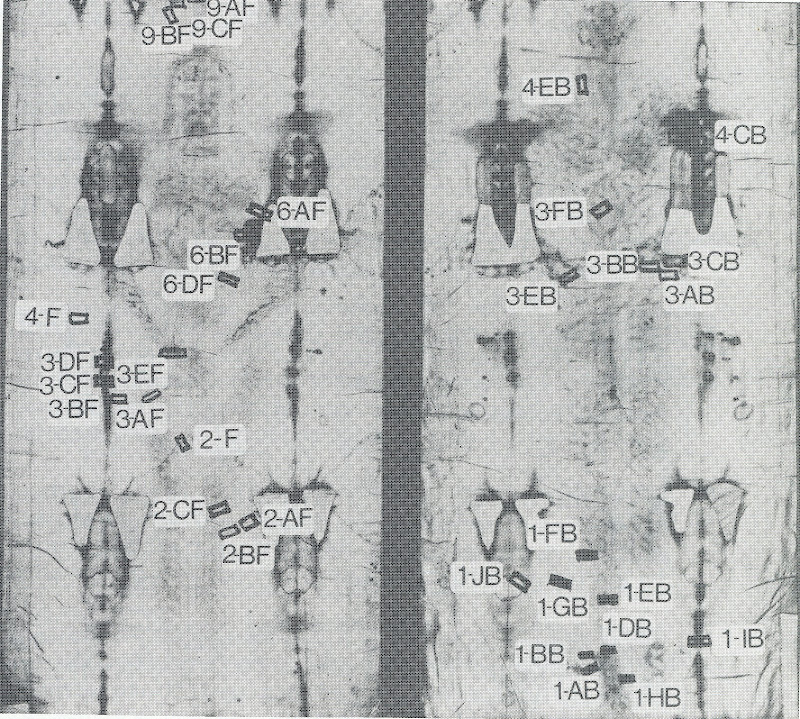
[Above (enlarge): Map in McCrone's "Judgment Day" (1999) book[18], showing where on the Shroud tape sample 3-CB was taken. Note it is on the dorsal side (right), next to a patch covering an area burned in the 1532 fire.]
found with the mercury and sulfur small amounts of sodium, magnesium, phosphorus, aluminum, silicon, potassium, chlorine, calcium and iron[19]. However, McCrone conceded that this did not prove it was the molecular combination mercuric sulfide HgS, i.e. vermilion[20]. Yet having conceded this, on the previous page, McCrone had already called the "mercury and sulfur (vermilion)"[21]!
To determine whether the mercury and sulfur was vermilion, McCrone examined fibre(s) on that 3-CB tape by polarized light microscopy and claimed that he "recognized the tiny rod-like, high index red particles as a form of vermilion"[22]. McCrone later claimed to have found nine microscopic particles of vermilion[23]. However, we only have McCrone's word for this. He provided no microphotographs of these "tiny rod-like, high index red particles" and no independent verification of his claim. But even if it was true (which Heller and Adler doubt[24]), only nine particles of vermilion is "not enough ... to account for one painted drop of blood, let alone all the gore on the Shroud"[25]. So, far from being support for McCrone's `all the blood on the Shroud is vermilion paint' theory, it is a refutation of it! Nor did McCrone consider other explanations, such as the vermilion (if indeed it was vermilion) came from burning artworks or furnishings in the Sainte Chapelle, Chambéry fire of 1532, since tape 3-CB was next to a patch covering charred areas from that fire; or from artists pressing their vermilion-painted copies of the Shroud against it to `sanctify' them (see below).
One of McCrone's employees produced an x-ray diffraction analysis from tape 3-CB, which returned a result for mercury, iron and calcite[26]. Yet despite there being no sulfur, McCrone simply called the "mercury (vermilion)"[27]! Another of McCrone's employees analysed by ion microprobe "about a dozen" of what McCrone called "blood-image pigment aggregates" on tape 3-CB and found iron, mercury and other elements but again no sulfur[28]. However again McCrone just labelled this "vermilion"[29]! But then, after previously pointing out correctly that evidence of "mercury (Hg) and sulfur (S) ... does not prove a molecular combination of the two as vermilion (HgS)" and "To determine whether vermilion was really present" it was necessary to find by "light microscopy ... the tiny rod-like, high index red particles ... of vermilion[30], McCrone admitted that he was "embarrassed by the finding of vermilion [sic] by the .. electron optics group" and asked, "Why hadn't I detected vermilion by light microscopy during 1979?"[31]. The obvious answer is that it wasn't there, only separate mercury and sulfur (if even the latter)!
Then, to explain why there was so much `vermilion', McCrone added to his red ochre (haematite) painted blood theory an "epicycle," that the `blood' was painted twice, first with red ochre and second with vermilion!:
"The variable relative percentage of the two pigments is significant ... The variability in the relative percentages of red ochre and vermilion [sic] proves that the artist used separate iron earth and vermilion paints to create the image on the cloth. I am certain that the first painting of the entire `Shroud' using red ochre was followed with a vermilion watercolor paint but only in the blood-image areas. Note that when the percentage of vermilion [sic] is high ... the percentage of red ochre (Fe) is generally low and vice versa. This is not a precise relationship because the relative quantities of the two paints in each area no doubt vary ..."[32]
But why
would a medieval forger go to the trouble of painting the blood
twice? And remember that on McCrone's own admission, he only ever determined by light microscopy
nine microscopic particles of vermilion (if even that). Also again remember that
we only have McCrone's word for it: there are no photomicrographs of even
one vermilion particle that McCrone claims he found on the Shroud in his "Judgment Day" book (which considering their importance there
should have been if they existed) and/or independent verification of these "tiny rod-like, high index red particles." And as we saw
above McCrone was capable of
self-deception and/or
lying to make it appear that he was right. Indeed, Wilson effectively says that McCrone was not to be trusted, because he caught McCrone out having presented in one of his in-house journal's Shroud papers, mere "estimates" as though they were "exact numbers:"
"While the layman might feel prepared to accept McCrone's microanalytical judgment on such a matter, the justification for trusting that judgment dissolves on close scrutiny of the second table in McCrone's first Microscope paper on the Shroud, showing the relative numbers of purported iron-oxide-coated fibrils to noncoated fibrils in any one sample. Puzzlingly, this shows a sample of body image (from a finger) containing as many as 72 percent `colored' fibrils, compared to a sample of blood image (from the heel) containing as little as 42 percent. Purportedly, exact numbers of fibrils are quoted. Since on McCrone's own arguments one would expect blood image to contain more coloring than body image, I questioned him on this point in personal correspondence and received a surprisingly candid reply: I have to confess that those numbers aren't as precise as one would like to have them. They were obtained by looking at the individual tapes and judging whether the degree of yellow color of the fibers constituted yellowing over and above the amount present ... for this reason the number should not be interpreted as anything like exact. They could easily vary by 20% or 30%.
Suddenly one comes face to face with the realization that McCrone's seemingly precise statistics in support of his arguments are nothing of the kind. He has simply estimated numbers ... [which is] unacceptably unscientific." (my emphasis)[33]
Dr. McCrone, who literally wrote the book on the analysis of microscopic particles ("The Particle Atlas," published in six volumes from 1973 through 1979), was eminently qualified to conclude that the shroud was a 14th century painting. No one contests McCrone's expertise in identifying microscopic particles. But it is a non sequitur (it does not follow) fallacy to claim that made him an expert in 14th century paintings. A real expert in 14th century painting, agnostic but pro-authenticist art historian, Thomas de Wesselow, dismissed McCrone's 14th century painting argument as "baseless." Not only had artists' copies of the Shroud been "laid ... on the original in order [for them] to be sanctified" and "fragments of paint would undoubtedly have been transferred in the process" but also when STURP examined the Shroud in 1978, it was "in the Royal Palace of Turin ... in a room whose ceiling was covered in frescoes, 'from which tiny paint fragments would fall like confetti'":
"Also found on the tapes were a few particles of paint. These were seized upon by an associate of the STURP team, a microscopist called Walter McCrone, who took them as evidence that the cloth had once been in an artist's studio and was therefore a painted fake. This argument is baseless. Artists have been making copies of the Shroud since the sixteenth century, at least, and several of these are known to have been laid directly on the original in order to be sanctified. Tiny fragments of paint would undoubtedly have been transferred in the process. Other particles could easily have come from nearby paintings. For instance, when STURP examined the Shroud in the Royal Palace of Turin, they did so in a room whose ceiling was covered in frescoes, 'from which tiny paint fragments would fall like confetti as the team members worked below'[34]. McCrone's paint particles could have fetched up on the Shroud just as easily as any of the other debris."[35]
The "scientists" who refuted his work had no qualifications to perform the analyses on which they claimed to rely. By placing quotation marks around "scientists," the writer, "Kenneth L. Johnson ... a retired chemist who was trained in microscopic analysis by Dr. Walter McCrone ..." (see below) shows that he learned prejudice well from his master, McCrone! It is an indication that one's theory is weak when to defend it one has to rule its critics out of court as not even scientists! And far from them having "no qualifications to perform the analyses," Ray Rogers was a senior chemist at Los Alamos National Laboratory. Alan D. Adler had a "doctorate in chemistry from the University of Pennsylvania ... specializing in porphyrins and blood chemistry"[36]. Adler's obituary in the Los Angeles Times noted that he was "a blood chemistry expert."[37]. And Dr John H. Heller (1921-95) was a medical doctor, a biophysicist and a former Professor of Internal Medicine at Yale[38]. McCrone's qualifications by contrast, were "a bachelor's degree in chemistry (1938) and a Ph.D. in organic chemistry (1942)[39]. That's all!
Their (and others') critique of McCrone's red ochre and vermilion painting theory includes:
■ It is not enough for McCrone to demonstrate the presence of iron oxide and vermilion on the sample tapes. He must also, but has not, established that they are present in sufficient quantities and in such locations as to account for the body image and blood seen on the Shroud[40]. Heller and Adler found one vermilion particle in a different location in their examination of the same tape samples[41] and despite "a complete and exhaustive search for additional samples" on all the tapes they could not find another[42].
■ McCrone must show, but has not, that the presence of iron oxide and vermilion cannot be more simply accounted for by other means[43] (e.g. retting of flax in water and artists pressing to the Shroud their painted copies of it[44]).
■ McCrone's conclusions must be, but are not, in accord with other studies[45](e.g. the 13 different tests (above) which show that the bloodstains on the Shroud really are blood)[46].
■ Vermilion turns black when exposed to light (as the Shroud has been in open-air daylight exhibitions over many decades), as evidenced in older paintings[47]. Vermilion also darkens under high temperature[48] but the Shroud's blood colour did not change in the 1532 fire which melted its silver casket[49] (at ~961°C).
■ X-rays of the Shroud's blood areas do not show the mercury that 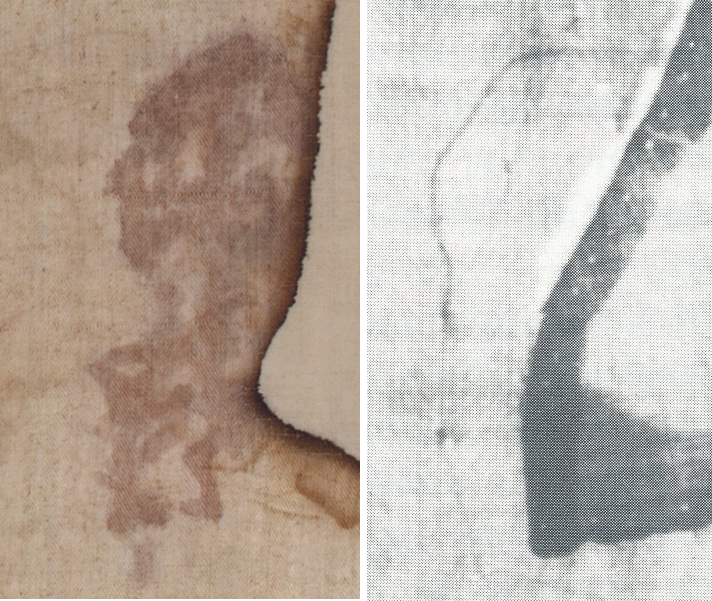
[Above (enlarge): Large bloodstain from the (spear) wound in the man's right side[50] (L) compared to a STURP x-radiograph of the same area[51] (R). Since mercury would show up prominently on an x-ray as a mercury amalgam dental filling does[52] (see below), this shows that little or no mercury (and therefore vermilion) is present and therefore it alone totally falsifies McCrone's `blood is vermilion paint' theory. Especially considering that this is the frontal counterpart of the dorsal bloodstain that tape 3-CB sample was taken from on which McCrone claimed he found vermilion which `proved' that the blood was vermilion!]
would be there if the blood was vermilion[53]. That is because an "x-ray image ... is an absorption image. ... The heavier the atomic weight, the more absorption and the lighter the x-ray image"[54]. If the Shroud's "blood image were the result of iron oxides and mercuric sulfide [vermilion], it would show up far more distinctly on the x-ray than the water stains, but quite the opposite is true."[55]. In fact "none of the blood marks showed up on the x-rays, while all the water marks were clearly visible"[56].

[Above: X-ray of teeth containing mercury amalgam dental fillings (white)[57]. Mercury has a high atomic mass (200.59) so it absorbs more x-rays and appears white on x-radiographs.]
■ STURP published all its Shroud findings in peer-reviewed scientific journals[58], but McCrone published his in his own in-house journal, The Microscope[59], without any peer-review at all[60].
The History Channel ran a documentary on the people "testing" the shroud, in which it was evident the channel had no interest whatsoever in accepting facts that conflicted with preconceived notions. I cannot comment on this as I have not seen this documentary since the History Channel, as far as I know, is not available in Australia, except perhaps on cable TV which I don't have. I have a vague idea I saw it on YouTube but if so I cannot remember it. Johnson's "preconceived notions" sounds like the pot calling the kettle black!
One "scientist" Again, Johnson puts quotes around "scientist." See above that ruling out of court as even scientists critics of one's position is a sign of weakness, not strength. If McCrone's critics are wrong, then Johnson should be able to state where they are wrong. seriously theorized that holy radiation from the resurrection might have transferred the image of Jesus to the cloth. Johnson, like most (if not all) atheist/agnostics (which I presume he is) is blind to his own "preconceived" atheistic/agnostic and anti-Christian "notions." But the fact is that the best (if not the only viable) explanation of the image on the Shroud is STURP physicist John P. Jackson's "Cloth Collapse Theory"[61], that "the cloth collapsed into and through the underlying structure of the body in the Shroud" and "emitted radiation from all points within and on the surface of the body ... forming the body image":
"Dr Jackson proposed the hypothesis that, at the time that the image on the Shroud was formed, the cloth collapsed into and through the underlying structure of the body in the Shroud. ... Based on his observations of the image he further proposed that, as the body became mechanically transparent to its physical surroundings, it emitted radiation from all points within and on the surface of the body. This radiation interacted with the cloth as it fell into the mechanically transparent body, forming the body image. He also suggested that the radiation would have had to have been strongly absorbed in air. This, he suggested, could have been electromagnetic radiation in the shortwave ultra-violet region of the spectrum, which would have caused a chemical alteration of the cellulose in the cloth fibres."[62]
This agrees with "the Gospel accounts of the resurrection [of Jesus Christ] and the events that followed" in that "Jesus could ... move apparently instantaneously from place to place regardless of the physical obstacles in the way":
"At this point it is necessary to return to the supernatural and the possible link between the Shroud image and the resurrection of Jesus Christ ... the Gospel accounts of the resurrection and the events that followed can offer some clues as to how the image on the Shroud may have been formed. The Gospels suggest that the risen Jesus could teleport - in other words he could move apparently instantaneously from place to place regardless of the physical obstacles in the way ... In Jn 20:19 and again in Jn 20:26 it is recorded that Jesus appeared suddenly among his disciples in a locked room. Lk 24:31 records Jesus as vanishing from the sight of the disciples he met on the road to Emmaus. Again, in Lk 24:36 he suddenly appears among the apostles in Jerusalem. However, his body was substantive - it was not some form of energy or light. Lk 24:43 describes how the apostles gave him a piece of grilled fish and he ate it `before their eyes'. Jn 20:27 records how the apostle Thomas placed his finger and hand into the wounds in Jesus's hands and side. Clearly the body of the risen Jesus, as described in the Gospels, had physical properties beyond the knowledge of modern science. ... the body of the risen Jesus became `mechanically transparent'. ... The Gospel accounts give ... credence to Dr Jackson's proposed image-formation mechanism ..."[63]
As in many cases where rational thought collides with religious beliefs, truth is ignored in favor of magical thinking. This shows that Johnson has `
swallowed hook, line and sinker'
Naturalism's
false dichotomy between "rational thought" and "religious beliefs." That his mind has been `taken captive by the philosophy' (
Col 2:8) of Naturalism and is now in the grip of its "strong delusion" (
2Th 2:11), such that he cannot even
think that Christianity could be true and the Shroud could be Jesus' burial sheeet. To Johnson the supernatural can only be "magical thinking."
The age and origin of the cloth is totally irrelevant to the question. On the contrary, since the evidence is overwhelming that the Shroud is authentic, its "age" is ~2000 years and its "origin" was a byproduct of the resurrection of Jesus, indeed a "snapshot" of it:
"Even from the limited available information, a hypothetical glimpse of the power operating at the moment of creation of the Shroud's image may be ventured. In the darkness of the Jerusalem tomb the dead body of Jesus lay, unwashed, covered in blood, on a stone slab. Suddenly, there is a burst of mysterious power from it. In that instant ... the body becomes indelibly fused onto the cloth, preserving for posterity a literal `snapshot' of the Resurrection."[64]
And on the basis of Jesus' resurrection (as proved by the Shroud
scientifically beyond reasonable doubt) "God ... commands
all people everywhere [including Kenneth L. Johnson] to repent [Gk.
metanoia = change your mind]:
Acts 17:30-31 "The times of ignorance God overlooked, but now he commands all people everywhere to repent, because he has fixed a day on which he will judge the world in righteousness by a man whom he has appointed; and of this he has given assurance to all by raising him from the dead."
You might better ask how red ochre and vermilion particles get on a real burial cloth. See above on there being not enough vermilion particles on the Shroud to account for its image. And likewise for "red ochre." Even the anti-authenticists
Picknett & Prince admit that "McCrone was wrong" because "the number of iron oxide particles quoted by McCrone ... was so low that an image made by them would be
too faint to be seen":
"Even so, it has to be admitted that his [McCrone's] work is open to serious question. To start with, McCrone produced figures showing the number of particles of iron oxide present in the image areas compared to those in the nonimage areas. They appeared to indicate that there was much more iron oxide in the image than elsewhere on the cloth, supporting the idea that it was the result of faking the image ... [but] When John Heller pointed out that the number of iron oxide particles quoted by McCrone, even on the image area, was so low that an image made by them would be too faint to be seen, McCrone's response was that, in that case, `there must be more'[65] ... The most reasonable conclusion is that McCrone was wrong."[66]
There is
iron oxide on the Shroud (as well as calcium and strontium) which is a consequence of retting flax "in a natural body of water":
"Ten days later he [Adler],came to see me ... he said, `What do you know about the process of retting linen?' `Isn't that something that you do to the flax plant to get linen fibers from it?' `Yes ... in order to ret linen, you take the flax plant and soak it in a natural body of water, like a river or lake. The useless part of the flax kind of rots away, and the fibers that remain are linen, which is spun into thread. ... during the retting, the linen fibers act as an ion exchanger, and do you know what ions they take up selectively from water?' ... `Calcium, strontium, and iron!' `... That explains the X-ray fluorescence data.'"[67]
Kenneth L. Johnson [from]
Cloquet. The writer is a retired chemist who was trained in microscopic analysis by Dr. Walter McCrone and his staff at the McCrone Research Institute in Chicago. Enough said! (see all the above). Tragically Johnson is yet another instance of `the blind having been led by the blind' (
Mt 15:14; Lk 6:39)! [
top]
Editorial. Rex Morgan's Shroud News: My scanning and word- processing of Rex Morgan's Shroud News for Barrie Schwortz to 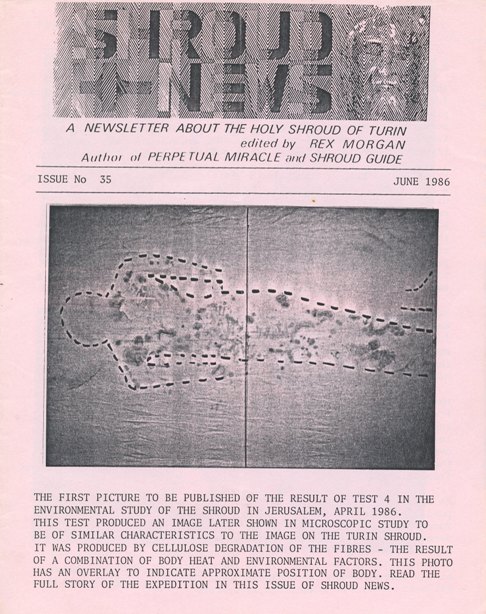 convert to PDF and add to his online Shroud News archive, continued in December up to issue #35, June 1986 [Right (enlarge)]. It is still only up to issue #28 on that archive, but an update is due this month. Topic index: I continued adding my old posts to my Topic Index in December up to and including my post of 11 February 2012. In December I blogged 5 posts: 04-Dec-15: News articles #3: Uncovering the sources of DNA found on the Turin Shroud; 10-Dec-15: Shroud of Turin News - November 2015; 26-Dec-15: The man on the Shroud #8: The evidence is overwhelming that the Turin Shroud is Jesus' burial sheet!; 27-Dec-15: Naked #9: The man on the Shroud: The evidence is overwhelming that the Turin Shroud is Jesus' burial sheet!; and 30-Dec-15: The 1260-1390 radiocarbon date of the Turin Shroud was the result of a computer hacking #5. Pageviews: At midnight on 31 December, Google Analytics gave this blog's "Pageviews all time history" as 482,283, and "Pageviews last month" (December) as 10,453. The most viewed posts for December were: "The man on the Shroud #8: The evidence is overwhelming that the Turin Shroud is Jesus' burial sheet!," Dec 26, 2015 - 85; "Naked #9: The man on the Shroud: The evidence is overwhelming that the Turin Shroud is Jesus' burial sheet!," Dec 27, 2015 - 55; "Re: Shroud blood ... types as AB ... aged blood always types as AB, so the significance of this ... is unclear," Mar 18, 2011 - 36; "Bogus: Shroud of Turin? #10: The Shroud's blood and pollen closely matches the Sudarium of Oviedo's," Aug 8, 2007 - 28; and "The Pray Manuscript," Jan 11, 2010 - 28. Again, it is intriguing to see these old posts of mine (of 2007, 2010 and 2011), being among the most pageviews. I intend this blog to be a reference site for the Shroud and I am pleased that it seems to be fulfilling that function. [top]
Notes:
1. This post is copyright. Permission is granted to extract or quote from any part of it (but not the whole post), provided the extract or quote includes a reference citing my name, its subject heading, its date, and a hyperlink back to this post. [return]
2. Berezow, A.B., 2015, "Shroud of Turin DNA Comes from All over World," RealClearScience, October 12. [return]
3. Gutierrez, L., 2015, "Shroud of Turin mystery deepens as DNA from `all over Earth' is found on the cloth," The Kansas City Star, October 20. Photo by Antonio Calanni/AP. Rotated left 90 degrees. [return]
4. Fearnside, W.W. & Holther, W.B., 1959, "Fallacy the Counterfeit of Argument," Prentice-Hall: Englewood Cliffs NJ, 25th printing, p.113. [return]
5. Ruffin, C.B., 1999, "The Shroud of Turin: The Most Up-To-Date Analysis of All the Facts Regarding the Church's Controversial Relic," Our Sunday Visitor: Huntington IN, p.89. [return]
6. Rogers, R.N., 2008, "A Chemist's Perspective on the Shroud of Turin," Lulu Press: Raleigh, NC, pp.23-24. [return]
7. McCrone, W.C., 1999, "Judgment Day for the Shroud of Turin," Prometheus Books: Amherst NY, pp.123-124. [return]
8. During a lecture I attended in 2011 by one of McCrone's former students, Prof. Joel Bernstein (1941-2019), we were told that McCrone had made a lot of money during World War II, testing explosives for the US Government. [return]
9. Heller, J.H., "Report on the Shroud of Turin," Houghton Mifflin Co: Boston MA, 1983, pp.215-216. [return]
10. Rogers, 2008, pp.36-37. [return]
11. Gove, H.E., "Relic, Icon or Hoax?: Carbon Dating the Turin Shroud," Institute of Physics Publishing: Bristol UK, 1996, p.19. [return]
12. Rogers, 2008, p.44. [return]
13. Rogers, 2008, pp.49-50. [return]
14. Rogers, 2008, p.50. [return]
15. Rogers, 2008, p.61. [return]
16. Rogers, 2008, p.128. [return]
17. McCrone, 1999, pp.128-129. [return]
18. McCrone, 1999, p.79. [return]
19. McCrone, 1999, p.128. [return]
20. McCrone, 1999, p.129. [return]
21. Ibid. [return]
22. McCrone, 1999, pp.129-130. [return]
23. Heller, 1983, p.194. [return]
24. Case, 1996, p.53. [return]
25. Heller, 1983, p.194; Stevenson, K.E. & Habermas, G.R., 1990, "The Shroud and the Controversy," Thomas Nelson: Nashville TN, p.121. [return]
26. McCrone, 1999, pp.134-135. [return]
27. Ibid. [return]
28. McCrone, 1999, pp.134, 136. [return]
29. Ibid. [return]
30. McCrone, 1999, pp.129-130. [return]
31. Ibid. [return]
32. McCrone, 1999, pp.134-135. [return]
33. Wilson, I., 1986, "The Evidence of the Shroud," Guild Publishing: London, pp.86,88. [return]
34. Wilson, I., 1998, "The Blood and the Shroud: New Evidence that the World's Most Sacred Relic is Real," Simon & Schuster: New York NY, p.98. [return]
35. de Wesselow, T., 2012, "The Sign: The Shroud of Turin and the Secret of the Resurrection," Viking: London, p.115. [return]
36. Adler, C., 2000, "6/11/00 Obituary of Alan D. Adler." [return]
37. "Obituaries: Alan D. Adler; Chemist Studied Shroud of Turin," Los Angeles Times, June 15, 2000. [return]
38. Wilson, I., 1996, "Obituaries - Dr. John Heller and Professor Werner Bulst, S.J.," BSTS Newsletter, No. 42, January, pp.12-13; Case, T.W., "The Shroud of Turin and the C-14 Dating Fiasco," White Horse Press: Cincinnati OH, 1996, p.47. [return]
39. "Walter McCrone," Wikipedia, 26 October 2015. [return]
40. Heller, J.H. & Adler, A.D., 1981, "A Chemical Investigation of the Shroud of Turin," in Adler, A.D. & Crispino, D., ed., 2002, "The Orphaned Manuscript: A Gathering of Publications on the Shroud of Turin," Effatà Editrice: Cantalupa, Italy, pp.34-57, 47. [return]
41. Heller & Adler, 1981, pp.44,46; Case, 1996, pp.52-53. [return]
42. Heller, 1983, p.192. [return]
43. Heller & Adler, 1981, p.47. [return]
44. Heller & Adler, 1981, p.47; Case, 1996, p.53. [return]
45. Heller & Adler, 1981, p.47. [return]
46. Case, 1996, p.13 [return]
47. Adler, A.D., 1993, "Conservation of the Shroud of Turin," in Adler & Crispino, 2002, pp.73-80, 75. [return]
48. Adler, 1993, p.77; Piczek, I., 1994, "Noted Los Angeles artist Isabel Piczek replies to the Craig Bresee Theory...," BSTS Newsletter, No. 37, March/April, pp.18-19. [return]
49. Antonacci, M., 2000, "Resurrection of the Shroud: New Scientific, Medical, and Archeological Evidence," M. Evans & Co: New York NY, p.48. [return]
50. Extract from Latendresse, M., 2010, "Shroud Scope: Durante 2002 Vertical," Sindonology.org. [return]
51. Extract from Wilson, 1986, p.90. [return]
52. Case, 1996, p.53. [return]
53. Wilson, 1986, p.90. [return]
54. Jumper, E.J., Adler, A.D., Jackson, J.P., Pellicori, S.F., Heller, J.H., Druzik, J.R., in Lambert, J.B., ed., 1984, "A Comprehensive Examination of the Various Stains and Images on the Shroud of Turin,"Archaeological Chemistry III: ACS Advances in Chemistry, No. 205," American Chemical Society, Washington D.C, pp.447-476, 468; Wilson, I. & Schwortz, B., 2000, "The Turin Shroud: The Illustrated Evidence," Michael O'Mara Books: London, p.70. [return]
55. Jumper, et al., 1984, p.468; Stevenson & Habermas, 1990, [return]
56. Jumper, et al., 1984, pp.468, 470. [return]
57. "Removal of Amalgam Fillings," Dr. Adé Meyer, Dentistry SA, 2014. [return]
58. Heller, 1983, pp.167-168. [return]
59. Heller, 1983, p.184; Stevenson & Habermas, 1990, p.30; Jackson, J.P., "An Unconventional Hypothesis to Explain all Image Characteristics Found on the Shroud Image," in Berard, A., ed., 1991, "History, Science, Theology and the Shroud," Symposium Proceedings, St. Louis Missouri, June 22-23, 1991, The Man in the Shroud Committee of Amarillo, Texas: Amarillo TX, pp.328-329. Case, 1996, p.13. [return]
60. Case, 1996, p.18. [return]
61. Jackson, J.P., "An Unconventional Hypothesis to Explain all Image Characteristics Found on the Shroud Image," in Berard, A., ed., 1991, "History, Science, Theology and the Shroud," Symposium Proceedings, St. Louis Missouri, June 22-23, 1991, The Man in the Shroud Committee of Amarillo, Texas: Amarillo TX, p.325-344. [return]
62. Oxley, M., 2010, "The Challenge of the Shroud: History, Science and the Shroud of Turin," AuthorHouse: Milton Keynes UK, pp.240-241. [return]
63. Oxley, 2010, p.244. [return]
64. Wilson, I., 1979, "The Shroud of Turin: The Burial Cloth of Jesus Christ?," [1978], Image Books: New York NY, Revised edition, p.251. [return]
65. Sox, H.D., 1981, "The Image on the Shroud: Is the Turin Shroud a Forgery?," Unwin: London, p.39. [return]
66. Picknett, L. & Prince, C., 2006, "The Turin Shroud: How Da Vinci Fooled History," [1994], Touchstone: New York NY, Second edition, Reprinted, 2007, p.76. [return]
67. Heller, 1983, pp.173-174. [return]
Posted 5 January 2016. Updated 25 October 2025.

 front and back[7] (or frontal and dorsal[8]).



 Posts
Posts


