Sunday, April 3, 2016

"The Shroud of Turin": Shroud of Turin News - March 2016

2016

Shroud of Turin News - March 2016
© Stephen E. Jones
[1]

This is part #2 of the March 2016 issue of my Shroud of Turin News. The article's words are in bold to distinguish them from mine.

[Previous: March 2016, part #1] [Next: March 2016, part #3]


"The Shroud of Turin," Homiletic & Pastoral Review, March 23, 2016, Raymond F. Hain III ... The Shroud of Turin was on
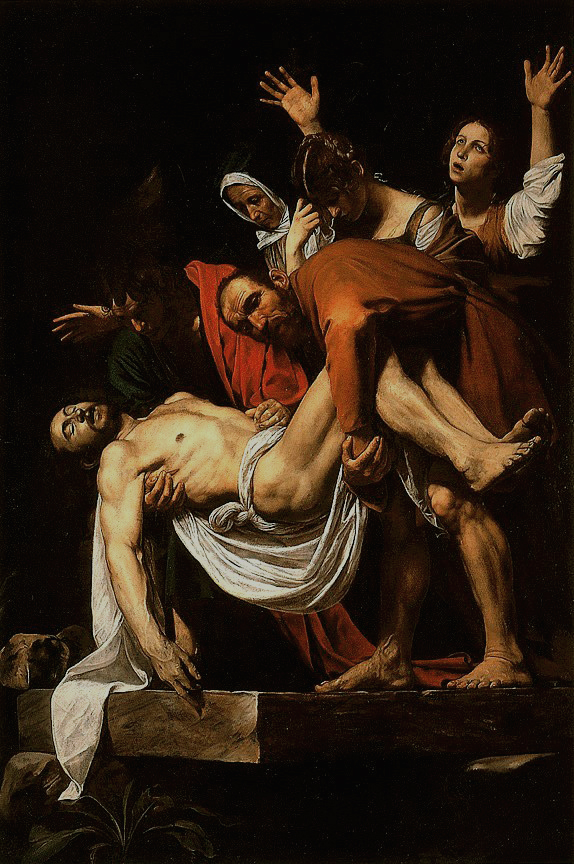
[Above (enlarge): "Burial of Christ," by Michelangelo Caravaggio, 1602-1604[2]. This painting by Michelangelo da Caravaggio (1571–1610), featured in this article, while a great work of 17th century Italian art, is almost completely opposite to what the burial of Jesus as revealed by the Shroud, was (see the photo in the previous post, "Problems of the Forgery Theory: Index G-M"). In Caravaggio's painting there are no wounds or blood on Jesus' head, body, hands and feet; but there is a large bloodstained spear wound in the right side of the Man on the Shroud (Jesus), as well as large Roman nail wounds in His wrists and feet and rivulets of blood from the crown (or cap) of thorns on the Shroud man's forehead. Also, Caravaggio's Jesus has a loincloth to preserve His modesty, but the Man on the Shroud is completely naked. This further shows that the Shroud is not a medieval forgery because no medieval forger would have depicted Jesus with bloody wounds and completely naked.]

public display from April 19, 2015 through June 24, 2015 in the Cathedral of St John the Baptist in Turin, Italy. More than two million visitors came to Turin from around the world to view the Shroud. "Some say the 14-foot piece of linen is Christ's burial cloth. They point to what appears to be the imprinted image of a man bearing wounds from a crucifixion. Others say the whole thing is a medieval forgery. Agnostic but pro-authenticist art historian Thomas de Wesselow pointed out that so foreign is the Shroud to medieval artistic culture, that a better explanation than that it "is a medieval forgery" is that "the Shroud was deposited in medieval France by aliens":

"Given credence, the [1260-1390] carbon-dating result effectively raises the Shroud to the status of a miracle, an object that defies, if not a law of nature, a law of culture. All artefacts are linked to the art and technology of the society in which they originate. Something that cannot be explained in terms of its (presumed) cultural context invites a supernatural explanation. As far as I am aware, no one has yet argued that the Shroud was deposited in medieval France by aliens, but ... There is no better explanation, though, for a fourteenth-century Shroud"[3].
Regardless, the shroud has remained a wildly popular attraction for pilgrims from around the world."1 The Shroud is certainly one of the most controversial relics in recent times. It has been displayed several times in this century, the last time in 2005. [sic] 2015. I was one of those fortunate visitors to view the Shroud. The viewing was part of a pilgrimage my wife and I made to Italy in May 2015. ...

[Above: "Figure 1: Shroud of Turin on Display" in the 2015 exposition.]

... The cloth itself measures 14.3 x 3.7 feet. This is a rather strange size for the cloth unless one takes into account a length measurement of the time - the Assyrian cubit. Doing this the size of the cloth is 8 cubits by 2 cubits - a much more regular measurement. Indeed! See my post, "Dimensions #3: The evidence is overwhelming that the Turin Shroud is authentic!" Since the dimensions of the standard Assyrian cubit of Jesus' day were not known until the 19th century, a medieval forger would not know, let alone care, that his cloth should have these first century dimensions.

The cloth is woven in a three-to-one herringbone twill composed of flax fibrils. Which was extremely rare and therefore expensive in the Middle Ages. Too rare and expensive for a medieval forger to use, because that would severely reduce his profit margin. So Oxford radiocarbon dating laboratory's Professor Edward Hall (1924-2001) was right on one point, in "the 14th century" a forger would have "just got a bit of linen" to create his forgery upon:

"There was a multi-million-pound business in making forgeries during the 14th century ... Someone just got a bit of linen, faked it up and flogged it." (my emphasis)[4]
But the Shroud is not just "a bit of linen"! If it existed today as a sheet of herringbone twill linen, without its image, it would be priceless. See my post, "Weave #4: The evidence is overwhelming that the Turin Shroud is authentic!"

There appears a faint image of the front and back image of a naked man with his hands crossed over his groin. The front and back views meet nearly at the middle of the cloth with no outline of the figure. The two views are aligned along the mid-plane of the body and point in opposite directions and nearly meet in the middle. The image is so faint that it can only be seen from about 2–9 feet away. When viewed any closer, it tends to disappear, and any further away, it becomes rather indistinct. Confirming the point made in my post, "Faint #11: The man on the Shroud: The evidence is overwhelming that the Turin Shroud is authentic!," that a forger would not create Jesus' image on a shroud that could not be seen close-up. This article is too long for me to comment on in full, but it is well worth reading.


Notes:
1. This post is copyright. Permission is granted to extract or quote from any part of it (but not the whole post), provided the extract or quote includes a reference citing my name, its subject heading, its date, and a hyperlink back to it. [return]
2. "The Entombment of Christ (Caravaggio)," Wikipedia, 22 March 2016. [return]
3. de Wesselow, T., 2012, "The Sign: The Shroud of Turin and the Secret of the Resurrection," Viking: London, pp.167-168. [return]
4. "Obituaries: Professor Edward Hall," The Independent:, 16 August 2001. [return]

Posted 3 April 2016. Updated 4 May 2025.

Saturday, April 2, 2016

Problems of the Turin Shroud forgery theory: Index G-M

This is my alphabetical index, "G-M," to where mentions of "forger," "forgery," etc, occur in Shroud literature on my system. This index has now been split into "A-F," "G-M" (this post), "N-R" and "S-Z." See "A-F" for more information. See also Problems of the forgery theory A-Z" in my "The evidence is overwhelming that the Turin Shroud is Jesus' burial sheet!" series.


PROBLEMS OF THE TURIN SHROUD FORGERY THEORY:
INDEX G-M
© Stephen E. Jones

Gospels Shroud is compatible with the Gospels but no forger starting from them would have created the Shroud we have[RJ78p69]. Hence the image on the Shroud is not what one would expect a forger to create so as to ensure its acceptance[WI79p61].

[Right (enlarge): "Anatomy of the Shroud"[WK80p.736-7], showing that the wounds and bloodstains on the Shroud match those in the Gospels' accounts of Jesus' sufferings and death. But no forger would or could forge even the over 100 scourge marks which perfectly match a Roman flagrum.]

For example,we cannot be sure from the scriptural evidence that the Shroud was among the linen cloths found by the Apostles Peter and John in the empty tomb[WI79p61]. There are numerous similarities between the Gospel accounts of Jesus' suffering and death and the man on the Shroud[SH90p84]. A forger could have attempted a duplication, but if there are many similarities, including some a forger would likely miss or be unable to reproduce, and if there are no differences, then the probability that Jesus is the man on the Shroud increases dramatically[SH90p84].

hands Thumbs are not visible on the Shroud[BP53p119]. Surgeon Pierre Barbet (1884–1961) found that when a nail passes through Destot's place in the wrist, the median nerve is injured and causes the thumb to contract into the palm[BP53p118-9]. But a forger would not have known this[BR78p44] nor portray it even if he did[BP53p119]. [see "thumbs"]

historical Necessary to trace Shroud's history because those who declare it to be a forgery claim that it was manufactured by or for Geoffroy I de Charny (c.1300-56) about 1350[CN88p46]? Nicolas Mesarites (c. 1163-1216) was the overseer of the relics collection in Constantinople's Pharos Chapel[WI98p145]. In 1201 he mentioned that the collection contained the "funerary sheets [sindones] of Christ" which had "wrapped the un-outlined [aperilepton], dead, naked" and body of Christ "after the Passion"[DT12p176]. Lack of outline and nakedness are major characteristics of the Shroud image[WI98p144]. There could not be stronger proof that the Constantinople Shroud is the Turin Shroud, yet those who insist that the Shroud is a medieval forgery, ignore this evidence[HR51p31]. Gaps in the Shroud's documented history does not make it a medieval forgery[DT12p184]. It is a common experience for museum curators to be confronted with genuinely ancient objects of unknown provenance and history, e.g. the Portland Vase has a 1,600-year gap in its history[DT12p184]. Gap of 151 years between Shroud's disappearance in sack of Constantinople in 1204 and its reappearance at Lirey, France in 1355, is simply explained by the fact that if Geoffroy de Charny I stated that the Shroud had been looted from Constantinople, then the Byzantine Empire (which existed until 1453) would demand it be returned[OM10p110].

how Despite hundreds of tests no one has been able to successfully explain how the mysterious image of a crucified man could have been produced by a medieval artist on the surface fibers of this linen cloth[JG99p113]

human body "We have certainly reached the point of absolutely excluding the work of a painter forger or a plagiarist of experiments, since it is a question of [a real human body] a real scourging, a real crowning with thorns, a real thrust of a lance in the side of a corpse." [RG77p73].

impossible "A forger could have obtained a Middle Eastern cloth, could have used some primate blood (and serum), and could have depicted the body in flawless anatomical detail, and the pigment could have disappeared, leaving a faint dehydration image - but that all of these unprecedented circumstances should have coalesced in the production of a single relic is virtually impossible to imagine"[MW83p308]

Leonardo da Vinci The forger would have been a genius as great as Leonardo[BR78p78] or Michelangelo[CN84p155]. Forger's knowledge of human anatomy rivals Leonardo's and Michelangelo's[CN88p31]. Conspiracy theorists Picknett and Prince claim that Leonardo faked the Shroud using photography, which was not invented until the 1820s. But the Shroud had already appeared in at Lirey, France in 1355, many decades before Leonardo (1452–1519) and Michelangelo (1475-1564) were born[WI98p200]. There is no mention in any of Leonardo's notebooks, in which he wrote everything he planned or did, even a word about the Shroud[RC99p141].

linen cloth That a medieval forger went to the trouble of procuring a piece of ancient eastern linen cloth to make his forgery as realistic as possible does not fit in with the medieval mentality, to which historical realism considerations were foreign[BW57p29].

Mandylion (aka "Image (or Cloth) of Edessa") That Geoffrey de Charny came into possession of a relic that had been unknown to history for some thirteen centuries can be discounted as extremely unlikely ... There was only one relic known to history that resembled de Charny's Shroud; that was the Cloth of Edessa which disappeared from Constantinople in 1204[OM10p86]. The Shroud is not a medieval forgery because it existed as the Mandylion of Byzantium[DR84p32-3].

medieval If the Shroud were a medieval forgery, the wounds in the feet and hands would have been clearly marked since in the Middle Ages Christ's wounds were considered profoundly meaningful and a focus of devotion[DT12p121]. A medieval artist would have drawn the marks of the nails as circular and in the traditional positions[DT12p121-2]. A fourteenth century European would have placed nail wounds in the hands of Jesus[DR84p28]. And the technique which produced the Shroud would have been much too valuable in the fourteenth century to lapse into oblivion[DR84p28].

miracle If the Shroud was the work of a forger, its creation would be more miraculous than if was the actual burial cloth of Jesus[IJ98p9].

missing parts The Shroud man has body parts either missing or so dim they can scarcely be seen, e.g. on the frontal view the feet and lower half of the shins[BW57p32]. The dorsal view is clearer but if the Shroud were the work of a forger, this would be hard to conceive, especially since the missing parts are supplied in medieval copies of the Shroud[BW57p32].

mites Turin microanalyst Giovanni Riggi (1935-2008), vacuumed between the Shroud and its backing cloth in 1978 and in the vacuumed dust he found mites which were very similar to those from ancient Egyptian burial fabrics[IJ98p21]. If the Shroud was a creation of the Middle Ages, then its forger must have ordered the mites (and [pollen) to go with it[SH90p65]!

To be continued in the background.

REFERENCES [top]
BP05. Ball, P., 2005, "To know a veil," Nature news, 28 January.
BP08. Ball, P., 2008, "Material witness: Shrouded in mystery," Nature Materials, Vol. 7, No. 5, May, p.349.
BP53. Barbet, P., 1953, "A Doctor at Calvary," [1950], Earl of Wicklow, transl., Image Books: Garden City NY, Reprinted, 1963.
BR78. Brent, P. & Rolfe, D., 1978, "The Silent Witness: The Mysteries of the Turin Shroud Revealed," Futura Publications: London.
BW57. Bulst, W., 1957, "The Shroud of Turin," McKenna, S. & Galvin, J.J., transl., Bruce Publishing Co: Milwaukee WI.
CN84. Currer-Briggs, N., 1984, "The Holy Grail and the Shroud of Christ: The Quest Renewed," ARA Publications: Maulden UK.
CN88. Currer-Briggs, N., 1988, "The Shroud and the Grail: A Modern Quest for the True Grail," St. Martin's Press: New York NY.
DT12. de Wesselow, T., 2012, "The Sign: The Shroud of Turin and the Secret of the Resurrection," Viking: London.
DR84. Drews, R., 1984, "In Search of the Shroud of Turin: New Light on Its History and Origins," Rowman & Littlefield: Lanham MD.
HR51. Hynek, R.W., 1951, "The True Likeness," [1946], Sheed & Ward: London
IJ98. Iannone, J.C., 1998, "The Mystery of the Shroud of Turin: New Scientific Evidence," St Pauls: Staten Island NY.
JG99. Jeffrey, G.R., 1999, "Jesus: The Great Debate," Frontier Research Publications: Toronto ON, Canada.
MW83. Meacham, W., 1983, "The Authentication of the Turin Shroud: An Issue in Archaeological Epistemology," Current Anthropology, Vol. 24, No. 3, June, pp.283-311.
OM10. Oxley, M., 2010, "The Challenge of the Shroud: History, Science and the Shroud of Turin," AuthorHouse: Milton Keynes UK.
RG77. Ricci, G., "Historical, Medical and Physical Study of the Holy Shroud," in Stevenson, K.E., ed., 1977, "Proceedings of the 1977 United States Conference of Research on The Shroud of Turin," Holy Shroud Guild: Bronx NY, pp.58-73.
RJ78. Robinson, J.A.T., "The Shroud and the New Testament," in Jennings, P., ed., 1978, "Face to Face with the Turin Shroud ," Mayhew-McCrimmon: Great Wakering UK, pp.69-81.
RC99. Ruffin, C.B., 1999, "The Shroud of Turin: The Most Up-To-Date Analysis of All the Facts Regarding the Church's Controversial Relic," Our Sunday Visitor: Huntington IN
SH90. Stevenson, K.E. & Habermas, G.R., 1990, "The Shroud and the Controversy," Thomas Nelson: Nashville TN.
WK80. Weaver, K.F., 1980, "Science Seeks to Solve ... The Mystery of the Shroud," National Geographic, Vol. 157, June. [return]
WI79. Wilson, I., 1979, "The Shroud of Turin: The Burial Cloth of Jesus?," [1978], Image Books: New York NY, Revised edition.
WI98.Wilson, I., 1998, "The Blood and the Shroud: New Evidence that the World's Most Sacred Relic is Real," Simon & Schuster: New York NY.
[top]

Posted 2 April 2016. Updated 31 March 2026.

Friday, April 1, 2016

"Editorial and Contents": Shroud of Turin News - March 2016

Shroud of Turin News - March 2016
© Stephen E. Jones
[1]

[Previous: February 2016, part #2] [Next: March 2016, part #2]

This is the "Editorial and Contents," part #1 of the March 2016 issue of my Shroud of Turin News. Following this editorial, I will add excerpts from Shroud-related March 2016 news articles in separate posts, linked back to this post, with the articles' words in bold to distinguish them from mine.

Contents (click on a link below to go to that article):
Editorial
"The Shroud of Turin"
"Modern-day 'Indiana Jones' links Shroud to 1st century"


Editorial. Rex Morgan's Shroud News: My scanning and word- processing of issues of Rex Morgan's Shroud News and emailing them to Barrie Schwortz for him to convert to PDF and add to his online Shroud News archive, continued in March up to issue #43, October 1987. [Right (enlarge)]. Issue #44, December 1987 has just been sent on 1st April. It is up to issue #36, August 1986, in that archive.

Topic index: I continued adding my old posts to my Topic Index in March up to and including my post of 28 March 2012. In March, I blogged 7 posts: "Problems of the Forgery Theory: Index N-Z" - 6th; "Editorial and Contents: Shroud of Turin News - February 2016" - 7th; "Faint #11: The man on the Shroud: The evidence is overwhelming that the Turin Shroud is authentic!" - 8th; "Phil Dayvault Presents Major New Evidence from Early Christianity: Shroud of Turin News - February 2016" - 13th; "Chronology of the Turin Shroud: 31-176" - 18th; "Colour #12: The man on the Shroud: The evidence is overwhelming that the Turin Shroud is authentic!" - 23rd; and "The 1260-1390 radiocarbon date of the Turin Shroud was the result of a computer hacking #7" - 29th.

Updates to my posts in the background in March included: "Problems of the Forgery Theory: Index A-M" and "N-Z"; and "Is The Shroud Of Turin Genuine?": Shroud of Turin News, January 2016."

Pageviews: At midnight on 31st March, Google Analytics gave this blog's "Pageviews all time history" as 515,212 and "Pageviews last month" as 10,710. It also gave the most viewed posts for the month as: "The Shroud of Turin: 3.6. The man on the Shroud and Jesus were crucified," Dec 2, 2013 - 271; "Faint #11: The man on the Shroud: The evidence is overwhelming that the Turin Shroud is authentic!," Mar 8, 2016 - 245; "Problems of the Forgery Theory: Index N-Z," Mar 6, 2016 - 245; "Re: Shroud blood ... types as AB ... aged blood always types as AB, so the significance of this ... is unclear," Mar 18, 2011 - 138; and "Phil Dayvault Presents Major New Evidence from Early Christianity: Shroud of Turin News - February 2016," Mar 13, 2016 - 98. While I still don't know why my 2011 post on "Shroud blood ... types as AB ..." is still `topping the charts,' I found out by Googling that my 2013 post, "3.6. The man on the Shroud and Jesus were crucified," as well as two other posts in that series, "3.4 The Man on the Shroud and Jesus Were Beaten" and "3.5 The Man on the Shroud and Jesus Were Crowned With Thorns," were referenced with links in an online article, by a Bob Shoup, "The Passion of Christ as told by the Shroud of Turin," Canada Free Press, March 25, 2016. Time permitting I will comment on that article in future issues of this month's Shroud of Turin News.


Notes:
1. This post is copyright. Permission is granted to extract or quote from any part of it (but not the whole post), provided the extract or quote includes a reference citing my name, its subject heading, its date, and a hyperlink back to it. [return]

Posted 1 April 2016. Updated 3 May 2025.

Tuesday, March 29, 2016

The 1260-1390 radiocarbon date of the Turin Shroud was the result of a computer hacking #7

Copyright ©, Stephen E. Jones[1]

[Index: #1, #2, #3, #4, #5, #6, #8, #9, #10 & #11] See "My Hacker Theory in a nutshell."

Introduction. This is part #7 of my concluding summary of the evidence that the 1988 radiocarbon dating of the Shroud of Turin as "mediaeval ... AD 1260-1390"[2] was the result of a computer hacking, allegedly by Arizona radiocarbon dating laboratory physicist Timothy W. Linick (1946-89)[3], aided by German hacker Karl Koch (1965–89)[4], on behalf of the former Soviet Union, through its agency the KGB. Previous posts in this series were parts: #1, #2, #3, #4, #5 and #6. I will link the main headings in these posts back to my previous, "My theory ..." posts on those topics. It is my emphasis below unless otherwise indicated. The next post in this series is part #8.

[Above: Arizona radiocarbon dating laboratory's AMS (Accelerator Mass Spectrometry) control console computer terminal[5] just before, or just after, it had on 6 May 1988 displayed the alleged hacker's bogus radiocarbon age of the Shroud, "640 years"[6], which was then calibrated to "1350 AD"[7]. Dr. (now Prof.) Timothy Jull is in the green jumper, and the alleged hacker, Timothy W. Linick, is in the black shirt[8].]

■ Responses by Professors Jull and Ramsey are evidence that Timothy W. Linick was the hacker [#10(8) & #7]

• The AMS computer at Arizona was a "DEC computer system." In the previously cited 1986 Radiocarbon journal paper, Linick stated that Arizona's AMS computer was a "DEC computer system" which "largely controls the ... calculation of results for each 15-minute run":

"The DEC computer system largely controls the cycling of isotopes, accumulation of data, and calculation of results for each 15-minute run"[9]

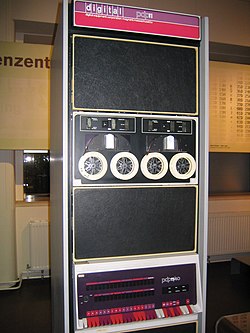
This is consistent with the terminal in the photo above, from page 176H of Prof. Harry Gove's book, of what appears to be a DEC VT-100 , which were typically networked to a DEC

[Right: A DEC VT-100 terminal[10].]

minicomputer (i.e. a mini-mainframe-computer). "DEC" stands for Digital Equipment Corporation, the maker of the powerful PDP-11 and VAX-11 mini- computers which were popular in science laboratories in the 1980s.

• Arizona's Prof. Jull's surprising, misleading and false response to my hacking proposal. A copy of comments I made when I was on Dan Porter's blog, proposing that the radiocarbon dating laboratories may have been duped by a computer hacker (at that early stage I did not claim it was a theory) was sent by Hugh Farey, the anti-authenticist Editor of the BSTS Newsletter[11], to Prof. A.J. Timothy Jull, Director of the Arizona radiocarbon dating laboratory,

[Left: Prof. A.J.T. Jull: Hungarian Academy of Sciences[12]. Prof. Jull was a signatory to the 1989 Nature paper[13] and is in Prof. Gove's photo above of those present at Arizona's first dating of the Shroud.]

and to Oxford's Prof. Christopher Ramsey (see next). Both Profs. Jull and Ramsey, surprisingly replied, and Porter posted those replies to his blog[14].

Prof. Jull's reply to Farey (as copied to my blog [15]) was as follows:

"This is impossible. In our case, the software for the calculations is offline. In any case, the calculation does NOT require software, it was done offline and plotted on a graph, as I recall. Indeed, in 1988 the internet (as we know it today) didn't exist – there was a pre-existing network run by the US government which was quite restricted. Anyway, the machine we used at that time couldn't have been attached to it, and that one still isn't."

First I was (and still am) surprised (indeed amazed) that two Professors, who are Directors of major radiocarbon laboratories, would bother responding to anonymous (Farey said he did not give them my name) blog comments. That itself is evidence that they may have been aware (or suspected), following Linick's assumed suicide (see part #6), that their laboratories' AMS computers may have been hacked by Linick in their 1988 carbon dating of the Shroud.

I don't know what Farey prefaced my comments with, but as I pointed out in my response when I was on Porter's blog (copied to my blog[16]), I said nothing about "the Internet" and Prof. Jull's "the software for the calculations is offline ... the calculation does NOT require software, it was done offline and plotted on a graph" (his emphasis) is not only self-contradictory (if the "calculation does NOT require software," why is "the software for the calculations ... offline"?), it is misleading, and even false. As we saw above, in a 1986 Radiocarbon journal paper, the first author of which was "T.W. Linick" and its second author, "A.J.T. Jull" (see reference [9] below), while the final calibration was "done offline and plotted on a graph," as I did in part #4, the actual "calculation of results for each 15-minute run" was done by the "DEC computer system."

This was confirmed by Prof. Gove's eyewitness account of Arizona's first Shroud dating run, published in 1996:

"The first sample run was OX1 [an oxalic acid control]. Then followed one of the controls. Each run consisted of a 10 second measurement of the carbon-13 current and a 50 second measurement of the carbon-14 counts. This is repeated nine more times and an average carbon-14/carbon-13 ratio calculated. All this was under computer control and the calculations produced by the computer were displayed on a cathode ray screen"[17].
and by David Sox in 1988, presumably obtained from Gove, since Sox wasn't there:
"The calculations were produced on the computer, and displayed on the screen. Even the dendrochronological correction [the calibration] was immediately available. All eyes were on the screen. The date would be when the flax used for the linen relic was harvested."[18]

Prof. Jull must have known this, so his reply to Farey that "the software for the calculations is offline ... the calculation does NOT require software, it was done offline and plotted on a graph" (his emphasis) is not only self-contradictory, but misleading and false.

However, from Prof. Ramsey's reply to Farey (see next), where he wrote, "Age calculation was done offline ...," I will charitably assume that by "calculations," Prof. Jull was referring not to the computer's calculation that Gove and Sox wrote about, but to the "offline" further processing, including calibration, of those computer calculations. If so, then while what Prof. Jull wrote in his reply above would not be deliberately false, it would still be difficult not to conclude that Jull was being deliberately misleading. That is because Prof. Jull must have known that it was "the calculations produced by the computer" which I was alleging had been hacked, not the further processing "offline" of those computer "calculations."

In which case this would itself be further evidence for my theory that the the radiocarbon laboratories were duped by a computer hacker (allegedly Timothy W. Linick). That is, following Linick's `suicide' on 4 June 1989, a little over three months after the 16 February 1989 Nature paper which claimed that the Shroud was "mediaeval ... AD 1260-1390"[19] appeared, Arizona laboratory leaders (of which Prof. Jull was not then one) may have discovered evidence that Linick had hacked Arizona's dating. If so, they would presumably not have been able to explain how Linick could have also hacked Zurich's and Oxford's datings. Which would in turn explain why Jull (and Ramsey-see next) emphasised that none of the three laboratories' AMS computers were online via "the Internet," which I hadn't mentioned. In which case the laboratories may have assumed that the Shroud was medieval after all and Linick's hacking of Arizona's dating made no difference to the final result. What other explanation is there for Prof. Jull's (and Prof. Ramsey's - see next) strange defensiveness, replying (and promptly at that) to an anonymous blogger's comments, misleadingly referring to "calculations ... offline," which are clearly irrelevant to my hacker claim, and going on at length about "the Internet" about which I said nothing?

• Oxford's Prof. Ramsey's surprising, misleading and false response to my hacking proposal. My surprise that Prof. Jull had responded to an anonymous (to him) comment of mine on Dan Porter's blog turned to amazement when my further reading of those comments revealed that the Director of the Oxford radiocarbon dating

[Right: Prof. Christopher Bronk Ramsey[20, 21], who as "C.R. Bronk" (for his original name Christopher Ramsey Bronk[22]) was also one of the signatories to the 1989 Nature paper[23].]

laboratory, Prof. Christopher Ramsey, had also responded to my comment sent to him by Farey, as follows:

"Yes – I agree with all that Tim [Jull] says. This would seem to be a suggestion from someone who does not know what computers were like in the 1980s. In the case of Oxford the AMS had no connection to any network (and indeed even today our AMS control computers have no network connections). The software was very simple just outputting counts of 14C and currents measured. Age calculation was done offline and could just be done with a calculator, or by a simple program into which you typed the numbers from the AMS"[24]

The first question is, how did Ramsey know "all that Tim [Jull] says"? Did Farey, having received Jull's response, email it to Ramsey for his added response? Or did Farey send my comments to both Jull and Ramsey separately at the same time and one of them contacted the other to present a united front?

Ramsey states that he agrees "with all that Tim [Jull] says," despite Jull's "...the software for the calculations is offline. ... the calculation does NOT require software" being at least self-contradictory and misleading (see above).

Like Jull, Ramsey also strangely (if not suspiciously) downplayed the role of the AMS computer. Indeed some on Porter's blog (including Porter himself) took Prof. Ramsey to be claiming that the AMS computer was little better than a calculator, and Porter even questioned whether it was "programmable"! When, as we have seen, both Jull and Ramsey knew that it was a "DEC computer system," probably either a PDP-11[left][25], or more likely a VAX-11 [below right][26], both of which were powerful, programmable, and therefore hackable computers! In fact as we shall see in the next part #8, some versions of VMS, the operating system of DEC PDP-11/VAX-11 computers, had a bug which made them vulnerable to hacking, and in fact many were hacked.

Moreover, in his reply above, Prof. Ramsey's, "This would seem to be a suggestion from someone who does not know what computers were like in the 1980s" is not only false, it is again difficult not to conclude that it is deliberately false, given that Ramsey, like Jull, knew that the AMS computer was a very powerful "DEC computer system." In fact, as I pointed out in my reply to Ramsey's response on Porter's blog, copied to my blog[27], far from me being "someone who does not know what computers were like in the 1980s":

"I was one of the first to have a personal computer in 1980. I pioneered the introduction of computers into Health Department of WA [Western Australia] hospitals in the mid-to late 1980s and in the late 1980s/early 1990s, I was the Systems Administrator of a network of 7 hospitals' UNIX systems."

Prof. Ramsey's ad hominem response cannot be explained by a lack of computer literacy, since he is the author of OxCal, a radiocarbon dating calibration computer program[28]. So, knowing that the AMS computers at the three laboratories were very powerful DEC minicomputers, what was Ramsey's point in claiming, falsely, that I was "someone who does not know what computers were like in the 1980s"? It is difficult not to conclude that Prof. Ramsey was deliberately trying to hide the fact that the AMS computers were indeed hackable. Which would be further evidence that after Linick's `suicide,' Arizona laboratory may have discovered evidence that its AMS computer, and hence its dating, had been hacked, and also that Zurich and Oxford's AMS computers may have been hacked.

Prof. Ramsey's "The software was very simple just outputting counts of 14C and currents measured" confirms my key point that there was "software" between the Shroud samples and the "outputting counts of 14C" displayed on the AMS computer's control console terminal. And being "software" it was hackable. That the "software was very simple" is irrelevant, so why mention it? Again Prof. Ramsey's defensiveness suggests that he has something to hide.

As we saw above Prof. Ramsey's "Age calculation was done offline" clarified what Prof. Jull probably meant by "calculation." But as with Jull, it is irrelevant that the "counts of 14C" were further processed "offline". Prof. Ramsey, like Prof. Jull, must be highly intelligent, and so they would surely know that if there was a hacking it would be in those "counts of 14C" before they were further processed offline. Indeed, Prof. Ramsey's "...a simple program into which you typed the numbers from the AMS," tacitly admits that the "numbers from the AMS" are from which the dating follows. If the Shroud samples' "numbers from the AMS" had been hacked, the further offline processing would inevitably reflect that hacked dating.

Nevertheless I did accept Profs. Jull and Ramsey's assurance that the AMS computers at Arizona and Oxford (and presumably also at Zurich) were never online. This however was not a problem for my theory because I had previously stated that if those computers never were online, they could still have been hacked manually and locally. Which in fact had been an alternative from the outset (see 22Feb14 and 07Mar14).

Continued in part #8 of this series.

Notes
1. This post is copyright. Permission is granted to quote from any part of this post (but not the whole post), provided it includes a reference citing my name, its subject heading, its date, and a hyperlink back to this post. [return]
2. Damon, P.E., et al., 1989, "Radiocarbon Dating of the Shroud of Turin," Nature, Vol. 337, 16th February, pp.611-615, p.611. [return]
3. Jull, A.J.T. & Suess, H.E., 1989, "Timothy W. Linick," Radiocarbon, Vol 31, No 2. [return]
4. "Karl Koch (hacker)," Wikipedia, 27 February 2016. [return]
5. Gove, H.E., 1996, "Relic, Icon or Hoax?: Carbon Dating the Turin Shroud," Institute of Physics Publishing: Bristol UK, p.176H. [return]
6. Gove, 1996, p.264. [return]
7. Ibid. [return]
8. Jull & Suess, 1989. [return]
9. T.W., Linick, A.J.T. Jull, L.J. Toolin, and D.J. Donahue, 1986, "Operation of the NSF-Arizona accelerator facility for radioisotope analysis and results from selected collaborative research projects," Radiocarbon, Vol. 28, No. 2a, pp.522-533, p.524. [return]
10. "VT100," Wikipedia, 16 January 2016. [return]
11. Farey, H., 2013, "Editorial - by Hugh Farey," BSTS Newsletter, No. 78, December. [return]
12. "Prominent guest researchers arrive in Hungary," Hungarian Academy of Sciences, 2013 (no longer online). [return]
13. Damon, 1989, p.611. [return]
14. "Comment Promoted: On the Hacking Hypothesis," Shroud of Turin Blog, March 9, 2014. [return]
15. Jones, S.E., 2014, "Were the radiocarbon dating laboratories duped by a computer hacker?: My replies to Dr. Timothy Jull and Prof. Christopher Ramsey," The Shroud of Turin blog, March 13. [return]
16. Jones, 2014. [return]
17. Gove, 1996, p.264. [return]
18. Sox, H.D., 1988, "The Shroud Unmasked: Uncovering the Greatest Forgery of All Time," The Lamp Press: Basingstoke UK, p.147. [return]
19. Damon, 1989, p.611. [return]
20. "Professor Christopher Ramsey" Merton College, Oxford, 2014. [return]
21. "Christopher Bronk Ramsey," Wikipedia, 25 December 2015. [return]
22. Bronk, C.R., 1987, "Accelerator Mass Spectrometry for Radiocarbon Dating: Advances in Theory and Practice," PhD Dissertation University of Oxford. [return]
23. Damon, 1989, p. 611. [return]
24. Jones, 2014. [return]
25. "PDP-11," Wikipedia, 21 March 2016. [return]
26. "VAX," Wikipedia, 31 March 2016. [return]
27. Jones, 2014. [return]
28. Ramsey, C.B., 2014, "OxCal," Oxford Radiocarbon Accelerator Unit, 24 May. [return]

Posted 29 March 2016. Updated 19 March 2026.

Wednesday, March 23, 2016

Colour #12: The man on the Shroud: The evidence is overwhelming that the Turin Shroud is Jesus' burial sheet!

COLOUR #12

Copyright © Stephen E. Jones[1]

This is part #12, "The man on the Shroud: Colour," of my series, "The evidence is overwhelming that the Turin Shroud is Jesus' burial sheet!" See the Main index for more information about this series.

[Main index #1] [Previous: Faint #11] [Next: Non-traditional #13]


  1. The man on the Shroud #8
    1. Colour #12

Introduction. The colour of the image of the man on the Shroud is a uniform straw-yellow[2].

[Above (enlarge): "Micrograph taken at the image area of the right eye at 32x magnification."[3]. As can be seen, the straw-yellow image colour is uniform against the lighter flax fibril background.]

Uniform. The body image lies only on the very top of those Shroud fibres it has modified[4] (see future part "superficial"). All the image portions of the fibres show a uniform straw-yellow coloration[5]. The colour is that of dehydrated oxidised cellulose in linen fibres[6]. Microdensitometric measurements of Shroud color photomicrographs found that the yellowing of any given fibril was the same of any other yellowed fibril on the Shroud[7]. That is, body image fibrils over the entire Shroud are basically identical to each other in their straw-yellow color[8]. Each yellowed fibre is yellowed to the same extent as any other image fibre[9]. There was no graduating difference in yellowness of the image fibres[10]. Each image fibre held the same quantity of yellowness[11].

Areal density image. If every topmost fiber of yellowed threads contained the same shade of yellow, then what caused the difference in the shading of the image[12]? The difference in the shading of

[Above (enlarge):

"areal density. The elements that make up the shroud image are all the same color. Like a halftone image all the `dots are the same color, more where its darker and less where its lighter. In the case of the Shroud the fibers are a uniform yellow of oxidized cellulose."[13].]

yellow from one area of the image to another was dependent on the number of yellowed fibers in each area[14]. If one image area was darker than the other, that area would contain more yellowed fibers[15]. It is similar to the half-tone prints in newspaper photos, where black is made by black ink dots bunched together, and gray is made by black ink dots interspersed with white areas[16]. The darker an area, the more dots in it[17]. This shows that the image seen at the macroscopic level is an areal density image and not a pigment concentration image[18]. Shading is not accomplished by varying the color but by varying the number of colored fibers per unit area at the microlevel[19]. The darker portions of the image were not due to a variation of the degree of the yellowing of the fibrils, but rather to the presence of more yellowed fibrils per unit area[20]. Any differences in intensity between different parts of the body image are due solely to the number of yellow-colored fibrils concentrated in a given area[21]. Although parts of the body image may appear to be darker, it is not due to them having a darker yellow coloring, but rather they have a greater number of uniformly colored fibrils in those locations[22].

Digital. All the colored fibers are uniformly colored, that is, an exposed fiber is either colored or not colored[23]. Yellowed image fibers lie alongside white non-image fibers[24]. The Shroud image colour information is therefore digital, with only two states: on-off[25], as in modern computer technology. Not analogue[26], with continuously varying information, as in a painting. Optical engineer, Kevin Moran examined by microscope Shroud fibres attached to the 27 sticky tapes which Max Frei (1913–83 had pressed into the Shroud in 1978[27]. Moran dubbed the Shroud's image fibres, "pixels, similar to a TV screen. ... darker and lighter shades are not the result of more or less `paint but rather a greater concentration of dehydrated fibers, ie. Pixelization"[28]:

"Because of my interest in how the image was formed, I have examined the image-forming pixels or segments of the fibre that have the darker yellowing. I have dubbed the elements 'pixels' to draw attention to the fact that they are optically terminated. They are very sharply defined at their ends. They are not diffused spots that would be seen if they were dyed or chemically reacted, or a thermal burn. They are most certainly not made by pigment contact"[29]
Moran further noted that under the microscope, "where the ... image ...

[Above (enlarge): Photomicrograph taken by Kevin Moran of 15 micron (15 thousandth of a millimetre) diameter Shroud fibres attached to one of Max Frei's sticky tapes[30]. As can be seen, the boundaries between the image (yellow) and non-image fibres are sharp, about 1 micron wide. Note that the image fibres are uniformly yellow, even at this microscopic scale. Note also that where a non-image fibre crossed over an image fibre, the non-image fibre became the same uniform yellow image colouring.]

fibre meets the ... nonimage ... fibre looks like a precision line formed on a modern semiconductor":

"Since the linen fibres are some 10 to 30 microns in diameter and appear as smooth fibre optics, the section where the darkened [i.e. image] fibre meets the clear [i.e. nonimage] fibre looks like a precision line formed on a modern semiconductor."[31]
As Ian Wilson commented, "This is something completely outside any conceivable technology, medieval or modern"[32]. While Wilson may be overstating it that this is outside of modern technology, it certainly is completely outside of 14th century technology, when the Shroud first appeared in undisputed history in 1355, at Lirey, France.

Problem for the forgery theory. (see previous three: #9, #10 & #11) . The uniformity of color of the body image fibers is further evidence against the body image being a painting[33]. To provide variation in colour an artist varies the concentration of an applied pigment, that is, a pigment concentration gradient[34]. But the Shroud's image's uniform straw-yellow colour means it not a pigment concentration gradient but an areal density image[35]. An artist would have to monitor the number of fibers he paints per unit area of his painting while visualizing in his mind's eye the macroscopic image he is trying to create[36]. A single fiber on the Shroud is about half the thickness of an average human hair, putting severe restrictions on the size of the artist's brush and the time required to produce the finished painting[37]. Because the many fibrils that make up a single thread are too fine to be distinguished by an unaided human eye, and because each fibril has been individually encoded with color, to see them a painter would need a microscope, several centuries before that instrument was invented[38]. Nor is the uniform straw-yellow colour of the Shroud image evidence for a dry powder contact transfer process[39]. There is no evidence on the Shroud of the powder particulates required to produce the image[40]. Moreover, the Shroud contains, conservatively, thousands (if not millions) of individual body-image fibrils, and each fibril is encoded with a uniform intensity of color[41] Someone applying powdered pigment onto a cloth with a hand-held dauber and/or rubbing powder on woven linen could never achieve this uniform intensity on all individual image fibrils[42]. In fact, experiments involving powder rubbing have shown that a uniform application of powder cannot be obtained on even one fibril[43]. Let alone with the precision of a "line formed on a modern semiconductor" (see above). It goes without saying that a medieval forger could not by any technology of his time selectively colour individual linen fibres with a precision of 1 micron! Therefore, by this evidence alone, all Shroud medieval forgery theories are rendered false!

Conclusion. So even the colour of the image of the man on the Shroud is part of the overwhelming evidence that the Turin Shroud is Jesus' burial sheet! That the `terminator' line where the image part of a fibril meets the non-image part of the same fibril "looks like a precision line formed on a modern semiconductor," is alone proof beyond

[Above: Close-up of a photomicrograph of the ~1 micron wide `terminator' line between the image and non-image part of the same fibril from the Shroud[44], showing that where a different non-image fibril crossed an image fibril, it was coated with the image!]

reasonable doubt that the Shroud is not a medieval, or earlier, forgery, because before the microscope was invented in the 1600s, no one could even see linen fibrils, let alone colour them. But as leading anti-Jesus' burial sheetists Fr. Herbert Thurston (1856–1939) and Steven D. Schafersman (quoted approvingly by Joe Nickell), have stated, either the Shroud is "a product of human artifice" or "the image is that of Jesus":

"As to the identity of the body whose image is seen on the Shroud, no question is possible. The five wounds, the cruel flagellation, the punctures encircling the head, can still be clearly distinguished ... If this is not the impression of the Christ, it was designed as the counterfeit of that impression. In no other person since the world began could these details be verified" (my emphasis)[45]

"As the (red ochre) dust settles briefly over Sindondom, it becomes clear there are only two choices: Either the shroud is Jesus' burial sheet (naturally or supernaturally produced by the body of Jesus) or it is a product of human artifice. Asks Steven Schafersman: `Is there a possible third hypothesis? No, and here's why. Both Wilson[46] and Stevenson and Habermas[47] go to great lengths to demonstrate that the man imaged on the shroud must be Jesus Christ and not someone else. After all, the man on this shroud was flogged, crucified, wore a crown of thorns, did not have his legs broken, was nailed to the cross, had his side pierced, and so on. Stevenson and Habermas even calculate the odds as 1 in 83 million that the man on the shroud is not Jesus Christ (and they consider this a very conservative estimate)[48]. I agree with them on all of this. If the shroud is Jesus' burial sheet, the image is that of Jesus.'" (my emphasis)[49]
And since no medieval human artificer could have even seen linen fibrils on the Shroud which are ~15 microns (15/1000ths of a millimetre) in diameter, let alone selectively colour thousands of them, the Shroud is not "a product of human artifice." Therefore, "the image is that of Jesus"!

Continued in part #13 of this series.

Notes
1. This post is copyright. Permission is granted to quote from any part of this post (but not the whole post), provided it includes a reference citing my name, its subject heading, its date, and a hyperlink back to this post. [return]
2. Adler, A.D., 2000a, "Chemical and Physical Aspects of the Sindonic Images," in Adler, A.D. & Crispino, D., ed., 2002, "The Orphaned Manuscript: A Gathering of Publications on the Shroud of Turin," Effatà Editrice: Cantalupa, Italy, pp.11-27, 15; Adler, 2000b, p.116. [return]
3. Lavoie, G.R., 2000, "Resurrected: Tangible Evidence That Jesus Rose from the Dead," [1998], Thomas More: Allen TX, p.58. [return]
4. Adler, A.D., 1999, "The Nature of the Body Images on the Shroud of Turin," in Adler & Crispino, 2002, pp.103-112, 105; Adler, 2000a, p.15; Adler, A.D., 2000b, "The Shroud Fabric and the Body Image: Chemical and Physical Characteristics," in Adler & Crispino, 2002, pp.113, 116; Antonacci, M., 2000, "Resurrection of the Shroud: New Scientific, Medical, and Archeological Evidence," M. Evans & Co: New York NY, p.36; Lavoie, 2000, p.62; Schwalbe, L.A. & Rogers, R.N., 1982, "Physics and Chemistry of the Shroud of Turin: Summary of the 1978 Investigation," Reprinted from Analytica Chimica Acta, Vol. 135, No. 1, 1982, pp.3-49, Elsevier Scientific Publishing Co: Amsterdam, p.10; Wilson, I. & Schwortz, B., 2000, "The Turin Shroud: The Illustrated Evidence," Michael O'Mara Books: London, p.74. [return]
5. Carter, G.F., 1982, "Formation of the Image on the Shroud of Turin by x-Rays: A New Hypothesis," in Lambert, J.B., ed., 1984, "Archaeological Chemistry III: ACS Advances in Chemistry, No. 205," American Chemical Society, Washington D.C., pp.425-446, 428; Adler, 1999, pp.104-105; Adler, 2000a, p.15; Adler, 2000b, p.116; Antonacci, 2000, p.36. [return]
6. Heller, J.H., 1983, "Report on the Shroud of Turin," Houghton Mifflin Co: Boston MA, p.199; Adler, 1999, p.105. [return]
7. Jumper, E.J., Adler, A.D., Jackson, J.P., Pellicori, S.F., Heller, J.H., Druzik, J.R., in Lambert, 1984, "A Comprehensive Examination of the Various Stains and Images on the Shroud of Turin," pp.447-476, 451; Antonacci, 2000, p.36. [return]
8. Antonacci, 2000, p.36. [return]
9. Lavoie, 2000, p.63. [return]
10. Ibid. [return]
11. Ibid. [return]
12. Lavoie, 2000, pp.63-64. [return]
13. Schneider, R., 2015, "The Shroud of Turin an Enduring Mystery – Part 4: Skeptics & Image Formation," Slide 13. [return]
14. Lavoie, 2000, p.64. [return]
15. Lavoie, 2000, p.64. [return]
16. Case, T.W., 1996, "The Shroud of Turin and the C-14 Dating Fiasco," White Horse Press: Cincinnati OH, p.22. [return]
17. Lavoie, 2000, p.64. [return]
18. Adler, 1999, p.105. [return]
19. Ibid; Adler, 2000a, p.15. [return]
20. Jumper, et al., in Lambert, 1984, p.451. [return]
21. Antonacci, 2000, p.36. [return]
22. Antonacci, 2000, p.36. [return]
23. Adler, 1999, p.105. [return]
24. Lavoie, 2000, p.63. [return]
25. "Digital data," Wikipedia, 24 March 2016. [return]
26. "Analog signal," Wikipedia, 5 March 2016. [return]
27. Moran, K.E., 1995, "Observations by Microscopy of the Sticky Tape Samples Taken from the Shroud by Dr. Max Frei in 1978," British Society for the Turin Shroud Newsletter, No. 41, September, pp.12-13. [return]
28. "Department of Physics," Shroud of Turin Education Project, 2000. [return]
29. Moran, K., 1995, "Observations by Microscopy of the Sticky Tape Samples Taken from the Shroud by Dr. Max Frei in 1978," British Society for the Turin Shroud Newsletter, No. 41, September, pp.12-13. [return]
30. Moran, K.E., 1999, "Optically Terminated Image Pixels Observed on Frei 1978 Samples," Shroud.com, pp.1-10, 8. [return]
31. Wilson & Schwortz, 2000, p.74; Moran, 1995, p.14. [return]
32. Wilson & Schwortz, 2000, p.74. [return]
33. Adler, 2000a, p.15. [return]
34. Ibid. [return]
33. Ibid. [return]
34. Ibid. [return]
35. Adler, 2000b, p.113. [return]
36. Adler, 2000a, p.15. [return]
37. Ibid. [return]
38. Antonacci, 2000, p.36. [return]
39. Adler, 2000a, p.15. [return]
40. Ibid. [return]
41. Antonacci, 2000, p.74. [return]
42. Ibid. [return]
43. Ibid. [return]
44. Moran, 1999, p.8. [return]
45. Thurston, H., 1903, "The Holy Shroud and the Verdict of History," The Month, CI, p.19, in Wilson, I., 1979, "The Shroud of Turin: The Burial Cloth of Jesus Christ?," [1978], Image Books: New York NY, Revised edition, p.52. [return]
46. Wilson, 1979, pp.51-53. [return]
47. Stevenson, K.E. & Habermas, G.R., 1981, "Verdict on the Shroud: Evidence for the Death and Resurrection of Jesus Christ," Servant Books: Ann Arbor MI, pp.121-129. [return]
48. Stevenson. & Habermas, 1981, p.128. [return]
49. Schafersman, S.D., "Science, the public, and the Shroud of Turin," The Skeptical Inquirer, Vol. 6, No. 3, Spring 1982, pp.37-56, p.42 in Nickell, J., 1987, "Inquest on the Shroud of Turin," [1983], Prometheus Books: Buffalo NY, Revised, Reprinted, 2000, p.141. [return]

Posted 23 March 2016. Updated 3 May 2025.

Friday, March 18, 2016

Chronology of the Turin Shroud: 31-176

Chronology of the Turin Shroud: 31-176

© Stephen E. Jones[1]

This is my "Chronology of the Turin Shroud: 31-176," which is part #2 of my "Chronology of the Turin Shroud" series. See the Index, part #1 for more information about this series. These parts of my "Chronology of the Turin Shroud" series are a work in progress. It will take a lot of time researching and writing each part, so after I have posted it, I will continue updating it in the background and report the updates in the Editorials of my Shroud of Turin News.

This series has been superseded by my, "Chronology of the Turin Shroud: AD 30 to the present" series.

[Index] [Previous: AD 30] [Next: 177-]


c. 31 Healing and conversion of King Abgar V of Edessa. According to the early church historian, Eusebius of Caesarea (c. 260–340), Edessa's King Abgar (whom he calls Prince Agbarus), heard of Jesus' healing miracles and sent Him a letter by a courier, Ananias, asking to be healed of an incurable, wasting disease[2]. According to Eusebius, Jesus replied by letter carried back by Ananias, saying that He could not come but after His resurrection and ascension, He would send one of His disciples to heal Abgar and bring eternal life to him and his subjects[3]. After Jesus' resurrection and ascension in AD 30 (see part #1), the Apostle Thomas sent Thaddeus, one of the seventy (Lk 10:1-20) to Abgar in Edessa and through him Abgar was healed and converted to Christianity, along with many Edessans[4].

[Above (enlarge)[5]: King Abgar V (c.25 BC-AD 50) of Edessa is depicted in this 10th century icon at Saint Catherine's Monastery, Mount Sinai[6], receiving the Image of Edessa/Mandylion (the Shroud "four-doubled" (tetradiplon)) from Jesus' disciple Thaddeus[7]. Abgar's face is that of Emperor Constantine VII Porphyrogenitus (r. 913-959)[8], to commemorate the arrival of the Mandylion/Image of Edessa (Shroud) in Constantinople on 15 August 944[9].]

Writing in about AD 325[10], Eusebius stated that he had read in Edessa's archives Abgar's letter to Jesus and Jesus' reply letter to Abgar, written in Syriac (i.e. Aramaic)[11]. But Eusebius did not mention anything about Abgar seeing or receiving an image of Jesus from Ananias or Thaddeus[12]. And as we shall see in a future part, while Abgar V may have been healed and converted to Christianity through the preaching of Thaddeus (Addai in Syriac[13]), the Abgar-Jesus correspondence may have been a pious fraud[14] inserted into Edessa's archives during the reign of Abgar VIII (177-212)[15].

c. 42 Apostle John left Jerusalem. Paul mentions in Galatians 2:9 that he met with the "pillars" of the Jerusalem church which included the Apostles Peter and John. That was probably Paul's first meeting with the Jerusalem church leadership mentioned briefly in Acts 11:30[16], which was before the death in 44 of Herod Agrippa I (11BC–44AD) (Acts 12:20-23). Due to the severe persecution by Agrippa in which John's brother James was executed (Acts 12:1-3), the Apostles had left Jerusalem by 44[17]. Neither Peter or John are mentioned in Paul's second meeting with the Jerusalem church leaders in Acts 15, which was in 48-49[18], indicating that they had left Jerusalem by then[19]. On the assumption that the Apostle John was "the servant of the priest" to whom Jesus gave His Shroud after His resurrection (see part #1), I assume that John took the Shroud with him out from Jerusalem in about 42.

50 Death of Abgar V. Abgar V died in 50[20]. He was succeeded by his infant son Ma'nu V (50-57)[21], who was in turn succeeded by another of Abgar's sons, Ma'nu VI (57–71)[22]. Ma'nu VI reverted to paganism[23] and persecuted the Edessan Christians[24]. According to Ian Wilson's reconstruction (which I don't accept), the Image of Edesss/Mandylion (Shroud) was then hidden with a tile later called the Keramion[25], in a niche in the wall above Edessa's west gate[26], where according to the tenth century "Story of the Image of Edessa"[27], it was rediscovered in 525 (see future parts) after a major flood of Edessa's river Daisan uncovered its hiding place[28].

c. 60 Apostle John in Ephesus. According to early church tradition, the apostle John wrote his Gospel while residing in Ephesus[28]. Clement of Alexandria (c. 150–215) wrote that the Apostle John returned to Ephesus after the death of the Emperor Domitian (81–96)[29]. Irenaeus (c. 130-202) wrote that John remained at Ephesus until the time of Emperor Trajan (r. 98-117)[30]. There is no information about when John first took up residence in Ephesus[31]. However, there is evidence that the Gospel of John was written in the 60s[32]. The earliest known portion of the New Testament, papyrus p52, is a fragment containing Jn 18:31–33[33]. As with the other gospels, there is no mention of the destruction of Jerusalem in AD 70, indicating they either were all written before AD 70, or long afterward[34]. But Jn 5:2 refers to "the Sheep Gate" and the "pool ... called Bethesda" in Jerusalem as presently existing:

"Now there is in Jerusalem by the Sheep Gate a pool, in Aramaic called Bethesda, which has five roofed colonnades." (my emphasis).
The natural way to understand this is that they were still existing when John wrote his gospel[35]. But they were not existing after AD 70: the five porches were found in the 1960s by archaeologists, buried beneath the rubble of Jerusalem's destruction[36]. Eusebius recorded that, "the whom Jesus loved, apostle alike and evangelist, even John" lived on in Asia, "directing the churches there"[37]. A Bishop of Ephesus, Polycrates (c. 130–196), wrote that John died in Ephesus[38], and according to Irenaeus it was during the reign of Trajan (see above), that is about the year 100. I assume that John had the Shroud with him at Ephesus from c. 60. I also assume it may be significant that Ephesus (near modern Selçuk, Turkey) and Edessa (modern Sanliurfa, Turkey) are only 1271 kms (789 miles) apart):

[Above (enlarge): Distance between Ephesus (near modern Selçuk) and Edessa (modern Sanliurfa)[39].]

To be continued in part #3, "177-", of this series.

Notes
1. This post is copyright. Permission is granted to quote from any part of this post (but not the whole post), provided it includes a reference citing my name, its subject heading, its date, and a hyperlink back to here. [return]
2. Eusebius, c. 325, "The Ecclesiastical History of Eusebius Pamphilus," Book I, Chapter XIII, Cruse, C.F., transl., 1955, Baker: Grand Rapids MI, Fourth printing, 1966, pp.43-44. [return]
3. Eusebius, p.44. [return]
4. Eusebius, pp.44-47. [return]
5. "Image of Edessa or Holy Mandylion," Digital Journal, 28 March 2012. [return]
6. "Abgar V," Wikipedia, 31 January 2016. [return]
7. Wilson, I., 1979, "The Shroud of Turin: The Burial Cloth of Jesus?," [1978], Image Books: New York NY, Revised edition, 154-155. [return]
8. Wilson, 1979, pp.151,154. [return]
9. Wilson, 1979, pp.116,151,255; Wilson, I., 1998, "The Blood and the Shroud: New Evidence that the World's Most Sacred Relic is Real," Simon & Schuster: New York NY, pp.148,268; Guerrera, V., 2001, "The Shroud of Turin: A Case for Authenticity," TAN: Rockford IL, pp.4-5; Tribbe, F.C., 2006, "Portrait of Jesus: The Illustrated Story of the Shroud of Turin," Paragon House Publishers: St. Paul MN, Second edition, p.24; Wilson, I., 2010, "The Shroud: The 2000-Year-Old Mystery Solved," Bantam Press: London, pp.165,300. [return]
10. Antonacci, M., 2000, "Resurrection of the Shroud: New Scientific, Medical, and Archeological Evidence," M. Evans & Co: New York NY, p.133. [return]
11. Eusebius, pp.44-45, 47; Wilson, 1979, p.127. [return]
12. Scavone, D.C., 1989, "The Shroud of Turin: Opposing Viewpoints," Greenhaven Press: San Diego CA, p.81; Ruffin, C.B., 1999, "The Shroud of Turin: The Most Up-To-Date Analysis of All the Facts Regarding the Church's Controversial Relic," Our Sunday Visitor: Huntington IN, p.54; Guerrera, 2001, p.2. [return]
13. Wilson, 1979, p.128. [return]
14. Markwardt, J., 1998, "Antioch and the Shroud," in Walsh, B.J., ed., 2000, "Proceedings of the 1999 Shroud of Turin International Research Conference, Richmond, Virginia," Magisterium Press: Glen Allen VA, p.94; Markwardt, J.J., 2009, "Ancient Edessa and the Shroud: History Concealed by the Discipline of the Secret," in Fanti, G., ed., "The Shroud of Turin: Perspectives on a Multifaceted Enigma," Proceedings of the 2008 Columbus Ohio International Conference, August 14-17, 2008, Progetto Libreria: Padua, Italy, p.384. [return]
15. Scavone, D.C., 2010, "Edessan sources for the legend of the Holy Grail," Proceedings of the International Workshop on the Scientific approach to the Acheiropoietos Images, ENEA Frascati, Italy, 4-6 May 2010, pp.1-6, p.1. [return]
16. Marshall, I.H., 1980, "The Acts of the Apostles: An Introduction and Commentary," The Tyndale New Testament Commentaries, Inter-Varsity Press: Leicester UK, Reprinted, 1987, pp.204-205. [return]
17. Walker, W., 1959, "A History of the Christian Church," [1918], T. & T. Clark: Edinburgh, Revised, Reprinted, 1963, p.23. [return]
18. Polhill, J.B., "Acts," in Grudem, W., ed., 2007, "The ESV Study Bible," Crossway Bibles: Wheaton IL, p.2114. [return]
19. Culpepper, R.A, 2000, "John, the Son of Zebedee: The Life of a Legend," [1994], T&T Clark: Edinburgh, p49. [return]
20. Wilson, 1979, p.135; Ruffin, 1999, p.54; Wilson, 2010, pp.120, 297. [return]
21. Wilson, 1998, pp.134, 170; Wilson, 2010, p.120. [return]
22. Wilson, 1979, pp.135, 252; Wilson, 1998, p.170; Wilson, 2010, p.120. [return]
23. Wilson, 1979, p.135; Scavone, D.C., "The History of the Turin Shroud to the 14th C.," in Berard, A., ed., 1991, "History, Science, Theology and the Shroud," Symposium Proceedings, St. Louis Missouri, June 22-23, The Man in the Shroud Committee of Amarillo, Texas: Amarillo TX, 1991, pp.171-204, 184. [return]
24. Wilson, 1979, pp.131, 135; Guerrera, 2001, p.3; Wilson, 2010, pp.132, 297. [return]
25. Wilson, 1979, p.132; Wilson, 2010, pp.132-133. [return]
26. Wilson, 1979, pp.136, 138, 252; Wilson, 1998, p.162; Wilson, 2010, pp.131-132. [return]
27. Wilson, 1979, p.138; Wilson, 2010, p.132. [return]
28. Wilson, 1979, pp.138, 254; Morgan, R., 1980, "Perpetual Miracle: Secrets of the Holy Shroud of Turin by an Eye Witness," Runciman Press: Manly NSW, Australia, pp.33-34; Wilson, 1998, p.162; Guerrera, 2001, p.3; Wilson, 2010, pp.132, 142. [return]
28. Kruse, C.G., 2003, "The Gospel According to St. John: An Introduction and Commentary," The Tyndale New Testament Commentaries, Inter-Varsity Press: Leicester UK, p.31. [return]
29. Kruse, 2003, p.31. [return]
30. Ibid. [return]
31. Ibid. [return]
32. Ibid. [return]
33. Morris, L.L., 1971, "The Gospel According to John," The New International Commentary on the New Testament," Eerdmans: Grand Rapids MI, Reprinted, 1984, p.30; Kruse, 2003, p.31. [return]
34. Robinson, J.A.T., 1976, "Redating The New Testament," SCM Press: London, Second Impression, 1977, p.13; Morris, 1971, pp.33-34Morris, 1971, p.30; Kruse, 2003, p.31. [return]
35. Robinson, 1976, p.278; Morris, 1971, pp.33-34. [return]
36. Robinson, 1976, p.278. [return]
37. Stott, J.R.W., 1988, "The Letters of John: An Introduction and Commentary," Tyndale New Testament commentaries, [1964], Inter-Varsity Press: Leicester UK, Revised Edition, Reprinted, 2004, p.43. [return]
38. Tasker, R.V., "John," in Douglas, J.D., et al., eds., 1982, "New Bible Dictionary," [1962], Inter-Varsity Press, Leicester UK, Second edition, Reprinted, 1988, p.602. [return]
39. "Distance between Selçuk and Sanliurfa," Google Maps. [return]

Posted 18 March 2016. Updated 30 April 2025.