Copyright ©, Stephen E. Jones[1][Index: #2, #3, #4, #5, #6, #7, #8, #9, #10 & #11] See "My Hacker Theory in a nutshell."
Introduction. Continuing from my previous series, "My theory that the radiocarbon dating laboratories were duped by a computer hacker," this is part #1 of my concluding summary of the evidence that the 1988 radiocarbon dating of the Shroud of Turin as "mediaeval ... AD 1260-1390"[2] was the result of a computer hacking, allegedly by Arizona radiocarbon dating laboratory physicist Timothy W. Linick (1946-89)[3], aided by German hacker Karl Koch (1965–89)[4], on behalf of the former Soviet Union, through its agency the KGB. I will list the main headings as bullet-points, linking them back to my previous "My theory ..." posts on those topics. In future I will link back to this post whenever I state that "the 1988 radiocarbon dating of the Shroud of Turin as `mediaeval ... AD 1260-1390' was the result of a computer hacking." The next post in this series is part #2.
■ In 1988 the Shroud of Turin was radiocarbon dated to 1260-1390 [#10(1) & #1]. Between May and August 1988[5], three radiocarbon dating laboratories at universities in Arizona, Zurich and Oxford, all using the same new Accelerator Mass spectrometry (AMS) method[6], radiocarbon dated samples that had been cut from the Shroud on 21 April 1988[7]. At a press conference in the British Museum, on 13 October 1988, following leaks that the Shroud had been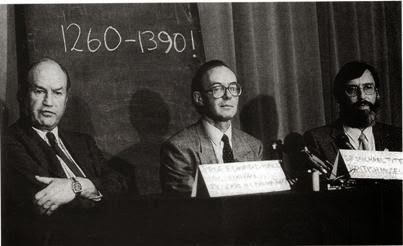 dated "1350"[8], Prof. Edward Hall (Oxford), Dr Robert Hedges (Oxford) [Right[9]], announced that the Shroud's radiocarbon date was "1260-1390!"[10].
■ In 1989 Nature reported that the Shroud was "mediaeval ... 1260-1390." [#10(1) & #1]. In February 1989 the scientific journal Nature reported:
"Very small samples from the Shroud of Turin have been dated by accelerator mass spectrometry in laboratories at Arizona, Oxford and Zurich ... The results provide conclusive evidence that the linen of the Shroud of Turin is mediaeval ... AD 1260-1390 ..."[11].
Signatories to the paper included: "A.J.T. Jull," "T.W. Linick," "C.R. Bronk," "E.T. Hall," "R.E.M. Hedges," "W. Woelfli," and "M.S. Tite."
■ Yet the evidence is overwhelming that the Shroud is authentic [#10(1) & #1]. Yet the evidence as a whole is overwhelming that the Shroud is Jesus' burial sheet[12]. There is abundant historical and  artistic evidence that the Shroud existed well before the earliest radiocarbon date of 1260[13] and indeed all
[Left (enlarge): The Hungarian Pray Codex[14] which has at least "eight telling correspondences" with the Shroud[15], yet is dated 1192-95[16], and so is least 65 years before 1260 and 160 years before 1355!]
the way back to the first century[
17]. So strong is this evidence that even
Prof. Christopher Bronk Ramsey, Director of the Oxford radiocarbon dating laboratory, and a signatory (as "
C.R. Bronk") to the 1989
Nature paper, has admitted:
"There is a lot of other evidence that suggests ... that the Shroud is older than the radiocarbon dates allow ..." (my emphasis)[18].
■ The probability that the Shroud being 1st century has a radiocarbon date of 1260-1390 is "astronomical" [
#10(2) &
#1]
. At the
above British Museum press conference, "those on the platform collectively insisted ... [that] the odds against ... were now `astronomical'" that the Shroud could be 1st century, yet have a "1260-1390" date[
19]. This was confirmed by
Prof. Harry Gove (1922-2009), the unofficial leader of the Shroud radiocarbon dating project[
20], who pointed out that the statistical probability of the Shroud having a radiocarbon date between 1260 and 1390, yet it's actual date being first century, is "about one in a
thousand trillion" (my emphasis)[
21]. That is the equivalent of finding by chance, at the first attempt, a particular grain of sand, 1 mm in diameter[
22] among a thousand trillion (1,000,000,000,000 = 10
12) similar grains of sand, on the surface of a strip of beach ~5.4 metres wide by 145 kilometres

[~90 miles] long[
23]. Which is about the length of the
Ninety Mile Beach in Victoria, Australia, only a part of which is shown
right[
24]. Therefore the 1988 radiocarbon dating of the Shroud as "
1260- 1390"[
25] has effectively
no chance of being correct, given that the Shroud
is authentic (see
above), and therefore first century. Indeed, Prof. Hall stated it was "
totally impossible" (his emphasis) that the Shroud could have a radiocarbon date of 1260-1390, yet its actual date was "AD 100" or less[
26].
■ Conventional explanations of the discrepancy all fail. [#10(2) & #1] Attempts by Shroud pro-authenticists to explain by conventional means the discrepancy between the Shroud being 1st century, yet its radiocarbon date is 1260-1390, all fail.
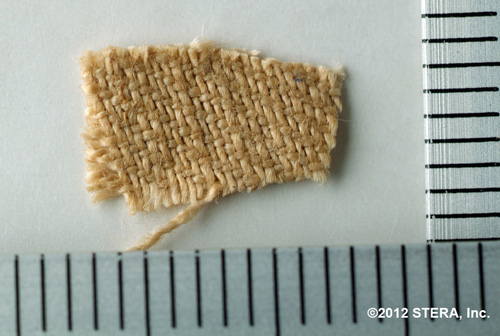
• Carbon contamination. All carbon contamination explanations (including a bioplastic coating) of why the 1st century Shroud has a 1260-1390 radiocarbon date fail, because "79% of the shroud would have been composed of such carbon contamination," but this "is preposterous, as anyone viewing the shroud samples before they were cleaned can attest"[27]. In fact Arizona laboratory still has an undated part of its Shroud sample as it came from Turin, and it has "no evidence for either coatings or dyes, and only minor contamin-ants"[28]. See  photomicro-graph [Left (enlarge) and "Weave: Twill"] taken by pro-authenticist Barrie Schwortz in 2012, of Arizona laboratory's remaining undated part of its Shroud sample[29].
• Invisible reweaving repair with 16th century cotton. Similarly, Benford and Marino's invisible reweaving repair theory requires that the repair be "approximately 60 percent of the C-14 sample consisting of 16th century threads while approximately 40 percent were 1st century in origin"[30]. Oxford laboratory did find some old cotton threads in their sample, but they were only "two or three fibres"[31]. Prof. Hall estimated that it would require "65 per cent of the mass of the shroud ... to give a date of 1350 to a fabric originally dating from the time of Christ" but there was "less than 0.1 per cent" of such contamination in the Shroud (my emphasis)[32]. Benford and Marino claimed that the green colour of the Shroud sample area in the 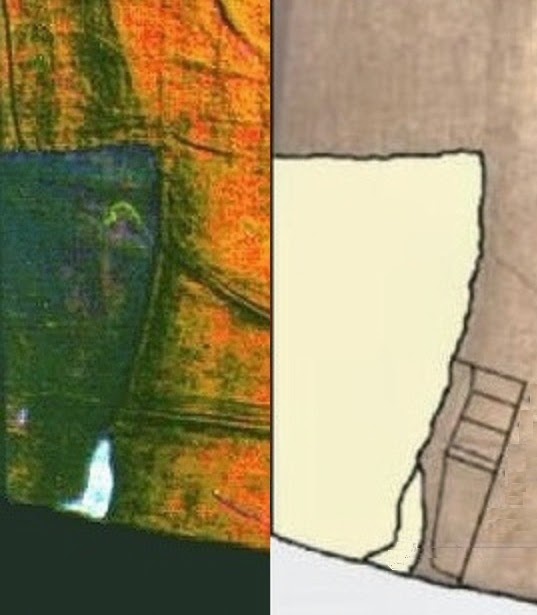 "Blue Quad Mosaic" photograph [Right (enlarge) [33]] supported their theory that the sample area was 60% 16th century cotton[34]. But as can be seen, the wrinkles in the Shroud near the radiocarbon dating sample area (see here) are the same green colour. And as Benford and Marino admitted, "it is possible that the Quad Mosaic's chemical-color signature ... may represent carbon" (my emphasis)[35]. But "carbon" includes all contamination with younger carbon, not only cotton. And since the wrinkles in the Shroud in the sample area are the same green colour, it is likely that both are the result of ordinary contamination by carbon-containing grime, sweat, oils, etc. Particularly since this corner is one of the most contaminated parts of the Shroud, it being one of the corners from which the cloth was held by "hundreds of sweaty hands" at Shroud expositions down through the centuries (#10(1))[36]. Benford and Marino concluded with another frank admission that, "it is impossible to quantify the amount of surface carbon, other contaminates, and/or intruded newer material in the radiocarbon sampling area based upon the Quad Mosaic" (my emphasis)[37]. Moreover, textile expert Mechthild Flury-Lemberg inspected the Shroud as part of its 2002 restoration[38] and she denies there is any evidence of reweaving[39].
• Neutron flux at Jesus' resurrection created new carbon 14. The neutron flux argument was first proposed by Harvard University physicist Thomas J. Phillips in the same issue of Nature which carried the radiocarbon dating of the Shroud paper[40]. Phillips pointed out that "If the shroud of Turin is in fact the burial cloth of Christ" then the resurrection of Jesus' dead body "may also have radiated neutrons" which could "have converted enough 13C to 14C to give an apparent carbon-dated age of 670 years"[41]. Oxford's Dr. Robert Hedges replied in the same issue, that it would be "an amazing coincidence that the neutron dose should be so exactly appropriate to give the most likely date on historical grounds" and that it "implies that the dose has been `fine-tuned' to better than one part in a hundred million" (my emphasis)[42] . Gove echoed Hedges' points and added his own "most devastating argument against Phillips' idea [which] was the fact that the samples were taken at just the right spot on the shroud to produce its historic date. A sample taken closer to the image would have produced an even more modern date-even a date into the future!" (my emphasis) [43].
■ The midpoint of 1260-1390 is 1325 ±65 years[#10(1) & #1][44], which `just happens' to be a mere ~30 years before the Shroud first appeared in undisputed history in Lirey, France, in c. 1355[45]. This is the major flaw in the neutron flux theory, and also of all carbon contamination theories. For a neutron flux or carbon contamination to shift the Shroud's first-century radiocarbon date fourteen centuries into the future, to not just any date, but to ~1325, a mere ~30 years before the Shroud first appeared in undisputed history, would be "a miracle"[46]. And a deceptive miracle by God at that!
■ Fraud is the only remaining viable explanation [#10(2) & #2]. Given that: 1) the Shroud is authentic, according to the overwhelming weight of the evidence (see above), and therefore first century; 2) the probability that the Shroud being first century, yet has a radiocarbon date of 1260-1390 is "astronomical", "about one in a thousand trillion," "totally impossible," indeed "a miracle" (see above); and 3) conventional explanations of the discrepancy of how the first century Shroud can have a 1260-1390 century radiocarbon date all fail (see above); some form of fraud is the only remaining viable explanation:
"... when you have eliminated the impossible whatever remains, however improbable, must be the truth ..."[47]
This is the flip-side
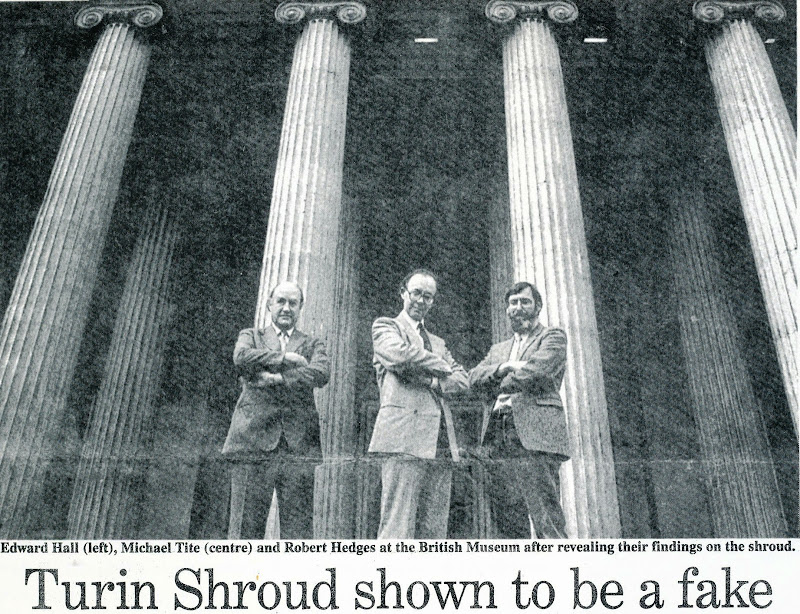
of the assumption by the laboratories [Left (
enlarge)[
48]] that the Shroud
must be a fake because the odds against it being first century
and having a radiocarbon date of 1260-1390 is effectively impossible. Therefore, since the Shroud
is authentic and for the above other reasons, it
must be the radiocarbon date of 1260-1390
itself which was the fake[
49], the result of scientific fraud! The question then is: "what
kind of scientific fraud was it?"
■ Accusations of conventional fraud (e.g. sample-switching) also fail. [#10(2) & #2]. Following the laboratories' report in the scientific journal Nature which claimed that "... the linen of the Shroud of Turin is mediaeval ... AD 1260-1390"[50], some Shroud pro-authenticists saw clearly that since the Shroud is authentic, then "it was the radiocarbon dating, not the Shroud, that must be the fraud"[51]. The foremost  spokesman for this view is the French Roman Catholic deacon Brother Bruno Bonnet-Eymard [Right [52]], of the ultra-conservative "Catholic Counter-Reformation in the Twentieth [now 21st] Century"[53]. The target of Bonnet-Eymard's attack was that, although the cutting of samples from the Shroud on the 21st April 1988 was videotaped, the placing of the samples into their coded canisters was not[54]. Dr. Tite and the Archbishop of Turin, Cardinal Ballestrero (1913-98), took the samples into a private area, out of view of the others and the camera, and put the samples into numbered canisters which were then brought out and presented to the representatives of the three laboratories[55]. This was done to preserve the pretense of blind testing (the Shroud's distinctive weave was easily recognisable by the laboratories[56]). Bonnet-Eymard seized on this as `proof' that Tite had switched the samples, so that the samples which the laboratories thought were from the Shroud were actually from a medieval control sample, while those from a control sample of first-century date was in fact from the Shroud[57].
But
Ian Wilson personally knew Dr. Tite and most of the radiocarbon dating laboratory leaders and he dismissed as "absurd and far-fetched as it is unworthy" accusations that "one or more of these men may have `rigged' the radiocarbon dating" by switching samples[
58]. It is also
highly unlikely that leaders of the radiocarbon dating project like Dr. Tite would commit major scientific fraud by switching control and Shroud samples, since they would have too much to lose if the fraud was discovered[
59], as it
would have been because of the Shroud's distinctive weave[
60]. Besides, since Tite thought the Shroud was medieval[
61] why would he switch samples to ensure the Shroud's radiocarbon date was medieval?
Nevertheless, agnostic pro-authenticist art historian Thomas de Wesselow considers fraud in the Shroud's radiocarbon dating to be a real possibility (albeit by conventional sample-swapping), because of the "1325 ± 65 years" date:
"The third possibility is that a fraud was perpetrated, that genuine Shroud samples were deliberately swapped with cloth of a later date ... Most sindonologists regard these fraud theories as plainly incredible. Some, like Ian Wilson, refuse to contemplate such `unworthy' accusations. However, scientific fraud is by no means unknown, as the editors of science journals are well aware. ... One important consideration weighs in favour of the possibility of deception. If the carbon-dating error was accidental, then it is a remarkable coincidence that the result tallies so well with the date always claimed by sceptics as the Shroud's historical debut. But if fraud was involved, then it wouldn't be a coincidence at all. Had anyone wished to discredit the Shroud, '1325 ± 65 years' is precisely the sort of date they would have looked to achieve" (my emphasis)[62].
Those like Bonnet-Eymard who claimed that there had been fraud in the radiocarbon dating of the Shroud had
correctly reasoned that that since the Shroud
is authentic, there
had to have been fraud for the first century Shroud to `just happen' to date to shortly before 1355, when
Bishop Pierre d'Arcis had wrongly claimed in his
1389 Memorandum that the Shroud had been painted 34 years before[
63]. However, they all assumed that the fraud had to be by conventional sample-switching[
64]. No one seems to have considered that there is another type of fraud that the
fully computerised AMS radiocarbon dating process[
65] was vulnerable to, and which was rife in the 1980s, namely
computer hacking!
Continued in part #2.
Notes
1. This post is copyright. Permission is granted to quote from any part of this post (but not the whole post), provided it includes a reference citing my name, its subject heading, its date, and a hyperlink back to this post. [return]
2. Damon, P.E., et al., 1989, "Radiocarbon Dating of the Shroud of Turin," Nature, Vol. 337, 16th February, pp. 611-615, p. 611. [return]
3. Jull, A.J.T. & Suess, H.E., 1989, "Timothy W. Linick," Radiocarbon, Vol 31, No 2. [return]
4. "Karl Koch (hacker)," Wikipedia, 5 May 2015. [return]
5. Guerrera, V., 2001, "The Shroud of Turin: A Case for Authenticity," TAN: Rockford IL, p.131. [return]
6. Wilson, I., 1991, "Holy Faces, Secret Places: The Quest for Jesus' True Likeness," Doubleday: London, p.178. [return]
7. Wilson, I., 1998, "The Blood and the Shroud: New Evidence that the World's Most Sacred Relic is Real," Simon & Schuster: New York NY, pp.5-6. [return]
8. Gove, H.E., 1996, "Relic, Icon or Hoax?: Carbon Dating the Turin Shroud," Institute of Physics Publishing: Bristol UK, p.279. [return]
9. Wilson, 1998, p.7 & pl.3b. [return]
10. Wilson, 1991, pp.8-9. [return]
11. Damon, 1989, p.611. [return]
12. Adams, F.O., 1982, "Sindon: A Layman's Guide to the Shroud of Turin," Synergy Books: Tempe AZ, p.86; Rinaldi, P.M., 1988, "For the Holy Shroud, the Hour of Truth," April, in McCrone, W.C., 1999, "Judgment Day for the Shroud of Turin," Prometheus Books: Amherst NY, p.243; Stevenson, K.E. & Habermas, G.R., 1990, "The Shroud and the Controversy," Thomas Nelson: Nashville TN, p.60; Case, T.W., 1996, "The Shroud of Turin and the C-14 Dating Fiasco," White Horse Press: Cincinnati OH, p.27; Guscin, M., 1998, "The Oviedo Cloth," Lutterworth Press: Cambridge UK, p.76; Antonacci, M., 2000, "Resurrection of the Shroud: New Scientific, Medical, and Archeological Evidence," M. Evans & Co: New York NY, p.6. [return]
13. Wilson, 1998, p.141; Maloney, P.C., "Researching the Shroud of Turin: 1898 to the Present: A Brief Survey of Findings and Views," in Minor, M., Adler, A.D. & Piczek, I., eds., 2002, "The Shroud of Turin: Unraveling the Mystery: Proceedings of the 1998 Dallas Symposium," Alexander Books: Alexander NC, p.33. [return]
14. Berkovits, I., 1969, "Illuminated Manuscripts in Hungary, XI-XVI Centuries," Horn, Z., transl., West, A., Irish University Press: Shannon, Ireland, plate III. [return]
15. de Wesselow, T., 2012, "The Sign: The Shroud of Turin and the Secret of the Resurrection," Viking: London, pp.178-180. [return]
16. Wilson, I., 1986, "The Evidence of the Shroud," Guild Publishing: London, pp.114-115; Wilson, 1991, pp.150-151; Wilson, 1998, p.146; Guerrera, 2001, pp.104-105; de Wesselow, 2012, p.178. [return]
17. Moroni, M., "Pontius Pilate's Coin on the Right Eye of the Man in the Holy Shroud, in the Light of the New Archaeological Findings," in Berard, A., ed., 1991, "History, Science, Theology and the Shroud," Symposium Proceedings, St. Louis Missouri, June 22-23, 1991, The Man in the Shroud Committee of Amarillo, Texas: Amarillo TX, pp.275-301; "Turin shroud 'older than thought'," BBC, 31 January, 2005; Rogers, R.N., 2008, "A Chemist's Perspective on the Shroud of Turin," Lulu Press: Raleigh, NC, pp.42-43, 129; Tornielli, A., 2013, "New experiments on Shroud show it's not medieval," Vatican Insider, 26 March; Wilson, I., 2010, "The Shroud: The 2000-Year-Old Mystery Solved," Bantam Press: London, pp.73-74; Fanti, G. & Malfi, P., 2015, "The Shroud of Turin: First Century after Christ!," Pan Stanford: Singapore, pp.204, 207, 246. [return]
18. Ramsey, C.B., 2008, "Shroud of Turin," Version 152, Oxford Radiocarbon Accelerator Unit, 16 June 2015. [return]
19. Wilson, 1998, pp.6-7. [return]
20. Antonacci, 2000, p.192. [return]
21. Gove, 1996, p.303. [return]
22. "In terms of particle size as used by geologists, sand particles range in diameter from 0.0625 mm (or 1⁄16 mm) to 2 mm. An individual particle in this range size is termed a sand grain." ("Sand," Wikipedia, 3 December 2014). [return]
23. By my calculations, the 1 mm diameter cross-section of a spherical grain of sand, i.e. 0.001 m. diameter, has a radius of 0.0005 m. Area of a circle = πr2, therefore the area of 1 grain of sand of 1 mm diameter is π x 0.00052 = ~ 7.854 x 10⁻⁷ m2. A thousand trillion of them has an area of ~ 7.854 x 10⁻⁷ + 12 m2. That is ~ 7.854 x 10⁵ m2 = ~785400 m2. Now 145 km = 145,000 m. Area of a rectangle = length x width, therefore width = area/length. So the width of an area of 785,400 m2 = 785,400 m2/145,000 m = ~5.42 m. I have assumed for simplicity of calculation that the grains of sand are perfectly spherical and I have ignored the tiny gaps between the curves of each grain. [return]
24. "Seacombe-Ninety Mile Beach Marine National Park," Holidayz, n.d. [return]
25. Damon, 1989, p.611. [return]
26. Currer-Briggs, N., 1995, "Shroud Mafia: The Creation of a Relic?," Book Guild: Sussex UK, pp.114-115. [return]
27. Gove, 1996, p.303. [return]
28. Freer-Waters, R.A. & Jull, A.J.T., 2010, "Investigating a Dated [sic] Piece of the Shroud of Turin," Radiocarbon, Vol 52, No 4. [return]
29. Schwortz, B.M., 2012, "New Photographs of Arizona Radiocarbon Dating Laboratory Samples," Shroud.com, November 21. [return]
30. Benford, M.S. & Marino, J.G., 2008, "Discrepancies in the radiocarbon dating area of the Turin Shroud," Chemistry Today, Vol. 26, No. 4, July-August. [return]
31. "Rogue fibres found in the Shroud," Textile Horizons, December 1988, p.13. [return]
32. Hall, E.T., 1990, "Letter to Textile Horizons, January, in Wilson, 1991, p.177. [return]
33. Benford & Marino, 2008, pp.1 & 4. Photos superimposed. [return]
34. Benford & Marino, 2008, pp.2-7. [return]
35. Benford & Marino, 2008, p.7. [return]
36. Wilson, 1998, pp.191-192. [return]
37. Benford & Marino, 2008, p.22. [return]
38. Wilson, I., 2002, "The New, Restored Turin Shroud," British Society for the Turin Shroud Newsletter, No. 56, December. [return]
39. de Wesselow, 2012, pp.169-170. [return]
40. Phillips, T.J., 1989, "Shroud irradiated with neutrons?," Nature, Vol. 337, 16 February, p.594. [return]
41. Ibid. [return]
42. Hedges, R.E.M., 1989, "Hedges replies," Nature, Vol. 337, 16 February, p.594. [return]
43. Gove, 1996, pp.301-302. [return]
44. Wilson, 1998, p.7; McCrone, 1999, p.1. [return]
45. Wilson, 2010, p.222. [return]
46. Tipler, F.J., 2007, "The Physics of Christianity," Doubleday: New York NY, pp.178-179; 216-217. [return]
47. Sherlock Holmes to Watson, in Doyle, A.C., 2001, "The Sign of the Four," Penguin: London, p.42. Emphasis original. [return]
48. Sheridan, M. & Reeves, P., "Turin Shroud shown to be a fake," The Independent, London, 14 October 1988, in Wilson, I. & Schwortz, B.M., 2000, "The Turin Shroud: The Illustrated Evidence," Michael O'Mara Books: London, p.94. [return]
49. Wilson, 1998, p.8. [return]
50. Damon, 1989, p.611. [return]
51. Wilson, 1998, p.8. [return]
52. Pagès, Abbé Guy, 2012, "Aux Sources du Coran par le frère Bruno Bonnet-Eymard," YouTube, November 29. [return]
53. Wilson, 1998, p.8. [return]
54. Wilson, 1998, p.8. [return]
55. Meacham, W., 2005, "The Rape of the Turin Shroud: How Christianity's Most Precious Relic was Wrongly Condemned and Violated," Lulu Press: Morrisville NC, p.91. [return]
56. Sox, H.D., 1988, "The Shroud Unmasked: Uncovering the Greatest Forgery of All Time," The Lamp Press: Basingstoke UK, pp.137-138. [return]
57. Wilson, 1998, pp.8-9. [return]
58. Wilson, 1998, p.11. [return]
59. Picknett, L. & Prince, C., 2006, "The Turin Shroud: How Da Vinci Fooled History," [1994], Touchstone: New York NY, Second edition, Reprinted, 2007, p.13. [return]
60. Wilson, 1998, p.1. [return]
61. Dupont, C., 1990, "An interview with Dr. Mike Tite," Radio Courtoisie, Paris, British Society for the Turin Shroud Newsletter, No. 25, April/May, pp.2-5. [return]
62. de Wesselow, 2012, p.170. [return]
63. Wilson, 1998, p.7. [return]
64. McDonnell, D.J., 2003, "The Great Holy Shroud Dating Fraud of 1988," 4 November. [return]
65. Gove, 1996, p.264; Sox, 1988, p.147. [return]
Posted 23 July 2015. Updated 10 May 2025.





 Posts
Posts


