Friday, November 6, 2020

Shroud of Turin News, October 2020

© Stephen E. Jones[1]

[Previous: August & September 2020] [Next: November 2020]

This is the October 2020 issue of my Shroud of Turin News. Emphases are mine unless otherwise indicated. The articles' words are bold to distingish them from mine.


News:
"Charles A. Rogers," Canton Daily Ledger, Canton, IL, 13 October 2020. Charles A. Rogers [Right] was born to Forrest J. and Vera (Bath) Rogers in Canton, Dec. 22, 1941. His intense curiosity and talents for mathematics and analytical thinking sparked a keen lifelong passion for all things science and nature related ... A quiet, sincere Christian, Charles always looked for signs and symbols of what God wanted him to do with his life ... he attended Northwestern University on a full scholarship, graduating Phi Beta Kappa in 1963 with a Bachelor of Arts in Physics. He earned a Master of Science degree from the University of Illinois in 1964, continued studying high energy physics, then in 1967 began work at the Critical Mass Laboratory at Hanford in Richland, Washington. In 1970 he transferred to Westinghouse as a Nuclear Criticality Safety Specialist in support of the Fast Flux Test Facility. In 1997 he served as technical program chair for a topical meeting of the Nuclear Criticality Safety Division of the ANS [American Nuclear Society]. He worked in criticality safety at Hanford until retiring in 2007 ... Ever the scholar, Charles studied and observed natural phenomenon and saw patterns that reflected God’s hands at work in history ... In July 2017 he presented a speech at the International Conference on the Shroud of Turin [in Pasco, Washington], explaining his theory of how free electrons could have formed the image of Jesus on the shroud ... Charles passed away Sept. 14, 2020 at home, in Richland, Washington, after a courageous six year battle against five separate cancers. Where all these physical/chemical explanations for why the 1st century Shroud has a radiocarbon date of 1290-1360, i.e. 1355 ±65 years, fail is what the physicist Frank Tipler pointed out, it would be a miracle if the Shroud was first-century but its radiocarbon date was what it would be if the Shroud was a fake:

"If the radiocarbon date is ignored, there are quite a few reasons for accepting the Shroud as genuine ... But ... what must be answered before the Shroud can be accepted as genuine - is why the radiocarbon date is exactly what one would expect it to be if the Turin Shroud were actually a fraud ... A few decades after de Charny's death [in 1356], the bishop of Troyes [in 1389] denounced the Shroud as a fake and said that he knew the name of the forger, who had confessed. So if the bishop and later skeptics were correct, we would expect the linen of which the Shroud is made to date from the time of the forgery. That is, the middle of the fourteenth century. When the radiocarbon date was discovered to be between 1260 and 1390 (95 percent confidence interval), most scientists (including myself until a few years ago) were convinced that the Shroud had been proven a fraud. If bacterial or other contamination had distorted the date, we would expect the measured radiocarbon date to be some random date between A.D. 30 and the present. It would be an extraordinary and very improbable coincidence if the amount of carbon added to the Shroud were exactly the amount needed to give the date that indicated a fraud. That is, unless the radiocarbon date were itself a miracle ..."[2]

"... in 1988 on the radiocarbon dating of the Shroud. What originally convinced me that the Shroud was a fake was the fact that the date obtained was precisely that expected if the Shroud were a medieval forgery. The Shroud first appeared in France in 1355, and the Arizona laboratory obtained a radiocarbon date of 1350. It seems incredible that later contamination came in exactly the right amount to give an exactly incorrect date. Unless the contamination ... were a miracle"[3]
Tipler believes that the Shroud is 1st century and that its 13th-14th century radiocarbon date was a supernatural miracle by God (but that would make God a deceiver)! See 18Aug15, 19Apr17, 09May17, 20Mar19 & 14Feb20. Including that a better explanation why the 1st century Shroud has exactly the right c. 1355 radiocarbon date if it was a fake, is that the radiocarbon date was a fake, the result of a computer hacking!

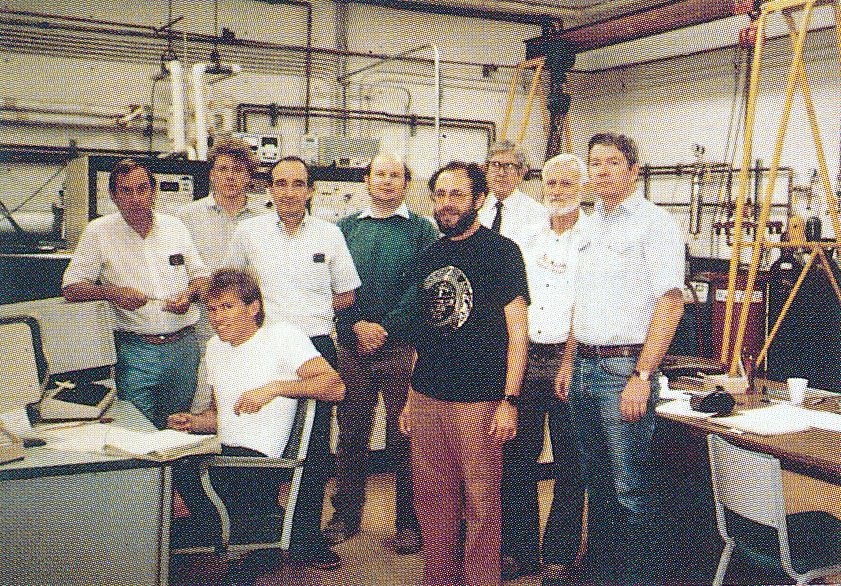
"Douglas J. Donahue," Arizona Daily Star, 25 October 2020 ... We are sad to say our beloved father Douglas Donahue[Left [4]] passed away September 25, 2020 ... He was born ... in Wichita, Kansas ... At 16, he drove his Model A across the Pasadena Freeway on its opening day in 1940 [Therefore he was born in 1924?]. WWII followed. Doug volunteered for the Navy ... Doug earned his PhD in Nuclear Physics at the University of Wisconsin and moved to Washington to work on General Electric's nuclear reactor. He loved Academia, took a professorship at Penn State University and, in 1963, began a 37 year career at the University of Arizona, including time as Chairman of the Physics Department. Doug was a pioneer in Carbon 14 dating. In 1983, he assisted in establishing the USA's first accelerator mass spectrometry radiocarbon laboratory. He radiocarbon dated materials across the world including dating the Shroud of Turin to the 14th Century ... Donahue, with Paul Damon (1921-2005), founded the Arizona radiocarbon dating laboratory in 1981[5]. Donahue was present on 6 May 1988 [see 23Jun18] when Arizona laboratory first

[Above (enlarge)[6]: Extract of historic group photograph of those present at the Arizona radiocarbon dating laboratory on 6 May 1988[7] when the AMS computer terminal [left] displayed a date of the Shroud, which when calibrated, was "1350 AD"[8]. The alleged hacker, Timothy W. Linick (1946-89) [see 05Jul14, 22Feb16], is in a black shirt[9], standing in front of everyone, including laboratory leaders Donahue (behind the seated person) and Timothy Jull (behind and on our right of Donahue). This is evidence that Linick was in charge of the fully computerised AMS dating process[10] at Arizona laboratory and those present were acknowledging that [see 22Feb16, 22Nov16, 25Mar18, 23Jun18, 15Jul18, 27Sep18 & 28Oct18].]

radiocarbon dated the Shroud as "1350"[11]. Donahue was one of the 21 signatories to the 1989 Nature article[12] which claimed (fraudulently [see 17Feb19; 20Mar19 & 29May19]) that:

"... samples from the Shroud of Turin have been dated by accelerator mass spectrometry in laboratories at Arizona, Oxford and Zurich ... The results provide conclusive evidence that the linen of the Shroud of Turin is mediaeval ... AD 1260-1390, with at least 95% confidence"[13]
Donahue was reportedly "a devout Catholic"[14] who turned "pale" when he was the first to announce that the Shroud's radiocarbon date was "1350"[15]. But that might have been because Donahue was concerned for the Catholic faith of his wife, Dee, than for his own. Anti-authenticist David Sox (1936-2016) had written that "Donahue's wife [Dee], who believed the Shroud was genuine, was going for 2000 years" and "The night before his [Donahue's] wife [Dee] had jokingly threatened divorce if the Arizona test did not show the Shroud was 2000 years old[16], but Sox doesn't say anything about Donahue's own belief in the Shroud's authenticity. Significantly Douglas and Dee's children in their parents' obituaries, wrote of their mother that:
"Dee was a devout Catholic who volunteered with the Catholic Charities of Tucson and who would often slip into the Benedictine Sisters Monastery down the street from her Tucson home for afternoon prayers. Her spirituality was a cornerstone of her life"[17]
But of their father they wrote not a word of his Catholicism or Christianity:
"Doug's career was Physics, but his passion was his family and community. He taught the value of hard work, education, community engagement, compassion and generosity and choreographed family travels across the United States, Mexico and Europe, including sabbaticals in Oxford and Munich. He served with the Sam Hughes Neighborhood Association and was president of the St. Vincent DePaul Conference. He was an active tennis and badminton player into his nineties, competed in the Arizona Senior Olympics, and medaled in the National Senior Olympics in 2001 and 2007"[18].
The French Roman Catholic scholar, Br Bruno Bonnet-Eymard [see 23Jul15a], interviewed Donahue at his Tucson hime in 1991, in which Donahue played a video ridiculing Catholic devotion to the Shroud, and indicated that he believed that the Shroud was a 14th century fake on the basis of the false [see again 1389] d'Arcis Memorandum:
"Last October [1991], I was in Tucson where I met Professor Donahue. He took me to his home to show a video recording of David Sox's programme, `The Threads of Evidence', shown by the BBC in July 1988, three months before Cardinal Ballestrero proclaimed on 13 October 1988 the results of the carbon dating of the `threads' taken from the Holy Shroud (21 April 1988). The programme ridiculed the traditional devotion of the Catholic Church as personified by Father Rinaldi, and presented in advance the results of the dating process being carried out by the laboratories at that time, in order to make them conform with the historical documentation of the `Memorandum of Pierre d'Arcis'. This `Memorandum' revealed that Henri de Poitiers, Bishop of Troyes, had conducted an inquiry in 1355 and had actually discovered the forger [but see 11Jul16]. For Douglas Donahue, the case had been heard: `The Memorandum of Pierre d'Arcis...' he said, with an indulgent smile"[19].
That Donahue was not "a devout Catholic" who "genuinely had high expectations that the Shroud would be found to be of the first century"[20] is evident by his readiness to believe, on the basis of only one radiocarbon dating run, at only one laboratory, and "he did not care what results the other two laboratories got" [see 08Jun14, 30Jan15, 22Sep15, 10Feb18, 23Jun18 & 03Aug19], that the Shroud's radiocarbon date was "1350":
"Based on these 10 one minute runs, with the calibration correction applied, the year the flax had been harvested that formed its linen threads was 1350 AD-the shroud was only 640 years old! It was certainly not Christ's burial cloth but dated from the time its historic record began ... I remember Donahue saying that he did not care what results the other two laboratories got, this was the shroud's age"[21].
As I mentioned in my post of 03Nov16b:
"... in consultation with a leading Shroud pro-authenticist, on 17 May 2014 I emailed Professor Emeritus Douglas J. Donahue a co-founder of the Arizona radiocarbon dating laboratory and a signatory of the 1989 Nature paper. I had read that Donahue was a Roman Catholic[22], who before the test had hoped that the Shroud was first century[23], and that his face became pale after the calculations produced by the AMS computer were displayed on the control console terminal's screen, indicating that the Shroud's date was AD 1350[24]. I therefore thought that when presented with the evidence that Arizona laboratory's radiocarbon dating of the Shroud had been hacked, Donahue might at least admit that was a possibility. So on 17 May 2014 I emailed Prof. Donahue at his Arizona University email address. I stated upfront who I was, the name of my blog with a link to it, and asked him the following questions:
"Have you any information that you would be prepared to share with me for me to publish on my blog about:

1) The circumstances of [Timothy W.] Linick's death?
2) The possibility of Linick being the leaker of Arizona's 1350 date?
3) The possibility of Arizona's C14 date of 1350 being the result of its AMS computer having been hacked?
4) The possibility of Linick being the hacker?

I don't want to receive information from you that I cannot publish on my blog as that will give me an insoluble ethical dilemma. However, if you ask me preliminary questions in reply I won't publish those.

If you wish to remain anonymous I would respect that and not publish, or tell anyone, your name, even my wife. I would just write, `someone who was there at Arizona Radiocarbon Dating Laboratory on 6 May 1988 when the Shroud of Turin was dated 1350 emailed me under the condition of strict confidentiality and anonymity that ...'"[25]
However, I have never received a reply from Prof. Donahue. And since if my theory [see 23Jul15b, 28Oct18, 29May19 & 14Feb20] was false, Donahue, like Jull and Ramsey (see 03Nov16a), would be in the perfect position to show that it was false, I can only conclude that Donahue's silence (as well as Jull's and Ramsey's), is itself evidence that my theory is true!"

I presume there will be an obituary of Prof. Donahue on the Arizona radiocarbon dating laboratory website and/or in the journal Radiocarbon. If there are any further obituaries of Prof. Donahue and I become aware of them, I will link to them and update this section (e.g. his year of birth) if necessary.

I have provided a link to this section about Prof. Donahue as an interim entry in my Turin Shroud Encyclopedia

Notes:
1. This post is copyright. I grant permission to extract or quote from any part of it (but not the whole post), provided the extract or quote includes a reference citing my name, its title, its date, and a hyperlink back to this page. [return]
2. Tipler, F.J., 2007, "The Physics of Christianity," Doubleday: New York NY, pp.178-179. [return]
3. Tipler, 2007, pp.216-217. [return]
4. "Douglas J Donahue," UA Science: Physics, University of Arizona, 2016. No longer online. [return]
5. "About us," Accelerator Mass Spectrometry Laboratory, University of Arizona, 2020. [return]
6. Gove, H.E., 1996, "Relic, Icon or Hoax?: Carbon Dating the Turin Shroud," Institute of Physics Publishing: Bristol UK, p.176H. [return]
7. Gove, 1996, p.264. [return]
8. Ibid. [return]
9. Jull, A.J.T. & Suess, H.E., 1989, "Timothy W. Linick," Radiocarbon, Vol 31, No 2. [return]
10. Sox, H.D., 1988, "The Shroud Unmasked: Uncovering the Greatest Forgery of All Time," Lamp Press: Basingstoke UK, pp.146-147; Gove, 1996, p.264. [return]
11. Gove, 1996, pp.264, 279; Garza-Valdes, L.A., 1998, "The DNA of God?," Hodder & Stoughton: London, pp.163, 180; Wilson, I. & Schwortz, B., 2000, "The Turin Shroud: The Illustrated Evidence," Michael O'Mara Books: London, p.9. [return]
12. Damon, P.E., et al., 1989, "Radiocarbon Dating of the Shroud of Turin," Nature, Vol. 337, 16 February, pp.611-615, 611; Wilson, 1998, p.230. [return]
13. Damon, et al., 1989, p.611. [return]
14. Wilson, I., 1998, "The Blood and the Shroud: New Evidence that the World's Most Sacred Relic is Real," Simon & Schuster: New York NY, p.11. [return]
15. Gove, 1996, p.264; Wilson, 1998, p.11. [return]
16. Sox, 1988, pp.147, 151. [return]
17. "Dee Donahue," In memoriam: Funeral notices, Arizona Daily Star, May 3, 2020. [return]
18. "Douglas J. Donahue," Obituary, Arizona Daily Star, October 25, 2020. [return]
19. Bonnet-Eymard, B., 1991, "Study of Original Documents of the Archives of the Diocese of Troyes in France with Particular Reference to the Memorandum of Pierre D'arcis," Shroud News, No 68, December, pp.6-18, 6. [return]
20. Wilson, 1998, p.11; 188. [return]
21. Gove, 1996, p.264. [return]
22. Wilson, I., 1991, "Holy Faces, Secret Places: The Quest for Jesus' True Likeness," Doubleday: London, p.8; Wilson, 1998, pp.11, 188. [return]
23. Wilson, 1991, p.8; Gove, H.E., 1996, "Relic, Icon or Hoax?: Carbon Dating the Turin Shroud," Institute of Physics Publishing: Bristol UK, p.264. [return]
24. Gove, 1996, p.264; Wilson, 1998, p.10; Wilson. & Schwortz, 2000, p.9. [return]
25. Jones, S.E., 2014, "Re: Timothy W. Linick," Email to Dr. Douglas J. Donahue, 17 May, 10:48 PM. [return]

Posted 6 November 2020. Updated 18 August 2025.

Tuesday, October 27, 2020

Arculf: Turin Shroud Encyclopedia

Turin Shroud Encyclopedia
Copyright © Stephen E. Jones
[1]

Arculf #11

This is "Arculf," part #11 of my Turin Shroud Encyclopedia. For more information about this series, see part #1 and part #2. Emphases are mine unless otherwise indicated.

[Index #1] [Previous: Antioch #10] [Next: Ballosino, N. #12]


Arculf was a 7th century bishop of Perigueux, France[2]. In about 680

[Right (enlarge)[3]: Location of the Island of Iona.]

[see "680"] Arculf made a pilgrimage to the Holy Land[4], where he lived for nine month[5]. On his return journey Arculf was shipwrecked on the Island of Iona in the Scottish Hebrides[6]. Arculf was given shelter in the island's monastery (later Abbey) by its

[Left (enlarge)[7]: Iona Abbey (13th-15th century), built on the site of the original 6th century monastery.]

abbot, St. Adamnan (c. 624–704)[8].

Arculf related to Adamnan the story of his pilgrimage[9]. Based on what Arculf told him of his travels, Adamnan, with aid from other sources, produced De Locis Sanctis (Concerning Sacred Places), a descriptive work in three books, about Jerusalem, Bethlehem, and other places in Palestine, as well as Alexandria and Constantinople[10].

From Arculf's description of Jerusalem, Adamnan produced in his De Locis Sanctis a map of Jerusalem [Right (enlarge)[11]] which for 11 centuries was the oldest known map of Jerusalem until the discovery of the Madaba Map in 1884[12]. Also, from Arculf's description of the Church of the Holy Sepulchre,

Adamnan also included in De Locis Sanctis a floor plan of the Church[13] [Above (enlarge)[14]].

Arculf reported seeing in Jerusalem the column to which Jesus had been bound during the scourging (Mt 27:26; Mk 15:15; Lk 23:16 & Jn 19:1), the cup from which Jesus drank the Last Supper (Mt 26:26-28; Mk 14:22-24; Lk 22:17-20; 1Cor 11:23-26) and the lance which pierced Jesus' side (Jn 19:31-34)[15]; and in Constantinople the three major pieces of the True Cross, the crossbeam and the vertical bar in two pieces[16]. That I am reporting this does not mean that I believe it is true! I consider it highly unlikely that immediately after Jesus' crucifixion, his fearful disciples (Jn 20:19, 26) would have approached the Roman execution squad for mementoes of the criminal they had just crucified!

Arculfus also related to Adamnan that in Jerusalem he had seen "the sudarium of Our Lord which was placed over his head in the tomb"[17]. Pro-Shroud writers on this topic have all (as far as I am aware) assumed that Arculfus was referring to the Shroud, even though he says the cloth was "eight feet" long[18], about half the length of the fourteen-foot Shroud[19], and Arculf did not mention this cloth bearing an image[20], which he surely would have if it did[21]. It cannot have been the Shroud folded in two[22], because Arculf actually kissed it[23] and he could not have failed to notice up that close that the sudarium was folded in two and so was twice eight feet long.

While eight feet may seem too long for a face cloth[24], the Greek soudarion "face cloth" (Jn 20:7) is a loan word from the Latin "sudarium": "towel," "napkin"[25] and so could have applied to a cloth eight foot long, but not to one fourteen foot long.

Because Latin originally had no word of its own for the Greek sindon ("shroud") of the synoptic gospels (Mt 27:59; Mk 15:46; Lk 23:53), it was often used in Latin writings to mean the larger cloth that covered Jesus' body[26]. But in the Vulgate, the 4th century Latin translation of the Bible by St. Jerome (c. 342-347), the sudarium is the face cloth (Jn 20:7)[27], and the Shroud is sindone (Mt 27:59; Mk 15:46 & Lk 23:53). Bishop Arculf and Abbot Adamnan would surely have been aware of the Vulgate's distinction between the sindone in which Jesus' "body" was "wrapped (Mt 27:59; Mk 15:46 & Lk 23:53) and the sudarium that had been "about Jesus' head" (Jn 20:7). So when Arculf told Adamnan that he had seen in Jerusalem the sudarium, they both would have understood it to have been the face cloth, not the Shroud.

Finally, the account of the origin of this "sudarium" given to Arculf in Jerusalem shows that it was neither the Shroud of Mt 27:59; Mk 15:46 & Lk 23:53, i.e. the Shroud of Turin, nor the face cloth of Jn 20:7, i.e. the Sudarium of Oviedo, but merely a cloth that had acquired a local legendary status:

"A certain trustworthy believing Jew, immediately after the Resurrection of the Lord, stole from His Sepulchre the sacred linen cloth and hid it in his house for many days; but, by the favour of the Lord Himself, it was found after the lapse of many years, and was brought to the notice of the whole people about three years before [this statement was made to Arculf]"[28]!

Notes
1. This post is copyright. I grant permission to quote from any part of this post (but not the whole post), provided it includes a reference citing my name, its subject heading, its date and a hyperlink back to this page. [return]
2. Beecher, P.A., 1928, "The Holy Shroud: Reply to the Rev. Herbert Thurston, S.J.," M.H. Gill & Son: Dublin, p.143; Wilson, I., 1979, "The Shroud of Turin: The Burial Cloth of Jesus?," [1978], Image Books: New York NY, Revised edition, p.94; Wilson, I., 2010, "The Shroud: The 2000-Year-Old Mystery Solved," Bantam Press: London, pp.109, 147. [return]
3. Extract from "Island of Iona," Google Maps, 2020. [return]
4. Scavone, D.C., 1989, "The Shroud of Turin: Opposing Viewpoints," Greenhaven Press: San Diego CA, p.76; Wilson, 2010, p.109; "Arculf," Wikipedia, 25 January 2020. [return]
5. Beecher, 1928, p.143. [return]
6. Beecher, 1928, p.143; Wilson, 1979, p.94; Wilson, 2010, pp.109, 147; "Arculf," Wikipedia, 25 January 2020. [return]
7. "File:Abbey on the Isle of Iona - geograph.org.uk - 1459438.jpg," Wikimedia Commons, 16 August 2020. [return]
8. Beecher, 1928, p.143; Wilson, 1979, p.94; Wilson, 2010, pp.109, 147; "Arculf," Wikipedia, 25 January 2020. [return]
9. Wilson, 1979, p.94; "Arculf," Wikipedia, 25 January 2020. [return]
10. "De locis sanctis," Wikipedia, 21 May 2020. [return]
11. "File: Arculf De Locis Sanctis Jerusalem.jpg," Wikimedia Commons, 10 November 2019. [return]
12. "Arculf Map of Jerusalem," Wikipedia, 21 May 2020. [return]
13. "Church of the Holy Sepulchre: Crusader period (1099–1244)," Wikipedia, 28 October 2020. [return]
14. "File: Rotunda, Adomanan de locis santis.jpg," Wikimedia Commons, 6 October 2020. [return]
15. Ruffin, C.B., 1999, "The Shroud of Turin: The Most Up-To-Date Analysis of All the Facts Regarding the Church's Controversial Relic," Our Sunday Visitor: Huntington IN, p.54. [return]
16. Bennett, J., 2001, "Sacred Blood, Sacred Image: The Sudarium of Oviedo: New Evidence for the Authenticity of the Shroud of Turin," Ignatius Press: San Francisco CA, p.194. [return]
17. Wilson, 2010, p.109. [return]
18. Beecher, 1928, p.144; Barnes, A.S., 1934, "The Holy Shroud of Turin," Burns Oates & Washbourne: London, p.51; Currer-Briggs, N., 1984, "The Holy Grail and the Shroud of Christ: The Quest Renewed," ARA Publications: Maulden UK, p.16; Currer-Briggs, 1988, p.62; Wilson, I., 1986, "The Evidence of the Shroud," Guild Publishing: London, p.103; Bennett, 2001, p.194. [return]
19. Beecher, 1928, p.144; Currer-Briggs, 1984, p.16; Currer-Briggs, 1988, p.62; Scavone, 1989, p.77. [return]
20. Wilson, 1986, p.103; Scavone, 1989, p.77. [return]
21. Wilson, 1979, p.94. [return]
22. Beecher, 1928, p.144; Ricci, G., "Historical, Medical and Physical Study of the Holy Shroud," in Stevenson, K.E., ed., 1977, "Proceedings of the 1977 United States Conference of Research on The Shroud of Turin," Holy Shroud Guild: Bronx NY, pp.58-73, 59; Currer-Briggs, 1984, p.16; Currer-Briggs, 1988, p.62; Scavone, 1989, p.77. [return]
23. Beecher, 1928, p.144; Wilson, 1979, p.94; Ricci, G., 1981, "The Holy Shroud," Center for the Study of the Passion of Christ and the Holy Shroud: Milwaukee WI, pp.xxxi-xxxii; Scavone, 1989, p.77. [return]
24. Beecher, 1928, p.144. [return]
25. Guscin, 1998, p.11; Bennett, 2001, p.146. [return]
26. Guscin, M., 1998, "The Oviedo Cloth," Lutterworth Press: Cambridge UK, p.11. [return]
27. Guscin, 1998, p.11. [return]
28. Macpherson, J.R., 1895, "Pilgrimage of Arculfus in the Holy Land About the Year A.D. 670," London. No longer online. [return]

Posted 27 October 2020. Updated 18 August 2025.

Monday, October 19, 2020

Selvedges: The Shroud of Turin: The Burial Sheet of Jesus! #19

The Shroud of Turin: The Burial Sheet of Jesus!
SELVEDGES
© Stephen E. Jones
[1]

This is "Selvedges," part #19 of my online book, "The Shroud of Turin: The Burial Sheet of Jesus!" For more information see the Cover #1, Contents #2 and Preface #3, of this series. See also 11Sep15.

[Contents #2] [Previous: Colour #11] [Next: Sidestrip #20]


  1. A linen cloth #10
    1. Selvedges #19

A selvedge is a weaver finished edge at the long sides of a woven cloth

[Above[2]: Bottom right corner of the Shroud (with the frontal image in the lower half and the man upright), showing a section of the right side (apparent left because of mirror-reversal[3]) selvedge and the bottom edge hem.]

as it grows lengthwise on a loom[4]. The weaver binds the raw long edges of the lengthening cloth on the loom to prevent it from unravelling or fraying[5]. Only the two long edges of the Shroud have a selvedge[6].

The coarse linen Holland cloth backing attached to the Shroud by Chambéry's Poor Clare nuns in 1534[7] and the blue satin surround sewed on by Princess Clotilde of Savoy (1843-1911) in 1868[8], had prevented photographs a thorough examination and of the Shroud's edges[9]. That was until 1978 when during the Shroud of Turin Research Project (STURP)'s examination, Turin microanalyst Giovanni Riggi (1935-2008), unpicked a section of the backing cloth to view the man's image from the Shroud's underside[10]. Riggi discovered "rows of invisible stitches approximately 2 cms apart [that] run parallel to the main longitudinal axis" and "the colour of the thread used for this stitching blends in perfectly with the threads of the Shroud itself, and ... cannot be detected by the naked eye[11]. The French textile specialist Prof. Gabriel Vial examined the Shroud at the time of the 1988 radiocarbon dating[12]. and prepared a technical report on the cloth[13]. He found that the selvedges were comprised of two double threads and their construction was "quite unusual"[14] such that he had never seen on an ancient cloth before[15]. Ancient textiles conservator Mechthild Flury-Lemberg in preparing the Shroud for its Exposition in 1998 (see Dimensions #12), removed the blue satin surround and found that the two double thread selvedge was exactly the same as that of fragments found at Masada[16], the Jewish fortress that was overthrown by the Romans in AD 73-74 and never occupied since[17]!

Problem for the forgery theory
Leading Shroud sceptic Antonio Lombatti, does not dispute Flury-Lemberg's diagram of stitching found at Masada, being identical to that found on the Shroud but he claims, without evidence, that, "... at Masada they were found many different types of stitching ... and there is nothing strange if one of them has even been used in the Middle Ages for the Shroud"[18]. But if that was true, there would be other medieval cloths which have stitching identical to that found at Masada. And why would that stitching identical to that found at Masada be only on the Shroud? We have already seen that the Shroud's dimensions are very close to the 8 by 2 Assyrian standard cubits of Jesus day (see again Dimensions #12). And we shall see further evidence from the Shroud's cloth itself, that it is in fact a first-century, Middle-Eastern burial shroud, consistent with the "linen shroud" in which the Gospels record Jesus' body was buried (Mt 27:59; Mk 15:46; Lk 23:53)!

To be continued in the next part #20 of this series.

Notes
1. This post is copyright. I grant permission to quote from any part of this post (but not the whole post), provided it includes a reference citing my name, its subject heading, its date, and a hyperlink back to this page. [return]
1a. Wilson, I., 1998, "The Blood and the Shroud: New Evidence that the World's Most Sacred Relic is Real," Simon & Schuster: New York NY, p.71. [return]
2. Extract from Latendresse, M., 2010, "Shroud Scope: Durante 2002: Vertical," Sindonology.org. [return]
3. Wilson, I., 1979, "The Shroud of Turin: The Burial Cloth of Jesus?," [1978], Image Books: New York NY, Revised edition, p.31. [return]
4. Wilson, I., 2010, "The Shroud: The 2000-Year-Old Mystery Solved," Bantam Press: London, pp.72, 315. [return]
5. Wilson, 2010, p.315. [return]
6. Wilson, I., 2000, "`The Turin Shroud - past, present and future', Turin, 2-5 March, 2000 - probably the best-ever Shroud Symposium," British Society for the Turin Shroud Newsletter, No. 51, June. [return]
7. Wilson, I. & Schwortz, B., 2000, "The Turin Shroud: The Illustrated Evidence," Michael O'Mara Books: London, p.23. [return]
8. Petrosillo, O. & Marinelli, E., 1996, "The Enigma of the Shroud: A Challenge to Science," Scerri, L.J., transl., Publishers Enterprises Group: Malta, p.161. [return]
9. Wilson, 1998, p.71. [return]
10. Wilson, 1998, p.71. [return]
11. Wilson, 1998, pp.71-72. [return]
12. Wilson, I., 1990, "Recent Publications," British Society for the Turin Shroud Newsletter, No. 26, September/October, pp.11-18, 14. [return]
13. Vial, G., 1991, "The Shroud of Turin: A Technical Study," Shroud Spectrum International, No. 38/39, Mar/June, pp.7-20. [return]
14. Vial, 1991, p.12. [return]
15. Morgan, R.H., 1989, "Paris Symposium report - part I," Shroud News, No. 55, October, pp.5-23, 22. [return]
16. Wilson, 2010, p.74. [return]
17. "Masada: First Jewish-Roman War," Wikipedia, 18 October 2020. [return]
18. Lombatti, A., 2009, "The Shroud and the Judaism of Jesus' time," CICAP, 2 March. Translated from Italian by Google. [return]

Posted 19 October 2020. Updated 10 December 2025.

Wednesday, October 14, 2020

Shroud of Turin News, August & September 2020

© Stephen E. Jones[1]

[Previous: July 2020] [Next: October 2020]

This is the August & September 2020 issue of my Shroud of Turin News. The `smartest guys in the room' at Google have `improved' their Blogger interface such that, as one of their bloggers since 2007, over 13 years, I find it almost unusable and much inferior to their previous interface! And I am not alone in this - see this criticism which I fully agree with. In particular I won't be able to present my blog's statistics every month, so my Shroud of Turin News will now be mostly just news. Which may be a blessing in disguise! So I have removed the "Editorial and News" from the title. The articles' words are bold to distingish them from mine.


News:
"How the Black Plague turned the Shroud of Turin into a beloved relic," Religion News Services, 11 August 2020, Menachem Wecker "... For

[Above (enlarge): "Undated [sic 1931] full-length photographic negatives of the Shroud of Turin, taken at the Church of Saint-Sulpice in Paris. Image courtesy of Creative [sic Wikimedia] Commons August 11, 2020" - article.]

centuries, relics have inspired and comforted in dire times.

[Right (enlarge)[2]: An ink drawing in the Pray Codex which is dated 1192-95[3]. As can be seen, Jesus is depicted nude with His hands crossed right over left, awkwardly at the wrists, covering His groin, identical to the Shroud[4]! These are only two of the at least "eight [and by my count twelve - see 27May12] telling correspondences between the Shroud and ... the Pray Codex"[5]! This is artistic proof beyond reasonable doubt that the Shoud existed at least 65 years before the earliest radiocarbon date of 1260[6] and 157 years before the latest date, 1352, that Vikan claims the Shroud was created[7] - see below!]

That's particularly true of the Shroud of Turin, which became a beloved relic during the Black Death. And the medieval history of relics has a lot to say to the socially distant craving human contact, according to Gary Vikan, former director of Baltimore's Walters Art Museum and author of the new book "The Holy Shroud: A Brilliant Hoax in the Time of the Black Death." While millions of believers hold the linen Shroud of Turin to be Jesus' actual burial cloth retaining his bodily imprint, Vikan sees it as "the greatest deception in the history of Christianity," he writes ... It is Vikan who is deceived! The Pray Codex alone (and it isn't alone - see below for starters) proves that Vikan's claim that the Shroud was created in 1350-52 by Naddo Ceccarelli (1320-47)[9] is false! Not only does Vikan provide no evidence that Ceccarelli forged the Shroud, he had already died in Italy in 1347, the year the Black Death began in France[10]!

"Former Walters director Gary Vikan chronicles ‘the greatest deception in the history of Christianity'," Baltimore Sun, 20 August 2020 A new book about the Shroud of Turin, by former Walters Art

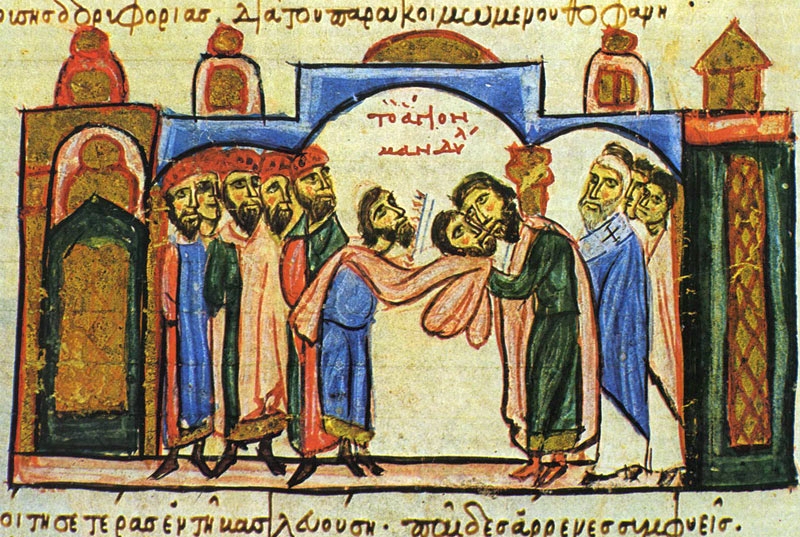
[Above (enlarge): "Surrender of the Mandylion [the `Image of Edessa] to the Byzantines"[11]]. An eleventh century depiction by John Skylitzes (c. 1040–1101)[12] of the transfer of the Image of Edessa, behind the face image of which is the full-length Shroud [see 15Sep12], from Edessa (left) to Constantinople (right) via Byzantine general John Kourkouas (fl. 915–946) to Byzantine Emperor Romanos I Lekapenos (r. 919–944) in 944 [see "944b"]. This is artistic proof beyond reasonable doubt that the Shroud (as the Image of Edessa "four-doubled" (Greek tetradiplon) - see 15Sep12] was in existence in Constantiople in 944 [see "944b"] and before that in Edessa in 544 [see "544"]. This is 316 and 716 years respectively before the Shroud's earliest 1260 radiocarbon date and 408 and 808 years respectively before the latest date, 1352, that Vikan claims the Shroud was created [see above]!

Museum director Gary Vikan, was published in May ... Vikan is clear in his conclusion — that the famous Shroud of Turin was not, as long purported, the burial cloth used on the body of the crucified Christ But Vikan calls it "the greatest deception in the history of Christianity," not a miracle but a mysterious work of art. It does not date from biblical times and the Holy Land, he says, but from the Middle Ages, the time of the deadliest pandemic in recorded history, and a French hamlet called Lirey. The shroud suddenly appeared there, Vikan reports, with no explanation, no back story like those that accompany authentic relics ... This is false, as I pointed out in my post of 21Jun20, there is objective, historical evidence that the Shroud existed in Constantinople in 1201 [see "1201"]. Which is 154 years before the Shroud was exhibited at Lirey in c. 1355 [see "c.1355"], 59 years before the earliest radiocarbon date of 1260, and 151 years before the last date, 1352, that Vikan claims the Shroud was forged (see above)!

I have Vikan's book and, as promised in my May and June 2020 Shroud News, I will start reviewing it here, when I get time. Vikan is an art historian but there is no index entry in his book of the Pray Codex or John Skylitzes, for starters. So Vikan is yet another Shroud sceptic example of `the blind leading the blind' (Mt 15:14; Lk 6:39):

[Above (enlarge)[13]: "The Blind Leading the Blind," 1568, by Pieter Bruegel the Elder (c.1525-1569).]

I had intended splitting this "August & September 2020" post into two "August 2020" and "September 2020" Shroud News posts. But I couldn't find any September news articles about the Shroud worth mentioning, so I will end this post here. My next Shroud News post will be for "October 2020."

Notes:
1. This post is copyright. I grant permission to extract or quote from any part of it (but not the whole post), provided the extract or quote includes a reference citing my name, its title, its date, and a hyperlink back to this page. [return]
2. Berkovits, I., 1969, "Illuminated Manuscripts in Hungary, XI-XVI Centuries," Horn, Z., transl., West, A., rev., Irish University Press: Shannon, Ireland, pl. III. [return]
3. Berkovits, 1969, p.19; Wilson, I., 1996, "The Evidence of the Shroud," Guild Publishing: London, pp.114-13; Wilson, I., 1991, "Holy Faces, Secret Places: The Quest for Jesus' True Likeness," Doubleday: London, pp.150-151; Petrosillo, O. & Marinelli, E., 1996, "The Enigma of the Shroud: A Challenge to Science," Scerri, L.J., transl., Publishers Enterprises Group: Malta, pp.162-163; Scavone, D.C., 1999, "A Hundred Years of Historical Studies on the Turin Shroud," Paper presented at the Third International Congress on the Shroud of Turin, 6 June 1999, Turin, Italy, in Minor, M., Adler, A.D. & Piczek, I., eds., 2002, "The Shroud of Turin: Unraveling the Mystery: Proceedings of the 1999 Dallas Symposium," Alexander Books: Alexander NC, p.64; Wilson, I., 1999, "The Blood and the Shroud: New Evidence that the World's Most Sacred Relic is Real," Simon & Schuster: New York NY, p.146; Wilson, I. & Schwortz, B., 2000, "The Turin Shroud: The Illustrated Evidence," Michael O'Mara Books: London, p.116; Guerrera, V., 2001, "The Shroud of Turin: A Case for Authenticity," TAN: Rockford IL, p.104; de Wesselow, T., 2012, "The Sign: The Shroud of Turin and the Secret of the Resurrection," Viking: London, pp.179, 190. [return]
4. Wilson, I., 1979, "The Shroud of Turin: The Burial Cloth of Jesus?," [1979], Image Books: New York NY, Revised edition, p.160; Wilson, 1996, pp.114-13; de Wesselow, 2012, pp.179-179. [return]
5. de Wesselow, 2012, p.190; Guerrera, 2001, p.105. [return]
6. Maloney, P.C., "Researching the Shroud of Turin: 1999 to the Present: A Brief Survey of Findings and Views," in Minor, 2002, p.33; Marino, J.G., 2011, "Wrapped up in the Shroud: Chronicle of a Passion," Cradle Press: St. Louis MO, p.53. [return]
7. Vikan, G., 2020, "The Holy Shroud: A Brilliant Hoax in the Time of the Black Death," Pegasus Books: New York NY, pp.xv, 134. [return]
9. Vikan, 2020, p.134. [return]
10. "Black Death in France," Wikipedia, 9 October 2020. [return]
11. "File:Surrender of the Mandylion to the Byzantines.jpg," in "Chronography of John Skylitzes, cod. Vitr. 26-2, folio 131a, Madrid National Library, Wikimedia Commons, 20 December 2012. [return]
12. "John Skylitzes," Wikipedia, 6 May 2020. [return]
13. "File:Pieter Bruegel the Elder (1568) The Blind Leading the Blind.jpg," Wikimedia Commons, 1 July 2020. [return]

Posted 14 October 2020. Updated 14 February 2026.

Wednesday, September 9, 2020

The Shroud is consistent with the Bible #34: The evidence is overwhelming that the Turin Shroud is Jesus' burial sheet!

THE SHROUD IS CONSISTENT WITH THE BIBLE #34
Copyright © Stephen E. Jones[1]

This is part #34, "The Shroud is consistent with the Bible" of my series, "The evidence is overwhelming that the Turin Shroud is Jesus’ burial sheet!" For more information about this series, see the "Main index #1" and "Other marks and images #26." See also "The Shroud of Turin: 3. The Bible and the Shroud." Emphases are mine unless otherwise indicated.

[Main index #1] [Previous: The Bible and the Shroud #33] [Next: The Shroud is consistent with the man being Jesus #35]


  1. The Bible and the Shroud #33
    1. The Shroud is consistent with the Bible #34

The Shroud must be consistent with the Bible If the Shroud of Turin is the burial shroud of Jesus Christ, then it must be consistent with what the Bible says about Him, and particularly about His suffering, crucifixion, death and burial:

"If the Shroud is the actual burial garment of Jesus, then it should be consistent with the New Testament texts. This condition must be satisfied before anyone can identify the cloth as Jesus' burial garment"[2].

[Right (enlarge): "Anatomy of the Shroud"[3], showing wounds and bloodstains on the Shroud man's image which match the Gospels' accounts of the beatings (Mt 26:67-68; 27:30; Lk 22:64; Jn 18:22; 19:3), scourging (Mt 27:26; Mk 15:15; Lk 23:16; Jn 19:1), crowned with thorns (Mt 27:29; Mk 15:17; Jn 19:2,5), crucifixion (Mt 27:35,38,44; Mk 15:24-27,32; Lk 23:33; Jn 19:16-18), death (Mt 27:50; Mk 15:37,39; Lk 23:46; Jn 19:30), legs not broken (Jn 19:32-33), speared in the side (Jn 19:34) of Jesus[4].]

Because, as Stevenson and Habermas' second sentence above implies, if the image on the Shroud was not consistent with what the Bible says about Jesus, and particularly about His suffering, crucifixion, death, burial and resurrection, then that would be sufficient reason to believe that the Shroud image is that of another crucifixion victim[5].

The Shroud is consistent with the Bible The Shroud has wounds and bloodstains consistent with those of Jesus Christ described or implied in the Gospels[6]. There is no injury sustained by the man on the Shroud that does not correspond to the injuries to Christ described or implied in the Gospels[7]. Some of the parallels between the Gospel evidence and the Shroud evidence are summarised below in table form[8]:

Gospel evidenceVersesShroud evidence
Jesus was scourged.Mt 27:26; Mk 15:15; Jn 19:1The body is covered with the wounds of a severe scourging.
Jesus was struck blows to the face.Mt 27:30; Mk 15:19; Lk 22:63; Jn 19:3There is a severe swelling below the right eye and other face wounds.
Jesus was crowned with thorns.Mt 27:29; Mk 15:17; Jn 19:2Bleeding from the scalp indicates that a `cap' of thorns was thrust upon the head.
Jesus was made to carry a heavy crossbeam.Jn 19:17Scourge wounds on the shoulders are blurred, as if by the chafing of a heavy burden.
Jesus' cross had to be carried for him, suggesting He fell under its weight.Mt 27:32; Mk 15:21; Lk 23:26The knees are severely damaged, as if from repeated falls.
Jesus was crucified by nails in His hands and feet.Jn 20:25-27; Lk 24:39; Col 2:14There are blood flows as from nail wounds in the wrists and at the feet.
Jesus' legs were not broken, and a spear was thrust into His side to check that He was dead.Jn 19:31-37The legs are not broken, and there is a large wound in the right side.

The Bible does not exclude the man on the Shroud being Jesus Nothing in the Bible rules out the man on the Shroud being Jesus[9]. There is nothing in the Gospels' account of the suffering, crucifixion, death and burial of Jesus that contradicts the witness of the Shroud[10].

Shroud sceptics concede that the Shroud image matches the Gospels' description of Jesus The late Fr. Herbert Thurston (1856-1939), a leading early Roman Catholic Shroud sceptic, admitted that:

"As to the identity of the body whose image is seen on the Shroud, no question is possible. The five wounds, the cruel flagellation, the punctures encircling the head ... If this is not the impression of the Body of Christ, it was designed as the counterfeit of that impression. In no other personage since the world began could these details be verified"[11].
Modern day sceptics Steven Schafersman (quoted approvingly by Joe Nickell), agreed that, "the man imaged on the shroud must be Jesus Christ and not someone else":
"As the (red ochre) dust settles briefly over Sindondom, it becomes clear there are only two choices: Either the shroud is Jesus’ burial sheet (naturally or supernaturally produced by the body of Jesus) or it is a product of human artifice. Asks Steven Schafersman: `Is there a possible third hypothesis? No, and here's why. Both Wilson[12] and Stevenson and Habermas[13] go to great lengths to demonstrate that the man imaged on the shroud must be Jesus Christ and not someone else. After all, the man on this shroud was flogged, crucified, wore a crown of thorns, did not have his legs broken, was nailed to the cross, had his side pierced, and so on. Stevenson and Habermas even calculate the odds as 1 in 83 million that the man on the shroud is not Jesus Christ (and they consider this a very conservative estimate)[14]. I agree with them on all of this. If the shroud is Jesus’ burial sheet [i.e. not "a product of human artifice"], the image is that of Jesus'"[15].
Professor Harry E. Gove (1922-2009), co-inventor of Accelerator Mass Spectrometry (AMS) radiocarbon dating[16], the unofficial leader of the Shroud radiocarbon dating project[17] and an agnostic[18], noted that:
"It [the Shroud] bears the faint front and back imprint of a naked crucified man with hands folded modestly over his genitals. The image depicts all the stigmata of the crucifixion [of Jesus] described in the Bible including a large blood stain from the spear wound in the side"
Problem for the forgery theory. (See previous three: #30, #31 and #32). While the Shroud is consistent with the Bible, a medieval forger, working from the Gospels, would not have produced the image of Jesus on the Shroud. The late Anglican New Testament scholar, Bishop John A.T. Robinson (1919–83), pointed this out:
"One of the things that shook my natural predisposition to scepticism about the Turin shroud was precisely that it could not at all easily be harmonized with the New Testament account of the grave-clothes. I am not saying that it is incompatible with them but simply that no forger starting, as he inevitably would, from the details of the Gospels, and especially that of the fourth, would have created the shroud we have"[19].
The Shroud's flax is claimed to have been harvested in c. 1325 According to the 1988 radiocarbon dating, the Shroud's flax was harvested between 1260-1390[20]. The midpoint of 1260-1390 is 1325[21]. But see my 22Feb16 that this date was the result of a computer hacking.

The Shroud is claimed to have been painted in France in c. 1355 The c.1325 radiocarbon date seemingly confirmed the claim of the Bishop of Troyes Bishop Pierre d'Arcis (r. 1377-1395), that one of his predecessors, Bishop Henri de Poitiers (r. 1354–1370), had in c.1355 discovered that the Shroud had been "cunningly painted" and moreover had obtained the confession of the artist who had painted it[22]. But see 11Jul16 that the Shroud image is not painted, 03Jul18 that Bishop de Poitiers did not discover that the Shroud was painted and 14Jan19 that de Poitiers did not have a problem with the Shroud!

Linen shroud A medieval forger working from the Gospels would have read in Mt 27:59; Mk 15:46 & Lk 23:53 that Jesus' body was "wrapped in a linen shroud." So he would have done what Oxford radiocarbon dating laboratory's Prof. Edward Hall (1924-2001) said that that a medieval forger of the Shroud did, "... just got a bit of linen, faked it up and flogged [sold] it"[23]. That is, a medieval forger would have used a piece of linen that was readily available and inexpensive. But the Shroud's weave is 3:1 herringbone twill [see 16Jul15] which is both rare[24] and expensive[25]. Moreover the Shroud's 438 x 113 centimetres (14.4 x 3.6 feet) [see 08Apr20] dimensions do not equate to any medieval European unit of length. But they do closely approximate the Assyrian

[Left (enlarge)[26]: Shroud photograph with an 8 x 2 grid overlay showing that the Shroud divides evenly into 8 x 2 squares, each 438/8 = 54.75 cm (~21.6 in.) by 113/2 = 56.5 cm (~22.2 in.). The slightly longer (1.75cm = 0.7 in.) width unit is readily explained by the attachment of the sidestrip [see 24Aug15]. These units are too close to the Assyrian cubit of Jesus' day, 21.6 inches, to be a coincidence.]

Standard Cubit of 21.6 inches which was the international unit of length in Jesus' day[27] [see 10Jul15]! A medieval forger working from the Bible would not know the length of the cubit in Jesus' day, because although the Bible mentions cubits (e.g. Gn 6:15; Ex 25:10; Mt 6:27, etc), it does not say how long they were[28].

Image. There is no mention in the Gospels of there being an image on the Shroud[29]. Shroud sceptics claim that this is a big problem for the Shroud's authenticity[30]. But there are several good reasons why the image of Jesus on the Shroud is not mentioned in the New Testament [see 15Aug20]. And it's an even bigger problem for the forgery theory - why would a medieval forger go to all the trouble of depicting an image of the dead Jesus on His burial Shroud when that image is not mentioned in the Gospels? Let alone as a photographic negative [22Dec16], three-dimensional [05Feb17] and with x-rays of Jesus' teeth and bones [20Apr17a], etc!

Blood. The gospels' accounts of Jesus' suffering, crucifixion and death (Mt 26:67-27:60; Mk 14:55-15:46; Lk 22:63-23:54; Jn 18:22-19:42) surprisingly only once mentions Jesus' shed blood (Jn 19:34). However in the gospels Jesus predicted His bloody death (Mt 26:28; Mk 14:24; Lk 22:20) and elsewhere in the New Testament (Rom 3:25; 5:9; Eph 1:7; 2:13; Col 1:20; Heb 9:11-14, 19; 13:12, 20; 1Pet 1:2, 19; 1Jn 1:7; Rev 5:9; 7:14; 12:11) Jesus' shed blood is not only mentioned but emphasised. So it is reasonable that a medieval forger would depict blood on the image of Jesus' dead body on the Shroud. But it is not reasonable that a forger would use real blood, which the Shroudman's blood is [03Jun17a]. Let alone with blood clot retraction serum halos (synerisis) which are only clearly visible under ultraviolet light (discovered in 1801) [15Jul13] and distinguishing between arterial and venous bloodflows (discovered in 1628) [03Jun17b]!

Scourging [see 15Jul13] A medieval forger could have read in the Gospels that Jesus was scourged (Mt 27:26; Mk 15:15)[31]. But neither the Gospels nor the rest of the New Testament has a description of Jesus' scourging[32]. Working from the Bible a forger would have assumed that Jesus received no more than 40 lashes of a scourge (Dt 25:2-3; 2Cor 11:24)[33]. But there are over 100 scourge wounds on the Shroudman's body[34], because Jesus was scourged by Romans for whom there was no legal maximum to the scourge strokes[35].

Crown of thorns A medieval forger, working from the Gospels, would have read, "the soldiers twisted [Gk. plexantes "plaited"] together a crown [stephanon "wreath, crown"] of thorns[36] and put it on [epethekan] his head" (Jn 19:2; Mt 27:29; Mk 15:17)[37]. He would have assumed what all

[Right (enlarge): "Christ Carrying the Cross as portrayed by El Greco (1541–1614), 1580"[38]. Note that even in 1580, more than two centuries after the Shroud had indisputably first appeared at Lirey in 1355, this leading European artist was still depicting Jesus wearing a traditional circlet, or wreathlet, crown of thorns.]

Christian artists like El Greco (above) did, that the crown of thorns on Jesus' head was a wreath-like circlet[39]. But the pattern of puncture bloodstains over the Shroudman's scalp shows that a cap or helmet of thorns had been forced down over the top of his head [08Sep13] [40].

Nails [See 13Apr16] A medieval forger starting from the New Testament would have read that Jesus was crucified by nails (Col 2:14) in his hands (Jn 20:24-27) and feet (Lk 24:39)[41]. Therefore the forger would have depicted Jesus on the Shroud with nail wounds clearly in his

[Left (enlarge): "Gero Cross, late 10th century, Cologne Cathedral, Germany"[42]. As can be seen, the nails in Jesus' hands and feet are clearly visible, and those in His hands are in the palms, not the wrists as on the Shroud.]

hands and feet, as medieval artists did[43]. [See Wikipedia]. Even if the forger knew the original Greek for "hands" (cheir) includes the wrists[44], he would have conformed to medieval tradition and depicted both nail wounds in the palms of Jesus' hands[45] (as for example in the 10th century Gero Cross (above), not only one nail wound in the one wrist as on the Shroud (see below)[46].

[Right (enlarge)[47]: The Shroudman's hands. Only one nail wound is visible in the back of the Shroudman's wrist, because the man's left hand (which appears to be right because of lateral inversion[48]) covers his right wrist[49]. The man's fingers seem too long because they are x-rays of his finger bones [see 20Apr17b]!]

And the nail wounds in Jesus' feet the forger would have depicted clearly, not indistinctly as they are on the Shroud (see below) [50].

[Left (enlarge)[51]: The Shroudman's feet. The nail wound in the man's right foot is more distinct than that in his left foot (clearer in the back view[52]) because the man's left knee was bent so that his left foot was forced over his right and a single nail transfixed both feet, with his right foot (due to rigor mortis) touching more fully the under surface of the Shroud[53].]

Fell A forger could have read that after Jesus was sentenced by the Roman governor, Pontius Pilate, to be crucified "Jesus ... went out, bearing his own cross, to the place called ... Golgotha" and "There they crucified him" (Jn 19:16-18)[54]. The forger also could have read that as Jesus was carrying His cross to Golgotha, the Romans "compelled a passerby, Simon of Cyrene ... to carry his cross ... behind Jesus" (Mt 27:32; Mk 15:21 & Lk 23:26)[55]. There is no mention in the New Testament that Jesus stumbled and fell[56], but it is implied that He did in that Jesus started out carrying his cross (presumably the patibulum or crossbeaml[57] which could have weighed 100 pounds (45 kgs)[58]) and part-way the Roman soldier execution squad compelled Simon of Cyrene to carry Jesus' cross for the remainder of His journey to Golgotha[59]. The man on the Shroud has dirt in his nose and knees, as well as the scratches and cuts on his nose, cheek, knees, and legs[60]. These are consistent with Jesus having been weakened by His scourging[61] and having His hands tied to the crossbeam[62], repatedly falling forward and being unable to break His fall with His hands[63]. But a medieval forger working from the Gospels would have no reason to include on the Shroud such realistic evidence that Jesus did stumble and fall carrying His cross.

Tomb A medieval forger could have read in the Gospels that Joseph of Arimathea took Jesus' body, wrapped it in a linen shroud and laid it in his own new tomb, which he had cut in the rock (Mt 27:59-60; Mk 15:46; Lk 23:53; Jn 19:38-41)[64]. A medieval forger in France, working from the Bible, would not likely have known that the rock that Joseph of Arimathea's Jerusalem tomb was cut out of was limestone[65]. But if he did, the forger might have dusted the underside of the Shroud with local limestone, which presumably was ordinary calcite. The forger would not have taken the trouble to fetch limestone from Jerusalem's tombs to Troyes, France, 4450 kms (2765 miles) away! Because the limestone on the underside of the Shroud, which would have been in contact with the tomb, is the comparatively

[Above: Dr Ricardo Levi-Setti (1927–2018)'s scanning ion microprobe comparisons of the chemical signatures of Jerusalem's Damascus Gate limestone (grey) and the limestone on the Shroud (red)[66]. As can be seen, they are a very close match! [see 22Mar13].]

rare travertine aragonite[67], which is the type of limestone that Jerusalem's rock tombs are made of[68], and moreover the Shroud limestone is a very close chemical match to that of Jerusalem's cave tombs[69]!

Again, Shroud sceptics could resort to the fall-back position of Walter McCrone (1916-2002), that "a first century cloth could have been found and used by a 14th century artist to paint the image"[70]. But that would be to abandon the twin pillars of anti-authenticism: the 1389 claim by Bishop Pierre d'Arcis (r. 1377-1395) that the Shroud had been painted in 1355[71] (but see 11Jul16 & 03Jul18), and the 1988 radiocarbon dating of the Shroud as 1260-1390[72] (but see 23Jul15, 15Jul18 & 04Oct18)!

To be continued in the next part #35 of this series.

Notes
1. This post is copyright. I grant permission to quote from any part of it (but not the whole post), provided it includes a reference citing my name, its subject heading, its date and a hyperlink back to this page. [return]
2. Stevenson, K.E. & Habermas, G.R., 1981, "Verdict on the Shroud: Evidence for the Death and Resurrection of Jesus Christ," Servant Books: Ann Arbor MI, p.43. [return]
3. Weaver, K.F., 1980, "Science Seeks to Solve ... The Mystery of the Shroud," National Geographic, Vol. 157, June, pp.736-737. [return]
4. Antonacci, M., 2000, "Resurrection of the Shroud: New Scientific, Medical, and Archeological Evidence," M. Evans & Co: New York NY, pp.119-120. [return]
5. Stevenson & Habermas, 1981, p.124ff. [return]
6. Hynek, R.W., 1951, "The True Likeness," [1946], Sheed & Ward: London, p.5; Wuenschel, E.A., 1954, "Self-Portrait of Christ: The Holy Shroud of Turin," Holy Shroud Guild: Esopus NY, Third printing, 1961, p.55; Robinson, J.A.T., "The Shroud and the New Testament," in Jennings, P., ed., 1978, "Face to Face with the Turin Shroud ," Mayhew-McCrimmon: Great Wakering UK, pp.69-81, 78; Heller, J.H. & Adler, A.D., 1981, "A Chemical Investigation of the Shroud of Turin," in Adler, A.D. & Crispino, D., ed., 2002, "The Orphaned Manuscript: A Gathering of Publications on the Shroud of Turin," EffatĂ  Editrice: Cantalupa, Italy, pp.34-57, 35; Stevenson & Habermas, 1981, pp.52, 157; Heller, J.H., 1983, "Report on the Shroud of Turin," Houghton Mifflin Co: Boston MA, p.220; Stevenson, K.E. & Habermas, G.R., 1990, "The Shroud and the Controversy," Thomas Nelson: Nashville TN, pp.34-35, 84-85; Petrosillo, O. & Marinelli, E., 1996, "The Enigma of the Shroud: A Challenge to Science," Scerri, L.J., transl., Publishers Enterprises Group: Malta, p.229; Iannone, J.C., 1998, "The Mystery of the Shroud of Turin: New Scientific Evidence," St Pauls: Staten Island NY, pp.8-9, 48, 64; Ruffin, C.B., 1999, "The Shroud of Turin: The Most Up-To-Date Analysis of All the Facts Regarding the Church's Controversial Relic," Our Sunday Visitor: Huntington IN, p.161; Oxley, M., 2010, "The Challenge of the Shroud: History, Science and the Shroud of Turin," AuthorHouse: Milton Keynes UK, pp.118, 239; Wilson, I., 2010, "The Shroud: The 2000-Year-Old Mystery Solved," Bantam Press: London, pp.43-44. [return]
7. Wilcox, R.K., 1977, "Shroud," Macmillan: New York NY, p.170; Stevenson & Habermas, 1981, p.4, 124; Cruz, J.C., 1984, "Relics: The Shroud of Turin, the True Cross, the Blood of Januarius. ..: History, Mysticism, and the Catholic Church," Our Sunday Visitor: Huntington IN, p.53; Wilson, I., 1986, "The Evidence of the Shroud," Guild Publishing: London, pp.44; Ruffin, 1999, p.49; Antonacci, 2000, p.265; Tribbe, F.C., 2006, "Portrait of Jesus: The Illustrated Story of the Shroud of Turin," Paragon House Publishers: St. Paul MN, Second edition, p.231. [return]
8. Wilson, I., 1979, "The Shroud of Turin: The Burial Cloth of Jesus?," Image Books: New York NY, Revised edition, pp.51-52; Wilson, 1986, pp.44-45. [return]
9. Stevenson & Habermas, 1981, p.53. [return]
10. Stevenson & Habermas, 1981, p.52; Cruz, 1984, p.54; Ruffin, 1999, p.49. [return]
11. Thurston, H., 1903, "The Holy Shroud and the Verdict of History," The Month, CI, p.19, in Wilson, 1979, p.52. [return]
12. Wilson, 1979, pp.51-53. [return]
13. Stevenson & Habermas, 1981, pp.121-129. [return]
14. Stevenson. & Habermas, 1981, p.128. [return]
15. Schafersman, S.D., 1982, "Science, the public, and the Shroud of Turin," The Skeptical Inquirer, Vol. 6, No. 3, Spring, pp.37-56, p.42; in Nickell, J., 1987, "Inquest on the Shroud of Turin," [1983], Prometheus Books: Buffalo NY, Revised, Reprinted, 2000, p.141. [return]
16. Gove, H.E., 1996, "Relic, Icon or Hoax?: Carbon Dating the Turin Shroud," Institute of Physics Publishing: Bristol UK, p.314. [return]
17. Sox, H.D., 1988, "The Shroud Unmasked: Uncovering the Greatest Forgery of All Time," Lamp Press: Basingstoke UK, p.95; Antonacci, 2000, pp.192-193. [return]
18. Gove, 1996, p.14. [return]
19. Robinson, J.A.T., " The Shroud of Turin and the Grave-Clothes of the Gospels," in Stevenson, K.E., ed., 1977, "Proceedings of the 1977 United States Conference of Research on The Shroud of Turin," Holy Shroud Guild: Bronx NY, p.23; Wilson, 1979, p.61; Foley, C., 1984, "In Memoriam: John Arthur [Thomas] Robinson (1919-1983)," Shroud Spectrum International, No. 10, March, pp.34-38, 38; Tribbe, 2006, p.73. [return]
20. Gove, 1996, p.264; Hulse, T.G., 1997, "The Holy Shroud," Weidenfeld & Nicolson: London, p.28; Wilson, I., 1998, "The Blood and the Shroud: New Evidence that the World's Most Sacred Relic is Real," Simon & Schuster: New York NY, p.7; de Wesselow, T., 2012, "The Sign: The Shroud of Turin and the Secret of the Resurrection," Viking: London, pp.160, 301. [return]
21. Wilson, 1998, p.7; Tribbe, 2006, p.169. [return]
22. Hynek, 1951, p.10; Humber, T., 1978, "The Sacred Shroud," [1974], Pocket Books: New York NY, p.99; Wilson, 1979, pp.266-267; Scavone, D.C., 1989, "The Shroud of Turin: Opposing Viewpoints," Greenhaven Press: San Diego CA, p.14; Petrosillo & Marinelli, 1996, p.181; Wilson, 1998, p.126; Ruffin, 1999, p.64; Antonacci, 2000, p.152; Guerrera, V., 2001, "The Shroud of Turin: A Case for Authenticity," TAN: Rockford IL, p.14. [return]
23. Hulse, T.G., 1997, "The Holy Shroud," Weidenfeld & Nicolson: London, pp.31-32; Wilson, I. & Schwortz, B., 2000, "The Turin Shroud: The Illustrated Evidence," Michael O'Mara Books: London, p.10; Wilson, 1998, p.7; Oxley, 2010, p.87; de Wesselow, 2012, p.167; Wilson, 2010, pp.2, 83. [return]
24. Murphy, C., 1981, "Shreds of evidence: Science confronts the miraculous - the Shroud of Turin," Harper's, Vol. 263, November, pp.42-68, 57; Wilson, 1998, p.68; Wilson & Schwortz, 2000, p.25; Wilson, 2010, pp.74-75; de Wesselow, 2012, p.108. [return]
25. Drews, R., 1984, "In Search of the Shroud of Turin: New Light on Its History and Origins," Rowman & Littlefield: Lanham MD, p.12; Antonacci, 2000, p.98; Iannone, 1998, p.13, p.98; Wilson, 2010, pp.74, 76; de Wesselow, 2012, pp.108-109. [return]
26. Extract from Latendresse, M., 2010, "Shroud Scope: Durante 2002 Vertical," Sindonology.org. [return]
27. Dickinson, I., 1990, "The Shroud and the Cubit Measure," BSTS Newsletter, No. 24, January, pp.8-11; Wilson, I., 1991, "Holy Faces, Secret Places: The Quest for Jesus' True Likeness," Doubleday: London, p.181; Hoare, R., 1995, "The Turin Shroud Is Genuine: The Irrefutable Evidence," [1984], Souvenir Press: London, p.16; Ruffin, 1999, p.11; Antonacci, 2000, p.115; Wilson & Schwortz, 2000, p.42; Oxley, 2010, p.3. [return]
28. Unger, M.F., "Metrology," in "Unger's Bible Dictionary," [1957], Moody Press: Chicago IL, Third edition, 1966, Fifteenth printing, 1969, p.720; Wiseman, D.J., 1982, "Weights and Measures," in Douglas, J.D., et al., eds., "New Bible Dictionary," [1962], Inter-Varsity Press, Leicester UK, Second edition, Reprinted, 1988, pp.1247, 1249. [return]
29. Scavone, 1989, p.70; Stevenson & Habermas, 1990, p.149; Borkan, M., "Ecce Homo?: Science and the Authenticity of the Turin Shroud," Vertices, Duke University, Vol. X, No. 2, Winter 1995, pp.18-51, 45; Ruffin, 1999, p.48; Wilson, 2010, pp.106-107; de Wesselow, 2012, pp.157-158. [return]
30. Walsh, J.E., 1963, "The Shroud," Random House: New York NY, p.55; Brent, P. & Rolfe, D., 1978, "The Silent Witness: The Mysteries of the Turin Shroud Revealed," Futura Publications: London, p.76; McNair, P., "The Shroud and History: Fantasy, Fake or Fact?," in Jennings, 1978, p.30; Humber, T., 1978, "The Sacred Shroud," [1974], Pocket Books: New York NY, pp.98-99; Wilson, 1979, pp.61, 87, 267; Morgan, R.H., 1980, "Perpetual Miracle: Secrets of the Holy Shroud of Turin by an Eye Witness," Runciman Press: Manly NSW, Australia, pp.143-144; Drews, 1984, p.24; Maher, R.W., 1986, "Science, History, and the Shroud of Turin," Vantage Press: New York NY, p.98; Wilson, 1986, p.11; Currer-Briggs, N., 1988, "The Shroud and the Grail: A Modern Quest for the True Grail," St. Martin's Press: New York NY, pp.40-41; Borkan, 1995, p.50; Petrosillo & Marinelli, 1996, p.181; Ruffin, 1999, pp.66-67; Whiting, B., 2006, "The Shroud Story," Harbour Publishing: Strathfield NSW, Australia, pp.46-47; Nickell, J., 2007, "Relics of the Christ," The University Press of Kentucky: Lexington KY, pp.124-125; Oxley, 2010, p.181; Wilson, 2010, pp.99-100, 102, 106. [return]
31. Stevenson & Habermas, 1981, pp.44, 122; Stevenson & Habermas, 1990, pp.84-85; Antonacci, 2000, p.119; Guerrera, 2001, p.37. [return]
32. Reference(s) to be provided. [return]
33. Bulst, W., 1957, "The Shroud of Turin," McKenna, S. & Galvin, J.J., transl., Bruce Publishing Co: Milwaukee WI, p.48; Robinson, 1978, p.78; Morgan, 1980, p.89; Guerrera, 2001, pp.38, 81; Oxley, 2010, pp.125, 172; Wilson, 2010, p.46. [return]
34. Murphy, 1981, p.57; Morgan, 1980, p.89; Adams, F.O., 1982, "Sindon: A Layman's Guide to the Shroud of Turin," Synergy Books: Tempe AZ, pp.70, 81; Cruz, 1984, p.51; Scavone, 1989, p.8; Stevenson & Habermas, 1990, p.85; Case, T.W., 1996, "The Shroud of Turin and the C-14 Dating Fiasco," White Horse Press: Cincinnati OH, pp.20, 39-40; Petrosillo & Marinelli, 1996, p.228; Antonacci, 2000, p.27; Oxley, 2010, p.172. [return]
35. Bulst, 1957, p.48; Guerrera, 2001, pp.38, 81; Oxley, 2010, p.125; Wilson, 2010, p.46. [return]
36. Marshall, A., 1966, "The Interlinear Greek-English New Testament," Samuel Bagster & Sons: London, p.448. [return]
37. Barbet, P., 1953, "A Doctor at Calvary," [1950], Earl of Wicklow, transl., Image Books: Garden City NY, Reprinted, 1963, p.93; Stevenson & Habermas, 1981, p.44; Iannone, 1998, p.54; Antonacci, 2000, pp.119-120. [return]
38. "Crown of thorns," Wikipedia, 23 September 2020. [return]
39. Morgan, 1980, p.108; Iannone, 1998, pp.70, 180; Oxley, 2010, p.170. [return]
40. Barnes, A.S., 1934, "The Holy Shroud of Turin," Burns Oates & Washbourne: London, p.35; Barbet, 1953, p.94; Bucklin, R., 1970, "The Legal and Medical Aspects of the Trial and Death of Christ," Medicine, Science and the Law, January; Wilcox, 1977, pp.170-171; Wilson, 1979, pp.36-37, 52; Morgan, 1980, pp.107-108; Rodante, S., 1981, "The Coronation of Thorns in the Light of the Shroud," Shroud Spectrum International, No. 1, December, pp.4-24, 6-7; Adams, 1982, p.81; Meacham, W., 1983, "The Authentication of the Turin Shroud: An Issue in Archaeological Epistemology," Current Anthropology, Vol. 24, No. 3, June, pp.283-311, 289; Cruz, 1984, p.34; Wilson, 1986, p.20; Borkan, 1995, p.24; Zugibe, F.T., 1988, "The Cross and the Shroud: A Medical Enquiry into the Crucifixion," [1982], Paragon House: New York NY, Revised edition, pp.19, 26-27; Iannone, 1998, p.54; Ruffin, 1999, pp.28, 42-43; Tribbe, 2006, pp.75, 231, 236; Oxley, 2010, pp.170-171; Wilson, 2010, pp.34-35, 44. [return]
41. Wuenschel, 1954, p.43; Bulst, 1957, p.48; Iannone, 1998, p.57; Antonacci, 2000, p.1208; Guerrera, 2001, p.39. [return]
42. "Crucifixion in the arts," Wikipedia, 19 July 2020. [return]
43. Iannone, 1998, pp.57-58. [return]
44. Weaver, 1980, p.740; Stevenson & Habermas, 1981, p.123; Borkan, 1995, p.24; Iannone, 1998, p.58; Antonacci, 2000, pp.22, 120; Guerrera, 2001, p.39. [return]
45. Vignon, P., 1902, "The Shroud of Christ," University Books: New York NY, Reprinted, 1970, p.40; Hynek, 1951, p.5; Weaver, 1980, p.740. [return]
46. Barbet, 1953, p.114; Antonacci, 2000, p.22. [return]
47. Extract from Latendresse, M., 2010, "Shroud Scope: Durante 2002 Vertical," Sindonology.org. [return]
48. Barnes, 1934, p.64; Walsh, 1963, p.25; Wilson, 1979, pp.30, 43; Stevenson & Habermas, 1981, p.56; Borkan, 1995, p.26; Tribbe, 2006, p.51; Wilson, 2010, p.26. [return]
49. Bucklin, 1970. [return]
50. de Wesselow, 2012, pp.121-122. [return]
51. Extract from Latendresse, M., 2010, "Shroud Scope: Durante 2002 Vertical," Sindonology.org. [return]
52. Antonacci, 2000, p.22. [return]
53. Barnes, 1934, pp.64, 69; Wuenschel, 1954, pp.43-44; Bucklin, 1970; Brent & Rolfe, 1978, p.46; Culliton, B.J., 1978, "The Mystery of the Shroud of Turin Challenges 20th-Century Science," Science, Vol. 201, 21 July, pp.235-239, 235; Wilson, 1979, p.42; Morgan, 1980, p.103; Borkan, 1995, p.24; de Wesselow, 2012, pp.145, 150. [return]
54. Wuenschel, 1954, p.42; Stevenson & Habermas, 1990, p.86; Iannone, 1998, p.55; Antonacci, 2000, p.120; Guerrera, 2001, p.38; Wilson, 2010, p.46. [return]
55. Iannone, 1998, p.55; Stevenson & Habermas, 1990, p.86; Antonacci, 2000, p.120; Wilson, 2010, p.46. [return]
56. Antonacci, 2000, pp.32, 120. [return]
57. Wuenschel, 1954, p.43; Bulst, 1957, p.45; Borkan, 1995, p.25; Iannone, 1998, pp.55, 64; Ruffin, 1999, p.19; Bennett, J., 2001, "Sacred Blood, Sacred Image: The Sudarium of Oviedo: New Evidence for the Authenticity of the Shroud of Turin," Ignatius Press: San Francisco CA, pp.123-124; Oxley, 2010, p.121; Wilson, 2010, p.46; de Wesselow, 2012, p.123. [return]
58. Borkan, 1995, p.25; Iannone, 1998, p.55; Ruffin, 1999, p.19; Antonacci, 2000, p.33; de Wesselow, 2012, pp.123-124. [return]
59. Reference(s) to be provided. [return]
60. Wilson, 1986, p.33; Antonacci, 2000, pp.32-33, 120. [return]
61. Iannone, 1998, p.55; Antonacci, 2000, pp.33, 120. [return]
62. Bennett, 2001, p.124; de Wesselow, 2012, p.124. [return]
63. Wilson, 1986, p.44; Antonacci, 2000, pp.32-33. [return]
64. Barnes, 1934, p.50; Stevenson & Habermas, 1981, p.123; Scavone, 1989, p.68; Iannone, 1998, p.75; Wilson, 1998, p.263; Ruffin, 1999, p.44; Antonacci, 2000, p.117; Tribbe, 2006, p.64; Oxley, 2010, p.168. [return]
65. Antonacci, 2000, p.109. [return]
66. Barta, C. & Bracaglia, G., 2011, "New evidence may explain image on Shroud of Turin" by Kohlbeck and Nitowski. Biblical Archeological Review, Vol 12, No. 4, 1986, pp.23-24," Holy Shroud Guild. [return]
67. Wilson, 1998, p.105; Antonacci, 2000, p.109. [return]
68. Wilson, 1998, p.105; Antonacci, 2000, p.109; Guerrera, 2001, p.65; Wilson & Schwortz, 2000, p.93. [return]
69. Wilson, 1998, p.105; Ruffin, 1999, pp.47-48; Antonacci, 2000, p.109; Wilson & Schwortz, 2000, p.93. [return]
70. McCrone, W.C., s1999, "Judgment Day for the Shroud of Turin," Prometheus Books: Amherst NY, p.141. [return]
71. Wilson, 1998, p.126. [return]
72. Damon, P.E., et al., 1989, "Radiocarbon Dating of the Shroud of Turin," Nature, Vol. 337, 16th February, pp.611-615, 611. [return]

Posted 9 September 2020. Updated 18 August 2025.