Saturday, November 4, 2017

"Editorial and Contents," Shroud of Turin News, October 2017

Shroud of Turin News - October 2017
© Stephen E. Jones
[1]

[Previous: September 2017, part #1] [Next: November 2017, part #1]

This is the "Editorial and Contents," part #1, of the October 2017 issue of my Shroud of Turin News. I have listed linked news article(s) about the Shroud in October as a service to readers, without necessarily endorsing them. If I do comment on an article it will be in a separate Shroud of Turin News post and I will add after the link, "- see "ddmmmyy, part #n."

Contents:
Editorial
"Gary Vikan will lead a talk "Two Museum Thefts that Made Headlines in Baltimore, Herald-Mail Media, Crystal Schelle, October 8, 2017. [Anti-authenticist art historian Gary Vikan mentions his upcoming book on the Shroud. But what he says in this article about the book:

"The shroud appears in history in the 1350s for the first time, and that's about the time it was made,"
falsifies his book! See my "Chronology of the Turin Shroud: Twelfth century," for starters.]

Editorial
Rex Morgan's Shroud News: My scanning and word-processing of the 118 issues of Rex Morgan's Shroud News, provided by Ian Wilson, and emailing them to Barrie Schwortz, for him to convert to PDFs and add to his online Shroud News archive, continued in October up to issue #87, February 1995. [Right (enlarge)], i.e ~74% completed. Issues in that archive are up to #84, August 1994.

Posts: In October I blogged only 3 new posts (latest uppermost): "Vignon markings: Shroud's 1260-1390 radiocarbon date is against the preponderance of the evidence (2): Steps in the development of my radiocarbon dating of the Turin Shroud hacker theory #10," - 29th; "10 October 1987: On this day 30 years ago in the radiocarbon dating of the Turin Shroud," - 22nd; and "Editorial and Contents," Shroud of Turin News, September 2017" - 21st. Note that I only started my first October post on the 21st, due to an `overhang' from September.

Updates In October there were no significant updates in the background of past posts. Except that, having been through all my posts from 2007 to 2016, saving linked photos in case they become no longer online and replacing those which had gone offline, in October I started going through my posts from 2017 forwards.

Comments: In October I deleted as substandard another comment which I considered inane. In October I received an email that asked:

"My question is always and may never get answered. Who took the Shroud from the tomb?"
I replied:
"My answer is that Jesus took His Shroud out of the tomb and later gave it to `the servant of the priest' who was the Apostle John. See my series, "Servant of the priest".

My radiocarbon dating hacker theory: I blogged two posts about my hacker theory in October: "10 October 1987: On this day 30 years ago in the radiocarbon dating of the Turin Shroud" and "Vignon markings: Shroud's 1260-1390 radiocarbon date is against the preponderance of the evidence (2)."

My book: In October I continued to make slow progress in writing a dot-point outline of my book, "The Shroud of Turin: The Burial Sheet of Jesus!" on my smartphone (see 06Jul17). I am still working on Chapter "6. History and the Shroud: AD 30 to 944," going through the Resurrection accounts (Mt 28:1-15; Mk 16:1-8; Lk 24:1-12 & Jn 20:1-18), but I hope to finish those early in November.

News: ANTI-authenticist Hugh Farey no longer is Editor of the British Society FOR the Turin Shroud Newsletter! Barrie

[Left (enlarge): Hugh Farey[2].]

Schwortz's October Fall Update, under "BSTS Newsletter June 2017 Issue No. 85 Now Online," contained the good news that:

"BSTS Newsletter June 2017 Issue No. 85 Now Online ... This issue also marks the last issue from current Editor Hugh Farey, who is retiring from the position he has held since December 2013 and handing it over to long time BSTS member, David Rolfe. David is best known in Shroud circles for his films on the Shroud which include The Silent Witness, the BAFTA-winning production from 1978 which introduced so many to the subject for the first time."
As far as I am aware, Farey never did, as Editor of the BSTS Newsletter, author an article in it, or anywhere, in support of his ABSURD, "accidental 14th century origin" of the Shroud theory:
"Unlike my predecessors, whom I think are more or less committed to a pro-authenticity point of view, I myself currently incline more towards an accidental 14th century origin for the cloth now preserved in Turin." ("Editorial - by Hugh Farey," BSTS Newsletter, No. 78, December 2013. My emphasis).
If this is so, it shows that: 1) Farey does not really believe his own "accidental 14th century origin" theory, and 2) he does not believe any other Shroud anti-authenticist theory either!

Farey could not resist firing a parting shot at pro-authenticists, patronising us all as dwellers in "the sunlit uplands of the conventional acceptance of authenticity":

"Since I first took on the job, I was keen to make this publication a window onto all aspects of current Shroud research, and not simply the sunlit uplands of the conventional acceptance of authenticity" ("Editorial - by Hugh Farey," BSTS Newsletter, No. 85, June 2017. My emphasis).

Pageviews: At midnight on 31 October 2017, Google Analytics [Below (enlarge)] gave this blog's "Pageviews all time history" as 813,706. This compares with 609,349 (up 204,357 or ~33.5%) from the same time in October 2016. It also gave the most viewed posts for the month (highest uppermost) as: "Chronology of the Turin Shroud: Twelfth century," Sep 23, 2017, 195; "The Shroud of Turin: 3.6. The man on the Shroud and Jesus were crucified.," Dec 2, 2013 - 154; "29 June 1987: On this day 30 years ago in the radiocarbon dating of the Turin Shroud," Sep 13, 2017 - 128; "Blood clots intact #24: The man on the Shroud: The evidence is overwhelming that the Turin Shroud is Jesus’ burial sheet!," Sep 4, 2017 - 99


Notes:
1. This post is copyright. I grant permission to extract or quote from any part of it (but not the whole post), provided the extract or quote includes a reference citing my name, its title, its date, and a hyperlink back to this page. [return]
2. Extract from, "Hugh Farey Is The Shroud of Turin a Forgery?" YouTube, August 24, 2015. [return]

Posted 4 November 2017. Updated 13 July 2025.

Sunday, October 29, 2017

Vignon markings: Shroud's 1260-1390 radiocarbon date is against the preponderance of the evidence (2): Steps in the development of my radiocarbon dating of the Turin Shroud hacker theory #10

Copyright © Stephen E. Jones[1]

This is part #10, "Vignon markings: Shroud's 1260-1390 radiocarbon date is against the preponderance of the evidence (2)," in my "Steps in the development of my radiocarbon dating of the Turin Shroud hacker theory," series. For more information about this series see part #1, "Hacking an explanation & Index." References "[A]", etc., will be to that part of my original post. Emphases are mine unless otherwise indicated.

[Index: #1, #2, #3, #4, #5, #6, #7, #8, #9, #11, #12. See "My Hacker Theory in a nutshell."]

[Previous: "VT-100 terminal to a DEC mini-computer, Timothy Linick and Karl Koch" #9] [Next: "12th-11th centuries: Shroud's 1260-1390 radiocarbon date is against the preponderance of the evidence (3)" #11]

Continuing with tracing the steps in the development of my radiocarbon dating of the Shroud hacker theory in my early 2014 posts (last three): "Were the radiocarbon dating laboratories duped by a computer hacker?: Revised #1," "Were the radiocarbon dating laboratories duped by a computer hacker?: Further to my replies to Dr. Timothy Jull and Prof. Christopher Ramsey" and now "Were the radiocarbon dating laboratories duped by a computer hacker?: Revised #2 (Vignon markings)".

[Above (enlarge) The Vignon markings:

"The Vignon markings-how Byzantine artists created a living likeness from the Shroud image. (1) Transverse streak across forehead, (2) three-sided "square" between brows, (3) V shape at bridge of nose, (4) second V within marking 2, (5) raised right eyebrow, (6) accentuated left cheek, (7) accentuated right cheek, (8) enlarged left nostril, (9) accentuated line between nose and upper lip, (10) heavy line under lower lip, (11) hairless area between lower lip and beard, (12) forked beard, (13) transverse line across throat, (14) heavily accentuated owlish eyes, (15) two strands of hair. "[2].

This post (originally "... Revised #2") continues from my previous "... against the preponderance of the evidence (1)... #8" (originally Revised #1) post, which presented historical evidence for the Shroud's existence in the 13th and 12th centuries [see also "Chronology ... 12th century"] ... The purpose of documenting all this historical evidence of the Shroud's existence from the 13th to the 1st century is to prove, beyond any reasonable doubt, that the 1988 radiocarbon date of the Shroud as "mediaeval ... AD 1260-1390" had to be wrong.

And then [since the evidence is overwhelming that the Shroud is Jesus’ burial sheet] the key questions would be (and are):

  1. "How could a 1st century cloth (absent fraud) carbon-date to the 13th-14th century?"; and

  2. "How could the midpoint of that date range, 1325 ±65[3], `just happen' (absent fraud) to be a mere ~30 years before the Shroud's first appearance in undisputed history at Lirey, France, in c.1355"?

Given that the leader of the Shroud carbon-dating project, Prof. Harry Gove (1922-2009), pointed out that the improbability of the Shroud being first century, yet its radiocarbon date was "between 1260 and 1390," is "about one in a thousand trillion"[4]), I will document how courts decide, on the basis of high improbability alone, that a scientific fraud must have occurred.

And then, having proved beyond any reasonable doubt that there must have been fraud in carbon-dating the 1st century (or earlier) linen of the Shroud to 1325 ±65, I will re-present the evidence for: 1) the fraud having been perpetrated by computer hacking; and 2) I will tentatively identify the hackers as Timothy W. Linick (1946-89), of Arizona radiocarbon dating laboratory, aided by Karl Koch (1965–89), a self-confessed hacker who had worked for the KGB. [A]

The Vignon markings From the fifth century Jesus began to be consistently depicted in Byzantine Christian art as dark, Jewish, with long hair, a full forked beard, a long nose, large staring eyes, with a rigid front-facing posture[5]. In the 1930s, French biology professor and artist, Paul Vignon (1865-1943), began to study a number of oddities that Byzantine portraits of Christ from the fifth century[6] shared in common[7]. After a painstaking comparison of hundreds of paintings, frescoes and mosaics with the face on the Shroud[8],

[Above (enlarge): Positive photograph of the Shroud face, with Vignon markings numbers 1-15 superimposed[9]. Compare the above sketch showing the 15 Vignon markings with this photograph of the Shroud face, which is what artists looking at the Image of Edessa/Shroud directly would have seen.]

Vignon identified 20 such oddities (reduced by Ian Wilson to a more certain 15 - see below), most of which artistically made no sense, including imperfections in the Shroud's weave, but were repeated slavishly[10] by Byzantine artists from the 5th to the 12th century[11]. Confirmation that the artists were copying the Shroud is evident in that they were trying to make sense of a negative image[12], for example open staring eyes which were actually closed in death[13], of which they could have had no concept, the camera using negative film not having been invented until the 19th century[14]. [B]

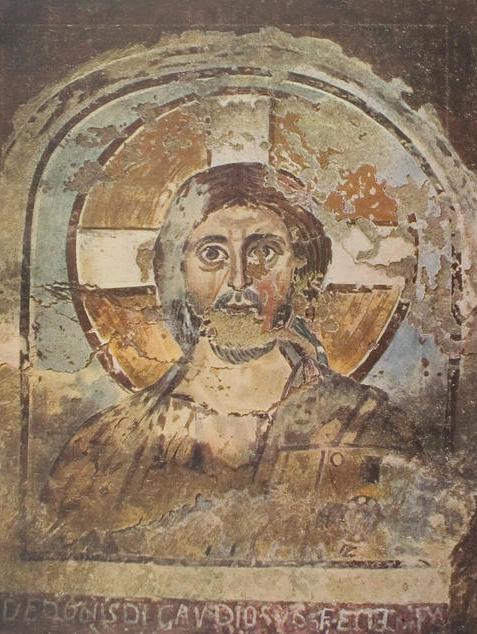
Vignon paid particular attention to a topless square (Vignon marking (2) above) on the 8th-century Christ Pantocrator in the catacomb of Pontianus, Rome[15] Artistically it made no sense, yet it appears on

[Above (enlarge): Bust of Christ Pantocrator from the catacomb of Pontianus, Rome[16]. Note in particular the Vignon marking on this 8th century fresco[17]: "(2) three-sided [topless] `square' between brows." See "c. 710".]

other Byzantine Christ portraits, including the 11th century Christ Pantocrator in the dome of the church at Daphni, near Athens[18],

[Above (enlarge): Christ Pantocrator mosaic in the church at Daphni, Greece[19].]

has 13 of the 15 Vignon markings[20]. Some of them (e.g. the three-sided, or topless square) are stylized having been rendered more naturalistic by a competent artist[21]. The 11th century Pantocrator in the apse of Sant'Angelo in Formis church, near Capua, Italy. This

[Above (enlarge): Extract of Christ's face which is part of a larger 11th century fresco in the church of St. Angelo in Formis, Capua, Italy[22].]

"Christ enthroned" fresco[23] has 14 out of the 15 Vignon markings that are on the Shroud[24], many of which are just incidental blemishes on the cloth[25]. The 10th century Hagia Sophia narthex

[Above (enlarge): Extract from the larger mosaic above the narthex of Constantinople's Hagia Sophia cathedral[26].]

mosaic, and the 11th century "Christ the Merciful" mosaic in

[Above (enlarge): "Christ the Merciful" mosaic (1100-1150) in the Bodemuseum, Berlin[27]. By my count this icon has 12 of the 15 Vignon markings]

Berlin[28].

And at the equivalent point on the Shroud face[, there is exactly the same `topless square' feature where it is merely a flaw in the weave[29] (see below).

[Above (enlarge): Extract from ShroudScope showing outlined in red the `three sided' or `topless square' (Vignon Marking no 2), superimposed on the above 8th century bust of Christ in the catacomb of Pontianus, Rome: Shroud Scope and Wikipedia. As can be seen, on the Shroud this "topless square" is merely a flaw or change in the weave[30], which in fact runs all the way down the Shroud! [C]]

In 1938 Vignon presented his discoveries as an "Iconographic Theory" in his book, "Le Saint Suaire de Turin: Devant La Science, L'archéologie, L'histoire, L'iconographie, La Logique" ("The Shroud of Turin: Before Science, Archeology, History, Iconography, Logic")[31] in which he proposed that the Shroud was known and revered as far back as the fifth century[32]. Historian Ian Wilson reduced Vignon's list of 20 peculiarities down to 15 more certain "Vignon markings"[33] (see above). No one work featured every peculiarity[34], but of the 15 Vignon markings, some have 13 (e.g. the 11th century Pantocrator in the dome of the church of Daphni, Greece [see above]) and even 14 (e.g. the 12th century Cefalu apse mosaic (see below) and the 11th

[Above: (enlarge): Christ Pantocrator, Cefalu Cathedral, Sicily[35]. As can be seen, this mosaic depicts a Shroud-like, long-haired, fork-bearded, front-facing likeness of Christ[36]. It has 14 out of 15 Vignon markings (see above)[37], including a triangle between the nose and the eyebrows, concave cheeks, asymmetrical and pronounced cheekbones, each found on the Shroud, and a double tuft of hair where the reversed `3' bloodstain is on the Shroud[38]. But at c.1150 it is still over a century before the earliest 1260 radiocarbon date of the Shroud[39]!

century Sant'Angelo in Formis [see above] fresco[40]. Wilson sampled depictions of Christ's face from the sixth, eighth, tenth, eleventh, and twelfth centuries and found between eight and fourteen of these Vignon markings features on them, an average of 80 percent incidence[41]! [D]

As Wilson pointed out of the 8th-century Christ Pantocrator in the catacomb of Pontianus, Rome (see above) that:

"Just as the viewing of a single footprint on fresh sand provided for Robinson Crusoe the conclusive evidence that there was another human being (later revealed as Man Friday) on his island, so the presence of this topless square on an indisputably seventh/eighth-century fresco virtually demands that the Shroud must have been around, somewhere, in some form at this early date"[42].
so is "this topless square on an ... eighth-century fresco" (and on the other pre-1260 portraits of Christ above) conclusive evidence that the Shroud existed in at least the eighth century! That is, six centuries before the earliest 1260 date given to it by radiocarbon dating[43]!

Continued in the next part #11 of this series.

Notes
1. This post is copyright. I grant permission to quote from any part of it (but not the whole post), provided it includes a reference citing my name, its subject heading, its date, and a hyperlink back to this page. [return]
2. Wilson, I., 1978, "The Turin Shroud," Book Club Associates: London, p.82e. [return]
3. McCrone, W.C., 1999, "Judgment Day for the Shroud of Turin," Prometheus Books: Amherst NY, pp.1,141,178,246; Wilson, I., 1998, "The Blood and the Shroud: New Evidence that the World's Most Sacred Relic is Real," Simon & Schuster: New York NY, p.7; Tribbe, F.C., 2006, "Portrait of Jesus: The Illustrated Story of the Shroud of Turin," Paragon House Publishers: St. Paul MN, Second edition, p.169; de Wesselow, T., 2012, "The Sign: The Shroud of Turin and the Secret of the Resurrection," Viking: London, p.170; Oxley, M., 2010, "The Challenge of the Shroud: History, Science and the Shroud of Turin," AuthorHouse: Milton Keynes UK, p.87. [return]
4. Gove, H.E., 1996, "Relic, Icon or Hoax?: Carbon Dating the Turin Shroud," Institute of Physics Publishing: Bristol UK, p.303. [return]
5. Maher, R.W., 1986, "Science, History, and the Shroud of Turin," Vantage Press: New York NY, p.76. [return]
6. Wuenschel, E.A., 1954, "Self-Portrait of Christ: The Holy Shroud of Turin," Holy Shroud Guild: Esopus NY, Third printing, 1961, p.60. [return]
7. Wilson, I., 1979, "The Shroud of Turin: The Burial Cloth of Jesus Christ?," [1978], Image Books: New York NY, Revised, p.103. [return]
8. Walsh, J.E., 1963, "The Shroud," Random House: New York NY, p.157. [return]
9. Shroud Scope: Durante 2002 Face Only Horizontal (cropped and rotated right 90°). [return]
10. Wuenschel, 1954, p.60. [return]
11. Wilson, 1979, p.104. [return]
12. Wuenschel, 1954, p.58. [return]
13. Wilson, 1979, p.105. [return]
14. Adams, F.O., 1982, "Sindon: A Layman's Guide to the Shroud of Turin," Synergy Books: Tempe AZ, p.82. [return]
15. Wilson, 1979, p.103. [return]
16. "Catacomba di Ponziano," Google Translate, Wikipedia, 25 January 2016. [return]
17. Wilson, I., 1986, "The Evidence of the Shroud," Guild Publishing: London, p.105; Scavone, D.C., "The History of the Turin Shroud to the 14th C.," in Berard, A., ed., 1991, "History, Science, Theology and the Shroud," Symposium Proceedings, St. Louis Missouri, June 22-23, 1991, The Man in the Shroud Committee of Amarillo, Texas: Amarillo TX, pp.171-204, 189, 191; Iannone, J.C., 1998, "The Mystery of the Shroud of Turin: New Scientific Evidence," St Pauls: Staten Island NY, p.153. [return]
18. Maher, 1986, p.77. [return]
19. "Daphni Monastery," Wikipedia, 7 May 2017. [return]
20. Maher, 1986, p.77. [return]
21. Wilcox, R.K., 1977, "Shroud," Macmillan: New York NY, p.84; Wilson, 1979, p.104. [return]
22. Wilson, 1986, p.110A. [return]
23. Wilson, 1991, p.47. [return]
24. Wilson, 1979, p.102. [return]
25. Wilson, 1991, p.47. [return]
26. "File:Byzantinischer Mosaizist des 9. Jahrhunderts 001.jpg," Wikimedia Commons, 22 February 2015. [return]
27. Mosaic icon, "Christ the Merciful (1100-1150), in Museum of Byzantine Art, Bode Museum, Berlin, Germany: File:Mosaikikon Bode Berlin 2.jpg, Wikipedia (translated by Google), 3 August 2015. [return]
28. Wilson, 1979, p.104. [return]
29. Wilson, I., 2010, "The Shroud: The 2000-Year-Old Mystery Solved," Bantam Press: London, p.142. [return]
30. Scavone, 1991, p.185; Wilson, I., 1991, "Holy Faces, Secret Places: The Quest for Jesus' True Likeness," Doubleday: London, p.166. [return]
31. Wilson, 1991, pp.161-162. [return]
32. Walsh, 1963, pp.154-157. [return]
33. Wilson, 1979, p.104. [return]
34. Wilson, 1979, p.104. [return]
35. "File:Master of Cefalu 001 Christ Pantocrator adjusted.JPG," Wikipedia, 15 June 2010. [return]
36. Wilson, 1986, p.105; Wilson, 1998, p.141. [return]
37. Wilson, 1979, p.105; Maher, 1986, p.82. [return]
38. Petrosillo & Marinelli, 1996, p.193. [return]
39. Wilson, 1986, p.104. [return]
40. Wilson, 1979, pp.104-105. [return]
41. Antonacci, M., 2000, "Resurrection of the Shroud: New Scientific, Medical, and Archeological Evidence," M. Evans & Co: New York NY, p.128. [return]
42. Wilson, 1991, p.168; Wilson, 2010, p.142. [return]
43. Wilson, 2010, p.142. [return]

Posted 29 October 2017. Updated 3 February 2026.

Sunday, October 22, 2017

10 October 1987: On this day 30 years ago in the radiocarbon dating of the Turin Shroud

© Stephen E. Jones[1]

This is part #6, "10 October 1987," of my series, "On this day 30 years ago in the radiocarbon dating of the Turin Shroud." For more information about this series, see part #1, Index. As explained in part #1, the first few significant days 30 years ago have already passed, but with this post I have almost caught up and when I do I will thereafter publish each day's post as near to its 30th anniversary as possible. Emphases are mine unless otherwise indicated.

[Index #1] [Previous: 29Jun87 #5] [Next: 18Nov87 #7]

10 October 1987 The Archbishop of Turin, Cardinal Anastasio Ballestrero (r. 1977-1989) [Below right[2].], on the advice of, and presumably written by[3], his scientific adviser, Professor Luigi Gonella (1930–2007)[4], wrote to all the participants in the 1986 Turin Workshop, including the seven laboratories which were to have dated the Shroud [see 27Apr87], advising them that only three of their number: Arizona, Oxford and Zurich, had been chosen to carry out the dating[5]. This confirmed Gonella's statement in La Stampa of 27 April 1987 [see 27Apr87] and Cardinal Casaroli's leaked letter of 21 May 1987 to Cardinal Ballestrero [see 29Jun87].

Now that the seven laboratories using two different methods had been reduced to three laboratories using the one AMS method, the alleged hacker, Arizona laboratory physicist Timothy W. Linick (see below), would have realised that it was feasible for him to write a program to be installed

[Left: Photo of Linick and report that "He died at the age of forty-two on 4 June 1989, in very unclear circumstances"[6]. In fact Linick "shot himself" (or so it was assumed) but left no suicide note [see 22Feb16]. That was on 4 June 1989, only one day after hacker Karl Koch's burnt body was publicly identified by West German police on 3 June 1989 [see again 22Feb16]. According to my hacker theory, Linick's "suicide," like Koch's, was murder by the KGB made to look like suicide, to prevent them publicly confessing their part in the Soviet sponsored hacking of the Shroud's 1988 radiocarbon dating, which produced the `too good to be true' 1260-1390 = 1325 ±65 radiocarbon date of the authentic first-century Shroud.]

on the AMS computers at the three laboratories (which were effectively clones[7]), that would substitute the Shroud's actual carbon-14 dates with computer-generated dates, which would make the Shroud seem to date from just before it's first appearance in undisputed history at Lirey, France, in c.1355[8]. [See 22Feb16]

The key points of Ballestrero's letter were (in bold): ■ It was based on, "positive instructions from the Holy See [Pope John Paul II] personally signed by the Cardinal Secretary of State [Cardinal Casaroli-see again 29Jun87] on how to proceed to the radiocarbon dating of the Shroud of Turin"[9]. Prof. Harry Gove's attempts to sideline Turin by getting Rome, in the person of Prof. Carlos Chagas Filho, President of the Pontifical Academy of Sciences, to take full control of the radiocarbon date of the Shroud[10] had utterly failed!

■ The "choice of the three laboratories among the seven ... was made ... on a criterion of internationality and consideration for the specific experience in the field of archaeological radiocarbon dating, taking also into account the required sample size"[11]. On the criterion of "the required sample size", the non-AMS laboratories Harwell and Brookhaven would need two to three times the amount of Shroud sample than the AMS laboratories[12]. From Turin's perspective, "reducing the amount of cloth to be taken was the principal consideration"[13]. for its departure from the 1986 Turin workshop protocol"[14]. This alone eliminated the non-AMS laboratories[15]. By the criterion of "specific experience in the field of archaeological radiocarbon dating," among the remaining AMS laboratories, Gove's Rochester and Gif-sur-Yvette in France had less than Arizona, Oxford and Zurich[16]. And the criterion of "internationality," meant only one laboratory each from the USA, England and Europe, leaving "the following laboratories ... selected: Radiocarbon Laboratory, University of Arizona"; "Research Laboratory for Archaeology, Oxford University"; and "Radiocarbon Laboratory, ETH, Zurich"[17].

■ "Professor Carlos Chagas, President of the Pontifical Academy of Sciences, will be invited to be present at the operation as ... my personal guest"[18]. This meant that Chagas "would play no role at all"[19].

■ It is not "... necessary for representatives of the measurement laboratories to attend the sample-taking operation"[20]. Gove regarded this "as absolutely outrageous" and Sox as "shocking"[21].

■ "The decisions took more time to be worked out than originally wished, owing to ... (the) initiative of some participants in the workshop who stepped out of the radiocarbon field to oppose research proposals in other fields, with implications on the freedom of research of other scientists ..."[22]. Gove admitted that the Archbishop's "thinly veiled accusation that we were attempting to prevent STURP from carrying out its scientific investigations was quite accurate"[23]! [see also 27Apr87, 15Jun87]. But having just admitted that Ballestrero's criticism of him regarding STURP was "quite accurate," in the same paragraph, Gove claimed that they were "false" and he "resented" them: "I had never before been directly or indirectly chastised by a cardinal and I resented the falseness of his charges"[24]!

■ "Besides, when the competent Authorities, advised me they deemed we ought to proceed with three samples ... Not only Turin's Gonella but also "a group of scientific consultants of the Pontifical Academy of Sciences" had advised that, "[c]utting seven pieces would have been too destructive"[25]), "...a concerted initiative was taken to counter the decision, with the outcome of a telegram [see 13Sep17] "... sent to H. E. the Cardinal Secretary of State and myself by some participants in the workshop, a telegram where the meaning of my introductory words at the workshop was heavily misinterpreted"[26]. The telegram sent to Cardinal Ballestrero on 6 July 1987 by Gove on behalf of the seven laboratories [see 29Jun87] quoted from Ballestrero's introductory words at the 1986 Turin workshop:

"Your Eminence, In your opening statements to the delegates of the Turin Workshop on Radiocarbon Dating of the Turin Shroud, you charged us with designing 'a valid and acceptable project for at last carrying out the radiocarbon dating of the shroud cloth'"[27]
Gove commented on this:
"One had to concede that only he could know what he meant to say in his introductory remarks but I think we correctly reported what he actually did say"[28].
But this is another example of the egotistical Gove[29] being blind to the effects of his own words and actions [see 07Jul17]. Clearly by "acceptable" Cardinal Ballestrero meant acceptable to all participants in the workshop: the laboratories, STURP, the Turin Archdiocese and the Rome Pontifical Academy of Science. But by Gove's own account in his book of his words and actions in the workshop, he adopted a confrontational and divide-and-conquer approach, riding roughshod over both STURP and Turin's Gonella, to achieve a result that was acceptable only to the seven laboratories!

■ "After further deliberation and scrutiny of the situation with the Cardinal Secretary of State, we are now proceeding on the already decided terms, that I was just going to write you when I received the above quoted telegram"[30]. Gove further commented that, "It was also clear that the cable we had sent to Ballestrero had really annoyed him intensely"[31]. When he first learned that his laboratory, Rochester, had been excluded, Gove conceded that, he "should probably take a course in diplomacy"[32]. Indeed! In response to Gove's blatant disregard of, and active working against, Cardinal Ballestrero's request for a protocol "acceptable" to all the particpants to emerge from the Turin workshop, Ballestrero would have been will within his rights to suspend the dating until all the participants came back to him with a consensus protocol!

■ "In consideration of the great attention from the public and the press that all of us know that this measurement is attracting, it seems to me worthwhile to stress again what I said in my opening address at the Turin workshop, about the purely scientific character of this enterprise, which does not mean to, nor could, address any issue related to the death and resurrection of Jesus Christ. Nor do I mean with this analysis to charge the laboratories that have been selected with the task of 'authenticating' the Shroud of Turin: the analysis is strictly meant to ascertain the radiocarbon date of its cloth as an objective datum of the highest importance for evaluating the complex issues of its authenticity and conservation"[33]. It is true that "the radiocarbon date of its [the Shroud's] cloth," if it turned out to be medieval (as it did), would not "address any issue related to the death and resurrection of Jesus Christ," since the Shroud could be a fake but Jesus' resurrection be true (as the majority of Christians maintain, including me for ~40 years). But the same does not hold for "'authenticating' the Shroud of Turin." If the Shroud's "radiocarbon date ... as an objective datum" was truly medieval, then the Shroud could not be authentic. But since the evidence is overwhelming that the Shroud is authentic, it is the "mediaeval ... AD 1260-1390"[34] radiocarbon date of the Shroud which cannot be "an objective datum"!

■ "As we move on to the executive phase of the project of radiocarbon dating the Shroud of Turin, I would like to thank again all those who brought positive contributions to it, and to offer my heartfelt good wish to those who will undertake it, trusting that they will carry it out with utmost scientific rigour in order to add this important objective datum to the scientific quest that has long been growing on the illustrious image entrusted to my stewardship. Anastasio Cardinal Ballestrero, Archbishop of Turin, Pontifical Custodian of the Shroud of Turin"[35]. Not "thanks to all participants" but "thanks to all those who brought positive contributions." Evidently aimed at Gove whose attitude in the 1986 Turin workshop was negative towards STURP and Turin's Gonella[36]. For example:

"At a point later on in the workshop, a list of the participants was passed around for people to correct their addresses or make whatever changes they wanted. Several people did make changes, for example, Professor Alan D Adler of the Chemistry Department, Western Connecticut State University, removed his tame completely ... In the case of Adler, I suspected it was a case of playing hookey"[37].
This further shows Gove's negativity towards STURP, of which Alan D. Adler (1931-2000) was a representative. Adler did later attend the workshop as Gove even mentioned (p.153), so Adler simply may not have been able to attend the opening session and his name had been removed from that session's list by the workshop organisers.
"Dr Robert Dinegar gave as his address USA Shroud of Turin Research Project only, with no location. Finally, the person listed as Professor Steve Lukasik, from the J P Getty Conservation Institute, corrected his tame to Dr Stephen J Lukasik and gave as his address Shroud of Turin Research Project, USA, just as Dinegar had done ... I was a little surprised at the requested changes. Perhaps they reflected a slight embarrassment at indicating a connection between such esteemed organizations such as NASA (Canuto), Los Alamos National Laboratory (Dinegar) and Northrup (Lukasik), and the Turin Shroud"[38].
If Gove had not been so prejudiced against STURP, he might have realised that they were not at the workshop representing their employers but in a private capacity, and so the corrections were more accurate. Besides, "Professor Steve Lukasik, from the J P Getty Conservation Institute" presumably was the organisers' mistake, because there was a James Druzik of the J.P. Getty Museum who was to attend the workshop, as Gove actually mentions in his book (at pages 95 and 113, etc), and Gove knew that Lukasik was from Northrup.
"Lukasik ... is Vice President–Technology of the Northrup Corporation whose headquarters are in Los Angeles, California. Northrup is a manufacturer, among other things, of military aircraft, and supplies one of the fighter planes for the US Air Force. It is interesting that there are several 'warriors', including atom bomb builders from Los Alamos, connected with STURP. Perhaps it is some sort of compensation for their occupation that makes them take an interest in the 'Prince of Peace'" (i.e. Jesus - Isa 9:6)[39]
This is another example of Gove the agnostic's anti-Christian prejudice [see 31May17]. What does it matter, scientifically, that there were Christians at the workshop, who were fully qualified scientists working in the USA's defence industries, and who were also members of STURP? The implication of Gove's attitude is that the Shroud of Turin, a Christian relic, should only be studied by atheist/agnostics like him!

But by far the greatest failing of the workshop, which would completely invalidated it, was that Gove, Chagas and the laboratories completely ignored Gonella's unhappiness with the proposal that seven laboratories were needed, requiring seven samples:

"During much of this part of the discussion, Gonella made incoherent teeth grinding sounds from time to time. He was clearly not in favour of seven samples for seven labs. He was also clearly unhappy about the assumption that all seven labs be involved. Harbottle's statement that four labs would be unacceptably too few bothered him greatly. He asked whether this meant that all dating made on only one archaeological sample should be considered unreliable? ... Chagas tried to sum up by saying that we needed two controls from two different age populations plus a shroud sample for each of the seven labs. Gonella indicated he was very unhappy about this conclusion"[40].
Gonella again stated there was no scientific justification for seven laboratories taking seven samples:
"Gonella [spoke] ... As far as dating the shroud was concerned, Turin could have proceeded like any archaeologist in the field who wanted an object dated - just send shroud samples to a couple of labs of their choice ... But we had decided to proceed differently. He criticized the decision to involve seven labs. He said that 12½ cm2 would be the largest sample ever taken from the shroud. There was no technical justification for this many labs and this much sample. He said he did not understand why the labs had to be present at the sample taking to be able to put the samples in their pockets. Did we not trust the British Museum?"[41]
But again Gonella, representing the Custodian of the Shroud, who would in the end have the final say, was ignored by Chagas, Gove and the laboratories:
"The workshop reconvened at 2:45 pm [on 1 October 1986] and Chagas presented a summary: (1) This was the moment for carbon dating. (2) We would take a minimum amount of cloth to ensure rigorous scientific results and to ensure public credibility but would not include charred material. (3) For statistical purposes it was decided that 7 labs would be involved, 5 accelerator and 2 small-counter labs..."[42]

To be continued in the next part #7 of this series.

Notes
1. This post is copyright. I grant permission to quote from any part of it (but not the whole post), provided it includes a reference citing my name, its subject heading, its date, and a hyperlink back to this page. [return]
2. "Ballestrero, Anastasio Alberto," Araldica Vaticana.com, n.d. [return]
3. Sox, H.D., 1988, "The Shroud Unmasked: Uncovering the Greatest Forgery of All Time," Lamp Press: Basingstoke UK, p.116 [return]
4. Wilson, I., 1998, "The Blood and the Shroud: New Evidence that the World's Most Sacred Relic is Real," Simon & Schuster: New York NY, p.307. [return]
5. Sox, 1988, p.115; Gove, H.E., 1996, "Relic, Icon or Hoax?: Carbon Dating the Turin Shroud," Institute of Physics Publishing: Bristol UK, p.213; Petrosillo, O. & Marinelli, E., 1996, "The Enigma of the Shroud: A Challenge to Science," Scerri, L.J., transl., Publishers Enterprises Group: Malta, p.40; Wilson, 1998, pp.5-6. 307; Tribbe, F.C., 2006, "Portrait of Jesus: The Illustrated Story of the Shroud of Turin," Paragon House Publishers: St. Paul MN, Second edition, p.169; Oxley, M., 2010, "The Challenge of the Shroud: History, Science and the Shroud of Turin," AuthorHouse: Milton Keynes UK, p.223; Wilson, I., 2010, "The Shroud: The 2000-Year-Old Mystery Solved," Bantam Press: London, p.87; de Wesselow, T., 2012, "The Sign: The Shroud of Turin and the Secret of the Resurrection," Viking: London, p.166. [return]
6. Bonnet-Eymard, B., 2000, "The Holy Shroud is as Old as the Risen Jesus, IV. Caution! Danger!, The Catholic Counter-Reformation in the XXth Century, No 330, Online edition, May. [return]
7. Wilson, I., 1991, "Holy Faces, Secret Places: The Quest for Jesus' True Likeness," Doubleday: London, p.178; Wilson, 2010, p.281. [return]
8. Wilson, 2010, p.222. [return]
9. Sox, 1988, p.115; Gove, 1996, p.213. [return]
10. Gove, 1996, pp.101-102. [return]
11. Sox, 1988, p.116; Petrosillo & Marinelli, 1996, p.41; Gove, 1996, p.214; Wilson, 1998, p.307; Antonacci, M., 2000, "Resurrection of the Shroud: New Scientific, Medical, and Archeological Evidence," M. Evans & Co: New York NY, p.179; Wilson, 2010, p.87. [return]
12. Gove, 1996, p.155. [return]
13. Tribbe, 2006, p.169; Gonella, L., "Discussant's contribution," in Scannerini, S. & Savarino, P., eds, 2000, "The Turin Shroud: Past, Present and Future," International scientific symposium, Turin, 2-5 March 2000," Effatà: Cantalupa, p.509. [return]
14. Wilson, 1998, pp.183-184. [return]
15. Antonacci, 2000, pp.178-179. [return]
16. Gove, 1996, pp.156-157; Wilson, 1998, p.183. [return]
17. Gove, 1996, p.214; Wilson, 1998, p.183; Oxley, 2010, p.223; Wilson, 2010, p.87. [return]
18. Sox, 1988, p.115; Gove, 1996, p.214; Petrosillo & Marinelli, 1996, p.41. [return]
19. Gove, 1996, p.215; Wilson, 1998, pp.183, 307; Wilson, 2010, p.281. [return]
20. Gove, 1996, p.214; Petrosillo & Marinelli, 1996, p.41. [return]
21. Sox, 1988, p.115; Gove, 1996, p.215. [return]
22. Sox, 1988, p.115; Gove, 1996, p.214; Petrosillo & Marinelli, 1996, p.42; Antonacci, 2000, p.200. [return]
23. Gove, 1996, p.216; Antonacci, 2000, p.200. [return]
24. Gove, 1996, p.216. [return]
25. Petrosillo & Marinelli, 1996, p.41. [return]
26. Gove, 1996, pp.214-215; Petrosillo & Marinelli, 1996, pp.42-43. [return]
27. Gove, 1996, p.200. [return]
28. Gove, 1996, pp.215-216. [return]
29. Wilson, I., 1997, "Recent Publications," BSTS Newsletter, No. 45, June/July; de Wesselow, 2012, p.164. [return]
30. Gove, 1996, p.215. [return]
31. Ibid. [return]
32. Gove, 1996, p.213. [return]
33. Gove, 1996, p.215. [return]
34. Damon, P.E., et al., 1989, "Radiocarbon Dating of the Shroud of Turin," Nature, Vol. 337, 16 February, pp.611-615, 611. [return]
35. Gove, 1996, p.215. [return]
36. Sox, 1988, p.116; Petrosillo & Marinelli, 1996, p.43. [return]
37. Gove, 1996, p.147. [return]
38. Ibid. [return]
39. Gove, 1996, p.148. [return]
40. Gove, 1996, pp.156-157. [return]
41. Gove, 1996, pp.170-171. [return]
42. Gove, 1996, p.174. [return]

Posted 22 October 2017. Updated 20 July 2025.

Saturday, October 21, 2017

"Editorial and Contents," Shroud of Turin News, September 2017

Shroud of Turin News - September 2017
© Stephen E. Jones
[1]

[Previous: August 2017, part #1] [Next: October 2017, part #1]

This is the "Editorial and Contents," part #1, of the September 2017 issue of my Shroud of Turin News. Following this editorial, I would normally list Shroud-related September 2017 news articles in separate posts, linked back to this post, but there were none I considered worth listing.

Contents:
Editorial


Editorial
Rex Morgan's Shroud News: My scanning and word-processing of the 118 issues of Rex Morgan's Shroud News, provided by Ian Wilson, and emailing them to Barrie Schwortz, for him to convert to PDFs and add to his online Shroud News archive, continued in September up to issue #85, October 1994. [Right (enlarge)], i.e ~72% completed. Issues in that archive are up to #84, August 1994.

Posts: In September I blogged 5 new posts (latest uppermost): "Chronology of the Turin Shroud: Twelfth century," - 23rd; "VT-100 terminal to a DEC mini-computer, Timothy Linick and Karl Koch, #9," - 18th; "29 June 1987: On this day 30 years ago in the radiocarbon dating of the Turin Shroud," - 13th "Blood clots intact #24: The man on the Shroud: The evidence is overwhelming that the Turin Shroud is Jesus’ burial sheet!," - 4th "Editorial and Contents," Shroud of Turin News, August 2017," - 3rd.

Updates In September there were no significant updates in the background of past posts. Except that in September I finished going through my posts from 2015 backwards, and started from 2016 forwards, saving linked photos in case they become no longer online and replacing those which had gone offline.

Comments: In September I deleted as substandard two comment which I considered inane and not worth me wasting my scarce time answering them.

My radiocarbon dating hacker theory: I blogged no posts about my hacker theory in September.

My book: In September I continued to make progress in writing a dot-point outline of my book, "The Shroud of Turin: The Burial Sheet of Jesus!" on my smartphone (see 06Jul17). Chapter(s) I

[Left (enlarge): My book's planned cover.]

worked on in September were: "6. History and the Shroud: AD 30 to 1355," but since changed to "...944." I had became bogged down in the Resurrection accounts (Mt 28:1-15; Mk 16:1-8; Lk 24:1-12 & Jn 20:1-18), but re-reading John Wenham's "Easter Enigma" is helping me disentangle them.


Pageviews: At midnight on 30 September 2017, Google Analytics [Below (enlarge)] gave this blog's "Pageviews all time history" as 798,759. This compares with 593,586 (up 205,173 or ~34.6%) from the same time in September 2016. It also gave the most viewed posts for the month (highest uppermost) as: "Blood clots intact #24: The man on the Shroud: The evidence is overwhelming that the Turin Shroud is Jesus’ burial sheet!," - 120; "Chronology of the Turin Shroud: Twelfth century," Sep 23, 2017 - 87; "Editorial and Contents," Shroud of Turin News, August 2017," Sep 3, 2017 - 80;"Obituary: Rev. H. David Sox (24 April 1936 - 28 August 2016)," - Aug 15, 2017 - 72; "John P. Jackson, `An Unconventional Hypothesis to Explain all Image Characteristics Found on the Shroud Image' (1991)," Aug 13, 2017 - 69


Notes:
1. This post is copyright. I grant permission to extract or quote from any part of it (but not the whole post), provided the extract or quote includes a reference citing my name, its title, its date, and a hyperlink back to this page. [return]

Posted 21 October 2017. Updated 13 July 2025.

Saturday, September 23, 2017

Chronology of the Turin Shroud: Twelfth century (1)

Chronology of the Turin Shroud: AD 30 to the present
TWELFTH CENTURY (1)
© Stephen E. Jones
[1]

This is the split part #12, "Twelfth century (1)" of my "Chronology of the Turin Shroud: AD 30 - present" series. See also 29Mar14. For more information about this series see part #1, "1st century and Index." Emphases are mine unless otherwise indicated. I decided to split this my "Chronology of the Turin Shroud: Twelfth Century" (1101-1200) into two parts 1101-1150 (1) and 1152-1200 (2), and insert a summary of the c. 1150 Chartres Cathedral stained glass windows [see 29Nov18a], into this first part (1). [See below and "c.1150"]. Part (2) is at 20Dec18.

[Index #1] [Previous: 11th century #11] [Next: 12th century (2) #13]


12th century (1) (1101-1150).

[Above (enlarge). Telephotograph of the "Crucifixion panel," in the "Window of the Passion and Resurrection," Chartres Cathedral, emailed to me by Prof. Roberto Falcinelli[2]. In this "The Crucifixion" panel, within the "Window of the Passion and Resurrection" (see "c. 1150" below), Jesus is depicted with a realistic reversed `3' or epsilon (ε) bloodflow on his forehead [see also 29Nov18b], and also a nail wound in his right wrist [see below and 29Nov18c], both exactly as on the Shroud!].]

1119 Formation of the Knights Templar[3]. The Order of Knights Templar was founded by noblemen from north-eastern France to defend Christianity against the Saracens at the beginning of the twelfth century[4]. It reached the height of its power and wealth during the thirteenth century and was finally suppressed in 1307 by King Philip IV of France (r.1285-1314)[5] [See "1307"]. In 1314 France's two leading Templars,
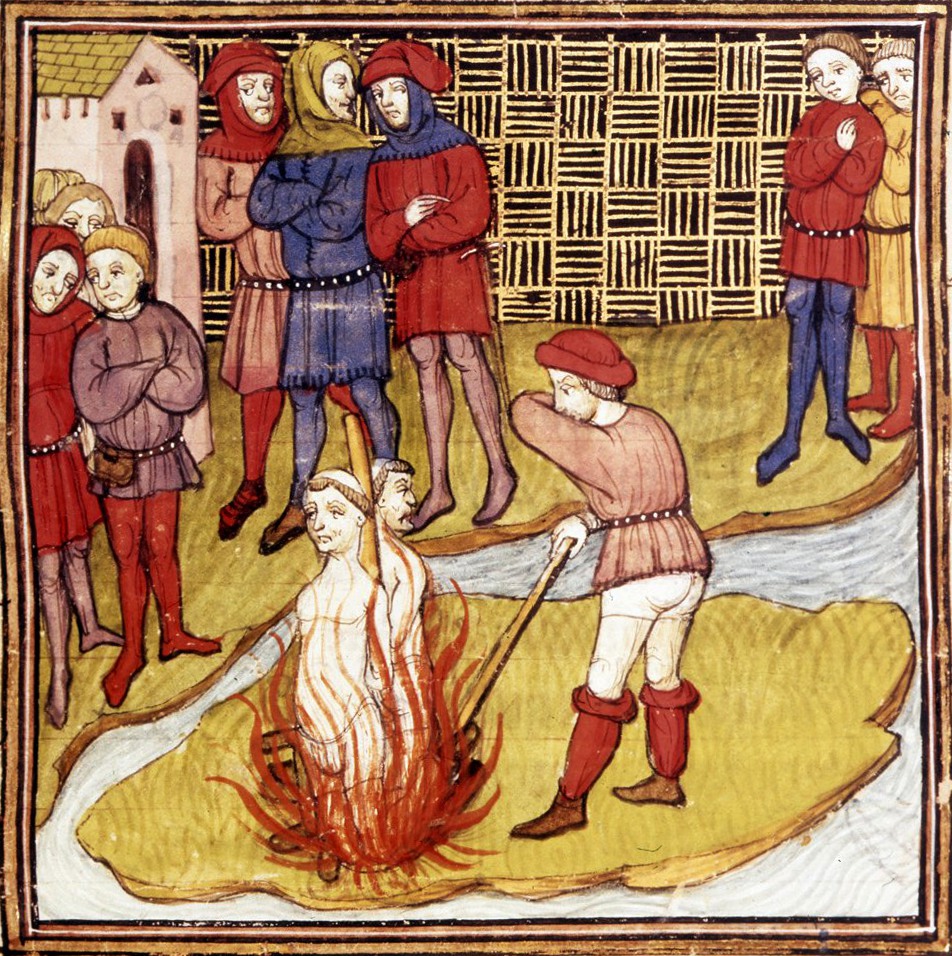
[Right (enlarge): Minia- ture (1380) depiction of the burning at the stake on 18 March 1314, of Templars Jacques de Molay and Geoffroi de Charney on an island (ÃŽle des Juifs - Isle of the Jews) in the Seine River, Paris[6].]

Jacques de Molay (c.1243–1314) and Geoffroi de Charney (c.1240–1314), were burned at the stake for recanting their confessions extracted under torture and proclaiming their, and the Templar Order's, innocence of the false charges brought by King Philip IV[7, 8, 9]. See my 09May15 that this Geoffroi de Charney was the great-uncle of Geoffroy I de Charny (c. 1300–1356), the first undisputed owner of the Shroud [See "1314"] Pro-authenticist historian Ian Wilson theorised that the Templars acquired

[Above (enlarge): Composite map illustrating Ian Wilson's theory that the Shroud was taken from Constantinople in 1204 to Acre, in today's Israel, and from there to France after 1291[10]. Wilson no longer holds that theory (see below).]

the Shroud after it was looted from Constantinople in 1204 by soldiers of the Fourth Crusade[11], and took it to their fortress at Acre[12]. Then after the Fall of Acre in 1291 the Templars took the Shroud to France and hid it in their network of fortresses and castles[13]. However, there is little evidence for Wilson's Templar theory[14] (see "1185") and at the 2012 Valencia Shroud conference, Wilson announced that he no longer held it[15].

Pre-1130 Before 1130, Vatican Library codex 5696, folio 35[16], is a Latin update of an original Greek[17] Easter Friday sermon by Pope Stephen III (r.768-772), delivered in 769[18]. [see "769"]. Stephen's original 8th century sermon quoted Jesus' supposed letter in response to Edessa's King Abgar V's request for healing [see "50"]:

"Since you wish to look upon my physical face, I am sending you a likeness of my face on a cloth ..."[19]
The twelfth-century Vatican version contains an interpolation (in italics):
"Since you wish to look upon my physical face, I am sending you a likeness of not only of my face but of my whole body divinely transformed on a cloth ..."[20]
Clearly the twelfth century copyist knew that the Edessa cloth now in Constantinople had an image not only of Jesus' face, but of His entire body, and he updated Pope Stephen's 769 sermon according to the new information he had[21]. [see "950" [11May14]

c.1130 An English-born Normandy monk Ordericus Vitalis (1075–c.1142)[22], in his History of the Church, written by 1130, when he came to an important event near his own day, the capture of Edessa in the First Crusade [see "1095], he retold the Abgar story, but with a new twist:

"Abgar the ruler reigned at Edessa; the Lord Jesus sent him a sacred letter and a beautiful linen cloth he had wiped the sweat from his face with. The image of the Saviour was miraculously imprinted on to it and shines out, displaying the form and size of the Lord's body to all who look on it"[23].
As with the above Pope Stephen III's sermon interpolation, this is an altered version of the Abgar story which substituted an image of Jesus' face, with an image of Jesus' whole body, imprinted onto a cloth[24].

1140a "The Song of the Voyage of Charlemagne to Jerusalem" (known by various names in French, including "Chanson du Voyage de Charlemagne à Jerusalem"[25], or "Le Pèlerinage de Charlemagne"[26]), is an Old French epic

[Left: The front cover of a 1965 reprint of the poem[27]. The oldest known written version was probably composed around 1140"[28].]

poem about a fictional expedition by Emperor Charlemagne the Great (c.742-814) and his knights, composed around 1140[29]. Although imaginary it bears historical testimony to the existence of the Shroud at the time, in that it reflects the accounts then given by pilgrims[30]. In it the Emperor asks the Patriarch of Jerusalem if he has any relics to show him, and the Patriarch replies:

"I shall show you such relics that there are not better under the sky: of the Shroud of Jesus which He had on His head, when He was laid and stretched in the tomb ..."[31].
While this contains an inaccuracy in that the Shroud was not in Jerusalem in Charlemagne's time (c.742-814) but continuously in Edessa from 544 to 944[see "544"] and ["944b"]. See also ["670a"] where the pilgrim French Bishop Arculf had reported seeing a shroud in Jerusalem in c.670, but this cannot have been the Shroud [see below]. So The Voyage of Charlemagne evidently reflects genuine but mistaken pilgrims' reports of a shroud in Jerusalem in the Early Middle Ages. The word for "Shroud" in The Voyage of Charlemagne is the Old French equivalent of "sindon"[32], the Greek word, used in the Gospels for Jesus' burial shroud (Mt 27:59; Mk 15:46; Lk 23:53)[33]. Moreover this Old French word (presumably sydoines) is the same word used by crusader Robert de Clari (1170-1216) of the shroud with "the figure of Our Lord on it" that he saw ~63 years later in Constantinople in 1203[34] (see future "1203"). So this is evidence that in 1140, over a century before the earliest, 1260, radiocarbon date of the Shroud, it was common knowledge that the burial shroud of Jesus existed, upon which He had been laid stretched out in the tomb, and which had then covered His head!

1140b Peter the Deacon (c. 1107-c.1159), a monk of Monte Cassino, Italy[35], claimed that in 1140 he had seen the Shroud in Jerusalem[36]. From his description of the ceremony, Peter's belief that this was Jesus' burial shroud was shared by the authorities in Jerusalem[37], as they were in Arculf's day [see above] and "670a"]. But the Shroud was continuously in Constantinople from 944 [see "944b"] to 1204 [see "1204"]. The shroud that Peter and Arculf saw in Jerusalem was only eight feet long[38], so it cannot have been the Shroud which is over fourteen feet long[39]. However, it could have been the Besançon shroud which had a painted frontal image only[40] and was eight feet long[41]. See future ["c. 1350"] and ["1794"].

1144 Edessa, having been captured in 1098 by Christian forces under Baldwin of Boulogne (1058-1118), who became the first ruler of the Crusader state, the County of Edessa [see "1095"], fell to Turkish Muslim forces[42] in the 1146 Siege of Edessa[43]. The bones

[Right (enlarge)[44]. A stone Christian cross over a lion's head in a former fountain in modern Sanliurfa (ancient Edessa), which has survived the almost complete eradication of Edessa's Christian history since the Muslim recapture of Edessa in 1144. The lion was the symbol of the Abgar dynasty[45], which ceased ruling over Edessa after Abgar VIII's death in 212 [see "212"].]

of Abgar V and Addai (Thaddeus) were thrown out of their coffins in the Church of St John the Baptist and scattered, but were retrieved by Christians and reinterred in the Church of St Theodore[46].

1146 After a temporary Crusader recapture under the former Count of Edessa, Joscelin II (1113-59), Edessa was again taken by the Turks in 1146[47]. This time there was much bloodshed[48], with more than 30,000 Christians killed, and 16,000 women and children enslaved[49]. Edessa was systematically looted[50], its Records Office destroyed[51], and its famous churches, including the Hagia Sophia cathedral, regarded as one of the wonders of the world[52], were reduced to rubble and many replaced with mosques[53]. Almost every

[Above (enlarge): Another rare survivor of the obliteration of almost all of Edessa's Christian history since 1144. A 6th-7th century mosaic copy of the Image of Edessa/Shroud, found in the wall of a house[54] in Bireçik, a small town in Sanliurfa Province about 69 kilometres (43 miles) west of Edessa/Sanliurfa [see 25Apr16].]

vestige of Christian imagery in Edessa was ruthlessly destroyed as an offence to the Koran, making any survival of pictorial evidence of the Image of Edessa/Shroud's former presence in Edessa highly unlikely[55]. From this time on Edessa became a wholly Muslim city, with almost all traces of its former Christianity obliterated[56].

1147a In 1147 Louis VII, King of France (r. 1137-80) and Conrad III King of Germany (r.1138-52), enroute to Jerusalem in the Second Crusade (see 1147b below)[57], visited Constantinople[58, 59].

[Left (enlarge): Louis VII, King of France and Conrad III, King of Germany, entering Constantinople in 1147. Miniature by Jean Fouquet (1420–1481) in the Chronicles of St. Denis, 15th century.]

However Manuel was unable to contribute any Byzantine troops to the Second Crusade because his empire had just been invaded by Roger II of Sicily (r. 1130-54) and the Byzantine army was needed in the Peloponnese[60].

1147b The Second Crusade (1147-49) was the response by Latin (Roman Catholic) Christian Europe to the fall of the County of Edessa in 1144 and 1146 to Turkish Islamic forces[61]. (see above "1144" and "1146"). The crusade was announced by Pope Eugene III (r.1145- 53)[62] with the aim of restoring Edessa as the northern bulwark of the
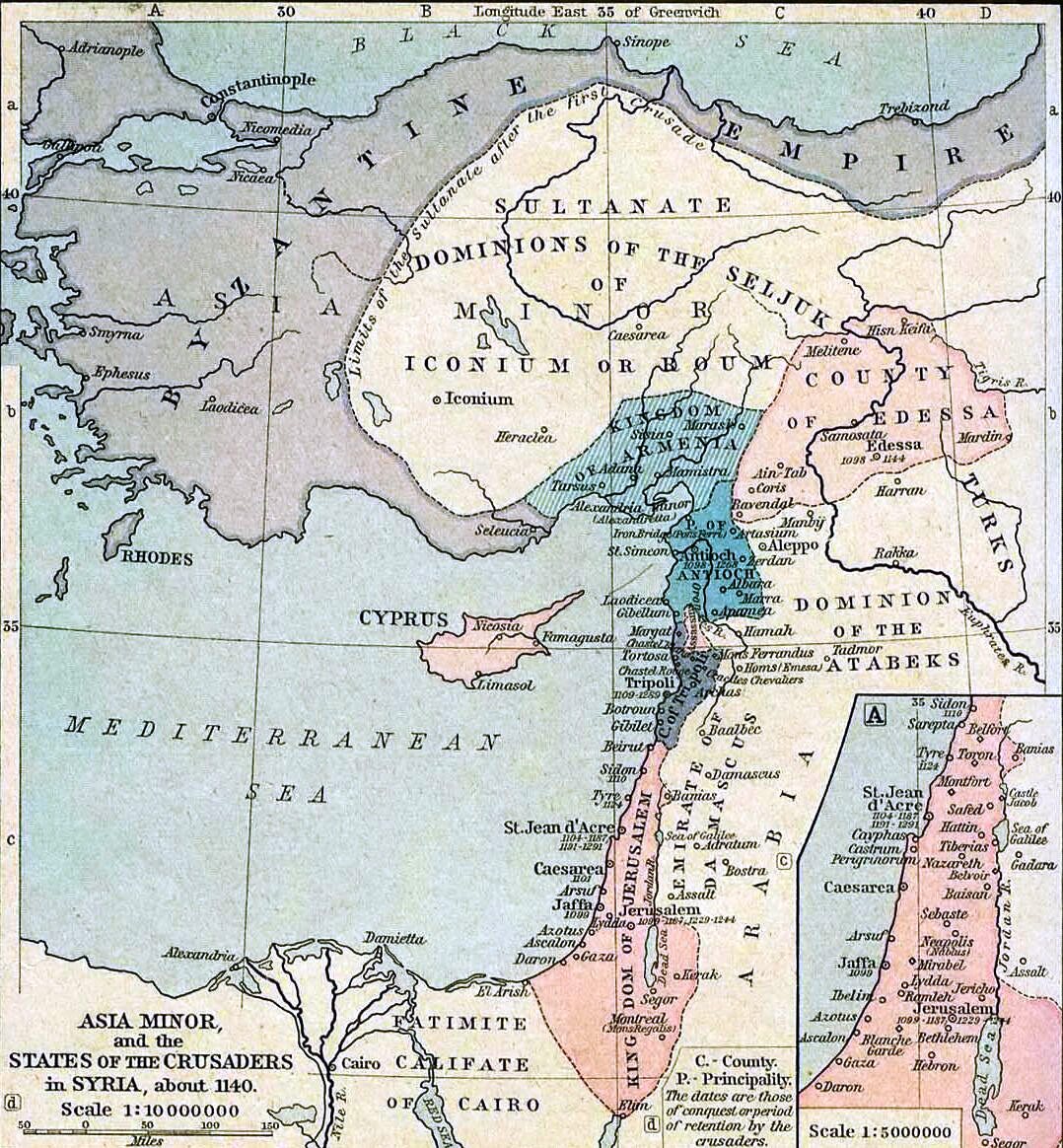
[Right (enlarge): The Crusader States c.1140[63]. This map shows the strategic impossibility of Western European Latin Christianity (without help from Byzantine Eastern Greek Christ- ianity), defending Jerusalem as a Crusader state against the more numerous and organised Turkish Islamic forces.]

crusader Kingdom of Jerusalem[64]. Eugene commissioned the French abbot Bernard of Clairvaux (1090–1153) to preach the case for a second Crusade[65]. Bernard in turn enlisted Kings Louis VII of France and Conrad III of Germany in 1146[66]. From Constantinople [see above], rather than taking the coastal road through Christian territory, Conrad took his army across Muslim-controlled Anatolia where it suffered heavy losses by the Seljuk Turks at the second Battle of Dorylaeum (1147)[67].

1147c In Constantinople Louis was entertained lavishly by the Byzantine Emperor Manuel I Komnenos (r.1143-80)[68]. The Emperor took Louis to the Blachernae palace where he was shown the Shroud and venerated it[69]. Louis, after merging with the remains of Conrad's army followed a route closer to the Mediterranean coast but they were still attacked and weakened by the Turks along the way[70].

1148 The remnant of Louis' and Conrad's combined army reached Antioch by sea in 1148[71]. The military objective was Edessa but Louis wanted to complete his pilgrimage to Jerusalem[72]. However, in Jerusalem the preferred military target of King Baldwin III (1143–63) and the Knights Templar was Damascus[73]. But the Siege of Damascus in 1148 was another heavy defeat for the Crusader armies[74]. So the Second Crusade ended a disastrous failure[75], which left a bitter feeling in the West toward the Byzantine empire, because it could have done more to help[76]. This bitterness between West and East was no doubt a factor in the Sack of Constantinople in 1204 by Western troops enroute to the Fourth Crusade[77] [see "1204"].

c.1149 A copy of the Shroud face on a Crusader period (1131-69) painted column in the Church of the Nativity, Bethlehem! "In the nave

[Above (enlarge): Extract from the cover of Rex Morgan's Shroud News, issue #54, August 1989. [See 04Aug16]. The caption is, "Crusader period painting of Christ in the Church of the Nativity, Bethlehem: Another copy from the Shroud?" The photo was taken by the late archaeologist, Eugenia Nitowski (1947-2007) (aka Sr Damian of the Cross).]

of the Church of the Nativity at Bethlehem are twenty-seven polished columns containing paintings of holy figures (c. 1130 and 1169)"[78]. Until 1131, the Church of the Nativity was used as the primary coronation church for crusader kings[79]. That is, from the coronation in 1100 of Baldwin I of Jerusalem (r.1100-1118)[80] to the coronation in 1131 of Baldwin I's granddaughter, Melisende, Queen of Jerusalem (r.1131-53)[81]. During this time and up to 1169, the crusaders made extensive decoration and restorations of the church and grounds[82].

This icon of Jesus' face dates from between c.1130 and 1169, and has, by my count, at least ten of the fifteen Vignon Markings: nos. 4, 5, 8, 9, 10, 11, 12, 13, 14 & 15 - especially no. 8 "enlarged left nostril", and therefore

[Above (enlarge): The Vignon markings: (1) Transverse streak across forehead, (2) three-sided `square' between brows, (3) V shape at bridge of nose, (4) second V within marking 2, (5) raised right eyebrow, (6) accentuated left cheek, (7) accentuated right cheek, (8) enlarged left nostril, (9) accentuated line between nose and upper lip, (10) heavy line under lower lip, (11) hairless area between lower lip and beard, (12) forked beard, (13) transverse line across throat, (14) heavily accentuated owlish eyes, (15) two strands of hair." [83]. [See 25Jul07, 29Jul08, 11Feb12, 22Sep12, 14Apr14, 09Nov15 and 15Feb16]

it is indeed "Another copy from the Shroud"! There are photos of the column online (e.g. "Jesus Christ Image on Pillar of Church of the Nativity in Bethlehem") but they are not high quality. Nevertheless, despite the poor quality of the photographs, it can be seen that this icon is very significant! Here is an icon on a pillar in the Church of the Nativity, Bethlehem, which has at least 10 of the 15 Vignon Markings that are on the Shroud, and therefore it is beyond reasonable doubt this icon was based on the Shroud. Yet the icon is securely dated c. 1130-69, i.e. between 91 and 130 years before the earliest 1260 radiocarbon date of the Shroud as "mediaeval ... AD 1260-1390"[84]! So this is yet another of the "lot of other evidence that" Oxford radiocarbon dating laboratory's Prof. Christopher Ramsey, who was involved in the 1988 dating and was a signatory to the 1989 Nature article admitted, "suggests [to put it mildly] ... that the Shroud is older than the radiocarbon dates allow" (my emphasis):

"There is a lot of other evidence that suggests to many that the Shroud is older than the radiocarbon dates allow and so further research is certainly needed. It is important that we continue to test the accuracy of the original radiocarbon tests as we are already doing. It is equally important that experts assess and reinterpret some of the other evidence. Only by doing this will people be able to arrive at a coherent history of the Shroud which takes into account and explains all of the available scientific and historical information."[85]
c. 1150a A Christ Pantocrator ("Ruler of all"[86]) fresco, dating back to the twelfth century, in the rupestrian (cave) Church of St. Nicholas in Casalrotto, Italy[87]. Jesus' face is Shroud-like, rigidly forward-

[Above (enlarge): Christ Pantocrator centre panel of fresco between Mary and John the Baptist (see here), in the twelfth century cave church in Casalrotto, Italy[88]. See also 29Mar14 & 21Jun17.]

facing with Vignon markings including a forked beard, open staring eyes, a wisp of hair where the reversed `3' bloodstain is in the Shroud, and a triangle between the nose and the eyebrows[89].

c. 1150b The Christ Pantocrator mosaic in the apse of Cefalu Cathedral, Sicily[90] is among the most recent of many such

[Above: (enlarge): Christ Pantocrator, Cefalu Cathedral, Sicily[91].

"... if the radiocarbon dating is to be believed, there should be no evidence of our Shroud [before 1260]. The year 1260 was the earliest possible date for the Shroud's existence by radiocarbon dating's calculations. Yet artistic likenesses of Jesus originating well before 1260 can be seen to have an often striking affinity with the face on the Shroud ... Purely by way of example we may cite from the twelfth century the huge Christ Pantocrator mosaic that dominates the apse of the Norman Byzantine church at Cefalu, Sicily ..."[92].]
works in the Byzantine tradition,which depict a Shroud-like, long-haired, fork-bearded, front-facing likeness of Christ[93]. But at c.1150 it is still over a century before the earliest 1260 radiocarbon date of the Shroud[94]. It has 14 out of 15 Vignon markings (see above)[95], including a triangle between the nose and the eyebrows, concave cheeks, asymmetrical and pronounced cheekbones, each found on the Shroud, and a double tuft of hair where the reversed `3' bloodstain is on the Shroud[96]. This means the artist was working from the face on the Shroud, copying each feature carefully, even though he did not understand what some of them were, for example the open, staring eyes are actually closed in photographic negative on the Shroud[97]. [See 29Mar14 & 21Jun17].

c. 1150 Installation of the "Window of the Passion and Resurrection"
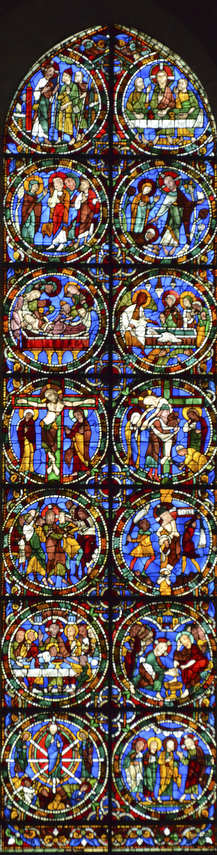
[Right (enlarge)[98]. To help identify each panel in this "Passion and Resurrection" window, I created a grid reference: "L" and "R" for the left and right columns of panels, and 1 to 7 for the seven rows of panels. Thus "the crucifixion panel" above is grid reference L4.]

in the west wall of Chartres Cathedral[99]. King Louis VII (r. 1137-80) [see above] was both "well-learned and exceptionally devout"[100], and given the Byzantines' prohibition of literal depictions of the Shroud image[101], the short timeframe (1149-51), and that stained glass windows originated in medieval Europe in the 10th century[102], not Constantinople, it seems that Louis must have remembered the features he saw on the Shroud and on his return to France in 1149[103], had them depicted in these Chartres Cathedral stained glass windows [see 29Nov18d].

The "Flagellation panel" (below), at grid reference R3 (above right), has the following Shroud-like unusual features: 1) Jesus' crown of thorns is helmet-like (not wreath-like), as is the pattern of head puncture bloodstains on the Shroud [see 08Sep13a]. 2) Jesus' hands are crossed, right over left, awkwardly at the wrists, exactly as they are on the

[Above (enlarge). "The Flagellation panel" in the Window of the Passion and Resurrection, Chartres Cathedral[104].]

Shroud [see 29Nov18e]. 3) Jesus' hands and fingers are abnormally long, as they are on the Shroud, due to them being xray images of the Shroudman's finger and hand bones [see 20Apr17]. And 4) There are two scourgers, as evident from the pattern of scourge marks on the Shroud [see 15Jul13].

Continuing with my count of Shroud-like features, now in the "Crucifixion panel" (above) at grid reference L4, 5) Jesus has a nail wound depicted in

[Left (enlarge): Extract from "the crucifixion panel" above, showing the nail wound in Jesus' right wrist (see below) and His body bent in a "Byzantine curve" (see below).]

his right (apparent because of mirror reversal) wrist, as on the Shroud [see below]. 6) His thumbs are retracted so they would not be visible from the back of the hand, as on the Shroud [see below]. 7) Jesus' abdomen is protruding, which was identified by French surgeon Dr Pierre Barbet (1884–1961) as evidence of the Shroudman's death by asphyxiation[105]. And 8) Jesus' right leg is depicted as shorter than his left, as appears on the Shroud [see below]. This is due to the Shroudman's left leg having been bent at the knee, his left foot placed over his right, and both feet transfixed to the cross by a single nail[106]. And then remaining fixed in that position by rigor mortis[107]. The

[Right (original)[108]: The frontal image of the Shroud (cropped). This is what the Byzantines and King Louis VII of France (r. 1137-80) would have seen [see above] when the Image of Edessa (the Shroud "four-doubled" - tetradiplon) was unfolded full-length. Note the nail wound in the Shroudman's right (apparent because of mirror reversal) wrist (see above); his hands are crossed, right over left, at the wrist (see above); his thumbs are not visible (see above); his hands and fingers appear to be abnormally long (see above); his abdomen is protruding (see above); and his right leg appears shorter than his left (see above).]

Byzantines thought Jesus was lame[109] (not realising that the Shroudman's legs only appear to be different lengths) and so they depicted Jesus' body in a compensatory "Byzantine curve"[110] [See "c.1001b"].

As mentioned at the beginning of this post (see above) Falcinelli discovered through his camera fitted with a telephoto lens, that in the "Crucifixion panel" (L4), Jesus is depicted with a realistic reversed `3', or epsilon (ε), bloodflow on his forehead[111] [see below and

[Above (enlarge): Falcinelli's telephotograph (left) and his highlighting (right), of the depiction of the Shroud's reversed `3', or epsilon (ε), forehead bloodstain [see below] in the c.1150 Chartres Cathedral stained glass window, "the crucifixion panel"[112]. This is Shroud-like feature 9) in this "window of the Passion and Resurrection" (see above) ogival stained glass window in the west wall of Chartres Cathedral.]

29Nov18b], exactly where the original is on the Shroud (see below)!

[Above (enlarge): The reversed `3', or epsilon (ε), and other bloodstains on the forehead and scalp of the man on the Shroud[113]. These bloodstains match the pattern of punctures by a crown (or rather cap or helmet) of thorns [see 08Sep13c].]

So this depiction of the Shroud's reversed `3' blood-stain at the exact same location on the face of Jesus in this c.1150 "the crucifixion panel" stained glass window in Chartres Cathedral, is yet another proof beyond reasonable doubt that the Shroud already existed in at least 1150, and therefore the mediaeval ... AD 1260-1390" radiocarbon date of the Shroud[114] was, and is, wrong!

Finally in the "Anointing panel" (L5) and below, Shroud-like features

[Above (enlarge): The "Anointing panel in the Window of the Passion and Resurrection, Chartres Cathedral[115].]

include: 10) Jesus' arms are crossed at the wrists, right over left, covering his pubic region; 11) His thumbs are not visible; 12) Jesus face has long hair and a forked beard, and 13) He is naked under his burial shroud. I have double-counted some of these features because they are on different panels and a sceptical alternative is that these are merely chance features, not based on any original model.

Therefore there are at least thirteen (13) unusual features on these three Chartres Cathedral stained glass window panels, dating from c.1150, that are found on the Shroud. One of these, Shroud-like feature 9), the reversed `3', or epsilon (ε), forehead bloodstain (above), is too specific to be explained away by Shroud sceptics as merely a chance similarity.

This discovery by Prof. Falcinelli of a realistic depiction of the Shroud's reversed `3' bloodstain (abov) in one of three Shroud-like depictions of Jesus in c.1150 stained glass windows in Chartres Cathedral, is at least as significant as the `poker holes' in the Pray Codex [see 21Aug18] in proving the Shroud pre-dated by at least a century its earliest 1260 radiocarbon date. That is because while sceptics can try to dismiss the Pray Codex as merely symbolic, they cannot so dismiss the Chartres Cathedral's literal reversed `3'! [see 29Nov18f] And there are at least thirteen unusual features in common between three of these stained glass windows and the Shroud (see below), compared with the Pray Codex's at least fourteen [see 04Oct18a].

Only a few days ago, in my scanning of the 118th and final issue of Rex Morgan's Shroud News (!), I read what Morgan had said in his keynote address at the 2001 Dallas Shroud conference:

"It is surely only a matter of time before someone comes up with hard evidence proving beyond dispute the whereabouts of the Shroud at some time in the first millennium. All the signs are there. Maybe we will find more clues amongst the ruins of Edessa, or in Constantinople, or tucked away in a medieval manuscript, as yet unseen in a hidden ancient library"[116].
The Pray Codex alone already proved beyond reasonable dispute that the Shroud was at Constantinople (944) and before that in Edessa (544), in the first millennium. See above and my "Open letter to Professor Christopher Ramsey" [see 04Oct18b]. So these thirteen (13) Shroud-like features (including a realistic reversed `3' bloodstain in the same shape and location as on the Shroud), in these three c.1150 Chartres Cathedral stained glass windows, doubly proves beyond reasonable dispute that the Shroud was at Constantinople (from 944) and before that in Edessa (544-944), in the first millennium!

Continued in the next 12th century (2) of this series.

Notes
1. This post is copyright. I grant permission to quote from any part of this post (but not the whole post), provided it includes a reference citing my name, its subject heading, its date, and a hyperlink back to this page.[return]
2. Email, "My studies on Shroud\Chartres," from Roberto Falcinelli, 28 November 2018, 2:15 am. [return]
3. "Knights Templar," Wikipedia, 24 September 2017. [return]
4. Currer-Briggs, N., 1984, "The Holy Grail and the Shroud of Christ: The Quest Renewed," ARA Publications: Maulden UK, p.17. [return]
5. Currer-Briggs, 1984, p.17. [return]
6. "File:Templars Burning.jpg," Wikimedia Commons, 7 June 2015. [return]
7. "Jacques de Molay: Death," Wikipedia, 11 September 2017. [return]
8. "Geoffroi de Charney: Death," Wikipedia, 19 September 2017. [return]
9. "Knights Templar: Arrests, charges and dissolution," Wikipedia, 24 September 2017. [return]
10. Wilson, I., 1978, "The Turin Shroud," Victor Gollancz: London, inside front cover. [return]
11. Wilson, I., 1979, "The Shroud of Turin: The Burial Cloth of Jesus?," [1978], Image Books: New York NY, Revised edition, pp.178-179. [return]
12. Wilson, 1979, p.188. [return]
13. Wilson, 1979, p.188. [return]
14. Scavone, D.C., "The History of the Turin Shroud to the 14th C.," in Berard, A., ed., 1991, "History, Science, Theology and the Shroud," Symposium Proceedings, St. Louis Missouri, June 22-23, 1991, The Man in the Shroud Committee of Amarillo, Texas: Amarillo TX, pp.171-204, 197-198. [return]
15. "So obviously there remains an unexplained gap between 1204 and the 1350s (and my suggestion of Templar ownership during this period has never been more than tentative and provisional - please note that I no longer support the claims for this ..." (Wilson, I., 2012, "Discovering more of the Shroud's Early History: A promising new approach ...," Talk for the International Congress on the Holy Shroud in Spain, Aula Magna of the Faculty of Medicine, University of Valencia, Valencia, Spain, 28-30 April, 2012, p.2). [return]
16. Wilson, 1979, pp.158, 256, 312; Wilson, I., 1986, "The Evidence of the Shroud," Guild Publishing: London, pp.145-146; Iannone, J.C., 1998, "The Mystery of the Shroud of Turin: New Scientific Evidence," St Pauls: Staten Island NY, p.120. [return]
17. Drews, R., 1984, "In Search of the Shroud of Turin: New Light on Its History and Origins," Rowman & Littlefield: Lanham MD, p.47; Scavone, 1991, p.195. [return]
18. Wilson, 1979, pp.158, 312 n.7; Iannone, 1998, p.120. [return]
19. Scavone, D., "The Shroud of Turin in Constantinople: The Documentary Evidence," in Sutton, R.F., Jr., 1989a, "Daidalikon: Studies in Memory of Raymond V Schoder," Bolchazy Carducci Publishers: Wauconda IL, pp.311-329, 318. [return]
20. Green, M., 1969, "Enshrouded in Silence: In search of the First Millennium of the Holy Shroud," Ampleforth Journal, Vol. 74, No. 3, Autumn, pp.319-345; Wilcox, R.K., 1977, "Shroud," Macmillan: New York NY, p.94; Wilson, 1979, p.158-159; Wilson, 1986, p.114; Scavone, D.C., 1989b, "The Shroud of Turin: Opposing Viewpoints," Greenhaven Press: San Diego CA, p.88; Stevenson, K.E. & Habermas, G.R., 1990, "The Shroud and the Controversy," Thomas Nelson Publishers: Nashville TN, p.78; Wilson, I., 1991, "Holy Faces, Secret Places: The Quest for Jesus' True Likeness," Doubleday: London, p.152; Wilson, I., 1998, "The Blood and the Shroud: New Evidence that the World's Most Sacred Relic is Real," Simon & Schuster: New York NY, p.270. [return]
21. Scavone, 1989b, pp.88-89; Wilson, 1998, p.270. [return]
22. Wilson, 1998, pp.144, 270. [return]
23. Wilcox, 1977, p.94; Wilson, 1979, pp.158, 257; Wilson, 1986, p.114; Wilson, 1991, pp.152-153; Wilson, 1998, pp.144, 270; Wilson, I., 2010, "The Shroud: The 2000-Year-Old Mystery Solved," Bantam Press: London, pp.177, 301, 325; de Wesselow, T., 2012, "The Sign: The Shroud of Turin and the Secret of the Resurrection," Viking: London, pp.382-383. [return]
24. Drews, 1984, p.47; Scavone, 1991, p.195. [return]
25. Beecher, P.A., 1928, "The Holy Shroud: Reply to the Rev. Herbert Thurston, S.J.," M.H. Gill & Son: Dublin, p.147. [return]
26. "Le Pèlerinage de Charlemagne," Wikipedia, 29 February 2016. [return]
27. Aebischer, P., 1965., "Le voyage de Charlemagne à Jérusalem et à Constantinople," Librairie Droz: Amazon.com. [return]
28. "Le Pèlerinage de Charlemagne," Wikipedia, 29 February 2016. [return]
29. "Le Pèlerinage de Charlemagne," Wikipedia, 29 February 2016. [return]
30. Beecher, 1928, p.147. [return]
31. Ibid. [return]
32. Adams, F.O., 1982, "Sindon: A Layman's Guide to the Shroud of Turin," Synergy Books: Tempe AZ, p.17. [return]
33. Wilson, 1998, p.269; Wilson, I. & Schwortz, B., 2000, "The Turin Shroud: The Illustrated Evidence," Michael O'Mara Books: London, p.109; Bennett, J., 2001, "Sacred Blood, Sacred Image: The Sudarium of Oviedo: New Evidence for the Authenticity of the Shroud of Turin," Ignatius Press: San Francisco CA, pp.145-147, 148; Wilson, 2010, p.50. [return]
34. Wilson, 1979, pp.95, 168-169; Adams, 1982, p.27, Dembowski, P.F., 1982, "Sindon in the Old French Chronicle of Robert de Clari," Shroud Spectrum International, No. 2, March, pp.13-18; Wilson, 1986, p.104; Scavone, 1989a, p.321; Stevenson & Habermas, 1990, p.79; Wilson, 1991, p.156; Iannone, 1998, pp.126-127; Wilson, 1998, pp.124-125, 142, 272; Antonacci, M., 2000, "Resurrection of the Shroud: New Scientific, Medical, and Archeological Evidence," M. Evans & Co: New York NY, p.123; Guerrera, V., 2001, "The Shroud of Turin: A Case for Authenticity," TAN: Rockford IL, p.8; Tribbe, F.C., 2006, "Portrait of Jesus: The Illustrated Story of the Shroud of Turin," Paragon House Publishers: St. Paul MN, Second edition, pp.30-31; Wilson, 2010, pp.108, 186; de Wesselow, 2012, pp.175-176. [return]
35. "Peter the Deacon," Wikipedia, 22 September 2017. [return]
36. Barnes, A.S., 1934, "The Holy Shroud of Turin," Burns Oates & Washbourne: London, p.52; Currer-Briggs, 1984, p.16; Currer-Briggs, N., 1988a, "The Shroud and the Grail: A Modern Quest for the True Grail," St. Martin's Press: New York NY, p.62. [return]
37. Barnes, 1934, p.52; Currer-Briggs, 1988a, p.62. [return]
38. Currer-Briggs, 1988a, p.62. [return]
39. Ibid. [return]
40. Ibid. [return]
41. Currer-Briggs, 1988a, p.62; Iannone, 1998, p.210. [return]
42. Wilson, 1998, p.270. [return]
43. "Siege of Edessa," Wikipedia, 12 June 2017. [return]
44. Wilson, 2010, p.146G. [return]
45. Wilson, 2010, p.119. [return]
46. Wilson, 1998, p.270. [return]
47. "Siege of Edessa: Aftermath," Wikipedia, 12 June 2017. [return]
48. Wilson, 1998, p.270. [return]
49. Wilson, 2010, p.301. [return]
50. Wilson, 2010, p.301. [return]
51. Wilson, 2010, p.118. [return]
52. Wilson, 2010, p.146F. [return]
53. Wilson, 2010, p.1. [return]
54. Wilson, 2010, pp.2-3, 210C. [return]
55. Wilson, 2010, pp.1-2. [return]
56. Wilson, 1998, p.270. [return]
57. "Louis VII of France: Early reign," Wikipedia, 28 September 2017. [return]
58. "Second Crusade: French route," Wikipedia, 23 September 2017. [return]
59. "Conrad III of Germany: Life and reign," Wikipedia, 30 August 2017. [return]
60. "Second Crusade: French route," Wikipedia, 23 September 2017. [return]
61. Latourette, K.S., 1953, "A History of Christianity: Volume 1: to A.D. 1500," Harper & Row: New York NY, Reprinted, 1975, p.411; "Second Crusade," Wikipedia, 23 September 2017. [return]
62. "Second Crusade," Wikipedia, 23 September 2017. [return]
63. "File:Asia minor 1140.jpg," Wikimedia Commons, 19 September 2016. [return]
64. Walker, W., 1959, "A History of the Christian Church," [1918], T. & T. Clark: Edinburgh, Revised, Reprinted, 1963, p.222. [return]
65. Latourette, 1953, p.411; Walker, 1959, p.222; "Second Crusade," Wikipedia, 23 September 2017. [return]
66. Walker, 1959, p.222; "Second Crusade," Wikipedia, 23 September 2017. [return]
67. "Conrad III of Germany: Life and reign," Wikipedia, 30 August 2017. [return]
68. "Second Crusade: French route," Wikipedia, 3 December 2018. [return]
69. Ricci, G., 1981, "The Holy Shroud," Center for the Study of the Passion of Christ and the Holy Shroud: Milwaukee WI, p.xxxv; Crispino, D.C., 1983, "Louis I, Duke of Savoy," Shroud Spectrum International, No. 7, June, pp.7-13, 12; Petrosillo, O. & Marinelli, E., 1996, "The Enigma of the Shroud: A Challenge to Science," Scerri, L.J., transl., Publishers Enterprises Group: Malta, p.178; ; Iannone, 1998, p.120; Ruffin, C.B., 1999, "The Shroud of Turin: The Most Up-To-Date Analysis of All the Facts Regarding the Church's Controversial Relic," Our Sunday Visitor: Huntington IN, p.58; Guerrera, V., 2001, "The Shroud of Turin: A Case for Authenticity," TAN: Rockford IL, p.7; Oxley, M., 2010, "The Challenge of the Shroud: History, Science and the Shroud of Turin," AuthorHouse: Milton Keynes UK, p.40; Fanti, G. & Malfi, P., 2015, "The Shroud of Turin: First Century after Christ!," Pan Stanford: Singapore, p.55. [return]
70. "Second Crusade: French route," Wikipedia, 23 September 2017. [return]
71. "Second Crusade: Journey to Jerusalem," Wikipedia, 23 September 2017. [return]
72. "Second Crusade: French route," Wikipedia, 23 September 2017. [return]
73. "Second Crusade: Journey to Jerusalem," Wikipedia, 23 September 2017. [return]
74. "Second Crusade: Siege of Damascus," Wikipedia, 23 September 2017. [return]
75. Latourette, 1953, p.411; Walker, 1959, p.222. [return]
76. Latourette, 1953, p.411; Walker, 1959, p.222; . "Second Crusade: Aftermath," Wikipedia, 23 September 2017. [return]
77. Latourette, 1953, p.411; Walker, 1959, p.222. [return]
78. Mahoney, L., 2012, "Painted Columns in the Church of the Nativity," Encyclopedia of Medieval Pilgrimage, Brill’s Medieval Reference Library. [return]
79. "Church of the Nativity: Eleventh- and twelfth-century additions and restoration (c. 1050–1169)," Wikipedia, 13 September 2017. [return]
80. "Baldwin I of Jerusalem," Wikipedia, 3 September 2017. [return]
81. "Melisende, Queen of Jerusalem," Wikipedia, 26 September 2017. [return]
82. "Church of the Nativity: Eleventh- and twelfth-century additions and restoration (c. 1050–1169)," Wikipedia, 13 September 2017. [return]
83. Wilson, I., 1978, "The Turin Shroud," Book Club Associates: London, p.82e. [return]
84. Damon, P.E., et al., 1989, "Radiocarbon Dating of the Shroud of Turin," Nature, Vol. 337, 16 February, pp.611-615, 611. [return]
85. Ramsey, C.B., 2008, "Shroud of Turin," Oxford Radiocarbon Accelerator Unit, 23 March, Version 152, Issued 16 June 2015. [return]
86. Ruffin, 1999, p.110; Zodhiates, S., 1992, "The Complete Word Study Dictionary: New Testament," AMG Publishers: Chattanooga TN, Third printing, 1994, pp.1093-1094. [return]
87. Petrosillo & Marinelli, 1996, p.193. [return]
88. Martino Miali, 2014, "Mottolo (Taranto). Church of St. Nicholas: fresco depicting Christ Almighty between Our Lady and St. John the Baptist. Photo by Martino Miali," Bridge Puglia & USA. [return]
89. Petrosillo & Marinelli, 1996, p.193. [return]
90. Wilson, 1979, p.102; Maher, R.W., 1986, "Science, History, and the Shroud of Turin," Vantage Press: New York NY, p.82; Wilson, 1998, p.141; Antonacci, 2000, p.126. [return]
91. "File:Master of Cefalu 001 Christ Pantocrator adjusted.JPG," Wikipedia, 15 June 2010. [return]
92. Wilson, 1998, p.141. [return]
93. Wilson, 1986, p.105; Wilson, 1998, p.141. [return]
94. Wilson, 1986, p.104. [return]
95. Wilson, 1979, p.105; Maher, 1986, p.82. [return]
96. Petrosillo & Marinelli, 1996, p.193. [return]
97. Wilson, 1979, p.105. [return]
98. Geoffrion, J., 2018, "Praying with Stained Glass Windows," Pray with Jill at Chartres. [return]
99. "Chartres Cathedral: Earlier buildings and the west façade," Wikipedia, 24 November 2018. [return]
100. "Louis VII of France: Early years," Wikipedia, 29 November 2018. [return]
101. de Wesselow, 2012, pp.180-181. [return]
102. "Medieval stained glass," Wikipedia, 16 July 2018. [return]
103. "Louis VII of France: Early years," Wikipedia, 29 November 2018. [return]
104. Falcinelli, 1998, p.9. [return]
105. Barbet, P., 1953, "A Doctor at Calvary," [1950], Earl of Wicklow, transl., Image Books: Garden City NY, Reprinted, 1963, p.86; Stevenson, K.E. & Habermas, G.R., 1981, "Verdict on the Shroud: Evidence for the Death and Resurrection of Jesus Christ," Servant Books: Ann Arbor MI, p.45; Meacham, W., 1983, "The Authentication of the Turin Shroud: An Issue in Archaeological Epistemology," Current Anthropology, Vol. 24, No. 3, June, pp.283-311, 285; Cruz, J.C., 1984, "Relics: The Shroud of Turin, the True Cross, the Blood of Januarius. ..: History, Mysticism, and the Catholic Church," Our Sunday Visitor: Huntington IN, p.51; Maher, 1986, p.53; Borkan, 1995, p.27; Wilson & Schwortz, 2000, p.114. [return]
106. Barnes, 1934, p.64; Brent, P. & Rolfe, D., 1978, "The Silent Witness: The Mysteries of the Turin Shroud Revealed," Futura Publications: London, p.46; Wilson, 1979, p.42; Morgan, R.H., 1980, "Perpetual Miracle: Secrets of the Holy Shroud of Turin by an Eye Witness," Runciman Press: Manly NSW, Australia, p.103; Wilson, 1986, pp.24-25; Borkan, M., 1995, "Ecce Homo?: Science and the Authenticity of the Turin Shroud," Vertices, Duke University, Vol. X, No. 2, Winter, pp.18-51, 24; Bucklin, R, 1998, "The Shroud of Turin: A Pathologist's Viewpoint," in Minor, M., Adler, A.D. & Piczek, I., eds., 2002, "The Shroud of Turin: Unraveling the Mystery: Proceedings of the 1998 Dallas Symposium," Alexander Books: Alexander NC, pp.271-279, 274; Iannone, 1998, p.59; Wilson, 1998, p.37; Antonacci, 2000, p.22; Tribbe, 2006, pp.94, 234-235; de Wesselow, 2012, p.145. [return]
107. Barnes, 1934, p.64; Borkan, 1995, p.24; Antonacci, 2000, p.32. [return]
108. Latendresse, M., 2010, "Shroud Scope: Durante 2002: Horizontal" (rotated left 90°), Sindonology.org. [return]
109. Barnes, 1934, p.68; O'Connell, P. & Carty, C., 1974, "The Holy Shroud and Four Visions," TAN: Rockford IL, p.6; Petrosillo, O. & Marinelli, E., 1993, "Shrouded in Mystery," Shroud News, No 76, April, pp.14-21, 16; Petrosillo & Marinelli, 1996, pp.13, 195-196; Tribbe, 2006, p.234. [return]
110. Barnes, 1934, pp.67-68; Petrosillo & Marinelli, 1996, p.195. [return]
111. Falcinelli, 1998, p.4. [return]
112. File "Chartres-Schema volto1.JPG", emailed to me by Roberto Falcinelli, 28 November 2018, 2:15 am. [return]
113. Extract from Latendresse, M., 2010, "Shroud Scope: Face Only Vertical," Sindonology.org. [return]
114. Damon, 1989, p.611. [return]
115. File "CHARTRES 2.jpg," emailed to me by Roberto Falcinelli, 28 November 2018, 2:15 am. [return]
116. Morgan, R.H., 2001, "The Shroud in the New Millennium," Keynote address given at the Dallas International Conference on 27 October 2001 by Rex Morgan," Shroud News, No. 118, December, pp.3-34, 32. [return]

Posted 23 September 2017. Updated 26 February 2025