I have decided to re-start my Shroud of Turin News. The previous issue was February 2012. I will add any new articles for each month from the top. My comments will be bold to distinguish them from the articles' words. Click a link below to go to that article.
- "Do not believe the myth that the Turin Shroud has been proved to be a fake."
- "Radiation From the Shroud of Turin a Clue to Jesus' Resurrection?"
- "Shroud of Turin speaker to unfurl relic's mysterious past"
- "Israeli particle accelerator opens new horizons"
- "A House Divided: Why Can't Jesus Be Both Jewish Hero and Risen Lord?"
- "Shroud of Turin replica coming to Alvernia"
"Do not believe the myth that the Turin Shroud has been proved to be a fake,," Brian Quail, Herald Scotland, 16 October 2013. YOUR "From the archives" snippet from 25 years ago (October 14) states that on that day the Shroud of Turin, pictured, was "proved a fake". I can't find this news item. Maybe it has been removed? Truly, as the old saying goes, "a lie can go three times round the world before the truth has got its boots on". It is amazing that journalists keep repeating this lie. As mentioned below even Prof. Christopher Ramsey, Director of the Oxford radiocarbon dating laboratory, who was involved in the 1988 radiocarbon dating of the Shroud and signatory to the 1989 Nature paper, has since conceded that:
"There is a lot of other evidence that suggests to many that the Shroud is older than the radiocarbon dates allow..." (Ramsey, 2008).In 1988 one sample was taken from the edge of the Shroud, cut into three, and sent to three labs (Arizona, Oxford and Zurich), which dated this as 1260-1390. See below on how tiny was this `postage stamp' sized sample which was then divided into three sub-samples for each of the three laboratories to carbon-date.

[Above: Prof. Edward Hall, Dr. Michael Tite and Prof. Robert Hedges, at a press conference on 13 October 1988 announcing that the Shroud of Turin had been radiocarbon dated to "1260-1390!": Ian Wilson, 1998, "The Blood and the Shroud," pl.3b. The exclamation mark indicates that, far from being objective science, these philosophical naturalists wanted the Shroud to be a fake. Indeed, Professor Hall candidly admitted it:
"Professor Hall, who heads the Oxford research laboratory in archaeology and the history of art, said he was not disappointed in the result. 'I have to admit I am an agnostic and I don't want at my time of life to have to change my ideas.'" (Radford, T., "Shroud dating leaves 'forgery' debate raging," The Guardian, October 14, 1988.]
In 2000 Sue Benford and Joseph Marino claimed that the patch had been taken from an area that had been repaired by a process of French "invisible mending". Initially this was dismissed because it is not obvious to the naked eye. But in 2005 the prestigious American scientist Ray Rogers presented a paper to the scientific journal Thermochemica Acta, proving Benford and Marino correct. His paper has never been faulted. Cotton is found in the selected section, absent from the otherwise 100% linen Shroud. There are also traces of madder dye. There is clear and unmistakable evidence of spliced fibres, where the sections were joined together. Thus, the Carbon 14 date is of a repaired area of the Shroud, and therefore anomalous. Well summarised! If this was any other artifact whose radiocarbon-date was so contrary to all the other evidence, it would have been thrown out. But the problem for the Shroud anti-authenticists is that they have so little evidence in their favour that they have to keep endlessly recycling what little evidence they have! When you have an abundance of evidence indicating one thing, and a contradictory fact is suddenly presented, the answer is not to abandon all previous evidence and grab the newest, like small boys playing football, who rush to where the ball is last seen. As Biblical archaeologist Dr Eugenia Nitowski put it:
"In archaeology, if there are ten lines of evidence, carbon dating being one of them, and it conflicts with the other nine, there is little hesitation to throw out the carbon date as inaccurate ...' (Nitowski, E., in Wilson, I., "Holy Faces, Secret Places," 1991, pp.178-179).Or as Ian Wilson put it:
"By way of analogy we might cite the case of a jumbo-jet pilot who midway during a routine flight across the Atlantic suddenly finds that his fuel gauges - scientific instruments upon which he can normally rely - are telling him that his plane is out of fuel. What should he do? Should he blindly accept what his instruments are telling him, and proceed immediately to ditch his plane and its passengers into the ocean? Or should he make a few other checks first? In effect, this is precisely the situation that has pertained since 1988 with regard to the Shroud and its carbon dating. " (Wilson, I., "The Blood and the Shroud," 1998, pp.10-11)The scientific response is to ask: why is this so? Professor Edward Hill's breezy "someone just got a bit of linen, faked it up, and flogged it" was a grotesquely unscientific response to the Shroud in 1988, and it still is. Agreed. It epitomises how biased and unscientific the 1988 radiocarbon date of the Shroud, when one of its leaders, Prof. Hall, could say something as absurd as that and believe it to be true. But that this was not just Prof. Hall's attitude is evident in that his Oxford colleague, Prof. R. Hedges, instead of being ashamed of it, thought it worthy of repeating in Prof. Hall's obituary: "In the late 1970s, he was quick to see the value of the revolutionary new method of radiocarbon dating then being developed (called accelerator mass spectrometry or AMS dating) and became fully committed to establishing the method at Oxford. ... Such total involvement got its reward especially in his participation in the dating of the Shroud of Turin in 1988 ... Hall's laboratory dated its sample to between 1260 and 1390. ... he also took pleasure in, as he saw it, the debunking of any conviction that could not be rationally demonstrated. `There was a multi-million- pound business in making forgeries during the 14th century,' he bluntly told a British Museum press conference. `Someone just got a bit of linen, faked it up and flogged it.' And again, `Some people may continue to fight for the authenticity of the shroud, like the Flat Earth Society, but this settles it all as far as we are concerned." (Hedges, R., "Obituary: Professor Edward Hall," The Independent, August 16, 2001). By the way Prof. Hedge's claim that: "Hall's [Oxford]
 laboratory dated its sample to between 1260 and 1390" is false and as a nuclear physicist involved in Oxford's radiocarbon dating of the Shroud, he must know it is false. As Table 1 of
 [Right: C-14 dates of "Sample 1" (the Shroud) from Table 1 of the Damon, et al., 1989, "Radiocarbon Dating of the Shroud of Turin," Nature, Vol. 337, pp.611-615, 16th February.]
the 1989 Nature paper shows, none of the three laboratories dated its sample to between 1260 and 1390 (the dates are years before 1950). That makes Oxford's C-14 dates: "795±65" = 1090-1220; 730±45" = 1175-1265; and "745±55" = 1150-1260," an average of 1138-1248. So the highest of Oxford's average C-14 date of the Shroud is over 100 years before the Shroud first appeared in the undisputed historical record at Lirey, France in about 1355! So Prof. Hall's own laboratory's 12-13th century C-14 dates don't support his claim that the Shroud was forged "during the 14th century"! The "1260 and 1390" date was a statistically manipulated average of the three laboratories' C-14 dates. The irony is that since 1988, a huge amount of additional evidence has accumulated indicating  the Shroud's authenticity.
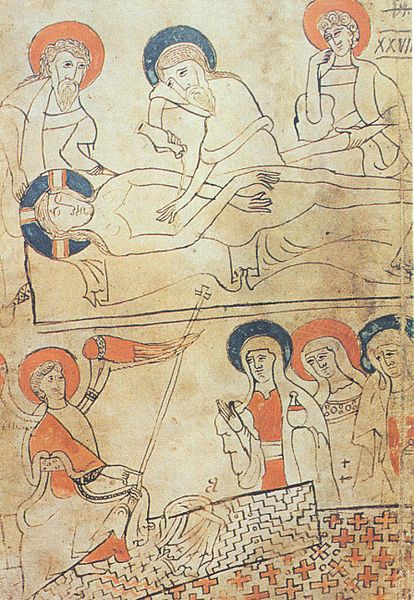
[Left (click to enlarge): The Hungarian Pray Codex, or Manuscript (1192-95): Wikipedia]
Its identification with the Image of Edessa is proved by an illustration in the Hungarian Pray Manuscript (1192), Agreed. This is clearly based on the Shroud (see my "The Pray Manuscript"), but is indisputably dated 1192-95, which is 65 years before the earliest claimed 1206-1390 C-14 date of the Shroud. and by the portrait of the solidi coins of Justinian II (692). Again agreed. As I wrote in a 2012 post:

[Right: Justinian II gold solidus coin, c. AD 692: Money Museum]
"Features on the [Justinian II gold solidii] coins which are very similar to the face of the Man of the Shroud include: long wavy shoulder-length hair, a long forked beard, moustache, and a small tuft of hair on the forehead, and no ears visible ... there are at least twelve out of fifteen Vignon markings on the Christ face of this coin that are also found on the Shroud of Turin: "... (2) three-sided `square' between brows, (3) V shape at bridge of nose, ... (6) accentuated left cheek, (7) accentuated right cheek, (8) enlarged left nostril, (9) accentuated line between nose and upper lip, (10) heavy line under lower lip, (11) hairless area between lower lip and beard, (12) forked beard, (13) transverse line across throat, (14) heavily accentuated owlish eyes, (15) two strands of hair."
Pollen from Gundelia tournefortii (a thorn-bush with fearsome spikes not found in Europe) has been discovered; Yes:
"An analysis of pollen grains and plant images places the origin of the `Shroud of Turin,' thought by many to be the burial cloth of Jesus of Nazareth, in Jerusalem before the 8th Century. ... Botanist Avinoam Danin of The Hebrew University of Jerusalem determined the origin of the Shroud based on a comprehensive analysis of pollen taken from the Shroud and plant images associated with the Shroud ... Danin presented his research findings at a lecture series held in conjunction with the XVI International Botanical Congress ... Danin's analysis suggests that flowers and other plant materials were placed on the Shroud of Turin, leaving pollen grains and imprints of plants and flowers on the linen cloth. In addition to the image of a crucified man, the cloth also contains faint images of plants ... Analysis of the floral images by Danin and an analysis of the pollen grains by Uri Baruch identify a combination of certain species that could be found only in the months of March and April in the region of Jerusalem during that time. The analysis positively identifies a high density of pollen of the thistle Gundelia tournefortii which has bloomed in Israel between March and May for millennia. An image of the plant can be seen near the image of the man's shoulder. It has been hypothesized ... that this is the plant used for the `crown of thorns' on Jesus' head." (XVI International Botanical Congress, "Botanical Evidence Indicates `Shroud Of Turin' Originated In Jerusalem Area Before 8th Century, " Science Daily, August 3, 1999).
the VP-8 Image Analyzer showed that image has 3D properties unlike any photograph in the world.  The VP-8 Image Analyzer
[Above: A 3D `relief map' image of the Shroud man's face as it appears on a VP-8 Image Analyzer screen: Heller, J.H., "Report on the Shroud of Turin," 1983, p.82h]
was developed for NASA to enable three-dimensional information contained in photos of the Moon taken by orbiting space craft to be decoded and displayed. It will not work on ordinary photos because there is no 3D information encoded in them. Yet it worked for photos of the Shroud, proving that there is 3D information encoded in the Shroud image. And much more. The absurd claim that Leonardo Da Vinci made it by a secret photographic process is disproven by the fact that the shroud is known to have been on public display 100 years before he was born. To be fair to Shroud anti-authenticists this is a minority position in their camp, promoted by conspiracy theorists Lynn Picknett and Clive Prince. Because the Shroud was indisputably (even by Picknett and Prince) in existence a century before Leonardo Da Vinci (1452–1519) was born, they have to maintain that the Savoy family secretly commissioned da Vinci to make a better copy of the Shroud and they substituted Leonardo's copy for the Shroud, without anyone in the Savoy family objecting and no one else noticing! But at least Picknett and Prince's theory tacitly acknowledges that it would take an artist with at least the genius of Leonardo da Vinci to forge the Shroud. These are complicated and complex matters, but not everything is reducible to a 30-minute TV show. The trouble is that the media establish a "truth", which is uncritically accepted by people who lack the interest or the patience to thoroughly investigate the matter personally. Thus a myth is created and rehashed - even in such a respected journal as The Herald. Given that most journalists and their readers are non-Christians, like Prof. Hall they don't want the Shroud to be true. Therefore, they will continue clinging like drowning men to whatever straw they can find, so they don't have to be confronted with the evidence that Christianity is true. But in so doing what St. Paul wrote in 2Th. 2:11-12 applies to them, who would rather believe the non-Christian lie than the Christian truth:
"Therefore God sends them a strong delusion, so that they may believe what is false [Gk. too pseudei "the lie"], in order that all may be condemned who did not believe the truth but had pleasure in unrighteousness. (my emphasis)Because if the Shroud is the very burial sheet of Jesus (and the evidence is overwhelming that it is), then Christianity is true and non-Christians are all believing and living the same "the lie"! But then the Shroud becomes a "fifth gospel":
"If it is authentic, the Holy Shroud is unquestionably the greatest religious relic known to Christianity and one of the most fascinating antiquities known to mankind. If it is authentic, the Shroud can rightfully take its place as "The Fifth Gospel," for what it reveals of Jesus and his suffering far exceeds the scant Gospel words of the evangelists. If it is authentic, and if no completely satisfactory natural explanation can account for its unusual physical properties, then the Shroud is indeed the most miraculous of Holy Miracles—an enduring, self-made portrait of the man who would be called Savior by millions of Christians throughout the world." (Humber, T., "The Fifth Gospel: The Miracle of the Holy Shroud,"1974, p.12).to non-Christian mankind, showing God's enduring love for them, if only they will change their mind and accept Jesus as their only Rescuer (Jn 14:6; Acts 4:12) from their life of believing "the lie. [...]
Radiation From the Shroud of Turin a Clue to Jesus' Resurrection?," Stoyan Zaimov, Christian Post, October 12, 2013. CHARLOTTE, North Carolina – Radiation and various blood stains found on the Shroud of Turin may be possible clues that the cloth is not a forgery and is indeed evidence of the resurrection of Jesus Christ, offered Gary Habermas, distinguished research professor and chair of the Department of Philosophy and Theology at Liberty University, on Friday during a presentation at Southern Evangelical Seminary's 20th annual Christian Apologetics conference. It was through reading a book co-authored by Prof. Gary Habermas that I came to accept the authenticity of the Shroud.

[Above: Gary Habermas during a Shroud of Turin presentation at the 20th annual Christian Apologetics conference in Charlotte, N.C. on October 11, 2013]
Habermas, who has been lecturing on the topic since the 1970s, reminded the audience of a number of interesting discoveries that scientists have been able to make about the Shroud, but refused to make any definitive statements on whether this is indeed the authentic burial robe of Jesus Christ. I disagree with Habermas' failure to state that, on the overwhelming preponderance of the evidence, the Shroud IS the very burial sheet of Jesus. People are convicted by courts every day on far less forensic and circumstantial evidence than there is for the Shroud being authentic. I agree with the commenter on Dan Porter's blog who wrote:
Holding the Shroud to an impossible standard?" ... I have been reading about the Shroud since I was 13. I’m now on Social Security. In that time I have never, with the signal exception of what we know to be a botched carbon 14 dating, encountered any credible evidence that the Shroud is NOT authentic, and an ever increasing mountain of evidence that it is–evidence of all sorts from many disciplines. So far as I can tell the Shroud has long since passed the test of reliable information. I mean unless you require repetition of the experiment, in this case the death, burial, and perhaps Resurrection of Jesus Christ, an historical artifact, especially an ancient one, can hardly deliver up more or better evidence than I have encountered in this case. I am to say the least very confused when people such as yourself or Gary Habermas, obviously otherwise sympathetic to it, hold the Shroud to an impossible standard. Certainly investigations can be refined and there is always the possibility of gathering more data but even without anything further the Shroud is about as genuine an artifact as any commonly accepted."One of the discoveries based on enhanced images of the Shroud presented is that the person's teeth were showing through the skin – possible signs of the resurrection for those who believe that the man is indeed Jesus Christ.

[Above (enlarge): Shroud head 3D image compared with x-ray of human head: Shroud University. Note the man on the Shroud's orbital arch (eyebrow) bones, cheekbones and teeth are visible through his skin.]
"His skin is intact, his beard is intact, but you are able to see what's inside coming out, just like if you are able to see what's on the back of a hand," Habermas said during the presentation, while showing a photo of an exposed human skull juxtapositioned next to the head of the man in the Shroud, with the teeth from the two images aligned. "This is one of the best indications that the man in the Shroud, who was dead and was crucified, (has) radiation coming out," he said of the teeth discovery. "And if that's what this is, you've got something from the inside (coming out). "(The teeth) are on the inside, but on the photo they are showing outside. Whichever way (the radiation) is coming, it dragged the image from the inside to the outside."

[Above (enlarge): Xray of human hand bones compared with the Shroud man's hand: Shroud of Turin Education Project. Again note that the Shroud man's hand bones are visible through the skin. Sceptics had claimed the hypothetical forger had blundered by making Jesus' fingers too long:
"And how shall we explain the strange anatomy of the figure on the Shroud? Again, a mere glance indicates that ... the hands and fingers long and spidery ... Perhaps the most creative turn of argument on this issue is, however, one described by Nickell. The unnaturally spidery fingers ... are ... evidence that Jesus suffered from Marfan’s syndrome ..." (Denis Dutton, "Requiem for the Shroud of Turin," Michigan Quarterly Review 23 (1984): 243-55).But they only seem too long because they are actually his
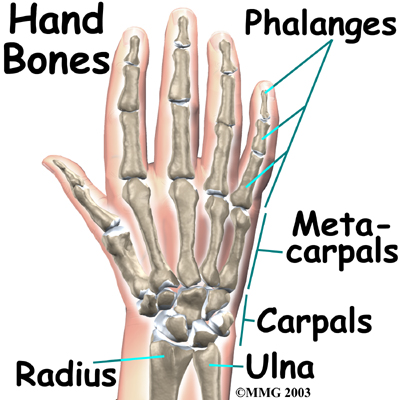 finger bones (phalanges) which
 [Right: Anatomy of the bones of the human hand: eOrthopod]
join to the hand bones (metacarpals) and continue well past the middle of the hand where they meet the wrist bones (carpals).]
Several members of the audience remarked that the radiation coming out of the body could be seen as evidence of the resurrection, if the man is indeed Jesus. What other explanation is there? Dead bodies do not normally emit xray radiation but a resurrected body might. Since the evidence is overwhelming that: 1) the Shroud of Turin is Jesus's burial sheet; and 2) Jesus rose from the dead; the best (indeed the only) explanation of the xray images of the man on the Shroud's face and finger bones is that they were imprinted on the Shroud by radiation emitted as Jesus' body changed state at His resurrection:
"... the Lord Jesus Christ, who will transform our lowly body to be like his glorious body ..." (Php 3:20-21)Habermas insisted at the end of his presentation that he cannot be sure whether the Shroud of Turin is the actual burial robe of Jesus Christ or not, but said it is an important artifact that researchers can definitely learn more from. What does Habermas mean "he cannot be sure"? He cannot be sure that he is not a brain in a vat! How much evidence does he need to "be sure the Shroud of Turin is the actual burial robe of Jesus Christ"? I strongly disagree and am disappointed with his `sitting on the fence' in this and his failure to `nail his colours to the mast' and come out and state that, on the basis of the evidence (which is overwhelming that the Shroud of Turin is the burial sheet of Christ), that he personally accepts that the Shroud is authentic, as I am sure he does. The One whose image is on the Shroud has warned his followers (Habermas and myself included) that He would rather us be "either cold or hot" than "lukewarm":
"How are the dead raised? With what kind of body do they come? ... So is it with the resurrection of the dead. What is sown is perishable; what is raised is imperishable." (1Cor 15:35,41-42).
"... flesh and blood cannot inherit the kingdom of God, nor does the perishable inherit the imperishable. ... We shall not all sleep, but we shall all be changed ... the dead will be raised imperishable, and we shall be changed." (1Cor 15:50-52).
Rev 3:15-16. "‘I know your works: you are neither cold nor hot. Would that you were either cold or hot! So, because you are lukewarm, and neither hot nor cold, I will spit you out of my mouth.[...]
[return]
"Shroud of Turin speaker to unfurl relic's mysterious past," Jonathan Pitts, The Baltimore Sun, October 9, 2013. Russ Breault at Hopkins to discuss questions regarding Jesus' death.

[Above (enlarge): Russ Breault is coming to Johns Hopkins to deliver a lecture on the Shroud of Turin. (Courtesy of the Shroud of Turin Education Project, Inc. / October 8, 2013)]
He was one of the most important figures of his day, a man who was tortured to death at the hands of his enemies. Yet no fingerprints were taken, no body was ever found, and the deed took place long before crime fighters had access to DNA profiling. It's not an episode of "CSI" or "Cold Case Files" but the death by crucifixion of Jesus, a tragedy that remains steeped in ambiguity some 2,000 years later. Some say the only evidence from the scene is a blood-flecked swatch of linen kept in a climate-controlled reliquary in Italy. To believers, the Shroud of Turin, as it's known, is the cloth that cloaked the body of Jesus before his planned burial. To skeptics, it's a hoax conjured up to sell Christianity or draw tourists. The "skeptics" (who are themselves "believers" in the Shroud's non-authenticity)have no evidence that the Shroud was "a hoax conjured up to sell Christianity or draw tourists". They cannot cogently explain: Who conjured it up? How was it conjured up? When was it conjured up? Why can't they conjured it up (i.e. make a convincing replicate copy of the whole Shroud)? The "skeptics" (so-called) cannot even agree on how the Shroud was "conjured up". As Ian Wilson concluded after reviewing all the major sceptical theories of how the Shroud was forged:
"Yet ingenious as so many of these ideas are, the plain fact is that they are extremely varied and from not one of them has come sufficient of a groundswell of support to suggest that it truly convincingly might hold the key to how the Shroud was forged - if indeed it was forged." (Wilson, I., "The Blood and the Shroud," 1998, p.10-11).It has been studied by everyone from theologians to NASA historians, and still, no one knows. "The shroud is the most analyzed artifact in history, yet it's still the world's greatest unsolved mystery," This alone is effectively proof that the Shroud is authentic. It is an important qualification of the usual "argument from ignorance", that if something should have been discovered by qualified investigators but hasn't been, that "absence of proof of its occurrence" is "positive proof of its non-occurrence":
"Argumentum ad Ignorantiam (argument from ignorance) ... A qualification should be made at this point. In some circumstances it can safely be assumed that if a certain event had occurred, evidence for it would have been discovered by qualified investigators. In such a case it is perfectly reasonable to take the absence of proof of its occurrence as positive proof of its nonoccurrence. Of course, the proof here is not based on ignorance but on our knowledge that if it had occurred it would be known. For example, if a serious security investigation fails to unearth any evidence that Mr. X is a foreign agent, it would be wrong to conclude that their research has left us ignorant. It has rather established that Mr. X is not one. Failure to draw such conclusions is the other side of the bad coin of innuendo, as when one says of a man that there is `no proof' that he is a scoundrel. In some cases not to draw a conclusion is as much a breach of correct reasoning as it would be to draw a mistaken conclusion." (Copi, I.M., "Introduction to Logic," 1986, pp.94-95. Emphasis original).Similarly, if the Shroud were a 14th century or earlier fake, the science of the 20th-21st century should have discovered that by now (see below on the 1988 radiocarbon date of the Shroud to 1260-1390 is itself a fake!). So that absence of proof by modern science that the Shroud is a fake, after 35 plus years of intensive scientific study of the Shroud, is positive proof that the Shroud is not a fake! says Russ Breault, an independent scholar See Russ Breault's Shroud University website. who will present "The Shroud Encounter," an original multimedia show and lecture, at the Johns Hopkins University Wednesday night. "It's my mission to pass the subject on to a new generation." Breault brings the rapid-fire show to the Homewood campus, complete with more than 200 original images and a commentary that explores the archaeology, science and theology surrounding the shroud. Perhaps the most mysterious element of the linen cloth, which is 14 feet long and about 31/2 feet wide, is that it bears the faint but visible image of a man who stands just under 6 feet tall, including a bearded face that strikingly resembles popular images of Jesus. The Shroud "strikingly resembles popular images of Jesus" because our popular images of Jesus (going back to at least the 6th century) are based on the Shroud!:
"Could the Shroud date back to the sixth century? Looking back in time from 1204, we are in a period in which, if the radiocarbon dating is to be believed, there should be no evidence of our Shroud. The year 1260 was the earliest possible date for the Shroud's existence by radiocarbon dating's calculations. Yet artistic likenesses of Jesus originating well before 1260 can be seen to have an often striking affinity with the face on the Shroud, insofar as anyone would have been able to make this out on the cloth itself, as distinct from the hidden photographic negative. Purely by way of example we may cite from the twelfth century the huge Christ Pantocrator mosaic that dominates the apse of the Norman Byzantine church at Cefalu, Sicily [pl. 36b i]; from the tenth century, the Christ Enthroned from the Church of San Angelo in Formis, Italy [p1. 36b ii]; from the sixth century, a Byzantine-style medallion portrait of Christ on a silver vase discovered at Homs, the ancient Emesa, in Syria p1. 36b iii]. The common features of all these are a very distinctive rigidly front-facing Jesus with long sidelocks, an individualistic long nose and a slightly forked beard, all strikingly similar to the face on the Shroud [p1. 36a]." (Wilson, I., "The Blood and the Shroud," 1998, p.141).[...]
See below images of Ian Wilson's three examples of "artistic likenesses of Jesus originating well before 1260 ... all strikingly similar to the face on the Shroud":
[Right (click to enlarge): Christ Pantocrator mosaic (c. 1150), Byzantine church at Cefalu, Sicily: "Cefalù Cathedral," Wikipedia, 13 October 2013]
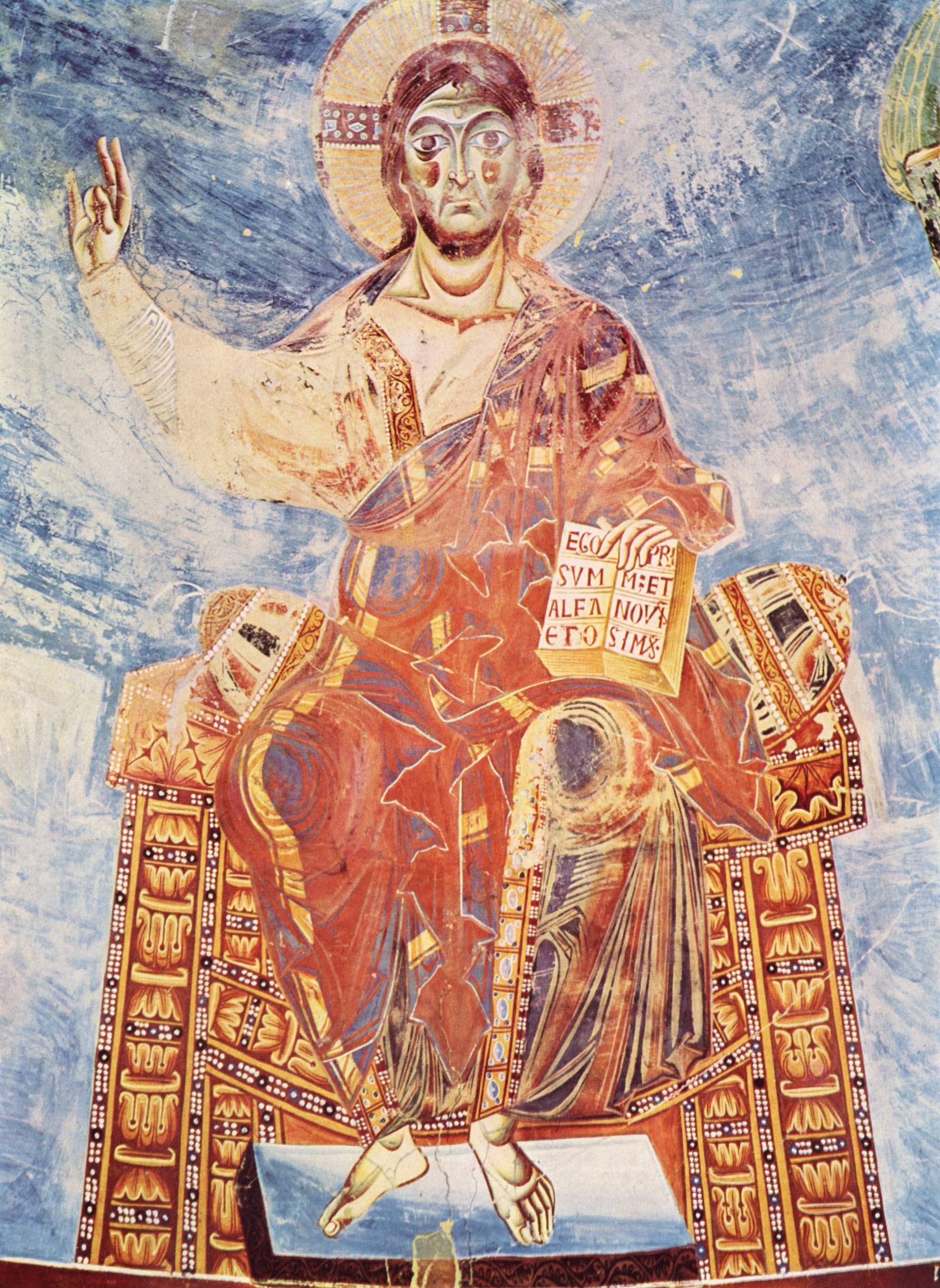
[Left (click to enlarge): Christ Enthroned (c. 1100) from the Church of San Angelo in Formis, Italy: "Christ Pantocrator," Wikipedia, 12 July 2013]
 [Below right (click to enlarge): Portrait of Christ on a silver vase (late 6th-early/7th century AD) discovered at Homs, ancient Emesa, in Syria: The Louvre, Paris.]
[return]
"Israeli particle accelerator opens new horizons," HAARETZ, Nir Hasson, September 18, 2013.

[Above (enlarge): "How carbon-14 dating works"]
Advanced carbon-14 dating technique is even expected to shed new light on the migration of modern humans. ... the new particle accelerator that began operating three months ago at the Weizmann Institute of Science ... is helping archaeologists peer into the past through cutting-edge carbon-14 testing of artifacts, a first in the annals of Israeli archaeology. Carbon-14 is considered the most reliable means of dating artifacts and matter unearthed in archaeological excavations. It's not a new technology. Carbon-14 dating was invented in 1947 by Willard Libby, which won him a Nobel Prize. The method was improved in the 1980s, which is when researchers began using particle accelerators to determine the age of archaeological findings. The method relies on a radioactive isotope of carbon, known as carbon-14. All organic matter has carbon and a given proportion of that is carbon-14. Like all radioactive material, carbon-14 degrades over the years. The age of the organic matter is determined by calculating the ratio between carbon-14 and two other carbon atoms: carbon-12 and carbon-13. The higher the proportion of carbon-14 in relation to that of other two carbons, the newer the material from which the isotope was taken. Carbon-14 dating became famous after the method was used in the 1980s to test the age of what has been called the Turin Shroud, a linen cloth that, according to Christian belief, enveloped the dead body of Jesus Christ. But three different particle accelerators told a different story and determined that the shroud had been woven in the Middle Ages, more than a thousand years after Jesus' crucifixion. This is misleading. There were indeed "three different particle accelerators", at Tucson, Zurich and London, but all three used the same AMS method, and all three tested the same tiny ~4 cm x 1 cm `postage-stamp' sized sample, divided into thirds, of the one contaminated and repaired corner of the ~4.4 metre x 1.1 metre Shroud. That's a mere (0.04 x 0.01 m)/(4.4 x 1.1 m) = 0.004/4.8507 = 0.0000826 or 0.008 percent (~1/800 thousandths) of the whole Shroud. And each laboratory had only one-third of that tiny sample, i.e. about 0.0000826/3 = 0.000028, or ~0.003 percent (~1/300 thousandths) of the whole Shroud! Clearly that is way too small a sample to be a statistically valid representation of the whole. Moreover, the Oxford laboratory found, and removed before it dated its sample, younger dyed cotton in its one-third sample that the other two laboratories apparently missed. Indeed the Nature paper mentions this in the `fine print' in is final paragraph: "Oxford thank P. H. South (Precision Process (Textiles) Ltd, Derby) for examining and identifying the cotton found on the shroud sample." There is no way that the other two laboratories' C-14 dates of the Shroud could agree with Oxford's, given the tiny amount of carbon-14 atoms in each laboratory's tiny one-third sample:
"Dr. Paul Damon, who, with his University of Arizona colleague, Douglas Donahue, has won the coveted right to test the age of the shroud, said the process was extremely complex and, like Gove, he offered an analogy to illustrate it. `Let's say the shroud material is 1,000 acres of green marbles piled three feet deep, and in there somewhere is one blue marble,' he said in a telephone interview from his Tucson laboratory. `We've got to find the blue marble. It's daunting, but we can do it.'" (Kenneth R. Clark, "Shroud of Turin Controversy Resumes," Chicago Tribune, January 17, 1988)and even a small amount of younger cotton would throw that sample's C-14 date completely out. Yet by statistical manipulation it was claimed in a 1989 paper in the scientific journal Nature that the average of the three laboratories' C-14 dates "provide[d] conclusive evidence that the linen of the Shroud of Turin is mediaeval ... AD 1260-1390". The mid-point of that date range `just happens' to be 1325 +/- 65 years, or a mere ~25 years before the Shroud first appeared in the undisputed historical record at Lirey, France in the mid-1350s. Indeed the Nature paper noted that: "The Shroud of Turin ... was first displayed at Lirey in France in the 1350s ..." so they knew they had that date to agree with. That "mediaeval ... AD 1260-1390" dating was despite there being overwhelming evidence that the Shroud was in existence well before AD 1260 (e.g. the Pray Manuscript: 1192-95) and back to at least the 6th century. Indeed, Professor Christopher Ramsey, the Director of the Oxford radiocarbon dating laboratory and a signatory to the 1989 Nature paper, has since admitted:
"There is a lot of other evidence that suggests to many that the Shroud is older than the radiocarbon dates allow and so further research is certainly needed. It is important that we continue to test the accuracy of the original radiocarbon tests as we are already doing. It is equally important that experts assess and reinterpret some of the other evidence. Only by doing this will people be able to arrive at a coherent history of the Shroud which takes into account and explains all of the available scientific and historical information." (Ramsey, C.B., "Shroud of Turin Version 77," Oxford Radiocarbon Accelerator Unit, 23 March, 2008. My emphasis).Oxford's C-14 date did not include the removed dyed cotton threads but other two laboratories' C-14 dates presumably did, since Oxford's sub-sample was located between Zurich's and Tucson's #2 sub-samples (see below), nothing

[Above (click to enlarge): "Carbon dating sample," Shroud Scope. Move your mouse over the purple border area to see the pop-up]
was reported about Tucson and Zurich finding cotton in their sub-samples, and those two labs completed their C-14 dating of the Shroud months before Oxford did. So the only way the three laboratories could have agreed on the `too good to be true' 1325 +/65 years date of the Shroud is that there had to have been at least low-level "scientific fraud" in "making results appear just a little crisper or more definitive than they really are" and/or "selecting just the `best' data for publication and ignoring those that don't fit":
"The term `scientific fraud' is often assumed to mean the wholesale invention of data. But this is almost certainly the rarest kind of fabrication. Those who falsify scientific data probably start and succeed with the much lesser crime of improving upon existing results. Minor and seemingly trivial instances of data manipulation-such as making results appear just a little crisper or more definitive than they really are, or selecting just the `best' data for publication and ignoring those that don't fit the case-are probably far from unusual in science. But there is only a difference in degree between `cooking' the data and inventing a whole experiment out of thin air." (Broad, W.A. & Wade, N.J., 1982, "Betrayers of the Truth: Fraud and Deceit in the Halls of Science," p.20)It is disappointing that science journalists are still ignorantly citing the 1988 radiocarbon dating of the Shroud as a triumph for C-14 dating, when in reality it is C-14 dating's greatest scientific scandal! ... Dr. Elisabetta Boaretto, director of the Radiocarbon Dating and Cosmogenic Isotopes Lab ... says. "There has always been a disconnect between the exact sciences and the humanities. Science always stayed in the lab, without understanding what was happening in the field, and the archaeologist excavates and sends the findings to the lab. If the data the test finds match his assumption, he publishes something about it. If they don't, then there was evidently a mistake in the lab. ... This shows that, far from radiocarbon dating being the final word, if the radiocarbon date of an artifact doesn't fit the preponderance of other evidence about that artifact, it is routine that the radiocarbon date is rejected!
[return]
"A House Divided: Why Can't Jesus Be Both Jewish Hero and Risen Lord?," PJ Lifestyle, Rhonda Robinson, September 8, 2013. Continuing to delve deeper into Rabbi Shmuley Boteach's Kosher Jesus.
After over two thousand years of Christianity, the historical character of Jesus remains shrouded in mystery. Scholars, clergy, and lay-people have used many methods in an effort to unlock the secrets of Christianity's founder. – Rabbi Shmuley Boteach, Kosher JesusPerhaps the most famous mystery surrounding Jesus, as the risen Christ, is the shroud of Turin. still has on the world to this day. Good point. Modern secular man would like to consign Christianity to the trashcan of history, but Jesus' image on the Shroud of Turin is one of His ways of ensuring they can't.
As all good authors do, Boteach has loaded the bases to drive home his theory. But first, let's underscore the few simple points we can agree upon. Jesus lived. Jesus was a devout Jew. He lived as a carpenter and a rabbi (a teacher). Jesus was crucified. The answers to questions such as "Why did he die?" and "Who killed him?" should be what separate Judaism and Christianity in faith - not hatred. This, I believe, is the heart of what Boteach is trying to convey. Agreed. But Jesus claimed to be, and the Apostles taught, that He was Yahweh come in the flesh (see my "Jesus IS Jehovah!"). That is the underlying reason why the Jewish religious leaders of Jesus' day had Him crucified:
Jn 10:30-33. "`30 I and the Father are one. 31 The Jews picked up stones again to stone him. 32 Jesus answered them, `I have shown you many good works from the Father; for which of them are you going to stone me?' 33 The Jews answered him, `It is not for a good work that we are going to stone you but for blasphemy, because you, being a man, make yourself God.'" (my emphasis).That is the ultimate stumbling block for Jews: that their first-century leaders did the unthinkable: they crucified Yahweh (as their prophets predicted they would-Ps 22:16; Isa 53:5; Zech 12:10). Which explains why the Jewish people has been so severely punished by Yahweh from AD70-1946.
The bulk of the author's work points to the Christian text (New Testament) revealing Jesus as a devoted Jew. Comparing his knowledge of Jewish laws and tradition with the life and words of Christ, leads the author to conclude that Jesus should be embraced as a beloved Jewish son. Followers of Christ should have no problem with this. However, Boteach paints a picture of a bipolar Jesus by contrasting the scripture where Jesus called Jews "a pack of vipers" with his instructing the disciples not to go among the gentiles but rather go to the "lost sheep of Israel." Then concludes:
"The two Jesuses–the anti- Semitic firebrand condemning Jews to hell, and the soft shepherd of Israel with no interest in proselytizing gentiles–are utterly irreconcilable. One is authentic, the other manufactured."I have a different theory. Indeed! What is "manufactured" is Boteach's "another Jesus" (2Cor 11:4). If Jesus was merely a "soft shepherd of Israel" then why was He crucified? As Archbishop William Temple (1881–1944) observed of Liberal Protestantism's `Jesus', whose preaching boiled down to "the fatherhood of God and the brotherhood of man," why would anyone have bothered to crucify such an inoffensive `Christ':
"The [search for the historical Jesus] process reached its climax in the so-called 'Liberal Jesus', a somewhat inoffensive teacher proclaiming 'the fatherhood of God and the brotherhood of man'. It was, of course, possible that their nineteenth-century background might have enabled these scholars to see Jesus more clearly than their predecessors and to remove layers of misinterpretation that had accumulated during preceding centuries. But the test of whether a historian's presuppositions help him to a better picture of a historical figure is simply whether they explain the evidence more adequately. It could certainly be argued that the pre-critical picture of Jesus produced a docetic figure who had little real connection with his Palestinian environment, a divine messenger who appeared as an alien in this world. But the Liberal picture fared no better, though for different reasons. The most damning criticism came from the pen of William Temple, Archbishop of Canterbury, who said quite simply, 'Why anyone should have troubled to crucify the Christ of Liberal Protestantism has always been a mystery'. [Temple, W., "Readings in St John's Gospel," London, 1945, p.xxiv] The Jesus of Liberal Protestantism simply fails to explain the evidence of the Gospels; he could never have been the founder of a new religion." (Marshall, I.H., "I Believe in the Historical Jesus," World Bible Publishers: Iowa Falls IA, 1977, p.113).
[return]
"Shroud of Turin replica coming to Alvernia," Reading Eagle Newspaper , September 28, 2013. The Rev. Thomas Drobena will lecture about the mysteries surrounding the relic.
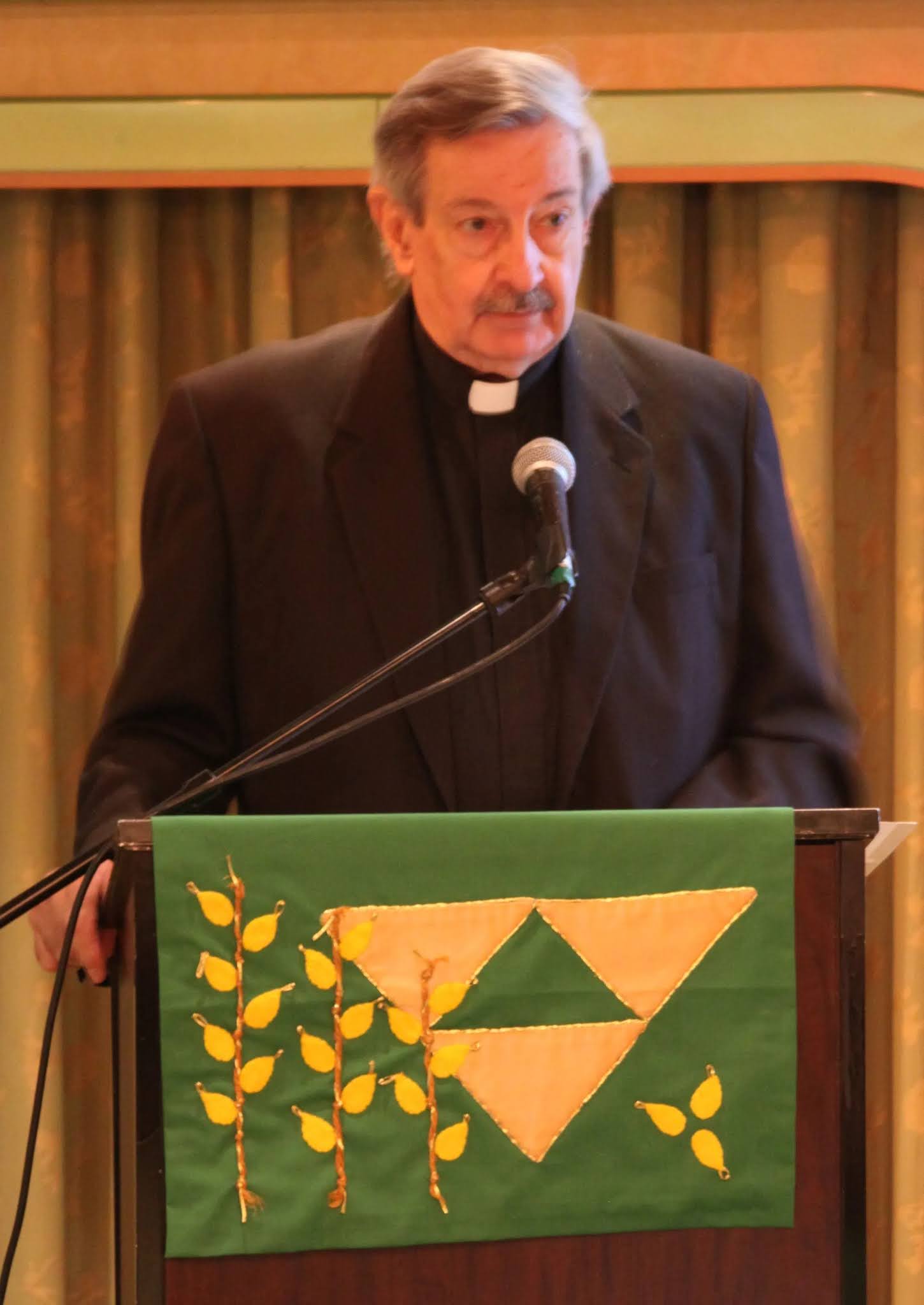
[Above: The Rev. Dr. Thomas Drobena of the Slovak Zion Lutheran Synod, Torrington, Conn., with a replica of the Shroud of Turin: Courtesy of Brother Doug Didyoung]
"This image, impressed upon the cloth, speaks to our heart This disfigured face resembles all those faces of men and women marred by a life which does not respect their dignity, by war and violence which afflict the weakest and yet, at the same time, the face in the shroud conveys a great peace; this tortured body expresses a sovereign majesty." - Pope Francis on Easter Saturday, 2013.Berks Countians will be able to see a life-sized replica of the Shroud of Turin and hear a lecture on the scientific research and mysteries surrounding the sacred cloth at four presentations next week at the Bernardine Francisan Sisters' Motherhouse Complex near Alvernia University. The Rev. Dr. Thomas Drobena of the Slovak Zion Lutheran Synod, Torrington, Conn., will make the presentations. Congratulations to the Rev. Dr. Thomas Drobena! The shroud, a blood-stained linen that bears the outline of someone crucified, is believed by many to be the cloth in which Jesus was buried. It has been the subject of scientific study and controversy for centuries. The Roman Catholic Church has not taken an official position on its authenticity, but generally views it as a valuable relic worth preserving. ... As I have commented before, I regard the Roman Catholic's Church's official position on the Shroud, that it is merely "a valuable relic worth preserving," as weak, and even dishonest.
Dishonest, because the Roman Catholic Church has spent, and continues to spend, the equivalent of many millions of US dollars preserving and protecting the Shroud, and holding expositions at which tens of millions of pilgrims have filed past it on the understanding that it really is Jesus' burial shroud. And individual Popes have expressed their personal conviction that it really is Jesus' burial shroud. So clearly the Roman Catholic Church (to its credit), really believes that the Shroud of Turin is the very burial sheet of Jesus and the image on it is of Jesus' body.
Weak, because as John Evangelist Walsh (himself a Catholic) pointed out 50 years ago, either the Shroud of Turin is a deliberate fraud, or it is Jesus' burial shroud:
"Only this much is certain: The Shroud of Turin is either the most awesome and instructive relic of Jesus Christ in existence-showing us in its dark simplicity how He appeared to men-or it is one of the most ingenious, most unbelievably clever, products of the human mind and hand on record. It is one or the other; there is no middle ground." (Walsh, J.E., "The Shroud," Random House: New York NY, 1963, pp.x-xii. My emphasis)If the Shroud of Turin is a deliberate fraud, then it would almost certainly be a work of Satan "the deceiver of the whole world" (Rev 12:9), and no Church that calls itself Christian should be promoting a deliberate fraud (let alone a work of Satan)! But if the Shroud is authentic (as the evidence is overwhelming that it is), then Jesus whose image would then be on the Shroud, who commanded His followers: "Let what you say be simply ‘Yes' or ‘No'; anything more than this comes from evil." (Mt 5:37) would presumably not be pleased with the Roman Catholic Church's duplicitous official position on His burial shroud.
[return]
Posted 6 October 2013. Updated 29 July 2026.










 Posts
Posts