"Shroud of Turin: Could Ancient Earthquake Explain Face of Jesus?," Megan Gannon, LiveScience, February 11, 2014. ... My comments are in bold. This LiveScience article has the earliest date
Above: "Full-length negative photograph of the Shroud of Turin": LiveScience]
and so appears to be the original source. See also (in alphabetic order): Daily Mail, The Independent, The Telegraph, USA Today, etc.
The authenticity of the Shroud of Turin has been in question for centuries and scientific investigations over the last few decades have only seemed to muddle the debate. Is the revered cloth a miracle or an elaborate hoax? This makes an important point. After the 1988 radiocarbon dating of the Shroud which claimed it was "medieval ... AD 1260-1390" it seemed all over for the Shroud's authenticity. The then Director of the Oxford radiocarbon laboratory, the late Prof. Edward Hall, likened those who continued arguing for the authenticity of the Shroud to "the Flat Earth Society":
"Some people may continue to fight for the authenticity of the shroud, like the Flat Earth Society, but this settles it all as far as we are concerned." ("Obituary: Professor Edward Hall," Robert Hedges and Michael Tite, The Independent, 16 August 2001),But ever since then (as this article indicates) that 13th/14th century radiocarbon date of the Shroud has steadily unravelled. Shroud pro-authenticists kept finding evidence which undermined (to put it mildly) that 1325 +/- 65 years date
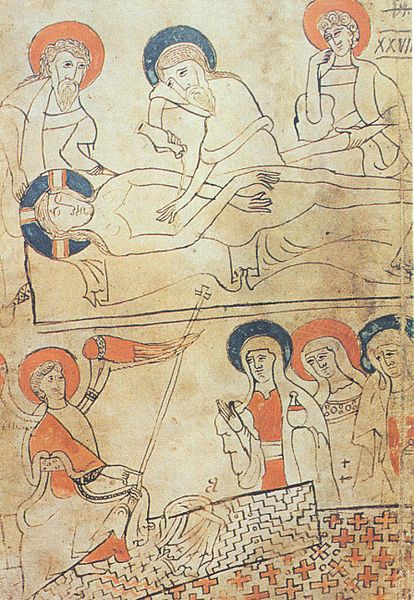 of the Shroud. To give only one example, the Hungarian Pray Codex
[Right (click to enlarge): "Pray Codex," Wikipedia, 13 January 2014]
(1192-95) is dated 65 years before the earliest 1260 radiocarbon date of the Shroud, yet it shows a number of unique features on the Shroud (see my "The Pray Manuscript") which can only mean the 12th century artist who painted (or inked) the Pray Codex had the Shroud as his model.
So the boot is now well and truly on the other foot. These days the Flat Earth Society's counterparts are those who, in the face of an ever increasing mountain of evidence, continue to argue that the Shroud is not the burial sheet of Jesus Christ!
Now, a study claims neutron emissions from an ancient earthquake that rocked Jerusalem could have created the iconic image, as well as messed up the radiocarbon levels that later suggested the shroud was a medieval forgery. But other scientists say this newly proposed premise leaves some major questions unanswered. This is presumably based on a 2012 paper where yet another (see my previous post) group of of Philosophical Naturalist (`nature is all there is-there is no supernatural') scientists who think they are theologians (or rather anti-theologians), seek to debunk the Bible, in this instance, "the earthquake reported in the Gospel of Matthew" as "a type of allegory": "An early first-century earthquake in the Dead Sea," Jefferson B. Williams, Markus J. Schwab & A. Brauer, International Geology Review, Vol. 54, No. 10, 2012, pp.1219-1228:
Abstract: This article examines a report in the 27th chapter of the Gospel of Matthew in the New Testament that an earthquake was felt in Jerusalem on the day of the crucifixion of Jesus of Nazareth. We have tabulated a varved chronology from a core from Ein Gedi on the western shore of the Dead Sea between deformed sediments due to a widespread earthquake in 31 BC and deformed sediments due to an early first-century earthquake. The early first-century seismic event has been tentatively assigned a date of 31 AD with an accuracy of ±5 years. Plausible candidates include the earthquake reported in the Gospel of Matthew, an earthquake that occurred sometime before or after the crucifixion and was in effect ‘borrowed’ by the author of the Gospel of Matthew, and a local earthquake between 26 and 36 AD that was sufficiently energetic to deform the sediments at Ein Gedi but not energetic enough to produce a still extant and extra-biblical historical record. If the last possibility is true, this would mean that the report of an earthquake in the Gospel of Matthew is a type of allegory.Mt 27:50-54 mentions an "earthquake" which split rocks and opened some tombs around Jerusalem, immediately after Jesus died on the cross:
50 And Jesus cried out again with a loud voice and yielded up his spirit. 51 And behold, the curtain of the temple was torn in two, from top to bottom. And the earth shook, and the rocks were split. 52 The tombs also were opened. And many bodies of the saints who had fallen asleep were raised, 53 and coming out of the tombs after his resurrection they went into the holy city and appeared to many. 54 When the centurion and those who were with him, keeping watch over Jesus, saw the earthquake and what took place, they were filled with awe and said, “Truly this was the Son of God!”But that this was not a major earthquake is evident in that it is only called an "earthquake" [Greek seismon], compared to the angel rolling away the stone of Jesus' tomb which Mt 28:20 describes as a "great earthquake" [seismon megas]. And the parallel passages in Mk 15:38 and Lk 23:45 mention only the tearing of the temple curtain in two, not the earthquake. Also during this earthquake the people are still standing around watching (Mt 27:55; Mk 15:40; Lk 23:49) and, there is no mention of buildings being damaged.
The Shroud of Turin, which bears a faint image of a man's face and torso, is said to be the fabric that covered Jesus' body after his crucifixion in A.D. 33. Though the Catholic Church doesn't have an official position on the cloth, the relic is visited by tens of thousands of worshippers at the Turin Cathedral in Italy each year. I repeat my criticism that "the Catholic Church doesn't have an official position on the cloth" is duplicitous (i.e. two-faced), in that the Church, to its credit, clearly believes the Shroud is authentic, and has spent the equivalent of millions of dollars in safekeeping the Shroud and exhibiting it. I am not anti-Catholic in this - I am pro-truth.
Carbon and quakes. Radiocarbon dating tests conducted at three different labs in the 1980s indicated the cloth was less than 800 years old, produced in the Middle Ages, between approximately A.D. 1260 and 1390. The first records of the shroud begin to appear in medieval sources around the same time, which skeptics don't think is a coincidence. See above on the Pray Manuscript alone being proof beyond reasonable doubt that the "medieval ... AD 1260-1390" radiocarbon date is wrong. And I too "don't think [it] is a coincidence." That the Shroud is first century (as the overwhelming weight of evidence points to) but the radiocarbon dates' midpoint, 1325 +/- 65, `just happens' to be 30 years before the Shroud first appeared in the undisputed historical record in Lirey, France in 1355, is simply too good to be true. Indeed, the co-inventor of the AMS method used to radiocarbon date the Shroud, Prof. Harry Gove (1922-2009), stated that the probability that the Shroud is actually first century but its radiocarbon date was 12th-13th century, would be "about one in a thousand trillion":
"The other question that has been asked is: if the statistical probability that the shroud dates between 1260 and 1390 is 95%, what is the probability that it could date to the first century? The answer is about one in a thousand trillion, i.e. vanishingly small." (Gove, H.E., 1996, "Relic, Icon or Hoax?: Carbon Dating the Turin Shroud," p.303).So given that the Shroud is 1st century, the 13th/14th radiocarbon date of the Shroud is evidence of at least low-level scientific fraud, "making results appear just a little crisper or more definitive than they really are, or selecting just the `best' data for publication and ignoring those that don't fit," by the radiocarbon dating laboratories:
"The term `scientific fraud' is often assumed to mean the wholesale invention of data. But this is almost certainly the rarest kind of fabrication. Those who falsify scientific data probably start and succeed with the much lesser crime of improving upon existing results. Minor and seemingly trivial instances of data manipulation-such as making results appear just a little crisper or more definitive than they really are, or selecting just the `best' data for publication and ignoring those that don't fit the case-are probably far from unusual in science. But there is only a difference in degree between `cooking' the data and inventing a whole experiment out of thin air." (Broad, W.A. & Wade, N.J., 1982, "Betrayers of the Truth: Fraud and Deceit in the Halls of Science," p.20)For this reason, agnostic art historian Thomas de Wesselow, who accepts the Shroud is authentic, but doesn't accept that Jesus rose from the dead, considers that scientific fraud in the radiocarbon dating of the Shroud to be a real possibility:
"The third possibility is that a fraud was perpetrated, that genuine Shroud samples were deliberately swapped with cloth of a later date. ... Most sindonologists regard these fraud theories as plainly incredible. Some, like Ian Wilson, refuse to contemplate such `unworthy' accusations. However, scientific fraud is by no means unknown, as the editors of science journals are well aware. ... One important consideration weighs in favour of the possibility of deception. If the carbon-dating error was accidental, then it is a remarkable coincidence that the result tallies so well with the date always claimed by sceptics as the Shroud's historical debut. But if fraud was involved, then it wouldn't be a coincidence at all. Had anyone wished to discredit the Shroud, '1325 ± 65 years' is precisely the sort of date they would have looked to achieve." (de Wesselow, T., 2012, "The Sign: The Shroud of Turin and the Secret of the Resurrection," p.170. My emphasis).Those results were published in the journal Nature in 1989. But critics in favor of a much older date for the cloth have alleged that those researchers took a sample of fabric that was used to patch up the burial shroud in the medieval period, or that the fabric had been subjected to fires, contamination and other damaged that skewed the results. Again, I agree with de Wesselow that it is not the pro-authenticists', but the anti-authenticists' problem to determine what went wrong with the 1988 radiocarbon dating of the Shroud:
"Contamination, reweaving or fraud: three potential sources of error, any one of which could have caused the incorrect carbon dating of the Shroud. But can we legitimately reject the carbon-dating result without determining exactly what went wrong? Of course we can. Archaeologists routinely dismiss 'rogue' radiocarbon dates out of hand. The success of a carbon-dating result should never be declared unilaterally; it is always measured against other evidence. The 1988 test may therefore be declared null and void, even though, without further direct study of the Shroud, it is unlikely we will ever be able to say definitively what went wrong." (de Wesselow, 2012, p.171. My emphasis).Except that my position is that since the Shroud is first century, and the 1325 +/- 65 radiocarbon date of the Shroud is too good to be true, even if there was contamination and/or the laboratories dated a re-woven patch, there will inevitably have been an element of scientific fraud in at the very least, "selecting just the `best' data for publication and ignoring those that don't fit".
The new theory hinges on neutrons released by a devastating earthquake that hit Old Jerusalem around the same time that Jesus is believed to have died. While a neutron flux, converting nitrogen 14 and carbon 13 into carbon 14, as a byproduct of Jesus' resurrection, is a possible (even probable) contributory cause to the Shroud's linen having a younger radiocarbon age than its first century chronological age, there was NO "devastating earthquake that hit Old Jerusalem around the same time that Jesus is believed to have died." (see above).
All living things have the same ratio of stable carbon to radioactive carbon-14, but after death, the radioactive carbon decays in a predictable pattern over time. That's why scientists can look at the carbon-14 concentration in organic archaeological materials like fabrics, bones and wood to estimate age. Carbon-14 is typically created when neutrons from cosmic rays collide with nitrogen atoms in the atmosphere (though it can be unleashed by manmade nuclear reactions, too).
The group of scientists, led by Alberto Carpinteri of the Politecnico di Torino in Italy, suspect high-frequency pressure waves generated in the Earth's crust during this earthquake could have produced significant neutron emissions. (They simulated this by crushing very brittle rock specimens under a press machine.) It was only a minor earthquake in Mt 27:50-54 (see above). And Joseph of Arimathea's new cave tomb in which Jesus was laid (Mt 27:59-60; Jn 19:41-42) would have been made of limestone, like the other cave tombs around Jerusalem (see "The Tomb of Christ from Archaeological Sources" by archaeologist Eugenia Nitowski), not "very brittle rock".

[Above: "The Garden Tomb," Jerusalem: Wikipedia, 24 January 2014].
These neutron emissions could have interacted directly with nitrogen atoms in the linen fibers, inducing chemical reactions that created the distinctive face image on the shroud, the scientists say. There are no nitrogen atoms in linen fibre. Linen is cellulose and cellulose's chemical formula is C6H10O5. That's carbon, hydrogen and oxygen, only. The reactions also could have led to "a wrong radiocarbon dating," which would explain the results of the 1989 [sic] experiments, Carpinteri said in a statement. While these scientists no doubt mean well, in trying to find a reason for what went wrong with the 1988 (not "1989") radiocarbon dating tests (not experiments), they haven't done their Biblical homework.
Giulio Fanti, a professor of mechanical engineering at Padua University, published a book last year "Il Mistero della Sindone," translated as "The Mystery of the Shroud," (Rizzoli, 2013), arguing that his own analysis proves the shroud dates to Jesus' lifetime. In an email, Fanti said he is not sure if a neutron emission is the only possible source responsible for creating the body image. (His own theories include a corona discharge.) However, he wrote that he is "confident" the 1980s radiocarbon dating "furnished wrong results probably due to a neutron emission." This seems contradictory.
Shaky science? Even if it is theoretically possible for earthquake-generated neutrons to have caused this kind of reaction, the study doesn't address why this effect hasn't been seen elsewhere in the archaeological record, Gordon Cook, a professor of environmental geochemistry at the University of Glasgow, explained. "It would have to be a really local effect not to be measurable elsewhere," Cook told Live Science. "People have been measuring materials of that age for decades now and nobody has ever encountered this." I agree with Prof. Cook in this.
Christopher Ramsey, director of the Oxford Radiocarbon Accelerator Unit, had a similar issue with the findings. "One question that would need to be addressed is why the material here is affected, but other archaeological and geological material in the ground is not," Ramsey wrote in an email. "There are huge numbers of radiocarbon dates from the region for much older archaeological material, which certainly don't show this type of intense in-situ radiocarbon production (and they would be much more sensitive to any such effects)." Ramsey added that using radiocarbon dating to study objects from seismically active regions, such as regions like Japan, generally has not been problematic. And with Prof. Ramsey. It doesn't help the Shroud pro-authenticity cause to use such a weak explanation of the aberrant 1988 radiocarbon dating of the Shroud that it has both the Bible and science against it.
It seems unlikely that the new study, published in the journal Meccanica, As with my previous post, who peer-reviews these Bible-science papers? Did they consult any Bible-believing theologians? will settle any of the long-standing disputes about how and when the cloth was made, which depend largely on faith. The boot is on the other foot. It is the Shroud anti-authenticist position which "which depend[s] largely on faith". The pro-authenticist position depends largely on evidence.
"If you want to believe in the Shroud of Turin, you believe in it," Cook said. Prof. Cook clearly knows nothing of the evidence for the Shroud's authenticity. Again, presumably under the influence of Naturalism (the belief that "nature is all there is-there is no supernatural"), which has so dominated science since the 19th century that scientists today are not even aware that they are believers in it: an unproven and unprovable philosophy. So Prof. Cook just assumes, wrongly, that the Shroud pro-authenticity position is mere belief!
Posted 14 February 2014. Updated 27 February 2025.







 Posts
Posts


