Saturday, June 18, 2016

Problems of the Turin Shroud forgery theory: Index S-Z

This is my alphabetical index, "S-Z" to where mentions of "forger," "forgery," etc, occur in Shroud literature on my system. This index had been split into "A-F," "G-M" and "N-Z" when each page grew too long. Now "N-Z" has been split into "N-R" and "S-Z" (this post). See "A-F" for more information. See also Problems of the forgery theory A-Z" in my "The evidence is overwhelming that the Turin Shroud is Jesus' burial sheet!" series.


PROBLEMS OF THE TURIN SHROUD FORGERY THEORY:
INDEX S-Z
© Stephen E. Jones

[Above (enlarge): Three-dimensional `relief map' of an Enrie 1931 photograph of the Shroud face displayed on a VP-8 Image Analyzer[BE81p22], showing that unlike normal photographs the Shroud image has three-dimensional information encoded within it.].


science Scientific testing could readily establish if Shroud were a forgery, e.g., a painting [HA81p36]. The Shroud has been studied and tested to a greater degree than any art object or archaeological artifact[MR86p16]. Yet science does not know "how the ghostly image of a serene, bearded man [on the Shroud] was made"[BP05]. Nor does science know "the nature of the image and how it was fixed on the cloth"[BP08p349].

scourged Forger would have had to encode intricate details, some invisible, on each of the 100-120 scourge marks[AM00p77]. If he had got just one of these scourge marks wrong, it would have betrayed his work as a forgery[AM00p77]. Some of the scourge marks are visible only under ultraviolet light, so a forger would have to `paint' them invisible to his naked eye, so they could only be seen with ultraviolet equipment to be invented ~650 years later[CT96p40].

Shroud The body of Jesus enfolded in a simple linen cloth passing lengthwise over the head and covering the whole body back and front is not what any medieval forger would have thought of[RJ77p25].

skeptics Skeptics who deny the authenticity of the Shroud are often atheists who deny the possibility of the supernatural and find it easier to dismiss the Shroud as a forgery, even when it flies in the face of the evidence[MJ11p272]. An authentic Shroud scares them as they know it would put their atheism on shaky ground[MJ11p272]. Although sceptics claim the Shroud is a mediaeval forgery, none has been able to produce a workable hypothesis that stands up to scientific scrutiny as to how the image was created by a mediaeval forger[OM10p254].

style Every artist is identifiable by his style, but the Shroud image has no style as a photograph doesn't[CT99p291-2].

Sudarium of Oviedo There is an evident correspondence between patches of blood on the face of the Shroud and those on the Sudarium of Oviedo[RG81p138]. There is also a remarkable agreement between much of the anatomical data on both[RG81p138]. Some of the drops and clots of blood on the face of the Shroud and the Sudarium are identical in shape and position[RG81p138]. But the Sudarium came from the East about four centuries before the Shroud appeared in the West, so they could not have been compared by a medieval forger[RG81p138].

three-dimensional In 1977 it was discovered that the Shroud man's image is three-dimensional[JJ77p74-9]. An artist or forger living in the 14th century would not have been able to encode three dimensional information into the Shroud image by adjusting the intensity levels of his work to everywhere correspond to actual cloth-body separations[JJ77p85]. How could [and why would] a medieval forger have encoded three-dimensional information into the Shroud image, when that was only recently [at least 6 centuries later] discovered by scientists[IJ98p44]? Skeptic Joe Nickell claimed to have replicated the Shroud by brushing a dry powder over a bas-relief, but it was found that his image was not three-dimensional[SH81p108].

thumbs. The Shroud man's thumbs are not visible[WI79p41]. Dr Pierre Barbet found that when he drove a nail through the wrists of freshly amputated arms, the grazed median nerve caused each thumb to contract into the palm of the hand[WI79p41]. "Could a forger have imagined this?" he asked himself[WI79p41]. [see "hands"].

unknown Forger's knowledge of human anatomy rivals that of Leonardo and Michelangelo-why have we never heard of him[CN88p31]?

Vignon, Paul Paul Vignon (1865-1943), was a French artist and biologist[BR78pp35-6]. He was confident that he would demonstrate how a forger had created the Shroud[BR78p36]. But after studying the Shroud photographs taken in 1898 by Secondo Pia (1855–1941) and interviewing Pia in Turin, Vignon accepted that Pia's photographs were genuine and that Shroud image was a photographic negative (see "negative")[BR78p36]. Vignon then realised that a forger could not have painted the image in negative as he would not have been able to see what he was doing to include so much fine detail[BR78p36]. From further study of Pia's photographs, Vignon asserted that no forger could have produced such a complex network of injuries[BR78p40]. Vignon also realised that no forger in the fourteenth century would have depicted Jesus nude[BR78p40]. Moreover, there were no signs of decomposition on the Shroud image, meaning that the body had been in the Shroud only a few days[BR78p40]. This and other details of the Shroud image matched the Bible story of Jesus' suffering, crucifixion, death and resurrection![BR78p40-1]. Based on Vignon's researches, his supervisor at the Sorbonne, Prof. Yves Delage (1854–1920), an agnostic, presented a paper in 1902 to the French Academy of Sciences, in which Delage concluded, "The man of the Shroud is the Christ!"[BR78p41].

wounds Medieval forger would have drawn wounds carefully, showing them in circular form, that they should be easily recognized in their traditional positions, as all artists have always accentuated Jesus' wounds[VP02p33]. But on the right foot the principal blood clot is shown under the heel itself, covering the place where the nail had entered[VP02p33]. The extreme naturalness and exactness of the wounds on the Shroud are beyond human skill[VP02p43].

To be continued in the background.

REFERENCES [top]
AM00. Antonacci, M., 2000, "Resurrection of the Shroud: New Scientific, Medical, and Archeological Evidence," M. Evans & Co: New York NY.
BP05. Ball, P., 2005, "To know a veil," Nature news, 28 January.
BP08. Ball, P., 2008, "Material witness: Shrouded in mystery," Nature Materials, Vol. 7, No. 5, May, p.349.
BR78. Brent, P. & Rolfe, D., 1978, "The Silent Witness: The Mysteries of the Turin Shroud Revealed," Futura Publications: London, pp.36-37.
BE81. Brooks, E.H., II., Miller, V.D. & Schwortz, B.M., 1981, "The Turin Shroud: Contemporary Insights to an Ancient Paradox," ["The Silver Book"], Worldwide Exhibition: Chicago IL.
CT99. Cahill, T., 1999, "Desire of the Everlasting Hills: The World before and after Jesus," Nan A. Talese/Doubleday: New York NY.
CT96. Case, T.W., 1996, "The Shroud of Turin and the C-14 Dating Fiasco," White Horse Press: Cincinnati OH.
CN88. Currer-Briggs, N., 1988, "The Shroud and the Grail: A Modern Quest for the True Grail," St. Martin's Press: New York NY.
HA81. Heller, J.H. & Adler, A.D., 1981, "A Chemical Investigation of the Shroud of Turin," in Adler & Crispino, 2002, pp.34-57.
IJ98. Iannone, J.C., 1998, "The Mystery of the Shroud of Turin: New Scientific Evidence," St Pauls: Staten Island NY.
JJ77. Jackson, J., et al., "The Three Dimensional Image on Jesus' Burial Cloth," in Stevenson, K.E., ed., 1977, "Proceedings of the 1977 United States Conference of Research on The Shroud of Turin," Holy Shroud Guild: Bronx NY, pp.74-94.
MR86. Maher, R.W., 1986, "Science, History, and the Shroud of Turin," Vantage Press: New York NY.
MJ11. Marino, J.G., 2011, "Wrapped up in the Shroud: Chronicle of a Passion," Cradle Press: St. Louis MO.
OM10. Oxley, M., 2010, "The Challenge of the Shroud: History, Science and the Shroud of Turin," AuthorHouse: Milton Keynes UK.
RG81. Ricci, G., 1981, "The Holy Shroud," Center for the Study of the Passion of Christ and the Holy Shroud: Milwaukee WI.
RJ77. Robinson, J.A.T., " The Shroud of Turin and the Grave-Clothes of the Gospels," in Stevenson, 1977, pp.23-30.
SH81. Stevenson, K.E. & Habermas, G.R., 1981, "Verdict on the Shroud: Evidence for the Death and Resurrection of Jesus Christ," Servant Books: Ann Arbor MI.
VP02. Vignon, P., 1902, "The Shroud of Christ," University Books: New York NY, Reprinted, 1970.
WI79. Wilson, I., 1979, "The Shroud of Turin: The Burial Cloth of Jesus?," [1978], Image Books: New York NY, Revised edition.
[top]

Posted 18 June 2016. Updated 14 May 2025.

Saturday, June 11, 2016

No outline #14: The man on the Shroud: The evidence is overwhelming that the Turin Shroud is Jesus' burial sheet!

NO OUTLINE #14

Copyright © Stephen E. Jones[1]

This is part #14, "The man on the Shroud: No outline," of my series, "The evidence is overwhelming that the Turin Shroud is Jesus' burial sheet!" See the Main index for more information about this series.

[Main index #1] [Previous: Non-traditional #13] [Next: No paint, etc. #15]


  1. The man on the Shroud #8
    1. No outline #14

Introduction. The image of the man on the Shroud has no outline[2].

[Above (enlarge)[3]: Extract of front trunk and thighs area of the Shroud man's image (Shroud Scope: Durante 2002 Vertical). As can be seen there is no outline of the image. Readers can verify this for themselves by clicking on this (or any) image area of Shroud Scope and continually enlarging it by clicking on that part of the image, until maximum magnification is reached. They will find that as the image is enlarged it becomes more diffuse and no outline ever appears - because there isn't one!]

No outline. A unique feature of the Shroud man's image is a total lack of outline[4]. Painters outline a figure before painting it[5], but there is no outline on the Shroud[6]. All medieval artists used outlines[7] and it was not until the nineteenth century Impressionists that artists began to rely less on outlines to give shape to their works[8]. Yet even the Pointillists, the most extreme branch of Impressionism, used outlines to indicate where they should place their dots of colour[9]. The legs on the frontal image and the greater part of the dorsal image are indefinite and fade away in a blur, unlike any painting[10]. All paintings reveal indications of the artist's technique, such as brush strokes, sketched outlines, corrections and layers of colors, but even under magnification, no evidence of these can be detected[11]. All human paintings show outline and shading, and even if deceives the unaided eye, it becomes evident under the microscope[12]. But the image on the Shroud has no outline nor shading, even under a microscope[13]. Infrared thermographs of the Shroud taken by STURP in 1978 did not detect evidence of any underlying paint structures nor outline[14], as would be expected if the Shroud image were a painting[15].

Historical. In 1201 the Overseer of Constantinople's relic collection, Nicholas Mesarites (c. 1163-1216), delivered a speech in which he stated that among those relics were:

"`The funerary sheets [sindones] of Christ' which had `wrapped the un-outlined [Greek aperilepton], dead, naked ... body ... after the Passion'"[16].
That Mesarites was referring to the Shroud is evident from his calling it the sindones in which Jesus' dead body had been "wrapped ... naked"[17]. It is not known why Mesarites used the plural sindones "shrouds"[18], except that he also mentioned a towel (cheiromaktron) in the relic collection which supposedly bore an image of Jesus "not wrought by hand"[19]. So it seems that by "sindones" Mesarites was including other claimed burial cloths of Jesus that were in Constantinople's relic collection. But the adjective aperilepton [Greek a "not" + peri "around" + lepton "thin"[20] - compare aperitmeton "uncircumcised"[21] (Acts 7:51)], means "un-outlined"[22], "un-outlined"[23] or "uncircumscribed"[24]. This can only be the Shroud man's image which uniquely (at least before the 19th century) has no outline[25]. So this is further proof beyond reasonable doubt that the Shroud was in Constantinople by at least 1201, more than a half-century before its earliest possible 1260 radiocarbon date[26]!

Problems for the forgery theory. (see previous three: #11, #12 & #13). Impossible to paint the Shroud man's image on linen without an outline. Paul Vignon (1865-1943), a French Professor of Biology and an artist[27], tried to paint an image on linen as faint and devoid of outline, as the man on the Shroud is and failed[28]. In 1967, Leo Vala, a professional photographer and an agnostic[29] made the first three-dimensional reproduction of the Shroud face by projecting a Shroud negative photograph onto a lump of clay and sculpting it[30].

[Above (enlarge): "British photographer Leo Vala displays the photographic representation he has produced of the face of Christ. He used a unique process to develop the Turin Shroud's imprint into a three-dimensional picture. (Photo by Douglas Miller/Keystone/Getty Images). 23rd January 1967"[31].]

Vala published his experiment in the March 8, 1967 issue of Amateur Photographer, stating in the article:

"I've been involved in the invention of many complicated visual processes, and I can tell you that no one could have faked that image. No one could do it today with all the technology we have. It's a perfect negative. It has a photographic quality that is extremely precise." (my emphasis)[32]
Vala became a critic of anyone who thought the image could have been produced by human hands[33]. For a forger to have created the Shroud image without outlines and in negative, "boggles the mind"[34]!

Radiation caused the Shroud man's un-outlined image. In 1998 Dr August Accetta injected himself with the medical radioactive isotope Technetium-99 (Tc-99][35] and then his body was scanned by nuclear radiation imaging[36].

[Right (enlarge): Nuclear radiation image of Dr. August Accetta[37]. The `V' shape over Accetta's genitals is a protective shield and the projections from his abdomen and chest are some of his internal organs, which absorbed more of the Tc-99[38]. As can be seen, Accetta's radiation image has no outline, like the Shroud image[39].]

The result was a full-body radiation image, which shared characteristics of the Shroud man's image, including having no outline[40]. Accetta does not claim that the Shroud man's image was necessarily the result of nuclear radiation, nor that it reproduced exact characteristics of the Shroud image, just that the human radiation model generated a number of characteristics which parallel the image on the Shroud[41]. This indicates that some type of radiation was the cause of the Shroud man's outline-less image[42] (as we will also see in "X-ray" #20). But since "... radiation of wavelengths other than visible light were [sic] discovered in the early 19th century" (my emphasis)[43], a medieval or earlier forger could not have created by electromagnetic or nuclear radiation the man's image on the Shroud[44].

Radiocarbon date of the Shroud as "mediaeval ... 1260-1390" was wrong. That the Shroud was in Constantinople by at least 1201 is further evidence that the 1988 radiocarbon dating of the Shroud as "mediaeval ... AD 1260-1390"[45] was wrong. And if wrong, then

[Above (enlarge): From left to right, Prof. E. Hall (Oxford), Dr M. Tite (British Museum) and Dr R. Hedges (Oxford) announcing on 13 October 1988 that the Shroud had been radiocarbon dated to "1260-1390!"[46].]

fraudulent[47]. That is because 1260-1390 is 1325 ± 65 years[48], the mid-point of which, 1325[49], is a mere ~30 years[50], before the Shroud first appeared in undisputed history at Lirey, France, in ~1355[51]. Shroud sceptics seized on 1325 as the date of the Shroud[52]. They were certain that the Shroud had to be a medieval fake because the improbability would be "astronomical"[53], "one in a thousand trillion"[54] and indeed "totally impossible"[55] that the Shroud could be first-century yet have a 13th-14th century radiocarbon date, let alone the `bull's-eye' date of 1325[56]. But the flip-side is that since the Shroud is authentic (as the evidence overwhelmingly indicates)[57], and therefore first century, then the improbability would be "astronomical," "one in a thousand trillion" and indeed "totally impossible" that the Shroud could have a 1260-1390 radiocarbon date!

Attempts by pro-authenticists to reconcile the Shroud's first century actual date with the claimed 1260-1390 radiocarbon date, are understandable, but as I showed in part #1 of my series, "The 1260-1390 radiocarbon date of the Turin Shroud was the result of a computer hacking," conventional explanations of the discrepancy, i.e. carbon contamination, bioplastic coating, invisible repair, neutron flux, all fail. Similarly, as I also showed in that part #1, accusations of conventional fraud (e.g. sample-switching) also fail.

Agnostic pro-authenticist art historian Thomas de Wesselow considers fraud in the Shroud's radiocarbon dating to be a real possibility (albeit by sample-swapping), because of the "1325 ± 65 years" date:

"The third possibility is that a fraud was perpetrated, that genuine Shroud samples were deliberately swapped with cloth of a later date ... Most sindonologists regard these fraud theories as plainly incredible. Some, like Ian Wilson, refuse to contemplate such `unworthy' accusations. However, scientific fraud is by no means unknown, as the editors of science journals are well aware. ... One important consideration weighs in favour of the possibility of deception. If the carbon-dating error was accidental, then it is a remarkable coincidence that the result tallies so well with the date always claimed by sceptics as the Shroud's historical debut. But if fraud was involved, then it wouldn't be a coincidence at all. Had anyone wished to discredit the Shroud, '1325 ± 65 years' is precisely the sort of date they would have looked to achieve" (my emphasis)[58].
But as I pointed out near the end of that part #1:
"... there is another type of fraud that the fully computerised AMS radiocarbon dating process[59] was vulnerable to, and which was rife in the 1980s [see part #2], namely computer hacking!"

Continued in part #15 of this series.

Notes
1. This post is copyright. Permission is granted to quote from any part of this post (but not the whole post), provided it includes a reference citing my name, its subject heading, its date, and a hyperlink back to this post. [return]
2. Barnes, A.S., 1934, "The Holy Shroud of Turin," Burns Oates & Washbourne: London, p.14; Iannone, J.C., 1998, "The Mystery of the Shroud of Turin: New Scientific Evidence," St Pauls: Staten Island NY, pp.71, 156; Wilson, I. & Schwortz, B., 2000, "The Turin Shroud: The Illustrated Evidence," Michael O'Mara Books: London, pp.38-39. [return]
3. Extract from Latendresse, M., 2010, "Shroud Scope: Durante 2002 Vertical," Sindonology.org. [return]
4. Currer-Briggs, N., 1988, "The Shroud and the Grail: A Modern Quest for the True Grail," St. Martin's Press: New York NY, p.33; Currer-Briggs, N., 1995, "Shroud Mafia: The Creation of a Relic?," Book Guild: Sussex UK, p.12. [return]
5. Iannone, 1998, p.6. [return]
6. Drews, R., 1984, "In Search of the Shroud of Turin: New Light on Its History and Origins," Rowman & Littlefield: Lanham MD, p.16; Iannone, 1998, p.177; Oxley, M., 2010, "The Challenge of the Shroud: History, Science and the Shroud of Turin," AuthorHouse: Milton Keynes UK, p.3. [return]
7. Wilson, I., 1991, "Holy Faces, Secret Places: The Quest for Jesus' True Likeness," Doubleday: London, p.23; Hoare, R., 1995, "The Turin Shroud Is Genuine: The Irrefutable Evidence," [1984], Souvenir Press: London, p.52. [return]
8. Wilson, I., 1979, "The Shroud of Turin: The Burial Cloth of Jesus?," [1978], Image Books: New York NY, Revised edition, p.22; Iannone, 1998, p.6; Wilson, I., 1998, "The Blood and the Shroud: New Evidence that the World's Most Sacred Relic is Real," Simon & Schuster: New York NY, p.21; Wilson & Schwortz, 2000, p.39; Wilson, I., 2010, "The Shroud: The 2000-Year-Old Mystery Solved," Bantam Press: London, p.11. [return]
9. Wilson & Schwortz, 2000, p.39. [return]
10. Currer-Briggs, 1988, p.33; Currer-Briggs, 1995, p.12. [return]
11. Bulst, W., 1957, "The Shroud of Turin," McKenna, S. & Galvin, J.J., transl., Bruce Publishing Co: Milwaukee WI, p.31. [return]
12. Barnes, 1934, p.14. [return]
13. Barnes, 1934, p.14. [return]
14. Adler, A.D., 2000b, "Chemical and Physical Aspects of the Sindonic Images," in Adler, A.D. & Crispino, D., ed., 2002, "The Orphaned Manuscript: A Gathering of Publications on the Shroud of Turin," Effatà Editrice: Cantalupa, Italy, p.17. [return]
15. Adler, A.D., 2000a, "Chemical and Physical Characteristics of the Bloodstains," in Adler & Crispino, 2002, pp.132-133. [return]
16. de Wesselow, T., 2012, "The Sign: The Shroud of Turin and the Secret of the Resurrection," Viking: London, p.176; Scavone, D., "The Shroud of Turin in Constantinople: The Documentary Evidence," in Sutton, R.F., Jr., 1989, "Daidalikon: Studies in Memory of Raymond V Schoder," Bolchazy Carducci Publishers: Wauconda IL, pp.320-321; Wilson, 1991, p.155; Wilson, 1998, p.145. [return]
17. Wilson, 1991, p.155; Wilson, 1998, p.145; de Wesselow, 2012, pp.176-177. [return]
18. Wilson, 1998, pp.145, 225 n.2; de Wesselow, 2012, p.176. [return]
19. Scavone, 1989, p.321. [return]
20. Abbott-Smith, G., "A Manual Greek Lexicon of the New Testament," [1921], T. & T. Clark: Edinburgh, Third edition, 1937, Reprinted, 1956, pp.2, 354, 267. [return]
21. Abbott-Smith, 1937, p.46. [return]
22. de Wesselow, 2012, p.176. [return]
23. Wilson, 1991, p.155; Wilson, 1998, p.145. [return]
24. Scavone, 1989, p.321; Wilson, 1991, p.155; Wilson, 1998, p.272. [return]
25. Wilson, 1991, p.155; Wilson, 1998, p.145; de Wesselow, 2012, p.176. [return]
26. de Wesselow, 2012, p.176; Wilson, 1991, p.3; Wilson, 1998, pp.125, 141; Wilson & Schwortz, 2000, p.113; Wilson, 2010, p.108. [return]
27. Shepard, L., 1970, in Vignon, P., 1902, "The Shroud of Christ," University Books: New York NY, Reprinted, p.vii.; Stevenson, K.E. & Habermas, G.R., 1981, "Verdict on the Shroud: Evidence for the Death and Resurrection of Jesus Christ," Servant Books: Ann Arbor MI, pp.15, 57; Maher, R.W., 1986, "Science, History, and the Shroud of Turin," Vantage Press: New York NY, p.72. [return]
28. Brent, P. & Rolfe, D., 1978, "The Silent Witness: The Mysteries of the Turin Shroud Revealed," Futura Publications: London, p.36. [return]
29. Wilson, 1998, p.19; Wilson, 2010, p.21. [return]
30. Wilson, 1979, p.34-35; Morgan, R.H., 1980, "Perpetual Miracle: Secrets of the Holy Shroud of Turin by an Eye Witness," Runciman Press: Manly NSW, Australia, pp.128-129; Tribbe, F.C., 2006, "Portrait of Jesus: The Illustrated Story of the Shroud of Turin," [1983], Paragon House Publishers: St. Paul MN, Second edition, pp.254. [return]
31. "Simply Some Photos," Avax News, 1 October 2011. [return]
32. Vala, L., 1967, "The Holy Shroud of Turin," Amateur Photographer, March 8, pp.332-335, in Wilcox, R.K., 1977, "Shroud," Macmillan: New York NY, pp.130-131 & Wilson, 2010, p.21. [return]
33. Wilcox, R.K., 1977, "Shroud," Macmillan: New York NY, pp.130-131. [return]
34. Wilson, 1998, p.24. [return]
35. Accetta, A.D., Lyons, K. & Jackson, J., 1999, "Nuclear Medicine and its Relevance to the Shroud Of Turin," in Walsh, B.J., ed., "Proceedings of the 1999 Shroud of Turin International Research Conference, Richmond, Virginia," Magisterium Press: Glen Allen VA, 2000, pp.3-8, 3. [return]
36. Whiting, B., 2006, "The Shroud Story," Harbour Publishing: Strathfield NSW, Australia, p.181. [return]
37. Wilson & Schwortz, 2000, p.131. [return]
38. Ibid. [return]
39. Accetta, 1999, p.4; Whiting, 2006, pp.181-182. [return]
40. Accetta, 1999, p.4; Wilson & Schwortz, 2000, p.130; Whiting, 2006, p.182. [return]
41. Accetta, 1999, p.4. [return]
42. Antonacci, M., 2000, "Resurrection of the Shroud: New Scientific, Medical, and Archeological Evidence," M. Evans & Co: New York NY, p.212. [return]
43. "Radiation: Discovery," Wikipedia, 8 June 2016. [return]
44. Antonacci, 2000, p.213. [return]
45. Damon, P.E., 1989, "Radiocarbon Dating of the Shroud of Turin," Nature, Vol. 337, 16th February, pp.611-615, 611. [return]
46. Wilson, 1998, p.7 & pl.3b. [return]
47. Wilson, 1998, p.8. [return]
48. McCrone, W.C., 1999, "Judgment Day for the Shroud of Turin," Prometheus Books: Amherst NY, pp.1,141,178,246; Wilson, 1998, p.7; Oxley, 2010, p.87; de Wesselow, 2012, p.171. [return]
49. Tribbe, 2006, p.169; Tipler, F.J., 2007, "The Physics of Christianity," Doubleday: New York NY, p.177. [return]
50. Gove, H.E., 1996, "Relic, Icon or Hoax?: Carbon Dating the Turin Shroud," Institute of Physics Publishing: Bristol UK, pp.264, 300; Milne, L., 2005, "A Grain of Truth: How Pollen Brought a Murderer to Justice," New Holland: Frenchs Forest, NSW, Australia, p.93. [return]
51. Scavone, D.C., "The History of the Turin Shroud to the 14th C.," in Berard, A., ed., 1991, "History, Science, Theology and the Shroud," Symposium Proceedings, St. Louis Missouri, June 22-23, 1991, The Man in the Shroud Committee of Amarillo, Texas: Amarillo TX, pp.171-204, 174; Oxley, 2010, p.4; Wilson, 2010, pp.222-223. [return]
52. McCrone, W.C., 1999, "Judgment Day for the Shroud of Turin," Prometheus Books: Amherst NY, pp.xxiii, xx, 247; Schafersman, S.D., 1998, "Unraveling the Shroud of Turin," Approfondimento Sindone, Vol. 2; Dutton, D., 2005, "Postscript: Requiem for the Shroud of Turin," Michigan Quarterly Review 23, 1984, pp.243-55; Gove, 1996, p.293. [return]
53. Wilson, 1998, pp.6-7. [return]
54. Gove, 1996, p.303. [return]
55. Currer-Briggs, N., 1995, "Shroud Mafia: The Creation of a Relic?," Book Guild: Sussex UK, pp.114-115. [return]
56. Meacham, W., 1986, "On Carbon Dating the Shroud," British Society for the Turin Shroud Newsletter, No. 14, September, pp.4-15, 10; Meacham, W., 1986, "On Carbon Dating the Turin Shroud," Shroud Spectrum International, No. 19, June, pp.15-25, 20; Nickell, J., 2013, "Another Easter for the Turin `Shroud'," Investigative Briefs with Joe Nickell, Center For Inquiry, March 28. [return]
57. Morgan, 1980, p.116; Adams, F.O., 1982, "Sindon: A Layman's Guide to the Shroud of Turin," Synergy Books: Tempe AZ, p.86; Minor, M., 1990, "Shroud of Turin Manuscript Discovered By Texas Member," [originally "A Lawyer Argues for Authenticity of the Shroud of Turin"], The Manuscript Society News, Vol. XI, No. 4, Fall, pp.117-122, 122; Stevenson, K.E. & Habermas, G.R., 1990, "The Shroud and the Controversy," Thomas Nelson: Nashville TN, pp.60; Case, T.W., 1996, "The Shroud of Turin and the C-14 Dating Fiasco," White Horse Press: Cincinnati OH, p.26; Antonacci, 2000, p.6; Meacham, W., 2005, "The Rape of the Turin Shroud: How Christianity's Most Precious Relic was Wrongly Condemned and Violated," Lulu Press: Morrisville NC, pp.110-111. [return]
58. de Wesselow, 2012, p.170. [return]
59. Gove, 1996, p.264; Sox, H.D., 1988, "The Shroud Unmasked: Uncovering the Greatest Forgery of All Time," The Lamp Press: Basingstoke UK, p.147. [return]

Posted 11 June 2016. Updated 13 September 2025.

Thursday, June 2, 2016

The 1260-1390 radiocarbon date of the Turin Shroud was the result of a computer hacking #8

Copyright ©, Stephen E. Jones[1]

[Index: #1, #2, #3, #4, #5, #6, #7, #9, #10 & #11] See "My Hacker Theory in a nutshell."

Introduction. This is part #8 of my concluding summary of the evidence that the 1988 radiocarbon dating of the Shroud of Turin as "mediaeval ... AD 1260-1390"[2] was the result of a computer hacking, allegedly by Arizona radiocarbon dating laboratory physicist Timothy W. Linick (1946-89)[3], aided by German hacker Karl Koch (1965–89)[4], on behalf of the former Soviet Union, through its agency the KGB. Previous posts in this series were parts: #1, #2, #3, #4, #5, #6 and #7. I will link the main headings in these posts back to my previous, "My theory ..." posts on those topics. The next post in this series is part #9.

■ Evidence that Karl Koch installed Linick's program on Zurich and Oxford laboratories' AMS computers [#10(9) & #8]
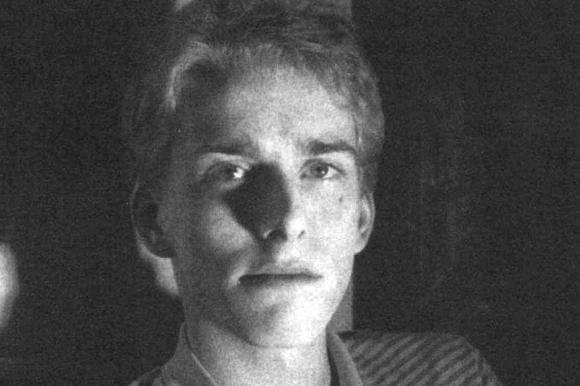
[Above (enlarge)[5]: Karl Koch (1965–89). "The hacker Karl Koch was only 23 years old. On 1 June 1989 they found his burnt corpse in a forest near Gifhorn (Lower Saxony)."[6].]

As summarised by Wikipedia:

"Karl Werner Lothar Koch (July 22, 1965 – ca. May 23, 1989) was a German hacker in the 1980s, who called himself `Hagbard', after Hagbard Celine. He was involved in a Cold War computer espionage incident. ... Koch was born in Hanover. As his moniker would suggest, he was heavily influenced by The Illuminatus! Trilogy by Robert Anton Wilson and Robert Shea. ... Koch was loosely affiliated with the Chaos Computer Club. He worked with the hackers known as DOB (Dirk-Otto Brezinski), Pengo (Hans Heinrich Hübner), and Urmel (Markus Hess), and was involved in selling hacked information from United States military computers to the KGB. Clifford Stoll's book The Cuckoo's Egg gives a first-person account of the hunt and eventual identification of Hess. Pengo and Koch subsequently came forward and confessed to the authorities under the espionage amnesty, which protected them from being prosecuted. Koch was found burned to death with gasoline in a forest near Celle, Germany. The death was officially claimed to be a suicide. However, some believe there is little evidence supporting suicide and many believe that Koch was killed in order to keep him from confessing more to the authorities. Why Koch would be targeted, and not Pengo and Urmel, is unknown. Koch left his workplace in his car to go for lunch; he had not returned by late afternoon and so his employer reported him as a missing person. Meanwhile, West German police were alerted of an abandoned car in a forest near Celle. When they went to investigate, they found an abandoned car, that looked like it had been there for years, as it was covered in dust. Near to the car they found a burned corpse (Koch). His shoes were missing and have never been found. There was a patch of burned ground around him, which although it had not rained in some time and the grass was perfectly dry, was controlled in a small circle around the corpse. It is thought to be highly unlikely that this type of controlled burning could have been achieved by Koch himself which leads many to believe that his death was not suicide." (my emphasis)[7].
• Koch was a German computer hacker in the 1980s. Karl Koch was born in Hanover, then West Germany, on 22 July 1965[8]. Both his parents were dead by the time he was 16 and Koch's inheritance supported his expensive drug habit[9]. Koch began computer hacking in Hanover in the early 1980s[10]. Koch's online name was "Hagbard Celine" after the hero of the The Illuminatus! Trilogy[11] novels, who fights against The Illuminati, a fictitious, but to Koch real, all-powerful secret society[12]. Unlike other hackers, Koch was no programmer but was expert at guessing logins and passwords[13]. What Koch lacked in programming skills he more than made up for by his deep intuition, fertile imagination[14], unusual insight, patience, single-mindedness[15] and persistence[16]. Also, other hackers were part-time but Koch, supported by his inheritance, devoted every waking moment to hacking[17].

• Koch became a paid hacker for the KGB. In 1985, at a hacker meeting in Hanover, Koch was recruited by a Peter Carl as a the first member of a ring of hackers to break into Western computer systems, particularly those on military or defence industry sites, and sell the information and programs to the KGB[18]. Others who joined Koch in the Hanover KGB hacker circle[19] included Hans Heinrich Hübner (Pengo)[20], Dirk-Otto Brzezinski (DOB)[21] and Markus Hess (Urmel)[22]. In September 1986 Peter Carl went to the Soviet trade mission in East Berlin with a proposition to sell them secret information from USA military computers[23]. A KGB agent, Sergei Markov, agreed to Carl's hacking proposition[24]. At subsequent meetings in East Berlin with Carl and Brzezinski, from 1986 through 1988, Markov paid for information and software the German hacker ring, including Koch, provided[25].

• Koch allegedly installed Linick's program on Zurich and Oxford's AMS computers. By early 1987, Koch had spent his inheritance and his drug dependency had become acute[26]. It was in this ~7 month period between October 1987, after the Archbishop of Turin announced that only three AMS laboratories, Arizona, Oxford and Zurich, would date the Shroud[27] and April 1988 when samples were cut from the Shroud and given to the three laboratories for dating[28], that according to my theory, the KGB's Sergei Markov secretly approached Koch, with an offer of drugs[29] and/or money in return for Koch installing Linick's program on Zurich and Oxford AMS computers. How exactly Koch installed Linick's program on Zurich and Oxford AMS computers is not part of my theory. Except that, since Arizona's and Oxford's (and presumably Zurich's) AMS computers were never online[30], Linick's program would have had to be installed manually and locally, either by Koch alone, or by a KGB operative following Koch's instructions, or more likely by a KGB operative taking Koch to each of the two laboratories and helping him gain access to their AMS computers.

• The laboratories' AMS computers had a major security flaw. In 1987 it was known by hackers (including Koch[31]) that VMS, the operating system for the "DEC computer system" that the AMS computer at Arizona[32] (and presumably also at Zurich and Oxford) was, had a major security flaw, in that if an unauthorised user entered any login and password and ignored the error messages, he could gain access to the system:

"Two ... Hamburg students ... code-named Bach and Handel ... had exploited a devastatingly simple flaw in the VMS operating system used on VAX. The machines, like most computer systems, required users to log in their ID and then type their password to gain access. If the ID or the password was wrong, the VMS system had been designed to show an 'error' message and bar entry. But ... if they simply ignored all the 'error' messages, they could walk straight into the system - provided they continued with the log-on as though everything was in order. When confronted with the 'error' message after keying in a fake ID, they would press `enter', which would take them to the password prompt. They would then type in a phoney password, bringing up a second, equally ineffectual 'error' message. By ignoring it and pressing enter again, they were permitted access to the system. It was breathtakingly easy, and left the VAX open to any hacker, no matter how untalented. ... The VAX operating system, VMS, had been subjected to stringent tests ... It beggared belief that VMS could have gone through such testing without the back door being discovered. [Later, it would be established that although early versions of VMS had been fully tested, later ones hadn't. It was these newer versions that contained the back door. (Users update their computers with the latest versions of the operating systems almost as a matter of course, so nearly all VAXen became insecure for a time.)]"[33] (my emphasis).

And even when "Digital issued a 'mandatory patch' ... in May 1987. ... many users didn't bother to install it"

"Responding to complaints from its users, Digital issued a 'mandatory patch', a small program designed specifically to close the back door, in May 1987. Despite the 'mandatory' tag, many users didn't bother to install it. So, at least for a time, VAX computers across the world provided hackers with an open house ..." (my emphasis)[34].
And a reason why many system managers did not install DEC's `mandatory patch" is that DEC were "being real quiet about it. They don't want their customers to panic" (see below).

Indeed, after the "NASA hack," in which both Hess and Koch were involved[35], it was found that "DEC's [VMS] installation procedure works only" for a "SYSTEM account" but "most system managers do not change the preset default password MANAGER" and those who did change it used easy-to-guess passwords:

"In Hess' apartment, public prosecutors found (on March 3, 1989) password lists from other hacks. On Monday, March 6, 1989, the Panorama team (who had disclosed the NASA hack and basically the KGB connection) asked Klaus Brunnstein to examine some of the password lists; the material which he saw (for 30 minutes) consisted of about 100 photocopied protocols of a hack during the night of July 27 to 28, 1987; it was the famous `NASA hack.' From a VAX 750 (with VMS 4.3) ... to log-into other VAXes in remote institutes. They always used SYSTEM account and the `proper' password (invisible). ... DEC's installation procedure works only if a SYSTEM account is available; evidently, most system managers do not change the preset default password MANAGER; since Version 4.7, MANAGER is excluded, but on previous VMS versions, this hole probably exists in many systems! ... the hackers, in more than 40% of the cases, succeeded to login, their first activities were to ... to install ... the Trojan horse. With the Trojan horse ... they copied the password lists to their PCs. When looking through the password list, Klaus observed the well-known facts: More than 25% female or male first names, historical persons, countries, cities, or local dishes ... the password lists contained less than 5% passwords of such nature easy to guess! (my emphasis)"[36].

And if the AMS laboratories' VMS was the very popular version 4.5, then "Anyone that logs into the system can become system manager by running a short program":

"Now if you want a tasty security hole, check out VMS. They've got a hole you could drive a truck through.' `Huh?' `Yeah. It's in every VAX computer from Digital Equipment Corporation that runs the VMS operating system Version 4.5.' `What's the problem?' Darren explained. 'Anyone that logs into the system can become system manager by running a short program. You can't stop 'em.' I hadn't heard of this problem. 'Isn't DEC doing something about it? After all, they sell those systems.' `Oh, sure, they're sending out patches. But they're being real quiet about it. They don't want their customers to panic.' `Sounds reasonable.' `Sure, but nobody's installing those patches. What would you do-some tape shows up in the mail saying, `Please install this program or your system may develop problems' ... you'll ignore it, because you've got better things to do.' `So all the systems are open to attack?' `You got it.' `Wait a second. That operating system was certified by NSA. They tested it and certified it secure.' `Sure they spent a year testing it. And a month after they verified the system, DEC modified it slightly. Just a little change in the password program.' ... `And now fifty thousand computers are insecure.' (my emphasis)"[37].

So it would be likely that Zurich and Oxford's AMS computers, not being online, were among the "many," indeed "nearly all," VAX computers which were not patched. And were in the "more than 40% of the cases" where the System password was still set to its default "MANAGER." And were among the 95% whose passwords were easy to guess!

• Koch was one of the first to exploit the VMS login security flaw. In 1985 Koch had obtained instructions and a program to exploit the VMS login security flaw, and sold it to the KGB for money and drugs:

"However, the Soviets lacked the skill and expertise for computer-mediated acquisitions and sought to recruit others. Having recruited Hanover hacker Karl Koch earlier, Koch became the vehicle through which the KGB acquired other IBM and DEC vigilante or mercenary talent and capability. In 1985, under greater pressure from Berlin KGB handlers. Karl Koch traveled to Karlsruhe seeking a DEC VAX VMS hacker named Steffen Weihruch. Weihruch provided Koch with a crafted software tool designed to automatically and deeply exploit a dangerous back-doors access point in the VAX system The hidden administrative backdoor was previously discovered by two Heidelberg hackers code-named Bach and Handel. The Weihruch tool was a password stealer that was covert, selective, and self-concealing. Once installed the tool cloaked its' presence, only recorded the access credentials of privileged system users in a record that could be picked up later, and erased its' activity as recorded in the computing system logs. Koch acquired the tool and sold it to the KGB in exchange for money and drugs. Bach and Handel also came into possession of the tool; the two were proteges of Weihruch."[38].
Hacking into such insecure 1980s computers would be easy for a very experienced hacker as Koch was. It may be significant that in late 1987/early 1988 Markov wanted Koch excluded from the KGB hacking ring because of his drug-taking and talking to journalists for money[39].

• Koch confessed to hacking for the KGB. Following a period of treatment in psychiatric hospitals and drug rehabilitation centers[40], Koch was on the road to recovery[41]. In June 1987, due to Clifford Stoll's persistence, American and West German authorities cooperated in tracing Markus Hess' modem call from Lawrence Berkeley Laboratories in California to his apartment in Hanover, Germany, but due to a police bungle, Hess was not caught in the act of hacking as planned[42], and although he was arrested and charged, Hess was later released on appeal[43]. A year later, in the summer of 1988, first Koch, then Hübner, independently, taking advantage of an amnesty provision for espionage in West German legislation, approached the authorities to confess their hacking for the KGB[44]. Both were interrogated by West German prosecutors[45], and on 2 March 1989 eight were arrested, including Hess, Hübner, Koch, Brezinski and Carl, but all except Carl and Brezinski were released after a few days[46]. Koch and Hübner, having confessed to espionage before they were caught, under the espionage amnesty legislation were in no danger of being jailed providing they co-operated, which they did[47].

• In April 1989 a distraught German-sounding male phoned a well-known Shroud author and begged forgiveness for "falsifying the results of the 1988 dating" through "espionage". As posted in my May 2016 Shroud of Turin News Editorial, leading Shroud pro-authenticist Joe Marino emailed me in May the following (author's name substituted with "AN"):

"I've been in contact with AN about the C-14 issue and he has given me his okay to mention something we discussed to you, which is interesting in light of your 10 part series about a possible hacking. He's only told a few people and never wrote about it in any of his books because he can't prove anything. He said that not long after the C-14 dating--he thinks it was probably around April 1989, he received a call about 1:30 in the morning. The (male) person, who did not apologize for calling so late, sounded distraught. The person told AN he had been involved in falsifying the results of the 1988 dating. AN thought the accent might have been German and thought the person was in his 40s but wasn't sure because of the accent and emotional nature of the call. The person would not reveal his name (the person claimed it wasn't important) or where he was calling from. He kept asking AN if he would forgive him for having done a disservice to humanity. The person even mentioned the word `espionage' in relation to the event. The only detail he gave about the procedure was saying that the real Shroud sample was thrown in the trash. That last detail, of course, doesn't fit with a computer hacking, but other details do fit with your description of Koch. AN said the person said he also planned to call other Shroud researchers, but as far as we know, no one ever did receive a call. AN has wondered over the years whether the call itself could have been a fraud, but he is firm that the person sounded distraught to the point that AN said he wouldn't have been surprised if the guy would have said `I've got a gun and I'm going to shoot myself.' Even now, AN just isn't sure what to think. But I know you'll find this interesting one way or the other."[48].
I replied to Marino that, because of the German accent, and especially "because of the unusual word `espionage,' I believe it was Koch":
"The caller being German does fit Karl Koch but him throwing the Shroud sample in the trash does not. There is no doubt that the Shroud sample was dated, because the dating was not blind and the Shroud has a distinctive weave. However, it could have been a metaphor for him having `trashed' the Shroud. The word `espionage' is very significant because that was what the hackers were charged with and were granted amnesty for under then West German law. That word has, as far as I know, never been used of the Shroud dating. I only found it in books [and Wikipedia] about the West German hacker ring who were prosecuted in 1988 for selling computer secrets to the USSR. Koch became a Christian in late 1988/early 1989, and could have obtained AN's name from his ... book `....' It would have been more certainly Koch if he had mentioned hacking. But because of the unusual word `espionage,' I believe it was Koch."[49]
The Wikipedia entry on Koch above twice mentions "espionage" in the context of Koch's hacking:
"... Koch ... was a German hacker in the 1980s ... He was involved in a Cold War computer espionage incident ... Pengo (Hans Heinrich Hübner) ... and Koch subsequently came forward and confessed to the authorities under the espionage amnesty, which protected them from being prosecuted."[50].
The alternative is that this was just a crank call, and while a crank might say "he had been involved in falsifying the results of the 1988 dating" by him throwing "the real Shroud sample" into "the trash," it is difficult to imagine a crank using the word "espionage" in that context. A search of my system found that, the word "espionage" had never been used in relation to the 1988 radiocarbon dating of the Shroud, until I started using it. It is also hard to imagine a crank being (or pretending to be) "distraught" about discrediting the Shroud, rather than crowing about it. Let alone being so distraught that it left an impression on AN such that he not only "told a few people," considered writing about it in one of "his books" and kept wondering about it "over the years." The time, "April 1989" also fits Koch better than a crank because the latter would more likely have phoned AN shortly after it was announced on 13 October 1988 that radiocarbon dating had shown the Shroud to be a medieval fake[51]. And as we saw above and shall see next, it was on 23 May 1989 that Koch was reported missing, presumably abducted by the KGB, and was later found dead on 1 June 1989.If the KGB discovered that Koch had since April 1989 been telling others that "he had been involved in falsifying the results of the 1988 dating," that would explain why it decided to silence Koch permanently. I regard this information volunteered by AN as highly significant, because not only is it the first piece of evidence that directly links Koch with hacking the 1988 radiocarbon dating of the Shroud, but also it shows that leading Shroud pro-authenticists like Joe Marino and AN are starting to take my hacking theory seriously!

• Koch was murdered between 23 and 30 May 1989. Before noon on 23 May 1989, Koch left his workplace at the Hanover office of West Germany's Christian Democratic Union party, in his employer's vehicle, to deliver a package to a government office in Hanover, but he never arrived[52]. In the late afternoon, Koch's employer notified the police of his disappearance[53]. Koch's friends and the West German domestic security agency (BFV) sent out search parties looking for Koch but after a week the searches were abandoned[54]. On 30 May a farmer who had been checking his irrigation daily noticed a car parked in the adjoining forest[55] near the village of Ohof, north of Hanover[56]. After a few days in a row, when he saw that the car was still there, he called the police[57], on 1 June. The police investigated the report that day and found that the car's roof, hood and windscreen were thick with dust[58], looking like it had been there for years[59]. In the undergrowth near the car, the police found a charred corpse lying next to an empty gasoline can[60]. He was lying face down with an arm over his head as though trying to shield himself from the flames[61]. The vegetation in the surrounding three or four metres had been burned black[62]. The police concluded that the driver of the car

[Above (enlarge): Partially burnt forest trees from the gasoline fire that killed Karl Koch[63]. Note that a fire which can partly burn "dry as matchwood" trees would not go out until all the wood was burned, unless it was controlled by one or more persons using fire extinguishers or hoses. Buckets of water would not put out a gasoline fire. But Koch couldn't have extinguished the gasoline fire that killed him and there were no fire extinguishers, hoses or buckets left at the scene. Therefore Koch's death was murder, not suicide!]

had committed suicide[64] by pouring the contents of the gasoline can over himself, soaking the surrounding earth as well, lit a match, and was burned to death[65]. The police noted that the corpse was barefoot but no shoes were found in the car or in the surrounding area[66]. They were puzzled, because there had been no rain for five weeks and the undergrowth was as dry as matchwood, yet the scorched patch around the body was contained, as if it had been carefully controlled[67]. On 3 June 1989[68] the body was publicly identified by the police as that of Karl Koch[69]. But if Koch had committed suicide
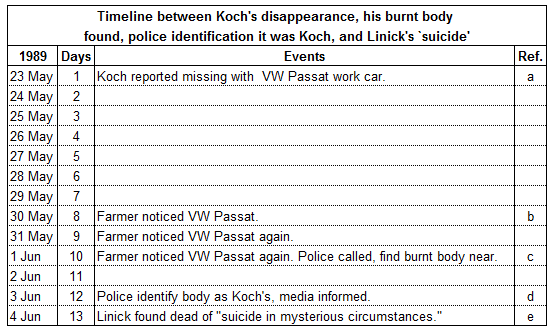
[Above (enlarge): Timeline between: a. Koch's disappearance on 23 May 1989[70]; b. a farmer first noticing on 30 May what turned out to be Koch's work vehicle parked in the adjoining forest[71]; c. police responding to the farmer's report found a burnt body near the vehicle[72]; d. police identification on 3 June of the body as that of Koch[73]; and e. Linick's `suicide' (see 22Feb16 & 07Mar16) a day later on 4 June[74].]

by pouring gasoline over himself and then setting it alight, he could not then have been able to control the fire that killed him to prevent it spreading outside the confined perimeter[75]. Koch would have been wearing shoes when he left his office in the car, but they weren't in the car or the surrounding area[76]. And no suicide note was found.[77].

Moreover, suicide made no sense, since Koch had confessed to the West German authorities his selling of hacked Western computer secrets to the KGB[78]. He was therefore in no danger of being prosecuted, being protected from punishment by the terms of the West German espionage amnesty legislation[79]. The authorities had actually provided Koch with accommodation and found him a job with the Christian Democratic Party[80]. He was also receiving help with his drug dependency and seemed on his way to rehabilitation[81] Koch was even planning to move into an apartment of his own and had embraced conventional religion[82]. So even on those grounds (apart from the impossibility of Koch extinguishing in dry forest undergrowth, with no fire extinguisher, hose or bucket, the gasoline fire which killed him), murder was much more likely than suicide[83] to put it mildly.

When the Nature paper announced on 16 February 1989 that the Shroud had in 1988 been radiocarbon dated by "laboratories at Arizona, Oxford and Zurich" as "mediaeval ... AD 1260-1390"[84], it was worldwide news[85]. Koch who was employed by the Christian Democratic Party, and had "embraced conventional religion" (see above) i.e. Christianity, would have heard about it, from the news media and/or from his Christian friends. If Koch knew that he had in 1987/88 hacked two computers in laboratories at Zurich and Oxford universities, even if he did not know what their function was, he would have `put two and two together' and realised that the "mediaeval" carbon date of the Shroud was partly the result of his hacking. In which case if Koch then told his Christian friends about it, and even phoned at least one leading pro-Shroud author (as we saw above), the KGB would likely have learned of it, and would explain why the KGB would have permanently silenced Koch, and then Linick on 4 June 1989, the day after Koch's burnt body was publicly identified on 3 June 1989!

• Koch is not essential to my theory. As I have previously stated, Karl Koch is not essential to my theory:

"... Koch's role is not essential to my theory. If it turned out that Koch could not possibly have personally travelled to Zurich and Oxford to access their radiocarbon laboratories computers, it would not falsify my theory. My theory includes Koch because of the striking coincidence that they were both allegedly hackers working for the KGB and both allegedly committed suicide within days of each other"[86]

"...Karl Koch is not essential to my theory, as Linick could have hacked Zurich and Oxford's AMS computer some other way, e.g. by issuing them with a program `update', or one of the KGB's own operatives could have entered those two laboratories clandestinely and installed Linick's program on their AMS control console computers"[87]

If it turned out that Koch could not possibly have been involved, either directly or indirectly, in installing Linick's program on Zurich and Oxford laboratories' AMS computers, then my theory would not be falsified. I would then maintain that Linick's program was installed on those laboratories' computers by some other way. For example, Linick himself could have flown over to Zurich and Oxford, installed his program clandestinely on their computers, and returned to Arizona, in a few days. This is why my theory always has been "that the radiocarbon dating laboratories were duped by a computer hacker" (singular).

Also, as I have also previously stated, it is not essential to my theory that Linick knew Koch, or even about Koch (and vice-versa):

"... I don't claim that the laboratories, or even Linick, knew about Koch"[88]

I had included Karl Koch in my theory despite there being no evidence of a link between Koch and Linick (there does not need to be), and before there was evidence of a link between Koch and the 1988 radiocarbon dating (as there now is - see above) because of: 1) the striking coincidence that both Koch and Linick died of suspected suicide within days of each other (and indeed Linick's `suicide' on 4 June 1989 was only one day after Koch charred body was identified and publicly announced as his by West German police on 3 June 1989 -see above); 2) Koch's death was almost certainly the work of the KGB, or the East German Secret Police (Stasi)[89] at the behest of the KGB; 3) yet the KGB had no reason to kill Koch unless he had been involved in an entirely different type of hacking for them which they did not want to become public knowledge; 4) Koch's expertise would have been useful in hacking into Zurich and Oxford's AMS computers (but Linick may have known how to do it); and 5) Koch's living in West Germany would have made it comparatively easy for him to travel to Zurich and Oxford to install Linick's program on their computers (although that too is not necessary to my theory as Koch may have only provided expert advice on how to hack into those computers and a KGB operative may have entered the laboratories clandestinely and installed Linick's program on their AMS computers, or Linick himself may have installed it).

So those who continue to dismiss my theory as merely a "conspiracy theory," ignoring all my evidence, and in the full knowledge of my above disclaimers that Koch is not essential to my theory and Linick could have acted alone, do so dishonestly and/or self-deludedly!

Continued in part #9 of this series.

Notes
1. This post is copyright. Permission is granted to quote from any part of this post (but not the whole post), provided it includes a reference citing my name, its subject heading, its date, and a hyperlink back to this post. [return]
2. Damon, P.E., et al., 1989, "Radiocarbon Dating of the Shroud of Turin," Nature, Vol. 337, 16th February, pp.611-615, p.611. [return]
3. Jull, A.J.T. & Suess, H.E., 1989, "Timothy W. Linick," Radiocarbon, Vol 31, No 2. [return]
4. "Karl Koch (hacker)," Wikipedia, 1 April 2016. [return]
5. Photo, "In memory of Karl Koch. Hagbard Celine. 22.7.1965. 23.05.1989." Translated by Google. http://www.hagbard-celine.de/. [return]
6. Clauss, U., 2012, "Ancestor of the Pirate Party was charred in the forest," Die Welt, 25 May 2012. Translated by Google. [return]
7. "Karl Koch (hacker)," Wikipedia, 1 April 2016. Footnotes omitted and links added. [return]
8. "Karl Koch (hacker)," Wikipedia, 1 April 2016. [return]
9. Hafner, K. & Markoff, J., 1991, "Cyberpunk: Outlaws and Hackers on the Computer Frontier," Corgi: London, reprinted, 1993, p.207. [return]
10. Clough. B. & Mungo, P., 1992, "Approaching Zero: Data Crime and the Computer," Faber & Faber: London & Boston, pp.164-165. [return]
11. Shea, R. & Wilson, R.A., 1975, "The Illuminatus! Trilogy," Dell: New York NY. [return]
12. Hafner & Markoff, 1991, p.206. [return]
13. Ibid. [return]
14. Hafner & Markoff, 1991, pp.206-207. [return]
15. Hafner & Markoff, 1991, p.216. [return]
16. Hafner & Markoff, 1991, p.214. [return]
17. Hafner & Markoff, 1991, p.215. [return]
18. Clough & Mungo, 1992, p.164. [return]
19. Hafner & Markoff, 1991, p.208. [return]
20. Hafner & Markoff, 1991, pp.209, 185. [return]
21. Hafner & Markoff, 1991, p.209. [return]
22. Hafner & Markoff, 1991, p.211. [return]
23. Hafner & Markoff, 1991, p.224. [return]
24. Hafner & Markoff, 1991, pp.225, 293. [return]
25. Hafner & Markoff, 1991, pp.230-231, 239-240, 245, 249, 250, 254, 260. [return]
26. Hafner & Markoff, 1991, p.266. [return]
27. Gove, H.E., 1996, "Relic, Icon or Hoax?: Carbon Dating the Turin Shroud," Institute of Physics Publishing: Bristol UK, pp.213-214. [return]
28. Gove, 1996, pp.260-261. [return]
29. King, T., ed., 1989a, "Computer Espionage: Three `Wily Hackers' Arrested," Phrack Magazine, Issue #25, March 3. [return]
30. Jones, S.E., 2014, "Were the radiocarbon dating laboratories duped by a computer hacker?: My replies to Dr. Timothy Jull and Prof. Christopher Ramsey," The Shroud of Turin blog, March 13. [return]
31. Clough & Mungo, 1992, p.173. [return]
32. Linick, T.W., et al., 1986, "Operation of the NSF-Arizona accelerator facility for radioisotope analysis and results from selected collaborative research projects," Radiocarbon, Vol. 28, No. 2a, pp.522-533, 524. [return]
33. Clough & Mungo, 1992, pp.170-172, 228n5. [return]
34. Clough & Mungo, 1992, p.172. [return]
35. Stoll, C., 1989, "The Cuckoo's Egg Tracking a Spy through the Maze of Computer Espionage," Pan: London, reprinted, 1991, p.362. [return]
36. King, T., ed., 1989b, "News From The KGB/Wily Hackers," Phrack Magazine, Issue #25, March 7. [return]
37. Stoll, 1989, pp.341-342. [return]
38. Yanalitis, M., 2014, "The Impact of Project RAHAB and the Chaos Computing Congresses (CCC) on the Future of Computer-Network Mediated Espionage: Cuckoo's Egg Prequel or Perfect Storm?," Carnegie Mellon University, January 9, pp.1-37, 15. [return]
39. Hafner & Markoff, 1991, pp.254, 266. [return]
40. Hafner & Markoff, 1991, p.283. [return]
41. Clough & Mungo, 1992, p.185. [return]
42. Stoll, 1989, p.363. [return]
43. Ibid. [return]
44. Clough & Mungo, 1992, p.184. [return]
45. Clough & Mungo, 1992, p.172. [return]
46. Clough & Mungo, 1992, p.184. [return]
47. Clough & Mungo, 1992, pp.183-184. [return]
48. Marino, J.G., 2016, Email "Re: info about a strange call Shroud researcher received circa 1989," 4 May 2016, 10:26 AM. [return]
49. Jones, S.E., 2016, Email "Re: info about a strange call Shroud researcher received circa 1989," 14 May 2016, 3:19 PM. [return]
50. "Karl Koch (hacker)," Wikipedia, 1 April 2016. [return]
51. Wilson, I., 1991, "Holy Faces, Secret Places: The Quest for Jesus' True Likeness," Doubleday: London, pp.8-9; Ruffin, C.B., 1999, "The Shroud of Turin: The Most Up-To-Date Analysis of All the Facts Regarding the Church's Controversial Relic," Our Sunday Visitor: Huntington IN, p.118; Wilson, I., 1998, "The Blood and the Shroud: New Evidence that the World's Most Sacred Relic is Real," Simon & Schuster: New York NY, pp.6-7; Zugibe, F.T., 2005, "The Crucifixion of Jesus: A Forensic Inquiry," M. Evans & Co.: New York NY, p.3; Tribbe, F.C., 2006, "Portrait of Jesus: The Illustrated Story of the Shroud of Turin," Paragon House Publishers: St. Paul MN, Second edition, pp.168-169; de Wesselow, T., 2012, "The Sign: The Shroud of Turin and the Secret of the Resurrection," Viking: London, p.166; Wilson, I., 2010, "The Shroud: The 2000-Year-Old Mystery Solved," Bantam Press: London, pp.84-85. [return]
52. Clough, & Mungo, 1992, p.163. [return]
53. Ibid. [return]
54. Hafner & Markoff, 1991, pp.302-303. [return]
55. Hafner & Markoff, 1991, p.303. [return]
56. Clough, & Mungo, 1992, p.163. [return]
57. Hafner & Markoff, 1991, p.303. [return]
58. Clough, & Mungo, 1992, p.163. [return]
59. Karl Koch (hacker)," Wikipedia, 1 April 2016. [return]
60. Clough, & Mungo, 1992, p.163. [return]
61. Hafner & Markoff, 1991, p.303. [return]
62. Ibid. [return]
63. "Cliff Stoll visiting Karl Koch's death forest," YouTube, January 13, 2008. [return]
64. Clough, & Mungo, 1992, p.163. [return]
65. Hafner & Markoff, 1991, p.303. [return]
66. Ibid. [return]
67. Clough, & Mungo, 1992, p.163. [return]
68. King, T., ed., 1989c, "One of Cliff Stoll's `Wily Hackers' Is Dead (Suicide?)," Phrack Magazine, June 5. This 5th June Phrack Magazine report states that Koch died on 3 June, evidently wrongly assuming at the time that Koch had died the same day that the police publicly identified his body. [return]
69. Ibid. [return]
70. Clough & Mungo, 1992, p.163; Hafner & Markoff, 1991, pp.302-303. [return]
71. Hafner & Markoff, 1991, p. 303. [return]
72. Clough & Mungo, 1992, p.163; Hafner & Markoff, 1991, p.303. [return]
73. Clough, & Mungo, 1992, p.163. [return]
74. Galeazzi, G., 2013. "Never solved: The enigma that still divides the Church: The Shroud," Vatican Insider, 1 April. Translated from Italian by Google (no longer online). English translation, "Unsolved Enigma that Still Divides the Church: The Shroud" (no longer online). [return]
75. Clough, & Mungo, 1992, p.163. [return]
76. Ibid. [return]
77. Stoll, 1989, p.362. [return]
78. Clough & Mungo, 1992, p.185. [return]
79. Clough & Mungo, 1992, p.186. [return]
80. Clough & Mungo, 1992, p.185. [return]
81. Ibid. [return]
82. Hafner & Markoff, 1991, p.302. [return]
83. Clough & Mungo, 1992, p.185. [return]
84. Damon, 1989, pp. 611-615. [return]
85. Wilson, 1991, p.9; Wilson, 1998, pp.7-8; Garza-Valdes, L.A., 1998, "The DNA of God?," Hodder & Stoughton: London, p.5; Ruffin, 1999, p.118; Tribbe, 2006, p.169; Whiting, B., 2006, "The Shroud Story," Harbour Publishing: Strathfield NSW, Australia, p.141. [return]
86. Jones, S.E., 2014, "My theory that the radiocarbon dating laboratories were duped by a computer hacker #1," The Shroud of Turin blog, 24 May. [return]
87. Jones, S.E., 2014, "My theory that the radiocarbon dating laboratories were duped by a computer hacker #5," The Shroud of Turin blog, June 13. [return]
88. Jones, S.E., 2014, "My theory that the radiocarbon dating laboratories were duped by a computer hacker #7," The Shroud of Turin blog, July 5. [return]
89. Clough & Mungo, 1992, p.185. [return]

Posted 2 June 2016. Updated 26 June 2026.

Wednesday, June 1, 2016

"Editorial and Contents," Shroud of Turin News, May 2016

Shroud of Turin News - May 2016
© Stephen E. Jones
[1]

[Previous: April 2016, part #4] [Next: May 2016, part #2]

This is the "Editorial and Contents," part #1 of the May 2016 issue of my Shroud of Turin News. Following this editorial, I will add excerpts from Shroud-related April/May 2016 news articles in separate posts, linked back to this post, with the articles' words in bold to distinguish them from mine. Click on a link below to go to that article. Articles not yet linked are planned to be commented on in this issue.

Contents:
Editorial
"New Study: The Shroud of Turin and the Sudarium of Oviedo Covered the Same Person"
"The Shroud of Turin, Authenticated Again"


Editorial. Rex Morgan's Shroud News: My scanning and word-processing of issues of Rex Morgan's Shroud News and emailing them to Barrie Schwortz for him to convert to PDF and add to his online Shroud News archive, continued in May up to issue #50, December 1988 [Right (enlarge)], which is a bumper issue of 68 pages, mostly about the radiocarbon dating of the Shroud as "mediaeval ... AD 1260-1390"[2]. Issues are up to issue #36, August 1986, in that archive, but Barrie had advised me there will be a Shroud.com update today, 1 June (Colorado time-which is 14 hours behind my Perth time) [which there was], and that will [and did] include issue #50 (less six pages which I will send him by 4 June).

Topic index: I had not found the time to add any more of my old posts to my Topic Index in May, so it is still up to and including my post of 28 March 2012.

Posts: In May, I blogged only 4 (time-consuming) posts: "Editorial and Contents": Shroud of Turin News - April 2016; "Has Science Proven the Shroud of Turin to Be a Medieval Forgery? (1)": Shroud of Turin News - April 2016; "Has Science Proven the Shroud of Turin to Be a Medieval Forgery? (2)": Shroud of Turin News - April 2016; and "The Shroud of Oviedo: A Legendary Cloth Connected to the Death of Jesus" (2): Shroud of Turin News - April 2016. As mentioned in "My review of `The Keramion, Lost and Found: A Journey to the Face of God' (2016) by Philip E. Dayvault" I am still working on a review of Dayvault's book to be posted on Amazon.com [Abandoned-see 10Jul16].

My radiocarbon dating hacker theory: In May Joe Marino emailed me the following (name replaced with "AN" by me):

"I've been in contact with AN about the C-14 issue and he has given me his okay to mention something we discussed to you, which is interesting in light of your 10 part series about a possible hacking. He's only told a few people and never wrote about it in any of his books because he can't prove anything. He said that not long after the C-14 dating--he thinks it was probably around April 1989, he received a call about 1:30 in the morning. The (male)person, who did not apologize for calling so late, sounded distraught. The person told AN he had been involved in falsifying the results of the 1988 dating. AN thought the accent might have been German and thought the person was in his 40s but wasn't sure because of the accent and emotional nature of the call. The person would not reveal his name (the person claimed it wasn't important) or where he was calling from. He kept asking AN if he would forgive him for having done a disservice to humanity. The person even mentioned the word `espionage' in relation to the event. The only detail he gave about the procedure was saying that the real Shroud sample was thrown in the trash. That last detail, of course, doesn't fit with a computer hacking, but other details do fit with your description of Koch. AN said the person said he also planned to call other Shroud researchers, but as far as we know, no one ever did receive a call. AN has wondered over the years whether the call itself could have been a fraud, but he is firm that the person sounded distraught to the point that AN said he wouldn't have been surprised if the guy would have said `I've got a gun and I'm going to shoot myself.' Even now, AN just isn't sure what to think. But I know you'll find this interesting one way or the other."
I regard this as highly significant, first because it shows that my hacker theory is starting to be taken seriously by leading Shroud pro- authenticists. Not only by Joe Marino, but also by AN, who (as indicated by "any of his books") is a well-known pro-authenticist author. For him to offer new evidence for my hacker theory is to me as good as it gets! Second, as I replied to Joe, "because of the unusual word `espionage,' I believe it was Koch":
"The caller being German does fit Karl Koch but him throwing the Shroud sample in the trash does not. There is no doubt that the Shroud sample was dated, because the dating was not blind and the Shroud has a distinctive weave. However, it could have been a metaphor for him having `trashed' the Shroud. The word `espionage' is very significant because that was what the hackers were charged with and were granted amnesty for under then West German law. That word has, as far as I know, never been used of the Shroud dating. I only found it in books about the West German hacker ring who were prosecuted in 1988 for selling computer secrets to the USSR. Koch became a Christian in late 1988 / early 1989, and could have obtained AN's name from his ... book `...'. It would have been more certainly Koch if he had mentioned hacking. But because of the unusual word `espionage,' I believe it was Koch."
I will comment on this further in part #8 of my "The 1260-1390 radiocarbon date of the Turin Shroud was the result of a computer hacking" which is next in that series and will be about Karl Koch. In fact I will make part #8 my very next post!

Other news: In May Joe Marino also emailed me a PDF (which `weighed' 12.5 Mb) of a 1989 sociology PhD thesis, titled, "The socio-politic of a relic: carbon dating the Turin Shroud," by a H. Laverdiere. She is Hélène Laverdière, now a Canadian MP [Left: Twitter]. In Joe's words,

"It's 291 pages long! ... It looks like a real gold mine. How in the world did this go unnoticed since 1989?"
I am only part way through it, but from what I have read, it probably is not going to be either pro- or anti-authenticity. However, I posted this quote from an interview she had with the then British Museum's Dr. Michael Tite, the coordinator of the dating, in a comment under one of my posts, where Tite admits that there was nothing in it for the Vatican to have the Shroud dated, because even if it did date 1st century, extreme anti-authenticists like him would still not accept that the Shroud was Jesus' burial sheet:
"`... there is no way I can see that the Vatican real interest to have it [the Shroud] authenticated at all really. Well I can't see the interest of the Vatican and Turin particularly to have it done. Well I mean you can't authenticate it. All you can do it's prove it is a fake... there is only one wrong date, it's the one which is 'not 0' because the other one doesn't prove anything... it could still be a 12th Century forgery using a 0 aged cloth.' (Tite, interview)" ("The Socio-Politic of a Relic: Carbon Dating the Turin Shroud," Submitted by H. Laverdiere for the degree of PhD of the University of Bath 1989, p.27)
The PDF can be downloaded from the University of Bath at the above link, but Joe said the site "was a bit difficult to navigate." As I didn't relish emailing a 12.5 Mb PDF to anyone who requested a copy, I emailed Ms Laverdiere over two weeks ago, asking could she put her thesis on her website for Shroudies to download? But apart from an email of acknowledgement from one of her assistants, Ms Laverdiere herself has not responded. Then, while writing this, I discovered that I could copy the PDF to my Dropbox public folder, and then post a link to it so that anyone can download it, which I have now done. To download the PDF, click on, "Laverdiere Socio-Politic of a Relic Carbon Dating the Turin Shroud." I tested it and the download worked for me. Joe Marino has emailed me since that it also worked for him.

Pageviews: At midnight on 31st May, Google Analytics [Below (enlarge)] gave this blog's "Pageviews all time history" as 536,240 and "Pageviews last month" as 11,339. It also gave the most viewed posts for the month as: "The Shroud of Turin: 2.6. The other marks (5): Coins over eyes," May 10, 2013 - 180; "Has Science Proven the Shroud of Turin to Be a Medieval Forgery? (1)," May 7, 2016 - 154; "The Shroud of Turin: 3.6. The man on the Shroud and Jesus were crucified," Dec 2, 2013 - 103; "Has Science Proven the Shroud of Turin to Be a Medieval Forgery? (2)," May 19, 2016 - 74 and "Re: Shroud blood ... types as AB ... aged blood always types as AB, so the significance of this ... is unclear," Mar 18, 2011 - 65.

Continued in part #2 of this May 2016 issue of my Shroud of Turin News.


Notes:
1. This post is copyright. Permission is granted to extract or quote from any part of it (but not the whole post), provided the extract or quote includes a reference citing my name, its subject heading, its date, and a hyperlink back to it. [return]
2. Damon, P.E., 1989, "Radiocarbon Dating of the Shroud of Turin," Nature, Vol. 337, 16th February, pp.611-615, 611. [return]

Posted 1 June 2016. Updated 23 May 2025.