Wednesday, August 8, 2007

Bogus: Shroud of Turin? #10: The Shroud's blood and pollen closely matches the Sudarium of Oviedo's

Bogus: Shroud of Turin, The Conservative Voice, April 08, 2007, Grant Swank ... But that "bearded face" on that particular cloth did not belong to Jesus of Nazareth.. ... Continued from part #9

[Above: Perfect fit of Sudarium of Oviedo (right) to the face on the Shroud of Turin (left), in Bennett, J., 2001, "Sacred Blood, Sacred Image: The Sudarium of Oviedo: New Evidence for the Authenticity of the Shroud of Turin," Ignatius Press: San Francisco CA, p.122]

on my CreationEvolutionDesign blog. That is, I will now continue that series (see previous parts #1, #2, #3, #4, #5, #6, #7, #8 & #9) with this part #10 here on my The Shroud of Turin blog.

As historian Ian Wilson summarised: 1) the Sudarium of Oviedo has a documented Spanish history from at least the "ninth century" and "can with reasonable plausibility be traced back to early first- millennium Jerusalem"; 2) the Sudarium's "blood and body fluid ... stains" are "very compatible with gospel writer John's observation that at the conclusion of Jesus' crucifixion `immediately there came out blood and water' (John 19:34)"; 3) if "the Oviedo cloth's back-of-the-head group of bloodstains" are "photographed to the same scale as their equivalent on the Shroud, and then matched up to each other, there are again enough similarities to indicate … that these two cloths were in contact with the same wounded body"; 4) "Exactly as in the case of the Shroud, whoever bled onto the Oviedo cloth was of the same comparatively rare AB blood group"; and 5) on "the Oviedo cloth" were "found ... pollens representative of Israel, North Africa and Spain, exactly in accord with the cloth's known history" and "among those Israel pollens was" at least one species found on the Shroud, "Gundelia tournefortii" (my emphasis):

"But while the debate over the Shroud's DNA therefore necessarily remains far from resolved, a major new development, also with its own bearing on the Shroud `blood', concerns a relic with its own authenticity controversies, the so-called sudarium of Oviedo. Although this bears bloodstains, like those on the Shroud, with every semblance of authenticity, because these are not accompanied by any similarly meaningful body image I have long shied from taking any interest in them - until a recent development. This was the emergence of a new, serious researcher on the subject, Mark Guscin, a British-born classicist resident in Spain, with an excellent book The Oviedo Cloth … published in 1998. In this he shows that historically the Oviedo cloth's origins can with reasonable plausibility be traced back to early first- millennium Jerusalem, having been moved from there to Spain in the seventh century apparently to keep it safe from the Persian invasions of that period. By early in the ninth century, due to Arab incursions into southern Spain, it had quite definitely moved north to Oviedo, since the cathedral's still extant camara santa or holy room was specially built for it at that time. And in 1075 it was similarly reliably recorded as being taken out of its still extant arca or chest in the presence of King Alfonso VI. Its certain history, therefore, significantly antedates that of the Shroud. It is also free of the early accusations of forgery that so dog the Shroud. But exactly like the Shroud, far more revelatory than the Oviedo cloth's history is its self-documentation. Although it bears no photograph-like `body' image in the manner of the Shroud, Mark Guscin and his Spanish colleagues have very convincingly demonstrated that its `blood and body fluid' stains exhibit shapes so strikingly similar to those on the Shroud that there has to be the strongest likelihood that both were in contact with the same corpse. Two groups of stains particularly indicate this. The first are what I would call the nasal stains, which appear to derive from a nose and mouth soaked in bloody fluids. These are repeated mirror-image-style, apparently because of the cloth having been partly doubled on itself. Forensic analysis indicates that they consist of one part blood and six parts pulmonary oedema fluid. This finding is therefore strikingly consistent with the strong body of medical opinion that the man of the Shroud's lungs would have filled with fluid caused by the scourging. They are also very compatible with gospel writer John's observation that at the conclusion of Jesus' crucifixion `immediately there came out blood and water' (John 19:34), as from the same oedematous fluid, when a lance was plunged into Jesus' chest. In the case of the Oviedo cloth's back-of-the-head group of bloodstains, if these are photographed to the same scale as their equivalent on the Shroud, and then matched up to each other, there are again enough similarities to indicate … that these two cloths were in contact with the same wounded body ... Exactly as in the case of the Shroud, whoever bled onto the Oviedo cloth was of the same comparatively rare AB blood group. ... Dr Frei took sticky-tape samples from the Oviedo cloth, just as he had from the Shroud. What he found was pollens representative of Israel, North Africa and Spain, exactly in accord with the cloth's known history. And among those Israel pollens was, yet again, Gundelia tournefortii." (Wilson, I. & Schwortz, B., "The Turin Shroud: The Illustrated Evidence," Michael O'Mara Books: London, 2000, pp.77-78,92).
Here are further quotes to support these five points. But first, to

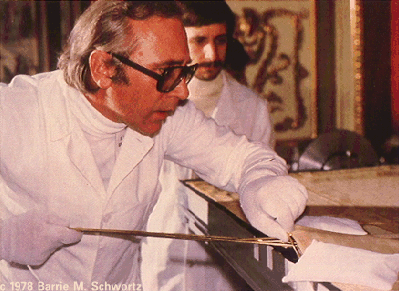
[Left: Mark Guscin shows how a sudarium covered the head of a crucified Jewish victim, The Shroud Report]

understand how the Sudarium of Oviedo complements the Shroud, watch Mark Guscin's demonstration of how it was used on the body of Jesus in the Shroud of Turin Education Project's Streaming Videos.

1) The Sudarium of Oviedo has a documented Spanish history from at least the "ninth century" and "can with reasonable plausibility be
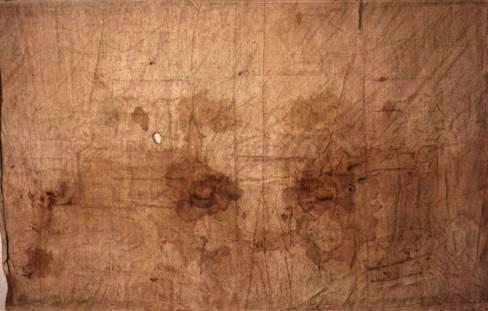
[Above: The Sudarium of Oviedo, Mark Guscin]

traced back to early first- millennium Jerusalem" (my emphasis):

"What exactly is the Sudarium of Oviedo? First of all, it can be said that it is an ancient linen cloth that has been in Spain since the seventh century and venerated in Oviedo for more than 1,200 years. It was originally a white linen cloth with a taffeta texture, now stained, dirty, and wrinkled. It is rectangular, somewhat irregular, and measures approximately 34 by 21 inches [855 x 526 mm]. The principal bloodstains clearly form a mirror image along the axis formed by a fold that is still present. They are fundamentally light brown in color, in varying degrees of intensity. Although the linen has been traditionally called the `Holy Sudarium' or `Holy Face,' there is no visible image of a face on the relic, only blood that is believed to be that of Jesus of Nazareth. The cloth has always been known as the Sudarium Domini, or the Sudarium of the Lord ..." (Bennett, J., "Sacred Blood, Sacred Image: The Sudarium of Oviedo: New Evidence for the Authenticity of the Shroud of Turin," Ignatius Press: San Francisco CA, 2001, p.13).
The Sudarium was "Located in Jerusalem until 614" when "it was moved to North Africa and then Spain to protect it from the advancing Moslems" (my emphasis):
"Since the eighth century, there is, in the Cathedral in Oviedo, Spain, the Sagrado Rostro or Holy Face, a face-cloth (83 x 53 cm.) also known as the Cloth of Oviedo (Sudarium Christi d'Oviedo). Located in Jerusalem until 614, it was moved to North Africa and then Spain to protect it from the advancing Moslems. The first historical information we have about it after the year 614 goes back to 1075 when Alphonsus VI of Leon recognized it as one of the relics in the Arca Santa or Holy Ark, a wooden reliquary which had housed the sudarium in Carthage, North Africa, and Monsagro and Toledo, Spain. Franca Pastore Trossello, a forensic scientist from the University of Turin, conducted a comparative study of the fabrics of the Shroud and the Cloth of Oviedo and found them to be of the same weave and texture. Dr. Alan Whanger studied the cloth and is convinced that it touched the face of Jesus. Dr. Max Frei matched at least four pollen on the Cloth of Oviedo with four pollen from the Shroud. Whanger found at least seventy matches between a polarized image overlay of the blood stains of the Shroud and those found on the Cloth of Oviedo. Further computerized comparative studies by Nello Balossino of the University of Turin, indicated that the traces of blood present on the two pieces of cloth matched perfectly." (Iannone, J.C., "The Mystery of the Shroud of Turin: New Scientific Evidence," St Pauls: Staten Island NY, 1998, p.91).
And from then "The sudarium has been in Oviedo ever since":
"The key date in the history of the sudarium is 14 March 1075. On this date the ark or chest where the sudarium was kept was officially opened in the presence of King Alfonso VI, his sister Doha Urraca, Rodrigo Diaz de Vivar (el Cid Campeador) and a number of bishops. This official act was recorded in a document which is now kept in the Capitular Archives of the cathedral in Oviedo, Series B.2.9. This is not the original document from the year 1075, but rather it is a copy, which was made in the thirteenth century. The copy is so exact that even the signatures are imitated - the vertical signature of Urraca is clearly legible. ... The document states that even in the year 1075, the chest had been in the church for a long time ... The sudarium has been in Oviedo ever since, kept in a wooden ark. Alfonso VI had this ark covered with silver plating, on which the twelve apostles, the four evangelists and Christ are portrayed. There are inscriptions in Arabic and Latin, both of Christian origin. After the reconquest of the kingdom of Toledo, Christian- inscriptions were often written in Arabic. The Latin inscription invites all Catholics to venerate this relic that contains the holy blood. The silver plating dates from the year 1113, and gives a list of the contents of the ark. One of these items is clearly registered as `el Santo Sudario de N.S.J.C.' These letters stand for `Nuestro Senor Jesucristo', and the inscription means, `The Sacred Sudarium of Our Lord Jesus Christ'." (Guscin, 1998, pp.17-18)
2) The Sudarium's "blood and body fluid ... stains" are "very compatible with gospel writer John's observation that at the conclusion of Jesus' crucifixion `immediately there came out blood and water' (John 19:34)" (my emphasis):
"The image of the back of the man on the Shroud is covered with wounds from the scourging he received before being crucified. The wounds on the man's back are obviously not reproduced on the sudarium, as this had no contact with it. However, there are thick bloodstains on the nape of the man's neck, showing the depth and extent of the wounds produced by the crown of thorns. This crown was probably not a circle, as traditional Christian art represents, but a kind of cap covering the whole head. ... The stains on the back of the man's neck on the Shroud correspond exactly to those on the sudarium." (Guscin, M., "The Oviedo Cloth," Lutterworth Press: Cambridge UK, 1998, pp.30,32).
3) If "the Oviedo cloth's back-of-the-head group of bloodstains" are "photographed to the same scale as their equivalent on the Shroud, and then matched up to each other, there are again enough similarities to indicate … that these two cloths were in contact with the same wounded body" (my emphasis):
"The most striking thing about all the stains is that they coincide exactly with the face of the image on the Turin Shroud. The first fact that confirms the relationship between the two cloths is that the blood on each belongs to the same group, AB. If the blood or each cloth belonged to a different group, there would be no sense in pursuing the comparative investigation, and little meaning in any further points of coincidence. This test is the starting point for all the others, and the results are positive. Blood of the group AB is also very common in the Middle East and rare in Europe. According to Monsignor Ricci's method of numbering the stains on the sudarium, the main group, corresponding to the liquid which came out of the nostrils, receives the number 13. The length of the nose which produced this stain has been calculated at eight centimetres, just over three inches, which is exactly the same as the length of the nose on the Shroud. In a case like this, it is very easy for sceptics to say that the investigators have just come up with the measurement they needed, but this is not a scientific or rational argument. The only to be expected, if, as seems obvious, both cloths covered the same face. Nobody would be surprised, for example, if we had two gloves that belonged to Napoleon, and the size of the hand that used each one was calculated to be the same. This would be the obvious measurement." (Guscin, 1998, pp.27-28).
In particular, "the most obvious fit when the stains on the sudarium are placed over the image of the face on the Shroud, is that of the beard; the match is perfect" (my emphasis):.
"Perhaps the most obvious fit when the stains on the sudarium are placed over the image of the face on the Shroud, is that of the beard; the match is perfect. This shows that the sudarium, possibly by being gently pressed onto the face, was also used to clean the blood and other fluids that had collected in the beard. Stain number 6 is also evident on all four faces of the sudarium. If stain 13 is placed over the nose of the image on the Shroud, stain 6 is seen to proceed from the right hand side of the man's mouth. This stain is hardly visible on the shroud, but its existence has been confirmed by Dr John Jackson, who is well known for his studies on the Shroud using the VP-8 image analyser. Using the VP-8 and photo-enhancements, Dr Jackson has shown that the same stain is present on the Shroud, and the shape of the stain coincides perfectly with the one on the sudarium. The gap between the blood coming out of the right hand side of the mouth and the stain on the beard is mapped as number 18. This gap closes as the stains get progressively more extensive on faces 1, 2, 3 and 4 while at the same time they are less intense. Stain number 12 corresponds to the eyebrows of the face on the Shroud. As with the beard, this facial hair would have retained blood and this would have produced the stains on the sudarium when it was placed on Jesus' face. There is also blood on the forehead, which forms stain number 10 on the sudarium." (Guscin, 1998, p.28).
In addition to "a notable similarity between both linens in the back part of the head, which match essentially in size, position, and genesis, which means that both contain vital blood" there is another place where "the blood stains on the back of both linens correspond" perfectly and that is "found on the two right and left lower corners on the Oviedo cloth" (it was folded twice):
"Bloodstains. The bloodstains have geometrically compatible sizes and have very similar positions on both linens. The stains are of human blood of the group AB. ... The stains produced from vital blood, those produced by the puncture wounds at the back of the neck, are the same on both linens. Remember that the linen of Oviedo was fastened to the head in the back with sharply pointed objects, perhaps thorns. The cloth fell on the left shoulder and upper part of the back of the person, and wrapped the left part of the face. This entire area that was touched by the cloth was completely bloody before blood flowed from the nose and mouth after death had occurred. There is a notable similarity between both linens in the back part of the head, which match essentially in size, position, and genesis, which means that both contain vital blood, or blood which flowed before the death of the victim. In addition, the blood stains on the back of both linens correspond, found on the two right and left lower corners on the Oviedo cloth." (Bennett, , 2001, p.85. Emphasis original)
In fact "Dr Alan Whanger" using a "Polarised Image Overlay Technique" (PIOT) which "allows comparison of various objects and images with the Shroud images or stains ... image by image, stain by stain" (my emphasis):
"The PIOT methodology (Whanger & Whanger, 1985, 1998) allows comparison of various objects and images with the Shroud images or stains. This affords for confirmation, image by image, stain by stain, painstakingly, of the historical authenticity of the Shroud. Representative observations include: … Sudarium (face cloth) of Oviedo, dated to the 1st century in Jerusalem, kept in El Salvador Cathedral of Oviedo, Spain, since the mid-8th century (Guscin, 1998), 120 points of congruent bloodstains between the Sudarium and the Shroud." (Whanger & Whanger, 1998)." (Danin, A., Whanger, A.D., Baruch, U. & Whanger, M., "Flora of the Shroud of Turin," Missouri Botanical Garden Press: St. Louis MO, 1999, pp.6-7)
found that "The frontal stains on the sudarium show seventy points of coincidence with the Shroud, and the rear side shows fifty" (my emphasis) :
"Dr Alan Whanger has studied the points of coincidence and relationship between the Shroud and hundreds of Byzantine paintings and representations of Christ, even using coins, from the sixth and seventh centuries. This was done using a system called Polarised Image Overlay Technique. His conclusion was that many of these icons and paintings were inspired by the image on the Shroud, which means that the Shroud must have been in existence in the sixth and seventh centuries. This coincides with Ian Wilson's theory that the Shroud was `rediscovered' in Edessa just before this. Dr Whanger applied the same image overlay technique to the sudarium, comparing it to the image and blood stains on the Shroud. Even he was surprised at the results. The frontal stains on the sudarium show seventy points of coincidence with the Shroud, and the rear side shows fifty. The only possible conclusion, according to this highly respected scientist, is that the sudarium covered the same face as the Turin Shroud. If this is so, and taking into account that it is impossible to deny that the sudarium has been in Oviedo since 1075, it casts a great shadow of doubt over the results of the Shroud's carbon dating." (Guscin, 1998, p.32).
4) "Exactly as in the case of the Shroud, whoever bled onto the Oviedo cloth was of the same comparatively rare AB blood group." While:
"Caution is needed .... since some researchers have noted a tendency among blood samples more than several centuries old always to test AB." (Wilson & Schwortz, 2000, p.76)
the point is that "If the blood or each cloth belonged to a different group, there would be ... little meaning in any further points of coincidence":
"The first fact that confirms the relationship between the two cloths is that the blood on each belongs to the same group, AB. If the blood or each cloth belonged to a different group, there would be no sense in pursuing the comparative investigation, and little meaning in any further points of coincidence. This test is the starting point for all the others, and the results are positive. Blood of the group AB is also very common in the Middle East and rare in Europe." (Guscin, 1998, p.27) .
5) On "the Oviedo cloth" were "found ... pollens representative of Israel, North Africa and Spain, exactly in accord with the cloth's known history" and "among those Israel pollens was" at least one species found on the Shroud, "Gundelia tournefortii" (my emphasis):
"The Pollen We have seen that historical testimony fits in with what we know about the sudarium, and there is no reason to doubt the historicity of the few references that exist. Its stay in Jerusalem and its route through the north of Africa can be further confirmed by studying pollen found on the cloth. As is well known, this method of study has also been used on the Turin Shroud, and the pollen found coincides with the historical route of this cloth through Edessa, Constantinople, France and Italy. ... From the pollen found, it is undeniable that the Shroud was in Palestine, Edessa and Constantinople. Most people who have read any book about the Shroud will be familiar with the name Dr Max Frei, the Swiss criminologist responsible for the pollen studies related to the Shroud. Before Dr Frei died, he also analysed pollen samples from the sudarium in Oviedo. The results perfectly match the route already described. He found pollen from Oviedo, Toledo, north Africa and Jerusalem. There was nothing relating the sudarium to Constantinople, France, Italy or any other country in Europe." (Guscin, 1998, p.22. Emphasis original).
Guscin concludes, "There are two irreconcilable conclusions, one of which must be wrong", i.e. Either the sudarium has nothing to do with the Shroud, or the carbon dating was wrong - there is no middle way, no compromise." But then "If the sudarium did not cover the same face as the Shroud, there are an enormous number of coincidences, too many for one small piece of cloth" and so "the carbon dating must be mistaken" (my emphasis):
"Carbon 14, Again We are faced with a choice. There are two irreconcilable conclusions, one of which must be wrong. All the studies on the sudarium point to its having covered the same face as the Shroud did, and we know that the sudarium was in Oviedo in 1075. On the other hand, the carbon dating specialists have said that the Shroud dates from 1260 to 1390. Either the sudarium has nothing to do with the Shroud, or the carbon dating was wrong - there is no middle way, no compromise. If the sudarium did not cover the same face as the Shroud, there are an enormous number of coincidences, too many for one small piece of cloth. If there was only one connection, maybe it could be just a coincidence, but there are too many. The only logical conclusion from all the evidence is that both the Oviedo sudarium and the Turin Shroud covered the same face. As we have already seen from the Cagliari congress, there are also many inherent reasons why the Shroud cannot be fourteenth century, reasons that nobody has been able to disprove, and only one that suggests a medieval origin-carbon dating. Those who believe in the carbon dating have never been able to offer any serious proof or evidence to explain why every other scientific method practised on the Shroud has given a first century origin as a result, most have not even tried. It can hardly be considered rational or scientific to blindly accept what conveniently fits in with one's own personal ideas without even taking into consideration what others say. And after all, carbon dating is just one experimental method compared with dozens of others, and it stands alone in its medieval theory. If both the sudarium and the Shroud date from the first century, then the carbon dating must be mistaken, and it is the duty of those who believe in the dual authenticity of the cloths to show why carbon dating has shown the Shroud to be first century. Those who have attempted this can be broadly divided into two bands, those who think that the particular process of the Shroud's carbon dating was a fake, a deliberate deception by the scientists involved, and those who believe that the whole process of carbon dating is not as reliable as it is made out to be, and is far from infallible." (Guscin, 1998, pp.64-65) .
Likewise, Danin, et al., conclude, "This pollen association, congruence of blood patterning, and probable identical blood type suggests the radiocarbon dating of the Shroud to only the Middle Ages... as untenable" (my emphasis):
"The finding of Gundelia tournefortii pollen on the Shroud with its Near Eastern predictive value is a striking observation. That G. tournefortii pollen also occurs on the Sudarium of Oviedo adds to the strong link between these two traditional burial cloths. Independent indication for this linkage has already been established by the presence of about 120 congruent blood stains on the two cloths (Whanger & Whanger, 1998). The blood on the Shroud of Turin is of the group AB (Bollone et al., 1983a, 1983b). Guscin (1998: 56) reported `Dr. Baima Bollone spoke about the blood on the Sudarium (of Oviedo), confirming that it is human blood of the group AB, the same group as the blood on the Shroud.' However, Adler (1999) suggested that ancient blood stains may be hard to interpret. This pollen association, congruence of blood patterning, and probable identical blood type suggests the radiocarbon dating of the Shroud to only the Middle Ages (Damon et al., 1989) as untenable." (Danin, A., et al., 1999, pp.23-24).
As Prof. Danin, one of Israel's leading botanists and author of Flora of Online put it at the 1999 XVI International Botanical Congress, "There is no way that similar patterns of blood stains, probably of the identical blood type, with the same type of pollen grains, could not be synchronic covering the same body" and these "similarities ... in the two cloths provide clear evidence that the Shroud originated before the 8th Century" (my emphasis):
"The location of the Sudarium has been documented from the 1st Century and it has resided in the Cathedral of Oviedo in Spain since the 8th Century. Both cloths also carry type AB blood stains, although some argue that ancient blood types are hard to interpret. What is clear is that the blood stains on both cloths are in a similar pattern. `There is no way that similar patterns of blood stains, probably of the identical blood type, with the same type of pollen grains, could not be synchronic covering the same body,' Danin stated. `The pollen association and the similarities in the blood stains in the two cloths provide clear evidence that the Shroud originated before the 8th Century.' Danin stated that this botanical research disputes the validity of the claim that the Shroud was from Europe during the Middle Ages, as many researchers had concluded in 1988 based on carbon-14 dating tests. The authors do not question the accuracy of the carbon-14 dating test which was done on only a single sample taken from one highly contaminated corner of the shroud, he said. However, their research looked at pollen grains and images from the entire piece of fabric and compared them with a fabric that has a documented history." (XVI International Botanical Congress, "Botanical Evidence Indicates `Shroud Of Turin' Originated In Jerusalem Area Before 8th Century, " Science Daily, August 3, 1999)
Not only is "the radiocarbon dating of the Shroud to only the Middle Ages... untenable" in the light of this perfect match between the Sudarium and the Shroud, but so are all forms of the fraud [forgery] theory. That is because, since "the wounds, facial characteristics, manner of death, pollen, and other evidence on both relics ... match exactly" and "the Sudarium of Oviedo has been in Spain since the seventh century" therefore "the so-called fraud [forgery] would have had to have occurred twice" but this "would be impossible, since the Sudarium of Oviedo was not removed from its chest in the thirteenth century, not even for kings" (my emphasis):
"There is one more consideration. That is that the Shroud of Turin was supposedly `dated' to the thirteenth century, while the Sudarium of Oviedo has been in Spain since the seventh century. This means, of course, that the so-called fraud would have had to have occurred twice, and that the wounds, facial characteristics, manner of death, pollen, and other evidence on both relics would have to match exactly. This, quite frankly, would be impossible, since the Sudarium of Oviedo was not removed from its chest in the thirteenth century, not even for kings, not to mention the fact that its use was unknown at that time. Blood typing, forensic medicine, pollen identification, the electronic scan microscope, photography, and all of the other scientific means at our disposal today did not exist. Microscopic information cannot be falsified, and it is for that reason that criminals are convicted today on the basis of DNA, fibers, and other evidence, because it is indisputable." (Bennett, 2001, p.89).
See the `tagline' quote below by Guscin, which draws out the implications of Bennett's point above that, "the so-called fraud would have had to have occurred twice," but concludes that "Such a story ... is more incredible than the Shroud's authenticity" (my emphasis)!

I originally intended to continued this series in a part #11: "Coin images minted by Pontius Pilate between AD 29 and 32 cover the eyes of the man on Shroud." But I later covered that topic in "Re: There is compelling evidence it is the burial cloth of Christ, or a man crucified during that time #3 ." So this is the end of my "Bogus: Shroud of Turin" series

Posted 8 August 2007. Updated 14 January 2026.


"However, let us suppose for a while that the results obtained from the carbon dating of both the sudarium and the Shroud are accurate, and neither cloth ever touched the body of Jesus. In that case, the following story would have to be true. Sometime in the seventh century, in Palestine, after reading the gospel of John, a well known forger of religious relics saw the opportunity of putting a new product on the market - a cloth that had been over the face of the dead body of Jesus. This forger was also an expert in medicine, who knew that a crucified person died from asphyxiation, and that when this happened, special liquids fill the lungs of the dead body, and can come out through the nose if the body is moved. The only way he could get this effect on the cloth was by re-enacting the process, so this is exactly what he did. He crucified a volunteer, eliminating those candidates who did not fulfil the right conditions - swollen nose and cheeks, forked beard to stain the cloth, etc. When the body was taken down from the cross, he shook it around a bit with the help of a few friends, holding the folded cloth to the dead volunteer's nose so that future generations would be able to see the outline of his fingers. He even stuck a few thorns in the back of the dead man's neck, knowing that relic hunters would be looking for the bloodstains from the crown of thorns. Being an eloquent man, he convinced people that this otherwise worthless piece of cloth was stained with nothing less than the blood and pleural liquid of Christ, and so it was guarded in Jerusalem with other relics, and considered so genuine and spiritually valuable that it was worth saving first from the invading Persians and later from the Arabs. A few hundred years later, some time between 1260 and 1390, another professional forger, a specialist in religious relics too, decided that the time was ripe for something new, something really convincing. There were numerous relics from various saints in circulation all round Europe, bones, skulls, capes, but no, he wanted something really original. Various possibilities ran through his mind, the crown of thorns, the nails from the crucifixion, the table cloth from the last supper, and then suddenly he had it - the funeral shroud of Jesus! And not only that, but he would also put an image on the Shroud, the image of the man whom the Shroud had wrapped! The first step was difficult. Being an expert in textile weaves, (one of his many specialities, the others being pollen, Middle East blood groups, numismatism of the years of Tiberius, photography, Roman whips, and electronic microscopes) he needed linen of a special kind, typical of the Middle East in the first century. Once this had been specially ordered and made, he folded it up before starting his work, as a neighbour had suggested that such a cloth would have been folded up and hidden in a wall in Edessa for a few hundred years, so the image would be discontinuous on some of the fold marks. Leaving the cloth folded up, he travelled to Oviedo in the north of Spain, where he knew that a forerunner in his trade had left a cloth with Jesus' blood stains. On obtaining permission to analyse the sudarium, he first checked the blood group - AB of course, common in the Middle East and relatively scarce in Europe - then made an exact plan of the blood stains (carefully omitting those which would have already clotted when the sudarium was used) so that his stains would coincide exactly. After his trip to Oviedo, he went on a tour of what is now Turkey, forming a composite portrait of Jesus from all the icons, coins and images he could find. After all, he needed people to think that his Shroud had been around for over a thousand years, and that artists had used it as their inspiration for painting Christ. He didn't really understand what some of the marks were, the square box between the eyes, the line across the throat, but he thought he'd better put them on anyway. He didn't want to be accused of negligence, because he was an internationally famous forger and had a reputation to maintain. Once he was back home, he somehow obtained some blood (AB, naturally) and decided to begin his work of art with the blood stains, before even making the body image. Unfortunately, he miscalculated the proportions, and the nail stains appeared on the wrist instead of on the palms of the hands, where everyone in the fourteenth century knew that they had been. `Well', he thought, `it's just a question of a few inches, nobody will notice.' Now, even the omniscient author is forbidden to enter in the secret room where the forger `paints' the image of Christ, a perfect three dimensional negative, without paint or direction. His method was so secret that it went to the tomb with him. After a few hours, he opened the door, and called his wife, who was busy preparing dinner in the kitchen. `What do you think?' `Not bad. But you've forgotten the thumbs' `No, I haven't. Don't you know that if a nail destroys the nerves in the wrist, the thumbs bend in towards the palm of the hand, so you wouldn't be able to see them?' `But didn't the nails go through the palms?' `Well, yes, but I put the blood on first, and didn't quite get the distance right' `Oh, in that case ... and what about the pollen?' `What pollen?' `Well, if this Shroud has been in Palestine, Edessa, and let's suppose it's been in Constantinople too, it's going to need pollen from all those places.' Our forger loved the idea, got the pollen from all the places his wife had indicated, and delicately put it all over his Shroud. And then, the final touch. Two coins from the time of Christ, minted under the emperor Tiberius, to put over the man's eyes. Our man had a sense of humour too - he decided that the coins would be included in the image in such a way that they would only be visible under an electronic microscope. Such a story, even without the embellishments, is more incredible than the Shroud's authenticity." (Guscin, M., "The Oviedo Cloth," Lutterworth Press: Cambridge UK, 1998, pp.84-88)

Monday, August 6, 2007

The Shroud of Turin: Burial Sheet of Jesus?: Contents

I have decided to largely (but not completely) confine my

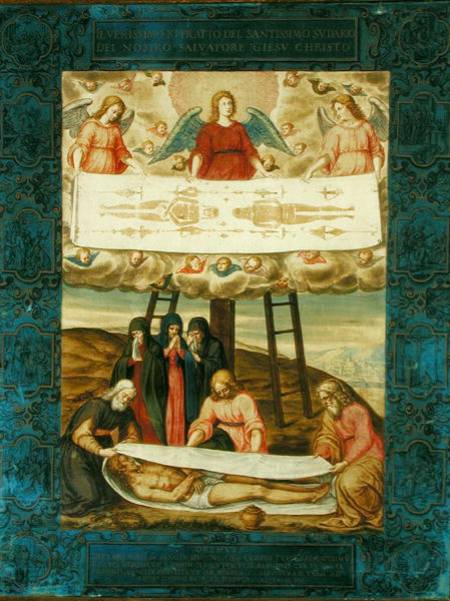
[Above: "The Holy Shroud," by Giovanni Battista della Rovere (1561-1630), Galleria Sabauda, Turin]

blogging here to writing an outline of a book, "The Shroud of Turin: Burial Sheet of Jesus?", as per the following chapter headings.


THE SHROUD OF TURIN: BURIAL SHEET OF JESUS?
© Stephen E. Jones

1. INTRODUCTION
2. HISTORY OF THE SHROUD
3. THE BIBLE AND THE SHROUD
4. FOR THE SHROUD BEING JESUS' BURIAL SHEET
5. AGAINST THE SHROUD BEING JESUS' BURIAL SHEET
6. IMAGE FORMATION THEORIES
7. CONCLUSION
BIBLIOGRAPHY

This will be, as the name suggests, a systematic analysis of the evidence for, and against, the Shroud of Turin being the very burial sheet of Jesus.

This is similar to what I am doing on my CreationEvolutionDesign blog, where most of my posts will be writing notes for a future book, "Problems of Evolution."

As there, this Contents page will contain the hyperlinks to each chapter, and each chapter in turn will contain the hyperlinks to each section in it. Each section will have its own page. The numbering of sections and even of chapters may change as the book outline grows. I will try to post at least one new section a week, not necessarily in chapter or section order. Because of the limitations of Blogger's format (and my time!), each section will have to be brief. If I make changes to an existing section, I won't post it again, although I may indicate it on a current post. While I will still continue to post here on other Shroud-related issues, including continuing here my "Bogus: Shroud of Turin?" series begun on my other blog), writing this book outline will be my main focus on this blog.

Comments are welcome but as per my stated policy, I no longer have the time or inclination for extended debate, so I will generally respond only once to each comment that appears.

Since I intend to use this material eventually as the basis of a published book , I hereby assert copyright over this page and all "The Shroud of Turin: Burial Sheet of Jesus?" pages linked under it.

PS: Note that the lead author of the paper in scientific journal, admitting that "The Turin Shroud ... bears" a "remarkable image" which "depicts all the stigmata of the crucifixion of Jesus Christ as described in the Bible" (my emphasis), was Harry E. Gove, Emeritus Professor of Physics at the University of Rochester NY, who was the leading figure in the radiocarbon dating of the Shroud to the 14th century!

Posted: 6 August 2007. Updated. 20 September 2017


"The Turin Shroud is a linen cloth the color of old ivory measuring 4.4 by 1.1 m. It bears the faint front and back, head to head, imprint of a naked man. This remarkable image depicts all the stigmata of the crucifixion of Jesus Christ as described in the Bible. As a result, it is thought by many to be the actual burial cloth of Jesus. The shroud's known history dates back to about the year 1357 when it was displayed in a church in Lirey, France. The shroud, or some version of it, eventually passed into the hands of the House of Savoy. The shroud was stored in a silver chest in a chapel in Chambery, France and in 1532 a fire raged through the chapel. Part of the chest melted and gouts of molten silver burned through the shroud, fortunately outside the image, in a symmetric fashion due to the way it was folded in the chest. The shroud was doused with water before further damage could occur and the burn holes were later patched. In 1578 the seat of the House of Savoy was moved to Turin, Italy and the shroud moved with it. In 1983 the last king of Italy, Umberto II, a member of the House of Savoy, willed the shroud to the Vatican. It is presently stored in a silver reliquary in a glass case behind the main altar of the Cathedral of John the Baptist in Turin, under the custody of the Archbishop of Turin." (Gove, H.E., Mattingly, S.J., David, A.R. & L.A. Garza-Valdes, "A problematic source of organic contamination of linen," Nuclear Instruments and Methods in Physics Research -Section B, 1997, pp.504-507, p.504. My emphasis)

Friday, August 3, 2007

Off-topic: Norton Antivirus froze my computer so I switched to AVG Free

Yesterday my desktop computer running Windows XP Home kept

[Above (enlarge): Screen shot of AVG Free Test Centre, Informer.com]

`freezing,' forcing me `hard-boot' it, i.e. to turn it off at the switch and then turn it on again. I could use the computer, but if I left it for a short time, when I came back I found it was `frozen'. It was as though the computer would not `wake up' from sleep mode, with the screen turned off, and not responding to the mouse or keyboard.

After a couple of hard-boots, with the same problem recurring, I decided to go into Control Panel: Power Options and set System standby and Turn off monitor to Never. But even then, when I came back after a short time from using it, I found the computer again frozen, unresponsive to the mouse or keyboard, but this time with the screen turned on and applications running.

I rang the company that I bought the computer from a couple of years ago and described the problem to a technical support person. He said right away that the cause of the problem was probably either: 1) Norton Antivirus, 2) a faulty power supply; or 3) a faulty motherboard, in that order. Then I remembered that Norton Antivirus had that morning updated itself and that the first time my computer froze was while it was running a Norton Antivirus full-system scan. So I removed Norton Antivirus in Control Panel: Add or Remove Programs and for good measure downloaded and ran the Norton Removal Tool.

I already had a copy of AVG Anti-Virus Free Edition on my laptop (which I had installed earlier in the year when I was having problems with Norton Antivirus update repeatedly saying my copy was not licensed and then deciding, correctly, that it was). I have had no problems with AVG, so I installed it also on my desktop computer and the problem of the computer freezing ceased. So the problem was Norton Antivirus. An added bonus is that Excel spreadsheets now load much faster.

There is however a downside to the free edition of AVG, which is that it does not have all the features of a paid full version. In particular, AVG Free Edition will only do scheduled full system scans, not scheduled quick scans of only key parts of a computer system as Norton Antivirus (and I presume AVG's paid edition) does. However, AVG Free Edition can still do manual scans of selected areas and the scheduled full scans run in the background and can be paused or stopped.

I have decided to share this my experience so that it might help others who have similar problems. I am not claiming that Norton Antivirus has a general problem but just that, after working fine for several years, it suddenly became a problem on my system (although the technical support person was obviously aware of similar problems on other computers). Nor am I claiming that AVG has no problems, although I am not aware of any, and this review of AVG Anti-virus Free Edition, described it as, "the best free anti-virus solution available today":

"AVG Anti-virus Free Edition, by Grisoft, is in our books, the best free anti-virus solution available today. It even out-performs many of the well-known commercial anti-virus packages in terms of effectiveness and ease of use. Its no-nonsense resident shield, low resource usage and thorough scanning engine make AVG Free Edition a must for every home user."

PS: See `tagline' quote below by Christian biologist Dr. R. Gary Chiang that what "Evolution Creation debate" and science and the Shroud of Turin have in common is, that "scientists who have based their faith in Naturalism" (i.e. nature is all there is = there is no supernatural = there is no God) "will never admit to the possibility that the Shroud could have wrapped the body of Christ," i.e. if that entails "a supernatural explanation" since "supernatural explanations are ruled out a priori by those scientists who believe that all of nature must be explained in purely materialistic terms."

Posted 3 August 2007. Updated 25 June 2023.


"What do science and scientists have to do with the Shroud of Turin, an old piece of cloth which folklore describes as being the very linen that wrapped the body of Jesus as it laid in the tomb over 2000 years ago? According to the Roman Catholic Church, which is the current owner of this cloth, the answer is `Nothing.' Science had its chance; now it is time for scientists to leave the cloth alone. Why has the church placed a moratorium on scientific study of this cloth? Could it be that the church is afraid that modern technology will prove the Shroud a fake, and hence, seriously harm the faith of millions of Shroud believers? That is unlikely. Instead, the church has come to the very same conclusion about scientists that this book is attempting to illustrate - the prejudices of a scientist determine how that scientist interprets the scientific facts, more so than any overwhelming scientific evidence that points to one theory being more valid than another. Authorities in the church realize that science and scientists who have based their faith in Naturalism will never admit to the possibility that the Shroud could have wrapped the body of Christ. To admit to this possibility is to also support the conclusion that this cloth was touched by a God who became a real human being for a very short period of time in earth's history. That would be a supernatural explanation, and supernatural explanations are ruled out a priori by those scientists who believe that all of nature must be explained in purely materialistic terms." (Chiang, R.G., "Science meets Religion: Shroud of Turin," in "Overcoming Prejudice in the Evolution Creation Debate: Developing an integrative approach to Science and Christianity," Doorway Publications: Hamilton ON, Canada, 2004)

Sunday, July 29, 2007

Shroud News - July 2007

I have decided to start here a monthly `newsletter' to post newsworthy items about the Shroud of Turin. Usually I will post the first item of significant current Shroud news for that month as I become aware of it, and then continue to add to that post with further Shroud-related news items through that month. Next issue August 2007.

Leonardo: The man behind the Shroud? As I have already blogged about, starting here, on Sunday 1 July, the ABC (Australia's national public broadcaster) showed a National Geographic `documentary', "Leonardo: The Man Behind the Shroud," which claimed that Leonardo da Vinci (1452 -1519) forged the Shroud (which has a documented European history since at least 1355, i.e. ~100 years before he was born)! [Right: Sydney Morning Herald] Unfortunately I was unaware it was being shown until the day after, although I have only just found out that it was 6 years old, having been produced in 2001. The show was promoted in The Sydney Morning Herald:

".... this documentary looks at the possibility that the Shroud of Turin was an elaborate hoax perpetrated by cheeky Renaissance man Leonardo da Vinci. It points out that there was once a thriving trade in religious artefacts: at one stage, six churches claimed to have Jesus's foreskin. Another place of worship claimed to hold St Joseph's last breath in a jar. Someone must have been turning prophets into profits. An argument is made via experts and artwork, carbon dating, scientific analysis and historical details ..."

However, as historian Ian Wilson pointed out, that the 14th century was so credulous that many (if not most) accepted as genuine such relics as, "St Joseph's last breath in a jar," is actually evidence in favour of the Shroud being genuine:

"Also is it not rather incredible that this unknown individual should have gone to so much trouble and effort to deceive in an age in which, as twentieth-century journalists have reminded us, a large proportion of the populace would have been very easily duped by a feather of the Archangel Gabriel or a phial of the last breath of St Joseph?" (Wilson, I., "The Blood and the Shroud," Simon & Schuster: New York, 1998, pp.59-60)!

Shroud exhibition in the Phillipines As per the following news articles: SM Pampanga unveils 'Shroud of Turin', 'Shroud of Turin' scholar arrives for RP exhibit, and [Left: Main exhibit, a life-size Shroud replica, Shroud.com] `Shroud of Turin' awes Pampanga, a travelling exhibition of the Shroud was displayed in the Phillipines city of Pampanga. It features:

"a replica of the Shroud, together with over 80 other exhibit items from the collection of Barrie Schwortz, the official documenting photographer commissioned by King Umberto II of Savoy, the Shroud's previous monarch-owner."

The exhibition had previously toured New Zealand and will continue to tour the Philippines until April 2008.

President Reagan's thoughts about the Shroud makes post-moderns cringe! Book Review: The Reagan Diaries - The White House from 1981 to 1989, Blogcritics [Right: Amazon.com] magazine, Alessandro Nicolo, July 27, 2007. The reviewer notes that the late President Reagan:

"... thought the `Shroud of Turin' was proof of the bodily ascension. ... Indeed, this sort of ... thinking would make most post-modern individuals cringe, but to Reagan it made perfect sense."

It never seems to occur to such "post-modern individuals" that those of us, like President Reagan, who consider the Shroud of Turin to be extra-Biblical "proof of the bodily ascension" of Jesus could actually be right!

New National Geographic Shroud documentary A new Shroud documentary [Left: "Secrets of the Shroud" video trailer] is now showing in the USA. The blurb says:

Is it Real? Secrets of the Shroud [TV-PG] Monday, July 23, 2007, at 09P Believed to be the burial cloth of Jesus, the Shroud of Turin is one of Christendoms most priceless treasures. But little is known about the mysterious origin of this precious relic or priceless work of art. Could it perhaps be the work of a cunning 14th century forger or was it really the cloth that covered Jesus when he was placed in his tomb? Now, with a team of scientists from both sides of the debate, NGC investigates the forensic and evidence connected to the mysterious Shroud of Turin.

The above blurb, and the trailer which is only about Kersten & Gruber's conspiracy theory, does not sound very promising. However Barrie Schwortz gives some grounds for hope that it may have some good points:

New Shroud Documentary to Air on the National Geographic Channel I am posting this special website update to let you know that a new television documentary, titled, "Is It Real? Secrets of the Shroud," will premiere on the National Geographic Channel (NGC) here in the U.S. on Monday, July 23, 2007 ... Tuesday, July 24, 2007 at 12:00am EDT and Sunday, July 29, 2007 at 2:00pm EDT. ... The program includes interviews with Ian Wilson, Dr. Frederick Zugibe and Barrie Schwortz presenting pro-authenticity arguments, Steve Schaffersman [sic] and Joe Nickell advocating their Shroud-is-a-forgery theory and Holger Kersten presenting his own Shroud-is-real theory.

Radiocarbon sample too tiny (~0.02%!) to represent entire Shroud PS: Regarding Barrie Schwortz's comment in the `tagline' quote below, that for the radiocarbon dating of the Shroud in 1988:

"They only took one sample, from one little corner and divided that in thirds. Good science requires multiple samples from multiple sites" (my emphasis)

he is right! Since the Shroud measures ~4.4 x 1.1 m = ~4.84 m2, and only an "Approx 1.2cm x 8cm sample [was] removed for radiocarbon dating," (Wilson, I., "The Blood and the Shroud," 1998, p.189), the

[Giovanni Riggi cutting the sample, Left: BSTS Newsletter, No. 43, June/July 1996. Note its size compared with the cutting man's fingers and thumb]

sample area was only 1.2 x 8 cm = 9.6 cm2 or 0.012 x 0.08 m = 0.00096 m2. This means that the sample was only 0.00096*100/4.84 = ~0.02% (or ~1 fiftieth of 1 percent), of the Shroud's total area. And since that 1.2 x 8 cm sample was then divided into three for each of the laboratories, each test was actually done on at most (in fact it was even less because, as the Nature paper admits, "all three laboratories subdivided the samples" for multiple tests) only ~0.02%/3 = ~0.007% (or ~7 thousandths of 1 percent), of the Shroud's total area! It is simply not "good science" (to put it mildly) for those radiocarbon laboratories (and their supporters) to claim that one sample of ~7 thousandths of 1 percent (or even combined ~1 fiftieth of 1 percent) is a statistically valid representation of the whole Shroud.

Stephen E. Jones, BSc. (Biol).
My other blog: CreationEvolutionDesign


"It is fitting that the daddy of all reputed religious relics is a shroud. For the Shroud of Turin is itself enveloped - in eternal controversy over its authenticity. And if you think it odd that the man who has become the shroud's modern advocate is Jewish - well so does he. American photographer Barrie Schwortz ... is a believer. But he wasn't always - he was raised in an orthodox Jewish family, and Jews don't believe Jesus was the son of God. In 1978 he was invited to photograph the investigations of a non-partisan group of scientists embarking on an unprecedented five-day study of the shroud, in its home in the Cathedral of St John the Baptist in Turin, Italy. `I was convinced that I was going to get to Turin and take a close look and see the paint and the brushstrokes and come home,' Schwortz says. He and the scientists assembled in Turin and the shroud was brought in and laid on a table. `And I leaned over it, probably with my nose just a few centimetres from the cloth, and I looked at it. And after about a minute or so I stood up and I thought, "well, I'm going to have to rethink my thinking on this, because it's obviously not a painting". `Up close it's almost invisible. One needs to stand back probably 3m before you can get a sense of where the image is and it becomes coherent to you because it is so subtle.' ... `And yet, the irony of my life is how much time I spend, as a Jew, trying to educate Christians that this could well be a relic of Jesus.' Schwortz runs a website - http://www.shroud.com/ - that has become an international focal point for the debate over the shroud's authenticity. He also lectures on the topic ... The History and Science of The Shroud of Turin. Its centrepiece is an actual-size replica of the shroud, from the photographs he took in 1978. ... Schwortz ... doesn't accept the results of radiocarbon dating of a small section of the shroud in 1988 in which three scientific laboratories independently concluded the cloth was created in medieval times. `They only took one sample, from one little corner and divided that in thirds. Good science requires multiple samples from multiple sites. That's no way to date anything.' `I mean, if someone wanted to date a vehicle, and they took the paint from one fender, what if that fender had been repaired from a crash, and would be newer paint - would that tell us how old the vehicle was? No. That's the best analogy I can think of for what happened with the shroud.'" (Sell, B., "Doubt about shroud turns to faith," The New Zealand Herald, May 07, 2005)

Posted 29 July 2007. Updated 5 May 2024.

Friday, July 27, 2007

Leonardo: The Man Behind the Shroud? #5

Leonardo: The Man Behind The Shroud, ABC, 1 Jul 2007 ... Continued from part #4. Was it indeed painted, using a

[Above: Microscope close-up of Shroud linen fibres showing superficiality of the image (the golden-brown colour on some fibrils, i.e. threads in a fibre): Sindonology: Photomicrographs. For an artist to have painted the Shroud, he would have to be able to paint individual flax fibrils which are 1/100th the thickness of a human hair!]

very sophisticated technique? No. Even Professors Edward Hall and Michael Tite (who were leaders in the 1988 radiocarbon dating of the Shroud of Turin as being 14th century), and despite Prof. Hall then claiming in 1989 that "Someone just got a bit of linen, faked it up and flogged it", both privately admitted to Ian Wilson in July 1988 (after the tests had all been completed but before they were published) that the Shroud was "very unlikely to be a painting" and "unconvinced by the McCrone mediaeval-painter hypothesis," respectively (my emphasis):

"When in early July 1988 I visited Professor Edward Hall at the Oxford laboratory, he told me that although his recent trip to Turin had not persuaded him of the Shroud's genuineness, even so, having taken the opportunity to examine its imprint carefully with a hand lens, he thought it very unlikely to be a painting. On hearing this, I quizzed him why he did not accept McCrone's findings and he told me very candidly that he was totally unimpressed by McCrone as a scientist and thought he relied far too much on subjective visual assessments from looking through a conventional microscope. Likewise, Dr Michael Tite expressed himself unconvinced by the McCrone mediaeval-painter hypothesis, inclining instead to the view that the Shroud had been made, albeit in the fourteenth century, by someone who used a genuinely crucified human body for his purpose." (Wilson, I., "The Blood and the Shroud: New Evidence that the World's Most Sacred Relic is Real," Simon & Schuster: New York NY, 1998, pp.198-199).
As Christian philosopher Gary Habermas summarising the evidence against the painting hypothesis pointed out: 1) "There is no paint, dye, powder, or other foreign substance on the image fibrils;" 2) "Paintings do not produce a 3-D effect, but the shroud image is 3-D"; 3) "the shroud image is superficial, which means that it is only on the top few fibrils of the affected threads"; 4) "It does not even soak to the back threads, let alone to the back of the cloth"; 5) "there are no plateaus or saturation points on the shroud image"; 6) "the shroud image is nondirectional"; 7) 'there is no capillary flow on the shroud"; and "the 1532 fire ... would have caused chemical changes in organic pigments, but there are no changes in the shroud" (my emphasis):
"We do not have to know how somebody could have painted it, but science is adept at finding paint when it is present. ... There is no paint, dye, powder, or other foreign substance on the image fibrils that could account for the image. Microchemical analyses revealed no paints or pigments. ... Paintings do not produce a 3-D effect, but the shroud image is 3-D. ... In addition, the shroud image is superficial, which means that it is only on the top few fibrils of the affected threads. Each thread has about 200 fibrils, and the image is on the top few fibrils only. It does not even soak to the back threads, let alone to the back of the cloth. Paint is not superficial, and reproducing the shroud has not been possible in the laboratory. Further, there are no plateaus or saturation points on the shroud image. But if you apply any pigment or dye there will naturally be saturation points. Still further, the shroud image is nondirectional. Now if one is going to put paint on a cloth, one moves the hand from side to side. When one gets tired, one often starts moving the hand up and down. But even if one only moves from side to side all of the time, that is directionality. One cannot generally apply paint without directionality. If one uses a spray gun it still involves directionality. But there is no directionality on the shroud image. Also, there is no capillary flow on the shroud, which rules out any liquid movement. In addition, the 1532 fire that the shroud was involved in would have caused chemical changes in organic pigments, but there are no changes in the shroud. Further, the water applied to the shroud to put out the 1532 fire would usually cause chemical changes, but there are no such changes observed on the shroud. .... A 1982 report from a team of scientists [STURP], released at a New London, Connecticut, meeting, states that, `No pigments, paints, dyes or stains have been found in the fibrils.' So again, we could falsify the shroud if there was paint. But they have not found any. Now maybe they will find some in the future. I am open to that, but right now that is a weak hypothesis. .... The shroud image does not appear to be painted at all." (Habermas, G.R., "Discussion," in Miethe, T.L., ed., "Did Jesus Rise From The Dead?: The Resurrection Debate," Harper & Row: San Francisco CA, 1987, p.119).
Every method suggested points to the fact that the artist would have needed unique talents, and the film demonstrates that these talents were exhibited by one individual: Leonardo da Vinci - inventor, visionary, scientist, anatomist, artist and heretic.

As for "artist," even Leonardo da Vinci could not have painted the Shroud of Turin, because (apart from the Shroud having a documented European history from 1357) and requiring amongst other things (like "a microscope ... attached to a ... color TV" set!), he would have needed "a paintbrush one to two meters long" that "consisted of a single bristle, since it painted single fibrils that were 10 to 15 microns in diameter" (a micron is one thousandth of a millimetre):

"With all this in mind, Adler and I began a gedankenexperiment to see what would be required of an artist. As mentioned earlier, you cannot see the man in the Shroud unless you are one or two meters away. An artist cannot paint if he cannot see what effect his brush is producing. Our putative artist, then, must have had a paintbrush one to two meters long. It must have consisted of a single bristle, since it painted single fibrils that were 10 to 15 microns in diameter. The finest paintbrush bristles I know of are sable, and a sable hair is vast in diameter compared with a linen fibril. In addition, the artist would have had to figure out a paint medium that had no oil or water, because there were no indications of capillarity. Now, to see what he was painting he would have needed a microscope with an enormous focal length that would permit the brush to operate under it. The physics of optics preclude such a device, unless it is attached to a television set. In this case, it would have had to be a color TV, for the straw-yellow is too faint to register on black and white. Another constraint the artist must have-dealt with is the limit of the human nervous system. No one can hold so long a brush steady enough to paint the top of a fibril. One would need a twentieth-century micromanipulator, which would have to work hydraulically at a distance of one to two meters. It would have to be rigged to a device called a waldo, which is an invention of the atomic era. Also, the artist would have to know how many fibrils to paint quantitatively, and do the whole thing in reverse, like a negative." (Heller, J.H., "Report on the Shroud of Turin," Houghton Mifflin Co: Boston MA, 1983, p.202).
Not only that but the "hypothetical artist" (including da Vinci) would have "had to paint with serum albumin alongside the edges of the scourge marks" but "Since serum albumin is visible only under ultraviolet" he would have "had to paint with an invisible medium"! (my emphasis):
"Our hypothetical artist obviously must have used blood - both pre-mortem and post-mortem. And he had to paint with serum albumin alongside the edges of the scourge marks. Since serum albumin is visible only under ultraviolet, not white light, he had to paint with an invisible medium. If an artist had painted the Shroud, the blood must have been put on after the images. We decided to check that point. We took some blood- and serum-covered fibrils from a body image area. If the images were there before the blood, and if we removed the blood, we could expect to see straw-yellow image fibers. We prepared a mixture of enzymes that digest blood and its proteins. When all the blood and protein were gone, the underlying fibrils were not straw-yellow; they were ordinary background fibrils. This was strong evidence that the blood had gone on before the images. It suggested that blood had protected the linen from the image-making process. Surely this was a weird way to paint a picture."(Heller, 1983, pp.202-203)
And there is no evidence that "Leonardo's" was a "heretic. " According to his near-contemporary, painter-architect Giorgio Vasari (1511-1574), Leonardo died a Christian:
""Finally, in his old age Leonardo lay sick for several months, and feeling that he was near to death he earnestly resolved to learn about the doctrines of the Catholic faith and of the good and holy Christian religion. Then, lamenting bitterly, he confessed and repented, and, although he could not stand up, supported by his friends and servants he received the Blessed Sacrament from his bed. He was joined by the king, who often used to pay him affectionate visits, and having respectfully raised himself in his bed he told the king about his illness and what had caused it, and he protested that he had offended God and mankind by not working at his art as he should have done. Then he was seized by a paroxysm, the forerunner of death, and, to show him favour and to soothe his pain, the king held his head. Conscious of the great honour being done to him, the inspired Leonardo breathed his last in the arms of the king; he was then seventy-five years old." (Vasari, G., "The Lives of the Artists," Volume I, Penguin: Harmondsworth UK, 1971, p.270) .
Indeed, it would be a strange (to put it mildly) for a "heretic" to create such a realistic depiction of Christ's crucifixion that many thousands (perhaps even millions) down through the centuries have either become Christians, or had their Christian faith strengthened, through it!

Leonardo had not only the means to create the Shroud, he also had the motive. This is false on both counts. First, as we have seen, Leonard da Vinci did not have "the means to create the Shroud." What the French biologists and artist Paul Vignon stated in 1937 still applies, "Even today no artist can paint so exact a negative," let alone in the 15th century when "the idea of a negative became known only through the invention of photography in the 19th Century" and even then "No artist, in fact, has yet succeeded in making an exact copy of the negative figures on the Shroud, though competent artists have made the attempt" (my emphasis):

"The figures on the Shroud, in fact, are not paintings at all. As already stated, they are negative images; and the idea of a negative became known only through the invention of photography in the 19th Century. No artist of any earlier period, therefore, (certainly none of the 14th Century and, above all, none before the 5th), could have conceived the idea of painting a negative. The figures, moreover, are very exact negatives. When they are photographed, they appear on the film with the natural proportions of a full-grown man, with a true perspective, with a noble, impressive countenance, and with a minute fidelity to nature even in minor details. Each one of these points involves principles of science and of art which were unknown or poorly grasped until comparatively modern times. It is hard , enough to carry out these principles in an ordinary positive painting, in which the lights and shades have their normal values. On the Shroud, they are perfectly illustrated with the lights and shades reversed, though it takes a photograph to reveal the fact. Even today no artist can paint so exact a negative. No artist, in fact, has yet succeeded in making an exact copy of the negative figures on the Shroud, though competent artists have made the attempt." (Vignon, P., "The problem of the Holy Shroud," Scientific American, Vol. 156, 1937, pp.162-164, p.162)
Second, da Vinci did not have the "motive" to create the Shroud (i.e. a Mk. II improving on the existing or previous Mk. I). Why would he, if he was a "heretic," create a better Shroud that would only help Christianity?

His was a life of facing challenges, of discovering the unknown, of pushing the boundaries and of devising riddles and practical jokes. There is a difference between "pushing the boundaries" and "practical jokes" and committing major art fraud (what Shroud sceptic David Sox called in the sub-title of his 1988 book, "The Shroud Unmasked," "the Greatest Forgery of All Time") of the holiest of all Church relics, which in 15th century Italy the penalty would probably be death (with or without torture). One would not need a genius IQ as Leonardo had to realise that it would only take one member of the House of Savoy (or even an accountant or servant) who knew that Shroud Mk. II was not Shroud Mk. I, and that Leonardo had faked it (and indeed the claim is that only Leonardo could have faked it) and at best his reputation would be ruined and at worst he would be executed.

He also despised the excesses of the Catholic church - though he moved among the upper reaches of its hierarchy. No doubt this is true, but Leonardo would realise that there was a difference between the corrupt medieval institutional Church and Christianity itself. An again, it is a strange way of showing one one's despising of "the excesses of the Catholic church" by creating a better Shroud of Turin that could only help that church!

Indeed, he was close to the Pope himself, through whom he was familiar with the Savoy royal family. Whether or not Leonardo was "close to the Pope," (presumably Innocent VIII - 1484 to 1492 is meant), there is no need to dispute it. It depends on what is meant by "familiar." No doubt Leonardo knew about "the Savoy royal family," but there is no evidence that he had anything to do with them, let alone conspired with it to create a major art fraud. In the three biographies of Leonardo that I was able to find in Perth City's public library, namely: Kemp, M., "Leonardo da Vinci: The Marvellous Works of Nature and Man" (Oxford, 1981); Turner, R.A., "Inventing Leonardo" (Knopf, 1993) and Nicholl, C., "Leonardo da Vinci: Flights of the Mind" (Viking, 2004) there is not even an entry for "Savoy" in their indexes!

And it was the Savoys who, significantly, owned the Shroud at the time a Papal blessing gave it its aura of authenticity. Well, since the Savoys owned the Shroud from 1453 (i.e. the year after Leonardo was born) until 1983 (when ex King Umberto II of Savoy died) , it is of no significance in respect of Leonardo, since it was when Leonardo was 15 that the Shroud received its first "Papal blessing" when "In 1467, Paul II " "authorized ... Amedeo IX ... the son of Duke Louis I, who had received the Shroud in 1452 from Margaret De Charny" to "erect a Church ... for the preservation of" the Shroud (although that was not mentioned explicitly)

Leonardo: The Man behind the Shroud, captures the wonder that the shroud holds, and the mastery of Leonardo. No, it doesn't! As I have shown in this part #5 and previous parts #1, #2, #3 & #4, there is no evidence at all that Leonardo da Vinci committed, what would in fact be major art fraud, to forge the Shroud of Turin. As I said in a previous comment, for once I agree with Shroud sceptic Joe Nickell that "the claim that Leonardo had created the Shroud of Turin, even though the shroud appeared a century before [his] ... birth" was "a ... foray into nonsense" (my emphasis)!:

"Lynn Picknett and Clive Prince, had made a previous foray into nonsense (1994) with the claim that Leonardo had created the Shroud of Turin, even though the shroud appeared a century before the birth of Leonardo (1452-1519). The duo believe the image on the cloth ... was produced for two reasons. It represented both `an innovative technique' (Leonardo, they suggest, invented photography to create the image!) and `an encoded heretical belief' (he supposedly faked blood on the image as still flowing so as to indicate that Jesus did not die on the cross) (Picknett and Prince 1998, 25, 289)." (Nickell, J., "Deciphering Da Vinci's Real Codes," Skeptical Inquirer, May/June 2007).
But what the claim does show is that if the Shroud was a forgery it would have required an artist at least as skilful as Leonardo da Vinci (and in fact more skilled-see above), and not just an unknown "Someone" who in "the 14th century ... just got a bit of linen, faked it up and flogged it" as would have to have been the case if the 1988 radiocarbon dating of 1260-1390 AD was true.

Indeed, as Ian Wilson pointed out (see `tagline' quote below), what all these mutually exclusive theories of the creation of the Shroud (including that "Leonardo" da Vinci was "The Man Behind the Shroud") in the ~14-15th centuries show, is that "if anyone had come up with a convincing solution as to how and by whom the Shroud was forged, they would inevitably have created a consensus around which everyone sceptical on the matter would rally" but "so far this has not even begun to happen" (my emphasis)!


"So what are we to make of the Shroud mystery? Surely, despite all the arguments advanced earlier in this book, we are too rationalist to accept belief in miracles? Surely we ought to be able to cast the Shroud from our minds as too good to be true, as something that simply must have been forged? Surely the `safe', sensible, rational option must be to accept the verdict of the three radiocarbon-dating laboratories that some cunning forger simply faked the Shroud's image some time between 1260 and 1390? Mustn't it? After some thirty years of actively grappling with the subject I almost envy this position .... As for the fundamental questions for anyone adopting the forgery hypothesis - for example: `Who forged such an extraordinary image?' 'How did he do so without betraying any obvious sign of his artifice?' 'How did he manage to get so much right medically, historically and culturally?' - if you ask yourself whether Sox, or any of the other current detractors, from McCrone and Hall to Picknett and Prince, has yet offered any genuinely satisfying answers, the response has to be no. Indeed, if anyone had come up with a convincing solution as to how and by whom the Shroud was forged, they would inevitably have created a consensus around which everyone sceptical on the matter would rally. Yet so far this has not even begun to happen." (Wilson, 1998, pp.234-235. Emphasis original)

Posted 27 July 2007. Updated 13 August 2024.

Wednesday, July 25, 2007

Fr. Maurus Green's "Enshrouded in Silence" is now webbed

Having read in an online back-issue of the British Society for the Turin Shroud's newsletter, in the obituary by Ian Wilson of Fr. Maurus Green

[Above (enlarge): "The Vignon markings-how Byzantine artists created a living likeness from the Shroud image. (1) Transverse streak across forehead, (2) three-sided "square" between brows, (3) V shape at bridge of nose, (4) second V within marking 2, (5) raised right eyebrow, (6) accentuated left cheek, (7) accentuated right cheek, (8) enlarged left nostril, (9) accentuated line between nose and upper lip, (10) heavy line under lower lip, (11) hairless area between lower lip and beard, (12) forked beard, (13) transverse line across throat, (14) heavily accentuated owlish eyes, (15) two strands of hair." (Wilson, I., "The Turin Shroud," Book Club Associates: London, 1978, p.82ff.)]

(1919-2001) that, "In just 24 pages he effectively set down the guidelines for all future research on the Shroud's history" (my emphasis):

"In the autumn of 1969, by which time he had moved to St. Mary's Priory, Warrington, Maurus published in the Ampleforth Journal his most seminal article on the Shroud `Enshrouded in Silence'. In just 24 pages he effectively set down the guidelines for all future research on the Shroud's history, this being the most scholarly UK based approach to the subject since the sceptical Jesuit Fr. Herbert Thurston's articles written more than forty years earlier." (Wilson, I., "Obituary - Fr. Maurus Green, OSB," British Society for the Turin Shroud Newsletter, No. 56, December 2002)
I decided that that journal article was a must read!

However, it was in a lesser-known periodical called the Ampleforth Journal (published by Ampleforth Abbey in Yorkshire, England), which was not online. So I emailed the Abbey asking how I could obtain the article and a Fr. Anselm Cramer OSB, kindly scanned it and put it online. Here is the link within a full citation of the article:

Green, M., "Enshrouded in Silence: In search of the First Millennium of the Holy Shroud," Ampleforth Journal, Vol. 74, Autumn 1969, pp.319-345.
Fr. Cramer gave me permission to post the above link to the article on this my The Shroud of Turin blog, although he cautions that it is a work-in-progress, requiring correction of a number of typos (which I am helping him find). [Fr. Cramer has since advised that he has "been right through the article and fixed a whole series of glitches. .... it is now in fairly good condition"].

Here are some quotes from the paper (or rather my own proof-read and corrected copy of it). I have deleted references (e.g. pictures) that are not yet in the webbed article.

The first quote is of the late Yves Delage (1854-1920), an agnostic Professor of Zoology and Anatomy at the Sorbonne, who in 1902, in a letter to the French Academy of Sciences, gave his "refutation of the forgery charge" that: 1) in the "fourteenth century ... there must ... have existed an artist-who has remained unknown-capable of executing a work hardly within the power of the greatest Renaissance painters"; 2) "While this is already very difficult to admit for an image painted as a positive, it becomes quite incredible in the case of a negative image"; 3) "Why should this forger have taken the trouble to realise a beauty not visible in his work" until the invention of photography "five centuries later"; and 4) "the forger has deliberately flouted the susceptibilities of his contemporaries. `The hands are pierced through the wrist and not through the palm ... against tradition" and "the nakedness of the image" would "shock their feelings or scandalise them" (my emphasis):

"In the light of subsequent discoveries, it is interesting to look again at Delage's refutation of the forgery charge . `As the shroud is authenticated since the fourteenth century, if the image is a faked painting, there must at this epoch, have existed an artist-who has remained unknown-capable of executing a work hardly within the power of the greatest Renaissance painters. While this is already very difficult to admit for an image painted as a positive, it becomes quite incredible in the case of a negative image, which lacks all aesthetic character in this form and assumes its value only when the lights and shades are reversed, while strictly respecting their contours and values. Such an operation would be almost impossible except by photography, an art unknown in the fourteenth century. The forger, while painting a negative, would have to know how to distribute light and shade so that after reversal they would give the figure which he attributed to Christ, and that with perfect precision; ... I add this argument whose force will be felt on reflection: Why should this forger have taken the trouble to realise a beauty not visible in his work and discernible only after reversal which was only later made possible?'- five centuries later! `He would be working for his contemporaries and not for the twentieth century and the Academy of Sciences.' Delage points out that in various ways the forger has deliberately flouted the susceptibilities of his contemporaries. `The hands are pierced through the wrist and not through the palm, in conformity with the anatomical requirements and against tradition.' Of the nakedness of the image, he writes, `the shroud destined to enflame the zeal of the faithful should not at the same time shock their feelings or scandalise them. This is so true that the loincloth has been added to certain copies'. [Delage, Y., "Communication to Academie des Sciences, Revue Scientifique, 31 May 1902]" (Green, M., "Enshrouded in Silence: In search of the First Millennium of the Holy Shroud," Ampleforth Journal, Vol. 74, Autumn 1969, pp.319-345).
And here are some quotes where Fr. Green summarised the evidence, that French biologist/artist and colleague of Delage's, "Paul Vignon and his followers have noticed" namely "certain peculiarities of the Syro-Byzantine Christs which, when taken in conjunction with their generally accepted characteristics" such as a "long-haired Christ with the forked beard and staring eyes" as well as "forehead marks" which were "disfigurements" which "seem to pin-point their [common] origin" (my emphasis):
"Paul Vignon has made a detailed study of the Image, comparing every feature with the details of the mask of the Turin Shroud. Since the chief characteristic of the Mandylions is their lack of neck and shoulders, it is probable that they derived this peculiarity from the Image of Edessa. Otherwise, they belong to the same family as the typical Christs of the normal Byzantine icons. Their faces are of the same type, as can be seen from a comparison between them ... and the Early Portraits ... As we have seen, this type of Christ appeared in the sixth century with the Edessan Image as the most famous, and perhaps the earliest, of the miraculous Mandylions. Art historians associate this long-haired Christ with the forked beard and staring eyes with Syria rather than with Greece or Rome. None have been able to explain its origin nor its immediate acceptance as the true type as against the Greco-Roman Christ. Only Paul Vignon and his followers have noticed certain peculiarities of the Syro-Byzantine Christs which, when taken in conjunction with their generally accepted characteristics, seem to pin-point their origin. ... The forehead marks of these Christs, for instance, are real disfigurements, as if their artists had deliberately accentuated one Byzantine method of emphasising eyebrows till their portraits seem to be branded for identification purposes. Were they driven by some remote model that they could not escape?" (Green, Ibid.).
These "forehead marks" which were actually "disfigurements" are "also found on portraits of Apostles, Saints and Emperors", for example the Christian Roman "Emperors Constantine and Justinian":
"The forehead marks are also found on portraits of Apostles, Saints and Emperors, but are rarely given to lesser mortals. The best example is the mosaic in Sancta Sophia, Istanbul, which shows the Emperors Constantine and Justinian presenting their gifts, Constantinople and Sancta Sophia, to the Virgin and Child. Across their foreheads are strong horizontal lines surmounting three sides of a square, more emphatic even than the branding of the Christ of St Pontianus... whilst Jesus has a rounded mark beneath the line in keeping with his child's face. The iconographic evidence so far accumulated gives the impression that these marks are reserved for Christ and his close friends, just as Byzantine artists frequently give Apostles and Emperors the same cast of feature as the Christs depicted with them. This facial resemblance suggests a concern to express physically the spiritual likeness to Christ ..." (Green, Ibid.).

[Above: 8th century Pantocrator "Bust of Christ in the catacomb of Pontianus," National Gallery of Art, Christian Theological Seminary, Indianapolis]

As "Vignon has highlighted" all these "strange anomalies or disfigurements," include not only "the wounds and bruises of the Man of the Shroud" but also "faults in the linen" are "to be found on the Turin Shroud" and with which "their artists felt compelled to adorn" the "hundreds of icons and Mandylions that strongly indicate the presence of the Shroud in the East from the sixth century" (my emphasis):

"If the archives of Edessa and Constantinople had not been so thoroughly destroyed or lost, we might be able to tie down this `icon-shroud' hypothesis with more documentary evidence. In default of this, Vignon has highlighted evidence of another kind-the hundreds of icons and Mandylions that strongly indicate the presence of the Shroud in the East from the sixth century. This is the earliest we can expect to hear of it in view of a long sequence of events and universal attitudes hostile to its disclosure and compelling its guardians to keep it a close secret: the Jewish horror of `impure' burial linens combined with the Jewish and Roman persecutions; the Christian shrinking from crucifixion and its detailed portrayal in art, an attitude that lasted many centuries; and the continuous quarrels about sacred images, both affecting and affected by the Christological controversies, from the earliest times to the final defeat of Iconoclasm. The late B. G. Sandhurst [pseudonym of Green's father] called these images of Christ `the Silent Witnesses' which steadfastly direct our attention to the Shroud. How do they do this? They point silently with the strange anomalies or disfigurements with which their artists felt compelled to adorn them. All these anomalies are to be found on the Turin Shroud ... where they were produced either by the wounds and bruises of the Man of the Shroud or by faults in the linen accentuated by the stains of the imprint." (Green, Ibid).
As Green pointed out, that "the Turin Shroud is the prototype of the Byzantine Christ and indeed the more remote origin of his traditional likeness in every school of art down to the present day" (my emphasis):
"None of the artists reproduce all the anomalies, but all feel bound to show some. This may have been due to the Byzantine canons of art, their books of instruction laying down strict rules of convention to be observed by religious artists. The Byzantine strait-jacket, though it did not rob artists of their individual inspiration, led to centuries of copying accepted models, of which Edessa was the most notable. In the first instance probably a very few artists actually saw the death mask of the Shroud but they seem to have reproduced its anomalies and mistakes so faithfully that subsequent artists felt bound to copy them. A careful study of the characteristics and anomalies common to the Mandylions ... Byzantine Christs ... and the Shroud ... will reveal what Vignon, Wuenschel and Sandhurst mean when they say that the Turin Shroud is the prototype of the Byzantine Christ and indeed the more remote origin of his traditional likeness in every school of art down to the present day." (Green, Ibid)
can be confirmed by "show[ing] a positive photograph of the Face of the Shroud to someone who has never seen it nor heard of the Shroud, and ask him whose image it is. He will get only one answer" - Jesus (my emphasis):
"A most striking confirmation of this theory can be experienced by the reader. Let him show a positive photograph of the Face of the Shroud to someone who has never seen it nor heard of the Shroud, and ask him whose image it is. He will get only one answer. The only explanation I can see for this recurrent phenomenon is that the ancient artists who copied the negative of the Shroud and gave us our traditional Christ, did their job so well that when the camera revealed the secret of its mysterious mask the resemblance was obvious. They did, up to a point, transpose negative details, e.g. the nose, so dark in the Shroud image, becomes of natural tone in the pictures. Other points, however, were not recognised, e.g. the dark-coloured closed eyelids are copied as wide open eyes; the drawing of the mouth is badly affected by the lack of understanding just where the lights and darks are inverted in the Shroud image." (Green, Ibid).
Green concluded that "we have already sufficient evidence to indicate beyond reasonable doubt that ... the Turin Shroud was in existence at least from the sixth century on, and by implication" (since there certainly was no Leonardo da Vinci or photography in the sixth century AD!) "dates therefrom back to the time of Christ" (my emphasis):
"Even without such identification I believe that we have already sufficient evidence to indicate beyond reasonable doubt that, whatever its whereabouts, the Turin Shroud was in existence at least from the sixth century on, and by implication dates therefrom back to the time of Christ. I submit that this would appear eminently acceptable to the ordinary canons of the history of art, were it not for the fact that the Shroud of Turin is so unusual a document. As was the case with Delage's medico-legal evidence, so it is, or has been, with the Shroud's historical and artistic claims. What he wrote of the reaction of his scientific colleagues in 1902, applies with equal force to the attitude prevailing in some circles today. `If they [the hypotheses that he had put before the Academy of Sciences] have not received from certain people the welcome they deserved, the sole reason is that there has been unfairly grafted on to this scientific question a religious issue which has excited men's minds and misled right reason. If not Christ but Sargon or Achilles or one of the Pharaohs had been involved, no one would have any objection. I consider Christ as an historical person, and I see no reason why people should be scandalised if there exists a material trace of his existence.' Perhaps Delage would allow us to add: Nor should we be surprised if strangely compelling artistic witnesses and certain documents urge us to look again at the baffling claims of that material trace." [Delage, Y., "Communication to Academie des Sciences, Revue Scientifique, 31 May 1902]" (Green, Ibid).
Note that some of these Vignon markings are not part of the body image at all but are just wrinkles and blemishes in the cloth (e.g. "(13) transverse line across throat" above). But artists from the sixth century onwards were dutifully copying these non-image, accidental blemishes found on the Shroud in their portraits of Christ.

And then note, as the late British paleontologist Professor Colin Patterson pointed out in a different context, that "in the law courts (where proof `beyond reasonable doubt' is required), cases of plagiarism or breach of copyright will be settled in the plaintiff's favour if it can be shown that ... whatever ... is supposed to have been copied contains errors present in the original (my emphasis):

"An interesting argument is that in the law courts (where proof `beyond reasonable doubt' is required), cases of plagiarism or breach of copyright will be settled in the plaintiff's favour if it can be shown that the text (or whatever) is supposed to have been copied contains errors present in the original. Similarly, in tracing the texts of ancient authors, the best evidence that two versions are copies one from another or from the same original is when both contain the same errors. A charming example is an intrusive colon within a phrase in two fourteenth-century texts of Euripides: one colon turned out to be a scrap of straw embedded in the paper, proving that the other text was a later copy." (Patterson, C., "Evolution," [1978], Cornell University Press: Ithaca NY, Second edition, 1999, p.117).

So there simply is no other reasonable explanation for why these "errors," i.e. those that are just wrinkles and blemishes in the linen of the Shroud of Turin, appear also in Christian art dating from at least the sixth century AD, other than that the Shroud of Turin was the original way back then from which they all, directly or indirectly, copied. That is because these accidental wrinkles and blemishes found on the linen of the Shroud of Turin are the exact equivalent of the "colon ... in two ... texts of Euripides: one colon turned out to be a scrap of straw embedded in the paper" (= blemishes in the Shroud's linen) "proving that the other text" (= portraits of Christ from the sixth century onwards) "was a later copy"!

Posted 25 July 2007. Updated 13 February 2026.


"Before probing deeper into what might have had such a profound artistic influence in the sixth century, it is important to consider whether there is any way in which one could be more positive that the Shroud likeness had been at work. Fortunately, there is, in the form of some most unusual, and so far largely unrecognized research on the part of Frenchman Paul Vignon, the biologist colleague of Professor Yves Delage. In the 1930s Vignon turned his interest away from the scientific aspects of the Shroud, and began to study some of the post-sixth-century Byzantine portraits looked at earlier in this chapter, together with many similar pre-fourteenth-century portraits of Christ. He had noticed that in many of these portraits there were certain oddities, certain peculiarities to the Christ face. One painting to which he paid particular attention was the eighth-century Christ Pantocrator from the catacomb of St. Pontianus, Rome. On the forehead between the eyebrows of this work a starkly geometrical U shape had caught his eye. Artistically it did not seem to make sense. If it was intended to be a furrowed brow, it was depicted most unnaturally in comparison to the rest of the face. It, therefore, intrigued him greatly that when he turned to the equivalent point on the Shroud face, there was the same feature, equally as geometric, and equally as unnatural because it appeared to have nothing to do with the image itself. The significance of the Pontianus discovery was heightened when other Byzantine Christ portraits were found to exhibit the same marking. The eleventh-century Daphni Pantocrator, the tenth-century Sant'Angelo in Formis fresco, the tenth-century Hagia Sophia narthex mosaic, and an eleventh-century portable mosaic from Berlin are typical of many Byzantine works featuring the same peculiar shaped brow, generally more stylized, but still suggestive of the same derivation. Coincidence? Or could the Byzantine artist have been working from some blueprint likeness of Christ, faithfully reproducing this feature derived from the Shroud? Vignon, and after him the American scholar Edward Wuenschel, [Wuenschel, E.A., "Self-Portrait of Christ: The Holy Shroud of Turin," Holy Shroud Guild," Esopus NY, 1954] began to search for other such peculiarities, and found some twenty in all, oddities originating from some accidental imperfection in the Shroud image or weave, and repeated time and again in paintings, frescoes, and mosaics of the Byzantine period, even though artistically they made no sense. By no means every work featured every peculiarity. Nor were the markings confined exclusively to front-facing portraits but were sometimes found three-quarter face. Occasionally some, such as the forehead markings, were given to saints, perhaps as a special mark of holiness. And some were seen reversed right to left, perhaps because of understanding of the reversing effect of an `impression.'" (Wilson, I., "The Turin Shroud," Book Club Associates: London, 1978, pp.83-84)