Saturday, December 26, 2015

The man on the Shroud #8: The evidence is overwhelming that the Turin Shroud is Jesus' burial sheet!

THE MAN ON THE SHROUD #8

Copyright © Stephen E. Jones[1]

This is "The man on the Shroud," part #8, of my series, "The evidence is overwhelming that the Turin Shroud is Jesus' burial sheet!" This page is a sub-index to topics under the heading, "The man on the Shroud." Each topic will be a page containing items of evidence for the authenticity of the Shroud, under that topic heading. Each of those pages will be linked back to this sub-index and it in turn will be linked back to the Main index. See that Main index for more information about this series.

[Right (enlarge): The man on the Shroud[2].]

The order of topics in this "The man on the Shroud," section is from the perspective of what I imagine a person looking at the Shroud would notice first, such as: the man is naked, it is a double image, etc., grading into features of the man's image that are less obvious, such as no paint, pigment or dye accounts for the image, etc.

[Main index #1] [Previous: Yarn #7] [Next: Naked #9]


  1. The man on the Shroud #8
    1. Naked #9
    2. Double image #10
    3. Faint #11
    4. Colour #12
    5. Non-traditional #13
    6. No outline #14
    7. No paint, etc. #15
    8. No style #16
    9. Non-directional #17
    10. Superficial #18
    11. Negative #19
    12. Three-dimensional #20
    13. No decomposition #21
    14. X-rays #22
    15. Real human blood #23
    16. Blood clots intact #24
    17. No image under blood #25


Continued in part #9 of this series.

Notes
1. This post is copyright. I grant permission to quote from any part of this post (but not the whole post), provided it includes a reference citing my name, its subject heading, its date, and a hyperlink back to this post. [return]
2. Latendresse, M., 2010, "Shroud Scope: Durante 2002: Horizontal" (rotated left 90°), Sindonology.org. [return]

Posted 26 December 2015. Updated 28 June 2025.

Thursday, December 10, 2015

Shroud of Turin News - November 2015

Shroud of Turin News - November 2015
© Stephen E. Jones
[1]

[Previous: October 2015] [Next: December 2015]

To all my readers, I wish you and yours a happy and safe Christmas. This is the November 2015 issue of my Shroud of Turin News. See the April 2015 issue for more information about this series. Following my editorial, I will add excerpts from Shroud-related November news articles to this post, latest uppermost, with the articles' words in bold to distinguish them from mine.

Contents (click on a link below to go to that article):
Editorial
Retirement
"Winners Announced for 2015 Paris Photo-Aperture Foundation PhotoBook Awards".


"Winners Announced for 2015 Paris Photo-Aperture Foundation PhotoBook Awards," TIME, Rachel Lowry, November 13, 2015 ... The 2015 Paris Photo-Aperture Foundation PhotoBook Awards winners were announced in Paris, with Daniel Mayrit receiving the $10,000 top prize for First PhotoBook. Other winners included Diane Dufour and Xavier Barral, Thomas Mailaender and Will Steacy. ... Diane Dufour and Xavier Barral's Images of Conviction: The Construction of Visual Evidence looks at how the photography has served as evidence of a crime for more than 150 years. The book examines 11 cases, from the famous Shroud of Turin images to ... cell phone shots of drone strikes in Afghanistan. The book was selected for this year's Photography Catalogue of the Year ... The following are a few examples of the ten case studies that appear in the exhibition. The Shroud of Turin Secondo Pia, an

[Above [enlarge): "Two enlarged views of Secondo Pia, The Holy Shroud, 1898"[2].]

amateur photographer, was the author of the first photographs of the Shroud of Turin as it was displayed in 1898. Apart from Pia's photographic positives being negatives, which showed that the Shroud image is a photograph negative (see future installment), Pia's photograph on the right above (enlarged) shows the hand bones of the man on the Shroud are x-ray images, because they reveal his beneath-the-skin finger, metacarpal and wrist bones! (see 14May07, 06Oct13, 01Dec07). That this was not a quirk of Pia's 1898 amateur photography is evident in that these x-ray images of the Shroud man's under-the-skin hand bones are also in a 1931 Shroud photograph by Giuseppe Enrie and in 2002 by Gian Carlo Durante (below). In 1982, Giles F. Carter (1930-2010), a Professor of Chemistry

[Above (enlarge): Extract of a 1931 Shroud negative photograph (flipped horizontally to correct for lateral inversion), by professional photographer Giuseppe Enrie (1886-1961), showing x-ray images of the Shroud man's under-the-skin hand bones[3].]

[Above (enlarge): Extract of a 2002 Shroud photograph by another professional photographer, Gian Carlo Durante, also showing xray images of the Shroud man's under-the-skin hand bones[4].]

at Eastern Michigan University, proposed that the Shroud man's image was the result of "x-rays [which] emanated from the elements sodium, silicon, phosphorus, sulfur, chlorine, potassium, and calcium on the surface of the skin":

"Intensive study of the Shroud of Turin by previous investigators has shown that the image very probably was not formed by painting, dyeing, rubbing, or staining. Indeed no hypothesis satisfactorily explains all attributes of the image, such as its inherent three-dimensional information or its shallow depth. The new hypothesis suggests that x-rays emanated from the elements sodium, silicon, phosphorus, sulfur, chlorine, potassium, and calcium on the surface of the skin. These long-wavelength x-rays, which are easily absorbed by air, apparently account for most attributes of the body-image. Calculations show the x-ray image would be moderately, but not severely, out of focus. Iron, which is present over the entire Shroud in varying concentrations, catalyzes the image formation by x-rays or by scorching"[5]
In support of his hypothesis, Dr Carter noted that the Shroud image's "fingers are extremely long for a man of [his] ... height" and so "the finger images may be due ... to x-rays emanating from the bones [which] ... continue throughout much of the hand, and they could cause the fingers to look too long":
"Many observers have noted the `too-long' fingers in the Shroud image. The fingers are extremely long for a man of 1.73-1.78 m (5'8" - 5'10") height ... The probability is very small that a man of this height would have such long fingers ... A disease called Marfan's syndrome could also cause a person to have unusually long fingers but other parts of the body would be similarly affected; however, the Shroud body is muscular and not slender as is found in those afflicted with Marfan's syndrome, and this explanation seems improbable. ... The author's suggestion is that the finger images may be due at least in part to x-rays emanating from the bones in the body. Finger bones continue throughout much of the hand, and they could cause the fingers to look too long. In normal bodies, the ratio of the distance from the middle fingertip to the base of the finger divided by the distance from the middle fingertip to the wrist (wound area) is about 0.5. This compares with a ratio of about 0.6 for the image on the Shroud, meaning that the fingers are unusually long and the rest of the hand is grotesquely small. The probability for this to have occurred must be small."[6]

[Above (enlarge): Extract from Enrie 1931 negative photograph of the Shroud man's face showing under-the-skin teeth and bones including cheekbones, eye sockets and skull[7].]

Moreover, other beneath-the-skin features which are visible, include "teeth," "cheekbones," skull (see above), and even part of the "the backbone":

"A second curious part of the Shroud image is the mouth area. Close inspection, particularly of slides from a distance, shows the presence of what appear to be eight or more objects, two rows of four or six ... Perhaps these could be teeth images ... Because the lips probably covered the teeth of the body of the Shroud, any images of teeth may indicate that x-rays have been involved in the formation of the Shroud image ... A third observation indicating possible image formation by x-rays is the high, pronounced cheekbones. The face is somewhat skull-like .... Part of the backbone may be visible on the dorsal image ..."[8]
As can be seen in the enlargements below of the mouth area of the 1931 Enrie negative sepia print of the Shroud face, (flipped horizontally to correct for lateral inversion), and the Durante 2002 Face Only positive, there are at least three teeth-shaped images, visible where the man's

[Above (enlarge): Extracts of the mouth area of the Enrie 1931 sepia print of the Shroud face [9] (upper), flipped horizontally to correct for lateral inversion, and the Durante 2002 Face only Vertical photo on Shroud Scope[10] (lower). I used the Enrie sepia print of the Shroud face, which I had already scanned from Vignon's 1939 book (see [9]), because it is larger than the maximum enlargement of the Enrie Negative photograph in Shroud Scope.]

front upper teeth would have been, under the flesh of his mouth area. And when I printed the above enlarged composite photo on my colour printer, obtaining further enlargement without distortion, and traced over the objects on the print out of the lower Durante positive extract with a pencil, I found at least four pairs of upper and lower teeth-like objects, meeting at a line cross the mouth. These cannot be part of the weave as they cross over and through the weave. The improbability of there being teeth-like objects, exactly where the man's teeth would have been, in such a tiny area of the ~4.4 x ~1.1 metre Shroud, would be astronomical, unless it can be shown that there are similar shaped objects randomly distributed across the entire Shroud. I therefore conclude they are teeth, under the flesh of the man's mouth, and therefore, like the man's finger and other hand bones (see above), also x-ray images!

Prof. Carter's x-ray images hypothesis has since been confirmed by others[11], including Dr Alan Whanger[12], Dr John Jackson[13], and Dr. August Accetta[14]. Although a Professor of Psychiatry, Whanger was formerly a surgeon with extensive experience in interpreting x-rays[15]. In applying his Polarized Image Overlay technique to the Shroud man's hands, Whanger realised that he was seeing the bones in his fingers (phalanges) and his palms (metacarpals)[16].

[Above (enlarge): Extract of a comparison between an x-ray of hands, hands and the Shroud man's hands under Whanger's Polarized Image Overlay[17].]

Whanger took a photograph of his Polarized Image Overlay to a Professor of Skeletal Radiology who confirmed that the bones of the hand were visible[18]. Therefore Whanger concluded that the Shroud man's image is in part an autoradiograph, meaning there is some type of x-radiation coming from within the man's body and revealing part of his skeletal system on the Shroud[19]. Whanger then with his Polarized Image Overlay technique identified on the Shroud man's head features of his underlying skull[20], including:

"... the teeth with their roots, the nasal cavities, and the orbit of the eye ... The bony structure of the orbits of the eyes ... accounts for the large, staring eyes found on so many of the early icons. The nasal bone may be seen, as well as the nasal cavities and maxillary sinuses. Perhaps most surprising of all is that twenty-four teeth with their roots may be seen!"[21]

[Above (enlarge): Split image of Whanger's Polarized Image Overlay of the Shroud head (L), showing visible, under-the-skin, features and a three-dimensional x-ray of a a human skull (R)[22].]

Whanger's findings have been reviewed by a number of physicians, including three professors of radiology, who all agreed that the Shroud image is, in part, an autoradiograph, i.e. an x-ray![23].

As he developed his photographs, he discovered on the picture negative an imprint of a face and body, which he thought were those of Christ. Who else could it have been? Pia's photographs were not just of the Shroud "face" but also its "body." And even arch-sceptics Fr. Herbert Thurston (1856–1939) and Steven D. Schafersman (quoted approvingly by Joe Nickell) have admitted that because of the distinctive pattern of wounds and bloodstains on the Shroud man's face and body, he can only be Jesus or a deliberate artistic representation of Him:

"As to the identity of the body whose image is seen on the Shroud, no question is possible. The five wounds, the cruel flagellation, the punctures encircling the head, can still be clearly distinguished ... If this is not the impression of the Christ, it was designed as the counterfeit of that impression. In no other person since the world began could these details be verified" (my emphasis)[24]

"As the (red ochre) dust settles briefly over Sindondom, it becomes clear there are only two choices: Either the shroud is authentic (naturally or supernaturally produced by the body of Jesus) or it is a product of human artifice. Asks Steven Schafersman: `Is there a possible third hypothesis? No, and here's why. Both Wilson[25] and Stevenson and Habermas[26] go to great lengths to demonstrate that the man imaged on the shroud must be Jesus Christ and not someone else. After all, the man on this shroud was flogged, crucified, wore a crown of thorns, did not have his legs broken, was nailed to the cross, had his side pierced, and so on. Stevenson and Habermas even calculate the odds as 1 in 83 million that the man on the shroud is not Jesus Christ (and they consider this a very conservative estimate)[27]. I agree with them on all of this. If the shroud is authentic, the image is that of Jesus.'" (my emphasis)[28]
Strangely enough, face and body were positive imprints, as if the shroud itself, which has been dubbed "the first photograph of crime," was the negative. It is not "as if" the Shroud image (not "the Shroud") "was the negative." The Shroud image is a photographic negative! Which "raised the question of how any forger back in the Middle Ages could produce an image like that, without any means of checking his work, and without anyone ... able to appreciate it for another five hundred years":
"Pia had little if any expectation that its negative would prove any more meaningful - but he received the shock of his life. Under the developer there began to appear an image so extraordinarily lifelike that it was as if the Shroud itself was a negative, so that photography produced a `positive' photograph from it. To all appearances the Shroud man's face and body were `lit' with natural light and shade, with the blood-flows as from crucifixion and the wound in the chest showing up in white. This immediately raised the question of how any forger back in the Middle Ages could produce an image like that, without any means of checking his work, and without anyone properly able to appreciate it for another five hundred years."[29]
This was the start of a long-lasting debate on the authenticity of the relic. It was not merely the start of a "debate" on the authenticity of the Shroud. It was the start of modern scientific investigation of it:
"In 1898, when the Shroud was first photographed, the image was found to be a negative: its light and dark values were reversed when it was `printed' on a piece of photographic film. This `print' was far more detailed and lifelike than the original ... Millions of Christians became intensely interested in the Shroud when the photographs of the negative image were published in books, magazines, and newspapers throughout the world. These photos revealed a crucified body in extraordinary detail. Believers and nonbelievers alike could count the scourge wounds, observe a bloody wound in the man's side, see his pierced wrists and feet, and note the signs of a beating in the face. The man of the Shroud, it seemed, suffered and died very much the way the gospels say Jesus of Nazareth suffered and died. Thus began the phenomenon of the Shroud. ... The Shroud of Turin was an unexceptional relic until people began to examine it with modern scientific instruments. The result has been a remarkable possibility: the more we learn about the Shroud, the more likely it seems that the cloth is what it purports to be-the burial garment of Jesus Christ."[30]
In 1902, the biologist Paul Vignon published a detailed study of the photographs. My comment on this became so large that I will post it separately as, "Paul Vignon (1865-1943)".

In 1986, the shroud was tested with carbon 14 and the test revealed that the fabric only dated back to sometime between 1260 and 1390. It was 1988. And again (see 23Jul15, 24Aug15, 11Sep15, 24Nov15), because the Shroud is authentic (according to the overwhelming weight of the evidence), then it must be the 1988 radiocarbon dating of the Shroud as "mediaeval. ... AD 1260-1390" which was wrong. But then because the improbability would be "astronomical"[31], "one in a thousand trillion"[32], "totally impossible"[33], and indeed "a miracle"[34], for the authentic, first-century, Shroud to have a radiocarbon date of 1260-1390, it cannot have been a radiocarbon dating error. Especially since the midpoint of 1260-1390 is 1325 ±65 years[35], which is a mere 25-30 years before the Shroud first appeared in undisputed history at Lirey, France in c. 1355[36]. Therefore because of this `bull's eye' "1325 ± 65 years" date, the agnostic but pro-authenticist art historian Thomas de Wesselow considers that fraud in the radiocarbon dating of the Shroud was a real possibility[37]. But since conventional forms of fraud such as switching a 13th century control sample for the Shroud sample are highly implausible, this leaves the 1260-1390 radiocarbon date of the Shroud being the result of a computer hacking as the best (if not the only viable) explanation!

Today the shroud still remains an object of veneration for the faithful, Again (see 24Nov15) this is an example of Naturalism's ("nature is all there is - there is no supernatural") false dichotomy between "the faithful" versus "scientific proof."

fascinated by the image and unconvinced by the scientific proof. The boot is on the other foot. The "scientific proof" is overwhelming on the side of the authenticity of the Shroud. And Shroud anti-authenticists are also "fascinated by the image." But as I pointed out in a comment under this post:

  • If the Shroud is authentic (as the evidence overwhelmingly indicates), then it is a miraculous work of Jesus[38]

  • In the Gospels Jesus called on those who witnessed His miraculous works to believe in Him on the evidence of those works (Jn 10:25,37-38; 14:10-11).

  • Jesus warned those residents of towns in Israel who had witnessed His miraculous works, but still did not believe in Him, they will face a more severe judgment than unbelieving residents of other towns who had not witnessed Jesus' miracles (Mt 11:20-22; Lk 10:13-15).

  • By analogy this applies to those non-Christians who know the evidence of the Shroud's authenticity but refuse to accept it. They will face a more severe judgment from Jesus (2Cor 5:10; Mt 16:27; 25:31-32; Ac 10:42; 2Tim 4:1, 1Pet 4:5) than they otherwise would have had they not known that evidence of Jesus' miraculous work.

  • Those non-Christians who don't accept the Shroud is authentic, but are ignorant of that evidence, are in the same position as those residents of towns in Israel who did not believe in Jesus but did not witness Jesus' miraculous works. They will still be judged by Jesus, if they remain non-Christians, but less severely.

  • This is according to Jesus' stated principle: "But the one who did not know, and did what deserved a beating, will receive a light beating. Everyone to whom much was given, of him much will be required ..." (Lk 12:48)

So Shroud sceptic, you who know the evidence for the Shroud's authenticity, but refuse to accept it, Jesus (the Man on the Shroud) commands YOU to "repent" (Gk. metanoia = change your mind) and believe in Him, who is God in human flesh (Mt 1:23; Jn 1:1,14; 20:28; Acts 20:28; Rom 9:5; Php 2:5-6; Col 2:9; Tit 2:13; Heb 1:8; 2Pet 1:1; 1Jn 5:20), and died a horrific death on the cross for YOUR sins (Php 2:8; Heb 12:2), so that YOU may be saved from God's righteous Judgment (Jn 3:16-18), and receive from Jesus eternal life (Jn 3:15-16,36; 5:24; 6:40,47; Acts 13:48; 1Tim 1:16; 1Jn 5:13). [top]


Retirement. I have today, 11th December 2015, retired as a relief (aka substitute, supply) high school teacher! I will now

[Left: [39] I will be happy that the phone no longer will ring at 6am from a school asking if I am available to teach today!]

be able to (except for more holidays that my wife will insist upon!) invest more time blogging about the Shroud. [top]


Editorial. Rex Morgan's Shroud News: My scanning and word-processing of Rex Morgan's Shroud News for Barrie Schwortz to put online on his Shroud News archive, continued in November up to issue #33, February 1986 [Right (enlarge)]. But it is still up to issue #28 on that archive. Topic index: I continued adding my old posts to my Topic Index in November up to and including my post of 4 February 2012. In November I blogged 6 posts: "Were struck in the face #6: Bible and the Shroud: Jesus and the man on the Shroud: Shroud of Turin quotes," "Shroud of Turin News - October 2015," "Carried their cross #7: Bible and the Shroud: Jesus and the man on the Shroud: Shroud of Turin quotes," "The 1260-1390 radiocarbon date of the Turin Shroud was the result of a computer hacking #4," "News articles #1: Uncovering the sources of DNA found on the Turin Shroud," and "News articles #2: Uncovering the sources of DNA found on the Turin Shroud" Most pageviews: Google Analytics listed as my blog's most viewed pages for November as: "Shroud of Turin News - October 2015," Nov 10, 2015 - 138," "News articles #1: Uncovering the sources of DNA found on the Turin Shroud," Nov 24, 2015 - 94, "Re: Shroud blood ... types as AB ... aged blood always types as AB, so the significance of this ... is unclear," Mar 18, 2011 - 90, "The 1260-1390 radiocarbon date of the Turin Shroud was the result of a computer hacking #4," Nov 18, 2015 - 73, "My theory that the radiocarbon dating laboratories were duped by a computer hacker #6", Jun 24, 2014 - 72. I am pleased to see my hacking posts being currently read. I am quietly confident that eventually it will be widely accepted by Shroud pro-authenticists. If it is ever accepted by the secular world, it will rank as one of the greatest scientific frauds, and be a case study in philosophy/sociology of science of how scientists (and indeed the media) can suspend their normally sceptical mindset when it is something they want to believe. As was candidly admitted by Oxford's Prof. Edward Hall, "I have to admit I am an agnostic and I don't want at my time of life to have to change my ideas":

"The Holy Shroud of Turin - revered by Catholics for centuries - is a piece of linen woven between AD1260 and 1390. Therefore the image it bears cannot be the imprint of the bloodstained body of the crucified Jesus Christ ... At a press conference in London, Dr Michael Tite, keeper of the British Museum research laboratories, who masterminded the three tests, and Professor Edward Hall and Dr Robert Hedges of Oxford, who conducted the British radiocarbon dating, all confirmed that there could be no serious doubt in the results. ... Their finding, they said, was consistent with the known historical evidence for the shroud, which was first recorded in about 1389 by the Bishop of Troyes. He described it as a cunning forgery and said his predecessor had met the forger. Professor Hall, who heads the Oxford research laboratory in archaeology and the history of art, said he was not disappointed in the result. 'I have to admit I am an agnostic and I don't want at my time of life to have to change my ideas.'"[40]
There was an anonymous comment about a week ago from someone who knew the late Art Hatheway, an Engineer at the Arizona radiocarbon dating laboratory and a signatory to the 1989 Nature paper. I asked the commenter, "Have you any information you can give me on this?" but he has not replied. Comments: I rejected three comments in November that I considered sub-standard, as per my longstanding stated policies (see lower right). The first rejected comment was a quote of one line from one of my posts, with just a bare assertion that it was "completely false." I am happy to approve comments that criticise my posts but they must state their reasons. The second rejected comment was from a person with a Spanish sounding name to whom English apparently was his/her second language (or not even that because it could have been a Google translation). Apart from it being hard to understand, it was just a string of bare assertions, e.g. "the C14 test is overwhelming, the fibers are of medieval age," etc. The third rejected comment was from an individual who wanted me to add a link to to his webpage which stated that the Shroud was a forgery. Apart from I generally regard bare links as substandard comments, I read his page and it repeated the usual Shroud sceptics' false statements about the Shroud, relying largely on the "deceiving and being deceived" (2 Tim 3:13) false and self-deluded claims of Joe Nickell. If Shroud sceptics were true sceptics they would be sceptical

[Left (original): Shroud skeptic Joe Nickell, whose "Ph.D. is in English for graduate work focusing on literary investigation and folklore" posing as a white-coated scientist![41]. Presumably that is yet another of the already "1,064 `personas'" of Nickell, which include "stage magician ... blackjack dealer ... and paranormal investigator"[42].]

of what Nickell writes about the Shroud. By relying on Nickell, they are `the blind, being led by the blind' (Mt 15:14; Lk 6:39)! I take seriously the Apostle John's warning in 2Jn 1:10-11 to not "receive ... into your house or give ... any greeting" to those bearing false teaching, because whoever does so, "takes part in his wicked works." So by analogy, I don't receive into my blog, or give its support to, those who would use it to spread their false teaching about the Shroud. [top]


Notes:
1. This post is copyright. Permission is granted to extract or quote from any part of it (but not the whole post), provided the extract or quote includes a reference citing my name, its subject heading, its date, and a hyperlink back to this post. [return]
2. Naggar, C., 2015, "Images of Conviction at Le Bal, Paris," Aperture, June 29. [return]
3. Extract from Latendresse, M., 2010, "Shroud Scope: Enrie Negative Vertical," (flipped horizontally), Sindonology.org. [return]
4. Extract from Latendresse, M., 2010, "Shroud Scope: Durante 2002 Vertical," Sindonology.org. [return]
5. Carter, G.F., 1982, "Formation of the Image on the Shroud of Turin by x-Rays: A New Hypothesis," in Lambert, J.B., ed., 1984, "Archaeological Chemistry III: ACS Advances in Chemistry, No. 205," American Chemical Society, Washington D.C., p.425. [return]
6. Carter, 1982, p.431. [return]
7. Extract from Latendresse, M., 2010, "Shroud Scope: Enrie Negative Vertical," Sindonology.org. [return]
8. Carter, 1982, p.433. [return]
9. Vignon, P., 1939, "Le Saint Suaire de Turin: Devant La Science, L'archéologie, L'histoire, L'iconographie, La Logique," Masson et Cie. Éditeurs: Paris, Second edition, plate I. [return]
10. Extract from Latendresse, M., 2010, "Shroud Scope: Durante 2002 Face Only Vertical," Sindonology.org. [return]
11. Antonacci, M., 2000, "Resurrection of the Shroud: New Scientific, Medical, and Archeological Evidence," M. Evans & Co: New York NY, pp.213-214. [return]
12. Whanger, M. & Whanger, A.D., 1998, "The Shroud of Turin: An Adventure of Discovery," Providence House Publishers: Franklin TN, pp.114-115; Whanger, A.D., 1998, "Radiation in the Formation of the Shroud Image - The Evidence," in Minor, M., Adler, A.D. & Piczek, I., eds., 2002, "The Shroud of Turin: Unraveling the Mystery: Proceedings of the 1998 Dallas Symposium," Alexander Books: Alexander NC, pp.184-189, 184-185, 187-188. [return]
13. Jackson, J.P., 1990, "Is the Image on the Shroud Due to a Process Heretofore Unknown to Modern Science?," Shroud Spectrum International, No. 34, March, pp.3-29, p. 18; Jackson, J.P., "An Unconventional Hypothesis to Explain All Image Characteristics Found on the Shroud Image," in Berard, A., ed., 1991, "History, Science, Theology and the Shroud," Symposium Proceedings, St. Louis Missouri, June 22-23, 1991, The Man in the Shroud Committee of Amarillo, Texas: Amarillo TX, p.325-344, pp.333-335. [return]
14. Accetta, A.D., Lyons, K. & Jackson, J., 1999, "Nuclear Medicine and its Relevance to the Shroud Of Turin," in Walsh, B.J., ed., 2000, "Proceedings of the 1999 Shroud of Turin International Research Conference, Richmond, Virginia," Magisterium Press: Glen Allen VA, pp.3-8. [return]
15. Whanger & Whanger, 1998, p.114; Wilson, I. & Schwortz, B., 2000, "The Turin Shroud: The Illustrated Evidence," Michael O'Mara Books: London, p.38. [return]
16. Whanger, 1998, p.187. [return]
17. "Image Gallery: Shroud University"; Whanger & Whanger, 1998, pp.112-113. [return]
18. Whanger, 1998, p.187. [return]
19. Ibid. [return]
20. Whanger & Whanger, 1998, pp.116-117; Wilson, I., 1998, "The Blood and the Shroud: New Evidence that the World's Most Sacred Relic is Real," Simon & Schuster: New York NY, p.29; Antonacci, 2000, p.213; Wilson & Schwortz, 2000, p.38. [return]
21. Whanger & Whanger, 1998, pp.116-117. [return]
22. "Autoradiography - Council for Study of the Shroud of Turin," 2015; Whanger & Whanger, 1998, p.117. [return]
23. Wilson, I., 1994, "Special Feature - Four New Theories of How the Shroud Image May Have Been Formed," British Society for the Turin Shroud Newsletter, No. 37, March/April; Whanger, A.D., 1998, "Knowing a Hawk from a Handsaw," British Society for the Turin Shroud Newsletter, No. 47, May/July. [return]
24. Thurston, H., 1903, "The Holy Shroud and the Verdict of History," The Month, CI, p.19, in Wilson, I., 1979, "The Shroud of Turin: The Burial Cloth of Jesus Christ?," [1978], Image Books: New York NY, Revised edition, p.52. [return]
25. Wilson, 1979, pp.51-53. [return]
26. Stevenson, K.E. & Habermas, G.R., 1981, "Verdict on the Shroud: Evidence for the Death and Resurrection of Jesus Christ," Servant Books: Ann Arbor MI, pp.121-129. [return]
27. Stevenson. & Habermas, 1981, p.128. [return]
28. Schafersman, S.D., "Science, the public, and the Shroud of Turin," The Skeptical Inquirer, Vol. 6, No. 3, Spring 1982, pp.37-56, p.42 in Nickell, J., 1987, "Inquest on the Shroud of Turin," [1983], Prometheus Books: Buffalo NY, Revised, Reprinted, 2000, p.141. [return]
29. Wilson & Schwortz, 2000, p.29. [return]
30. Stevenson & Habermas, 1981, p.4. [return]
31. Wilson, 1998, pp.6-7. [return]
32. Gove, H.E., 1996, "Relic, Icon or Hoax?: Carbon Dating the Turin Shroud," Institute of Physics Publishing: Bristol UK, p.303. [return]
33. Currer-Briggs, N., 1995, "Shroud Mafia: The Creation of a Relic?," Book Guild: Sussex UK, pp.114-115. [return]
34. Tipler, F.J., 2007, "The Physics of Christianity," Doubleday: New York NY, pp.178-179; 216-217. [return]
35. McCrone, W.C., 1999, "Judgment Day for the Shroud of Turin," Prometheus Books: Amherst NY, pp.1,141,178,246; Wilson, 1998, p.7. [return]
36. Wilson, 1998, p.111,278; Wilson, I., 2010, "The Shroud: The 2000-Year-Old Mystery Solved," Bantam Press: London, pp.222-223. [return]
37. de Wesselow, T., 2012, "The Sign: The Shroud of Turin and the Secret of the Resurrection," p.170. [return]
38. Morgan, R., 1980, "Perpetual Miracle: Secrets of the Holy Shroud of Turin By an Eye Witness," Runciman Press: Manly NSW, Australia, pp.174-177. [return]
39. "Dallas County R-I School District - Info for Substitute Teachers" (no longer online). [return]
40. Radford, T., 1988, "Shroud dating leaves 'forgery' debate raging," The Guardian, October 14. [return]
41. Extract from photograph "Triptych," 2005, by Andrew A. Skolnick, joenickell.com. [return]
42. "Joe Nickell," Wikipedia, 21 November 2015. [return]

Posted 10 December 2015. Updated 18 April 2025

Friday, December 4, 2015

News articles #3: Uncovering the sources of DNA found on the Turin Shroud

This is part #3 of my comments on further news articles about the paper, Barcaccia, G., et al., 2015, "Uncovering the sources of DNA found on the Turin Shroud," Nature, Scientific Reports 5, 5 October. These will be in date order, with the article's words in bold. For previous posts in this series, see part #1 and part #2. Other previous posts on this topic were on: 06Oct15, 18Oct15, 25Oct15 and 10Nov15.


"Mystery of the Shroud of Turin deepens: Genetic study reveals the fabric contains DNA from plants found all over the world," Daily Mail, Ellie Zolfagharifard, 20 October 2015 ... A new DNA study has

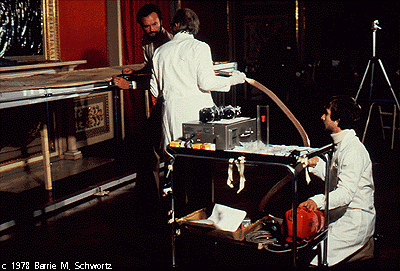
[Above (enlarge): "Professor Giovanni Riggi, (back to camera), leader of the Italian scientific team [in conjunction with STURP's 1978 examination of the Shroud], inserts a special vacuum nozzle between the Shroud and the Holland Cloth in an attempt to gather dust, pollen and other particulate matter from the cloth's fibers"[1].]

added to the mystery Again, they have not "added to the mystery." They have reduced what mystery there may have been, by adding to the already overwhelming evidence that the Shroud is authentic. It is only a "mystery" to those who don't want the Shroud to be authentic because they would then have to answer for themselves Pontius Pilate's question:

"Then what shall I do with Jesus who is called Christ?" (Mt 27:22).
surrounding the Shroud of Turin - the supposed burial cloth of Jesus. Again it is not "supposed." The evidence is overwhelming that the Shroud of Turin is authentic, the very burial sheet of Jesus, bearing the imprint of His crucified and resurrected body!

By sequencing genes from pollen and dust particles on the shroud, Again, this pollen and dust was not merely "on the Shroud." It was in the interspace between the underside of the Shroud and its Holland cloth backing, which was sewn on in 1534, following the 1532 fire. Which means that this interspace was effectively a sealed time capsule until 1978, so the DNA in that interspace cannot have entered it between 1534 and 1978. Which then means that if the 1988 radiocarbon dating of the Shroud as "mediaeval ... AD 1260-1390" was correct, then there would only be a maximum of 1534 - 1260 = 274 years for that "DNA from plants [and humans] found all over the world" to be deposited on the underside of the Shroud, when it was located entirely in France and briefly in Belgium (24Nov15 & 30Nov15). In fact, since the Shroud first appeared in undisputed history at Lirey, France, in 1355, that leaves only 1534 - 1355 = 179 years for this DNA from "all over the world" to be deposited on the underside of the Shroud (10Nov15 & 30Nov15). This is further evidence that the 1260-1390 radiocarbon dating of the Shroud was wrong and indeed the result of a computer hacking (10Nov15 & 24Nov15)!

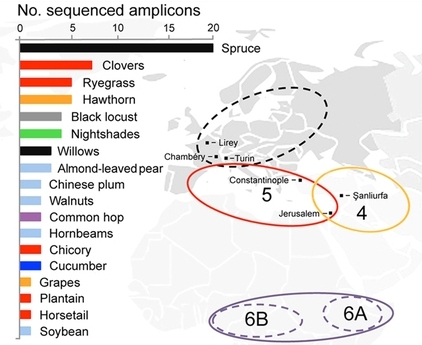
researchers have been able to map the type [of] plants and people that came into contact with the linen. Again (see 10Nov15 & 24Nov15), as can be seen below in this extract from that

[Above: Extract from "Figure 1: Plant DNA species found on the Turin Shroud"[2].]

map of plant types, DNA from plant groups (red) are found around Jerusalem and Constantinople but not Turin, Chambéry or Lirey. Moreover, the red group includes the second and third most abundant species. The DNA of the yellow group includes Constantinople, Sanliurfa (formerly Edessa) and Jerusalem, but does not include Europe. In particular, the "Plantain" (Plantago lanceolata), is "a native of Palestine"[3].

And as for the DNA of "people that came into contact with the linen", again (see 10Nov15 & 24Nov15), as can be seen below in these extracts from that map, there was wide diversity of human mtDNA in the

[Above: Extracts from "Figure 2: Human mtDNA haplogroups found on the Turin Shroud"[4].]

interspace between the underside of the Shroud and its Holland cloth backing, which (again) was sewn on in 1534, in Chambéry, France and only partially opened in 1978 and 1988 inside Turin Cathedral.

Their research suggests the shroud was made in India, See previous (10Nov15 & 30Nov15) that:

"The highest frequency mtDNA haplogroups [in the above human DNA map] are M56, R8 and U2, as well as the medium frequency M39, the centre of origin of which includes India. The high frequency of these latter four mtDNA haplogroups suggests that the flax and/or the linen was manufactured in India, and indeed Barcaccia, et al. point out that the word "Sindon" derives from "Sindia or Sindien, a fabric coming from India. It is no problem for the authenticity of the Shroud if its flax or linen came from India, but there would be a problem for the anti-authenticity alternative because there is no record, and it would seem highly unlikely (to put it mildly) that Indians in any great numbers (indeed any at all) had access to the Shroud in the period 1260-1534, when the Shroud was in France."
According to Thayer's Greek lexicon, "sindon ... [a] linen cloth, esp. that which was fine and costly" may derive from the Sanskrit "sindhu"[5], which is a region west of the Indus River, in what today is Pakistan. The Indus River Valley was an early centre of flax growing[6].

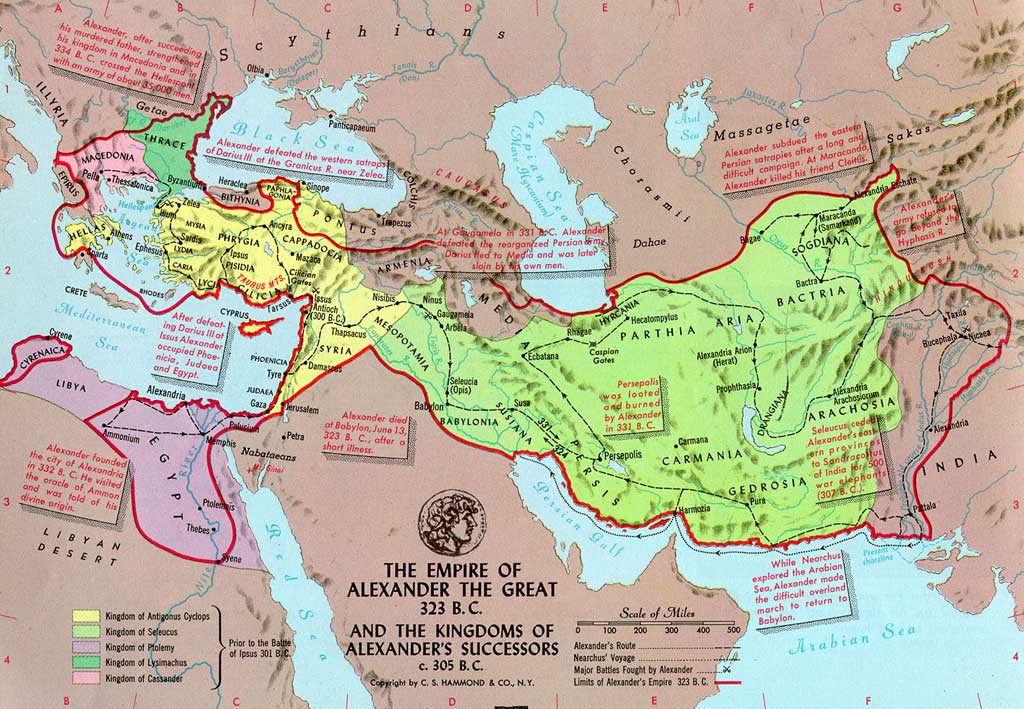
It may be that "the Shroud went, with the Apostle Thomas, to India in its early centuries." (24Nov15 & 30Nov15). Supporting this, the Apostle Thomas' remains were brought from India and buried in Edessa[7]! There were Jews in India (Esther 1:1; 8:9) during the reign of the Persian King Ahasuerus = Xerxes I (r. 486 BC - 465 BC). Significantly, the Hebrew word translated "India" in those versus is hoddu, which means the region of the lower Indus River[8]. That region was taken from the Persians by Alexander the Great in 326 BC. This opened

[Above (original): Extract of a map of Alexander the Great's Empire, showing it encompassed the region west of the Indus River, Jerusalem and Edessa[9]. It also corresponds to the above map of the highest frequency human mtDNA haplogroups M56, R8 and U2, as well as the medium frequency M39.]

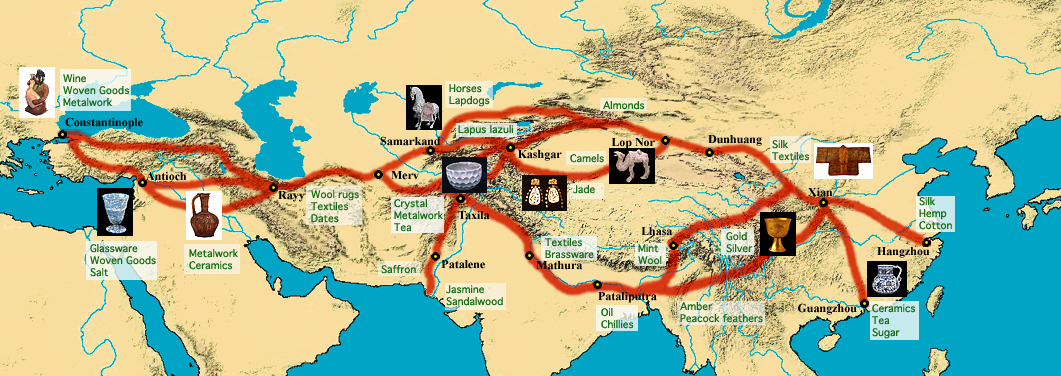
up trade between East and West, and added the region west of the Indus to the Silk Road network of trade routes[10]. With the result

[Above (original): Extract from "Maps & Atlas - Silk Road Trade Routes Map"[11], showing the lower Indus Valley, from where the word "sindon" came from (see above), as part of the ancient silk road network, which connected Antioch (and so indirectly Jerusalem) with Constantinople."]

that, by Jesus' time, "The Mediterranean world ... had become like one big marketplace, attracting trade goods from distant lands as far as India and China" and "The Jews had become very familiar with [such] trade ..." (24Nov15):

"During the first century A.D. the East and West were making a solid connection, especially with the Jews. By the time of Jesus the Jews were living in a commercial Greek world, due to the achievements of Alexander the Great. The Romans built even more and established additional trade in all of its provinces, linking the major centers of population and uniting the provinces. The Mediterranean world had become a Greco-Roman world and it had become like one big marketplace, attracting trade goods from distant lands as far as India and China. The Roman army and navy protected the boundaries of the Empire from barbarians and pirates. The Jews had become very familiar with trade and the art of international commerce. They became very wealthy and it was all controlled by a select few. Most of the common Israelites bought and sold in the local marketplace without ever realizing how all the goods from around the world had arrived there. How many of the goods had arrived there on the backs of camels and donkeys, passing through countless cities and villages upon roads and footpaths that were all but washed away by the heavy rains."[12]

And again (24Nov15), if the Shroud was an expensive import from India, that would only add to the evidence that the Shroud was authentic, because Joseph of Arimathea, who bought Jesus' shroud (Mk 15:46) was "a rich man" (Mt 27:57). But for the same reason this would be an added problem for the medieval forgery theory, because (see 16Jul15):

"That the Shroud's weave is expensive and rare is another ... problem for the forgery theory. The primary motive of art and archaeological (including relic) forgery is financial gain ... According to Oxford radiocarbon dating laboratory's Professor Edward Hall (1924-2001), that was the motive of the claimed forger of the Shroud, `There was a multi-million-pound business in making forgeries during the 14th century' so `Someone just got a bit of linen, faked it up and flogged it'[13] ... And in a sense Hall was right! If the Shroud were a medieval forgery, then the forger, to maximise his profit, would have "just got a bit of linen." That is, he would have used the least expensive `bit of linen' he could find that would still deceive his prospective buyers ... he would not have bought it [the ~4.4 x 1.1 metre fine linen sheet that the Shroud is] for the very high price it would have been, as that would have severely reduced the profit margin on his planned forgery of the Shroud image upon it. This is yet another of the many problems of the forgery theory ..."

and travelled the world extensively, moving from Jerusalem to Turkey to France before ending up in its in Turin, Italy. Again (see 25Oct15, 10Nov15, 24Nov15 & 30Nov15) the Shroud having had a ~15 centuries history from AD 30 up to 1534 in a wide variety of locations, including Jerusalem, Edessa, Constantinople, Athens and France, is consistent with this plant and human DNA evidence from the interspace between the underside of the Shroud and its Holland cloth backing which was sewn on in 1534. And (see 10Nov15 & 24Nov15) according to the lead author of study, University of Padua plant geneticist, Prof. Gianni Barcaccia, "the importance of the DNA analysis lies in the great diversity of the species identified, which is atypical" and is "an indication that the Shroud was displayed in very different areas":

"In agreement with Professor Barcaccia, the importance of the DNA analysis lies in the great diversity of the species identified, which is atypical if compared with similar studies that always present a much reduced number of species. They can be related to Asian, African, and European areas. This is an indication that the Shroud was displayed in very different areas ranging from cultivated plains to mountainous areas, from arid to more myths [sic moist?] environments."[14]
Another suggestion is that the shroud was created in medieval Europe, but people from all over the world came to see it, contaminating it with their DNA. Again (see 10Nov15, 24Nov15 & 30Nov15) while this may be genetically possible, it is historically and realistically highly implausible:

The first implausibility is that if the Shroud had been "created in medieval Europe" (based on the 1988 radiocarbon dating of the Shroud as "mediaeval ... AD 1260-1390") then, leaving aside that the cloth's dimensions are 8 x 2 standard Assyrian cubits (04Feb15 & 10Jul15) and its stitching and selvedge are identical to that found only at the 1st century Jewish fortress of Masada (22Jan15 & 24Aug15), and indeed the plant DNA evidence above from "Constantinople ... Edessa ... and Jerusalem), then as we saw above, there would only be a maximum of only 274 years for these "people from all over the world" to come to see the Shroud. But since the first exposition of the Shroud in undisputed history was in c. 1355 at Lirey, France, that leaves only 179 years for these "people from all over the world" to come to France or Belgium to see the Shroud.

The second implausibility is that these "people from all over the world" could have contaminated the Shroud with their DNA. But as we saw (24Nov15 & 30Nov15), in all known public expositions of the Shroud, it has been held by clerics on a raised platform or balcony, high above the general public, so they could have had no personal contact with it, as they would have to have had to leave their DNA on it.

The third implausibility (see 10Nov15 & 24Nov15) is that if those attending Shroud expositions had been able to contaminate the Shroud with their DNA, then the European-only haplogroups H1, H3, H4 and U2 would have the highest frequency, not among the lowest, since the vast majority of those attending Shroud expositions between 1355 and 1534, when the Shroud was only in France and Belgium (as well as the Shroud's owners and ecclesiastical custodians), were Europeans.

By contrast, the pro-authenticist scenario is consistent with the plant and human DNA evidence and does not have the above implausibility problems, because "in the ... faraway past," (i.e. the first through fourth centuries) "people" in small Christian congregations, could "have touched, kissed, or come in contact with the Shroud":

"In conclusion, in agreement with Professor Barcaccia, the haplotypes found in the traces of DNA have a reference to the haplogroups of ethnic groups belonging to Europe, North Africa, and the Middle East, that is to say, of people living in areas facing the Mediterranean basin. More accurate analyses in the process of development could, in the near future, be more precise and give us specific data concerning those people who in the past - even in a faraway past - have touched, kissed, or come in contact with the Shroud of Turin."[15]
So again (see above) this plant and human DNA on the Shroud is is yet another item in the already overwhelming evidence that the Turin Shroud is authentic, and further evidence that the 1260-1390 radiocarbon dating of the Shroud was wrong and indeed the result of a computer hacking!

I therefore see no point in continuing this series. As T.H. Huxley observed:

"Life is too short to occupy oneself with the slaying of the slain more than once."[16]!

Notes
1. "The 1978 Scientific Examination," Shroud.com, nd. [return]
2. Barcaccia, G., et al., 2015, "Uncovering the sources of DNA found on the Turin Shroud," Nature, Scientific Reports 5, 5 October. [return]
3. Fanti, G. & Malfi, P., 2015, "The Shroud of Turin: First Century after Christ!," Pan Stanford: Singapore, pp.298-299. [return]
4. Barcaccia, et al., 2015. [return]
5. Thayer, J.H., 1901, "A Greek-English Lexicon of the New Testament: Being Grimm's Wilke's Clovis Novi Testamenti Translated Revised and Enlarged," T & T. Clark: Edinburgh, Fourth edition, Reprinted, 1961, p.576. [return]
6. Tortora, P.G., 2015, "Dress, Fashion and Technology: From Prehistory to the Present," Bloomsbury Academic: London, p.32. [return]
7. Wilson, I., 1979, "The Shroud of Turin: The Burial Cloth of Jesus?," [1978], Image Books: New York NY, Revised edition, p.138; Wilson, I., 2010, "The Shroud: The 2000-Year-Old Mystery Solved," Bantam Press: London, pp.124, 131. [return]
8. Kitchen, K.A., "India," in Douglas, J.D., et al., eds., "New Bible Dictionary," [1962], Inter-Varsity Press, Leicester UK, Second edition, 1982, Reprinted, 1988, p.513; Gehman, H.S. & Davis, J.D., 1924, "The Westminster Dictionary of the Bible," [1898], Collins: London, Revised, 1944, p.265. [return]
9. Pillai, N.G., 2015, "Skanda: The Alexander Romance in India," 18 November. [return]
10. Marx, I., 2000, "Empire of Alexander the Great - Expansion into Asia and Central Asia," 8 September. [return]
11. "Maps & Atlas - Silk Road Trade Routes Map," Silkroutes.net, 24 October 2015. [return]
12. "Roads in Ancient Israel," Bible History Online, nd. [return]
13. "Obituaries: Professor Edward Hall," The Independent:, 16 August 2001. [return]
14. Fanti & Malfi, 2015, p.299. [return]
15. Fanti & Malfi, 2015, p.301. [return]
16. Huxley, T.H., 1861, The Athenaeum, 13 April, in Browne, E.J., 2002, "Charles Darwin: The Power of Place: Volume II of a Biography," Pimlico: London, Reprinted, 2003, p.159. [return]

Posted 4 December 2015. Updated 19 November 2026

Monday, November 30, 2015

News articles #2: Uncovering the sources of DNA found on the Turin Shroud

Continuing from part #1, this is part #2 of my comments on further news articles about the paper, Barcaccia, G., et al., 2015, "Uncovering the sources of DNA found on the Turin Shroud," Nature, Scientific Reports 5, 5 October. These will be in date order, with the article's words in bold.


"Turin Shroud: DNA and pollen from all over the world found on cloth, new study finds," The Independent, Kashmira Gander, 14 October 2015

[Above (enlarge): STURP's Ray Rogers (L) and John Jackson (C), and Turin's Giovanni Riggi (R) in October 1978, having partially unstitched the Shroud's Holland cloth backing which had been sewn on in April 1534, are the first to look at the underside of the Shroud in 444 years.[1]]

... Scientists have added to the complex and controversial tales of origin surrounding the Turin Shroud, by revealing the myriad locations of the DNA and pollen that are present on the cloth. As per my previous posts (18Oct15, 10Nov15 and 24Nov15), that the plant and human DNA in the interspace between the underside of the Shroud and its Holland cloth backing, which was sewn on in 1534, has "myriad locations" is inconsistent with the 1988 radiocarbon dating claim that, "the linen of the Shroud of Turin is mediaeval ... AD 1260-1390"[2]. Because that would leave less than 3 centuries between the claimed earliest possible radiocarbon date of 1260 and 1534, when the Shroud was then entirely in France and Belgium. In fact, less than 2 centuries between the Shroud's first public exposition in undisputed history at Lirey, France, in 1355[3] and 1534. But again, it is consistent with the Shroud having had a ~15 centuries history up to 1534, in widely different locations including "Jerusalem... Edessa ... Constantinople ... Athens ... [and] France":

"... the journey of TS [the Turin Shroud] began in Jerusalem in the year 30 or 33 AD. After concealment for years, TS would have been first moved to Edessa (now Şanliurfa in Turkey) and then to Constantinople (now Istanbul in Turkey) in 944 AD. A burial cloth, which some historians consider the Shroud, was owned by the Byzantine emperors but disappeared during the Sack of Constantinople in 12044. After this event, TS would have been taken by the crusaders and transferred to Athens (Greece), where it remained until 1225. Official documents attest that it was in France at Lirey around the years 1353 to 1357 and then was kept at Chambéry from 1502 to 1578, where passed into the hands of the Dukes of Savoy. From 1578, apart from some brief displacements in an effort to hide it during war periods, TS was kept in Turin (Italy) and later placed in the royal chapel of the city Cathedral inside a specially designed shrine where it has been permanently conserved from 1694 to the present."[4]
... The length of linen is highly contentious. Some Christians believe the fabric – which is kept in the Cathedral of Saint John the Baptist in Turin - is the burial shroud of Jesus of Nazareth, dating back over 2,000 years. Again a secular, naturalistic, false dichotomy: "Some Christians" versus "scientific studies." But as previously pointed out, so strong is the evidence for the Shroud's authenticity that non-Christians like agnostic zoologist Prof. Yves Delage (1854-1920), agnostic art historian Thomas de Wesselow and Jewish Barrie Schwortz have become pro-authenticists. However, previous scientific studies have suggested that the cloth, which appears to be imprinted with the image of a man, may in fact be from the 13th or 14th century - centuries after Jesus is believed to have died. The evidence is very strong that this 1988 radiocarbon dating of the Shroud as "mediaeval ... AD 1260-1390" (see above).

Now, a new study by Italian researchers published in the prestigious science journal Nature gives a further insight into the potential origins of the cloth. To make their findings for the paper entitled 'Uncovering the sources of DNA found on the Turin Shroud', the team behind the study sequenced the DNA of pollen and other dust from the cloth. This is doubly misleading (either deliberate or through journalistic ignorance). First, it was not just "DNA of pollen and other dust" but both plant and human DNA. Second, the dust did not merely come "from the cloth" but it came "from the interspace between the Shroud and the Holland Cloth sewn to it as reinforcement":

"In 1978 and 1988, dust particles were vacuumed from the interspace between the Shroud and the Holland Cloth sewn to it as reinforcement ... In this study, we performed DNA analyses to define the biological sources of the dust particles ... vacuum-collected in 1978 and 1988 ... To identify plant taxonomic entities and human genetic lineages, universal plant DNA sequences ... and human mitochondrial DNA (mtDNA) target regions were amplified and sequenced. This allowed the identification of DNA sources from a wide range of plant species and human mitogenomes belonging to numerous haplogroups. The overall findings were then evaluated to determine whether the geographic areas of origin and distribution of detected plant cpDNA species and human mtDNA haplogroups might provide novel clues concerning the origin of the Turin Shroud."[5]
And what even the Nature article omits to mention is the crucially important fact that "the Holland Cloth sewn to it" was in 1534:
"On the night of December 4, 1532, fire broke out in the Sainte Chapelle, Chambéry, where the Shroud was then kept. ... the cloth itself was only saved by the quick intervention of one of the duke of Savoy's counsellors ... and two Franciscan priests. ... For sixteen months the Shroud languished in a state quite unfit for exposition. Then, on April 15, 1534 ... it [was] sent to the nearby convent of Poor Clares for repair. ... on May 2 the cloth was returned, now backed by a simple piece of Holland cloth of the same size to give it strength. Over the worst of the damage had been sewn fourteen large triangular-shaped patches and eight small ones, all made from altar cloth."[6]
Because, as previously pointed out (see 18Oct15), if the radiocarbon dating of the Shroud's linen as "mediaeval ... AD 1260-1390" was correct, then this would leave at most a mere 274 years between 1260 and 1534 (and indeed a mere 179 years between the first undisputed exposition of the Shroud at Lirey, France, in 1355 and 1534), for all this plant and human DNA from "myriad locations" to be deposited on the underside of the Shroud!

By doing so, they were able to pinpoint the biogeographic origin of the people who came into contact with the shroud. Again (see 24Nov15), the key word is "contact". In all its known expositions, the Shroud has been held by clerics on a raised platform or balcony, high above the general public, so they could have no personal contact with it. See again the engraving by Antonio Tempesta of the 1613 exposition in Turin [above (enlarge)[7]. Again, this DNA was on the underside, which in all known Shroud expositions, the general public viewers would not have even seen, let alone touched to leave their DNA on it.

The authors found traces on the parchment The Shroud is linen cloth, made from flax, not "parchment," which is "made from processed animal skin." See above on journalistic ignorance! from people and pollen from around the world, including Europe, south Asia, eastern Africa and the Middle East. Again (see above) this is consistent with the Shroud being authentic and having a ~15 centuries history up to 1534, in widely different locations including Jerusalem, Edessa, Constantinople, Athens and France. But it is inconsistent with the Shroud being a medieval forgery, having had a less than 3 centuries history between the earliest possible radiocarbon date of 1260 (in fact less than 2 centuries between the Shroud's first public exposition in undisputed history at Lirey, France, in 1355) and 1534, when this DNA on the Shroud's underside, was sealed in by the Holland cloth backing. And when the Shroud was entirely in France and Belgium.

Researchers said that the findings could indicate that that the shroud made its "historic [...] presumed journey" from the Near East What the Nature paper said was:

"Such diversity ... would be also compatible with the historic path followed by the Turin Shroud during its presumed journey from the Near East."
and was taken around the world before being kept in Italy; See above on:
"the journey of TS began in Jerusalem in the year 30 or 33 AD. [it] ... would have been first moved to Edessa ... and then to Constantinople ... in 944 AD. ... but disappeared during the Sack of Constantinople in 1204. After this event, TS would have been taken by the crusaders and transferred to Athens (Greece) ... it was in France at Lirey around the years 1353 to 1357 and then was kept at Chambéry from 1502 to 1578 [in] ... the hands of the Dukes of Savoy. From 1578, apart from ... during war periods, TS was kept in Turin (Italy) ... to the present."
or that it has its origins in medieval Europe where and was contaminated by those who travelled to it. See previous (10Nov15) that:
"It may be genetically possible, but it is historically highly implausible. There is no evidence for, and much evidence against, that there were `thousands of worshippers who came into contact with the relic in France and Italy' before 1534 (or even after it), close enough to the Shroud to leave their DNA on it (especially its underside). All the depictions of public Shroud exhibitions in those centuries, show the Shroud being held by bishops on a high platform, well above the `thousands of worshippers' .... The Shroud would have been torn to pieces if it was allowed to be handled by those `thousands of worshippers,' which it would have to have been for them to leave their DNA on it. If it were the case, that `thousands of worshippers who came into contact with the relic in France and Italy,' left their DNA on the Shroud, then the European-only haplogroups H1, H3, H4 and U2 would have the highest frequency, not among the lowest, since the vast majority of those `worshippers' (not to mention the Shroud's de Charny and Savoy owners and its ecclesiastical custodians) were Europeans."
and 24Nov15:
"Genetically there are two explanations: 1) the Shroud originated in Jerusalem in the 1st century and in the subsequent ~15 centuries it was taken via Edessa, Constantinople, Athens and France up to 1534, when its underside was sealed off by its Holland cloth backing. Or 2), the Shroud originated no later than 1260 and in the less than 3 centuries between then and 1534, plant and human DNA was deposited on its underside, in greater quantities than European DNA, from Palestine, Turkey, France and even India. The second option, while genetically possible, is historically and realistically, effectively impossible! ... As geneticists, using only the tools of genetics, they could not rule out the anti-authenticist option 2. But historically and realistically it is preposterous that in the less than 3 centuries between 1260-1354, indeed less than 2 centuries between the Shroud's first public exposition in undisputed history at Lirey, France, in 1355 and the sewing of the Holland cloth backing on the Shroud in 1534, that `worshipers (and plants) from all over the world ... made their way to Europe [and] contaminated' the Shroud. Yet, the Shroud's European owners, ecclesiastical custodians and worshippers, contaminated it the least with their DNA!"
In a further twist, the study indicated that it may have been manufactured in India. See previous 10Nov15:
"It is no problem for the authenticity of the Shroud if its flax or linen came from India, but there would be a problem for the anti-authenticity alternative because there is no record, and it would seem highly unlikely (to put it mildly) that Indians in any great numbers (indeed any at all) had access to the Shroud in the period 1260-1534, when the Shroud was in France. The Shroud was in the 13-16th centuries, as it is today, displayed but not allowed to be touched by the public."
and24Nov15:
"It is no problem for the authenticity of the Shroud if its flax or linen came from India, or even if the Shroud went, with the Apostle Thomas, to India in its early centuries. But there would be a problem for the anti- authenticity alternative because there is no record, and it would seem highly unlikely (to put it mildly) that Indians in any great numbers (indeed any at all) had access to the Shroud in the period 1260-1534, when the Shroud was in France."

Continued in part #3 of this series.

Notes
1. Schwortz, B.M., 2005, "In Memoriam: Raymond N. Rogers - July 21, 1927-March 8, 2005," 2005 Website News, Shroud.com; Wilson, I. & Schwortz, B., 2000, "The Turin Shroud: The Illustrated Evidence," Michael O'Mara Books: London, p.68. [return]
2. Damon, P.E., et al., 1989, "Radiocarbon Dating of the Shroud of Turin," Nature, Vol. 337, 16th February, pp.611-615, p.611. [return]
3. Wilson, 1998, p.111,278; Wilson, I., 2010, "The Shroud: The 2000-Year-Old Mystery Solved," Bantam Press: London, pp.222-223. [return]
4. Barcaccia, G., et al., 2015, "Uncovering the sources of DNA found on the Turin Shroud," Nature, Scientific Reports 5, 5 October. [return]
5. Barcaccia, et al., 2015. [return]
6. Wilson, I., 1979, "The Shroud of Turin: The Burial Cloth of Jesus Christ?," [1978], Image Books: New York NY, Revised edition, p.24. [return]
7. Freeman, C., 2014, "The Origins of the Shroud of Turin," History Today, Vol. 64, Issue 11, 24 October. [return]

Posted 30 November 2015. Updated 15 April 2025.