Sunday, September 12, 2021

The Shroud man and Jesus were beaten #36: The evidence is overwhelming that the Turin Shroud is Jesus' burial sheet!

THE SHROUD MAN AND JESUS WERE BEATEN #36
Copyright © Stephen E. Jones[1]

This is part #36, "The Shroud man and Jesus were beaten," of my series, "The evidence is overwhelming that the Turin Shroud is Jesus’ burial sheet!" For more information about this series, see the "Main index #1" and "Other marks and images #26." See also "The Shroud of Turin: 3.4. The man on the Shroud and Jesus were beaten." Emphases are mine unless otherwise indicated.

[Main index #1] [Previous: The Shroud is consistent with the man being Jesus #35] [Next: The Shroud man and Jesus were scourged #37]


  1. The Bible and the Shroud #33
    1. The Shroud man and Jesus were beaten #36

Jesus was struck in the face The Gospels record that Jesus was struck in the face on three occasions[2]. The first was at the night session of the Sanhedrin, when Jesus was first sentenced to death[3]. Then He was struck [Gk. rapisma = hit with the palm of the hand[4]] by one of the Jewish court officers (Jn 18:22-23)[5]. The second occasion was the morning after that session, when the sentence of death was ratified before the full Sanhedrin[6]. Then the Jewish guards blindfolded Jesus, spat in His face, struck Him [Gk. kolaphizo = to strike with the fist[7]] and asked Him to prophesy who did it (Mt 26:67-68; Mk 14:65; Lk 22:63-65)[8]. The third occasion when Jesus was struck in the face was after He had been scourged, when mock homage was paid to Him and He was crowned with thorns[9]. Then Jesus was spat on by the Roman soldiers and then struck [Gk. etupton = to strike with the hand or stick repeatedly[10]] on the head with a reed [Gk. kalamon = a reed, staff[11] (Mt 27:27-31; Mk 15:16-20; Jn 19:3)[12]. The terms used by the Gospel writers signify heavy blows with the hand, fist or rod[13].

The man on the Shroud was struck in the face The man on the

[Above (enlarge)[14]: Enrie 1931 negative photograph of the face of the man on the Shroud. The reversed `3' bloodstain is on the Shroudman's left forehead[15]. Because the negative is a left-right reversal of the positive (see below), which in turn is a left-right reversal of the man who was inside the Shroud, this negative is left-right correct for the man who was inside the Shroud. As can be seen, there is a large swelling of the right cheek and between the nose a sunken area before another swelling of the man's left cheek. His nose has also been bent towards his right. As we shall see below, artists from the 6th to the 13th century depicted these swellings of the man's cheeks and his bent nose!]

Shroud had been beaten about the face[16]. His facial wounds include: swelling of both eyebrows, a torn right eyelid, a large swelling below his right eye, a swollen nose, a triangular-shaped wound on right cheek with its apex pointing to his nose, a swelling to his left cheek, a swelling to the left side of his chin[17]. His right eye is nearly swollen shut, and his nose is twisted[18]. The swelling of the man's cheek, under his right eye-socket, was probably caused by a blow with a stick, estimated to have been about 4.5 mm. (1.75 in.) in diameter[19].

Byzantine artists in their Christ Pantocrator ("ruler over all"[20]) icons, depcted an asymmetric face of Jesus, with His cheeks accentuated and nose deformed[21] (see examples below).

Art historian, Prof. Heinrich Pfeiffer SJ, wrote:

"The Byzantine masters, who could have observed the image of the Shroud at close range, had often, in their icons and mosaics, accentuated the cheekbone, especially on one side of the face, and this corresponds to our fifth spy element, the swelling of the cheek. Thus they drew an asymmetric face with one cheek concave and a noticeable bulge of the bone, especially on one side"[22].
Below is what Byzantine artists would have seen in their looking at the the face of the Shroudman, to depict him:

[Above (enlarge)[23]: Positive photograph of the face of the man on the Shroud, showing the reversed 3 bloodstain on the man's forehead, his swollen cheeks and deformed nose.]

Below are photographs of the positive of the Shroud face (left) and its negative flipped horizontally (right) for ease of comparison.

[Above (enlarge): Durante 2002, positive photograph (left) of the Shroud face, compared with Enrie 1931 negative photograph of the same face (right), flipped horizontally. The reversed `3' bloodstain is on the Shroudman's left forehead (see above) but it appears to be his right forehead because the imprint on the Shroud is a mirror-image of the man who was inside it[24]. As we saw above, the Enrie negative is left-right correct for the man who was inside the Shroud. As can be seen, when the above image is enlarged, there is a swelling of the man's cheek under his left eye, and a sunken area between the man's nose and a swelling over the man's right cheek. His nose is swollen and has been displaced towards the right.

In the 1930s French biologist Paul Vignon (1865-1943) discovered twenty peculiarities recurring in hundreds of Byzantine depictions of Jesus beginning in the sixth century, which were features visible on the Shroud[25]. Shroud historian Ian Wilson later reduced these twenty to fifteen more certain "Vignon markings"[26]. Many of these peculiarities made no artistic sense and some were imperfections in the Shroud's weave[27].

Below is Wilson's sketch of the Shroudman's face showing the location of his 15 Vignon markings.

[Above (enlarge): "The Vignon markings-how Byzantine artists created a living likeness from the Shroud image. (1) Transverse streak across forehead, (2) three-sided `square' between brows, (3) V shape at bridge of nose, (4) second V within marking 2, (5) raised right eyebrow, (6) accentuated left cheek, (7) accentuated right cheek, (8) enlarged left nostril, (9) accentuated line between nose and upper lip, (10) heavy line under lower lip, (11) hairless area between lower lip and beard, (12) forked beard, (13) transverse line across throat, (14) heavily accentuated owlish eyes, (15) two strands of hair"[28].]

Wilson's "(6) accentuated left cheek," "(7) accentuated right cheek" and "(8) enlarged left nostril" (above) correspond to what I have above called a swelling of the man's left cheek, a sunken area between the man's nose, a swelling over the man's right cheek and his swollen and displaced nose.

And below is Wilson's 15 Vignon markings in yellow, superimposed over the positive of the Shroud face:

[Above (enlarge): Positive photograph of the Shroud face, with Vignon markings numbers 1-15 superimposed[29]. See below for comparisons of Pantocrator icons with these superimposed Vignon marking numbers.]

Christ Pantocrator icons which depict Jesus with an asymmetrical face, both cheeks swollen and a bent nose include:

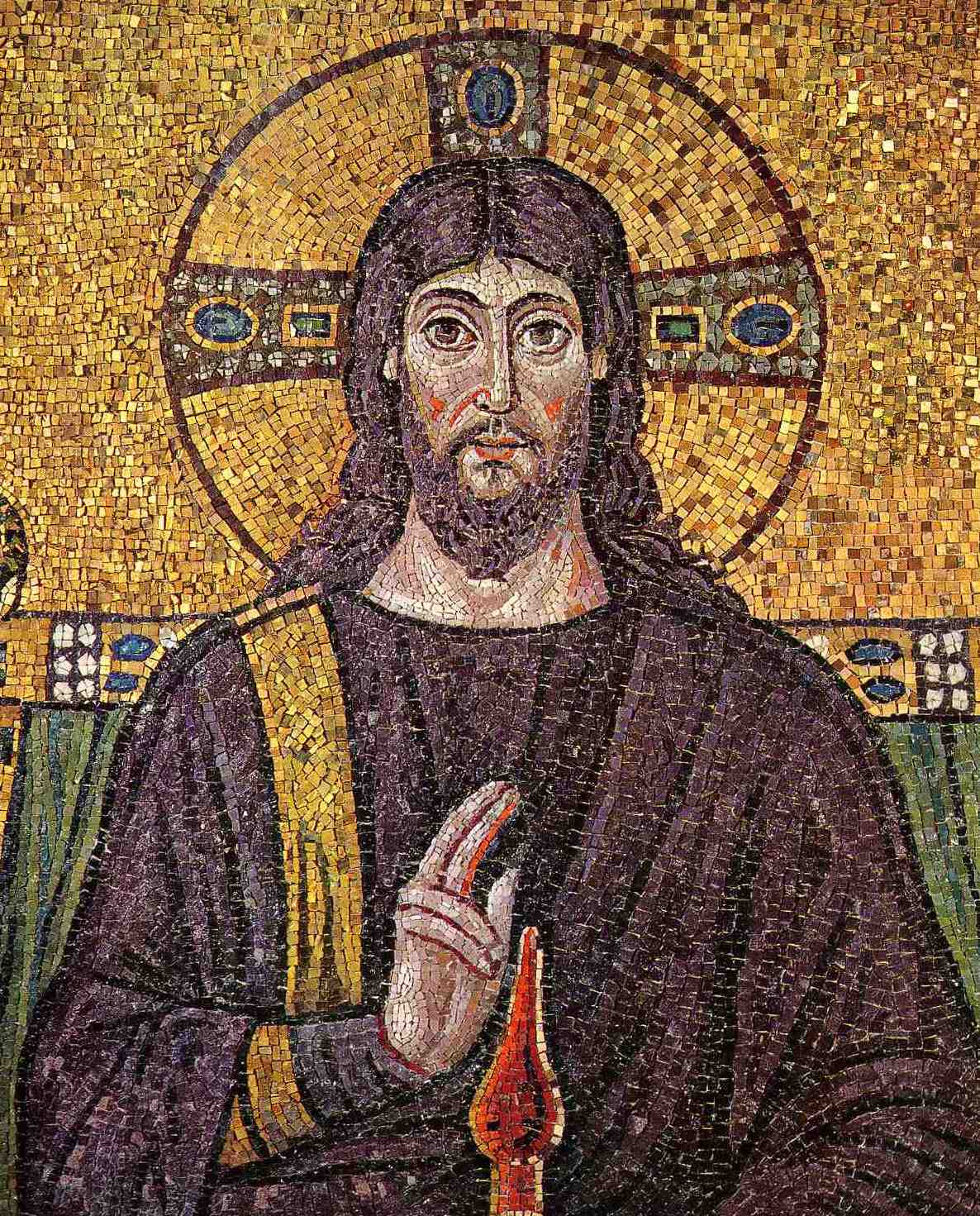
■ Sixth century pantocrator in the Basilica of Sant'Apollinare Nuovo, Ravenna, Italy (below), which was commissioned by Theodoric the Great (454–526)[30]. It has 8 Vignon markings[31].

[Above (enlarge): Christ Pantocrator, c. 529, in the Basilica of Sant'Apollinare Nuovo, Ravenna, Italy[32]. Note Jesus' accentuated cheeks( 6) and (7) [33] and displaced nose(8)[34], as on the Shroud above!]

When the face of the above Pantocrator is compared with that of the Shroudman below (enlarged), it is evident that the 6th century artist

[Above (enlarge): Comparison of the sixth century Pantocrator mosaic, Sant'Apollinare Nuovo church, Ravenna and the Shroud face with the 15 Vignon marking numbers in yellow superimposed. This Ravenna Pantocrator has 8 Vignon markings[35]. By my count there are nine: (5), (6), (7), (8), (9), (10), (13), (14) and (15) - see above. Some Pantocrators have even more Vignon markings (see future below), but even nine is proof beyond reasonable doubt that this sixth century, c.529, mosaic was based on the Shroud. Which means the Shroud already existed 731 years before its earliest 1260 radiocarbon date and 826 years before 1355 when Bishop d'Arcis claimed that the Shroud was "cunningly painted"!]

was trying to interpret and depict the man's swollen left and right cheeks on the Shroud, which is a photographic negative[36].

■ Sixth century Christ Pantocrator in St. Catherine's Monastery, Sinai[37].

[Above (original)[38]: Extract from Christ Pantocrator, St. Catherine's Monastery, Mount Sinai (c. 550). Again, note the asymmetrical face, the swollen right cheek (the artist had evidently realised that Jesus' body would have been the left-right reverse of His image on the Shroud[39], and a sunken area between the nose and a swelling over the left cheekbone, as well as the bent nose[40], exactly as they are on the Shroud's negative image above!]

A side-by-side comparison below between the St Catherine's Sinai Pantocrator (above) and the positive face of the Shroudman (above)

[Above (enlarge): Comparison of the sixth century Christ Pantocrator in St. Catherine's Monastery, Sinai and the and the Shroud face with the 15 Vignon markings superimposed. I have been unable to find a reference to how many Vignon markings it has, but by my count it has twelve: (1), (2), (3), (5), (6), (7), (8), (9), (10), (11), (13) and (14) - see above. Particularly striking is "(13) transverse line across throat" which as Scavone pointed out below, the artist had faithfully depicted as Jesus' "garment neckline"! Again this is further proof beyond reasonable doubt that the Shroud was the artist's model and therefore already existed in c.550, seven centuries before the earliest radiocarbon date of the Shroud and eight centuries before the Bishop d'Arcis claimed that the Shroud had been "cunningly painted"!]

makes it plain that the sixth century artist had the Shroud before him as his model!

Historian Prof. Daniel Scavone wrote of this icon:

"St. Catherine's Monastery, tucked away and virtually isolated in the Sinai Peninsula, was a place that evaded the iconoclasts. Here still resides perhaps the earliest surviving portrait-icon of Christ, in encaustic on wood. It dates from the 6th c. A comparison of this icon with the face on the Shroud of Turin will, for many, put an end to their doubts about the Shroud. The icon is nearly perfectly congruent to the Shroud-face. Notice especially the high right eyebrow, the very hollow right cheek, and the garment neckline. The artist seems even to have rendered even the creases and wrinkles still seen on the Shroud, meaning that it must have been inspired by, i.e., copied from, the Shroud"[41].

■ Sixth century pantocrator on a silver vase found at Homs (ancient Emesa) in Syria, which has "distortions carved into the right [sic left]

[Above (enlarge)[42]: Shroud-like face on a 6th century silver liturgical vase found at the site of ancient Emesa (today's Homs) in Syria[43]. Note the deliberately carved depiction of Jesus' swollen and and bruised left (actually right) cheek, exactly as they appear on the Shroud above! See 16Feb12, 06Oct13, 09Aug15 & 07Dec16]

side of the face, where the Shroud face has two sizable bruises, the swollen cheek and the half-moon bruise below"[42].

As can be seen in the comparison below between the 6th century Homs vase pantocrator (above) and the positive face of the Shroudman (above), the 6th century artist has depicted on the vase, his own inter-

[Above (enlarge): Further striking similarities between the 6th century Emessa (Homs) vase and the Shroud face with the 15 Vignon marking numbers in yellow superimposed. Again I have been unable to find a reference to how many Vignon markings it has, but by my count it has eleven: (1), (2), (3), (5), (6), (7), (8), (9), (10), (13) and (14) - see above. Again, particularly striking is its "(13) transverse line across throat" which as Scavone pointed out below, the artist had interpreted as Jesus' "garment neckline"! So again this is further proof beyond reasonable doubt that the Shroud was, directly or indirectly, the artist's model and therefore already existed in c.550, seven centuries before the earliest radiocarbon date of the Shroud and eight centuries before the Bishop d'Arcis claimed that the Shroud had been "cunningly painted"!]]

pretation of the Shroudman's swollen cheeks, including a bruised left cheek, as well as a moustache and beard which encircle his mouth. Clearly the only plausible explanation is that this sixth century artist, either directly or indirectly, had the Shroud as his model!

■ Eighth century portrait of Christ in the Catacomb of Pontianus, Rome)[45].

[Above: Closeup of the face of Jesus in the Catacomb of Pontianus[46] (see original[47]): Note the man's swollen right cheek, his nose bent towards his right and the sunken area between his nose and and a swelling of his left cheek, again exactly as they appear on the Shroud above! Also note the "starkly geometrical" three-sided topless square between Jesus' eyebrows[48], which is Vignon marking 2 above. See 25Jul07, 18Mar12, 22Sep12, 27Apr14].

As can be seen in the comparison below between the face of the 8th century portrait of Jesus in the Catacomb of Pontianus, Rome (above) and the positive face of the Shroudman (above), the artist has depicted

[Above (enlarge): More close similarities between the 8th century portrait of Jesus in the Catacomb of Pontianus, Rome and the Shroud face with the 15 Vignon marking numbers in yellow superimposed. This Pontianus Pantocrator has 8 Vignon markings[49]. By my count there are ten: (1), (2), (5), (6), (7), (8), (9), (13), (14) and (15) - see above.]

features found only on the Shroud, including a three-sided topless square between Jesus' eyebrows, and His swollen cheeks, particularly his (apparent) left cheek, which the artist had coloured reddish to represent the bruising of that cheek which is evident on the Shroud!

■ Tenth century Christ Enthroned fresco in the Church of Sant' Angelo in Formis, near Capua, Italy[50]. The church was built by Desiderius,

[Above (enlarge)[51]: Extract of face of Jesus from larger 11th century pantocrator fresco painted by Byzantine artists hired from Constantinople[52]. Note the accentuated cheeks, depicting the swollen cheeks of the man on the Shroud (see above)!]

the Abbot of Monte Cassino (1058–87), who later became Pope Victor III (r. 1086-87)[53]. The church's frescoes, including this Pantocrator, date between 1072 and 1087[54].

A comparison between the face of Jesus in this 10th century Pantocrator and the positive of the face of the Shroudman (below),

[Above (enlarge): Very close similarities between the face of Jesus in the 10th century Christ Enthroned fresco in the Church of Sant' Angelo in Formis, Italy, and the Shroud face with the 15 Vignon marking numbers in yellow superimposed. This Pantocrator has a claimed 13 Vignon markings[55]. By my count it has twelve: (1), (3), (5), (6), (7), (8), (9), (10), (11), (13), (14) and (15) - see above.]]

reveals the following very close similarities: stylised depictions of the reversed 3 bloodstain as a tuft of hair above and an oval shape below; as well as of the Jesus swollen left and right cheeks, where they are on the Shroud!

■ Twelfth century Christ Pantocrator mosaic in the Cathedral of Cefalu, Sicily[56].

[Above (enlarge)[57]: Face of the c.1130 bust of Christ Pantocrator on the apse of Cefalù Cathedral, Sicily. As can be seen, Jesus' right cheek is swollen, there is a sunken area between his nose and a swelling over his left cheekbone, and His nose is bent[58], as they appear to be on the Shroud (above)].

A closeup comparison of the face of Jesus in this 12th century Cefalu Pantocrator mosaic with the positive of the Shroud face, as the

[Above (enlarge): Closely similar features between the face of Jesus in the 12th century Christ Pantocrator mosaic in the Cathedral of Cefalu, Sicily, and the Shroud face with the 15 Vignon marking numbers in yellow superimposed. It is claimed that this Cefalu Pantocrator has all 15 Vignon markings[59]. By my count it has thirteen: (1), (3), (4), (5), (6), (7), (8), (9), (10), (12), (13), (14) and (15) - see above.]

artist would have seen it (above), includes these closely similar features in common: "V shape at bridge of nose" (3) as well as "accentuated left cheek" (6) and "accentuated right cheek" (7). The latter is particularly striking, because the artist has depicted a diagonal sunken area between the side of Jesus' nose and his lower left cheek, which is also on the Shroud!

■ Thirteenth century Pantocrator in Hagia Sophia Cathedral, Istanbul (formerly Constantinople).

[Above (original): Face of Christ Pantocrator, c. 1261, in the Deesis Mosaic in Hagia Sophia Cathedral, Istanbul[60]. Note again Christ's swollen left cheek and a sunken area between His nose and swollen right cheek. Again, why would there have been such a strange artistic tradition, persisting from the 6th to the 13th century, if it were not that the Shroud was the artists' model and they were trying to depict Jesus' beaten-up face as it is on the Shroud?]

Seventh and last comparison of the face of Jesus in this thirteenth century Pantocrator in Hagia Sophia Cathedral, Istanbul

[Above (enlarge): Obviously similar features between the face of Jesus in this 13th century Deesis Mosaic in Hagia Sophia Cathedral, Istanbul, and the Shroud face with the 15 Vignon marking numbers in yellow superimposed. This Pantocrator is claimed to have only 8 Vignon markings[61], but by my count it has ten: (2), (4), (5), (6), (7), (8), (9), (10), (13) and (14) - see above.]

Problem for the forgery theory. See previous three: #32, #34 and #35. We have seen above, especially in the photographic negative of the Shroud face, that the man on the Shroud has a swollen right cheek (opposite from the reversed `3' bloodstain which is on his left - see above) and a sunken left area between his nose and a swelling over his left cheekbone. In the photographic positive, which is what the artists would have seen looking at the Shroud, the sides are mirror-reversed, so the major swelling appears to be under the man's right eye, and the sunken area between the nose and a swelling over his opposite cheekbone appears to be under his left eye. Which is exactly what the various artists depicted! There would be no reason for the various artist who lived many centuries, from the sixth to the thirteenth, and thousands of kilometres apart, to depict Jesus that way, unless the Shroud was their model, directly or indirectly, and they were trying to interpret the assymetrical face, swollen cheeks and bent nose of the man on the Shroud!

We have also seen by referring to Ian Wilson's numbered sketch above, that the Shroudman's swollen cheeks and displaced nose, are Vignon markings "(6) accentuated left cheek," "(7) accentuated right cheek" and "(8) enlarged left nostril," which are among 15 Vignon markings which occur, to varying degrees, in hundreds of Byzantine depictions of Jesus' face and all 15 are features found on the Shroudman's face!

These are clearly insuperable problems for the forgery theory, and in particular for its claimed "conclusive evidence that the linen of the Shroud of Turin is mediaeval ..."[62], the 1260-1390 radiocarbon date of the Shroud.. Because, as Wilson pointed out:

"... if the radiocarbon dating is to be believed, there should be no evidence of our Shroud [before 1260]. The year 1260 was the earliest possible date for the Shroud's existence by radiocarbon dating's calculations. Yet artistic likenesses of Jesus originating well before 1260 can be seen to have an often striking affinity with the face on the Shroud, insofar as anyone would have been able to make this out on the cloth itself, as distinct from the hidden photographic negative"[63]
Conclusion We saw above that according to the Gospels, Jesus was repeatedly struck in the face. And we also saw that the man on the Shroud had been struck in the face. In particular, we saw in the photographic negative of the Shroudman's face that he has very swollen cheeks and his nose is swollen and displaced, which can only be the result of severe beatings about the head and face. Moreover, we saw that from the sixth century, through to the thirteenth century, Byzantine artists all, to varying degrees, depicted the exalted and enthroned "Pantocrator" Jesus with swollen cheeks and a displaced nose! We saw that the French biologist Paul Vignon (1865-1943), from his study of hundreds of Byzantine depictions of the enthroned Jesus, identified 20 oddities, shared between most of them. Wilson reduced Vignon's 20 to 15 more certain "Vignon markings." And these 15 Vignon markings include "(6) accentuated left cheek, (7) accentuated right cheek, [and] (8) enlarged left nostril"! And although the Gospels mention that Jesus was struck in the face, they do not describe the effect of those beatings. The consistency and lack of `evolution' of these 15 Vignon markings over seven centuries, and over thousands of kilometres, can only be plausibly explained by the artists in each century referring to the existing Shroud as their model!

Notes
1. This post is copyright. I grant permission to quote from any part of it (but not the whole post), provided it includes a reference citing my name, its subject heading, its date and a hyperlink back to this page. [return]
2. Wuenschel, E.A., 1954, "Self-Portrait of Christ: The Holy Shroud of Turin," Holy Shroud Guild: Esopus NY, Third printing, 1961, p.40. [return]
3. Ibid. [return]
4. Zodhiates, S., 1992, "The Complete Word Study Dictionary: New Testament," AMG Publishers: Chattanooga TN, Third printing, 1994, p.1260. [return]
5. Wuenschel, 1954, p.40; Iannone, J.C., 1998, "The Mystery of the Shroud of Turin: New Scientific Evidence," St Pauls: Staten Island NY, p.51; Antonacci, M., 2000, "Resurrection of the Shroud: New Scientific, Medical, and Archeological Evidence," M. Evans & Co: New York NY, p.119; Guerrera, V., 2001, "The Shroud of Turin: A Case for Authenticity," TAN: Rockford IL, p.39. [return]
6. Wuenschel, 1954, p.40. [return]
7. Zodhiates, 1992, p.874. [return]
8. Wuenschel, 1954, p.41; Hoare, R., 1978, "Testimony of the Shroud," St. Martin's Press: New York NY, p.40; Wilson, I., 1979, "The Shroud of Turin: The Burial Cloth of Jesus?," [1978], Image Books: New York NY, Revised edition, p.52; Stevenson, K.E. & Habermas, G.R., 1981, "Verdict on the Shroud: Evidence for the Death and Resurrection of Jesus Christ," Servant Books: Ann Arbor MI, p.122; Wilson, I., 1986, "The Evidence of the Shroud," Guild Publishing: London, p.44; Stevenson, K.E. & Habermas, G.R., 1990, "The Shroud and the Controversy," Thomas Nelson Publishers: Nashville TN, p.86; Iannone, 1998, p.51; Antonacci, 2000, p.119; Guerrera, 2001, p.38; Wilson, I., 2010, "The Shroud: The 2000-Year-Old Mystery Solved," Bantam Press: London, pp.44, 313. [return]
9. Wilson, 2010, p.44. [return]
10. Zodhiates, 1992, p.1399. [return]
11. Bauer, W., Arndt, W.F., Gingrich, F.W. & Danker, F.W., 1979, "A Greek-English Lexicon of the New Testament and Other Early Christian Literature," University of Chicago Press: Chicago IL, Second edition, p.398. [return]
12. Antonacci, 2000, p.119. [return]
13. Wuenschel, 1954, p.40. [return]
14. Latendresse, M., 2010, Shroud Scope: Enrie Negative Vertical. [return]
15. Wilson, 1979, p.37; Morgan, R.H., 1980, "Perpetual Miracle: Secrets of the Holy Shroud of Turin by an Eye Witness," Runciman Press: Manly NSW, Australia, p.107; Rodante, S., 1981, "The Coronation of Thorns in the Light of the Shroud," Shroud Spectrum International, No. 1, December, pp.4-24, 8; Wilson, 2010, p.35. [return]
16. Heller, J.H., 1983, "Report on the Shroud of Turin," Houghton Mifflin Co: Boston MA, p.2; Antonacci, 2000, pp.32, 119. [return]
17. Cameron, J. M., "The Pathologist and the Shroud," in Jennings, P., ed., 1978, "Face to Face with the Turin Shroud ," Mayhew-McCrimmon: Great Wakering UK, p.58; Wilson, 1979, p.36; Oxley, M., 2010, "The Challenge of the Shroud: History, Science and the Shroud of Turin," AuthorHouse: Milton Keynes UK, p.171. [return]
18. Cameron, 1978, p.58; Stevenson & Habermas, 1981, p.44. [return]
19. Barbet, P., 1953, "A Doctor at Calvary," Earl of Wicklow, transl., Image Books: Garden City NY, p.90. [return]
20. Zodhiates, 1992, pp.1093-1094. [return]
21. Pfeiffer, H., 1984, "The Shroud of Turin and the Face of Christ in Paleochristian, Byzantine and Western Medieval Art: Part II," Shroud Spectrum International, No. 10, March, pp.14-15; Petrosillo, O. & Marinelli, E., 1996, "The Enigma of the Shroud: A Challenge to Science," Scerri, L.J., transl., Publishers Enterprises Group: Malta, pp.191-192. [return]
22. Pfeiffer, 1984, pp.14-15. [return]
23. Extract from Latendresse, M., 2010, "Shroud Scope: Durante 2002 Face Only Vertical," Sindonology.org. [return]
24. Barnes, A.S., 1934, "The Holy Shroud of Turin," Burns Oates & Washbourne: London, pp.68-69; Wilson, 1979, p.30; Tribbe, F.C., 2006, "Portrait of Jesus: The Illustrated Story of the Shroud of Turin," Paragon House Publishers: St. Paul MN, Second edition, p.267. [return]
25. Wuenschel, E.A., 1954, "Self-Portrait of Christ: The Holy Shroud of Turin," Holy Shroud Guild: Esopus NY, Third printing, 1961, p.58; Walsh, J.E., 1963, "The Shroud," Random House: New York NY, p.157; Green, M., 1969, "Enshrouded in Silence: In search of the First Millennium of the Holy Shroud," Ampleforth Journal, Vol. 74, No. 3, Autumn, pp.319-345; Wilcox, R.K., 1977, "Shroud," Macmillan: New York NY, p.84; Wilson, 1979, p.104; Morgan, 1980, p.114; Stevenson & Habermas, 1981, p.15; Adams, F.O., 1982, "Sindon: A Layman's Guide to the Shroud of Turin," Synergy Books: Tempe AZ, p.20; Borkan, 1995, p.30; Tribbe, 2006, p.249; Wilson, 2010, pp.142-143. [return]
26. Wilson, 1979, p.104; Morgan, 1980, pp.114-115; Stevenson & Habermas, 1981, pp.15-16; Borkan, 1995, p.30; Tribbe, 2006, p.249. [return]
27. Wilson, 1979, p.104; Adams, 1982, p.20; Antonacci, 2000, p.124; Tribbe, 2006, p.249. [return]
28. Wilson, I., 1978, "The Turin Shroud," Book Club Associates: London, p.82e. [return]
29. Extract from Latendresse, M., 2010, "Shroud Scope: Durante 2002: Face Only Horizontal (cropped and rotated right 90°), Sindonology.org. [return]
30. Theodoric the Great: Ravenna," Wikipedia, 22 August 2021. [return]
31. Maher, R.W., 1986, "Science, History, and the Shroud of Turin," Vantage Press: New York NY, p.77. [return]
32. "return]
33. Maher, 1986, pp.76-77; Pfeiffer, H., 1983, "The Shroud of Turin and the Face of Christ in Paleochristian, Byzantine and Western Medieval Art," Part I, Shroud Spectrum International, No. 9, December, pp.7-20, 17-18; Antonacci, 2000, pp.124-125. [return]
34. Barbet, 1953, p.76; Heller, 1983, pp.2-3; Bucklin, R., 1970, "The Legal and Medical Aspects of the Trial and Death of Christ," Medicine, Science and the Law, January; Borkan, M., 1995, "Ecce Homo?: Science and the Authenticity of the Turin Shroud," Vertices, Duke University, Vol. X, No. 2, Winter, pp.18-51, 26; Cameron, 1978, p.58; Stevenson & Habermas, 1981, p.44; Wilson, 1986, p.17; Iannone, 1998, pp.52-53; Stevenson & Habermas, 1990, p.86; Ruffin, C.B., 1999, "The Shroud of Turin: The Most Up-To-Date Analysis of All the Facts Regarding the Church's Controversial Relic," Our Sunday Visitor: Huntington IN, p.29; Guerrera, 2001, p.38; Oxley, 2010, p.171; de Wesselow, T., 2012, "The Sign: The Shroud of Turin and the Secret of the Resurrection," Viking: London, p.138. [return]
35. Maher, 1986, p.77. [return]
36. Antonacci, 2000, p.124. [return]
37. Scavone, D., "The Shroud of Turin in Constantinople: The Documentary Evidence," in Sutton, R.F., Jr., 1989, "Daidalikon: Studies in Memory of Raymond V Schoder," Bolchazy Carducci Publishers: Wauconda IL, p.311-329, 311, 315; Borkan, 1995, p.31; Petrosillo & Marinelli, 1996, p.193; Iannone, 1998, p.153; Ruffin, 1999, pp.110-111; Guerrera, 2001, pp.102, 150; Tribbe, 2006, p.21. [return]
38. "Spas vsederzhitel sinay," Wikipedia, 25 December 2011. [return]
39. Barnes, 1934, pp.68-69. [return]
40. Pfeiffer, 1984, pp.14-15; Guerrera, 2001, p.114-13. [return]
41. Scavone, D.C., "The History of the Turin Shroud to the 14th C.," in Berard, A., ed., 1991, "History, Science, Theology and the Shroud," Symposium Proceedings, St. Louis Missouri, June 22-23, 1991, The Man in the Shroud Committee of Amarillo, Texas: Amarillo TX, pp.171-204, 187. [return]
42. Extract from, "Vase from Emesa," Louvre Museum, Paris, 1992 (no longer online). [return]
43. Maher, 1986, p.77; Wilson, 1986, pp.105-106; Iannone, 1998, p.153; Wilson, I., 1998, "The Blood and the Shroud: New Evidence that the World's Most Sacred Relic is Real," Simon & Schuster: New York NY, p.141; Wilson, 2010, p.135. [return]
42. Scavone, 1991, p.189. [return]
45. Maher, 1986, p.77; Scavone, 1991, p.189; Iannone, 1998, p.153. [return]
46. "Christ Pantocrator in the catacomb of St. Pontianus, c8th century," Fr. Dcn Alexander, Pinterest. [return]
47. "File:Ponziano Wilpert.JPG," Wikimedia Commons, 25 August 2020. [return]
48. Wilson, 1979, p.103; Wilson, 1986, p.105; Wilson, 1998, p.1591; Wilson, 2010, p.142. [return]
49. Wilson, 1979, p.192b. [return]
50. Wilson, I., "The Shroud's History Before the 14th Century," in Stevenson, K.E., ed., 1977, "Proceedings of the 1977 United States Conference of Research on The Shroud of Turin," Holy Shroud Guild: Bronx NY, p.39; Morgan, 1980, pp.114-115; Wilson, 1986, p.105; Borkan, 1995, p.31; Iannone, 1998, p.153; Wilson, 1998, p.141. [return]
51. Wilson, 1986, p.110a. [return]
52. "Sant'Angelo in Formis: History," Wikipedia, 26 May 2021. [return]
53. Ibid. [return]
54. "Basilica of Saint Angelo in Formis," UNESCO World Heritage Centre, 2021. [return]
55. Wilson, 1979, pp.192b, 105. [return]
56. Wilson, 1979, p.102; Maher, 1986, pp.82-83; Wilson, 1986, p.105; Petrosillo & Marinelli, 1996, p.193; Wilson, 1998, p.141; Tribbe, 2006, p.79. [return]
57. "File:Christ Pantokrator, Cathedral of Cefalù, Sicily.jpg," Wikimedia Commons, 21 September 2020. [return]
58. Wilson, 1979, p.105. [return]
59. Wilson, 1979, p.102; Maher, 1986, p.83. [return]
60. "File:Christ Pantocrator mosaic from Hagia Sophia 2744 x 2900 pixels 3.1 MB.jpg," Wikimedia Commons, 29 August 2021. [return]
61. Maher, 1986, p.81. [return]
62. Damon, P.E., et al., 1989, "Radiocarbon Dating of the Shroud of Turin," Nature, Vol. 337, 16 February, pp.611-615, 611. [return]
63. Wilson, 1998, p.141. [return]

Posted 12 September 2021. Updated 18 February 2026.

Wednesday, August 4, 2021

Balossino, Nello, Turin Shroud Encyclopedia

Turin Shroud Encyclopedia
Copyright © Stephen E. Jones
[1]

Balossino, Nello #13

This is "Balossino, Nello," part #13 of my Turin Shroud Encyclopedia. For more information about this series, see part #1 and part #2. Emphases are mine unless otherwise indicated.

[Index #1] [Previous: Baima Ballone, Pierluigi #12] [Next: Barbet, Pierre #14]


Nello Balossino is is an Associate Professor in Computer Science at the

[Above (original). "Prof. Nello Balossino explains his work that allows the blind to `see' the Shroud"[2].]

University of Turin[3]. He is Deputy Director of the International Center of Sindonology in Turin[4]. For many years he has been studying the image of the Shroud, and in particular the three-dimensional representation that allows one to appreciate the physiognomy of the face and the sufferings of the Shroud man[5].

In May 1978, Giovanni Tamburelli (1923-90), a professor in the Computer Science Department of the University of Turin, attended a Shroud conference, where he saw three-dimensional images of the Shroud that had been produced by a VP8 Image Analyzer [Right (enlarge)[6]] from a Shroud photograph, by STURP's John Jackson and Eric Jumper[7].

Tamburelli immediately set up a research team, under the auspices of CSELT (Centro Studi e Laboratori Telecomun-icazioni)[8], to use computer processing to confirm that the Shroud image is three-dimensional[9] [Left (enlarge)[10]], and by filters such as the Fourier Transform, to uncover details of the Shroud face which are not apparent to the naked eye[11].

Starting with a photograph of the Shroud face taken in 1931 by Giuseppe Enrie (1886-1961), the analogue image was converted into numerical form with a resolution of 512 x 512 pixels and 256 levels of grey[12]. Then, after computer processing, the three-dimensional properties of the image of the Shroud face [Right (enlarge)[13]] were fully confirmed[14].

Balossino was a key member of Tamburelli's Shroud research team[15] and when Tamburelli died in 1990, Balossino continued with Shroud computer processing studies in Turin University's Department of Information Technology[16].

By applying computerised filters, Tamburelli and Balossino removed the overlying marks of torture on the above three-dimensional image of the Shroudman's face and obtained an underlying three-dimensional image [Left (enlarge)[17]] of his "natural face"[18]. But they overlooked that under the Shroudman's lips are xray images of his teeth [see 20Apr17]. So their obviously distorted mouth area is not what what the face of the man on the Shroud would have looked like!

Tamburelli and Balossino also confirmed that Jackson and Jumper were correct in their 1976 discovery that the two "buttonlike" objects over the Shroudman's eyes, revealed by the VP8 Image Analyzer (see above), were Pontius Pilate (r. c. 26–36 AD) lepton coins [18Apr20a]; and that Fr Francis Filas (1915-85) was correct in discovering a Roman lituus, part of the "Tiberius Caesar" (r. 14–37 AD inscription of a Pontius Pilate lepton coin over the right eye [18Apr20b] (see below).

[Above (enlarge): Three-dimensional computer enhancement of an Enrie 1931 negative photograph of the right eye on the Shroud face (left)[19]; and numismatist Mario Moroni's slide (right[20]) from his presentation to the 1991 St. Louis Shroud Symposium.]

As Balossino explained

"As we can see, an astrologer's staff [lituus] can be glimpsed, shaped like a question mark, and round the upper left edge structures associable with the letter Y, separated from the letter C, followed by the letters A and I" (part of TIBEPIOY CAICAPOC - "Tiberius Caesar" in Greek)[21].]

For me, seeing is believing! In 2013 I enlarged the area over the right eye of a previous scan of the Enrie 1931 sepia photograph of the Shroud face on plate 1 of Paul Vignon's 1939 book, "The Holy Shroud of Turin

[Above (enlarge): Sepia print of the Shroud face by Giuseppe Enrie in 1931[22]. The left eye is below the reversed `3' bloodstain, as can be seen by this Shroud Scope photo which shows the large bloodstain from the spear in the man's right side [see 02Dec13].]

in the Light of Science, Archaeology, History, Iconography and Logic" (English translation). See 10May13 and 21Dec14 where I saw the letter "A" - it was actually the lower part of a "K" (see below), but at the time I wrongly thought, following Filas and Whanger, that the lituus was the shape of a reversed question mark, when Moroni showed it is actually is the shape of a question mark (see below again). Nevertheless, it is

[Above (enlarge): Comparison of right eye of Enrie's sepia negative photograph of the Shroud face (left)[see 18Apr20], showing what appears to be the letter "Α" (red arrow) but its slightly open vertices means it is actually the lower part of a "Κ" (Greek kappa (Κ); the front curve of a lituus (orange arrow); the handle of the lituus (yellow arrow) and the mark of the pliers that held the hot coin while it was being struck (blue arrow); with Moroni's diagram of the lituus as a question mark shape on a photographic negative of the Shroud (right). The tiny, 1/32 of an inch (8.3 millimetres) high letter "Α" (actually "Κ") above can be clearly seen (the image has not been enhanced or manipulated by me, only enlarged).]

clearly a tiny, sharp, letter "Α" (actually the lower part of the letter "Κ" as I later realised), and I could no longer doubt that there actually is an image over the right eye of the man on the Shroud, of a lepton coin struck by order of Pontius Pilate (r. c. 26–36 AD), the Roman governor who ordered that Jesus be crucified in AD 30 (see below)!

But Filas and Allan D. Whanger (1930-2017) assumed that the lituus in the image of a lepton coin over the right eye of the Shroudman, which is the shape of a question mark, was made by a coin with a reverse question mark. But that was an elementary error [see 10May13a, 03Mar18 & 18Apr20] as Balossino pointed out (continuing from the above quote):
"Since three-dimensional enhancement of the photographic negative throws a shape like a back-to-front astrologer's staff in relief, we can deduce that the coin must have shown a question mark. For by placing a coin with a question mark symbol on the face, an astrologer's staff is formed by transference on the cloth, and this would once again appear as a question mark on the photographic negative. It follows from this that we must postulate the existence of a coin with the astrologer's staff in mirror-reversal of the one postulated by Father Filas"[23].

Numismatist Mario Moroni has found examples of a rare dilepton coin with a lituus shaped like a question mark, which were struck by Pontius Pilate in AD 29-30 [see 18Apr20c and below]. And Jesus was crucified in AD 30[24] by the order of Pontius Pilate (Mt 27:24-26; Mk 15:15; Lk 23:24-25 & Jn 19:13-16)!

[Above (enlarge): Pontius Pilate AD 29-30 dilepton with rare reversed lituus shaped like a question mark[25].]

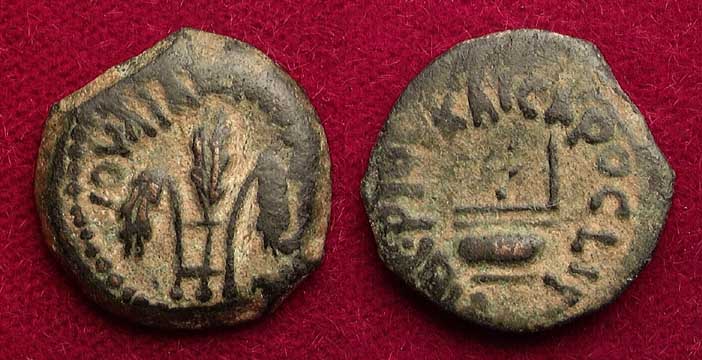
Balossino and Prof. Pierluigi Baima Ballone confirmed that Filas was also correct in discovering over the Shroudman's left eye, an image of a Roman simpulum or sacrificial vessel, and three barley sheaves[26], which were features only of a Pontius Pilate Julia lepton coin, which [Above (enlarge)[27]: Julia (ΙΟΥΛΙΑ) lepton with three barley sheaves on one side (reverse) and a simpulum (Roman sacrificial vessel) and Greek letters "Tiberius Caesar" on the other (obverse). The "LΙϚ" ("LIS") on the obverse indicates the coin was issued in the 16th year of the reign of Tiberius Caesar, which was AD 29-30[28].]

was only struck in AD 29-30, on the death in that year of Livia Drusilla (58 BC–AD 29), also known as Julia Augusta, who was the mother of Roman Emperor Tiberius (r. AD 14-37) and the wife of former Emperor Augustus (r. 27 BC-AD 14)[29] [see 21Jul09, 10May13b, 03Mar18 & 18Apr20]. Filas's identification of both a Pontius Pilate lituus dilepton over the Shroudman's right eye and a Julia lepton over his left eye was confirmed in 1984 by numismatist Arden Howell Brame, Jr., II (1943-2004)[30].

Madden, in his "History of Jewish Coinage, and of Money in the Old and New Testament" (1864), wrote of the lepton simpulum (or Julia lepton):

"Though Eckhel and Cavendoni have cited [earlier] coins ... similar to the coins with date L. IS (no. 13), it is rather curious that none have yet been discovered; a fact which somewhat confirms the idea of De Saulcy (Num. Jud. p. 145), that Pilate adopted on his accession a new type, and that consequently coins do not exist of the type of the simpulum or lituus previous to A.D. 26"[31]

[Above (enlarge)[32]: Composite item in Madden's "History of Jewish Coinage, and of Money in the Old and New Testament" (1864), pages 147 & 148, re the lepton simpulum (or Julia (ΙΟΥΛΙΑ = Joulia) lepton, struck only in AD 29-30 by Pontius Pilate.]

However, while Balossino and Baima Bollone were unable to to find an image of a coin over the Shroudman's left eye, they did find over the left eyebrow an image of "a cup" resembling a Roman simpulum and the three letters "LIS" consistent with a "lepton simpulum" or Julia lepton, struck only in AD 29-30]:

"The presence of a coin on the left eyelid was considered at the same time as the one on the right. From observation of the two-dimensional and three-dimensional images however, no shape appears that could relate to the imprint of a coin. Observation of the arch of the eyebrows however shows, in the three-dimensional image, a curious protuberance, which suggests it may be due to a foreign body. Enhancement of the two-dimensional image of this area allowed the present author and Prof. Baima Bollone to demonstrate the presence of signs identifiable with a lepton simpulum [Julia lepton]. In particular, from observation of the two-dimensional image (figure 17 [see below]) shapes were glimpsed of a structure calling to mind a cup, and three letters which can be read as LIS. Numismatic experts know that these three letters mean `sixteenth year', where L stands for year, I for 10 and S for 6. So we are talking of year XVI of the Emperor Tiberius, which corresponds to the year 29 of the Christian era. This is the date when the coin was minted, a lepton simpulum (figure 18 [see below]) of which there are numerous examples showing the device of a ritual cup, i.e. a simpulum. This coin circulated in Jewish markets and was given in small change. As well as the simpulum in the centre, the coin bore the inscription ΤΙΒΕΡΙΟΥ ΚΑΙΣΑΡΟϹ with the final initials LIS giving the date"[33].
[Above (enlarge)[34]: Figure 17. Extract of Balossino's computer-processed image of a cup, i.e. a Roman simpulum, over the Shroudman's left eyebrow.]

[Above (enlarge)[35]: Figure 18. Lepton simpulum (Julia lepton) coin struck by Pontius Pilate only in AD 29-30.]

Moroni responded to a criticism by a leading Shroud sceptic, Prof. Antonio Lombatti, that the computer-processed images by Tamburelli, Balossino and Baima-Bollone of coins over the Shroudman's eyes are "mostly due to a photographic enlargement and to computer processing, often arbitrary operations which eliminate stains and shades"[36], by pointing out that some of the symbols and lettering on the coins over both eyes, "are readily visible to the naked eye, and can be photographed with a conventional camera":

"I do not understand why some consider the imprints of the lituus, or auger's wand, on the first coin, and the simpulum, or libational ladle, on the other, to have been electronically manipulated by professors Tamburelli, Balossino and Baima-Bollone, when the imprints of these symbols and some of the lettering are readily visible to the naked eye, and can be photographed with a conventional camera"[37].
To prove his point, in 1998 photographs by Moroni were published showing on a positive photo of the Shroud, as would be seen by looking at it, in which Moroni drew the locations of the coins over the right eye and left eyebrow where some details of them can be seen (next).

[Above (enlarge): Location on a positive photograph of the Shroud, of images of two Pontius Pilate lepton coins: a lituus lepton (AD 29-30) over the right eye [left], and a Julia lepton (AD 29-30) over the left eyebrow[right] [38].]

Moroni also published close-up photos of the above coin images, in which the simpulum on the Julia lepton coin over the left eyebrow can be made out (next).

[Above (enlarge)[39]: Enlargement of the coin image over the left eyebrow of the Shroudman, showing a simpulum which is the major feature only of a Julia lepton, struck only in AD 29-30.]

Although I cannot see on Shroud Scope (Durante 2002, Face Only Vertical) over the right eye the image of a lituus and at least one letter "Κ," that I can see on the Enrie 1931 sepia negative in Vignon (1939) [see above], surprisingly I can see on Shroud Scope, at the location drawn by Moroni (above), over the left eyebrow, the image of a Roman simpulum (see below), with handle and horizontal bars which are

[Above (enlarge)[40]: Image of a Roman simpulum over the left eyebrow of the Shroud man, on a positive photo of the Shroud (Shroud Scope, Durante 2002: Face Only Vertical), which means it would be visible looking at the Shroud with the unaided eye. A simpulum was a feature only of a Julia lepton, which was struck by order of Pontius Pilate only in AD 29-30 (see Madden above). And again Jesus was crucified in AD 30 (see above)!]

evidently depictions of a Roman simpulum's circular rim and hand grips [Right (enlarge)[41].] . And I can dimly see the outline of the coin, but I can't see any letters.

I was originally sceptical of Balossino et al.'s claim that there was an image of a coin over the Shroudman's left eyebrow. Not only did it seem to contradict Jackson and Jumper's VP-8 Image Analyzer claim that "over each eye appeared objects resembling small buttons"[42] which were most likely Pontius Pilate lepton coins[43]. But it also seemed to contradict Filas and Whanger's claim that over the left eye was the image of a coin with barley sheaves, which was a feature of the Julia lepton[44], because the barley sheaves (or corn ears - see Madden above) and the simpulum are on opposite sides of a Julia lepton coin (see above). While it would be possible, that there were two Julia lepton coins, one over the left eye with its reverse, barley sheaves or corn ears, side uppermost, and the other over the left eyebrow with its obverse, simpulum, side uppermost, it would be unlikely. Especially since Balossino's team would have found it if it was there. It is significant that Jackson and Jumper's original VP-8 Image Analyzer photograph

[Above (enlarge): Extract close-up of the original 1977 VP-8 Image Analyzer three-dimensional output of the Shroud face, supposedly showing the "button-like objects" over each eye[45]. But as can be seen, while there is a "button-like object" over the right eye (red arrow), where Balossino et al. found evidence of an AD 29-30 Pontius Pilate dilepton coin (above), there is no "button-like object" over the left eye. But there is a "button-like object" in the region of the left eyebrow (yellow arrow)! In fact, because the VP-8 Image Analyzer only displays degrees of darkness as vertical relief [46], the ridge under which the left "button-like object" is, would be the man's dark eyebrow hair, not his bony eyebrow ridge. So the left-most "button-like object" in Jackson and Jumper's VP-8 Image Analyzer photo is actually over the left eyebrow ridge, where Balossino et al. found evidence of an AD 29-30 Pontius Pilate Julia lepton coin with their computer processing technique (above). Moreover, the ascending series of three protuberances to the left of and above the "button-like object" over the left eyebrow, would be the reversed `3' bloodstain and the single dark protuberance to the right of the object over the left eyebrow would be another large bloodstain (see both above). So the "button-like object" the left eyebrow is exactly where Moroni drew the location of the Julia lepton image (see above)! This is as good as it gets! It's hard to believe that no one has noticed this before, but I can't remember reading it.]

which they included in their original presentation of the coins over the eyes evidence to the 1977 STURP conference in Albuquerque, New Mexico, as can be seen above, while there is a "button-like object" over the right eye (red arrow), there is no "button-like object" over the left eye, but there is one in the region of the left eyebrow (yellow arrow)! So I assume that both Jackson and Jumper, and Filas and Whanger, were wrong about there being an image of a leptom coin over the left eye, and Balossino, et al. are correct about there being an image of a Julia lepton coin over the left eyebrow!

Why would there be a coin over the left eyebrow, rather than the left eye? Balossino suggested that due to the Shroudman's facial swelling, when it subsided in the tomb, the coin placed over the left eyelid settled over the left eyebrow[47]. And/or, my suggestion is that, because the coins would have been placed over the man's closed eyelids, and then the Shroud would have been drawn over the front of the man's head and body, the coin over the left eyelid was displaced slightly.

The discovery, in the late 20th century of two, different AD 29-30 lepton coins over the eyes of the Shroudman, completely excludes medieval forgery of the Shroud[50]. A 14th century artist/forger would be most unlikely to have owned, or had access to, 1st century lepton coins[51]. And even if he did, he would not have been able to imprint their tiny Greek letters 1/32 of an inch (0.8 of a millimetre) high on a linen cloth, let alone in photographic negative[52]! Moreover, even if he could, a medieval artist/forger would not have included such tiny details of a coin that could not be seen for at least another six centuries when photographic and computer imaging techniques would first be able to detect theme[53].

Objections answered:

• `Recent photographs of the Shroud don't show coins over the man's eyes'[54]. This is only partly true-see above the Roman simpulum over the left eyebrow of the Shroudman, in a Durante 2002 Shroud Scope photograph. But it is true that the images of coins over the Shroudman's eyes are clearest in Enrie's 1931 photographs, which were on large glass plates, 15 3/4 in. by 19 5/8 in. (40 by 50 cm.), 11 3/4 in. by 15 3/4 in. (30 by 40 cm.), 9 1/2 in. by 11 3/4 in. (24 by 30 cm.) and 7 in. by 9 1/4 in. (18 by 24 cm.)[56]. The photographic film (or its digital equivalent) in modern cameras is much smaller, and therefore captures less fine detail[57]. Enrie glass plates were coated with a film of high-resolution orthochromatic photographic emulsion to enhance contrast[58]. Enrie's photographs required a long exposure time, compared to modern fast photographic film (or its digital equivalent)[59]. Also, Enrie stretched the cloth taught with metal tacks, but STURP's and other modern photographers held the cloth with magnets, which allowed tiny folds which could have distorted the coin imgages over one or both eyes[60].

• `Jews would not place coins over the eyes of their dead becuse it was a pagan custom to pay Charon, the ferryman of Hades to carry their souls across the river Styx'[61]. But placing coins over the eyes of the dead was common in antiquity among pagan cultures which did not have a mythology about paying a ferryman with them[62]. And coins have been found inside skulls of 1st century Jewish burials that could only have come from the coins having been placed over the Jewish deceased's eyes[63]. And since the lepton, the `widow's mite' (Mk 12:42 & Lk 21:2 KJV), was the lowest value Jewish coin[64], it is self-evident that that Jews were not placing coins over the eyes of their dead to pay for their transport in the afterlife! It was a Jewish custom to close the eyes of their deceased and placing coins over the eyelids was a practical way of keeping the eyelids shut[65]. Moreover, since leptons were acceptable as temple offerings by Jews (as the `widow's mite' example above shows), there is no reason why Jewish religious leaders, as Joseph of Arimathea (Mk 15:43 & Lk 23:50) and Nicodemus (Jn 3:1,10) were, would not have, in their burial of Jesus (Mt 27:57-60; Mk 15:43-46; Lk 23:50-53; Jn 19:38-40), placed a lepton over each of His eyelids to keep them closed[66].

• `Seeing coins over the Shroudman's eyes is pareidolia' - seeing things that aren't there[67]. This was a favourite of the "theological liberal" Dan Porter, on his since closed Shroud of Turin Blog, who dismissed the evidence for the coins over the eyes of the man on the Shroud as "pure pareidolia":

"... But this is so only if you believe that the images of coins are there. I've spent years considering this question; I don't believe they're there. What people see, I think, is pure pareidolia"[10May13c].
But as I pointed out to Porter at the time, pareidolia is (my emphasis):
"...a psychological phenomenon involving a vague and random stimulus (often an image or sound) being perceived as significant ... Common examples include seeing images of animals or faces in clouds ..."[68]

"... the imagined perception of a pattern or meaning where it does not actually exist, as in considering the moon to have human features"[69].

In this Porter is simply ignoring the evidence ... for example, that Jackson, et al. found on their VP-8 Image Analyzer three-dimensional `relief map' of the Shroud, images of two, round, flat objects over the eyes, which were the same size and shape of Pontius Pilate leptons. They did not "imagine" them-the images really are there [I assume that Jackson, et al. wrongly thought the coin over the left eyebrow, was over the left eye]. And this was confirmed by others using different three-dimensional computer processing. Even if the details on the face of those two objects could not be seen, it would still be a reasonable conclusion that they are Pontius Pilate leptons ... Porter blithely dismisses all the evidence above that there are Pontius Pilate coins over the eyes of the man on the Shroud with the `magic' word "pareidolia"! But in so doing he goes far beyond what the word "pareidolia" means"[10May13d].

• `I can't see the coins over the Shroudman's eyes, so those who claim they can see them must be wrong' While I cannot find a quote which actually states that (hence the quote is within single quotation marks), it is inherent in Shroud sceptics' alternative explanation of the coins over the eyes evidence. For example, in the quote of Porter above: "I don't believe they're ["images of coins"] there. What people see, I think, is pure pareidolia," Porter is accusing those of us who can see (to varying degrees) the images of coins over the man's eyes, of being duped like a person who sees "faces in the clouds" and believes they really are there! Leading Shroud sceptic, Joe Nickell, quotes approvingly a fellow Shroud sceptic, Marvin M. Mueller, that those who see images of coins over the Shroudman's eyes, are like those who `see what they want to see' in a Rorschach inkblot test:

"A shroud critic, Dr. Marvin M. Mueller of the Los Alamos National Laboratory, has made a study of Filas' [coins over they eyes] claims, has himself examined the photographs under magnification, and concludes: `The magnified weave patterns in the image areas function somewhat as a Rorschach test-one sees what one wants to see'"[70].
But surely only a tiny minority (if even that), of those who see faces in

[Above (enlarge)[71]: An example of a face in the clouds. But no one would believe that it really was a face. So unless Porter could show that anyone who sees a face in the clouds, believes that it is a real face, his "pure pareidolia" (above) explanation of why those (like me) who see coins over the Shroudman's eyes, and believe they are real images imprinted from real coins that were over the real Shroudman's (Jesus') eyes, fails!]

the clouds, or images in a Rorschach inkblot test, believe they really

[Above (enlarge)[72]: Extract from the first of the ten cards in the Rorschach test. These are supposed to be "humans" but I see two monkeys or meerkats dressed in clothes. But no one, unless they had a serious mental problem, would believe they really were humans, or monkeys, etc. So again, unless Mueller and Nickell could show that those who see humans, or animals, etc, in a Rorschach inkblot test, unless they had a serious mental problem, believe that they are real humans, or animals, etc, their "Rorschach test" (above) explanation of why those (like me) who see coins over the Shroudman's eyes, and believe they are real images imprinted from real coins that were over the real Shroudman's (Jesus') eyes, fails!]

are there. Do Shroud sceptics like Porter, Nickel and Mueller, seriously believe that senior scientists like Balossino and Baima-Bollone are being fooled by the equivalent of faces in the clouds and Rorschach inkblot tests? In this Shroud sceptics are being willfully blind, refusing to see the images of coins over the eyes of the man on the Shroud, which really are there, because they could not then remain Shroud sceptics and might have to become Christians! Of them the wise saying is apt, "There are none so blind as those who will not see"!

• `Balossino et al's claim to have discovered coins over the man's eyes by computer-processing is the result of "arbitrary operations," according to Shroud sceptic Antonio Lombatti' (see above)[73]. But this is disproved by the fact that Tamburelli, et al. didn't confirm Filas and Whanger's claim that there was an image of the reverse side of a Julia lepton coin over the left eyelid of the Shroudman, but instead they found an image of the obverse side of a Julia lepton coin over his left eyebrow. For an example of Lombatti's dishonesty and/or self-delusion regarding the Shroud, see my 15Jun12.

That there are images of two different lepton coins, each struck in AD 29-30 by order of Pontius Pilate, the Roman Governor of Judea from c. 26 to 36 AD, who in AD 30 ordered that Jesus be crucified (see above), is proof beyond reasonable doubt that Jesus is the Man on the Shroud[74]! It is most likely that two dfferent lepton coin minted in AD 29-30 in Judea, were in circulation in the same area and time in which they were both minted[75]. And both coins would have been freshly minted, because Tiberius began his reign on 17 September 14, so 7 April 30, the day of Jesus' death, was still in Tiberius' 16th year (see above)! Also Julia, Tiberius' mother, died on 28 September AD 29, so it is inaccurate to say that the Julia lepton was minted only in AD 29 - it would have been minted from 28 September 29 to 13 September 30, from Julia's death to the end of Tiberius' 16th year, so its accurate minting date was AD 29-30[76].

The 1988 radiocarbon dating of the Shroud claimed that the flax from which its linen was made was harvested between 1260 and 1390[77]. But in addition to its other improbabilities, this would require the medieval forger to obtain two different Pontius Pilate lepton coins, both minted in AD 29-30, AD 30 being the year of Jesus' crucifixion (see above), which was only discovered in the 17th-18th century by Isaac Newton (1642-1727)[78], and somehow imprint their images over Jesus' eyes, except the left one was over His eyebrow!

Prof. Baima Ballone concluded:

"... the indisputable presence of two coins of Pontius Pilate of 29/30 A.D. on photographic images registered by Enrie of the face of the corpse which was wrapped by the Shroud proves a strict connection with the period of death of Jesus. No mediaeval forger could know these coins, as they were only identified by numismatic studies of the last century"[79].
And:
"No more must we rely on tests or calculations; we now have an 'intrinsic' proof, clearly stamped, as it were, upon the Shroud itself. No medieval forger could have accomplished this. ... In my opinion, this latest research is just about 100% proof that the Shroud of Turin truly held the body of the crucified and buried Christ"[80]!
Notes
1. This post is copyright. I grant permission to quote from any part of this post (but not the whole post), provided it includes a reference citing my name, its subject heading, its date and a hyperlink back to this page. [return]
2. "Shroud Exposition Opens In Turin," Shroud.com, 2000. [return]
3. "Nello Balossino," Editrice Effata, Italy, 2021. Translated by Google. [return]
4. Ibid. [return]
5. Ibid. [return]
6. Wilson, I., 2010, "The Shroud: The 2000-Year-Old Mystery Solved," Bantam Press: London, pl.8a. [return]
7. Balossino, N., 1998, "The image on the Shroud: Results of Photography and Information Technology," Neame, A., transl., St Pauls: Ireland, pp.19-20; "A three-dimensional image," Santa Sindone, 2015. [return]
8. Balossino, 1998, p.20; Moretto, G., 1999, "The Shroud: A Guide," Neame, A., transl., Paulist Press: Mahwah NJ, p.51; Balossino, N., "Computer Processing of the Body Image," in Scannerini, S. & Savarino, P., eds, 2000, "The Turin Shroud: Past, Present and Future," International scientific symposium, Turin, 2-5 March 2000," Effatà: Cantalupa, p.117; "A three-dimensional image," Santa Sindone, 2015. [return]
9. Balossino, 1998, pp.19-20. [return]
10. Moretto, 1999, p.51. [return]
11. Tribbe, F.C., 2006, "Portrait of Jesus: The Illustrated Story of the Shroud of Turin," [1983], Paragon House Publishers: St. Paul MN, Second edition, p.125. [return]
12. Balossino, 2000, p.117. [return]
13. Moretto, 1999, p.51. [return]
14. Ibid. [return]
15. Moretto, 1999, p.51. [return]
16. Balossino, 1998, p.20. [return]
17. Moretto, 1999, p.51. [return]
18. Balossino, 1998, pp.28-31; Balossino, 2000, pp.118-119. [return]
19. Balossino, 1998, p.35. [return]
20. Moroni, M., "Pontius Pilate's Coin on the Right Eye of the Man in the Holy Shroud, in the Light of the New Archaeological Findings," in Berard, A., ed., "History, Science, Theology and the Shroud," Symposium Proceedings, St. Louis Missouri, June 22-23, 1991, The Man in the Shroud Committee of Amarillo, Texas: Amarillo TX, 1991, pp.285-286. [return]
21. Balossino, 1998, p.34. [return]
22. Vignon, P., 1939, "Le Saint Suaire de Turin: Devant La Science, L'archéologie, L'histoire, L'iconographie, La Logique," Masson et Cie. Éditeurs: Paris, Second edition, plate I. [return]
23. Balossino, 1998, pp.34-35; Balossino, 2000, pp.120-121. [return]
24. Finegan, J., 1964, "Handbook of Biblical Chronology: Principles of Time Reckoning in the Ancient World and Problems of Chronology in the Bible," Princeton University Press: Princeton NJ, pp.296,300; Doig, K.F., 2015, "New Testament Chronology: Part IV, The Crucifixion of Jesus" & "The 30 CE Crucifixion," 22 April. [return]
25. Moretto, 1999, p.51. [return]
26. Whanger, M. & Whanger, A.D., 1998, "The Shroud of Turin: An Adventure of Discovery," Providence House Publishers: Franklin TN, p.24; Zugibe, F.T., 2005, "The Crucifixion of Jesus: A Forensic Inquiry," M. Evans & Co.: New York NY, p.236. [return]
27. "Edgar L. Owen, Ltd," 16 October 2017. [return]
28. Madden, F.W., Fairholt, F. W. & Reidenbach, R., ed., 1967, "History of Jewish Coinage, and of Money in the Old and New Testament," [1864],Pegasus Publishing Co: San Diego CA, Revised, pp.148-149; Balossino, 1998, pp.37-38; Baima Bollone, P., "Images of Extraneous Objects on the Shroud," in Scannerini & Savarino, 2000, pp.132-133; Balossino, 2000, p.121. [return]
29. Petrosillo, O. & Marinelli, E., "The Enigma of the Shroud: A Challenge to Science," Scerri, L.J., transl., Publishers Enterprises Group: Malta, 1996, p.224; Iannone, J.C., 1998, "The Mystery of the Shroud of Turin: New Scientific Evidence," St Pauls: Staten Island NY, p.38; Whanger & Whanger, 1998, p.24; Guerrera, V., 2001, "The Shroud of Turin: A Case for Authenticity," TAN: Rockford IL, pp.98-99; Zugibe, 2005, p.236; Tribbe, 2006, p.117; Whiting, B., 2006, "The Shroud Story," Harbour Publishing: Strathfield NSW, Australia, p.100; Oxley, M., 2010, "The Challenge of the Shroud: History, Science and the Shroud of Turin," AuthorHouse: Milton Keynes UK, p.177. [return]
30. Wilson, I., 1985, "Some Recent Publications," BSTS Newsletter, No. 9, January, pp.18-20, 19; Morgan, R., 1985, "Filas Coin Work," Shroud News, No. 27, February, p.15. [return]
31. Madden, 1967, pp.147-148. [return]
32. Ibid. [return]
33. Balossino, 1998, pp.37-38. [return]
34. Balossino, 1998, p.37. [return]
35. Moretto, 1999, p.51; Balossino, 1998, p.38. [return]
36. Lombatti, A., 1997, "Doubts concerning the Coins over the Eyes," Letters to the Editor, BSTS Newsletter, No. 45, June/July. [return]
37. Moroni, M., 1997, "Those Contentious 'Coins over the Eyes'...," Letters to the Editor, BSTS Newsletter, No. 46, November/December. [return]
38. Schiatti, L., 1998, "The Shroud: A Guide to the Reading of an Image Full of Mystery," St Pauls: Staten Island NY, p.31. [return]
39. Schiatti, 1998, p.31. [return]
40. Extract from Latendresse, M., 2010, "Shroud Scope: Durante 2002 Face Only Vertical," Sindonology.org. [return]
41. "Simpulum," Forum Ancient Coins. [return]
42. Jackson, J.P., Jumper, E.J., Mottern, R.W. & Stevenson, K.E., ed., 1977, "The Three Dimensional Image On Jesus' Burial Cloth," in Stevenson, K.E., ed., "Proceedings of the 1977 United States Conference of Research on The Shroud of Turin," Holy Shroud Guild: Bronx NY, pp.74-94, 89; Iannone, 1998, p.33. [return]
43. Jackson, et al., 1977, pp.90-91. [return]
44. Whanger & Whanger, 1998, pp.24-25. [return]
45. Jackson, et al., 1977, p.88. [return]
46. Culliton, B.J., 1978, "The Mystery of the Shroud of Turin Challenges 20th-Century Science," Science, Vol. 201, 21 July, pp.235-239; Wilson, I., 1979, "The Shroud of Turin: The Burial Cloth of Jesus?," [1978], Image Books: New York NY, Revised edition, pp.228-229; Morgan, R.H., 1980, "Perpetual Miracle: Secrets of the Holy Shroud of Turin by an Eye Witness," Runciman Press: Manly NSW, Australia, p.132; Adams, F.O., 1982, "Sindon: A Layman's Guide to the Shroud of Turin," Synergy Books: Tempe AZ, p.93; Borkan, M., 1995, "Ecce Homo?: Science and the Authenticity of the Turin Shroud," Vertices, Duke University, Vol. X, No. 2, Winter, pp.18-51, 22; Ruffin, C.B., 1999, "The Shroud of Turin: The Most Up-To-Date Analysis of All the Facts Regarding the Church's Controversial Relic," Our Sunday Visitor: Huntington IN, p.79; Balossino, 2000, p.117; Tribbe, 2006, p.124; Wilson, 2010, p.21; de Wesselow, T., 2012, "The Sign: The Shroud of Turin and the Secret of the Resurrection," Viking: London, p.101. [return]
47. Guerrera, 2001, p.99. [return]
50. Filas, F.L., 1981, "`Missing Link' Coin of Pontius Pilate Proves Authenticity, Place of Origin, and Approximate Dating of the Shroud Of Turin," News Release, Loyola University of Chicago, 1 September, pp.1-4, 2. [return]
51. Moroni, 1991, p.295. [return]
52. Filas, 1981, p.2; Iannone, 1998, p.44. [return]
53. Iannone, 1998, pp.43-44. [return]
54. Antonacci, M., 2000, "Resurrection of the Shroud: New Scientific, Medical, and Archeological Evidence," M. Evans & Co: New York NY, p.104; Fanti, G. & Malfi, P., 2015, "The Shroud of Turin: First Century after Christ!," Pan Stanford: Singapore, p.311. [return]
56. Wuenschel, E.A., 1954, "Self-Portrait of Christ: The Holy Shroud of Turin," Holy Shroud Guild: Esopus NY, Third printing, 1961, p.29; Bulst, W., 1957, "The Shroud of Turin," McKenna, S. & Galvin, J.J., transl., Bruce Publishing Co: Milwaukee WI, p.25. [return]
57. Moroni, 1991, pp.pp.281a-282. [return]
58. Fanti & Malfi, 2015, pp.70, p.311; Antonacci, 2000, p.105. [return]
59. Morgan, 1980, pp.180-181. [return]
60. Filas, F.L., 1980, "The Dating of the Shroud of Turin from Coins of Pontius Pilate," Cogan Productions: Youngtown AZ, p.7; Antonacci, 2000, p.105. [return]
61. Meacham, W., 1983, "The Authentication of the Turin Shroud: An Issue in Archaeological Epistemology," Current Anthropology, Vol. 24, No. 3, June, pp.283-311, 290; Borkan, 1995, p.49; Iannone, 1998, pp.38-39; Whanger & Whanger, 1998, p.30; Ruffin, 1999, p.107; Fanti & Malfi, 2015, p.311. [return]
62. Borkan, 1995, p.49; Iannone, 1998, p.39. [return]
63. Meacham, 1983, p.290; Borkan, 1995, p.49; Whanger & Whanger, 1998, pp.30-31; Ruffin, 1999, pp.107-108. [return]
64. "Metrology IV," in Unger, M.F., 1966, "Unger's Bible Dictionary," [1957], Moody Press: Chicago IL, Third edition, Fifteenth printing, 1969, p.724; Wheaton, D.H., "Money," in Douglas, J.D., et al., eds., "New Bible Dictionary," [1962], Inter-Varsity Press, Leicester UK, Second edition, 1982, Reprinted, 1988, p.791; Zodhiates, S., 1992, "The Complete Word Study Dictionary: New Testament," AMG Publishers: Chattanooga TN, Third printing, 1994, p.917. [return]
65 Borkan, 1995, p.49; Whanger & Whanger, 1998, p.30; Ruffin, 1999, p.107. [return]
66 Jackson, et al., 1977, p.90; Jumper, E., Stevenson, K. & Jackson, J., 1978, "Images of Coins on a Burial Cloth?," The Numismatist, July, Vol. 91, No. 7, pp.1349-1357, 1356; Morgan, 1980, p.135 & Borkan, 1995, p.49. [return]
67. Sessions, L., 2020, "Seeing things that aren't there? It's called pareidolia," Earth Sky, 25 November 25. [return]
68. "Pareidolia," Wikipedia, 2 May 2013. [return]
69. "Pareidolia," World English Dictionary, 2013. [return]
70. Mueller, M., 1982, "The Shroud of Turin: A Critical Appraisal," The Skeptical Inquirer_, Vol. 6, No. 3, Spring, p.24, in Nickell, J., 1987, "Inquest on the Shroud of Turin," [1983], Prometheus Books: Buffalo NY, Revised, Reprinted, 2000, p.39. [return]
71. "Face In Cloud Real Pareidolia Event," 4QEDm 13 June 2014. [return]
72. "File:Rorschach blot 03.jpg," Wikimedia Commons, 28 October 2020. [return]
73. Lombatti, 1997. [return]
74. Adams, 1982, pp.89-90. [return]
75. Antonacci, 2000, p.105. [return]
76. Madden, F.W., Fairholt, F. W. & Reidenbach, R., ed., 1967, "History of Jewish Coinage, and of Money in the Old and New Testament," [1864],Pegasus Publishing Co: San Diego CA, Revised, pp.153K; Wilson, I., 1985, "Some Recent Publications," BSTS Newsletter, No. 9 , January, pp.18-20, 19; Morgan, R., 1985, "Filas Coin Work," Shroud News, No. 27, February, p.15. [return]
77. Gove, H.E., 1996, "Relic, Icon or Hoax?: Carbon Dating the Turin Shroud," Institute of Physics Publishing: Bristol UK, p.301; Wilson, I., 1998, "The Blood and the Shroud: New Evidence that the World's Most Sacred Relic is Real," Simon & Schuster: New York NY, p.7; de Wesselow, 2012, p.160. [return]
78. "Chronology of Jesus," Wikipedia, 11 September 2021. [return]
79. Baima Bollone, 2000, p.135. [return]
80. Iannone, 1998, p.44; Guerrera, 2001, p.99. [return]

Posted 4 August 2021. Updated 20 August 2025.

Wednesday, July 28, 2021

The Shroud is consistent with the man being Jesus #35: The evidence is overwhelming that the Turin Shroud is Jesus' burial sheet!

THE SHROUD IS CONSISTENT WITH THE MAN BEING JESUS #35
Copyright © Stephen E. Jones[1]

This is part #35, "The Shroud is consistent with the man being Jesus," in my series, "The evidence is overwhelming that the Turin Shroud is Jesus’ burial sheet!" For more information about this series, see the "Main index #1" and "Other marks and images #26." See also "The Shroud of Turin: 3. The Bible and the Shroud." Emphases are mine unless otherwise indicated.

[Main index #1] [Previous: The Shroud is consistent with the Bible #34] [Next: The Shroud man and Jesus were beaten #36]


  1. The Bible and the Shroud #33
    1. The Shroud is consistent with the man being Jesus #35

The man on the Shroud is consistent with him being Jesus[2].

[Above (enlarge): "`Crucifixion,' sculpture in wood according to research carried out on the Holy Shroud" by Italian artist Giulio Ricci (1913-95)[3].]

Some of the parallels between the Gospel evidence and the Shroud evidence are summarised below in table form[4] (see a different table in part #34):

Gospel evidenceVersesShroud evidence
Jesus was repeatedly struck in the face.Mt 26:67-68; 27:30; Mk 12:4; 14:65; 15:19; Lk 22:63-64; Jn 18:22; 19:3The man has bruises and swellings around both eyes, both cheeks, the nose, and the chin.
Roman soldiers scourged Jesus.Mt 27:26; Mk 15:15; Jn 19:1The man's body, except for the face, arms and feet, bears the marks of a severe scourging by a Roman flagrum.
Soldiers plaited a crown of thorns and put it on Jesus' head.Mt 27:29; Mk 15:17; Jn 19:2There are numerous puncture wounds in the man's scalp.
Jesus initially was forced to carry his own cross.Jn 19:17Smudging of the scourge wounds on the right shoulder and back indicate that the man had carried a heavy object.
Jesus' cross had to be carried for him, indicating He stumbled and fell under its weight.Mt 27:32; Mk 15:21; Lk 23:26There are cuts and bruises on both knees, indicating falls on a hard surface.
Jesus was nailed to the cross through His hands and feet.Lk 24:39; Jn 20:20, 25-27.The Shroud shows a man pierced through the wrists and feet.
Jesus was already dead on the cross so His legs were not broken.Jn 19:31-33The man in the Shroud died on the cross and his legs were not broken.
A soldier pierced Jesus' side with a spear, to ensure that He was dead, and out came blood and water.Jn 19:34There is a large wound in the side of the man's right chest and a mixture of blood and fluid had flowed from it.
Jesus was buried in a linen shroud.Mt 27:59; Mk 15:46; Lk 23:53The Shroud is linen and bears the imprint of a man which matches the Gospels' description of Jesus' suffering, death, burial and resurrection!

Leading Shroud sceptics admit that the Shroudman is either Jesus or an artistic depiction of Him - see Fr. Herbert Thurston (1856–1939) and Steven Schafersman (quoted approvingly by Joe Nickell) in "#34."

But an agnostic, Yves Delage (1854–1920) [see "1900a"], Professor of Zoology at the Sorbonne, Paris, considered and rejected that the Shroud was a painting (see next) and concluded that the Shroudman actually was Christ:

"Should I speak of the identity of the person who left his image on the shroud? ... On the one hand we have the shroud, probably impregnated with aloes-which brings us to the East outside Egypt-and a crucified man who had been scourged, pierced on the right side and crowned with thorns. On the other hand we have an account - pertaining to history, legend and tradition - showing us Christ as having undergone in Judea the same treatment as we decipher on the body whose image is on the shroud. Is it not natural to bring together these two parallel series and to refer them to the same object? Let us add that, in order that the image should be produced and not later destroyed, it is necessary that the body should remain in presence of the shroud at least twenty- four hours, the time necessary for the formation of the image, and at most a few days, after which there supervenes putrefaction which destroys the image and finally the shroud. Now this is precisely what tradition - more or less apocryphal, I admit - asserts to have happened to Christ who died on Friday and disappeared on Sunday ... I consider Christ as a historical person, and I see no reason why anyone should be scandalised if there exists a material traces of his existence"[5].
However, having shown that the Shroud image was not a painting (see next), and refusing to accept that it was a result of the supernatural resurrection of Jesus, the agnostic Delage, was left with "some physico-chemical phenomenon" as the explanation:
"For these and many other reasons which need not be specified, there results the conviction that the image on the shroud is not a painting made by the hand of man, but that it has been obtained through some physico-chemical phenomenon"[6].
Problem for the forgery theory. (See previous three: #31, #32 and #34). The agnostic Yves Delage (see above), Professor of Zoology at the Sorbonne, Paris, then and now one of the world's leading universities, gave his reasons why the Shroud image is not a painting:

• The unknown 14th century artist would have been greater than the Renaissance (14th-17th century) painters:

"At first sight it would seem that the image on the shroud is ... a painting made for the purpose of a pious fraud. But when this hypothesis is examined with care, we see that it must be rejected for the following reasons: (1) As the shroud is Jesus’ burial sheetated since the fourteenth century, if the image is a faked painting, there must at this epoch have existed an artist-who has remained unknown-capable of executing a work hardly within the power of the greatest Renaissance painters"[7].
• It would have been impossible for a 14th century forger to paint the Shroud image in negative:
"While this is already very difficult to admit for an image painted as a positive, it becomes quite incredible in the case of a negative image, which lacks all aesthetic character in this form and assumes its value only when lights and shades are reversed, while strictly respecting their contours and values. Such an operation would be almost impossible except by photography, an art unknown in the i4th century. The forger, while painting a negative, must have known how to distribute light and shade so that after reversal they would give the figure which he attributed to Christ, and that with a perfect precision: for we know how little is required to change a beautiful head into a caricature, especially when its beauty is due to the expression"[8].
• Why would a 14th century forger have depicted the Shroud image in negative, when it could not have been appreciated by his contemporaries?
"I add this argument whose force will be felt on reflection: Why should this forger have taken the trouble to realise a beauty not visible in his work and discernible only after a reversal which only later was made possible? He was working for his contemporaries and not for the twentieth century and the Academy of Sciences" (emphasis Delage's)[9].
• The Shroud's negative image could not have been the result of a colour reversal because (amongst other things) it is in monochrome:
"The idea that the image could have been painted in positive and changed to negative, as has happened to certain paintings on cloth and certain frescos, is contradicted inter alia by the fact that the image is in monochrome and consequently could not have undergone two inverse modifications from clear to shadow and from shadow to clear"[10].
• The Shroud's image has no outline [see #14], which is alien to the art of the 14th century:
"(2) The image results from the juxtaposition of graded tints, without definite delineation or sketching, like a badly focussed photograph: a procedure quite alien to the artistic conceptions of the fourteenth century"[11].
• The image is realistic, perfect and has no artisic style [see "#16"]:
"(3) The image is strongly realist, impeccable, without defect or omission: only imperfectly does it take account of tradition. it is neither schematic nor conventional: characteristics not to be found in any of the artistic productions of this epoch nor to such an extent in those of any epoch"[12].
• The dumbbell shaped scourge marks were made by a Roman flagrum

[Right (enlarge): Reconstruction by Delage's colleague Paul Vignon (1865-1943)[13], of a Roman flagrum from the scourge marks on the Shroud[14]. One similar to this was recovered in the 19th century from the Roman city of Herculaneum[15] which, with its neighbour Pompeii, was buried in the eruption of Mt Vesuvius in AD 79[16].]

with thongs ending in heavy weights [see 15Jul13], unknown in the 14th century:

"(b) The marks of the flagellation in the form of a dumb-bell, such as might be made by a flagrum with thongs ending in hard heavy masses of the same form, analogous to those in certain archaeological museums. It would be interesting to know if people of the 14th century knew this construction of the flagrum: if they did not. this is a further proof. And the convergence of these marks, downward on the back, crosswise on the thighs, upward on the calves, towards a point where the executioner's hand could be! A forger does not think of all that. To be convinced, one need only examine the pictures of the epoch: and yet these artists had an equal desire to represent the truth"[17].
• The Shroudman's image is non-traditional:
"(3) The image ... only imperfectly does it take account of tradition ... (a) The loins, perhaps the genital region, naked: which would have been considered most irreverent. The bishop or the prior who might have ordered the shroud from a monastic or lay artist would not have failed to require the addition of a loin-cloth. For we must place ourselves in the epoch in which the fraud might have been carried out; the shroud destined to enflame the zeal of the faithful should not at the same time shock their feelings or scandalise them. This is so true that the loin-cloth has been added to certain copies. (d) The hands pierced through the wrist and not through the palm, in conformity with the anatomical requirements and against tradition"[18].
It is remarkable that the first arguments against the Shroud being a painting, and for the Shroudman being Jesus, were made by by Delage, an agnostic! Clearly Delage had no pro-Christian bias, rather the opposite. There could be no stronger proof that the Man on the Shroud is Jesus, and not a forger/artist's depiction of him, than that the first to argue this, on purely scientific grounds, was the agnostic, Yves Delage (1854–1920), Professor of Zoology at the Sorbonne, Paris!

I will expand on the items of evidence in, "The Bible and the Shroud #33," in future posts in this series.

Notes
1. This post is copyright. I grant permission to quote from any part of it (but not the whole post), provided it includes a reference citing my name, its subject heading, its date and a hyperlink back to this page. [return]
2. Wilson, I., 1979, "The Shroud of Turin: The Burial Cloth of Jesus?," [1978], Image Books: New York NY, Revised edition, pp.46-53; Stevenson, K.E. & Habermas, G.R., 1981, "Verdict on the Shroud: Evidence for the Death and Resurrection of Jesus Christ," Servant Books: Ann Arbor MI, pp.122-124. [return]
3. Ricci, G., 1978, "The Way of the Cross in the Light of the Holy Shroud," Center for the Study of the Passion of Christ and the Holy Shroud: Milwaukee WI, Second edition, Reprinted, 1982, p.61. [return]
4. Robinson, J.A.T., " The Shroud of Turin and the Grave-Clothes of the Gospels," in Stevenson, K.E., ed., 1977, "Proceedings of the 1977 United States Conference of Research on The Shroud of Turin," Holy Shroud Guild: Bronx NY, pp.22-30, 22-23; Robinson, J.A.T., "The Shroud and the New Testament," in Jennings, P., ed., 1978, "Face to Face with the Turin Shroud," Mayhew-McCrimmon: Great Wakering UK, pp.69-81; Wilson, 1979, pp.46-53; Stevenson & Habermas, 1981, pp.43-54,121-128; Wilson, I., 1986, "The Evidence of the Shroud," Guild Publishing: London, pp.44-45; Ruffin, C.B., 1999, "The Shroud of Turin: The Most Up-To-Date Analysis of All the Facts Regarding the Church's Controversial Relic," Our Sunday Visitor: Huntington IN, pp.40-46; Antonacci, M., 2000, "Resurrection of the Shroud: New Scientific, Medical, and Archeological Evidence," M. Evans & Co: New York NY, p.119; Guerrera, V., 2001, "The Shroud of Turin: A Case for Authenticity," TAN: Rockford IL, pp.31-40. [return]
5. Delage, Y., 1902, "Letter to M. Charles Richet," Review scientifique, 31 May, in O'Rahilly, A. & Gaughan, J.A., ed., 1985, "The Crucified," Kingdom Books: Dublin, pp.76-77, 79. [return]
6. Delage, 1902, p.74. [return]
7. Delage, 1902, p.72. [return]
8. Ibid. [return]
9. Delage, 1902, pp.72-73. [return]
10. Delage, 1902, p.73. [return]
11. Ibid. [return]
12. Ibid. [return]
13. Vignon, P., 1939, "Le Suaire de Turin devant la Science, l'Archeologie, l'Histoire, l'Iconographie, la Logique," Masson: Paris, p.56. [return]
14. Wilson, I. & Schwortz, B., 2000, "The Turin Shroud: The Illustrated Evidence," Michael O'Mara Books: London, p.56. [return]
15. de Wesselow, 2012, p.144O. [return]
16. "Herculaneum," Wikipedia, 14 July 2021. [return]
17. Delage, 1902, p.73. [return]
18. Ibid. [return]

Posted 28 July 2021. Updated 20 August 2025.