TWENTY-FIRST CENTURY (1)
© Stephen E. Jones[1]
This is part #31, "Twenty-first century" (1) of my "Chronology of the Turin Shroud: AD 30 - present" series. For more information about this series see the Index #1. To save time I have quoted from some articles without quotation marks because I changed the wording for clarity, but I have provided a link to each article. Emphases are mine unless otherwise indicated. This page was initially based on Ian Wilson's 1996, "Highlights of the Undisputed History: 2000's." See below the devastating refutation by Fanti of ALL painting and powdering with colouring matter Shroud forgery theories"!
[Index #1] [Previous: 20th century (6) #30] [Next: 21st century (2) #32]
21st century (1) (2001-10).
2001 11 August. Death of Prof. Edward Hall (1924–2001) [EHW]. Hall was the Director of the Oxford radiocarbon dating laboratory from 1954 to 1989[EHW], which along with Arizona and Zurich radiocarbon dating laboratories, in 1988 dated the Shroud to 1260-1390[DP89]. [Right: Prof. Edward Hall on 13 October 1988 in the British Museum, London, announcing with Michael Tite (British Museum) and Robert Hedges (Oxford) that the Shroud had been radiocarbon dated to "1260-1390!"[WI98, pl. 3b].]
Hall was an agnostic who frankly admitted that he didn't want the Shroud to be Jesus':
"Professor Hall, who heads the Oxford research laboratory in archaeology and the history of art, said he was not disappointed in the result [of the Shroud's 1260-1390 radiocarbon dating]. 'I have to admit I am an agnostic and I don't want at my time of life to have to change my ideas'"[RT88].Hall showed his anti-Christian bias against the Shroud by publicly denigrating both the Shroud and shroudies (in my book [in progress] I am reluctantly going to use "shroudies" and "sceptics" instead of the mouthfulls "pro-authenticists" and "anti-authenticists"):
"The mix of good science, intricate instrumentation, the attention of the world's press, the ambivalence of the religious authorities and sheer importance of the outcome for so many people appealed to him immensely; he also took pleasure in, as he saw it, the debunking of any conviction that could not be rationally demonstrated. `There was a multi-million-pound business in making forgeries during the 14th century,' he bluntly told a British Museum press conference. `Someone just got a bit of linen, faked it up and flogged it.' And again, `Some people may continue to fight for the authenticity of the shroud, like the Flat Earth Society, but this settles it all as far as we are concerned'"[HT01].But in doing so, Hall refuted the forgery theory. First, because he admitted that the forger was an unknown "someone." But if the forger was part of "a multi-million-pound business" he would have been well-known. Second, a medieval forger would have "just got a bit of linen, faked it up and flogged [sold ] it." But the Shroud is not just "a bit of linen". It is a 4.4 x 1.1 metre (14.4 x 3.6 foot) sheet of herringbone twill fine linen which would have been "ranked with gold, silver and silk" in the first century[DI90, 10-11], and unobtainable in the fourteenth century[WI98, 68]!
And the real `Flat Earthers' in this are Hall and his anti-Shroud ilk! They are the "science deniers":
"Flat Earth advocates are classified by experts in philosophy and physics as science deniers[MFW]."clinging to one experiment 35 years ago and refusing to even consider the overwhelming evidence that the Shroud is Jesus' burial sheet!
2002a April 25-26, 2002: The International Center for the Study of the Shroud of Turin (CIELT), the largest Shroud study organization in France, sponsors their fourth major symposium, the IV Symposium Scientifique International du CIELT, in Paris, France. Many researchers from around the world attend the event and present papers and abstracts regarding current and future Shroud studies. A paper

[Left (enlarge): Large water stains on the Shroud (left) were discovered by Aldo Guerreschi and Michele Salcito not to have been caused by water to extinguish the 1532 fire (only the small water stains were), but exactly match the pattern of the Shroud having been folded (top right) and hididen in a part-filled first century earthenware jar (bottom right). This is from 13Jul22. See also 05Apr18.]
that I have commented on is "Photographic and Computer Studies Concerning the Burn and Water Stains Visible on the Shroud and Their Historical Consequences by Aldo Guerreschi and Michele Salcito" (see above).
2002b June 20-July 22. A small group of textile experts, headed by  Mechtild Flury-Lemberg (1929-) of Switzerland, perform a dramatic and radical "restoration" of the Shroud under the auspices of the Archbishop of Turin and his advisors at the Turin Center for Shroud Studies, and with the full permission of the Vatican. They remove the thirty patches sewn into the cloth by Poor Clare Nuns in 1534 [see "1534"] to repair burn holes from the 1532 fire. They remove the
[Right (enlarge): The Shroud after the 2002 restoration[HR14].]
backing cloth (frequently referred to as the "Holland Cloth") that was sewn onto the back of the Shroud in 1534 to strengthen the fire damaged relic. They photograph the hidden back side of the cloth and then re-attach a new, whiter linen backing cloth. They use lead weights suspended from the edges of the Shroud to "flatten" many of the creases in the cloth and apply steam to certain areas to help accomplish this. They handle the cloth without gloves or special clothing. They scrape away the charred edges of all the burned areas and collect the scrapings into small containers. They perform this restoration in secret, without consulting any of the world's Shroud experts who could have contributed important scientific guidance to ensure that no valuable scientific or historical data was lost or damaged during the restoration. They set off a firestorm of controversy, criticism, debate and recrimination that ultimately engulfs, polarizes and divides the Shroud research community. See the 2002 Website News page. See also Comments On The Restoration, where fourteen noted Shroud experts express their own opinions of the restoration.
2002c 14 October. Textile historian Mechthild Flury-Lemberg (1929-) has become the latest specialist to say that the Turin shroud bearing the features of a crucified man may well be the cloth that enveloped the body of Christ. Disputing inconclusive carbon-dating tests suggesting the shroud hailed from medieval times, Swiss specialist said it could be almost 2,000 years old. Flury-Lemberg examined the back of the shroud, the first researcher ever to do so, and it bore bloodstains, there were no mysterious marks comparable to those on the front of the cloth. She said the outline of the body was only in the top 2 millimeters of the cloth. Flury-Lemberg related that she discovered identical forms of weaving and high-quality sewing on textiles found at Masada, the ancient fortress in southeastern Israel, that hailed from the year 73 A.D. Other first-century cloths found in the Red Sea region showed weaving patterns similar to those of the Turin shroud[CX02].
2004 12 April. The ghostly image of a man's face has emerged on the
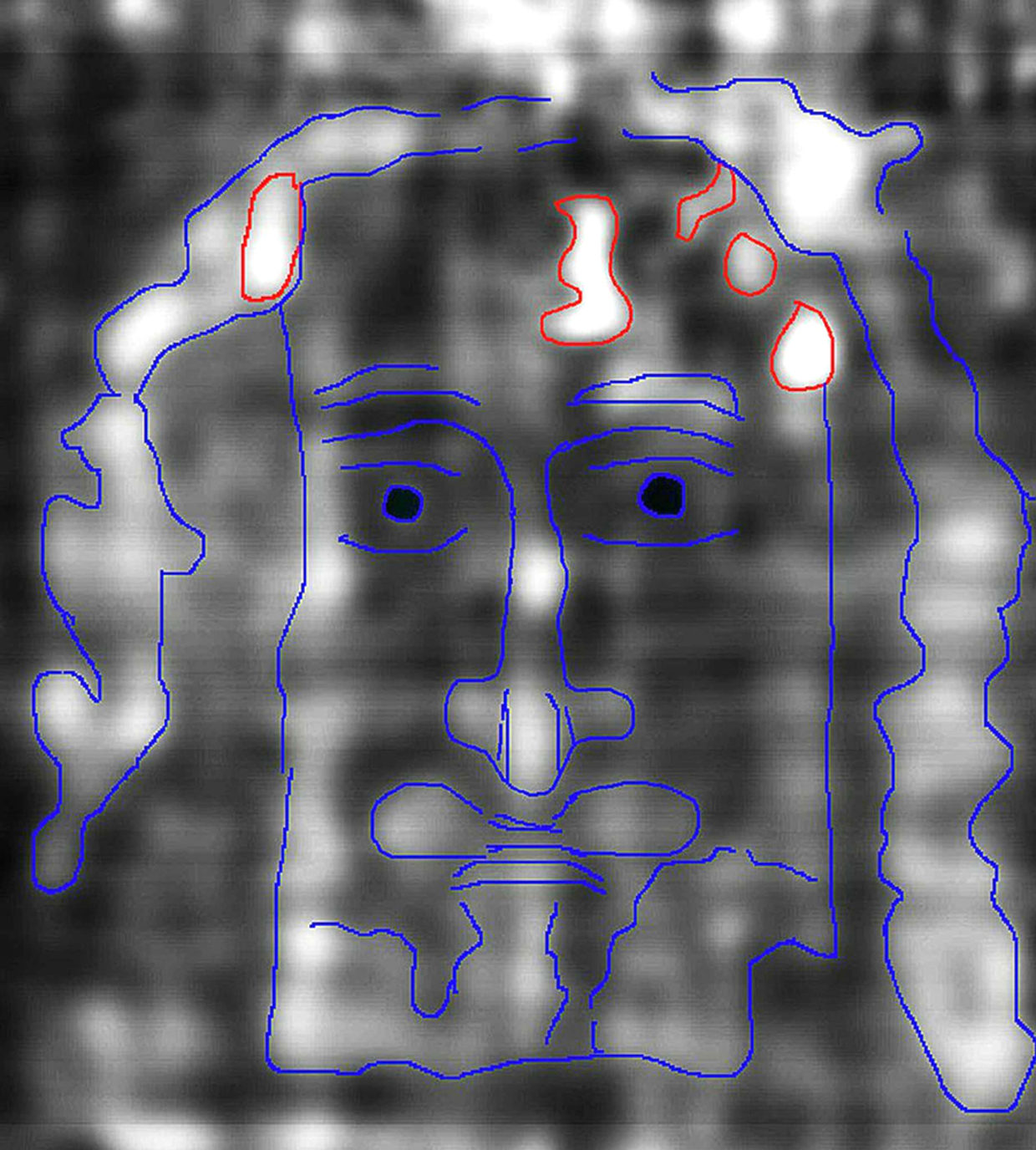
[Left (enlarge): "This photo released on April 13 by the Journal of Optics shows the new face found on the back side of the Turin shroud, as revealed by the studies of Italian scholars Giulio Fanti and Roberto Maggiolo. Franco Tanel / EPA via Sipa"]
reverse side of the Shroud of Turin, the piece of linen believed to have been wrapped around the body of Jesus after he was crucified, scientists say. The discovery, using new digital imaging techniques, adds new complexity to one of the most controversial relics in Christendom. The study, which was published in the Journal of Optics A: Pure and Applied Optics, examined the back surface of the famous handwoven linen. The front side of the shroud, which carries the outline of the body of a man, has been venerated as proof that Christ was resurrected from the grave, yet dismissed by others as a brilliant medieval fake. While a multitude of scientists have investigated the front side of the shroud, the back side has remained hidden for centuries beneath a piece of so-called Holland cloth. Nuns had sewn on the cloth in 1534 to protect the shroud after it had been damaged by fire. And researchers only fully scrutinised the cloth's back surface in 2002, when the 14-foot-long linen was unstitched from the Holland cloth during a restoration project. To the naked eye, the back surface of the shroud showed almost nothing, apart from a peculiar stitching that Mechtild Flury-Lemberg, the Swiss textile expert who performed the restoration work, identified as a style seen in the first century AD or before. The back surface, however, was photographed in detail and the pictures published in a book by Monsignor Giuseppe Ghiberti (1934-), one of the Church's top shroud officials. At the end of the restoration, a new reinforcing cloth was sewn back in place, hiding the shroud's reverse side once more. `As I saw the pictures in the book, I was caught by the perception of a faint image on the back surface of the shroud. I thought that perhaps there was much more that wasn't visible to the naked eye,' said Giulio Fanti, professor of mechanical and thermic measurements at the University of Padua and the study's lead author. Imaging the face Fanti used sophisticated image processing based on direct and inverse Fourier transform, enhancement and template-matching techniques on Ghiberti's pictures to uncover the image of a man's face. Lying behind the known image of the bearded man bearing the marks of crucifixion, the new image had a striking 3-D quality and matched the known face in form, size and position. `Though the image is very faint, features such as nose, eyes, hair, beard and moustache are clearly visible. There are some slight differences with the known face. For example, the nose on the reverse side shows the same extension of both nostrils, unlike the front side, in which the right nostril is less evident,' Fanti said. But the enhancing procedure did not uncover the full body image as it appeared on the front side. `If it does exist, it is masked by the noise of the digital image itself. But we found what it is probably the image of the hands,' Fanti said. The presence of a face on both sides of the shroud would seem an obvious feature in case of a fake: when making a print onto a cloth, paint soaks the cloth's fibres and also reaches the back side. `This is not the case of the shroud. On both sides, the face image is superficial, involving only the outermost linen fibres. When a cross-section of the fabric is made, one extremely superficial image appears above and one below, but there is nothing in the middle. It is extremely difficult to make a fake with these features,' Fanti said ... Fanti's finding matches a hypothesis postulated in 1990 by John Jackson, a U.S. physicist who conducted the first major investigation into the shroud in 1978. Jackson speculated the presence of a faint image on the back surface of the shroud[LR04]. See 18Jan12. The front side of the Shroud was its inner side, and the back side of the Shroud was its the outer side, as this extract from a painting by Giovanni Battista della Rovere (1560-1627) below shows. Therefore, Jackson's Cloth Collapse theory (see 01Sep15, 21Jan16, 11Nov16,

[Left (enlarge)[AM16, 5]: Extract from "The Holy Shroud" by Giovanni Battista della Rovere (1560-1627), showing how the man's image is on the inner side of the Shroud and the previously hidden back side of the Shroud was its outer side.]
22Dec16, 05Feb17 & 03Jun17) did predict that "the frontal image should reside on both sides of the Shroud":
"However, the above reasoning leads to one other prediction concerning the superficiality of the image; the frontal image should reside on both sides of the Shroud, whereas the dorsal image should reside on only one side. The reason is that when the upper part of the Shroud falls into the body region, radiation from the body impinges upon both sides of the cloth. However, in the case of the dorsal image, radiation impinges from only one side because the cloth there never moves into the body. Unfortunately, there are no suitable data available to test this prediction because the reverse side of the Shroud has been covered since 1534 with a backing cloth. But if such a prediction could be confirmed by a future examination of the reverse side, then the theory proposed herein would be given considerable support. It is likely, however, that if a frontal image discoloration exists on the reverse surface of the Shroud, it would be somewhat less intense than the discoloration which is observed on the normal viewing side because that side presumably entered the [mechanically transparent] body first"[JJ91, 342-343].
Why would, and how could, a medieval forger depict two extremely superficial and three-dimensional images of Jesus on the Shroud? This is further evidence that the Shroud image is a "snapshot" of Jesus' resurrection!:
"Even from the limited available information, a hypothetical glimpse of the power operating at the moment of creation of the Shroud's image may be ventured. In the darkness of the Jerusalem tomb the dead body of Jesus lay, unwashed, covered in blood, on a stone slab. Suddenly, there is a burst of mysterious power from it. In that instant ... the body becomes indelibly fused onto the cloth, preserving for posterity a literal `snapshot' of the Resurrection"[WI79, 251]2005a 20 January. A peer reviewed scientific paper by Raymond N. Rogers (1927–2005), retired Fellow of the Los Alamos National Laboratory, is published in the journal Thermochimica Acta, Volume 425, Issues 1-2, Pages 189-194. Titled "Studies on the radiocarbon sample from the Shroud of Turin," the paper concludes: "As unlikely as it seems, the sample used to test the age of the Shroud of Turin in 1988 was taken from a rewoven area of the Shroud. Pyrolysis-mass spectrometry results from the sample area coupled with microscopic and microchemical observations prove that the radiocarbon sample was not part of the original cloth of the Shroud of Turin. The radiocarbon date was thus not valid for determining the true age of the Shroud." Rogers' paper is extremely important as it provides a credible scientific argument for redating the cloth to determine its actual age. Here is a quote which summarises Rogers' paper:
"Shroud of Turin Chemical analysis shows the cloth that formed the Shroud of Turin is up to 3000 years old ... The Shroud of Turin, the piece of linen long-believed to have been wrapped around Jesus' body after the crucifixion, is much older than radiocarbon tests suggest, according to new microchemical research. Published in the 20 January issue of Thermochimica Acta, a peer-reviewed chemistry journal, the study dismisses the results of the 1988 carbon-14 dating .... `As unlikely as it seems, the sample used to test the age of the shroud in 1988 was taken from a rewoven area of the shroud. Indeed, the patch was very carefully made. The yarn has the same twist as the main part of the cloth, and it was stained to match the colour,' says Raymond Rogers, a retired chemist from Los Alamos National Laboratories and former member of the STURP (Shroud of Turin Research Project) team of US scientists that examined the Shroud in 1978 ... The latest research In his study, Rogers analysed and compared the radiocarbon sample with other samples from the controversial cloth. `As part of the STURP research project, I took 32 adhesive-tape samples from all areas of the shroud in 1978, including some patches and the Holland cloth. I also obtained the authentic samples used in the radiocarbon dating,' Rogers says. It emerged that the radiocarbon sample has completely different chemical properties than the main part of the shroud, Rogers says. `The radiocarbon sample had been dyed, most likely to match the colour of the older, sepia-coloured cloth...,' says Rogers. Microchemistry reveals a different date ... These [tests] revealed the presence of vanillin in the radiocarbon sample and in the Holland cloth, but not in the rest of the shroud. Vanillin is produced by the thermal decomposition of lignin, a chemical compound of plant material including flax, and levels decrease and disappear with time. It is easily detected on medieval linens, but cannot be found in the very old ones, such as the wrappings of the Dead Sea scrolls. `A determination of the kinetics of vanillin loss suggests that the shroud is between 1300 and 3000 years old,' Rogers writes. According to Tom D'Muhala, the president of the American Shroud of Turin Association for Research [(AMSTAR) and also the founding President of STURP], the new chemical tests produced `conclusive evidence'. `They indicate that the linen shroud is actually very old, much older than the published 1988 radiocarbon date,' D'Muhala says"[LR05].Rogers' vanillin test was the first of four different age of the Shroud tests which yielded a date range in which Jesus' death in AD 30 falls! See 22May22:
| Test | Max/Min | Range |
| Vanillin | 150 BC ±850 | 1000 BC-AD 700 |
| FT-IR | 300 BC ±400 | 700 BC-AD 100 |
| Raman | 200 BC ± 500 | 700 BC-AD 300 |
| Mechanical | 400 AD ± 400 | AD 0 - AD 800 |
2005b 8-11. The 3rd International Dallas Conference on the Shroud of Turin, jointly sponsored by The Holy Shroud Guild and the American Shroud of Turin Association for Research (AM*STAR) in collaboration with the Centro Internationale de Sindonologia, of Turin, Italy, is held in Dallas, Texas. This was the first Shroud conference to have international co-sponsors. Papers included: "Further Studies on the Scorches and the Watermarks" by Aldo Guerreschi.
2007 30 June. My first post on this my The Shroud of Turin blog! I had come from a background of debating evolution on the Internet and:
"My interest in the Shroud of Turin began in January 2005 when, as I posted to my then Yahoo group, after reading Stevenson & Habermas' `Verdict on the Shroud' (1981), I accepted (then provisionally but now fully) that the Shroud of Turin is the actual burial sheet of Jesus Christ and therefore extrabiblical evidence of His death and resurrection. Before then I knew very little about the Shroud and, to the extent that I thought about it at all, I assumed it was just another medieval fake relic. I created this blog because I have become increasingly interested in the Shroud as empirical evidence that Christianity is true and therefore that Naturalism (i.e. the philosophy that nature is all there is = there is no supernatural = there is no God, which dominates science and our secular Western society generally), is false. The authenticity of the Shroud of Turin has therefore the highest relevance to the creation/evolution/design controversy because `evolution,'in the all-important `standard scientific theory' sense of the word, assumes that Naturalism is true, that is, `God had no part in this process' (my emphasis) of bringing human beings (and everything else) into existence"[SM02].2008a 14-17 August. Joe Marino, Sue Benford (1958-2009) and the Shroud Science Group, organize and sponsor "The Shroud of Turin: Perspectives On A Multifaceted Enigma," an International Shroud Conference at Ohio State University, Blackwell Hotel. A paper that I hadn't noticed before was: "The Sudarium of Oviedo: A Study of Fiber Structures," by the late Raymond N. Rogers. Rogers concluded (my emphasis):
"The Sudarium of Oviedo shows all of the physical and chemical properties of a very old sample of linen. The types of radiation damage observed in the crystals of its cellulose are very similar to other old linens of known age. Many small deposits of residual lignin can be observed at the growth nodes of the flax fibers. This is probably characteristic of linen samples made in Palestine during Roman times, as described by Pliny the Elder. The technology is certainly not the type used during medieval times in Europe or through the millennia in Egypt. I conclude that there is a finite probability that the Sudarium is related in time and location to the Shroud of Turin"[RR04].2008b 18 August. Botany of the Shroud of Turin and Shroud of Turin: The Holographic Experience Lectures at the Missouri Botanical Garden, St. Louis, by Prof. Avinoam Danin (1939–2015) and Dr Petrus Soons on the Shroud of Turin, believed to be the burial cloth of Jesus of Nazareth. Danin is co-author of the Flora of the Shroud of Turin. Using photographs of the shroud taken in 1978, Danin recently discovered over 300 flowers and plant parts on the head area of the cloth. He has also has studied botanical evidence of a `crown of thorns' and other flowers on the garment . Dr Soons's three-dimensional holograms of
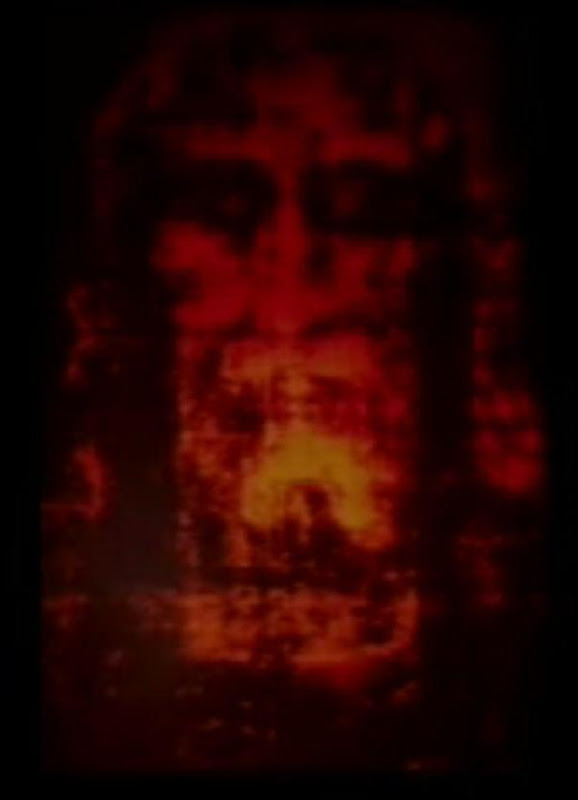 [Right (enlarge): Hologram of the Shroud face by Dr Petrus Soons, showing three Hebrew letters under the beard of the man on the Shroud (best enlarged and viewed through red-green, three-dimensional, anaglyph glasses)[27May23].]
the shroud offer another view. Soon's work involves the digitization of shroud photographs taken in 1931. Soons enhanced the original photos to improve details—resulting in a three-dimensional (3-D) holographic images of the shroud. This unprecedented new view of the artifact yielded the discovery of previously unseen details, confirmation of many previous findings, and a few surprises.
2009a March. "Russian politician: 'My assistant started Estonian cyberwar'" … A junior Russian politician has admitted that a Russian government official might have played some part in the infamous cyberattacks against Estonia two years ago ... Comments by Sergei Markov, a State Duma deputy from the Putin's Unified Russia

[Left (enlarge): "Sergei [or Sergey] Markov in February 2012"[SMW]. The Soviet official who the German hackers (including Karl Koch) sold their hacked secrets to was a "Sergei Markov"[HM91]. See my 30Jul16].
party, on a cybercrime panel … During a discussion on information warfare in the 21st century, moderated by US-based Russian journalist Nargiz Asadova, Markov unexpectedly went into a Boris Yeltsin-style rant, Radio Free Europe reports. `About the cyberattack on Estonia... don't worry, that attack was carried out by my assistant. I won't tell you his name, because then he might not be able to get visas,' he said. Markov explained his assistant was in `one of the unrecognized republics' during the 2007 dispute with Estonia where he decided on his own initiative that `something bad had to be done to these fascists' before launching a cyberattack. `Turns out it was purely a reaction from civil society and, incidentally, such things will happen more and more,' he added. Civil unrest in Estonia over the relocation of Soviet-era WWII memorials in April 2007 was followed by sustained denial of service attacks against the Baltic nation’s government, bank and media websites. The attacks stemmed from botnet networks of compromised PCs. Estonia makes heavy use of the internet so the attack caused a great deal of inconvenience, while acting as a wake-up about cyberwarfare. Estonian ministers blamed Russian government for instigating the attacks, an accusation the Kremlin robustly denied at the time …"[LJ09].
2009b April. "Turin Shroud could be genuine, scientist has said. Radiocarbon dating carried out in 1988 was performed on an area of the relic that was repaired in the 16th century, according to Ray Rogers (1927–2005), who helped lead the Shroud of Turin Research Project (STURP). At the time he argued firmly that the shroud, which bears a Christlike image, was a clever forgery. But in a video made shortly before his death three years ago, he said facts had come to light that indicated the shroud could be genuine. Rogers, a chemist from the Los Alamos National Laboratory in New Mexico, said ... After the 1988 investigation I'd given up on the shroud. `But now I am coming to the conclusion that it has a very good chance of being the piece of cloth that was used to bury the historic Jesus.' He came to his conclusion after re-examining a theory from two amateur scientists that he had earlier dismissed as being from `the lunatic fringe'. Sue Benford and Joe Marino, from Ohio, suspected the 1988 sample was from a damaged section of the linen shroud repaired in the 16th century after being

[Above (enlarge)[MJ19]: Photo of the Rogers' sample mentioned in this article which convinced him that Joe Marino and Sue Benford were right about the C-14 sample being part of a medieval repair[MJ23]. Ironically, Shroud sceptic Walter McCrone (1916-2002) detected Madder Rose dye on a Shroud sample loaned to him by Rogers, and McCrone claimed this was evidence that the Shroud was painted[MP08]. But instead it is evidence that the 1260-1390 radiocarbon date of the Shroud is invalid because the laboratories' samples were contaminated with dyed cotton which was part of a 16th century medieval repair!]
damaged in a fire. Rogers said: `I was irritated and determined to prove Sue and Joe wrong.' However, when he came to examine threads taken in 1978 - luckily from the same section as the 1988 sample - he found cotton in them. He said: `The cotton fibres were fairly heavily coated with dye, suggesting they were changed to match the linen during a repair. `I concluded that area of the shroud was manipulated by someone with great skill. `Sue and Joe were right. The worst possible sample for carbon dating was taken. `It consisted of different materials than were used in the shroud itself, so the age we produced was inaccurate.' In the video, made shortly before he died of cancer in March 2005, he said: `I came very close to proving the shroud was used to bury the historic Jesus'"[AS09].
2009c July. "Is the Turin Shroud really a self-portrait by Renaissance man, Leonardo da Vinci? ... Lillian Schwartz (1927- age 95 years!) ... claims that the image is a self-portrait of Leonardo, which was made using a crude photographic technique. Using computer scans she found that the face on the Turin Shroud and a self portrait of Leonardo da Vinci ... lined up perfectly, leading her to suggest that he used a self
 [Above (enlarge): "Self image? Leonardo da Vinci (right) is suspected of faking the image of Christ's face on the Turin Shroud using his own features"[DD09 But there are a `minor' problems. 1) This "Presumed self-portrait of Leonardo" is dated c. 1510[LDW], which is 155 years after the Shroud first appeared in undisputed history in 1355! And 2) imprinting the double full-length image of a man onto a 4.4 x 1.1 metre (14.4 x 3.6 ft) sheet of linen would not be "a crude photographic technique".]
portrait as a model for the painting. ... According to a ... documentary ... Leonardo scorched his facial features on to the linen of the Shroud using a sculpture of his face and a photographic device called a 'camera obscura'. He would have hung the shroud's fabric over a frame in a

[Above (enlarge): How a camera obscura supposedly created the Shroud's image. There are further `minor' problems. 3) Although the camera obscura is known to have existed since the 4th century BC[CBW], no one, including Leonardo, discovered imprinting the image cast by a camera obscura onto a surface "painted with light-sensitive emulsion" (which were made with silver salts not "egg whites and gelatin") until the 1820s. 4) And not just any lens would focus the Sun's rays onto a such a `photographic film'. It had to a be a huge, flawless, quartz crystal lens, which didn't, and couldn't, exist until the Industrial Revolution (1760-1840)! See my "Medieval photography: Nicholas Allen." Also 5) This only shows a head. It needs to show imprinting the double full-length image of a man onto a 4.4 x 1.1 metre (14.4 x 3.6 ft) sheet of linen. Finally, there was no electric light in Leonardo's day. That was invented by "Humphry Davy [1778-1829] in the early 19th century"[ALW]. So 6) Leonardo would have had to use the Sun as his light source. But the passage of the Sun across the sky is directional and the Shroud imge is not directional! See my "Non-directional #17"].
blacked- out room and coated it with a substance to make it light-sensitive, just like photographic film. When the sun's rays passed through a lens in one of the walls, Leonardo's 3D model would have been projected on to the material, creating a permanent image. According to the documentary, da Vinci 'scorched' his facial features onto the linen using a primitive photographic device called a 'camera obscura' ... But Professor John Jackson, director of the Turin Shroud Centre of Colorado, who believes the item dates from the time of Jesus's crucifixion, dismissed the Leonardo hypothesis. 'It is based on some very poor scientific and historical scholarship,' he said. The earliest known record of the shroud appears on a commemorative medallion struck in the mid-14th century and on display at the Cluny Museum Paris, he added. 'It clearly shows clerics holding up the shroud and is dated to around 100 years before Leonardo was born. 'There is

[Above (enlarge)[LM10]: A lead pilgrim's badge, found in 1855 in the mud under a bridge over the Seine River, Paris and dated 1357, depicts the Shroud at the first Shroud exposition in Lirey c.1355[WI98, 126-127]. Now in the Cluny Museum, Paris, the badge depicts the Shroud being exhibited with the coats of arms of Geoffroy I de Charny (c. 1300–56) (left) and his wife Jeanne de Vergy (c.1332–1428) (right) [LM10]]
no evidence whatsoever that Leonardo was involved in the shroud.' The professor believes the radiocarbon dating of the shroud was wrong because the sample was contaminated."
2009d October. "An Italian scientist says he has reproduced the Shroud of Turin, a feat that he says proves definitively that the linen

[Above enlarge[PP09]: The face of the Shroud (L) compared with Garlaschelli's shroud's face (R)]. When enlarged, Garlaschelli's face image is seen to be unrealistically cartoon-like compared to the Shroud's.]
some Christians revere as Jesus Christ's burial cloth is a medieval fake. ... "We have shown that is possible to reproduce something which has the same characteristics as the Shroud," Luigi Garlaschelli ... A professor of organic chemistry at the University of Pavia [said] ... Carbon dating tests by laboratories in Oxford, Zurich and Tucson, Arizona in 1988 caused a sensation by dating it from between 1260 and 1390 ... But scientists have thus far been at a loss to explain how the image was left on the cloth. Garlaschelli reproduced the full-sized

[Above (enlarge)[PP09]: The front body of the Shroud (L) compared with Garlaschelli's image (R). It is obvious that the hands, arms and parts of the body of Garlaschelli's shroud are much darker than the Shroud. Failure 6) and 7) below.]
shroud using materials and techniques that were available in the middle ages. They placed a linen sheet flat over a volunteer and then rubbed it with a pigment containing traces of acid. A mask was used for the face ... The pigment was then artificially aged by heating the cloth in an oven and washing it, a process which removed it from the surface but left a fuzzy, half-tone image similar to that on the Shroud. He believes the pigment on the original Shroud faded naturally over the centuries. They then added blood stains, burn holes, scorches and water stains to achieve the final effect ... Garlaschelli received funding for his work by an Italian association of atheists and agnostics ... See my 08Oct09. It is not enough "to reproduce something which has the same characteristics as the Shroud." In my book [in progress] I quote Barrie Schwortz:
"In the end, any attempt at duplicating the image on the Shroud of Turin must match all of its physical and chemical properties, not just a select few" (emphasis original)[SB00].And, "Any explanation of how the Shroudman's image was formed must explain all the Shroud's major features ... Claimed replications of the Shroud which do not include each and every major feature of the Shroud, are a type of `straw man' fallacy. That is, they present a claimed replication of the Shroud which does not replicate all the Shroud's major features, and then claim that they have replicated the Shroud! Major features of the Shroud include: 1) Double body length; 2) Faint; 3) Negative; 4) Three-dimensional; 5) Non-directional; 6) Superficial; 7) Uniform colour; 8) Not painted; 9) Blood real human and 10. Blood first." As for "Garlaschelli reproduced the full-sized shroud," the article only shows a frontal image (see above), and I have never found on the Internet a back image by Garlaschelli (however see 2010b) that Garlaschelli did produce both a front and back side of the Shroud. "They ... then rubbed it with a pigment." Rubbing is directional. Failure 5). Garlaschelli's "the pigment on the original Shroud faded naturally over the centuries" is an admission that there is no pigment on the Shroud! Failure 8). "They then added blood stains ..." The blood was before the image on the Shroud. Failure 10). So Garlaschelli's shroud failed to replicate at least 6 of the Shroud's 10 major featrures: 2) Faint; 5) Non-directional; 6) Superficial; 7) Uniform colour; 8) Not painted; and 10. Blood first! So Garlaschelli's shroud is a straw man: he set up a false shroud and refuted that! So, "scientists ... [are still] ... at a loss to explain how the image was left on the cloth"! I spent time on Garlaschelli's shroud because it is going to be in my book.
2009e December. "'Jesus-era' burial shroud is found near the Old City

[Right (enlarge): Fragment of this woollen shroud, showing its simple two-way weave[MM09].]
of Jerusalem." A team of archaeologists and scientists says it has, for the first time, found pieces of a burial shroud from the time of Jesus in a tomb in Jerusalem. The researchers, from Hebrew University and institutions in Canada and the US, said the shroud was very different from the controversial Turin Shroud. The newly found cloth has a simpler weave than Turin's, the scientists say. The body of a man wrapped in fragments of the shroud was found in a tomb dating from the time of Jesus near the Old City of Jerusalem. The tomb is part of a cemetery called the Field of Blood [Akeldama], where Judas Iscariot is said to have killed himself[Mt 27:8; Acts 1:19]. The researchers believe the man was a Jewish high priest or member of the aristocracy who died of leprosy, the earliest proven case. They say he was wrapped in a cloth made of a simple two-way weave, very different to the complex weave of the Turin Shroud. The researchers believe that the fragments are typical of the burial cloths used at the time of Jesus. As a result, they conclude that the Turin Shroud did not originate from 1st Century Jerusalem[BB09]. See my 17Dec09, where I pointed out that it is statistically fallacious that, from a sample of two surviving 1st century Jerusalem shrouds, out of what must have been many thousands from that area and time that have not survived, to deduce that all those thousands of shrouds that did not survive were like only one of these two surviving shrouds, and therefore the other surviving one, the Shroud, must be a fake! And it was this woollen shroud which is not representative of Jerusalem shrouds in the first century because in the National Geographic article, which is no longer online, the archaeologist who found this shroud, Shimon Gibson, stated:
"The way the wool in the shroud was spun indicates it had been imported from elsewhere in the Mediterranean-something a wealthy Jerusalem family from this period would likely have done"[MM09]!Besides, as I pointed out in my post of 17Dec09, it has never been claimed as an argument in favour of the Shroud that it is typical of first century Jewish burial shrouds in the type and quality of its weave, because "we know from the Gospels that Joseph of Arimathea was a `rich man' and it was he who provided the Shroud used to bury Jesus ... (Mt 27:57-61)"[IJ98, 13]. In my in progress book, I point out that:
"... the Greek word translated `shroud' in the New Testament is sindon, a fine linen sheet. But a sindon was not necessarily a burial shroud[WS00, 44]. The Gospel of Mark mentions a young man (presumably Mark himself) who was wearing only a sindon over his naked body at night[Mk 14:51-52], so presumably it was his bedsheet. In the Septuagint, the third century BC Greek translation of the Old Testament, sindons are `linen garments'[Jdg 14:12-13]. Priestly garments were made of fine linen [Lev 6:10, 2Chr 5:12], so the cloth that became the Shroud may not have been originally intended for that purpose."So Gibson is a case of an archaeologist not understanding his subject matter!
2010a 10 April - 23 May. The Shroud is displayed publicly for the
 [Above: Pope Benedict XVI (1927-2022) prays before the Shroud at its 2010 Exposition[PE10]
first time since 2000, giving the public their first opportunity to see the relic since the controversial "restoration" of 2002.
2010b 4-6 May. The International Workshop on the Scientific Approach to the Acheiropoietos Images is organized by Paolo Di Lazzaro and sponsored by and held at the ENEA Research Center, in Frascati, Italy. A paper at the workshop by Dr Thibault Heimburger, MD and Prof. Giulio Fanti, "Scientific comparison between the Turin Shroud and the first handmade whole copy" critiqued Prof. Luigi Garlaschelli claim above that he had reproduced a man's image on linen, "which has the same characteristics as the Shroud." Their Abstract summarised their paper:
"Luigi Garlaschelli recently provided an interesting `Shroud-like' image. He used a variant of the well-known Nickell's rubbing technique on a sheet lying on the body of a volunteer and a bas relief for the face. For the first time a beautiful whole front and back image made by chemical discoloration of the cellulose was obtained. After having explained the experiments, we examine the characteristics of the image at macroscopic level as well as at fabric, threads and fibers level to compare them with those of the Turin Shroud image. We conclude that most of the critical characteristics of the Turin Shroud image are very different from those of Garlaschelli's image. As a consequence, it is unlikely a forger may have produced the body image on the Turin Shroud by this technique. We conclude the image is still not reproducible"[HF10].To conclude this post, here is a devastating refutation by Fanti of ALL
 [Above (enlarge): "Figure 1.12 On the left, the first superficiality level is shown by the Shroud linen thread model, magnified 300 times, constituted of drinking straws; on the right, the second level of superficiality is highlighted by the fact that, removed from the colored layer, the straw (fiber) is uncolored"[FM15, 22].]
painting and powdering with colouring matter Shroud forgery theories:
"To understand the huge difficulties that a hypothetical artist would have run into in order to obtain results similar to the Shroud, especially at the microscopic level, let us see the model in Fig. 1.12. If ideally we extract a thread of the body image of the Shroud, whose diameter is 0.25 mm (0.0098 in.), and if we magnify it by about 300 times, we can think it as analogous to a bundle of drinking straws. Each straw is, in this case, a linen fiber with a diameter of 0.015 mm (0.00059 in.). From one side of the bundle we can see a dozen colored straws side by side uncolored straws. If we remove the colored film of the linen fiber, we can observe that the cellulose in the inner side is uncolored. Now, let us think of a hypothetical artist who tries to reproduce these characteristics on a linen cloth using a simple painting technique: difficulties seem insuperable. First of all, the artist should dip the brush, not in the color, because there are not pigments on the threads, but in an acid capable of shading the linen chemically. However, the artist has to see what he or she is painting, so the acid (usually transparent) should be pre-emptively colored, though, at work completed, he or she should eliminate any evidence of pigment, because on the Shroud there is no colorant. Since colored fibers are side by side uncolored ones, the brush must have only one bristle with a diameter not superior to 0.01 mm (0.00039 in.). Inexplicably, the artist also has to be able to color the part of the straw in the inner side of the bundle without coloring the adjacent straws, since the color is uniformly distributed around the circumference. Then, the acid has to be placed on the fiber just for a split second because it must have no uncolored cellulose. Besides, the acid has to be spread uniformly along all the straw, that is, all the single fiber. Finally the artist would have to paint in the same way all the million straw-fibers that constitute the Shroud using a microscope (not existing in the Middle Ages) and in the same time observing the Shroud from at least a 1 m distance, corresponding to a 300 m (984 ft.) distance in the straws model, because, as already explained, when we get closer to the Shroud, the body image is not visible anymore. If these difficulties seem unsolvable nowadays, for a hypothetical, though brilliant, medieval artist they are far more problematic!"[FM15, 26-27].
Notes:
1. This post is copyright. I grant permission to extract or quote from any part of it (but not the whole post), provided the extract or quote includes a reference citing my name, its title, its date, and a hyperlink back to this page. [return]
Bibliography
ALW. "Arc lamp: History," Wikipedia, 2 June 2023.
AM16. Antonacci, M., 2016, "Test The Shroud: At the Atomic and Molecular Levels," Forefront Publishing Company: Brentwood TN.
AS09. Adams, S., 2009, "New evidence suggests the Turin Shroud could have been the cloth in which Jesus was buried, as experiments that concluded it was a medieval fake were flawed," Telegraph.co.uk 10 April.
BB09. Bell, B., 2009, "'Jesus-era' burial shroud found," BBC News, Jerusalem, 16 December.
CBW. "Camera obscura: 500 BC to 500 AD: Earliest written observations," Wikipedia, 20 June 2023.
DI90. Dickinson, I., 1990, "The Shroud and the Cubit Measure," BSTS Newsletter, No. 24, January, 8-11.
CX02. "Cloth expert calls shroud of Turin authentic," The Washington Times, 14 October 2002.
DI90. Dickinson, I., 1990, "The Shroud and the Cubit Measure," BSTS Newsletter, No. 24, January, 8-11.
DD09. Derbyshire, D., 2009, "Is the Turin Shroud really a self-portrait by Renaissance man, Leonardo da Vinci?," Daily Mail, 1 July.
DP89. Damon, P.E., et al., 1989, "Radiocarbon Dating of the Shroud of Turin," Nature, Vol. 337, 16 February, 611-615.
EH01. "E.T. Hall; Discovered Piltdown Man Hoax, Shroud of Turin's Age," Los Angeles Times, 22 August 2001.
EHW. "Edward Thomas Hall," Wikipedia, 21 May 2023.
FM15. Fanti, G. & Malfi, P., 2015, "The Shroud of Turin: First Century after Christ!," Pan Stanford: Singapore.
HF10. Heimburger, T. & Fanti, G., 2010, "Scientific comparison between the Turin Shroud and the first handmade whole copy," Proceedings of the International Workshop on the Scientific approach to the Acheiropoietos Images, ENEA Frascati, Italy, 4-6 May 2010 https://www.acheiropoietos.info/proceedings/HeimburgerWeb.pdf (the link doesn't work).
HM91. Hafner, K. & Markoff, J., 1991, "Cyberpunk: Outlaws and Hackers on the Computer Frontier," Corgi: London, reprinted, 1993, 292-293.
HT01. Hedges, R. & Tite M., 2001, "Obituary: Professor Edward Hall," The Independent, 16 August.
HR14. "Image of Full 2002 Restored Shroud," High Resolution Imagery, Shroud University, 2014.
IJ98. Iannone, J.C., 1998, "The Mystery of the Shroud of Turin: New Scientific Evidence," St Pauls: Staten Island NY.
JJ91. Jackson, J.P., 1991, "An Unconventional Hypothesis to Explain all Image Characteristics Found on the Shroud Image," in Berard, A., ed., "History, Science, Theology and the Shroud," Symposium Proceedings, St. Louis Missouri, June 22-23, 1991, The Man in the Shroud Committee of Amarillo, Texas: Amarillo TX, 1991, 325-344.
LDW. "Leonardo da Vinci: Drawings," Wikipedia, 20 June 2023.
LJ09. Leyden, J., 2009, "Russian politician: 'My assistant started Estonian cyberwar'," The Register, 10 March.
LM10. Extract from Latendresse, M., 2010, "A Souvenir from Lirey," Sindonology.org.
WI98. Wilson, I., 1998, "The Blood and the Shroud: New Evidence that the World's Most Sacred Relic is Real," Simon & Schuster: New York NY, pp.126-127.
LR04. Lorenzi, R., 2004, "Turin shroud shows another mystery face," ABC/Discovery News, 12 April.
LR05. Lorenzi, R., 2005, "Turin shroud older than thought," ABC/Discovery News, 26 January.
MJ19. Marino, J., 2019, "[Powerpoint for] The Invisible Reweave and Other Challenges to the Turin Shroud's C-14 Medieval Dating: a Review."
MJ23. Marino, J., 2023, Email 2 July reply to S. Jones, "Re: Can you send me a photo of the Rogers sample in this article which convinced him that you and Sue were right about the C-14 sample being part of a medieval repair?"
MM09. Milstein, M., 2009, "Shroud of Turin Not Jesus', Tomb Discovery Suggests," National Geographic News, 16 December (link no longer works).
MP08. Marino, J.G. & Prior, E.J., 2008, "Chronological History of the Evidence for the Anomalous Nature of the C-14 Sample Area of the Shroud of Turin," November, Shroud.com.
PE10. Povoledo, E., 2010, "A Faded Relic of Christendom Reappears," The New York Times, 3 May.
PP09. Pullella, P., 2009, "Italian scientist reproduces Shroud of Turin," Reuters, 5 October.
LR04. Lorenzi, R., 2004, "Turin shroud shows another mystery face," ABC/Discovery News, 12 April.
RR04. Rogers, R.N., 2004, "The Sudarium of Oviedo: A Study of Fiber Structures," in Fanti, G., ed., 2009, "The Shroud of Turin: Perspectives on a Multifaceted Enigma," Proceedings of the 2008 Columbus Ohio International Conference, August 14-17,
2008, Progetto Libreria: Padua, Italy, pp.49-53.
RT88. Radford, T., 1988, "Shroud dating leaves 'forgery' debate raging," The Guardian, 14 October.
SB00. Schwortz, B.M., 2000, "Is The Shroud of Turin a Medieval Photograph?: A Critical Examination of the Theory," Shroud.com.
SM02. Shermer, M.B., 2002, "The Gradual Illumination of the Mind," Scientific American, February.
SMW. "Sergey Alexandrovich Markov," Wikipedia, 25 June 2016.
WI79. Wilson, I., 1979, "The Shroud of Turin: The Burial Cloth of Jesus Christ?," [1978], Image Books: New York NY, Revised edition.
WI98. Wilson, I., 1998, "The Blood and the Shroud: New Evidence that the World's Most Sacred Relic is Real," Simon & Schuster: New York NY.
Posted 11 June 2023. Updated 8 May 2026.






 Posts
Posts


