Tuesday, November 10, 2015

Shroud of Turin News - October 2015

Shroud of Turin News - October 2015
© Stephen E. Jones
[1]

[Previous: September 2015] [Next: November 2015]

This is the October 2015 issue of my Shroud of Turin News. See the April 2015 issue for more information about this series. Following my editorial, I will add excerpts from Shroud-related October news articles to this post, latest uppermost, with the articles' words in bold to distinguish them from mine.

Contents (click on a link below to go to that article):
"Editorial"
"Shroud of Turin Offers Some DNA"


"Shroud of Turin Offers Some DNA," GenomeWeb, October 06, 2015. A team of Italian researchers has analyzed DNA obtained from the Shroud of Turin, Apart from my Editorial below, the only

[Above: First scene of a YouTube video [no longer online] about this Shroud DNA study[2].]

items of news about the Shroud in October were about this DNA study on the Shroud in the paper, Barcaccia, G., et al., 2015, "Uncovering the sources of DNA found on the Turin Shroud," Nature, Scientific Reports 5, 5 October. I have started an in-depth commentary on that paper (see my posts "`Uncovering the sources of DNA found on the Turin Shroud' #1" and #2, but I now have to interrupt that and comment on these news articles about that study, otherwise they will become stale. a burial cloth that's traditionally thought to have covered Jesus. Not only "traditionally" but the evidence, scientific, historical, artistic and Biblical, is overwhelming that the Turin Shroud is authentic! That is, it really does bear the image of Jesus' crucified and resurrected body! Previous analyses of the shroud have traced its origin to between 1260 and 1390 AD, This was the 1988 "Radiocarbon Dating of the Shroud of Turin," but the evidence is that the 1260-1390 radiocarbon date of the Turin Shroud was the result of a computer hacking! though the chemistry of the linen fibers and the production method used doesn't suggest such a medieval origin, the researchers note. On "the chemistry of the linen fibers" one of the footnotes is to a 2005 paper by Ray Rogers, in which the abstract stated, the "between A.D. 1260 and 1390" radiocarbon date of the Shroud "came as a surprise in view of the technology used to produce the cloth, its chemical composition, and the lack of vanillin in its lignin" which "prompted questions about the validity of the sample":

"In 1988, radiocarbon laboratories at Arizona, Cambridge, and Zurich determined the age of a sample from the Shroud of Turin. They reported that the date of the cloth’s production lay between A.D. 1260 and 1390 with 95% confidence. This came as a surprise in view of the technology used to produce the cloth, its chemical composition, and the lack of vanillin in its lignin. The results prompted questions about the validity of the sample. Preliminary estimates of the kinetics constants for the loss of vanillin from lignin indicate a much older age for the cloth than the radiocarbon analyses. The radiocarbon sampling area is uniquely coated with a yellow - brown plant gum containing dye lakes. Pyrolysis-mass-spectrometry results from the sample area coupled with microscopic and microchemical observations prove that the radiocarbon sample was not part of the original cloth of the Shroud of Turin. The radiocarbon date was thus not valid for determining the true age of the shroud" (my emphasis)[3]
Here is what Rogers wrote in Thermochimica Acta in 2004, which was published in 2005, about the Shroud being "between 1300- and 3000-years old" based on its vanillin content [see 01Dec07, 12Feb08, 27Mar13, 02Apr13 & 02Jan14]:
"The fact that vanillin can not be detected in the lignin on shroud fibers, Dead Sea scrolls linen, and other very old linens indicates that the shroud is quite old. A determination of the kinetics of vanillin loss suggests that the shroud is between 1300- and 3000-years old. Even allowing for errors in the measurements and assumptions about storage conditions, the cloth is unlikely to be as young as 840 years." (Rogers, R.N., 2005, "Studies on the Radiocarbon Sample from the Shroud of Turin," Thermochimica Acta, Vol. 425, Nos 1-2, 20 January, pp.189-194, 192)
If the Shroud was 1300 years old in 2004, its linen would date from ~AD 704. If it was 3000 years old in 2004, its linen would date from ~996BC. That is a range of ~996BC to ~AD 704, or ~146BC ± 850 years. Jesus' crucifixion was in AD 30, which was ~176 years after ~146BC, and the Shroud's flax would have been harvested and its linen woven before AD30.

But, they add that some scholars say the shroud traveled from Jerusalem to Constantinople in 944 AD via Edessa, and from there to Athens and was later in France from 1353 to 1357 and then in Italy, where it's been since 1578. And as I point out in my "#1" post on the article:
"... a wide variety of plant and human DNA found in the dust particles within the space between the underside of the Shroud and its Holland cloth backing, which was created in 1534 [when the backing was sewn on to the Shroud] and only partially first opened in 1978, is far more compatible with the Shroud having had in 1534 a ~1500 year history in its journey from Jerusalem, Syria, Turkey, Greece and France, than a then ~209-274 year history in France alone."
As the team led by Università di Pavia's Antonio Torroni writes in Scientific Reports, they examined DNA obtained from dust vacuumed from the cloth, As previously mentioned, these "dust particles ... [were] vacuumed from the interspace between the Shroud and the Holland Cloth sewn to it" in 1534:
"In 1978 and 1988, dust particles were vacuumed from the interspace between the Shroud and the Holland Cloth sewn to it as reinforcement"[4]
This vacuuming was carried out by Turin microanalyst Prof. Giovanni Riggi (1935-2008):
"In 1978 ... Giovanni Riggi di Numana was authorized, among other things, to vacuum dust samples from the back of the Shroud, samples that have been widely used in the alternative dating methods ... A particular head attached to a vacuum cleaner has been inserted, facing the Shroud's cloth, in the interspace between the sheet and the reinforcement Holland cloth, thus in correspondence of not visible areas. So the machine has vacuumed up the powder contained in this interspace ... During the important analyses performed by STURP in 1978 and the cutting of the Shroud's fabric strip in 1988 further vacuum suctions were performed on the relic."[5]
finding DNA belonging to plants, The plant DNA was displayed on a graph superimposed over a map of each species' centre of origin. As

[Above: Extract from "Figure 1: Plant DNA species found on the Turin Shroud"]

can be seen in this extract from that graph, DNA from plants (red) are found around Jerusalem and Constantinople and the edge of their distribution does not include Turin, let alone Chambéry and Lirey. And moreover, the red group includes the second and third most abundant species. The DNA of the yellow group species includes in its centre of origin, Constantinople, Sanliurfa (formerly Edessa) and Jerusalem, but does not include Europe. In particular, the "Plantain" (Plantago lanceolata), is "a native of Palestine":
"About 100 samples were amplified through this technique and it was possible to reconstruct the nucleotidic structure of about 60 of them, identifying 24 different plant species ... Many of the species detected, like clover (Trifolium repens and Trifolium fragiferum) and rye-grass (Lolium multiflorum), are widespread in the Mediterranean basin, including in the Palestine; others originate from Central Asia but spread up to the Middle East, like the pear tree (Pyrus) and the plum tree (Prunus). The latter two are related to the species Pyrus Cossonii, a tree native of Algeria, and Pyrus syriaca, a pear tree spread in Turkey and Syria. Even more interesting for the reconstruction of the historic journey of the Shroud of Turin is the English plantain (Plantago lanceolata), a native of Palestine. There are then other species, spread over vaster areas (including Europe), which attest the exposition of the Shroud in different geographical areas"[6]

but also to people representing a range of Western Eurasian mitochondrial haplotype groups. These are "differences in human mitochondrial DNA" which "represent the major branch points on the mitochondrial phylogenetic tree":
"In human genetics, a human mitochondrial DNA haplogroup is a haplogroup defined by differences in human mitochondrial DNA. Haplogroups are used to represent the major branch points on the mitochondrial phylogenetic tree."[7]
The most abundant plant species the team identified belong to the genus Picea, which includes a number of species native to Europe like spruce trees. This is to be expected, since the spruce tree sheds its pollen in the Northern Spring (March, April and May), and the Shroud was exhibited in the open air in France and Italy every year for centuries on its feast day, 4th May, from 1495 in Chambéry and then in Turin from 1578:
"In 1958 Pope Pius XII declared that the Feast of the Holy Winding Sheet of Christ (now usually known as the Turin Shroud) was to be kept on the day before Ash Wednesday. ... History ... A Feast of the Holy Winding Sheet of Christ originated about 1495 at Chambéry, in Savoy, to honour the so-called sudario of Christ. It came there in 1432 from Lirey in Burgundy, and is the sheet venerated from 1578 in the royal chapel of the cathedral of Turin. This feast was celebrated on 4 May ... and was approved in 1506 by Pope Julius II; it was kept in Savoy, Piedmont, and Sardinia as the patronal feast of the royal House of Savoy ..." [8]
And before that, the Shroud was publicly exhibited in the open air every Easter for ~19 years by Marguerite de Charny (c. 1390–1460) on the banks of the River Doubs at St Hippolyte in far Eastern France:
"1418 6 July. Because of security risks arising from the wars with England, the Shroud is moved from Lirey to the castle of Montfort, owned by Margaret de Charny's second husband, Humbert, Count de la Roche. A few years later it is moved to St Hippolyte sur Doubs, in Alsace-Lorraine, close to Switzerland. While at St Hippolyte sur Doubs public showings of the Shroud are staged each Easter Sunday in a meadow on the banks of the river Doubs."[9]

"The Shroud was moved to Saint Hippolyte .... Each year the Shroud was displayed in a field called `The Lord’s Field' on the banks of the river Doubs. ... The Shroud had stayed in St Hippolyte for 34 yrs. [sic. from 1418-37 = ~19 years]"[10]
They also identified DNA from plants native to the Mediterranean basin, but also DNA from some New World plants. The DNA from some New World (i.e. the Americas) plants are explained in the study as "introduced in a historical interval later than the Medieval period"[11], although the listing of them in Fanti & Malfi, 2015, pp.404-405 shows that they were also present in Africa and Asia. And again, the Mediterranean Basin does not include Turin, let alone Chambéry or Lirey. So the plant DNA found in the interspace between the underside of the Shroud and its Holland cloth backing which (as previously mentioned) was sewn on in 1534 and only partially opened by STURP in 1978, inside Turin Cathedral, cannot be plausibly explained as having been deposited on the Shroud in the ~274 years between its claimed earliest possible radiocarbon date of 1260[12] and 1534 (let alone the ~209 years between 1325, the date claimed by anti-authenticists as the date of the Shroud[13], and 1354), when the Shroud was then entirely in northern and eastern France. And according to the lead author of study, University of Padua plant geneticist, Prof. Gianni Barcaccia, "the importance of the DNA analysis lies in the great diversity of the species identified, which is atypical" and is "an indication that the Shroud was displayed in very different areas":
"In agreement with Professor Barcaccia, the importance of the DNA analysis lies in the great diversity of the species identified, which is atypical if compared with similar studies that always present a much reduced number of species. They can be related to Asian, African, and European areas. This is an indication that the Shroud was displayed in very different areas ranging from cultivated plains to mountainous areas, from arid to more myths [sic moist?] environments."[14]
Again, this only to be expected if "the shroud traveled from Jerusalem to Constantinople in 944 AD via Edessa, and from there to Athens and was later in France from 1353 ..." (see above). But it is definitely not to be expected, if according to the 1988 radiocarbon dating of the Shroud, "the year the flax had been harvested that formed its linen threads was 1350 AD" (or even 1260 AD), "from the time its historic record began" in c. 1355:
"Based on these 10 one minute runs, with the calibration correction applied, the year the flax had been harvested that formed its linen threads was 1350 AD-the shroud was only 640 years old! It was certainly not Christ's burial cloth but dated from the time its historic record began."[15]
So again, this is yet more evidence that the 1260-1390 radiocarbon date of the Turin Shroud was the result of a computer hacking!

In addition, Torroni and his colleagues identified mitochondrial DNA that belonged to numerous individuals - some six subgroups of haplotype H were present as well as representatives from haplogroups U2, U5, R0a, R7, R8, L3c, M39, and M56. As with the plant DNA, this wide diversity of human mtDNA in the interspace between the underside of the Shroud and its

[Above: Extracts from "Figure 2: Human mtDNA haplogroups found on the Turin Shroud."]

Holland cloth backing, which (again) was sewn on in 1534 in Chambéry, France, and only partially opened in 1978 and 1988 inside Turin Cathedral, is consistent with the Shroud having had at least ~15 centuries history up to 1534, including Palestine, Syria, Turkey, Greece and France. But it is inconsistent with the Shroud having had only a ~2-3 centuries history, in France only, from 1260 up to 1534, as the 1988 radiocarbon dating of the Shroud claimed:

"Very small samples from the Shroud of Turin have been dated by accelerator mass spectrometry in laboratories at Arizona, Oxford and Zurich ... The results provide conclusive evidence that the linen of the Shroud of Turin is mediaeval. ... AD 1260-1390 ..."[16]

Haplogroup H1, the researchers note, is common among Western Europeans, while haplogroup U2 is mostly found in South Asians, though a subgroup of that haplogroup is present in about 1 percent of Europeans, and haplogroup R0a is mostly found among people from the Arabian Peninsula and the Horn of Africa. As can be seen in Figure 2 above, like the plant DNA, there is a wide variety of human mtDNA haplogroups on the Shroud. Only H1, H3, H4 and U5 are fully consistent with the Shroud having had a ~2-3 century history in France alone (as the 1988 radiocarbon dating of 1260-1390 claimed-see above), yet they occur with the lowest frequency. The remainder of the haplogroups are consistent with the Shroud having had at least a ~19 centuries history up to 1534, including Palestine, Syria, Turkey, Greece and France. Indeed, as can be seen in the lower extract of Figure 2, the high frequency mtDNA haplogroups, H13 and H33 have a centre of origin including Jerusalem, Sanliurfa (Edessa) and Constantinople. Of medium frequency is R0a which also includes Jerusalem and Sanliurfa. The highest frequency mtDNA haplogroups are M56, R8 and U2, as well as the medium frequency M39, the centre of origin of which includes India. The high frequency of these latter four mtDNA haplogroups suggests that the flax and/or the linen was manufactured in India, and indeed Barcaccia, et al. point out that the word "Sindon" derives from "Sindia or Sindien, a fabric coming from India." It is no problem for the authenticity of the Shroud if its flax or linen came from India, but there would be a problem for the anti-authenticity alternative because there is no record, and it would seem highly unlikely (to put it mildly) that Indians in any great numbers (indeed any at all) had access to the Shroud in the period 1260-1534, when the Shroud was in France. The Shroud was in the 13-16th centuries, as it is today, displayed but not allowed to be touched by the public.

Torroni and his colleagues say that their findings are consistent with either a medieval, Western European origin for the shroud or a Middle Eastern origin. What they wrote was:

"With regard to the sources of human DNA, the detected haplotypes do not cluster randomly on the entire human mtDNA tree, but only on a specific subset of its branches, corresponding to numerous haplogroups from Western Eurasia and surrounding areas ... This finding not only indicates that many individuals have left traces of their DNA on the TS, but also that they most likely belonged to different ethnic groups and were from far away geographic regions, including Europe, North and East Africa, the Middle East and India. Thus, the sources of these sequences fit well the geographic path of the postulated long journey from the Near East, even if they are also fully compatible with the scenario that among the perhaps thousands of worshippers who came into contact with the relic in France and Italy throughout the centuries, there were many coming from the far away geographic areas where these mtDNA haplogroups are common."[17]
They clearly favour the first, pro-authenticist, scenario, in which "the sources of these sequences fit well the geographic path of the postulated long journey from the Near East." And as for the second, anti-authenticist, scenario, far from it being "fully compatible" with the DNA and historical evidence, it has the following major (if not fatal) problems:

• This second anti-authenticist scenario is inconsistent with the plant DNA evidence (above).

• This plant and human DNA came from the interspace between the underside of the Shroud and its former Holland cloth backing which (again) was sewn on in 1534, meaning that "worshippers ... throughout the centuries" after that could not leave their DNA in that sealed interspace.

• The second, anti-authenticist scenario, does not have that many "centuries" if it wishes to remain consistent with the 1988 radiocarbon dating of 1260-1390. Then at most it would have less than three centuries, the 274 years between 1260 and 1534, and indeed less than two centuries, the 179 years from 1355 (when the Shroud was first publicly displayed in Europe at Lirey, France) and 1534.

• It is highly unlikely that among the "thousands of worshippers who came into contact with the relic in France and Italy" before 1534, there were many (if any) "from far away geographic regions, including Europe, North and East Africa, the Middle East and India." Europe was in a almost continuous state of war in those centuries, and the idea that "thousands of worshippers" from "North and East Africa, the Middle East and India" would be allowed to pass through numerous borders of countries at war, to attend Shroud exhibitions (assuming that they would even know about them), is both ahistorical and unrealistic. It may be genetically possible, but it is historically highly implausible.

• There is no evidence for, and much evidence against, that there were "thousands of worshippers who came into contact with the relic in France and Italy" before 1534 (or even after it), close enough to the Shroud to leave their DNA on it (especially its underside). All the depictions of public Shroud exhibitions in those centuries, show the Shroud being held by bishops on a high platform, well above the "thousands of worshippers" (see below). The Shroud would have been

[Above (enlarge): "Displaying the Shroud in Turin, 1613. Engraving by Antonio Tempesta. AKG Images / De Agostini Picture Library"[18].]

torn to pieces if it was allowed to be handled by those "thousands of worshippers," which it would have to have been for them to leave their DNA on it.

• If it were the case, that "thousands of worshippers who came into contact with the relic in France and Italy," left their DNA on the Shroud, then the European-only haplogroups H1, H3, H4 and U2 would have the highest frequency, not among the lowest, since the vast majority of those "worshippers" (not to mention the Shroud's de Charny and Savoy owners and its ecclesiastical custodians) were Europeans.

The pro-authenticist scenario does not have those problems, because "in the ... faraway past," (i.e. the first through fourth centuries) "thousands of worshippers ... from ... geographic regions, including ... Africa, the Middle East and India" in small Christian congregations, could "have touched, kissed, or come in contact with the Shroud ...":

"More accurate analyses in the process of development could, in the near future, be more precise and give us specific data concerning those people who in the past - even in a faraway past - have touched, kissed, or come in contact with the Shroud ..."[19]
So this DNA on the Shroud is is yet another item in the already overwhelming evidence that the Turin Shroud is Jesus' burial sheet!

I have decided to end this October 2015 issue of my Shroud of Turin News and continue my analysis and comments on the news articles about this DNA study on the Shroud, in a series: "Uncovering the sources of DNA found on the Turin Shroud: News articles." I may then (if it is still worthwhile) continue my series, "Uncovering the sources of DNA found on the Turin Shroud" #1 and #2, with part #3 of my analysis of the study itself.


Editorial. Rex Morgan's Shroud News My scanning and word- processing of issues of Rex Morgan's Shroud News and emailing them to Barrie Schwortz, for him to convert to PDF and eventually put online on his Shroud News archive, continued in October up to issue #30, August 1985. [Right (enlarge)]. It is now up to issue #28 on that archive. Topic index. In my Topic Index, my rate of indexing my old posts has continued to be slow under other pressures, and I am still only up to and including my post of 15 January 2012. In October I blogged 9 posts: "`Uncovering the sources of DNA found on the Turin Shroud' #2," "Yarn #7: The evidence is overwhelming that the Turin Shroud is Jesus' burial sheet!," "Were crowned with thorns #5: Bible and the Shroud: Jesus and the man on the Shroud: Shroud of Turin quotes," "`Uncovering the sources of DNA found on the Turin Shroud' #1," "Shroud of Turin News - September 2015," "Were scourged #4: Jesus and the man on the Shroud: Bible and the Shroud: Shroud of Turin quotes," "Jesus and the man on the Shroud #3: Shroud of Turin quotes," "Bible and the Shroud #2: Shroud of Turin quotes," and "Main index #1: Shroud of Turin quotes." Most pageviews. Google Analytics lists as my blog's pages most viewed for the month to date: "The Shroud of Turin: 3. The Bible and the Shroud," June 9, 2013-153; "Re: Shroud blood ... types as AB ... aged blood always types as AB, so the significance of this ... is unclear," Mar 18, 2011-138; "The Pray Manuscript," Jan 11, 2010-111; "Old blood does not always degenerate to type AB, so the Shroud of Turin's and the Sudarium of Oviedo's AB blood group is significant!," Jul 14, 2012-158; "`Uncovering the sources of DNA found on the Turin Shroud' #1," Oct 18, 2015-75; "Wasn't Jesus' body washed before putting it in the grave?," Sep 30, 2015 - 80. Comments I deleted two comments in October that I considered sub- standard, as per my longstanding stated policies (see lower right):

"Comments are moderated. Those I consider off-topic, offensive or sub-standard will not appear. Except that comments under my latest post can be on any Shroud-related topic without being off-topic. I reserve the right to respond to any comment as a separate blog post."
The first commenter told me to change my language in a post. I reviewed what I wrote and I could see nothing wrong with it. If a reader doesn't like what I write, he/she doesn't have to read my blog. The second deleted comment was just a bare assertion. If a commenter wants to dispute one of my posts, that's OK, but he/she needs to state his/her reasons. [top]


Notes:
1. This post is copyright. Permission is granted to extract or quote from any part of it (but not the whole post), provided the extract or quote includes a reference citing my name, its subject heading, its date, and a hyperlink back to this post. [return]
2. "Shroud Of Turin DNA Indicates Global Origins," Whatevvervideos, October 20, 2015 [no longer online]. [return]
3. Rogers, R.N., 2005, "Studies on the radiocarbon sample from the Shroud of Turin," Thermochimica Acta, 425, pp.189 - 194. [return]
4. Barcaccia, G., et al., 2015, "Uncovering the sources of DNA found on the Turin Shroud," Nature, Scientific Reports 5, Article no. 14484, 5 October. [return]
5. Fanti, G. & Malfi, P., 2015, "The Shroud of Turin: First Century after Christ!," Pan Stanford: Singapore, p.179. [return]
6. Fanti & Malfi, 2015, pp.298-299. [return]
7. "Human mitochondrial DNA haplogroup," Wikipedia, 1 September 2015. [return]
8. "Feast of the Holy Winding Sheet of Christ," Wikipedia, 28 June 2015. [return]
9. Wilson, I., 2010, "The Shroud: The 2000-Year-Old Mystery Solved," Bantam Press: London, p.303. [return]
10. Duncan, H., 2006, "The Turin Shroud in a 15th century Fresco in St Hippolyte," British Society for the Turin Shroud Newsletter, No. 63, June. [return]
11. Barcaccia, et al., 2015. [return]
12. Wilson, I., 1998, "The Blood and the Shroud: New Evidence that the World's Most Sacred Relic is Real," Simon & Schuster: New York NY, p.141. [return]
13. McCrone, W.C., 1999, "Judgment Day for the Shroud of Turin," Prometheus Books: Amherst NY, pp.xxiii, xx, 247; Schafersman, S.D., 1998, "Unraveling the Shroud of Turin," Approfondimento Sindone, Vol. 2; Dutton, D., 2005, "Postscript: Requiem for the Shroud of Turin," Michigan Quarterly Review 23, 1984, pp.243-55. [return]
14. Fanti & Malfi, 2015, p.299. [return]
15. Gove, H.E., 1996, "Relic, Icon or Hoax?: Carbon Dating the Turin Shroud," Institute of Physics Publishing: Bristol UK, p.264. [return]
16. Damon, P.E., et al., 1989, "Radiocarbon Dating of the Shroud of Turin," Nature, Vol. 337, 16th February, pp.611-615, p.611. [return]
17. Barcaccia, et al., 2015. [return]
18. Freeman, C., 2014, "The Origins of the Shroud of Turin," History Today, Vol. 64, Issue 11, 24 October. [return]
19. Fanti & Malfi, 2015, p.301. [return]


Posted 10 November 2015. Updated 12 April 2025.

Monday, November 9, 2015

Were struck in the face #6: Bible and the Shroud: Jesus and the man on the Shroud: Shroud of Turin quotes

Shroud of Turin quotes #6:

WERE STRUCK IN THE FACE

© Stephen E. Jones[1]

This is the "Bible and the Shroud: Jesus and the man on the Shroud: Were struck in the face" page #6 in my Shroud of Turin quotes series. For more information about this series, see the Main Index.

[Above (enlarge): "The Vignon markings-how Byzantine artists created a living likeness from the Shroud image. (1) Transverse streak across forehead, (2) three-sided `square' between brows, (3) V shape at bridge of nose, (4) second V within marking 2, (5) raised right eyebrow, (6) accentuated left cheek, (7) accentuated right cheek, (8) enlarged left nostril, (9) accentuated line between nose and upper lip, (10) heavy line under lower lip, (11) hairless area between lower lip and beard, (12) forked beard, (13) transverse line across throat, (14) heavily accentuated owlish eyes, (15) two strands of hair"[2]. Vignon markings "(6) accentuated left cheek," "(7) accentuated right cheek," and "(8) enlarged left nostril," are the result of the man on the Shroud having been struck in the face, as Jesus was!]

[Main Index] [Previous: Were crowned with thorns #5] [Next: Carried their cross #7]


  1. Bible and the Shroud #2
    1. Jesus and the man on the Shroud #3
      1. Were struck in the face #6
"The Buffeting Christ was repeatedly struck in the face on three occasions-at the night session of the Sanhedrin, when He was first sentenced to death; after the session in the morning, when the sentence of death was ratified; and at the mocking homage paid to Him when He was crowned with thorns. He was struck by the guard, by attendants of the court, apparently by some of the Sanhedrists, and by the Roman soldiers (Mt 26:67-68; Mk 14:65; Lk 22:63-64; Jn 18:22-23; 19:3). The terms used by the Evangelists signify heavy blows that wound or prostrate, blows with the palm of the hand, with the fist, with a rod or switch. The face of the Man of the Shroud was cruelly maltreated. The imprint shows that there were several excoriations, especially on the brow, the orbital arches and the right cheek, where there was also a large swollen bruise. There was an excoriation and a swelling also at the bridge of the nose. The right eyelid is sharply contracted." (Wuenschel, E.A., 1954, "Self-Portrait of Christ: The Holy Shroud of Turin," Holy Shroud Guild: Esopus NY, Third printing, 1961, p.40. Italics original)

"This, then, is the visual evidence, and since it is claimed that the body was that of Jesus, we must examine it against the written evidence we have of him to see how they match. At once the parallels become impressive. Christ was a Jew, of course, and he was crucified. We can consider the extensive bruising, and compare it with the Gospel accounts, Mark's, for instance: `Some began to spit on him, blindfolded him, and struck him with their fists, crying out, `Prophesy!' And the High Priest's men set upon him with blows' (14:65)." (Hoare, R., 1978, "Testimony of the Shroud," St. Martin's Press: New York NY, p.40. Verse corrected)

"The gospels also relate that Jesus was repeatedly struck in the face (Mt 27:30; Mk 15:19; Lk 22:63-64; Jn 19:3). Such a beating can be observed in the image on the Shroud. The man has several bruises and swellings around both eyes, both cheeks, the nose, and the chin." (Stevenson, K.E. & Habermas, G.R., 1981, "Verdict on the Shroud: Evidence for the Death and Resurrection of Jesus Christ," Servant Books: Ann Arbor MI, p.122)

"`This is a 5-foot, 11-inch male Caucasian weighing about 178 pounds. The lesions are as follows: beginning at the head, there are blood flows from numerous puncture wounds on the top and back of the scalp and forehead. The man has been beaten about the face, there is a swelling over one cheek, and he undoubtedly has a black eye. His nose tip is abraded, as would occur from a fall, and it appears that the nasal cartilage may have separated from the bone. ...' [Bucklin, R, 1982, "The Shroud of Turin: a Pathologist's Viewpoint," Legal Medicine Annual, pp. 33-39]." (Heller, J.H., 1983, "Report on the Shroud of Turin," Houghton Mifflin Co: Boston MA, pp.2-3)

"Inevitably, because of the varying backgrounds of such men and the already mentioned subtleties of the Shroud image, not all agree on all details. Nonetheless, across their published findings there is a broad consensus in identifying on the Shroud five distinct, major groups of injuries. The first such group consists of variegated wounds to the head, some distinct, others less so. Among the latter, but consistently pointed out by Bucklin, Willis, and others, are a large swelling on the upper right cheek, just below the eye, and similar damage to the nose. Inferred from this damage is a heavy blow struck across the face." (Wilson, I., 1986, "The Evidence of the Shroud," Guild Publishing: London, p.18)

"And some began ... to strike him ... And the guards received him with blows (Mk 14:65). And they struck his head with a reed (Mk 15:19). Jesus was beaten on two occasions, once before the high priest, chief priests, and the council, and again at the praetorium by the Roman soldiers (Mt 26:67 and 27:30; Mk 14:65 and 15:19; Lk 22:63; Jn 18:22 and 19:3). The man in the Shroud has been beaten about the face and head, which is clearly indicated by the swellings and lacerations evident on the image." (Antonacci, M., 2000, "Resurrection of the Shroud: New Scientific, Medical, and Archeological Evidence," M. Evans & Co: New York NY, p.119. Italics and ellipses original)

"Jesus was struck at the head and spat upon (Mt 26:68, 27:30; Mk 14:65, 15:19; Lk 22:63-64; Jn 18:22, 19:3). The image on the Shroud shows a bruised face, a broken nose and a swollen right eye that is almost closed." (Guerrera, V., 2001, "The Shroud of Turin: A Case for Authenticity," TAN: Rockford IL, p.38. Italics original)

[top]


Notes:
1. This post is copyright. Permission is granted to extract or quote from any quote, one at a time (but not the whole post), provided the extract or quote includes a reference citing my name, its subject heading, its date, and a hyperlink back to this post. [return]
2. Wilson, I., 1978, "The Turin Shroud," Book Club Associates: London, p.82e. [return]

Posted 9 November 2015. Updated 11 April 2025.

Sunday, October 25, 2015

"Uncovering the sources of DNA found on the Turin Shroud" #2

Continuing from part #1, here is part #2 of my comments on the paper, Barcaccia, G., et al., 2015, "Uncovering the sources of DNA found on the Turin Shroud," Nature, Scientific Reports 5, 5 October. The article's words are in bold.

[Above (enlarge): "An archive negative image of the Shroud of Turin (L) in full length next to one created by Luigi Garlaschelli"[1]. Except that these are not "full length," (i.e. not front and back, head to head as the Shroud is) let alone self-evidently not a true replication of the Shroud.]

This study was reported in, "Shroud of Turin Offers Some DNA," GenomeWeb, October 6, 2015. News articles (updated) on this paper include (in date order): "Shroud of Turin DNA Comes from All over World," RealClearScience, October 12, 2015; "Turin Shroud: DNA and pollen from all over the world found on cloth, new study finds," The Independent, 14 October 2015; and "Mystery of the Shroud of Turin deepens: Genetic study reveals the fabric contains DNA from plants found all over the world," Daily Mail, October 19, 2015; "Shroud Of Turin DNA Indicates Global Origins," The Huffington Post, October 19, 2015; "Shroud of Turin's DNA traced to India and plants found 'all over Earth,' new study says," Christian Today, 20 October 2015; "Here's What DNA Analysis of Dust Particles From the Shroud of Turin Found," TheBlaze, October 20, 2015; "The Shroud of Turin: Controversial Cloth Defies Explanation as Study Shows it Has DNA From Around the World," Ancient Origins, 21 October, 2015; "Mystery Engulfs Shroud of Turin: DNA Found From All Over World," The Christian Post, October 21, 2015; "Is It a Fake? DNA Testing Deepens Mystery of Shroud of Turin," LiveScience, October 23, 2015, etc. I will comment on these in my October Shroud of Turin News.

Introduction. The Turin Shroud (TS) is a linen cloth, 4.4 m long and 1.1 m wide, bearing the double image of a man ... This alone is sufficient to establish that the Shroud is authentic. No forger would even attempt to depict Jesus’ "double image" front and back, head to head, on a "4.4 m long and 1.1 m wide" fine "linen cloth". A medieval forger would only have done what Shroud sceptics who claim to have replicated the Shroud have done: depicted only the face of Jesus (Joe Nickell) or at most only the front body image (e.g. Luigi Garlaschelli - see above). Why would a medieval forger depict also a naked full rear view of Jesus?

... who suffered physical trauma in a manner consistent with crucifixion after being beaten, scourged and crowned with thorns1,2. It could have added that the image can only be of Jesus, either His actual body or a forged counterfeit of it. This has been conceded by leading Shroud anti-authenticists. In 1903 Fr. Herbert Thurston (1856–1939) admitted:

"As to the identity of the body whose image is seen on the Shroud, no question is possible. The five wounds, the cruel flagellation, the punctures encircling the head, can still be clearly distinguished ... If this is not the impression of the Christ, it was designed as the counterfeit of that impression. In no other person since the world began could these details be verified" (my emphasis)[2].

And in 1982 modern day Shroud sceptics, Steven D. Schafersman (and Joe Nickell) who cited him approvingly) also conceded:

"As the (red ochre) dust settles briefly over Sindondom, it becomes clear there are only two choices: Either the shroud is authentic (naturally or supernaturally produced by the body of Jesus) or it is a product of human artifice. Asks Steven Schafersman: `Is there a possible third hypothesis? No, and here's why. Both Wilson[3] and Stevenson and Habermas[4] go to great lengths to demonstrate that the man imaged on the shroud must be Jesus Christ and not someone else. After all, the man on this shroud was flogged, crucified, wore a crown of thorns, did not have his legs broken, was nailed to the cross, had his side pierced, and so on. Stevenson and Habermas even calculate the odds as 1 in 83 million that the man on the shroud is not Jesus Christ (and they consider this a very conservative estimate)[5]. I agree with them on all of this. If the shroud is authentic, the image is that of Jesus.'" (my emphasis)[6]

TS is the most important relic of Christianity because the Catholic tradition identifies this burial cloth as that in which the body of Jesus Christ was wrapped before being placed in a Palestine tomb approximately 2000 years ago. "Catholic tradition" maintains that the Shroud is authentic, but the Vatican refuses to confirm (or deny) that the Shroud is authentic. But then as devout Roman Catholic Donald M. Smith pointed out in his 1983 book, "The Letter," which was actually a letter to Pope John Paul II, bound as a book, if the Shroud is not authentic then it can only be the image of someone else tortured and crucified to make it look like Jesus:

"If the carbon-14 dating test was allowed to be conducted on the Shroud of Turin and if it was actually determined that the life of the flax which was used to manufacture the linen of the Shroud was terminated after 100 AD., then two conclusions must follow: 1) The linen of the Shroud of Turin was manufactured after 33 A.D. and after the crucifixion of Jesus of Nazareth. 2) The human being whose image is shown on the Shroud of Turin is not Jesus of Nazareth. ... Your Holiness, if the Shroud was dated to an era after 100 AD., there is another conclusion which also must follow: Sometime between 100 A.D. and 1357 A.D., an evil, cruel and sinful act occurred. A human being was actually made to go through the exact same torture and agonizing death as suffered by Jesus and as reported in the GOSPELS, for the sole purpose of producing a valuable relic ... If the goal of producing a likeness of the only begotten Son of God by such evil means, could in any way be condoned, then the whole principle is based on the theories that `the end justifies the means,' and that `power makes right.' These are the same set of principles of men with character the likes of Nietzsche, Machiavelli and Adolf Hitler. Your Holiness, I believe that it is indeed important to know if the identity of the human being whose image appears on the Shroud of Turin could in no way be that of Jesus, but was in fact a victim who was sacrificed for the sole motive of greed. How can Christians use a physical object as a vehicle to promote the teachings of God's only begotten Son when the physical object was created by evil means and motivated by greed? For we know if the linen was manufactured after the crucifixion of Jesus, there had to be a human victim other than Jesus, who was not only robbed of his life, but who was forced to undergo the agonies of crucifixion. It is not right to venerate an object if that object was created by evil means and for the motive of greed."[7] (emphasis original)
Leaving aside Smith's naive view of radiocarbon dating (as the pro-authenticist archaeologist William Meacham noted, the Shroud's radiocarbon date could have been "4th or 5th centuries [AD], owing to some intractable contamination"[8] yet be authentic), Smith is morally exactly right, that if the Shroud were not authentic, then (given that its image is that of a real human body[9]), it is that of, "A human being [other than Jesus who] was actually made to go through the exact same torture and agonizing death as suffered by Jesus. For the Vatican to not care if the Shroud was the result of such "an evil, cruel and sinful act" is to operate on the "principle [of] `the end justifies the means'," which was the principle "of Nietzsche, Machiavelli and Adolf Hitler." It definitely would "not [be morally and ethically] right to venerate an object if that object [the Shroud] was created by [such] evil means ..."!

Such a scenario is supported by numerous scholars who believe that the journey of TS began in Jerusalem in the year 30 or 33 AD3. The years AD 30 and 33 are the only two in that time period in which the Sabbath was also the Passover[10] as Jesus' death was on the eve of both (Mt 28:1; Mk 15:42; Lk 23:54; Jn 19:31 & Mt 26:2; Mk 14:1; Lk 22:1,15; Jn 18:28,39; 19:14).

After concealment for years, TS would have been first moved to Edessa (now Şanliurfa in Turkey) ... That is, according to Ian Wilson's theory that the Mandylion or Image of Edessa, was the Shroud "doubled in four" (Gk. tetradiplon)[11] which (with the possible exception of the "first" before "moved to Edessa"[12]), most Shroud pro-authenticists (including me) accept.

... and then to Constantinople (now Istanbul in Turkey) in 944 AD. That the Shroud moved from Edessa (irrespective of when it as the Mandylion/Image of Edessa first arrived in Edessa) to Constantinople in 944 is well-established by: 1) In 943 Constantinople's Emperor Romanos I Lekapenos (c. 870–948) sent an army led by General John Curcuas (or) Kourkouas (fl. c. 915–946) to Edessa and laid siege to it, offering to lift the siege and to pay twelve thousand silver pieces, for "the cloth with Jesus's imprint"[13]. That the offer was reluctantly accepted is confirmed by Wikipedia:

"In 943 Kourkouas invaded northern Mesopotamia and besieged the important city of Edessa in 944. As the price for his withdrawal, Kourkouas obtained one of Byzantium's most prized relics, the Mandylion, the holy towel allegedly sent by Jesus Christ to King Abgar V of Edessa."[14]
2) The day after the Mandylion/Shroud had arrived in Constantinople from Edessa on 15 August 944[15], Gregory Referendarius, the Archdeacon of Constantinople's Hagia Sophia cathedral[16], after having had the opportunity overnight to personally examine the Mandylion/Shroud close up, preached a sermon in which he said:
"But Jesus, undergoing the passion of his own free will, believing that human nature fears death – indeed death comes upon the very nature that was made to live – taking this linen cloth he wiped the sweat that was falling down his face like drops of blood in his agony. And miraculously, just as he made everything from nothing in his divine strength, he imprinted the reflection of his form on the linen. ... This reflection, however – let everyone be inspired with the explanation – has been imprinted only by the sweat from the face of the originator of life, falling like drops of blood, and by the finger of God. For these are the beauties that have made up the true imprint of Christ, since after the drops fell, it was embellished by drops from his own side. Both are highly instructive – blood and water there, here sweat and image. Oh equality of happenings, since both have their origin in the same person. The source of living water can be seen and it gives us water, showing us that the origin of the image made by sweat is in fact of the same nature as the origin of that which makes the liquid flow from the side" (My emphasis)[17].
The mention by Gregory of "blood" is a significant advance on the traditional Edessan explanation of the Mandylion's image being due to Jesus' sweat having been imprinted on a towel during His ministry[18]. That night of 15 August 944, alone with the Mandylion/Shroud in Hagia Sophia cathedral, Gregory presumably noticed blood on the image's face and attempted to explain it away as having been imprinted on the cloth in the Garden of Gethsemane when "his [Jesus'] sweat became like great drops of blood falling down to the ground" (Luke 22:44)[19]. But that would not explain his reference to "drops from his own side" and "blood and water" which occurred after Jesus' death on the cross: "one of the soldiers pierced his side with a spear, and at once there came out blood and water." (John 19:34)[20]. So Gregory presumably partially undid the Mandylion's fastenings to examine it more thoroughly and discovered that behind it was at least part of the full-length Shroud? This is consistent with a depiction (below) in the 12th century Madrid Skylitzes, one of 574 miniatures based on the Synopsis of Histories by Greek historian John Skylitzes (c. 1040s-1101) of Emperor Romanos I Lekapenos receiving the Mandylion in Constantinople, and behind it is a full-length, folded, Shroud[21]!

[Above (enlarge): "Emperor Romanos I Lekapenos accepts the Mandylion in Constantinople. A miniature from the so-called Madrid manuscript of `Synopsis of Histories' by Skylitzes"[22].]

A burial cloth, which some historians consider the Shroud, was owned by the Byzantine emperors but disappeared during the Sack of Constantinople in 12044. Leading art historian Hans Belting (1935-)[23] and most, if not all, pro-authenticist (including me) consider that the "sydoines [Old French for sindon] in which Our Lord had been wrapped" which crusader Robert de Clari (c. 1170-1216) saw in Constantinople in 1203:

"... there was another church which was called My Lady Saint Mary of Blachernae, where was kept the sheet [sydoines] in which Our Lord had been wrapped, which every Friday rose up straight, so that one could clearly see the figure [figure] of Our Lord on it; and no one, neither Greek nor French, knew what became of this sheet after the city was taken" (emphasis original)[24]
and which disappeared after the crusaders' sack of Constantinople in 1204, was the Shroud[25]

After this event, TS would have been taken by the crusaders and transferred to Athens (Greece) ... This is the most likely explanation of the Shroud's 151 "missing years" between its disappearance from Constantinople in 1204 to its reappearance at Lirey, France in c. 1355[26]. Othon (Otto) de la Roche (c. 1170-1234)[27] was a Burgundian knight[28] and a commander in the Fourth Crusade (1202-4) which sacked Constantinople in 1204[29]. He commanded Constantinople's District of Blachernae within which was the church where the Shroud was kept[30]. Othon was later made Duke of Athens[31] by the leader of the Fourth Crusade, Boniface I, Marquess of Montferrat (c. 1150–1207)[32]. Evidence that the Shroud was taken from Constantinople to Athens includes a letter of of 1 August 1205 to Pope Innocent III (c. 1160-1216) from Theodore Komnenos Doukas (c. 1200-1253) also known as Theodore Angelus, protesting about the looting of Constantinople by the Fourth Crusade[33], and in particular the "most sacred of all the linen in which our Lord Jesus Christ was wrapped after his death" which was "in Athens":

"In April last year a crusading army, having falsely set out to liberate the Holy Land, instead laid waste the city of Constantine. During the sack, troops of Venice and France looted even the holy sanctuaries. The Venetians partitioned the treasures of gold, silver and ivory, while the French did the same with the relics of the saints and, most sacred of all the linen in which our Lord Jesus Christ was wrapped after his death and before the resurrection. We know that the sacred objects are preserved by their predators in Venice, in France and in other places, the sacred linen in Athens. So many spoils and sacred objects should not be taken contrary to all human and divine laws, nevertheless in your name and in the name of Jesus Christ our Lord, albeit against your will, the barbarians of our age have done just that" (my emphasis) [34]
Theodore later became the ruler of Epirus in then northwestern Greece, a successor state of the Byzantine Empire established in the aftermath of the fall of Constantinople[35]. Theodore's statement to the Pope, only a year after the sack of Constantinople, that he knew the Shroud had been taken to Athens[36] is supported by a letter written in 1207 by Nicholas (or Nikolaos) of Otranto (c. 1155-1235), the Abbot of Casole monastery in southern Italy[37] In 1205 Nicholas, who was fluent in Latin and Greek, accompanied as his interpreter a new Papal legate, Benedict of St Susanna, through Greece to Constantinople[38]. In his 1207 letter, Nicholas wrote:
"When the city [Constantinople] was captured by the French knights, entering as thieves, even in the treasury of the Great Place where the holy objects were placed, they found among other things the precious wood, the crown of thorns, the sandals of the Saviour, the nail, and the spargana which we (later) saw with our own eyes."[39]
The word spargana usually denotes the swaddling clothes of an infant (e.g. Lk 2:7,12), but it is also used of burial linen wrappings[40] and since Nicholas is listing relics of the Passion, he must mean burial linens[41]. Nicholas does not say where he had seen the spargana[42] and the word "(later)" is in Nicholas' Latin, but not in his Greek, version[43]. But in 1206 he and Benedict had traveled through Thessalonica and Athens, so his claim that "we saw with our own eyes" (plural) Jesus' burial linens would more likely apply to Nicholas and Benedict seeing the Shroud recently in Athens rather than Nicholas only seeing them years before in Constantinople[44].

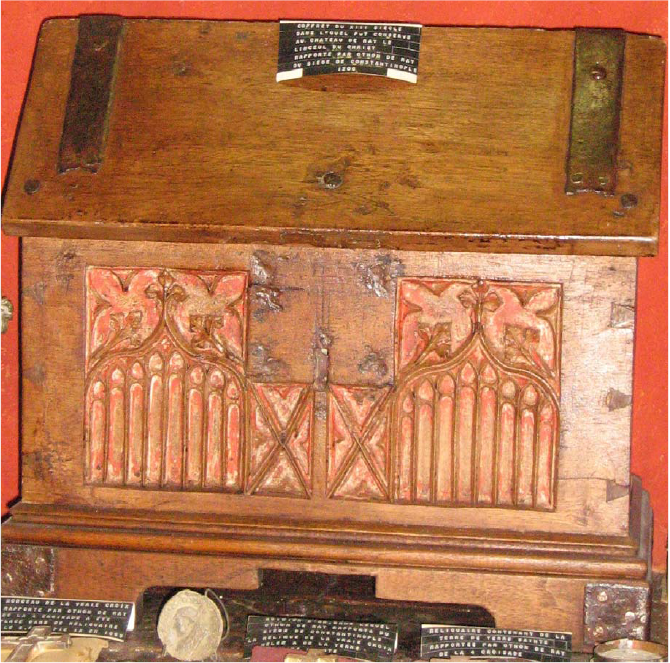
... where it remained until 1225. In 1225 Othon transferred his titles and lands to his sons Guy I (c. 1205-1263) and Othon V (c. 1206-1254) and returned to Burgundy with his second wife Elisabeth de Chappes (1175-1236) and the two youngest children of Othon's first wife, Isabelle de Ray (c. 1190-1212)[45]. The simplest assumption is that Othon then took the Shroud with him to Burgundy[46], although there is a 1750 anonymous handwritten document (MS 826) which states an opinion that Othon had sent the Shroud to his father Pons I de la Roche (1145-95) in 1206, who in turn entrusted it to Amadeus de Tramelay, Archbishop of Besançon (1197–1220)[47]. But this is anachronistic because Othon's father Pons died in 1195[48], before the sack of Constantinople in 1204[49]. However, in the tenth century Ray-sur-Saône chateau in which Othon lived after his return from Athens[50], there is a 13th century wooden chest which according to de la Roche family tradition, was used to transport the Shroud from

[Above (enlarge): Wooden chest preserved in Ray-sur-Saône chateau, which is claimed to be that in which Othon V de la Roche brought the Shroud from Constantinople (see below).[51]]

Athens to France, and indeed a label on it in modern writing states the family tradition that it was used by Otho de Ray to bring the "the Shroud of Christ ... from Constantinople [in] 1206":

"13th century coffer in which was preserved at Ray Castle the Shroud of Christ brought by Otho de Ray from Constantinople. 1206"[52]
However, the style of the carving is late 14th century, although the bottom of the chest may be original[53]. The inner dimensions of the chest in centimetres are ~37.5 long x 16.5 wide x 25 deep[54]. This would neatly fit the 437 x 111 cms Shroud[55], if it were folded twelve times long and eight times wide, i.e. 437/12 = 36.4 cms x 111/8 cms = 13.9 cms[56]. This twelve by eight folds is a simple and economical folding arrangement of the Shroud, and since Othon's family would be unlikely to know the true dimensions of the Shroud if they had never owned it, this ~37.5 cms long x 16.5 cms wide `floor plan' of the bottom of the Ray-sur-Saône chateau chest, which is claimed to have once held the Shroud, is strong evidence that Othon de la Roche really did bring the Shroud with him from Athens (and before that from Constantinople) to his Ray-sur-Saône chateau in Burgundy, France in 1225! However, having said the above, it would seem unlikely that Othon woud

Official documents attest that it was in France at Lirey around the years 1353 to 1357 ... There is a direct ancestral link between Othon de la Roche and Jeanne de Vergy (c. 1332-1428)[57], the second wife of Geoffroy I de Charny (c. 1300–1356), who was the

[Above: (enlarge): Pilgrim's badge, bearing the coats of arms of Geoffroy I de Charny (left) and his wife Jeanne de Vergy (right)[58], from the first undisputed exhibition of the Shroud at Lirey, France in c.1355[59].]

first undisputed owner of the Shroud. "Jeanne was ... a great-great-great-great granddaughter of Othon de La Roche (descended from the marriage of Henri de Vergy and Isobelle de La Roche, granddaughter of Othon"[60]. That direct ancestor-descendant line was as follows: Othon (Otto) IV de la Roche, Duke of Athens (1170-1234) → Othon V de La Roche-sur-L'Ognon (1206-54) (1205-63) → Isabelle (Elisabeth) de La Roche-sur-L'Ognon (1235-78) → Jean I de Vergy (1248-1310) → Guillaume III de Vergy (c. 1290-1360) → Jeanne de Vergy (c. 1332-1428)[61]. From c. 1355 Geoffroy and Jeanne exhibited the Shroud at Lirey church until Geoffroy was killed in the Battle of Poitiers on 19 September 1356[62]. Despite Geoffroy's death, Jeanne continued the first Lirey Shroud exhibition until at least 1357[63]. Following the French defeat at Poitiers, marauding bands of English soldiers formed `companies' and attacked French towns for loot, including nearby Troyes in 1358[64]. So Jeanne presumably had by then taken her young son Geoffroy II de Charny (1352–98), and the Shroud, from Lirey[65] south to the comparative safety of her castle at Montfort-en-Auxois[66]. In about 1359, Jeanne married Aymon IV of Geneva (1324-88), an uncle of Robert of Geneva (1342–94), who in 1378 became Pope Clement VII[67]. Jeanne then took Geoffroy II and the Shroud to the safety of Aymon's lands around Anthon, High Savoy, France. Following Aymon's death in 1388[68], Jeanne returned to Lirey with the Shroud where she and the now adult Geoffroy II exhibited it for a second time at Lirey from 1389[69] for an unknown period, but presumably no later than 1396 when Geoffroy II left to fight in the Battle of Nicopolis, Bulgaria, in which he was fatally wounded and died in 1398[70].

... and then was kept at Chambéry from 1502 to 1578, where passed into the hands of the Dukes of Savoy3,4,5. The Shroud already had been transferred to Duke Louis I of Savoy (1413–65) in 1453[71] by Geoffroy II's eldest child, the twice-widowed, childless and aged[72] Marguerite de Charny (c.1392-1460)[73]. The transfer took place in Geneva[74], but the Shroud would presumably have then been moved within days to the Savoy's administrative centre, Chambéry castle. In 1502 the Shroud was installed by Louis's grandson, Duke Philibert II (1480–1504), in the specially built Sainte Chapelle royal chapel in Chambéry[75].

From 1578, apart from some brief displacements in an effort to hide it during war periods, TS was kept in Turin (Italy) and later placed in the royal chapel of the city Cathedral inside a specially designed shrine where it has been permanently conserved from 1694 to the present. See my "Locations of the Shroud: Chambéry 1471-Turin 1578," "Turin 1578-1694," "Turin 1694-1918" and "1918-Present."

To be continued in part #3 of this series.

Notes:
1. Pullella, P., 2009, "A new taint on the Shroud of Turin?," FaithWorld, October 6. [return]
2. Thurston, H., 1903, "The Holy Shroud and the Verdict of History," The Month, CI, p.19 in Wilson, I., 1979, "The Shroud of Turin: The Burial Cloth of Jesus Christ?," [1978], Image Books: New York NY, Revised edition, p.52. [return]
3. Wilson, 1979, pp.51-53. [return]
4. Stevenson, K.E. & Habermas, G.R., 1981, "Verdict on the Shroud: Evidence for the Death and Resurrection of Jesus Christ," Servant Books: Ann Arbor MI, pp.121-129. [return]
5. Stevenson. & Habermas, 1981, p.128. [return]
6. Schafersman, S.D., "Science, the public, and the Shroud of Turin," The Skeptical Inquirer, Vol. 6, No. 3, Spring 1982, pp.37-56, p.42 in Nickell, J., 1987, "Inquest on the Shroud of Turin," [1983], Prometheus Books: Buffalo NY, Revised, Reprinted, 2000, p.141. [return]
7. Smith, D.M., 1983, "The Letter," DMS Publishing Co: Rancho Palos Verdes CA, pp.24-25. Emphasis original. Footnotes omitted. [return]
8. Meacham, W., 2005, "The Rape of the Turin Shroud: How Christianity's Most Precious Relic was Wrongly Condemned and Violated," Lulu Press: Morrisville NC, p.87. [return]
9. Petrosillo, O. & Marinelli, E., 1996, "The Enigma of the Shroud: A Challenge to Science," Scerri, L.J., transl., Publishers Enterprises Group: Malta, p.223; Wilson, I., 1998, "The Blood and the Shroud: New Evidence that the World's Most Sacred Relic is Real," Simon & Schuster: New York NY, p.27; de Wesselow, T., 2012, "The Sign: The Shroud of Turin and the Secret of the Resurrection," Viking: London, p.148. [return]
10. Finegan, J., 1964, "Handbook of Biblical Chronology: Principles of Time Reckoning in the Ancient World and Problems of Chronology in the Bible," Princeton University Press: Princeton NJ, p.296. [return]
11. Wilson, I., 1986, "The Evidence of the Shroud," Guild Publishing: London, pp.113-114; Wilson, I., 1991, "Holy Faces, Secret Places: The Quest for Jesus' True Likeness," Doubleday: London, pp.141-142; Wilson, 1998, p.152; Wilson, I., 2010, "The Shroud: The 2000-Year-Old Mystery Solved," Bantam Press: London, pp.140-141; Wilson, I. & Schwortz, B., 2000, "The Turin Shroud: The Illustrated Evidence," Michael O'Mara Books: London, pp.110-111. [return]
12. Markwardt, J., 1998, "The Fire and the Portrait," Shroud.com; Markwardt, J., 1999, "Antioch and the Shroud," Shroud.com. [return]
13. Wilson, 1998, p.148. [return]
14. "Romanos I Lekapenos: Campaigns in the East," Wikipedia, 21 October 2015. [return]
15. Wilson, 1998, pp.148-149; Scavone, D.C., "Underscoring the Highly Significant Historical Research of the Shroud," in Tribbe, F.C., 2006, "Portrait of Jesus: The Illustrated Story of the Shroud of Turin," Paragon House Publishers: St. Paul MN, Second edition, p.xxvii. [return]
16. Wilson, 1991, p.143; Scavone, in Tribbe, 2006, p.xxvii. [return]
17. Guscin, M., 2004, "The Sermon of Gregory Referendarius," Shroud.com. [return]
18. Wilson, 1991, p.143. [return]
19. Wilson, 1991, pp.143; Wilson, 1998, p.154, 268. [return]
20. Wilson, 1991, p.143; Wilson, 1998, p.154. [return]
21. Scavone, in Tribbe, 2006, p.xxvii. [return]
22. Juliusz Maszloch, nd., "The Holy Face, il Volto Santo di Manoppello." [return]
23. de Wesselow, 2012, pp.176-177. [return]
24. de Wesselow, 2012, p.175. [return]
25. Wilson, 1979, pp.95-96, 168-169; Wilson, 1986, p.104; Wilson, 1991, pp.155-157; Wilson, 1998, pp.124-125, 142-143; Wilson, 2010, pp.186-187. [return]
26. Wilson, 1979, pp.172-191; Maloney, P.C., "Researching the Shroud of Turin: 1898 to the Present: A Brief Survey of Findings and Views," in Minor, M., Adler, A.D. & Piczek, I., eds., 2002, "The Shroud of Turin: Unraveling the Mystery: Proceedings of the 1998 Dallas Symposium," Alexander Books: Alexander NC, p.34; Tribbe, 2006, pp.26-40, 194; Oxley, M., 2010, "The Challenge of the Shroud: History, Science and the Shroud of Turin," AuthorHouse: Milton Keynes UK, pp.100-114. [return]
27. Jones, S.E., 2015, "de Charny Family Tree," Ancestry.com.au (members only). [return]
28. Scavone, D.C., "The History of the Turin Shroud to the 14th C.," in Berard, A., ed., 1991, "History, Science, Theology and the Shroud," Symposium Proceedings, St. Louis Missouri, June 22-23, 1991, The Man in the Shroud Committee of Amarillo, Texas: Amarillo TX, pp.171-204, p.198. [return]
29. Scavone, D.C., 1989, "The Shroud of Turin: Opposing Viewpoints," Greenhaven Press: San Diego CA, p.96. [return]
30. O'Connell, P. & Carty, C., 1974, "The Holy Shroud and Four Visions," TAN: Rockford IL, pp.7-8; Guerrera, V., 2001, "The Shroud of Turin: A Case for Authenticity," TAN: Rockford IL, p.9. [return]
31. Guerrera, 2001, pp.9-10. [return]
32. Guerrera, 2001, p.8. [return]
33. Piana, A., 2007, "The Shroud's `Missing Years'," British Society for the Turin Shroud Newsletter, No. 66, December, pp.9-25,28-31. [return]
34. Currer-Briggs, N., 1988, "The Shroud and the Grail: A Modern Quest for the True Grail," St. Martin's Press: New York NY, p.148. [return]
35. Oxley, 2010, p.100. [return]
36. Scavone, 1989, p.96. [return]
37. Oxley, 2010, p.101. [return]
38. Ibid. [return]
39. Oxley, 2010, pp.101-102. [return]
40. Barnes, A.S., 1934, "The Holy Shroud of Turin," Burns Oates & Washbourne: London, p.51. [return]
41. Scavone, D., "The Shroud of Turin in Constantinople: The Documentary Evidence," in Sutton, R.F., Jr., 1989, "Daidalikon: Studies in Memory of Raymond V Schoder," Bolchazy Carducci Publishers: Wauconda IL, p.325. [return]
42. Oxley, 2010, p.102. [return]
43. Scavone, in Sutton, 1989, p.325. [return]
44. Scavone, 1989, pp.96-97; Scavone, in Sutton, 1989, p.325; Scavone, in Berard, 1991, p.198; Ruffin, C.B., 1999, "The Shroud of Turin: The Most Up-To-Date Analysis of All the Facts Regarding the Church's Controversial Relic," Our Sunday Visitor: Huntington IN, p.62; Guerrera, 2001, p.10; Piana, 2007; Oxley, 2010, p.102. [return]
45. Oxley, 2010, p.104. [return]
46. Oxley, 2010, pp.104-105. [return]
47. Scavone, 1989, p.98; Ruffin, 1999, p.62. [return]
48. "Pons I Heer van La Roche-Sur-Ognon, Flagey, Maizières en Ray," Web: Netherlands, GenealogieOnline Trees Index, 1000-2015 (in Dutch)". [return]
49. Piana, A., 2010a, "`Missing years' of the Holy Shroud," Proceedings of the International Workshop on the Scientific approach to the Acheiropoietos Images, ENEA Frascati, Italy, 4-6 May 2010. [return]
50. Piana, 2007. [return]
51. Extract from slide 25 of Piana, A., 2010b, "The `Missing Years' of the Holy Shroud," Frascati (Rome), 5th May 2010. [return]
52. Oxley, 2010, pp.105-106. [return]
53. Piana, 2010a. [return]
54. Ibid. [return]
55. Wilson, I., 2000, "‘The Turin Shroud – past, present and future’, Turin, 2-5 March, 2000 – probably the best-ever Shroud Symposium," British Society for the Turin Shroud Newsletter, No. 51, June. [return]
56. Piana, 2010a. [return]
57. Ibid. [return]
58. Latendresse, M., 2012, "A Souvenir from Lirey," Sindonology.org. [return]
59. Wilson, 1979, p.194; Wilson, 1986, pp.5,12; Wilson, 1991, pp.20-21; Wilson, 1998, pp.126-127; Guerrera, 2001, pp.103-104; Tribbe, 2006, pp.42-43; Oxley, 2010, p.49; Wilson, 2010, pp.221-222. [return]
60. Scavone, in Berard, 1991, p.198; Oxley, 2010, p.105. [return]
61. Currer-Briggs, 1988, pp.39,38, 35; Piana, 2010a. [return]
62. Ruffin, 1999, p.64; Guerrera, 2001, pp.10-11; de Wesselow, 2012, pp.14-15. [return]
63. Wilson, 1998, p.128; Guerrera, 2001, p.12; Oxley, 2010, pp.50,53. [return]
64. Wilson, 1998, p.278; Wilson, 2010, p.229. [return]
65. Wilson, 1998, pp.229,278; Wilson, 2010, p.229. [return]
66. Crispino, D.C., 1983, "The Castle of Montfort," Shroud Spectrum International, No. 8, September, pp.35-40. [return]
67. Adams, F.O., 1982, "Sindon: A Layman's Guide to the Shroud of Turin," Synergy Books: Tempe AZ, p.33; Guerrera, 2001, p.12; Wilson, 1991, p.18; Wilson, 2010, p.229. [return]
68. Wilson, 1998, p.280; Wilson, 2010, p.230. [return]
69. Wilson, 1979, p.260; Guerrera, 2001, pp.14-15; Wilson, 1998, pp.280-281; Wilson, 2010, pp.302-303. [return]
70. Wilson, I., 2007, "1: The Tombstone of Geoffrey II de Charny at Froidmont," British Society for the Turin Shroud Newsletter, No. 66, December; Wilson, 2010, p.235. [return]
71. Iannone, J.C., 1998, "The Mystery of the Shroud of Turin: New Scientific Evidence," St Pauls: Staten Island NY, p.130; Wilson, 1998, p.117; Guerrera, 2001, p.16. [return]
72. Wilson, 1986, p.12; Crispino, D.C., 1988, "To Know the Truth: A Sixteenth Century Document with Excursus," Shroud Spectrum International, No. 28/29, September/December, pp.25-40, p.28; Wilson, I., 2012, "Discovering more of the Shroud's Early History: A promising new approach ...," Talk for the International Congress on the Holy Shroud in Spain, Aula Magna of the Faculty of Medicine, University of Valencia, Valencia, Spain, 28-30 April, 2012. [return]
73. Jones, 2015. [return]
74. Wilson, 1979, p.214; Currer-Briggs, 1988, p.46; Wilson, 2010, p.241. [return]
75. Moretto, G., 1999, "The Shroud: A Guide," Neame, A., transl., Paulist Press: Mahwah NJ, p.19; Ruffin, 1999, p.67; de Wesselow, 2012, p.16. [return]

Posted 25 October 2015. Updated 5 March 2026.

Tuesday, October 20, 2015

Yarn #7: The evidence is overwhelming that the Turin Shroud is Jesus' burial sheet!

YARN #7

Copyright © Stephen E. Jones[1]

This is "Introduction: Yarn," part #7 of my series, "The evidence is overwhelming that the Turin Shroud is Jesus' burial sheet!" As can be seen on the "Introduction #2" page, "Yarn" should logically have preceded "Weave #4," but at the time I did not think of the significance

[Above (enlarge): Ultraviolet-fluorescence photograph of the Shroud man's hands, showing colour banding of different hanks of yarn in the linen[2], both weft (widthwise) and warp (lengthwise) on the loom[3].]

of the yarn's banding (see below). This is an example of how the chronological order of posts in this series will not necessarily be the same as their logical order in the index pages.

[Main index] [Previous: Selvedge #6] [Next: The man on the Shroud #8]


  1. Introduction #2
    1. Yarn #7

Yarn is a long continuous length of interlocked fibres, suitable for use in the production of textiles, including weaving[4].

Linen yarn is spun[5] from the cortex[6] fibres of the flax plant[7], in the Shroud's case, Linum usitatissimum[8].

Retting is the process of separating the fibre from the rest of the plant in water[9]. It relies on the fermentation[10] action of microorganisms and moisture to rot and dissolve away the cellular tissues[11] leaving the almost pure cellulose of the flax fibres[12]. Ancient retting of linen was in natural bodies of water, whereas its medieval counterpart could also have been in large vats of water[13]. A consequence of ancient retting of linen in natural bodies of water like rivers and lakes, is that the linen takes up ions of strontium, calcium and iron from the water[14].

Bleaching Ancient linen yarn was, as described by the Roman natural historian Pliny the Elder (AD 23-79), after spinning laid out in hanks to be mildly bleached by the sun[15]. Medieval linen was, by contrast, mildly bleached in the sun as the whole cloth, mostly in "bleach fields" in the Low Countries, hence the name "Holland cloth" for the medieval

[Above (enlarge): Medieval Holland Cloth backing of the Shroud, visible in its bottom left-hand corner[16]. As can be seen, this medieval linen cloth is homogeneous and has no variegated colour banding, unlike the Shroud (see photograph above and to its right in this photograph).]

linen backing of the Shroud[17]. Each hank of ancient linen yarn was bleached separately, and so they each have slightly different, banded, colours[18]. Medieval linen, again by contrast, was bleached as a whole cloth after being woven, not before[19], and so is homogeneous, with no bands of different coloured yarn[20]

The Shroud shows bands of different-colored yarn in its weave (see photograph above), unlike medieval linen which is homogeneous[21] (see photograph of the Holland cloth above). The Shroud also has particles of strontium, calcium and iron uniformly distributed throughout its fibres[22], which can only have come from ion exchange during retting in a natural body of water[23]. While the latter is consistent with the Shroud being either medieval or ancient, the former is consistent only with the linen of the Shroud having been spun in antiquity and not the Middle Ages[24].

Problem for the forgery theory That the linen yarn which comprises the Shroud's weave is banded in variegated colours and therefore was spun from flax in antiquity, not the Middle Ages, is yet another problem for the medieval forgery theory (see #1, #2, #3, #4, #5 & #6).

Again (see #5 & #6), an anti-authenticist could still (like a drowning man clutching at a straw) cling to to the pre-1988 fall-back position of the late leading anti-authenticist Walter McCrone (1916-2002), that:

"... a first century cloth could have been found and used by a 14th century artist to paint the image"[25].
But then again that would be then admitting that the "1988 radiocarbon dating of the Shroud" claim:
"The results provide conclusive evidence that the linen of the Shroud of Turin is mediaeval ... AD 1260-1390"[26]
was wrong. Whether anti-authenticists admit it or not, because of this Shroud yarn colour banding, and a mountain of other evidence (see for example parts #3, #5 and #6 of this series and much, much, more to come), the "mediaeval ... AD 1260-1390" radiocarbon date of the Shroud was wrong (and indeed the result of a computer hacking)!

Continued in part #8 of this series.

Notes
1. This post is copyright. Permission is granted to quote from any part of this post (but not the whole post), provided it includes a reference citing my name, its subject heading, its date, and a hyperlink back to this post. [return]
2. Rogers, R.N., 2008, "A Chemist's Perspective on the Shroud of Turin," Lulu Press: Raleigh, NC, p.19. [return]
3. Zugibe, F.T., 2005, "The Crucifixion of Jesus: A Forensic Inquiry," M. Evans & Co.: New York NY, p.176. [return]
4. "Yarn," Wikipedia, 1 October 2015. [return]
5. "Spinning (textiles)," Wikipedia, 11 October 2015. [return]
6. Petrosillo, O. & Marinelli, E., 1996, "The Enigma of the Shroud: A Challenge to Science," Scerri, L.J., transl., Publishers Enterprises Group: Malta, p.196. [return]
7. "Linen," Wikipedia, 17 October 2015. [return]
8. "Flax," Wikipedia, 19 October 2015. [return]
9. "Retting," Wikipedia, 21 May 2015. [return]
10. Wilson, I., 1986, "The Evidence of the Shroud," Guild Publishing: London, p.91. [return]
11. Ibid. [return]
12. Case, T.W., 1996, "The Shroud of Turin and the C-14 Dating Fiasco," White Horse Press: Cincinnati OH, p.36. [return]
13. Wilson, 1986, p.91. [return]
14. Heller, J.H., 1983, "Report on the Shroud of Turin," Houghton Mifflin Co: Boston MA, p.174. [return]
15. Rogers, 2008, p.18. [return]
16. Extract from Latendresse, M., 2010, "Shroud Scope: Durante 2002: Vertical.," Sindonology.org. [return]
17. Rogers, 2008, p.18. [return]
18. Ibid. [return]
19. de Wesselow, T., 2012, "The Sign: The Shroud of Turin and the Secret of the Resurrection," Viking: London, p.110. [return]
20. Rogers, 2008, p.18. [return]
21. Rogers, 2008, p.18; de Wesselow, 2012, p.110. [return]
22. Antonacci, M., 2000, "Resurrection of the Shroud: New Scientific, Medical, and Archeological Evidence," M. Evans & Co: New York NY, p.187. [return]
23. Wilson, 1986, p.91. [return]
24. Rogers, 2008, p.18; de Wesselow, 2012, p.110. [return]
25. McCrone, W.C., 1999, "Judgment Day for the Shroud of Turin," Prometheus Books: Amherst NY, p.141. [return]
26. Damon, P.E., et al., 1989, "Radiocarbon Dating of the Shroud of Turin," Nature, Vol. 337, 16th February, pp.611-615, 611. [return]

Posted 20 October 2015. Updated 31 October 2026.