Thursday, June 23, 2016

The Shroud of Turin blog topics "E"

The Shroud of Turin blog topics #5
© Stephen E. Jones[
1]

Topics "E"

This is the topics page "E" and part #5 of my "The Shroud of Turin blog topics" series. See the Index "A-Z" for more information about this series. I will add other topics beginning with "E" in the background as I come to them, working forward in time from my earlier posts.

[Above (enlarge): ENEA's Hercules-L XeCl excimer laser: ENEA FIS-ACC Excimer Laboratory Annual Report 2000-2001. Italy's National Agency for New Technologies, Energy and Sustainable Development (ENEA) found that it would require a battery of excimer ultraviolet lasers drawing a total power of 34 billion watts to recreate the total Shroud image[2]. It goes without saying that this is beyond medieval technology and may even be beyond 21st century technology! This will be a future "E" topic.]


[Index #1] [Previous "N" #4] [Next "L" #6]

Evolution. The authenticity of the Turin Shroud has the highest relevance to the creation/evolution controversy, because "evolution," in the all-important "standard scientific theory" sense of the word, assumes that Naturalism (see Naturalism) is true, that `nature is all there is' and therefore there is no supernatural, including God. And because there is no God, according to Naturalism, Naturalistic Evolution claims that, "God had no part in this process" (my emphasis) of bringing human beings and everything else into existence. Atheist Michael Shermer in 2002 lamented that only "a paltry 12 percent" of Americans in 2001 accepted the "standard scientific theory" of evolution that "God had no part in this process":

"Facing such a reality, perhaps we should not be surprised at the results of a 2001 Gallup poll confirming that 45 percent of Americans believe `God created human beings pretty much in their present form at one time within the last 10,000 years or so'; 37 percent prefer a blended belief that `human beings have developed over millions of years from less advanced forms of life, but God guided this process'; and a paltry 12 percent accept the standard scientific theory that `human beings have developed over millions of years from less advanced forms of life, but God had no part in this process.'"[3] (my emphasis).
But if Christianity (see Christianity) is true then Naturalism is false. The Shroud of Turin is empirical evidence that Christianity is true[4] and therefore that Naturalism is false. And if Naturalism is false, then there is no reason to think that Naturalistic Evolution is true, that "God had no part in this process" [30Jun07].

Notes:
1. This page, and each page, in my The Shroud of Turin blog topics series, is copyright. However, permission is granted to quote from one entry at a time within a page (e.g. "Shroud of Turin," not the whole page "S"), provided that it includes a reference citing my name, its subject heading, its date, and a hyperlink back to the page it came from. [return]
2. Tosatti, M., 2011, "The Shroud is not a fake," Vatican Insider, 12 December. [return]
3. Shermer, M.B., 2002, "The Gradual Illumination of the Mind," Scientific American, February. [return]
4. Habermas, G.R., 1984, "Ancient Evidence for the Life of Jesus," Thomas Nelson: Nashville TN, pp.158-159; Habermas G.R., 1987, "Affirmative Statement: Gary R. Habermas," in Habermas G.R., Flew A.G.N. & Miethe T.L., ed., "Did Jesus Rise From The Dead?: The Resurrection Debate," Harper & Row: San Francisco CA, p.28. [return]

Posted 23 June 2016. Updated 17 May 2025.

Wednesday, June 22, 2016

The Shroud of Turin blog topics "N"

The Shroud of Turin blog topics #4
© Stephen E. Jones[
1]

Topics "N"

This is the topics page "N" and part #4 of my "The Shroud of Turin blog topics" series. See the Index "A-Z" for more information about this series. I will add other topics beginning with "n" in the background as I come to them, working forward in time from my earlier posts.

[Above (enlarge): Entombment of Jesus, 1181, by Nicholas of Verdun (1130–1205), Klosterneuburg Abbey, Vienna. See BSTS Newsletter, No. 67, June 2008. This will be a future "N" topic. As Ian Wilson pointed out:

"... a champlevé enamel panel that forms part of the decoration of a magnificent twelfth-century pulpit preserved at Klosterneuberg, near Vienna, a work that is known to have been completed by master decorator Nicholas of Verdun no later than 1181 ... As an otherwise inexplicable innovation in art, we see in some of the examples Christ's body depicted in a very stiff attitude, the hands crossed over the loins in the same so-called `modesty pose' visible on the Shroud. Worthy of note is not only the `pose' itself, but that the right arm is over the left, with an awkward crossing point at the wrists, exactly as on the Shroud." (my emphasis)[2]
This is further proof beyond reasonable doubt that the Shroud existed long before its earliest 1260[3] radiocarbon date of "... mediaeval ... 1260-1390" and therefore, again, that that radiocarbon dating was wrong!]


[Index #1] [Previous "C" #3] [Next "E" #5]

Naturalism is the philosophy that `nature is all there is'. That is, there is no supernatural, including God. Naturalism dominates science and our secular Western society generally. But if Christianity (see Christianity) is true then Naturalism is false. The Shroud is empirical evidence that Christianity is true[4] and therefore that Naturalism is false [30Jun07]. See future "Evolution."

Notes:
1. This page, and each page, in my The Shroud of Turin blog topics series, is copyright. However, permission is granted to quote from one entry at a time within a page (e.g. "Shroud of Turin," not the whole page "S"), provided that it includes a reference citing my name, its subject heading, its date, and a hyperlink back to the page it came from. [return]
2. Wilson, I., 2010, "The Shroud: The 2000-Year-Old Mystery Solved," Bantam Press: London, pp.182-183. [return]
3. Wilson, I., 1991, "Holy Faces, Secret Places: The Quest for Jesus' True Likeness," Doubleday: London, p.3; Wilson, I., 1998, "The Blood and the Shroud: New Evidence that the World's Most Sacred Relic is Real," Simon & Schuster: New York NY, pp.125, 140-141; Wilson, 2010, p.108. [return]
4. Habermas, G.R., 1984, "Ancient Evidence for the Life of Jesus," Thomas Nelson: Nashville TN, pp.158-159; Habermas G.R., 1987, "Affirmative Statement: Gary R. Habermas," in Habermas G.R., Flew A.G.N. & Miethe T.L., ed., "Did Jesus Rise From The Dead?: The Resurrection Debate," Harper & Row: San Francisco CA, p.28. [return]

Posted 22 June 2016. Updated 17 May 2025.

Tuesday, June 21, 2016

The Shroud of Turin blog topics "C"

The Shroud of Turin blog topics #3
© Stephen E. Jones[
1]

Topics "C"

This is the topics page "C" and part #3 of my "The Shroud of Turin blog topics" series. See the Index "A-Z" for more information about this series. I will add other topics beginning with "c" in the background as I come to them, working forward in time from my earlier posts.

[Right (enlarge): "Anatomy of the Shroud"[2], showing wounds and bloodstains on the Shroud man's image which match those in the Gospels' accounts of Jesus' sufferings and death]


[Index #1] [Previous "J" #2] [Next "N" #4]

Christianity. The wounds and bloodstains on the Shroud man's body match the Gospels' accounts of Jesus' sufferings and death (see above) and so the Shroud provides empirical, extra-Biblical, evidence that Christianity is true[3]. [30Jun07].

Notes:
1. This page, and each page, in my The Shroud of Turin blog topics series, is copyright. However, permission is granted to quote from one entry at a time within a page (e.g. "Shroud of Turin," not the whole page "S"), provided that it includes a reference citing my name, its subject heading, its date, and a hyperlink back to the page it came from. [return]
2. Weaver, K.F., 1980, "Science Seeks to Solve ... The Mystery of the Shroud," National Geographic, Vol. 157, June, pp.736-737. [return]
3. Habermas, G.R., 1984, "Ancient Evidence for the Life of Jesus," Thomas Nelson: Nashville TN, pp.158-159; Habermas G.R., 1987, "Affirmative Statement: Gary R. Habermas," in Habermas G.R., Flew A.G.N. & Miethe T.L., ed., "Did Jesus Rise From The Dead?: The Resurrection Debate," Harper & Row: San Francisco CA, p.28. [return]

Posted 21 June 2016. Updated 17 May 2025.

Monday, June 20, 2016

The Shroud of Turin blog topics "J"

The Shroud of Turin blog topics #2
© Stephen E. Jones[
1]

Topics "J"

This is the sub-index of topics with the first letter "J" and part #2 of my "The Shroud of Turin blog topics" series. See the Main Index "A-Z" and sub-index "M" for more information about this series.

[Right (enlarge): Front negative image of the the man on the Shroud of Turin (colour enhanced)[2]. My first photo posted on this blog.]

[Main index] [Previous: Main index] [Next: "C"]


[Jones, Stephen E.]


Notes:
1. This page, and each page, in my The Shroud of Turin blog topics series, is copyright. However, permission is granted to quote from any part of this page (but not the whole page), provided it includes a reference citing my name, its subject heading, its date, and a hyperlink back to this page. [return]
2. Fortean Picture Library (no longer online). [return]

Posted 20 June 2016. Updated 16 May 2025.

Sunday, June 19, 2016

The Shroud of Turin blog topics Index "A-Z"

The Shroud of Turin blog topics #1
© Stephen E. Jones[
1]

Index "A-Z"

I have finally realised that topics series' are too time-consuming, so I have abandoned this my third and last topics series!


This is the Index "A-Z" and part #1 of my "The Shroud of Turin blog topics" series. This series replaces my "Topic index: The Shroud of Turin blog" which proved too time-consuming. It also replaces my "Turin Shroud Encyclopedia" and my "Turin Shroud Dictionary." This

[Above (enlarge): Giuseppe Enrie's 1931 sepia negative photograph of the face of the man on the Shroud of Turin[2].]

index will now be linked to sub-index pages of the first letter of each topics in alphabetic order (see sub-index "M"). Each sub-index page will then be linked to those topics themselves which were in my posts to this blog, starting with the first and working forward in time. In


[A][B][C][D][E][F][G][H][I][J][K][L][M][N][O][P][Q][R][S][T][U][V][W][X][Y][Z][Next "J" #2]


those topic pages there will be a coverage of each topic, usually without references, and a link to each original post, in the form 30Jun07, in which that topic appeared. Once a topic page is posted it won't appear again, but it will be updated in the background. I will mention, with links, those updated topics pages in the "Editorial' of of my Shroud of Turin News for that month.

Notes:
1. This page, and each page, of my "The Shroud of Turin blog topics" series, is copyright. However, permission is granted to quote from one entry at a time within a page (e.g. "Shroud of Turin," not the whole page "S"), provided that it includes a reference citing my name, its subject heading, its date, and a hyperlink back to the page it came from. [return]
2. "Shroud University - Exploring the Mystery Since 33 A.D.," Shroud of Turin Education Project, Inc., Peachtree City, GA. [return]

Posted 19 June 2016. Updated 16 May 2025.

Saturday, June 18, 2016

Problems of the Turin Shroud forgery theory: Index S-Z

This is my alphabetical index, "S-Z" to where mentions of "forger," "forgery," etc, occur in Shroud literature on my system. This index had been split into "A-F," "G-M" and "N-Z" when each page grew too long. Now "N-Z" has been split into "N-R" and "S-Z" (this post). See "A-F" for more information. See also Problems of the forgery theory A-Z" in my "The evidence is overwhelming that the Turin Shroud is Jesus' burial sheet!" series.


PROBLEMS OF THE TURIN SHROUD FORGERY THEORY:
INDEX S-Z
© Stephen E. Jones

[Above (enlarge): Three-dimensional `relief map' of an Enrie 1931 photograph of the Shroud face displayed on a VP-8 Image Analyzer[BE81p22], showing that unlike normal photographs the Shroud image has three-dimensional information encoded within it.].


science Scientific testing could readily establish if Shroud were a forgery, e.g., a painting [HA81p36]. The Shroud has been studied and tested to a greater degree than any art object or archaeological artifact[MR86p16]. Yet science does not know "how the ghostly image of a serene, bearded man [on the Shroud] was made"[BP05]. Nor does science know "the nature of the image and how it was fixed on the cloth"[BP08p349].

scourged Forger would have had to encode intricate details, some invisible, on each of the 100-120 scourge marks[AM00p77]. If he had got just one of these scourge marks wrong, it would have betrayed his work as a forgery[AM00p77]. Some of the scourge marks are visible only under ultraviolet light, so a forger would have to `paint' them invisible to his naked eye, so they could only be seen with ultraviolet equipment to be invented ~650 years later[CT96p40].

Shroud The body of Jesus enfolded in a simple linen cloth passing lengthwise over the head and covering the whole body back and front is not what any medieval forger would have thought of[RJ77p25].

skeptics Skeptics who deny the authenticity of the Shroud are often atheists who deny the possibility of the supernatural and find it easier to dismiss the Shroud as a forgery, even when it flies in the face of the evidence[MJ11p272]. An authentic Shroud scares them as they know it would put their atheism on shaky ground[MJ11p272]. Although sceptics claim the Shroud is a mediaeval forgery, none has been able to produce a workable hypothesis that stands up to scientific scrutiny as to how the image was created by a mediaeval forger[OM10p254].

style Every artist is identifiable by his style, but the Shroud image has no style as a photograph doesn't[CT99p291-2].

Sudarium of Oviedo There is an evident correspondence between patches of blood on the face of the Shroud and those on the Sudarium of Oviedo[RG81p138]. There is also a remarkable agreement between much of the anatomical data on both[RG81p138]. Some of the drops and clots of blood on the face of the Shroud and the Sudarium are identical in shape and position[RG81p138]. But the Sudarium came from the East about four centuries before the Shroud appeared in the West, so they could not have been compared by a medieval forger[RG81p138].

three-dimensional In 1977 it was discovered that the Shroud man's image is three-dimensional[JJ77p74-9]. An artist or forger living in the 14th century would not have been able to encode three dimensional information into the Shroud image by adjusting the intensity levels of his work to everywhere correspond to actual cloth-body separations[JJ77p85]. How could [and why would] a medieval forger have encoded three-dimensional information into the Shroud image, when that was only recently [at least 6 centuries later] discovered by scientists[IJ98p44]? Skeptic Joe Nickell claimed to have replicated the Shroud by brushing a dry powder over a bas-relief, but it was found that his image was not three-dimensional[SH81p108].

thumbs. The Shroud man's thumbs are not visible[WI79p41]. Dr Pierre Barbet found that when he drove a nail through the wrists of freshly amputated arms, the grazed median nerve caused each thumb to contract into the palm of the hand[WI79p41]. "Could a forger have imagined this?" he asked himself[WI79p41]. [see "hands"].

unknown Forger's knowledge of human anatomy rivals that of Leonardo and Michelangelo-why have we never heard of him[CN88p31]?

Vignon, Paul Paul Vignon (1865-1943), was a French artist and biologist[BR78pp35-6]. He was confident that he would demonstrate how a forger had created the Shroud[BR78p36]. But after studying the Shroud photographs taken in 1898 by Secondo Pia (1855–1941) and interviewing Pia in Turin, Vignon accepted that Pia's photographs were genuine and that Shroud image was a photographic negative (see "negative")[BR78p36]. Vignon then realised that a forger could not have painted the image in negative as he would not have been able to see what he was doing to include so much fine detail[BR78p36]. From further study of Pia's photographs, Vignon asserted that no forger could have produced such a complex network of injuries[BR78p40]. Vignon also realised that no forger in the fourteenth century would have depicted Jesus nude[BR78p40]. Moreover, there were no signs of decomposition on the Shroud image, meaning that the body had been in the Shroud only a few days[BR78p40]. This and other details of the Shroud image matched the Bible story of Jesus' suffering, crucifixion, death and resurrection![BR78p40-1]. Based on Vignon's researches, his supervisor at the Sorbonne, Prof. Yves Delage (1854–1920), an agnostic, presented a paper in 1902 to the French Academy of Sciences, in which Delage concluded, "The man of the Shroud is the Christ!"[BR78p41].

wounds Medieval forger would have drawn wounds carefully, showing them in circular form, that they should be easily recognized in their traditional positions, as all artists have always accentuated Jesus' wounds[VP02p33]. But on the right foot the principal blood clot is shown under the heel itself, covering the place where the nail had entered[VP02p33]. The extreme naturalness and exactness of the wounds on the Shroud are beyond human skill[VP02p43].

To be continued in the background.

REFERENCES [top]
AM00. Antonacci, M., 2000, "Resurrection of the Shroud: New Scientific, Medical, and Archeological Evidence," M. Evans & Co: New York NY.
BP05. Ball, P., 2005, "To know a veil," Nature news, 28 January.
BP08. Ball, P., 2008, "Material witness: Shrouded in mystery," Nature Materials, Vol. 7, No. 5, May, p.349.
BR78. Brent, P. & Rolfe, D., 1978, "The Silent Witness: The Mysteries of the Turin Shroud Revealed," Futura Publications: London, pp.36-37.
BE81. Brooks, E.H., II., Miller, V.D. & Schwortz, B.M., 1981, "The Turin Shroud: Contemporary Insights to an Ancient Paradox," ["The Silver Book"], Worldwide Exhibition: Chicago IL.
CT99. Cahill, T., 1999, "Desire of the Everlasting Hills: The World before and after Jesus," Nan A. Talese/Doubleday: New York NY.
CT96. Case, T.W., 1996, "The Shroud of Turin and the C-14 Dating Fiasco," White Horse Press: Cincinnati OH.
CN88. Currer-Briggs, N., 1988, "The Shroud and the Grail: A Modern Quest for the True Grail," St. Martin's Press: New York NY.
HA81. Heller, J.H. & Adler, A.D., 1981, "A Chemical Investigation of the Shroud of Turin," in Adler & Crispino, 2002, pp.34-57.
IJ98. Iannone, J.C., 1998, "The Mystery of the Shroud of Turin: New Scientific Evidence," St Pauls: Staten Island NY.
JJ77. Jackson, J., et al., "The Three Dimensional Image on Jesus' Burial Cloth," in Stevenson, K.E., ed., 1977, "Proceedings of the 1977 United States Conference of Research on The Shroud of Turin," Holy Shroud Guild: Bronx NY, pp.74-94.
MR86. Maher, R.W., 1986, "Science, History, and the Shroud of Turin," Vantage Press: New York NY.
MJ11. Marino, J.G., 2011, "Wrapped up in the Shroud: Chronicle of a Passion," Cradle Press: St. Louis MO.
OM10. Oxley, M., 2010, "The Challenge of the Shroud: History, Science and the Shroud of Turin," AuthorHouse: Milton Keynes UK.
RG81. Ricci, G., 1981, "The Holy Shroud," Center for the Study of the Passion of Christ and the Holy Shroud: Milwaukee WI.
RJ77. Robinson, J.A.T., " The Shroud of Turin and the Grave-Clothes of the Gospels," in Stevenson, 1977, pp.23-30.
SH81. Stevenson, K.E. & Habermas, G.R., 1981, "Verdict on the Shroud: Evidence for the Death and Resurrection of Jesus Christ," Servant Books: Ann Arbor MI.
VP02. Vignon, P., 1902, "The Shroud of Christ," University Books: New York NY, Reprinted, 1970.
WI79. Wilson, I., 1979, "The Shroud of Turin: The Burial Cloth of Jesus?," [1978], Image Books: New York NY, Revised edition.
[top]

Posted 18 June 2016. Updated 14 May 2025.

Saturday, June 11, 2016

No outline #14: The man on the Shroud: The evidence is overwhelming that the Turin Shroud is Jesus' burial sheet!

NO OUTLINE #14

Copyright © Stephen E. Jones[1]

This is part #14, "The man on the Shroud: No outline," of my series, "The evidence is overwhelming that the Turin Shroud is Jesus' burial sheet!" See the Main index for more information about this series.

[Main index #1] [Previous: Non-traditional #13] [Next: No paint, etc. #15]


  1. The man on the Shroud #8
    1. No outline #14

Introduction. The image of the man on the Shroud has no outline[2].

[Above (enlarge)[3]: Extract of front trunk and thighs area of the Shroud man's image (Shroud Scope: Durante 2002 Vertical). As can be seen there is no outline of the image. Readers can verify this for themselves by clicking on this (or any) image area of Shroud Scope and continually enlarging it by clicking on that part of the image, until maximum magnification is reached. They will find that as the image is enlarged it becomes more diffuse and no outline ever appears - because there isn't one!]

No outline. A unique feature of the Shroud man's image is a total lack of outline[4]. Painters outline a figure before painting it[5], but there is no outline on the Shroud[6]. All medieval artists used outlines[7] and it was not until the nineteenth century Impressionists that artists began to rely less on outlines to give shape to their works[8]. Yet even the Pointillists, the most extreme branch of Impressionism, used outlines to indicate where they should place their dots of colour[9]. The legs on the frontal image and the greater part of the dorsal image are indefinite and fade away in a blur, unlike any painting[10]. All paintings reveal indications of the artist's technique, such as brush strokes, sketched outlines, corrections and layers of colors, but even under magnification, no evidence of these can be detected[11]. All human paintings show outline and shading, and even if deceives the unaided eye, it becomes evident under the microscope[12]. But the image on the Shroud has no outline nor shading, even under a microscope[13]. Infrared thermographs of the Shroud taken by STURP in 1978 did not detect evidence of any underlying paint structures nor outline[14], as would be expected if the Shroud image were a painting[15].

Historical. In 1201 the Overseer of Constantinople's relic collection, Nicholas Mesarites (c. 1163-1216), delivered a speech in which he stated that among those relics were:

"`The funerary sheets [sindones] of Christ' which had `wrapped the un-outlined [Greek aperilepton], dead, naked ... body ... after the Passion'"[16].
That Mesarites was referring to the Shroud is evident from his calling it the sindones in which Jesus' dead body had been "wrapped ... naked"[17]. It is not known why Mesarites used the plural sindones "shrouds"[18], except that he also mentioned a towel (cheiromaktron) in the relic collection which supposedly bore an image of Jesus "not wrought by hand"[19]. So it seems that by "sindones" Mesarites was including other claimed burial cloths of Jesus that were in Constantinople's relic collection. But the adjective aperilepton [Greek a "not" + peri "around" + lepton "thin"[20] - compare aperitmeton "uncircumcised"[21] (Acts 7:51)], means "un-outlined"[22], "un-outlined"[23] or "uncircumscribed"[24]. This can only be the Shroud man's image which uniquely (at least before the 19th century) has no outline[25]. So this is further proof beyond reasonable doubt that the Shroud was in Constantinople by at least 1201, more than a half-century before its earliest possible 1260 radiocarbon date[26]!

Problems for the forgery theory. (see previous three: #11, #12 & #13). Impossible to paint the Shroud man's image on linen without an outline. Paul Vignon (1865-1943), a French Professor of Biology and an artist[27], tried to paint an image on linen as faint and devoid of outline, as the man on the Shroud is and failed[28]. In 1967, Leo Vala, a professional photographer and an agnostic[29] made the first three-dimensional reproduction of the Shroud face by projecting a Shroud negative photograph onto a lump of clay and sculpting it[30].

[Above (enlarge): "British photographer Leo Vala displays the photographic representation he has produced of the face of Christ. He used a unique process to develop the Turin Shroud's imprint into a three-dimensional picture. (Photo by Douglas Miller/Keystone/Getty Images). 23rd January 1967"[31].]

Vala published his experiment in the March 8, 1967 issue of Amateur Photographer, stating in the article:

"I've been involved in the invention of many complicated visual processes, and I can tell you that no one could have faked that image. No one could do it today with all the technology we have. It's a perfect negative. It has a photographic quality that is extremely precise." (my emphasis)[32]
Vala became a critic of anyone who thought the image could have been produced by human hands[33]. For a forger to have created the Shroud image without outlines and in negative, "boggles the mind"[34]!

Radiation caused the Shroud man's un-outlined image. In 1998 Dr August Accetta injected himself with the medical radioactive isotope Technetium-99 (Tc-99][35] and then his body was scanned by nuclear radiation imaging[36].

[Right (enlarge): Nuclear radiation image of Dr. August Accetta[37]. The `V' shape over Accetta's genitals is a protective shield and the projections from his abdomen and chest are some of his internal organs, which absorbed more of the Tc-99[38]. As can be seen, Accetta's radiation image has no outline, like the Shroud image[39].]

The result was a full-body radiation image, which shared characteristics of the Shroud man's image, including having no outline[40]. Accetta does not claim that the Shroud man's image was necessarily the result of nuclear radiation, nor that it reproduced exact characteristics of the Shroud image, just that the human radiation model generated a number of characteristics which parallel the image on the Shroud[41]. This indicates that some type of radiation was the cause of the Shroud man's outline-less image[42] (as we will also see in "X-ray" #20). But since "... radiation of wavelengths other than visible light were [sic] discovered in the early 19th century" (my emphasis)[43], a medieval or earlier forger could not have created by electromagnetic or nuclear radiation the man's image on the Shroud[44].

Radiocarbon date of the Shroud as "mediaeval ... 1260-1390" was wrong. That the Shroud was in Constantinople by at least 1201 is further evidence that the 1988 radiocarbon dating of the Shroud as "mediaeval ... AD 1260-1390"[45] was wrong. And if wrong, then
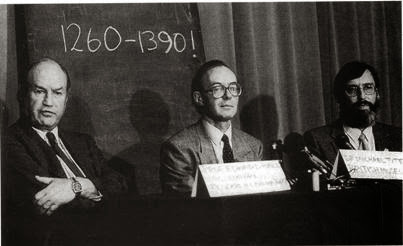
[Above (enlarge): From left to right, Prof. E. Hall (Oxford), Dr M. Tite (British Museum) and Dr R. Hedges (Oxford) announcing on 13 October 1988 that the Shroud had been radiocarbon dated to "1260-1390!"[46].]

fraudulent[47]. That is because 1260-1390 is 1325 ± 65 years[48], the mid-point of which, 1325[49], is a mere ~30 years[50], before the Shroud first appeared in undisputed history at Lirey, France, in ~1355[51]. Shroud sceptics seized on 1325 as the date of the Shroud[52]. They were certain that the Shroud had to be a medieval fake because the improbability would be "astronomical"[53], "one in a thousand trillion"[54] and indeed "totally impossible"[55] that the Shroud could be first-century yet have a 13th-14th century radiocarbon date, let alone the `bull's-eye' date of 1325[56]. But the flip-side is that since the Shroud is authentic (as the evidence overwhelmingly indicates)[57], and therefore first century, then the improbability would be "astronomical," "one in a thousand trillion" and indeed "totally impossible" that the Shroud could have a 1260-1390 radiocarbon date!

Attempts by pro-authenticists to reconcile the Shroud's first century actual date with the claimed 1260-1390 radiocarbon date, are understandable, but as I showed in part #1 of my series, "The 1260-1390 radiocarbon date of the Turin Shroud was the result of a computer hacking," conventional explanations of the discrepancy, i.e. carbon contamination, bioplastic coating, invisible repair, neutron flux, all fail. Similarly, as I also showed in that part #1, accusations of conventional fraud (e.g. sample-switching) also fail.

Agnostic pro-authenticist art historian Thomas de Wesselow considers fraud in the Shroud's radiocarbon dating to be a real possibility (albeit by sample-swapping), because of the "1325 ± 65 years" date:

"The third possibility is that a fraud was perpetrated, that genuine Shroud samples were deliberately swapped with cloth of a later date ... Most sindonologists regard these fraud theories as plainly incredible. Some, like Ian Wilson, refuse to contemplate such `unworthy' accusations. However, scientific fraud is by no means unknown, as the editors of science journals are well aware. ... One important consideration weighs in favour of the possibility of deception. If the carbon-dating error was accidental, then it is a remarkable coincidence that the result tallies so well with the date always claimed by sceptics as the Shroud's historical debut. But if fraud was involved, then it wouldn't be a coincidence at all. Had anyone wished to discredit the Shroud, '1325 ± 65 years' is precisely the sort of date they would have looked to achieve" (my emphasis)[58].
But as I pointed out near the end of that part #1:
"... there is another type of fraud that the fully computerised AMS radiocarbon dating process[59] was vulnerable to, and which was rife in the 1980s [see part #2], namely computer hacking!"

Continued in part #15 of this series.

Notes
1. This post is copyright. Permission is granted to quote from any part of this post (but not the whole post), provided it includes a reference citing my name, its subject heading, its date, and a hyperlink back to this post. [return]
2. Barnes, A.S., 1934, "The Holy Shroud of Turin," Burns Oates & Washbourne: London, p.14; Iannone, J.C., 1998, "The Mystery of the Shroud of Turin: New Scientific Evidence," St Pauls: Staten Island NY, pp.71, 156; Wilson, I. & Schwortz, B., 2000, "The Turin Shroud: The Illustrated Evidence," Michael O'Mara Books: London, pp.38-39. [return]
3. Extract from Latendresse, M., 2010, "Shroud Scope: Durante 2002 Vertical," Sindonology.org. [return]
4. Currer-Briggs, N., 1988, "The Shroud and the Grail: A Modern Quest for the True Grail," St. Martin's Press: New York NY, p.33; Currer-Briggs, N., 1995, "Shroud Mafia: The Creation of a Relic?," Book Guild: Sussex UK, p.12. [return]
5. Iannone, 1998, p.6. [return]
6. Drews, R., 1984, "In Search of the Shroud of Turin: New Light on Its History and Origins," Rowman & Littlefield: Lanham MD, p.16; Iannone, 1998, p.177; Oxley, M., 2010, "The Challenge of the Shroud: History, Science and the Shroud of Turin," AuthorHouse: Milton Keynes UK, p.3. [return]
7. Wilson, I., 1991, "Holy Faces, Secret Places: The Quest for Jesus' True Likeness," Doubleday: London, p.23; Hoare, R., 1995, "The Turin Shroud Is Genuine: The Irrefutable Evidence," [1984], Souvenir Press: London, p.52. [return]
8. Wilson, I., 1979, "The Shroud of Turin: The Burial Cloth of Jesus?," [1978], Image Books: New York NY, Revised edition, p.22; Iannone, 1998, p.6; Wilson, I., 1998, "The Blood and the Shroud: New Evidence that the World's Most Sacred Relic is Real," Simon & Schuster: New York NY, p.21; Wilson & Schwortz, 2000, p.39; Wilson, I., 2010, "The Shroud: The 2000-Year-Old Mystery Solved," Bantam Press: London, p.11. [return]
9. Wilson & Schwortz, 2000, p.39. [return]
10. Currer-Briggs, 1988, p.33; Currer-Briggs, 1995, p.12. [return]
11. Bulst, W., 1957, "The Shroud of Turin," McKenna, S. & Galvin, J.J., transl., Bruce Publishing Co: Milwaukee WI, p.31. [return]
12. Barnes, 1934, p.14. [return]
13. Barnes, 1934, p.14. [return]
14. Adler, A.D., 2000b, "Chemical and Physical Aspects of the Sindonic Images," in Adler, A.D. & Crispino, D., ed., 2002, "The Orphaned Manuscript: A Gathering of Publications on the Shroud of Turin," Effatà Editrice: Cantalupa, Italy, p.17. [return]
15. Adler, A.D., 2000a, "Chemical and Physical Characteristics of the Bloodstains," in Adler & Crispino, 2002, pp.132-133. [return]
16. de Wesselow, T., 2012, "The Sign: The Shroud of Turin and the Secret of the Resurrection," Viking: London, p.176; Scavone, D., "The Shroud of Turin in Constantinople: The Documentary Evidence," in Sutton, R.F., Jr., 1989, "Daidalikon: Studies in Memory of Raymond V Schoder," Bolchazy Carducci Publishers: Wauconda IL, pp.320-321; Wilson, 1991, p.155; Wilson, 1998, p.145. [return]
17. Wilson, 1991, p.155; Wilson, 1998, p.145; de Wesselow, 2012, pp.176-177. [return]
18. Wilson, 1998, pp.145, 225 n.2; de Wesselow, 2012, p.176. [return]
19. Scavone, 1989, p.321. [return]
20. Abbott-Smith, G., "A Manual Greek Lexicon of the New Testament," [1921], T. & T. Clark: Edinburgh, Third edition, 1937, Reprinted, 1956, pp.2, 354, 267. [return]
21. Abbott-Smith, 1937, p.46. [return]
22. de Wesselow, 2012, p.176. [return]
23. Wilson, 1991, p.155; Wilson, 1998, p.145. [return]
24. Scavone, 1989, p.321; Wilson, 1991, p.155; Wilson, 1998, p.272. [return]
25. Wilson, 1991, p.155; Wilson, 1998, p.145; de Wesselow, 2012, p.176. [return]
26. de Wesselow, 2012, p.176; Wilson, 1991, p.3; Wilson, 1998, pp.125, 141; Wilson & Schwortz, 2000, p.113; Wilson, 2010, p.108. [return]
27. Shepard, L., 1970, in Vignon, P., 1902, "The Shroud of Christ," University Books: New York NY, Reprinted, p.vii.; Stevenson, K.E. & Habermas, G.R., 1981, "Verdict on the Shroud: Evidence for the Death and Resurrection of Jesus Christ," Servant Books: Ann Arbor MI, pp.15, 57; Maher, R.W., 1986, "Science, History, and the Shroud of Turin," Vantage Press: New York NY, p.72. [return]
28. Brent, P. & Rolfe, D., 1978, "The Silent Witness: The Mysteries of the Turin Shroud Revealed," Futura Publications: London, p.36. [return]
29. Wilson, 1998, p.19; Wilson, 2010, p.21. [return]
30. Wilson, 1979, p.34-35; Morgan, R.H., 1980, "Perpetual Miracle: Secrets of the Holy Shroud of Turin by an Eye Witness," Runciman Press: Manly NSW, Australia, pp.128-129; Tribbe, F.C., 2006, "Portrait of Jesus: The Illustrated Story of the Shroud of Turin," [1983], Paragon House Publishers: St. Paul MN, Second edition, pp.254. [return]
31. "Simply Some Photos," Avax News, 1 October 2011. [return]
32. Vala, L., 1967, "The Holy Shroud of Turin," Amateur Photographer, March 8, pp.332-335, in Wilcox, R.K., 1977, "Shroud," Macmillan: New York NY, pp.130-131 & Wilson, 2010, p.21. [return]
33. Wilcox, R.K., 1977, "Shroud," Macmillan: New York NY, pp.130-131. [return]
34. Wilson, 1998, p.24. [return]
35. Accetta, A.D., Lyons, K. & Jackson, J., 1999, "Nuclear Medicine and its Relevance to the Shroud Of Turin," in Walsh, B.J., ed., "Proceedings of the 1999 Shroud of Turin International Research Conference, Richmond, Virginia," Magisterium Press: Glen Allen VA, 2000, pp.3-8, 3. [return]
36. Whiting, B., 2006, "The Shroud Story," Harbour Publishing: Strathfield NSW, Australia, p.181. [return]
37. Wilson & Schwortz, 2000, p.131. [return]
38. Ibid. [return]
39. Accetta, 1999, p.4; Whiting, 2006, pp.181-182. [return]
40. Accetta, 1999, p.4; Wilson & Schwortz, 2000, p.130; Whiting, 2006, p.182. [return]
41. Accetta, 1999, p.4. [return]
42. Antonacci, M., 2000, "Resurrection of the Shroud: New Scientific, Medical, and Archeological Evidence," M. Evans & Co: New York NY, p.212. [return]
43. "Radiation: Discovery," Wikipedia, 8 June 2016. [return]
44. Antonacci, 2000, p.213. [return]
45. Damon, P.E., 1989, "Radiocarbon Dating of the Shroud of Turin," Nature, Vol. 337, 16th February, pp.611-615, 611. [return]
46. Wilson, 1998, p.7 & pl.3b. [return]
47. Wilson, 1998, p.8. [return]
48. McCrone, W.C., 1999, "Judgment Day for the Shroud of Turin," Prometheus Books: Amherst NY, pp.1,141,178,246; Wilson, 1998, p.7; Oxley, 2010, p.87; de Wesselow, 2012, p.171. [return]
49. Tribbe, 2006, p.169; Tipler, F.J., 2007, "The Physics of Christianity," Doubleday: New York NY, p.177. [return]
50. Gove, H.E., 1996, "Relic, Icon or Hoax?: Carbon Dating the Turin Shroud," Institute of Physics Publishing: Bristol UK, pp.264, 300; Milne, L., 2005, "A Grain of Truth: How Pollen Brought a Murderer to Justice," New Holland: Frenchs Forest, NSW, Australia, p.93. [return]
51. Scavone, D.C., "The History of the Turin Shroud to the 14th C.," in Berard, A., ed., 1991, "History, Science, Theology and the Shroud," Symposium Proceedings, St. Louis Missouri, June 22-23, 1991, The Man in the Shroud Committee of Amarillo, Texas: Amarillo TX, pp.171-204, 174; Oxley, 2010, p.4; Wilson, 2010, pp.222-223. [return]
52. McCrone, W.C., 1999, "Judgment Day for the Shroud of Turin," Prometheus Books: Amherst NY, pp.xxiii, xx, 247; Schafersman, S.D., 1998, "Unraveling the Shroud of Turin," Approfondimento Sindone, Vol. 2; Dutton, D., 2005, "Postscript: Requiem for the Shroud of Turin," Michigan Quarterly Review 23, 1984, pp.243-55; Gove, 1996, p.293. [return]
53. Wilson, 1998, pp.6-7. [return]
54. Gove, 1996, p.303. [return]
55. Currer-Briggs, N., 1995, "Shroud Mafia: The Creation of a Relic?," Book Guild: Sussex UK, pp.114-115. [return]
56. Meacham, W., 1986, "On Carbon Dating the Shroud," British Society for the Turin Shroud Newsletter, No. 14, September, pp.4-15, 10; Meacham, W., 1986, "On Carbon Dating the Turin Shroud," Shroud Spectrum International, No. 19, June, pp.15-25, 20; Nickell, J., 2013, "Another Easter for the Turin `Shroud'," Investigative Briefs with Joe Nickell, Center For Inquiry, March 28. [return]
57. Morgan, 1980, p.116; Adams, F.O., 1982, "Sindon: A Layman's Guide to the Shroud of Turin," Synergy Books: Tempe AZ, p.86; Minor, M., 1990, "Shroud of Turin Manuscript Discovered By Texas Member," [originally "A Lawyer Argues for Authenticity of the Shroud of Turin"], The Manuscript Society News, Vol. XI, No. 4, Fall, pp.117-122, 122; Stevenson, K.E. & Habermas, G.R., 1990, "The Shroud and the Controversy," Thomas Nelson: Nashville TN, pp.60; Case, T.W., 1996, "The Shroud of Turin and the C-14 Dating Fiasco," White Horse Press: Cincinnati OH, p.26; Antonacci, 2000, p.6; Meacham, W., 2005, "The Rape of the Turin Shroud: How Christianity's Most Precious Relic was Wrongly Condemned and Violated," Lulu Press: Morrisville NC, pp.110-111. [return]
58. de Wesselow, 2012, p.170. [return]
59. Gove, 1996, p.264; Sox, H.D., 1988, "The Shroud Unmasked: Uncovering the Greatest Forgery of All Time," The Lamp Press: Basingstoke UK, p.147. [return]

Posted 11 June 2016. Updated 13 September 2025.