Shroud of Turin News - May 2020
© Stephen E. Jones[1][Previous: April 2020] [Next: June 2020]
This is the May 2020 issue of my Shroud of Turin News. I have listed below linked news article(s) about the Shroud in May as a service to readers, without necessarily endorsing any of them. The articles' words are bold to distinguish them from mine. Emphases are mine unless otherwise indicated.
News:
• "Shakespearean Stabbings, How to Feed a Dictator and Other New Books to Read," Smithsonian Magazine, May 5, 2020, Meilan Solly ...  The Holy Shroud: A Brilliant Hoax in the Time of the Black Death by Gary Vikan [Right. I have today, 21 June, ordered Vikan's book and will review it here after I receive it.] Gary Vikan has spent some 35 years tracking down evidence refuting the Shroud of Turin's authenticity. [See "Deconstructing the `Debunking' of the Shroud by Daniel Scavone," for a refutation of Vikan's so-called "refuting the Shroud of Turin's authenticity."] In The Holy Shroud, Vikan — former director of Baltimore's Walters Art Museum and a respected art historian — outlines his findings, arguing that the controversial burial cloth belonged not to Jesus, but to a medieval artist employed by French monarch John II [r. 1350-64] at the height of the Black Death [1347-52]. [The evidence is that Geoffroi I de Charny (c. 1300-56) already had been given, or had been promised, the Shroud by John II's father King Philip VI of France (r. 1328-50) by 1343. See "c. 1343".]
"I knew right away that the Holy Shroud was the fake, for the simple reason that it does not fit into the chronology of Christian relics or iconography, ..." [This is strange `logic'. It amounts to saying that, `the Shroud must be 14th century because it doesn't look like it's 14th century'! As French biologist-artist Paul Vignon (1865-1943) pointed out, if the Shroud were a medieval forgery it would fit in with the traditional depictions of Jesus by medieval artists":
"Now let this be well noted: every time that we find in the Holy Shroud some strangeness, some departure from tradition, we may feel assured that such strangeness, such departure, can never have been knowingly done by a forger, whose direct intention would have been to appeal forcibly to the imagination of his public"[2]
Agnostic but pro-authenticist art historian
Thomas de Wesselow pointed out that so foreign is the Shroud to medieval artistic culture, that a better explanation than that it "is a medieval forgery" is that "the Shroud was
deposited in medieval France by aliens":
"Given credence, the [1260-1390] carbon-dating result effectively raises the Shroud to the status of a miracle, an object that defies, if not a law of nature, a law of culture. All artefacts are linked to the art and technology of the society in which they originate. Something that cannot be explained in terms of its (presumed) cultural context invites a supernatural explanation. As far as I am aware, no one has yet argued that the Shroud was deposited in medieval France by aliens, but ... There is no better explanation, though, for a fourteenth-century Shroud"[3].]
"... and because it appears for the first time in the historical record in 14th century France," wrote Vikan in a blog post earlier this year." [This is
false! The
Shroud first appeared in the undisputed historical record at Lirey, France in c.1355. That is, even the vast majority of
anti-authenticists don't dispute that. But that is not the same as, The Shroud "
appears for the first time in the historical record." As I quoted
in my previous post (footnotes omitted):
"In 1207, after the sack of Constantinople in 1204, Nicholas Mesarites, keeper of the Emperor's relics in the Pharos Chapel, Constantinople, recalled that in 1201, in that chapel, was `the sindon [which] wrapped the mysterious, naked dead body [of Christ] after the Passion' (my emphasis). The Greek word variously translated `mysterious', `indefinable' and `uncircumscribed', is aperilepton, which literally means `un-outlined' or `outlineless'. The Shroud-image uniquely has no outline [see 11Jun16], so there could be no stronger proof that the Shroud in Constantinople is that of Lirey, Chambéry and Turin!"
This is
objective, historical evidence that the Shroud existed in Constantinople in 1201,
over a century and a half (154 years) before it was exhibited at Lirey in c. 1355! And
59 years before the
earliest possible
radiocarbon date of 1260! Therefore the Shroud appeared in the historical record in at least 13th century Constantinople, irrespective of whether anti-authenticists accept it!]
"... [W]ith the help of a brilliant scientist, I am [now] able to answer the questions of when, why, by whom, and how the Shroud was made." [I will be interested to read in Vikan's book, "by whom ... the Shroud was made"! As well as "when, why ... and how the Shroud was made"! The "brilliant scientist" is presumably a "Robert Morton" who is mentioned, with a Rebecca Hoppe, on the title page of the book. I have been unable to find anything about Morton or Hoppe, except a 2007 article which mentions a "Chemist Robert Morton" with Vikan `explaining' "how a realistic shroud could be made using common scribe's chemicals ..." ]
Per the book's description, John II gifted the "photograph-like body print" to his friend Geoffroi de Charny shortly before the latter's death at the Battle of Poitiers in 1356. [See above that the evidence is that Geoffroi I de Charny already had been given, or had been promised, the Shroud by John II's father King Philip VI of France by 1343.]
Originally meant as an "innocuous devotional image" for the knight's 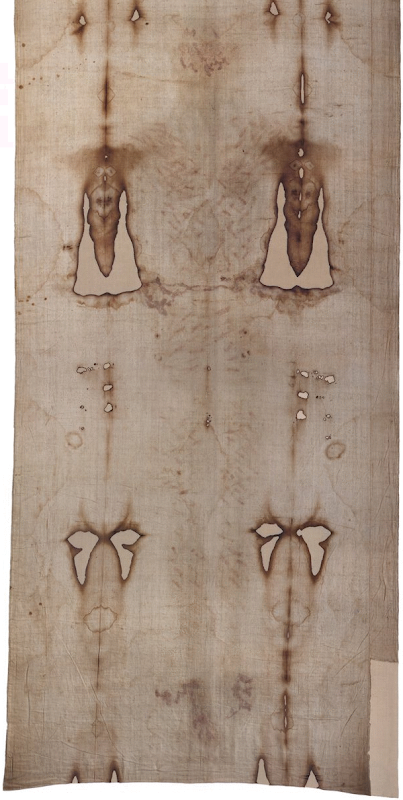 newly-built church, the cloth was soon reinvented as one of Christianity's most significant relics. [It is self-evidently absurd that the Shroud, half of which shows Jesus completely naked the full length of His back and covered with hundreds of scourge wounds [Left (enlarge[4])] would have been "meant as an `innocuous devotional image'"!] "Miracles were faked," says Vikan, "and money was made." [I don't know what Vikan meant by this, but on the topic of "miracles", if the Shroud was a forgery "it would be a greater miracle than if it were the actual cloth of Christ":
"At this point, I am reminded of what Dr. Donald Lynn, a dedicated Shroud researcher, said when questioned on the possibility that the Shroud be indeed a forgery. 'Were the Shroud a forgery, it would be a greater miracle than if it were the actual cloth of Christ'"[5].
And as for "money was made,"
Prof. Edward Hall's Oxford radiocarbon dating laboratory received 1 million pounds for its part in radiocarbon dating the Shroud as
1260-1390:
"24 March [1989] (Good Friday). A press release to the UK press announces that forty-five businessmen and 'rich friends' have donated £1 million to create a chair of archaeological sciences at Oxford to perpetuate the radiocarbon-dating laboratory created by Professor Edward Hall. The first incumbent is to be the British Museum's Dr Michael Tite"[6].
• "
`There WAS a body inside' Shroud of Turin oddity discovery exposed in Bible breakthrough,"
Daily Express, Callum Hoare, May 27, 2020 ...
an expert who radiocarbon-dated the cloth more than three decades ago revealed more recently that he spotted an "oddity" during his experiment that he admitted proves "it is highly probable that there was a body inside" This by an anti-authenticist (see below) would destroy one of the twin pillars of the temple (
Jdg 16:25-30) of anti-authenticism (the other being the
1260-1390 radiocarbon date), the claim of the Bishop of Troyes
Bishop Pierre d'Arcis (r. 1377-1395) that one of his predecessors
Bishop Henri de Poitiers (r. 1354–1370), had discovered that the Shroud had been "cunningly painted" and moreover had obtained the confession of the artist who had painted it:
"The Lord Henry of Poitiers ... then Bishop of Troyes ... after diligent inquiry and examination, he discovered the fraud and how the said cloth had been cunningly painted, the truth being attested by the artist who had painted it, to wit, that it was a work of human skill and not miraculously wrought or bestowed"[7]
Rob Walker spoke to Professor Michael Tite [Below left (
original)[
8].]
, who supervised  the testing process
 [and]
"was, at the time, keeper of the British Museum Research Laboratory and he was given the job of coordinating the work of three labs chosen by the Church to do the radiocarbon dating." ...
The experiments concluded with a 95 percent confidence that the Shroud's material dated between 1260–1390AD. This is
false and indeed
fraudulent [see
29May19]
But, Professor Tite revealed why that was not the end of the argument. ...
He added: "To some extent, it confirmed what I expected, my suspicions were proved. "But I did make a mistake at the press conference, there was a big blackboard 
[Right (enlarge): From left to right, Prof. E. Hall (Oxford), Dr M. Tite (British Museum) and Dr R. Hedges (Oxford) announcing on 13 October 1988 that the Shroud of Turin had been radiocarbon dated to "1260-1390!"[9].]
behind me and I put 1260 - 1390 and an exclamation mark afterwards which caused me endless trouble."The significance of the exclamation mark was to tell the press that this is what you already knew, but all sorts of various things were read into the exclamation mark." So Tite was lying when in September 1989 he told a French radio interviewer, Chantal Dupont, that he couldn't remember who added the exclamation mark after "1260-1390" on the blackboard at the news conference in the British Museum on 13 October 1988[10]:
"[Dupont] Who put the exclamation mark after the date on the blackboard? [Tite] I can't remember who did that, the press, Hall, or me ... it reflected the mood of the moment"[11].
But Tite was telling the truth back then, that the exclamation mark "reflected the mood of the moment," rather than it was "to tell the press that this is what you already knew," because the press
did not then already
know that the Shroud had been radiocarbon dated "
1260-1390." And "the mood of the moment" represented by the explanation mark was the
triumph[
12] of
naturalistic (`nature is all there is - there is no supernatural') science over Christianity (or so they thought)!
But, Professor Tite admitted there was one "oddity" he discovered during the testing, leading him to believe there was a body inside the Shroud at one point, a breakthrough in understanding the struggle of Bible followers in the Middle Ages. He continued: "There are certain groups who resisted and continue to resist the date. "A number of people have made their whole career out of the Shroud, in one way or another. So they should "continue to resist the date," given that the evidence is overwhelming that the Turin Shroud is authentic! And therefore the 1260-1390 radiocarbon date is false!
There's no real evidence it was painted on there, This is a huge admission by Tite that the Shroud image was not painted [see "No paint, etc. #15"] because as leading anti-authenticist, the late Walter McCrone (1916-2002) pointed out, painting the Shroud man's image "... is certainly the simplest and probably the only way" that it could have been done by a medieval forger:
"I realize that there are still, perhaps, a majority of people convinced by the carbon-dating that the `Shroud' is medieval, who are still looking for an answer as to how the `Shroud' was produced. Many mechanisms have already been proposed. Some say it was draped wet over a bas-relief to which it was shaped then dabbed with powder or a paint. Some say a painting was prepared and transferred to a cloth in contact with it by pressure. However, I see no reason to doubt that an artist ... simply took up his brush and a dilute red ochre watercolor paint based on scraps of parchment as the vehicle and proceeded to paint the `Shroud.' Why go to all the work of preparing a statue or bas-relief or making a transfer of the image from a primary artist's rendering? A direct approach to painting a dilute watercolor image on a canvas of the proper size is a common sense assumption; Occam's Razor applies here ... It is certainly the simplest and probably the only way an undistorted original image could be prepared. If an artist (read sculptor) has to first prepare a statue or bas-relief then decorate it he will have to be more skilled, go to more trouble and stand in greater risk of distorting the final image than if he decided, by careful study, the image he wanted to produce then proceeded to paint it on a flat canvas with materials, and, by a method, readily available to him in the 1350s. The artist requires only a dilute watercolor paint, a paint brush, canvas and the talent and skill to produce a `Shroud'"[13].
and the other oddity is if you look at paintings from the Middle Ages they always paint Christ with the nails going through the palms of the hands. "Whereas in reality, you have to put the nails through the wrist, Indeed! Tite sounds like a pro-authenticist! See my "
Non-traditional #13" (footnotes omitted):
"A medieval artist/forger who who intended his shroud to be accepted, would not have contradicted the traditional iconography, showing only only one full hand on the Shroud and therefore only one nail wound, in the wrist, not the palm. It was not until the 17th century, and therefore likely influenced by the Shroud, that a minority of artists, notably Van Dyck, began depicting Jesus crucified, suspended by a nail in each wrist ... A medieval forger would certainly have placed the hand nail wound in Jesus' palm, as he would have had to conform to traditional norms, if he wanted his false shroud to have been accepted. Medieval tradition demanded that the nail-wound in the left hand be in the centre of the palm, and in a forged relic such independence from tradition would not have been tolerated."
I think a complete replication of the image has not been achieved. Indeed it hasn't! As
Mark Oxley [Left (
original)[
14]] asked,

`could a 14th century forger produce an image that 21st century science cannot replicate?':
"The Shroud presents many challenges. It challenges those who claim it is a mediaeval forgery to replicate it. Nobody has yet been able to do so with any credibility. This must be an argument in favour of its authenticity. Could a fourteenth century forger, with the limited scientific knowledge of his time, really produce an artifact that can still not be replicated by all the wonders of twenty-first century science?"[15].
"I don't believe it was the Shroud, but I believe it is highly probable that there was a body in there – it was the time of the Crusades and an appropriate way to humiliate a Christian would be to crucify him." This was the theory of a
Dr. Michael Straiton but de Wesselow has
demolished it:
"Slightly more sensible is the suggestion of another doubter, Dr Michael Straiton, that the body was that of an unfortunate Crusader, captured and crucified by Mamluk Turks in the last years of the thirteenth century. This is probably the least implausible idea regarding the Shroud's origin that a sceptic has ever offered, though that is not saying very much. The Turks may have practised crucifixion occasionally at the time of the Crusades, but it is a massive leap of faith to imagine that they ever crucified anyone in exact imitation of Jesus. Even if they had wanted to, they could hardly have recreated the complex torture, execution and burial of a first-century Jew without introducing a single anachronism. Just consider what would have been involved. First, our archaeologically minded Muslims would have scourged their prisoner with a Roman-style flagrum, before making him carry a crossbeam on his shoulders, in imitation of the Roman custom. Then, rather than bang a nail into the upright through either foot, they would have expertly driven a single nail through both feet ... Once he was dead, they would have pierced him in the Roman manner beneath the armpit, using a spear like a Roman lancea. The reconstruction would have continued after the man was taken down from the cross. Rather than toss him into a simple grave, they would have given him an appropriate Jewish burial, washing away all the blood clots, carefully avoiding the post-mortem 'lifeblood', binding up the jaw, and wrapping him in a sovev. This linen sheet, of very fine material and manufactured in conformity with ancient Jewish textile-making techniques, would have been sourced from the Jerusalem area, as indicated by the pollen and limestone dust embedded in its weave. Finally, they would have left the burial unfinished, draping the body rather than tying it up, and then they or someone else would have removed the cloth from the body within a few days. All this would have been done, moreover, to a man bearing an uncanny resemblance to the traditional portrait of Jesus ... The odds against the Mamluk Turks (or anyone else) having performed such a bizarre 'action-replay' of the events of Good Friday must be astronomical. As a historical scenario, it is speculative, nonsensical and implausible"[16].
Editorial
Posts: In May I blogged only 2 new posts (latest uppermost):
"Problems of the forgery theory A-Z: The evidence is overwhelming that the Turin Shroud is authentic!" - 24th & "`News and Editorial,' Shroud of Turin News, April 2020" - 22nd.
Pageviews: At midnight on 31 May 2020, Google Analytics [Below (enlarge)] gave this blog's "Pageviews all time history" as 1,189,689:
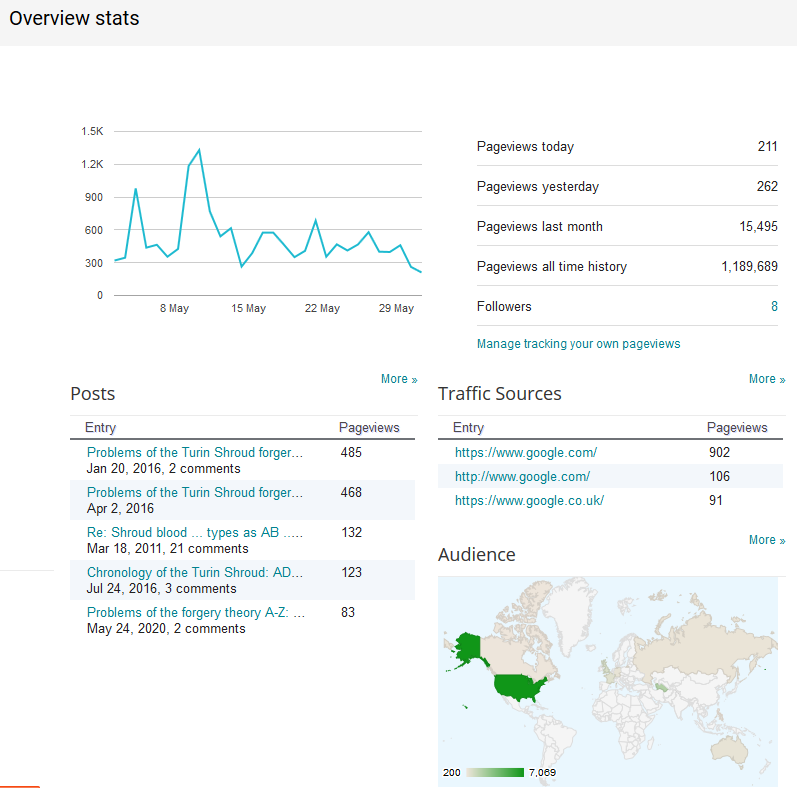
This compares with 1,064,304 at the same time in May 2019. That is 125,385 pageviews over the year, or an average of ~344 pageviews per day.
Google Analytics also gave the most viewed posts for May 2020 (highest uppermost) as: "Problems of the Turin Shroud forgery theory: Index A-F," Jan 20, 2016 - 485; "Problems of the Turin Shroud forgery theory: Index G-M," Apr 2, 2016 - 468; "Re: Shroud blood ... types as AB ... aged blood always types as AB, so the significance of this ... is unclear" Mar 18, 2011 - 132; "Chronology of the Turin Shroud: AD 30 to the present: 1st century and Index." Jul 24, 2016 - 123 & "Problems of the forgery theory A-Z: The evidence is overwhelming that the Turin Shroud is authentic!" - 83.
Notes:
1. This post is copyright. I grant permission to extract or quote from any part of it (but not the whole post), provided the extract or quote includes a reference citing my name, its title, its date, and a hyperlink back to this page. [return]
2. Vignon, P., 1902, "The Shroud of Christ," University Books: New York NY, Reprinted, 1970, p.32. [return]
3. de Wesselow, T., 2012, "The Sign: The Shroud of Turin and the Secret of the Resurrection," Viking: London, pp.167-168. [return]
4. Extract from Latendresse, M., 2010, "Shroud Scope: Durante 2002 Horizontal, rotated right 90 degrees," Sindonology.org. [return]
5. Rinaldi, P., 1987, "For the Holy Shroud, the Hour of Truth Reprint of an interview with Fr. Peter Rinaldi," Shroud News, No. 39, February, pp.13-17, 16. [return]
6. Wilson, I., 1998, "The Blood and the Shroud: New Evidence that the World's Most Sacred Relic is Real," Simon & Schuster: New York NY, p.311. [return]
7. "Memorandum of Pierre D'arcis, Bishop Of Troyes, to the Avignon Pope Clement VII," 1389, Thurston, H., transl., "The Holy Shroud and the Verdict of History," The Month, CI, 1903, pp.17-29, in Wilson, I., 1978, "The Turin Shroud," Book Club Associates: London, pp.230-231. [return]
8. "Michael S. Tite-2008 Pomerance Award for Scientific Contributions to Archaeology," Archaeological Institute of America, 2008. [return]
9. Wilson, 1998, plate 3b. [return]
10. Wilson, 1998, pp.6-7; 310-311; Wilson, I., 2010, "The Shroud: The 2000-Year-Old Mystery Solved," Bantam Press: London, p.84. [return]
11. Dupont, C., 1989, "Radio Courtoisie," Shroud Spectrum International, No. 32/33, September/December, pp.36-37. [return]
12. Garza-Valdes, L.A., 1998, "The DNA of God?," Hodder & Stoughton: London, pp.8-9; McDonnell, D.J., 2003, "The Great Holy Shroud Dating Fraud of 1988," 4 November. [return]
13. McCrone, W.C., 1999, "Judgment Day for the Shroud of Turin," Prometheus Books: Amherst NY, p.122. [return]
14. "Mark O.," Oxley Consulting, Devex, 2020. [return]
15. Oxley, M., 2010, "The Challenge of the Shroud: History, Science and the Shroud of Turin," AuthorHouse: Milton Keynes UK, p.xii. [return]
16. de Wesselow, 2012, p.150. [return]
Posted 21 June 2020. Updated 11 September 2025.




 Posts
Posts

