Thursday, March 7, 2019

Accetta, August, Turin Shroud Encyclopedia

Turin Shroud Encyclopedia
Copyright © Stephen E. Jones
[1]

Accetta, August #4

This is "Accetta, August," part #4 of my new Turin Shroud Encyclopedia. For information about this series, see part #1 and part #2. Emphases are mine unless otherwise indicated.

[Index #1] [Previous: Abgar VIII #3] [Next: acheiropoietos #5]


Accetta, August August David Accetta (c. 1959-), M.D., is (or was) a urogynecologist and

[Right (enlarge)[2]: Dr August Accetta and the full-size replica of the Shroud at his The Shroud Center of Southern California, in Silverado, California. See 14May07 (my CED blog), 09Oct07, 29Oct07, 10Oct08, 11Jun16, 20Apr17]

cosmetic surgeon living and practicing in Huntington Beach, California.

He is not to be confused with Joseph S. Accetta who was a member of STURP but is an anti-authenticist.

August Accetta was raised a Roman Catholic but in medical school became an agnostic. He married an evangelical protestant and became a protestant but later returned to the Roman Catholic church.

Accetta's becoming a Christian began 1992 Accetta heard a radio talk by Dr. Alan Whanger (1930-2017), a professor emeritus at Duke University and chief researcher for the Council for Study of the Shroud of Turin (no longer online) Accetta met with Whanger and began to collect information on the Shroud.

In 1996 Accetta founded the Shroud of Turin Center of Southern California in Huntington Beach in 1996, relocating to Fountain Valley Californian in 2002. It now is in the Santiago Retreat Center in Silverado, California. [Left (enlarge)[3].] The Center has a museum and research facility dedicated to the scientific study of the Shroud.

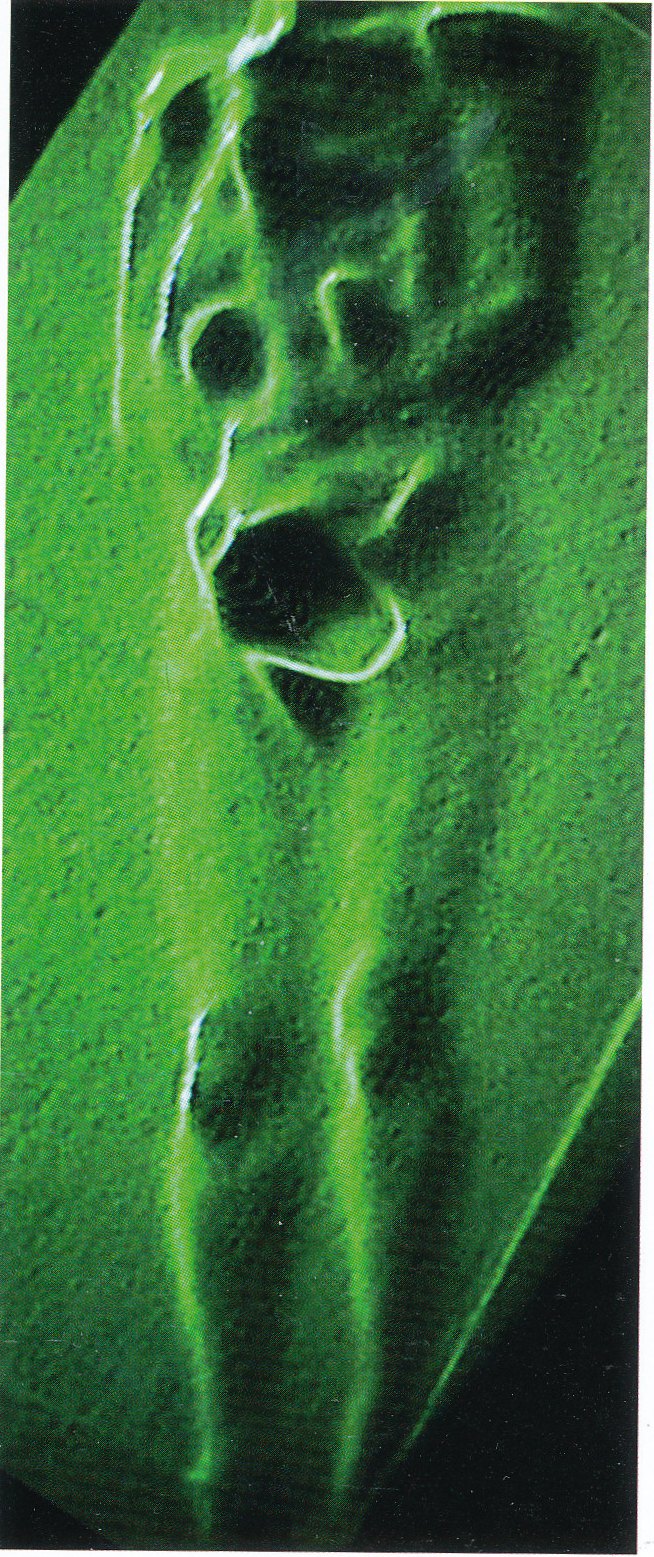
Accetta has written four research papers in support of the Shroud's authenticity, journeyed to Turin to view the Shroud and injected himself with radioactive dye to test his theory of how the Shroud image was formed.

[Right (enlarge): Nuclear radiation image of Dr. August Accetta[4]. The projections are due to technetium-99m concentrating in the internal organs. The hole and V-shape over the pelvis is due to a protective shield over the genitals.]

Dr Accetta injected into his own veins a solution of methylene-diphosphonate, containing radioactive technetium-99m, a radioisotope with a short half life. The radiation from the technetium atoms produced gamma rays, which could be detected by the VP8 Image Analyzer Computer. Dr Accetta produced an image on the VP8 computer similar, but with less definition, than the Shroud image.

Accetta’s theory is that at the moment of Jesus’ resurrection, His body in the tomb turned to light [sic - see 23Jun15, 05Sep16, 22Dec16 & 05Feb17], emitting a radiance that created a head-to-toe likeness of Jesus on the Shroud.

As evidence for his radiation theory, Accetta points to the New Testament accounts of the Transfiguration of Jesus (Mt 17:1–8; Mk 9:2–8, Lk 9:28–36; 2Pet 1:16–18). It was a moment in Jesus’ life when his body turned briefly into light, and Accetta says it may have foreshadowed what happened in His resurrection.

Ian Wilson listed the similarities between Accetta's above radiation experiment's results and the Shroud:

"First, it was conclusively demonstrated that a full-body radiation image could be produced by this means, without the application of any paints or dyes, which replicated all the Shroud image's monochromatic characteristics. Second, the image had the same collimated, or straight-up, straight-down character as that of the Shroud's imprint, though in fairness it should be said that a collimator in the set-up ensured this, since otherwise the radiation would have spilled out at all sides. Third, apart from its being slightly more distinct against its background, the image had the same lack of outline as that on the Shroud. Fourth, the image shared the Shroud's otherwise seemingly unique lack of any light focus. Fifth, the Shroud's X-ray properties were strikingly replicated, spectacularly in the case of the hands, in which the metacarpal bones and phalange or finger bones could clearly be distinguished with a most compelling similarity to these same bones on the Shroud. Sixth, when viewed via the VP-8 Image Analyzer, Accetta's body exhibited the same three-dimensional properties as that on the Shroud imprint, the limbs being particularly similar."

This is strong evidence (if not proof beyond reasonable doubt) that the Man on the Shroud is Jesus, His image having been imprinted on the Shroud by the light of His resurrection! [see 22Dec11].

To be continued in the next part #5 of this series.

Notes
1. This post is copyright. I grant permission to quote from any part of this post (but not the whole post), provided it includes a reference citing my name, its subject heading, its date and a hyperlink back to this page. [return]
2. "Shining a light on the Shroud of Turin," Orange County Register, September 6, 2007. [return]
3. "Shroud Center: Santiago Retreat Center," 2019. [return]
4. Wilson, I. & Schwortz, B., 2000, "The Turin Shroud: The Illustrated Evidence," Michael O'Mara Books: London, p.131. [return]

Posted 7 March 2019. Updated 14 August 2025.

Sunday, February 17, 2019

16 February 1989: On this day 30 years ago in the radiocarbon dating of the Turin Shroud

© Stephen E. Jones[1]

This is part #14, "16 February 1989," of my series, "On this day 30 years ago in the radiocarbon dating of the Turin Shroud." For more information about this series, see part #1. Instalments will be to the whole post and not specifically linked. Emphases are mine unless otherwise indicated.

[Index #1] [Previous: 13Oct88 #13] [Next: Mar89 #15]

16 February 1989 The science journal Nature in an article,

"Radiocarbon Dating of the Shroud of Turin" [Above (original)[2].], reported that:

"... samples from the Shroud of Turin have been dated by accelerator mass spectrometry in laboratories at Arizona, Oxford and Zurich ... The results provide conclusive evidence that the linen of the Shroud of Turin is mediaeval ... AD 1260-1390"[3].
By this time it was old news, because as we saw in part #13, 4 months earlier, on 13 October 1988, Prof. Edward Hall (Oxford), Dr Michael Tite (British Museum) and Dr Robert Hedges (Oxford) had announced at a press conference in the British Museum, London (and it had also been near-simultaneously announced in Turin)[4], that the Shroud had been radiocarbon dated "1260-1390!"[5].

The article is opaquely written Prof. Harry Gove (1922-2009), the unofficial leader of the radiocarbon dating laboratories[6], wrote of this Nature article:

"The article was rather opaquely written-difficult to comprehend in complete detail even by experts in the field ..."[7]!
Since there is no reason to think that the author of the article, Dr Michael Tite[8], was unable to write clearly, presumably the opacity of his article was deliberate - to hide the fatal flaw of the Shroud's radiocarbon dating (see below)!

The fatal flaw: The laboratories' Shroud dates disagreed widely Table 2 of the 1989 Nature article article (below) shows that

[Above (enlarge): Table 2 in the 1989 Nature article [see 18Nov15a] showing the mean uncalibrated (before adjustments for past variations of atmospheric carbon dioxide) radiocarbon dates of sample 1 (the Shroud) and control samples 2-4, by the three laboratories[9]. The dates are "BP" which is 1950 when atmospheric nuclear testing changed the levels of carbon 14 in the atmosphere. So Arizona's uncalibrated mean was 1950-646 = 1304 ±31, Oxford's was 1950-750 = 1200 ±31 and Zurich's was 1950-676 = 1274 ±24]

the radiocarbon dates of the Shroud samples (column 1) varied widely. As can be seen above, Oxford's uncalibrated mean of 750±31 is widely different from Arizona's mean of 646 ±31 and Zurich's mean of 676±24. This table is an example of the article being deliberately "opaquely written" (see above), because, as we shall see, nowhere in the article is there a table which sets out the actual years (uncalibrated and/or calibrated) of the three laboratories' Shroud sample (see mine below). Because as can be seen above, Oxford's uncalibrated mean's midpoint is the year 1200 whereas Arizona's is 1304, more than a century later! And Zurich's uncalibrated mean's midpoint is nearly three-quarters of a century after Oxfords!

That there are wide differences in the Shroud sample dates between the three laboratories is clearer in my spreadsheet table below and bar chart below that, based on the years in column "1" (the Shroud sample) of Table 2 of the 1989 Nature article (see above), showing the age ranges (before 1950) and the years they equate to.

[Above (enlarge): Spreadsheet table, based on column "1" (the Shroud sample) of Table 2 in the Nature article, showing minimum and maximum uncalibrated year ranges of each of the three laboratories' average for Sample 1 (the Shroud). See 18Nov15b.]

As can be seen above in the column "Age (bef. 1950)," Oxford's years range 780-720 doesn't overlap Arizona's 677-615 or Zurich's 700-652, and Arizona's and Zurich's ranges overlap by only 25 years (677-652). And in the column "Years," when subtracted from 1950, Oxford's 780-720 equates to a years range of 1170-1230, which doesn't overlap either Arizona's 1273-1335 or Zurich's 1250-1298. Moreover, Arizona's and Zurich's ranges again overlap by only 25 years (1273-1298).

This is even clearer in my spreadsheet bar chart below. As can be seen

[Above (enlarge): Bar chart, based on the uncalibrated years in my spreadsheet table (above), which in turn is based on the average age ranges for each laboratory's dating of Sample 1 (the Shroud) in Table 2 of the 1989 Nature article. See 18Nov15c]

in the bar chart above, visually (allowing for the limitations of the spreadsheet), Oxford's year range of 1170-1230 does not overlap those of the other two laboratories: Arizona 1273-1335 or Zurich 1250-1298. And visually, Arizona's 1273-1335 and Zurich's 1250-1298 ranges overlap by only 25 years 1273-1298.

Calibrated dates and years also disagreed widely Continuing with his deliberately "opaquely written" (see above) Nature article, Dr Michael Tite, instead of providing a table showing calibrated dates and years, he supplied a calibration curve graph (below)

[Right: Calibrated years of Arizona (red), Zurich (green) and Oxford (orange) laboratories, based on the ages (before 1950) in Table 2. The coloured lines were drawn by me using Windows Paint™ on a photocopy of the calibration curve in Fig. 2 of the 1989 Nature article[10]. See 18Nov15d].]

which is useless unless the reader took the time and effort to laboriously draw intercepts from the y-axis ("Radiocarbon age (yr BP)") down to the x-axis ("Calendar age [sic] (AD)"), which I did (see above), to convert the above uncalibrated years into calibrated calendar years. This makes me doubt that the 1989 Nature article was peer-reviewed, because it is hard to believe that at least one reviewer would not have asked Tite to provide a table of calibrated years below (or in place of) the above graph.

Below is my spreadsheet table based on these calibrated years, derived from Table 2 and the calibration curve of Fig. 2. As can be seen, there

[Above: My spreadsheet table showing calibrated years of the Shroud (sample 1) based on Table 2 and Fig. 2 of the 1989 Nature article. See 18Nov15e]

are still wide variations between the three laboratories' calibrated dating years of the Shroud, with Oxford's years 1264-1275 still not overlapping Arizona's 1285-1314 or Zurich' 1285-1293 and those latter two laboratories overlapping by only 8 years (1285-1293).

See my bar chart below for a clearer view of the still wide differences between the three laboratories' calibrated years of the same 8 cm x 1.2 cm sample cut from the Shroud, divided between the three laboratories, and dated using the same AMS method[11].

[Above: My bar chart of the Shroud samples' calibrated years based on my table above, which is turn is based on Table 2 and Fig. 2 of the 1989 Nature article. See 18Nov15f]

These year tables explain why the article was deliberately "opaquely written" (see above) by Tite! And why no tables were provided showing calibrated or uncalibrated years by each laboratory. If readers were permitted to see the wide disagreement in calendar years between the laboratories, they might realise that the Shroud radiocarbon dating `Emperor' has no clothes!

There is a table, Table 3 (see below), at the end of this "opaquely

[Above (enlarge): Table 3 at the end of the 1989 Nature article [12], which shows only the total unweighted mean, 691 ±31, (see Table 2 above) of Sample 1 (the Shroud), of the three laboratories' combined means. The areas outlined in red are where the Shroud's "1260-1390" radiocarbon date came from. If the "Mean Date (Yr BP)" of "Sample ... 1" (the Shroud) is not "691 ±31" (which it isn't - see future below), then the "1260-1390" date is wrong (which it is), and the 1989 Nature article should never have been published!]

written" article, which does show calibrated years, but not by each laboratory! And as Table 3 above indicates, and the article states under it, it was from this combined unweighted mean of the three laboratories that the "95%" confidence level, "AD 1262 - 1312, 1353 - 1384 cal" was derived, which when rounded down and up to the nearest 10 years, yielded the radiocarbon date of the Shroud, "1260-1390":

"The results of radiocarbon measurements at Arizona, Oxford and Zurich yield a calibrated calendar age range with at least 95% confidence for the linen of the Shroud of Turin of AD 1260 - 1390 (rounded down/up to nearest 10 yr)"[13].
The Shroud radiocarbon dating failed its own Chi-square test! The Chi-square test is "a statistical method assessing the goodness of fit between a set of observed values and those expected theoretically"[14]. In the below extract from Table 2, it can be seen that

the Chi-square value ("Χ2 value (2 d.f.)") of sample 1 (the Shroud) was 6.4. This contrasts markedly with the table's Chi-square values of the control samples 2 (0.1), 3 (1.3) and 4 (2.4). So already there is a serious problem. According to the radiocarbon dating result, the Shroud cloth was just another medieval ("1260-1390") linen sheet. As Oxford's Prof. Edward Hall put it, the Shroud was just another "fourteenth century ... bit of linen":

"There was a multi-million-pound business in making forgeries during the fourteenth century. Someone just got a bit of linen, faked it up and flogged it"[15].
But two of the the three control samples were bits of linen also:
"The three control samples, the approximate ages of which were made known to the laboratories, are listed below. Two were in the form of whole pieces of cloth (samples 2 and 3) and one was in the form of threads (sample 4). Sample 2. Linen (sample QI.T/32) from a tomb excavated at Qasr Ibrîm in Nubia ... On the basis of the Islamic embroidered pattern and Christian ink inscription, this linen could be dated to the eleventh to twelfth centuries AD. Sample 3. Linen ... associated with an early second century AD mummy of Cleopatra [not queen Cleopatra] from Thebes (EA6707). This linen was dated ... giving a radiocarbon age of 2,010 ± 80 yr BP (BM-2558). This corresponds to a calendar age, rounded to the nearest 5 years, of 110 cal BC - AD 75 cal ... (where cal denotes calibrated radiocarbon dates). Sample 4. Threads removed from the cope of St Louis d'Anjou ... On the basis of the stylistic details and the historical evidence the cope could be dated at ~ AD 1290 - 1310 ..."[16].
and they had the lowest, 2 (0.1) and 3 (1.3), chi-square values! So why was the Shroud's 6.4 chi-square value 64 times (6.4/0.1 = 64) that of control sample 2 and nearly 5 times (6.4/1.3 = ~4.9) the chi-square value of sample 3?

For a chi-square test with 2 degrees of freedom, "(2 d.f.)," the maximum upper limit of homogeneity, at 95% confidence, is 5.99[17]. The chi-square value of 6.4 of the Shroud samples in Table 2 of the 1989 Nature article means they were not homogeneous[18] (as is evident in my uncalibrated and calibrated bar charts above). It therefore was a lie by Tite (and what's more he knew it was a lie[19]), his claim in the 1989 Nature article that, "The age of the shroud is obtained as AD 1260-1390, with at least 95% confidence"[20]!

Arizona's dates in Nature are fraudulent Remi van Haelst, a Belgian industrial chemist and expert in statistical analysis, discovered that Arizona had provided the British Museum with eight radiocarbon dates of the Shroud, some of which when calibrated and converted to calendar years, were more recent than 1355, when the Shroud first appeared in undisputed history at Lirey, France:

"Arizona did not provide FOUR but EIGHT data ... The error-values between brackets are estimated ... Mathematically, the calculations following Wilson-Ward, with EIGHT and FOUR data will give the same result. So why were this data reduced from EIGHT to FOUR???? Because with the quoted errors the Arizona data overspans an era of 540-95 = 445 to 753+93 = 846. About FOUR centuries. Converted into calendar date 1270-1430. And one may not forget that any date below 650 rc conflicts with the historical deadline of 1355, when started the veneration of the Shroud in Lirey. After receiving the Zurich results, with also TWO dates below 650 rc, Dr. Leese wrote a letter to Arizona (dated July 28 1988), asking to REDUCE the EIGHT data to FOUR, by considering the TWO runs made the same day, like ONE run. So the data presented in table 1 are not INDIVIDUAL measurements, but the mean of TWO measurements. Which are in fact the average of between 10-20 measurements. Arizona agreed. because they knew that their mean result 646±31 was in fact conflicting with the historical deadline of 1350" (his emphasis)[21].
Below is my more compact spreadsheet copy of van Haelst's table in his Shroud News article:

[Above (enlarge): Arizona laboratory's original eight dates, uncalibrated, which were fraudulently statistically manipulated by the British Museum's statistician Dr. Morwen Leese (with Tite and Arizona's approval) to become four dates in the 1989 Nature article (see below). Note that the midpoint of 574±45 is 1950-574 = 1376, which 21 years after 1355. So that was combined and averaged with 606±41 to make it 591±30, the midpoint of which is 1950-591 = 1359, still 4 years past 1355. And 540±57, the midpoint of which is 1950-540 = 1410, 55 years after 1355, was combined and averaged with 676±59 to make it also 606±41, the midpoint of which is 1950-606 = 1344, now 11 years before 1355.]

This was scientific fraud, "making results appear just a little crisper or more definitive than they really are":

"The term `scientific fraud' is often assumed to mean the wholesale invention of data. But this is almost certainly the rarest kind of fabrication. Those who falsify scientific data probably start and succeed with the much lesser crime of improving upon existing results. Minor and seemingly trivial instances of data manipulation-such as making results appear just a little crisper or more definitive than they really are, or selecting just the `best' data for publication and ignoring those that don't fit the case-are probably far from unusual in science. But there is only a difference in degree between `cooking' the data and inventing a whole experiment out of thin air"[22].
Moreover, according to Van Haelst, the chi-square value of the Shroud samples is actually 7.13[23], not 6.4, which means that the Shroud samples' dates across the three laboratories were even less homogeneous[24]!

The fatal admission! Hidden in the midst of a block of text in this deliberately "opaquely written" (see above) article is a fatal admission by Tite:

"An initial inspection of Table 2 shows that the agreement among the three laboratories for [control] samples 2, 3 and 4 is exceptionally good. The spread of the measurements for sample 1 [the Shroud] is somewhat greater than would be expected from the errors quoted"[25].
But this is inexplicable and indeed impossible if the Shroud dates were real and not computer-generated by a hacker's program [see 13Jun14, 11Feb15, 03Jun15, 18Nov15 and 24Oct16]. Given that: 1) the three laboratories' `postage stamp' size Shroud samples[26] were all sub-divided from the same 81 x 16 mm (~3.2 x 0.6 in.)[27] sample cut from the Shroud[28] (see below); and 2) at each laboratory, Shroud and

[Above (enlarge): Drawing of the approximately 1.6 cm x 8.1 cm (not 1.2 cm x 8 cm) Shroud sample, which was subdivided into sub-samples from right to left: "A" (Arizona), "Z" (Zurich), "O" (Oxford), "A1" (Arizona additional), and "R" (Reserve retained by Turin), with a photograph of the sample superimposed over the bottom right hand side[29]. There can be no significant differences in radiocarbon dates between sub-samples from such a tiny sample - but there was!]

control samples were each converted to pure carbon (graphite) and then compressed into 1 mm diameter carbon pellets inside the holder pits on the same ~26 mm (~1 inch) carousel[30] and irradiated

[Right (enlarge): carousel of the CEDAD (CEntro di DAtazione e Diagnostica) AMS radiocarbon dating facility at the University of Salento, Italy[31]. This carousel has 12 target holders [but see 28Jan25] and is of unknown diameter. Zurich's (and presumably Arizona's and Oxford's) carousel had ten holders and its diameter was about 26 mm or 1 inch (see above).]

together at the same time in a beam of caesium atoms[32] for a total of ten minutes[33].

The process was fully "under computer control"[34] so human error cannot have intervened in the process, to cause the Shroud sample dates across the three laboratories to disagree widely (as they did-see above uncalibrated and calibrated bar charts), while the control samples' dates across the three laboratories had "exceptionally good" agreement (see above). The AMS system must be designed so that if there was a problem with the dating process at one of the laboratories, then its Shroud and control sample dates would wrongly agree together, and disagree together with the Shroud and control sample dates of the other two laboratories. Therefore it is inexplicable and impossible that the control samples across the three laboratories had "exceptionally good" agreement, but the Shroud samples across the three laboratories had a "spread of ... measurements" that was "greater than would be expected."

But it is explicable and possible if the Shroud sample dates were not
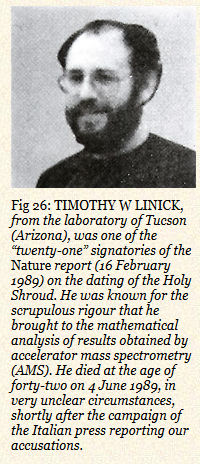
[Left: Photo of Timothy W. Linick and report that "He died at the age of forty-two on 4 June 1989, in very unclear circumstances"[35]. In fact Linick "shot himself" (or so it was assumed) but left no suicide note [see 22Feb16a]. That was only one day after hacker Karl Koch's burnt body was publicly identified by West German police on 3 June 1989 [see 22Feb16b]. According to my hacker theory, Linick's `suicide,' like Koch's, was murder by the KGB made to look like suicide, to prevent them publicly confessing their part in the Soviet sponsored hacking of the Shroud's 1988 radiocarbon dating, which produced the `too good to be true' 1260-1390 = 1325 ±65 radiocarbon date of the first-century Shroud.]

real but computer-generated by a hacker's (allegedly Timothy W. Linick's) program in this fully computerised process! [22Oct17]

Before the article On 15 October, two days after the 13 October 1988 announcement by Hall, Tite and Hedges that the Shroud had been radiocarbon dated "1260-1390!" (see above), the Rev. David Sox (1936-2016), officially launched his anti-authenticist book, "The Shroud Unmasked"[36]. As Ian Wilson pointed out in his review of

[Right: The date in the Introduction of this book is "August 1988"[37], so the book had already been written by Sox well before the 13 October official announcement of the 1260-1390 dating results[38] See 24Jun14, 05Mar15, 30Dec15, 22Nov16, 15Aug17 & 06Aug18.

Sox's book:

"The book, which was already printed, but not yet released, more than two weeks before the official announcement of the carbon dating results, makes clear that Sox authoritatively knew the carbon dating result well in advance. Inevitably, therefore, someone leaked their result to Sox, and he in turn was responsible directly or indirectly for at least two of the highly publicised leaks from within the U.K., those immediately in the wake of his Timewatch programme, and the Sunday Times premature announcement (headlined an `official' result) of 18 September, which the Sunday Times admitted derived from an advance copy of Sox's book. But if Sox knew from Switzerland, he does not disclose this"[39].
In the wake of that 13 October announcement, Ian Wilson in an October 1988 BSTS Newsletter article, "The Carbon Dating Results: Is This Now the End?" used the inspired analogy of a jumbo jet pilot who doesn't ditch his plane into the sea because one instrument, the fuel gauge, reads empty:
"But if there was one feature of the British Museum press conference that particularly astonished, and frankly annoyed me, it was Professor Hall's flat assertion, on the basis merely of the averaged `1260-1390 AD' dates quoted ... that the carbon dates have overwhelmingly proved the Shroud's fraudulence. Effectively we are supposed to believe that on the basis of one single branch of science, nuclear physics (and all involved with the carbon dating, including Gonella and Tite, were physicists), every other scientific and historical contribution to the subject must now be tossed aside as totally worthless. As Hall admitted, it did not matter to him that there remained no clear explanation for how some hypothetical forger created the Shroud's image. The laboratories' instruments had spoken, and that was it. Now although a mere arts graduate, I have always understood that to be truly scientific, any hypothesis needs to be checked from at least two different directions. For instance we do not expect the captain of an Atlantic-crossing jumbo jet, spotting that his fuel gauges suddenly read empty, immediately to ditch his aircraft in the sea without a few further checks"[40].
Wilson's leadership in this darkest hour of sindonology's greatest crisis, was heroic. He was personally derided as "clutching at straws":
"Yet when on 13 October 1988 the scientists who radiocarbon dated the `Shroud announced their 1260-1390 result, to the world at large it was as all previous research on the subject, however scientific and well founded, had immediately to be swept aside as of no consequence. Within minutes of the announcement BBC TV's science correspondent, James Wilkinson, was asking me how it felt to have the Shroud proved a fake. My all too shaky response was to deny that the matter was proven and to suggest that some undetermined factor might have skewed the result. This provoked `Wilkinson to snort: `But aren't you clutching at straws?'[41].
Anti-authenticist Lynn Picknett (1947-) recalled the "ridicule" that Wilson and other Shroudies had to endure in that immediate "post-carbon-dating world":
"The post-carbon-dating world of the Shroudies was very different from the one that preceded the devastating announcement of October 13, 1988. For the Shroudies, the worst thing about the carbon dating was the ridicule. Cartoons began to appear, and jokes about it crept into television programs, such as the irreverent satirical show Spitting Image. A full-length transparency of the Shroud would later figure in the British Museum's exhibition Fake: The Art of Deception. When Ian Wilson gave a talk to the Wrekin Trust on November 5, 1988, and was introduced as `being best known for his book The Turin Shroud," the large audience of respectable, intelligent people laughed. He may have smiled back, but one does not have to try too hard to understand his feelings"[42].
On 15 February 1989, the eve of the publication of the 1989 Nature article, Oxford's Prof. Edward Hall (1924–2001), derided pro-authenticism as "Self-Persuasion" and ridiculed anyone who continued to regard the Shroud as authentic as a "Flat Earther" and "onto a loser":
"In a £5-a-ticket talk at the Logan Hall, Institute of Education, 20 Bedford Way, London, Professor Hall lectures to the British Museum Society on 'The Turin Shroud: A Lesson in Self-Persuasion'. He very forcefully declares anyone continuing to regard the Shroud as genuine a 'Flat Earther' and 'onto a loser'"[43].
After the article On 19 March 1989 the Archbishop of Turin, Cardinal Anastasio Ballestrero (r. 1977-89), retired as Archbishop of Turin, and was succeeded by Giovanni Saldarini (r. 1989-99), with Ballestrero temporarily remaining the custodian of the Shroud[44]. That this was not a normal retirement is evident that it was seven months short of the then official retiring age of 75 for bishops, including cardinals. Ballestrero was a progressive who regarded it as unimportant if the Shroud was not authentic, whereas Pope John Paul II (r. 1978-2005) was a conservative who did believe the Shroud was authentic[45]. Ballestrero came under fierce criticism throughout Italy in the wake of his simplistic acceptance of the results of the Shroud carbon dating (see 30Oct18). The Vatican declined to defend Ballestrero from his attackers, leaving the Cardinal feeling "embittered and dismayed"[46], so it seems that Ballestrero either resigned or was pushed!

On 25 March The Times announced that forty-five businessmen and 'rich friends' had donated £1 million to create a chair of archaeological sciences at Oxford to perpetuate the radiocarbon-dating laboratory created by Professor Edward Hall, with the first incumbent to be the British Museum's Dr Michael Tite[47]!

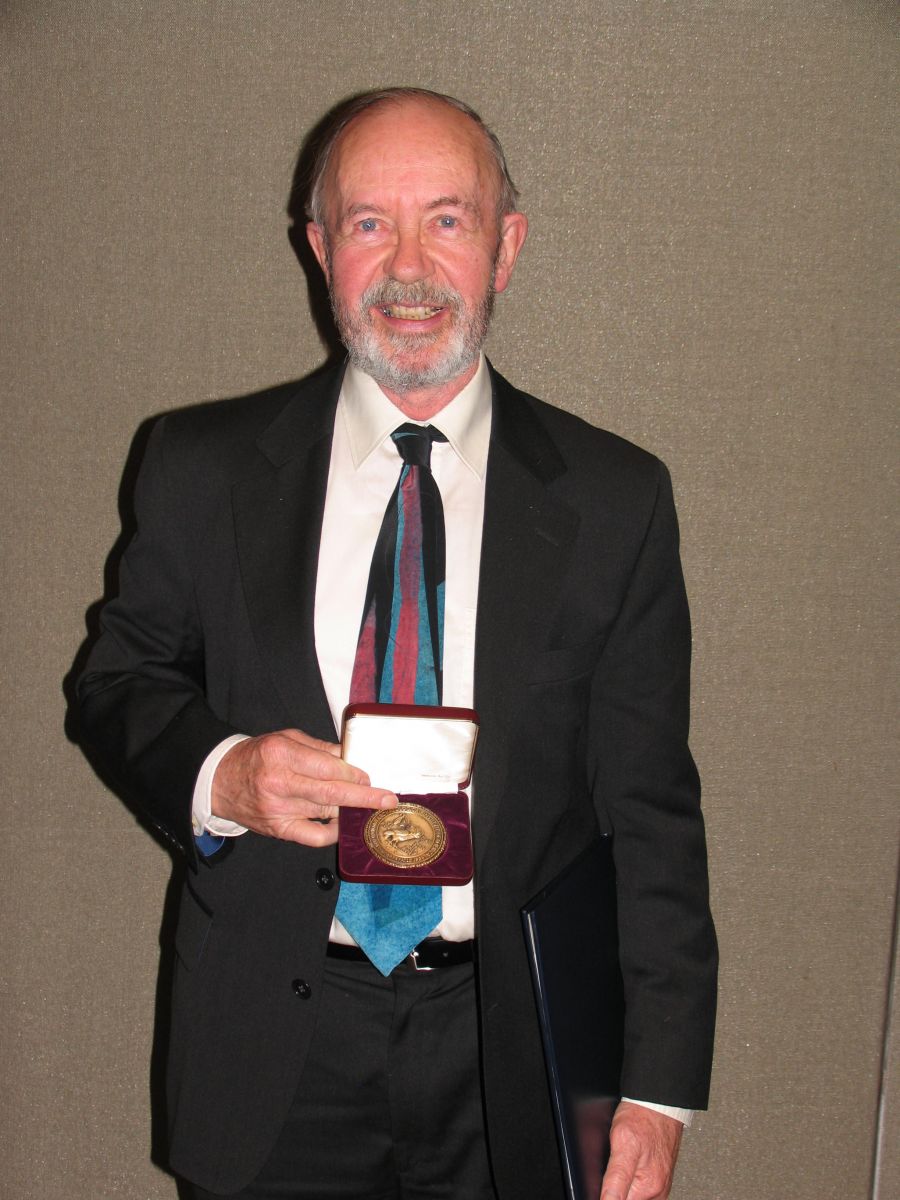
On 1 October 1989, Dr. Michael Tite [Left (original)[48].] succeeded to Hall's professorship at Oxford[49] and also Director of the Oxford radiocarbon dating laboratory[50]. In 1985 when Gove learned that Hall was on the Board of Trustees of the British Museum with Tite being the coordinator of the radiocarbon dating, Gove regarded it a "disturbing" potential conflict of interest[51]. Clearly Hall had a lot riding on the success of the Shroud's radiocarbon dating, and Tite as the author of the 1989 Nature article [see reference 8], with the presumed promise by Hall of his Chair at Oxford and Directorship of the Oxford radiocarbon dating laboratory, had a strong incentive to be a party to scientific fraud (see above and to lie that, "The age of the shroud is obtained as AD 1260-1390, with at least 95% confidence" (see above)!

Continued in the next part #15 of this series.

Notes
1. This post is copyright. I grant permission to quote from any part of it (but not the whole post), provided it includes a reference citing my name, its subject heading, its date, and a hyperlink back to this page. [return]
2. Damon, P.E., et al., 1989a, "Radiocarbon Dating of the Shroud of Turin," Nature, Vol. 337, pp.611–615, 611. [return]
3. Damon, P.E., et al., 1989b, "Radiocarbon Dating of the Shroud of Turin," Nature, Vol. 337, 16 February, pp.611-615, 611. [return]
4. Wilson, I., 1991, "Holy Faces, Secret Places: The Quest for Jesus' True Likeness," Doubleday: London, p.8; Garza-Valdes, L.A., 1998, "The DNA of God?," Hodder & Stoughton: London, p.8; Iannone, J.C., 1998, "The Mystery of the Shroud of Turin: New Scientific Evidence," St Pauls: Staten Island NY, p.164; Wilson, I., 2010, "The Shroud: The 2000-Year-Old Mystery Solved," Bantam Press: London, p.89. [return]
5. Wilson, 1991, pp.8-9; Wilson, I., 1998, "The Blood and the Shroud: New Evidence that the World's Most Sacred Relic is Real," Simon & Schuster: New York NY, pp.6-7; Wilson, 2010, p.89. [return]
6. Sox, H.D., 1988, "The Shroud Unmasked: Uncovering the Greatest Forgery of All Time," The Lamp Press: Basingstoke UK, p.95; Antonacci, M., 2000, "Resurrection of the Shroud: New Scientific, Medical, and Archeological Evidence," M. Evans & Co: New York NY, pp.192-193. [return]
7. Gove, H.E., 1996, "Relic, Icon or Hoax?: Carbon Dating the Turin Shroud," Institute of Physics Publishing: Bristol UK, pp.300-301. [return]
8. Dr Michael Tite, in Marinelli, E. & Petrosillo, O., 1989, "The 1988 Shroud Samples: An interview with Dr Michael Tite," Paris Symposium 1989. [return]
9. Damon, 1989b, p.613. [return]
10. Damon, 1989b, p.614. [return]
11. Wilson, 1998, pp.189, 192. [return]
12. Damon, 1989b, p.614. [return]
13. Damon, 1989b, p.614. [return]
14. "chi-square test - Google Search," 25 February 2019. [return]
15. Sheridan, M. & Reeves, P., 1988, "Turin Shroud shown to be a fake," The Independent, 14 October, in Wilson, 1998, p.7. [return]
16. Damon, 1989b, p.612. [return]
17. Van Haelst, R., 1992, "Will the British Museum finally open its Shroud file?," Shroud News, No 73, October, pp.3-6, 5; Petrosillo, O. & Marinelli, E., 1996, "The Enigma of the Shroud: A Challenge to Science," Scerri, L.J., transl., Publishers Enterprises Group: San Gwann, Malta, p.127. [return]
18. Petrosillo & Marinelli, 1996, p.127. [return]
19. Van Haelst, R., 1994, "A caveat about the Shroud radiocarbon dating," Shroud News, No 84, August, pp.13-14, 13. [return]
20. Damon, 1989b, p.611. [return]
21. Van Haelst, R., 1991, "Radiocarbon data indeed manipulated," Shroud News, No 68, December, p.5. [return]
22. Broad, W. & Wade, N., 1982, "Betrayers of the Truth: Fraud and Deceit in the Halls of Science," Simon and Schuster: New York NY, p.20. [return]
23. Van Haelst, 1991, p.5; Van Haelst, R., 1992, "Were the radiocarbon dates manipulated?," BSTS Newsletter, No. 30, December/January, pp.5-8, 6; Van Haelst, 1994, p.13. [return]
24. Van Haelst, 1991, p.5; Van Haelst, 1992, p.6. [return]
25. Damon, 1989b, p.613. [return]
26. Scavone, D.C., 1989, "The Shroud of Turin: Opposing Viewpoints," Greenhaven Press: San Diego CA, p.104; Iannone, 1998, p.163; Ruffin, C.B., 1999, "The Shroud of Turin: The Most Up-To-Date Analysis of All the Facts Regarding the Church's Controversial Relic," Our Sunday Visitor: Huntington IN, p.117; Wilson, I. & Schwortz, B., 2000, "The Turin Shroud: The Illustrated Evidence," Michael O'Mara Books: London, p.94; Tribbe, F.C., 2006, "Portrait of Jesus: The Illustrated Story of the Shroud of Turin," Paragon House Publishers: St. Paul MN, Second edition, p.170. [return]
27. Petrosillo & Marinelli, 1996, p.62; Garza-Valdes, 1998, p.179; Danin, A., Whanger, A.D., Baruch, U. & Whanger, M., 1999, "Flora of the Shroud of Turin," Missouri Botanical Garden Press: St. Louis MO, p.5. [return]
28. Wilson, 1991, p.6; Wilson, 1998, pp.6,191; Wilson, 2010, pp.82A, 87, 93, 95, 146E. [return]
29. Wilson, 1998, p.189. [return]
30. Sox, H.D., 1988, "The Shroud Unmasked: Uncovering the Greatest Forgery of All Time," Lamp Press: Basingstoke UK, pp.142, 145; Damon, et al., 1989, p.613; Wilson, 1991, pp.7-8; McCrone, W.C., 1999, "Judgment Day for the Shroud of Turin," Prometheus Books: Amherst NY, p.246; Guerrera, V., 2001, "The Shroud of Turin: A Case for Authenticity," TAN: Rockford IL, p.130. [return]
31. "Accelerator Mass Spectrometry," CEDAD, University of Salento, Italy, 27 June 2006. [return]
32. Sox, 1988, pp.142, 145; Gove, 1996, p.262. [return]
33. Gove, 1996, p.262. [return]
34. Gove, 1996, p.264. [return]
35. Bonnet-Eymard, B., 2000, "The Holy Shroud is as Old as the Risen Jesus, IV. Caution! Danger!, The Catholic Counter-Reformation in the XXth Century, No 330, Online edition, May. [return]
36. Wilson, 1998, p.311. [return]
37. Sox, 1988, p.6. [return]
38. Wilson. I., 1988a, "Recent Publications," BSTS Newsletter," No. 20, October, pp.18-19; Crispino, D., 1990, "Recently Published," Shroud Spectrum International, Nos. 35/36, June/September, pp.29-37, 30; Paci, S.M., 1990. "The Case is Not Closed!," Shroud News, No 60, August, pp.4-11, 8; Petrosillo & Marinelli, 1996, pp.11, 109; Guerrera, 2001, p.134. [return]
39. Wilson, 1988a, p.19. [return]
40. Wilson, I., 1988b, "The Carbon Dating Results: Is This Now the End?," BSTS Newsletter, No. 20, October, pp.2-10, 4. [return]
41. Wilson & Schwortz, 2000, p.95. [return]
42. Picknett, L. & Prince, C., 2006, "The Turin Shroud: How Da Vinci Fooled History," [1994], Touchstone: New York NY, Second edition, Reprinted, 2007, p.10. [return]
43. Wilson, 1998, p.311. [return]
44. Wilson, 1998, p.311. [return]
45. "Anastasio Ballestrero," Wikipedia, 16 January 2019. [return]
46. Wilson, I, 1989a, "News from overseas: Retirement of Cardinal Ballestrero," BSTS Newsletter, No. 21, January/February, pp.10-11. [return]
47. Wilson, I., 1989b, "Dr. Tite to succeed Professor Hall at Oxford," BSTS Newsletter No. 22, May, pp.7-8; Wilson, 1998, p.311. [return]
48. "Michael S. Tite-2008 Pomerance Award for Scientific Contributions to Archaeology," Archaeological Institute of America, 2008. [return]
49. Petrosillo & Marinelli, 1996, p.111. [return]
50. "Michael S. Tite," Archaeological Institute of America, 2008. [return]
51. Gove, 1996, p.82. [return]

Posted 17 February 2019. Updated 8 October 2025.

Thursday, February 14, 2019

"News and Editorial," Shroud of Turin News, January 2019

Shroud of Turin News - January 2019
© Stephen E. Jones
[1]

[Previous: December 2018, part #1] [Next: February 2019, part #1]

This is the January 2019 issue of my Shroud of Turin News. I have listed below linked news articles about the Shroud in January as a service to readers, without necessarily endorsing any of them.

News:
• "New discoveries prove man on Shroud of Turin was ‘really crucified’," LifeSiteNews, 11 January 2019, Diane Montagna.
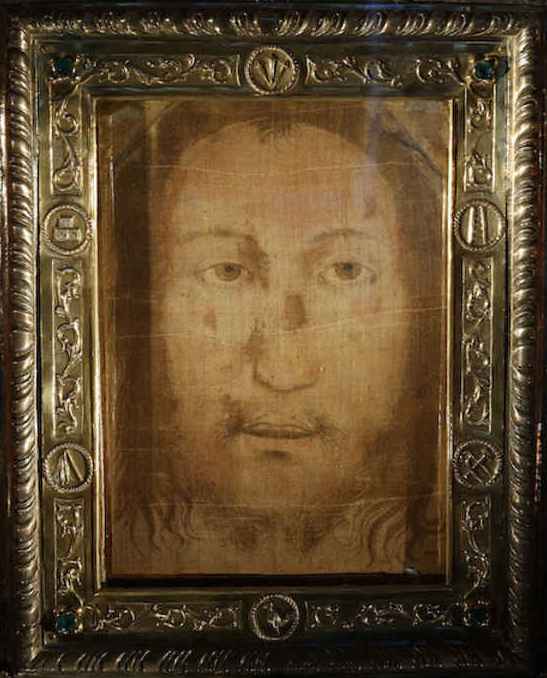
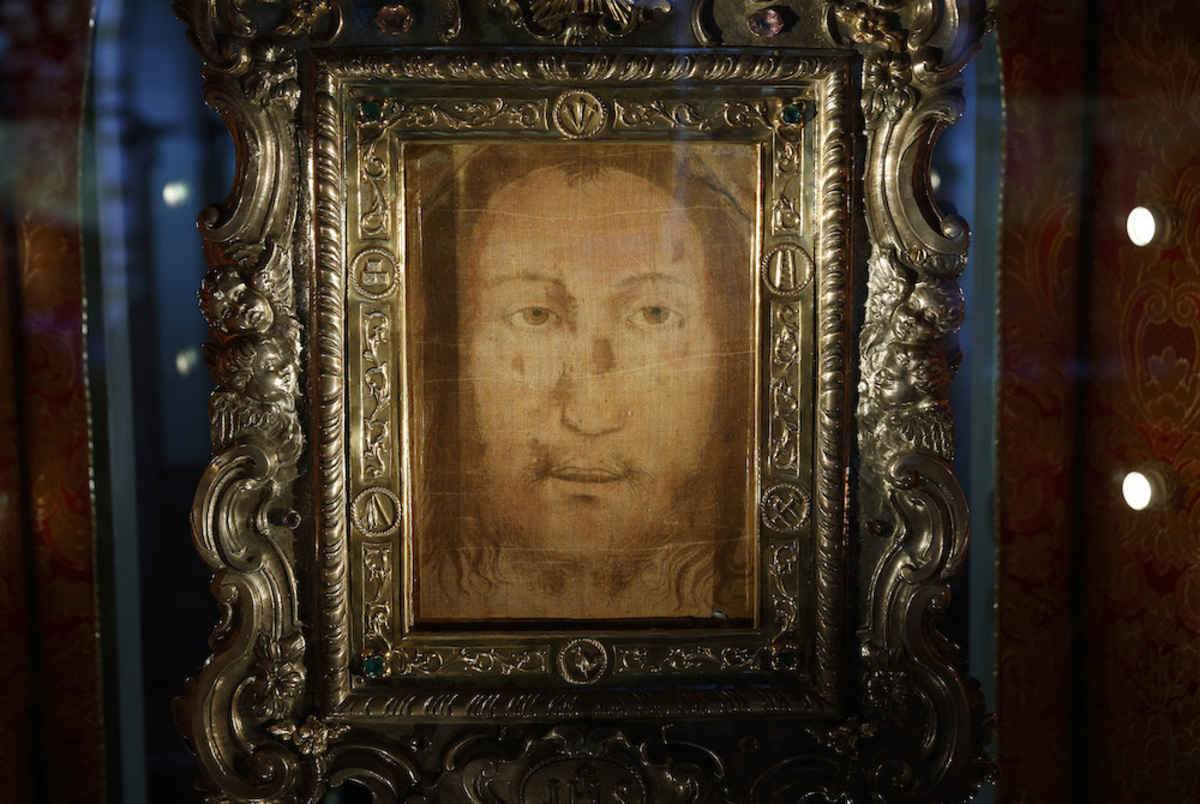
• "Seeking Christ's face: Some believe hilltop shrine holds true relic," Catholic News Service, 18 January 2019, Junno Arocho Esteves. [This is about the Holy Face of Manoppello [Right (enlarge): (extract from article photo)]. See 09Dec17 for Ian Wilson's reasons why this is merely a copy (or even a copy of a copy) of the Vatican's Veil of Veronica (now very deteriorated-see 27Jul17), which itself was merely the Vatican's early 12th century copy of the Shroud face.]

Editorial
Rex Morgan's Shroud News: In Shroud.com's January Update the final 8 issues of Rex Morgan's Shroud News, nos. 111-118 appeared in Barrie Schwortz's Shroud News, archive. On 3 January I mailed back to Ian Wilson his 118 issues of Shroud News and he emailed me on 15 January that he received them. So ended a project that began on 4 April 2015 - 3 years and ~9 months ago! But the sad news is that Rex Morgan, who is
[Left (original): Rex Henry Morgan, JP, Member of the Order of Australia (AM), Member of the British Empire (MBE), etc, etc] in his 80s, emailed me in large capital letters that his eyesight is failing and he is having difficulty reading the online versions of his "life work" as he once told me his Shroud News was (yet see what else Rex Henry Morgan is and has done!). At least Rex knows that his "life work" has been "immortalised" by being digitised and put online.

Posts: In January I blogged 6 new posts (latest uppermost): "Abgar VIII: Turin Shroud Encyclopedia" - 31st; "Chronology of the Turin Shroud: Fifteenth century (2)" - 14th; "Abgar V: Turin Shroud Encyclopedia" - 8th; "`News and Editorial,' Shroud of Turin News, December 2018" - 5th; "Date index 2019: The Shroud of Turin blog" - 4th; "Index A-Z: Turin Shroud Encyclopedia" - 3rd.

Updates Updates of past posts in the background included adding to my "Abgar V: Turin Shroud Encyclopedia" post after I had posted the final installment, what I had overlooked, the c.945 Official History's account of how the Image of Edessa/Shroud came to be in Edessa.

Turin Shroud Encyclopedia. In January I restarted my "Turin Shroud Encyclopedia." The main reason I did that is because it enables me to post Shroud topics that might never come up otherwise.

Comments: I deleted an anti-authenticist mocking comment in January. If anti-authenticists knew deep down that they had truth on their side, their comments would reflect a polite serenity. But instead their nasty `body language' tells me that deep down they fear they are wrong!

In January I received a follow-up comment under my 21 August 2018 post, "`Poker holes' #29: Other marks and images: The evidence is overwhelming that the Turin Shroud is Jesus’ burial sheet! from a Dr. Tibor Szarvas, a radiochemist in Budapest. I reply commented to Dr Szarvas that I would respond to his comment in a separate post. But since tomorrow, 16 February 2019, is the 30th anniversary of the Nature paper, "Radio-carbon Dating of the Shroud of Turin" [Right: The abstract of the article.], and I will need to post near to that date in my series, "On this day 30 years ago in the radiocarbon dating of the Turin Shroud," it will have to wait until after that. But after waiting so long, it will probably be an anticlimax for Dr Szarvas because I will probably repeat much of what I wrote in my earlier comment under that post.

Radiocarbon dating of the Shroud. I still have had no response to my "Open letter to Professor Christopher Ramsey" of 4 October 2018. I recently found where Ian Wilson wrote that Ramsey was a "professed Christian":

"Professor Edward Hall died in 2001, and his successor Dr Michael Tite has retired from what has been renamed the Oxford Radiocarbon Accelerator Unit, now moved to rather more salubrious premises in Oxford's South Parks Road. The unit's present director, Professor Christopher Bronk Ramsey, a professed Christian, was a young student at the time the Shroud was radiocarbon dated and has none of Hall's Old Etonian braggadocio. Characteristically soft-spoken, he has declared himself very willing to make his laboratory's facilities available for any sensible, properly scientific fresh approach to the subject"[2]
I therefore still hope and pray that Prof. Ramsey will put Jesus (or at least the truth) first and either collectively, or him individually, write to Nature, requesting it retract its 16 February 1989 article, "Radiocarbon dating of the Shroud of Turin," on the grounds that the artistic and historical evidence is overwhelming that the Shroud was in Constantinople in the mid-12th century, and therefore it arrived in Constantinople as the Image of Edessa in 944, and therefore was in Edessa from 544 [see 04Oct18].

My radiocarbon dating hacker theory As can be seen above, I blogged no new post on my hacker theory in January.

My book: After a slow start, in January I began making progress word-processing my draft book manuscript, "The Shroud of Turin: The burial sheet of Jesus!"

[Right (enlarge): The planned cover of my book.]

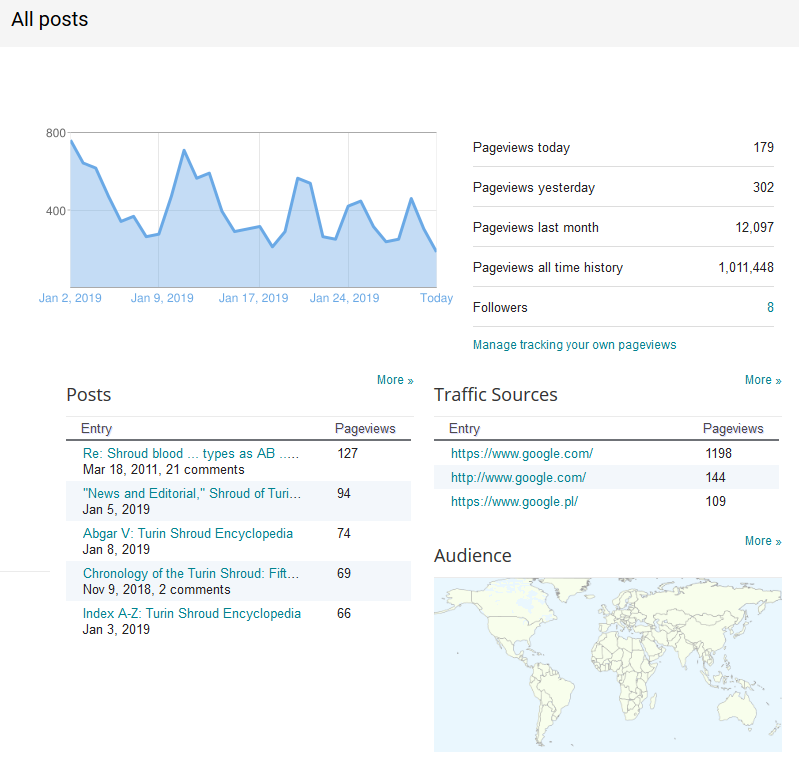
Pageviews: At midnight on 31 January 2019, Google Analytics [Below (enlarge)] gave this blog's "Pageviews all time history" as 1,011,448. This compares with 842,205 at the same time in January 2018. That is 169243 pageviews over the past 12 months, or an average of ~464 pageviews per day.

Google Analytics also gave the most viewed posts for the month (highest uppermost) as: "Re: Shroud blood ... types as AB ... aged blood always types as AB, so the significance of this ... is unclear," Mar 18, 2011 - 127; "`News and Editorial,' Shroud of Turin News, December 2018," Jan 5, 2019 - 94; "Abgar V: Turin Shroud Encyclopedia," Jan 8, 2019 - 74; "Chronology of the Turin Shroud: Fifteenth century (2)," Nov 9, 2018 - 69 and "Index A-Z: Turin Shroud Encyclopedia" - Jan 3, 2019 - 66.

Notes:
1. This post is copyright. I grant permission to extract or quote from any part of it (but not the whole post), provided the extract or quote includes a reference citing my name, its title, its date, and a hyperlink back to this page. [return]
2. Wilson, I., 2010, "The Shroud: The 2000-Year-Old Mystery Solved," Bantam Press: London, pp.98. [return]

Posted 14 February 2019. Updated 23 April 2026.

Thursday, January 31, 2019

Abgar VIII: Turin Shroud Encyclopedia

Turin Shroud Encyclopedia
Copyright © Stephen E. Jones
[1]

Abgar VIII #3

This is "Abgar VIII," part #3 of my new Turin Shroud Encyclopedia. For information about this series, see part #1 and part #2. Emphases are mine unless otherwise indicated.

[Index #1] [Previous: Abgar V #2] [Next: Accetta, A. #4]


Abgar VIII Abgar VIII, the Great (r. 177–212) was, like Abgar V [see

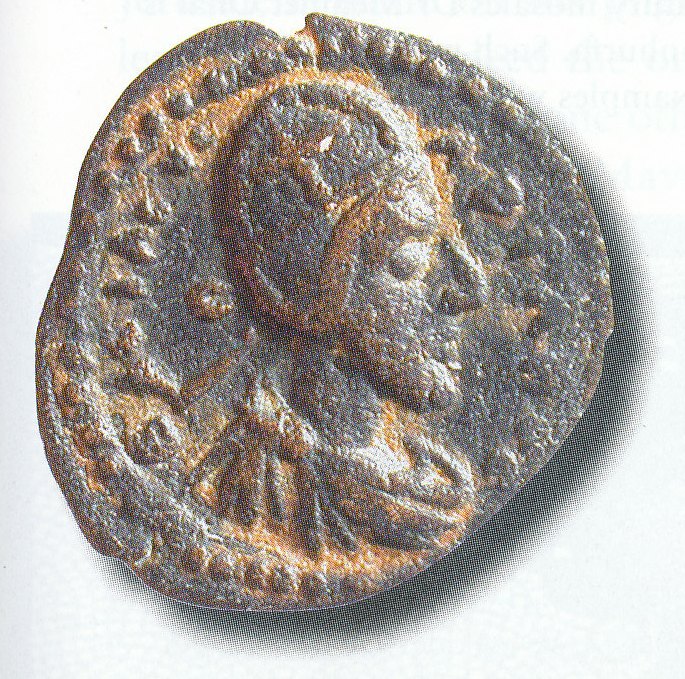
[Above (enlarge): Abgar VIII coin depicting a Christian cross on his head-dress, probably issued during the tolerant reign of Roman Emperor Commodus (r. 177-192)[2]. While there probably were previous Christian kings of Edessa, e.g. Abgar V, Abgar VIII was the world's first overtly Christian king. See "177".]

"Abgar V"] a king of Osroene, in today's eastern Turkey, the capital of which was Edessa [see future "Edessa"], today's Urfa. The two Abgars may have been no relation, there being 127 years between the AD 50 end of Abgar V's reign and the AD 177 start of Abgar VIII's, and "Abgar" may have been a generic name for the kings of Edessa[3].

Osroene had been absorbed into the Roman Empire in 114 as a semi-autonomous vassal state, after a period of rule by the Parthian Empire.

In 163 Osroene's king Ma'nu VIII bar Ma'nu (139–163, 165–167)[4]was deposed by the Parthians but he was reinstated by the Romans in 165, when the Roman general Gaius Avidius Cassius (c.130–175) besieged Edessa and its citizens killed the Parthian garrison and admitted the Romans into the city[5].

In 177 Abgar VIII (177–212), the Great, became king of Osroene and therefore of Edessa, its capital.

In about 180, during the tolerant reign of Roman Emperor Commodus (r. 177-192), Abgar VIII asked Pope Eleutherus (r.174-189) to send missionaries to Edessa. In Abgar VIII's reign Edessa became the world's first Christian city as evidenced by this stone Christian cross over a former fountain based on lion's head in modern Sanliurfa (ancient Edessa) [Right (enlarge)[6].], which has survived the almost complete eradication of Edessa's Christian history since the Muslim conquest in 1144. The lion was the symbol of the Abgar dynasty, which ceased with Abgar IX's death in 213 (see below)

Abgar VIII supported Parthia in its 194 war against Rome, which Parthia lost. So Roman Emperor Septimius Severus (r. 193-211) took Edessa's rule from Abgar VIII and gave it to a procurator (Roman governor), until 197-198 when Abgar VIII assisted Rome in its defeat of Parthia.

In 201 a major flood of its river Daisan devastated Edessa, thousands died, and the "church of the Christians" was damaged. This is the first mention anywhere of a Christian church building and is further evidence that Edessa had become a Christian city.

As a reward for assisting Rome in its war with Parthia in 194, Abgar VIII was invited to Rome in 202, which he visited after 204.

In 205 Abgar VIII built on higher ground within the walls of the old Edessa, a new walled Citadel (below), called Birtha in Syriac, and Britium in Latin.

[Above (enlarge)[7]: The ruins of Edessa's citadel, within the modern city of Sanliurfa, Turkey.]

The early church father Clement of Alexandria (c. 150-215), in his Outlines, listed the burial places of Jesus' disciples, including that Thaddaeus/Addai was with that of the Apostle Thomas "in the Britio of the Edessans." That is Edessa's birtha, or citadel (see below).

In 212 Abgar VIII died, and was succeeded by his son Abgar IX (r. 212-213).

Abgar IX was a reprobate, who ill-treated his subjects and killed Aggai, the aged Bishop of Edessa by breaking his legs[8]. He was summoned to Rome in 213 and executed on the orders of Roman Emperor Caracalla (r.211–217).. In 214 Caracalla ended the independence of Osroene and incorporated it as a province of the Roman Empire.

The English monk, the Venerable Bede (c.673–735), was told that in the Liber Pontificalis (Book of the Popes) in Rome that Pope Eleutherus (r.174-189) had received a letter from Lucio Britannio rege (King Lucius [Abgar VIII] of the [Edessa] Citadel), asking for Christian missionaries to be sent [to Edessa] that he might become a Christian and to help convert those within his lands to Christianity. Bede wrongly interpreted this to have been a previously unknown British King Lucius, and wrote in his influential Ecclesiastical History of the English People, completed in 731, that Lucius was a British king and that Christianity had commenced in Britain in the second century!

[Above (enlarge)[9]: "King Lucius (middle) from the East Window in York Minster." But there there never was an English King Lucius: he was in fact Edessa's King Lucius Septimius Severus, aka. Abgar VIII (r. 177-212)!]

Because of Bede's misunderstanding the French creators of the Holy Grail [see future "Grail"] legends located their stories not in France but in England, and the legend arose that Joseph of Arimathea had visited England!

Continued in the next part #4 of this series.

Notes
1. This post is copyright. I grant permission to quote from any part of this post (but not the whole post), provided it includes a reference citing my name, its subject heading, its date and a hyperlink back to this page. [return]
2. Wilson, I., 2010, "The Shroud: The 2000-Year-Old Mystery Solved," Bantam Press: London, plate 15a. [return]
3. Segal, J.B., 2001, "Edessa: The Blessed City," [1970], Gorgias Press: Piscataway NJ, Second edition, Reprinted, 2005, p.13. [return]
4. Segal, 2001, p.13. [return]
5. Segal, 2001, p.13. [return]
6. Wilson, 2010, p.146G. [return]
7. Extract from "Edessa citadel in Urfa, Turkey (Google Maps)," Virtual Globetrotting, 2016. [return]
8. Segal, 2001, pp.14, 18. [return]
9. "File:King Lucius and two other Kings, East Window, York Minster.jpg," Wikimedia Commons, 27 May 2018. [return]

Posted 31 January 2019. Updated 13 August 2025.

Monday, January 14, 2019

Chronology of the Turin Shroud: Fifteenth century (2)

Chronology of the Turin Shroud: AD 30 to the present
FIFTEENTH CENTURY (2)
© Stephen E. Jones
[1]

This is part #19, "Fifteenth century (2)" of my "Chronology of the Turin Shroud: AD 30 - present" series. For more information about this series see the Index #1. Emphases are mine unless otherwise indicated.

[Index #1] [Previous: 15th century (1) #18] [Next: 16th century (1) #20]


15th century (1454-1500).

[Above (enlarge): "Man of Sorrows"[2] depiction of the Shroud with its distinctive wounds, bloodstains and crossed hands:

"... the wounds of the Christ can be seen to be Shroud-related. Not only are the hands crossed in the Shroud manner and Christ's body peppered with most-Shroud-like scourge-marks, particularly telling are long streams of blood as from the nail-wounds that are depicted running down the front of the forearms"[3]
in 1485 by French miniaturist Jean Colombe (c. 1430-c. 93)[4], on behalf of Charles I, Duke of Savoy (r. 1482-90) (left), to commemorate his marriage in that year to Blanche (Bianca) de Montferrat (1472–1519)[5] (right). This miniature was added to the collection, Les Très Riches Heures (the "Very Rich Hours") of King John II (r.1350–64)'s son John, Duke of Berry (1340–1416)[6], by Duke Charles I, John's descendant[7] [See "1485a"].]

1457 On 29 May, evidently having learned that Marguerite de Charny (c. 1393–1460) [see "c.1393"] had transferred the Shroud four years earlier to Duke Louis I of Savoy (r. 1440-65)[8] [see "1453a"], the Lirey church canons continued with their extortion racket [see part (1)] by issuing her, the rightful owner of the Shroud [see "1398"], with a pro-forma writ of excommunication through the ecclesiastical Court of Besançon [see 09Nov18], if she did not return the Shroud to them immediately[9] [see 1418b, 1443 and 1447]! Then on the next day, 30 May 1457, Marguerite was excommunicated[10]!

1459 Marguerite de Charny's half-brother Charles de Noyers[11], a son of Marguerite's mother's second marriage[12] [see 03Jul18], negotiated compensation to the Lirey canons for their `loss' of `their' Shroud[13], which they specifically recognise they will not now recover[14]. On the promise of payment of monetary compensation[15], which never was paid[16], Marguerite's excommunication was lifted[17].

1460 On 7 October Marguerite de Charny died[18], leaving her Lirey lands to her cousin and godson Antoine-Guerry des Essars (c. 1408-74)[19]. As previously mentioned (see "c. 1392" and 11Jul16), Antoine-Guerry des Essars was the son of Guillemette de Poitiers (1370–1450), who in turn was one of four illegitimate children of Bishop Henri de Poitiers (r. 1354–70) and his nun concubine, Jeanne de Chenery (1340–)! According to the 1389 Memorandum of the Bishop of Troyes, Pierre d'Arcis (r. 1377-95), one of his predecessors, Bishop Henri de Poitiers, had discovered that the Shroud was "cunningly painted" and even the "artist who had painted it":

"... Henry of Poitiers ... then Bishop of Troyes ... after diligent inquiry and examination, he discovered the fraud and how the said cloth had been cunningly painted, the truth being attested by the artist who had painted it, to wit, that it was a work of human skill and not miraculously wrought or bestowed"[see "1389d"].
But not only: 1) is the Shroud not painted [11Jul16]; 2) there is no evidence that Bishop de Poitiers had a problem with the Shroud[21Aug18]; and much evidence that he did not: 3) Geoffroy II de Charny married Marguerite de Poitiers, who was Bishop de Poitiers' niece[c. 1392]; and 4) so close was the relationship between Marguerite de Charny and her mother's de Poitiers family, and Guillemette de Poitiers in particular, that Marguerite was the godmother of Guillemette's son Antoine and left him her Lirey lands! A more comprehensive refutation of the d'Arcis Memorandum is difficult to imagine!

1464 The Liray canons, having received nothing from Marguerite or Charles de Noyer, next approached Duke Louis I of Savoy (r. 1440-65)[20]. On 6 February by an accord drawn up in Paris, Louis agreed to pay the Lirey canons an annual rent of fifty francs[21], to be drawn from the revenues of the castle of Gaillard, near Geneva, as compensation for their loss of the Shroud[22]. The accord notes that the Shroud had been given [sic] to the church of Lirey by Geoffroy I de Charny, and that it had then been transferred to Duke Louis by Marguerite de Charny[23]. This is the earliest surviving document to record the de Charny's Shroud of Lirey had become Savoy property[24].

1465 Duke Louis I died at Lyon[25]. He was succeeded by his son Duke Amadeus IX (r. 1465-72)[26] [Right (enlarge)[27].], who shared with his wife Duchess Yolande (1434-78), a daughter of King Charles VII of France (r. 1422-61), a particular devotion to the Shroud[28]. Due to his retiring nature and epilepsy[29], Amadeus delegated to Yolande the day-to-day admin-istration of his territories[30].

1467a On 21 April Pope Paul II (r. 1464-71) approved the upgrading of the Chambéry Royal Chapel [see "1408"], where the Shroud had been primarily kept since 1453 [see "1453b"] to a collegiate church[31], with twelve canons[32].

1467b In that same year, the Franciscan theologian Francesco della Rovere was appointed a Cardinal[33]. In his 1464 treatise The Blood of Christ, della Rovere wrote:

"... the Shroud in which the body of Christ was wrapped when he was taken down from the cross. This is now preserved with great devotion by the Dukes of Savoy, and it is coloured with the blood of Christ"[34].
On the death of Pope Paul II, Cardinal della Rovere was elected Pope and took the name Sixtus IV (r. 1471-84)[35].

1471a Commencement by Duke Amadeus IX of the enlargement and embellishment of the Chambéry Royal Chapel[36]. Pope Sixtus IV approved its name to be the Sainte Chapelle, Chambéry[37] [see "1479"], after the Sainte Chapelle, Paris, which was completed in 1248 by King Louis IX (r. 1226–1270) to house Passion relics, including the Crown of Thorns[38].

1471b On 20 September the Shroud was taken from Chambéry, France over the Alps to Vercelli, Italy[39]. It may have been due to a fear that with the impending death of Duke Amadeus IX [see next], Yolande's estranged brother King Louis XI (1461-83), would try to seize the Shroud [see "1476"]. The Shroud would be away from Chambéry for four years [see "1475b"].

1472 Death of Duke Amadeus IX[40]. He was succeeded by his six-year old son Philibert I (r. 1472-82)[41]. His mother, Dowager Duchess Yolande [Left (enlarge)[42].], assumed the role of regent during his minority[43]. But this was contested by Yolande's brother King Louis XI[45], who in 1451 had married, without the permission of his father King Charles VII, the ~10 year old Charlotte of Savoy (c.1441-83), a daughter of Duke Louis I and Anne de Lusignan (1418–62)[44]. Louis XI presumably wanted his own 2 year-old son, Charles VIII (1470–98), to succeed Amadeus IX as the next Duke of Savoy.

1473a On 14 May representatives of the Lirey canons visited Regent Yolande in Chambéry and pressed her for eight years' arrears in the promised rent [see "1464"], or return of the Shroud to them[46]. But Yolande, presumably knowing that their claim was fraudulent [see "1457"], sent them away empty-handed, because they then petitioned Louis IX requesting that the king himself assign them revenues as compensation for their loss of revenue from the Shroud[47]! Louis responded by sending letters to the baillis of Sens, Troyes and Chaumont[48], presumably to seize the Shroud if it entered their jurisdictions.

1473b On 2 July 1473 the Shroud was taken from Vercelli to Turin[49].

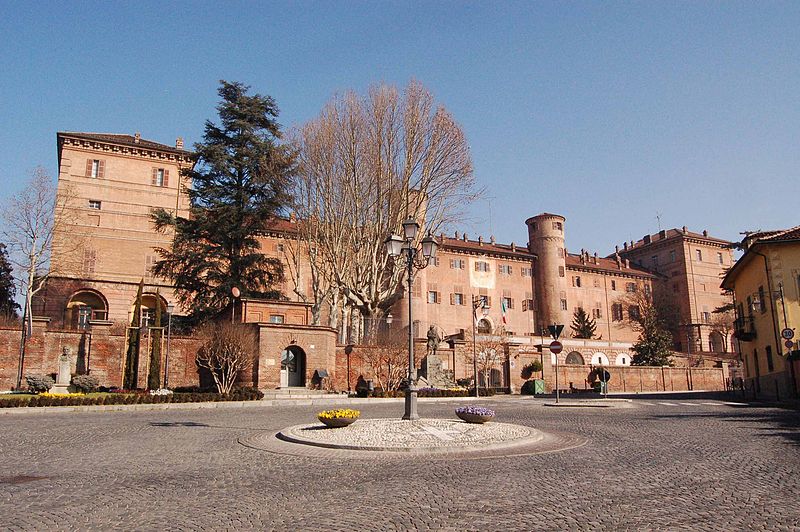
[Right (enlarge)[50]: The rear of the Palazzo Madama, Turin, which in the 15th century was a Savoy castle. Presumably the Shroud was kept here from July to October 1473.]


1473c Then on 5 October the Shroud was moved from Turin to Ivrea[51].

[Left (enlarge)[52]: The 14th century Savoy castle in Ivrea, Italy. Presumably the Shroud was here from October 1473 to July 1474 and August 1474 to October 1475 - see below.]


1474a On 18 July the Shroud was moved from Ivrea to Moncalieri[53].

[Right (enlarge)[54]: Savoy Castle of Moncalieri. The twin towers were part of the 15th century castle where the Shroud was presumably kept in July and August 1474.]

1474b On 25 August the Shroud was taken from Moncalieri back to Ivrea[55].

1475a End of the Hundred Years' War between England and France with the signing of the Treaty of Picquigny by King Louis XI of France and King Edward IV of England (1461–70, 1471–83)[56].

1475b Then on 5 October 1475b the Shroud was returned from Ivrea back to Chambéry[57].

1476 Like her late younger brother Charles, Duke of Berry (1446–72), Yolande was an ally of her near neighbour Charles, Duke of Burgundy (r. 1467–77) against her eldest brother King Louis XI of France[58]. But after Burgundy's humiliation at the Battle of Grandson in 1476, the Duke of Burgundy accused Yolande of being in league with Louis, attacked Savoy, seized Yolande and imprisoned her[59]. But Yolande was released by Louis[60] and remained on good terms with him thereafter[61].

1477-8 The Shroud was in the Piedmont towns of Susa, Avigliano and Rivoli[62].

[Left (enlarge)[63]: The unfinished Savoy castle at Rivoli, Italy[64]. Presumably the Shroud was here in 1477-8.]

1478 On 20 March (Good Friday), the Shroud was exhibited at Pinerolo[65].

Duke Louis and his successors needed to visit their extensive properties[66], and in doing so they took the Shroud with them[67], both to safeguard it from theft[68], and to protect them as a palladium (a guarantee of Divine protection)[69]. In some or all of these above places the Savoys may have exhibited the Shroud as a symbol of their rising dynastic status[70], but except for Pinerolo, the records have not survived.

It is noteworthy that from 1473 to 1478 above it must have been Dowager Duchess Yolande, acting as regent for her very young son, Duke Philibert I (1465-82), who carried the Shroud around with them and exhibited it!

1479 Completion of the Sainte Chapelle, Chambéry[71].

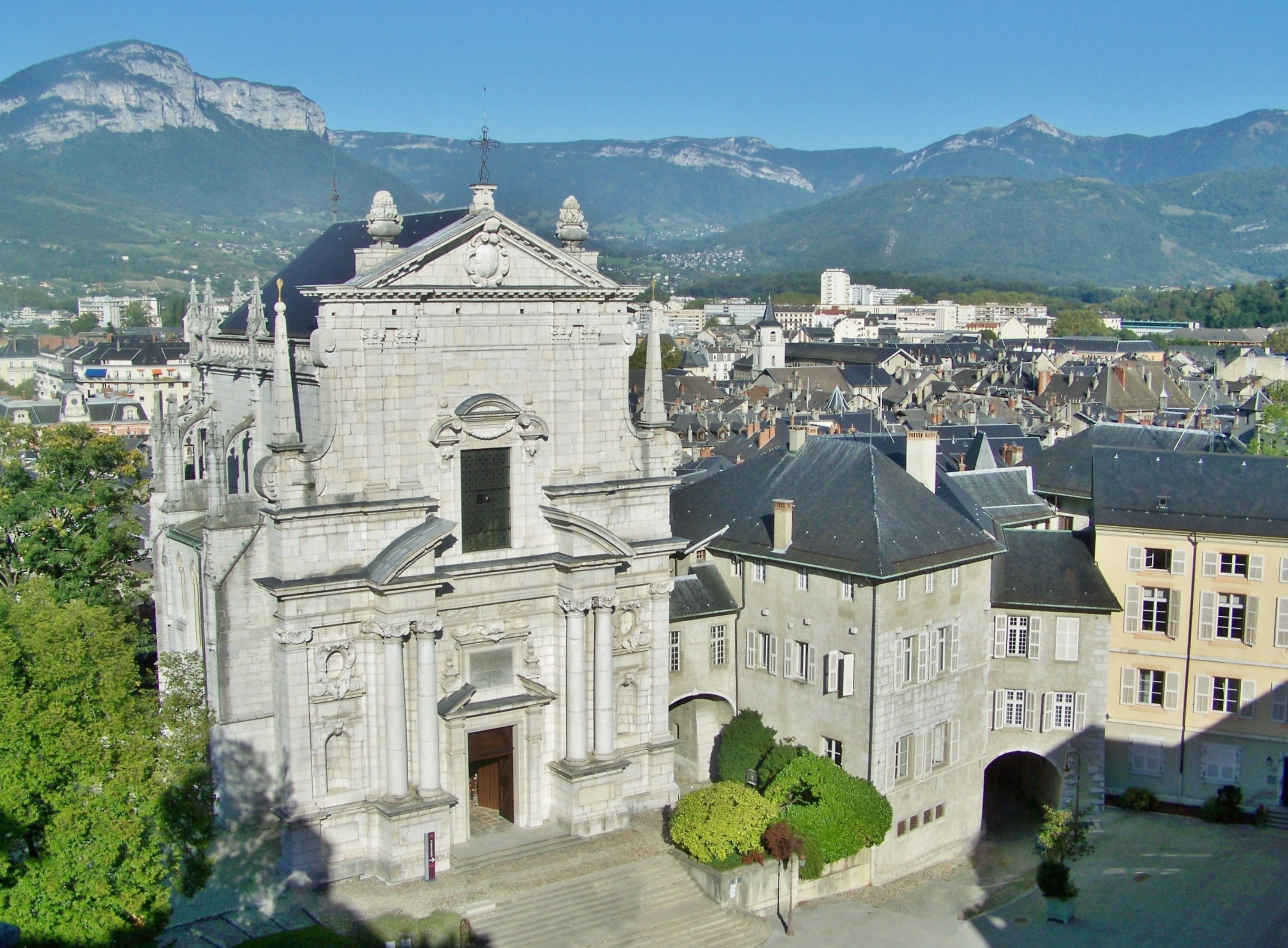
[Above (enlarge): The Sainte-Chapelle, Chambéry[72], as it is today, after the 1532 fire fire [see future "1532"].]

1482a A warrant is issued on behalf of the Lirey canons that the Dowager Duchess Yolande should observe the agreement made by Duke Louis I [see "1464"] [73]. But again no payment was forthcoming and as this was the Lirey canons' last attempt to obtain compensation, they evidently gave up on what had clearly become a lost cause[74].

1482b In this same year Duke Philibert I of Savoy, now about sixteen years old, dies in a hunting accident[75]. He is succeeded by his fourteen-year-old brother Charles, who becomes Duke Charles I (r. 1482-90)[76], inheriting through the 1458 marriage of his late younger brother Louis II of Savoy (c. 1436–82) to Charlotte de Lusignan, Queen of Cyprus (1444–87) the empty titles of King of Cyprus and King of Jerusalem[77].

1483a Death of King Louis XI of France[78] who is succeeded by his eldest surviving son King Charles VIII (r. 1483-98)[79].

1483b An inventory dated 6 June 1483 of the Sainte Chapelle at Chambéry, described the Shroud as "enveloped in a red silk drape, and kept in a case covered with crimson velours, decorated with silver-gilt nails, and locked with a golden key"[80].

1485a On 1 April Duke Charles I of Savoy married Blanche (Bianca) de Montferrat (1472–1519)[81]. That same year the French painter Jean Colombe added to a Book of Hours that Duchess Bianca had inherited, a Shroud-like miniature of the risen Christ, with the coats of arms and portraits of Duke Charles and Duchess Bianca [see above] [82]. Duchess Bianca followed in the footsteps of the previous Duchesses of Savoy in her piety and veneration of the Shroud[83].

1485b On 2 June of that year a clerk Jean Renguis, who seems to have had special charge of the Shroud, is recorded as being paid 2 ecus 'in recompense for two journeys which he made from Turin to Savigliano carrying the Shroud'[84].

1488a On Easter Sunday 1488 the Shroud was exhibited at Savigliano[85].

1488b A Passion play known as the Passion de Semur was written in this year, probably at Semur-en-Auxois in Burgundy, that includes what mediaevalist Lynette Muir (1930-2007) described as "an explicit and undeniable reference to the Lirey Shroud"[86]. In the scene of the Marys [sic-see 27May12] visiting the tomb on Easter Day, the second Mary says, "There is nothing but the Shroud", followed by Mary Magdalen exclaiming, "See the trace of the wound". This is then followed a little later by a stage direction requiring that Mary Magdalen "shall take the Shroud "sudorem" and display it thus"[87].

1490 Death of Duke Charles I of Savoy at the age of twenty-one[88], his seven-month-old son becoming Duke Charles II (r. 1490-96)[89]. Dowager Duchess Bianca acted as regent and ruler of Savoy for her son Duke Charles II, until he died six years later [see "1496"][90].

1492 Conspiracy theorists Lynn Picknett and Clive Prince claimed

[Right[91]: Their blurb states:

"Despite often bitter opposition from many vested interests, Lynn Picknett and Clive Prince have fearlessly exposed cover-ups and conspiracies, from the faking of the Shroud of Turin ..." [92]. But as I showed on 14Jul09, they "are patent liars in this matter ..."!]

that:

"Leonardo [da Vinci (1452–1519)] faked the Shroud in 1492 ... just two years before the Shroud emerged from its forty-year period of obscurity"[93].
But for starters [see Scavone, 1996], as can be seen above, far from having been in "obscurity" for forty years until 1494 [see "1494], i.e. from 1453-94, the Shroud was publicly exhibited only four years before 1492, in 1488 at Savigliano! And there must have been many people who attended both the 1488 Savigliano exposition and the 1494 Vercelli exposition, who would have noticed that the Shroud they saw only six years earlier was not the same[94]!

1494 On Good Friday Dowager Duchess Bianca of Savoy exhibited the Shroud at Vercelli in the presence of Rupis, secretary to Francesco II Gonzaga, Marquess of Mantua (r. 1484-1519)[95]. According to Rupis' report:

"A sudarium was exhibited, that is, a sheet in which the body of our Lord was wrapped before being laid in the tomb, and on which his image can be seen outlined with blood - both front and back - and it looks as though blood is still issuing"[96].

1496 Death of the now seven-year-old Duke Charles II of Savoy[97]. And with his death the male line of Duke Amadeus IX (r. 1465-72) became extinct[98]. The next in line was Philip II, Count of Bresse (r. 1496-97), who became Duke of Savoy at age 58[99]. Phillip II (1438–97) was was actually a younger son than Amadeus IX (1435-72) of Duke Louis I and Anne de Lusignan[100]!

1496 Death of Duke Philip II of Savoy[101]. He is succeeded by his seventeen-year-old son Philibert II (r. 1497-1504)[102].

1498 An inventory lists the Shroud at Turin this year as:

"a coffer covered with crimson velours, with silver gilt roses, and the sides silver and the Holy Shroud inside wrapped in a cloth of red silk"[103]

To be continued in the next part #20 of this series.

Notes
1. This post is copyright. I grant permission to quote from any part of this post (but not the whole post), provided it includes a reference citing my name, its subject heading, its date, and a hyperlink back to this page. [return]
2. "File:Folio 75r - The Man of Sorrows.jpg," Wikimedia Commons, 4 June 2018. [return]
3. Wilson, I., 1994, "A New Finding," BSTS Newsletter. No. 38, August/September, pp.16-19, 17; Wilson, I., 1998, "The Blood and the Shroud: New Evidence that the World's Most Sacred Relic is Real," Simon & Schuster: New York NY, p.285. [return]
4. "Très Riches Heures du Duc de Berry," Wikipedia, 24 August 2018. [return]
5. Wilson, 1994, p.17; Wilson, 1998, p.285. [return]
6. "John, Duke of Berry," Wikipedia, 12 October 2018. [return]
7. Wilson, 1994, p.17. [return]
8. Humber, T., 1978, "The Sacred Shroud," [1974], Pocket Books: New York NY, p.103; Wilson, I., 1979, "The Shroud of Turin: The Burial Cloth of Jesus?," [1978], Image Books: New York NY, Revised edition, p.217; Wilson, I., 2010, "The Shroud: The 2000-Year-Old Mystery Solved," Bantam Press: London, pp.243-244. [return]
9. Wilson, 1979, pp.217, 261; Wilson, 1998, p.283; Wilson, 2010, p.244. [return]
10. Humber, 1978, p.103; Wilson, 1979, pp.217, 261; Currer-Briggs, N., 1995, "Shroud Mafia: The Creation of a Relic?," Book Guild: Sussex UK, p.40; Wilson, 1998, p.283; Wilson, 2010, p.244; de Wesselow, T., 2012, "The Sign: The Shroud of Turin and the Secret of the Resurrection," Viking: London, p.15. [return]
11. Wilson, 1979, p.213; Currer-Briggs, 1995, p.36; Wilson, 1998, p.283; Whiting, B., 2006, "The Shroud Story," Harbour Publishing: Strathfield NSW, Australia, p.51; Wilson, 2010, p.240. [return]
12. Oxley, 2010, p.70. [return]
13. Wilson, 1979, pp.217, 261; Currer-Briggs, 1995, p.40; Wilson, 1998, p.283; Wilson, 2010, p.244. [return]
14. Wilson, 1979, p.217; Wilson, 1998, p.283; Whiting, 2006, p.54; Wilson, 2010, p.244. [return]
15. Oxley, 2010, p.71. [return]
16. Humber, 1978, pp.104-105. [return]
17. Wilson, 1998, p.283; Oxley, 2010, p.71. [return]
18. Wilson, 1979, pp.217, 261; Currer-Briggs, N., 1988, "The Shroud and the Grail: A Modern Quest for the True Grail," St. Martin's Press: New York NY, p.47; Currer-Briggs, 1995, p.40; Wilson, 1998, p.283; Guerrera, V., 2001, "The Shroud of Turin: A Case for Authenticity," TAN: Rockford IL, p.16; Whiting, 2006, p.54; Wilson, 2010, pp.244, 303. [return]
19. Currer-Briggs, 1995, p.40; Wilson, 1998, p.283; Oxley, 2010, pp.70-71. [return]
20. Humber, 1978, p.104. [return]
21. Wilson, 1998, p.283; Guerrera, 2001, p.17. [return]
22. Ibid; Ibid; Oxley, 2010, p.71; Wilson, 2010, p.244. [return]
23. Humber, 1978, p.104; Wilson, 1998, p.283; Oxley, 2010, p.71; Wilson, 2010, p.244. [return]
24. Wilson, 1998, p.283; Oxley, 2010, p.71; Wilson, 2010, p.244. [return]
25. Wilson, 1998, p.283; "Louis, Duke of Savoy," Wikipedia, 18 December 2018. [return]
26. Wilson, 1998, p.283; Guerrera, 2001, p.17. [return]
27. "File:Antoine de Lohny Amedeo IX.jpg," Wikimedia Commons, 26 October 2013. [return]
28. Wilson, 1998, p.283. [return]
29. "Yolande of Valois," Wikipedia, 29 December 2018. [return]
30. Wilson, I., 1994, "A Chronology of the Shroud 1452-1509, BSTS Newsletter, No. 38, August/September, pp/20-25, 21. [return]
31. Wilson, 1998, p.283. [return]
32. Guerrera, 2001, p.24. [return]
33. Wilson, 1998, p.283; Guerrera, 2001, p.24. [return]
34. Wilson, 1979, p.217; Wilson, 1998, p.283; Guerrera, 2001, pp.24-25; Oxley, 2010, pp.75-76; Wilson, 2010, p.245. [return]
35. "Pope Sixtus IV," Wikipedia, 16 October 2018. [return]
36. Wilson, 1979, p.218; Wilson, 1998, pp.283-284; Guerrera, 2001, p.17. [return]
37. Guerrera, 2001, p.24. [return]
38. Moretto, G., 1999, "The Shroud: A Guide," Neame, A., transl., Paulist Press: Mahwah NJ, p.19. [return]
39. Wilson, 1998, pp.116, 284; Oxley, 2010, p.74; Wilson, 2010, p.248. [return]
40. Wilson, 1998, p.284; Wilson, 2010, p.248. [return]
41. Ibid; Wilson, 2010, p.246. [return]
42. "File:Dedication by Guillaume Fichet of his book Rhetorica to Yolande of France, Duchess of Savoy.jpg," (1471), Wikimedia Commons, 6 January 2017. [return]
43. Wilson, 1998, p.284; Oxley, 2010, p.74. [return]
44. "Charlotte of Savoy," Wikipedia, 11 December 2018. [return]
45. Wilson, 1998, p.284. [return]
46. Humber, 1978, p.104; Wilson, 1998, p.284; Oxley, 2010, p.72. [return]
47. Humber, 1978, pp.104-105. [return]
48. Humber, 1978, p.104; Wilson, 1998, p.284. [return]
49. Wilson, 1998, pp.116, 284; Oxley, 2010, p.74; Wilson, 2010, p.248. [return]
50. "Palazzo Madama in Turin," Aree Protette del Po e della Collina Torinese, 2015. [return]
51. Wilson, 1998, pp.116, 284; Wilson, 2010, p.248. [return]
52. "File:Castello Ivrea-1.jpg," Wikimedia Commons, 12 September 2017. [return]
53. Wilson, 1998, pp.116, 284; Wilson, 2010, p.248. [return]
54. "Castle of Moncalieri," Wikipedia, 11 March 2015. [return]
55. Wilson, 1998, pp.116, 284; Wilson, 2010, p.248. [return]
56. "Treaty of Picquigny," Wikipedia, 5 October 2018. [return]
57. Wilson, 1998, pp.116, 284; Wilson, 2010, p.248. [return]
58. "Yolande of Valois," Wikipedia, 29 December 2018. [return]
59. Crispino, D.C., 1988, "To Know the Truth: A Sixteenth Century Document with Excursus," Shroud Spectrum International, No. 28/29, September/December, pp.25-40, 39; "Yolande of Valois," Wikipedia, 29 December 2018. [return]
60. Crispino, 1988, p.39. [return]
61. Ibid. [return]
62. Wilson, 1998, p.284. [return]
63. "File:CastelloRivoli.JPG," Wikimedia Commons, 6 July 2014. [return]
64. "Rivoli, Piedmont: Main sights," Wikipedia, 16 December 2018. [return]
65. Wilson, 1998, pp.116, 284. [return]
66. Wilson, 1998, p.116; Scott, J.B., 2003, "Architecture for the Shroud: Relic and Ritual in Turin," University of Chicago Press: Chicago & London, p.39. [return]
67. Wilson, 1998, p.116; Scott, 2003, p.39; Oxley, 2010, pp72, 74; de Wesselow, 2012, p.16. [return]
68. Scott, 2003, p.39. [return]
69. Scott, 2003, p.39; Oxley, 2010, p.73; de Wesselow, 2012, p.16. [return]
70. Scott, 2003, pp.39, 47. [return]
71. Scott, 2003, p.39. [return]
72. "File:Sainte-Chapelle (Chambéry).jpg," Wikimedia Commons, 7 May 2016. [return]
73. Wilson, 1998, p.284. [return]
74. Oxley, 2010, p.72. [return]
75. Wilson, 1998, p.284. [return]
76. Ibid. [return]
77. Ibid; Wilson, 2010, p.246. [return]
78. Ibid. [return]
79. Ibid. [return]
80. Ibid; Wilson, 2010, p.248. [return]
81. Ibid; Oxley, 2010, p.74; Wilson, 2010, p.248; "Blanche of Montferrat," Wikipedia, 12 April 2018. [return]
82. Wilson, 1998, p.284; Wilson, 2010, p.246. [return]
83. Oxley, 2010, p.74. [return]
84. Wilson, 1998, p.284; Wilson, 2010, p.246. [return]
85. Wilson, 1998, p.285; Oxley, 2010, p.74; Wilson, 2010, p.248. [return]
86. Wilson, 1998, p.285. [return]
87. Ibid. [return]
88. Ibid; Wilson, 2010, p.246. [return]
89. Ibid; Wilson, 2010, p.246. [return]
90. "Blanche of Montferrat," Wikipedia, 12 April 2018. [return]
91. "The Official Website of Lynn Picknett and Clive Prince," 27 June 2015. [return]
92. Ibid. [return]
93. Picknett, L. & Prince, C., 2006, "The Turin Shroud: How da Vinci Fooled History," [1994], Touchstone: New York NY, Second edition, Reprinted, 2007, p.138. [return]
94. Oxley, 2010, p.75. [return]
95. Wilson, 1979, p.262; Wilson, 1998, p.285; Oxley, 2010, p.74; Wilson, 2010, p.248. [return]
96. Wilson, 1998, p.285; Oxley, 2010, p.74; Wilson, 2010, p.248. [return]
97. Wilson, 1998, p.285; Wilson, 2010, p.246. [return]
98. Wilson, 2010, p.247. [return]
99. Wilson, 1998, p.285; Wilson, 2010, p.246. [return]
100. Wilson, 2010, p.247. [return]
101. Wilson, 1998, p.285; Wilson, 2010, p.246. [return]
102. Ibid; Ibid. [return]
103. Ibid; Ibid. [return]

Posted 14 January 2019. Updated 4 April 2026.