Copyright © Stephen E. Jones[1]
Objections answered (1) #25
This is "Objections answered (1)," part #25 of my Turin Shroud Encyclopedia, which will help me write Chapter "21. Objections answered" of my book in progress, "Shroud of Turin: Burial Sheet of Jesus!" See 06Jul17, 03Jun18, 04Apr22, 13Jul22 & 8 Nov 22.
I am basing this "Objections answered (1)" on an online article by leading Shroud sceptic Joe Nickell (1944-): "PBS 'Secrets of the Dead' Buries the Truth about Turin Shroud." I had intended to also base it on Nickell's "Fake Turin Shroud Deceives National Geographic Author." but this post grew too long, so that will have to be in "Objections answered (2)."
[Index #1] [Previous: John Calvin #24] [Next: Report of the 1969 Turin Commission on the Shroud #26]
I will present Nickell's objections to the Shroud being Jesus' burial sheet under headings using his words as far as possible. They will be in bullet points, enclosed in single quotation marks as from an imaginary objector, which will be closer to what will appear in my book.
• `Science and scholarship have demonstrated that the Shroud of Turin is a medieval fake'
"Although science and scholarship have demonstrated that the Shroud of Turin is a medieval fake, die-hard shroud enthusiasts continue to claim otherwise. Just in time for Easter 2004 viewing, a PBS television documentary that aired Wednesday, April 7, gave them a forum to state their conviction that the image on the cloth is a first-century picture--miraculous or otherwise--of Jesus' crucified body"[NJ04].Nickell, whose PhD is in English is a master of rhetoric and

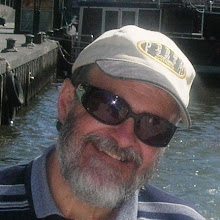
[Right (original): Shroud sceptic Joe Nickell, whose "Ph.D. is in English for graduate work focusing on literary investigation and folklore"[JNW] posing as a white-coated scientist[PSS]!]
propaganda! Those (like me) who are persuaded by the evidence that the Shroud is Jesus' burial sheet are, according to Nickell, all "die-hard shroud enthusiasts"! And as for "science and scholarship have demonstrated that the Shroud ... is a medieval fake," of those who have studied the Shroud, there are far more "scientists and scholars" on the pro-Shroud side, than there are on the sceptics' side. And in 2022 British pro-Shroud film-maker David Rolfe offered one million US dollars to the British Museum (which was involved in the 1988 radiocarbon dating of the Shroud to 1260-1390) to, "If the Turin Shroud is a forgery, show how it was done"[MJ22]. And, as far as I am aware, there have been no takers!
• `Contrary evidence includes the gospel accounts, the forger's confession, the blood and body images are painted and the radiocarbon results'
"Omitted were mention of the contrary gospel evidence, the reported forger's confession, and the microanalytical analyses that showed the `blood' and `body' images were rendered in tempera paint. Unsubstantiated claims were presented as fact, and the radiocarbon results--which dated the cloth to the time of the forger's confession--were treated in straw-man fashion: presented as virtually the sole impediment to authenticity"[NJ04].Nickell is wrong about the first three. There is no "contrary gospel evidence" to the Shroud being Jesus' burial sheeet. See my "The Bible and the Shroud #33." And there was no "forger's confession." See my "1389d" where I wrote (footnotes omitted):
"D'Arcis appealed to Pope Clement VII to stop the exposition, claiming that one of his predecessors, Bishop Henri de Poitiers (r. 1354–70) had discovered that the Shroud was `cunningly painted':As for "the `blood' and `body' images were rendered in tempera paint," Nickell wrote this article in 2004, but in his 1987 book (~17 years earlier), hidden in its middle with no index entry (so his Shroud sceptic readers would be unlikely to find it), Nickell (to his credit) effectively admitted that the Shroud image was not painted, including with "egg tempera":`... Henry of Poitiers ... then Bishop of Troyes ... after diligent inquiry and examination, he discovered the fraud and how the said cloth had been cunningly painted, the truth being attested by the artist who had painted it, to wit, that it was a work of human skill and not miraculously wrought or bestowed'.But d'Arcis provided no evidence in his memorandum to substantiate his claims, which he would have if there had been any. D'Arcis did not provide the name of the artist, nor a record of his confession, nor the source of his allegations. There is also no record of Henri de Poitiers conducting any inquiry into the origin of Shroud and d'Arcis did not even know its date! But there is a record of a letter of 28 May 1356, from Bishop Henri de Poitiers, praising Geoffroy I, ratifying the Lirey church and approving its `divine cult', which presumably refers to the Shroud! It is also highly unlikely that Geoffrey I de Charny, the owner of the Shroud in the 1350s, one of France's most ethical knights, and a devout author of religious poetry, was complicit in forging Jesus' burial shroud. The final refutation of the d'Arcis memorandum is that the image of the man on the Shroud is not painted!"
"While we should never underestimate what an unknown, skillful artist might be capable of - and so cannot conclusively rule out freehand painting - we must add that convincing evidence for any painting medium (that is, oil, egg tempera, etc.) on shroud image fibers is lacking ... Even at 40X magnification there are no obvious encrustations and no apparent cementing between threads nor any consistent and confirmed coating of fibers to indicate the presence of a painting medium ... The superficiality of the stain - extending `only 2 or 3 fibers deep into the thread structure' - is another strong argument against painting. A fluid medium (for example, paint, dye, ink) would be expected, by capillary action, to penetrate much farther - to the depth of a full thread, or even to the reverse of the cloth. Finally, tests at several laboratories failed to detect the presence of any foreign organic substance in `body' image areas"(my emphasis)[NJ87, 99-100].Nickell is right about his fourth item of contrary evidence that the Shroud is Jesus' burial sheet, "the radiocarbon results ... dated the cloth to the time of the forger's confession" i.e. 1260-1390 or 1325 ± 65 years[WI98, 7]. But there was no "forger's confession" that he painted the Shroud image (see above), and Nickell himself effectively admitted the Shroud image is not painted (see above). So there is no valid independent corroboration of the Shroud's 1260-1390 radiocarbon date! And if the radiocarbon dating itself was a fraud (which it was), then "1325 ± 65 years" is the date that the fraudster would make the Shroud appear to be[DT12, 170]. So as to agree with Bishop's d'Arcis false claim that one of his Bishop of Troyes' predecessors, Henri de Poitiers (r. 1354-70), had obtained the confession of the forger who had "cunningly painted" the Shroud"[WI79, 267]. The Pray Codex alone (and it is not alone), "a

[Left (enlarge): "The Entombment of Christ (above) and Three Marys [sic] at the tomb (below). The images are claimed as one of the evidences against the radiocarbon 14 dating of the Shroud of Turin"[PCW]. There are "eight telling correspondences between the Shroud and the drawings on a [this] single page of the Pray Codex"[DT12, 180]!]
collection of medieval manuscripts, dated to the late 12th to early 13th centuries"[PCW]. But "1260-1390" is late 13th to late 14th centuries - they don't overlap! The latest date of the Pray Codex is 1195[PCW], but that is 65 years before the earliest 1260 date of the 1260-1390 radiocarbon dating of the Shroud!
• `The Shroud contradicts the Gospels which describe multiple cloths including a separate cloth over Jesus' face'
"The shroud contradicts the Gospel of John, which describes multiple cloths (including a separate "napkin" over the face) ..."I answer this objection in my book (in progress): "This is fallacious. That there are multiple gravecloths of Jesus in the Gospels, doesn't mean that one of them can't be the Shroud. No Shroudie, as far as I am aware, claims that there was only one cloth, the Shroud, in Jesus' tomb. The Gospels reveal that there were three different types of gravecloths in Jesus' tomb: the sindon "shroud"[Mt 27:59; Mk 15:46; Lk 23:53]; the soudarion "face cloth" [Jn 20:7]; and the othonia "strips of linen"[Lk 24:12; Jn 20:5,6]. And many, if not most, Shroudies, including me, accept that the Sudarium of Oviedo is "the face cloth, which had been on Jesus' head"[Jn 20:7].
• `John 19:39-40 says that Jesus’ body was wrapped with a mixture of myrrh and aloes of about seventy-five pounds weight but not a trace of those spices appears on the cloth.'
"... the Gospel of John ... describes ... `an hundred pound weight' of burial spices--not a trace of which appears on the cloth."[NJ04].The key Greek word in Jn 19:39-40 is meta[BW57, 94], "with"[RA32, 307], not epi "on." That is, the "hundred pound weight' of burial spices" were with, not on Jesus' body:
"What of the spices? St. John tells us that Nicodemus, assisting Joseph of Arimathea, brought a mixture of myrrh and aloes weighing about a hundred pounds. He also tells us that these were wrapped with the body in the burial linen (Jn. 19:39, 40). Had such spices been used for anointing, it would have been requisite in Jewish ritual and indeed in that of any other culture to wash the body first. As it is quite evident from the Shroud that the body was not washed, and as the weight of spices described would be vastly excessive even for the most lavish anointing, the most likely explanation would seem to be that they were dry blocks of aromatics packed around the body as antiputrefacients"[WI79, 56].So, since the spices were alongside Jesus' body, not over it, it would not be surprising if there were no traces of myrrh and aloes on the Shroud. Especially after almost 2000 years. But Nickell is wrong again. There are traces of myrrh and aloes on the Shroud:
"During the tests of 1978, one of the scientists was permitted to remove fragments of threads from the Holy Shroud ... Recent research with immunofluorescence methods has also demonstrated the presence of traces of aloes and myrrh. These traces occur both in areas corresponding to bloodstains and in other areas as well." (my emphasis)• `No examples of the Shroud's complex herringbone twill weave in linen date from the first century.'
"No examples of the shroud linen's complex herringbone twill weave date from the first century, when burial cloths tended to be of plain weave in any case"[NJ04].This is misleading. Nickell's "... first century ... burial cloths tended to be of plain weave" implies that there are many existing first century burial cloths. But, as Nickell would surely have known, there is only one burial shroud, other than the Shroud, which has survived from first

[Right (enlarge): Fragment of the only first century shroud, a simple two-way weave in wool[MM09].]
century Jerusalem, out of what must have been tens of thousands, and it was a simple weave in wool. Besides, it is not a Shroudie claim that the Shroud was an average first century cloth. Indeed, the very opposite! That Jesus' shroud would have been expensive, is consistent with it having been bought by Jesus' "rich man" (Mt 27:57-59) disciple, Joseph of Arimathea (Mk 15:46):
"The normal weave in Palestinian, Roman and Egyptian loom-technology was a one-over-one. The three-to-one herringbone twill was a more refined weave. It would have been an expensive piece of cloth for the first century. However, we know from the Gospels that Joseph of Arimathea was a rich man and it was he who provided the Shroud used to bury Jesus (Mt 27:57-61)[IJ98, 13].In this article Nickell railed against "The intellectual incompetence or outright dishonesty of the show's producers ..."[NJ04]. but he needs to look in a mirror! Because he must know that there are herringbone twill woven cloths far older than the Shroud, in linen as well as other fabrics:
"Several authors have questioned whether the complex weaves found on the shroud were capable of being produced in the first century A.D. However, cloths with Z twist and twill weaves have been dated to times well before the time of Christ, as evidenced by a late - Bronze Age cloak found at Gerumsberg, Germany. In the burial wrappings of the mummy of King Thutmes II (c. 1450 B.C.), fabrics with a 4:1 twill were found. A scarf from the burial garments of King Seti I (1300 B.C.) contained a border with a 1:3 weave. The disposition of threads in the frame and the operation of the loom are identical with 1:3 and 3:1 twills. A piece of fabric from the tomb of Queen Makeri (1100 B.C.) had a 1:3 twill bordered with a 1:10 twill. Similarly, mummy cloth of the high priest Nessita-neb-Ashir from the same period contained weaves with 1:2 twill, 1:3 twill, and 1:6 twill. One particularly striking example of fabric weaving is a linen girdle of Ramses III (1200 B.C) This specimen, which is seventeen feet long, is woven with threads of five colors in a design composed of a 3:1 twill alternating with a 4:1 and 5:1 pattern. William Geilmann, who was a textile expert from the University of Mainz, studied pieces of linen from Palmyra, dating between the first and third centuries A.D., and one of them had the same 3:1 pattern as the Shroud. Herringbone twill examples in silk, thought to be of Syrian manufacture and dating from A.D. 250 and A.D. 276, have been found in Syria and England" (footnotes omitted)[AM00, 98-99].• `The shroud has no known history prior to the mid-fourteenth century'
"The shroud has no known history prior to the mid-fourteenth century, when it turned up in the possession of a man who never explained how he had obtained the most holy relic in Christendom"[NJ04].It is false that "The shroud has no known history prior to the mid-fourteenth century." The Pray Codex (see above ) is proof that the Shroud had a history prior to the late 12th century, let alone "the mid-fourteenth century". See my "Chronology of the Turin Shroud: AD 30 to the present," from "1201" back to "544."
• `In the mid-fourteenth century the Shroud turned up in the possession of a French knight, Geoffroy I de Charny (c. 1306-56), who never explained how he had obtained it.'
"The shroud ... [in] the mid-fourteenth century ... turned up in the possession of a man who never explained how he had obtained the most holy relic in Christendom"[NJ04].Nickell is again misleading his readers. He would surely be aware that there is a plausible explanation why Geoffroy I de Charny "turned up" owning the Shroud in "the mid-fourteenth century." And that is, his wife Jeanne de Vergy (c.1337-1428) (note their ~31 year age difference, proving that this was no ordinary marriage), was a direct descendent of Fourth Crusader Othon de la Roche (c.1170-1234), who looted the Shroud in the 1204 Sack of Constantinople, and passed it down through his descendants, one of whom was Jeanne de Vergy. See my:
"1389f Pope Clement VII allowed expositions of the Shroud to continue as a `figure' and `representation' of Jesus' burial shroud and commanded Bishop d'Arcis to `perpetual silence' on this matter. This unexpected siding of the Pope with the de Charnys against a senior bishop is explained by Clement, as Robert of Geneva, being not only a nephew of Jeanne de Vergy[Geoffroy I's wife]'s second husband Aymon (Amadeus) IV of Geneva (c.1324-1369), but also having been their neighbour. So Clement presumably had a private viewing of the Shroud and was told by Jeanne that her ancestor, Othon de la Roche (c.1170-1234) had looted the Shroud in the 1204 sack of Constantinople. The problem for the Pope was that the Byzantine Empire (c.330–1453) still existed and its Emperor John V Palaiologos (1332–1391) lived in Chambéry, France! So if the de Charny's continued to claim that the Shroud was Jesus' burial Shroud, John V would have known it was the one looted from Constantinople and demanded it be returned to him, creating a diplomatic crisis for the Pope! It may be no coincidence that the year the Byzantine Empire ended, 1453, was the same year that Geoffroy II's daughter, Marguerite de Charny, transferred the Shroud to Duke Louis I of Savoy (1440-1465)" (references omitted).• `The earliest written record of the Shroud is a 1389 memorandum of a Bishop of Troyes, Pierre d'Arcis (r. 1377-95) to Pope Clement VII (r. 1523-34), which alleged, "to attract the multitude so that money might cunningly be wrung from them, pretended miracles were worked"[WI79, 267]'
"The earliest written record of the shroud is a bishop's report to Pope Clement VII, dated 1389, stating that it originated as part of a faith-healing scheme, with `pretended miracles' being staged to defraud credulous pilgrims"[NJ04].But d'Arcis (a former lawyer) did not provide any evidence for his allegations, and it is contrary to the evidence that we do have. So d'Arcis was fraudulently making it up! See my:
"1389d. In October Bishop d'Arcis appealed to Pope Clement VII about the current exhibition of the Shroud at Lirey, describing it as bearing the double imprint of a crucified man and that it was being claimed to be the true Shroud in which Jesus's body was wrapped, and was attracting crowds of pilgrims. But according to d'Arcis' information it had been discovered to be the work of an artist ... But d'Arcis provided no evidence in his memorandum to substantiate his claims, which he would have if there had been any. D'Arcis did not provide the name of the artist, nor a record of his confession, nor the source of his allegations. There is also no record of Henri de Poitiers conducting any inquiry into the origin of Shroud and d'Arcis did not even know its date! But there is a record of a letter of 28 May 1356, from Bishop Henri de Poitiers, praising Geoffroy I, ratifying the Lirey church and approving its `divine cult', which presumably refers to the Shroud! It is also highly unlikely that Geoffrey I de Charny, the owner of the Shroud in the 1350s, one of France's most ethical knights, and a devout author of religious poetry, was complicit in forging Jesus' burial shroud. The final refutation of the d'Arcis memorandum is that the image of the man on the Shroud is not painted!" (references omitted)Moreover, the de Charnys never were wealthy, as they would have been if d'Arcis' allegations were true. In 1356 the newly widowed Jeanne de Vergy had to petition the future king Charles V (r. 1364-80), whose father King John II (r. 1350-64) was a prisoner in France, for the two houses in Paris that King John had promised Geoffroy I, to be granted to their son Geoffroy II de Charny (1352-98)[WI98, 279]. And the small wooden Lirey church, far from being very wealthy, as it would have been if d'Arcis' allegations were true, became dilapidated and was not rebuilt in stone until 1526, 171 years after 1355:
"1508 ... Under the direction of John Huart, dean of Lirey, work begins in this year on the rebuilding in stone of Geoffrey de Charny's wooden church at Lirey, now fallen into disrepair. This will take another eighteen years[WI98, 287].• `Bishop d'Arcis in his memorandum claimed that, "Henry of Poitiers ... then Bishop of Troyes ... after diligent inquiry and examination ... discovered the fraud and how the said cloth had been cunningly painted, the truth being attested by the artist who had painted it, to wit, that it was a work of human skill and not miraculously wrought or bestowed'[WI79, 267].
"The bishop's report also stated that a predecessor had `discovered the fraud and how the said cloth had been cunningly painted, the truth being attested by the artist who had painted it'"[NJ04].This shows the duplicity of Joe Nickell! As we saw above, Nickell had admitted ~17 years before, that the Shroud image was not painted! So at best d'Arcis was mistaken that one of his predecessors Henri de Poitiers, had discovered the artist who had painted the Shroud and obtained his confession that he did it, or more likely, d'Arcis was lying about it! Either way, Nickell is again misleading his readers by claiming the Shroud was "cunningly painted" when he knows it was not painted!
• `As St. Augustine wrote in the early fifth century, the portraits in his time were "innumerable in concept and design," and for one very good reason: "We do not know of his external appearance, nor that of his mother"'[ADT].
"Although, as St.Augustine lamented in the fourth century, Jesus' appearance was completely unknown, the shroud image follows the conventional artistic likeness"[NJ04].First, Augustine was not lamenting - this is an example of Nickell's constant anti-Christian spin. In his De Trinitate ("On the Trinity") Augustine (354-430) was arguing for "the impossibility for the finite human mind to know deeply the faith mystery of the Most Holy Trinity"[NTW]. So Augustine would have been happy to claim that (if he actually did-see next). Second, it was the fifth century (Augustine began De Trinitate in 400[NTW] - the last year of the fourth century). Third, Augustine did not actually write the words attributed to Augustine by Wilson, quoted above by Nickell, and repeated in several of Wilson's books[WI79, 101, WI86, 110, WI10, 126 & WS00 109]. What Augustine actually wrote in his De Trinitate was:
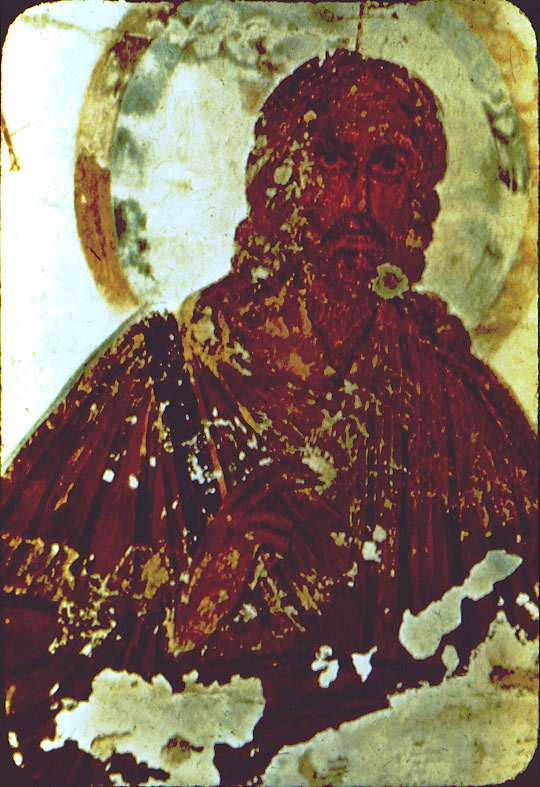
"For even the countenance of our Lord Himself in the flesh is variously fancied by the diversity of countless imaginations, which yet was one, whatever it was ... And whether that was the countenance of Mary which occurred to the mind in speaking of those things or recollecting them, we neither know at all, nor believe"[HA87]So Augustine did not write in his De Trinitate that "Jesus' appearance was completely unknown" but rather there were a diversity of depictions of Jesus then current but there was only one actual face of Jesus. Augustine may have been aware of Shroud-like depictions of Jesus like this c. 400 Pantocrator ("Ruler of All") in the Catacomb of

[Left (enlarge)[MPW]: Extract of the c.400 Pantocrator in the Catacomb of Saints Marcellinus and Peter (not the Apostle), Rome. Although Jesus' Shroud-like face does not have the Vignon markings of later Byzantine icons, it is such a radical departure from the "beardless Apollo" depictions of Jesus then current, the simplest explanation is that the artist had seen the Shroud in the 4th century!]
Saints Marcellinus and Peter, Rome. But living in Alexandria, Augustine may not have known the history of the Image of Edessa/Shroud for him to realise that such images are indeed Shroud-like!
• `The man's physique is unnaturally elongated'"
"The physique is unnaturally elongated (like figures in Gothic art) ..."[NJ04].
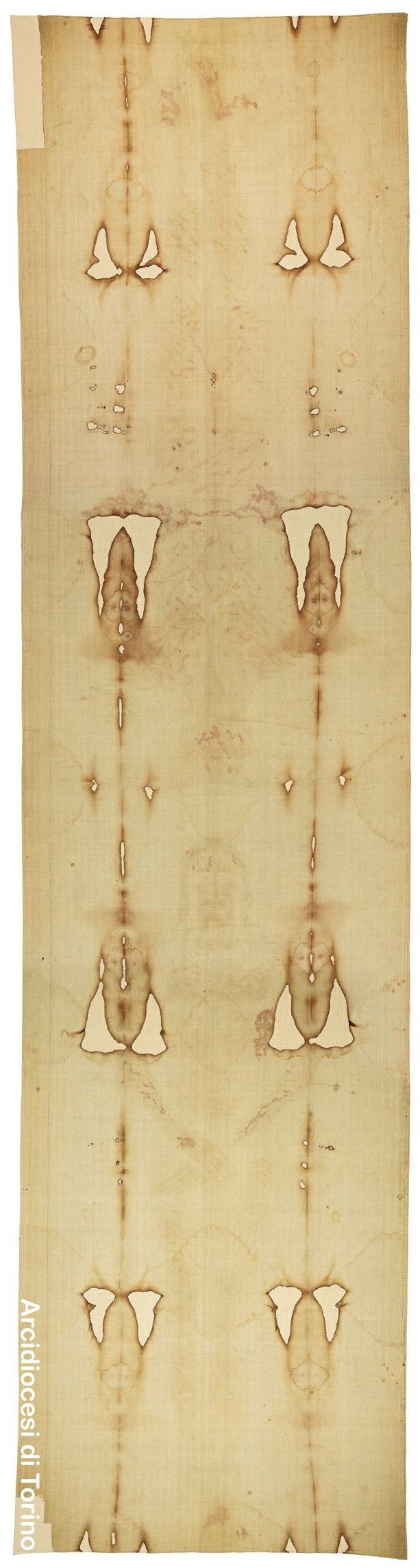
 [Right (enlarge)[LM10a]: The full-length Shroud. As can be seen, the man's image is not "unnaturally elongated." It does however reflect the Shroudman's forward-leaning final crucifixion position, fixed by rigor mortis (see 05Jun22).]
• `There is a lack of wrap-around distortions that would be expected if the cloth had enclosed a three-dimensional human body'
"... there is a lack of wrap-around distortions that would be expected if the cloth had enclosed an actual three-dimensional object like a human body"[NJ04].This is explained by STURP founder Prof. John Jackson's Cloth Collapse Theory (see my 18Jan12), where the Shroud fell through the man's "mechanically transparent" body, flattening out by air resistance as it fell:
"Jackson's [cloth collapse] theory predicts that the Shroud's images would be encoded if the body became insubstantial and emitted ultraviolet light. As the cloth fell through the body region, each point on the cloth would receive a radiation dose in proportion to the time it was within the region. The parts of the cloth that were over the highest points of the supine body (for example, the tip of the nose) would receive the longest dose of radiation, while the parts of the cloth over the lowest points of the body would receive the least. Thus, the intensity of all points on the resultant body image on the two-dimensional cloth would be directly correlated to the distance that they originally were from the surface of the three-dimensional body. Furthermore, since the draped cloth fell by gravity, all points of the resultant body image would have aligned vertically with the corresponding body point below it"[AM00, 220]• `The man's hair hangs as though he is standing, rather than reclining'
"The hair hangs as for a standing, rather than reclining figure ..."[NJ04].There are three plausible explanations why the Shroudman's hair is parallel to his face, as though he is standing, not lying on his back.

[Right (enlarge)[LM10c]: Positive of the Shroud-man's face, showing his hair parallel to his face.]
First, if the man in the Shroud was laid in a trough grave, his hair would be held by the sides of the trough, parallel to his upturned face:
"According to the researches of G. Dalman [1855– 1941], the celebrated authority on Palestine, the actual burial chamber was a small cubicle roughly three and one quarter feet wide, six and a half feet long, and six and a half feet high (1 m. by 2 m. by 2 m.). It was entered by a small opening, a little more than three feet (1 m.) high at most. To the right was the grave, cut from the living rock and set about two feet (60 cm.) above the floor of the chamber. Its dimensions were roughly six and a half feet long by three feet wide (2 m. by 90 cm.). Above it, there probably was a vaulted roof hewn from the rock. The grave proper was either a so-called `bench grave' upon which the dead was laid, or more likely, a `trough grave,' hollowed out of the rock in the shape of a coffin, into which the corpse was placed. A number of such graves have been preserved to us (the most ancient go back to the first century) so that we know approximately the proportions of the tomb under discussion" (my emphasis)[BW57, 96-97]Second, the man's hair may have been pressed parallel to his face by the spices packed around his head and body (see above ). Third, a corona discharge may have caused the man's hair to `stand on end' and

[Left (enlarge): "The classic is holding your hands on the [Van de Graaff Generator's] metal sphere as it charges, the results really can be hair-raising!"[EVD].
make it appear to be lighter (see 17Dec19).
• `The imprint of a bloody foot is incompatible with the outstretched leg to which it belongs'
"... the imprint of a bloody foot is incompatible with the outstretched leg to which it belongs"[NJ04].This is simply false and Nickell (who is not stupid and has read pro-

[Right (enlarge)[LM10b]: Shroud feet and legs, dorsal. As can be seen, the imprints of both bloody feet are compatible with the outstretched legs to which they belongs!]
Shroud literature) must know it is false! The frontal image of the legs and feet looks like what Nickell described, because the man was lying on his back and from his thighs down the front of the Shroud only touched his knees and toes. But the back, or dorsal image shows that both feet were connected normally to their respective legs. The left foot, because its leg was bent at the knee, placed over the right foot, and a single nail driven through both feet into the cross under them, remained bent by rigor mortis and didn't fully touch the Shroud under it[AM00, 22].
• `The bloodstains are unnaturally picture-like'
"The alleged blood stains are unnaturally picture-like"[NJ04].Nickell knows the answer to this objection but he keeps it from his readers: "what is seen on the Shroud is not so much whole blood as an exudate from clotted wounds":
"Again, from our experience with cut fingers we know that blood upon clotting quickly becomes crusty and flakes off, both from the skin and from any covering bandage, regardless of what injury it may have derived from. Yet one of the extraordinary features of the Shroud's bloodflows is that they appear suspiciously complete - effectively, whole images of stains, without any indications of anything having flaked away. So how is any of this possible, without the Shroud being an obvious forgery? ... [Dr.] Gilbert Lavoie threw some significant light on this question by dripping fresh blood onto various surfaces, then applying a linen cloth at various intervals during the clotting process, finding that the impression had to be transferred onto the cloth within two hours in order to produce imprints like those on the Shroud[LG83] From such experiments both he and others have formed the opinion that what is seen on the Shroud is not so much whole blood as an exudate from clotted wounds. This contains very few actual cells of blood and would give us more in the way of images of blood rather than whole bloodstains ..."[WI98, 85-86, 88].The transfer from the blood clots to the Shroud was due to "fibrinolysis, which causes blood clots to dissolve again":
"From his study of the Shroud, Gilbert Lavoie has deduced that, until a few moments before death, blood was flowing from the wounds and that the body was wrapped in a winding sheet not more than two-and-a-half hours after his death ... The experimental studies of [Dr] Sebastiano Rodante [1924-2016] have shown that to effect a transfer of the blood onto the cloth as that which took place on the Shroud, the body has to remain in contact with the sheet for about 36 hours. During this period of time, an important part was carried out by fibrinolysis, which causes blood clots to dissolve again." Carlo Brillante [1931-2006], a professor in chemistry and clinical microscopy at the University of Bologna, has developed the study of fibrinolysis in connection with the Shroud: `The coagulating and fibrinolytic systems are in a dynamic equilibrium between them. The first one forms the fibrin, the second one removes it. The phenomenon of the lysis must have happened in a relatively short time, in any case not more than 36 hours. The fibrinolytic phenomenon follows precise laws according to the period of contact; if this does not exceed a certain amount of hours, the transfer does not take place or takes place in a rudimentary manner, while, if it exceeds that number of hours, the blood will smear the fabric (and therefore it will not form a transfer) because of the increased friability of the blood clots. This is one of the fundamental observations that confirms the undeniable relationships between fibrinolysis and the haematic stains on the Shroud. The Shroud shows that fibrinolysis had started and ceased at an unknown time `X' (probably not more than 36-40 hours) since the haematic imprints are perfectly transferred and delineated'" [PM96, 211-212].• `Instead of matting the hair, the bloodstains run in rivulets on the outside of the locks'
"Instead of matting the hair, for instance, they [the bloodstains] run in rivulets on the outside of the locks"[NJ04].Again, Nickell must know that "the bloodstains [which] run in rivulets on the outside of the locks" are not in his hair but on his face! From my post of 03Jun17 (references omitted): "In 1986 Dr Gilbert Lavoie was looking at a life-size positive photograph of the Shroud face (Fig. 1),

[Above (enlarge): Fig. 1, Shroud face, positive image (left), and Fig. 3, cutouts of the blood marks on the face and hair of the Shroud (right).
[Below (enlarge): Fig. 4, cutouts of the blood marks above right draped over a man's face (left), and Fig. 5, `blood' marks painted on the man's face through the cutouts.]
 when it occurred to him that the blood was a little too far out on either side of the face. To test this he asked his daughters to outline on tracing paper the blood marks on the forehead and hair, trace the position of the eyes and nose, make a cutout of the tracing, remove the paper within the outlined blood marks, and make holes at the eyes large enough to see through. When Lavoie placed the tracing paper with its blood mark cutouts over his face, aligning the eyes and nose with his own, and looked through the eye slits in a mirror, it confirmed that the blood in the hair is actually on the sides of the face! Lavoie then visually reproduced this by painting through the blood mark cutouts onto the face of a bearded man volunteer (see Fig. 1, 3, 4 and 5 above). This means that the blood on the Shroud and the body image were caused by two different processes separated in space and time! The blood marks have been transferred to the cloth by direct contact with clots from wounds, while the body image has been projected onto the cloth by a non-contact type of radiation. This is explained by STURP's John P. Jackson's "cloth collapse theory" where the body became "mechanically transparent," and the cloth fell through the space where the radiating body was, flattening out due to air resistance.
"Also, dried `blood' (as on the arms) has been implausibly transferred to the cloth"[NJ04].First, the blood on the Shroud is not `blood' in quotation marks but real, human blood! See again my post of 03Jun17 which is titled "Real human blood #23." In that post I showed a table of 12 tests for blood used by STURP blood chemist Alan D. Adler (1931-2000), at STURP's final public meeting in October 1981 (references omitted):
"Table 5: Summary of tests by Adler and Heller which confirmed that the blood on the Shroud was real blood. At the public final meeting of STURP in New London, Connecticut in October 1981, after explaining each item in this table, Adler, who had `already published close to a hundred articles on his blood research; forty-odd concerned porphyrins' concluded: `That means that the red stuff on the Shroud is emphatically, and without any reservation, nothing else but B-L-O-O-D!'"Second, see above that all the blood on the Shroudman at the time of his burial had dried but in the tomb it became briefly liquid again by the process of fibrinolysis (which again Nickell would surely know but keeps that from his `sceptic' readers).
• `The blood is bright red whereas blood blackens with age.'
"The blood remains bright red, unlike genuine blood that blackens with age."[NJ04].Again Nickell, who is well-read in pro-Shroud literature, knows the answer to this objection but does not tell his so-called `sceptic' readers, that the Shroudman's blood is red, because of its extraordinarily high bilirubin content, found in the blood of victims of severe trauma, as that of a crucifixion victim would be:
"Furthermore, Alan Adler tumbled upon one very important explanation for why, as has been agreed by everyone, the `blood' looks too red. A particular oddity that he discovered of the Shroud `blood's' bile pigments was that these seemed to contain what he called `an extraordinarily high' level of the pigment bilirubin, giving rise to the question why this should be so. As he explained[WI98, 88-89]:• `The 1973 Turin Commission, which included Prof. Giorgio Frache, a forensic serologist from the University of Modena, Italy, was unable to detect blood in bloodstained threads taken from the Shroud.'`One possibility is that the person had a severe malaria, but this does not seem very likely. But a torture, scourging and crucifixion leading to shock - that would produce a tremendous hemolysis [break-up of red blood corpuscles-IW]. In less than 30 seconds the haemolyzed haemoglobin will run through the liver, building up a very high bilirubin. If that blood then clots the exudate forms, and all the intact cells with haemoglobin stay behind, only the haemolyzed goes out along with the serum albumin which bind the bilirubin. So what one ends up with on the cloth is an exudate which has an enhanced bilirubin index with respect to the haemolyzed haemoglobin. You now mix bilirubin which is yellow-orange with methaemoglobin in its para-hemic form, which is an orangey-brown, and you get blood which has a red colour"[AA86, 60-61].
"Subsequently, the distinguished microanalyst Walter McCrone identified the "blood" as red ocher and vermilion tempera paint and concluded that the entire image had been painted."[NJ04].It was one forensic serologist, Giorgio Frache, Professor of Legal Medicine at the University of Modena, Italy, and his assistants. And I doubt that he was "internationally known" since a Google search reveals very little about him. So Nickell is indulging in his usual rhetoric, boosting those who are favourable to his anti-Shroud position and denigrating those unfavourable to it! And nor were the "reddish granules" they found "suspicious" - Nickell is making that up!
The problem was that, as a truly "internationally known" blood expert, Prof. Alan Adler, "who had `already published close to a hundred articles on his blood research" (see above), pointed out, Frache's team had failed to dissolve the "granules" into a solution to conduct the necessary wet chemical test:
"A more complete examination was made in the autumn of 1973 by a team made up of most of the scientists " who had made the preliminary study. They included Giorgio Frache, forensic serologist from the University of Modena; Guido Filogamo, director of the Institute of Human Anatomy at the University of Turin; Alberto Zina, another professor from the University of Turin; Enzo DeLorenzi, who headed a radiological laboratory in Turin; Gilbert Raes, a professor of the Ghent Institute of Textile Technology in Belgium; Silvio Curto, a museum curator; Cesare Codegone, a physicist; and Noemi Gabrielli, former curator of the art galleries in Italy's Piedmont region. This group viewed the Shroud on November 24, 1973, and were allowed to remove seventeen samples, mostly single threads, for study. Three years later [1976], they published their findings in a one hundred twenty page report entitled La Sindone: Richerche e studi della Commissione di Esperti ("The Shroud: Research and Studies of the Commission of Experts"). One of the most significant findings was that the body image did not penetrate the cloth, but was confined to the topmost layers of the fabric ... Frache studied several threads from the areas of the Shroud that appear to be stained with blood. He subjected them to a test with a chemical solution of benzidine, followed by treatment with hydrogen peroxide. If the threads contained blood, this solution should have turned blue when it came in contact with them. It did not, and Frache and his colleagues therefore had no evidence of the presence of blood on the Shroud. Alan Adler, the American chemist who later demonstrated the presence of blood, believed that his Italian colleagues were unsuccessful because they were unable to get the blood into a solution in order to perform the necessary wet chemical test"[RC99, 74-75].And again, Nickell deceived his `sceptic' readers by not telling them that subsequently blood chemist Alan D. Adler (1931-2000)[HJ83, 216] and Medical Examiner at the University of Turin, Prof. Pierluigi Baima Bollone (1937-)[BZ98, 21], did show that the Shroudman's bloodstains are real, human blood!
• `The leading sceptic Walter McCrone (1916-2002) identified the Shroudman's blood' as red ochre and vermilion tempera paint and concluded that the entire Shroud image had been painted.'
"Subsequently, the distinguished microanalyst Walter McCrone identified the `blood' as red ocher and vermilion tempera paint and concluded that the entire image had been painted."[NJ04].McCrone ignored STURP'S battery of chemical and physical tests which proved that the Shroud image was not painted, and claimed that just by looking through an optical microscope he could determine that the Shroud image was painted[HJ83, 99-100]! But another leading sceptic, Joe Nickell, effectively admitted in his 1987 book, "Inquest of the Shroud of Turin," that the Shroudman's image was not painted (see above):
"... convincing evidence for any painting medium (that is, oil, egg tempera, etc.) on shroud image fibers is lacking ... Even at 40X magnification there are no obvious encrustations and no apparent cementing between threads nor any consistent and confirmed coating of fibers to indicate the presence of a painting medium ... The superficiality of the stain - extending `only 2 or 3 fibers deep into the thread structure'[SR82, 11] - is another strong argument against painting. A fluid medium (for example, paint, dye, ink) would be expected, by capillary action, to penetrate much farther - to the depth of a full thread, or even to the reverse of the cloth. Finally, tests at several laboratories[SR82, 14, 29, 31] failed to detect the presence of any foreign organic substance in `body' image areas"[NJ87, 99-100].• `In 1988, the Shroud was radiocarbon dated 1260-1390 by three laboratories at Zurich, Oxford and Arizona, each using the identical AMS technique. The midpoint, 1325 ± 65, was about the time of the forger's confession claimed by Bishop Pierre d'Arcis (r. 1377-95) in his 1389 memorandum.'
"In 1988, the shroud cloth was radiocarbon dated by three different laboratories (at Zurich, Oxford, and the University of Arizona). The results were in close agreement and yield a date range of A.D.1260-1390, about the time of the reported forger's confession"[NJ04].First, there was no "forger's confession" (see above), so there is no independent corroboration of the Shroud's 1260-1390 radiocarbon date (see above). The Pray Codex (1192-95) with its "eight telling correspondences" between the Shroud and one of its the drawings (see above) alone is proof beyond reasonable doubt that the 1260-1390 radiocarbon date of the Shroud cannot be correct. And the Pray Codex is not alone as visual proof beyond reasonable doubt that the 1260-1390 radiocarbon date of the Shroud was wrong! One of 574 miniatures in the Madrid Skylitzes, a twelfth century illuminated manuscript, titled "The surrender of the Holy Mandylion, depicts Edessa's Muslim ruler handing the Image of Edessa to Byzantine
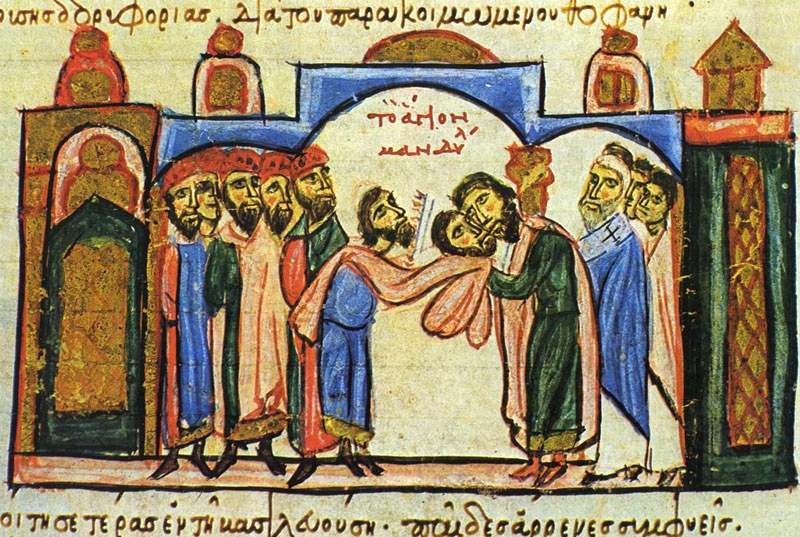
[Above (enlarge): "The surrender of the Holy Mandylion" (the Image of Edessa), one of 574 miniatures, which may be copies of earlier Byzantine images, in the 12th Century "Madrid Skylitzes," which was based on the Synopsis of Histories by John Skylitzes (c. 1040s – aft. 1101). It depicts the arrival of the Image of Edessa in Constantinople on 15 August 944 , having been passed by Byzantine general John Kourkouas (bef. 900-aft. 946)[JKW] to Emperor Romanos I Lekapenos (r. 920-44)[RNW]. The persons on the left are wearing turbans and the buildings on their side have no Christian crosses, hence they are Muslims. The buildings on the right have Christian crosses, which means that the artist depicted both the Image having been surrendered by muslims in Edessa and its arrival in Christian Constantinople. Note that behind the face-only Image of Edessa is depicted the full-length Shroud! So by at least the 12th century (and the earliest 1260-1390 radiocarbon dating of the Shroud was in the 13th century) the Image of Edessa/Mandylion was known to be the full-length Shroud! See 31May17 (footnotes omitted).]
general John Kourkouas (bef. 900-aft. 946) in the summer of 944 (see "944a"), who carried it to Constantinople in August 945 (see "944b"). As can be seen, behind the face of the Image of Edessa is a long, folded cloth, which can only be the Shroud! This proves beyond reasonable doubt that the Image of Edessa was the Shroud "four-doubled" tetradiplon! Which was in Edessa in 544 (see "544"), seven centuries before the earliest 1260 radiocarbon date of the Shroud!
• `Defenders of the Shroud's authenticity have answers for each claimed piece of evidence against the Shroud being Jesus' burial sheet.'
"Defenders of the shroud's authenticity have rationalizations for each damning piece of evidence."[NJ04].Nickell is deceiving himself if he really thinks that there is even one "damning piece of evidence" against the Shroud being Jesus' burial sheet. He hasn't presented one in this article! Rather, the evidence is overwhelming that the Turin Shroud is Jesus' burial sheet!
• `Defenders of the Shroud's authenticity assert that microbial contamination of the Shroud shifted its first century date thirteen centuries into the future.'
Nickell is setting up a strawman. As far as I am aware, the only defender of the Shroud's authenticity who asserted that microbial contamination altered the radiocarbon date by thirteen centuries was Dr Leoncio Garza-Valdes (1939-2010). And as per my 21Mar23 post (footnotes omitted) ... in 1999 Adler delivered a devastating critique of Garza-Valdes' "bioplastic coating" claim:"`Defenders of the Shroud's authenticity ... assert that microbial contamination might have altered the radiocarbon date, although for an error of thirteen centuries, there would have to be twice as much contamination by weight as the cloth itself!"[NJ04].
"In `The DNA of God?' Garza-Valdez makes a large number of extravagant claims, many of them self-contradictory, at odds with accepted Shroud scientific literature, or at odds with basic accepted biochemical, chemical, or physical knowledge ... His ... contention is that the entire cloth is more or less covered by a bioplastic coating deposited by a novel microbe [sic] that he himself has discovered in the Shroud samples in his possession. He claims this bioplastic has corrupted the radiocarbon date and even suggests that the microbes may be responsible for creating the body image ... Are we to take seriously the notion that such microbial growth could produce the VP-8 characteristic? It should be noted that to corrupt the observed radiodate from a first century date to that reported [1260-1390] requires about a 50% increase in the C14 mole fraction. This is a prodigious amount of bacterial metabolism. Even if we ignore the Second Law of Thermodynamics and only satisfy the First Law, where does all this energy for growth come from? Are the organisms photosynthetic? Where does the mass come from? Does this microorganism fix the nitrogen from air as required for its growth and metabolism? Where does it get its sulfur, phosphorus, and minerals from and to where have they disappeared ... It seems that his evidence for large amounts is based on what he sees in a microscope. Looking at his micrographs, however, gives us pause for new concerns. He shows us a magnified picture of the weave of the whole cloth and says see how shiny it is — bioplastic coated. Unfortunately, he seems to be unaware that all linen looks like this. It is called luster and it is one of the characteristics by which linen is distinguished from other fabrics. For many of the pictures ... a question arises as to whether one is really seeing ... only diffraction artifacts, as the smaller objects in the field show pronounced diffraction rings, indicating that the field is simply out of focus. His work lacks hard convincing quantitative evidence on which one can judge the merit of his claims ..."• `Defenders of the Shroud's authenticity begin with the assumption that the Shroud is Jesus' burial sheet, then they work backward to the evidence.'
"Defenders of the shroud's authenticity ... Beginning with the desired answer, they work backward to the evidence, picking and choosing and-all too often-engaging in pseudoscience"[NJ04].First, Nickell is deluding himself if he thinks that sceptics like him don't have the "desired answer" that the Shroud is not Jesus' burial sheet and they don't "work backward to the evidence, picking and choosing" evidence that confirms their "desired answer"! Second, even if it were true of Shroud defenders, it would be consistent with modern science's hypothetico-deductive method" in which "scientific inquiry proceeds by formulating a hypothesis in a form that can be falsifiable, using a test on observable data where the outcome is not yet known" and "A test outcome that could have, but does not run contrary to the hypothesis corroborates the theory." But it is not true in my case where, as I stated in my first post to this blog, as an evangelical Christian, "to the extent that I thought about it [the Shroud] at all, I assumed it was just another medieval fake relic." But I found Stevenson & Habermas' "Verdict on the Shroud" (1981) for sale in a second-hand bookstore and was willing to consider their evidence for the Shroud's authenticity. To my surprise, the evidence they presented was compelling, so "I accepted ... that the Shroud of Turin is the actual burial sheet of Jesus Christ and therefore extrabiblical evidence of His death and resurrection"! But perhaps the best example is the agnostic art historian Thomas de Wesselow. It was definitely not his "desired answer" that the Shroud is Jesus' burial sheet, but he was forced by the evidence to accept that it is (and moreover de Wesselow remained a non-Christian):
"Though sceptical of the relic's authenticity ... I was nevertheless fascinated by some of the historical evidence Wilson presented. Various texts he cited - such as Robert de Clari's account of the Byzantine cloth on which 'the figure of Our Lord could be plainly seen' [see 11Nov17] did seem to point to a Shroud-like relic existing long before the fourteenth century, the date indicated by the problematic carbon-14 test. Moreover, I was aware by then of the major clue first recognized by Andre Dubarle: the distinctive pattern of the 'poker- holes' found on the representation of Christ's burial cloth in the Pray Codex [see 21Aug18]. Unable to dismiss this as a coincidence, I found myself forced to reckon with the heretical idea that the Shroud was already known in the twelfth century. I also had to admit that Wilson's identification of the Shroud with the Mandylion [see 15Sep12] was plausible and accounted for a good deal of evidence that, as far as I could see, orthodox opinion either ignored or dismissed without proper justification ... If Wilson's theory was correct, the Shroud's provenance could be traced back to the sixth century. And if it was that old, the chances of its being a fake were drastically reduced. As an agnostic ... I was extremely uncomfortable with the idea that the Shroud might be ... authentic ... I was extremely sceptical that this one - the most astonishing of all - might be genuine. Nevertheless, having considered every alternative explanation and found it wanting, I felt pinned down and forced to think the unthinkable. The execution and burial of Jesus, I told myself, is the only recorded event that could have resulted in a length of linen becoming stained by the body of a man flogged, crucified, crowned with thorns and speared in the side, and it is an event that is unlikely ever to have been exactly repeated. I couldn't avoid the conclusion: from a purely historical point of view, the death and burial of Jesus seemed to be the best explanation for the Shroud"[DT12, 191-192].
As for "and-all too often-engaging in pseudoscience" this is Nickell's attempt to "poison the well" against sindonology, "the scientific study of the Shroud of Turin." And it is false! STURP, for example, published all its scientific findings in peer-reviewed scientific journals.
• `The preponderance of evidence leads to a conclusion: the Shroud is the work of a medieval artisan.'
"In contrast, the scientific approach allows the preponderance of evidence to lead to a conclusion: the shroud is the work of a medieval artisan. The various pieces of the puzzle effectively interlock and corroborate each other"[NJ04].The exact opposite is true. The evidence is overwhelming that the Turin Shroud is Jesus' burial sheet! See above on the Pray Codex and the Madrid Skylitzes, for example. And as we saw above, in 1987, ~17 years before this 2004 article, Nickell admitted that the Shroudman's image was not painted. That is presumably why Nickell changed "painter" to "artisan" without alerting his `sceptic' readers of the change. But that the Shroud image was not painted is a huge blow to the medieval forgery theory. As the leading proponent of the painting theory, Walter McCrone (1916-2002) pointed out, why would a medieval artist go to all the work of preparing a bas relief, etc., when he could simply paint the Shroud image?
"I realize that there are still, perhaps, a majority of people convinced by the carbon-dating that the `Shroud' is medieval, who are still looking for an answer as to how the `Shroud' was produced. Many mechanisms have already been proposed. Some say it was draped wet over a bas-relief to which it was shaped then dabbed with powder or a paint. Some say a painting was prepared and transferred to a cloth in contact with it by pressure. However, I see no reason to doubt that an artist ... simply took up his brush and a dilute red ochre watercolor paint based on scraps of parchment as the vehicle and proceeded to paint the `Shroud.' Why go to all the work of preparing a statue or bas-relief or making a transfer of the image from a primary artist's rendering? A direct approach to painting a dilute watercolor image on a canvas of the proper size is a common sense assumption; Occam's Razor applies here …"[MW99, 122].• `The Catholic historian, Ulysse Chevalier (1841-1923) brought to light the documentary evidence of the Shroud's medieval origin.'
"In the words of Catholic historian, Ulysse Chevalier, who brought to light the documentary evidence of the Shroud's medieval origin, `The history of the shroud constitutes a protracted violation so often condemned by our holy books: justice and truth'[NJ04].See my post of 11Jan23 (footnotes omitted) that in creating the d'Arcis Memorandum on parchment out of two rough paper drafts, and which was never sent to Pope Clement VII (r. 1378-94) because it never existed, Chevalier committed literary fraud:
However, Chevalier's worst act of dishonesty, indeed literary fraud, was in creating the d'Arcis Memorandum out of two rough drafts:
"There are two handwritten copies of the memorandum attributed to d'Arcis, `Folio 137' and `Folio 138' Folio 138 is a first draft with some parts crossed out, underlinings, and some very violent expressions expressions canceled; it is unsigned and undated and the addressee is not even shown. Chevalier made an orderly and careful transcription of this and published it in his very influential book. But Chevalier affixed the heading from Folio 137, `The Truth about the Cloth of Lirey, which was and now is being exhibited and about which I intend to write to our Lord the Pope in the following manner and as briefly as possible,' onto Folio 138. Thus, the document seen in Chevalier's book does not even exist, for it is actually a combination of two documents! Folio 137, the second draft, is neater than the first, and with its proper heading removed and affixed to the earlier messy draft, Chevalier gives the impression that Folio 137 was sent to Clement VII" (my emphasis).
 [Left (enlarge): Folio 137, the second of the two drafts, the first being folio 138, of the so-called d'Arcis Memorandum]
At the foot of Folio 137, not part of the Latin document itself, a scribe had written in French "Fin 1389", i.e. "end of 1389". Chevalier forged the "Fin 1389" at the head of the d'Arcis Memorandum in his Appendix, without informing his readers that the date, though probably correct, is not on the document itself.
In my post of 11Jan23 I quoted from the "Chevalier" Wikipedia article, that in this Chevalier "showed ... intellectual dishonesty" but the quote has since been removed (footnotes omitted):
"In 2006 French historian Emmanuel Poulle wrote in a peer-reviewed journal that Ulysse Chevalier showed in this case intellectual dishonesty. According to Poulle, Chevalier deliberately did not correctly mention the Papal bulls of antipope Clement VII issued in 1390. In fact Clement VII never opted for the forgery thesis" (my emphasis).And Nickell would have us believe that, as regards the Shroud, Chevalier the literary fraudster was concerned for "justice and truth"!
In conclusion, we have seen above that none of Nickell's objections are a problem for the Shroud being Jesus' burial sheet. That is not surprising because the Shroud is Jesus' burial sheet!
Notes:
1. This post is copyright. I grant permission to extract or quote from any part of it (but not the whole post), provided the extract or quote includes a reference citing my name, its title, its date, and a hyperlink back to this page. [return]
Bibliography
AA86. Adler, A.D., 1986, "The Origin and Nature of Blood on the Turin Shroud," in Adler, A.D. & Crispino, D., ed., 2002, "The Orphaned Manuscript: A Gathering of Publications on the Shroud of Turin," Effatà Editrice: Cantalupa, Italy, 59-66.
ADT. St. Augustine, De Trinitate, VIII, 4, 5 in WI79, 101.
AM00. Antonacci, M., 2000, "The Resurrection of the Shroud: New Scientific, Medical, and Archeological Evidence," M. Evans & Co: New York NY.
BG84. Baima Bollone, P. & Gaglio, A., 1984, "Demonstration of Blood, Aloes and Myrrh on the Holy Shroud with Immunofluorescence Techniques," Shroud Spectrum International, No.13, December, 3-8.
BW57. Bulst, W., 1957, "The Shroud of Turin," McKenna, S. & Galvin, J.J., transl., Bruce Publishing Co: Milwaukee WI.
BZ98. Baima-Bollone, P. & Zaca, S., 1998, "The Shroud Under the Microscope: Forensic Examination," Neame, A., transl., St Pauls: London.
DT12. de Wesselow, T., 2012, "The Sign: The Shroud of Turin and the Secret of the Resurrection," Viking: London.
EVD. "Experiments - Van de Graaff Generator," Physikanten & Co.," 2019.
FB08. Fanti, G. & Basso, R., 2008, "Turin Shroud: Optical Research in the Past Present and Future," Nova Science Publishers: Hauppauge, NY.
HA87. Haddan, A.W., 1887, "St Augustine: On the Trinity," Book VIII, in Schaff, P., ed., Nicene and Post-Nicene Fathers, First Series, Vol. 3., Christian Literature Publishing Co, Buffalo, NY.
HDW. "Hypothetico-deductive model," Wikipedia, 6 August 2023.
HJ83. Heller, J.H., 1983, "Report on the Shroud of Turin," Houghton Mifflin Co: Boston MA.
JNW. "Joe Nickell," Wikipedia, 7 June 2023.
IJ98. Iannone, J.C., 1998, "The Mystery of the Shroud of Turin: New Scientific Evidence," St Pauls: Staten Island NY.
JKW. "John Kourkouas," Wikipedia, 27 November 2024.
LG83. Lavoie, G.R., et al., 1983, "Blood on the Shroud of Turin: Part II," Shroud Spectrum International, No. 8, September, 2-10.
LM10a. Extract from Latendresse, M., 2010, "Shroud Scope: Durante 2002 Vertical," Sindonology.org.
LM10b. Extract from Latendresse, M., 2010, "Shroud Scope: Durante 2002 Vertical," Sindonology.org.
LM10c. Extract from Latendresse, M., 2010, "Shroud Scope: Durante 2002 Face Only Vertical," Sindonology.org.
MJ22. Moorhead, J., 2022, "The $1m challenge: `If the Turin Shroud is a forgery, show how it was done'," The Observer, 17 April.
MM09. Milstein, M., 2009, "Shroud of Turin Not Jesus', Tomb Discovery Suggests," National Geographic News, 16 December (link no longer works).
MPW. "File:ChristPeterPaul detail.jpg," Wikimedia, 1 July 2023.
MW99. McCrone, W.C., 1999, "Judgment Day for the Shroud of Turin," Prometheus Books: Amherst NY.
NJ87. Nickell, J., 1987, "Inquest on the Shroud of Turin," [1983], Prometheus Books: Buffalo NY, Revised, Reprinted, 2000.
NJ04. Nickell, J., 2004, "PBS `Secrets of the Dead' Buries the Truth About Turin Shroud," Skeptical Inquirer, 9 April.
NTW. "On the Trinity," Wikipedia, 31 March 2023.
PCW. "Pray Codex," Wikipedia, 13 February 2023.
PM96. Petrosillo, O. & Marinelli, E., 1996, "The Enigma of the Shroud: A Challenge to Science," Scerri, L.J., transl., Publishers Enterprises Group: Malta.
PSS. Extract from photograph "Triptych," 2005, by Andrew A. Skolnick, joenickell.com
RA32. Robertson, A.T., 1932, "Word Pictures in the New Testament: Volume V: The Fourth Gospel & the Epistle to the Hebrews," Broadman Press: Nashville TN.
RC99. Ruffin, C.B., 1999, "The Shroud of Turin: The Most Up-To-Date Analysis of All the Facts Regarding the Church's Controversial Relic," Our Sunday Visitor: Huntington IN.
RNW. "SR82. Schwalbe, L.A. & Rogers, R.N., 1982, "Physics and Chemistry of the Shroud of Turin: A Summary of the 1978 Investigation," Analytica Chimica Acta, No. 135, 3-49.
WI79. Wilson, I., 1979, "The Shroud of Turin: The Burial Cloth of Jesus Christ?," [1978], Image Books: New York NY, Revised edition.
WI86. Wilson, I., 1986, "The Evidence of the Shroud," Guild Publishing: London.
WI98. Wilson, I., 1998, "The Blood and the Shroud: New Evidence that the World's Most Sacred Relic is Real," Simon & Schuster: New York NY.
WI10. Wilson, I., 2010, "The Shroud: The 2000-Year-Old Mystery Solved," Bantam Press: London.
WS00. Wilson, I. & Schwortz, B., 2000, "The Turin Shroud: The Illustrated Evidence," Michael O'Mara Books: London.
Posted 7 July 2023. Updated 1 April 2026.






 Posts