© Stephen E. Jones[1]
[Previous: June 2015] [Next: August 2015]
This is the the July 2015 issue of my Shroud of Turin News. I will add excerpts from Shroud-related news articles to this post, latest uppermost, with the articles' words in bold to distinguish them from mine. See the April 2015 issue for more information about this re-started series.
Contents:
"The Shroud the Pope and the `Strip of Cloth'," Patheos, by Fr. Dwight Longenecker, June 23, 2015.
"Pope Francis Pope Francis praises Turin shroud as an 'icon of love'," The Guardian, 22 June 2015.
"The Shroud the Pope and the `Strip of Cloth'," Patheos, by Fr. Dwight Longenecker, June 23, 2015.  Can the main stream media get any
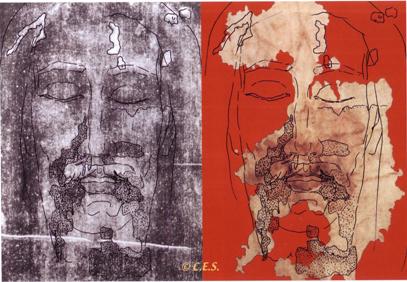
[Right: The Shroud face positive (left) and negative (right). But because the negative is a photographic positive, the Shroud image must be a photographic negative-at least ~600 years before the invention of photography! (see below]
dumber than when they try to report on religion? This article at CNN reports on Pope Francis' recent visit to Turin where he prayed before the Shroud.
"Pope Francis prayed Sunday before the Shroud of Turin, a strip of cloth that some believe was used for the burial of Jesus Christ. The shroud appears to bear the image of a man who resembles paintings of Christ.""A strip of cloth..."?? It's that last line, "The shroud appears to bear the image of a man who resembles paintings of Christ." - not only is it badly written but it reveals that the writer knows next to nothing about the shroud itself - which is one of the most extensively researched relics of Christianity. I don't disagree, but Fr. Longenecker can hardly blame secular journalists for knowing "next to nothing about the shroud" [sic] when the leader of his own Roman Catholic denomination, Pope Francis, by calling the Shroud a mere "icon," (see below) gives the appearance of knowing next to nothing about the Shroud! I've written here about the shroud. Here are some of the basic points shroud doubters have to answer:
1. The image of the man on the cloth: the image is not a stain. It is not painted on the shroud. It is not burned on in a conventional manner. Instead it is an image seared on to the cloth with some technology that has yet to be explained. That seems a strange word, "technology" to use, if the Shroud's image was (as Fr. Longenecker himself agrees - see "the body vanished from within it" below), a "snapshot" of Jesus' resurrection:
"Even from the limited available information, a hypothetical glimpse of the power operating at the moment of creation of the Shroud's image may be ventured. In the darkness of the Jerusalem tomb the dead body of Jesus lay, unwashed, covered in blood, on a stone slab. Suddenly, there is a burst of mysterious power from it. In that instant the blood dematerializes, dissolved perhaps by the flash, while its image and that of the body becomes indelibly fused onto the cloth, preserving for posterity a literal `snapshot' of the Resurrection." (Wilson, I., 1979, "The Shroud of Turin," p.251).Not only can they not reproduce the image using medieval technologies, they can't reproduce it with modern technology. With "modern technology" scientists might be able to reproduce the image on the Shroud, but it would required a battery of excimer (ultraviolet) lasers outputting a "total power of ... 34 thousand billion watts"!:
"Instead, the results of ENEA `show that a short and intense burst of VUV directional radiation can color a linen cloth so as to reproduce many of the peculiar characteristics of the body image on the Shroud of Turin, including shades of color, the surface color of the fibrils of the outer linen fabric, and the absence of fluorescence'. `However, ENEA scientists warn, `it should be noted that the total power of VUV radiations required to instantly color the surface of linen that corresponds to a human of average height, body surface area equal to = 2000 MW/cm2 17000 cm2 = 34 thousand billion watts makes it impractical today to reproduce the entire Shroud image using a single laser excimer, since this power cannot be produced by any VUV light source built to date (the most powerful available on the market come to several billion watts )'." (Tosatti, M., 2011, "The Shroud is not a fake," Vatican Insider, 12 December).
2. The 3-D capabilities of the image - the image of the man on the shroud can be read by 3-D imaging technology. Paintings fail this test. Indeed! Stevenson and Habermas point out that, "the three-dimensional effect [of the Shroud's image] is the Waterloo ["final, crushing defeat"] for all artistic theories":
"In short, though none of the Shroud opponents would willingly concede this point, the three-dimensional effect is the Waterloo for all artistic theories. That same effect has been scientifically demonstrated and subjected to the best peer review. And it still stands." (Stevenson, K.E. & Habermas, G.R., 1990, "The Shroud and the Controversy," p.32).
3. The Positive-Negative Image - the image is a photographic negative. That means when a traditional photograph is taken what should be the negative appears as a positive image. If it is a medieval painting how did they do that and why? See the Shroud's positive and negative images above. Since even the concept of photographic negativity was unknown until the discovery of chemical photography in the early 19th century, a medieval forger could not even think about forging the Shroud as a photographic negative, let alone do it.
4. The anatomical accuracy - not only is it an accurate image of a dead man but the image is distorted as it should be if it was laying over a real body and the body vanished from within it. I am not sure that "distorted" is the right word, but Jackson, et al, found that, "the frontal image on the Shroud ... is ... consistent with a naturally draping cloth [and] can be derived from a single global mapping function of distance between these two surfaces" (see diagram below):
"the frontal image on the Shroud of Turin is shown to be consistent with a naturally draping cloth in the sense that image shading can be derived from a single global mapping function of distance between these two surfaces" ("Some Recent Publications," BSTS Newsletter, No. 9, January 1985)

[Above: Diagram in Jackson, et. al, 1984, "Correlation of image intensity on the Turin Shroud with the 3-D structure of a human body shape," Applied Optics, Vol. 23, No. 14, pp. 2244-2270.]
This shows that a single process created the Shroud's image. But no medieval forger would know about a "global mapping function" and even if he did, no artist/forger could paint, etc., a whole human body in a single process (let alone in negative)!
5. The historical accuracy to crucifixion - the wounds are all consistent not only with Roman crucifixion, Roman Emperor Constantine the Great (c. 272–337) abolished crucifixion across the Roman Empire in 337 and writers in the Roman era, including the New Testament, gave little details of what crucifixion involved, presumably because: 1) it was so horrible; and 2) everyone then knew those details because crucifixion was public and common. So a medieval forger ~1000 years later would not know the historically accurate details of Roman crucifixion that the Shroud reveals. but the details of Jesus' particular crucifixion like the crown of thorns, no broken bones the scourging and the wound in the side. And although the particular details of Jesus' crucifixion: crowning with thorns, which was unique to Jesus to mock His claim to be King of the Jews (Mk 15:44), they could have been gleaned from the gospels. But then a medieval forger, reading that the nail wounds were in Jesus' "hands" (Lk 24:39-40; Jn 20:20, 25, 27), would have put nail wounds (plural) in Jesus' palms where all medieval artists who depicted Jesus' crucifixion did, not a nail wound (singular) exiting from the back of Jesus' wrist, where the hand is strong enough to support a man's body without the nail tearing through it.
6. Geographical accuracy - pollen from the shroud is not only from the Jerusalem area, but from Turkey and the other places the shroud is supposed to have resided, See my Turin Shroud Dictionary entry "Frei-Sulzer, Max." While sceptics have tried to discredit Frei, by focusing narrowly on his identification of a few of his species, Frei's broad findings of pollen on the Shroud still stand unrefuted: 1) a minority of European pollen; 2) many halophyte (salt-loving) pollen species which don't grow in Europe but do grow around the Dead Sea; and 3) confirmation of Frei's identification of Jerusalem pollen species by images on the Shroud of flowers and plants of the same species by one of Israel's leading botanists, Prof. Avinoam Danin. dust from the area on the shroud by the knees and feet is from the area of Jerusalem. Limestone dust on feet of the man on the Shroud is the comparatively rare travertine Aragonite found in Jerusalem area. Moreover, the chemical signature of trace elements strontium and iron, and no lead, of that Shroud limestone dust very closely matches Jerusalem limestone.
7. The accuracy to Jewish burial customs - the shroud shows details perfectly consistent with first century Jewish burial customs. Jewish law required that a Jew who had died a bloody death (as Jesus did), should not be washed, but covered with a sovev, a single, all-enveloping sheet, to as far as possible, keep the body and its life-blood together. The double-body length Shroud conforms perfectly to that requirement of Jewish burial law. There are even microscopic traces of the flower that would have been used in the burial They are not "microscopic" nor are they "traces." They are normal size and some of them, e.g. a chrysanthemum, can be seen with the naked eye over the Internet (see my "2.6. The other marks (4): Plant images". Their images are consistent with having been formed by a coronal (electrical) discharge. So all forgery theories need to explain how and why a medieval or earlier forger also imprinted images of Palestinian flowers on the Shroud! - flowers that grew locally and were known to be used for burial. And which bloom in and around Jerusalem between March and April. Which is consistent with the death of Jesus which was in April AD 30!
8. The blood and the image - the blood was on the shroud first. The image happened later. Chemistry professor the late Alan D. Adler (1931-2000) found there was no image under the blood on the Shroud:
"While treatment of the body image fibers with proteases yielded no changes even after several hours of treatment, in less than 20 minutes it removed the coating of the serum coated [bloodstained] fibers to reveal a smooth and uncorroded surface. This interesting observation suggests that the blood marks were on the cloth before the image producing process took place and protected the blood mark areas from this process. This further confirms that there were two separate processes involved in generating the images seen on the Shroud of Turin. Any proposed image forming mechanism must account correctly for both sets of images." (Adler, A.D., c. 2000, "Chemical and Physical Aspects of the Sindonic Images".This is consistent with Jesus' scourging and crucifixion followed by His resurrection ~36 hours later (Mt 27:26-28:6; Mk 15:15-16:7). But it is not consistent with the work of an artist/forger who would first paint, etc, the image and then add blood on or around the image (as all attempted modern replications of the Shroud do, e.g. Luigi Garlaschelli). If it was painted (there is not evidence of paint anywhere) the two would be part of the same faked image If the forger did not use real blood (wrong for starters because the blood on the Shroud is real blood type AB), then the image would be under the faked `blood'. But it is clearly humanly impossible for a forger to have applied blood to the Shroud first and then consistently added the image around the blood (let alone in negative). This is yet another proof beyond reasonable doubt that the Shroud is authentic.
9. The type of cloth The cloth is consistent with fabrics from first century Israel, but not with medieval Europe. This is not strictly true. There is one example of a herringbone twill woven fragment of linen from the 14th century, so it cannot be claimed on the basis of the weave alone that the Shroud could not have been woven in the Middle Ages. A forger would have had to not only forge the image in some as yet undiscovered way, but would have had to have detailed knowledge of linen weaves of the first century and then not only reproduce it, but age it convincingly. That wouldn't work anyway. Ancient textile expert Mechthild Flury-Lemberg in 1998 discovered that the unusual stitching of the Shroud's sidestrip and its selvedge (woven edges) have only been found elsewhere at the first century Jewish fortress Masada, which was wiped out by the Romans in AD 63 and never re-occupied. So a forger would still have had to find a first century Jewish linen sheet to forge the Shroud. But then that would invalidate the 1988 radiocarbon dating of Shroud as "mediaeval ... AD 1260-1390" (see next).
10. The age of the cloth - The 1987 carbon 14 tests They were in 1988. are now believed to have been taken from an area of the cloth that was not simply patched in the middle ages but patched with a difficult to detect interweaving and the carbon 14 tests were therefore compromised. Convenient, easy to understand, and widely accepted, but it is nevertheless wrong. See my "Conventional explanations of the discrepancy all fail." The latest technology and testing suggests a date for the shroud between 200 BC and 200AD. Go here for news of Professor Fanti's test in 2013. A better source for Fanti's tests is:
"New scientific experiments carried out at the University of Padua have apparently confirmed that the Shroud Turin can be dated back to the 1st century AD. ... The research includes three new tests, two chemical ones and one mechanical one. The first two were carried out with an FT-IR system, so using infra-red light, and the other using Raman spectroscopy. The third was a multi-parametric mechanical test based on five different mechanical parameters linked to the voltage of the wire. The machine used to examine the Shroud's fibres and test traction, allowed researchers to examine tiny fibres alongside about twenty samples of cloth dated between 3000 BC and 2000 AD ... Final results show that the Shroud fibres examined produced the following dates, all of which are 95% certain and centuries away from the medieval dating obtained with Carbon-14 testing in 1988: the dates given to the Shroud after FT-IR testing, is 300 BC ±400, 200 BC ±500 after Raman testing and 400 AD ±400 after multi-parametric mechanical testing. The average of all three dates is 33 BC ±250 years. The book's authors observed that the uncertainty of this date is less than the single uncertainties and the date is compatible with the historic date of Jesus' death on the cross, which historians claim occurred in 30 AD. The tests were carried out using tiny fibres of material extracted from the Shroud by micro-analyst Giovanni Riggi di Numana who passed away in 2008 but had participated in the 1988 research project and gave the material to Fanti ..."(Tornielli, A., 2013, "New experiments on Shroud show it's not medieval," Vatican Insider, 26 March).
The only piece of evidence from the shroud which doesn't match up is the 1987 carbon testing. And that is because:
"... the 1988 radiocarbon dating of the Shroud of Turin as `mediaeval ... AD 1260-1390' was the result of a computer hacking, allegedly by Arizona radiocarbon dating laboratory physicist Timothy W. Linick (1946-89), aided by Karl Koch (1965–89), on behalf of the former Soviet Union, through its agency the KGB."See my new, incomplete series, "The 1260-1390 radiocarbon date of the Turin Shroud was the result of a computer hacking" and my previous complete series, "My theory that the radiocarbon dating laboratories were duped by a computer hacker" When considering evidence and you have nine items which fit with the known facts and fit with each other, but you have one piece of evidence which does not fit, it is common sense to challenge that one piece of evidence and reject it or try again to see why it doesn't fit. It is routine for archaeologists to order a radiocarbon dating of an artefact but then reject that date as a "rogue" result if it does not fit in with all the other evidence about that artefact. The difference in the 1988 radiocarbon dating of the Shroud was that, unusually, the laboratories were both the clients and the testers. In this the Vatican made a huge tactical mistake. It should have insisted that it was the client and that it was free to reject the date if it did not agree with all the other evidence about the Shroud. This is what Fanti's research has done and proven that the 1987 tests were faulty. STURP member Ray Rogers had already done that in 2005, when he showed that the vanillin content of the Shroud's linen is too low for the 1260-1390 radiocarbon date, and is consistent with a 995 BC - AD 705 date:
"The Shroud of Turin is much older than suggested by radiocarbon dating carried out in the 1980s, according to a new study in a peer-reviewed journal. A research paper published in Thermochimica Acta suggests the shroud is between 1,300 and 3,000 years old. ... Raymond Rogers ... a retired chemist from Los Alamos National Laboratory in New Mexico, US ... analysed and compared the sample used in the 1988 tests with other samples from the famous cloth. ... These tests revealed the presence of a chemical called vanillin in the radiocarbon sample and in the Holland cloth, but not the rest of the shroud. Vanillin is produced by the thermal decomposition of lignin, a chemical compound found in plant material such as flax. Levels of vanillin in material such as linen fall over time. 'Older date' `The fact that vanillin cannot be detected in the lignin on shroud fibres, Dead Sea scrolls linen and other very old linens indicates that the shroud is quite old ... A determination of the kinetics of vanillin loss suggests the shroud is between 1,300 and 3,000 years old.'" ("Turin shroud 'older than thought'," BBC, 31 January, 2005).Here is what Rogers wrote in Thermochimica Acta in 2004, which was published in 2005, about the Shroud being "between 1300- and 3000-years old" based on its vanillin content [see 01Dec07, 12Feb08, 27Mar13, 02Apr13 & 02Jan14]:
"The fact that vanillin can not be detected in the lignin on shroud fibers, Dead Sea scrolls linen, and other very old linens indicates that the shroud is quite old. A determination of the kinetics of vanillin loss suggests that the shroud is between 1300- and 3000-years old. Even allowing for errors in the measurements and assumptions about storage conditions, the cloth is unlikely to be as young as 840 years." (Rogers, R.N., 2005, "Studies on the Radiocarbon Sample from the Shroud of Turin," Thermochimica Acta, Vol. 425, Nos 1-2, 20 January, pp.189-194, 192)If the Shroud was 1300 years old in 2004, its linen would date from ~AD 704. If it was 3000 years old in 2004, its linen would date from ~996BC. That is a range of ~996BC to ~AD 704, or ~146BC ± 850 years. Jesus' crucifixion was in AD 30, which was ~176 years after ~146BC, and the Shroud's flax would have been harvested and its linen woven before AD30.
Atheists often ask for evidence for the existence of God. They are not sincere because atheism is the apriori metaphysical position that there is no God I debated atheists on creation/evolution pre-Internet, and then Internet, forums for over a decade from 1994 to 2005, and I used to ask atheists: "what evidence could I give you on this forum that would convince you that there is a God?" Apart from "If God personally appeared to me I would believe in him" (which I could not arrange for them and they agreed that even if God did appear to them they would dismiss it as a hallucination) most refused to answer my question but a few were honest and said that no evidence would convince them that there is a God. As this 2002 article pointed out, most Internet atheists do "not so much disbelieve in God as personally dislike Him" and have "a preoccupation with Christianity" (i.e. they are really anti-Christians):
"Hopping around their web world, one quickly gets the impression that there are two basic types of atheist. The first is the sincere, scholarly atheist, the type who walked away from the Unitarians when they got too evangelical. The Maine Atheists Union typifies this bunch. They want to `think freely' and `live free,' and one of their main precepts reads: `Nobody has all of the answers and nobody ever will. Take the time to get as close as possible to the truth.' The other group is like Orwell's embittered specimen from `Down and Out in Paris and London,' `the sort of atheist who does not so much disbelieve in God as personally dislike Him.' These shrill types can be found in places like MSN's God is a Lie! chat community and, of all places, high school. ... What do they all have in common? For one thing, a preoccupation with Christianity. Look around the precincts of atheism and you'll see lots of slogans like `The Religious Right is neither,' but you'll never see `Taoism is for dummies.' Or, for that matter, much anti-Judaism or anti-Islam sentiment ..." (Last, J.V., 2002, "You Gotta (Dis)Believe," (no longer online) Weekly Standard, 30 July)that I think the Shroud of Turin is the most convincing evidence available if they want scientific, archeological, historical, physical proof. The Shroud is an acid test for atheists. The evidence is overwhelming that the Shroud is authentic but atheists continue to reject it and trot out the same few discredited arguments: 1) Pierre d'Arcis' mere hearsay painter; 2) the false claim that there is no history of the Shroud before the 1350s; and 3) the 1988 radiocarbon date of 1260-1390 which is patently false, because as, Oxford radiocarbon dating laboratory's Prof. Christopher Ramsey, who was involved in the 1988 dating and was a signatory to the 1989 Nature article, admitted:
"There is a lot of other evidence that suggests to many that the Shroud is older than the radiocarbon dates allow and so further research is certainly needed. It is important that we continue to test the accuracy of the original radiocarbon tests as we are already doing. It is equally important that experts assess and reinterpret some of the other evidence. Only by doing this will people be able to arrive at a coherent history of the Shroud which takes into account and explains all of the available scientific and historical information." (Ramsey, C.B., "Shroud of Turin," Oxford Radiocarbon Accelerator Unit, 23 March, 2008, Version 152, Issued 16 June 2015)So the planned answer of atheist Bertrand Russell (1872–1970) to God when he meets Him, "Sir, why did you not give me better evidence?":
"Attributed to Russell in the New York Times article So God's Really in the Details? (May 11, 2002) by Emily Eakin, where she writes: `Asked what he would say if God appeared to him after his death and demanded to know why he had failed to believe, the British philosopher and staunch evidentialist Bertrand Russell replied that he would say, 'Not enough evidence, God! Not enough evidence.' Actually, the quote is slightly inaccurate. The original source of this line comes from an article by Leo Rosten published in Saturday Review/World (February 23, 1974) which features an interview with Russell. There, Rosten writes: `Confronted with the Almighty, [Russell] would ask, "Sir, why did you not give me better evidence?"'" ("Bertrand Russell - Wikiquote," 15 August 2015)won't work because in 1898, when Russell was ~26, it was worldwide news that the Shroud was a photographic negative. And even less would the "not enough evidence" defence work for atheists today! Which no doubt is Jesus' reason for imprinting His image on His Shroud such that its miraculous (literally) properties would become even more apparent in our scientific age, "So they are [even more] without excuse" (Rom 1:20). Why? because an atheist must insist on the natural world being a closed system. Miracles are not allowed. Not even one miracle is allowed. That's Naturalism: `Nature is all there is - there is no supernatural, including God. Because if there is a miracle, then there is an intelligent being outside and beyond the closed natural system. So if it can be shown that one miracle has occurred, then God must exist, and the most astounding miracle would be the resurrection of a dead person and the only person that happened to was Jesus Christ, and the evidence from the shroud is increasingly intriguing and points to exactly that. As I pointed out in one of my comments:
"Ockham's Razor again: Jesus is the only person of whom it is credibly claimed that He was resurrected. The Shroud of Turin is credibly claimed to be Jesus' burial shroud and it only has an image of a body that has wounds and bloodstains consistent with the Gospels' description of Jesus' suffering and death. The simplest explanation is that the Shroud of Turin is Jesus' burial shroud and the body image on it is Jesus' caused by His resurrection." (Jones, S.E., "Comment: `Gn-Gq': Turin Shroud Dictionary," 13 June 2015).Of course doubters exist and the debate continues. That's all healthy, well and good, but the more closely you look at the shroud the more difficult it becomes to question its authenticity. Up to a point, "debate [is] ... healthy, well and good." But when God has graciously provided ample evidence in the Shroud to unbelievers of not only His existence, but His amazing love for mankind in the sacrificial, horrific, death on the cross of His Son Jesus, and that love of God is continually spurned, then then the doubters will have only themselves to blame when they stand before Jesus, the Man on the Shroud, at the Last Judgment (2Cor 5:10; Mt 16:27; 25:31-32; Ac 10:42; 2Tim 4:1, 1Pet 4:5) and receive from Him their just deserts (Mt 25:31-34, 41-46) for rejecting Jesus' rightful reign over them (Lk 19:11-27). [top]
"Pope Francis Pope Francis praises Turin shroud as an 'icon of love'," The Guardian, 22 June 2015 ... Pope Francis paused in silent prayer before the shroud of Turin on Sunday ... Later, after
[Above: Pope Francis touches the shroud of Turin. Photograph: Giorgio Perottino/Reuters]
celebrating mass in a packed Turin square, Francis shared his thoughts on the cloth as he spoke of the love Jesus had for humanity when being crucified. "The icon of this love is the shroud, that, even now, has attracted so many people here to Turin," Francis said. As I pointed out in my June Shroud of Turin News:
"An `icon,' in Roman Catholic theology is merely a humanly created representation of the real thing:So by continuing to refuse to confirm or deny that the Shroud is authentic, and in fact calling the Shroud an `icon,' Pope Francis, and the Vatican, is sending a mixed message that the Shroud could be a fake. Pope Francis himself might well believe that the Shroud is a fake, but the Vatican, by its actions: 1) spending the equivalent of many millions of dollars protecting the Shroud; and 2) displaying it to many millions of people, clearly believes the Shroud is authentic."ICON ... from the Greek eikon meaning image, is a word now generally applied to paintings of sacred subjects or scenes from sacred histories" ("Icon," New Catholic Encyclopedia 2003. My emphasis)as opposed to `relic' which is the real thing:"RELICS The material remains of a saint or holy person after his death, as well as objects sanctified by contact with his body." ("Relics," New Catholic Encyclopedia, 2003)"
"The shroud draws [people] to the tormented face and body of Jesus and, at the same time, directs [people] toward the face of every suffering and unjustly persecuted person." This is damming the Shroud with faint praise and reinforces that Pope Francis really does think (wrongly) that the Shroud is just another fake icon. But the evidence is overwhelming that the Shroud is authentic, and therefore the image on the Shroud IS "the tormented face and body of Jesus"! Again, I am not being anti-Catholic in this but pro-truth and pro-Shroud (which is the same thing)! ... [top]
Notes:
1. This post is copyright. Permission is granted to extract or quote from any part of it (but not the whole post), provided the extract or quote includes a reference citing my name, its subject heading, its date, and a hyperlink back to this post. [return]
Posted 11 August 2015. Updated 16 March 2025.





 Posts

